Dissertations and Theses Dissertations and Theses
Spring 6-6-2018
How Persevering Latina/o First-Generation College Students
Navigate Their College Experience: Keeping Who They Are While
Learning and Persisting in the Culture of College
Angela Judith Balcacer
Portland State UniversityLet us know how access to this document benefits you.
Follow this and additional works at:https://pdxscholar.library.pdx.edu/open_access_etds Part of theCurriculum and Instruction Commons, and theHigher Education Commons Recommended Citation
Balcacer, Angela Judith, "How Persevering Latina/o First-Generation College Students Navigate Their College Experience: Keeping Who They Are While Learning and Persisting in the Culture of College" (2018).Dissertations and Theses.Paper 4415.
Experience:
Keeping Who They Are While Learning and Persisting in the Culture of College
by
Angela Judith Balcacer
A dissertation submitted in partial fulfillment of the requirements for the degree of
Doctor of Education in
Educational Leadership: Curriculum and Instruction
Dissertation Committee: Dannelle D. Stevens, Chair
Candyce Reynolds Esperanza De La Vega
Elena Avilés
Portland State University 2018
Abstract
Latina/o first-generation college students, along with their families, are learning a new culture when considering going to four-year universities. While the conversation involving Latina/o first-generation college students can often focus on attrition, I am interested in exploring what, from participants’ point of view, are the successes they experience as well as the most challenging obstacles they encounter on their journey to graduating from four-year universities. Employing the theoretical frameworks of
constructivism, critical race theory, and cultural capital, the purpose of this study was to go beyond the conversation of Latina/o first-generation college student attrition by examining how they navigate postsecondary institutions and explore the implications associated with how higher education affects them. I intend to highlight the already powerful voices of Latina/o first-generation college students who are brave enough to be the first in their immediate families to embark on a demanding odyssey to attain four-year degrees. My participants were recruited from classes in the Chicano/Latino studies
department as well as a cultural resource center, both at a four-year university in the Pacific Northwest. Using qualitative research methods, including semi-structured interviews, Draw-A-College-Student, and participant written reflections, I examined the lived experiences of persisting Latina/o first-generation college students from their own perspectives. To provide a well-rounded account of the Latina/o postsecondary
experience, I engaged the voices of eight participants in this study. This research found that while Latina/o first-generation college students feel that they are trailblazers in working to improve family life through education, they often feel unseen and
underrepresented in higher education. Through highlighting Latina/o first-generation college student voices and experiences instead of just focusing on attrition, this study also recommends actions for change based on participant feedback. Ultimately, participants in this study felt that more support is needed for Latina/o first-generation students to attain four-year degrees in higher education.
Acknowledgements
I am everlastingly grateful and indebted to my esteemed committee, Dannelle Stevens, Esperanza De La Vega, Candyce Reynolds, and Elena Aviles. Your feedback allowed me to explore my topic through different points of view, which expanded the breadth of my work. I could not have made this accomplishment without your sagacious advice and guidance.
To Dannelle Stevens, I am so thankful to have had you as my dissertation chair. Your honest advice, ceaseless support, and scholastic wisdom successfully led me to the finish line. I could not have had a more dependable advocate and mentor. There is no way to convey my appreciation for your dedication to my accomplishment. I know that you will always be there to help further my leadership and sense of professional direction. You helped me believe in myself, and I will forever be indebted to you.
To Esperanza De La Vega, thank you so much for collaborating with me on a topic that is close to our hearts. Your adept viewpoints on what it means to be a Latina first-generation student was precious. You know the topic inside and out. My research is that much more multidimensional because of your input and encouragement. Your help made me think outside traditional ideologies, and I cannot thank you enough for your perspective on my work.
To Candyce Reynolds, I very much value the varying perspectives you provided that helped me develop my problem statement. Your expertise on the first-generation college student experience was invaluable. I very much appreciated your constructive
angles, which helped me arrive at ideas I would not have thought of on my own. Thank you for your positive reinforcement and validation.
To Elena Aviles, your outstanding attention to detail and feedback were crucial in fine-tuning my study and analysis. Your assistance with logistics on how to approach the interviewing process made my work possible. As a fellow Latina professional, your ideas on how to approach my study were incomparable. I am very grateful to have had you as an advisor. Thank you so much for building-up my confidence to pursue this work.
To my husband, Sunil Schauffler—I could not have done any of this without you. You help me believe in myself. Your view of my potential has led me to self-enrichment and empowerment. Thank you for always being there. Your support got me through the most challenging of times. I am very lucky to have you in my life, and I look forward to our future.
Lastly, I dedicate my work to my parents, Maria and Hector. You inspired me to press on when obstacles seemed unconquerable, and that is why I am the professional I am today. I also dedicate my work to the many Latina/o first-generation college students who continue fighting the odds to persist regardless of the seemingly insurmountable challenges they face in their journeys to four-year degree attainment.
Table of Contents Abstract ... i Acknowledgements ... iii List of Tables ... x List of Figures ... xi Chapter I: Introduction ... 1 A Personal Connection ... 1
Background of the Problem ... 5
Latino Immigrant Family Background, Acculturation and Education ... 6
Trouble with Educational Attainment ... 20
Cultural Capital and the Latina/o First-Generation College Student ... 23
Statement of the Research Problem ... 33
Significance of the Research Problem ... 43
Presentation of Methods and Research Questions ... 46
Definition of Key Terms ... 50
Latina/os ... 50
First-Generation College Students ... 54
Chapter II: Review of Literature ... 59
Introduction ... 59
Why College Matters ... 62
Degree Attainment... 64
Theoretical Frameworks ... 66
Review of the Research Literature ... 83
On Identity ... 83
On Belonging... 90
On Hegemony ... 93
On College Culture ... 95
Methodology ... 103
Chapter III: Methods ... 114
Introduction ... 114
Qualitative Means ... 115
Data Gathering ... 116
Demographic Information Form... 117
The Interviews ... 117
The Interview Questions... 120
Draw-A-College-Student ... 125
The Free-Write ... 126
Participant Recruitment ... 127
Consent ... 129
Timeline ... 134
Coding ... 134
Triangulation and Validity ... 138
Contextualizing My Own Story... 140
Concluding Thoughts ... 141
Chapter IV: Results ... 144
Introduction ... 144
Analysis of Data ... 144
Participant Demographics ... 145
Participant Interviews ... 148
Data Coding and Overarching Themes ... 149
Participant Profiles ... 150
Organization of Data Analysis ... 157
Presentation of Results and Interpretation of Findings ... 161
Overarching Theme #1: Conquering Obstacles ... 161
Being Persistent ... 163
Burnout ... 169
Personal Barriers ... 172
Overarching Theme #2: A Sense of Belonging ... 176
Experiences of Exclusion ... 182
Feelings of Cultural Isolation... 185
Social Distance... 188
Academic Aspirations ... 194
Social Influences ... 199
Identity Development... 202
Overarching Theme #4: Navigating the College Landscape ... 206
Adjusting ... 211
Paying for College ... 217
Words of Wisdom ... 223
Draw-A-College-Student Findings ... 229
Draw-A-College-Student Findings Summary... 247
Limitations and Constraints of the Study ... 248
Chapter V: Discussion ... 255
Introduction ... 255
Synthesis of Findings ... 257
Revisiting Results ... 259
The First-Generation College Student Experience ... 261
First-Generation Student Families and Cultural Capital ... 264
Significance: Equity, Not Sameness ... 267
Implications ... 271
Recommendations ... 272
Include Culture... 273
Stories are Told by the People Who Control the Social Master Narrative ... 275
Encourage Mentoring... 281
Add Diversity ... 287
Centralize Information ... 289
Conclusion: Navigating the Borderlands of Higher Education ... 295
References ... 301
Appendix A: Participant Consent Form ... 316
Appendix B: Brief Demographic Questionnaire... 322
Appendix C: Interview Introduction Script ... 323
List of Tables
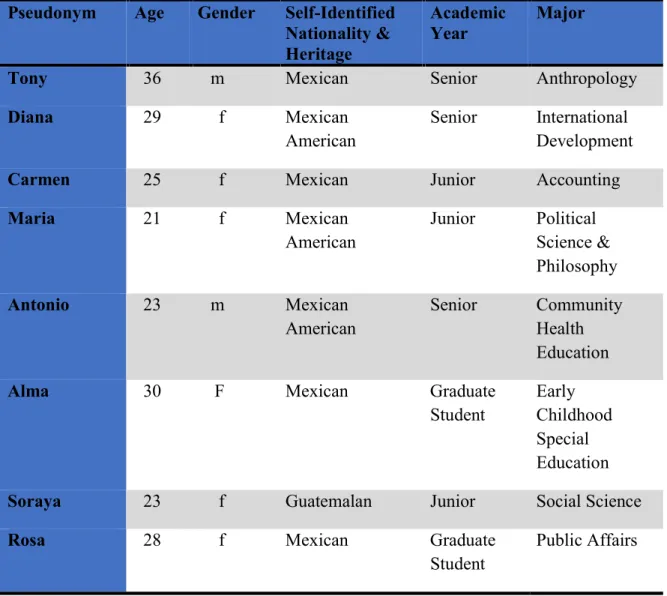
Table 1: Participant Background and Identification ... 146
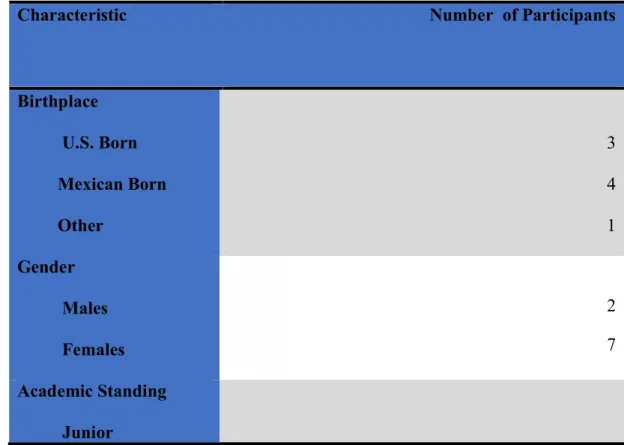
Table 2: Summary of Participant Characteristics: Birthplace, Gender, & Academic Standing. ... 147
Table 3: Code Clusters and Overarching Themes ... 157
Table 4: Draw-A-College-Student Art... 230
Table 5: Summary of methods and findings ... 260
List of Figures
Figure 1: Hispanic parents without a high school degree. ... 13
Figure 2: Hispanic parents with a four-year degree. Reprinted from “Higher education: Gaps in access and persistence study,” by Ross, T., Kena, G., Rathbun, A. Kewal Ramani, A., Zhang, J., Kristapovich, P., and Manning E. (@012). (NCES 2-12-046). U.S. Department of Education, National Center for Educational Statistics. Washington, DC: Government Printing Office. ... 14
Figure 3: Percentages of students 18-24 who attended four-year universities, by race/ethnicity. ... 35
Figure 4: Data analysis process... 136
Figure 5: Visual depiction of In Vivo codes, pattern codes, and overarching themes. .. 160
Figure 6: Tony Draw-A-College-Student ... 231
Figure 7: Diana Draw-A-College-Student ... 233
Figure 8: Carmen Draw-A-College-Student ... 235
Figure 9: Maria Draw-A-College-Student ... 237
Figure 10: Antonio Draw-A-College-Student ... 239
Figure 11: Alma Draw-A-College-Student ... 241
Figure 12: Soraya Draw-A-College-Student ... 243
Figure 13: Rosa Draw-A-College-Student... 246
Figure 14: Summary of Latina/o first-generation student challenges, successes, and wisdom. ... 262
Chapter I: Introduction
A Personal Connection
The bell rings. The school day is ending. My backpack is laden with books and binders are heavy with homework. I arrive home. My mother and father are cooking and, as I enter the kitchen, the sweet smell of arroz con pollo wafts through the air, reminding me of my hunger. “¿Tienes tarea?” With high expectations in her eyes, my mother wants to know if I have any homework. “No. No me dieron tarea hoy.” I lie. I know my parents can’t help me with any of my college-level academic work. He never made it to high school; she never made it to college. What they know is how to work with their hands, something I have always admired in them. “¿Estás segura?” My father echoes my mother’s concern. “Te podemos ayudar si tienes tarea.” I nod at my parents’ good intentions and am on my way to tackle the mountain of homework assigned that day. Sitting on the floor strewn with stacks of textbooks, I think about future challenges and wonder how I will be the first in my family to make it through unfamiliar college territory and fight against the odds on my own. All I know for sure is that I will try my very best to make my parents proud.
Even though my parents did not attain college degrees, I know that this does not devalue who they are. They continuously promoted a love of learning and will to succeed academically in our home. I made it, despite the arduous, epic journey through the
college world. As a first-generation Latina college student in an immigrant family, I was able to survive, deciphering the cryptic demands and expectations of college on my own,
yet owing my success to my parents. My parents’ story, while unique in its own way, is similar to many other immigrants’ coming to the United States; they want the best for their progeny but may not know how one can attain success and traverse through the murky waters of the education system in a foreign country. My experiences are what prompt me to investigate the lived experiences of historically marginalized students from an insider’s perspective, voices that may be hidden behind statistics on the education gap or failure to persist in higher education.
In my ten-year career as a secondary level teacher working with Latina/o high school seniors in low-income, urban neighborhoods, both in Portland, Oregon and in the Bronx, New York, I have witnessed the discouragement of Latina/o students who were the first in their families to go to college. Speaking with them about their postsecondary futures, I have heard some of them say they were not going to college because “That stuff is for White people.” I have also heard Latina/o students say that they were not going to college because no one else in their family had, so why should they change anything? At times, Latina/o first-generation college students may view graduating high school as the endpoint and not the start of a new beginning; they may not want to become another statistic or see how they fit in the unknown realm of higher education. This phenomenon is not unfounded.
The domains of academic, financial, cultural, and social capital, as well as family concerns, assumptions about Latinos' backgrounds, and unwelcoming campus climates pose significant challenges to Latino student success. Considering these
collectively portrays a bleak picture for the future of Latino college
attainment. (Núñez, Hoover, Pickett, Stuart-Carruthers & Vasquez, 2013, p. 52) In other words, there is a plethora of different obstacles Latina/o first-generation college students face in postsecondary education that influences their level of achievement. In my experience, because of these and other factors, Latina/o first-generation college students’ hopes of success may affect how they view their odds for success; if they don’t see themselves thriving in the foreign culture of college, they are less likely to pursue a four-year degree. Thus, our education system plays a role in framing how students view themselves, their potential in academe and, ultimately, society (Dennis, Phinney, & Chauteco, 2005; French & Chavez, 2010; Garcia, 2010; Núñez et al., 2013; Orbe, 2004; Pyne & Means, 2013; Storlie, Moreno, & Portman, 2014). These obstacles are what inspire my study on Latina/o first-generation college students’ lived experiences of persistence and hardships. The purpose of this study is to go beyond the conversation of Latina/o first-generation college student attrition by examining how they navigate postsecondary institutions and explore the implications associated with how higher education affects them. I sought to relay these phenomena through the lens of students who have been through at least two years of the four-year degree journey as Latina/o first-generation college students.
Because of a variety of barriers, Latina/o college students face the possibility of not attaining four-year degrees: “Even [Latina/os] who do attend college remain much less likely than other groups to complete a four-year degree or continue to graduate or
professional schools” (Gandara & Contreras, 2009, pp. 196). Often, the focus of research may be on the education gap or the lack of degree completion of minority populations (Dumais & Ward, 2010; French & Chavez, 2010; Garcia, 2010; Inkelas & McCarron, 2006; Keels, 2013; Krogstad & Fry, 2014; Ladson-Billings, 2006; Pino, Martínez-Ramos, & Smith, 2012: Pyne & Means, 2013; Ross et al. 2012; Stephens, Hamedani, & Destin, 2012; Storlie et al., 2014). At times, research can highlight the stories of those failing:
Such stories are compelling, but they also simplify and homogenize the day-to-day experiences of underrepresented students, erasing contradiction and struggle, ignoring the larger historical systems of privilege and power that are embedded in the institutional fabric of schools in favor of a more seductive myth of success. By sanitizing the complexity of experience, it becomes easy to create a false
measuring stick by which “less successful” students are seen as problematic, unfortunate, or not trying hard enough. (Pyne & Means, 2013, pp. 5-6)
One must ask, for whom does this “seductive myth of success” work? This focus on the numbers can dehumanize Latina/os college students’ stories of successes and struggles. Without carefully analyzing students’ lived experiences, which make them who they are, how can we claim to fully understand their plight? Seidman (2013) explains that while there while “So much research is done on schooling in the united states; yet so little of it is based on studies involving the perspectives of the students” (p 9). Ultimately, all the research in the world cannot replace a student’s voice. Simply assigning numbers to
Latina/o first-generation college students who do not attain degrees takes away from their individualism and unique circumstances, as Minikel-Lacocque illustrates:
… Too often our collective focus is on measurable outcomes such as grade-point averages, the rates of college acceptance and graduation rates and what those trends can tell u about underrepresented college students. While these numbers are certainly important, they do not tell us enough about the students’ experiences [emphasis in original] in college. (p.100)
Focusing on only the numbers can be misleading. Alternatively, my goal is to examine the dynamic between Latina/o first-generation college students’ lived experiences and how these are affected by the culture of higher education. As I have stated, the purpose of this study is to go beyond the conversation of Latina/o first-generation college student attrition by examining how they navigate postsecondary institutions and explore the implications associated with how higher education affects them. Thus, I considered the influence of higher education on these historically marginalized students as well as the factors relating to the culture of college that may create tension between the two. I examined stories of Latina/o first-generation college students’ perspectives in order to better understand how they thrive and struggle in higher education.
Background of the Problem
In this section, I examine the challenges faced by Latina/o first-generation college students in American higher education institutions. I explore the background of Latino immigrant families, the issues with acculturation, and the role of education in shaping the
consciousness of these students. I also explore issues with four-year degree attainment and cultural capital in the Latina/o first-generation student population.
Latino Immigrant Family Background, Acculturation and Education
Latina/os are an ethnically diverse and a relatively young population in the U.S that by 2025 will compose 25% of K-12 students in the country (Gandara & Contreras, 2009, pp. 304-305), a statistic that highlights our need to investigate and better
understand the obstacles for first-generation Latina/o college students. Latina/os are one of the fastest growing populations in the country and come to the U.S. for a variety of reasons. Based on Taylor, Lopez, Martínez, & Velasco’s (2012) findings focusing on Hispanics’ identities, behaviors, views about social issues, and language use,
economic opportunities are the most common reason by far that Hispanic immigrants give for coming to the U.S. More than half (55%) cite this as their main reason, followed by 24% who say it was “for family reasons,” and 9% who say it was to pursue educational opportunities. (p. 21)
This means that a substantial number of Latina/o immigrants are trying to improve their odds for a more promising and productive future.
Latina/os or Hispanics can be any race and, according to the United States Census Bureau, “Hispanic origin can be viewed as the heritage, nationality, lineage, or country of birth of the person or the person’s parents or ancestors before arriving in the United States” (United States Census Bureau, n.d.). Thus, the term Latina/o does not necessarily connote the existence of European roots. Latina/os are a unique group because they may
be from a variety of places and possess different attributes: “[The attributes] include citizenship, ethnicity, economic status, family roles, immigration, language, religion, and neighborhood composition” (Núñez et al., 2013, pp. 25-26). This myriad of attributes means that Latina/os have a rich, diverse background that makes their cultural heritage one-of-a-kind, an observation colleges can keep in mind when serving and retaining their Latina/o first-generation college students for education reform.
Immigrating to a foreign country is a brave decision, whether voluntary or involuntary, given the distress and difficulty associated with such drastic change.
Immigrant parents or caregivers in the lives of first-generation college students may face a multitude of struggles getting accustomed to a new culture.Anzaldúa (1987) poetically describes the separation associated with leaving one’s homeland: “To this day I’m not sure where I found the strength to leave the source, the mother, disengage from my family, mi tierra, mi gente, and all that picture stood for” (p. 38). To transplant one’s identity into a new environment does not always translate into a sense of belonging. It takes a substantial amount of valor and resolution to leave one’s land and people. In other words, separating from all one knows and holds dear for a chance at a better family life requires great courage; this is the type of courage most Latina/o FGCS muster when navigating the unfamiliar borderlands (Anzaldúa) or terrain of college culture.
As an immigrant, getting accustomed to mainstream society is associated with upward mobility, which, according to Gans (2007), leads to biased views about what is “mainstream” or “acceptable” social behavior:
Immigrants who add significantly to their disposable income or become successful entrepreneurs in the mainstream economy may be tempted to adopt class-appropriate non-immigrant lifestyles… Economic success will persuade people to speak English more often or resort to the standard middle-class version of the language. (p. 158)
Ultimately, acculturation, incorporating traits of others’ cultures into one’s own to
survive relates to cultural adaptation (Teske & Nelson, 1974, p. 358). Gans (2007) further describes acculturation as “processes by which immigrants become more like
non-immigrants culturally and socially” (p. 154). Based on Gans’ work, acculturation results in the loss of identity. Seeking to fit in and prosper may be the catalyst to acculturation. Blending-in means there is little deviation from the dominant language and middle-class way of life. Most importantly, for some, resisting the need to adopt a mainstream way of life is not an option.
Acculturation may result in conflict. Schwartz et al. (2013) examined first-generation college students’ immigrant parents’ experiences and discovered that “Most immigrants undergo a process of adaptation—known as acculturation—following their arrival in the United States” (p. 299). Their study examined the correlations between acculturation and immigrant parents’ children’s well-being and success in higher education. The researchers found that the process of acculturation affects one’s sense of individualism, values, and self-identification; this a problem that often influences underrepresented students’ educational performance and views about their success.
Further, there may be strife between immigrant parents and their American children: “The difference between the level of acculturation exhibited by parents and the level exhibited by younger family members is sometimes referred to as the ‘acculturation gap’” (Dennis, Basanez, & Farahmand, 2010, p. 119). This imbalance or “acculturation gap” can make relationships between parents or guardians and their children complex, affecting their abilities to perform well in school (Dennis, Basanez, & Farahmand).
Because immigrants are often placed in a sink-or-swim situation when entering a foreign land, they may feel success is not possible without acculturating. Schwartz et al. (2013) assert, “First-generation immigrants are challenged with selectively acquiring the practices, values, and identifications of their new homelands while selectively retaining those of their cultural heritage” (p. 156). In other words, to progress in a new land and become successful, immigrants and their children may give up pieces of their identities, who they are, and what they believe. Anzaldúa (1987) describes the turmoil of vacillating between cultural worlds. She explains that being “... sandwiched between two cultures… [is] an inner war… Like all people, we perceive the version of reality that our culture communicates. Like others having or living in more than one culture, we get multiple, often conflicting messages” (p. 100). It is not easy to live in two cultural worlds at once, especially when one culture supersedes the other in dominance. Thus, having two very different cultures often results in inner strife, and choices must be made about which one will guide our thinking and principles.
Latina/os may feel that without acculturating, they may not have a chance: “…Hispanic Americans may sacrifice their ethnic identity to increase social
connectedness with American host culture… The acculturation process functions in part as a trade-off between traditional Latino tendencies and mainstream Anglo-American practices” (Valentine, 2001, p. 465). In a sense, acculturation represents success to those seeking to live a better life in this country, but at what cost? Being from another culture would then mean that we must alter or transform our identities to fit in with what America represents. To gain access to success in America, immigrants often surrender who they are to thrive, which contradicts the all-are-welcome-as-they-are pretense in American culture. As Anzaldúa (1987) previously stated, the “inner war” resulting from “being sandwiched between two cultures” is a construct we should explore in higher education given that culture is ever-present in the lives of bi-cultural students.
Seeking opportunities demonstrates that Latina/o immigrant parents or guardians are interested in a better life for their families. Latina/os place strong emphasis on
attaining a higher education (Núñez et al., 2013). Trying to earn one’s way into college is a driving force of the home culture, especially if Latinos may not have had the
opportunity to do so themselves in their native land. But, is our education system doing all it can to support this growing population? Contreras (2011) answers this question with what she terms the “Brown Paradox”:
The influence of Latinos is expanding in several aspects of American life, particularly their importance to the economy as consumers and workers, their
presence in neighborhoods and regions across the country, and their visibility in popular culture, politics, and the media. Yet very little investment has
accompanied such shifts to ensure educational success and economic sustainability among Latinos. (p. 2)
Latina/os are making their mark on American culture. However, as Contreras explains, while the American culture benefits from the Latina/o presence, this host culture is not actively seeking to improve conditions for this population. If our country benefits economically from the presence of Latina/os, for example, our school system could continue improving to ensure they are successful in their tireless fight for a promising future via education. But, given the lack of persistence among students in this population (Keels, 2013; Krogstad & Fry, 2014; Ladson-Billings, 2006; Pino, Martínez-Ramos, & Smith, 2012: Pyne & Means, 2013; Ross et al., 2012; Stephens, Hamedani, & Destin, 2012; Storlie et al., 2014), why is higher education still struggling to better retain Latino students in their quest to attain for four-year degrees?
Many Latina/o immigrant families know that the way to a better life begins with education. However, this value is not always reinforced by the American education system. Contreras (2011) continues illustrating this with what she calls the “Brown Paradox”:
The Brown Paradox is essentially society’s paradox, because minimal investment in Latino students in the United States has larger implications for American society as a whole, potentially undermining our future viability as a nation. Doing
nothing to alter the current trend toward expanding Latino underclass in the United States is not an option the United States can afford. (p. 4)
Today, Latina/os are a growing constituency in our populous society. Gandara and Contreras (2009) project that the number of Latina/os will continue to increase in the coming future. Because our society does rely on the success of its individuals, it is logical to allot Latina/os as many opportunities as possible to pursue higher education. Our country can literally not afford for Latina/os to fail.
Latina/o parents’ familiarity with the American system and their views on the importance of a higher education greatly impact Latina/o first-generation college
students’ success (Núñez et al., 2013). In other words, parents or guardians’ educational background may influence how their students perform at school because of the exposure students have to academic language and experience. As a relatively young immigrant group to the country, Latina/o parents or guardians may not have had the opportunity to finish high school. Ross et al. (2012) and the National Center for Educational Statistics found that Latina/o or Hispanic parents are more likely than parents of other
four-year degrees, as Figure 1 depicts:
Figure 1: Hispanic parents without a high school degree.
Reprinted from “Higher education: Gaps in access and persistence study,” by Ross, T., Kena, G., Rathbun, A. Kewal Ramani, A., Zhang, J., Kristapovich, P., and Manning E. (@012). (NCES 2-12-046). U.S. Department of Education, National Center for
Educational Statistics. Washington, DC: Government Printing Office.
Pino, Martínez-Ramos, and Smith (2012) support this claim in explaining that “Latino students are far more likely than either Whites or Blacks to be first-generation college students… who had mothers and fathers who did not finish high school” (p. 24). The disparity in education between some Latino parents and their students is significant. Examining how Latina/o FGCS deal with this disparity in the 21st century can help
explain the low four-year degree attainment rates. This disconnect affects how parents or guardians relate to their students and how the students view their educational futures
which parents or guardians feel that their children are becoming “too American” and may be losing part of their culture based on their experiences with American schools:
… Many Latino families are made of relatively unacculturated parents who were born in another country residing with their children who have spent most or all their life in the United States and have been educated by the American school system. (Dennis, Basanez, & Farahmand, 2010, p. 119)
Latina/o first-generation college students may experience feelings of loneliness if their parents or caregivers have not gone through the experience of being in college or successfully attaining a college degree, a probable scenario based on Figure 2, which shows that Hispanic parents are less likely to have a college degree:
Figure 2: Hispanic parents with a four-year degree. Reprinted from “Higher education: Gaps in access and persistence study,” by Ross, T., Kena, G., Rathbun, A. Kewal
Department of Education, National Center for Educational Statistics. Washington, DC: Government Printing Office.
The difference in educational experience is also true for parents who graduated high school but did not go to college. The demands of college may not be evident to parents or guardians with less educational experience: “… Many Latino students are the first in their families to go to college, so their families may not be familiar with the experience of college and what that experience requires in terms of time and academic focus” (Núñez et al., 2013, p. 49). Given that Latina/os are more likely than other
ethnicities to be first-generation college students (Gandara & Contreras, 2009), there may be additional challenges in trying to attain postsecondary degrees, such as approaching professors for help, understanding the financial aid, grant, and scholarship process, as well as not knowing what resources exist for them at the postsecondary level. These factors make the college experience more challenging for Latina/o first-generation college students than many other groups of underrepresented students. The growing Latina/o population and the number of first-generation students in this population make understanding these students’ successes and hardships immediate. The need to study their experiences throughout their college education is high and stakes for the future even higher.
To reiterate, being the first to go to college in one’s family is not easy. As stated previously, some Latina/os will be the first to experience the challenges and rigor of a college environment without the luxury of having people in their household who have
gone through the same experience and know the college terrain. Pino, Martínez-Ramos, and Smith (2012) maintain that “Latino families with [formal] levels of education… may be less familiar with how to access the appropriate information to assist their children in preparing for and applying to college” (p. 18). Due to this level of unpreparedness, some believe that Latino immigrant families are at a loss because they may not have the tools they need to prepare their young adults for the demands of college. I agree that not having guidance in the journey to and through college is more difficult as a Latina/o first-generation college student, but does this mean that deficiency views are warranted, and Latina/o first-generation college students’ families have less social or intellectual mobility?
Persons with diverse backgrounds have a variety of knowledge and cultural-richness to offer, yet there are negative stereotypes associated with those who do not complete a certain level of education. Often, people may not acknowledge the varying forms of schooling and learning that exist within cultural spheres or dominant
institutions. As Lave (1996) claims, “It seems imperative to explore ways of
understanding learning that do not naturalize and underwrite divisions of social inequality in our society” (p. 149). Latina/o families that may not have college degrees are not uneducated. Lave is illustrating that learning, via everyday interactions and duties,
produces wisdom and knowledge as well; it is not just a matter of memorizing material in textbooks. Latina/o immigrants, for example, come to this country with a plethora of
knowledge in diverse fields and, as a result, provide their students with different kinds of knowledge and sagacious advice (Núñez et al., 2013).
Ultimately, formal education is not the sole determinant of one’s value or potential in society. For instance, there are often differences in cultural family support systems (Arevalo, So, & McNaughton-Cassill, 2016, p. 9). Not all support systems involve parents or guardians with a college education. Lave (1996) claims that “The ‘informal’ practices through which learning occurs in apprenticeships are so powerful and robust that this raises questions about the efficacy of standard ‘formal’ educational practices in schools rather than the other way around” (p. 150). Thus, wisdom does not only stem from going to school. Latino communities that have not attained high levels of education may be wiser than others who have had the luxury of going to college, based on Lave’s argument on apprenticeships.
Historically, Latina/o first-generation college students have been depicted as “lacking” or seen through a lens of inadequacy because they are students of color who are the first in their families to venture off to college. Latina/o first-generation college
students whose parents are not formally educated will experience more obstacles in their quest for higher education because other types of learning experiences are not as valued or acknowledged; henceforth, Latina/o first-generation college students are culturally and academically deficient to some. For example, Padgett, Johnson, and Pascarella (2012) propose that “Compared to students with highly educated parents, first-generation college students are already at a disadvantage in terms of their… resources before they even step
foot on a college campus” (p. 246). It may not be that the researchers are devaluing Latina/o first-generation college students, but that they are using the language that has been classically used in research; this lens of “disadvantage” assumes that Latina/o first-generation college students are already lacking before they begin their postsecondary careers.
In the past, educational research has showcased the recurring theme of Latina/o first-generation college students’ family shortfalls (Gandara & Contreras, 2009; Núñez et al., 2013). Families are sometimes cast as not having the means to help their students be successful: “Although the family members of first-generation college students can provide emotional support, most family members cannot provide vital instrumental support” (Dennis, Phinney, & Chauteco, 2005, p. 234). However, Latina/o
first-generation college students see it differently: “[Latino college students] often express that their families offer a key source of support in education through encouragement and guidance.” (Núñez et al., 2013, p. 17). As responsible researchers, the attention needs to shift from a deficit view to a positive outlook on the promising potential of these
students, a goal I believe research in the educational field is moving towards. By focusing less on attrition or the numbers of those “failing,” seeking to modify deficit-view research to a more comprehensive examination of lived experiences of Latina/o first-generation college students seems tenable.
Latino families place strong values on the role and importance of family in their lives: “Traditionally, the Hispanic family is a close-knit group and the most important
social unit” (Núñez et al., 2013, p. 17). To many Latina/os, family is everything. Thus, Latina/o students’ upbringing have a large impact on their academic trajectories and performance. Yet, just because immigrant parents of Latina/o first-generation college students may not have college degrees does not mean they are unable to promote the importance of education in their homes. Casting Latina/o first-generation college
students’ families as deficient sends the wrong message to these aspiring scholars. Their family ties need to be celebrated, not blamed. All in all, while some believe that Latino families are unable to support their students if they lack formal education, I think that this is not a flaw in who students’ caretakers are but a motivating force to help their students pursue what their caretakers were unable or disallowed to accomplish.
Latino families’ strong beliefs in the value of education are pervasive, which challenges stereotypes (Núñez et al., 2013). Their life experiences taught them what they know about the importance of education, and they pass that knowledge on to their students. If we place worth on the value of their families, home life, and culture while avoiding concentrating on the lack of resources, Latina/o first-generation college students are more likely to have more confidence in their potential. As Gonzalez, Moll, and Amanti (2013) put it, “by drawing on household knowledge, student experience is legitimized as valid, and classroom practice can build on the familiar knowledge bases that students can manipulate to enhance learning” (p. 43). I agree that one’s culture and home life are rich sources of learning through which students can grow. Home life, and not just school life, is responsible for the way students view themselves and their paths in
our society. Dewey (2013) also agrees that one’s home life and educational life are inevitably intertwined: “… The school life should grow gradually out of the home life… It is the business of the school to deepen and extend [a student’s] sense of the values bound up in [his or her] home life” (p.35). In short, Latina/o home life, family, and values are not responsible for first-generation college students not persisting or “lacking” in any way; instead, these factors enhance and promote the importance of education and self-betterment for generation college students. To legitimize who Latina/o
first-generation college students are and where they come from is to acknowledge their lived experiences.
Trouble with Educational Attainment
Without education, society would be unable to evolve. Dewey (2013) argued that “education is the fundamental method for social progress and reform” (p.39). Education is the base that supports the fundamental pillars of society. Indeed, our nation’s progress is linked to various social reforms, including the evolution of our flawed education system, an “essential driver… in the future of our nation” (Cross, 2014, p 168). Our education system is our ticket to an egalitarian society, yet it is failing our students of color because of oversight and neglect. Ladson-Billings (2006) reiterates this assertion by explaining that education is leaving our underrepresented students behind: “Our focus on the achievement gap is akin to a focus on the budget deficit, but what is actually
happening to African American and Latina/o students is really more like the national debt…” (p. 5). She aptly illustrates the immediacy of the problems facing minority
students in our education system. Our emphasis on the education gap has dehumanized our students in need of support; they are faceless numbers and statistics. Therefore, the vehicle for research on the topic of Latina/o first-generation college students needs to continue changing. Through social transformation and educational reform, our society can work to right past inequities in order to repay what Ladson-Billings calls the “educational debt” (p. 5) since it is a result of our history, politics, and moral compass.
The education debt that Ladson Billings (2006) refers to may be addressed through radical change, like assessing how underrepresented students, such as Latina/o first-generation college students, are being underserved by analyzing their experiences in the college world. The reality is that Latina/o students are not graduating from four-year institutions at the same rates as their peers: “Although data indicate an increase in Latino students’ college enrollment, Latino students continue to have a much smaller chance of actually earning a bachelor’s degree” (Arevalo, So, & McNaughton-Cassill, 2016, p. 3). While there is growing concern, attention, and research around this problem, the issue persists. Latina/o FGCS may not be attaining four-year degrees because they may have trouble navigating the traditionalistic, dominant-culture model of higher education. It should follow that if there is an increase in student participation in college, there should be more students graduating; yet, this is far from the truth. Garcia (2010) also points out that “… retention of Hispanic students has come to the forefront in part because the number of Hispanic students enrolling in higher education has increased, and with this, the number of Hispanic students dropping out of higher education has also increased” (p.
840). Subsequently, if there is a clear disparity between Latina/o first-generation college students and their peers in attaining four-year degrees, is it not a debt that must be addressed?
Students in the majority are outperforming minority students because “in addition to academic skills, university success requires mastery of the ‘college student’s role’” (Collier & Morgan, 2008, p. 425). But, who fits in neatly to the college student’s role? Certainly, one must ask if there are enough support structures or resources in place to even the playing field for all students or whether colleges still primarily catering to White, predominantly middle-class students who may feel the right to a college education because of the likelihood that they will succeed (Minikel-Lacocque, 2015). Is this
traditionalistic model impenetrable for Latina/o first-generation college students? Without acculturating to the mainstream to some degree, students of color may not succeed when it comes to achieving in higher education. Specifically, Latina/o students may not feel a sense of belonging at American universities and might feel excluded, lonely, and unsupported if they do not fit the “college student’s role.” These challenges are what prompt me to develop agency by trying to relay the Latina/o postsecondary educational journey through the lens of students who, like me, know the adversity, challenges, and victories involved in assisting a four-year college as first-generation college student.
Cultural Capital and the Latina/o First-Generation College Student
Educational opportunities and expectations in higher education may be out of sync for some Latina/o first-generation college students’ culture and heritage if colleges do not acknowledge the diversity of its students of color. While diversity is an important part of universities’ strategic planning for change, it can be more talk than action.
Minikel-Lacocque (2015) states,
At its inception in the late 1780s U.S. higher education was solely for the elite White male… [Today,] efforts to make campuses more diverse are made highly visible; [However,] most universities showcase their commitment to diversity on their website’s homepage and in recruitment materials. (p. 2)
The American education system was indeed meant for White, upper-class men, and there are traces of that history still at play since colleges still remain predominantly White. Minikel-Lacocque reiterates this claim in saying that “a closer look reveals a disconnect between rhetoric and reality; despite these advertised efforts, most public four-year universities remain predominantly White” (p. 3). What does this disparity say about our colleges?
While strides are being made to improve the system, college still has the face of a White man (Pyne & Means, 2013; Núñez et al., 2013; Ross et al., 2012). There is
dissonance between practice, dogma, and reality since the students of color that are in college struggle to get and stay there (Arevalo et al., 2016; Dennis, Phinney, & Chuateco, 2005; Garcia, 2010; Krogstad & Fry, 2014; Pyne & Means, 2013; Storlie et al., 2014). I
concede that we are making progress to improve our accessibility and persistence in higher education, but higher education can still do more to solidify the importance of the heritage of our students of color.
Cultural capital is a theoretical construct that further explores the dynamics between the culture of power in society and its reflection in schools. The term “cultural capital” was first coined by Bourdieu and Passeron (2014/1977), and states that “the educational system, with the ideologies and effects which its relative autonomy engenders, is for the bourgeois society” and oversees the reproduction of this
phenomenon in culture (p. 210). Bourdieu’s (1986) theories around what it means to be culturally adept sheds light on why some succeed, and others don’t. As illustrated by Bourdieu, capital
… can present itself in three fundamental guises: as economic capital, which is immediately and directly convertible into money and may be institutionalized in the form of property rights; as cultural capital, which is convertible, on certain conditions, into economic capital and may be institutionalized in the form of educational qualifications; and as social capital, made up of social obligations (“connections”), which is convertible, in certain conditions, into economic capital and may be institutionalized in the form of a title of nobility. (p. 242)
Cultural capital is a social asset. Particularly, cultural capital is acquired through time, experiences and attitudes learned mostly in the education system; it represents advantages
one stands to gain from family and school, which can turn into economic capital and elevate or lower one’s standing in the social hierarchy:
Parents transmit cultural capital to their children by passing along information and beliefs needed to succeed in the school environment. For college students, cultural capital… is acquired over time as a result of exposure to experiences, attitudes, and language of the parents. (Ward, Siegel, and Davenport, 2012, p. 6)
Cultural capital, passed down from generation to generation, symbolizes social advantages that elevate one’s chances of success or social mobility. Without the
appropriate, and often necessary cultural capital, one cannot gain economic capital, which then affects quality of life.
Cultural capital is a source of power for students via their education. Without it, students are less likely to be successful: “Cultural capital represents the education and advantages that a person accumulates, which elevate his or her capacity to fit into higher social strata; it provides students with the means to ensure social mobility” (Ward, Siegel, and Davenport, 2012, pp. 6-7). Because of the lack of their family’s exposure to
postsecondary experience, first-generation college students would have a more difficult time acquiring this type of capital. The unfamiliarity of first-generation students to
college jargon, culture, and experience places them in a more compromising position than their counterparts, whose parents can pass down their college knowledge:
Unfortunately, first-generation students receive relatively little cultural capital specific to higher education from their parents, who by definition have little or
none to give… These parents may want their children to go to college and do well… but there are few details from lived examples that these parents can share with their children to help them in that quest. (Ward, Siegel, and Davenport, 2012, p. 7)
Parents may understand that the college experience requires sacrifice and hard work but may not know exactly what that looks like. First-generation students, in turn, are then less informed or prepared for college. In other words, first-generation students are then on their own:
Specifically, cultural capital includes… for example, researching institutions, making informed decisions, applying to schools, locating financial resources, developing expectations and learning the language and terminology of college life and persisting in college once there, [like] locating campus-based resources, developing friendships and social connections, learning to navigate the academic curriculum, participating in campus activities, and making progress toward graduation. (Ward, Siegel, and Davenport, 2012, pp. 7-8)
It is these everyday processes or common knowledge that first-generation students have trouble with once in college. They then “lack” cultural capital because peers are likely to already have this knowledge and progress forward without having to learn routines, procedures, and norms. Cultural capital is what, based on Bourdieu’s theory,
predetermines how students will perform on their quest for higher education and, ultimately, success in life.
Specifically, Latina/o first-generation college students may feel out of place when they enter the world of higher education not only because of the statistical likelihood that they may not persist, but because college culture is very different from what they may deem familiar. Pyne and Means (2013) conducted a single case study of a low-income Latina first-generation college student during her freshman year at a selective, private, predominantly White university. The focus of the study was to explore incidents surrounding racial, ethnic, and socioeconomic identities. Pyne and Means related that Ana, the pseudonym used to protect the identity of the participant, often felt conflicted because she felt as though she did not belong on account of her difference: “As a Hispanic student attending a highly selective predominantly White institution, Ana is immediately visible among her peers, her brown skin and her international accent inescapable evidence of difference” (p. 11). Ana was one of the few Latinas in her school, which contributed to feelings of loneliness, inadequacy, and doubt. Concurrently, Ana also felt invisible: “She is frequently made invisible by her social and academic interactions with others and by a pervasive and deep-rooted sense that she must hide critical elements of herself in order to maintain an appearance of success in this
environment” (Pyne & Means, 2013, p. 11). Because of the academic and sociocultural demands of college culture, Latina/o first-generation college students may have to acculturate to succeed.
Latina/o first-generation college students feel that pressure when they arrive at college (Pyne & Means, 2013). Pyne and Means’ (2013) study participant, Ana, had
trouble in college as a first-generation Latina as she began her journey. Ana is the quintessential example of a Latina first-generation college student who may feel that she does not belong in her school environment. But, why? It may be because she is simply not part of mainstream, majority, White culture. Minikel-Lacocque (2015) illustrates this dynamic further in explaining that “Neither are ‘mainstream’ students asked to cross the border between their world and the worlds of their Peers of Color; rather, it is expected that the Students of Color will travel into the ‘mainstream’ world instead” (p. 174). As a result, underrepresented students are often asked to consider changing who they are to accommodate majority needs or the processes already in place. The world of the majority rules and those who don’t fit in it, consequently, must change in order to thrive and, often, survive.
The culture of schools illustrates the values of a society. If what the society deems important are White ideals and standards, then schools will reflect that; this may be part of the reason why Latina/o first-generation college students of color struggle in college. Harris & Kiyama (2015) concur: “For Latina/o students in the U.S. who have complex cultural, linguistic, and geographical identities, the essence of who they are is contested in school” (p. 43). So, school can affirm who we are, or it can question our identities:
Cultural capital of Hispanic undergraduate students can include celebrating Hispanic cultural events, providing Spanish language information for potential students and parents, and having Spanish-speaking faculty and staff. Universities that are serious about providing funding and other resources to reinforce the
cultural capital for Hispanic students should have higher recruitment and retention rates for these undergraduate students. (Montalvo, 2012, p. 241)
Taking culture into account when considering reasons why Latina/o first-generation college students leave college is crucial. Success should not only be guaranteed to those who acculturate. In my case, college was not just difficult because I was unfamiliar with the language of academe, but also because I didn’t see myself in the environment given the few people in positions of authority who looked like me; my lack of knowledge about resources on campus; and, opportunities to connect with students from similar cultural backgrounds, symptoms of what some deem to be a “lack” of cultural capital.
School is the foundation society is built upon. There is no denying that what we have for a society today is the result of schools. Bourdieu (1986) emphasizes that one cannot ignore “the contribution which the educational system makes to the reproduction of the social structure by sanctioning the hereditary transmission of cultural capital” (p. 243). Our education system is, in essence, a valuation system; it determines what one is worth in society. Not only is this so, but it is also generational. Parents or guardians can allot cultural capital to their progeny. Bourdieu and Passeron (2014/1977) maintain that “It is precisely its relative autonomy that enables the traditional educational system to make a specific contribution towards reproducing the structure of class relations,” making the “lack” of cultural capital generational (p. 199). Hence, the school system, while seemingly harmless and an emblem of social progress, plays a large role in transmitting cultural capital, or worth, to those in the upper echelons of society. If one is born into a
family whose education and knowledge is recognized as proficient or dominant and, as a result, has the opportunity to progress up the educational ladder, one possesses cultural capital. The school system helps propagate this message, reproducing the existing social order or “norm.”
The concept of cultural capital plays an important role in influencing students’ progress. Socially, we are either “wealthy” or “poor.” Our cultural background is predetermined and there is little we can do to change the course of our potential worth. Ward, Siegel, and Davenport (2012) also argue that cultural capital is acquired through time and socialization; it “serves as a vehicle for [social] mobility” (p. 248) that can determine one’s place in the social ranks. The development of Latina/o first-generation college students’ persistence, for example, depends on their cultural capital. Relating cultural capital to first-generation college students, Ward, Siegel, and Davenport (2012) state that cultural capital includes “the knowledge students and their families have about the variables involved in getting into college… and persisting in college once there… [It] is therefore the key factor in shaping the experiences of first-generation students” (p. 8). Thus, based on Bordieuan theory, Latina/o first-generation college students in immigrant families’ growth and advancement is informed or determined by cultural capital. Given that “Hispanics are… the youngest population among all ethnic groups” (Núñez et al., 2013, p. 9) and, as first-generation immigrants, may still be learning the culture of their new country, it would follow that cultural capital would be more difficult for Latinos to attain and propagate.
Today, the notion of cultural capital is associated with the study of educational inequity. Yosso (2005) explains that the flaw in the theory of cultural capital lies in its injustice since it is “narrowly defined by White, middle-class values” (p. 77) yet
determines everyone’s future achievement. Cultural capital is prophetic, which makes it unfair and archaic. According to Dumais and Ward (2010), “Those in the power structure may select and reward those who possess knowledge of the dominant culture” (p. 246). Fundamentally, the elite have more cultural capital than those who have access to fewer resources or are not familiar with the dominant culture. Since cultural capital is passed down from generation to generation,
… The transmission of cultural capital is no doubt the best hidden form of hereditary transmission of capital, and it therefore received proportionately greater weight in the system of reproduction strategies, as the direct, visible forms of transmission tend to be more strongly censored and controlled. (Bourdieu, 1986, p. 245)
In other words, cultural capital is the invisible enemy to those who are learning the American way of life, and this dynamic also seeps into schools. Cultural capital is tangible but difficult to obtain if one does not inherit it. Due to the differences in cultural capital, “[The less privileged students] may not be rewarded at the same rate as those students from more privileged backgrounds” (Dumais & Ward, 2010, p. 247). All in all, those who know more about the culture of power succeed.
Students who are not part of the majority or dominant class are seemingly “devoid” of cultural capital. Yosso’s (2005) article’s title captures the nature of the problem: “Whose culture has capital?” (p. 69). Whose way of life warrants learning and adopting? Unfortunately, as Yosso points out, “Bourdieu’s work has often been called upon to explain why students of color do not succeed at the same rate as Whites” (p. 76). The danger in the idea of cultural capital, and what Bordieuan theory fails to take into account, is that this deficit view, which exists in U.S. education today, is fallacious, detrimental, and oppressive.
Boldly, Yosso (2005) asserts that there is no such thing as cultural capital. What exists, according to Yosso, is “the potential of community cultural wealth to transform the process of schooling” (p. 70). In other words, re-conceptualizing cultural capital as cultural wealth is transformative, constructive, and edifying for a community. Through cultural wealth, different groups can succeed and be acknowledged as valuable to society; these groups are then important enough to warrant attention and consideration. Cultural wealth means there is more to American life than the dominant account of what is right, just, and worthy:
… the prevalent majoritarian master narratives, those of deficiency and of
success… can be equally antagonistic to a genuine understanding of the first-year experience of underrepresented students in higher education. Both accept the dominant discourses that continue to deny higher education to low-income, first-generation students of color. (Pyne & Means, 2013, p. 5)
The dichotomy between the master narratives of unintegrated systems of power, and those who are “deficient,” dictate who gets to benefit from school. Normative
expectations of what it means to be successful also hinder the potential of our students of color. Cultural wealth, on the other hand, helps lift-up the existing voices of the
undermined and subjugated. Precisely, cultural wealth is “an array of knowledge, skills, abilities and contacts possessed and utilized by Communities of Color to survive and resist macro and micro-forms of oppression” (Yosso, 2005, p. 77). This new
characterization of “wealth” draws on the knowledge, traditions, and worldviews underrepresented students bring with them to school every day, traits that should be acknowledged as relevant, respectable, and important in our ever-changing social milieu.
Statement of the Research Problem
In the previous section, I discussed major challenges Latina/o first-generation college students experience in American higher education as well as issues with
acculturation, cultural capital, and degree attainment. In this section, I will delineate the purpose and reasoning behind my study and explain why it is important in the fight for equity in education. The purpose of this study is to go beyond the conversation of Latina/o first-generation college student attrition by examining how they navigate postsecondary institutions and explore the implications associated with how higher education affects them. I seek to explore the effects of the college-going experience on the developing identities of Latina/o first-generation college students to better understand
persistence in higher education. Part of the motivation for this study is that, overall, Latina/os are struggling to stay in college, specifically four-year institutions:
Even though more Hispanics are getting a postsecondary education than ever before, Hispanics still lag other groups in obtaining a four-year degree. In 2014, among Hispanics ages 25 to 29, just 15% of Hispanics have a bachelor’s degree or higher. By comparison, among the same age group, about 40% of whites have a bachelor’s degree or higher (as do 20% of Blacks and 60% of Asians).
(Krogstad, 2016, para. 6)
In other words, Latina/os are coming across barriers impeding them from succeeding at the postsecondary level; they are falling behind their peers. More Latina/os
first-generation college students are getting to college, but not persisting once there, so
completion of four-year program rates for Latina/o students are low (Núñez et al., 2013). The lack of Latina/o degree attainment may be the responsibility of our faulty school system: “Latinos have become the largest population of color in the United States and in U.S. higher education. Yet, their low postsecondary educational attainment rates suggest that P-20 U.S. education is not serving them as well as it could” (Núñez et al., 2013, p. vii). In other words, our education system needs improvement, and this is evident in the enrollment in four-year programs (Krogstad and Fry (2014), only 56 percent of young Latina/o or Hispanic students attend four-year institutions compared to 72 percent of Whites, 66 percent for African Americans, and 79 percent for Asian students:
Figure 3: Percentages of students 18-24 who attended four-year universities, by race/ethnicity.
This figure illustrates the disparity between Hispanic four-year degree completion compared to other ethnic groups. Retrieved March 01, 2016, from
http://www.pewresearch.org/fact-tank/2014/04/24/more-hispanics-blacks-enrolling-in-college-but-lag-in-bachelors-degrees/
The reasons for Latina/o first-generation college students’ lack of persistence are multifold since Latina/o first-generation college students encounter a plethora of hardships and barriers in college. There are so many variables at play and so many
obstacles on the path to postsecondary success that some Latina/o first-generation college students may fail to see their potential for attaining a college degree. The lived
experiences of Latina/o first-generation college students, then, should be studied to better assist and understand their needs, struggles, and victories. To better grasp the depth of the problem, first it is key to better understand the systems at play behind what it means to be a first-generation college student since “The attrition number is even higher for Hispanics who are first-year students” (Garcia, 2010, p. 840).
Latina/o students who are the first in their family to go to college experience even more distress in the struggle to attain college degrees than other first-generation college student groups (Dennis, Phinney, & Chauteco, 2005). Ward, Siegel, & Davenport (2012) describe first-generation college students further as follows:
For first generation students in particular, who typically have far less exposure to higher education than their non-first-generation peers, the college campus might seem like a foreign place. They may feel like frontier explorers who have entered a complex wilderness, equipped with their belongings and a lot of good wishes behind them but largely on their own. (p. 2)
First-generation college students are brave in accepting the challenge to embark on a journey full of challenges and the unknown. Due to the tension and stress associated with the challenges of being a first-generation college student, first-generation college students may “self-select out of pursuing a college education, because of the feeling that it is ‘not for them,’” (Dumais & Ward, 2010, p. 250) silencing their unique voices in academe. When they make it to college, first-generation college students may feel inadequate, possibly believing that they may not fit in and not asking for help when they need it (Dumais & Ward, 2010). This tells us that they don’t see themselves taking part in higher education, but why do some Latina/o first-generation college students think this way? One possibility is that students from more privileged backgrounds feel more comfortable asking for and accessing college resources since they are the ones with the most cultural capital (Collier & Morgan, 2008; Dumais & Ward, 2010; Minikel-Lacocque, 2015).
Regardless, it is thinking that first-generation Latina/o students need to eradicate to be successful scholars.
Latina/o first-generation college students are learning a new culture and language when considering going to college, not only because they are the first in their family to undergo a postsecondary educational experience, but because the culture of independence in higher education may be different from their own cultural values. An important factor to consider is that Latino culture places a heavy emphasis on family and a collectivist mentality (Núñez et al., 2013). Familism, a term used to describe varying cultures’ focus on family relationships, has been a term of interest when describing Latino culture: “Familism assumes a social structure in which the family’s needs supersede those of the individual. Feelings of devotion, reliability, and mutual obligation toward the family are aspects of familism” (Arevalo, So, & McNaughton-Cassill, 2016, p. 4). Family is then a pillar in Latina/o culture. This value may conflict with the individualistic culture
dominant in college life. Schwartz et al.’s (2013) findings further support this claim in determining that the ability to meet the needs of daily life on one’s own is essential for first-generation college students who “attend universities dominated by American ‘college culture’” (p. 311). An individualistic mentality may be one of the many conventions and customs Latina/o students must adopt once they are in college.
Going to college may also impact Latina/o first-generation college students’ relationship with family: “… Many Latino students are the first in their families to go to college, so their families may not be familiar with the experience of college and what that