Effect of Simulation Based Practice on Attitude, Confidence and
Perception of Learning Outcomes of Nursing Students
Hanem F. Mohamed1, 2, Sarah Grace Gonzales3, Hend M. El Azazey 1, 2
1. Assistant Professor, Medical Surgical Nursing Department, College of Nursing, Tanat University, Egypt. 2. Assistant Professor, College of Nursing, King Saud Bin Abdul-Aziz University for Health Sciences,
Riyadh, KSA.
3. Lecturer, College of Nursing, King Saud Bin Abdul-Aziz University for Health Sciences, Riyadh, KSA.
Abstract:
Introduction: Simulation in nursing education has detonated recently and the use of high fidelity simulators is growing. Simulation means creating situations that resemble situations arise in clinical practice in a safe and less complex environment to enhance students’ learning without putting the patient at risk. The clinical experience is a significant part of nursing education and students’ preparation for future practice as nurses. However, nursing students sometimes lack self-confidence and experience fear and stress about meeting performance expectations. It is important for nursing curricula to incorporate educational strategies that foster learning, decrease anxiety and stress, strengths critical thinking and increase self-confidence. The objective of this study was to examine the effect of simulation based practice on attitude, confidence and learning outcomes among nursing students. Methods: A descriptive design with pre and post-test was employed with a convenience sample of 68 nursing students from college of nursing at King Saud Bin Abdul Aziz University for Health sciences, Riyadh, Kingdom of Saudi Arabia. The Simulation Effectiveness Tool was used to collect data in addition to demographic profile of participants. The tool has been used widely and has a good reliability.
Results: Results showed a mean age of 20.26 (.75) years old and a mean of 3.1 out of 5 for GPA. Majority were singles, has no previous hospital experience and few previous simulation experience. Students showed positive attitude toward the use of simulation in the pre-test. Students reported improvement in their confidence in preparation for real patients, decision making, what to tell health care providers, recognizing and predicting changes in patients’ condition. Regarding learning outcomes, majority reported that they developed critical thinking abilities, better understanding of clinical experience, assessment skills, decision making skills, and learned from debriefing, observation and peer.
Conclusion and recommendations: Existing evidence from the current study support that the use of simulation is tangible teaching and learning methods and students can get many benefits not limited to knowledge gain, application of knowledge, and self-confidence. Application of simulation in all nursing courses, with more training is highly recommended. Studying effect of simulation on specific competency and patients outcomes is also crucial.
Key words: simulation, attitude, confidence, learning outcomes
Introduction:
Simulation in nursing education has detonated recently and the use of high fidelity simulators is growing. Simulation means creating situations that resemble situations arise in clinical practice in a safe and less complex environment to enhance students’ learning (Jeffries, 2005). The emphasis in simulation is often on the application and integration of knowledge, assessment skills, psychomotor and problem solving skills, and critical thinking skills for the purpose of enhancing student’s clinical judgement abilities (DeVita, 2009; Jeffries, 2008; Rothgeb, 2008; Madhaven, 2006). Although, active student participation, discussion, observation, and reflection are principals for successful learning. The complexity of the real clinical practice environment and the low census of required patients create a gap between theory and practice and necessitate the presence of well-equipped simulation labs for practice to bridge the gap (Nehring 2008).
The clinical experience is a significant part of nursing education and students’ preparation for future practice as nurses. However, nursing students sometimes lack self-confidence and experience fear and stress about meeting performance expectations (Heslop, McIntyre, & Ives, 2001). It is important for nursing curricula to incorporate educational strategies that foster learning, decrease anxiety and stress, strengths critical thinking and increase self-confidence (Dearmon, Graves, Hayden, Mulekar, Lawrence et al., 2013). Simulation-based learning has been used successfully to prepare novice students for their first clinical experience to reduce stress and promote confidence (Bremner, Aduddell, Bennett, & Van Geest, 2006). This is in fact because simulated learning
experience offers nursing students an opportunity to practice skills without harm to patients (Henneman & Cunningham, 2005), practice in an environment that is similar to the clinical environment (Jeffries, 2005) and provide a safe and controlled environment for experiential learning (Cioffi, 2001). In addition, simulation learning experience help students gain many skills such as proficiency in clinical, cognitive skills, effective communication and critical thinking skills during their simulation experience (Harder, 2010; Becker, Rose, Berg, Park, & Shatzer, 2006).
In Saudi Arabia, with the growing number of nursing programs, the number of nursing students are increasing and there is a need for valuable clinical experience. Although, most universities in Saudi Arabia have well equipped nursing labs with high fidelity simulators, still little is available or published about simulation experience with regards to students’ attitude, confidence or learning outcomes. The objective of this study was to examine the effect of simulation based practice on attitude, confidence and learning outcomes among nursing students.
Theoretical framework
The framework that guided the present study was based on Benner’s theory of Novice to Expert (Benner 1984). The theory assumed that nursing expertise is situational and nurses develop from novice to expert in their profession by experiencing the same type of experience over and over again. Through learning, students can draw on the experience of a variety of differing situations to formulate a plan of care for a patient and reach the desired outcomes. The role of the instructor is to help novice students to advance form level to the next level. Simulation experience allow students to develop essential critical thinking and decision making skills to move on and reach the upper level of expertise. Level 4 nursing students should be prepared for clinical practice in level 5. They practice all nursing competencies in the nursing labs for the whole semester using a simulation based practice with a moderate to law fidelity manikins. During the semester, they build on their experience passing by many experiences and situations that challenge them to go on.
Method:
Setting: The study was conducted in College of Nursing, King Saud bin Abdul-Aziz University for Health Sciences, Riyadh, Kingdom of Saudi Arabia. Data were collected on spring Semester, 2014/2015 from level 4 nursing students.
Research Design: Descriptive design with pre and post-test was used to examine the study objectives.
Sample: A convenience sample of 68 nursing students from level 4. Level 4 students was chosen because this is the first time students study nursing courses that utilize simulation such as fundamentals of nursing 2. In Fundamentals of nursing 2, students study all basic nursing competencies in the simulation lab before they go for clinical experience at the hospital in the following semester. The nursing competencies include vital signs assessment, medication calculation and administration, wound care, patients’ safety, infection control and prevention, insertion, care of and removal of nasogastric tube, insertion, care of and removal of urinary catheter, bowel elimination, activity and exercises and oxygen therapy.
Tools of the Study: The socio-demographic variables in this study were age, marital status, Grade Point Average (GPA), previous experiences in the hospital and previous experience with simulation. A modified version of the Simulation Effectiveness Tool (SET) (Cordi, Leighton, Wenger, Doyle and Ravert, 2012) was used. The original tool consists of 20 items on 6-points Likert scale and was modified to include only 4-points Likert scale. For the purpose of the present study the items on a 4 points Likert scale was used with 3(strongly agree), 2 (somewhat agree), 1 (undecided) and 0(do not agree). Undecided response was kept since the pre-test was applied at the beginning of the semester and there is a possibility that students do not have previous experience about simulation and it might be hard for them to decide how they feel or perceive the experience. In the post-test, responses were 3-point Likert scale and the not decided option was removed. The tool has 3 subscales that include attitude (8 items), learning outcomes (8 items), and confidence (4 items). Responses are do not agree (0), somewhat agree (1) and strongly agree (2). The tool was applied twice, the first time in week 2 at the beginning of the semester before the students engaged in simulation activity for the fundamentals of nursing 2. This is to gather base line data on their attitude, confidence and perception on their learning outcomes. The tool applied for the second time at the end of the semester to examine the effect of simulation based experience throughout the semester on students’ confidence, and perception of learning outcomes.
Procedure of data collection:
Students were told about the objectives of the study, confidentiality, and freedom to participate and withdraw at any time during the study at the beginning of the semester. Students who agreed to participate were asked to
oriented to the course. The tool applied for the post-test at week 16 after completion of the clinical simulation based experience in nursing lab using low and medium fidelity simulation manikins. Each interview lasted 15 to 20 minutes and the investigators were available to clarify questions.
Results:
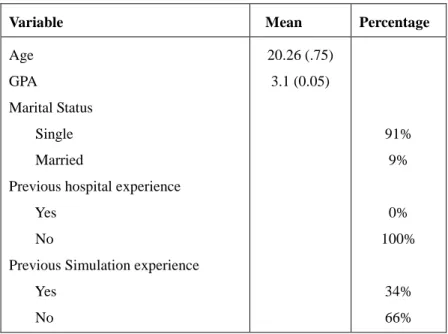
This study aimed at examining the effect of using simulation based practice on nursing students’ attitude, confidence, and perception of learning outcomes. Using a descriptive with pre and post-test design, a 68 students from level 4 were interviewed. The demographic factors were age, marital status, previous hospital experience, previous simulation experience and GPA. Results showed a mean age of 20.26 (.75) years old and a mean of 3.1 (0.05) for GPA. Majority were singles, has no previous hospital experience. 66% reported no previous simulation experience. Demographic results are showed in table 1.
Table 1: Demographic data of students
Variable Mean Percentage
Age GPA
Marital Status Single Married
Previous hospital experience Yes
No
Previous Simulation experience Yes No 20.26 (.75) 3.1 (0.05) 91% 9% 0% 100% 34% 66%
Pre-test was done in the 2nd week of the semester before students engage in simulation based practice in their clinical experience. Results indicated the following:
a. Attitude:
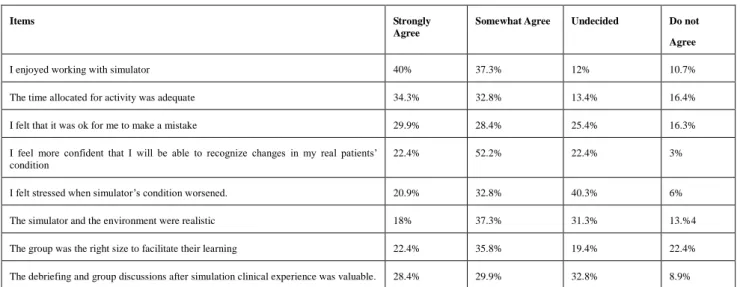
40% of students strongly agree, 37.3% somewhat agree, 12% undecided, and 10.7% do not agree that they enjoyed working with simulator. 34.3% strongly agree, 32.8% somewhat agree, 13.4% undecided, and 16.4% do not agree that the time allocated for activity was adequate. 29.9% strongly agree, 28.4% somewhat agree, 25.4% undecided, and 16.3% do not agree that they felt that it was ok for them to make a mistake. 22.4% strongly agree, 52.2% somewhat agree, 22.4% undecided and 3% do not agree that they feel more confident that they will be able to recognize changes in their real patients’ condition. 20.9% strongly agree, 32.8% somewhat agree, 40.3% undecided and 6% do not agree that they felt stressed when simulator’s condition worsened. 18% strongly agree, 37.3% somewhat agree, 31.3% undecided, and 13.4% do not agree that simulator and environment were realistic. 22.4% strongly agree, 35.8% somewhat agree, 19.4% undecided, and 22.4% do not agree that the group was the right size to facilitate their learning. Finally, 28.4% strongly agree, 29.9% somewhat agree, 32.8% undecided and 8.9% don’t agree that debriefing and group discussions after simulation clinical experience was valuable. Results about attitude in the pre-test are presented in table 2.
Table 2: Attitude regarding simulation experience among nursing students.
Items Strongly
Agree
Somewhat Agree Undecided Do not Agree
I enjoyed working with simulator 40% 37.3% 12% 10.7%
The time allocated for activity was adequate 34.3% 32.8% 13.4% 16.4%
I felt that it was ok for me to make a mistake 29.9% 28.4% 25.4% 16.3%
I feel more confident that I will be able to recognize changes in my real patients’ condition
22.4% 52.2% 22.4% 3%
I felt stressed when simulator’s condition worsened. 20.9% 32.8% 40.3% 6%
The simulator and the environment were realistic 18% 37.3% 31.3% 13.%4
The group was the right size to facilitate their learning 22.4% 35.8% 19.4% 22.4%
The debriefing and group discussions after simulation clinical experience was valuable. 28.4% 29.9% 32.8% 8.9%
b. Learning outcomes:
37.3% strongly agree, 38.8% somewhat agree, 13.4% undecided and 10.5% do not agree that the instructor questions helped them to think critically. 14.9% strongly agree, 37.3% somewhat agree, 35.8% undecided, and 10.4% do not agree that they developed a better understanding of the pathophysiology of the conditions in simulated clinical experience. 9% strongly agree, 22.4% somewhat agree, 47.8% undecided and 20.8% do not agree that they developed better understanding of the catheterization that were demonstrated in the simulation clinical experience. 44.8% strongly agree, 38.8% somewhat agree, 11.9% undecided and 3% do not agree that their assessment skills improved. 14.9% strongly agree, 44.8% somewhat agree, 28.4% undecided and 10.4% do not agree that they are able to predict what changes may occur with their real patients. 29.9% strongly agree, 49.3% somewhat agree, 16.4% undecided, 3% do not agree that completing simulation clinical experience helped them understand classroom information better. 23.9% strongly agree, 44.8% somewhat agree, 17.9% undecided and 10.4% do not agree that they were challenged in their thinking and decision making skills. Finally, 41.8% strongly agree 44.8% somewhat agree, 4.5% undecided and 7.5% do not agree that they learned as much from observing their peers as they did when they actively involved in caring for the simulated patients. Results about learning outcomes in the pre-test are presented in table 3.
Table 3: Learning outcomes in the pre-test.
Items Strongly Agree Somewhat Agree Undecided Do not know The instructors’ questions helped them to think critically 37.3% 38.8% 13.4% 10.5% I developed a better understanding of the pathophysiology of the
conditions in simulated clinical experience
14.9% 37.3% 35.8% 10.4%
I developed better understanding of the catheterization that were demonstrated in the simulation clinical experience
9% 22.4% 47.8% 20.8%
My assessment skills improved. 44.8%, 38.8% 11.9% 3%
I am able to predict what changes may occur with my real patients. 14.9% 44.8% 28.4% 10.4% Completing simulation clinical experience helped me understand
classroom information better
29.9% 49.3% 16.4% 3%
I was challenged in their thinking and decision making skills 23.9% 44.8% 17.9% 10.4% I learned as much from observing my peers as I did when they actively
involved in caring for the simulated patients
c. Confidence:
37.3% strongly agree, 34.3% somewhat agree, 22.4% undecided, and 3% do not agree that they feel better to prepared care for real patients. 19.4% strongly agree, 52.2% somewhat agree, 17.9% undecided and 9% do not agree that they feel more confident in their decision making skills. 26.9% strongly agree, 43.3% somewhat agree, 17.9% undecided and 9% do not agree that they are more confident in determining what to tell the health care provider. 41.8% strongly agree, 38.8% somewhat agree, 7.5% undecided and 6% do not agree that they had fun while were learning. Results about confidence are presented in table 4.
Table 4: Confidence in simulation experience, pre-test.
Items Strongly
Agree
Somewhat Agree
Undecided Do not Agree
I feel better to prepared care for real patients 37.3% 34.3% 22.4% 3% I feel more confident in my decision making skills 19.4% 52.2% 17.9% 9% I am more confident in determining what to tell the health care provider. 26.9% 43.3% 17.9% 9%
I had fun while were learning 41.8% s 38.8% 7.5% 6%
Post-test was applied in week 16th at the end of the semester after the students had been exposed to the simulation experience for fundamentals of nursing competencies to examine the effect of the simulation based experience on students’ confidence, and perception of learning outcomes. Results reported as follow:
a. Confidence
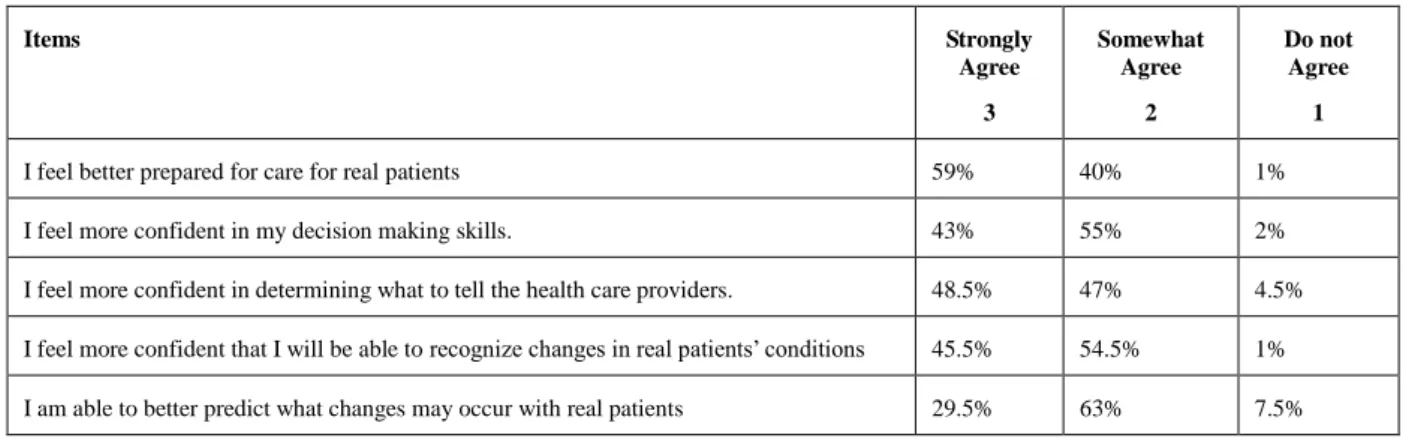
59% strongly agree and 40% somewhat agree that they feel better prepared for care for real patients. 43% strongly agree and 55% somewhat agree that they feel more confident in their decision making skills. 48.5% strongly agree, and 47% somewhat agree that they are more confident in determining what to tell the health care providers. 45.5% strongly agree and 54.5% somewhat agree that they feel more confident that they will be able to recognize changes in their real patients’ conditions. Finally, 29.5% strongly agree, 63% somewhat agree and 7.4% do not agree that they are able to better predict what changes may occur with their real patients. Results about confidence from post-test are presented in table 5.
Table 5: Confidence in simulation, post-test.
Items Strongly Agree 3 Somewhat Agree 2 Do not Agree 1
I feel better prepared for care for real patients 59% 40% 1%
I feel more confident in my decision making skills. 43% 55% 2%
I feel more confident in determining what to tell the health care providers. 48.5% 47% 4.5% I feel more confident that I will be able to recognize changes in real patients’ conditions 45.5% 54.5% 1% I am able to better predict what changes may occur with real patients 29.5% 63% 7.5%
b. Perception of learning outcomes:
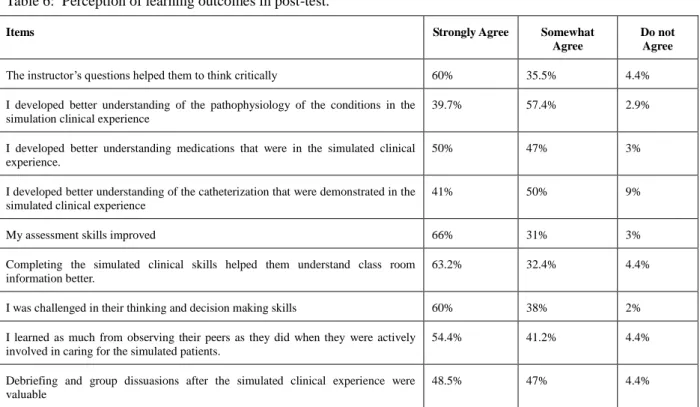
60 % of students strongly agree and 35.5% somewhat agree that the instructor’s questions helped them to think critically. 39.7% strongly agree and 57.4% somewhat agree that they developed better understanding of the pathophysiology of the conditions in the simulation clinical experience. 50% strongly agree and 47% somewhat agree that they developed better understanding medications that were in the simulated clinical experience. 41% strongly agree and 50% somewhat agree that they developed better understanding of the catheterization that were demonstrated in the simulated clinical experience. Further, 66% strongly agree and 31% somewhat agree that their assessment skills improved. 63.2% strongly agree and 32.4% somewhat agree that completing the simulated clinical skills helped them understand class room information better. 60% strongly agree and 38%
somewhat agree that they were challenged in their thinking and decision making skills. 54.4% strongly agree and 41.2% somewhat agree that they learned as much from observing their peers as they did when they were actively involved in caring for the simulated patients. Finally, 48.5% strongly agree and 47% somewhat agree that debriefing and group dissuasions after the simulated clinical experience were valuable. Results on perception of learning outcomes from post-test are presented in table 6.
Table 6: Perception of learning outcomes in post-test.
Items Strongly Agree Somewhat
Agree
Do not Agree The instructor’s questions helped them to think critically 60% 35.5% 4.4% I developed better understanding of the pathophysiology of the conditions in the
simulation clinical experience
39.7% 57.4% 2.9%
I developed better understanding medications that were in the simulated clinical experience.
50% 47% 3%
I developed better understanding of the catheterization that were demonstrated in the simulated clinical experience
41% 50% 9%
My assessment skills improved 66% 31% 3%
Completing the simulated clinical skills helped them understand class room information better.
63.2% 32.4% 4.4%
I was challenged in their thinking and decision making skills 60% 38% 2% I learned as much from observing their peers as they did when they were actively
involved in caring for the simulated patients.
54.4% 41.2% 4.4%
Debriefing and group dissuasions after the simulated clinical experience were valuable
48.5% 47% 4.4%
Discussion:
In practice-based healthcare professions, methods of teaching and learning focus on enabling students to assimilate clinical knowledge and skills. Nursing students needs to learn how to apply classroom learning in the clinical context. Although, majority of students in the present study reported having no previous experience with simulation, findings indicated positive attitude regarding the use of simulation based experience. This was supported by Yeun, Bang, Ryoo and Ha, (2014) who used a Q- method to explore students’ subjective attitude toward simulation based learning that helped them to have a successful learning experience. Nuraini et al. (2015) also revealed that using human patient simulation improved the students’ attitude toward simulation. In the same line, Patterson and Hulton, (2011) stressed the importance of simulation based learning in enhancing the nursing students attitude toward some concepts such as poverty.
Students in this study reported that they become more confident in terms of preparation for care of real patients in the actual clinical practice setting. They also reported more confident in their knowledge and decision making skills. This was similar to results from Blum, Borglund and Parcells, (2010) who studied the effect of high fidelity simulation on nursing students’ self-confidence and clinical skills. They indicated that simulation improved the overall self confidence level among nursing students’ especially the advanced levels. The study recommended the use of high fidelity simulation for beginners as well. In addition, Dearmon, et al. (2013) found that simulation based experience increase students’ self-confidence in expected performance in their clinical experience. Further, McCabe, Gilmartin, and Goldsamt (2016) showed that students in their study reported improvement in their perception of confidence in their general nursing practice. The study recommended combining simulation hours to clinical teaching hours in medical surgical courses to be 50% for each.
Learning outcomes in this study were mainly thinking critically, better understanding of the pathophysiology of the conditions, better understanding of the catheterization, improve assessment skills, predict what changes may occur with real patients, understand classroom information better, challenge in thinking and decision making skills, and learning from observing peers. The post-test results of the present study showed that students were
matching with results from Sullivan-Man, Perrson, and Fellner (2009) who reported that simulation scenarios improved the students’ total score on critical thinking scale. Powelll-Laney (2010) confirmed that students learn better with simulation than traditional teaching. Same results were presented that simulation based learning improved non-technical nursing skills as leadership skills, situational awareness, and communication during patient hand over (Radovich, et al., 2011; Endacott, 2010; Copper et al., 2010; Lewis, Strachan, and Smith, 2016). Further, Hunter and Ravert (2010) studies the nursing students’ perception of learning outcomes through simulation experience. They documented that students’ skills of critical thinking ranked highest. Nursing skills among novice fundamentals of nursing students and facilitating teamwork ranked higher in the semesters following nursing fundamentals. Communication and increasing the understanding of classroom material were also documented. Further, a perceived improvement in development of clinical judgment, confidence and cognitive ability to interpret information through structured classroom reflective were reported among novices (Glynn, 20102; Benner, Sutphen, leonard, & Day, 2010). Same results were reported by Liao (2011), Ma et al. (2010) who indicated that simulation based experience improved their critical thinking, communication skills, and problem solving skills.
Conclusion and recommendations
Existing evidence from the current study support that the use of simulation is tangible teaching and learning methods and students can get many benefits not limited to knowledge gain, application of knowledge, and self-confidence. Students can also develop critical thinking skills and decision making skills. This in turn will improve skills necessary for safe and effective nursing practice. To change from the traditional clinical experience in which clinical learning is based on chance, integrating simulation in nursing education with the institute of more simulating learning experience is needed. Further research should be conducted using a larger sample and including more nursing courses. Studying effect of using simulation on different outcomes such as patient’s outcomes or students’ perceptions of their competency of a specific skill is also of great importance. This study employed a descriptive pre post-test, using longitudinal design to assess if the measured variables changed over time would provide more variability and better understanding.
Limitations:
The present study has some limitations, this study examined the effect of simulation experience on critical thinking and problem solving skills in general as they were measured by few items on the Simulation Effectiveness Scale. Studying further details on how simulation affect the process of critical thinking and decision making ability among nursing students would be more beneficial. Using a small sample size and convenience sample is another limitation. Large sample and random assignment could bring more variability and better explanation. The present study did not look at the effect of using simulation on patients’ outcomes which would provide a broader view of the effect of simulation.
References:
Becker, K.L., Rose, L.E., Berg, J.B., Park, H., & Shatzer, J.H. (2006). The teaching effectiveness of standardized patients. Journal of Nursing Education, 45, 103-111.
Benner, P. (1984). From novice to expert: Excellence and power in clinical nursing practice. Menlo Park, CA. Addison-Wesley.
Benner, P., Sutphen, M., leonard, V., & Day, L. (2010). Educating nurses: a call for radical reform. Stanford, CA: Jossey-Boss.
Blum, C.A., Borglund, C. A., and Parcells, D. (2010). High-Fidelity Nursing Simulation: Impact on Student Self-Confidence and Clinical Competence. International Journal of Nursing Education Scholarship, Vol. 7, Iss. 1, 18.
Blum, C.A., Borglund, S. & Parcells, D. (2010). High Fidelity Nursing Simulation: Impact on Students’ Self-confidence and Clinical Competence. International Journal of Nursing Education Scholarship 7(1), 1-14. Bremner, M.N., Aduddell, K., Bennett, D.N., & VanGeest, J.B. (2006). The use of human patient simulators: Best practices with novice nursing students. Nurse Educator, 31, 170-174.
Cioffi, J. (2001). Clinical simulations: Development and validation. Nurse Education Today, 21, 477-486. Cooper S, Kinsman L, Buykx P, Endacott R, Scholes J. (2010). Managing the deteriorating patient in a simulated environment: nursing students' knowledge, skills and situation awareness. Journal of Clinical Nursing, 19: 2309-18.
Simulation Effectiveness Tool (SET). Clinical Simulation in Nursing, 8(6), 199-210.
Dearman, V., Graves, R., Hayden, S., Mulekar, M., Lawrence, S.M., Jones, L.et al., (2013). Effectiveness of Simulation-Based Orientation of Baccalaureate Nursing Students Preparing for Their First Clinical Experience. Journal of Nursing Education, 52(1), 29-38.
DeVita, M. A. (2009). Society for Simulation in Healthcare Presidential Address. Simulation in Healthcare, 4(1), 43-48. http://dx.doi.org/10. 1019/SIH.0b13e318197d315.
Endacott R, Scholes J, Buykx P, Cooper S, McConnell-Henry T. (2010). Final year students' ability to detect and act upon clinical cues of deterioration in a clinical environment. Journal of Advanced Nursing, 66(12): 2722-31. Glynn, D. M. (2012). Clinical Judgment Development Using Structured Reflective Practice: A Qualitative Study. Journal of Nursing Education, 51 (3), 134-139.
Henneman, E.A., & Cunningham, H. (2005). Using clinical simulation to teach patient safety in an acute/critical care nursing course. Nurse Educator, 30, 172-177.
Hunter C, Ravert P (2010) Nursing students’ perceptions of learning outcomes throughout simulation experiences. Undergraduate Research Journal for the Human Sciences, 9, 1-4.
Jeffries, P. R. (2008). Getting in S.T.E.P. with simulations: Simulations take educator preparation. Nursing Education Perspectives, 29(2), 70-73.
Jeffries, P.R. (2005). A framework for designing, implementing, and evaluating simulations used as teaching strategies in nursing. Nursing Education Perspectives, 26, 96-103.
Lewis, R. Strachan, A., Smith, M.M. (2016). Is High Fidelity Simulation the Most Effective Method for the Development of Non-Technical Skills in Nursing? A Review of the Current Evidence. The open Nursing Journal, 10.
McCabe, D.E., Gilmaarin, M.J., and Goldsamthigh, L.A. (2016). Student self-confidence with clinical nursing competencies in a high-dose simulation clinical teaching model. Journal of Nursing Education and Practice, 6(8), 52-58.
Nuraini,T., Afifah, E., Agustini, N., Pujasari, H., Masfuri, M. and Milan, A. (2015). Human patient simulation to improve the attitude of the nursing students. Journal of Nursing Education and Practice, 5(4), 52-57.
Patterson, N., and Hulton, L.J. Nehring W.M. (2008) U.S. boards of nursing and the use of high fidelity patient simulators in nursing education. Journal of Professional Nursing 24(2), 109–117.
Powelll-Laney, S. K. (2010, August). THe Use of Human Patient Simulators to Enhance the Clinical Decision Making of Nursing Students. Walden University, Pennsylvania, United States.
Radovich P, Palaganas J, Kiemeney J, Strother B, Bruneau B, Hamilton L. Enhancing leadership orientation through simulation. Critical Care Nurse 2011; 31(5): 58-63.
Sullivan-Mann, J., Perrson, C.A., and Fellner, A.N. (2009). The Effects of Simulation on Nursing Students' Critical Thinking Scores: A Quantitative Study. New-born and Infant Nursing Reviews 9, (2), 111–116.
Yeun, E.J., Bang, H. Y; Ryoo, E.N.; Ha, E.H.; (2014). Attitudes toward simulation-based learning in nursing students: an application of Q methodology. Nurse Education Today, 34(7), 1062-1068.