S.R.M UNIVERSITY
FACULTY OF SCIENCE AND HUMANITIES
BACHELOR OF VISUAL COMMUNICATION
SEMESTER SYSTEM
REGULATIONS 2008 - 09
B.Sc Visual Communication
SYLLABUS
I Year
I SEMESTER Maximum Marks Subject Name Subject CodeWeekly Lecture/ practical Hours Credits Exam Hours Ext Int Total Language LAT LAH 101 LAF 5 3 3 80 20 100 English LAE 102 5 3 3 80 20 100 Introduction to Visual Communication BVC 101 5 4 3 80 20 100 Communication Skills BVC 102 5 4 3 80 20 100 Drawing - I ( Practical ) BVC 103 5 5 3 80 20 100
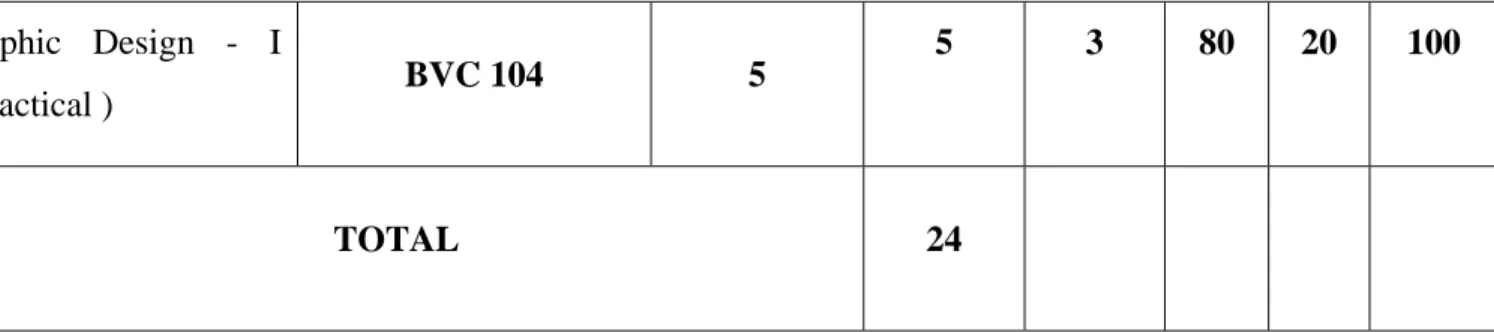
Graphic Design - I ( Practical ) BVC 104 5 5 3 80 20 100 TOTAL 24 II SEMESTER Maximum Marks Subject Name Subject Code
Weekly Lecture/ practical Hours Credits Exam Hours Exte Inte Total Language LAT LAH 201 LAF 5 3 3 80 20 100 English LAE 202 5 3 3 80 20 100 History of Media BVC 201 5 4 3 80 20 100 Advertising - I BVC 202 5 4 3 80 20 100 Drawing II - ( Practical ) BVC 203 5 5 3 80 20 100 Graphic Design II - ( Practical ) BVC 204 5 5 3 80 20 100 TOTAL 24
I Semester
II Semester
1. English 1. English
2. Language 2. Language
3. Introduction to Visual Communication 3. History of Media
4. Communication Skills 4. Advertising - I
5. Graphic Design – I 5. Graphic Design - II
6.Drawing – I 6. Drawing – II
PASSING REQUIREMENT
a) Procedures for awarding marks for internal assessmen
THEORY COURSES
For regularity (scoring 80% and above attendance) - 5 Marks
For two assignment (equal weightage) - 5 Marks
For two tests to be conducted (equal weightage) - 10 Marks
Total - 20 Marks
b) A candidate who secures not less than 40% of total marks prescribed for any course shall be declared to have passed in the examination for that course.
c) If any candidate fails to secure a pass in a particular course, it is mandatory that he / she shall register and reappear for the examination in that course during the next year when examination is conducted in the course. He / she should continue to register and reappear for the examination till he / she secures a pass. However, the internal assessment marks obtained by the candidate in the first attempt shall be retained and considered valid for all subsequent attempts.
SRM UNIVERSITY
FACULTY OF SCIENCE AND HUMANITIES
B.Sc DEGREE COURSE IN VISUAL COMMUNICATION
SYLLABUS
SEMESTER I
INTRODUCTION TO VISUAL COMMUNICATION
UNIT: I
Need and important of Human and Visual Communication, Communication as a process, Understanding Communication.
UNIT: II
Communication as a process: Message, Meaning, Connotation and Denotation culture / code etc.Levels of communication: Technical, Semantic and pragmatic.
UNIT: III
Principles of visual and other sensory peraptions.Color Psychology and theory (some aspects) Definition, Optical / Visual illusion etc.
UNIT: IV
Types of Media – Traditional media, Print media, Electronic media and new media.
UNIT: V
Basic of Graphic Design, Definition, Elements of Graphic Design. The process of developing ideas – Verbal, Visual, Combination and thematic, visual thinking, design execution and presentation.
Reference:
1. Lester, E (2000) Visual Communication: Image with messages. 2. Visual Elements of Arts and Design (1989) Longman Porter.
COMMUNICATION SKILLS
UNIT: 1
Interpersonal communication: Theories and Models – Transactional analysis.
UNIT: 2
Verbal communication and Non – Verbal communication theories and models. Types of Non – Verbal behavior Kinesics.
UNIT: 3
Group communication: Theories and models – Decision making process, leadership, and team work communication patterns in group context.
UNIT: 4
Public communication; Rhetoric model, Persuasion models.
UNIT: 5
Ideation and creative thinking: Lateral thinking, designing, messages for different audiences.
Reference:
Wood, Julia T: Communication mosaics: An introduction to the field of Communication, 2001, Wards worth. Larson, Charles, persuasion- Reception and responsibility Wards worth
GRAPHIC DESIGN -- I
1. LINE STUDY IN DIFFERENT THICKNESS 2. CURVES AND CIRCLE
3. SHAPE
4. PATERNS AND DISTRACTION
5. FONTS – ALPHABETS AND NUMBERS
(EACH EXERCISE SHOULD HAVE MINIMUM 3 NUMBERS OF WORKS WITH ROUGH THUMB NILE SKETCH FOLLOWED BY FAIR WORKS)
DRAWING – I
1. CUBES WITH GEOMETRICAL SHAPES 2. TEXTURE ON PATTERN
3. COMPOSITION WITH LIGHT AND SHADOW 4. PERSPECTIVE DRAWING
5. FACE MASK MAKING
(EACH EXERCISE SHOULD HAVE MINIMUM 3 NUMBERS OF WORKS WITH ROUGH THUMB NILE SKETCH FOLLOWED BY FAIR WORKS)
SEMESTER – II
HISTORY OF MEDIA
UNIT – 1
Historical Development of the press as a media Institution in India, Advent of printing press in India and Newspaper, Role of the press in Indian’s freedom movement.
UNIT – 2
Study of leading newspapers and journalists in India since 1947. The vernacular press in India, Development of news agencies.
UNIT – 3
Invention and development of radio as a medium of mass communication, Development of radio in pre- independence & post – independence in India.
UNIT – 4
Invention and development of TV as medium of mass communication in India, Advent and growth of satellite and cable TV in India.
UNIT – 5
Film as medium of communication, Historical development of film in India, Regional cinema.
REFERENCE
Nadiq Krishna moothy Indian Journalism, Prasaranga, University of Mysore, 1966.
Chatterjee, P.C, Broadcasting in India, Sage, New Delhi, 1990.
ADVERTISING - I
UNIT – 1
Definition, Origin & Growth – Nature & Scope of Advertising, roles of advertising, Social, Communication, Marketing & Economic- functions of advertising.
UNIT – 2
Based on target audience, geographic area, Media & purpose. Corporate & Promotional Advertising – Web Advertising.
UNIT – 3
Latest trends in advertising (India & abroad) – Ad agency & its types, Structure of small, medicine & big agencies, functions, services- legal aspects & ethical issues.
UNIT – 4
Client Brief, Account Planning, Creative Strategy & Brief, Communication Plan, Brand management – Positioning, Brand personality, Brand image, Brand equity, Case studies.
UNIT – 5
Conceptualization & Ideation. Translation of ideas to campaigns, visualization designing & layout, coy writing – types of headlines, body copy base lives, slogans. Logos & trademarks.
REFERENCE
Sandage, frylruger and Rotzoll (1996): Advertising theory and Practice. AAITBS Publishers.
Mohan: Advertising Management: Concepts & Cases. Late McGraw – Hiss
Jewler, E (1998): Creative strategy in Advertising. Thomson leasning.
GRAPHIC DESIGN – II
Logo Design Letter Head Visiting Cards Calendar Design Poster DesignNote:
(EACH EXERCISE SHOULD HAVE MINIMUM 3 NUMBERS OF WORKS WITH ROUGH THUMB NILE SKETCH FOLLOWED BY FAIR WORKS)DRAWING – II
Anatomy study ( Human and animals )
Live Models ( Portraits )
Landscapes and Composition
Monuments
Still Life
Note:
(EACH EXERCISE SHOULD HAVE MINIMUM 3 NUMBERS OF WORKS WITH ROUGH THUMB NILE SKETCH FOLLOWED BY FAIR WORKS)B Sc VISUAL COMMUNICATION
SYLLABUS
II YEAR
III SEMESTER Maximum Marks Subject Name Subject CodeWeekly Lecture/ Practical Hours Credits Exam Hours Ext Int Total Basic Photography 5 4 3 80 20 100 Script & Creative Writing 5 4 3 80 20 100 Computer Graphics-I 10 5 3 80 20 100 Practical Script Writing 10 5 3 80 20 100 TOTAL 30 18
SEMESTER - III
BASIC PHOTOGRAPHY
(Theory: Internal-20, External- 80)Unit I
Human Eye and Camera. Visual Perception. Basics of Camera (aperture, shutter speed, focal length, depth of field etc.,) Camera operations- Types of Camera, Types of Lenses.
Unit II
Understanding Lighting- indoor and outdoor, Exposing and Focusing, Types of lighting, Natural and Artificial Lights, Exposure Meters, Differential focus, Filters, Flashes. Designing with light.
Unit III
Types of Film- Sensitivity, Temperature, Speed etc., Reversal Films. Manipulation of Colour and Light. Black and White and Colour Photography- Negatives, Colour materials, Processing and Printing.
Unit IV
Basic Requirements, Equipments. Developing Process. Control Factors- Fixing, Washing, Drying. Negative (ideal, identifying faults). Printing (paper, chemicals, Enlarger) etc. Special effects techniques-motion pictures etc., manipulation of image, framing & trimming.
Unit V
Some Basic Principles. Aesthetics. Basics of Photo-Journalism, Photo-features, Photo-essays, Writing
captions, Visual story telling. Photography for advertising- Consumer and Industrial. Planning a shoot-studio, location, set props and casting.
Reference:
Michael Langford: Basic Photography, Focal Press.
Michael Langford: Advanced Photography, Focal Press.
Mitchell Bearley & John Hedgeese: New Introductory Photography Course, Read consumer Book Ltd.
35 mm Photographer Hand book, Pan Books.
PRACTICAL
PRACTICAL- I
COMPUTER GRAPHICS I
(Practical: Record- 80, Viva- 20) The practical will include
1. DTP for Publication Design: Page Maker (latest version)
EXERCISES
1. Design a ‘logo’ for an a. Advertising agency b. Commercial organization c. Non- profit organization d. Government agency e. Service industry
2. Design a ‘visiting card’ & ‘letter head’ for the same FIVE organizations mentioned above using the logo created in the previous exercise.
3. Design a ‘news letter’ for any one of the above mentioned agencies.
4. Design the ‘front cover’ of an in-house journal published by any one of the above mentioned agencies.
Practical-II
SCRIPT WRITING
(Practical: Record-80, Viva-20)
Script writing record should contain at least one script from each exercise. Each exercise should include all the necessary details. Final practical examination will test student’s knowledge on script writing (either as a viva or written exam). Following themes should be covered (minimum)
Exercises
1. Fully scripted Running order for any TV Commercial. 2. Fully scripted Story Board for any AD Film.
3. Fully scripted Documentary on any issue. 4. Fully scripted Short Film on any topic. 5. Fully scripted Feature Film on any genre.
B Sc VISUAL COMMUNICATION
SYLLABUS
II YEAR
IV SEMESTER Maximum Marks SubjectName Subject Code
Weekly Lecture/ Practical Hours Credits Exam Hours Ext Int Total Printing & Publication 5 4 3 80 20 100 Elements of Film 5 4 3 80 20 100 Web Publishing 10 5 3 80 20 100 Photography Practical 10 5 3 80 20 100 TOTAL 30 18
Semester - IV
PRINTING AND PUBLICATION
(Theory: External - 80, Internal - 20)Unit 1
History of printing. Recent technological development of printing processes. Importance of printing processes in design decisions.
Unit 2
Principles of printing.(relief, planography etc.,) Type-setting methods: hot metal, photo composition and digital. Plate making process. Types of printing processes- Letter Press, Offset, Gravure , Flexography and Silk Screen. Colour printing process - colour separation, colour correction and colour reproduction. Current trends and future developments in printing processes (Laser Printers, Scanners, Ink-jet printers, Image setters, Direct-to-plate printing etc.).
Unit 3
Elements of publication design. Page-makeup & Layout. Types of Layout-Books, Magazines, Brochures, Catalogues etc., Typography—typeface design, copy fitting, communication through typography. Special designs (information graphics, charts, tables boxes etc.).
Unit 4
Printing Management, Printing press organization and structure Economics of printing - different types of paper, ink, plates, miscellaneous; Print order estimation, managing wastage.
Unit 5
New technological development in printing process. Digital pre-press. Direct to plate technologies. Recent trends printing processes. An over view of printing and publishing industry in India. An over view of electronic publishing.
References
Dennis, E(1997). Lithographic technology in transition. Amdams, J.M. Ramano F (1997). Delmar’s dictionary of Digital Printing and Publishing
Ruggles, P (1996) Printing Estimating: digital and traditional costing methods for graphic imaging. 4th Edition. Thomson Learning
McAllister, R (1998) Pathways to Print: Trapping. Thomson Learning McAllister, R (1998) Pathways to Print: Color. Thomson Learning Cost, F (1997) Pocket guide to digital printing. Thomson Learning Bergland, D (1997). Printing in a digital world. Thomson Learning Finley, C (1998). Printing paper and inks. Thomson Learning
Amdams, J.M. (1996) Printing Technology 4th Edition. Thomson Learning Hoff, S (1997). Screen Printing. Amdams, J.M.- Thomson Learning Ramano, F (1996).Pocket Guide to digital pre-press- Thomson Learning
ELEMENTS OF FILM
(Theory: External - 80, Internal - 20)Unit I
Indian (Hindi, Tamil & other languages), Film form and film History: Early Cinema (1893-1903). Development of Classical Hollywood cinema (1903-1927). German expressionism (1919-1924). French Impressionism and Surrealism (1917-1930). Soviet Montage (1924-1930). The Classical Hollywood Cinema after the coming of sound. Italian neo-realism (1942-1951). The French New wave (1959-1964). Japanese cinema. Cinema in the third world. Contemporary trends.
Unit II
Planning, pre-production- Concept / Story development, Scripting / Screen play writing, Budgeting, Casting, Locations, Financing. Production –Shooting, Direction & Cinematography. Post production- Editing, Sound recording, Dubbing, Special effects,
Graphics & Final mixing. Distribution & Exhibition.
Unit III
Mise-en-scene-Realism, the power of mise-en-scene, aspects of mise-en-scene, space and time, narrative functions of mise-en-scene. Cinematographer properties- the photographic image, framing, duration of the image, montage and long take. Editing- dimensions of film editing, continuity editing, alternative to continuity editing. Sound- the powers of sound, fundamentals of film sound, dimensions of film sound, functions of film sound.
Unit IV
The concept of form in films, principles of film, narrative form, non-narrative form, dividing a film into parts and Genres (language, style, grammar, syntax.)
Unit V
Style as a formal system, narrative unity, ambiguity, a non-classical approach to narrative films, space and time, disunity, form, style and ideology.
References
Thoraval, Yves(2000) The Cinema of India(1896-2000) Roberge, Gaston: the Subject of Cinema
Roberge, Gaston (1977): Films for an ecology of Mind Halliwell;: The Filmgoers Companion 6th Edition Arora: Encyclopedia of Indian Cinema
PRACTICAL
PHOTOGRAPHY
(Practical: External - 80, Internal - 20)
Photography record should contain at least 15 black and white and 15 colour photographs. Each exercise should include all the necessary details (colour, exposure time, lens type etc.). Final practical examination will test students knowledge on photography (either as a viva or written exam or practical work on fundamentals of photography). Following themes should be covered (minimum)
Exercises
1. Landscape (scenic, people, birds/animals, monuments) 2. Portraits
3. Photo feature, photo language 4. Environnemental exposure – 5. Silhouette 6. Freezing movement 7. Panorama 8. Montage 9. Indoor photography 10.Industrial photography 11.Special effects
WEB PUBLISHING
(Practical: External - 80, Internal - 20)
Web publishing:Web Publishing Tool, FrontPage or Dream Weaver and MM Flash HTML and XML Programming
Creation of the Home Page of a Web Site with proper links
Creation of a dynamic web page using appropriate web development tool (e.g. Dream Weaver) for three different concepts.
Students should be given orientation of web/multimedia usability issues and interface design basics
Each student to provide individual CD-ROMs with all the exercises done during the year with proper dates. Students should be given adequate orientation on Web design and usability concepts
Each student to provide individual CD-ROMs with all the exercises done during the year with proper dates.
Note
1. The web pages should contain objects created by the students only. No objects/ elements downloaded from the Internet should be used. If static images are to be included, then the student is expected to create her/his own images using appropriate software like PhotoShop.
2. A minimum of Five exercises should be carried out on each theme outlined above
3. At least FIVE complete web sites for different categories of products or organizations must be created for the record
4. All exercises should be accompanied by “paper-page” and “paper-design” in record form along with the original fine containing the exercises.
5. The above mentioned are the minimum requirement for external examination.
References
Powell, Thomas . Web Design(2000). The Complete Reference. Tata McCraw-Hill Arora, Deva Yashwant Singh. Multimedia 98: Shaping the Future
Grahm, L (1999) The principles of Interactive Design. Thomson Learning Xavier: World Wide Web with HTML. Tata McGraw- Hill