EFFECTS OF ADAPTIVE LEARNING TECHNOLOGIES ON MATH ACHIEVEMENT: A QUANTITATIVE STUDY OF
ALEKS MATH SOFTWARE
A DISSERTATION IN Education
Presented to the Faculty of the University of Missouri-Kansas City in partial fulfillment of
the requirements for the degree DOCTOR OF EDUCATION
by
BURAK YILMAZ
M.Ed., University of Central Oklahoma, 2008 B.S., Bilkent University, 2005
Kansas City, Missouri 2017
© 2017 BURAK YILMAZ
EFFECTS OF ADAPTIVE LEARNING TECHNOLOGIES ON MATH ACHIEVEMENT: A QUANTITATIVE STUDY OF ALEKS MATH SOFTWARE
Burak Yilmaz, M.Ed., Candidate for the Doctor of Education Degree University of Missouri – Kansas City, 2017
ABSTRACT
The intent of this study is to investigate the effects of a particular adaptive math learning program (ALEKS) on math achievement and its impact on closing the achievement gap in math performance of middle school students. The study is conducted in two small urban school districts in a southern city. The study is a quasi-experimental research design with a sample size of 1110 students in grades fifth through ninth forming a control group and a treatment group of equal sizes. The data is compiled from the 2014-2015 school year (archived data) and has been analyzed using analysis of covariance (ANCOVA) to compare mean scores of the two groups from a norm-referenced test and regression analysis to understand various categorical variables affecting math achievement on ALEKS.
APPROVAL PAGE
The undersigned, appointed by the Dean of the School of Education, have examined a dissertation titled “Effects of Adaptive Learning Technologies on Math Achievement: A Quantitative Study of ALEKS Math Software” presented by Burak Yilmaz, candidate for the Doctor of Education degree, and certify that in their opinion it is worthy of acceptance.
Supervisory Committee:
Loyce Caruthers, Ph.D., Committee Chair
Department of Educational Leadership, Policy and Foundations Shirley McCarther, Ph.D.
Department of Educational Leadership, Policy and Foundations Robert Leachman, Ph. D.
Department of Educational Leadership, Policy and Foundations
Yuankun Yao, Ph. D.
Department of Educational Foundations & Literacy University of Central Missouri
TABLE OF CONTENTS
ABSTRACT ... iii
LIST OF ILLUSTRATIONS ... viii
LIST OF TABLES ... ix
ACKNOWLEDGEMENTS ... xi
Chapter 1. INTRODUCTION ...1
Adaptive Online Learning... 1
Problem Statement ... 3
Purpose of Study ... 6
What is ALEKS?... 6
What is NWEA MAP? ... 7
Research Questions & Hypotheses ... 8
Theoretical Framework ... 9
Significance of the Study ... 10
Organization of Subsequent Chapters ... 12
2. REVIEW OF LITERATURE ...14
Current Landscape of Education in American Public Schools ... 14
The Skills Gap and Industry Expectations ... 15
Mathematics Instruction in the U.S. ... 16
Personalized Learning Initiatives ... 20
Blended Learning. ... 20
Adaptive Learning Technologies ... 21
Knowledge Space Theory. ... 22
Adaptive Control of Thought. ... 27
Cognitive Science & Intelligent Tutoring Systems ... 30
Nexus between K-12 Personalized Learning and Post-Secondary Education 47 3. METHODOLOGY ...55 Participants ... 55 Data Considerations ... 56 Design. ... 56 Data Collection. ... 56 Measures ... 57 Procedure ... 59 Analysis... 60 Ethical Considerations ... 64
4. RESULTS OF ANALYSES AND CONCLUSIONS...66
Characteristics of Treatment and Control Groups ... 66
Statistical Analyses & Data Tables ... 71
Performance Analyses of Demographic Groups... 81
Conclusions and Summary ... 86
5. DISCUSSION ...88 Discussion of Findings ... 93 Summary ... 94 Conclusions ... 98 Implications... 100 Limitations ... 101
Recommendations for Future Research ... 102
Concluding Thoughts ... 103
REFERENCES ...107
LIST OF ILLUSTRATIONS
Figure Page
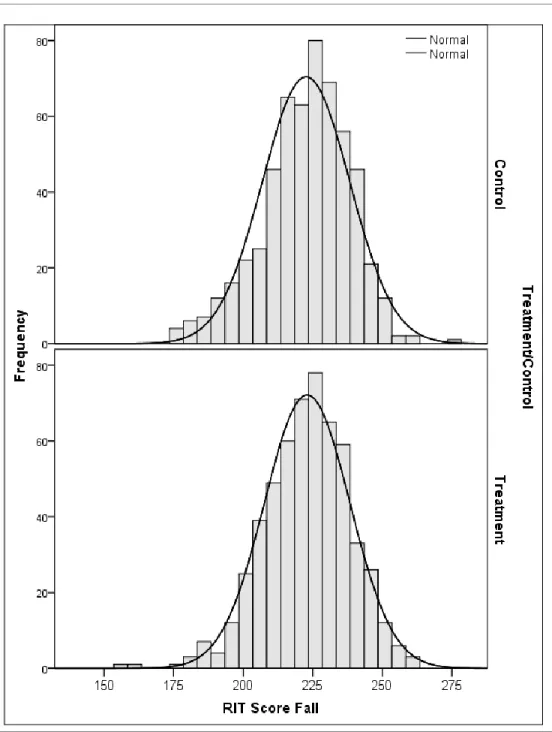
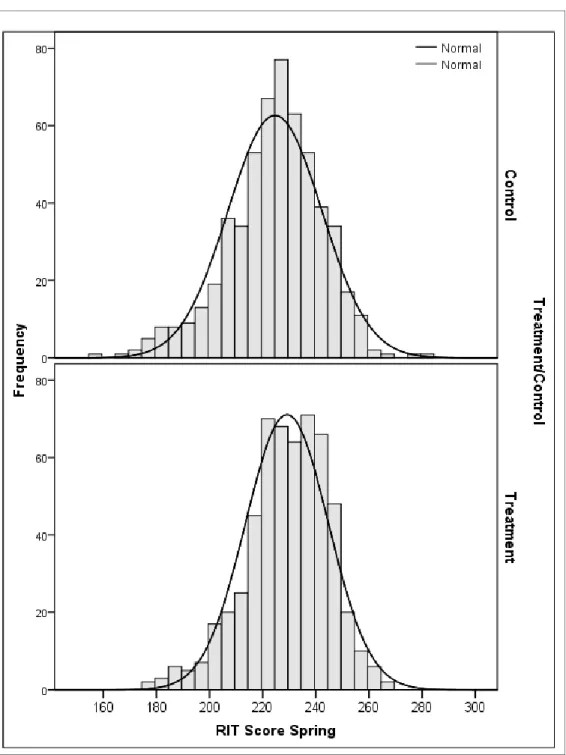
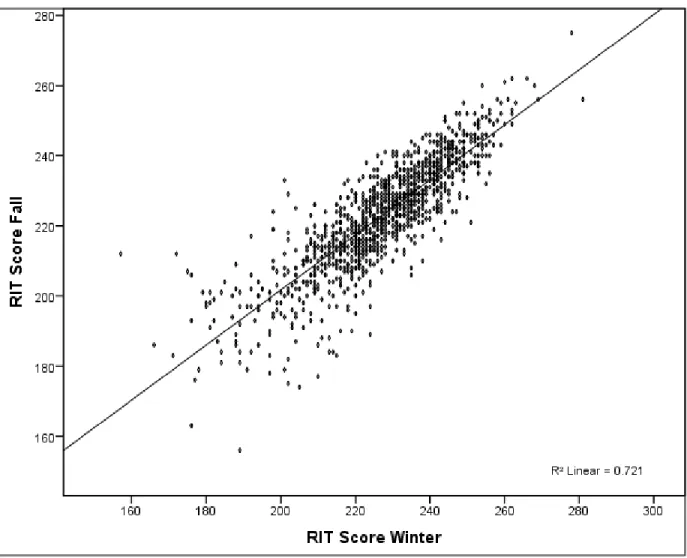
4.1. Distribution of independent variable fall RIT score by treatment/control group……….36 4.2. Distribution of dependent variable spring RIT score by treatment/control group……....61 4.3. Scatter plot of dependent variable spring RIT score and covariate fall RIT score...……63
LIST OF TABLES
Table Page
1.1. Definition of Key Terms ……….……….…….………...12
4.1. Control/treatment group participation by grade level…………...…….………...66
4.2. Control/treatment group participation by race ……….…….………...67
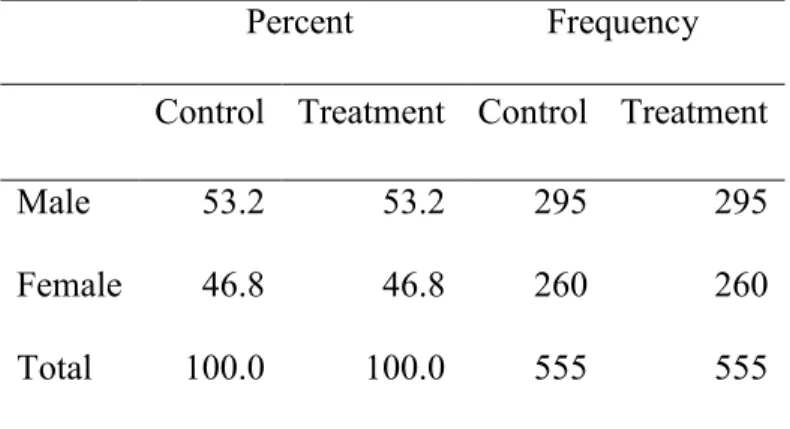
4.3. Control/treatment group participation by sex ………..…….………...67
4.4. Control/treatment group participation by special – education status………...68
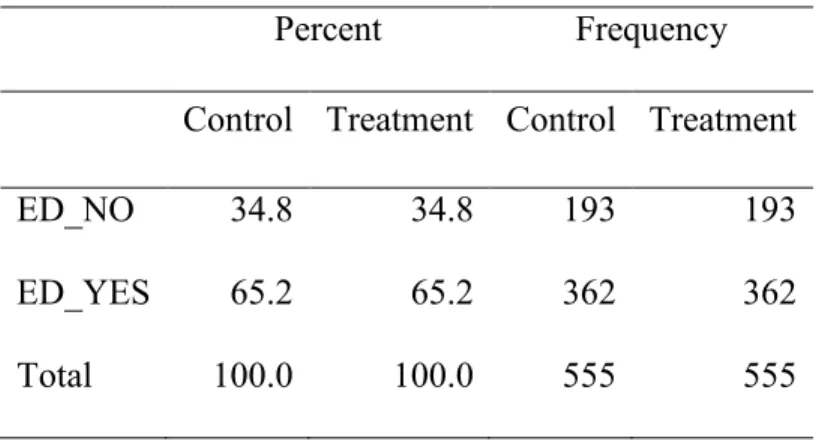
4.5. Control/treatment group participation by economic disadvantage…...………...68
4.6. Control/treatment group participation by Limited English Proficiency status….……...69
4.7. Control/treatment group participation by Gifted/Talented status…….………...69
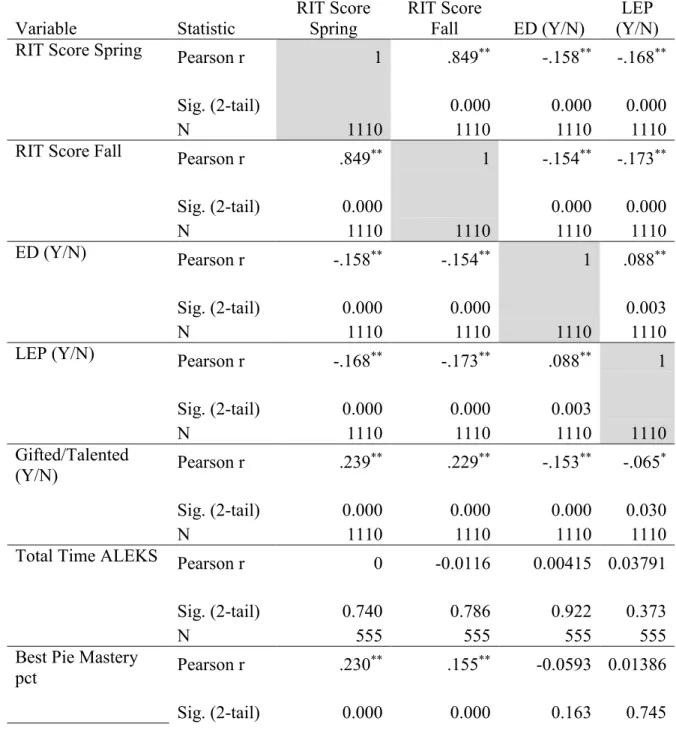
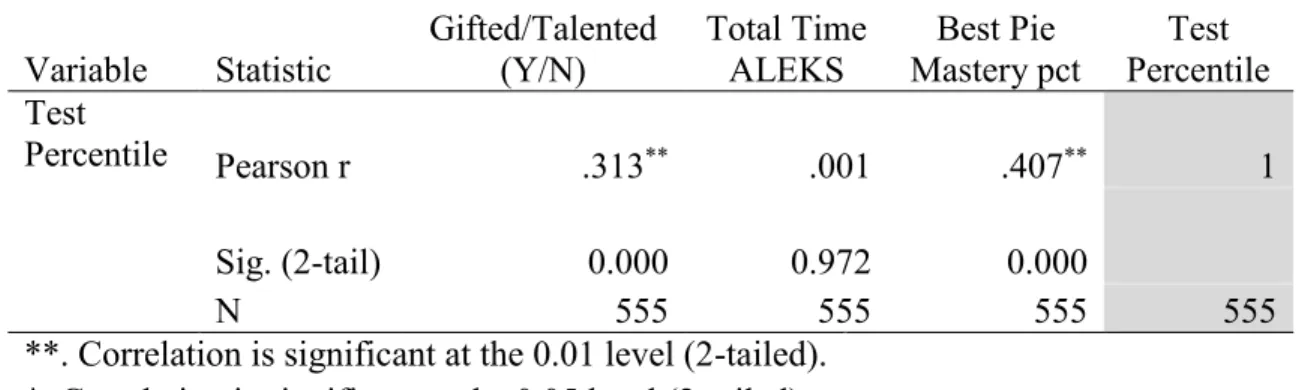
4.8. Correlations among selected variables used in the study ……….………...70
4.9. Descriptive statistics for dependent and independent variables used in the study, by treatment/control group….………....…………..72
4.10. Results of ANCOVA analysis, test of hypothesis ……….……….…..76
4.11. Results of ANCOVA analysis, mean spring mathematics RIT score by group……....76
4.12. Test for homogeneity of variance..………….……….…..77
4.13. Regression model specification..………….……….…...78
4.14. Test for homogeneity of variance..………….……….…. 79
4.15. ANOVA results associated with the regression model ………...……….……….…... 79
4.16. Coefficients resulting from the regression model……….…... 80
4.17. Results of ANCOVA analysis, mean spring mathematics RIT score by group, broken down by grade level ……….…... 81
4.18. Results of ANCOVA analysis, mean spring mathematics RIT score by group, broken down by special populations ………...………….…... 82
4.19. Results of ANCOVA analysis, mean spring mathematics RIT score by group, broken down by race/ethnicity ……….………... 84 4.20. Results of ANCOVA analysis, mean spring mathematics RIT score by group, broken
ACKNOWLEDGEMENTS
I would never have completed this dissertation without the guidance of my advisor and committee members, assistance of friends, and most importantly love, support, and encouragement of my family, especially my beloved wife.
I would first like to thank Dr. Loyce Caruthers for her support and guidance
throughout the development of this dissertation. Her timely and critical feedback was much appreciated and pushed me to produce quality work. I am also extremely thankful for her encouragement and individual support especially after I moved away to Texas. I could not have asked for a better advisor. I would like to also thank Dr. Yuankun Yao for his valuable insight in my methodology and analyses.
Next I would like to thank my friends John, Sean, and Ruili for providing reviews, suggestions, and inputs into my work. Their contributions made this study stronger. I am especially thankful to my classmate and former boss Sean, who encouraged and even insisted that I start this doctorate program. Without his constant encouragement and persistence, I may never have started this program.
I would also like to express my deepest gratitude to my parents, who –despite being oceans apart– have always supported my graduate studies and constantly checked on me and motivated me to pursue my goals. I am thankful for their high expectations and vision for my future.
Last, but by all means not least, I would like to dedicate this dissertation to my family. Without my beautiful wife Kubra, and my adorable children Pinar and Tarik, I would never have found the strength and motivation in myself to pursue this degree and finish this dissertation. My entire purpose and motivation to pursue life-long learning and earn my
doctorate lies within my desire to become the best husband and father, and become a model educator and leader to my family, first and foremost. I am forever grateful to my wife and children, for always being there for me and cheering me on.
CHAPTER 1 INTRODUCTION
Math has traditionally been difficult to understand, a dreaded subject area in K-16 for many students. When educators talk about achievement gaps among ethnic groups, math is definitely at the center of those discussions. A significant number of college freshmen must take remedial math courses, despite having passing scores on state standardized tests or making good grades on their high school math coursework (Harper & Reddy, 2013;
Robathan & Wilson, 2011). With advancements in computer and network technologies, new trends and methods for teaching and learning mathematics have emerged, especially web-based assessment and tutoring systems built on artificial intelligence (Albert & Hockemeyer, 1997; Doignon & Falmagne, 1999; Falmagne, Cosyn, Doignon, & Thiery, 2006). Despite this, attrition rates in math courses, online or classroom-based, are still higher than courses of other disciplines (Shakerdge, 2016; Varsavsky, 2010). Even with the support of adaptive learning technologies and intelligent tutoring systems, many students still fail, withdraw from or perform poorly in their math courses. Therefore, there is a clear need for evaluation of computer-based adaptive learning software to determine their effects on learning and math achievement.
Adaptive Online Learning
Computer based learning environments in mathematics have evolved rapidly in the past decade. It started with programs that provide drills and tutorials based on behaviorist learning philosophy; then continued with using games and simulations in the learning process advocated by cognitive learning theory; and finally lead to the extensive use of hypertext and
hypermedia that promote constructivist learning approaches (Anderson, 1970; Baker, 1968; McKenney & Dill, 1966; Albert & Hockemeyer, 1997).
Cognitive tutoring and assessment systems built on artificial intelligence opened a new wave of reform in public education. In the last two decades, smart algorithms started helping teachers identify student knowledge gaps and create learning spaces; an especially effective method for teaching mathematics (Aleven & Koedinger, 2001; Doignon & Falmagne, 1999; Falmagne & Doignon, 2011). Such advancements lead to digital learning reforms aimed at personalizing learning for all students. With personalization in mind, local districts began putting individual devices into the hands of students as early as first grade in an attempt to engage learners through digital content providers and adaptive instructional software, thus allowing students to progress at their own pace using a mastery based approach.
Online instructional delivery by means of an interactive device such as a computer or tablet in order to engage students with content tailored to student learning needs forms the basis of adaptive learning. “How well it adapts to the individual is entirely dependent on the sophistication of the software that drives the device” explains Vander Ark (2013). Education expert Tom Vander Ark goes on to explain how smart learning algorithms are starting to keep user experience in mind when delivering just-right content, just in time:
The same sophisticated, predictive, intelligent use of data that has accustomed us to personalization in online shopping and music, and show us content we are mostly likely to appreciate and potentially use, has come to learning and education. Smart instructional content adjusts its path based on response to questions. Like computer games, adaptive systems calibrate the difficulty to maintain an appropriate level of challenge. But there is a level beyond shopping and gaming where an entirely new class of adaptive learning software exists, and it is called Intelligent Adaptive Learning. (Vander Ark, 2013, p. 8)
Intelligent adaptive learning holds promise for robust personalization in education, specifically most beneficial for high need students in public schools. These new learning models can be a cure for closing the persistent achievement disparities in the U.S.
Problem Statement
Public education in America has long suffered from disparities of achievement among ethnic groups. According to the Coleman Report of 1966, cited in Camera (2016), average black student in grade 12 ranked in the 13th percentile of the score distribution in both math and reading, outperformed by 87% of their white counterparts in grade 12. Data from 2013 National Assessment for Educational Progress Education placed average black twelfth grader in the 19th percentile in math, a slight improvement in nearly half a century showing that achievement gaps still persist (Camera, 2016). Agencies both at the federal and state levels have made countless attempts to reform public education with a single goal in mind: closing the achievement gap. Starting with No Child Left Behind Act and followed by Race to the Top initiatives, education reformers placed heavy emphasis on improving math and reading instruction, and promoted personalized learning models. These legislative initiatives (“Every Student Succeeds Act (ESSA)”, 2017; “No Child Left Behind”, 2017; “U.S. Department of Education”, 2017) put federal and state mandates on schools to make adequate yearly progress on accountability measures, and ensure that all students perform ‘proficient’ on standardized state assessments. Because students in the very same classroom begin at different levels, and hence have very different needs, differentiation of instruction, and even more importantly, personalizing the learning experience for each student has become necessary. With the pressure of performance targets on standardized tests, schools and districts are designing or adopting new programs and tools to boost student performance on
state assessments. In recent years, the use of computer-based adaptive learning programs has been on the rise, and schools are purchasing and using these programs in hopes that they will help increase test performance (Dickard, 2003).
Traditional instructional approaches have not been successful in narrowing and closing the achievement gaps in mathematics between black and white students, as well as economically disadvantaged and affluent students. The demographic makeup of American public schools is closely related to the achievement disparities among racial and socio-economic groups, particularly with growing resegregation of schools in recent decades (Frankenberg, Lee, & Orfield, 2003; Orfield, Kucsera, & Siegel-Hawley, 2012). Based on data from National Assessment of Educational Progress (NAEP) in 2011, “on average, White students attended schools that were 9 percent Black while Black students attended
schools that were 48 percent Black, indicating a large difference in average Black student density nationally” (Bohrnstedt, Kitmitto, Ogut, Sherman, & Chan, 2015, p. 1). Student performance analysis showed that math achievement was significantly lower in the highest black density schools for both black and white students than in the lowest black density schools, while the achievement gap in math remained the same between black and white students in the same schools regardless of black density level (Bohrnstedt et al., 2015).
Some researchers identified teacher quality as the root cause of achievement
disparities in math (Flores, 2007; Kane & Staiger, 2005), while others argued that poverty is a more significant cause than teacher quality (Haberman, 1991; Marder, 2012). Indeed, Haberman (1991) claimed that recruiting good teachers is the solution for closing
was strongly correlated with poverty. Based on SAT/ACT math scores of Texas high school students in 2010 and college readiness criterion, Marder (2012) concludes:
Among schools where less than 15% of the students are eligible for free and reduced meals, there are virtually none where fewer than 20% of the students graduate college-ready. Conversely, among schools where more than 85% of the students are eligible for free and reduced meals, there are none where more than 20% of the students graduate college-ready. In short, the least successful schools serving the wealthy do better than the most successful schools serving the poor. (p. 15) Although new edtech products can seem appealing to educators right away, the problem becomes testing the adaptivity and curricular alignment of these programs and determine whether they are able to contribute to math achievement measured by standardized assessments. Teachers and administrators should ask themselves this very question: Is our educational technology moving the needle in the classroom? The U.S. Department of Education is recommending schools and districts to use a new approach to evaluating new programs called rapid-cycle evaluations prior to making large scale decisions on edtech acquisition. Rapid cycle evaluation offers educational leaders a low-cost, quick-turn-around evaluation option to make evidence-based decisions (“Mathematica Policy Research”, 2017). School districts need timely and reliable evidence on the effectiveness of new innovative programs to be able to determine whether it is the right fit for the need. However, anecdotal experience, references, and marketing materials are typically the only data available to
administrators for decision-making when purchasing a new edtech product or implementing a new curricular program. Because education technology is a rapidly changing and developing field, traditional research and evaluation approaches do not meet the needs of school districts as they take too long and cannot usually keep up with new developments (“Office of
Educational Technology”, 2017). Theoretically, with the personalized learning path adaptive learning programs create to cater to the needs of individual students, they seem promising in
bringing success to all students. The problem being investigated in this study is whether or not adaptive learning programs are able to make significant contributions to learning outcomes in mathematics in reality.
Purpose of Study
The purpose of this research study is to investigate the effects of a particular adaptive math learning software (ALEKS) on math achievement and its impact on closing the
achievement gap in math performance of middle school students in two public charter school districts in a large urban southwestern city. This research will help educators assess how similar digital learning tools can help create personalized learning environments for middle school students.
An Intelligent Tutoring System (ITS) is defined as a computer based program that has problem-solving capabilities, which can identify users’ current knowledge and skills, and can help users close the achievement gap between themselves and the software itself. ALEKS is a perfect example of an ITS, and is widely used in teaching and learning of math across many K-12 school districts and higher education institutions.
What is ALEKS?
This research is aimed at studying the effectiveness and impact of adaptive learning programs built on artificial intelligence and how they can support personalized learning for students in mathematics. For the purposes of this research, I chose to study ALEKS
(Assessment of LEarning in Knowledge Spaces), a web-based intelligent tutoring system (ITS) that is widely used at both K-12 and college levels, particularly for math (“ALEKS”, 2017; Carpenter & Hanna, 2006; Harper & Reddy, 2013; LaVergne, 2007; Taylor, 2008). The adaptive questioning feature of ALEKS is able to determine quickly and accurately what
a student knows and does not know in a math course. The program then creates an instruction plan to teach students math topics they are most ready to learn based on the precedence relation among topics. As a student works through a course in ALEKS, the program periodically reassesses the student to ensure that topics learned are also retained over time. Another great feature of ALEKS is that it avoids multiple-choice questions, and instead uses flexible answer input tools, which is equivalent to what students would traditionally need to do with paper and pencil to work out a problem.
ALEKS is an artificially intelligent assessment and learning system that is built on Knowledge Space Theory (KST), which is the theoretical framework that enables a computerized algorithm to identify the knowledge state of a learner and create a learning space individualized to the needs of that particular student (Falmagne, Cosyn, Doignon, & Thiery, 2006). KST reveals the knowledge state of the individual and determines the best learning path based on what the learner is capable of doing in math (Doignon & Falmagne, 2011).
What is NWEA MAP?
Measures of Academic Progress (MAP) is a norm-referenced assessment developed by non-profit Northwest Evaluation Association (NWEA). MAP creates a personalized assessment experience by adapting to each student’s learning level in order to measure student progress and growth for each individual. NWEA MAP assessments are used by many districts across the nation as they provide valuable data on student percentile ranks, student growth, and instructional gains (“NWEA”, 2017). The districts participating in this study administers the MAP tests twice a year, once at the start of school and once again at the end of school year.
Research Questions & Hypotheses This study intends to address the following two broad questions:
1- Does use of ALEKS math software improve student achievement in mathematics? 2- Does increased time spent with ALEKS correlate with improved student achievement
in mathematics?
For the first broad question, I will compare student performance on NWEA MAP test, which is a norm-referenced adaptive assessment that is used in participating districts as a summative assessment, between ALEKS users and non-ALEKS users.
In order to tackle the second question, I will need to measure time spent within ALEKS and study the relationships between time-spent and measured subsequent
achievement levels. Below are more specific questions I will seek answers to, when tackling the second question:
- What is the relationship between time spent in ALEKS and latest test performance? - What is the relationship between concept mastery and latest test performance? These questions might help me uncover the best learning indicator for teachers to use for instructional purposes, especially when teachers are forming small groups to reteach certain topics based on common areas students struggle in math.
In this study, I have formed three hypotheses as follows:
Ho1: There is no statistically significant difference in mean spring NWEA
mathematics scores between students who received a regular math instruction and students who received adaptive math instruction via ALEKS, controlling for previous fall NWEA mathematics scores, α ≤ .05.
Ho2: Among ALEKS users, there is no statistically significant relationship between time spent on ALEKS and students’ spring NWEA mathematics scores, controlling for previous fall NWEA mathematics scores, α ≤ .05.
Ho3: Among ALEKS users, there is no statistically significant relationship between pie mastery percentage and students’ spring NWEA mathematics scores, controlling for previous fall NWEA mathematics scores, α ≤ .05. The ALEKS pie shows the amount of topics mastered in the course.
In order to test the first hypothesis, spring RIT scores from the NWEA MAP math assessment will be used as the dependent variable. Previous (fall) RIT scores from the NWEA MAP math assessment will be used as a covariate to control for prior skill level. The independent variable will be ALEKS use (i.e., ALEKS users as treatment group, and non-users as the control group).
To test the second and third hypothesis, a two – block regression model will be used. In the first block, previous (fall) RIT scores from the NWEA MAP math assessment will be used as a control variable and regressed onto spring RIT scores (dependent variable). In the second block, the significance of time spent on ALEKS instruction and PIE mastery
percentage will be used to test the hypotheses.
Theoretical Framework
Many adaptive math software programs, including ALEKS, are built on Knowledge Space Theory (KST), which constitutes the theoretical framework of this study. Falmagne and Doignon (1999) developed the knowledge space theory and explained the science behind ALEKS through KST. This theory makes it possible to uncover the knowledge state of a particular student in a particular math topic through an online assessment. Knowledge state is
defined as the complete set of problems in a particular topic that a student is able to solve (Falmagne & Doignon, 1999). Based on this basic principle, Falmagne and Doignon (1999) explains, an artificially-intelligent adaptive assessment in ALEKS creates two shortlists of problems and concepts that guide students and teachers on what each student can do and what he/she is ready to learn. These two lists uncover the complete knowledge state of an individual student being assessed and then their learning space is mapped out accordingly (Doignon & Falmagne, 2011). The connectivity of student responses made possible by KST allows ALEKS to track thinking patterns of the students in learning the math content
(Taagepera & Noori, 2000). As a result, knowledge space theory provides new means for assessing the cognitive organization of student knowledge, which enables educators to deliver instruction with greater insight (Falmagne, Cosyn, Doble, Thiery, & Uzun, 2007).
Significance of the Study
Given the contemporary nature of merging software development with cognitive science, there has been very limited previous research in this field. Lead researchers in this field mainly addressed theoretical aspects of advanced computer tutoring in an attempt to introduce the phenomenon to educators and touched on achievement gains through cognitive tutors in a broad sense as case studies (Anderson et al., 1995, & Koedinger and Aleven, 2007). There are numerous adaptive math software programs in the market that are built on artificial intelligence (“ALEKS”, 2017; “DreamBox Learning”, 2017; “MIND Research Institute”, 2017; “Reasoning Mind”, 2017). Many of them can simulate responses of a human tutor and provide tutoring, hints, explanations, and feedback on problem solving to students. These programs are also designed to help students progress at their own pace through a competency based approach, which means students are continually assessed on a particular
objective until they show evidence of mastery based on their performance before moving on to the next learning target.
Many entrepreneurs in the field of education used aforementioned principles and theories to develop adaptive learning software in math and they have been widely in use in K-16 education institutions (Horn & Staker, 2014; Vander Ark, 2012). Advancements in learning technologies and software development have been so rapid and many school districts have been pushed to implement personalized education reforms and adopt such adaptive learning software quickly with federal and state mandates, without a chance to see research based pilot programs first. Shortly, the market of edtech tools is growing rapidly and more and more districts are adopting these programs every year. Unfortunately, research in this area has not been able to keep up with the fast paced advancements and quick changes in implementation. Although there is a clear need for further research to study effectiveness of these learning technologies, much of the existing evaluations come from companies who develop them, which questions the reliability of those studies and brings up ethical concerns (Krimski, 2012; Pigott, Polanin, Valentine, Willians, & Canada, 2013). Furthermore,
investors, developers, and entrepreneurs spend more time and money on advertising these products rather than conducting evaluations and research to test and improve them. Much of the existing evaluations conducted has a single goal of presenting the product with a
“research proven” label and thus increasing its market value, which ultimately brings in more customers and more profit. Therefore, there is an immediate need for an investigation on these adaptive learning programs to be conducted by an independent researcher with no ties to the developers and/or vendors. Majority of the previous independent research on ALEKS and other adaptive learning technologies have been conducted with college student samples,
and very few research conducted on K-12 student samples (“ALEKS”, 2017). A thorough experimental research with participants from K-12 school districts would allow educators to see the true value of these programs and help them make informed decisions before they spend tax-payer dollars from their already constrained budgets.
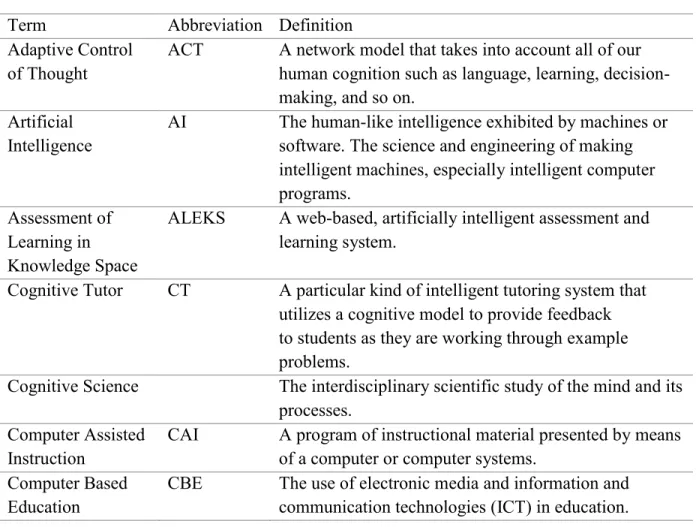
Table 1.1 lists key technical terms along with their common abbreviations and basic definitions. These terms will be referenced many times throughout the literature review and they can also be encountered in other scholarly articles on adaptive learning technologies and intelligent tutoring systems.
Table 1.1.
Definition of Key Terms
Term Abbreviation Definition
Adaptive Control of Thought
ACT A network model that takes into account all of our human cognition such as language, learning, decision-making, and so on.
Artificial Intelligence
AI The human-like intelligence exhibited by machines or software. The science and engineering of making intelligent machines, especially intelligent computer programs.
Assessment of Learning in Knowledge Space
ALEKS A web-based, artificially intelligent assessment and learning system.
Cognitive Tutor CT A particular kind of intelligent tutoring system that utilizes a cognitive model to provide feedback to students as they are working through example problems.
Cognitive Science The interdisciplinary scientific study of the mind and its processes.
Computer Assisted Instruction
CAI A program of instructional material presented by means of a computer or computer systems.
Computer Based Education
CBE The use of electronic media and information and communication technologies (ICT) in education.
Depth of Knowledge
DOK Represents the comparison of the cognitive demand of learning standards and the cognitive demand of the assessments given to determine their mastery. Hypermedia Based
Instruction
HBI Instruction based on electronic literature including but not limited to audio, video, plain text, hyperlinks, and other multimedia tools.
Intelligent Tutoring System
ITS A computer system that aims to provide immediate and customized instruction or feedback to learners, usually without intervention from a human teacher.
Knowledge Space Theory
KST A set-theoretical framework, which proposes
mathematical formalisms to operationalize knowledge structures in a particular domain.
Practical Algebra Tutor
PAT An intelligent tutoring system for algebra problem solving.
Organization of Subsequent Chapters
Chapter two of this study is a review of the literature that brings together rich discussions on relevant research topics, including an overview of adaptive learning technologies. Chapter 3 presents the research design for this study and describes the
statistical methodology used to perform hypothesis testing. Chapter 4 presents the results of the study along with data analyses. Finally, chapter 5 is a discussion of findings, conclusions, and implications of the study, and it concludes with limitations of current study and
CHAPTER 2
REVIEW OF LITERATURE
This chapter is organized to present a thorough review of relevant literature in the field being studied, in order to establish the significance of the research and to provide a benchmark for assessing the results of this study with comparable research in the field. In an effort to establish the context for the current literature in this field, the chapter starts with a brief discussion of select topics in the current landscape of American public schools, and continue with a more extensive discussion of trends and reform efforts in public education. The latter broader topic includes the conceptual framework of this study, Knowledge Space Theory (KST), as well as online Intelligent Tutoring Systems (ITS), mainly ALEKS. The literature review includes a wide range of studies on ALEKS and its effects on mathematics instruction in both secondary and post-secondary education institutions.
Current Landscape of Education in American Public Schools
American public education system was designed based on a Prussian factory model of education introduced by Horace Mann in late 1800s. This industry model of education was the right fit for decades in the twentieth century, because graduates would take
manufacturing jobs at factories that did not require higher order skills. The world has
changed dramatically since then. Advancements in technology, robotics, and automation has caused a shift towards a knowledge economy. The job markets have changed dramatically, so did the expectations of what a high school or college graduate must know and be able to do. Despite all these changes, our education system has remained almost the same for nearly 130 years.
The Skills Gap and Industry Expectations
Math skills have always been vital to employers for successful job performance. Even lower level or mid-level jobs require some kind of math skills in order to operate high-tech equipment (Agondi, Harris, Atkins-Burnett, Heaviside, Novak, & Murphy, 2009). Many states have invested in high school courses under career and technical education to make sure students leave high school with necessary mid-skills to be successful in such careers. An increasing number of business and industry leaders reported dissatisfaction with new generation workers coming out of high schools or two year colleges lacking foundational math skills to perform above average at their jobs (Vincent, 2005).
It is also known that United States has been lagging behind many other European and Asian countries in international student assessments in the areas of math and science. It has been common over the past decade for researchers and the popular press to report the deficits in U.S. student achievement relative to many other nations (Kerr, 2015). For example, Pew Research reports that the Programme for International Student Assessment (PISA), a comparative international test of mathematics science and literacy skills, ranked the United States 38th among 71 countries in mathematics, and only 24th in science. The Organization for Economic Cooperation and Development (OECD), a 35 – nation group that sponsors PISA testing, ranked the US 30th in mathematics and 19th science. (Desilver, 2017). Kerr (2016) reported in the Associated Press (AP) that the Trends in International Mathematics and Science Study, (TIMSS), which administers tests every four years in many countries, that the United States placed 10th in fourth grade science and eighth grade mathematics. Kerr also reported that American students placed 14th in fourth grade mathematics on the TIMMS, behind Portugal and Kazakhstan. Employer dissatisfaction and the increasing
negative distance between American student achievement and students of other countries are the reasons that led educational policy makers to design new and more rigorous learning standards, especially in math, which subsequently led to the adoption of common core standards by 46 states and District of Columbia in the United States (Coburn, Hill & Spillane, 2016; Watt 2015).
Mathematics Instruction in the U.S.
Many researchers also argue that in addition to a viable, coherent curriculum, it is also equally important how such a curriculum is delivered to students (Schmoker, 2011; Marzano, Waters, & McNulty, 2005). That is, we should focus both on what we teach and how we teach. This argument brings up the question of what effective instructional tools and strategies must be implemented to be able to ensure a highly effective delivery of the
curriculum. Furthermore, the delivery of instruction is supposed to make sure that all student groups (based on demographics and educational needs) master the content and skills before the teacher can move on. American public education has long been suffering from disparities of achievement among ethnic groups. Education agencies both at the federal and state levels have made countless attempts to reform public education with a single goal in mind: closing the achievement gap. The U.S. Department of Education defines the term achievement gap as follows:
Achievement gap: The difference in the performance between each ESEA subgroup (as defined in this document) within a participating LEA or school and the statewide average performance of the LEA's or State's highest achieving subgroups in
reading/language arts and mathematics as measured by the assessments required under the ESEA. (U.S. Department of Education, 2012)
Starting with No Child Left Behind Act and followed by Race to the Top initiatives, education reformers put heavy emphasis on improving math and reading instruction and
promoted personalized learning models. With personalization in mind, technology and digital learning came into picture. Now more than ever, local districts started putting individual devices into the hands of students as early as first grade in an attempt to engage learners through digital content providers. The role of the teacher shifted from provider of information to facilitator of learning (Juan et al., 2011).
According to National Assessment of Educational Progress (NAEP), also known as the nation’s report card, only 39% of fourth-graders, 34% of eighth-graders, and 23% of twelfth-graders score proficient in math. These statistics confirm that the longer students are in school, the wider the achievement gap is in math. This impacts higher education
negatively as well. The demand for remedial math courses is very high in colleges. Since many students enter into higher education with critical deficiencies in mathematics, Robathan and Wilson (2011) state that universities are obligated to rectify those deficiencies by means of remedial course offerings. According to a report by Jobs for the Future, 60% of
community college students end up taking at least one remedial math course before they are allowed to enroll in college-level courses. This is simply because many high school graduates arrive at college lacking not just basic algebra but also basic arithmetic. Varsavsky (2010) confirms that one of the main reasons why students drop out of college is their lack of mathematical skills.
Minimizing drop out and failure rates have become a major priority for university administrators across the U.S. (Gury, 2011). There is a strong need for evidence-based innovative programs and interventions, especially in math as Kezar (2011) points out, to improve student skills for college level requirements and college persistence rates. Padilla-Oviedo, Mundy, and Kupczynski (2016) suggest a blended learning model for improving
mathematics instruction that effectively complements the learning environment with a computer-based component. There has been slow but steady shifts in the educational system from traditional methods to technology-assisted instruction (Gano, 2011). The advancements in technology, computer science, and internet connectivity enabled effective utilization of technology tools in education, which has transformed the outlook of instruction in American classrooms (Juan, Steegmann, Huertas, Martinez, & Simosa, 2011). These trends are further discussed in the blended learning section of this literature review.
All of these facts point to a significant problem in our math education. Mathematics and policy experts at the National Mathematics Advisory Panel acknowledge that math education is broken and must be fixed in the United States, and they list the following six issues to be addressed (Hechinger Report, 2010):
1. Standards: There are too many content standards that are scattered and repetitive. Teachers need clear guidance on what is important. Many higher achieving countries focus on a few set of standards each year and expect students to study those in greater depth.
2. Curriculum: Elementary and middle school curricula must be redesigned to build a strong foundation in whole numbers, fractions, measurement, and basic geometry. The goal should be to prepare students to take algebra by eighth grade.
3. Graduation Requirements: Increased requirements must align with student achievement and preparedness as measured by SAT and end-of-course exams. 4. Textbooks: American textbooks are too big and cover a wide range of topics.
material without a coherent plan. Moreover, the textbooks address merely definitions and formulas and do not go beyond the mechanics of mathematics.
5. Teaching: There is no consensus among researchers about what good math teaching is. Teachers must have a deep knowledge of the math content they are teaching. Teacher preparation programs must incorporate more math content into their design. Schools and districts must support less experienced math teachers with strong mentorship and professional development.
6. Culture: American society has accepted a culture of inadequate expertise and fluency in math. It is ok for many students to say “I hate math.” Many parents do not seem to mind that their children lack basic math literacy.
There are obvious roadblocks for students to understand math. Many students experience math anxiety and teachers feel pressured to cover material too quickly. Korbey (2013) stated that math teachers are strapped for time and resources to be able to explore the beauties of math in meaningful ways. The way textbooks are designed and written as well as pressures to meet curriculum pacing requirements are among main reasons for this problem (Korbey, 2013). More students can understand and appreciate math if teachers are granted more time and freedom.
Personalized learning approaches advocate for connecting learning to student interests, which helps student retain information for longer periods of time. According to Schwartz (2013), this approach might work specifically well with math since many students dislike the subject for not seeing its relevance to their lives. In many classrooms today math is not being applied to the student’s world in a meaningful way. One strategy to change that
is tailoring questions to individual student interests when teaching difficult and abstract math concepts in particular (Schwartz, 2013).
Standardized Testing & Accountability
In recent decades, American public schools have focused heavily on standardized testing, which sometimes even supersedes instruction in importance. This prioritization has led some schools and teachers to feel pressured to “teach to the test” rather than implement authentic lesson plans to make learning more meaningful and enjoyable for students. The achievement gap among different student groups (based on demographics and educational needs) urges educators to find creative ways to use data in decision making to inform their instruction and make it more targeted. Teachers are expected to use formative and interim assessments more than ever to constantly assess student skills and knowledge. Critics who oppose testing argue that the more focus on assessments the less time teachers have for instruction. But why should we lose valuable instructional time at the expense of extracting formative data every so often? Cognitive tutoring allows integrating assessment into
classroom instruction, which enables students to learn during a test (Anderson et al., 1995). Personalized Learning Initiatives
Blended Learning. One of the emerging models that support personalized learning environments is blended learning. Simply put, this model blends individual and group instruction with facilitated technology through digital curricula. Blended learning
encompasses a wide spectrum of tools and practice such as extensive use of technology in the classroom, use of online and formative assessment, adaptive software for students, learning management systems and many other technological advancements. A formal and commonly
accepted definition of blended learning is given below by research fellows at Clayton Christensen Institute for Disruptive Innovation:
Blended learning is a formal education program in which a student learns, at least in part, through online learning. Blended learning includes some element of student control over time, place, path, and/or pace and includes learning, at least in part, in a supervised brick-and-mortar location away from home. The modalities within a course or subject along each student's learning path are connected to provide an integrated learning experience. (Staker & Horn, 2012, p. 3)
Wolf and Schneiderman (2014) stated that the ultimate goal of blended learning is personalized learning for all students.
No Child Left Behind Act (2001) was ambitiously passed by the United States Congress with an intent to to close the achievement gap in reading and math. It required schools to make adequate yearly progress with the ultimate goal of all students meeting or exceeding proficiency by 2014. Unfortunately, many schools across the nation have fallen far behind this ambitious goal. Blended learning was suggested by experts as a powerful model to help close the achievement gap in reading and math. As NCLB unfolded over the years, we have started seeing early adopters of blended learning by innovative districts and schools in different pockets of the country. Although many schools implement different curricular initiatives in math classrooms, there is little empirical research to demonstrate their effectiveness (Slavin & Lake, 2007). My research topic is the impact of adaptive learning software on math achievement and how such digital learning tools can help create
personalized learning environments for middle school students. Adaptive Learning Technologies
In the area of adaptive learning technology research, there are two groundbreaking theories that form the foundation of adaptive learning technologies. The first is called the Knowledge Space Theory (KST), developed by Jean-Claude Falmagne, a Belgium-born
American mathematical psychologist, along with his colleague Jean-Paul Doignon. Falmagne and Doignon’s research made significant contributions to educational technology,
specifically in mathematics. The second predominant theory in adaptive learning technologies is Adaptive Control of Thought (ACT).
Knowledge Space Theory. Knowledge Space Theory (KST) is a key principle used in creating artificially intelligent adaptive learning software in math. KST is basically a knowledge representation and it is based on precedence relation. Due to strong prerequisite requirements among many mathematical subjects, Falmagne et al. (2004) argued that precedence relation can be used to design effective and rigorous assessment tools. This concept revolutionized the digital learning market for K-12 math education, which is now a billion dollar industry thanks to entrepreneurial spirit of elite-class American businessmen.
Adaptive online learning programs are now being largely used in order to leverage advances in artificial intelligence and cognitive science. Falmagne and his research team explained the science behind adaptive math software through knowledge space theory. This theory makes it possible to uncover the knowledge state of a particular student in a particular math topic through an online assessment (Falmagne, Koppen, Villano, Doignon, &
Johannesen, 1990). Knowledge state is defined as the complete set of problems in a particular topic that a student is able to solve (Falmagne & Doignon, 1999). Based on this basic
principle, Falmagne and Doignon (1999) explains, an artificially intelligent adaptive
assessment creates two shortlists of problems and concepts that guide students and teachers on what each student can do and what he/she is ready to learn. These two lists uncover the complete knowledge state of an individual student being assessed (Falmagne et al., 2007).
Effective teachers first assess the knowledge state of their students, find out their strengths and weaknesses, and then attempt to tailor their lessons to meet the varying needs of their individual students. This is how, in the most basic idea, teachers can differentiate instruction to personalize learning for each individual student. Knowledge space theory simulates the skills of an expert teacher to assess the knowledge state of a student in a computerized fashion (Falmagne & Doignon, 1985). As opposed to a theory of human cognition, knowledge space theory automatically informs an online assessment of student knowledge and keeps it accurate and continuously updated. A knowledge space for a
particular math topic consists of all possible knowledge states related to that topic (Falmagne et al., 1990).
Adaptive learning software designed with knowledge space theory maps out the details of each student’s knowledge and determines whether they mastered a particular topic with that continuous assessment cycle, and it knows what they are ready to learn next based on their updated knowledge state. Such programs use this knowledge to provide feedback to learners, make learning more efficient and provide continuous growth path by offering students a selection of only the topics they are ready to learn at that specific moment in time. This, in turn, provides a personalized learning environment for students, where each learner can progress at their own pace as if they are studying with a private tutor.
Knowledge Space Theory provides a framework to be able to formally describe knowledge domain structures in particular knowledge spaces. Albert and Hockemeyer (1997) argues that “the set of possible knowledge states is restricted by prerequisite relationships between the items” (p. 553). They went on to apply this phenomenon to describe hypertext structures, where prerequisite relationships among hypertext components are specified by
prerequisite links (Albert, Hockemeyer, and Held, 1997). The structures of knowledge spaces and these prerequisite links in hypertexts turn out to be quite similar, which made it possible to design intelligent hypertext tutoring systems for individualized instruction through
combination of a hypertext model and knowledge space theory (Albert & Hockemeyer, 1997). The authors attribute the efficiency of such an adaptive hypertext-based ITS to two main things. First one is the effective procedures presented by knowledge space theory in identifying structures of a given knowledge domain. The second one is the description of a hypertext model that uses mathematical relations to connect prerequisite links to specific components of the knowledge domain within the student’s knowledge state. Applying methods of relational database theory to knowledge domain structures “concerns not only individual access to document appropriate for student’s actual knowledge but also the construction of sub hypertexts due to educational objectives or to the student’s prior knowledge” (Albert & Hockemeyer, 1997, p. 555).
Combining knowledge space theory with relational hypertext model Hockemeyer, Held, and Albert (1998) created an ITS prototype called RATH, which stands for Relational Adaptive Tutoring Hypertext. Elementary probability theory was chosen as the initial course to be incorporated into RATH as a knowledge domain due to the fact that many students had difficulties with this course, hence further instructional support was needed (Hockemeyer et al., 1998). Any other math courses could be easily added into RATH, provided that a tutoring hypertext is available containing lessons, examples, assessments, and any other teaching materials for the course. Although the initial prototype of RATH was instrumental in providing instructional support to students, Hockemeyer et al. (1998) acknowledge several areas of improvement for RATH, such as the addition of an initial assessment to determine a
student’s current knowledge state rather than starting everyone off with the assumption of zero knowledge in the course, and improving analysis of student answers to exercise questions in order to provide meaningful feedback rather than just giving a true/false response. The authors conclude that RATH was an important stepping stone for incorporating psychological theories into intelligent tutoring systems.
Villano and Bloom (1992) also used knowledge space theory as the foundational architecture of a probabilistic student model to be embedded into an ITS. The researchers were particularly interested in a probabilistic student model in order to be able to represent the uncertainty of estimating student knowledge. “Several factors contribute to uncertainty in student modeling such as careless errors and lucky guesses in the student's responses,
changes in the student knowledge due to learning and forgetting, and patterns of student responses simply unanticipated by the designer of the student model” (Villano & Bloom, 1992, p. 1). In knowledge space theory, Falmagne and Doignon, (1985) define the basic unit of knowledge as an item. Villano and Bloom (1992) considered two basic steps in the construction of their probabilistic student model: (i) building the structural relationships among the items in domains of knowledge, and (ii) determining the initial probability values in the models. Following these steps required expert judgments and/or empirical student data. The authors explored both of these approaches with the addition of a novel application of neural networks for constructing knowledge structures. This research was able to leverage knowledge space theory and its utilization to develop adaptive, computerized student assessment and tutoring systems for building a probabilistic student model in KST. The probabilistic student model demonstrated many effective applications such as adaptive assessment item selection, adaptive assessment updating routine, knowledge type
representations, curriculum representation, hint level selection, advancement criterion, and student feedback. Villano and Bloom (1992) concluded that applying probabilistic student models to an intelligent tutoring system could lead to “developing a dynamic,
non-deterministic student model capable of robust, individualized assessment” (p. 9).
Conlan, Hampson, O’Keeffe, and Heller (2006) presented a series of case studies where KST principles were applied to the analysis and determination of a learner’s knowledge for creating highly effective adaptive systems to support learner modeling and personalization in instruction. Over the course of six years, the researchers designed and refined an adaptive engine which powers the personalized learning services for adaptive instruction. The first case study examined a personalized course on mechanics, which tested the initial prototype of the adaptive engine in 2001. The adaptive nature of this personalized physics course was four-fold. It started with a pre-test to build a basic model of the learner’s initial knowledge. Next, the dynamic personalization mechanism presented a series of modules that the learner is capable of mastering. As the learner interacts with the eLearning modules and consumes the course materials, the dynamic modeling tool mapped out the learner’s evolving competencies aligned to created modules and objectives of the course. And the final piece of its adaptivity was learner choice to expand the course, which meant that additional content would be added to the eLearning space when learner decided he/she is ready to learn more, provided that all prerequisite content is already mastered.
The second case study presented by Conlan et al. (2006) was called Personalization in iClass, and it examined two particular personalization technologies. One is the
personalization of content and activities, while the other is monitoring and profiling the learner. The authors report dramatic evolutions in both the use of adaptive engine and the
implementation of knowledge space theory during the iClass project. One innovative approach in this case study was to incorporate confidence degrees in knowledge assessment by soliciting the confidence degree of the respondent after each question item. Another addition to the initial assessment was to assess also skills along with concepts. The confidence degree attached to each response enabled the adaptive engine to create more robust personalization experience for learners as it hinted the ITS whether a wrong answer was merely a guess or a serious misconception. The iClass program offered a more powerful personalization experience with a two-fold approach: (i) the Selector service that adapts concepts and activities recommended to a learner based on their knowledge and personal preferences, and (ii) the LO generator that selects new learning objects from the content pool. Conlan et al. (2006) reports this separation of knowledge assessment from the
personalization of eLearrning as the primary advancement made through this case study. In the first case study presented above, the knowledge assessment approach was intricately tied to the adaptation mechanism. “This separation has enabled the evolution of the knowledge assessment to be carried out independently to the evolution of the personalized eLearning, thus enabling different pedagogical approaches to be adopted for different learners while still using the same knowledge assessment facilities” (Conlan et al., 2006, p. 1916).
Adaptive Control of Thought. The second theory supporting human-computer interaction as a teaching/learning tool is also widely used in cognitive learning systems, and is called adaptive control of thought (ACT), developed by Kenneth Koedinger, a cognitive psychologist at Carnegie Mellon University. Koedinger extensively studied human-computer interaction and his research significantly contributed to the development of intelligent
designed to provide personalized instruction and immediate feedback to students while assessing their knowledge and skills (Koedinger & Aleven, 2007). Cognitive tutors are designed based on a set of eight principles of the advanced computer tutoring theory, which are listed as follows:
1. Use production system models of the student
2. Communicate the goal structure of the problem space 3. Provide instruction on the problem-solving context
4. Promote an abstract understanding of the problem-solving knowledge 5. Minimize working memory load
6. Provide immediate feedback in errors
7. Adjust the grain size of instruction according to learning principles
8. Enable the student to approach the target skills by successive approximation (Anderson, Boyle, Farrell, & Reiser, 1987)
Similar to knowledge space theory, adaptive control of thought also provides means to assess current knowledge and skills of a student, thereby providing personalized instructional methods via intelligent tutoring systems (Anderson et al., 1987; Koedinger & Aleven, 2007).
Although there is evidence that computer-aided instruction and intelligent tutoring systems increased student engagement and motivation in math classes (Schofield, 1995), it would be naïve to assume that such tech-enabled classrooms are exempt from motivation and engagement issues that are chronic in traditional lecture-based classrooms. Aleven and Koedinger (2001) stated that some students misuse intelligent tutoring systems designed with principles of adaptive control of thought. Baker, Corbett, Koedinger, and Wagner (2004) conducted a study on off-task student behaviors while working with a cognitive tutor. The
researchers found that students who misuse the cognitive tutor and cheat the system learned only two-thirds as much as their counterparts who used the system properly. The misuse of the tutoring system was referred to as “gaming the system” which meant systematically abusing the feedback and help features of the program for the sole purpose of finding correct answers and advancing through the material as quickly as possible (Baker et al., 2004). This study provoked the idea of designing enhanced ITSs which can adapt to not only varying levels of student cognition but also differences in student motivation. This requires a robust assessment of motivational state of students. Baker, Corbett, and Koedinger (2004) further investigated motivational issues when students interact with ITSs and ways to remedy such issues. During their study, Baker et al. (2004b) observed students gaming the system in two different ways, one by abusing the help feature and the other by engaging in systemic trial-and-error. The authors reported a strong negative correlation between a student’s frequency of gaming and their learning gains. Interestingly, they also reported no significant correlation between learning and other off-task behavior such as talking, sleeping, web-surfing, etc. This finding suggests that various types of low motivation do not impact learning outcomes the same way. When choosing a remediation approach to prevent or reduce gaming, it is critical to be able to detect which students are gaming the system and which ones are not, because the remediation approaches will likely frustrate learners who do not engage in gaming the system. Therefore, Baker et al. (2004b) “present and discuss a machine-learned Latent Response Model (LRM) that is highly successful at discerning which students frequently game the system in a way that is correlated with low learning” (p. 535). Creating an algorithm to accurately detect which students were gaming the system was the purpose of this study. In order to accomplish this, Baker et al. (2004b) included a sample of 70 students
using the same cognitive tutor lesson during their regular math instructional setting. Three different types of data were collected and combined as participating students interacted with the ITS. The first data set was recording a log of student activities for each student, the second data was observations of student behavior, while the third data came from learning outcomes of the participants. By following the patterns and frequency of errors in student responses and cross-validating this data with learning outcomes, the algorithm calculates probability rates for estimating whether a student is gaming or not and whether their learning outcomes were hurt due to gaming. Out of the 70 students participating in the study, the algorithm reported 53 students never engaged in gaming, 9 students gaming the system but not impacted negatively by their gaming behavior, and the remaining 8 students engaged in gaming with low learning outcomes. This machine-learned Latent Response Model (LRM) was proven to be able to detect gaming students who have low learning outcomes with high accuracy. Baker et al. (2004b) indicates that this research will have significant contributions to the further development of intelligent tutors that can adapt to behavioral characteristics of students as well as their knowledge and cognition levels.
Cognitive Science & Intelligent Tutoring Systems
Technological advancements across the world in the past few decades caused
tremendous shifts in the way we live, work, and organize our lives. Industries and jobs have also gone through major transformations that changed the outset of the global economy. For example, automation and coding almost completely wiped out manual labor needs in
manufacturing, networking, and infrastructures. Advancements in computer science and software design enabled major breakthroughs in the field of artificial intelligence, which has been quite instrumental in education. Online and digital learning mediums powered by
artificial intelligence and smart algorithms continue to create huge opportunities for cognitive science to expand learning methodologies and their efficiency in education. Online adaptive instructional programs have been designed to interact with learners by mimicking human responses and attitudes when providing performance feedback and learning
recommendations to users, very much like the recommendation engine we see at Amazon or Netflix that customizes experience to user needs, interests, and personal preferences. Such educational software programs have the potential to function as an Intelligent Tutoring System (ITS) or as a cognitive tutor through machine learning.
Anderson et al. (1995) report significant achievement gains through use of cognitive tutors, where students in some cases reach the same proficiency levels as in traditional instructional setting in one-third of the time. The rich problem-solving environment
combined with instructional guidance through step by step feedback and on-demand content hints are some of the features that make these theory-based tutoring systems highly
interactive and appealing to learners (Koedinger & Aleven, 2007). As intelligent tutoring systems have matured and more widely used in K-12 education, more researchers have been attracted to the adaptive learning technology field. One intriguing question posed by
Koedinger and Aleven (2007) was “How should learning environments balance information or assistance giving and withholding to achieve optimal student learning?” (p. 239).
How best to achieve this balance remains a fundamental open problem in
instructional science. We call this problem the “assistance dilemma” and emphasize the need for further science to yield specific conditions and parameters that indicate when and to what extent to use information giving versus information withholding forms of interaction. (Koedinger & Aleven, 2007, p.239)
Intelligent tutoring systems provide a powerful tool for educators to leverage
are merged with the evolving power of the Internet, effective learning in math becomes scalable and personalized for every single student. Before intelligent tutoring systems, more traditional computer-based instruction was in use, which was not as robust as ITS in terms of tracking student performance and adjusting the teaching approach based on the needs and strengths of students (Woolf, 2009).
A number of researchers reported positive learning outcomes in math as a result of using computer-aided instruction, including ITS models (Murphy, Penuel, Means, Korbak, Whaley, & Allen, 2001; Beal, Arroyo, Cohen & Woolf, 2010). On the other hand, some researchers claimed that many computer-based instruction studies had design flaws, which made their findings invalid (Waxman, Lin, & Michko, 2003). According to Waxman et al. (2003), many studies were only descriptive and lacked relevant data and specificity, and only a handful created a randomized experimental design.
One of the evaluation studies examined use of a computer-aided algebra tutoring program by PLATO Learning in a high school remedial math setting. The overall program objective was to boost student performance on state mandated testing. In this comparative experimental study, a treatment group of 87 students spent 80% of the instructional time on PLATO’s computer-based algebra program, 39 students in the control group received regular instruction without any use of technology. Hannafin and Foshay (2006) reported significant gains made by both treatment and control group on the state exams. While the mean score for the control group was a lot higher than the mean score for treatment group, the achievement gains of the treatment group were significantly higher than the gains made by the control group (Hannafin & Foshay, 2006).
In a similar study, Koedinger, Anderson, Hadley, and Mark (1997) evaluated an algebra curriculum called PUMP, which also had a supplemental intelligent tutoring system called PAT. In this rather larger experimental study, the treatment group included 470 students enrolled in algebra classes who were taught with PUMP curriculum and used the ITS as well. The control group had 120 students also enrolled in algebra class who did not use the ITS at all and were taught with a traditional curriculum. Students were given two standardized tests and two custom-created tests by the end of the class, and the students in the treatment group outperformed their counterparts in control group on all tests (Koedinger et al., 1997).
A rather contemporary study attempted to evaluate and compare the performance of students from two Algebra I classes; one that uses a computer-based instructional software and another that uses an intelligent tutoring system. Campuzano, Dynarski, Agodini and Rall (2009) set up a control group where students accessed Larson computer-based algebra program as part of their traditional curriculum, while the treatment group used Cognitive Tutor as the core algebra curriculum. Control group students accessed the program 313 minutes per year over 6-week periods. Treatment group students used the Cognitive Tutor software an average of 2,149 minutes per year over a 24-week period. This large scale study reported no significant difference between the performances of treatment and control groups using computer-based and intelligent tutoring softwares for algebra instruction (Campuzano et al., 2009).
Barrus, Sabo, Joseph, Atkinson, & Perez (2012) conducted their research by means of a summative evaluation of two off-the-shelf intelligent tutoring systems: Carnegie Learning’s Cognitive Tutor and ALEKS. The goal of this study is to measure the effectiveness of these
two ITS models when they are used as an exclusive method of instructional delivery. 30 remedial high school algebra students were selected and they were randomly assigned to either ALEKS or Cognitive Tutor and worked on their respective adaptive software every day during the 14-day summer school. Students’ gains in math were measured through the Accuplacer algebra and arithmetic reasoning subtests and both groups made significant gains from Day 1 to Day 13 using either ITS model (Barrus et al., 2012).
In another recent study, Nwaogu (2012) conducted research on ALEKS by means of a quasi-experimental study using one-group, non-randomized, pretest-posttest design to
measure the effect of ALEKS on student math achievement. 80 students participated in this study as part of an online 5-week long summer College Mathematics course. Nwaogu (2012) reports a strong correlation between the concept mastery and achievement scores on the quizzes and posttest. There was not a significant relationship between time spent learning in ALEKS and achievement scores. The results also did not suggest any correlation between the two independent variables: concept mastery and time spent learning in ALEKS (Nwaogu, 2012).
Foster, et al (2016) studied the effects of using Building Blocks Software, specifically with kindergarten – level low income and minority children in an urban school district. Student – subjects for this study were 243 monolingual and predominantly minority (63% black, 30% Hispanic, 4% mixed/other and 2% White) who attended a Title I school. Students’ pre – and post – test scores (beginning and end of kindergarten year) on the "Research Based Early Math Assessment," were recorded as a measure of numeracy. Subjects were randomly selected to receive Building Blocks Software (mathematics) or "Earobics Step 1", a literacy oriented computer - assisted tutoring program. The authors
found a significant positive affect of using Building Blocks Software to supplement instruction (F(1, 178) = 8.08, p < 0.01), controlling for subjects’ initial numeracy sc