VERONICA MWINKOM KUUMWAAR
TEACHERS’ PERCEPTIONS ABOUT THE USE OF TECHNOLOGY IN THE CLASSROOM IN BASIC SCHOOLS IN GHANA
Master’s Degree
FACULTY OF EDUCATION Learning, Education and Technology
University of Oulu Faculty of Education
Veronica Mwinkom Kuumwaar: Teachers’ perceptions about the use of technology in the
classroom in basic schools in Ghana.
Master’s Thesis in Education, 53 pages, 1 appendix June 2020
Abstract:
The aim of this study is to examine teachers’ perceptions concerning the use of technology as a tool that enhances teaching and learning in the classroom for basic schools in Ghana. The study seeks to identify the gains and challenges associated with basic school teachers that could promote or impede the usage of technology in the classroom. Their teaching, problems that can
cause the use of it and limitations. The study analyzed the teacher’s perceptions, whether
neg-ative and positive, towards technology use in the classroom.
The study was conducted using a sample collected from four regions of Ghana. The number of participants involved was 200, and the instrument was a questionnaire with 60 questions based on a Likert-scale type. The main statistical tools used in analyzing the data included frequency, percentages, standard deviation, mean, and hierarchical regression analysis.
The results from the study show that basic school teachers in Ghana generally exhibited a pos-itive perception and attitude for using technology in the classroom. Participants who are younger or have less teaching experience were more willing to adopt to the use of technology in the classroom compared to teachers with much teaching experience.
The conclusions of this study reveal that basic school teachers were generally of a positive attitude towards the use of technology in the classroom. They also consider technology to be optimistic to their pupils. The teachers acknowledged how beneficial the implementation and use of technology in classrooms could enhance their teaching performance. Also, most of the teachers suggest that limited resources and skills training could impede effective usage of tech-nology in the classroom.
This research work could for addressing some of the challenging associated with one main stakeholder such teachers with regards to the effective implementation of technology in the classroom for teaching and learning purposes.
Contents
1 INTRODUCTION ... 1
1.1 Background ... 1
1.2 Significance of the study... 4
1.3 Scope and organization of the study ... 4
2 THEORETICAL FRAMEWORK ... 6
2.1 Classroom Technology Usage ... 6
2.2 Technology to support learning ... 7
2.3 The role of teachers in technology usage ... 9
2.3.1 Teachers perception about technology ... 9
2.4 Appropriate Use of Technology in teaching and learning ... 10
2.5 Factors that affect the use of technology ... 11
2.5.1 Extrinsic factors ... 11
2.5.2 Intrinsic factors ... 12
2.6 Empirical review ... 13
2.6.1 Teachers’ attitude or perception of technology use in the classroom ... 13
2.6.2 Type of Technology used by teachers in the classroom ... 14
2.6.3 How technology used in the classroom ... 15
2.6.4 Factors that affect teachers use of technology ... 16
2.7 Ghanaian educational policies on technology ... 17
3 METHODOLOGY ... 20
3.1 Aims and Research Questions ... 20
3.1.1 Hypothesis ... 20
3.2 Research method ... 21
3.2.1 Context and participants ... 22
3.2.2 Data collection ... 22
3.2.3 Data Analysis Process ... 24
4 RESULTS ... 25
4.1 What attitudes or perceptions do teachers exhibit about use of technology in the classroom? ... 25
4.2 What type of technology and how is used by Teachers in the classroom? ... 27
4.3 What are the factors that affect the use of technology in the classroom ... 30
4.4 Teachers perception based on the participant teaching experience ... 32
5 DISCUSSION ... 35
5.1 What attitudes or perceptions do teachers exhibit about use of technology in the classroom? ... 35
5.2 Type of technology, and how is the technology used in the classroom by teachers? ... 38
5.4 Perceptions teachers exhibit about use of technology in the classroom based on their teaching
experience. ... 41
6 CONCLUSIONS ... 43
6.1 Recommendations and future research ... 44
7 EVALUATION ... 46
7.1 Limitation of the study ... 46
7.2 Validity and reliability ... 46
7.3 Ethical issues ... 47
REFERENCES ... 48
List of Tables and Figures
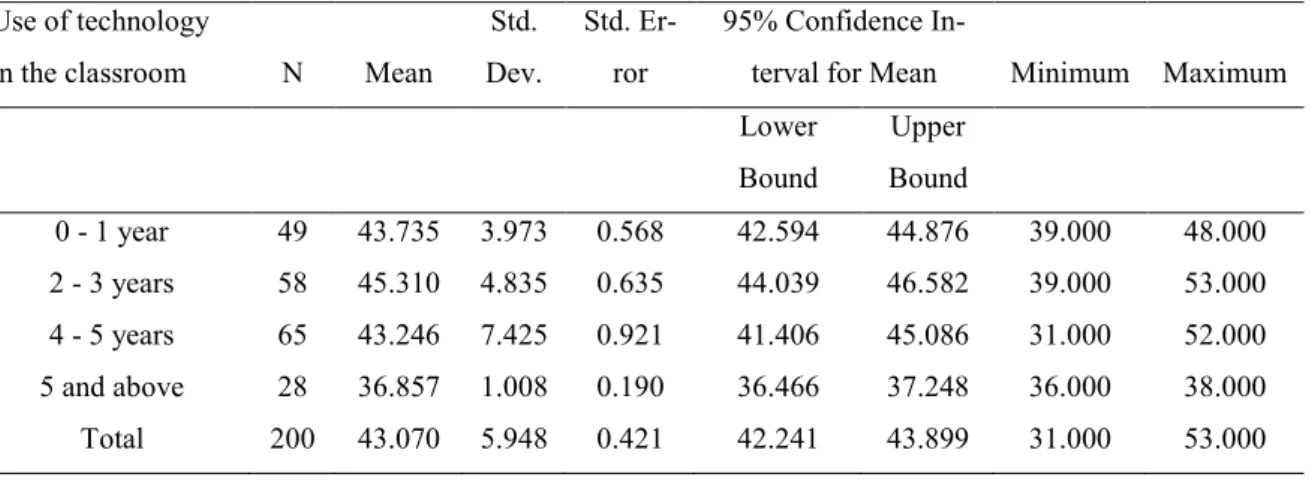
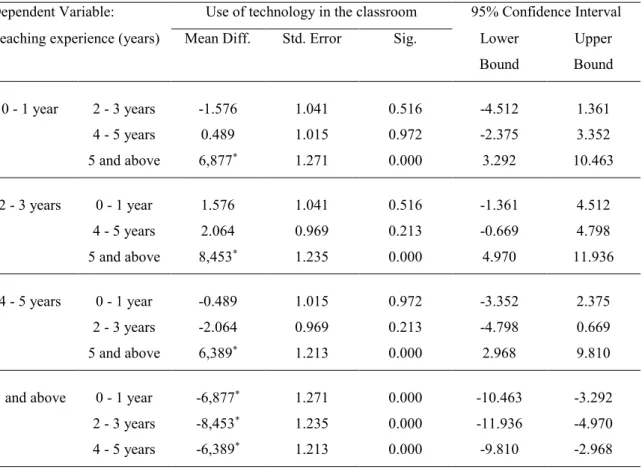
Table 1. Teachers attitudes or perception towards the use of technology in the classroom .... 26 Table 2. What type of technology and how it is used by Teachers in the classroom. ... 29 Table 3. Hierarchical regression of level of intentions ... 32 Table 4. Descriptive analysis for the use of technology in the classroom based on teaching experience ... 33 Table 5. Multiple Comparisons for teaching experience to the use of technology in the classroom. ... 34
Figure 1. Simplified educational structure for Ghana. ... 19 Figure 2. A bar chart the types of technological options available for teachers to use in the classroom. ... 28
1
INTRODUCTION
The main background of this study is explained with some literature materials that concern the topic for the current study in this section. The section also highlights thesignificance of the study, the scope and how the thesis is structured.
1.1 Background
Technology has become the main driver of civilization in recent times, thereby being de-scribed as the greatest gift for humanity. According to Sutton (2013) since its inception tech-nology has controlled generally every activity due to its impact on various disciplines. Thus, over the last two decades, many cellular devices have found their way into society, which has changed the way people interact. Given the rapid advancement and reliance on technol-ogy in society, Cascio and Montealgre (2016) iterate that its impact is significantly changing the working environment concerning inputs and outcome (performance). This implies that the penetration of technology has transformed the working system. This is because of the introduction of the use of clouds and mobile communicating, sensors, robotics among sev-eral others.
The use of technology in the education has not only made academic work faster and easier but has improved knowledge and contributed to high productivity levels for both teachers and students (Kwesani, Banerjee & Patni, 2008). For instance, Raja and Nagasubramani (2018) indicated that the introduction of technological tools such as software in education enriches classroom learning. Thus, technology has aided the transfer of knowledge in a con-venient way where there is an interactive means of learning. Because of this, it has become imperative that technology in schools is regularized to enhance teaching and learning. Martin (2007) asserts that technology in education bares a well-founded pedagogy that serves that interest of students both in and outside a country. One such means is online education that facilitates a convenient academic process; thus, the language of one state can be translated easily to enhance teaching and learning. Ascough (2002) is of the view that effective educa-tion requires the awareness of the opportunities and limitaeduca-tions of the model of educaeduca-tion. Therefore, technology comes as a medium through which increase educational success.
The presence of technology at all levels of education is undoubtedly a fundamental aid for improved teaching and learning as many developed countries who have used technology
have far advanced in education. Thus, Klopfer, Osterweil, Groff and Haas (2009) affirms that technology and education are closely related, hence the tendency for it to improve teach-ing and learnteach-ing. However, if they are not used appropriately, the link between knowledge and accomplishment will be lost. Therefore, effective integration of technology depends on several factors, including teachers’ positive attitudes and perception concerning its use in the classroom as well as their competencies about usage (Gorder, 2008; Selvi, 2010). To achieve that, many countries have introduced IT models into school curricula and hence implemented technology training sessions to improve teacher competencies which attract, values, attitudes and practice (Khan, 2014).
Despite the link established between technology and education, factors such as perception and attitudes towards the use of technology in the classroom cannot be overlooked. Besides that, numerous studies, however, have shown that the use of technology impacts immensely in teaching and learning. Thus, a lot of studies have been conducted to ascertain that fact. One of such is Mundy, Kupcczynski and Kee (2012) whose study examined the perception of teachers regarding the use of technology in schools in the USA. This study involved teach-ers who underwent technology empowerment sessions. The results indicated that teachteach-ers perceived a significant increase in engagement during teaching and learning, as well as the enthusiasm of students to learn more when technology is used in the classroom.
In Pakistan, Zehra and Bilwani (2016) examined and compared the perceptions of teachers in elite and mediocre schools in Karachi. The study was carried out using the exploratory design coupled with a qualitative approach to address the research questions. From this study, teachers’ perception and attitude were favorable towards technology use in the class-room. Unlike Zehra and Bilwani’s (2016) work, Ansong-Gyimah and Sarfo’s (2010) study involved teachers, students and the educational officers examined their perception on the role of computers in the classroom. The results, however, revealed diverse views concerning the role of computers in schools. The study suggested that students had a higher positive perception about the use of computers compared with teachers about in terms of the effect of the technological tool on the quality of teaching and learning. Boadu (2014) revealed that teachers had a strong perception of the importance of technology in teaching history in sec-ondary schools. These studies were done involving second cycle and tertiary institutions. Based on this background, the study seeks to examine the perception of teachers on the use of technology in basic schools.
In the past, the development of a country was built on both natural and human resources and literature suggests that the latter is more crucial in national development than the former (Slaus & Jacobs, 2011). For instance, human resources have been more engaged in schools to impact knowledge into learners. On the other hand, technology has lately been noted to facilitate many challenging activities and have many times been used to replace outmoded practices, functions and style of engaging students in academia. Technology is, however, skewed towards the industrial discipline of Ghana’s economy, thereby increasing a techno-logical gap between education and industry. Thus, technology is far advanced in business, sports, mining and health. Ghana’s educational systems lag because according to Jackson (2019), the country has not been able to adapt and integrate technology into its education. This could be associated to some factors, including high incompetence levels and reduced perception of teachers since they could be kept out of the teaching field.
In that respect literature, various studies like Aminiu and Samah (2019); Dogan (2010) and Boaten (2007) have suggested the critical role technology could play in the learning envi-ronment and the outcome of its integration into education. The study by Dogan (2010) used data obtained from 2008-2009 academic years which is over a decade ago. There has been relatively a considerable amount of time between Dogan’s work and now as much has hap-pened over this period concerning technology. Thus, the data cannot be related to the current educational system with the existence of technology. Also, the use of descriptive design, which is characterized by observational, cannot allow for a repetition currently since there have been changes over the period.
Besides that, Aminu and Samah’s (2019) work through current, involved less than 50 teach-ers whose responses cannot be generalized since a small sample size reduces the reliability of the results of the survey thereby increasing variability and the margin of error. Similar to Dogan (2010), Boateng’s (2007) study is over a decade. Hence, the results cannot be used to make current generalizations considering the advancement in technology. Also, the study only focused on rural secondary education whose geographical location might affect the re-sult of the study. Given these, there is the need to carry out this study since the literature gap has been identified. Thus, the current study focused on examining the perception of teachers about the use of technology in the classroom in basic schools in Ghana.
1.2 Significance of the study
Perception and visualization have become more critical in the learning process, which is noted to improve teaching and to learn in the educational system, especially for developing nations such as Ghana. Hence, the study result can contribute significantly to the Ghana Educational system regarding how teachers’ attitude could influence the use of technology in the classroom. This is because the perception and attitudes of teachers will be determined, and this will inform the appropriate sector (s) within the educational system to formulate policies that will incorporate technology into academic curricula. For the effective imple-mentation of this policy, the empowerment of teachers will play a key role in the formulated policy. This study will provide the opportunity to assess the general view of precautions for teachers to address any potential negative perception and acquire positive conceptions about technology. The study results will also serve as a reference for future studies. Consequently, based on the results obtained from this study, it could be useful for future curriculum devel-opment by policymakers in the educational sector to some background information for the implementation of ICT in teaching and learning purposes in the classroom from the perspec-tive of teachers’ opinion are concerned.
1.3 Scope and organization of the study
The study seeks to examine the perception of teachers about the use of technology in the classroom in basic schools in Ghana. The research is focused on teachers of basic schools within four regions in Ghana out of sixteen Regions which included Asanti Region, Northern Region, Upper East and the Greater Accra Region of Ghana. The selection of the sample population structure gives better sample teachers opinion in the context of Ghana. The study is only considered to the use of a quantitative method which gives a better understanding of the research problem yielding complete evidence. Thus, this will help to address the research objectives appropriately. This study consists of six main chapters.
Chapter one presents the introduction of the study. Chapter two focuses on the theoretical framework and review of literature related studies where the main concepts and definitions associated with this study are explained. The chapter is structured under the introduction, conceptual framework and empirical review. The chapter further emphasizes the classroom technology use, technology to support learning such as computer-supported collaborative learning (CSCL) and technology-enhanced learning. Additionally, teachers involvement in
technology, factors that affect the use of technology, where empirical reviews such as teach-ers’ attitude or perception of technology use in the classroom, type of technology used by teachers in the classroom, how technology used in the classroom and factors that affect the use of technology.
Chapter three covers theaims, research questions and methodology. The methodology com-prises of features such as the context and participants, sample size determination, data col-lection procedure, and data analysis process. Chapter four covers the presentation of the results of data analysis and are presented based on the research questions and objectives. Chapter five the discussion of these results, which demonstrate the interpretation of the sults, supported with some literature associated with results analysis and significance of re-sults. Finally, chapter six presents the summary, limitation, reliability and validity, conclu-sion and recommendations for the study.
2
THEORETICAL FRAMEWORK
This chapter reviews studies that relate to the current research topic under the research ob-jectives. The chapter provides and discusses the main terms used in this research work under sub-sections constituting conceptual review. Furthermore, this section covers the explana-tion of the terms in the research topic. Thus, it provides a generalized idea concerning the subject matter. These include the use of technology in teaching and learning, teacher’s role in technology use, teacher’s attitude towards technology usage as well as factors that affect the use of technology.
2.1 Classroom Technology Usage
Bozemann (2000), describes technology as a process that enables people to perform func-tions efficiently, which is generally applicable to all works. Thanyi and Roath (2002) also add that technology is a kind of information that is not easily reproducible and transferable; hence, known as tacit knowledge. In defining the term technology; however, all the elements must be understood as linked to each other whereby a variation in one aspect can cause an impact in the other. Given this, technology can be said to be inseparable.
Using these elements above, Isman (2012) defines technology as the practical application of knowledge in a particular discipline. This can be explained as a manner of accomplishing a task with the help of applying a technical process or methods and knowledge. Wahab (2012) also add that technology can be defined as consisting of the necessary knowledge system, technical support (software) and a capital embodied technology (hardware). In a nutshell, the definition of technology is envisaged in terms of object, knowledge, process, volition and applied science.
Recent trends in education require a significant shift from the mere provision of technolog-ical tools in the educational environment into a comprehensive use of technology. Royer (2002) suggested that the more teachers were involved in preparing the classroom for tech-nology, and more possibilities are provided for them to use that technology for instruction. The use of ICT in classrooms provides innovative opportunities that assist in increasing the efficiency and effectiveness of teaching and learning. However, implementation of technol-ogy potentially could have an impact on the educational theory and its application to the education curriculum. Wang (2002) illustrates that teachers perceive their roles as being
more teacher-centered and less student-centered in classrooms that did not have computers. Additionally, the use of computers and other technological accessories are considered essen-tial tools for the 21st century compared to the previous generations where the use of pencil and paper were considered as the primary learning tool (Ntoliopoulou, 1998).
Nevertheless, teachers did not realize that their roles would be different in a classroom with computers. (Snoeyink & Ertmer, 2001–2002) suggests that teachers’ skills and beliefs about the use of technology can influence their adaptation of technology. Also, Zhao and Frank (2003) said, teachers’ ideas, experiences, pedagogy, and technological skills can influence technology integration into the school culture. Beliefs are personal and challenging to ad-dress in staff development and take time to change, and even if they do change, the process can take years.
The use of technology in the classroom is much related to teachers’ attitudes towards ad-dressing the technological barriers inherent in the traditional deployment of technology in schools. These barriers reflect the school culture and affect a teacher’s belief system or self-efficacy and the ultimate impact of using technology in the classroom. Brzycki and Dudt (2005) suggest that there are some difficulties and challenges such as time, support, models, infrastructure, and culture that continue to reappear with new technologies applications tech-nology in the teaching and learning.
The introduction of technology in an organization requires that training of staff is carried out to ensure the effective use of the accessory such as new equipment for the implementation of the latest Technology (Emad, 2010). This concept applies to the use of ICT in the class-room since most staff, such as teachers, are the main stakeholder in the implementation of ICT in classrooms.
2.2 Technology to support learning
Collaborative learning (CL) and Computer-supported collaborative learning (CSCL)
Collaborative learning (CL) can be defined as an educational approach to teaching and learn-ing with the involvlearn-ing of small groups of the student (learners) to solve a problem or com-plete a task thereby promoting collaboration among themselves towards enhancing and op-timizing each other's learning capacities (Johnson & Johnson, 1999, Marjan Laal & Seyed Mohammad Ghodsi, 2012).
According to Domingo (2008), collaborative learning requires teamwork with clearly de-fined assigned roles and not just working together as a group, ensures the task is accom-plished. (Marjan Laal and Seyed Mohammad Ghodsi, 2012, Panitz, 1999) recognizing the contribution of CL to the learning process, described the benefits of CL into four main cat-egories. These include; academic benefit (promotes student critical thinking skills and active involvement in the learning process), psychological benefit, (reduces anxiety and improves students' self-esteem through active cooperation) and social benefit (ensures collaboration and build diversity and understanding among students).
In Collaborative learning, the process of working together towards achieving the group tar-get is generally the wish of all members, however research studies conducted by Lasse Lip-ponen, 199 identified some obstacles associated to the effectiveness of CL. The challenges related to CL demonstrated by Lasse Lipponen (1999) includes students' lack of collabora-tive skills, competence status, free-riding attributable impediments such as lack of interper-sonal and teamwork skills.
The introduction of technological tools such as computers and additionally, the introduction of collaborative learning in small groups become increasingly has become essential in the educational system. Therefore, Computer-supported collaborative learning (CSCL) accord-ing to Stahl, G., Koschmann, & Suthers, D. (2006) emergaccord-ing branch of the learnaccord-ing sciences concerned with studying how students can learn together aided with computers. Further-more, computer-supported collaborative learning (CSCL)can also be explained as where a group of learners’ construct knowledge through negotiation, explanation, argumentation and interaction using technology (Kreijns, Kirschner, & Jochems, 2003; Stahl et al., 2006). CSCL promotes 21st-century skills such as critical thinking, information and media literacy, creativity, communication skills, collaboration, and contextual learning, the CSCL approach in classroom learning is needed (Lambert & Cuper, 2008).
Also, Wang and Kinuthia (2004) define technology-enhanced learning environments as hav-ing four characteristics: ‘the use of technology to motivate students, the use of technology to enhanced teaching and learning materials, the use technology during the teaching process to implement learning and instructional strategies and the use of technology for assessment of learning outcomes and objectives. A computer environment can improve the magnitude and quality of social interaction among students and between teachers and students (Brandon & Hollingshead 1999).
2.3 The role of teachers in technology usage
The implementation of technology in the classroom generally depends on the part played by teachers. Teachers are responsible for creating a very creative and exciting environment in the classroom that meets student needs (Clements, 1995; Kleiman, 2000). The application of technology in the classroom to enhance students learning process requires that the teach-ers are given the necessary training that makes them competent, capable and well informed about the use of technological tools available for teaching. Also, the approach of teaching and its impact on the children’s learning ability needs to be considered since it can affect the learner’s development and relationships (Bolstad, 2004).
Generally, some teachers have a perception about the use or even may not be interested in using technology in the classroom. The use of technology should be structured in a way that teachers are encouraged to actively participate in assisting students in developing their in-terest in using ICT as a learning tool. Kelley (2002) illustrated that there is a challenge of effectively implementing technology as a result of lack of proper training for teachers. Therefore, it is important to give teachers enough time to explore and understand how best they could use the technological tools available for effective teaching and impact positively on the student learning process.
2.3.1 Teachers perception about technology
Perception can be describedas attitudes, behaviors, self-beliefs, and views that a person has developed towards anything (Boulton,1997). Based on Boulton’s description of perception and relating to the scope of this study, teachers’ perceptions could be referred to as the atti-tudes, behaviors, self‐beliefs, opinions or views and the understanding of what teachers hold towards the application of technology in a learning environment such as ICT in education. Teachers’ perceptions could also explain the beliefs/views that teachers have about the rel-evance of integrating technology into teaching and learning. Furthermore, teachers’ percep-tions using technology could indicate about the teachers’ opinions/beliefs, including their self-efficacy on technology usage into teaching and learning.
According to Wang (2002), the teacher’s perception of the use of technology could be ex-plained as to how teachers regard, understand and interpret the use of technology in teaching and learning. Perceptions teachers exhibit towards the use of technological tools such as computers in teaching and learning are important factors to the success or failure of the use
of ICT in education system (Apeanti, 2014). Yan and Zhao (2006) suggest that technology adoption lies in teachers’ goals and perceptions. Warschauer (2007) established that schools with a higher socio-economic status integrated technology more easily because teachers are confident that students usually have access to computers for their daily activities. Schools with a lower socioeconomic status could compensate for this difference by providing them with laptops for home use or making computer laboratories or room available all the time for more efficient use. According to Warschauer (2007), boys tend to use computers for activities such as gaming, and girls prefer to use it for communication and networking. Schools are, therefore required to develop more effective strategies by incorporating tech-nology in the classroom for teaching and learning.
The availability and use of technology in the classroom allow students to engage in a more productive way of thinking, literally a hands-on learning experience in which makes teach-ing and learnteach-ing more practical and entertainteach-ing for students. Hence, they can develop and accomplish skills that would be impossible with the traditional method of teaching.
The introduction of ICT affects the way teachers traditionally approach teaching more in-novatively. Generally, teachers are involved in setting up the needed technological tools in the classroom and will potentially have a positive perception to use technology for instruc-tion (Royer, 2002). However, some experienced teachers, especially the older generainstruc-tion, still have misconceptions or opinions about the use of technologies for the educational field (Lyle 2009). Therefore, teachers with no or less ICT experience are most probably will not be motivated to use technology in the classroom since they may not appreciate the benefits of using ICT to aim in teaching (Cope & Ward, 2002).
2.4 Appropriate Use of Technology in teaching and learning
The use of technology could now be considered as an essential component in education since it enhances how subjects are taught in the classroom and have the potential for transforming a learning environment to a more interactive one (Lowerison, Sclater, Schmid, & Abrami 2006). Although the use of technology in classrooms is generally considered to progress positively in teaching and learning, the implementation and its effectiveness are greatly in-fluenced by the purpose and the skills of the person using it (Burbules & Callister 2000). The nature of ICT training and skills offered to teachers affects their way of delivery and the appropriate use of ICT in the classroom. Therefore, the selection of ICT tools and decisions
suitable for the learning environment supports the children learning ability (Bolstad, 2004) since teachers serve as facilitators and intermediate between technology and the classroom (Livingstone 2012).
The integration of ICT into the classroom could be a powerful tool, and when effectively implemented can enhance the learning of school children. Additionally, the technology used appropriately in the classroom could be an influential tool that enhances the learner’s poten-tial and facilitates the learning process (Wardle, 2002).
2.5 Factors that affect the use of technology
The application of technology in the classroom continues to see as a growing phenomenon. However, the implementation and its integration have some challenges as identified by Ge-bremedhin and Fenta (2015) such as limited technological infrastructure and lack of tech-nical assistance on the part of the main stakeholders' such as teachers. The potential chal-lenges associated with the use of technology can be classified as extrinsic and intrinsic fac-tors.
2.5.1 Extrinsic factors
Various aspects of people’s lives are shaped by circumstances surrounding them as such extrinsic factors refer to the details related to the social environment. Thus, external factors such as the learning environment tend to contribute to a learner’s cognitive development and learning abilities (Sizer, Sawyer, Felstehausen & Couch, 2008). Adaptation of ideas or trends, including technology, also impacts on the users’ ability to perform. In that regard, relation to the use of technology is influenced by environmental conditions. Some of these extrinsic factors can either constrain teachers from using technologies in the classrooms, and others also enable them to. Those affecting the use of technology include limited accessibil-ity, limited technical support, lack of technological training. Ramnarain (2016) indicates that a lack of professional help (technological experts to train trainees), and school policies and access to technological infrastructure indeed constraints teachers to use technology in class-rooms. According to Ertmer, Ottenbreit-Leftwich and York (2006), enabling factors that hinder the success of using technology in the classroom also includes access to hardware, quality software, reliable internet connectivity, technical support, as well as administrative and peer support.
2.5.2 Intrinsic factors
Just as surrounding factors influence the intention of using technology, inherent factors tend to lead people to develop the plan toward using technology. These are simply noted through attitudes and behaviour of people and hence are known as intrinsic factors. Sizer et al. (2008) iterate that intrinsic factors like the extrinsic factors also contribute to a learner’s cognitive development and learning abilities. The personal characteristics of teachers influence the implementation of technology in the classroom. Personal characteristics affect the usage of technology by teachers, as Buaben-Andoh (2012) reveals that age and gender, lack of time on the part of the teacher, low self-esteem, and incompetence.
The provision of technological tools in the classroom environment is not enough to ensure the effective use and implementation when the stakeholders are not adequately trained to use these tools. The main potential challenge which could be encountered in implementing tech-nology in schools can be because of a lack of practical training of teachers on how to use technology efficiently in the classroom (Kelley, 2002).
Generally, the decision concerning the integration of new technologies into the classrooms for teaching and learning purposes is usually determined by policymakers, where little or no inputs from teachers concerning the use, efficiency, and benefits of the new technology. This situation where policymakers are interested in incorporating technology into the classroom, within a short period, therefore limiting or no paying full attention to the implementers (teachers) of the technology, could be attributable to extra cost and require time for detailed training of the teachers (Cuban, 1996). According to Gebremedhin and Fenta (2015) factors that could be a challenge and potentially have negative implications on the teacher’s ability to deliver with the use of technology include; lack of technical support, insufficient encour-agement for teachers and shortage of resources or technological.
Another factor which could contribute to how technology is used in the classroom could be attributable to limited access or supply the needed technological tools. Inadequate technical support may not motivate teachers. The accessibility to technology, such as computers to the students, could affect how the learners appreciate and acquire skills with the use of technol-ogy in schools. In developing countries where technoltechnol-ogy in school was recently introduced mostly have a challenge with the accessibility of computers since there are not usually enough resources to provide for every student. Therefore, schools mostly have computer laboratories instead of having computers or technological learning tools in their classrooms.
Kelly (2000) suggested that students with access to technology in their incorporated class-rooms demonstrate to have improved confidence and competence in computer skills com-pared with those who use computer laboratories away from the classroom.
These factors which negatively affect the use of technology in the classroom could be grouped as extrinsic and intrinsic barriers (Brickner, 1995; Ertmer, 1999). The extrinsic bar-riers include environmental issues and resources while intrinsic barbar-riers are associated with teacher’s personal instructional experiences, views, beliefs and strategies. Teachers encoun-ter many challenges as results of intrinsic barriers, which affect their decision-making pro-cesses and classroom practices (Ertmer, 1999). Majority of teachers hold the view that ex-trinsic restrictions prevent teachers from using technology in teaching and learning. In sup-port Cuban, Kirkpatrick, and Peck (2001), and Bauer and Kenton, (2005) cite time to learn and prepare instruction as barriers that hinder teachers from utilising technology in the class-room. Inadequate professional development (Koehler & Mishra, 2005) and access to equip-ment (Yan & Zhao, 2006) also contribute to extrinsic barriers.
2.6 Empirical review
This section is used to illustrate a review of studies that are related to the topic. The review is done under specific objectives.
2.6.1 Teachers’ attitude or perception of technology use in the classroom
A recent study by Aminu and Samah (2019) examined the perception of teachers training on the use of technology and integrating into instructional delivery. The study involved 40 teachers from Zamfara State from whom questionnaires were used to solicit information. The study revealed that the teachers exhibited positive thoughts and attitude towards the use of technology, including the usefulness of the technology (increases academic achievements, enhancing interaction between students and ensures active students classroom participation). Also, the study found out that the teachers thought of how easily they could choose instruc-tional materials. Consequently, the perception of teachers on training and use of technology was found to improve their teaching practice. These are believed to influence teachers’ de-cisions to use technology.
Similarly, Jatileni and Jatileni (2018) also assessed teachers’ perception on the use of ICT teaching and learning in Namibia’s primary education. The study adopted a quantitative ap-proach and involved ninety teachers. Questionnaires were designed and used to collect data from the respondents. The study found out that the teachers agreed to the ICT improving their teaching practices and learning. According to the study, teachers decide to use technol-ogy in teaching and learning purposes based on accessibility and availability of the devices, the lesson objectives, subject policy, curriculum, learners’ diverse learning needs. Further-more, males’ teachers were found to be using ICT than female teachers. From the study, it can be deduced that facilitating conditions influence the usage of technology
Furthermore, Sanchez, Marcos, Gonzalez and Guanlin (2012) also investigated teachers’ at-titude towards the use of ICT in the classroom. A total of 157 teachers from the kindergarten level to the high school level were involved in the study. The study adopted a quasi-experi-mental design. The findings revealed that teachers’ attitude towards the use of ICT was very positive. The ICT allowed them to access teaching resources to teach; it enhances teaching methodology and helps to obtain resources to evaluate students. This can be associated with perceived usefulness and perceived ease of use.
2.6.2 Type of Technology used by teachers in the classroom
As mentioned earlier, the technology consists of various forms, including knowledge (infor-mation), the software part (intangible technology) and the tangible hardware. Hence, any of these aforementioned means could be used by organisations as educational institutions are not left out. Given this, the classrooms of schools that use technology as teaching and learn-ing aid are furnished with technology in the hardware form, which houses the software part technology (Ghaviferkr & Rosdy, 2015). These include a desktop computer, laptop, system unit, keyboard, mouse, smart boards and digital cameras (Capaldo, Flanagan & Littrelll, 2008).
An interview of teachers reports by Capaldo et al., (2008) on the type of technology used in basic classrooms suggests that teachers utilize educational software some of which include drill and practice (math blaster, Jumpstart series). Teachers use this visual learning material to help students master their academic skills, thereby increasing attention in class and mak-ing teachmak-ing enjoyable. Accordmak-ing to the report, search engines and the internet are also often used as teachers indicate these technological tools bring the world to the classrooms. Besides
that, it is of importance to note that access to the internet assists both teachers and learners in obtaining instant answers. Furthermore, teachers also use Microsoft word to write out their mandatory weekly lessons and to draw their educational programmes for the semester. The Microsoft Office is also used by students for drawing and illustration purposes, thus creating patterns and designs as well as creating posters by way of using Adobe Photoshop CS3.
In Spain, Imbernon, Silva and Guzman’s (2010) study on teaching skills in virtual and blended learning environments revealed a university using the internet for purposes of e-learning and b-e-learning. To make progress with this study, the authors adopted the case study design and the qualitative approach. Findings from the study indicated that the teaching staff utilised Information Communication Technology to improve students learning through set-ting digital platforms as support for teaching. It can then be deduced from the study that tutors could run tutorial sessions in the comfort of their homes as the students. This thus encourages interactive and participatory learning.
2.6.3 How technology used in the classroom
Technology plays an essential role in every aspect of life, and its application has increased greater efficiency in critical processes. Thus, highlighting its effectiveness, Raja and Na-gasubramani (2018) indicate that technology has made it easier for both teachers and stu-dents to enhance their knowledge in any discipline. They can search the internet to learn more about a topic being treated in the classroom, as well as students, learn from other tutors via video learning.
A study conducted by Vassall and Warren (2018) on the use of technology in the classroom was done among primary and secondary schools in Australia. The authors utilised the lon-gitudinal study means covering nine years (2006-2014). The study indicated the schools run
“Bring Your Own Device” as part of the Australian government Digital Education Revolu-tion. The study findings suggest that technology is used to practice reading as well as written text and conduct research in the English classroom. Further, the students use the technology available to them to create graphics, contribute to blogs and networking to complete assign-ments.
On the other hand, a study by Eady and Lockyer (2013) identifies how teachers patronize technology. The study submits that use digital resources for a variety of purposes, including introducing a topic to students, for demonstrating abstract ideas during learning. Also, teach-ers use technology to engage students outside classroom activities like tutorials, making in-puts in semester assignments.
2.6.4 Factors that affect teachers use of technology
Many studies have indicated the impact of technology integration in educational processes. However, not all teachers have embraced technology usage into the classrooms. On that note, Hew and Brush (2007) indicate that there are barriers to using technology in the classrooms which are associated with a lack of teacher technological skill, attitudes, beliefs. Also, some level of difficulty is attributed to technical support by institutions, including the availability of resources for schools and teachers to use. Butler and Selbom (2002) also emphasise that reliability is a major contributing factor for poor patronisation of technology in the class-rooms. Reliability has to do with the availability of hardware, incompatible software be-tween home and school, slow internet connectivity and out-moded software.
Similarly, Afshari, Bakar, Luan, Samah and Fooi (2009) conducted a study on factors af-fecting teachers’ use of information and communication technology. The study reviewed past studies to arrive at their conclusion. The findings from the study reveal that teachers’
decision to use technology in the classroom is dependent on two interrelated factors, namely non-manipulative and manipulative school and teacher factor. The former includes teachers demographics like age, gender, educational level. The latter, however, relates to the inability of technological institutions to develop training programmes for their teachers. This implies that none of these factors is independent of the success of the integration of ICT into instruc-tional periods.
Likewise, Chigona and Chgona’s (2010) study on factors affecting the use of ICT for teach-ing in the Western Cape School, south Africa also disclosed an excitteach-ing point of views. The study used a qualitative approach to examine issues regarding teaching and learning using ICT. An in-depth interview was done involving 14 educationists and two other personnel. The study revealed that personal characteristics (Literacy and gender, mental condition), so-cial issues (public policies, power structure like politics as well as environmental concerns (lack of resources or infrastructure) account for teachers not using technology.
2.7 Ghanaian educational policies on technology
The realisation of the importance of Technology in Ghanaian education began after the ed-ucational reforms of 1987 to 1996 and between 1996 and 2004. The recognition of the value of Technology in Ghanaian education did not emerge until 1987 when the education system was restructured. The first educational reforms were launched in 1974, but it was not until 1987 that educational policies emphasized the importance of science and technology. In 1998, a review and analysis of education were embraced by the Ghanaian branch of the Educational Research Network for West and Central Africa (ERNWACA). This review of education in Ghana focused on the period between 1987 and 1998. Within the same period, the Ministry of Education established three strategic objectives namely; improving the man-agement efficiency and enhancing the quality of teaching and learning in the educational sector, and improved access science and technology in basic education, of which access to science and technology was given the topmost priority.
This review noticed that there was inadequate research on the applications of science and
technology in Ghanaian education. In 1997, Ghana had a program “Ghana Vision 2020”
that had the First Medium-Term Development Plan between1997-2000. The objective was to identify issues that needed attention for Ghana to face the challenges of the 21st century. It proposed an increase in access to education across all levels in society. In 2000, a draft of the Information Technology Policy Framework for Ghana was published by the Ghanaian government. This document had information on the development of the telecommunications industry, and information and communications technologies (ICTs) in all aspects of the Gha-naian social, economic and political life. In the educational, the government established the National Council for Information Technology in Education (NCITE) within the Ministry of Education for the development of IT curricula. Currently, ICT is made a compulsory subject at all of education in Ghana. Also, ICT curricula were developed and used at all levels of education (nursery, kindergarten, primary, secondary, polytechnic and university).
Additionally, Ghana Institute of Information Technology (GIIT) is formed for the network-ing of universities and institutions of higher learnnetwork-ing for distance education programs. The establishment of distance education virtual learning centres that will connect institutes of higher learning to pre-tertiary schools to make up for the shortages of qualified teachers. A
draft information technology policy framework for Ghana (2001) produced the Ghana ICT for Accelerated Development (ICT4AD) policy document, a comprehensive national IT plan. This policy prioritised the development and implementation of ICTs in education by concentrating efforts on the training, research and generation of resources for the expansion of ICTs.
The policy aimed at improving human, technical expertise in Ghana, and the training of experts and facilitators in the applications of ICTs in education. In achieving the set goals and objectives for this policy initiative, the approach to implementation was to improve the telecommunications infrastructure, and facilities in educational institutions (tertiary and prtertiary), and promote ICT driven instructional systems. Also, distance education through e-learning initiatives was identified as a possible way of improving access to education to the Ghanaian population as a whole. There have been a lot of efforts to ensure the necessary development when it comes to ICT by each successive government. The new recent curric-ular aimed at making sure teachers used ICT as a pedagogical tool during teaching and learn-ing in the classroom. Figure 1 is used to illustrates the in a simplified form the structure and stage for Ghana educational system.
Figure 1. Simplified educational structure for Ghana.
Basic
eudcation
• Pre-School
• Primary school
• Junior High school
Secondary Education
•• Senior High SchoolVocational schoolHigher
Education
•Universities
3
METHODOLOGY
The main objectives for this study and the research questions are presented in this section. The methodology is made of the context, and participants used, data collection, procedure and instrument, analysis of data research design and approach.
3.1Aims and Research Questions
The aim of this study is to examine and get a deeper understanding of the perception of teachers about the use of technology in the classroom in Basic Schools in Ghana. Analysing perception of teachers about the use of technology in the classroom is very important since their attitude will have an impact on the teaching and learning process. Through the current research, it offers an opportunity to identify teacher’s perception either negative or positive attitude towards the use of technology in the classroom.
The research questions for the current research are as follows:
1. What attitudes or perceptions do teachers exhibit about use of technology in the class-room?
2. What type of technology is used by teachers in the classroom?
3. How is the technology used?
4. What factors affect the use of technology?
3.1.1 Hypothesis
The following hypothesis was used for the study:
H1: limited accessibility will negatively affect teacher’s perception in using technology in the classroom.
H2: Lack of access to an internet connection will negatively affect teacher’s perception in using technology in the classroom.
H3: Lack of effective training will negatively affect teacher’s perception in using of tech-nology in the classroom.
H4: Lack of time will negatively affect teacher’s perception use of technology in the class-room
H4: Lack of technical support for computers will negatively affect teachers use of technology
H5: Lack of teacher’s confidence (skills and knowledge) will negatively affect teacher’s
perception of using technology in the classroom.
H6: Lack of teacher’s competency will negatively affect the use of technology in the class-room.
H7: Appropriate use of technology in the classroom will positively affect teacher’s percep-tion of using technology in the classroom.
3.2 Research method
The main focus of this study is to understand teachers’ perceptions and attitudes towards the use of technology in the classroom using a quantitative approach (method). Quantitative re-search approach can be considered as a scientific to evaluate the rere-search data such as num-bers, and measurable figures assessed, thereby saving time and resources (Gorard, 2001; Connolly, 2007).
According to Williams and May (1998), the use of a quantitative approach could not be attributable to just a mere coincidence in the interpretation of the findings made from the studies. Additionally, Denscombe (1998) suggests that the potential issue of bias associated with either data collection or data analysis by the researcher is reduced in situations where the researcher is not in direct contact with the participants, through the use of other medium such emails, paper questionnaire or using the telephone to collects the research data. Conse-quently, based on the merits elaborated concerning the use of a quantitative approach by the other researchers, the researcher found this to be the most suitable method for this study. The research approach uses a Likert scale questionnaire to illustrate how basic school teach-ers’ attitude towards the use of technology in the classroom. Furthermore, the Likert scale questionnaire assisted in examining how the teachers (participants) rate their responses as negative, neutral, or positive to each question asked. The researcher developed the question-naire and tested it with assistance from her supervisor.
3.2.1 Context and participants
The participants for this research work was carried out by selecting teachers from basic schools, the northern, Ashanti, Upper East and Greater Accra regions of Ghana randomly. These four Region forms part of sixteen political Regions in Ghana. In the context of the participants, they were from the northern sector, and southern sectors of Ghana where north-ern region and Upper East region are the northnorth-ern sector and the southnorth-ern sector are Ashanti and Greater Accra regions. In the context of Ghana, basic school refers to primary and junior high schools. The study focused on both classroom and subject teachers from the basic schools. Preliminary interactions my colleagues’ teachers through workshops organized by the Ghana Education Service (GES) and other non-governmental organizations for teachers from different schools and educational level concerning the use of ICT in school, reveals how teachers perceive the use of ICT differently. Consequently, based on my previous work as a professional basic school teacher my motivation to investigate teachers’ perception on the use of technology in the classroom such as in teaching and learning purposes from rela-tively wider sample population within Ghana.
The sampling technique used to get the participants was based on the researcher contacting eight teachers who work in various basic schools and two experts in technology from Ghana, who assisted the researcher for collecting the data. The researcher informed them about the purposes of the study. These respondents came from four regions out of sixteen and a total of sixteen schools. There was no consideration of gender and age for the purpose of this study.
3.2.2 Data collection
The questionnaires used for the research were developed, and the participants responded in the English language since this is the official and national language of instruction used in schools in Ghana. The questionnaires were sent to the teachers via e-mail teachers, where those having smartphones responded through online platforms while teachers without smartphones responded through offline completed the questionnaire on printed paper. The use of snowball sampling is not limited to the sampling frame, which extends sampling methodologies that promote sample diversity. The snowball sampling technique was per-formed by getting `be asking well-situated people or persons, who also know a lot of other
persons to be contacted for the sampling are also suggested by Patton (1999). Snowball sam-pling could be used as network research, and consequently have an advantage such as iden-tifying the hidden populations during data collection, where the researcher is not able to reach.
Snowball sampling technique was used to collect a total of 200 respondents who are teachers from public primary, and junior high schools in Ghana, a sector where the researcher has taught (basic school) for almost five years. The research first conducted with some teachers who were a colleague of the researcher, and the chain continued until 200 teachers partici-pated. The respondents were given 4 to 5 days to return the questionnaire. It took seven weeks to complete the data collection.
The questionnaires were close-ended questions, intending to provide the respondent oppor-tunity to answer more questions within a reasonable short time and allow for more variables in a research study to be added. According to Ross (2005) explains close-ended questions could be used to restrict the respondents to a finite set of responses, therefore making it easy to answer and analyses. Survey questionnaire of a total of 60 items with Likert scale ranged from 1= totally disagree, 2 = disagree, 3 = neutral, 4 = agree, and 5 = Totally agree. The questionnaire consists of 4 sections:
Section A was about the background information of the respondents, which consists of 5 items that include the name of the school, higher academic qualification, current skills of handling technology in classroom and teaching experience. The other three sections of the questionnaire focused on the teachers’ perception of technology and how they use technol-ogy as well as factors hindering the use of technoltechnol-ogy in teaching and learning.
Section B contains 34 items measuring both external and internal barriers that impede the use of technology in teaching and learning.
Section C contains 9 items to define how teachers used technology in education,
Section D consists of 17 items about teachers’ attitude towards the use of technol-ogy. The researcher modified questionnaire originally developed Gulbahar and Guven (2008) to address her research questions in this quantitative study.
3.2.3 Data Analysis Process
The researcher analyzed all the data from the respondents using Statistical Package for the Social Sciences (SPSS) software (Connolly, 2007; Gorard, 2001). The main statistical tools used in analyzing the data included frequency, percentages, standard deviation, mean, and hierarchical regression analysis. Frequency, percentages, standard deviation means were used to describe research question labelled section A, B and C while hierarchical regression analysis was performed to analyze research labelled section D. One-way analysis of variance (ANOVA) and post hoc tests were used to analyze the background information of the re-spondents to determine if the number of years a teacher spent in the teaching field and their current skills affect their use of technology in teaching in the classroom.
4
RESULTS
This study aims to examine and get a deeper understanding of the perception of teachers about the use of technology in the teaching and learning process in basic schools in Ghana. From this perspective the following research questions were designed to achieve these aims which are, what attitudes or perceptions do teachers exhibit about use of technology in the classroom, what type of technology is used by teachers in the school, how do they use tech-nology and finally what factors affect the use of techtech-nology. The results presented method-ologies such as descriptive statistics, hierarchical regression analysis and ANOVA.
4.1 What attitudes or perceptions do teachers exhibit about use of technology in the class-room?
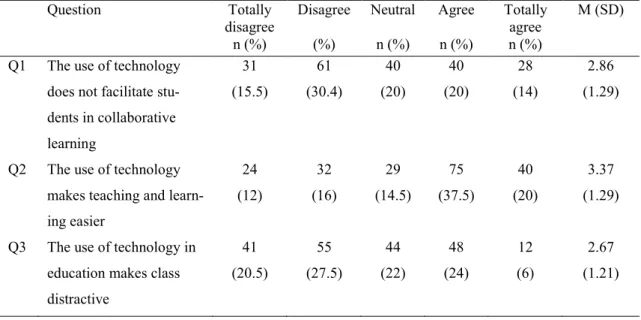
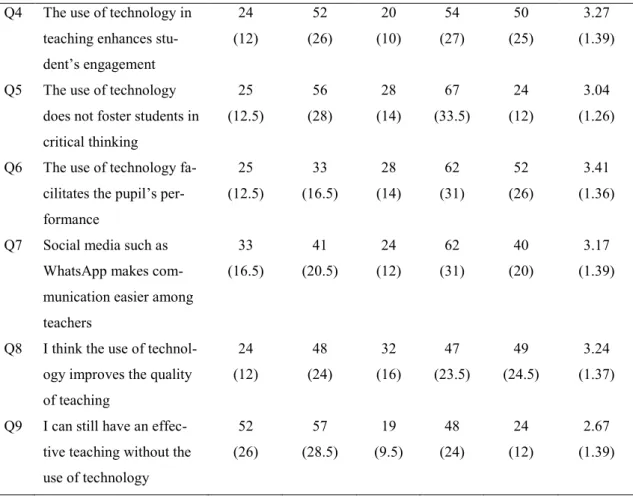
The descriptive statistics for the research question; what attitudes or perception teachers ex-hibit about use of technology in the classroom are presented in Table 1. Nine sets of ques-tionnaires (Q1 – Q9) were presented to the participants that are the basic school teachers for their responses. It can be observed from Table 1 that questionnaire six (Q6)’the use of tech-nology facilitates the pupil’s performance’ had the highest mean value of 3.41 and with 26 % of the respondents totally agreed to the question (Q6). The response for Q6 shows that the teachers interviewed generally accept that the use of technology could potentially play a role to enhance their pupil’s performance compared to using only conventional teaching system. This view from the respondents shows from table 1 that combining the percentages of agree (31%) and totally agree (26%) exceeds 50%, further demonstrates that more than half of the total responses identify the relevance of technology that improves pupil output.
For Q3 (The use of technology in education makes class distractive), and Q9 (I can still have an effective teaching without the use of technology) shown in table 1 demonstrate to have the lowest mean value of 2.67. The responses based on Q3 and Q9 reveals that the teachers acknowledge the role of technology to teaching and the learning process in the classroom since they consider the use of technology to be less destructive to classroom activities and also recognize how technology could be used to improve on teaching. Additionally, the analysis for Q3 and Q9 have shown that percentage contribution for Q3 had 20.5% totally disagree and 27.5% for disagreeing which when combined was slightly below 50% when compared to Q9 percentage contribution of 26% for totally disagree and 28.5% for disagree-ing was found to be above 50%.
For questionnaires (Q2, Q4, Q5, Q7 and Q8) the mean values range between 2.86 – 3.37 and for the percentage of respondents totally agree to these questions varied between 12 % – 25 %, agree ranged from 23.5 – 37.5 %. Also, 12 – 16.5 % totally disagree, 16 – 30.4 % were for the respondent that disagreed and with a neutral percentage range being 10 – 20, as illus-trated in Table 1. Furthermore, Table 1 demonstrates the percentage contribution for each of the options made available on the Likert scale for the respondents. The percentage contribu-tion for totally disagreeing and disagreeing for the quescontribu-tionnaire (Q2, Q4, Q5, Q7 and Q8) were less than 50 %. Q2 (The use of technology makes teaching and learning easier), Q4 (The use of technology in education enhances student’s engagement) and Q7 (Social media such as WhatsApp makes communication easier among teachers) had the percentage contri-bution by combining totally agree and agree more 50% which indicated that teachers agreed to the fact social media makes communication easier among teachers and other stakeholders of education as shown in Table 1.
This is in contrast with Q1, Q5 and Q8 which had the addition for a set totally agree and agree, as well as totally disagree and disagree less than 50 %. For example, questionnaire Q1 that concerns the potential negative effect of computer-supported collaborative learning (CSCL) shows that only 45% opposing (totally disagree and disagree) to Q1, with a signifi-cant percentage (20%) remaining neutral in their response. The potential reason for Q2, Q4 and Q7 having more than 50% totally agreeing or agreeing to these questionnaires show that teachers as generally have a positive perception about the application of technology in basic schools in Ghana.
Table 1. Teachers attitudes or perception towards the use of technology in the classroom
Question Totally
disagree
Disagree Neutral Agree Totally agree
M (SD) n (%) (%) n (%) n (%) n (%)
Q1 The use of technology does not facilitate stu-dents in collaborative learning 31 (15.5) 61 (30.4) 40 (20) 40 (20) 28 (14) 2.86 (1.29)
Q2 The use of technology makes teaching and learn-ing easier 24 (12) 32 (16) 29 (14.5) 75 (37.5) 40 (20) 3.37 (1.29)
Q3 The use of technology in education makes class distractive 41 (20.5) 55 (27.5) 44 (22) 48 (24) 12 (6) 2.67 (1.21)
Q4 The use of technology in teaching enhances stu-dent’s engagement 24 (12) 52 (26) 20 (10) 54 (27) 50 (25) 3.27 (1.39)
Q5 The use of technology does not foster students in critical thinking 25 (12.5) 56 (28) 28 (14) 67 (33.5) 24 (12) 3.04 (1.26)
Q6 The use of technology fa-cilitates the pupil’s per-formance 25 (12.5) 33 (16.5) 28 (14) 62 (31) 52 (26) 3.41 (1.36)
Q7 Social media such as WhatsApp makes com-munication easier among teachers 33 (16.5) 41 (20.5) 24 (12) 62 (31) 40 (20) 3.17 (1.39)
Q8 I think the use of technol-ogy improves the quality of teaching 24 (12) 48 (24) 32 (16) 47 (23.5) 49 (24.5) 3.24 (1.37)
Q9 I can still have an effec-tive teaching without the use of technology 52 (26) 57 (28.5) 19 (9.5) 48 (24) 24 (12) 2.67 (1.39)
4.2 What type of technology and how is used by Teachers in the classroom?
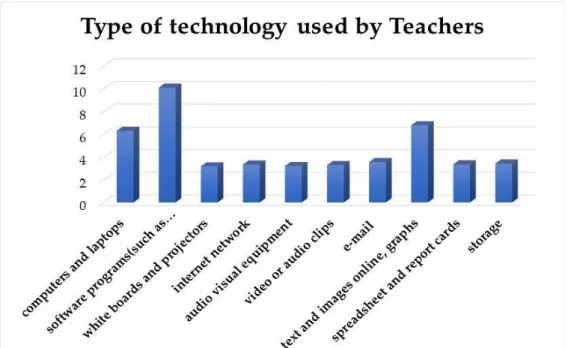
Figure 2 shows a bar chart the types of technological options available for teachers to use in the classroom. The use of software programs had dominated as the most used as a techno-logical application in the classroom. The second highest features associated with the use of technology in the classroom is text, images online and graphs, and with the third-highest been the use of computers and laptops. These topmost three items could result from easy availability. The remaining questionnaire had almost the same from the respondents; this trend from the results could be as a result of the availability of ICT materials and facilities in basic schools in Ghana.
Figure 2. A bar chart the types of technological options available for teachers to use in the classroom.
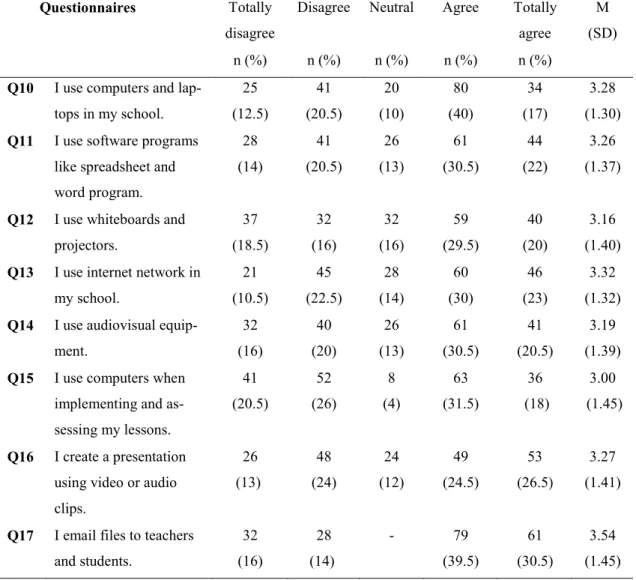
Table 2 indicates the results based on the data obtained and analyzed from the research ques-tion’ what type of technology is used by Teachers in the classroom’ Based on descriptive statistics questionnaire Q17 ( that is’ I email files to teachers and students) as shown in Table 2 gives the mean of 3.54 as the highest value and with 70% of the respondents indi-cating to ‘totally agree’ and agree to the questionnaire. This demonstrates that the use of emails as a source of giving lessons materials in electronic form is relatively comfortable for the teachers. The next second-highest mean value is 3.48, with a percentage point based on response was 26.5% totally agree were associated with Q19 with the general majority (over 50%) of the respondent showing that they totally agree or they agree to they create text using the office word program. The use of Microsoft office word program is generally readily available and to use, therefore could be associated with response to Q19 having a relatively good figure of merits.
In Table 2, Q15 (I use computers when implementing and assessing my lessons) have the lowest mean value of 3.00, and slightly below the 50 % mark ‘totally agree (18%)’ or agree (31.5%). Other questionnaires (Q10, Q11, Q12, Q13, Q14, Q16, Q18, Q20, Q21, Q22 and Q8) the mean values ranged between 3.16 – 3.42. The average mean (M) value of 3.3 illus-trates that responses for (Q10, Q11, Q12, Q13, Q14, Q16, Q18, Q20, Q21, Q22 and Q8)
were generally impressive. The percentage of respondents that show a very positive response (totally agree and agree) to the questionnaire in this paragraph, varied between 51 % – 57 %, as shown in Table 2. Consequently, the percentage addition for agreeing and totally agree
options for the surveys (Q10 – Q22) could be said to be higher than 50 % of the responses, except for Q15 that had 49.5%.
Furthermore, Table 2 shows the percentage contribution for other of the options (neutral, disagree and totally disagree) made available for the respondents to select. A combined of the percentage contribution for ‘totally disagree’ and ‘disagree’ to the questionnaires (Q10
– Q22) in table 2 were less than 50 %. Also, the neutral options in percentage terms show for the surveys (Q10 – Q22) in Table 2 ranged between 4.00 % – 16 % except for Q17, where the respondents had no option to be natural.
Table 2. What type of technology and how it is used by Teachers in the classroom.
Questionnaires Totally
disagree
Disagree Neutral Agree Totally agree
M (SD) n (%) n (%) n (%) n (%) n (%)
Q10 I use computers and lap-tops in my school. 25 (12.5) 41 (20.5) 20 (10) 80 (40) 34 (17) 3.28 (1.30)
Q11 I use software programs like spreadsheet and word program. 28 (14) 41 (20.5) 26 (13) 61 (30.5) 44 (22) 3.26 (1.37)
Q12 I use whiteboards and projectors. 37 (18.5) 32 (16) 32 (16) 59 (29.5) 40 (20) 3.16 (1.40)
Q13 I use internet network in my school. 21 (10.5) 45 (22.5) 28 (14) 60 (30) 46 (23) 3.32 (1.32)
Q14 I use audiovisual equip-ment. 32 (16) 40 (20) 26 (13) 61 (30.5) 41 (20.5) 3.19 (1.39)
Q15 I use computers when implementing and as-sessing my lessons. 41 (20.5) 52 (26) 8 (4) 63 (31.5) 36 (18) 3.00 (1.45) Q16 I create a presentation using video or audio clips. 26 (13) 48 (24) 24 (12) 49 (24.5) 53 (26.5) 3.27 (1.41)
Q17 I email files to teachers and students. 32 (16) 28 (14) - 79 (39.5) 61 (30.5) 3.54 (1.45)
Q18 I edit text and images online. 28 (14) 28 (14) 26 (13) 65 (32.5) 53 (26.5) 3.42 (1.48)
Q19 I create text using office word program. 24 (12) 28 (14) 28 (14) 67 (33.5) 53 (26.5) 3.48 (1.33)
Q20 I use a spreadsheet for pupils to register and re-port cards. 28 (14) 33 (16.5) 28 (14) 65 (32.5) 46 (23) 3.34 (1.36)
Q21 I create folders to store my documents. 24 (12) 33 (16.5) 28 (14) 66 (33) 49 (24.5) 3.41 (1.33) Q22 I use a spreadsheet to plot graphs. 28 (14) 37 (18.5) 20 (10) 69 (34.5) 46 (23) 3.34 (1.37)
4.3 What are the factors that affect the use of technology in the classroom
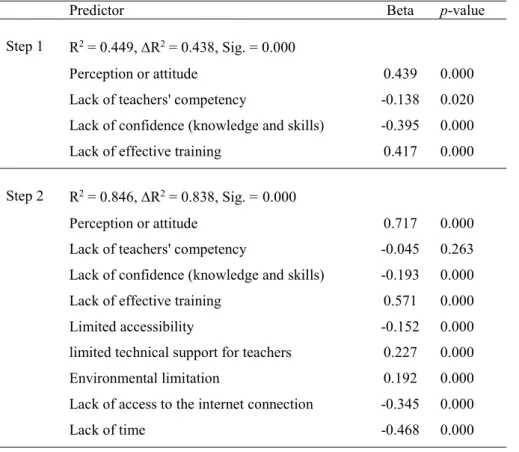
The hierarchical regression analysis presented in Table 3 shows that the first sets of predic-tors labelled as step 1 are: lack of effective training, Lack of teachers’ competency, Lack of confidence (knowledge and skills), perception or attitude could be examined with 44.9 % variance in the dependent variable. For the independent variable, the predictors (labelled as step 2): Lack of effective training, Lack of teachers’ competency, Lack of confidence (knowledge and skills), perception or attitude, Lack of time, Limited accessibility, Environ-mental limitation, Lack of access to the internet connection, limited technical support for teachers could be explained with an R2 value of 84 % variance in the independent variable.
Additionally, the accuracy of the model had a standard error of the estimate for predicting the dependent variable is 4.46 and for independent variable is 2.39.
Table 3 further shows the coefficients obtained based on the hierarchical regression analysis carried with figures of merits such as beta and significance (p-value) were estimated. In step 1, three variables of perception or attitude, lack of confidence (knowledge and skills), and
lack of effective training had p-values of 0.000 relatively far below the p-value of 0.05. The use of standardised coefficient beta indicates the performance of the variables where a pos-itive value gives a better prospect to evaluate the quantitative data. In Table 3, the most important independent variable is the perception or attitude with a best-standardised coeffi-cient beta value of 0.439. Consequently, from the analysis p-value (significance) and