Cornell University ILR School
DigitalCommons@ILR
Articles and Chapters ILR Collection
7-2001
How High Performance Human Resource
Practices and Workforce Unionization Affect
Managerial Pay
Alexander J.S. Colvin Pennsylvania State University Rosemary Batt
Cornell University, [email protected]
Harry C. Katz
Cornell University, [email protected]
Follow this and additional works at:http://digitalcommons.ilr.cornell.edu/articles
Thank you for downloading an article from DigitalCommons@ILR.
Support this valuable resource today!
This Article is brought to you for free and open access by the ILR Collection at DigitalCommons@ILR. It has been accepted for inclusion in Articles and Chapters by an authorized administrator of DigitalCommons@ILR. For more information, please [email protected].
How High Performance Human Resource Practices and Workforce
Unionization Affect Managerial Pay
Abstract
Using data from a nationally representative sample of telecommunications establishments, this study finds that HR practices and workforce unionization influence managerial pay levels and the ratio of manager-to-worker pay. High performance HR practices, including investment in the skills of the workforce, in computer-based technologies, and in performance-computer-based worker pay practices, are all positively related to managerial pay; but the use of workforce teams, which shift some managerial responsibilities to workers, has the opposite association. High performance HR practices also are associated with lower manager-to-worker pay
differentials. In addition, workforce unionization is positively associated with managerial pay levels, with worker base pay mediating the relationship between managers' pay and unionization.
Keywords
human resources, telecommunications, unionization, compensation, managerial pay Comments
Suggested Citation
Colvin, A. J. S., Batt, R., & Katz, H.C. (2001).How high performance human resource practices and workforce unionization affect managerial pay[Electronic version]. Retrieved [insert date] from Cornell University, ILR school site:
http://digitalcommons.ilr.cornell.edu/articles/274/
Required Publisher Statement
Reprinted with permission ofWiley-Blackwell Publishing. Final version published as Colvin, A. J. S., Batt, R., & Katz, H. C. (2001). How high performance human resource practices and workforce unionization affect managerial pay.Personnel Psychology, 54(4), 903-934.
How High Performance Human Resource Practices and Workforce Unionization Affect Managerial Pay*
July, 2001
Forthcoming, Personnel Psychology
Alexander J.S. Colvin Dept. of Labor Studies & Industrial Relations, Pennsylvania State University, University Park, PA 16802 814-865-0754 (ph) 814-863-3578 (fax) [email protected] Rosemary Batt
Human Resources Dept., Industrial & Labor Relations School, Cornell University Ithaca, NY 14853 607-254-4437 (ph) 607-255-1836 (fax) [email protected] Harry C. Katz
Jack Sheinkman Professor of Collective Bargaining, Industrial & Labor Relations School, Cornell University Ithaca, NY 14853
Abstract
Using data from a nationally representative sample of telecommunications establishments, this study finds that HR practices and workforce unionization influence
managerial pay levels and the ratio of manager-to-worker pay. High performance HR practices, including investment in the skills of the workforce, in computer-based technologies, and in performance-based worker pay practices, are all positively related to managerial pay; but the use of workforce teams, which shift some managerial responsibilities to workers, has the opposite association. High performance HR practices also are associated with lower manager-to-worker pay differentials. In addition, workforce unionization is positively associated with managerial pay levels, with worker base pay mediating the relationship between managers' pay and unionization.
In recent years, compensation researchers have challenged the notion that variation in wages can be accounted for solely by explanations derived from human capital and other conventional economic theories. Studies have found persistent inter-organizational differences in pay levels after controlling for employee human capital and factors such as industry and size (Eisenhardt, 1988; Gerhart & Milkovich, 1990; Groshen & Kreuger, 1990). These findings support the notion that organizations possess a measure of discretion in setting compensation policies, resulting in variation in pay levels between similarly situated organizations.
The nature of the factors influencing managerial compensation, however, is less well understood. Most research on managerial pay has focused on top executives, and has examined agency problems involved in alignment of owner and top management interests (Barkema & Gomez-Mejia, 1998) or whether variation in such characteristics as ownership structure, profitability, or business risk predict compensation levels (Finkelstein & Hambrick, 1989; Hambrick & Finkelstein, 1995). Some recent studies have extended these models to middle-level managers (Bloom & Milkovich, 1996, 1998).
There is reason to believe, however, that the pay of middle managers may be equally or more influenced by lower level organizational factors. While top executives are primarily responsible for corporate profitability and shareholder wealth, lower level line managers are primarily responsible for operational performance. While corporations often seek to tie a portion of middle managers' pay to corporate financial performance, these managers also are likely to be rewarded for their contribution to the organization – their ability to effectively manage the production systems for which they are responsible. Prominent among these production systems in contemporary organizations are "high performance" human resource (HR) practices -- those that invest in the skills and abilities of employees, design work in ways that facilitate employee
collaboration in problem solving, and provide incentives to motivate workers to use their discretionary effort (Appelbaum, Bailey, Berg, & Kalleberg, 2000; Delery & Doty, 1996). A growing body of empirical research shows that these practices indeed are associated with better performance (Appelbaum et al., 2000; Becker & Gerhart, 1996; Ichniowski, Kochan, Levine, Olson, & Strauss, 1996). If these practices lead to better organizational performance, then it is reasonable to consider whether managers are rewarded for managing them. High performance HR practices may affect managerial pay directly, by altering the complexity of managers’ jobs, or indirectly, by raising workers’ productivity and pay, which in turn may lead to upward internal equity adjustments.
Managers’ pay also may be affected by union pressures. Unions, for example, may directly affect managerial pay by constraining managerial prerogative and increasing the complexity of managers' jobs. Workforce unionization may indirectly affect managerial pay levels through unions’ ability to negotiate higher wages for workers, with companies seeking to maintain manager-to-worker pay ratios for internal equity reasons. No prior research, however, has examined the relationship between workforce unionization and managerial pay levels.
Thus, in contrast to the literature that views middle managers’ pay from the top down, we examine managerial pay as a function of “bottom-up” factors that influence operational
performance and the complexity of their jobs. We focus on both the absolute levels of manager pay and the ratio of manager-to-worker pay for middle and lower level line managers (second and third tier managers above first line supervisors). We consider these issues using data from a nationally representative survey of customer service and sales centers in the telecommunications services industry. This industry-specific focus allows us to analyze detailed measures of
variation in business and HR practices. The industry is a reasonable one to examine because, as in many other industries, the proportion of managerial employees in this industry is large and has
increased considerably over the last two decades, from 10.1% in 1980 to 22% in 1997 (CPS, 1998).
Theory and Hypotheses
In the first major investigation of the compensation of middle managers, Gerhart and Milkovich (1990) found significant inter-organizational variation in compensation levels, even after controlling for the human capital of managers and differences in the organizational characteristics, such as size and sales and profitability. Other studies have demonstrated a positive relationship between managers’ pay and education and tenure (Abowd, 1990; Bloom & Milkovich, 1998; Fisher & Govindarajan, 1992; Leonard, 1990; Werner & Tosi, 1995) and managers’ pay and organizational size (Bloom & Milkovich, 1998; Fisher & Govindarajan, 1992; Lambert, Larcker, & Weigelt, 1991; Werner & Tosi, 1995). A recent study showed that individual characteristics account for about half of inter-industry wage differentials and firm heterogeneity accounts for the other half (Abowd & Kramarz, 2000). In addition, other recent research has approached variation in middle manager pay from ‘above’, by applying factors drawn from the literature on executive compensation to attempt to explain the compensation of lower level managers (Bloom & Milkovich, 1998; Mueller & Yun, 1997; Werner & Tosi, 1995).
An alternative approach is to view managers' pay as a function of their role in managing the workforce for which they are responsible. Recent literature documents wide inter-firm variation in HR practices, variation that reflects differences in firm-level strategic human resource decisions (Cappelli, 1999; Katz & Darbishire, 2000). One such strategic human
resource decision is to adopt high performance work systems -- sets of HR practices designed to enhance the productivity of the workforce. Managerial pay may be affected by the adoption of high performance work systems in two ways: indirectly, in response to the effects of HR practices on the productivity and pay of workers; or directly, by affecting the complexity of
managers' jobs. Similarly, workforce unionization may influence manager's pay indirectly, through their effect on workers' pay, or directly, by increasing the complexity of managers' jobs. In the following sections, we outline the hypothesized relationships between managers' pay and the use of high performance HR practices, subject to the pressures exerted by unions.
High Performance HR Practices and Managerial Pay
The use of high performance work systems has gained widespread interest in recent years as the source of competitive advantage (e.g., Pfeffer, 1998). Researchers have identified three interrelated dimensions of these systems that are hypothesized to contribute to organizational performance: high relative skills of the workforce; the opportunity to use those skills (e.g.
employee discretion and participation in teams); and incentives, such as performance-based pay, to induce commitment and discretionary effort (e.g., Appelbaum et al, 2000; Delaney & Huselid, 1996, p. 951). These three dimensions also have been identified by other researchers of
organizational behavior as the source of organizational performance gains (Blumberg & Pringle, 1982; Hackman, 1987).
A fourth dimension that typically accompanies the use of high performance HR practices is the use of advanced information-based technologies that require a computer-literate workforce. Growing evidence suggests that high performance HR practices, combined with new technology, produce better productivity, quality, sales, and financial performance (Appelbaum et al, 2000; Arthur, 1994; Bailey, 1998; Batt, 1999; Becker & Gerhart, 1996; Black & Lynch, 1998; Huselid, 1995; Ichniowski, et al, 1997; MacDuffie, 1995; Youndt, Snell, Dean, & Lepak, 1996).
If high performance HR practices lead to better organizational performance, then manager pay may be higher where these practices are present due to the higher skills, productivity, and pay of workers in these systems. Through this channel, managers benefit indirectly from the effects of high performance HR practices on workers. This argument draws
on human capital theory and is consistent with the economic literature that views increased wage variation as a function of “skill biased technical change” (e.g., Johnson, 1997). Economists have argued that new technologies have increased the demand for skill, thereby raising the relative wages of higher skilled workers. If technology is defined to include both hardware (e.g., computer systems) and soft technologies (e.g., HR practices), then it is reasonable to suspect that variation in the use of high performance HR practices may explain wage outcomes of workers. We extend this argument by examining whether this technologically induced variation in workers' jobs and wages exerts indirect effects on manager pay.
Researchers only recently have begun to examine the links between high performance HR practices and worker pay, and the evidence to date is mixed. In a longitudinal study using a nationally representative sample of establishments, Osterman (2000) found no evidence that establishments with high performance practices paid higher wages to workers than other firms. In contrast, in a study of the steel, apparel, and medical instruments industries, Appelbaum et al. (2000) found that the use of high performance systems was associated with higher wages. Similarly, Hunter and Lafkas (1998) found that the interactive effect of more autonomous work organization and new technology produced higher wages for retail bank workers. Other studies of self-managed teams, a key component of high performance systems, have found that workers in teams received higher wages because they worked more overtime to absorb supervisory tasks (Batt, 2000; Weisman et al., 1993). In sum, it is possible that managers who manage high performance HR systems receive higher pay indirectly because the operations and workforce they manage are more productive. However, no studies have yet examined this relationship.
The pay of managers who manage high performance HR systems also may be affected as these work practices alter the complexity of managers’ jobs (a direct influence of these HR practices). For purposes of this discussion, it is useful to consider whether and how each of the
dimensions of high performance systems – the use of a higher skilled workforce, advanced information technologies, teams, and performance-based worker pay – might directly affect the complexity of managerial jobs. First, with respect to the human capital of the workforce, it is likely that managers of higher skilled workers would themselves need to have higher skills, particularly interpersonal skills. In the shift from a command-and-control to a participative management system, for example, some research shows that managers need more sophisticated interpersonal and leadership skills (e.g., Manz & Sims, 1987; Stewart & Manz, 1997). The compensation of managers under high performance systems is also likely to be enhanced if these skills required to manage the systems are more highly valued in the labor market.
Investment in new technologies also is likely to affect the skill requirements of
managerial jobs. Management theorists have generally distinguished between technology used to inform or complement workforce capabilities (informating) and technology used as a
substitute to reduce the labor content of jobs (automating) and control the quality of labor output (e.g., Zuboff, 1988). Informating uses of technology are consistent with the use of high
performance HR practices. In manufacturing, for example, the use of computers for statistical process control requires the selection and training of computer-literate workers (MacDuffie, 1995). An analogous use of technology in the context of customer service centers in this study is to develop a rich database of information on customers to enhance workers’ ability to sell and customize products. Another example is the use of email to inform employees of updates on products, pricing, and procedures. In workplaces with advanced information systems, managers as well as workers need to be computer literate. An alternative use of technology in call centers is as a device for quality control through electronic monitoring workers' performance. This latter approach is consistent with an engineering or production line approach to services because it allows firms to hire low skilled workers in low-paid, low-discretion jobs (Levitt, 1972). Because
electronic monitoring is a substitute for managerial monitoring, it simplifies the work of managers and is likely to be associated with lower manager pay levels.
The second dimension of high performance systems – the use of workforce teams – allows employers to shift some operational decisions to workers, who are viewed as having more tacit knowledge than managers for making decisions close to the point of production.
Considerable research shows that reorganizing work into teams, especially self-managed teams, alters the locus of control between managers and workers, with workers absorbing some tasks previously performed by lower level managers. Research also shows that lower level managers often have resisted workforce teams because they infringe on managers’ power, authority, and job security (e.g., Buchanan & Preston, 1991; Klein, 1984; Muller-Jentsch, 1995; Schlesinger & Klein, 1987). While no research has examined the relationship between workforce teams and managerial pay, these arguments suggest that the use of workforce teams will be associated with lower managerial pay levels because some managerial tasks are shifted to workers.
The third dimension of high performance systems, performance-based worker pay, is unlikely to have direct implications for managerial pay, but may have indirect effects. Manager pay levels will be directly affected by their own performance-based pay. Managerial pay, however, may be indirectly affected by the use of performance-based pay among workers because this form of compensation is likely to induce greater effort on the part of workers, resulting in better organizational performance, and managers may share in these productivity improvements.
In sum, this discussion suggests the following set of hypotheses:
Hypothesis 1a: Investment in a high skilled workforce and in informating technologies will be associated with higher managerial pay levels.
Hypothesis 1b: Work organized to give non-managerial employees greater discretion through participation in teams will be associated with lower managerial pay levels.
Hypothesis 1c: HR incentives for workers, such as performance-based pay, will be associated with higher managerial pay levels.
So far we have offered hypotheses related to the level of managerial pay. The general argument is that if high performance HR practices produce better organizational performance and these gains are shared, then both worker and managerial pay should be higher. If the gains from high performance practices are shared equally, then manager-to-worker pay ratios might be unaltered. However, as indicated above, some dimensions of high performance systems,
particularly the use of teams, may alter the relative compensation of managers and workers. Other arguments also suggest that manager-to-worker pay ratios may be lower in establishments that use high performance HR practices. As a general principle, high
performance practices are likely to have a greater effect on the skills and jobs of workers than of managers because workers are the focus of the HR practices. If we consider the dimensions of high performance systems discussed above, manager-to-worker skill and pay differentials are likely to be compressed because high performance systems raise the skills, responsibilities, and contributions made by workers relative to managers. If workers’ skill requirements rise more than do those for managers, then human capital theory would predict that the wages of workers would rise relative to those of managers, reducing the managerial wage premium. Similarly, variation in technology is likely to have more direct implications for the skills and pay of workers using the technology than for managers. Thus, where technology is used to informate production work, consistent with high performance practices, then the wages of workers should rise relatively more than those of managers, resulting in a lower manger-to-worker pay ratio (and conversely, electronic monitoring is likely to increase the manager-to-worker pay gap).
Second, as noted above, if teams shift the relative roles and responsibilities between managers and workers, essentially narrowing the gap in relative status and contribution to the organization, then the manager-to-worker pay ratio is likely to be lower than would otherwise be the case. A similar outcome is likely with respect to performance-based pay. Compared to workers, managers typically have a higher percentage of pay that is variable; and evidence suggests that performance-based pay is associated with higher pay levels. Thus, if firms increase the percent of workers’ pay that is variable relative to that of managers, then the manager-to-worker pay ratio should be lower than would otherwise be the case.
Finally, other organizational effects may provide a further rationale for lower manager-to-worker pay ratios under high performance work systems. MacDuffie (1995), for example, argued that lower manager-to-worker status differentials were an important part of Japanese lean production systems. Levine and D’Andrea Tyson (1990) argued that compressing manager-to-worker pay differentials can increase group cohesiveness and “reinforce the atmosphere of participation” (p. 211). Some empirical studies show that reduced inter-group pay differentials are associated with better organizational performance (Bloom, 1999; Cowherd & Levine, 1992; Drago & Garvey, 1998; Pfeffer & Langton, 1993). Thus, if reduced manager-to-worker pay ratios help elicit the level of worker participation needed for high performance systems to function effectively, then organizations that adopt these systems are likely to redesign
compensation systems in ways that reduce pay differentials. In sum, these arguments suggest the following two hypotheses:
Hypothesis 2a: High performance HR practices will be associated with lower manager-to-worker pay ratios.
Hypothesis 2b: The use of informating technologies will be associated with lower manager-to-worker pay ratios and electronic monitoring will have the opposite association.
The Influence of Workforce Unionization on Managerial Pay
Extensive research has documented the existence of a union wage premium, with unionized workers receiving approximately 15% to 20% higher wages than similarly situated nonunion workers (Freeman, 1980, 1984; Jakubson, 1991; Lewis, 1986; Raphael, 2000). This research also has shown that unions reduce the white collar/blue collar wage premium by raising the level of blue collar wages (Freeman and Medoff 1984). Due to the exclusion of managers from coverage by the National Labor Relations Act, any wage premium obtained through collective bargaining only applies to the workers who are in the bargaining unit and not to managerial employees. As a result, the direct effect of union representation should be to raise the wages of workers relative to managers, thereby reducing the manager-to-worker pay ratio.
There are reasons to believe, however, that unions also exert indirect effects on manager pay levels, albeit of smaller size than for workers. First, there may be "spillover" effects, as firms pass on union-negotiated wage increases to managers in order to enhance perceptions of intra-organizational distributive justice (Cowherd & Levine, 1992). Institutional theory (DiMaggio & Powell, 1983; Eisenhardt, 1988) also provides a related rationale for why
organizations would attempt to maintain existing manager-to-worker wage differentials within the organization. Collective bargaining may serve as a mechanism through which norms about appropriate wage increases become institutionalized within the organization, with expectations developed that managers will receive pay increases corresponding to those obtained by unionized workers. In his study of managers in the auto industry, for example, MacDuffie (1996, p. 95) showed that from 1948 to the early 1980s, the big three auto makers routinely passed on to salaried employees the pay and benefit increases negotiated by the auto workers union.
In addition, unionization may affect managerial compensation more directly by adding a level of complexity to managers' jobs. Unions, for example, may make it difficult for managers
to exercise their prerogative or unilaterally introduce innovative work practices. Thus, middle managers in unionized workplaces are likely to need more interpersonal and negotiating skills. They are likely to have to negotiate with the union or set up on-going labor-management committees as a prerequisite for union support for high performance HR practices. For these reasons, we hypothesize that the institution of unionization will be associated with higher manager pay but only modest reductions in manager-to-worker pay ratios.
Hypothesis 3a: Unionization of workers will be associated with higher manager pay levels. Hypothesis 3b: Worker base pay will partially mediate the relationship between workforce unionization and managerial pay levels.
Hypothesis 3c: Unionization of workers will be associated with modest reductions in manager-to-worker pay ratios.
Methods Data
The data for this study come from a nationally representative random sample drawn from the Dun and Bradstreet listing of telecommunications establishments. Establishments were stratified by state and size, with all states represented and almost all establishments with more than 100 employees included. Smaller establishments were stratified by SIC code so that the total sample reflects the relative proportion of establishments in the three segments of the industry: wireline (SIC 4813); cellular (SIC 4812); and cable TV (SIC 4841). Because Internet service providers (ISPs) are an important new part of the industry that is not well captured by SIC code, additional ISPs were identified through the Directory of National Dial-up Providers and Area Codes of Operation.
A university-based survey team administered the survey by telephone in the Fall of 1998. Respondents were the top (general) managers in charge of customer service and sales (call)
centers. The telephone interviews averaged 52 minutes and yielded 354 usable responses, representing a 54% response rate. Information from the Dun and Bradstreet establishment database allowed us to check the representativeness of the respondents on a number of dimensions. There were no statistically significant differences between respondents and non-respondents on whether or not the establishment was publicly or privately held, a branch of a larger organization, or owned by a former Bell company. Internet service providers were somewhat less likely to respond, perhaps because they are less likely than other segments to self-identify with the telecommunications industry. Smaller establishments were somewhat more likely to respond than larger establishments. Missing values randomly distributed in the data reduced the final sample for the multivariate equations to 242. We tested whether there are statistically significant differences in the variables of interest between the full sample and the reduced sample, and found none.
In contrast to most high performance work system studies that rely on non-random samples (e.g., Appelbaum et al., 2000; Huselid, 1995; Youndt et al., 1996), we chose to survey a large nationally representative sample of establishments so that our findings would be
generalizable across the industry. This strategy, however, did not allow us to survey multiple respondents per establishment. We are aware of potential problems of measurement error in single source organizational surveys, as recently debated in this journal (Gerhart, Wright, & McMahan, 2000; Gerhart, Wright, McMahan, & Snell, 2000; Huselid and Becker, 2000).
Gerhart, Wright, McMahan and Snell (2000) compared the survey responses of 44 corporate HR managers in 12 firms and found significant differences in the reported use of HR practices by HR executives in the same firm.
Gerhart and his co-authors (2000), however, were particularly concerned about the reliability of corporate-level single rater reports of human resource practices, where a corporate
level executive estimates the aggregate proportion of all employees in the firm affected by a particular HR practice. Given the wide range of product market conditions, occupational groups, and regional labor market conditions facing establishments in different business units within any given firm, the reliability of these types of estimates may be understandably low. In contrast, we conducted our study at the establishment level. Following suggestions by Becker and Gerhart (1996, p. 792), we analyzed comparable establishments within one industry (service and sales centers); and because HR practices vary considerably within establishments for different occupational groups (e.g., Jackson, Schuler, & Rivero, 1989), we focused on the "core"
workforce defined as the largest group of non-managerial employees (e.g., Arthur, 1992, 1994; Delery & Doty, 1996; Osterman 1994, 2000). In this study, core employees are service and sales representatives.
By way of comparison, whereas the average size of firms in the samples used by Gerhart and his co-authors (2000) and Huselid (1995) was 46,396 employees and 4,413 employees respectively, the average size of the core workforce reported on by our respondents is 93. As Gerhart and his co-authors note, “…our results do not necessarily speak to the reliability of HR measures used in research conducted at the plant level … [t]hese designs, because of smaller numbers of employees and the presumably greater homogeneity of HR practices, might be expected to yield higher reliabilities.” (p. 829). In fact, when Gerhart, Wright, and McMahan (2000, p. 866) analyzed the reliability of survey responses collected at the plant versus company level in a study of oil refineries, they found that reliability was substantially higher at the plant level.
In addition, we used several other techniques to minimize measurement problems. First, we used only general managers as respondents because research suggests that they are less optimistic than HR managers in their assessment of HR practices and their effectiveness (Wright
et al., 1998). Also, as recommended by Becker and Gerhart (1996, p. 791), our survey questions are context specific and informed by extensive field research, including site visits to fifteen customer service centers in distinct markets (local, long distance, cellular, cable) and customer segments (residential, small business, large business) in six telecommunications companies in five geographic regions. Each visit included interviews with the general manager, middle managers, HR managers, supervisors, and service workers. We also observed workers in the context of their interactions with customers and computer systems. We then piloted the survey with general managers from the sites we had visited, and through follow-up discussions, we rephrased questions or dropped those that the managers considered too difficult to answer. This procedure also allowed us to compare the answers of the general managers to the information that other managers or specialists at the same site had provided us during our field visit.
We also used outside information as a random check to verify survey responses. First, we compared survey responses (date establishment founded, and primary market) to data contained in the Dun and Bradstreet listing. The means for each variable in the two data sets are not statistically significantly different. The mean date of founding in each data set, for example, is 1986 (r = .75). The primary industry segment is a categorical variable (wireline, wireless, cable, internet), and is correlated at r=.78. Second, we examined union contracts and found that the non-managerial wage rates and job titles reported in our survey by managers at specific Bell companies were comparable to those in the corresponding union contracts. Third, we compared our survey data to that in the Current Population Survey for the telecommunications industry (CPS, 1998). We found that the reported pay and unionization rates were slightly higher in our sample (e.g., the 1998 median annual pay in the CPS is $31,200 for union clerical and sales workers, compared to $33,000 for union workers in our sample; the 1998 CPS unionization rate is 32 percent while that of our sample is 38 percent). Given the fact that we over-sampled large
establishments that tend to pay higher wages and to be more heavily unionized, these comparisons are reasonably consistent.
Measures
Dependent variables
The dependent variables in the study are the natural log of the median pay of managers and the ratio of median pay of managers to workers, at the establishment level. This measure excludes first line supervisors and captures a relatively narrow band of lower and middle-level (2nd and 3rd tier) managers. First line supervisors were specifically excluded because many first line supervisors in the industry are promoted from the ranks of non-managerial workers (Batt, 1996) and thus their labor markets might be more similar to that of workers than 2nd and 3rd tier managers, most of whom have a college degree. The average call center in this study has a total workforce of 258 employees and 1 layer of managers between the first line supervisor and the top (general) manager or director of the center. Larger centers tend to have 2 layers of managers between the supervisor and center director.
The measure of median pay of managers is based on asking the call center's top manager, “what are the annual earnings of a typical full-time manager in your establishment? (by 'typical' we mean that about half the managers are paid more and about half are paid less).” We asked respondents to include base pay and performance-based pay such as profit-sharing, gainsharing, and bonuses, but exclude stock options and employer contributions to benefits. We also
collected measures of total compensation, including benefits; however since this measure substantially increased the amount of missing data and yielded generally similar results, we did not include it in the results reported here.
The ratio of manager-to-worker pay was constructed by comparing the median pay of managers to the same measure of pay for “core” workers, defined as the largest group of
non-managerial employees who perform the core production work of the establishment. Given that our focus is on determinants of differences in pay levels rather than perceptions of pay inequity, we use the ratio of absolute pay levels. By contrast, an interest in perceptions of inequity has led some researchers to focus on relative pay levels, using as a measure of pay level the salary as a percentile of salaries in the relevant external labor market (e.g. Cowherd & Levine, 1992).
Independent variables
Our measures of high performance HR practices capture the practices used to manage core workers in the establishment. We drew on prior literature to develop indicators of three dimensions of high performance practices: the relative skill requirements of core jobs, the design of work to enhance employee discretion through participation in teams, and the use of
performance-based pay. We also measured variation in the use of information technology. To capture skill requirements of the jobs, we used measures of human capital typically included in economic models of wage determination. This allows us to identify whether technology, work design, and performance-based pay explain wage variation over and above that explained by traditional human capital variables. Included are three measures of skill level: a) years of formal education of the typical (median) core worker; b) percent of the core workforce with less than 1 year of tenure; and c) percent of the core workforce with more than ten years of tenure.
The technology used in the establishment is measured in two ways: as an information resource that is complementary to high performance HR practices (“informating”) and as a quality control device associated with a production line approach to HR management. Technology as an information resource is measured by the number of emails sent by management to employees each hour to update them on information regarding products, procedures, or regulations. Technology as a control device is represented by the percentage of workers’ performance that is electronically monitored each day.
Work design is measured by participation of workers in two types of teams: the percentage of core workers that participate in regular off-line problem-solving groups and the percentage that participate in self-directed teams. For performance-based pay, we asked the general manager to indicate the percentage of the pay of the typical (as defined above) core worker that is performance-based. Performance-based worker pay includes profit-sharing, gainsharing, commission pay, and bonuses not included in base pay. The survey asked separate questions about performance-based pay in general and commission pay in particular. However, given the sales environment of this study, the two variables were very highly correlated (r=.95), so that most of the performance-based pay is accounted for by commission pay. In the analysis, we use the broader performance-based pay measure, which has less missing data.
Union presence is measured by a dummy variable (where 1 = union, and 0 = nonunion) representing whether or not the core workforce in the establishment is unionized. Because we used a narrow definition of core workers that was consistent with bargaining unit definitions, the workforce in each establishment was either entirely union or nonunion.
Control variables
We included economic, organizational, human capital, and HR control variables that are likely to influence managerial pay. The establishment’s economic environment is measured by two variables: a) the average unemployment rate for 1998 in the county where the establishment is located, based on the Local Area Unemployment Statistics of the Bureau of Labor Statistics; and b) the local cost of living for 1998, drawn from the Economic Research Institute’s
Geographic Reference Report. Market success is measured by the change in the establishment’s sales in the prior two years (–1 = decreased, 0 = remained the same, and 1 = increased).
With respect to organizational characteristics, we controlled for customer segment served by the call center. It is likely that managers of centers serving higher value added business
customers will require higher skills and have more complex jobs than their counterparts serving residential consumers in commodity markets. To identify customer segmentation,
establishments were dummy coded into five groups: operator services, residential target, small business target, large business market, and universal centers that do not target a particular segment (the omitted category). Operator services is included because it represents the lowest valued service channel: while historically a cost center, deregulation has turned it into a fee-generating business as directory assistance is no longer free. We also controlled for
establishment size (the natural log of the total number of employees).1
Managers’ human capital is measured by years of formal education of managers, the percent of managers with less than one year of company tenure, and the percent of managers with more than ten years of tenure. Managers’ performance-based pay is measured by the percentage of managers’ pay that is variable. Finally, worker base pay is included as a control in the models estimating manager pay. The base pay of workers is the natural log of the annual base pay of the typical (median) core worker.
Analysis
Relationships are analyzed using ordinary least squares (OLS) regressions. However, because the data include multiple establishments from some companies, the standard OLS assumption that observations are independently distributed may be violated. To deal with this possibility, we use a Huber (1967) technique to correct for a possible company clustering effect, providing robust standard errors. We entered groups of independent variables hierarchically into the equations to examine the added explanatory power of that category of variables. One of our dependent variables, the manager-to-worker pay ratio is more difficult to interpret because it is in ratio form (Cohen & Cohen, 1983, p. 73-76). To help analyze the results for this dependent
variable, we first present the results for each of the components of the ratio, i.e. the denominator, worker pay, and the numerator, manager pay, then present the results for the ratio itself.
Results
Table 1 reports the means, standard deviations, and correlations among the variables. The mean annual median pay of managers (not transformed into natural log) is $57,458, and that of the core workforce is $35,213, with a mean manager-to-worker pay differential of 1.88. The correlations between variables support several of the hypothesized relationships. In the next sections, we report regression findings concerning the hypotheses relating to manager and worker pay levels and then turn to the regression findings concerning manager-to-worker pay ratios.
Manager and Worker Pay Levels
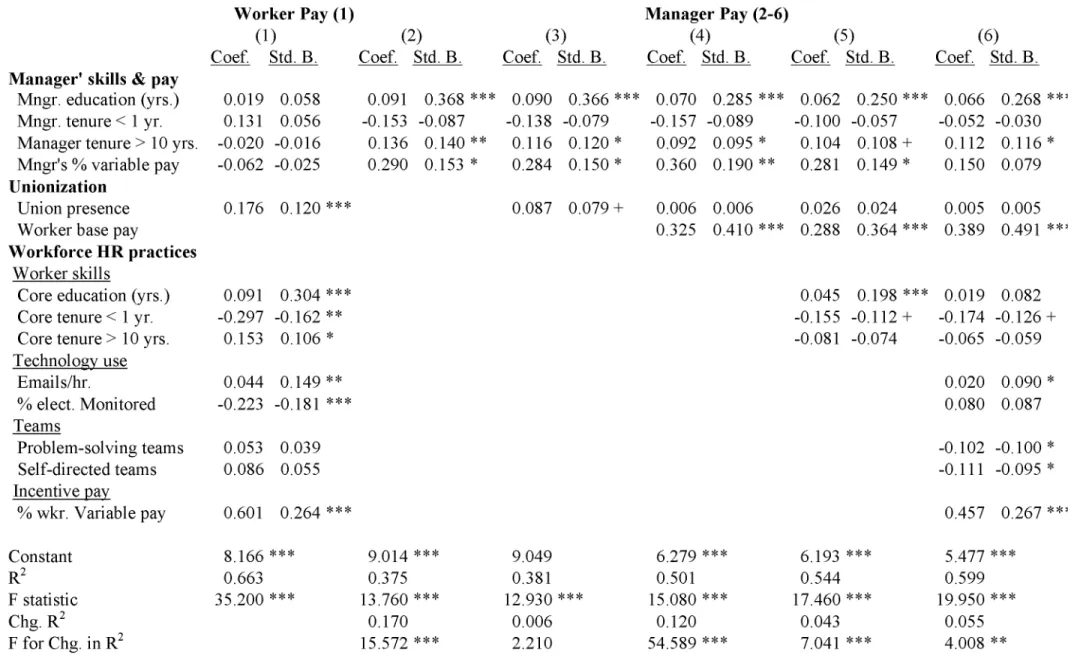
Table 2 reports the unstandardized coefficients and standardized beta coefficients for regressions with worker and manager pay levels as the dependent variables. Worker pay level is the dependent variable in the first model. Manager pay level is the dependent variable in the other five models. Controls for economic indicators and organizational characteristics are not reported in the table, but are included in all of the regression models.
Worker pay level is the dependent variable in the first model, which includes the control variables plus the independent variables representing unionization and human resource practices. As predicted, unionization has a significant (p<.001) positive association with worker pay levels. On average unionized workers receive 19.2% higher pay than nonunion workers, holding other factors constant.2 Among the human resource practices, both of the technology variables have the predicted relationships with worker pay. Number of emails per hour has a significant (p<.01) positive association with worker pay, whereas the percentage of time workers are electronically monitored has a significant (p<.001) negative association with worker pay. As predicted, the
percentage of worker pay that is variable also has a significant (p<.001) positive association with overall worker pay, however neither of the variables representing teams had significant
associations with worker pay in this model.
The second model includes both the control variables (labor market environment, organizational characteristics) plus manager human capital and manager variable pay. This model explains 37.5% of the variance in manager pay, which represents an increase in the R2 of 17.0 percentage points over the base case with market and organizational controls only.
Education levels for managers (p<.001), long tenure for managers (p<.01), and manager variable pay (p<.05) have significant positive associations with manager pay. Associations for the control variables in model 2 are generally as expected. In the subsequent four models, the groups of variables representing unionization, worker base pay, worker skills, and human resource practices for workers are added hierarchically to this base model to allow examination of the additional variance explained by each group of variables.
In the third model, the variable representing union presence is added to the base model. Hypothesis 3a states that the unionization of workers will be associated with higher levels of manager pay, and hypothesis 3b states that worker pay should partially mediate the relationship between union presence and manager pay levels. These hypotheses receive partial support. Union presence had a marginally significant (p<.10) positive association with manager pay, and the coefficient estimate indicates a manager pay premium of 9.1% in unionized establishments compared to nonunion establishments. However, including the union presence only explains an additional 0.6% of the variance in manager pay and this is not a significant improvement in the model.
To test for mediation, we followed Baron and Kenny's (1986) procedure and first tested whether the independent variable (union presence) is significantly related to managerial pay
(model 3 above). We then tested whether the mediating variable alone (worker base pay added to model 1) was significantly positively related to manager pay levels and found that it was (equation not shown). Third, we tested whether the union coefficient drops in size and significance in the presence of worker base pay (Table 2, model 4). We found that with the addition of worker base pay, the union variable became insignificant and the coefficient was reduced in size to almost zero (from .087 to .006). While we hypothesized that the union would affect managerial pay both directly (by increasing the complexity of managers' jobs) and
indirectly (via the union's affect on worker pay levels), our results suggest that the union effect is fully accounted for by its indirect effects on workers' pay. These results imply that there is no direct effect via increasing the complexity of managers' jobs.
The fifth model adds the three measures of workers' skills. As predicted in hypothesis 1a, workers' years of education is significantly positively related to managerial pay levels (p <.001), while low tenure among workers has a marginally significant (p<.10) negative association. Addition of these measures of workers' skill level increases the variance explained by 4.3 percentage points, which is a significant (p>.001) improvement over the fourth model. Thus, after controlling for managers' human capital and workers' base pay, the human capital of workers is significantly related to managers' pay levels. To give a sense of the magnitude of these relationships, if the typical worker has 1 additional year of education, manager pay levels are 1.9% higher.
The sixth model adds the five variables measuring technology use, teams, and performance-based pay. With the addition of these variables, the coefficient on worker education becomes insignificant and smaller in size, consistent with the idea that high
performance HR practices are typically used in conjunction with higher skilled workers. The results of model 5 show that hypotheses 1a-c are supported for all but 1 of the HR variables.
Hypothesis 1a states that the informating use of technology will be associated with higher managerial pay, and electronic monitoring with lower pay levels. The results show that the number of emails sent by management to workers has a significant (p<.05) positive association with manager pay, but electronic monitoring is not significant. Hypothesis 1b states that the use of teams among workers will be associated with lower managerial pay. Both problem-solving teams and self-directed teams have a significant (p<.05) negative association with manager pay, thus providing support for hypothesis 1b. Finally, the percentage of worker pay that is variable has a significant positive association (p<.001) with manager pay levels (after controlling for the percent of manager pay that is variable), supporting hypothesis 1c.
To give a sense of the magnitude of these relationships, a 10-percentage point increase in the percent of the workforce in problem-solving teams is associated with a 1% lower pay level for managers. The same change in the percentage of the workforce organized into self-directed teams is associated with a 1.1% lower pay for managers. The same increase in the percentage of workers' pay that is variable is associated with 5.6% higher manager pay levels.
Manager-to-Worker Pay Differentials
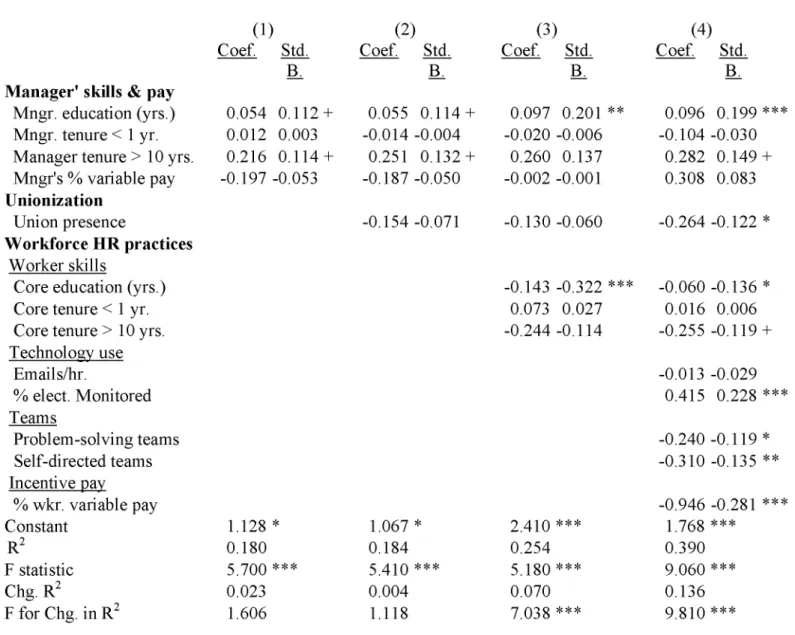
Table 3 reports the results when the manager-to-worker pay ratio is the dependent variable in a regression analysis with four hierarchically ordered models. However, because median worker pay is used to construct the dependent variable, worker base pay is excluded from the independent variables in the manage-to-worker pay equations in Table 3. The first model in Table 3 includes control variables plus manager human capital and manager variable pay. It explains 18% of the variance in the ratio of manager-to-worker pay (the change in R2 over the base case is .023). In Model 2, the union variable is added to the first model, increasing the variance explained by only 0.4 percentage points, which is a non-significant improvement in the model. In the third model, the measures of workforce skills are added, and they explain an
additional 7% of the variance, which is a significant improvement over the second model (p<.001). The fourth model, which includes the measures of technology use, teams, and performance-based pay, explains an additional 13.6% of the variance, which is a significant improvement of the model (p<.001).
Hypothesis 3b, which states that workforce unionization will be associated with lower manager-to-worker pay ratios, receives support in the fourth model. The relationship between unionization and the manager-to-worker pay ratio is not statistically significant at even the .10 level when unionization is added in the second model. However, the coefficient on unionization increases and becomes statistically significant in the fourth model (p<.05) when the remaining human resource practice variables are added, indicating that these variables had a suppressor effect for unionization. In the fourth model, controlling for variation in human resource practices, unionized establishments have on average a 23.2 percentage point lower manager-to-worker pay ratio relative to non-union workplaces.
Hypothesis 2a states that use of teams, informating technology, and worker incentives will be associated with a lower manager-to-worker pay ratio, whereas Hypothesis 2b predicts that electronic monitoring will be associated with a higher manager-to-worker pay ratio. These arguments receive some support in the third model. While email use has no significant
association with the ratio of manager-to-worker pay, electronic monitoring is associated with a larger pay gap between managers and workers (p<.001). An increase of ten percentage points in the percentage of worker time that is electronically monitoring is associated with a 5.2
percentage point higher manager-to-worker pay ratio.
Results for the other human resource practice variables provide strong support for
Hypothesis 2a. Employee participation in both offline problem-solving teams (p<.05) and online self-directed teams (p<.001) has significant negative associations with manager-to-worker pay
ratios in the fourth model. A 10-percentage point increase in employee involvement in problem-solving teams is associated with a reduction of 2.1 percentage points in the manager-to-worker pay ratio, and a 10-percentage point increase in participation in self-directed teams is associated with a reduction in the manager-to-worker pay ratio of 2.7 percentage points. Finally, the percentage of worker pay that is variable also has a significant (p<.01) negative association with manager-to-worker pay ratios. An increase of ten percentage points in the portion of worker pay that is variable is associated with a 6.1 percentage point lower manager-to-worker pay ratio.
Discussion
This study investigates the relationship between high performance HR practices, workforce unionization, and managerial pay in telecommunications service and sales centers. We find that high performance HR practices and workforce unionization in addition to
influencing worker pay, influence both managerial pay levels and manager-to-worker pay ratios. High performance work systems have been promoted on claims that they provide major
economic performance benefits and potential gains for both employees and organizations. Our study investigates the effects of high performance HR practices from a previously unexplored direction, through their relationship with managerial compensation. Given that changes in work organization and HR practices associated with high performance systems are predominantly focused on workers, any relationship with outcomes for managers might be expected to be attenuated or even absent.
However, we find several statistically significant relationships between high performance HR practices and pay outcomes. Our findings suggest that managers benefit through higher pay levels in establishments that adopt high performance practices. However, not all high
performance practices are positively related to manager pay. While high performance HR practices conventionally are viewed as representing a coherent system that has a positive
relationship to organizational performance, this study shows the importance of disaggregating the bundle of HR practices when examining employee outcomes such as pay. In this case, investment in the education of the workforce, in computer-based technologies, and in variable worker pay practices were all positively related to managerial pay, but the use of workforce teams had the opposite association (albeit of small magnitude). These findings are consistent with much of the research showing that managers often resist worker team-based systems. While the conventional interpretation of this resistance is that managers’ power and authority is undermined, this study suggests that the shift in responsibilities from managers to teams of workers may have negative financial implications for managers as well. The negative
relationship between worker teams and managerial pay is nonetheless consistent with the fact that teams improve organizational performance – both by allowing workers to learn from each other and use their skills more effectively and by lowering indirect labor costs.
Second, in our data, high performance HR practices are associated with lower manager-to-worker pay differentials and these associations are statistically significant for a number of HR practices. The use of worker teams and variable worker pay are particularly strongly associated with lower pay ratios. While the literature has suggested that smaller status differentials and pay compression may be components of high performance systems, we know of no prior studies that have empirically tested whether high performance systems actually include enhanced
egalitarianism in relative compensation levels. There are two possible interpretations of this finding. For one thing, high performance HR practices may cause a narrowing of pay
differentials by elevating the status and rewards provided to workers relative to those provided to managers. Alternatively, the forces operating within an organization that lead it to adopt a high performance system may simultaneously (or previously) lead to narrow pay differentials within the organization. For example, organizations that start out more egalitarian in their pay practices
may be the very organizations more prone to adopt high performance HR practices. If these latter forces predominate, then it would be a mistake to conclude from our findings that high performance HR practices per se produce narrow manager-to-worker pay differentials. Longitudinal data on pay and the use of high performance HR practices would be needed to identify whether there is a causal connection between these HR practices and manager pay.
Third, we find that the associations between high performance HR practices and manager pay levels and the ratio of manager-to-worker pay are robust after controlling for other
organizational factors including local economic conditions, sales growth, size of the
establishment, and the customer segment served. The level of workforce human capital explains variation in managers' pay levels after controlling for managers' human capital; and workforce HR practices explain variation in managers' pay after controlling for the use of performance-based pay among managers.
Fourth, this study examines how a previously ignored institutional factor, the
unionization of the core workforce, influences managerial compensation. We find that workforce unionization is positively associated with managerial pay levels, with the union influence
occurring entirely through its effect on the base pay of workers. Higher managerial pay in unionized establishments appears to be related to organizations attempting to maintain internal pay equity rather than to the enhanced complexity of the managerial function in union
workplaces. These results indicate the important role that unions play in wage setting, even for a group that might initially seem removed from such influences. Unionized establishments also have lower manager-to-worker pay ratios.
Limitations and Future Research
This study focuses on a single operation (service and sales channels) in one industry (telecommunications services) to better account for context-specific factors such as technology,
work organization, business strategy, and HR practices. Use of an industry and occupation-specific population brings with it the inevitable trade-off between greater contextual detail versus more limited generalizability. Confirmation of the generalizability of our findings will require similar contextual analysis of managerial pay in other industries. However, given the dramatic growth in the use of call centers across many industries and the similarities in the nature of computer technology and information processing in these call centers, we suspect that our findings will generalize to call centers across other industries. Future research will need to investigate whether HPWS also lead to the narrowing of manager to worker pay ratios in other industries and for other types of workers.
Some other limitations also are inherent in the design of our study. As noted in our methods section, because the study is of a nationally representative sample of establishments, we could not use multiple sources of data. Given that the data is based on a single source
organizational level survey, this raises the danger of measurement error, though for the reasons discussed earlier we believe the extent of this danger is reduced in the present study.
The cross-sectional nature of the data also limits the causal inferences that can be drawn from it. In particular, we cannot definitively exclude the possibility that higher levels of
organizational performance may lead to both the adoption of high performance work systems and higher levels of compensation. However, two recent longitudinal studies of adoption of high performance HR practices suggest that it is not high performers that are more likely to adopt. First, in their longitudinal study of high performance work practices in the international auto industry, Pil and MacDuffie (1996) examined predictors of adoption of such practices between 1989 when they originally surveyed auto assembly plants and 1994 when they resurveyed them. Pil and MacDuffie found that it was the poor performers who were more likely to adopt. Their findings are consistent with research by Bolton (1993), which showed that poorer performing
high tech companies were more likely to change how they conducted research than were their higher performing counterparts. The Pil and MacDuffie research also is consistent with celebrated case studies showing that poor performers or plants in crisis are likely to adopt high performance practices, such as GM's conversion of the battered Fremont, California plant into NUMMI, the joint venture with Toyota (Adler, 1993), or Xerox and Corning's adoption of HPWS in the 1980s as their competitiveness and profitability plummeted (Appelbaum & Batt, 1994).
Second, in studies of new entrants or start-up firms, other recent research has shown strong path dependence in the evolution of employment systems. In their longitudinal research on 100 Silicon Valley firms, Baron, Burton, and Hannan (1996) identified 4 different
employment models (e.g., factory, engineering, star, and high commitment models). Using data from multiple sources, Baron et al. showed that the original employment models of founders were significant predictors of the adoption and evolution of human resource practices. In the future, we plan to collect this type of longitudinal data that will allow us to test the causal relationship between high performance work practices and manager and worker compensation levels suggested by the cross-sectional findings in the present study.
Another limitation of this study is that we focused on a single organizational level, the establishment. Again, this produces a trade-off. We were able to obtain substantial
comparability between our subjects and reduce measurement error by focusing on the
establishment level, but our findings may not be generalizable to other managers, such as those at higher levels in companies. Although we employed statistical corrections for firms that have multiple establishments in our data set, we did not examine any links in managerial
compensation between the establishment, divisional, and corporate levels of the
examined through qualitative case study research that provides even greater contextual detail. In particular, future research should examine whether there is a narrowing of manager-to-worker pay ratios at the divisional and corporate level of analysis in organizations adopting more extensive high performance work practices, corresponding to the narrowing ratios at the establishment level found in the present study.
We do identify quantitatively sizeable linkages between high performance HR practices, union institutions, and managerial pay. Although we cannot fully clarify the processes through which these factors influence managerial pay, given the cross-sectional nature of our data, our findings suggest the importance of further analysis of how business and HR practices affect both managers and workers in organizations.
References
Abowd JM. (1990). Does performance-based managerial compensation affect corporate performance? Industrial and Labor Relations Review, 43-S, 52-73.
Abowd JM, Kramarz, F. (2000). Inter-industry and firm-size wage differentials: New evidence from linked employer-employee data. Paper presented at the 9th annual
Cornell-Princeton policy conference on labor markets in comparative perspective. October 6-7, 2000.
Adler, P. 1993. “The ‘Learning Bureaucracy’: New United Motor Manufacturing, Inc.” In Barry Shaw and Larry Cummings (Eds.), Research in Organizational Behavior (Vol. 15, pp. 111-194).
Appelbaum E, Bailey T, Berg P, Kalleberg AL. (2000). Manufacturing advantage. Ithaca, NY: Cornell ILR Press.
Appelbaum E, Batt R. (1994). The new American workplace: Transforming work systems in the United States. Ithaca, NY: Cornell ILR Press.
Arthur JB. (1992). The link between business strategy and industrial relations systems in American steel minimills. Industrial and Labor Relations Review, 45, 488-506. Arthur JB. (1994). Effects of human resource systems on manufacturing performance and
turnover. Academy of Management Journal, 37, 670-687.
Bailey DE. (1998). Comparison of manufacturing performance of three team structures in semiconductor plants. IEEE Transactions on Engineering Management, 45, 1-13.
Barkema HG., Gomez-Mejia, LR. (1998). Managerial compensation and firm performance: A general research framework. Academy of Management Journal, 41, 135-145
Baron JN, Burton MD, Hannan MT. (1996). The road taken: Origins and evolution of
employment systems in emerging companies. Industrial and Corporate Change, 5, 239-75.
Baron, RM., Kenny, DA. (1986). The moderator-mediator variable distinction in social psychological research. Journal of Personality and Social Psychology, 51, 1173-82. Batt R. (1996). From bureaucracy to enterprise? The changing jobs and careers of managers in
Telecommunications service. In Osterman, P (Ed.), Broken ladders: Managerial careers in the new economy (pp. 55-80). Oxford, UK: Oxford University Press.
Batt R. (1999). Work organization, technology, and performance in customer service and sales. Industrial and Labor Relations Review, 52, 539-564.
Batt R. (2000). The economics of teams among technicians. British Journal of Industrial Relations., 39, 1-24.
Becker B, Gerhart B. (Eds.). (1996). Special forum: Human resource management and organizational performance. Academy of Management Journal, 39, 777-985. Black S, Lynch L. (1997). “How to compete: The impact of workplace practices and
information technology on productivity.” Industrial and Labor Relations Review.
Bloom M. (1999). The performance effects of pay dispersion on individuals and organizations. Academy of Management Journal, 42, 25-40.
Bloom M, Milkovich GT. (1996). Issues in managerial compensation research. Trends in Organizational Behavior, 3, 23-47.
Bloom M, Milkovich GT. (1998). Relationships among risk, incentive pay, and organizational performance. Academy of Management Journal, 41, 283-297.
Blumberg M, Pringle C. (1982). The missing opportunity in organizational research: Some implications for a theory of work performance. Academy of Management Review, 7, 360-69.
Bolton MK. (1993) Organizational innovation and substandard performance: When is necessity the mother of innovation? Organization Science, 4, 57-75.
Buchanan D, Preston D. (1991). Life in the cell: Supervision and teamwork in a ‘manufacturing systems engineering' environment. Human Resource Management Journal, 2, 55-76. Cappelli P. (Ed.). (1999). Employment Practices and Business Strategy. Oxford: Oxford
University Press.
Cohen J, Cohen P. (1983). Applied Multiple Regression/Correlation Analysis for the Behavioral Sciences. Hillsdale, NJ: Erlbaum.
Cowherd DM, Levine DI. (1992). Product quality and pay equity between lower-level employees and top management: An investigation of distributive justice theory. Administrative Science Quarterly, 37, 302-320.
Current Population Survey [CPS]. (1998). CPS merged outgoing rotation group.
Delaney, J T, Huselid, M A. (1996). The impact of human resource management practices on perceptions of organizational performance. Academy of Management Journal, 39, 949-69.
Delery JE, Doty HD. (1996). Modes of theorizing in strategic human resource management: Tests of universalistic, contingency, and configurational performance predictions. Academy of Management Journal, 39, 802-835.
DiMaggio P, Powell W. (1983). The Iron Cage Revisited: Institutional isomorphism and collective personality in organizational fields. American Sociological Review, 48, 147-160.
Drago R, Garvey GT. (1998). Incentives for helping on the job: Theory and evidence. Journal of Labor Economics, 16, 1-25.
Eisenhardt KM. (1988). Agency- and institutional-theory explanations: The case of retail sales compensation. Academy of Management Journal, 31, 488-511.
Finkelstein, S, Hambrick, DC. (1989). Chief executive compensation: A study of the intersection of markets and political processes. Strategic Management Journal, 10, 121-25.
Fisher J, Govindarajan V. (1992). Profit center manager compensation: An examination of market, political and human capital factors. Strategic Management Journal, 13, 205-217. Freeman RB. (1980). Unionism and the dispersion of wages. Industrial and Labor Relations
Review, 34, 3-23.
Freeman RB. (1984). Longitudinal analyses of the effects of trade unions. Journal of Labor Economics, 2, 1-26.
Freeman RB, Medoff JL. (1984). What Do Unions Do? New York, NY: Basic Books.
Gerhart B, Milkovich GT. (1990). Organizational differences in managerial compensation and financial performance. Academy of Management Journal, 33, 663-691.
Gerhart B, Wright PM, McMahan GC, Snell SA. (2000). Measurement error in research on the human resources and firm performance relationship: How much error is there and how does it influence effect size estimates? Personnel Psychology, 53, 803-34.
Gerhart B., Wright PM, McMahan GC. (2000). Measurement error in research on the human resources and firm performance relationship: Further evidence and analysis. Personnel Psychology, 53, 855-72.
Groshen EL, Kreuger AB. (1990). The structure of supervision and pay in hospitals. Industrial and Labor Relations Review, 43-S, 134-146.
Hackman, J. R. 1987. The design of work teams. In J. Lorsch (Ed.), Handbook of Organizational Behavior, (315-342). New York, NY: Prentice Hall.
Hambrick, DC, Finkelstein, S. (1995). The effects of ownership structure on conditions at the top: The case of CEO pay raises. Strategic Management Journal, 16, 175-94.
Huber PJ. (1967). The behavior of maximum likelihood estimates under non-standard
conditions. Proceedings of the Fifth Berkeley Symposium on Mathematical Statistics and Probability, 1, 221-233.
Hunter LW, Lafkas JJ. (1998). Information technology, work practices, and wages. In
Proceedings of the 50th Annual Meeting of the Industrial Relations Research Association (pp. 110-117). Madison, WI: IRRA.
Huselid M. (1995). The impact of human resources management practices on turnover,
productivity, and corporate financial performance. Academy of Management Journal, 38, 635-672.
Huselid M, Becker BE. (2000). Comment on “Measurement error in research on human resources and firm performance: How much error is there and how does it influence effect size estimates?” by Gerhart, Wright, McMahan, and Snell. Personnel Psychology, 53, 835-854.
Ichniowski C, Kochan T, Levine D, Olson C, & Strauss G. (1996). “What works at work: Overview and assessment.” Industrial Relations, 35, 299-334
Ichniowski C, Shaw K, Prennushi G. (1997). The effects of human resource management practices on productivity: A study of steel finishing lines. American Economic Review, 87, 291-313.
Jackson SE, Schuler RS, Rivero JC. (1989). Organizational characteristics as predictors of personnel practices. Personnel Psychology, 42, 727-786.
Jakubson G. (1991). Estimation and testing of the union wage effect using panel data. Review of Economic Studies, 58, 971-91.
Johnson G. (1997). Changes in earnings inequality: The role of demand shifts. Journal of Economic Perspectives, 11, 41-54.
Katz HC, Darbishire O. (2000). Converging Divergences. Ithaca, NY: Cornell ILR Press. Klein JA. (1984). Why supervisors resist employee involvement. Harvard Business Review,
62, 87-96.
Lambert RA, Larcker DF, Weigelt K. (1991). How sensitive is executive compensation to organizational size? Strategic Management Journal, 12, 395-402.
Leonard JS. (1990). Executive pay and firm performance. Industrial and Labor Relations Review, 43-S, 13-29.
Levine DI, D’Andrea Tyson L. (1990). Participation, productivity, and the firm’s environment. In Blinder, AS (Ed.), Paying for productivity: A look at the evidence (pp. 183-237). Washington, D.C.: The Brookings Institution.