• The United Kingdom’s financial system is large and has grown rapidly in recent decades.
Understanding its structure is an important starting point for a wide range of policy questions.
• One way into this is through the balance sheets of financial firms. This article paints a picture of
the financial system by exploring those balance sheets, first using data currently available and
then looking ahead to new avenues of research that should further improve our understanding.
Mapping the UK financial system
By Oliver Burrows and Katie Low of the Bank’s Macro-financial Risks Division and Fergus Cumming of the Bank’s Monetary Assessment and Strategy Division.(1)
(1) The authors would like to thank David Matthews (ONS) and Iren Levina for their help in producing this article.
Overview
£220bn General insurance companies £270bn Finance companies £400bn Bank of England £320bn Securitisation SPVs £250bn UK other banks £160bn Central counterparties £90bn Exchange-traded funds £90bn Investment trusts £90bn Private equity Other unauthorised funds Banks Non-banks Liabilities Assets Liabilities Assets £3,570bn Major UK international banks £1,160bn Major UK domestic banks £460bn RoW other banks £1,730bnRest of the world (RoW) investment banks £1,430bn Pension funds £1,610bn Life insurance companies £700bn Unit trusts £670bn Hedge funds
Summary figure A map of the UK financial system(a) The financial system is an ever-present feature of most people’s lives and a critical part of the economy. It is very large relative to the amounts of money most people deal with on a daily basis even when summed over the whole country: for instance, while UK residents earn around £1 trillion in wages per year, the balance sheets of UK financial firms are around £20 trillion. These balance sheets have grown rapidly in recent decades and the UK financial system is bigger, relative to the size of the economy, than that of most other countries.
Understanding the nature of the financial system and its links to borrowers and savers in the real economy, such as
households and companies, is an important starting point for a wide range of policy questions. For instance, when
analysing the impact of a change in incomes or interest rates,
policymakers may wish to know: how much debt do the UK household and corporate sectors have? Which financial sectors hold that debt? How vulnerable are the most highly indebted households and corporates — and which banks and asset managers have lent to them? Addressing these questions requires data on the balance sheets of the various firms that make up the financial system, as well as the connections between them.
This article uses the data currently available to build a series of increasingly detailed pictures of the UK financial system. The summary figureshows some of the different types of financial institution, with each sector scaled by the size of its balance sheet. The article then looks ahead to work under way to provide more detailed pictures and open up future avenues of research and analysis.
(a) Sectors are sized in proportion to their total financial assets excluding derivatives and cross-border exposures of foreign-owned bank branches. For more detail on sectors and sources see main article text and footnotes to Figure 3.
The financial system is an ever-present feature of most people’s lives and a critical part of the economy. Financial institutions are important for the provision of financial services. They facilitate the wage payments companies make to staff and the transactions households make when they use credit and debit cards to buy goods and services; provide loans to households and companies to allow some to consume and invest today, while managing savings for tomorrow on behalf of others; and provide insurance against all sorts of adverse outcomes, from ships sinking to pets needing medical care. This article paints a picture of the financial system by exploring the balance sheets of firms in the financial sector. A detailed picture of UK balance sheets is a starting point for answering a wide range of policy questions. For instance, when analysing the impact of a change in income or interest rates,
policymakers may wish to know: how much debt do the UK household and corporate sectors have? Which financial sectors hold that debt? Addressing these questions requires data on the balance sheets of the various sectors that together make up the financial system, as well as the connections between those sectors. Going further, policymakers might ask: how vulnerable are the most highly indebted households and corporates? And which banks and asset managers have lent to them? These questions require data on firm-level balance sheets and firm-level interconnections. This article uses the data currently available to build a series of increasingly detailed pictures of the UK financial system. It then looks ahead to work under way to provide more detailed pictures and open up future avenues of research and analysis. The first section of this article briefly sets the scene by describing how the sizes of financial systems compare across countries and across time. The second section describes the high-level functions of a financial sector and presents a scaled ‘map’ of the financial balance sheets of the UK economy, split into various financial and non-financial sectors. The third section illustrates the distribution of financial assets within sectors, highlighting the need to understand where features of a sector are common across all firms versus instances in which the differences within sectors are as important as the
similarities. The final section outlines ongoing work between the Bank and the Office for National Statistics (ONS) to expand the standard National Accounts to encompass more detail within the financial sector, more availability of
anonymised microdata and collection of ‘who-to-whom’ data to allow better mapping of the connections between sectors. A short videobuilds up the map of the financial system presented in this article.(1)
Setting the scene: how big is the UK financial
system?
The financial system is very large compared to the amounts of money that most people deal with on a daily basis. Chart 1
shows some examples. UK GDP in 2014 was £1.8 trillion. This is the amount of income generated in the United Kingdom that year. About £1.0 trillion of that was paid to households in wages or earned by self-employed individuals.(2)
The second set of bars in Chart 1shows the total value of
transactionsover a year. Spending on goods and services
in 2014 was around £2.5 trillion. But the total value of payments made through the United Kingdom’s domestic payment and settlement systems was far larger — around £245 trillion. This is principally due to all of the buying and selling of assets and other financial market transactions that take place each year. Houses are one example, with around £0.3 trillion bought in 2014. But financial assets, such as shares and bonds, represent a much larger share because they are often bought and sold multiple times in the space of one year.
Whereas income and transactions measure the flowof money,
the final set of bars in Chart 1show measures of stocksof assets. Some assets are physical assets, such as dwellings, which in the United Kingdom are valued at close to £5 trillion (or £180,000 per household, on average). But many are financial assets, such as loans, deposits, shares and bonds. The ‘financial system’, in this context, is the sum of all the financial assets owned by banks and non-bank financial companies in the United Kingdom. At £20 trillion, it is around twelve times the size of UK annual GDP as measured in the National Accounts. This article presents a map of the UK financial system which is smaller, at £13 trillion; £8 trillion of this is banks, as shown in the last bar of Chart 1. The difference is
(1) www.youtube.com/watch?v=Jlq5hm7oSew.
(2) There are around 31 million workers in the United Kingdom, implying average annual earnings from wages, mixed income and employers’ social contributions of £33,000.
UK financial system(e) (Figure 3) UK financial system(d) (National Accounts) UK housing(c) Payments and settlements Sales of goods and services GDP Wages Income
per year(a)
Transactions per year(b) Balance sheets 0 10 20 30 £ trillions £245 trillion Non-banks Banks
Sources: Bank of England, ONS and Bank calculations. (a) Income and GDP data are as of 2014.
(b) Transactions data are as of 2014. Payments and settlements include those processed by Bacs, CHAPS, CREST and FPS.
(c) All non-financial assets for UK households in 2013. By value, housing is the largest non-financial asset held by households.
(d) UK financial system in National Accounts includes derivatives and data are as of 2014. (e) UK financial system (Figure 3) is as described in main text and footnotes to Figure 3.
due to a number of design choices, principally the exclusion of derivatives, described later in the article.
The UK financial system has grown rapidly in recent decades.
Chart 2shows its size in 2013 compared to snapshots from
1958 and 1978. The size of the UK financial system is large compared to other advanced economies, such as the United States, France and Japan, but is comparable to other countries with a historic specialisation in financial services, such as Switzerland. The largest part of the UK financial system is the banking system. A recent Bulletinarticle explores the reasons for the large size of the UK banking system.(1)
This article uses information contained within firms’ balance sheets to explore how the economy fits together. Financial balance sheets are a representation of the stock of financial contracts. Financial contracts tie agents together through time. For instance, when a household takes out a mortgage to buy a house, the lender provides funds today in exchange for a commitment from the household to make repayments over a number of years. The mortgage is an assetfor the lender — giving it the right to receive those payments — and a liability
for the household — since it has an obligation to make those payments. In this way, financial balance sheets represent connections betweenagents in the economy. The assets and liabilities on balance sheets affect today’s spending and savings decisions, making them important to understanding the evolution of the economy and the outlook for growth and inflation. The size and composition of balance sheets can also point to potential fragilities in the system that could pose threats to financial stability. For example, commitments to pay sometimes exceed the capacity or willingness of the borrower and a failure to pay can cascade losses through the financial system via the interconnections between agents’ balance sheets.
Mapping the financial system
This section introduces the fundamental functions of the financial system using simple examples. These examples illustrate why the financial system is highly interconnected and demonstrate the types of risk that arise from its core functions. A stylised financial system
Figure 1Ashows some examples of how funds flow around an
economy. The figure shows six transactions between six ‘agents’: two households, two non-financial companies (Ed’s Beds and Anne’s Vans), and two financial companies (Megabank and Unit Trust). Each red arrow represents a flow of money between agents, while the orange oval at the start of the arrow shows what was ‘purchased’ with those funds. For example, the red arrow on the far left of the diagram shows that Household 1 paid money to Household 2 to acquire a house, while the arrow on the far right shows that Ed’s Beds bought some vans from another company, Anne’s Vans. These are examples of money being used to buy goods. The
transactions could take place through an exchange of cash, but are more likely to take place through the payment system, with the buyers instructing their bank to move deposits from their accounts to those of the sellers. Facilitating such payments is one of the core services of the financial system. Providing mechanisms for saving and borrowing are another core function of the financial system. In this example, Household 1 borrows money from Megabank in the form of a mortgage, which is used to purchase a house from Household 2. And Ed’s Beds secures funds from Unit Trust by selling it shares in the company — funds that it then uses to buy vans. Both of these are forms of borrowing. In contrast, Household 2 wants to savethe proceeds of the house sale so buys units in Unit Trust. This will provide a future income stream and may rise or fall in value. Meanwhile, Anne’s Vans leaves the proceeds of its van sales in its bank account, where it can easily access them to pay wages and buy raw materials. Purchases of goods and services change the distribution, but not the overall quantity, of financial assets in the economy. When Household 1 bought a house from Household 2 and Ed’s Beds bought a van from Anne’s Vans, money moved from one bank account to another. But these transactions created no lasting connection between buyer and seller — a physical
assetwas simply exchanged for money in a bank account. And
the financial system did not grow — the deposits simply moved from one account to another.
The other assets shown in the figure are all financialassets. An example is the funds that Megabank lent to Household 1 as a mortgage. There is now an ongoing connection between
0 500 1,000 1,500 Switzerland(c) Japan France United States 2013 1978(b) 1958(b) 2013 Percentage of GDP 100 United Kingdom
Sources: OECD, ONS, Radcliffe Report (1959), Swiss National Bank, Wilson Report (1980) and Bank calculations.
(a) ‘Financial system’ is defined as total assets of the financial corporations sector, measured on an unconsolidated basis, including derivatives.
(b) For 1958 and 1978, the total assets of the individual subsectors covered in the Radcliffe and Wilson Reports are summed to give an illustrative total for the financial system. (c) Data for Switzerland are as of 2012.
Chart 2 The size of financial systems(a)
Megabank and Household 1, which is obliged to repay the mortgage over time. Similarly, in selling units in its unit trust to Household 2, the Unit Trust gives Household 2 a claim over the future income of its assets.
Figure 1Bshows the ongoingconnections that have been formed by the transactions illustrated in Figure 1A. For each agent, a blue oval positioned above it shows a liability, whereas an orange oval beneath it shows an asset. More generally, a financial asset can alwaysbe matched to a financial liability of someone else. The black arrows point in the opposite direction to their matching red arrows in
Figure 1A. They now represent the potential future flow of funds: Household 1 will have to repay its mortgage, and Megabank will have to provide the funds if Anne’s Vans decides to withdraw some money from its bank account. The physical assets — houses and vans — are no longer shown in
Figure 1B, as they do not create an ongoing connection between two parties, in contrast to the financial assets. While similar in nature, there is an important difference between the businesses of the bank and the unit trust. In selling a unit in the trust to Household 2 and buying shares from Ed’s Beds, Unit Trust is matching an existing saver to a borrower. The trust can only buy shares in Ed’s Beds by first securing an investment. But banks are able to createdeposits through the act of lending. Megabank must have liabilities to finance its lending (in this case the deposit from Anne’s Vans) but it does not have to secure that financing priorto lending.(1) This ability to simultaneously create loans and deposits gives the banking system a unique role in the financial system, as it can lead to an increase in the quantity of money in
circulation.(2) It is also a key reason why the banking system is of interest to financial stability and monetary policy makers alike.
The simple set of four transactions which resulted in Figure 1B
illustrate some of the key risks that arise in the financial system:
Different types of financial contract pose different risks to borrowers and lenders. Megabank lent funds as debt, which means that Household 1 is committed to make repayments in every time period no matter what its income, whereas Unit Trust lent funds as equity so may receive no money if Ed’s Beds makes insufficient profits.
The composition of assets and liabilities matters for individual agents and the system. The financial assets that a financial company holds may have different properties to its liabilities. For example, Megabank expects to receive
payments from Household 1 over a long period of time but has committed to provide funds to Anne’s Vans whenever it decides to withdraw them. This maturity transformation is a fundamental service that the financial system provides. And although not shown in this example, some financial companies borrow money to buy assets. This leverageincreases the return they make in good times but also increases their risk, as in bad times they are still required to make repayments on their debt. A previous Bulletinarticle explains these risks in more detail for the example of the banking sector, although they apply more broadly.(3)
Interconnections between agents matter for the system.
The connections created by the financial assets have started to form a network. Household 1 never transacted with
Financial asset Non-financial asset Flow of money Household 1 House Household 2 Unit trust shares Megabank Mortgage Unit Trust Company shares Ed’s Beds Van Anne’s Vans Bank account
Figure 1A Stylised transactions
Financial liability Financial asset Future flow of money
Unit trust shares Company shares Unit trust shares Bank account Household 1 Household 2 Megabank Mortgage Unit Trust Ed’s Beds Anne’s Vans
Mortgage Companyshares
Bank account
Figure 1B Resulting financial assets and liabilities
(1) In practice, the individual bank that creates a deposit (bank liability) as the counterpart to a loan (bank asset) may see it quickly withdrawn. But the banking system as a whole does not need to first find deposits to make a loan. (2) For more detail on money creation see McLeay, Radia and Thomas (2014). (3) See Farag, Harland and Nixon (2013) for more information on bank capital and
Anne’s Vans but both are connected to Megabank so that, in theory, the safety of Anne’s Vans’ asset is connected to Household 1’s ability to repay Megabank.(1) As more connections are added, agents in the economy become ever more interconnected without ever dealing directly with each other. An accompanying article in this edition of the Bulletin
discusses interconnectedness in more detail, focusing on the banking sector.(2)
Mapping out the stocks of financial assets and liabilities therefore helps to answer the questions about risks and vulnerabilities that were posed in the introduction. Drawing the map to scale
Figure 1Bshowed four stylised contracts. In the rest of this article, the figure will be expanded to cover all of the financial assets and liabilities in the UK economy. They will be shown to scale to illustrate how large different parts of the financial system are. To do this, it will be necessary to simplify the figure in a number of ways. First, as more agents are added, they will be grouped by type. For example, instead of showing each of the 27 million households in the United Kingdom, the map will show one aggregated household sector, comprising the assets and liabilities of allUK households. Second,
Figure 1Bshowed examples in which each agent in the real economy (the households and companies) had either financial assets or liabilities. In reality, many have both — but the figure will continue to be drawn with the financial assets of those in the real economy shown at the top and their liabilities shown at the bottom of the figure. Finally, the black arrows will not be drawn in. The final section of this article considers an example of what the map might look like if these
simplifying choices were not made. It also describes ongoing work between the ONS and Bank of England to collect sufficient detailed data to draw such a map.
Since 1987, the ONS has published data on the financial balance sheets of the UK economy each year (within the National Accounts, known as the ‘Blue Book’).(3) The ONS organises the economy into seven sectors: non-financial corporations (NFCs); government;(4) households;(5) monetary financial institutions (MFIs); insurance companies and pension funds (ICPFs); other financial institutions (OFIs); and the rest of the world (RoW).(6) Assets and liabilities for RoW are included where one party to the contract is a non-resident entity. All such non-resident entities are collected together into a single balance sheet (for example, a UK bank lending to a company overseas is counted as a RoW liability, while an overseas bank lending to a UK company is counted as a RoW asset).(7) Returning to the agents in Figure 1B, Megabank would be classified within MFIs while Unit Trust would sit within OFIs.
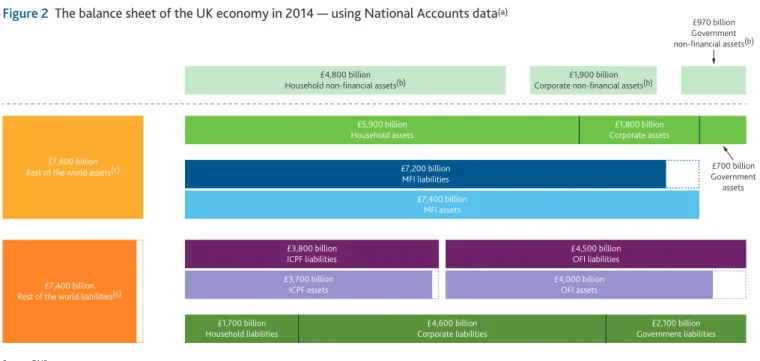
Figure 2shows the scaled financial balance sheets of the UK economy using ONS data for 2014. Each sector is
represented by a pair of boxes with an area that is in proportion to its total financial assets and liabilities.(8) The values of non-financial assets owned by the real economy, such as houses or vans, are shown as additional boxes at the top of the figure. Substantial amounts of wealth are held in non-financial assets: the stock of UK housing (the largest non-financial asset owned by households) is worth about £5 trillion and NFCs own about £1.9 trillion of capital stock. A map of the financial system
Figure 2contains some useful information on the size and composition of the UK financial system. Moreover, because the data come from the National Accounts, the data in the map are consistent with the activity captured elsewhere in those accounts, such as GDP, consumption and investment in physical capital. For many questions in economics, this level of detail is sufficient. But for some questions, including many that relate to the Bank’s policy goals, more detail can be required.
The Bank of England has committees charged with maintaining monetarystability (the Monetary Policy
Committee (MPC)) and financialstability (the Financial Policy Committee (FPC)). In addition, the Prudential Regulation Authority (PRA) Board oversees the PRA’s role in promoting the safety and soundness of firms it regulates, and protecting policyholders of insurance contracts. The information required by all three bodies to meet their objectives is likely to extend beyond the data contained in the National Accounts. As an example, in looking for vulnerabilities in the
United Kingdom’s external balance sheet that might exacerbate the risks around the current account deficit, the December 2014 Financial Stability Reportemphasised the need for greater detail than is available in the National Accounts. This has been an active area of research recently.(9)
(1) In practice, for individuals and smaller businesses, deposits in the United Kingdom of up to £85,000 are protected by the Financial Services Compensation Scheme. (2) See Liu, Quiet and Roth (2015) in this edition of the Bulletin.
(3) National Accounts have been published each year since 1952 but balance sheets were not included until later. From 1978 the Central Statistical Office started to produce regular information on UK financial balance sheets in its publications. Sporadic attempts to estimate the stock of assets (financial and non-financial) started much earlier, with the Domesday Book perhaps the best-known example. Piketty (2014) gives a brief history of economists’ attempts to measure national accounts including stock information (see ‘National Accounts: an evolving social construct’, pages 55–59). Pozsar et al(2010) is a recent example of visually representing how parts of the financial system fit together.
(4) Includes central and local government.
(5) This ONS sector also includes non-profit institutions serving households. (6) The current standards for ONS National Accounts are known as ESA 2010. NFCs are
also split into public and private (here meaning those owned by the state or not) though public NFCs are of negligible size in practice.
(7) In a closed economy, the total size of financial assets would be equal to the total size of financial liabilities. For an open economy, by including these ‘RoW’ assets and liabilities, the National Accounts maintain this identity: that total assets and liabilities are equal.
(8) Financial institutions typically do not have substantial non-financial assets so that they have financial assets of roughly the same size as their liabilities. Assets do not equal liabilities exactly, however, due to the difference between the book value of equity and the market value of equity, for example.
(9) See Box 2 on pages 29–31 of the December 2014 Financial Stability Report; www.bankofengland.co.uk/publications/Documents/fsr/2014/fsrfull1412.pdf.
To this end, Figure 3presents a ‘map’ of the financial system. The RoW sector and real-economy physical assets have been stripped out. The length of each box is now directly
proportional to the size of the sector’s assets or liabilities. Sectors within the financial system are shown at double height as the map shows both their assets and liabilities. The
non-bank financial sector has been separated into a number of meaningfully distinct subsectors such as pension funds, hedge funds and life insurance companies. The map is drawn at a level of detail at which it is reasonable to compare institutions within each financial sector and to aggregate their balance sheets to give a single representative balance sheet for that sector. For instance, it makes sense to think of all unit trusts as having some features in common, whereas in the National Accounts OFI sector, unit trusts are aggregated up alongside central counterparties, which perform a completely separate function. Similarly, the MFI sector has been split into different types of banking business, paying particular attention to whether they are UK or foreign-owned, which is an important distinction in particular for many regulatory and financial stability issues.
Figure 3includes some important design choices, to help focus on the flow of funds within the UK financial system. First, it excludes derivatives. Derivatives are important for the provision of some services, are a significant proportion of some firms’ balance sheets and lead to important interconnections within the financial system, particularly between banks. But their contingent nature, together with the practice of a small number of financial firms holding very large, offsetting positions that cancel out to small net positions, means that it is not sensible to directly compare
their size to other financial assets. Second, it excludes the foreign assets and liabilities of foreign branches. This significantly reduces the size of the ‘RoW other banks’ sector. While important for those banks and some policy purposes, it is useful to remove these assets and liabilities here to focus on the United Kingdom.
A further way in which Figure 3differs to Figure 2is that the banking system is illustrated on a consolidated basis, capturing the global activity of UK-based institutions.(1) This is different to the residency basis of the National Accounts but can be more useful for answering some questions related to financial stability.(2) But this choice comes at a cost — the accounts are no longer consistent with other measures of UK activity. It also means that for a small proportion of assets (liabilities), the corresponding liability (asset) is no longer shown.
Figure 3is not the only way to dissect the financial system but it is one that makes sense based on current structures and analysis of the financial system. Other decompositions could be drawn as the financial structure of the economy changes and more information becomes available. The initial attempts to collect information on the UK financial system as part of the Radcliffe Report (1959), and later the Wilson Report (1980), serve as a reminder that our data and analysis need to evolve in line with the financial landscape.(3)
£7,800 billion Rest of the world assets(c)
£4,800 billion
Household non-financial assets(b) Corporate non-financial assets£1,900 billion (b)
£5,900 billion Household assets £1,800 billion Corporate assets £1,700 billion Household liabilities £4,600 billion Corporate liabilities £2,100 billion Government liabilities £7,200 billion MFI liabilities £7,400 billion MFI assets £3,800 billion ICPF liabilities £4,500 billion OFI liabilities £3,700 billion ICPF assets £4,000 billion OFI assets £7,400 billion
Rest of the world liabilities(c)
£970 billion Government non-financial assets(b) £700 billion Government assets Source: ONS.
(a) Figure shows financial assets excluding derivatives. MFI refers to monetary financial institutions, ICPF refers to insurance companies and pension funds and OFI refers to other financial institutions. Financial assets may not be equal to financial liabilities for individual companies, and hence sectors. This is due primarily to excluding non-financial assets, using market values for equity and the exclusion of derivatives. The coloured dashed lines indicate the balancing value for sectors.
(b) Values for non-financial assets are as of 2013. Non-financial assets of financial sectors are not shown in the figure.
(c) Rest of the world assets and liabilities are included where one party to a contract is not a resident in the United Kingdom. See main text for more details.
Figure 2 The balance sheet of the UK economy in 2014 — using National Accounts data(a)
(1) A further difference is that large investment firms that are regulated by the PRA have been grouped with banks in Figure 3whereas they would fall under OFIs in Figure 2. (2) The National Accounts seek to capture the economic activity of agents resident in the
United Kingdom, regardless of the nationality of their ultimate owner. For example, this leads them to capture the balance sheets of foreign-owned, UK-resident bank branches; but not UK-owned, foreign-resident bank branches.
To examine the risks laid out in the previous section and answer the questions posed in the introduction, the map could
be shown with the detail of what typesof contract are on each
balance sheet (debt or equity), the maturityof those assets
and liabilities, or with the connections explicitly drawn in. The ability to accurately draw such maps is hindered from some sectors by data availability. The final section of this article describes ongoing work to expand the available data sets.
The map shows the financial assets and liabilities ownedby
each sector — and it only includes sectors that are substantial
on this measure. Some types of business that have a very important role in the UK financial system do not have large balance sheets. For example, some institutions do not appear on the maps at all because they trade assets on behalf of clients such as households or pension funds. Examples of this include certain types of asset management firm: these companies account for a substantial share of trading in financial markets but their own balance sheets are relatively small; the assets traded on behalf of their clients appear on the respective sectors’ balance sheets.
What are the subsectors of the financial system? Figure 3provides a richer description of the financial system
than Figure 2, but the basic structure remains the same. The
banking system, which was represented as a single sector
shown in blue in Figure 2, is now sub-divided into the different
types of bank collected in the blue rectangle. And the non-bank financial sector, which is split into two sectors by
the ONS, is further sub-divided in Figure 3with most sectors
collected in the purple rectangle. The Bank of England and CCPs are shown separately in the centre to represent their central role in the financial system.
Together the firms in the map provide all the core functions of the financial system. Banks facilitate payments through the payment system, and also make loans and take deposits, with the vast majority of this activity accounted for by the major UK international banks and major UK domestic banks. Reflecting London’s role in global financial markets, the UK banking system also includes many rest of the world investment banks that specialise in securities trading and corporate finance. Rest of the world ‘other’ banks also engage
£220bn General insurance companies £270bn Finance companies £1,800bn Corporate assets £700bn Government assets £400bn Bank of England £320bn Securitisation SPVs £1,700bn Household liabilities £4,600bn Corporate liabilities £2,100bn Government liabilities £250bn UK other banks £160bn Central counterparties(b) £90bn Exchange-traded funds £90bn Investment trusts £90bn Private equity Other unauthorised funds(d) Real-economy financial assets
Real-economy financial liabilities
Banks(a) Non-banks(c)
Liabilities Assets Liabilities Assets £5,900bn Household assets £3,570bn Major UK international banks £1,160bn Major UK domestic banks £460bn RoW other banks £1,730bn
Rest of the world (RoW) investment banks £1,430bn Pension funds £1,610bn Life insurance companies £700bn Unit trusts £670bn Hedge funds
Excludes cross-border exposures of foreign-owned bank branches and derivatives
Sources: AIC, Asset Based Finance Association, Bank of England, British Private Equity & Venture Capital Association, company accounts, Finance & Leasing Association, Financial Conduct Authority, ONS, S&P SynThesys, Securities Industry and Financial Markets Association, The Investment Association and Bank calculations.
(a) UK banks are measured on a global consolidated basis. Rest of the world banks include subsidiaries and branches, with cross-border assets/liabilities excluded for foreign branches. PRA-regulated investment firms are shown within the banking sector. Finance companies and special purpose vehicles (SPVs) include both those consolidated into banks and others. SPVs covers vehicles with assets resident in the United Kingdom but does not include the Asset Purchase Facility, which is consolidated into the Bank of England’s balance sheet.
(b) Central counterparties (CCPs) are measured on a consolidated basis. Includes accounts of UK-authorised CCPs.
(c) Insurance companies and pension funds are measured on a residency basis. Insurance companies includes all PRA-authorised insurers and reinsurance companies are included in the general insurance sector. Pension funds covers self-administered pension funds in the United Kingdom. In general, other non-banks are included if managed in the United Kingdom. The range of sources used to estimate non-banks may not report on consistent bases. Unit trusts includes authorised unit trusts and open-ended investment companies. Value for hedge funds is indicative only, based on estimates using a number of data sources and assumptions. Data for private equity and pension funds are as of 2013.
(d) No sector estimate is shown for other unauthorised funds.
in these kinds of activities but tend to interact less with the UK real economy.
Turning to non-bank financial institutions, fund managers offer investment products and services for savers, on whose behalf they lend money in the form of debt or equity to borrowers. Unit trusts are one example, but they sit alongside pension funds, hedge funds and other collective investment schemes. Finally, the map shows insurers: life insurance companies provide long-term savings products, typically involving provision for retirement. General insurers, meanwhile, provide insurance against particular events, such as a car being stolen or a pet needing veterinary care. The box on pages 122–24 explains all of the different types of financial institution that feature in the map in more detail.
How representative are the aggregate
sectors?
Analysing sectors using disaggregate analysis In Figure 3, institutions have been assigned to sectors depending on the defining characteristics of their business. Understanding the characteristics of each of these sectors and their aggregate financial balance sheet is important for assessing both the risks they face and the risks they pose to the rest of the financial system. But availability of underlying individual entity data also allows analysis of whether sector
aggregatesgive a good approximation of a representative
balance sheet of a representative company or the totalrisk of the sector. There could, for example, be a set of vulnerable
institutions or individuals that pose a broader risk to financial stability than can be seen from the aggregate data for that sector alone.
For this reason, more detailed analyses often concern how metrics are distributed across a sector. For example, the June 2014 Financial Stability Reportfocused on the distribution
of debt across households rather than aggregate indebtedness. The FPC was concerned that an increase in the number of highly indebted households could lead to an economy that would be more vulnerable in the face of shocks.
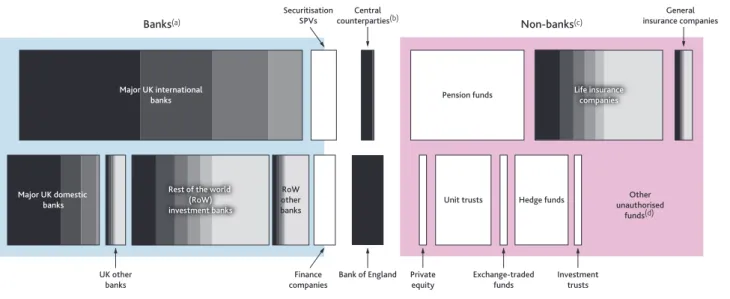
Other types of analysis focus on the very largest firms in a sector. For example, the UK 2014 bank stress tests were conducted by the largest eight banks. Within the financial system, particular attention is paid to institutions considered ‘systemically important’. This can be because of their complexity or interconnectedness, or it can be because they have a dominant position in the provision of a critical service.(1) Very often, though not always, these factors are highly correlated to the sheer size of a firm, or its dominance in its industry. Figure 4shows one illustration of
concentration in different sectors. The five darkest shades of grey represent the size of the balance sheets of the largest five entities in those sectors closest to the Bank’s regulatory and
(1) Box 9 on pages 73–76 of the June 2014 Financial Stability Reportsummarises these criteria for the non-bank financial system;
www.bankofengland.co.uk/publications/Documents/fsr/2014/fsrfull1406.pdf. General insurance companies Finance companies Major UK international banks Bank of England Major UK domestic banks RoW other banks Securitisation SPVs UK other banks Central counterparties(b) Exchange-traded funds Investment trusts Private equity Pension funds
Unit trusts Hedge funds
Banks(a) Non-banks(c)
Largest firm Second-largest firm Third-largest firm
Fourth-largest firm Fifth-largest firm All other firms
Other unauthorised
funds(d) Rest of the world
(RoW) investment banks
Life insurance companies
Sources: Bank of England and Bank calculations.
(a) UK banks are measured on a global consolidated basis. Rest of the world banks include subsidiaries and branches, with cross-border assets/liabilities excluded for foreign branches. PRA-regulated investment firms are shown within the banking sector. Santander UK is shown within Major UK domestic banks. Finance companies and SPVs include both those consolidated into banks and others. SPVs covers vehicles with assets resident in the United Kingdom but does not include the Asset Purchase Facility, which is consolidated into the Bank of England’s balance sheet.
(b) CCPs are measured based on consolidated accounts of UK-authorised CCPs.
(c) Insurance companies and pension funds are measured on a residency basis. Insurance companies includes all PRA-authorised insurers and reinsurance companies are included in the general insurance sector. Pension funds covers self-administered pension funds in the United Kingdom. In general, other non-banks are included if managed in the United Kingdom. The range of sources used to estimate non-banks may not report on consistent bases. Unit trusts includes authorised unit trusts and open-ended investment companies. Value for hedge funds is indicative only, based on estimates using a number of data sources and assumptions. Data for private equity and pension funds are as of 2013.
(d) No sector estimate is shown for other unauthorised funds.
The subsectors of the financial system
This box provides more detail on the different types of financial institution shown in the map of the UK financial system (Figure 3). Some of these institutions are fairly complex, so for further details the box links to other sources of information.
Banks(1)
Banks provide some of the core services of a financial system, including holding deposits, providing payment services and lending to households and companies. The UK banking sector is large compared to other developed countries and
particularly international in nature: both in terms of the scale of foreign bank activity in the United Kingdom and the scale of the international operations of UK-owned banks. A recent
Quarterly Bulletinarticle explains that this is partly due to
London’s history as a financial centre and considers the implications of such a large banking sector for financial stability.(2)
Figure 3separates the sector into different types of bank. The UK-owned banks are split into three groups. The eight lenders in the United Kingdom that took part in the 2014 stress-testing exercise make up the first two groups, distinguished by the extent of their overseas business: the
major UK international banksand the major UK domestic
banks.(3) All other UK-owned banks (both retail and investment banks) and building societies are in the group
UK other banks.(4)
The subsidiaries and branches of overseas banks are split into two groups. Investment banksoperate in capital markets, either to help companies and governments raise funds, or to manage risks for clients.(5) This sector includes PRA
‘designated firms’ — institutions that do not accept deposits but which are still prudentially regulated by the PRA. Other branches and subsidiaries of overseas banks operating in the United Kingdom are shown asRoW other banks. Many international banks have branches operating in London, which is an international financial centre, but actually do little business with UK clients. Because the focus here is on the UK financial system, the exposures to non-residents of branches operating in the United Kingdom have been excluded from this map. This is an important design decision. If they were included, they would be substantially larger.
Semi-banking sectors
Two types of institution are illustrated as sitting on the border of banking: securitisation special purpose vehicles (SPVs) and finance companies. They are illustrated in this way because they are often, though not always, owned by banks.
Like banks, finance companieslend money to the real economy. And many finance companies are owned by banks. But finance companies themselves are not banks as they do not use customer deposits to finance the loans they make. One common way that finance companies and banks fund their lending activities is via the process of securitisation, explained in more detail in Balluck (2015). Securitisation involves selling a bundle of loans to a separate entity called anSPV, which holds these loans as its assets. The SPV then issues debt securities to outside investors, where the interest and principle payments are covered by the cash flows from the original loans. In this way, the risk associated with the loans can be transferred to other investors and traded on a secondary market in the form of debt securities. Non-bank sectors
Asset managers provide a wide range of savings products. Some products, such as pensions and life insurance, are primarily aimed at helping households plan for their retirement (the top row of the non-banks box). Other products, shown on the bottom row of the non-banks box, are more general, and might be marketed to various types of investor. They can take a range of structures and risk profiles.
Life insurance companiessell products that promise
payments to the holder over a long time horizon, usually with uncertainty over when, or for how long, those payments will be made. Much of households’ long-term savings are on the balance sheets of life insurers in the form of pension savings or annuities.(6)
Other pension savings, such as those accrued through private sector pension schemes, are held on the balance sheets of self-administered pension funds,which invest those savings so that the fund can honour its commitments.
General insurance companiestypically sell products, such as motor insurance, which promise compensation payments to the holder in the event of an adverse occurrence, such as a car accident. Insurance contracts allow households and
companies to manage their risks: in return for making relatively small, predictable payments they are able to avoid
(1) As with Figure 2, ‘bank’ is used as a simple title and includes building societies. As described in the text, the blue box includes some institutions that are not strictly banks. The Bank of England is itself a bank and is discussed at the end of this section. (2) See Bush, Knott and Peacock (2014).
(3) The first grouping is Barclays, HSBC, Royal Bank of Scotland and Standard Chartered. The second is the Co-operative Bank, Lloyds Banking Group, Nationwide and Santander UK. Note that ‘major UK domestic banks’ is used as a simple label but the sector includes a building society (Nationwide) and a foreign-owned bank (Santander UK).
(4) Credit unions are excluded from the map.
(5) See Balluck (2015) for a more in-depth description of what investment banks do. (6) There is also often uncertainty over the amount that will be paid out. Many life
insurance policies are savings products where the payout is dependent on investment performance.
larger, unpredictable costs. This category includes reinsurers, which sell insurance to the insurance industry.(1)
The rest of the non-bank sector is composed mostly of forms of collective investment schemes.(2) These are funds which pool the money of many savers and use those to buy assets such as shares and bonds. Savers that have invested in the fund are entitled to a proportional share of the assets held by the fund. Funds differ along a number of dimensions, including whether they are suited to holding liquid or illiquid assets and the types of risk they can take:
(a) Unit trusts, which are open-ended funds, are the most common type of collective investment scheme. When a new investor joins an open-ended fund, the size of the fund increases and the manager uses the additional funds to purchase more assets for the fund. When an investor sells their share then the size of the fund is reduced. Open-ended funds are usually managed by investment firms but the unit shares are owned by the savers, not the investment firms. Their open-ended nature makes them suited to investments in highly liquid financial assets, such as some classes of equities and bonds, which can be easily bought and sold.
(b) Investment trusts, which are closed-ended funds, are ‘closed’ because the number of units is fixed — if an investor wants to join the fund then they must buy their share from an existing investor. The units can trade on an exchange. (That is, there is a secondary market in the units in the trust.) Not only can no units be added, but none can be redeemed — such funds are not allowed to pay out capital, only the dividends on the assets they own. Closed-ended funds can be suited to investments in less liquid assets, such as commercial property, where it is harder to quickly sell assets in order to meet investors’ desire to sell positions.
(c) Exchange-traded funds(ETFs) combine some of the
features of open and closed-ended funds. ETFs are open-ended funds but the units can be traded on an exchange — a saver who wishes to cash in their holding can sell their share to another saver. Only large institutional investors can create or redeem units in the fund.(3)
Many unit trusts, investment trusts and ETFs are marketed to retail investors. In order to do so, they must meet conduct regulations on the types of risk they can take and the types of asset in which they can invest. This leads to many such funds refraining from borrowing money to enhance returns in their investment strategies. Hedge funds, private equity funds and unauthorised funds are typically marketed at sophisticated
investors and professional institutions and so are not subject to the same strict conduct regulation. This allows them to pursue a broader range of investment strategies.
(a) Hedge fundsare similar to open-ended funds in that
investors can normally redeem their capital at fairly short notice. By marketing largely to institutions and
sophisticated investors, hedge funds have historically been subject to lighter regulation than other more mainstream investment vehicles and are more likely to invest in complex asset classes and use borrowed money to enhance returns (and exacerbate losses). While the hedge funds captured in the map are managedfrom the
United Kingdom, the funds themselves are typically domiciled overseas.
(b) Private equityfunds differ markedly from the other collective investment schemes because they buy controlling stakes in firms with the intention of providing not just capital for such a firm, but also management input in the running of the firm.(4) Given the illiquid nature of such investments, they are usually structured as closed-ended funds with a finite lifetime. In purchasing companies to manage, such as manufacturing and services firms, private equity funds often use borrowed money. Because the debt is secured against the target company, it shows up on that company’s balance sheet, rather than that of the fund.
(c) Other unauthorised fundsinclude unregulated collective
investment schemes and non-mainstream pooled investments, which are not subject to the rules that apply to retail-oriented investment funds. Such schemes have restrictions around marketing to retail customers. By their very nature, it is difficult to ascertain the size of these funds and no sector estimate is shown in Figure 3. Financial system plumbing
Finally, central counterparties(CCPs) and the
Bank of England play an important role in the plumbing of the financial system and so are placed in the centre of the map. CCPs reduce bilateral counterparty credit risk exposures in the markets in which they operate by effectively placing
themselves between the buyer and seller of an original trade. In doing so, they take on a financial asset with one party
(1) See Breckenridge, Farquharson and Hendon (2014) for more on the business models of insurers.
(2) In general, the map tries to capture funds managed from the United Kingdom, even if they are registered in other jurisdictions.
(3) This means that ETFs are less likely than investment trusts to trade at a discount or surplus to the value of the underlying assets as an institutional investor would be likely to redeem or create units respectively if this were the case.
(4) Includes venture capital funds, which invest in younger businesses and start-ups. See Gregory (2013) for more on private equity funds.
and an equal and opposite liability to another.(1) The
Bank of England is itself a bank and has its own balance sheet. Through its monetary, microprudential and macroprudential policies it influences the size and composition of other sectors’ balance sheets. And its role in overseeing the United Kingdom’s systemically important payment systems
gives it a central role in the financial system. The importance of these roles is not obvious from the size of its balance sheet.(2)
(1) See Rehlon and Nixon (2013) and Cumming and Noss (2013) for more on CCPs. (2) The Bank of England also operates the Real-Time Gross Settlement (RTGS) system.
policy functions. For example, the largest five life insurers account for half of the sector.
The banking system in the United Kingdom is particularly concentrated. Partly because of their size and
interconnectedness, four UK-owned banks are on the
Financial Stability Board’s list of global systemically important banks, which requires them to have more capital (which can absorb losses when economic conditions deteriorate). Non-bank financial sectors are less concentrated. The large insurers and pension funds are extremely large in absolute terms, but there are many medium-sized firms in both sectors. And collective investment funds tend to be more evenly distributed. The sectors drawn in the centre of the map, the central bank and CCPs, are important to the financial system beyond the size of their balance sheets but they are also, by their very nature, highly concentrated.
Case study: funding the non-financial corporate sector The difference between aggregate and individual balance sheets can be highlighted by looking at the heterogeneity of the non-financial corporate sector. There are around 1.3 million non-financial firms in the United Kingdom with around £1,300 billion of publicly traded equity, £350 billion of publicly traded bonds and £400 billion of loans from UK-resident banks. But the vast majority of the sector’s financial contracts are accounted for by the largest 1% of firms. Around 800,000 firms have no external financing at all and only a few hundred have publicly traded bonds.
Figure 5shows the largest non-financial firms in the United Kingdom. It shows less than 1% of companies (fewer than 10,000 companies), but they likely account for over 90% of the total assets of all non-financial companies. Each collection of circles represents approximately one fifth of the total assets of the companies and each firm is represented by a circle sized proportionally to its assets. A small number of very large firms make up most of the aggregate balance sheet of the UK corporate sector. For example, the four largest firms have total assets of roughly the same size as the next
fourteen.
Non-financial companies finance themselves in different ways: some (typically larger) firms have access to capital markets — they can issue debt (corporate bonds) or shares. The
remainder do not issue securities, so rely on other sources such as retained earnings or bank loans for their financing. The
colour of the circles in Figure 5corresponds to how the firms finance themselves. Only around 400 firms have bonds outstanding and around 1,300 have publicly traded equity. The prices of equities and bonds are watched carefully for information about the prospects of companies. But this analysis shows that this represents only a very small share of UK companies by some measures, and it may not be
appropriate to infer prospects for the whole corporate sector from these markets. This might be important for the MPC’s outlook for growth and inflation in particular. For this reason, the Bank uses a variety of information sources to monitor firms of different sizes, including microdata sources, surveys like the Credit Conditions Surveyand the Bank’s Agency network.(1)
One of the questions posed in the introduction of this article asked how vulnerable the most highly indebted corporates are. Data on individual firms can shed light on this. For instance, there may be significant numbers of firms in particular industries that are vulnerable to shocks to income or interest rates. While it is possible to detect this with statistical analysis of the individual balance sheets, it may not be at all apparent from the aggregate balance sheet of the
non-financial company sector, as the high indebtedness of some areas of the corporate sector may be averaged out by low indebtedness elsewhere.
To answer the final question posed in the introduction — who has lent to these vulnerable firms — requires further extensions of the currently available data. This is picked up in the next section.
Looking ahead: how can the data sets be
improved
Mapping out the links between the sectors: who is indebted to whom?
As emphasised earlier in the article, financial assets and liabilities represent connections. But the data needed to characterise accurately these interconnections between sectors are not always available. The map shows, for instance,
(1) Indeed, the Bank’s Credit Conditions Surveyhas persistently reported different conditions for firms by size and highlighted different conditions for different industries. See England et al(2015) for more information on the work of the Bank’s Agents.
that UK households have £6 trillion of financial assets — meaning that other sectors have a total of £6 trillion of liabilities owed to the household sector. Non-financial companies and households largely hold deposits with banks, and banks largely lend to firms and households. Similarly, firms and households hold insurance contracts and pensions, and insurance companies and pension funds in turn hold debt and equity of real economy and other financial institutions, sometimes directly and sometimes via collective investment schemes.
But the interconnections that are implied by the map go well beyond these simple connections. There is a large web of lending between different banks, and the links between banks and other financial institutions are also very important.(1)
In some cases these intra-financial linkages have improved the resilience of the system, perhaps with risks distributed to the institutions best structured to hold them. But at other times, these interconnections have proven to propagate shocks beyond their original markets. Understanding the evolving layout of the financial system — and when additional links mitigate risks versus magnifying them — is an important aspect of correctly focusing analysis and macroeconomic policy.(2)
Developing the ‘flow of funds’ data set
National Accounts data have long been regarded as important for understanding the economy as a whole, and monitoring risks to financial stability.(3) The crisis has been a reminder that the data the Bank and others use need to evolve with our understanding of the key issues and risks. This article has highlighted two areas in which more data are important: comprehensive statistics on the institutions which make up the OFI sector, and availability of microdata underlying the sectoral aggregates.
Going a step further, comprehensive analysis of sectoral interconnectedness requires assets and liabilities to be matched between counterparties. These ‘who-to-whom’ data would allow for analysis of the potential propagation of shocks. For example, knowing which sectors hold UK bank debt would allow analysis of (i) which sectors might feel the knock-on effects in the event of certain banks defaulting (or being bailed-in), and (ii) which sectors the banking system relies on for financing, and whether that has changed over time.
While such information would facilitate analysis of
propagation channels at a sector level, some financial stability questions require more detailed data still. Returning again to the questions posed in the introduction, to work out the exposures of different lenders to the most vulnerable corporates, for example, requires who-to-whom data at the level of individual agents. To then work out how distress at those lenders might be propagated through the financial system requires detailed data on their counterparties. Indeed, some of the most promising research on the sources and propagation of macroeconomic fluctuations and financial instability in recent years has focused on disturbances and interactions at a firm level. For instance, Gabaix (2011) argues that the distribution of the size of non-financial firms is sufficiently skewed that shocks to the largest 100 firms in the United States can account for around one third of variations in output growth. Acemoglu et al(2012) take a different approach, showing that the network structure of the interactions between non-financial firms can play an important role in explaining aggregate fluctuations. With sufficiently granular data on firm-level interactions, such research could be extended to take account of connections
Equity and debt issuance Debt issuance only
4 firms 14 firms 50 firms 268 firms 8,570 firms
Equity issuance only No security issuance
Sources: Bank of England and Capital IQ.
(a) Each collection of circles represents roughly a fifth of the total assets shown. Each circle represents a firm and is sized in proportion to total consolidated assets of that firm at book value. The largest 8,906 UK-incorporated, non-financial companies operating in 2013 are shown. These firms are likely to account for over 90% of non-financial firm assets in the United Kingdom. Subsidiaries of firms that are in the figure are not shown additionally as separate companies. UK subsidiaries wholly owned by non-UK companies are shown as private companies, even if the parent is publicly traded.
Figure 5 Size and financing sources for largest non-financial firms in the United Kingdom(a)
(1) See Liu, Quiet and Roth (2015) in this edition of the Bulletin. (2) See, for example, Battiston et al(2012).
between the real economy and the financial system. And Delli Gatti et al(2010) build a theoretical model in which a credit network exists both between firms and between firms and banks, showing that the structure of this network of interconnections does indeed affect aggregate fluctuations. Further improvements in our understanding of financial instability may require further improvements in our data. This article has focused on the stock of financial assets and liabilities, but the same principles apply to flow data. The complexity of the financial system could be better understood with collection of more detail on the OFI sector, availability of microdata, and knowledge of who is transacting with whom. Sectoral Financial Accounts, covering both stocks and flows, compiled with counterparty information are often referred to as ‘Flow of Funds’ data.
The Bank of England and ONS are working together to make the changes necessary to improve official Flow of Funds data.(1) For example, initiatives already under way include: undertaking an assessment of counterparty information currently contained within the National Accounts; updating the surveys used to collect financial data so that estimation of who-to-whom relationships can be improved;(2) checking and improving the classification of all financial firms surveyed; and enhancing the use of administrative and regulatory data to inform estimates.(3) At a minimum, this work is expected to deliver better interconnections data at a sectoral level and some disaggregation of the OFI sector shown in Figure 2into different types of institutions. But it is possible that it will be able to go a lot further and use the underlying firm-level data to provide data sets for analysing risks within sectors, or even the interconnections between firms.
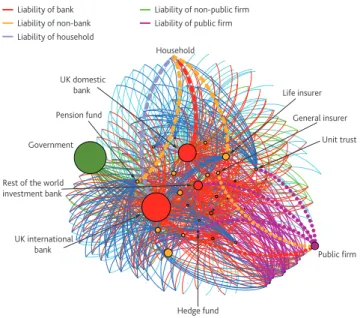
Figure 6looks ahead to what a map of the UK financial system might look like if such data were available. Rather than showing aggregate sectors, like Figures 2and 3, it returns to showing individual agents (the circles) and the connections between them (the connections), like Figure 1B. Each circle represents an individual agent: the tiny mauve circles around the outside of the figure are households; the slightly larger purple circles are non-financial companies; and the larger red circles in the centre are banks. For the purposes of illustration, the number of agents in each sector has been reduced heavily to a representative sample, based on the data in Figures 3
and4and some connections are highlighted with dashes and dots. The size of circles reflects the size of that agent’s outstanding liabilities — note that this makes the households hard to see with the naked eye. Detailed data do not currently exist on all the interconnections, so the lines are simply a stylised presentation of the sorts of connections known to exist between different types of agent.
While harder to interpret visually than Figure 3, Figure 6
offers some different perspectives on the financial system. It
shows that interconnections are most dense within the financial system itself: from one bank to another and between banks and some types of investment vehicle. Households and
privately ownedcompanies have far smaller connections to the
financial system: for example, some households have debt to banks (the mauve dashed line), most have deposits with banks (the red dashed line), many have savings with individual pension funds and some hold other forms of investment (the yellow dashed lines). Companies with publicequity or debt — the companies that did not show up in green in Figure 5— are more connected to the financial system through investment funds’ holdings of their securities (the purple dotted lines). But maps like Figure 6are not an end in themselves. Instead, the underlying data can be interrogated with statistical techniques to analyse interconnections and the propagation and mitigation of shocks through the financial system.
Conclusion
Thinking about the financial system as a series of interconnected balance sheets is a useful framework for macroeconomic analysis. Just as every transaction has a buyer and a seller, so every financial contract is an asset for one party and a liability for another. These stocks of wealth and debt create connections between individuals and different sectors of the economy. Macroeconomic policy makers need
Sources: AIC, Asset Based Finance Association, Bank of England, British Private Equity & Venture Capital Association, company accounts, Finance & Leasing Association, Financial Conduct Authority, ONS, S&P SynThesys, Securities Industry and Financial Markets Association, The Investment Association and Bank calculations.
(a) Nodes (circles) represent individual agents while edges (connections) represent individual financial assets/liabilities. Data are stylised with size of nodes based on data in Figure 3. Edges in the figure are coloured according to which sector is owed money. For example, a household (a mauve node) may be connected to a bank (a red node). If the edge is coloured mauve then it shows borrowing by the household, for example a mortgage, whereas if it is coloured red then it shows an asset for the household, a bank deposit in this example.
(1) See Barker and Ridgeway (2014).
(2) New financial services surveys, which will provide better coverage of the OFI sector, were sent to businesses for the first time in 2015 Q1.
(3) For more information see Financial Statistics Expert Group meeting minutes (2015).
Liability of bank Liability of non-bank Liability of household
Liability of non-public firm Liability of public firm Household
UK international bank Rest of the world investment bank UK domestic bank General insurer Life insurer Unit trust Hedge fund Public firm Pension fund Government
to consider both sides of these connections. The various maps explored in this article use different sources of information to piece together the constituent sectors of the economy and are a useful way of understanding how the financial system fits together.
It is important for the Bank of England to understand this stock of financial wealth and debt, and the interconnections it represents. This work builds on the National Accounts of the United Kingdom and its focus reflects three areas in which analysis must push beyond traditional sources of data. First, the financial system is not an amorphous whole and it is important to understand the different structures of non-bank financial companies. Sectoral balance sheets were introduced into international standards for National Accounts in 1968. Financial systems have changed since then and, as a country with an important non-bank financial sector, it is natural that the United Kingdom should consider how that can best be encompassed into standard reporting.
Second, it is imperative to understand how these subsectors of the financial system are connected to each other and to other parts of the economy. The maps are a way to ensure that such analysis is not done for each type of institution in isolation, but rather considers how they fit into the UK economy.
Third, underlying differences can be as important as
similarities when analysing sectors. Some risks arise because a whole sector moves with the same trend — for example, the high levels of leverage that built up in banking systems across the world prior to the global financial crisis. But others arise where aggregate data might not point to a risk — where a small group of highly indebted borrowers or pockets of vulnerable lenders arise, for example. Some risks will only be identified by looking at high-level trends; while others will be missed with such an approach requiring work with more disaggregate data. Adjusting the map to the correct scale and focus, and having the data to be able to do so as needed, are important elements of policy analysis.