287.1
7800
32/X 1
4300.250
4300.25036.14
Perspiciatis Nemo enim ipsam voluptatem quia voluptas sit aspernatur aut odit aut fugit, sed quia consequuntur magni dolores. 45% - 20143420.330
3420.3305x
42
x21
2014
175lbs 21 x 31 10 x 15 10 x 150.2
21.56 205 101977
6’1”4300.250
32/X 1
21.56 21.56287.1
2015x210.2
7800 780010.5kg
-20.27800
21.56287
0.2
32/X 1 287.1 x21 25% weight5.0
.2
DATA-CENTRIC CRE:
A COMPETITIVE
IMPERATIVE
John Forrest
Global Director and CEO Corporate Solutions, Americas
Jordi Martin
Global Director and CEO
Corporate Solutions, Asia Pacific
Vincent Lottefier
Global Director and CEO Corporate Solutions, Europe, Middle East and Africa
Introducing the JLL CRE Data and Analytics Series
This is the first in a thought leadership series exploring the challenges, opportunities and perceptions of data and analytics within corporate real estate (CRE) worldwide.
In this report, we link CRE teams’ ability to drive competitive business advantage to the effective creation, management and use of data.
In our second publication, we consider how CRE teams can embrace data and analytics to transform data into actionable insights, and how technology supports this process.
Our third piece illustrates how CRE capabilities in data and analytics correspond with their evolution in terms of outsourcing maturity.
Finally—in partnership with leading business and technology research group, Forrester—a global market study explores the depth and potential of data and analytics in the CRE industry. This research provides an unprecedented view into the current state of CRE data and analytics, future opportunities and potential inhibitors to progress.
Figure 1: Six compelling reasons to be data centric
Source: JLL Enables smart and reasoned decision
making
Extends reporting power and influence with senior business
leaders and stakeholders Allows future scenarios to be developed, modeled and assessed Enhances CRE team
productivity and persuasiveness
Strengthens investment cases and
allows success to be measured
Connects the physical portfolio to operations
and wider business strategy
1
2
3
4
5
6
Driving CRE excellence through data
The digital world in which we live and work is awash with data, and it is forecast to grow tenfold by 2020. As computing power and technology advances at breakneck speed, creating and gathering new data has become both fundamental and transformational for business. Entire industries are being revolutionized by the use of data to make better informed decisions, target prospective clients more accurately and drive revenue.
Moving toward a data-centric business model is a competitive imperative. The Harvard Business Review recently stated that companies among the top third in their industry for data-driven decision making are, on average, 5 percent more productive and 6 percent more
profitable than their competitors. Companies that embrace internal and external data, manage its flow carefully but efficiently, and structure it to create actionable
information and insight have a strong competitive advantage.
The era of ‘big data’—data too large and complex to be processed with standard tools or processes—and the ‘Internet of Things’—data derived from embedded systems—is developing quickly and will shape the
corporate real estate (CRE) industry in the near term. CRE teams need to embrace data as core to their remit
in order to meet the demands for productivity gains
identified in our Global CRE Trends report. Rather than
Placing better, deeper, more accessible
and more relevant data at the heart of
everything is the key to addressing the
challenges facing CRE.
viewing data as a burden—another item on an already
full agenda—CRE teams should push proactively toward
data centricity. Placing better, deeper, more accessible and more relevant data at the heart of everything is the key to
addressing the challenges facing CRE.
While some CRE teams are breaking new ground, many
overlook the value of effective data creation, management
and application. Our Global CRE Trends report clearly identified an impetus for change, as 78 percent of more
than 600 survey respondents said that their ability to extract real estate metrics had improved since 2010. Almost a third said the provision of data and insights
will be the most important future contribution of CRE
within their organization. While there are some leaders
in the field, and the momentum is growing, much more will be required for CRE to reap the benefits of a truly data-centric approach (Fig 1). This is a route full of opportunities and will be a feature of best-in-class CRE
Data
denial
you have a distrust of data and avoid using it
Data
centric
you use data to shape all of your opinions and decisions you use data only when it supports your
opinions or decisions
Data
informed
Data
indifference
you don’t care about data and have no need for it
Figure 2: Four stages on the data culture continuum
Source: JLL
Data: Defining principles
Data creation and gathering
Data creation depends on strong governance. It requires clear thinking about what needs to be collected and why, as well as what can be collected and how. The way
processes and systems are designed has a huge influence on a company’s data culture. Processes that are efficient,
simple to follow and enabled by technology have more
chance of gaining traction. Unwieldy and inefficient
processes will generate tension, resulting in data sets that lack rigor, depth and accuracy.
Data gathering needs to bring structure and utility. Much of the data created will be unstructured. A key role in data gathering is to establish a structure that makes the data clear and comparable. Doing this requires a deep
understanding and a strong definition of the data being
collected. Without this structure, data will be brought
together in ways that are inappropriate (apples vs. pears),
leading to inaccuracies in reporting and decision making.
So how do you become a data-driven, best-in-class CRE team? There are three key questions to address, and the answers will vary from company to company:
1
How is the data created and gathered?
2
How is the data stored and managed?
3
How is the data used?
Data storage and management
Data management needs to balance accessibility with control. Storing data is relatively straightforward from a technology standpoint—computing and storage capacity today can accommodate deep data sets. The challenge is to maintain data integrity, yet make sure it is accessible to, and understood by, those who need it to make decisions. One solution is to centralize data management processes, restricting editing rights to a small team and providing ‘read-only’ access to others. A centrally controlled data warehouse becomes a ‘data lake’ that is accessible to a wider set of users who can dive into the data, but are unable to modify it, thus ensuring long-term data integrity.
Data processes and infrastructure must be scalable. Any approach to data management must be grounded in the needs of the future. Exponential increases in the data’s volume, velocity and variety mean that processes and architectures need to be future proof and resilient. Many organizations are so focused on their own internal data that they miss the opportunity to incorporate emerging open sources of data. Even if ‘big data’ is not being faced today, it is important to account for potential future implications.
Data utilization
Data utilization is influenced by culture and behavior. Data can only be useful and empowering if the culture
surrounding it is progressive. Corporate and individual
attitudes to data can be placed along a continuum of four
mix of these cultures or attitudes, those that show high levels of consistency are the ones that achieve competitive advantage through data.
Data must be viewed as a corporate asset. Organizations that are successful in their use of data value it in much the same way as human capital—as a corporate asset. Yet, many organizations still regard data as being the
intellectual property of an individual or a specific
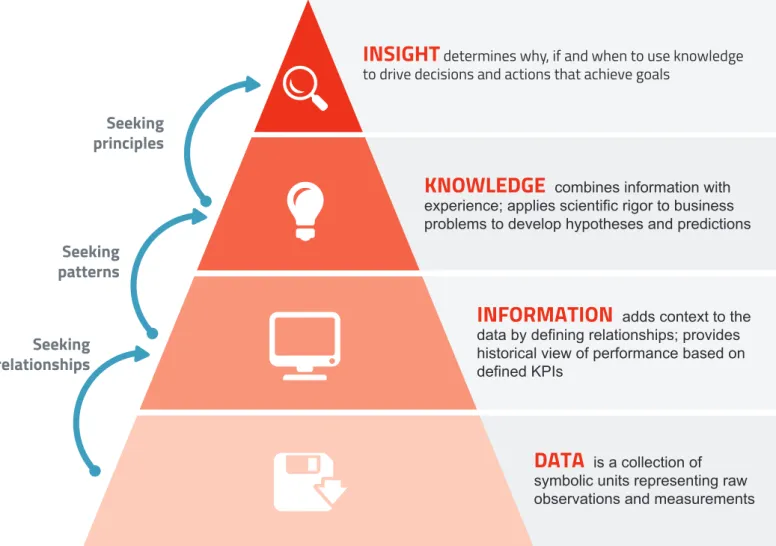
Figure 3: A strong data foundation enables information, knowledge and insight within an organization
Source: JLL function. This makes driving data centricity across an organization extremely challenging.
Data in itself is of limited utility. The data available to an organization is a means to an end, not the end itself. A strong data foundation enables information, knowledge
and insight within an organization (Fig 3). It provides a
baseline on which reporting has greater rigor, depth and capability. Analytical techniques, increasingly enabled by technology, bring further meaning and utility to this data.
Seeking principles Seeking patterns Seeking relationships
INSIGHT
determines why, if and when to use knowledge to drive decisions and actions that achieve goalsDATA
is a collection of symbolic units representing raw observations and measurementsINFORMATION
adds context to the data by defining relationships; provides historical view of performance based on defined KPIsKNOWLEDGE
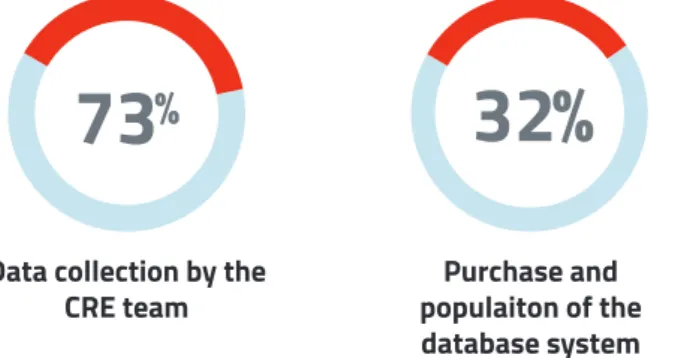
combines information with experience; applies scientific rigor to business problems to develop hypotheses and predictionsData collection by the
CRE team administration to a data Outsourcing of lease provider Purchase and populaiton of the database system Commitment to spend on datacollection and data systems
73
%
32%
22%
39%
Figure 4: Factors driving improvement in ability to extract CRE metrics
Data in CRE today and tomorrow
Source: JLL, Global Corporate Real Estate Trends 2013
The data story in CRE is a relatively recent one. Most CRE teams have only really grappled with the challenges of data since the passing of Sarbanes-Oxley (SOX) or the global financial crisis (GFC) and its immediate aftermath, both of which increased C-suite scrutiny of CRE. Simple
questions such as “How much do we spend on real estate globally?” “How many leases do we have across the world?” or “Which buildings are we able to exit in the
next 12 months?” all became more urgent. Many CRE
teams have been unable to answer these questions quickly or satisfactorily.
This has led to increased investment in CRE data platforms and processes. Indeed, 78 percent of survey respondents in our Global CRE Trends report said their
Source: JLL, Great Traits of CRE Organizations
Figure 5: Increasing importance of data and analytics in the CRE organization
1 5.0 4.5 4.0 3.5 3.0 2.5 2.0 1.5 1.0 0.0 2 3 5 6 7 8 9 10 2013 Avg-Score 2014 Avg-Score 4 Centralized empowered & process oriented Data analyticis/ Business intelligence Internal relationship management Strategic portfolio management Talent
management Infrastructuremanagement Innovation management/ Partner leverage
Change
agents Feedback & continuous improvements
ability to extract real estate metrics improved since 2010. The factors driving this improvement are shown in Fig 4.
Some CRE teams have moved from building early
foundations to creating more data-centric approaches
to CRE. Members of JLL’s Client Advisory Board (CAB)—a global peer network of CRE leaders
exchanging perspectives and ideas that influence the CRE
industry—self-assessed their performance against 10 traits
of world-class CRE organizations. While performance
on data and analytical capabilities was assessed as being
relatively weak, a significant increase in this score over a
12-month period shows that it is an important focus area
This momentum is encouraging, as is a clear recognition
of the need to do more. According to our Global CRE
Trends report, almost a third of survey respondents regarded provision of data and insight as the most important future contribution they could make to the wider business. Meanwhile, 61 percent highlighted increasing business requirements to present scenarios and solutions ‘on demand’ in order to proactively manage both
the CRE function and the portfolio.
Some CRE teams still have a long way to go before they can be regarded as data centric. Few CRE teams are any
further than ‘data informed’ along the data continuum. To progress, more attention needs to be given to addressing
gaps in data quality, application and skills within CRE. Data quality
Many CRE teams are narrow in defining and gathering
data, focusing on physical portfolio data that relates to size, cost, number of leases, or asset characteristics. This data in itself can be incomplete, inconsistent
and poorly managed. As CRE continues to evolve as
a strategic function focused on delivering workplace transformation, this preoccupation with physical data
begins to look outdated. CRE teams must complement
physical portfolio data with more comprehensive data that enables understanding of the workplace—how it functions day to day, how it supports employee
productivity, how it is perceived by the workforce and the
impact of transformations in its design and configuration. CRE teams will also need to relate the contribution of
real estate to the wider performance of the business— something that will require access and exposure to a much broader set of data from across the organization.
Data application
CRE teams have typically used data for descriptive
reporting. While doing this addresses some fundamental
questions asked at the height of the GFC, CRE teams fall
short in using data to present future scenarios and make actionable recommendations. As a result, the potential
of CRE is limited in a corporate environment that now
More attention needs to be given to
addressing gaps in data quality, data
application and data skills within CRE.
requires investment cases to be underpinned by hard data
more than ever before. Once CRE teams have access to
a broad range of quality data sets, they will need to be able to understand and interpret this data and turn it into business insight.
Data skills
Our Global CRE Trends report identified a clear skills gap facing CRE as it broadens its strategic remit. A move toward data-centric CRE compounds this challenge. There is no data army residing in CRE today, despite the
growing use of external service providers to add capacity
in this area. Further, CRE is afflicted by the issues facing
many industries—a shortage of highly skilled data
scientists. Bringing these capabilities into the CRE fold is
important, but it will be time consuming and costly.
Making steady but measured progress
around defining and structuring
existing data can yield big advances.
So what of the future?We see a twofold challenge in moving to data-centric
CRE.
First, there is the challenge of better gathering and managing the physical portfolio data characteristic of
the CRE function today. Making steady but measured progress around defining and structuring existing data can
yield big advances. Doing this requires urgent attention to the construction of better architecture and stronger processes to create robust data sets over the long term.
Second, there is the challenge of future proofing the data.
Action needs to be taken now to seize the opportunity that will emerge from combining data sets on the portfolio, workplace and business performance with real-time data from embedded systems, as well as data from external
sources. Processes need to be defined, or redefined, to be
capable of gathering the data that will be required in the
future. Lack of preparation could limit the individual and collective impact of CRE teams.
Addressing these twin challenges with concerted effort
and investment will enable CRE teams to realize the benefits of increased productivity, greater efficiency and
Toward data-centric CRE: A call to action
It is clear that becoming a data-centric CRE function is no longer a choice. In our view, there are four key moves that will detetrmine which teams lead the way.
And finally, as AC Nielsen—the founding father of market research—noted:
“The price of light is less than the cost of darkness.”
CAPTuRE TO CAPITALIzE
Start by gathering and managing your data. Make a concerted effort to add structure to existing data, which may be incomplete or inconsistent. Explore ways to create new data internally or draw on relevant external data sets. This process may be painful at first, but the rewards of having this data at your fingertips will be worth it.DON’T SEPARATE, INTEgRATE
Do not go it alone. Work with other functions, such as HR, IT and finance, to align and integrate your data. For example, overlay data on recruitment and retention, occupancy and utilization with your physical portfolio data. You may even be able to develop new data sets—imagine the power of applying employee satisfaction survey results at the building level! This will provide rich, new insights and integrate CRE into broader corporate data strategies and decision making.BE A CHANgE AgENT
(Version 2.0)
Take the lead in your organization’s mission to become data centric. Our Global CRE Trends report identified an opportunity for CRE teams to become firm-wide change agents, driving cultural change in the workplace and leading the entire company on the journey. The need to create and integrate data presents a further opportunity to act as a change agent—version 2.0. By building bridges with other data initiatives across the firm and collaborating on new initiatives, you can establish a stronger context for your own actions within CRE.
EMBRACE ANALyTICS
Turn data into insights. The challenge does not stop with creating and managing a better flow of data. Those at the leading edge are moving quickly beyond data and harnessing the power of analytics. That means finding new interrelationships between data sets, interpreting the data, presenting it quickly and effectively and, ultimately, generating new insights that drive productivity, cost reduction or operational enhancement for your organization.
HoChun Ho
Data Management and Governance
Matt Hoberg
Business Intelligence
Author
Dr Lee Elliott
Global Lead Corporate Research