User’s guide
ML6300FB
ML6300
P
REFACE
Every effort has been made to ensure that the information in this document is complete, accurate, and up-to-date. Oki Printing Solutions assumes no
responsibility for the results of errors beyond its control. Oki Printing Solutions also cannot guarantee that changes in software and equipment made by other manufacturers and referred to in this guide will not affect the applicability of the information in it. Mention of software products manufactured by other companies does not necessarily constitute endorsement by Oki Printing Solutions.
While all reasonable efforts have been made to make this document as accurate and helpful as possible, we make no warranty of any kind, expressed or implied, as to the accuracy or completeness of the information contained herein.
The most up-to-date drivers and manuals are available from the Oki Printing Solutions web site:
http://www.okiprintingsolutions.com
Copyright © 2006 Oki Printing Solutions.
Oki, OKI Printing Solutions and Microline are registered trademarks of Oki Electric Industry Company, Ltd.
ENERGY STAR is a trademark of the United States Environmental Protection Agency. Microsoft, MS-DOS and Windows are registered trademarks of Microsoft
Corporation.
Other product names and brand names are registered trademarks or trademarks of their proprietors.
As an ENERGY STAR Program Participant, the manufacturer has determined that this product meets the ENERGY STAR guidelines for energy efficiency.
This product complies with the requirements of the Council Directives 89/336/EEC (EMC) and 73/23/EEC (LVD) as amended where applicable on the approximation of the laws of the member states relating to electromagnetic compatibility and low voltage.
Preface > 3
C
ONTENTS
Preface . . . 2
Notes, cautions and warnings . . . 5
Introduction . . . 6
About this guide. . . 6
On-line usage . . . 7
Printing pages . . . 8
Getting started . . . 9
Retaining packing materials. . . 9
Identifying component parts . . . 9
Front view. . . 9
Rear view . . . 11
Locating your printer . . . 12
Powering on your printer. . . 13
Producing a test print . . . 14
Connecting to a computer . . . 15
Interconnecting printer and computer. . . 15
Interfaces . . . 15
Interconnection . . . 16
Installing the printer driver . . . 16
Printing a test page . . . 16
Printing from a computer . . . 17
Paper handling . . . 18
Loading cut sheet paper . . . 18
Ejecting cut sheet paper . . . 20
Loading continuous forms . . . 20
Setting up continuous forms . . . 20
Feeding continuous forms . . . 21
Tearing off continuous forms . . . 24
Aligning the tear-off perforations . . . 24
Removing continuous forms . . . 25
Setting the Paper Thickness lever. . . 26
Operating instructions . . . 28
Control panel . . . 28
Indicators . . . 29
Button switches . . . 30
Setting menu values. . . 32
Confirming current settings. . . 32
Menu setting . . . 33
Initialising menu settings . . . 40
Adjusting TOF position . . . 41
Quick printer settings . . . 42
Printer impact mode. . . 42
Troubleshooting . . . 44
Clearing paper jams . . . 44
Cut sheet paper jammed in printer . . . 44
Continuous forms jammed in printer . . . 46
Responding to alarm conditions . . . 47
Responding to general problems . . . 48
Cleaning your printer . . . 54
Printer exterior . . . 54
Printer interior . . . 54
Consumables and accessories . . . 56
Consumables . . . 56
Changing a ribbon cartridge . . . 56
Consumable order information . . . 61
Accessories . . . 61
Accessory order information . . . 61
Specifications . . . 62
Appendix A – Rear Cover removal . . . 65
Removal . . . 65
Refitting . . . 66
Index . . . 67
Notes, cautions and warnings > 5
N
OTES
,
CAUTIONS
AND
WARNINGS
NOTE
A note provides additional information to supplement the main text.
CAUTION!
A caution provides additional information which, if
ignored, may result in equipment malfunction or
damage.
WARNING!
A warning provides additional information which, if
ignored, may result in a risk of personal injury.
I
NTRODUCTION
Congratulations on purchasing this Oki Printing Solutions printer!
The ML6300FB is designed to provide highly reliable letter quality
printing and high resolution graphics for the desktop/office
printing environment. It combines state-of-the-art, 24-pin, serial
impact dot matrix printing technology with advanced materials
and superior construction to provide high performance and
versatility in a desktop sized unit. Careful attention to
ergonomics and application needs provides user friendly
operation for operators of varying technical capabilities.
A
BOUT
THIS
GUIDE
NOTE
Images used in this manual may include optional features that your printer does not have installed.
This manual is your user’s guide (check the web site,
www.okiprintingsolutions.com, for the most up-to-date version)
for your printer and forms part of the overall user support listed
below:
>
Installation Safety booklet
: provides information as to
safe use of the printer.
This is a paper document that is packaged with the printer
and should be read before setting up your printer.
>
Set-up guide
: to describe how to unpack, connect and
turn on your printer.
This is a paper document that is packaged with the printer.
>
This
User’s Guide
: to help you to become familiar with
your printer and make the best use of its many features.
Also included are guidelines for troubleshooting and
maintenance to ensure that it performs at its best.
Additionally, information is provided for adding optional
accessories as your printing needs evolve.
This is an electronic document stored on the manuals CD.
>
Technical Reference Guide
: to provide detailed
technical information for programmers and more technical
users.
Introduction > 7
This is an electronic document available on the web site
www.okiprintingsolutions.com.
>
Network Configuration Guide
: to provide detailed
technical information for network administrators to
configure the optional accessory network interface.
This is an electronic document stored on the CD that
accompanies the network interface card optional
accessory.
>
Installation Guides
: accompany consumable items and
optional accessories to describe how to install them.
These are paper documents that are packaged with the
consumables and optional accessories.
>
On-line Help
: on-line information accessible from the
printer driver and utility software.
O
N-
LINEUSAGEThis guide is intended to be read on screen using an Adobe
Acrobat Reader. Use the navigation and viewing tools provided in
Acrobat.
You can access specific information in two ways:
>
In the list of bookmarks down the left hand side of your
screen, click on the topic of interest to jump to the
required topic. (If the bookmarks are not available, use
the
“Contents” on page 3
.)
>
In the list of bookmarks, click on Index to jump to the
Index. (If the bookmarks are not available, use the
“Contents” on page 3
.) Find the term of interest in the
alphabetically arranged index and click on the associated
page number to jump to the page containing the term.
P
RINTINGPAGESThe whole manual, individual pages, or sections may be printed.
The procedure is:
1.
From the toolbar, select [File], then [Print] (or press the
Ctrl + P keys).
2.
Choose which pages you wish to print:
(a)
[All pages], (1), for the entire manual.
(b)
[Current page], (2), for the page at which you are
looking.
(c)
[Pages from] and [to], (3), for the range of pages
you specify by entering their page numbers.
3.
Click on [OK].
1 2 3
Getting started > 9
G
ETTING
STARTED
R
ETAINING
PACKING
MATERIALS
After setting up your printer according to the instructions in the
Set-up Guide, retain your packing materials and container in case
you ever need to ship or transport your printer.
I
DENTIFYING
COMPONENT
PARTS
The main parts of your printer are identified and briefly explained
below.
F
RONTVIEW1.
Print Head: prints the characters on the paper.
WARNING!
If you have not already done so, familiarise yourself
with the content of the Installation Safety booklet
supplied with your printer.
1
2
3
4
5
6
7
8
9
10
2.
Top Cover: open and close for access, for example when
changing a ribbon cartridge. Keep closed for noise
reduction.
3.
Control Panel: contains button switches and indicators
(described in detail later) that allow you to operate the
printer.
4.
Power Switch: to turn the printer power ON/OFF.
5.
Platen Knob: turn to move or eject the paper.
6.
Paper Tray: to hold cut sheet paper for use by the printer
(one sheet at a time).
7.
Paper Guide: can be adjusted as required to locate the left
edge of cut sheet paper.
8.
Paper Type Lever: set according to the type of paper used
– cut sheet or continuous forms.
9.
Paper Thickness Lever: set according to the thickness of
the paper. There is also a setting to facilitate ribbon
replacement.
Getting started > 11
R
EARVIEW1.
Optional connector position: connect to optional accessory
serial interface card or 100BASE-TX/10BASE-T network
card.
2.
USB connector: connect to USB interface cable.
3.
Parallel connector: connect to parallel interface connector.
4.
Pin Tractor: to load and feed continuous forms.
5.
Power connector: connect to printer power cable.
6.
Rear Cover: open and close for access, for example when
loading continuous forms. (To remove completely, see
“Appendix A – Rear Cover removal” on page 65.
)
1
2
3
4
5
6
L
OCATING
YOUR
PRINTER
>
Select a firm, solid surface on which to site your printer.
>
Allow enough space around your printer (e.g. at least 60
cm from any wall) for easy access to the Platen Knob and
the various paper feed paths.
>
Make sure a grounded power outlet is available nearby.
>=60 cmGetting started > 13
P
OWERING
ON
YOUR
PRINTER
1.
Ensure that your printer Power Switch is set to OFF.
2.
Connect the power cable connector (1) to the power
connector (2) on the printer.
3.
Connect the power cable to a 220/240 V AC power outlet
and switch on the outlet power.
4.
Turn the printer Power Switch to ON.
5.
Check that the POWER indicator on the control panel
illuminates.
1
P
RODUCING
A
TEST
To check that your printer is operational, produce a test print on
a sheet of 80 gsm A4 paper (for example) as follows:
1.
Turn the printer Power Switch to OFF.
2.
Set the Paper Type Lever to cut sheet and set the Paper
Thickness Lever to position 1.
3.
Press and hold the LF button and turn the Power Switch to
ON.
4.
With the long side of the paper against the paper guide,
insert the paper carefully into the printer. The printer will
automatically grip the paper and start the test print.
NOTE
If required, you can pause the test print by pressing the SEL button and then resume the test print by again pressing the SEL button.
5.
When the test print has completed, the paper is
automatically ejected.
NOTE
If you want to abort the test print for any reason, press the SEL button followed by the PARK button to eject the paper and then turn the printer Power Switch to OFF.
CAUTION!
Allow at least 5 seconds between turning the printer ON
after turning it OFF. A shorter time interval between
turning ON/OFF operations may cause printer power
failure.
Do not turn the printer OFF while it is printing as this
may result in damage to the print head.
Connecting to a computer > 15
C
ONNECTING
TO
A
COMPUTER
In this section you will interconnect your printer and computer,
install the printer driver in your computer and print a test page.
I
NTERCONNECTING
PRINTER
AND
COMPUTER
I
NTERFACESYour printer is equipped with two data interfaces:
>
Parallel: for direct connection to a PC. This port requires a
bi-directional (IEEE 1284 compliant) parallel cable.
>
USB: for connection to a PC running Windows 98 or
above. This port requires a shielded cable less than 5m
long conforming to USB version 2.0.
NOTE
Interface cables are not supplied with your printer.
The following interfaces are available as optional accessories and
are described in their accompanying installation documentation:
>
RS232 Serial interface
>
100BASE-TX/10BASE-T network connection
NOTE
Refer to the Network Configuration Guide for setting up the network connection.
It is not recommended that you use either the parallel or USB port when the RS-232C or OL7120e option is installed in this product.
CAUTION!
I
NTERCONNECTION1.
Ensure that both printer and computer are turned OFF.
2.
Connect the required interface cable, USB (1) or parallel
(2), to the printer and then to the computer (3).
3.
Turn ON the printer and then turn ON the computer.
I
NSTALLING
THE
PRINTER
DRIVER
Insert the Drivers CD into your computer and follow the
on-screen instructions to install the printer driver for use with your
printer.
P
RINTING
A
TEST
PAGE
As an example, using Windows XP:
1.
Use Start > Printers and Faxes to show the Printers and
Faxes window.
2.
Highlight the driver for your printer.
3.
Use File > Properties to show the Properties window.
4.
On the General tab, click the Print Test Page button.
5.
Ensure that a test page has printed, verifying your
printer – computer setup.
2
1
3
3
1
2
Printing from a computer > 17
P
RINTING
FROM
A
COMPUTER
When printing to your printer from, for example, a Windows
application on your computer, make your printing selections from
the driver windows that appear on screen. These driver windows
have been designed to be easy to use and intuitive while
supplementary on-line help is available by clicking each window
Help button .
P
APER
HANDLING
This section describes how to use cut sheet paper and continuous
forms in your printer.
L
OADING
CUT
SHEET
PAPER
1.
Ensure that the printer is turned ON.
NOTE
If there are any continuous forms in the printer, eject them as described in “Removing continuous forms” on page 25.
2.
Ensure that the Pin Tractor covers (1) are closed to avoid
the possibility of paper jams.
3.
Ensure the Paper Type Lever (1) is set to Cut Sheet.
1
1
Paper handling > 19
4.
Set the left margin of the paper by adjusting the Paper
Guide (1) along the scale (2) relative to the start of
printed line marker arrow (3).
5.
Adjust the Paper Thickness Lever (4) to suit the paper.
See “Setting the Paper Thickness lever” on page 26.
NOTE
If the Paper Thickness Lever setting does not match the paper being used, paper feeding and printing may not work properly.
6.
With the printing side upwards and the left edge aligned
with the Paper Guide (1), carefully insert the paper on the
Paper Tray (2) into the printer until it is gripped.
1
2
3
4
1
2
NOTE
Ensure that the paper is accurately aligned along the Paper Guide to avoid the possibility of skew printing.
When printing an envelope, do not fold up the flap. A flap aligned along the Paper Guide can lead to skew printing.
E
JECTING
CUT
SHEET
PAPER
When the printer reaches the end of the cut sheet page it
automatically ejects the page. If required, add another sheet for
the printer to continue printing from where it left off.
To eject a cut sheet left in the printer, carry out the following:
1.
Press the SEL button to put the printer off-line.
2.
Press the PARK button and the paper is ejected to the
Paper Tray.
NOTE
Paper longer than A4 length (297 mm) may overlap and possibly fall off the Paper Tray.
L
OADING
CONTINUOUS
FORMS
S
ETTINGUPCONTINUOUSFORMSTo avoid paper feeding problems, carry out the following:
1.
Check your printer is on a surface approximately 75 cm
above the floor.
>=60 cm
75 cm
Paper handling > 21
2.
Position the continuous forms supply directly below the
printer, no more than 3 cm left or right of the printer
paper path.
3.
Ensure the rear of the printer is close to and parallel with
the edge of the surface and at least 60 cm from any wall.
F
EEDINGCONTINUOUSFORMS1.
Ensure that the printer is turned ON.
NOTE
If there is a cut sheet in the printer, eject it as described in
“Ejecting cut sheet paper” on page 20.
2.
Ensure the Paper Type Lever (1) is set to Continuous
Forms.
3.
Adjust the Paper Thickness Lever to suit the paper.
See
“Setting the Paper Thickness lever” on page 26.
NOTE
If the Paper Thickness Lever setting does not match the paper being used, paper feeding and printing may not work properly.
4.
Open the Rear Cover by gently pulling it out horizontally
to the end of its travel then swinging it upwards until it
locks into position.
5.
Lift the locking lever (1) of the left Pin Tractor and slide
the Pin Tractor as required to adjust the paper position
relative to the first horizontal character centre mark (2).
Press the locking lever back down to lock the Pin Tractor in
the desired position.
6.
Lift the locking lever (1) of the right Pin Tractor and slide
the Pin Tractor to the required position to accommodate
the width of the continuous forms to be used. Move the
rear paper guide (2) to midway between the left (3) and
right (4) Pin Tractors.
1
2
1
2
Paper handling > 23
7.
Open the left and right Pin Tractor covers (1) and feed the
continuous forms in the direction of the arrows, locating
the sprocket holes (2) in the forms onto the sprocket pins.
Ensure that the forms are properly aligned on the
sprocket pins (3), then close the covers.
8.
Adjust the right Pin Tractor (1) to accommodate the width
of the continuous forms, taking care that the forms are
held neither too loosely nor too tightly between the Pin
Tractors. Press the locking lever (2) down to lock the right
Pin Tractor in the desired position.
9.
Close the Rear Cover by gently swinging it downwards to
the horizontal and then pushing it inwards until it locks
into position.
1
2
3
1
2
10.
Press the FF/LOAD button. The continuous forms will be
taken into the printer and positioned at the first line print
position and the SEL indicator will illuminate.
T
EARING
OFF
CONTINUOUS
FORMS
1.
With the SEL indicator illuminated, press the TEAR button
to eject the continuous forms onto the Paper Tray.
2.
Carefully tear off the forms along the tear-off perforations
in the direction shown. Using excessive force may result in
tearing at a position other than the tear-off perforations.
3.
Press the TEAR button, FF/LOAD button or LF button to
reposition the continuous forms in the printer back to the
first line print position.
A
LIGNINGTHETEAR-
OFFPERFORATIONSIf the tear-off perforations are not aligned with the paper cutter
on the Top Cover, align them as follows:
1.
With the SEL indicator illuminated, press and hold the
TEAR button to move the tear-off perforations to the
paper cutter on the Top Cover.
Paper handling > 25
2.
Check the position of the tear-off perforations (1) relative
to the paper cutter (2). (Paper Tray (3) is shown for
clarity.)
(a)
To advance the forms, hold down the TEAR button
and press the FF/LOAD button.
(b)
To retract the forms, hold down the TEAR button and
press the LF button.
NOTE
If a movement greater than +- 7/90 in is specified, the QUIET indicator blinks and the above adjustment cannot be made.
3.
Release the buttons after the tear-off perforations have
been aligned with the paper cutter.
R
EMOVING
CONTINUOUS
FORMS
1.
Tear off the continuous forms.
See “Tearing off continuous
forms” on page 24.
2.
Press the SEL button to set the printer off-line and
reposition the continuous forms in the printer.
3.
Press the PARK button to move the front edge of the
continuous forms backwards to the Pin Tractors.
NOTE
The ALARM indicator illuminates to indicate there is no paper present.
If sprocket holes of the last page of the forms disengage from the sprocket pins, do not attempt to eject the paper to avoid the possibility of a paper jam.
1
2
3
4.
Open the Rear Cover by gently pulling it out horizontally
to the end of its travel then swinging it upwards until it
locks into position.
5.
Lift the Pin Tractor covers (1) and remove the forms.
6.
Close the Pin Tractor covers.
7.
Close the Rear Cover by gently swinging it downwards to
the horizontal and then pushing it inwards until it locks
into position.
S
ETTING
THE
P
APER
T
HICKNESS
LEVER
There are 10 lever positions, the first 9 for printing purposes and
the tenth to facilitate ribbon replacement.
Set the Paper Thickness lever for different paper types as follows:
1
PAPER TYPE
LEVER POSITION
1 2 3 4 5 - 9
Cut sheet paper See below
52 – 80 gsm X
81 – 127 gsm X
128 – 156 gsm X
Envelope X
Carbon paper or Pressure-
sensitive paper (40 gsm) See below
2 part X
Paper handling > 27
Set the Paper Thickness lever for overall paper thickness as
follows:
NOTE
Printing with lever positions 5 – 9 is not guaranteed.
If the lever position does not suit the paper thickness, paper feeding and printing may not work properly.
Do not print bankbooks to avoid possible pin breakage/ribbon snagging.
Printing can be carried out with the lever position set to 4 for paper thickness up to 0.39 mm.
When lever positions 5-9 are selected, printing quality for carbon paper may decline resulting in illegible characters for example. 4 part X 5 part X 6 part X PAPER TYPE LEVER POSITION 1 2 3 4 5 - 9
OVERALL PAPER THICKNESS LEVER POSITION
0.06 – 0.12 mm 1 0.13 – 0.21 mm 2 0.22 – 0.30 mm 3 0.31 – 0.39 mm 4 0.40 – 0.48 mm 5 0.49 – 0.57 mm 6 0.58 – 0.66 mm 7 0.67 – 0.75 mm 8 0.76 – 0.84 mm 9
O
PERATING
INSTRUCTIONS
C
ONTROL
PANEL
The status/alarm indicators and button switches on the control
panel allow you to check printer status and control the printer.
Operating instructions > 29
I
NDICATORS
INDICATOR STATUS MEANING
SEL ON Printer is on-line i.e. is available to print OFF Printer is off-line i.e. is not available to
Flashing When flashing together with the ALARM indicator, printing cannot be resumed at this stage. Turn the power OFF, verify that the carriage moves properly, then turn the power ON again.
If the problem is still there after you turn the power ON again, contact your dealer. ALARM ON Paper end status i.e. no paper present
OFF Paper present status Flashing Paper jam alarm status
Media switch alarm status
When flashing together with the SEL indicator, printing cannot be resumed at this stage. Turn the power OFF, verify that the carriage moves properly, then turn the power ON again.
If the problem is still there after you turn the power ON again, contact your dealer. High temperature alarm status
MENU ON Menu printing mode
OFF Normal printing mode Flashing High temperature indication
QUIET ON Quiet print mode
OFF Normal speed printing mode Flashing High multipart printing mode
POWER ON Printer power is ON
OFF Printer power is OFF
B
UTTON
SWITCHES
SWITCH STATUS FUNCTION
SEL On-line Sets the printer to off-line
Off-line Sets the printer to on-line and disalarms the printer
SHIFT Used only in conjunction
with one of the following buttons: SEL, LF, FF/LOAD, PARK, TEAR described below.
LF On-line Feeds paper by one line.
Holding the button down results in continuous line feeding.
Off-line Feeds paper by one line. Holding the button down results in continuous line feeding.
FF/LOAD On-line and off-line
Continuous Forms mode Continuous form fed until first line of next page On-line and off-line
Cut sheet manual mode Ejects the cut sheet
TEAR On-line
Continuous Forms mode Delivers the continuous form to the cut position. If the button is pressed again or data is received, the original form position is restored.
On-line
Cut sheet manual mode Ineffective
Off-line Ineffective
PARK Continuous Forms mode If the continuous form is in position, press to retract the form to the Pin Tractors. (If the sprocket holes of the last page of the form disengage from the sprocket pins, do not attempt to eject the paper as a paper jam may result.)
Operating instructions > 31
SHIFT+LF Microfeed (0.14 mm step)
down
Hold this button combination down for continuous feeding or ejecting of paper.
SHIFT+FF/LOAD Microfeed (0.14 mm step)
up
Hold this button combination down for continuous feeding or ejecting of paper.
SHIFT+PARK On-line Ineffective
Off-line Saves the set paper start position (first line print position).
SHIFT+TEAR On-line Quieter print mode
Each press of the button pair progresses the printer through Quieter print mode > High multipart print mode > Normal print mode
Off-line Ineffective
S
ETTING
MENU
VALUES
The following information explains the printer settings and how
you can change them. Printer items and their values are printed
for reference.
C
ONFIRMINGCURRENTSETTINGSTo print the current menu settings, use a cut sheet of A4 paper
or continuous forms of width at least 254 mm. In this example,
a sheet of A4 paper is used.
1.
Set the Paper Type lever to cut sheet mode.
2.
Carry out one of the following:
(a)
If the printer power is OFF, while holding down the
SEL button set the printer Power Switch to ON.
(b)
If the printer power is ON, press the SHIFT and SEL
buttons together.
3.
Place the cut sheet on the Paper Tray. The cut sheet is
taken into the printer automatically and the printer
prompts you to request a menu settings print.
4.
Press the PARK button and the printer prints out all the
menu items currently selected and their corresponding
settings.
5.
Exit or proceed to change menu settings:
(a)
To exit menu settings confirmation, save the current
settings and eject the paper, press the SHIFT and
SEL buttons together.
(b)
To change menu settings, see
“Menu setting” on
page 33.
Operating instructions > 33
M
ENUSETTINGNOTE
Before changing menu settings, you may wish to print the current menu settings as in “Confirming current settings” on page 32.
Set menu item values (printed out for reference as you proceed)
as follows:
1.
Press LF (or SHIFT and LF together) to step forward
(backward) through the menu items to the required item.
2.
To change the setting for a selected item, press FF/LOAD
(or SHIFT and FF/LOAD together) to step forward
(backward) through the setting values to the required
setting.
3.
Repeat steps 1 and 2 as required to change settings for
other items.
4.
To exit menu setting, press SHIFT and SEL together to
save the new settings and exit menu setting mode.
NOTE
Switching the printer OFF does not save the new settings.
M
ENUITEMSANDSETTINGSIn the menu settings tables below, factory default settings are
shown emboldened.
ITEM FUNCTION SETTING
Emulation Mode Select EPSON LQ mode, IBM PPR mode, or IBM X24 AGM mode.
IBM PPR IBM AGM
EPSON LQ
Print Mode Select quality of ANK
characters. LQ CourierLQ Roman LQ Swiss LQ Swiss Bold LQ Orator LQ Gothic LQ Prestige LQ OCR-A LQ OCR-B Utility HSD
Pitch Select character pitch. 10 CPI, 12 CPI, 15 CPI, 17.1 CPI, 20 CPI
Proportional Spacing Select whether to use proportional spacing or not.
Yes
No
Style Select either font style. Normal, Italics
Size Select the character
scale size. Single, Double Character Set Select either ANK
character code table. Set ISet II
Language Set Select a language
character set. ASCIIGerman, British, Danish , French, I, Swedish I, Italian, Spanish I, Japanese, Norwegian, Danish II, Spanish II, Latin American, French Canadian, Dutch, Swedish II, Swedish III, Swedish IV, Turkish, Swiss I, Swiss II, Publisher Zero Character Select either print font
pattern to receive a zero character located at 30H in ANK code or at AA30H in a single-byte code.
Unslashed
Slashed
Operating instructions > 35 Code Page Select a code page. USA
Canada French Multilingual Portugal Norway Turkey Greek_437 Greek_869 Greek_928 Grk_437 CYPRUS Polska Mazovia Serbo Croatic I Serbo Croatic II ECMA-94 Hungarian CWI Windows Greek Windows East Europe Windows Cyrillic East Europe Latin II-852 Cyrillic I-855 Cyrillic II-866 Kamenicky(MJK) ISO Latin 2 Hebrew NC (862) Hebrew OC Turkey_857 Latin 5 (Windows Turkey) Windows Hebrew Ukrainian Bulgarian ISO Latin 6 (8859/10) Windows Baltic Baltic_774 KBL-Lithuanian Cyrillic Latvian Roman-8 Icelandic-861 Multilingual 858 ISO 8859-15 Greek_737 Asmo449+ Asom708 Arabic864 Windows Arabic Slashed Letter 0 Set whether to convert
slashed 0 located at 9BH and 9DH in USA code page or not.
Yes
No
Multi Pass Select the printing direction when double-height print data exists in a line.
Bi-directional
Uni-directional
Rcv Buffer Select size of the
received buffer. 0, 2 K, 32 K, 64 K Print Suppress Effective Set whether to enable
or disable a print suppress setup command.
Yes
No
Auto LF Select whether to perform auto LF operation or not upon receiving a CR code.
Yes
No
Auto CR
*IBM PPR only Select whether to perform auto CR operation upon receiving a carriage return command.
Yes
No
SI Select Pitch (10CPI)
*IBM PPR/AGM only Set how to handle an SI command received in 10 CPI mode.
15 CPI
17.1 CPI
SI Select Pitch (12CPI)
*IBM PPR/AGM only Set how to handle an SI command received in 12 CPI mode.
12 CPI
20 CPI
Reset Inhibit Set whether to enable or disable an initial command.
No
Yes
Select Language Set
*EPSON only Set whether to enable or disable a combination of the code page setting and the language setting by menu.
Combined
Code Page Only
Impact Mode Select print mode on power on. (This item is referred to on initialisation only by I-PRIME or power on but not by an initialisation command.) Normal Quiet Hi Copy Print Direction
Command Select the validity of a one-way print setup command.
Valid
Invalid
Power Save Time Set idle time to enter
power save mode. 5 min30 min, 60 min, 10 min, 15 min,
Operating instructions > 37 PE Detection Select whether to
detect paper end or not. OFFON
Table Print Set whether to divide a path or not to print on occasions when printing by the same headpin continues for 3 in or more in the same print block.
Standard
Special
Line Spacing Select line feed pitch. 6 LPI
8 LPI Page Width Set width of a line to
determine the number of ANK (10CPI) characters to be printed. With this setting, the right margin is set. For reduced-size prints, at 75 % or 50%, 136 characters are printed.
10.6 in
8 in
Form Tear-Off Select manual or auto as the method to advance a continuous form to the form tear-off position.
Off
500 ms 1 sec 2 sec
Skip Over Perforation Select whether to skip over perforation or not. (When a skip over perforation setup command is received, the received command is given priority.)
Yes
No
Page Length
(Continuous) Select the length of a continuous form. 3.5 in, 4 in, 5.5 in, 6 in, 7 in, 8 in, 8.5 in, 11 in, 11 2/3 in, 12 in, 14 in, 17 in, 5 in, 3 in, 3.25 in
TOF (Continuous) Select the reference position for the TOF position when auto loading continuous form paper from the rear of the printer. (Up to the mid-section of characters in the first line.)
“1Chr. Set Pos.” is printed if the TOF position is set by using SHIFT + PARK switches.
2.12 mm (1/12 in) 4.23 mm (1/6 in) 6.35 mm (1/4 in) 8.47 mm (1/3 in) 10.58 mm (5/12 in) 12.7 mm (1/2 in) 14.82 mm (7/12 in) 16.93 mm (2/3 in) 19.05 mm (3/4 in) 21.17 mm (5/6 in) 23.28 mm (11/12 in) 25.4 mm (1 in) 27.52 mm (13/12 in) 1Chr. Set Pos. Initial Position This is the position of
the paper when the paper is already loaded at power on. (For continuous form mode only.)
Tear OFF
Auto Eject Position Select a printable area at the bottom of cut sheets of paper in cut-paper mode (the character centre position).
6.35 mm (1/4 in)
14.8 mm
Page Length (Cut
Sheet) Select the page length of cut-paper. 3.5 in, 4 in, 5.5 in, 6 in, 7 in, 8 in, 8.5 in, 11 in,
11 2/3 in, 12 in, 14 in, 16.57 in, 5 in, 3 in, 3.25 in
TOF (Cut Sheet) Select the reference position for the TOF position when feeding cut-paper in manual mode. (Up to the mid-section of characters in the first line.) “1Chr. Set Pos.” is printed if the TOF position is set by using SHIFT + PARK switches.
2.12 mm (1/12 in) 4.23 mm (1/6 in) 6.35 mm (1/4 in) 8.47 mm (1/3 in) 10.58 mm (5/12 in) 12.7 mm (1/2 in) 14.82 mm (7/12 in) 16.93 mm (2/3 in) 19.05 mm (3/4 in) 21.17 mm (5/6 in) 23.28 mm (11/12 in) 25.4 mm (1 in) 27.52 mm (13/12 in) 1Chr. Set Pos.
Operating instructions > 39 Wait Time Select the waiting time between setting paper on the tray and feeding it while the printer is waiting for paper to be fed in cut-paper manual feed mode.
500 ms
1 sec 2 sec
I-Prime Select whether to print or clear buffer contents upon initialisation by receiving I-PRIME. Invalid Buffer Clear Buffer Print Auto Feed XT
*EPSON only Set the validity of an Auto Feed XT signal. ValidInvalid
I/F Bi-Direction Set whether to return a device ID or not in accordance with IEEE1284. Enable Disable TOF Adjustment
(Cut Sheet) Select an adjustment value for the reference position in regard to the TOF position of cut-paper/passbooks. The position moves to the rear of the form by [+] and to the top of the form by [-] in 1/ 60 in increments.
-7 – -1
0
+7 – +1
Rear Load Adjustment Select an adjustment value for the reference position in regard to the TOF position of a continuous form. The position moves to the rear of the form by [+] and to the top of the form by [-] in 1/ 60 in increments.
-7 – -1
0
+7 – +1
Cut Position Adjust Select an adjustment value for the position to cut the end of a continuous form. (In 1/ 90 in increments)
-7 – -1
0
+7 – +1
I
NITIALISINGMENUSETTINGSTo restore the menu settings to their initial values, carry out the
steps below.
NOTE
The values adjusted by the Adjustment menus are not initialised by the following procedure.
1.
Set the Power Switch to OFF.
2.
Press and hold down the SEL and SHIFT buttons together
then set the Power Switch to ON.
Registration Low Adjust the print starting position on printing in the reverse direction. (The position moves to the right or left in 1/ 720 in increments.)
-10 – -1
0
+10 – +1
Registration Normal Adjust the print starting position on printing in the reverse direction. (The position moves to the right or left in 1/ 720 in increments.)
-10 – -1
0
+10 – +1
Registration High1 Adjust the print starting position on printing in the reverse direction. (The position moves to the right or left in 1/ 720 in increments.)
-10 – -1
0
+10 – +1
Registration High2 Adjust the print starting position on printing in the reverse direction. (The position moves to the right or left in 1/ 720 in increments.)
-10 – -1
0
+10 – +1
LF Revise (Cut Sheet) Adjust a line feed amount in cut-paper mode.
-14 – -1
0
+14 – +1
Operating instructions > 41
A
DJUSTING
TOF
POSITION
Use the following procedure to set TOF to accord with the
reference position (6.35 mm (0.25 in)). The reference position
refers to the first line of the paper i.e. the position to which the
printer feeds the paper when automatically loading the paper.
NOTE
Adjusting of TOF can be done in cut sheet mode or continuous forms mode.
1.
Print out the menu settings of the printer as in
“Confirming current settings” on page 32
and confirm that
the TOF (in cut sheet mode or continuous forms mode) is
6.35 mm (0.25 in).
2.
Set the Paper Type lever to the required paper type.
3.
When continuous forms are used, place the paper on the
Pin Tractor.
For cut sheet mode, do not insert the paper at this stage.
4.
In continuous forms mode, press the FF/LOAD button.
In cut sheet manual feeding mode, press the FF/LOAD
button and place the paper on the Paper Tray.
After the paper has started to be taken into the printer,
continue to press the FF/LOAD button and the paper is
taken into the 6.35 mm (0.25 in) position.
5.
Align the paper with the first print line position as follows:
In off-line mode, press the following buttons to adjust the
first printing line:
To feed the paper forward by a small amount, hold down
the SHIFT button and press the FF/LOAD button.
To feed the paper backward by a small amount, hold down
the SHIFT button and press the LF button.
NOTE
If the specified correction range is more than +-7/60 in, the QUIET indicator flashes and the paper cannot be moved.
6.
When the paper is positioned at the required TOF, release
the buttons in Step 5 above.
set the printer off-line and press and hold down the SHIFT
and PARK buttons for 3 seconds.
NOTE
Do not turn the Platen Knob or switch off the printer during the above procedure.
Q
UICK
PRINTER
SETTINGS
P
RINTERIMPACTMODEWhen switched ON, the printer enters the impact mode selected
in the menu. You can change this to normal speed and quiet
printing without using the menus as follows.
Normal speed printing
Use this for standard file printing operations.
1.
Ensure the SEL indicator is illuminated.
2.
Hold down the SHIFT button and press the TEAR button.
The QUIET indicator turns off.
Quiet printing
Use this for quieter printing.
1.
Ensure the SEL indicator is illuminated.
2.
Hold down the SHIFT button and press the TEAR button.
The QUIET indicator is illuminated.
Emphasis printing
Use this for printing multipart forms.
You have to set emphasis printing by using the menus to set
Impact Mode to Hi Copy as described in
“Menu setting” on
page 33
.
CAUTION!
Do not use emphasis printing if performing horizontal
tab character printing on thin paper as the paper may
become damaged.
Operating instructions > 43
NOTE
If the paper on top is so thick that duplication on the paper below it fails, use emphasis printing.
In emphasis printing mode, printing is carried out twice. The print may become blurred if high density characters and graphics are printed using a new ribbon.
In emphasis mode, ensure that the paper is flat to avoid possible printing errors.
T
ROUBLESHOOTING
C
LEARING
PAPER
JAMS
C
UTSHEETPAPERJAMMEDINPRINTER1.
Set the Power Switch to OFF.
2.
Open the Top Cover.
3.
Set the Paper Thickness lever to the Replace Ribbon
position (position 10).
WARNING!
Do not carry out any operations inside the printer with
the Power Switch set to ON.
WARNING!
The Print Head may be hot after printing. Allow it to cool
before touching it.
Troubleshooting > 45
4.
Move the Print Head away from the paper.
5.
Rotate the Platen Knob in the relevant direction and pull
the cut sheet out from the front or rear of the printer.
6.
If a paper fragment remains inside the printer:
(a)
use forceps to grip and extract it or
(b)
insert a triple folded sheet from the Paper Tray and
turn the Platen Knob to pass the folded sheet
through and push out the paper fragment.
7.
When the paper jams are cleared, close the printer Top
Cover.
C
ONTINUOUSFORMSJAMMEDINPRINTER1.
Set the Power Switch to OFF.
2.
Tear off any unprinted continuous forms.
3.
Open the Rear Cover by gently pulling it out horizontally
to the end of its travel then swinging it upwards until it
locks into position.
4.
Raise each Pin Tractor cover (1) and remove the
continuous forms from the Pin Tractors.
5.
Rotate the Platen Knob and remove the forms from the
front or rear of the printer.
6.
If a form fragment remains inside the printer, place two or
three forms in a stack on the Pin Tractors and turn the
Platen Knob to push the fragment out of the printer.
7.
When the paper jams are cleared, close the Rear Cover by
gently swinging it downwards to the horizontal and then
pushing it inwards until it locks into position.
8.
Set the Power Switch to ON.
WARNING!
Do not carry out any operations inside the printer with
the Power Switch set to ON.
Troubleshooting > 47
R
ESPONDING
TO
ALARM
CONDITIONS
Use the following table for guidance on how to respond to
indicated alarm conditions.
INDICATOR
ALARM MEANINGS AND ACTIONS
SEL ALARM
OFF ON Paper has run out. Add paper and press the SEL button.
OFF Flashing The Paper Type lever is wrongly set for the type of paper in use. Press the SEL button and set the Paper Type lever to the correct position. OFF Flashing Problem with cut sheet feeding. Remove the cut
sheet.
Flashing ON Print data is received but printing does not start because no paper is being fed. Insert paper. Flashing Flashing Printing cannot be resumed at this stage. Turn the
power OFF, verify that the carriage moves properly, then turn the power ON again. If the problem is still there after you turn the power ON again, contact your dealer.
R
ESPONDING
TO
GENERAL
PROBLEMS
Use the following table to help you to identify symptoms with
possible causes and take suggested remedial actions.
PROBLEM CAUSE ACTION
No power
No power The power cable is not
properly connected. Check the power cable is properly connected at both power outlet and printer.
Power outlet problem or
power outage. Plug another appliance into this outlet to check if it works.
No printing takes place
SEL indicator is unlit. The printer driver is not
installed properly. Re-install the printer driver correctly. The printer has just
stopped printing. Press the SEL button. There is no paper in the
printer. Load paper.
SEL indicator is illuminated but no printing takes place.
Inrterface cable is
disconnected. Reconnect the interface cable. Wrong interface cable
has been used. Use correct interface cable. The print head is
moving but no printing takes place.
The ribbon cartridge
has not been installed. Install the ribbon cartridge.
Print position offset
The horizontal printing
position is offset. The start position may change after the printer is powered on.
When the printer is powered ON, switch from off-line mode to on-line mode by pressing the SEL button. Reset the start position. You must set the Power Switch to OFF before you change the start position.
Troubleshooting > 49
Printing slows down
Print direction changes suddenly to
unidirectional .
When the print head overheats, the printer automatically starts unidirectional split printing.
When the print head temperature drops sufficiently, the printer will return to its original operation.
PE warning
The print carriage does
not operate. There is contamination on the carriage shaft. Clean any paper dust and contamination from the carriage with a dry cloth.
Print blurring
The characters are too pale to display properly on the paper.
The Paper Thickness lever position does not match the paper.
Correct the Paper Thickness lever setting.
The printer is set to
print at high speed. Set the speed to normal. The ribbon has reached
its end of life. Replace the ribbon by a new one. The ribbon cartridge is
not installed correctly. Reinstall the ribbon cartridge correctly. The ribbon has been
wound incorrectly. Replace the ribbon cartridge by a new one. The ribbon is not
transferring properly. Replace the ribbon cartridge by a new one. A line of print is
missing. Broken wire pins. Contact your dealer.
The printout differs from the screen display.
Printout of completely different characters or symbols.
Incorrect print setup for
the user application. Reselect print setup for the applications according to priority. The application control
codes for the previous print operation are still enabled.
Initialise the printer.
The input application control signal is not correct.
Print in hex dump mode and verify the data content. Make corrections in the application. The interface cable is
not properly connected. Reconnect the cable correctly. Too high or too low TOF
(where printing starts). The TOF is not correctly selected. Initialise the printer. Select correct TOF for cut sheet and continuous forms. Select the first-line print position and adjust the paper top position. Reselect the margin correctly in the application. Too large or small left
and/or right margins. The left or right margin is not correctly selected.
Incorrect positions of the Paper Guide or Pin Tractors. Select and adjust the position again depending on the paper type.
Reselect the left and right margins correctly in the application. When continuous forms
are used, the content of a single form is printed on two forms.
The paper length selected in the application does not match the physical paper length.
Match the paper length selected in the application with the physical paper length in use.
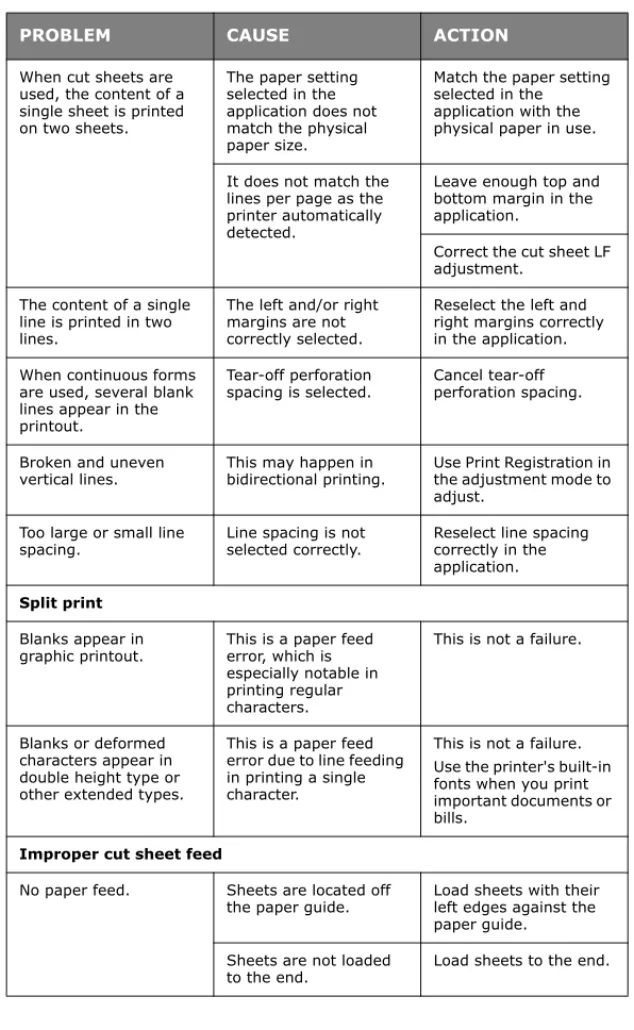
Troubleshooting > 51 When cut sheets are
used, the content of a single sheet is printed on two sheets.
The paper setting selected in the application does not match the physical paper size.
Match the paper setting selected in the application with the physical paper in use.
It does not match the lines per page as the printer automatically detected.
Leave enough top and bottom margin in the application.
Correct the cut sheet LF adjustment.
The content of a single line is printed in two lines.
The left and/or right margins are not correctly selected.
Reselect the left and right margins correctly in the application. When continuous forms
are used, several blank lines appear in the printout.
Tear-off perforation
spacing is selected. Cancel tear-off perforation spacing.
Broken and uneven
vertical lines. This may happen in bidirectional printing. Use Print Registration in the adjustment mode to adjust.
Too large or small line
spacing. Line spacing is not selected correctly. Reselect line spacing correctly in the application.
Split print
Blanks appear in
graphic printout. This is a paper feed error, which is especially notable in printing regular characters.
This is not a failure.
Blanks or deformed characters appear in double height type or other extended types.
This is a paper feed error due to line feeding in printing a single character.
This is not a failure. Use the printer's built-in fonts when you print important documents or bills.
Improper cut sheet feed
No paper feed. Sheets are located off
the paper guide. Load sheets with their left edges against the paper guide.
Sheets are not loaded
to the end. Load sheets to the end.
The platen rotates without paper feed, or continuous forms instead of cut sheets are fed.
Sheets are not loaded
to the end. Load sheets to the end. The printer is in the
continuous forms mode. Eject the continuous forms and select cut sheet mode for the printer.
Paper distortion. Sheets are not loaded to the end, or they are not inserted straight.
Load sheets to the end.
Paper with wrinkles,
folds or other defects. Change paper. Paper not specified for
the printer. Use paper types specified for the printer. Unable to eject. The FF/LOAD button is
pressed. Press the PARK button.
Improper continuous forms feed.
No line feed, and no
paper feed. Paper is off the Pin Tractors. Reload paper correctly. The adjust lever
position does not match the paper type.
Set the adjust lever to the correct position.
Paper distortion or jam. Forms are loaded with their left holes out of line with the right ones.
Load forms with their left holes in line with the right ones. Inadequate distance
between the left and right Pin Tractors, making for loose paper.
Relocate the Pin Tractors to tighten the paper.
Skew paper feeding. Move the paper to make it straight.
Paper movement is
blocked. Remove the blockage. Paper source is too far
from the printer. Move the paper source nearer to the printer. Paper not specified for
the printer. Use paper types specified for this printer.
Several blank lines
appear in the printout. Skip over perforation spacing is selected. Cancel the skip over perforation spacing.
Troubleshooting > 53 The selected skip over
perforation spacing does not match the physical tear-off perforation positions.
The paper length selected in the application does not match the physical paper length.
Match the paper length selected in the application with the physical paper length in use.
Select the paper length in number of lines in the application.
Abnormal switchover between cut sheet and continuous forms modes.
No cut sheet feed. The printer is in
continuous forms mode. Set the Paper Type lever to cut sheet mode. No continuous forms
feed. The printer is in cut sheet mode. Set the Paper Type lever to continuous forms mode. Paper feed operations
for both cut sheets and continuous forms are actuated.
The cut sheet is not
ejected. Eject the cut sheet.
C
LEANING
YOUR
PRINTER
To keep your printer in good operating condition, you are advised
to clean it regularly.
P
RINTER
EXTERIOR
Clean the exterior of the printer as required, but at least every
six months or 300 hours of operation, whichever comes first.
1.
Moisten a piece of cotton cloth with diluted neutral
detergent and carefully wipe the printer exterior.
P
RINTER
INTERIOR
Clean the interior of the printer every 6 months or 300 hours of
operation, whichever comes first.
WARNING!
Set the printer Power Switch to OFF and disconnect the
power cable from the printer before cleaning the printer.
CAUTION!
Keep the Top Cover closed to avoid the possibility of
detergent entering the printer
WARNING!
As the print head becomes hot during printing, allow it
to cool before carrying out any cleaning inside the
printer.
Do not use any flammable solvents for cleaning the
printer to avoid any risk of fire or electric shock.
Cleaning your printer > 55
Using a soft cloth, cotton swabs and a vacuum cleaner, clean the
interior of the printer as follows:
WHERE TO CLEAN WHAT TO CLEAN
The carriage (1) and the area around it Clean and remove paper waste, dirt, dust and ribbon shreds. The paper travel surface (2)
1
2
CAUTION!
When you clean the interior of the printer with a vacuum
cleaner, do not attempt to clean any parts smaller than
the suction nozzle.
Do not clean any interior working parts with the suction
nozzle to avoid possible damage to the printer.
C
ONSUMABLES
AND
ACCESSORIES
C
ONSUMABLES
When the printed image becomes faint or incomplete, replace the
ribbon cartridge.
C
HANGINGARIBBONCARTRIDGE1.
Set the Power Switch to OFF.
2.
Set the Paper Thickness lever to Replace Ribbon (position
10) and open the Top Cover.
CAUTION!
Only use genuine Oki Original consumables to ensure
the best quality and performance from your hardware.
Non-Oki Original products may damage your printer’s
performance and invalidate your warranty.
WARNING!
Do not change the ribbon cartridge with the Power
Switch set to ON.
WARNING!
The print head and area around it may be hot after
printing. Allow it to cool down before touching it.
Consumables and accessories > 57
3.
Move the carriage (1) to the cutout (2) for ribbon
replacement position.
4.
Hold the ribbon cartridge (1) with your fingers pressing on
its ribbon guide (2) and slope it up and out to remove it
from the carriage.
1
2
1
5.
Holding the ribbon cartridge (1) close to both ends, slope
it up and out until it unlocks then remove it along the
direction indicated by the arrows.
6.
Dispose of the cartridge in accordance with your local
guidelines.
7.
Remove the new ribbon cartridge from its wrapping and
note the position of the Ribbon Guide (1), Knob (2) and
Pin (3).
1
1
2
3
Consumables and accessories > 59
8.
In the direction indicated by the arrows, insert the pins at
both ends of the ribbon cartridge (1) into the U grooves
(2) in the printer until the ribbon cartridge is fully locked.
NOTE
It may be easier to mount the ribbon cartridge in place if you align it with the topside of the grooves. Also, a slightly loose ribbon may make it easier to mount the ribbon cartridge.
9.
Hold the ribbon cartridge (1) with your fingers pressing on
its ribbon guide (2) and slope it upward and inward along
the guide rails until the ribbon guide (2) comes in line with
the U slot at the top of the cartridge.
1
2
1
10.
Turn the knob (1) clockwise (in the direction of the arrow)
to wind up the ribbon.
11.
Close the printer Top Cover.
12.
Set the Paper Thickness lever to match the paper being
used. (
See “Setting the Paper Thickness lever” on
page 26.
)
13.
Set the printer Power Switch to ON.
CAUTION!
Do not turn the knob anticlockwise as the ribbon might
jam.
Make sure that the ribbon is not twisted or damaged
when it goes through the gap between the Print Head
and the ribbon guide.
Consumables and accessories > 61
C
ONSUMABLEORDERINFORMATIONA
CCESSORIES
The following accessories are available for your printer:
>
RS-232C Serial Interface
>
OL7120e 100BASE-TX/10BASE-T Network Interface
Installation instructions are supplied with the accessories. The
Network Configuration Guide on the CD that accompanies the
Network Interface card provides detailed configuration
information for the OL7120e.
A
CCESSORYORDERINFORMATIONITEM LIFE ORDER NO.
Ribbon cartridge (Black) 4 million characters 43503601
ITEM ORDER NO.
RS-232C Serial Interface 09002351
S
PECIFICATIONS
ITEM SPECIFICATION
Model No. D21008B (ML6300FB)
Print method Impact dot matrix
Print head 24 pins, 0.2 mm (0.0079 in) diameter Print direction Bi-directional, short-line-seeking printing Print speed
High Speed Draft (HSD) Letter Quality (LQ) Utility
400cps @ 10 cpi 100 cps @ 10 cpi 300 cps @ 10 cpi
Line Feed (LF) time Approximately 65 ms per line for LF of 4.23 mm (1/6 in)
Form Feed (FF) speed Approximately 114.3 mm/s (4.5 in/s) Paper feed control Paper feed: yes
Vertical tab: yes Direct line feed: yes
Duplication capability Continuous forms: the original page +5 more pages (total maximum paper thickness less than 0.36 mm)
Cut sheet: the original page +5 more pages (total maximum paper thickness less than 0.36 mm)
Feeding direction Feed forward Feed backward
Feeding mode Friction feed mode (front) Pin tractor feed mode (rear) Continuous forms tape tail
detection method Detected when remaining paper is approximately 24 mm long. It can, however, print till about 6 mm from the paper bottom (measured at the centre of the characters). (The print accuracy of the last page cannot be guaranteed.)
Character sets Standard ASCII Epson (Italics/Graphics) IBM (Set1/Set2) Foreign Code Page