March 2006
TROOPS-TO-TEACHERS
Program Brings More
Men and Minorities to
the Teaching
Workforce, but
Education Could
Improve Management
to Enhance Results
What GAO Found
Why GAO Did This Study
www.gao.gov/cgi-bin/getrpt?GAO-06-265.
To view the full product, including the scope and methodology, click on the link above.
Results
The 3,875 troops who were documented as having been hired through the program between the enactment of NCLBA in 2002 and the close of the 2004-2005 school year contributed to gender and racial diversity in the teaching workforce. Over 80 percent of Troops teachers are male and over 25 percent are African American—characteristics that differ from the new teacher population overall. However, participation has recently decreased and hiring has been geographically concentrated. The majority of the program’s teachers hired from school years 2001-2002 through 2004-2005 were employed in seven states.
Most teachers receiving financial assistance through the program between the enactment of NCLBA and June 30, 2005, were placed in districts designated as high-need on the basis of serving children who qualify for federal assistance. About 90 percent of these funded participants continued teaching in high-need districts during their second year, and over 75 percent of the original group taught in high-need districts for a third year. About one-third of Troops hired during this period reported teaching in the priority areas of math, science, special education, or vocational education.
Percentage of Hired Teachers Reporting Subject Areas Taught between the Enactment of NCLBA and June 30, 2005
Source: GAO analysis of DANTES’ administrative records.
9%
teaching math
28%
not reported
11%
teaching special education
7%
teaching science
5%
teaching vocational education
3%
teaching multiple priority subjects
37%
teaching other subject areas
Education has taken some steps to improve program management, but has not effectively coordinated resources with another teacher recruitment program also targeting military personnel. While Education has developed a draft work plan for Troops-to-Teachers and improved the definition of a high-need district for eligibility purposes, it has not assessed the data it uses to make high-need school determinations. Further, it disbanded a teacher policy group that once provided a forum for department managers to discuss recruitment and retention initiatives.
With the 2002 enactment of the No Child Left Behind Act (NCLBA), GAO was mandated to review the Troops-to-Teachers program, which provides financial assistance and counseling to help military personnel obtain their teacher licenses, especially in priority subject areas, such as math and science, and find employment in high-need districts and schools, as well as public charter schools. The U.S. Department of Education oversees the program, which received nearly $15 million in fiscal year 2005. This report identifies (1) the number and characteristics of program participants and factors affecting participation; (2) the recruitment and retention of participants in high-need districts and priority subject areas; and (3) the steps Education has taken to facilitate program management.
What GAO Recommends
GAO recommends that the Secretary of Education take steps to improve program management and better coordinate with existing teacher recruitment and retention initiatives. Education generally agreed with GAO’s findings and recommendations.
Letter
1Results in Brief 3
Background 5 The 3,875 Troops Documented as Recent Hires Have Contributed
to Diversity in the Teaching Workforce, but Participation Has
Recently Decreased and Is Geographically Concentrated 11 Most Funded Teachers Have Been Recruited and Retained by
Districts Designated as High-Need, and about One-Third
Reported Teaching in Priority Subject Areas 18 Education Has Taken Steps to Improve Program Management but
Has Not Effectively Coordinated Program Administration with
Related Initiatives 23
Conclusions 29
Recommendations for Executive Action 30
Agency Comments and Our Evaluation 31
Appendix I
Objectives, Scope, and Methodology
32Appendix II
Comments from the Department of Education
34Appendix III
GAO Contact and Staff Acknowledgments
36Related GAO Products
37Tables
Table 1: Financial Assistance Provided through the
Troops-to-Teachers Program 7
Table 2: Definitions of High-Need Schools and High-Need Districts 9 Table 3: Demographic Characteristics of Teachers from the
Program Hired between the Enactment of NCLBA and
June 30, 2005 12
Table 4: Criteria and Data Sources Used to Support the Designation
of High-Need Schools and Districts 25
Table 5: Selected Department of Education Activities to Facilitate
Figures
Figure 1: Key Legislative and Regulatory Changes in the
Troops-to-Teachers Program 8
Figure 2: Number of Troops-to-Teachers Participants Hired by
State, July 1, 2001, through June 30, 2005 16 Figure 3: Concentration of Troops Hired through the Program
between the Enactment of NCLBA and June 30, 2005, Relative to the Location of Major Military Installations, by
County 17 Figure 4: Types of Financial Assistance Received by Program
Participants Hired between the Enactment of NCLBA and
June 30, 2005 19
Figure 5: Percentage of Hired Teachers Reporting Subject Areas Taught between the Enactment of NCLBA and June 30,
2005 22
Abbreviations
DANTES Defense Activity for Non-Traditional Education Support
DOD Department of Defense
IDEA Individuals with Disabilities Education Act NCLBA No Child Left Behind Act
This is a work of the U.S. government and is not subject to copyright protection in the United States. It may be reproduced and distributed in its entirety without further permission from GAO. However, because this work may contain copyrighted images or other material, permission from the copyright holder may be necessary if you wish to reproduce this material separately.
March 1, 2006
The Honorable Michael B. Enzi Chairman
The Honorable Edward M. Kennedy Ranking Minority Member
Committee on Health, Education, Labor, and Pensions United States Senate
The Honorable Howard P. “Buck” McKeon Chairman
The Honorable George Miller Ranking Minority Member
Committee on Education and the Workforce House of Representatives
Approximately 3 million teachers work in public and private elementary and secondary schools across the country, but school districts still face difficulty recruiting and retaining highly qualified teaching professionals. In 1992, when the shortage of math and science teachers was increasing and the military forces were undergoing a significant reduction in personnel, Congress authorized the Department of Defense (DOD) to oversee a new national Troops-to-Teachers program designed to help separated members of the military obtain their teaching credentials and teach in school districts with large low-income populations and a shortage of teachers in priority subject areas, such as math and science. Since Troops-to-Teachers’ inception, more than 8,400 program participants reported that they were hired as elementary and secondary school teachers, with about half of those entering the profession since 2002. Funding for the Troops-to-Teachers program has varied over time. In fiscal year 2003, the program received a $29 million appropriation, while more recently, in fiscal years 2004 and 2005, the appropriation held steady at nearly $15 million. Each year, some funds obligated to Troops-to-Teachers are used to provide direct financial assistance in the form of stipends and bonuses to attract and retain participants. Dollars not allocated toward financial assistance fund (1) the centralized administration of the program by personnel in the Defense Activity for Non-Traditional Education
Support (DANTES)—a DOD unit that operates the program and provides members of the military with services, such as education-related
and placement assistance that Troops-to-Teachers’ state placement assistance offices provide.
In 1999, Congress reauthorized the Troops-to-Teachers program and transferred program oversight from DOD to the Department of Education (Education), effective in 2000. Through a memorandum of agreement between DOD and Education, DANTES continues daily program
administration—registering individuals, identifying high-need schools and districts, and making determinations about who qualifies for bonuses and stipends—while Education, rather than DOD, has responsibility for program oversight and management. In that same year, Congress mandated that GAO conduct an assessment of the program’s accomplishments from fiscal years 1994 through 2000.1
We concluded that the main focus of the program had shifted from an outplacement resource for separated military personnel to a recruitment tool to address teacher shortages. The report also concluded that opportunities existed for Education to integrate the program into its overall teacher recruitment and retention initiatives, which included efforts to assist both civilian and military mid-career professionals become teachers. The 2002 enactment of the No Child Left Behind Act (NCLBA) reauthorized the program and its funding through 2007, increased the total amount that could be spent on state placement assistance services, and mandated a second GAO report. To address the NCLBA mandate, this report answers the following questions:
1. What are the number and characteristics of program participants, and what factors affect participation?
2. To what extent have participants been recruited and retained to teach in high-need districts and priority subject areas?
3. What steps has Education taken to facilitate program management? To conduct our work, we analyzed data that DANTES maintains on all individuals who have registered for the program, focusing specifically on those who have received funding between the enactment of NCLBA on January 8, 2002, and June 30, 2005, which marks the end of the 2004-2005 school year. For this population, we analyzed demographic and financial assistance data, as well as information on the schools and subject areas in which the teachers became employed. To assess the reliability of school
1
GAO, Troops to Teachers: Program Helped Address Teacher Shortages, GAO-01-567 (Washington, D.C.: May 25, 2001).
placement data, we matched the data DANTES provided to data from Education’s National Center for Education Statistics’ Common Core of Data, which includes district and school-level information on free and reduced price meal eligibility, and the U.S. Census Bureau’s Small Area Income and Poverty Estimates program, which includes district-level information on poverty. In addition, of the 30 funded Troops-to-Teachers placement assistance offices, we contacted personnel from 7 to obtain the perspectives of those helping both large and small numbers of troops find employment through the program. We also interviewed Education officials to discuss their management of the program and to assess program
practices against GAO standards for internal controls, which establish a framework for effective agency operations. Further, we interviewed officials at DANTES and reviewed the results from a recent survey of program participants conducted by the National Center for Education Information—a private, non-partisan research organization specializing in survey research and data analysis. We also spoke with several researchers in the field of teacher recruitment, preparation, and professional
development, and reviewed related reports on these topics. We assessed the reliability of all data elements used in the report and determined that the data were sufficient and reliable for the purposes of our study. We conducted our work between May 2005 and January 2006 in accordance with generally accepted government auditing standards. A more detailed discussion of our scope and methodology appears in appendix I.
The 3,875 teachers documented as having been hired between the enactment of NCLBA in 2002 and June 30, 2005—the close of the 2004-2005 school year—contributed to gender and racial diversity in the teaching workforce. Participation has recently decreased and hiring has been geographically concentrated. According to our review of
administrative records during this period, over 80 percent of Troops teachers have been male and over 25 percent have been African-American, demographic characteristics that differ from the new teacher population at large, which is 26 percent male and 9 percent African-American. The program’s fiscal year 2005 annual report documents a 1-year decline in program registrations and hires, and personnel from the placement assistance offices we interviewed attributed this to the military’s ongoing demand for active and reserve troops. According to the program’s own data on school-year hiring, which track teaching placements made between July 1, 2001, and June 30, 2005, the majority of teachers hired from the program were geographically concentrated in seven states— Arizona, California, Colorado, Florida, Georgia, Texas, and Virginia. According to interviews with placement office personnel, the
Results in Brief
concentration of hires partly can be attributed to the number and presence of military bases and personnel in these locations.
Most funded teachers were recruited and retained by schools meeting the statutory definition of high-need and about one-third reported teaching in priority subject areas. Most teachers receiving financial assistance through the program between the enactment of NCLBA and June 30, 2005, found employment in schools meeting program criteria for serving children who qualify for federal assistance—either through free or reduced-price meals or special education services. With regard to retention, about 90 percent of the funded participants teaching in high-need districts were retained for a second year, and over 75 percent taught for a third year. However, valid comparisons with national retention rates are not possible because Education calculates teacher retention in high-need schools rather than high-need districts and also uses a different definition than Troops-to-Teachers uses when defining what constitutes a high-need school. Thirty-five percent of Troops hired taught in at least one of the priority areas of math, science, special education, or vocational education and 37 percent of all hired teachers reported finding employment in secondary schools. Education has taken some steps to improve program management, but has not explored some opportunities for coordination with related teacher recruitment activities. In the past several years, Education has
promulgated a final rule to clarify the definition of a high-need school district, drafted a preliminary work plan to oversee the program, and signed a memorandum of agreement with DOD. However, the department has not had procedures in place to validate that DANTES was accurately designating schools as high-need and has not monitored the spending patterns of the program’s state placement assistance offices to ensure that funding levels are commensurate with success in facilitating troops’ employment. Additionally, despite operating multiple programs to recruit, retain, and develop teachers—including the Transition to Teaching program, which also serves the military population—there was little evidence that Education coordinated resources among these initiatives. For example, Education has not known the extent to which these programs worked together to expand the opportunities for troops to obtain their teaching certifications. Further, Education disbanded its teacher policy group, which had previously convened to allow managers a forum to discuss teacher-related programs.
To enhance the department’s oversight of this program, we are recommending that the Secretary of Education take steps to improve program management, such as better assessing data used to designate
schools as high-need, and enhancing coordination with existing teacher recruitment and retention initiatives. After reviewing a draft of this report, officials from DOD indicated that they did not have any comments, while officials from Education generally agreed with our findings and
recommendations.
According to Education, about 300,000 individuals obtain teaching certifications each year and the career path generally begins by enrolling in either a traditional or an alternative certification program, typically provided by a 4-year institution of higher education. Programs are considered “traditional” when they combine subject matter instruction, training on how to manage a classroom, and field experience, or
“alternative” when they enroll individuals who already have the subject matter knowledge and focus instead on classroom management and exposure to real-life teaching and learning conditions. Based on Education data, 46 states reported implementing alternative routes to certification, and about 35,000 individuals each year obtain their teaching credentials through alternative programs. According to Education, many alternative certification programs are designed to recruit teachers into shortage areas such as math, science, and special education or to increase gender and ethnic diversity in the teaching workforce.
The Troops-to-Teachers program facilitates the entry of former military personnel into the teaching profession by assessing their academic history and professional skills and by counseling individuals toward appropriate programs to obtain certification.
Members and former members of the armed forces are generally eligible to participate in Troops-to-Teachers if they have a baccalaureate or advanced degree2
and meet any of the following four requirements:
• They are retired from active or reserve service.
• They have an approved date of retirement that is within 1 year after the date on which the member submits an application to participate in the program.
2
A baccalaureate or advanced degree is not required of those applying for assistance as a vocational or technical teacher. Instead, these applicants must have the equivalent of 1 year of college and 6 years or more of military experience in a related field, or meet the
certification requirements for a vocational education teacher in the state in which the applicant wishes to work.
• They have separated from active duty after 6 or more years of continuous service and enter into a commitment to continue in the reserves for at least 3 years.
• They are currently serving in the reserves and have at least 10 years of active or reserve duty and enter into a commitment to continue in the reserves for at least 3 years.
Eligible members selected to participate in the program must enter into an agreement to obtain certification or licensing as an elementary, secondary, or vocational or technical teacher and to become a highly qualified
teacher.3
In addition, program participants must agree to accept full-time employment as a teacher for at least 3 years with a high-need school district or public charter school. NCLBA further requires that in selecting eligible members of the armed forces to receive assistance under the program, priority is to be given to members who have educational or military experience in science, mathematics, special education, or
vocational or technical subjects, and agree to seek employment as science, mathematics, special education, or vocational education teachers.
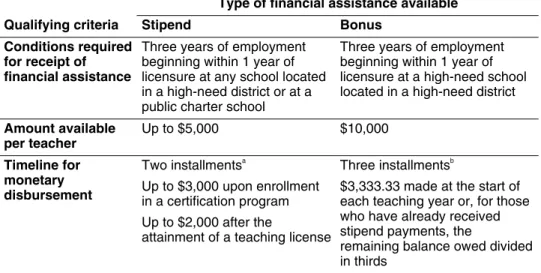
Participants in the program may receive stipends of not more than $5,000 to help defray the cost of enrollment in a teaching certification program if they agree to teach in high-need school districts, defined as those in which there are specific numbers or percentages of children from families with incomes below the poverty line, or public charter schools. Participants may instead receive bonuses of $10,000 if they agree to teach in high-need schools—defined as those in which the student population meets certain low-income eligibility criteria or in which large percentages of students have disabilities—that are also located in high-need districts. As further clarified by Education in a recent final rule, participants initially receiving a stipend who agree to teach for at least 3 years in a high-need school within a high-need school district or a public charter school can receive a total payment of $10,000 less their stipend payments. Reimbursement generally is required of the participant under certain circumstances, such as failing to obtain certification, to become a highly qualified teacher, or to obtain employment. Individuals who do not meet the criteria for stipends
3
Generally, a highly qualified teacher is defined as a teacher who (1) has obtained full state certification as a teacher or passed the state teacher licensing exam and holds a license to teach in the state; (2) holds a minimum of a bachelor’s degree; and (3) has demonstrated subject-matter competency in each of the academic subjects in which the teacher teaches, in a manner determined by the state and in compliance with § 9101(23) of the Elementary and Secondary Education Act.
and bonuses are ineligible for financial assistance, but can still receive counseling and referral services through the program. Table 1 illustrates the terms of the financial assistance available.
Table 1: Financial Assistance Provided through the Troops-to-Teachers Program Type of financial assistance available
Qualifying criteria Stipend Bonus
Conditions required for receipt of financial assistance
Three years of employment beginning within 1 year of licensure at any school located in a high-need district or at a public charter school
Three years of employment beginning within 1 year of licensure at a high-need school located in a high-need district
Amount available per teacher Up to $5,000 $10,000 Timeline for monetary disbursement Two installmentsa Up to $3,000 upon enrollment in a certification program Up to $2,000 after the
attainment of a teaching license
Three installmentsb
$3,333.33 made at the start of each teaching year or, for those who have already received stipend payments, the
remaining balance owed divided in thirds
Source: GAO analysis.
aIf the cost of the certification program does not exceed $3,000, one lump sum payment equal to the
actual certification costs is made upon enrollment.
b
The total amount of payments received through the program is not to exceed $10,000. Thus, for those first receiving a stipend and then receiving a bonus, their total stipend and bonus payments will be no more than $10,000.
DANTES administers the Troops-to-Teachers program, working with 30 state placement assistance offices, 6 of which are considered regional offices because they provide coverage for neighboring states in which there are no designated Troops-to-Teachers personnel.4
Each state office is responsible for recruiting participants through advertisements and face-to-face encounters, assessing participants’ academic transcripts, guiding them toward the appropriate state certification programs, and providing placement assistance to direct them to high-need schools or districts and priority subject areas. According to the program’s authorizing statute, no more than $5 million per year can be used to establish and maintain these
4
Two additional offices, New York and West Virginia, have small-scale operations and, as a result, do not receive any program funding.
placement assistance offices, and grants to states for these placement offices are made at the Secretary of Education’s discretion.
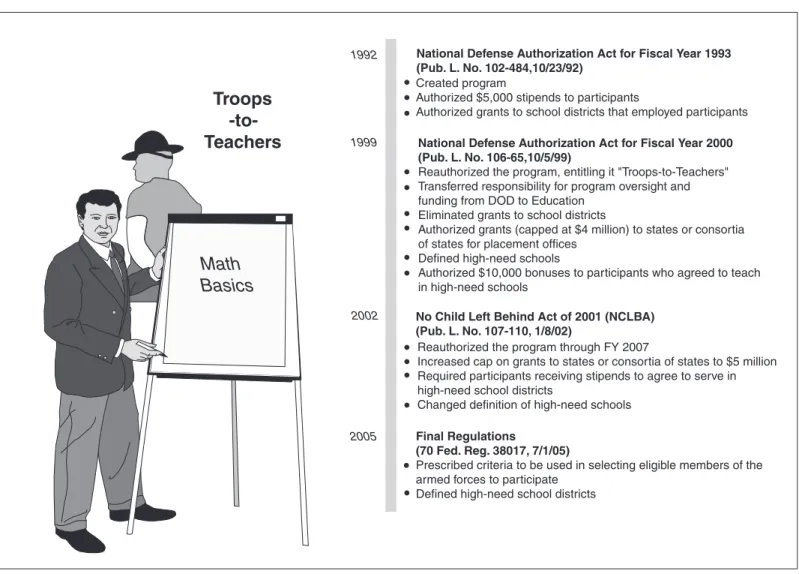
As figure 1 illustrates, many legislative changes made to the Troops-to-Teachers program have affected both the program’s administration and the identification of schools and districts in which employment makes servicemembers eligible to receive financial assistance.
Figure 1: Key Legislative and Regulatory Changes in the Troops-to-Teachers Program
With regard to eligibility for financial assistance, the type of school in which a participant is statutorily required to teach has changed
National Defense Authorization Act for Fiscal Year 1993 (Pub. L. No. 102-484,10/23/92)
National Defense Authorization Act for Fiscal Year 2000 (Pub. L. No. 106-65,10/5/99)
Reauthorized the program, entitling it "Troops-to-Teachers" Transferred responsibility for program oversight and funding from DOD to Education
Eliminated grants to school districts
Authorized grants (capped at $4 million) to states or consortia
of states for placement offices
Defined high-need schools
Authorized $10,000 bonuses to participants who agreed to teach in high-need schools
No Child Left Behind Act of 2001 (NCLBA) (Pub. L. No. 107-110, 1/8/02)
Final Regulations
(70 Fed. Reg. 38017, 7/1/05)
Prescribed criteria to be used in selecting eligible members of the armed forces to participate
Defined high-need school districts
Math Basics
Troops
-to-Teachers
Source: GAO analysisand Art Explosion.
1992
1999
2002
2005
Created program
Authorized $5,000 stipends to participants
Authorized grants to school districts that employed participants
Reauthorized the program through FY 2007
Increased cap on grants to states or consortia of states to $5 million Required participants receiving stipends to agree to serve in high-need school districts
significantly since the program started. Prior to NCLBA’s reauthorization of the program, participants were required to teach in a district receiving Title I funds in order to receive a stipend.5
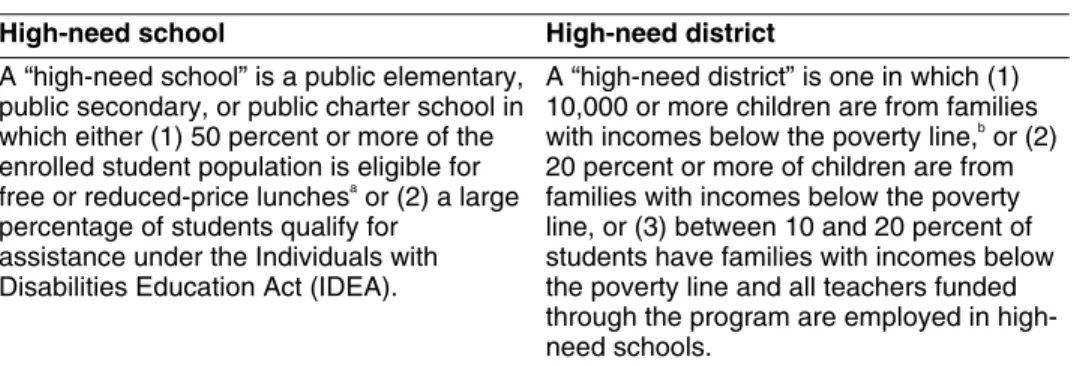
Under current requirements, participants can receive a stipend for teaching in a high-need district or public charter school and can receive a bonus for teaching in a high-need school. The definition of a high-need school that was established in the National Defense Authorization Act for fiscal year 2000 included a school that had a dropout rate exceeding the national average or that had a large percentage of students speaking English as a second language; however, this definition has changed. Table 2 illustrates the current definitions for both a high-need school and a high-need district. The table also
incorporates Education’s recent clarification on the definition of a high-need district, which became effective through a final rule in September 2005.
Table 2: Definitions of High-Need Schools and High-Need Districts
High-need school High-need district
A “high-need school” is a public elementary, public secondary, or public charter school in which either (1) 50 percent or more of the enrolled student population is eligible for free or reduced-price lunchesa
or (2) a large percentage of students qualify for
assistance under the Individuals with Disabilities Education Act (IDEA).
A “high-need district” is one in which (1) 10,000 or more children are from families with incomes below the poverty line,b
or (2) 20 percent or more of children are from families with incomes below the poverty line, or (3) between 10 and 20 percent of students have families with incomes below the poverty line and all teachers funded through the program are employed in high-need schools.
Source: 20 U.S.C. § 6674(d)(3) and 34 C.F.R. § 230.2.
a
The statute states that at least 50 percent of students enrolled in the school must be from low-income families. DANTES has issued guidance defining this criterion as meaning students eligible for free and reduced-price lunches.
b
Poverty line refers to the family income, adjusted for family size, that the U.S. Census Bureau defines as the threshold below which a family can be considered living in poverty, for statistical purposes. According to the Department of Health and Human Services, the 2005 poverty guideline— used for determining financial eligibility for certain federal programs—for a family of four living in the contiguous United States was $19,350.
With regard to program administration, legislative shifts have prompted changes in oversight. DANTES has maintained daily administration of the
5
Title I of the Elementary and Secondary Education Act is the largest source of federal funding to improve the educational achievement of children at risk. See GAO,
Disadvantaged Students: Fiscal Oversight of Title I Could Be Improved, GAO-03-377
program since its inception, but when the statute shifted program oversight to Education, a memorandum of agreement was needed to outline the relationship between DANTES, DOD, and Education.
According to the current agreement, which was signed in February 2004, DANTES’ fiscal and administrative responsibilities—such as facilitating recruitment activities, selecting participants, managing program
participant files, and overseeing state placement assistance offices— remained intact, but DANTES’ personnel were also expected to provide Education with an annual performance report, an itemized financial report, and a program report on key participant characteristics. According to the agreement, DOD has the following responsibilities:
• Transfer funds from Education to DANTES for the administration of the program.
• Assign responsibility for the administration and management of the program to DANTES.
• Provide information about the program to military personnel as part of its pre-separation counseling.
While, among other responsibilities, Education is now expected to:
• Transfer the congressionally appropriated funds to DOD.
• Oversee DANTES’ use of these dollars.
• Monitor on an annual basis the implementation of all activities carried out by the program through review and approval of annual budget plans, compliance reviews, audits, and site visits.
• Monitor the expenditure of available funds during any fiscal year and assure that no more than 10 percent of these funds is used for
administrative infrastructure.
• Provide support and technical assistance.
• Provide legal and policy advice on programmatic issues arising under the authorizing legislation.
Aside from overseeing Troops-to-Teachers, Education engages in several additional activities to encourage teacher recruitment in high-need areas. For example, the department provides funding to forgive the student loans of highly qualified math, science, and special education teachers serving in low-income communities. Education also provides states with recruitment grants to help reduce shortages of qualified teachers in high-need districts through scholarships and support services. In addition, the department operates the Transition to Teaching program, which, like
Troops-to-Teachers, helps adult professionals make a career change into the teaching profession.
The 3,875 troops who were documented as having been hired through the program between the enactment of NCLBA in 2002 and June 30, 2005—the close of the 2004-2005 school year—contributed to gender and racial diversity in the teaching workforce.6
However, participation has recently decreased and hiring has been geographically concentrated. Over 80 percent of Troops teachers are male and over 25 percent are African-American—characteristics that differ from the new teacher population at large. Interviews with personnel from several state placement assistance offices indicated that recruitment has been negatively affected by recent overseas deployments. Based on DANTES’ own records of school year hiring—July 1, 2001 through June 30, 2005—the majority of the program’s teachers found employment within seven states, with about 700 hired in Texas alone. According to state placement personnel in these and other states, the number and presence of military bases and military personnel in these locations also affect participation.
Since Troops-to-Teachers’ inception through June 30, 2005, about 30,720 individuals registered for the program. Beginning with the enactment of NCLBA through June 30, 2005, more than 3,870 of these registrants documented that they went on to teach, helping to diversify the teaching workforce. Over 80 percent of all the teachers hired through the program during this period were male, a demographic consistent with the military population but different than that of the new teacher workforce,7
which is only 26 percent male. Similarly, African-Americans have represented a larger percentage of teachers in the program when compared to their representation in the military and in the new teaching workforce. Specifically, the proportion of African-Americans teaching through Troops-to-Teachers is 28 percent, which is higher than the share of African-Americans in the military population (17 percent), the civilian
6
While 3,875 program participants provided documentation of their teaching experiences between the enactment of NCLBA and school year 2004-2005, those not receiving funding were not required to provide such documentation. Thus, program participants who did not receive funding and did not voluntarily provide documentation of employment are not included in this total.
7
Education defines beginning, or new, teachers as those with 3 or fewer years of experience.
The 3,875 Troops
Documented as
Recent Hires Have
Contributed to
Diversity in the
Teaching Workforce,
but Participation Has
Recently Decreased
and Is Geographically
Concentrated
The Program Brought
Males and Minorities to the
Teaching Profession
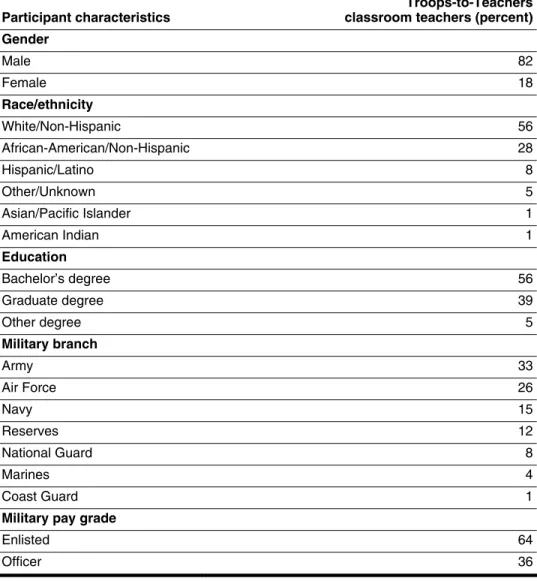
workforce (11 percent), and the new teacher population (9 percent). Table 3 illustrates additional demographic characteristics of Troops-to-Teachers participants.
Table 3: Demographic Characteristics of Teachers from the Program Hired between
the Enactment of NCLBA and June 30, 2005
Participant characteristics
Troops-to-Teachers classroom teachers (percent) Gender Male 82 Female 18 Race/ethnicity White/Non-Hispanic 56 African-American/Non-Hispanic 28 Hispanic/Latino 8 Other/Unknown 5 Asian/Pacific Islander 1 American Indian 1 Education Bachelor’s degree 56 Graduate degree 39 Other degree 5 Military branch Army 33 Air Force 26 Navy 15 Reserves 12 National Guard 8 Marines 4 Coast Guard 1
Military pay grade
Enlisted 64
Officer 36
Source: GAO analysis.
Note: Percentages may not add to 100 because of rounding.
As table 3 documents, Troops-to-Teachers’ classroom teachers most frequently served in the Army (33 percent), Air Force (26 percent), and Navy (15 percent) before registering with the program.
DANTES’ latest annual report indicates that registrations have declined and officials from all of the seven placement offices we interviewed said that a number of factors affect participation. These officials also noted that despite the allure of more lucrative professions, registrants have a keen interest in working with children and want to remain in public service after leaving the military.
The program’s fiscal year 2005 annual report notes that registrations declined by 9 percent from fiscal year 2004. State placement personnel said that the high demand for troops to support the conflicts in Iraq and Afghanistan has resulted in decreased Troops-to-Teachers program registrations. Further, personnel in some offices noted that DOD’s stop loss policy has reduced the volume of calls and inquiries.8
These individuals also speculated that Education’s recent rule, which was implemented in September 2005, and changed the criteria for receipt of bonuses, would further reduce the number of participants. According to these officials, the projected decrease in registrations would result
because potential applicants would no longer be able to attain the needed financial assistance if the schools most appealing to them did not meet the new criteria specified in the rule. However, others reported that
registrants typically lacked information about school eligibility at the time of their application. As we will discuss later in the report, due to several data limitations, the effect of the rule on the number of qualifying schools and districts cannot be precisely determined.
In addition, some officials noted that barriers to entering the teaching profession, such as difficulty identifying and enrolling in a flexible and convenient teacher certification program, could limit participation, but they expressed the opinion that as these programs became more prevalent, teacher credentialing could accelerate and more individuals would consider the profession to be a viable option. According to a 2005 survey of nearly 1,500 Troops-to-Teachers participants, 58 percent of respondents received their teaching credentials through traditional, campus-based teacher education programs—either at the undergraduate or graduate level—40 percent of respondents took an alternative
8
DOD’s stop loss program enables the military to prevent service members from leaving active duty after they have completed their obligations.
Barriers to Participation
Include Ongoing Military
Deployments
certification route to receive the same credential, and the remaining respondents were unsure how to characterize their programs.9 At the individual level, motivational factors also were reported as
influencing participation. According to the 2005 survey, nearly 60 percent of respondents said they would not have become a teacher if the Troops-to-Teachers program had not been available, and more than 60 percent of respondents said they decided to become teachers because of their desire to work with young people. The state placement personnel we interviewed made comments that reflected this, with officials from three of the seven offices specifically noting troops’ interests in working with young people, and officials from five offices mentioning that troops often have
experience coaching and mentoring younger and newer recruits.
Additionally, personnel from all seven of the placement assistance offices we interviewed characterized troops entering the classroom as mature, experienced in working with diverse socio-economic groups, professional, and adaptable. That said, they acknowledged that professions more lucrative than teaching, such as those in the consulting or defense-related industries, could lead many away from the education profession.
9
C. Emily Feistritzer, National Center for Education Information, Profile of Troops to Teachers, August 24, 2005.
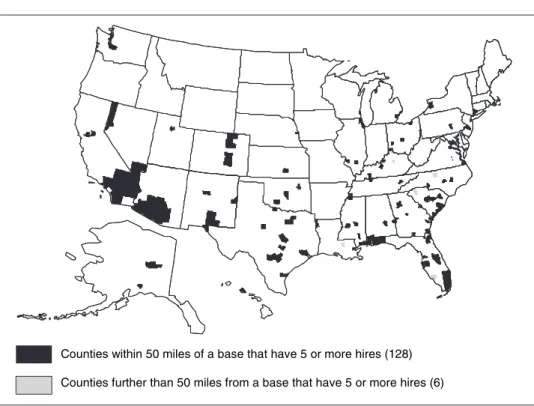
Based on DANTES’ data collected from school years 2001-2002 through 2004-2005 (the period between July 1, 2001, and June 30, 2005), the number of teachers hired from the program varied widely across the country. For example, among the seven states with the largest number of Troops hired over this period—Arizona, California, Colorado, Florida, Georgia, Texas, and Virginia—the number of hires ranged from 169 in California to 697 in Texas. In contrast, during the same period, there were 34 states in which fewer than 50 teachers were hired from the program.10 In particular, 13 of these states had fewer than 10 hires over the same 4 years. Nevertheless, even among the seven states with the largest numbers of hires, teachers from the Troops program comprise less than 1 percent of the K-12 workforce. Figure 2 illustrates the pattern of hiring from the program across the country during this period.
10
DANTES’ data includes hiring in Washington, D.C.; Puerto Rico; and schools overseas.
In Recent Years, Seven
States Encompassed over
Half the Teachers Hired
from the Program, and
Costs per Teacher Hired
Varied Nationwide
Figure 2: Number of Troops-to-Teachers Participants Hired by State, July 1, 2001, through June 30, 2005
Note: Map does not include the nine hires in overseas locations.
The concentration of hires also reflects, to some extent, the concentration of military personnel in these states. Officials from DANTES and the placement offices said that troops tend to seek employment close to a military base because of the services provided there, such as medical, Source: GAO analysis of DANTES hiring data.
Vt. Idaho 1-50 51-100 101+ N.H. Mass. R.I. Conn. N.J. Del. Md. D.C. Alaska Hawaii Vt. Ala. Ark. Calif. (169) Colo. (269) Ga. (220) Idaho Ill. Ind. Iowa Kans. La. Maine Mich. Minn. Mo. Mont. Nebr. Nev. N.Mex. N.Y. N.Dak. Okla. Oreg. Pa. S.Dak. Tenn. Tex. (697) Utah Wash. Wisc. Wyo. Fla. (241) Puerto Rico Ariz. (179) Miss. (154) S.C. (131) N.C. (137) Va. (199) Ky. W.Va. Ohio (109)
career counseling, and commissary services. States with a larger number of military bases also had a larger number of Troops participants hired in their schools.
Figure 3: Concentration of Troops Hired through the Program between the
Enactment of NCLBA and June 30, 2005, Relative to the Location of Major Military
Installations, by County
Note: Major military installations include all forts, bases, presidios, and military reservations— including all facilities with 1,500 or more military personnel—serving all branches of the military.
The majority of states (34) hired fewer than 50 program teachers between July 1, 2001, and June 30, 2005—accounting for 15 percent of hires during this period—but placement offices serving these states accounted for a significant proportion of placement office funds (24 percent or $1.1 million of $4.6 million). Given the hiring variation across the country, DANTES compiles a report card to assess efficiencies in the 30 funded placement assistance offices. The report card assigns a letter grade based on each office’s cost (budget) per Troops participant hired. Report card grades for fiscal year 2004 were nearly evenly distributed “A” through “C,” with about eight states in each category, and another five receiving a “D,” the grade assigned to states with the highest costs per hire. Costs per hire ranged
Counties within 50 miles of a base that have 5 or more hires (128) Counties further than 50 miles from a base that have 5 or more hires (6)
from $181 in Arkansas to $22,000 in Montana, with the median state cost per hire approximately $4,000. Five of the seven offices with the greatest number of hires had cost per hire ratios below the median—suggesting economies of scale and a strong market for Troops participants in these states.
Some states with high cost-per-hire ratios noted the frequency with which they are counseling registrants who ultimately find employment outside their states. However, our analysis of DANTES’ information on teacher hiring shows that, between the enactment of NCLBA and June 30, 2005, 5 percent of program registrants found employment in a state
administered by a placement assistance office other than the office with which they registered.
Most teachers receiving financial assistance through the program between the enactment of NCLBA and June 30, 2005, found employment in high-need districts, and about 90 percent of those first funded continued teaching in such districts their second year. Over 75 percent of this original group taught in high-need districts for a third year, but data for retention beyond 3 years are unavailable. About one-third of the troops hired during this period reported teaching in the priority areas of math, science, special education, or vocational education, and based on reported data, 37 percent of hires reported teaching at the secondary school level.
Most teachers receiving financial assistance through the program during this period found employment in schools designated as high-need. Those individuals receiving bonuses are required to teach in high-need schools, and DANTES validates their continued eligibility for funding by requiring annual documentation of their employment. Those receiving stipends are required to teach in high-need districts or public charter schools and must also document their employment each year for DANTES’ verification, but these individuals are not required to teach in high-need schools. DANTES does not track or verify the places of employment for participants who do not receive funding.
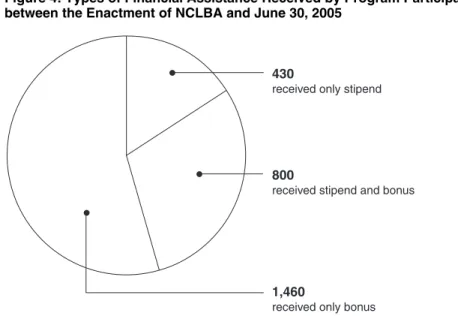
As figure 4 illustrates, between the enactment of NCLBA and June 30, 2005, about 2,690 teachers have received some form of financial assistance to teach in high-need schools or districts.
Most Funded
Teachers Have Been
Recruited and
Retained by Districts
Designated as
High-Need, and about
One-Third Reported
Teaching in Priority
Subject Areas
Most Funded Teachers
Worked in Schools Serving
Large Percentages of
Children Who Qualify for
Federal Assistance
Figure 4: Types of Financial Assistance Received by Program Participants Hired
between the Enactment of NCLBA and June 30, 2005
Note: Counts rounded to nearest 10.
Of this number, about 2,260 individuals received bonuses for teaching in high-need schools.11
In this same time period, 254 of the 430 hired teachers receiving only stipend dollars reported finding teaching positions in a high-need district.12
In addition, another roughly 950 participants who received a stipend but not a bonus either have not yet completed their certification program or have just completed it but have not yet been hired.
Even though more program registrants are eligible for a stipend than a bonus, DANTES officials attribute the smaller number of stipend
recipients to (1) the fact that the program cannot guarantee employment after the acquisition of a teaching certification and (2) participants’ own risk aversion. For example, if participants take the stipend money up front to pay for their certification and then do not find a teaching position in a high-need district, they will be required to repay the funds—a risk that
11
This includes those who received both a stipend and a bonus in their financial assistance package.
12
Of the remaining 176 hired stipend recipients, 36 reported finding teaching positions in a district that was not designated as high-need, and 140 did not report district information. According to DANTES officials, they are in contact with individuals from whom repayment is required.
800
received stipend and bonus 430
received only stipend
1,460
received only bonus Source: GAO analysis of DANTES’ administrative records.
program officials said participants may not be willing to take. On the contrary, if they decline the stipend money initially and wait instead to see if they can obtain a teaching position in a high-need school, program officials stated that these participants will be eligible for a bonus and may feel more comfortable making the 3-year teaching commitment that receipt of the bonus requires.
DANTES tracks the 3-year retention rate for each starting teacher because that is the term of teaching required for an individual to receive financial assistance. Of teachers funded through either a bonus or a stipend between the enactment of NCLBA and June 30, 2002, and who subsequently found employment in high-need districts, 90 percent
continued teaching in a high-need district in their second year, and over 75 percent of this original group taught in a high-need district for a third year. Retention rates for more recent starting teachers cannot be calculated because 3 years have not yet passed since their initial placement. In comparison, registrants who did not receive funding through the program have had lower retention rates, with 47 percent teaching in a high-need district for a second year and 20 percent teaching for a third year.
The 1-year retention rate for Troops-to-Teachers’ participants teaching in high-need districts is not comparable to the national retention rate that Education calculates because Education analyzes teacher retention in high-need schools rather than in high-need districts. Further, even if both calculations systematically assessed retention at the school-house level, the two measures could still not be compared because Education’s
definition of a high-need school differs from the definition used by Troops-to-Teachers. Specifically, Education considers a school high-need if 75 percent or more of the student population is eligible for free or reduced-priced lunches. As we have noted, the Troops program uses a high-need school definition that is broader, including schools in which 50 percent or more of the student population is eligible to receive free or reduced-price lunches, as well as schools in which “large percentages” of students are served under IDEA.
Although the statute requires bonus recipients to teach in high-need schools for 3 years, recipients who initially found employment in a high-need school may teach in a school not designated as such the following year and thus postpone their second and third bonus payments until employment in an eligible school is found again. If such employment is not found, recipients are required to reimburse the program for funds
previously received. Similarly, stipend recipients are required to reimburse
Over 75 Percent of Funded
Teachers Continued
Teaching in Districts
Designated as High-Need
for at Least 3 Years, but a
Valid Comparison with
National Retention Rates
Is Impossible
the program when employment in a high-need district is not continued for 3 years. Of the funded participants who initially obtained a teaching position in a high-need school, but who have not yet completed their 3-year teaching commitment, DANTES officials stated that the program has not asked the vast majority for reimbursement because they can still meet the law’s requirements through future employment. However, according to DANTES’ officials, they have requested that 21 percent of stipend recipients reimburse the program because they did not fulfill their teaching obligation.
Between the enactment of NCLBA and June 30, 2005, about one-third of hired Troops reported teaching in the priority areas of math, science, special education, and vocational education, and, based on reported data, 37 percent reported teaching at the secondary school level. Because DANTES has been able to fund all qualified applicants, it has not had to invoke the statutory subject area selection priorities. As figure 5
illustrates, hired teachers were spread across a variety of subject areas.
About One-Third of
Teachers Hired from the
Program Reported
Teaching Math, Science,
Special Education, or
Vocational Education
Figure 5: Percentage of Hired Teachers Reporting Subject Areas Taught between
the Enactment of NCLBA and June 30, 2005
Note: Subject area percentages include all funded and non-funded teachers who were documented as having been hired through the program. Because only funded teachers have an obligation to report annual employment information, this number may not include employment for all non-funded teachers. Additionally, not all funded participants reported the subject areas in which they taught.
During this same period, 14 percent of Troops participants were hired into elementary schools, 19 percent were hired into middle schools, 37 percent were hired into secondary schools, 3 percent taught courses covering multiple grade levels, and another 28 percent did not provide information on the grade level they taught, based on reported data.
Source: GAO analysis of DANTES’ administrative records.
9%
teaching math
28%
not reported
11%
teaching special education
7%
teaching science
5%
teaching vocational education
3%
teaching multiple priority subjects
37%
Education has taken some steps to improve program management, but coordination with related teacher recruitment activities is lacking. For example, Education staff have promulgated a final rule to clarify the definition of a high-need school district and drafted a preliminary work plan to oversee the program. However, the department does not have procedures in place to validate DANTES’ designations of high-need schools and does not monitor spending patterns of Troops-to-Teachers placement offices. Additionally, despite operating multiple programs to recruit, retain, and develop teachers, Education has done little to facilitate coordination among the staff who manage these initiatives.
After allowing time for public comment, Education promulgated a final rule in July 2005, in part to clarify the definition of a high-need school district. According to department officials, the rule change, which took effect in September 2005, was necessary because of discrepancies in the statute and subsequent confusion over which data sources and indicators of poverty to use.13
While 66 percent of districts nationwide met the criteria for designation as high-need—based on eligibility for free and reduced-price lunches—before the rule change, the department has not collected data to determine how the rule change would affect that number. Since a district’s designation as high-need depends, in some cases, on the designation of schools within that district as high-need, and the number of schools nationwide designated as high-need is unknown, any discussion of how the rule change would affect qualifying districts depends on certain assumptions.14
If we assume that all districts with a poverty rate from 10 to 20 percent contain a high-need school to which all funded teachers have been assigned, then the percentage of districts qualifying would drop from 66 to 61. However, if none of these districts contains a high-need school, then the percentage of qualifying districts drops from 66 to 24.
13
Teachers who received funding prior to the implementation of the rule will not lose their financial assistance, but teachers hired after implementation—September 15, 2005—will not be eligible for a bonus if the districts in which they teach do not meet the eligibility criteria.
14
The actual number of qualifying schools nationwide cannot be determined because percentages of students served under IDEA are tracked at the district level rather than at the school-house level. As a result, the characteristics of individual schools cannot be assessed.
Education Has Taken
Steps to Improve
Program Management
but Has Not
Effectively
Coordinated Program
Administration with
Related Initiatives
Education Has Better
Defined High-Need
Districts but Has Not
Assessed the Data It Uses
to Make High-Need School
Determinations
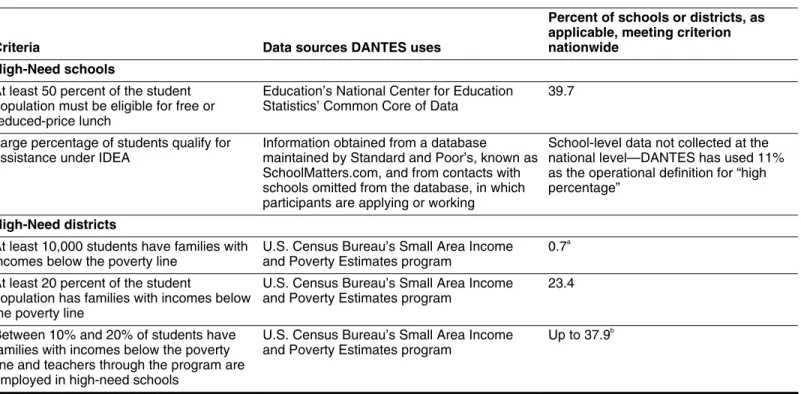
Although Education better defined high-need districts, it has not assessed the data it uses to make high-need school determinations. Based on the statute, DANTES has defined a high-need school as having either 50 percent of more of its student population eligible to receive free and reduced-price lunches or “large percentages of children receiving special education services under IDEA.” However, unlike the criterion related to lunches, which states a specific qualifying percent that can be assessed using Education data sources, the statute does not make clear what constitutes a “large percentage” of students served under IDEA. In addition, the department does not have a basis for calculating IDEA information at the school-house level because its own Common Core of Data has that information only for districts.
According to DANTES’ records, in an attempt to operationalize the
definition of a high-need school, the department provided verbal guidance on or before February 15, 2002, on this issue, specifying that DANTES should use an eligibility threshold of 11 percent, which it characterized as the national average. However, no one at the department we spoke with was familiar with the origins of this guidance, and according to our review of Education’s data, the percentage of students receiving services under IDEA across the nation was actually 13 percent in 2001 and 14 percent in 2002 and 2003.15
By our analysis, three-quarters of districts nationwide have 11 percent or more of their student population receiving IDEA services—indicating that the threshold the department established to define a “large percentage” may not result in a very targeted universe of schools. In commenting on a draft of this report, Education officials noted that in November 2005, they provided DANTES with the latest national data on the percentage of students served under IDEA—13.8 percent. According to Education, DANTES will use this figure when making determinations for the upcoming school year.
Because Education does not collect IDEA information at the school-house level, it is not possible to determine the concentration of students
receiving services under IDEA in individual schools, and DANTES must use alternative data sources to determine if schools meet the IDEA
criterion. Specifically, DANTES currently relies on a database operated by Standard and Poor’s that presents the percentage of students receiving services under IDEA for some schools in certain states. If information on
15
National Center for Education Statistics, Digest of Education Statistics, 2004. U.S. Department of Education.
the schools where participants are working or applying is omitted from the database, DANTES then has to call the schools to make determinations on a case by case basis. Table 4 illustrates the different sources DANTES must use to determine if schools and districts meet the criteria necessary for designation as high-need.
Table 4: Criteria and Data Sources Used to Support the Designation of High-Need Schools and Districts
Criteria Data sources DANTES uses
Percent of schools or districts, as applicable, meeting criterion nationwide
High-Need schools
At least 50 percent of the student population must be eligible for free or reduced-price lunch
Education’s National Center for Education Statistics’ Common Core of Data
39.7
Large percentage of students qualify for assistance under IDEA
Information obtained from a database
maintained by Standard and Poor’s, known as SchoolMatters.com, and from contacts with schools omitted from the database, in which participants are applying or working
School-level data not collected at the national level—DANTES has used 11% as the operational definition for “high percentage”
High-Need districts
At least 10,000 students have families with incomes below the poverty line
U.S. Census Bureau’s Small Area Income and Poverty Estimates program
0.7a
At least 20 percent of the student
population has families with incomes below the poverty line
U.S. Census Bureau’s Small Area Income and Poverty Estimates program
23.4
Between 10% and 20% of students have families with incomes below the poverty line and teachers through the program are employed in high-need schools
U.S. Census Bureau’s Small Area Income and Poverty Estimates program
Up to 37.9b
Source: Troops-to-Teachers legislation and regulations, DANTES, and data from the U.S. Department of Education and U.S. Census Bureau for 2003-2004.
a
The vast majority of districts with 10,000 or more students from families with incomes below the poverty line also have at least 10 percent of the student population in poverty.
b
In the absence of national information on IDEA participation at the school-house level, it is unknown how many schools meet the high-need criteria. As a result, it is impossible to determine how many districts across the nation contain a high-need school. However, if all of the 37.9 percent of districts containing between 10 and 20 percent of students in poverty have at least one school that meets the high-need criteria and all funded teachers have been assigned to this school, then they can be designated as high-need districts.
Education officials noted the difficulty of amassing the various data needed for DANTES to adhere to the definition of high-need schools, and cited this as a reason for not developing a centralized database of
information. However, according to Education officials, the department had not assessed the reliability of the steps DANTES currently uses to
make high-need school determinations. Without a thorough review of the validity of available data, the department is unable to determine (1) if DANTES is applying the existing eligibility criteria appropriately, and (2) if the eligibility thresholds, particularly with regard to IDEA, reflect current conditions.
Education has not effectively implemented some of the controls necessary to ensure that the program is efficiently achieving its objectives. GAO’s standards for agencies’ internal control activities note the importance of qualified and continuous supervision, overall workforce continuity planning, and regular review of performance reports, budgets, and trends to ensure effective agency operations.16
Since 2001, Education has had four different individuals responsible for the Troops-to-Teachers program. Further, while one former manager had drafted a preliminary work plan, which included developing an evaluation plan and working with DANTES to develop performance measures, officials acknowledged that they had not focused on implementing the steps, and said that the current work plan needed improvement. When we established that no timeline was in place to implement the existing plan, officials responded that they would finalize a revised plan and implement it by February 2006. Officials added that while Troops-to-Teachers is included in Education’s annual
performance report, they are also working on alternative outcome measures that better assess the quality of teachers recruited through the program.
In addition, Education lacks the necessary controls to ensure that the program is spending its funding not only within the parameters established by the statute and the memorandum of agreement, but also in an efficient and productive way. The statute caps annual grants that can be made to states for Troops-to-Teachers’ placement office operations at $5 million and the memorandum caps expenses associated with administrative infrastructure, such as DANTES’ spending on database management or personnel, at 10 percent of the total available funds. While Education officials check to ensure that the program does not exceed its caps, they neither review how DANTES spends its budget nor do they monitor the spending patterns of placement assistance offices. As noted earlier, 13 of the 30 funded placement offices received low scores of either “C” or “D”
16
GAO, Standards for Internal Control in the Federal Government, GAO/AIMD-00-21.3.1 (Washington, D.C.: November 1999).
Education Lacks Controls
to Ensure Effective
Allocation of Program
Funds and Timely
Execution of Its
Management
Responsibilities
but department officials told us they have not determined if the cost per hire ratios, which drive the grades DANTES assigns, are appropriate measures of state offices’ performance. As a result, the department is not positioned to comment on the dispersion of these grades or to take action to address poor performing offices. Specifically, without assessing these measures or alternative performance data, Education cannot determine whether state offices should be closed or consolidated to improve program efficiency. Additionally, our analysis of the program’s overall expenditures for fiscal year 2002 showed that about 60 percent was allotted to financial assistance and 40 percent of funds supported
operational or administrative expenses in the central office and placement offices.17
For fiscal year 2004, to date, the amount expended on financial assistance has been just over 50 percent of the program’s total
expenditures. Without a thorough review of these spending patterns, the department’s ability to take action when spending approaches the caps may be limited.
Education operates another teacher recruitment and retention program— the Transition to Teaching program—that overlaps somewhat with the mission of Troops-to-Teachers. Both programs recruit mid-career professionals to teach in high-need schools and in subjects such as math and science, for which qualified teachers are in short supply. Both
programs target career changers and Transition to Teaching funds are also used to recruit from the military population. However, as illustrated in table 5, Transition to Teaching is distinct from Troops-to-Teachers in that it provides grants directly to organizations, such as universities or county offices of education, that operate teacher certification programs.
17
According to program officials, obligations for financial assistance each year are generally expended over a 3-year period because individuals receive their bonus payments in installments.
Education Has Not Made
Efforts to Coordinate
Program Administration
with Other Federal
Teacher Development
Activities
Table 5: Selected Department of Education Activities to Facilitate Entrance into the Teaching Profession
Program Mission Funding recipients Numbers served
FY 2005 funding Transition
to Teaching
To support (1) the development of new or enhanced alternative routes to certification and (2) the participation of mid-career
professionals in these programs and their ultimate recruitment by and retention in high-need schools and districts.
Grant recipients operate programs that serve mid-career professionals from all industries and trades—participation is neither limited to nor focused exclusively on the military.
State and local educational agencies, for-profit organizations,
non-profit organizations, or institutions of higher education collaborating with state or local educational agencies are eligible for 5-year grants to operate their programs
164 grantees have received funding to operate their programs since the federal program began in calendar year 2001.
$44,900,000
Troops- to-Teachers
To recruit, prepare, and support former members of the armed forces as teachers in high-need schools and districts.
Individuals participating in the program are eligible for stipends and bonuses to facilitate entry into the teaching profession
About 8,000 individuals have received financial assistance since the program began in fiscal year 1994.
$14,800,000
Source: GAO analysis.
We found that 12 of the 123 grants (approximately 10 percent) made through the Transition to Teaching program from the 2002 and 2004 award years funded programs that specifically targeted military personnel.18
For example, several universities receiving Transition to Teaching grants recruit from the retired military population and operate programs that provide mentoring services to assist with their retention and development. The remaining Transition to Teaching grantees generally focus their recruitment on career changers from a wide variety of professions, although they too may provide mentoring and ongoing support for new teacher candidates.
Despite the similarities in the mission of Transition to Teaching and Troops-to-Teachers, and the fact that they are administered by the same office within Education, we found minimal coordination between the programs. Although Education officials said that department personnel from both programs attend the same conferences and share ideas, there was little evidence of resource coordination beyond discussions of how the programs related. Additionally, officials noted that a teacher policy group had previously existed within the department so that managers could meet regularly to discuss the teacher-related programs they
18
oversaw. Though department officials told us that the group had disbanded, they noted it would be a useful tool to facilitate ongoing collaboration.
Differences in data collection and monitoring strategies exist that may further limit the coordination of these programs. For example, DANTES collects participation data on the Troops-to-Teachers program. For the Transition to Teaching program, however, Education merely lists grant recipients and summarizes their programs. Additionally, Education collects very little data to assess grant recipients’ program outcomes. According to Education’s performance report on Transition to Teaching, grantees use different methods for reporting data to the department. Further, the department does not have any summary information on the program’s outcomes over time, but agency officials told us they have contracted with an independent research group to evaluate performance for a sample of 2002 grant recipients. Because Education does not know the demographic characteristics of the individuals who benefit from the Transition to Teaching program, the department cannot determine the extent to which the two programs complement and coordinate with one another to move former military personnel into teaching positions. Education officials told us that they believe statutory barriers would prevent the consolidation of Troops-to-Teachers with the other programs like Transition to Teaching. Nevertheless, the officials acknowledged similarities between the programs and supported the idea of further coordination.
Between the enactment of NCLBA on January 8, 2002, and June 30, 2005, the Troops-to-Teachers program helped at least 3,875 former members of the military enter the teaching profession, contributing to the
diversification of the teaching workforce. However, without thoroughly reviewing the data sources that DANTES uses to designate schools as high-need, Education cannot ensure that DANTES is (1) making accurate decisions about which schools meet the criteria and (2) placing new teachers in these high-need schools. Further, without providing updated guidance on eligibility thresholds for students served under IDEA, Education cannot ensure that the criteria currently used reflect schools’ changing conditions.
Education, which has overseen the program since 2000, has taken some steps to manage the program, but it only recently established a timeline to finalize and implement a draft work plan. As of December 2005, however,