Triangle of Business Intelligence, Performance Measurement and Knowledge Management Jussi Okkonen Virpi Pirttimäki Mika Hannula Antti Lönnqvist
Tampere University of Technology, Finland Performance Measurement Team
Track: Managing Performance
ABSTRACT
Recent significant changes in the business environment, e.g. the globalisation of markets, ever faster technological developments and the increased importance of knowledge-based assets, have brought about new managerial challenges. This has resulted in the emergence of new management concepts and tools, such as performance measurement, business intelligence and knowledge management. These concepts are expected to be better suited to the development of an organisation’s performance in a modern business environment.
The new management tools have been developed to solve different problems from different managerial points of view. Simply stated, performance measurement deals with the implementation of an organisation’s strategy; business intelligence deals with the gathering and analysis of the vast amount of information in and around the organisation; and knowledge management is about managing information and competencies in the organisation. Despite the different viewpoints of these methods, they seem to share several connective elements. However, hardly any research has focused on how these newly developed tools relate to each other.
This paper defines and enlightens the unambiguous concepts of performance measurement, business intelligence and knowledge management, and illustrates how these tools are related to each other. The main question is how and for what purposes the three methods are supposed to be used. In conclusion, a framework of the uses of these performance management tools is suggested.
Introduction
Contemporary operating environments challenge organisations. As markets have become larger and there are more global operations, many companies face more competition. In order to survive, companies, and other organisations too, are in need of the competitive advantage of being better informed. As the nature of organisations has become more knowledge-intensive, the importance of competencies, i.e. knowledge and skills, is emphasised. Continuous improvement is important; thus for an organisation to be successful, it is essential that an organisation manages its competencies. In order to lead an organisation, the management need information on the organisation’s current stage and the direction it is heading for. As an old proverb goes: “What you can’t measure, you can’t manage”.
The change has caused new managerial challenges and has resulted in the emergence of new management concepts and tools, such as performance measurement, business intelligence and knowledge management. These concepts are expected to be better suited to the development of an organisation’s performance in a modern business environment. The new management tools have been developed to solve different problems from different managerial points of view. Simply stated, performance measurement deals with the implementation of an organisation’s strategy; business intelligence deals with the gathering and analysis of the vast amount of information in and around the organisation; and knowledge management is about managing information and competencies in the organisation.
Performance Measurement
Knowledge Management Business Intelligence
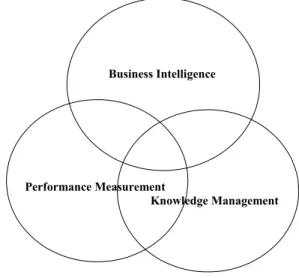
Figure 1 The key concepts for this paper.
In Figure 1, the key concepts for this paper are illustrated. The main question is how the concepts are related to each other and how they overlap. In addition to the main question, it is important to pay attention to how and for what purposes the three methods are supposed to be used. There seem to be similarities in some aspects, but, in practice, the emphasis placed on these concepts varies between organisations as the management tools are not in use simultaneously nor in juxtaposition. This paper aims to decrease overlap and to show the importance of the proper use of each tool. As a conceptual analysis, the aim is to construct a framework as a hypothesis for further research. In conclusion, a framework of performance management is suggested.
Performance Measurement
“(Business) performance measurement is a process of quantifying the efficiency and effectiveness of purposeful action” (Neely et al. 1996, p. 11). The main rationale for measuring an organisation’s performance is to be able to manage it. Performance measurement can be used as a tool for implementing an organisation’s strategy (see e.g. Kaplan and Norton 1996). Performance measurement can be used to:
• translate an organisation’s strategy into concrete objectives; • communicate the objectives to employees;
• guide and focus employees’ efforts according as these objectives are
achieved;
• control whether or not the strategic objectives are reached;
• use double-loop learning to challenge the validity of the strategy itself, and • visualize how individual employees’ efforts contribute to the overall business
objectives (see e.g. Neely 1998, Simons 2000 and Uusi-Rauva 1996).
When performance measurement is used diagnostically, things are supposed to be under control as long as the target values of all measures are achieved (Simons 2000, pp. 209-210). Management need to examine measures only when a problem occurs, i.e. a target is not achieved. This saves management resources.
Performance measurement is usually carried out using a performance measurement system, which consists of several individual measures. There are many frameworks for constructing such a system. The most commonly used model is the Balanced Scorecard (BSC) (Lönnqvist 2002, PMA 2001, Toivanen 2001). Others include, e.g. the Performance Prism and the Performance Pyramid (Lynch and Cross 1991, Neely and Adams 2000). The measures for the performance measurement system chosen are based on an organisation’s vision and strategy (see e.g. Kaplan and Norton 1996). Measures are chosen to measure success factors from different points of view, such as that of the customer, employees, business processes and financial success, as well as from the point of view of past, current and future performance. This way, different aspects of an organisation’s performance can be measured and managed.
There are four main phases related to the performance measurement process (Neely et al. 2000, p. 1143). Firstly, the measures are chosen as described above. Then, the measurement system is implemented into the organisation. This includes, e.g. the determining of how the data for the measures is collected, how the measurement results are reported and how the measures are used. After the measurement system has been designed and implemented, the third phase is simply to use the measurement system. The final phase, the updating of the measurement system, closes the loop. Every time when an organisation’s strategy or business objectives change, the measurement system must be redesigned accordingly (see e.g. Gueldenberg 1999, pp. 13 - 14). Otherwise it will no longer provide strategically important information.
As a summary of what has been stated above, a definition for performance measurement is formed: Performance measurement is a continuous and dynamic process in which measures are first constructed, based on strategically important success factors, then the measures are used to help implement planned strategies and, finally, the analysis of measurement results provides feedback for new strategy
formulations. The definition emphasises the importance of performance
measurement in a strategy process. Performance measurement, of course, also has several operative uses. However, they can be seen as part of the strategy implementation phase.
Knowledge Management
Knowledge management seems to be quite a hyped management fad of the new millennium. As the academics and business consultants have adopted the concept, there are several ways to define and understand knowledge management. To its widest extent, it is the management of the intellectual capital of an organisation. To its narrowest extent, it is only a system or a tool for managing information and knowledge inside an organisation. Definitions vary according to the perspective from which knowledge management is viewed.
Nonaka and Takeuchi consider knowledge management the management of the dynamic processes of knowledge transformation (1995, p. 124). They state that any form of knowledge in an organisation is manageable, and that the highest form of knowledge is tacit knowledge. Tacit knowledge can be achieved by the internalisation of explicit knowledge, i.e. learning. The context for Nonaka and Takeuchi is the innovation process in Japanese companies. Thus, taking this perspective, knowledge management is the art of management in a dynamic environment.
Kiianmaa (1996, pp. 51-53), takes the same approach as he describes the importance of gate-keepers in knowledge-intensive creative organisations. Hence, it could be stated that gate-keepers are mediators of knowledge between persons, and, especially, they are persons who know the right sources of particular competences. The same notion is used by Harryson (2000, pp. 194-196), who states that the essence of effective knowledge management is to break free from rigid organisational restraints to ensure the free flow of information, ideas and knowledge; hence the idiom, “know-who based company”.
A contemporary Finnish classic in the field of knowledge management, Dynamic Intellectual Capital, by Ståhle and Grönroos (2000), defines knowledge management as a set of tools used in the process of managing knowledge in organisations. Another definition by Ståhle and Grönroos (1999, p. 209) gives knowledge management a broader content, such as the methods for managing the human capital and intangible assets of an organisation. The use of these tools is governed by the Intellectual Capital Management; thus knowledge management is a sub-concept of intellectual capital management. Ståhle and Grönroos are committed to tool outlook, but they do not define the nature of the actual tools which could be a mechanical system or the actions taken by the management.
Leonard-Barton (1995, pp. 5-11) conceptualises knowledge management as knowledge creating and diffusing activities. These activities are contained in operating environment levels, importing knowledge, and implementing and integrating knowledge in an organisation. In time, the present – future time division, the activities involve problem-solving and experimenting. This notion originated from the same concepts worked out by Nonaka and Takeuchi or Kiianmaa.
In the glossary of Mastering Information Management (Marchand et al. 2000a, pp. 349-350), knowledge management is defined as a concept which includes the efforts to maximise organisational performance by creating, sharing and leveraging knowledge and experience from internal and external sources. Boshyk (2000, pp. 51-52) lists seven attributes of knowledge management. Firstly, the basic resource is absolute knowledge in finite scope. Secondly, it is targeted to accumulate knowledge. Thirdly, it deals with present knowledge. Fourthly, it aims to manage, administer and maintain the knowledge. Fifthly, it considers knowledge to be an asset. Sixthly, it is easiest implemented into knowledge-intensive organisations, e.g. in R&D. Seventhly, it includes the aggregation and dissemination of existing knowledge, education, copying and learning by doing. Actions in the knowledge management process, therefore, entail the management of explicit knowledge.
Davenport and Marchand (2000, pp.165-169) suggest that knowledge management is the management of information as companies manage a mixture of information, knowledge and data. The essence is to see the difference between information and knowledge. It depends on the nature of the work whether the information management system is applicable to knowledge management too; hence, if information is processed in an organisation, then the information management system is applicable to the knowledge management. If the work has a different nature, such as that of R&D, the information management system is lacking in effectiveness as a knowledge management tool. As knowledge is a human attribute and it is also dependent on the people who create, use and share it, knowledge management is the management of people at least as much as that of information and IT.
According to Wah (2000, pp. 308-309), the essence of knowledge management in organisations is to prevent the waste of resources by seeking the best practices and by not reinventing the wheel. Knowledge management objectives then, try first to capture, store, retrieve and distribute tangible knowledge assets, e.g. copyrights, patents and licences. Secondly, to gather, organise and disseminate intangible knowledge, e.g. tacit and explicit knowledge and information. And thirdly, they are used to create an interactive learning environment where people transfer, and share, their knowledge, and apply it in order to accumulate new knowledge.
Thierauf (2001, p. 97) states that the essence of knowledge management is knowledge discovery, knowledge organisation and knowledge sharing. Knowledge management is a process ruled by a knowledge management system, which is designed to improve corporate efficiency by providing a framework, tools, and techniques for re-using captured intellectual assets. For performance enhancement by applying knowledge, a knowledge management system needs capturing, integrating and disseminating functions (ibid., p. 105).
These definitions imply that knowledge management is more than a system or a tool. Knowledge management is a managerial philosophy, which is perceivable in the practices of different organisations. Knowledge management is not an ultimate tool that solves all information and knowledge transfer problems. However, utilising knowledge management, better performance can be achieved by interaction between individuals or groups. Moreover, to be efficient, knowledge management requires storage for its information, which is open to organisation members for searching critical information or the best practices. Thus knowledge management is the learned methods for knowledge sharing and interaction and, furthermore, knowledge management clarifies which way to operate. The greatest benefit gained through knowledge management is that it does not waste the most important asset to contemporary organisations, the time people have.
In this paper knowledge management is considered an organisational process, which is used to achieve better performance due to effective knowledge sharing and
organisational learning. The IT tools of knowledge management are also important,
but they are not the essence of knowledge management. Business Intelligence
Kalakota and Robinson (2000, p. 161) define business intelligence as one of the applications that enables both the active and passive delivery of information. Data and information is collected from large-scale databases, providing the enterprise and managers with timely answers to mission-critical questions. In other words, the
objective of business intelligence is to turn raw data into actionable intelligence. Kalakota and Robinson argue that the growth of business intelligence stems mainly from the demand for more competitive business intelligence and increases in electronic data capture and storage.
Kalakota’s and Robinson’s view is supported by Thierauf (2001, pp. xi – xii). Thierauf points out that business intelligence converts captured data, information and knowledge into valuable intelligence. Thierauf considers business intelligence systems to be the latest in information systems. Business intelligence systems are an effective aid to decision makers for getting the whole picture of a company’s own capabilities and external operating environment.
Collins’s (1997, p. 14) definition of business intelligence differs a little bit from the two presented above. According to him, business intelligence is the process which supports business decision-making. Required information is gathered about competitors, customers and markets. This raw data is converted into accurate and focused analyses. Collins (1997, p. 19) has a few objectives of business intelligence. Firstly, by using business intelligence, a company can avoid surprises and identify opportunities and threats. Secondly, business intelligence establishes a baseline for performance evaluation. Thirdly, business intelligence provides increased reaction time. Added to this, operational and tactical decisions, business planning and strategy formulation are improved by a more extensive knowledge of the company and the external environment.
Halliman’s (2000, pp. 3–7) approach to business intelligence is different from those presented above. He suggests that business intelligence can mean anything and everything having to do with using business information. He argues that business
intelligence can mean any information that facilitates decision-making and managing business future. He claims that ‘text-mining’ methods are useful to any company engaged in obtaining business intelligence. He suggests that text-mining is a process of identifying concepts in unstructured texts in document collections. In other words, text-mining scans and helps evaluate large amounts of external business text.
To present a more consulting business-oriented definition, it is useful to become familiar with the definition of a Finnish company called Viva Business Intelligence. They define business intelligence as follows: “Business intelligence is a continuous and systematic process producing and communicating actionable intelligence of the external business environment to facilitate proactive decision-making” (1998, p. 5).
In this paper, business intelligence is defined as follows: business intelligence is separated into two categories of information needed for the formulation of a business strategy. Business intelligence is the process of gathering and analysing internal and
external business information. Internal information. External information. In
addition, business intelligence is defined as the process which supports operational and tactical business decision-making. The process consists of phases in which, for example, external and internal data is gathered and converted into intelligence. Comparing performance measurement, knowledge management and business intelligence
The use, definitions and practical applications of performance measurement, knowledge management and business intelligence vary between different companies. In this chapter, the tools are compared to each other from several different points of view.
One of the most obvious questions regarding any managerial tool or method is to ask what it is used for. Table 1 illustrates the different purposes for using the tools. As the table shows, the use of the tools differentiates between short and long periods, i.e. between operative and strategic levels.
The main rationale for using the tools PERFORMANCE
MEASUREMENT Motivation, control and guidance of employees, quality management, etc. KNOWLEDGE
MANAGEMENT
Effective knowledge sharing between employees. Management know the organisation’s knowledge level. Operative level,
i.e. short period
BUSINESS INTELLIGENCE
Gaining knowledge about important matters (i.e. changes) within and around the organisation in order to provide better information for decisions-makers.
PERFORMANCE MEASUREMENT
Implementing strategy and receiving feedback for strategy formulation. Strategic level, i.e.
long period
KNOWLEDGE MANAGEMENT
Developing employees’ competencies according to strategy.
BUSINESS INTELLIGENCE
Gaining knowledge about important matters (i.e. changes) within and around the organisation that make emergent strategies possible or current strategies invalid.
Table 1 The rationale of performance measurement, knowledge management and business intelligence at the operative and strategic level.
In practical applications, the use of performance measurement, knowledge management and business intelligence differs clearly when compared to each other. Performance measurement simply deals with the act of measuring various factors of business, e.g. financial and operational factors, and then using the measurements somehow. Knowledge management is about various activities and tools, e.g. knowledge surveys, document databases, reporting policies, etc. (see e.g. Cortada and Woods 2000, Ståhle and Grönroos 1999), which are used in order to improve employee competencies and to make the use of information more efficient also in the organizational context. In business intelligence, information about a company’s external and internal environments is gathered and analysed using various means, such as information systems and market surveys.
Unfortunately, reality is not as black and white as the description of the above paragraph suggests. The three tools are overlapping in several ways. Firstly, performance measurement can be used as a tool to analyse the effectiveness of knowledge management activities. Secondly, sometimes performance measures provide the information needed in knowledge management activities. For example, measuring employees’ competencies can be called either knowledge management or performance measurement. Moreover, someone might consider the analysis of employees’ competencies an internal business intelligence activity. Thirdly, a business intelligence process may be the same process that provides the necessary data for the calculation of measurements. To boot, the process of formulating and implementing measures or indicators may be regarded as the analysis phase of a business intelligence process. These three examples illustrate that using the tools may mean different things and yet, because of their relatively loose definitions, the tools may be overlapping in some situations.
The strategy process of an organisation effectuates yet another way of examining the tools. The strategy process lays down the formulation, implementation and control of the strategy. Performance measurement deals with all of the phases of the strategy process. Firstly, by assigning measures for strategically important success factors, employees are guided to implement the planned strategy. Secondly, the monitoring of measurement results provides information regarding the success of the implementation of the strategy. Thirdly, double-loop learning may be used to analyse and question the validity of the strategy. This analysis may be used in formulating new strategies.
Also, knowledge management can be used to support the strategy process. For example, an organisation’s core competencies can be identified by analysing employees’ competencies. Sometimes the strategy is formulated around the core competencies. On the other hand, knowledge management activities can be used to implement strategic objectives, such as the decrease in costs by more effective
knowledge sharing, or the gain in new know-how among the employees of the organisation.
The business intelligence process provides information about the changes in an organisation’s environment. This information can be used both in formulating the strategy and in making better-informed decisions while implementing the strategy. The business intelligence process also provides information concerning the success of the implementation of the strategy. For example, a market research can be carried out in order to find out the share growth of an important new market.
As a summary of the comparison of the three tools, it can be stated that they all have clearly distinctive roles and characteristics, but also that several overlapping characteristics can be found. In the following section, a way to integrate the use of performance measurement, knowledge management and business intelligence is proposed.
Efficient and effective use of performance management tools
The primary reason for using performance measurement, knowledge management or business intelligence is to manage and improve the performance of an organisation. Therefore, in an ideal situation all three methods are used simultaneously in an organisation, all unnecessary and overlapping activities are eliminated, and the tools are used to leverage each other’s effects on performance improvement. This is based on the assumption that eliminating overlapping activities saves resources and that synergies are possible to achieve when the tools are used together. For example, the effectiveness of knowledge management activities may be increased by measuring them.
Effective knowledge management needs performance measurement. Firstly, in order to know its current position, an organisation should conduct a competence survey to identify core competencies and major competency gaps. Secondly, in order to improve performance, there should be a plan for competency improvement. The plan should be implemented by defining target levels for subsequent competency surveys in the desired areas. Measurement is used for continuous improvement as an organisation sets and resets target levels as it advances. The use of the performance measurement tool makes knowledge management more efficient. The use of performance measurement and knowledge management is an internal process which is iterative, and both components are dependent on each other. The overlapping in measurement and target setting is avoided as performance measurement and knowledge management are in simultaneous use.
The connection between measurement and business intelligence should be seen by comparing an organisation to others as performance measurement is used for generating data for the business intelligence process. As every piece of data is somewhat comparable, efficient benchmarking demands an effective system for data gathering and refining. Measurement without a context or comparison is trivial, thus a sufficient level of information and knowledge about the operating environment is needed. Business intelligence is considered an efficient way to gather necessary information for comparing as well as benchmarking purposes. The overlapping in performance measurement and business intelligence lies at least in the interface between utilising internal and external information. It could be stated that business
intelligence and performance measurement are both needed in order to gain full advantage of the performance management process.
There is also a connection between business intelligence and knowledge management as an organisation creates comprehension of its operating environment and compares its competencies to other organisations, and tries to find its own niche where it can excel. This connection does not overlap as much as business intelligence and knowledge management overlap with performance measurement, but still there are similarities when the factors of performance are evaluated. When business intelligence is efficiently used, it generates vast masses of data, which need processing in business intelligence also in order to convert data into information and intelligence. An efficient knowledge management system could be used for attaching meaning to such information and intelligence. By processing data systematically, data can be interpreted and spread in the form of information and knowledge through both processes. The use of knowledge management leverages the value of using business intelligence and vice versa.
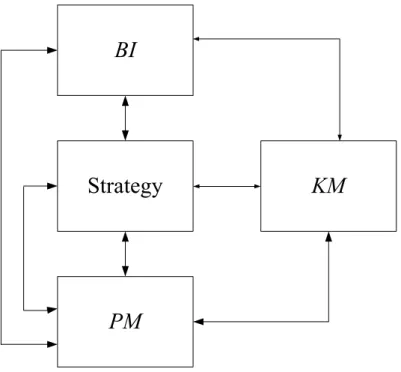
Every organisation has a vision or a mission, which is somewhat permanent. Strategy is an explicit plan to reach the goals set. Strategy takes into account both the external operating environment and internal status of an organisation; thus, a triangle of performance measurement, knowledge management and business intelligence is formed around the strategy. Figure 2 illustrates the connections.
BI
PM
Strategy
KM
Figure 2 Performance measurement, knowledge management and business intelligence in the strategy process of an organisation.
These operations, which are set around the strategy process, are seen from three temporal perspectives. Firstly, business intelligence presents a future perspective as it is used for gaining competitive advantage through better business understanding. Business intelligence is connected to performance measurement as the latter provides internal and external information to be converted into business knowledge. Via
performance measurement and knowledge management, important information on the knowledge in an organisation is mediated to the business intelligence process. Secondly, knowledge management is used to manage the present competencies in an organisation. Critical competencies are derived from strategy. Knowledge management communicates with strategy; however, competencies are very important when performance is evaluated, thus knowledge management is also connected to strategy via performance measurement. Business intelligence is connected to knowledge management directly, as information is refined through the business intelligence process into organizational knowledge. Also, signals indicating the need for different knowledge and skills emanate from business intelligence.
Thirdly, performance measurement has a dual role. Firstly, it is used for strategy implementation as the focus is turned to critical success factors and performance drivers. Measurement is very important as sufficient levels are evaluated. Secondly, it is used for strategy formulations in parallel with business intelligence. For efficient planning, it is important to know the current position. Performance measurement is connected to knowledge management via critical success factors and performance drivers, as knowledge management should focus on vital competencies and on increasing their level in an organisation.
Conclusions and discussion
The triangle of business intelligence, performance measurement and knowledge management provides a framework for strategic performance management. As there is some overlapping, coordination between them is needed. As mentioned above, overlapping makes it possible to use only one or two methods, but then the performance management apparatus is not complete. Efficient performance management requires both foresight and history and, moreover, active development. Thus not a single component of the triangle should be underrated. In order to gain the leveraging effect of using performance management, the system should extend the above features. At least one benefit derived from setting business intelligence, performance measurement and knowledge management in the same framework, is that they are conceptually coherent; they share the same language through which they can communicate with each other. Conceptual coherence is essential to avoid wasting scarce resources.
In conclusion, the framework of performance management opens up some questions for further research. Firstly, how is the defined performance management applicable in real life? Secondly, if such a framework was adopted by an organisation, would there be a dominant tool on the strategic or operative level? Thirdly, how is the leverage effect of performance management evaluated when compared to business intelligence, performance measurement and knowledge management? And fourthly, what are the organizational and system requirements for the performance management.
Bibliography
Boshyk, Yury: Beyond Knowledge Management: how companies mobilize
experience. in Marchand, Donald A. and Davenport, Thomas H. (eds.): Mastering
Information Management. Prentice Hall, London 2000, pp. 51-58.
Collins, B. Better Business Intelligence – How to Learn More about Your Company.
Astron On-Line, Letchworth 1997. 164 p.
Cortada, James W. and Woods, John A.: The Knowledge management Yearbook
2000-2001. Butterworth-Heineman, Boston 2000.
Davenport, Thomas H. and Marchand, Donald A.: Is KM just good information
management?. in Marchand, Donald A. and Davenport, Thomas H. (eds.): Mastering
Information Management. Prentice Hall, London 2000, pp. 165-169.
Gueldenberg, S. C. Measuring in the Knowledge Age: The Perspective of the Living and Learning Organization. Journal of Strategic Performance Measurement, December 1999, pp. 6-15.
Halliman, C. Business Intelligence Using Smart Techniques. Information Uncover, Houston 2001. 212 p.
Harryson, Sigvald J.: Managing Know-Who Based Companies. Edward Elgar Publishing, Inc., Northampton 2000.
Kalakota R., Robinson, M. e-Business 2.0 – Roadmap for Success. Addison-Wesley, Boston 2000. 520 p.
Kaplan, R. S., Norton, D. P. The Balanced Scorecard. Translating Strategy into Action. Harvard Business School Press, Boston, Massachusetts 1996.
Leonard-Barton, Dorothy: Wellsprings of Knowledge. Building and Sustaining the
Sources of Innovation. Harvard Business School Press, Boston 1995.
Lynch, R. L., Cross, K. F. Measure Up! The Essential Guide to Measuring Business Performance. Mandarin, Lontoo 1991.
Marchand, Donald A. and Davenport, Thomas H. (eds.): Mastering Information
Management. Prentice Hall, London 2000.
Lönnqvist, A. Suorituskyvyn mittauksen käyttö suomalaisissa yrityksissä. Tampere University of Technology 2001.
Neely, A. Measuring Business Performance. Why, What and How? Profile Books Ltd, London 1998.
Neely, A., Adams, C. Perspectives on Performance: The Performance Prism. Centre for Business Performance, Cranfield Business School, UK 2000.
Neely, A., Mills, J., Gregory, M., Richards, H., Platts, K., Bourne, M. Getting the Measure of Your Business. Findlay, London 1996.
Neely, A., Mills, J., Platts, K., Richards, H., Gregory, M., Bourne, M., Kennerley, M. Performance Measurement System Design: Developing and Testing a Process-Based Approach. International Journal of Operations & Production Management, Vol. 20, No. 10, 2000, pp. 1119-1145.
Nonaka, Ikujiro and Takeuchi, Hirotaka: The Knowledge Creating Company. How
Japanese Companies Create the Dynamics of Innovation. Oxford University Press,
New York 1995.
PMA (Perspectives on Performance) Newsletter, Vol. 1, Iss. 4, October 2001.
Simons, R. Performance Measurement & Control Systems for Implementing Strategy. Prentice Hall, New Jersey 2000.
Ståhle, Pirjo and Grönroos, Mauri: Knowledge Management – tietopääoma yrityksen
kilpailutekijänä. WSOY, Helsinki 1999.
Ståhle, Pirjo and Grönroos, Mauri: Dynamic Intellectual Capital. Knowledge
management in Theory and Practice. WSOY, Helsinki 2000.
Tierauf, Robert J.: Effective Business Intelligence Systems. Quorum Books, Westport 2001.
Toivanen, J. Balanced Scorecardin implementointi ja käytön nykytila Suomessa. Acta Universitatis Lappeenrantaensis 108, Dissertation, Lappeenranta University of Technology 2001.
Uusi-Rauva, E. Ohjauksen tunnusluvut ja suoritusten mittaus. Second Edition, Opetusmonisteita 2/96, Tampere 1996.
Viva Business Intelligence. Introduction to Business Intelligence. Pro-How Paper 1/98, 1998. 18 p.
Wah, Luisa: Behind the Buzz: The Substance of Knowledge Management. in Cortada, James W. and Woods, John A.: The Knowledge management Yearbook 2000-2001.