Global Risks 2014
Ninth Edition
sources that the authors believe to be reliable and accurate. However, it has not been independently verified and no representation or warranty, express or implied, is made as to the accuracy or completeness of any information obtained from third parties. In addition, the statements in this report may provide current expectations of future events based on certain assumptions and may include statements that do not directly relate to a historical or current fact. These statements involve known and unknown risks, uncertainties and other factors which are not exhaustive. The companies contributing to this report operate in a constantly changing environment and new risks emerge continually. Readers are cautioned not to place undue reliance on these statements. The companies contributing to this report undertake no obligation to publicly revise or update any statements, whether as a result of new information, future events or otherwise, and they shall in no event be liable for any loss or damage arising from the use of the information in this report.
World Economic Forum Geneva
Copyright © 2014
By the World Economic Forum
All rights reserved. No part of this publication may be reproduced, stored in a retrieval system, or transmitted, in any form or by any means, electronic, mechanical, photocopying, or otherwise, without the prior permission of the World Economic Forum.
ISBN-13: 92-95044-60-6 ISBN-10: 978-92-95044-60-9 REF: 090114
This report and an interactive data platform are available at www.weforum.org/risks.
World Economic Forum 91-93 route de la Capite CH-1223 Cologny/Geneva Switzerland Tel.: +41 (0) 22 869 1212 Fax: +41 (0) 22 786 2744 [email protected] www.weforum.org
Ninth Edition
World Economic Forum in collaboration with:
Marsh & McLennan Companies
Swiss Re
Zurich Insurance Group
National University of Singapore
Oxford Martin School, University of Oxford
7 Preface
Klaus Schwab
9 Executive Summary 11 Introduction
12 Part 1: Global Risks 2014: Understanding Systemic Risks in a Changing Global Environment
26 Part 2: Risks in Focus
26 2.1 Introduction: Understanding Global Systemic Risk
27 2.2 Instabilities in an Increasingly Multipolar World
33 2.3 Generation Lost?
38 2.4 Digital Disintegration
42 2.5 Strategies for Managing Global Risks
50 Part 3: Towards Ten Years of the Global Risks Report
52 Conclusion
53 Appendix A: Definitions of Global Risks 2014 55 Appendix B: Global Risks Perception Survey and
Methodology 2014 57 Acknowledgements
Our lives are changing at an
unprecedented pace. Transformational shifts in our economic, environmental, geopolitical, societal and technological systems offer unparalleled
opportunities, but the interconnections among them also imply enhanced systemic risks. Stakeholders from across business, government and civil society face an evolving imperative in understanding and managing emerging global risks which, by definition, respect no national boundaries.
Conceptual models are needed to define, characterize and measure the potential negative impacts of
interconnected global risks. It is in this spirit that I present the Global Risks 2014 report, now in its ninth edition. This report aims to enhance our understanding of how a
comprehensive set of global risks is evolving, how their interaction can lead to unexpected and often systemic impacts, and the trade-offs involved in managing them.
Global Risks 2014 is a stimulus for reflection for policy-makers, chief executive officers, senior executives and thought leaders around the world. It is also a call to action to improve international efforts at coordination and collaboration, going beyond the traditional roles and responsibilities of the public and private sectors to equip institutions to understand, map, monitor, manage and mitigate global risks.
The report emphasizes the importance of understanding systemic risks, long-term thinking to address and
to have systemic consequences in the geopolitical, socio-economic and digital spheres. The report features an analysis of a survey of over 700 leaders and decision-makers from the World Economic Forum’s global
multistakeholder community on 31 selected global risks. For the first time, survey respondents were asked directly to nominate their risks of highest concern, which placed economic and social issues firmly at the top.
I would like to thank the partners of the Global Risks 2014 report, without whose expert contributions this report would not have been possible: Marsh & McLennan Companies, Swiss Re and Zurich Insurance Group, as well as the National University of Singapore, Oxford Martin School at the University of Oxford and the Wharton Risk Management and Decision Processes Center at the University of
Pennsylvania. My appreciation also goes to the World Economic Forum’s Network of Global Agenda Councils for their important insights, under the leadership of Martina Gmür. I am also grateful to Jennifer Blanke, Chief Economist, and the Global Risks 2014 project team members Beñat Bilbao-Osorio, Ciara Browne, Gemma Corrigan, Roberto Crotti, Attilio Di Battista, Gaëlle Dreyer, Margareta Drzeniek Hanouz, Caroline Galvan, Thierry Geiger and Tania Gutknecht for their critical contributions to making this report possible.
Moving from urgency-driven risk management to more collaborative efforts to strengthen risk resilience would benefit global society. Together, leaders from business, government and civil society have the foresight and collaborative spirit to shape our global future.
Klaus Schwab
Founder and Executive Chairman World Economic Forum
The Global Risks 2014 report highlights how global risks are not only interconnected but also have systemic impacts. To manage global risks effectively and build resilience to their impacts, better efforts are needed to understand, measure and foresee the evolution of interdependencies between risks, supplementing traditional risk-management tools with new concepts designed for uncertain environments. If global risks are not effectively addressed, their social, economic and political fallouts could be far-reaching, as exemplified by the continuing impacts of the financial crisis of 2007-2008. The systemic nature of our most significant risks calls for procedures and institutions that are globally coordinated yet locally flexible. As international systems of finance, supply chains, health, energy, the Internet and the environment become more complex and interdependent, their level of resilience determines whether they become bulwarks of global stability or amplifiers of cascading shocks. Strengthening resilience requires overcoming collective action challenges through international cooperation among business, government and civil society.
Mapping Global Risks in 2014
Based on a survey of the World Economic Forum’s multistakeholder communities, the report maps 31 global risks according to level of concern, likelihood and impact and interconnections among them.
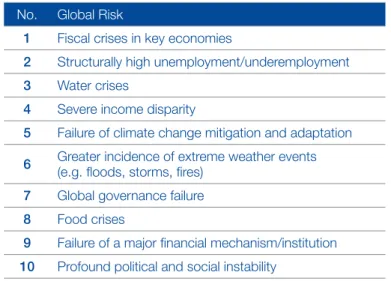
– The risks of highest concern to respondents are fiscal crises in key economies, structurally high unemployment and underemployment, and water crises (Table 1).
Table 1: Ten Global Risks of Highest Concern in 2014
Source: Global Risks Perception Survey 2013-2014.
Note: From a list of 31 risks, survey respondents were asked to identify the five they are most concerned about.
– The risks considered high impact and high likelihood are mostly environmental and economic in nature: greater incidence of extreme weather events, failure of climate change mitigation and adaptation, water crises, severe income disparity, structurally high unemployment and underemployment and fiscal crises in key economies. Female respondents perceived almost all global risks as both more likely and more impactful than did males, especially in the environmental category. Younger individuals gave higher scores for the impact of almost all of the risks, particularly environmental risks, such as water crises, greater incidence of natural catastrophes, the loss of biodiversity and greater incidence of extreme weather events.
– The risks perceived to be most interconnected with other risks are macroeconomic – fiscal crises, and structural unemployment and underemployment – with strong links between this macroeconomic risk nexus and social issues, such as rising income inequality and political and social instability. The failure of global governance emerges as a central risk that is connected to many different issues. Mapping perceived
interconnections between risks helps to understand the potential transmission channels between them.
– The decline of trust in institutions, lack of leadership, persisting gender inequalities and data mismanagement were among trends to watch, according to survey respondents. Experts added further concerns including various forms of pollution, and accidents or abuse involving new technologies, such as synthetic biology, automated vehicles and 3-D printing.
No. Global Risk
1 Fiscal crises in key economies
2 Structurally high unemployment/underemployment
3 Water crises
4 Severe income disparity
5 Failure of climate change mitigation and adaptation
6 Greater incidence of extreme weather events (e.g. floods, storms, fires) 7 Global governance failure
8 Food crises
9 Failure of a major financial mechanism/institution
10 Profound political and social instability
Box 1: Objectives of the Global Risks 2014 Report
The world faces risks that can be addressed only by long-term thinking and collaboration among business, governments and civil society. The Global Risks 2014 report aims to support this process by:
– exploring the nature of systemic risks
– mapping 31 global risks according to the level of concern they arouse, their likelihood and potential impact, as well as the strength of the
interconnections between them
– looking in-depth at the ways in which three constellations of global risk – centred on youth, cyberspace and geopolitics – could interplay and have systemic impact
risks could play out systemically over the 10-year horizon considered by this report, three are explored in depth: – Instabilities in an increasingly multipolar world:
Changing demographics, growing middle classes and fiscal constraints will place increasing domestic demands on governments, deepening requirements for internal reform and shaping international relations. Set against the rise of regional powers, an era of greater economic pragmatism and national self-protection might increase inter-state friction and aggravate a global governance vacuum. This may hinder progress on cross-cutting, long-term challenges, and lead to increased inefficiencies and friction costs in strategically important sectors, such as healthcare, financial services and energy. Managing this risk will require flexibility, fresh thinking and
multistakeholder communication.
– Generation lost? The generation coming of age in the 2010s faces high unemployment and precarious job situations, hampering their efforts to build a future and raising the risk of social unrest. In advanced economies, the large number of graduates from expensive and outmoded educational systems – graduating with high debts and mismatched skills – points to a need to adapt and integrate professional and academic education. In developing countries, an estimated two-thirds of the youth are not fulfilling their economic potential. The generation of digital natives is full of ambition to improve the world but feels disconnected from traditional politics; their ambition needs to be harnessed if systemic risks are to be addressed.
– Digital disintegration:So far, cyberspace has proved resilient to attacks, but the underlying dynamic of the online world has always been that it is easier to attack than defend. The world may be only one disruptive technology away from attackers gaining a runaway advantage, meaning the Internet would cease to be a trusted medium for communication or commerce. Fresh thinking at all levels on how to preserve, protect and govern the common good of a trusted cyberspace must be developed.
Collaborative multistakeholder action is needed. Wide variance in how risks are identified and managed still exists. Businesses, governments and civil society alike can improve how they approach risk by taking steps such as opening lines of communication with each other to build trust, systematically learning from others’ experiences, and finding ways to incentivize long-term thinking. By offering a
framework for decision-makers to look at risks in a holistic manner, the Global Risks 2014 report aims to provide a platform for dialogue and to stimulate action.
Accelerating change in the 21st century has bound countries, economies and businesses ever more tightly together through better infrastructure, faster and more efficient communication systems, and closer trade and investment links. Innovations such as the Internet and mobile phone have boosted productivity, created new business opportunities and enhanced access to information. Economic growth has lifted millions of people out of poverty. Yet the same dynamic that lies behind these gains – everything being more connected and interdependent – also threatens to undermine them. Economic growth, for example, may be inexorably undermining its own
foundations through its negative side-effects on ecosystems, biodiversity and the climate – effects that cannot be stopped at national borders. Disruptions in the online environment are becoming as impactful as those in the physical world, if not more.
Since 2006, the Global Risks report has been calling attention to global risks that can be systemic in nature, causing breakdowns of entire systems and not only their component parts.
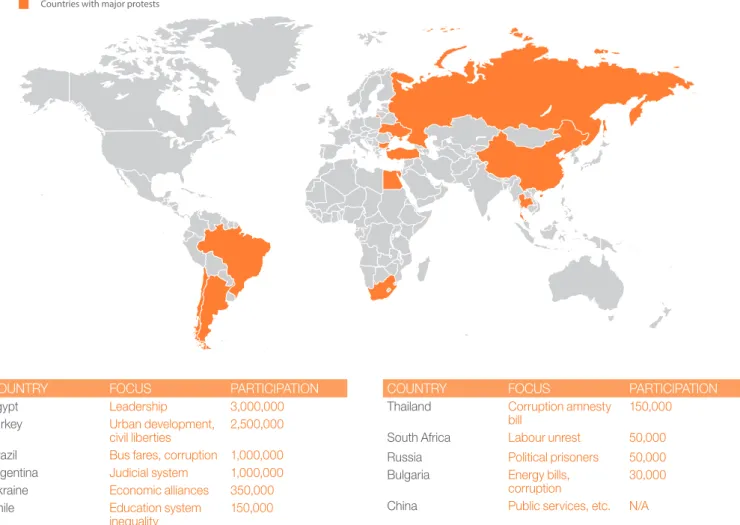
These risks can come from many sources. The greater the interdependencies between countries and industries, the greater the potential for events to bring about unforeseen, cascading consequences. The year 2013 alone witnessed a number of illustrations of such risks, bringing significant losses in terms of both human life and wealth. The fiscal crisis in the United States (US), the subsiding threat of sovereign default in eurozone countries and popular protests in emerging markets all presented economic risks far beyond national borders. Typhoon Haiyan took a heavy toll on the Philippines, even as global leaders debated climate change in Warsaw in November 2013. Syria’s refugee crisis destabilized the entire Middle East. Revelations about data leakage and new forms of espionage created geopolitical tensions that may yet have far-reaching implications in the years to come. These events have painfully emphasized that the world is not equipped to deal with global risks.
This year, as in past editions, the Global Risks report represents a step in a continuous process of improving how global risks and their interconnections can be put on decision-makers’ radar screens, to provide a basis for dialogue on how governments, business and civil society can work together effectively to build resilience and mitigate any negative effects accruing from them.
Part 1 of the report presents the results of this year’s Global Risks Perceptions Survey, enumerating the 10 risks that respondents nominated as being of highest concern and also those they thought were most likely and potentially impactful. It also maps the strength of perceived interconnections among these risks to provide a holistic picture of the complexity and broad framework needed to understand their full potential impact. Finally, it includes a “risks and trends to watch” section, noting additional issues that respondents and experts were concerned about. Part 2 selects and explores in detail three constellations of global risks from the Risks Interconnections Map. “Instabilities in an Increasingly Multipolar World” examines possible interconnections among risks related to the
changing geopolitical order. “Generation Lost?” looks at how high rates of youth unemployment risk stoking social unrest and squandering human and economic potential, and how the current situation will affect tomorrow’s youth. “Digital Disintegration” imagines how cyberspace could become severely affected through growing strength of attacks and dwindling trust, at a huge cost to economies and societies. The report also features contributions from several of the Forum’s Global Agenda Councils, which bring together thought leaders from academia, business, government, international organizations and other civil society
organizations to set the global agendas in their respective fields. The Councils’ contributions explore a selection of specific risks that rank highly on the Global Risks Perceptions Survey.
The multistakeholder collaboration required to address global risks should take place through effective mechanisms of global governance, as global risks can only be addressed at a global level. Addressing risks effectively takes not only a common understanding of the issues and a willingness to work together but also the building of mutual trust and nurturing of the capacity for long-term thinking – issues further explored in the concluding section of Part 2. Part 3 analyses the main learnings from past Global Risks reports and looks ahead towards the 10th anniversary of the report in 2015.
To work together to prepare and mitigate risks and strengthen resilience, leaders in business, politics and civil society all need to first identify, understand and monitor the most important global risks. The Global Risks 2014 report aims to facilitate this process and provide a platform for dialogue.
Pa
rt 2
Pa
rt 3
Part 1:
Global Risks 2014:
Understanding Systemic
Risks in a Changing Global
Environment
Box 1.1: What Is Systemic Risk?
Systemic risk is the risk of “breakdowns in an entire system, as opposed to breakdowns in individual parts and components”.1 Systemic risks are characterized by: – modest tipping points combining indirectly to
produce large failures
– risk-sharing or contagion, as one loss triggers a chain of others
– “hysteresis”, or systems being unable to recover equilibrium after a shock
Note
1 Kaufman, G. G. and K. E. Scott. 2003. “What Is Systemic Risk, and Do
Bank Regulators Retard or Contribute to It?” Independent Review 7 (3): 371–391. See quote on p. 371.
Source
Goldin, I. and M. Mariathasan. The Butterfly Defect: How globalization creates systemic risk, and what to do about it. Princeton University Press. Forthcoming Spring 2014.
A global risk is defined as an occurrence that causes significant negative impact for several countries and industries over a time frame of up to 10 years. A key
characteristic of global risks is their potential systemic nature – they have the potential to affect an entire system, as opposed to individual parts and components – as defined in Box 1.1 below.
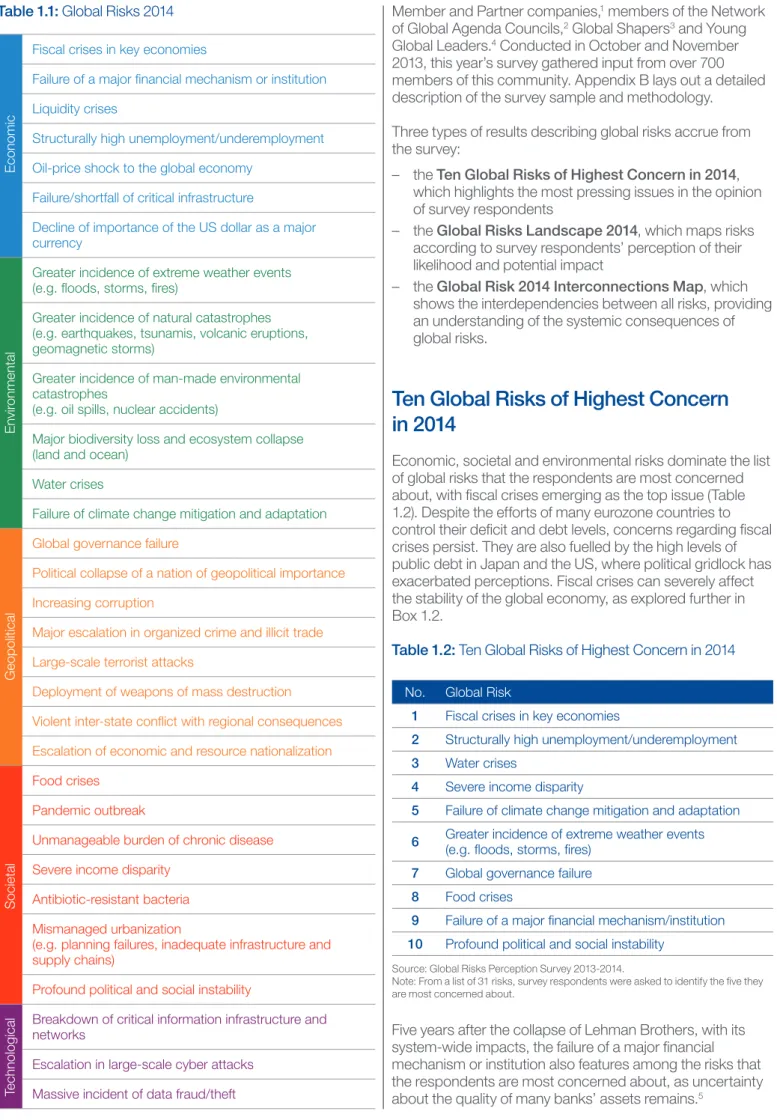
This report considers a core set of 31 global risks in five categories (see Table 1.1): economic, environmental, geopolitical, technological, and societal (Appendix A provides the definitions of individual risks).
Economic Risks
Risks in the economic category include fiscal and liquidity crises, failure of a major financial mechanism or institution, oil-price shocks, chronic unemployment and failure of physical infrastructure on which economic activity depends.
Environmental Risks
Risks in the environmental category include both natural disasters, such as earthquakes and geomagnetic storms, and man-made risks such as collapsing ecosystems, freshwater shortages, nuclear accidents and failure to mitigate or adapt to climate change.
Geopolitical Risks
The geopolitical category covers the areas of politics, diplomacy, conflict, crime and global governance. These risks range from terrorism, disputes over resources and war to governance being undermined by corruption, organized crime and illicit trade.
Societal Risks
The societal category captures risks related to social stability – such as severe income disparities, food crises and
dysfunctional cities – and public health, such as pandemics, antibiotic-resistant bacteria and the rising burden of chronic disease.
Technological Risks
The technological category covers major risks related to the growing centrality of information and communication technologies to individuals, businesses and governments. These include cyber attacks, infrastructure disruptions and data loss.
The core set of global risks considered in this report is not exhaustive, and the Forum attempts to continually refine it as the global risks landscape evolves. The list also includes “vulnerabilities”, or those trends that are already manifest and that affect other risks – for example, an ageing population represents a vulnerability potentially affecting a country’s fiscal situation. This distinction is further explored in Part 3 of this report.
Since 2009, the Global Risks report has evaluated risks over a 10-year time horizon through the Global Risks Perception Survey, which gathers the perceptions of the World Economic Forum’s multistakeholder communities across different areas of expertise, geographies and age groups. It includes representatives of the World Economic Forum’s
Pa
rt 2
Pa
rt 3
Member and Partner companies,1 members of the Network of Global Agenda Councils,2 Global Shapers3 and Young Global Leaders.4 Conducted in October and November 2013, this year’s survey gathered input from over 700 members of this community. Appendix B lays out a detailed description of the survey sample and methodology.
Three types of results describing global risks accrue from the survey:
– the Ten Global Risks of Highest Concern in 2014, which highlights the most pressing issues in the opinion of survey respondents
– the Global Risks Landscape 2014, which maps risks according to survey respondents’ perception of their likelihood and potential impact
– the Global Risk 2014 Interconnections Map, which shows the interdependencies between all risks, providing an understanding of the systemic consequences of global risks.
Ten Global Risks of Highest Concern
in 2014
Economic, societal and environmental risks dominate the list of global risks that the respondents are most concerned about, with fiscal crises emerging as the top issue (Table 1.2). Despite the efforts of many eurozone countries to control their deficit and debt levels, concerns regarding fiscal crises persist. They are also fuelled by the high levels of public debt in Japan and the US, where political gridlock has exacerbated perceptions. Fiscal crises can severely affect the stability of the global economy, as explored further in Box 1.2.
Table 1.1: Global Risks 2014 Fiscal crises in key economies
Failure of a major financial mechanism or institution Liquidity crises
Structurally high unemployment/underemployment Oil-price shock to the global economy
Failure/shortfall of critical infrastructure
Decline of importance of the US dollar as a major currency
Greater incidence of extreme weather events (e.g. floods, storms, fires)
Greater incidence of natural catastrophes (e.g. earthquakes, tsunamis, volcanic eruptions, geomagnetic storms)
Greater incidence of man-made environmental catastrophes
(e.g. oil spills, nuclear accidents)
Major biodiversity loss and ecosystem collapse (land and ocean)
Water crises
Failure of climate change mitigation and adaptation Global governance failure
Political collapse of a nation of geopolitical importance Increasing corruption
Major escalation in organized crime and illicit trade Large-scale terrorist attacks
Deployment of weapons of mass destruction
Violent inter-state conflict with regional consequences Escalation of economic and resource nationalization Food crises
Pandemic outbreak
Unmanageable burden of chronic disease Severe income disparity
Antibiotic-resistant bacteria Mismanaged urbanization
(e.g. planning failures, inadequate infrastructure and supply chains)
Profound political and social instability
Breakdown of critical information infrastructure and networks
Escalation in large-scale cyber attacks Massive incident of data fraud/theft
Table 1.2: Ten Global Risks of Highest Concern in 2014
Source: Global Risks Perception Survey 2013-2014.
Note: From a list of 31 risks, survey respondents were asked to identify the five they are most concerned about.
No. Global Risk
1 Fiscal crises in key economies
2 Structurally high unemployment/underemployment
3 Water crises
4 Severe income disparity
5 Failure of climate change mitigation and adaptation
6 Greater incidence of extreme weather events (e.g. floods, storms, fires) 7 Global governance failure
8 Food crises
9 Failure of a major financial mechanism/institution
10 Profound political and social instability
Five years after the collapse of Lehman Brothers, with its system-wide impacts, the failure of a major financial mechanism or institution also features among the risks that the respondents are most concerned about, as uncertainty about the quality of many banks’ assets remains.5
Economic Envir onmental Geopolitical Technological Societal
Pa
rt 2
Pa
rt 3
Structural unemployment and underemployment appears second overall, as many people in both advanced and emerging economies struggle to find jobs. The youth and minorities are especially vulnerable. Youth unemployment rates hover around 50% in some countries (such as Greece, Spain, South Africa).
Closely associated in terms of societal risk, income disparity is also among the most worrying of issues. It raises concerns about the Great Recession and the squeezing effect it had on the middle classes in developed economies, while globalization has brought about a polarization of incomes in emerging and developing economies. This is true despite the obvious progress in countries such as Brazil and lower levels of poverty in several developing countries in Asia and Africa.
Environmental risks also feature prominently in this year’s list, appearing as three of the top 10 global risks of greatest concern. Water crises, for instance, rank as the third highest concern (see Box 1.3). This illustrates a continued and growing awareness of the global water crisis as a result of
Box 1.2: Fiscal Crises: Just When You Thought It Was Safe to Go Back…
Contributed by the Global Agenda Council on Fiscal Sustainability
The risk of fiscal crises features as the top risk in this year’s Global Risks report. Governments often run deficits, spending more than they raise in taxes. They make up the shortfall by selling bonds – borrowing money from private investors with the promise of repaying it, with interest, at a specified future date. A fiscal crisis occurs when investors begin to doubt the government’s future ability to repay; the government then has to offer higher interest on its bonds to compensate investors for the increased risk. A vicious cycle starts: ballooning interest payments add to government debt, increasing the doubts of investors and forcing interest rates up still further. This can rapidly turn into a fatal spiral, in which fears that a country will default on its debt become a self-fulfilling prophecy.
As government bonds tend to be held in substantial part by domestic banks, when the government defaults, the resulting losses on these bonds endanger banks’ solvency. In this way, a fiscal crisis can lead to financial crisis. The causation can also run the other way: the government may be forced to bail out large banks at risk of default to avoid a systemic financial crisis. However, the additional debt taken on can plunge the government from an already-precarious fiscal position into a full-blown fiscal crisis.
Unsustainable debt developments ultimately force governments to undertake painful fiscal adjustments by cutting expenditures and/or raising taxes. If such austerity is not timed well, it can trigger a deep recession and a strong increase in unemployment, a dynamic which has played out in many advanced economies since the financial crisis of 2007-2008. By contrast, most emerging markets were able to quickly recover from the recent financial crisis. Latin American and Asian countries, which had experienced their own fiscal crises in the 1980s and 1990s, had implemented reforms to bring government debt under control. When they were hit by the fallout of the financial crisis, they had the fiscal leeway to stimulate economic activity through the opposite of austerity – increasing spending and/or cutting taxes.
Advanced economies remain in danger of fiscal crises. Given the US’s official public debt of more than 100% of its GDP, and Japan’s of more than 230%, investors may at some point conclude that these levels are unsustainable. In the short run, the risks are higher for eurozone countries, which lack the option of devaluing their currencies to ease the necessary fiscal adjustment. Although ostensibly in a better position, many emerging markets have seen credit bubbles in recent years that could turn into financial crises, and then fiscal crises, for example, the rapid credit growth in Asia since 2008.1 A fiscal crisis in any major economy could easily have cascading global impacts.
Finding ways to deal effectively with the current risks of fiscal crises is, therefore, important. Making fiscal frameworks more resilient in the future is even more important given the substantial longer-run fiscal challenges created by an ageing
population. Note
1 Bowman, A. 2013. “HSBC: Asia’s ‘worrying’ debt-led growth.” Financial Times, February 21. Available at http://blogs.ft.com/beyond-brics/2013/02/21/
hsbc-asias-worrying-debt-driven-growth/#axzz2mhjDelCh
mismanagement and increased competition for already scarce water resources from economic activity and population growth. Coupled with extreme weather events such as floods and droughts, which appears sixth on the list, the potential impacts are real and happening today.6
Climate change, ranked fifth on the list (see Box 1.4), is the key driver of such uncertain and changing weather patterns, causing an increased frequency of extreme weather events such as floods and droughts. It is important to consider the combined implications of these environmental risks on key development and security issues, such as food security, and political and social instability, ranked eighth and 10th
respectively.7
Given that global risks can be addressed effectively only through international collaboration, it is hardly a surprise that global governance failure is also included in the list as the risk of seventh highest concern.
Pa
rt 2
Pa
rt 3
The Global Risks Landscape 2014
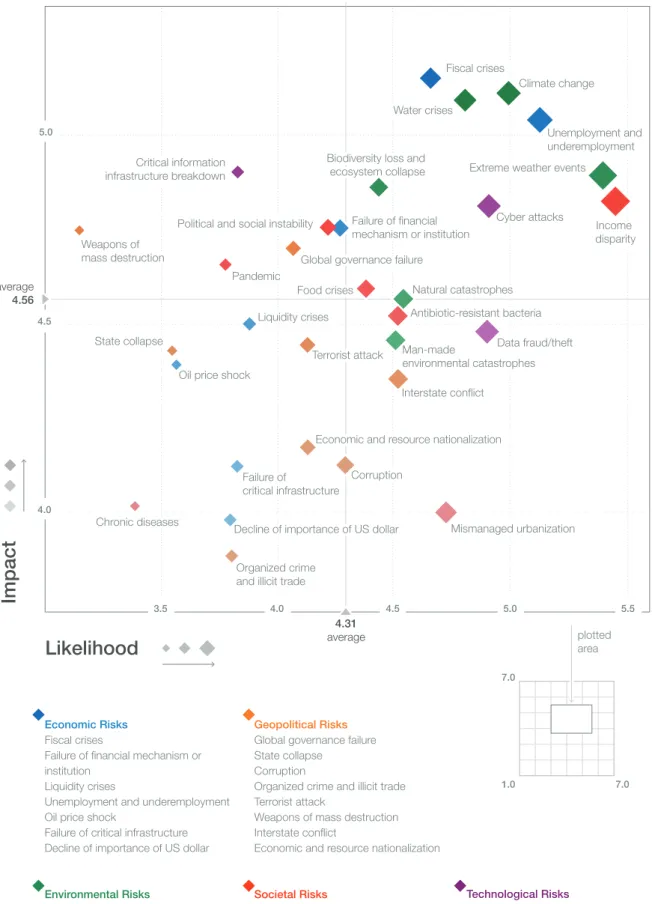
Figure 1.1 plots the aggregated survey responses on the perceived likelihood and impact of the 31 risks. The risks are grouped in four quadrants as delineated by the averages of their overall likelihood and impact. As evident, most risks cluster around the two upper quadrants, which identify risks with high impact.
The upper right quadrant shows those global risks that are perceived by the respondents as both potentially impactful and likely to occur. Similar to the risks of highest concern, this quadrant is dominated by economic, social and environmental risks. Fiscal crises and structural
unemployment and underemployment are among the most impactful risks; the latter also feature among those most likely to occur, with knock-on effects on income disparities, which is regarded as the overall most likely risk.
Climate change features among the five most likely and most impactful risks. Among other environmental risks, extreme weather events are considered the second most likely, and
water crises also appear high on the list. This suggests a pressing need for better public information about the potential consequences of environmental threats, given that collective action will need to be based on common
understanding.
The upper left quadrant shows those risks that are considered less likely to happen, but would be impactful if they did. The deployment of weapons of mass destruction is perceived to be high-impact yet the least likely of the 31 risks, despite recent developments such as North Korea’s alleged third nuclear test and the deployment of chemical weapons in Syria. Other lower-likelihood, high-impact risks are the political collapse of a nation of geopolitical
importance, an oil-price shock and the inability to deal with pandemics.
Box 1.3: Risks that Flow from Water
Contributed by the Global Agenda Council on Water Security
Water crises and extreme weather events have been identified by the World Economic Forum community as two of the top 10 global risks. This is hardly surprising, given the devastating impacts of having too little water, or too much. While water’s immediate impacts are often local, water security is now recognized as a systemic global risk.
In 2010, floods in Pakistan paralysed large parts of the country for many weeks, killing thousands of people and wrecking the rural economy. Thailand’s slow-onset flood in 2011 caused fewer deaths but showed how one local event could have an impact across the world: global car production slowed as supplies of components were cut, and hard-drive manufacture for the world’s computers was slashed. Similarly, Japan’s GDP and global industrial production dipped significantly following the tsunami of March 2011.
Too little water can also have systemic impacts. Drought in Russia in 2010 led to restrictions on agricultural exports, causing the price of staple grains to rise across North Africa and the Middle East. The resulting food shortages and price rises aggravated the tensions that led to the Arab Spring. Some studies suggest that water scarcity could reduce grain production by as much as 30%.
In the future, geopolitical tensions over access to strategic water resources could become more systemically impactful, and water shortage coupled with poverty and societal instability could weaken intra-state cohesion. Because of the systemic importance of water for global economic activity, any failings in its planning, management and use in one country can ripple across the world. That management is becoming increasingly complex and difficult as populations expand and people grow wealthier, demanding more freshwater to supply cities and factories and consuming more foods, such as dairy and meat, that need more water to produce. Water is equally key for energy production. While the world population grew fourfold in the 20th century, freshwater withdrawals grew nine times.
While there is growing concern about future climate change exacerbating water-related risk, many countries cannot even manage today’s climate variability. Drought and flood could increasingly ravage the economies of poorer countries, locking them more deeply into cycles of poverty.
Beyond water quantity, water quality is another critical issue. Pollution incidents have paralysed business operations in parts of China and elsewhere, disrupting global value chains and damaging corporate reputations – poor water quality or shortages are often blamed on business operations even when businesses comply fully with regulatory requirements. How can the global community respond? The overarching prescription is for a package of investments in information, institutions and infrastructure. But successful water management needs the cooperation of a wide network of water users, public and private institutions.
Pa
rt 2
Pa
rt 3
Figure 1.1: The Global Risks Landscape 2014
Source: Global Risks Perception Survey 2013-2014.
Note: Survey respondents were asked to assess the likelihood and impact of the individual risks on a scale of 1 to 7, 1 representing a risk that is not likely to happen or have impact, and 7 a risk very likely to occur and with massive and devastating impacts. See Appendix B for more details. To ensure legibility, the names of the global risks are abbreviated. Please see Appendix A for the full name and description.
3.5 4.0 4.5 5.0 5.5 average 4.56 5.0 4.5 4.0 4.31 average
Likelihood
Impact
7.0 1.0 7.0 plotted area Economic Risks Fiscal crisesFailure of financial mechanism or institution
Liquidity crises
Unemployment and underemployment Oil price shock
Failure of critical infrastructure Decline of importance of US dollar
Environmental Risks Extreme weather events Natural catastrophes
Man-made environmental catastrophes Biodiversity loss and ecosystem collapse
Water crises Climate change
Geopolitical Risks Global governance failure State collapse
Corruption
Organized crime and illicit trade Terrorist attack
Weapons of mass destruction Interstate conflict
Economic and resource nationalization
Societal Risks Food crises Pandemic Chronic diseases Income disparity Antibiotic-resistant bacteria Mismanaged urbanization Political and social instability
Technological Risks
Critical information infrastructure breakdown Cyber attacks Data fraud/theft Fiscal crises Failure of financial mechanism or institution Liquidity crises Unemployment and underemployment
Oil price shock
Failure of critical infrastructure
Decline of importance of US dollar
Extreme weather events
Natural catastrophes
Manmade
environmental catastrophes Biodiversity loss and
ecosystem collapse Water crises
Climate change
Global governance failure
State collapse Weapons of mass destruction
Corruption
Organized crime and illicit trade
Terrorist attack
Interstate conflict
Economic and resource nationalization Food crises Pandemic Chronic diseases Income disparity Antibiotic-resistant bacteria Mismanaged urbanization Political and social instability
Critical information infrastructure breakdown Cyber attacks Data fraud/theft Fiscal crises Failure of financial mechanism or institution Liquidity crises Unemployment and underemployment
Oil price shock
Failure of critical infrastructure
Decline of importance of US dollar
Extreme weather events
Natural catastrophes
Man-made
environmental catastrophes Biodiversity loss and
ecosystem collapse Water crises
Climate change
Global governance failure
State collapse Weapons of mass destruction
Corruption
Organized crime and illicit trade
Terrorist attack
Interstate conflict
Economic and resource nationalization Food crises Pandemic Chronic diseases Income disparity Antibiotic-resistant bacteria Mismanaged urbanization Political and social instability
Critical information infrastructure breakdown
Cyber attacks
Pa
rt 2
Pa
rt 3
Table 1.3: The Evolving Global Risks Landscape (2007-2014)
Source: Global Risks reports 2007-2014, World Economic Forum.
Note: Global risks may not be strictly comparable across years, as definitions and the set of global risks have been revised with new issues having emerged on the 10-year horizon. For example, cyber attacks, income disparity and unemployment entered the set of global risks in 2012. Some global risks were reclassified: water supply crises and income disparity were reclassified as environmental and societal risks, respectively, in 2014.
Breakdown of critical information
infrastructure
Breakdown of critical information infrastructure
2008 2009 2010 2011 2012 2013
1st Asset price collapse Asset price collapse Asset price collapse Fiscal crises Major systemic Major systemic
2nd Retrenchment from globalization (developed) Retrenchment from globalization (developed) Retrenchment from globalization (developed)
Climate change Water supply
crises Water supply crises
3rd Slowing Chinese economy (<6%) Oil and gas price spike Oil price spikes Geopolitical Food shortage crises imbalances
4th Oil and gas price spike Chronic disease Chronic disease Asset price collapse imbalances
5th Pandemics Fiscal crises Fiscal crises Extreme energy price volatility Extreme volatility in energy and agriculture prices
weapons of mass destruction
Economic Environmental Geopolitical Societal Technological
Failure of climate change adaptation Breakdown of
critical information infrastructure
Breakdown of critical information infrastructure
2008 2009 2010 2011 2012 2013
1st Asset price collapse Asset price collapse Asset price collapse Storms and cyclones Severe income disparity Severe income disparity
2nd Middle East instability Slowing Chinese economy (<6%) Slowing Chinese economy (<6%) Flooding imbalances imbalances
3rd Failed and failing states Chronic disease Chronic disease Corruption Rising greenhouse gas emissions Rising greenhouse gas emissions
4th Oil and gas price spike Global governance gaps Fiscal crises Biodiversity loss Cyber attacks Water supply crises
5th Chronic disease, developed world Retrenchment from globalization (emerging)
Global governance
gaps Climate change Water supply crises Mismanagement of population ageing 2014 Fiscal crises Climate change and underemployment Critical information infrastructure 2014 Income disparity events Unemployment and underemployment Climate change Cyber attacks Extreme weather Water crises Unemployment breakdown 2007 Breakdown of critical information infrastructure Chronic disease in developed countries Oil price shock
China economic hard landing
Asset price collapse
Top 5 Global Risks in Terms of Likelihood
Top 5 Global Risks in Terms of Impact 2007
Asset price collapse
Retrenchment from globalization
Interstate and civil wars
Pandemics
Oil price shock
Complementing Figure 1.1, the five risks considered most likely and most impactful since 2007 are shown in Table 1.3. Although the set of risks and their definitions have been continually revised over the years, the comparison still provides some qualitative insight into how global risk perceptions have evolved.
Environmental risks, such as climate change, extreme weather events and water scarcity, have become more prominent since 2011, while health-related risks (pandemics and chronic disease) have become less so. Concern about
geopolitical risks, such as global governance failure, has given way to concern about socio-economic risks such as income disparity, unemployment and fiscal crises. In addition to the socio-economic and environmental risks, cyber attacks and the breakdown of critical information
infrastructure are prominent risks. This arguably reflects the increasing digitization of economies and societies, where rising dependence on information and data, as well as the systems to analyse and use them, has made attacks more likely and their effects more impactful.
Pa
rt 2
Pa
rt 3
Figure 1.2: The Global Risks Landscape 2014 – Gender
Source: Global Risks Perception Survey 2013-2014.
Note: To ensure legibility, the names of the global risks are abbreviated. Please see Appendix A for the full name and description
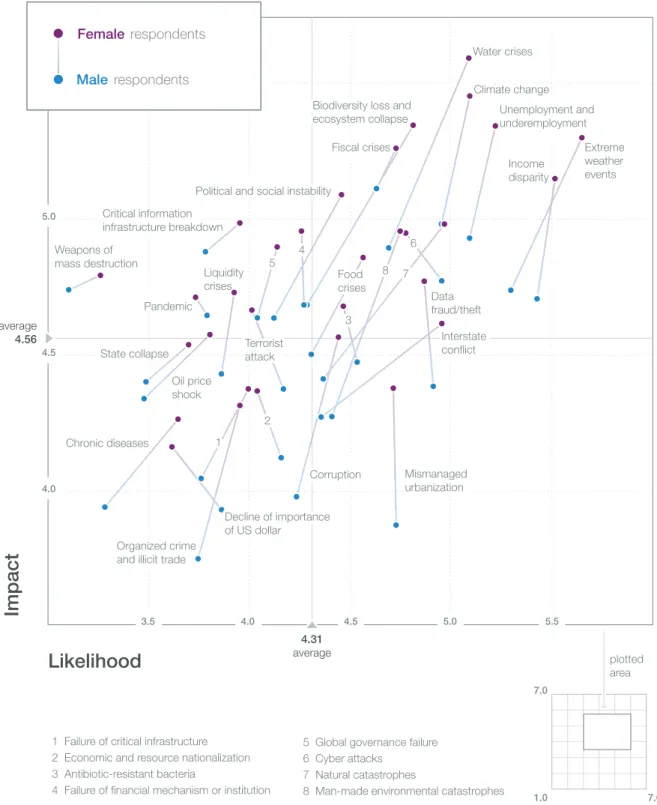
Responses to the survey can be disaggregated by gender, as shown in Figure 1.2. An extensive body of literature exists on the link between gender and risk perceptions, suggesting women are typically more sensitive to risk than men.8 Studies also show that women are more likely to be concerned about environmental issues.9 Some argue that this reflects a tendency for women to think more of the long term than men, and to have a more network-focused rather than linear approach to problem-solving.10
It is also possible to isolate the perspective of young respondents, those aged under 30 years. In general, the younger generation is more concerned about the potential impact of global risks, while perceptions of likelihood show no such consistent deviation.
In particular, younger individuals gave higher scores for the impact of almost all of the risks with the exception of liquidity crises (Figure 1.3). The young consider an oil-price shock, the loss of biodiversity and collapse of the
4.5 3.5 4.0 4.5 4.31 average 5.5 5.0 5.5 5.0 average 4.56 4.0 7.0 1.0 7.0 plotted area 3 Antibiotic-resistant bacteria
2 Economic and resource nationalization 1 Failure of critical infrastructure
4 Failure of financial mechanism or institution
5 Global governance failure 7 Natural catastrophes 6 Cyber attacks
8 Man-made environmental catastrophes
Likelihood
Impact
Biodiversity loss and ecosystem collapse Chronic diseases Climate change Corruption Critical information infrastructure breakdown Data fraud/theft Decline of importance of US dollar 2 Extreme weather events 1 Fiscal crises Food crises Income disparity Interstate conflict Liquidity crises Mismanaged urbanization Oil price shock Organized crime and illicit trade
Pandemic
Political and social instability
State collapse Terroristattack
Unemployment and underemployment Water crises Weapons of mass destruction 3 6 7 8 4 5 Female respondents Male respondents
Biodiversity loss and ecosystem collapse Chronic diseases Climate change Corruption Critical information infrastructure breakdown Data fraud/theft Decline of importance of US dollar 2 Extreme weather events 1 Fiscal crises Food crises Income disparity Interstate conflict Liquidity crises Mismanaged urbanization Oil price shock Organized crime and illicit trade
Pandemic
Political and social instability
State collapse Terroristattack
Unemployment and underemployment Water crises Weapons of mass destruction 3 6 7 8 4 5
Pa
rt 2
Pa
rt 3
Figure 1.3: The Global Risks Landscape 2014 - Age
Source: Global Risks Perception Survey 2013-2014.
Note: To ensure legibility, the names of the global risks are abbreviated. Please see Appendix A for the full name and description.
Olderrespondents (30 or over)
Youngerrespondents (under 30)
ecosystem, and the occurrence of natural catastrophes as considerably more likely and impactful than those over 30 years of age. Furthermore, while both age groups agree on the likelihood of environmental risks, younger respondents consider risks such as water crises, man-made natural catastrophes, the loss of biodiversity and extreme weather events more impactful if they were to occur. As with gender differences, similar findings emerge from broader literature about links between age and concern for the environment.11
Younger respondents were also more concerned than their older counterparts about the impact of the failure of a major financial institution, unemployment and political and social instability, which fits with the mindset of the “Generation Lost”, explored in Part 2.3.
Pa
rt 2
Pa
rt 3
Box 1.4: Poor Countries Are Losing Ground in the Race to Adapt to a Changing Climate
Contributed by the Global Agenda Council on Climate Change
The year 2014 is likely to be crucial for addressing climate risks, a point made by United Nations (UN) climate chief Christiana Figueres at the Warsaw Climate Change Conference. Countries made only limited progress on issues such as emissions reduction, loss and damage compensation, and adaptation. Greater progress is urgently needed to create incentives and mechanisms to finance action against climate change while efforts are made to keep temperature rise below 2 degrees Celsius.
Even as governments and corporations are called upon to speed up greenhouse gas reduction, it is clear that the race is on not only to mitigate climate change but also to adapt. Droughts, super-storms and other natural disasters are
increasingly causing systemic risks around the world.
Failure to adapt most strongly affects the most vulnerable, especially those in the least developed countries. They tend to lack the infrastructure and capacity to deal with extreme droughts and floods, reduced crop yields and increased stresses on energy and water supplies.
According to the latest Notre Dame-Global Adaptation Index, it will take more than 100 years for the world’s poorest countries to reach the current adaptive capacity of higher-income OECD countries. The World Bank estimates the cost of climate change adaptation for developing countries at US$ 70-100 billion per year through to 2050.
Gradually, however, promising models are emerging of collaboration between the public and private sectors and civil society to strengthen resilience to climate change. An example is the US$ 3 billion Southern Agricultural Growth Corridor of Tanzania (SAGCOT), intended to create the infrastructure to nurture new value chains. Through techniques such as rainwater harvesting, efficient irrigation and crops that can produce more nutrients for the same input of water, SAGCOT aims to increase food production in a way that is both environmentally sustainable and benefits small-scale farmers and the rural poor.
Such innovative and ambitious projects, unlocking investment funds through public-private partnership, showcase the kind of multistakeholder collaboration that will be needed across all sectors to meet the twin priorities of climate change mitigation and adaptation.
Sources
Scherr, S. J., J. C. Milder, L. E. Buck, A. K. Hart, and S. A. Shames. 2013. A vision for Agriculture Green Growth in the Southern Agricultural Growth Corridor of Tanzania (SAGCOT): Overview. Dar es Salaam: SAGCOT Centre. Available at http://www.ecoagriculture.org/documents/files/doc_483.pdf
World Bank. 2010. Economics of Adaptation to Climate Change: Synthesis Report, Washington DC: World Bank. Available at http://climatechange.worldbank. org/sites/default/files/documents/EACCSynthesisReport.pdf
The Global Risks 2014 Interconnections
Map
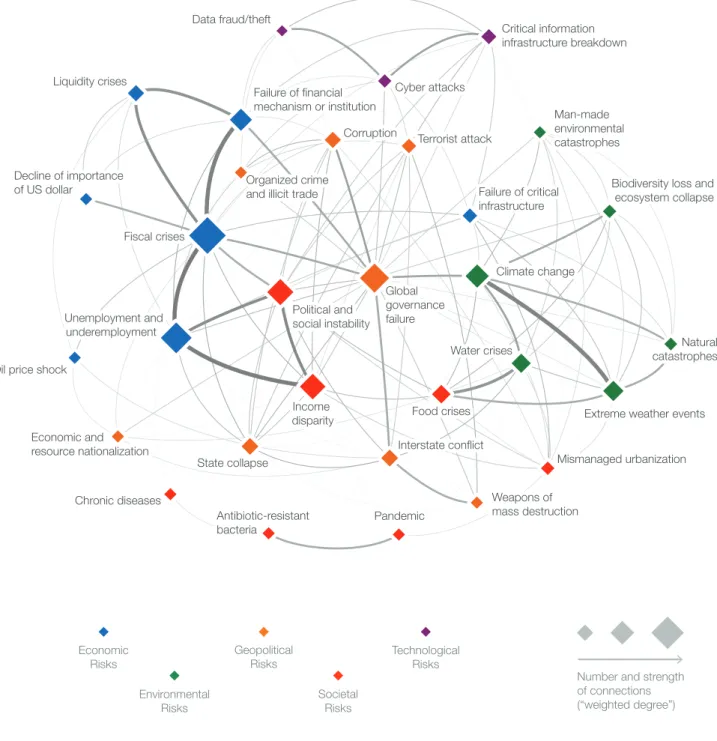
While the 31 risks have been separated out for analytical purposes, the numerous and complex interconnections between them can create consequences that are disproportionate and difficult to contain or predict. The Global Risks Interconnections Map (Figure 1.4) seeks to connect the dots by identifying and visualizing the underlying patterns. This allows for a better understanding of the impact of systemic risks so as to mitigate them by identifying the transmission channels between risks and potential second- and third-order effects.
These interconnections do not represent direct causality. They are likely to be indirect, for example through parallel impacts or mitigation trade-offs.
The Global Risks Interconnections Map shows how all global risks are connected to others and underlines the complexity of dealing with global risk in an effective manner. The map visualizes the strength of connection between individual risks – the most strongly connected risks could merit additional
attention due to the multiple ways they affect or are affected by other risks.
Respondents viewed global governance failure as one of the risks most connected to others. A well-functioning system could contribute to preventing and mitigating the
consequences of global risks, which by definition require internationally-coordinated responses. The need for an agile and responsive multilateral governance system that can identify, forecast and respond to the multiple and
interconnected risks of today’s globalized world is explored in Part 2.2 of this report, with particular reference to economic and geopolitical risks.
Macroeconomic risks were strongly linked by respondents to various socio-economic issues. Failure of a financial
mechanism or institution, fiscal crises and liquidity crises are risks closely interrelated among themselves and also with the risks of high levels of unemployment and
underemployment, income disparity and political and social instability.
Pa
rt 2
Pa
rt 3
Recent examples illustrate the reality of these
interconnections – the failure of financial institutions brought about a financial crisis that resulted in liquidity crises affecting multiple national economies. This in turn led to higher levels of unemployment, widened income disparity and associated political and social tensions and protests, notably in some European countries and large emerging markets. Part 2.3 of this report examines these
interconnections through the lens of the challenges facing today’s youth.
Environmental risks such as water crises, extreme weather events, natural catastrophes, man-made environmental catastrophes and climate change present another important cluster in the interconnections map. While all these risks are interlinked, climate change is of pivotal importance. The risk of climate change by far displays the strongest linkages and can be seen to be both a key economic risk in itself and a multiplier of other risks, such as extreme weather events and water and food crises. The latest work by the
Intergovernmental Panel on Climate Change (IPCC) – its 5th Assessment released in late 2013 – states that warming of
Economic
Risks GeopoliticalRisks
Environmental Risks Societal Risks Technological Risks
Number and strength of connections (“weighted degree”) Fiscal crises Political and social instability Failure of financial mechanism or institution Liquidity crises Unemployment and underemployment Oil price shock
Failure of critical infrastructure Decline of importance
of US dollar
Extreme weather events Natural catastrophes Man-made
environmental catastrophes
Biodiversity loss and ecosystem collapse Water crises Climate change State collapse Weapons of mass destruction Corruption Organized crime and illicit trade
Terrorist attack Interstate conflict Economic and resource nationalization Food crises Pandemic Chronic diseases Income disparity Antibiotic-resistant bacteria Mismanaged urbanization Critical information infrastructure breakdown Cyber attacks Data fraud/theft Global governance failure Figure 1.4: The Global Risks 2014 Interconnections Map
Source: Global Risks Perception Survey 2013-2014
Note: Survey respondents were asked to identify between three and six pairs of global risks they believe to be most interconnected. See Appendix B for more details. To ensure legibility, the names of the global risks are abbreviated. Please see Appendix A for the full name and description.
Pa
rt 2
Pa
rt 3
the climate system is unequivocal and that each of the last three decades has been successively warmer at the earth’s surface than any preceding decade since 1850. This is the strongest IPCC statement on climate change yet. The increased frequency of extreme weather events, such as storm surges and droughts, is consistent with the latest IPCC modelling.12 The damage to economic assets, such as city and industrial infrastructure, agriculture and key global supply chains, caused by such extreme weather events is becoming more evident, as is the fragility of the global logistics and mobility systems (see Box 1.5). Consequently, “resilience” has become a key policy and agency theme to counteract the growing sense of economic, political and social risk that changing climatic conditions pose.
The risk of global governance failure, which lies at the heart of the risk map, is linked to the risk of climate change. Negotiations on climate change mitigation and adaptation are progressing by fits and starts, perpetually challenged to deliver a global legal framework. Meanwhile, a regime of national, regional and public-private collaborative efforts to address the problem is gathering pace. This may represent the future of global governance – a more intricate lattice of multiple, interconnected government agreements related to
relatively simple global “goals” (such as a commitment to limit warming to no more than 2 degrees Celsius), supported by a framework of collaborative alliances and partnerships to help deliver on that target across different themes, regions or sectors. Arguably, such a heterogeneous and diverse intergovernmental and public-private response to the climate-change risk could offer more resilience and flexibility to the dynamic challenge of climate change than a
homogenous, single global framework.
The technological risks of cyber attacks, data fraud/theft and critical information infrastructure breakdown are strongly connected to each other and to risks such as terrorist attacks and global governance failure. This reflects the changing nature of vulnerability in an increasingly digitized world, and the need for global multistakeholder collaboration to maintain the resilience of cyberspace. These issues are explored in Part 2.4 of this report.
Box 1.5: Growing Cities, Growing Risks
More than half of the world’s population now lives in cities. By 2050, the urban population will have nearly doubled to an estimated 6.4 billion. Most of the increase in urban populations will be in middle- and lower-income countries, which have more limited capacity to manage the new risks being created – and existing risks being exacerbated – by the global urban transition.
While urbanization provides important economic and social gains, it substantially increases risks related to ecological disruptions, pollution, climate change and environmental disasters. Populations are agglomerating along coastal areas where climate change portends rising sea levels, extreme weather events, earthquakes and tsunamis. Urban flooding has already become the leading form of disaster in the world, and the UN forecasts that the number of people in large cities exposed to cyclonic winds, earthquakes and flooding will more than double in the first half of this century. Around 1 billion people, one-third of the world’s urban population, live in slums1 – a number that has been increasing in the current era of high and widening income inequalities. This growing population of urban poor is vulnerable to rising food prices and economic crises, posing significant risks of chronic social instability.
Communicable diseases can spread more quickly in densely-populated areas, increasing the risk of global pandemics. For example, if a new strain of avian flu were to spread globally through the air travel network that connects the world’s major cities, 3 billion people could potentially be exposed to the virus within a short span of time.
More generally, cities are connected systemically through physical and informational networks in ways that may become apparent only when events in one location are rapidly transmitted globally in unexpected trajectories. For example, the 2011 earthquake in Japan and subsequent nuclear power plant meltdown had cascading impacts through global supply chains that immediately led to decreases in auto production around the world.
As urban populations grow, multistakeholder processes of inclusive governance will increasingly be needed to make cities resilient against these complex and interconnected risks. While cities have been efficient at driving change in some areas, substantial improvements in urban governance capacities will be needed to address risks, especially in the emerging economies where future urbanization will mostly take place, and which are especially vulnerable to systemic risks.
Note
1 See http://www.unhabitat.org/content.asp?typeid=19&catid=10&cid=928.
Source
For more information, see Douglass, M. 2013. The Urban Transition of Environmental Disaster Governance in Asia. Working Paper Series No. 210. Singapore: Asia Research Institute. Available at http://www.ari.nus.edu.sg/publication_details.asp?pubtypeid=WP&pubid=2334.
Pa
rt 2
Pa
rt 3
Risks and Trends to Watch
Adopting a proactive, precautionary approach to anticipating future challenges can help to avoid being caught by surprise and forced into a fully reactive mode. A range of assessment methodologies can be applied to identifying and
understanding emerging risks.
In this year’s report, respondents to the survey were asked to identify additional global risks that are already or could become relevant and were not explicitly surveyed. Figure 1.5 shows categories of issues that respondents mentioned most frequently. Gathered into three broad categories, the most commonly identified issues are presented here, followed by additional assessments and comments from experts.
Demographic trends have been flagged, including the risk of being unable to deal with rapid population growth and the growing burden of an ageing population – which could also be a source of great opportunities for society and business if managed effectively. Concerns were also raised about unmanaged migration flows, overpopulation and energy crises.
Societal concerns include the breakdown of social structures, the decline of trust in institutions, the lack of leadership and persisting gender inequalities. Risks related to ideological polarization, extremism – in particular those of a religious or political nature – and intra-state conflicts such as civil wars, were also frequently highlighted. Several concerns in this category relate to the future of the youth: the quality of and access to education, the marginalization of young generations and high rates of youth unemployment (see Part 2.3 for more on this topic).
Technological concerns include data mismanagement, loss of privacy, increase in surveillance, and possible abuse of new and more complex information technology, which is further explored in Part 2.4. These risks are becoming potentially more impactful as social media transitioned from a purely social pastime into the corporate communications environment.
In addition, risk experts in the insurance industry have nominated further trends worth highlighting, which could evolve into significant risks:
Environmental: Two kinds of pollution are especially worth noting. First, plastic waste pollution could degrade marine ecosystems and spoil shorelines, posing a credible threat to ecosystems and human health.13 Second, endocrine disruptors in the environment have been linked to human health problems through interference with hormonal systems.14
Another environmental trend to track is the development and production of unconventional oil and natural gas resources, such as oil sands and shales, which require processes and technologies (e.g. fracking) that differ considerably from those used for conventional resources in terms of energy input, cost and environmental impact.15 Their impact and sustainability are being increasingly questioned.
Science and technology:Several emerging risks are associated with the use of new technology, such as the potential toxicity of nanomaterials, the future evolution and impact of 3-D printing, and uncertainty about the potential impact of widespread use of autonomous vehicles, which are capable of sensing their environment and navigating on their own. The potential for abuse, or an accident involving synthetic biology, could even pose an existential risk, as discussed in Box 1.7.16
Economic: As a consequence of the 2008 financial crisis, central banks in many countries have been pursuing an ultra-loose monetary policy. Although theoretical fears of high inflation and unintended asset bubbles have so far mainly been contained, central banks are expected to tighten monetary policy.17 The resulting higher interest rates could see volatility in asset prices, capital flows and exchange rates, and rising government debt due to higher interest costs.18
The rise of the bitcoin and the possibility of other new modes of payment could create new risks as well as opportunities. Risks relate to the facilitation of money laundering,
corruption, illicit financial flows as well as volatility and susceptibility to security threats and market manipulation. China is among the governments that have already begun to restrict the use of virtual currencies.19
Social and political: The “costs of living longer” was raised as an X-factor risk to watch in the 2013 edition of this report, and risks related to longevity remain significant as medical advances increase life expectancy, posing funding challenges in retirement financing, long-term care and healthcare.20 Along the same lines, the prevalence of overweight and obesity is increasing and could result in significant economic cost.21
Pa
rt 2
Pa
rt 3
Box 1.6: Sustainable Competitiveness and Global Risks
Appreciation is growing that high historical rates of economic progress, especially those experienced by emerging markets, may not be sustainable in the future.
Environmental pressures that could undermine competitiveness include pollution, biodiversity loss and climate change, while scarcity of mineral resources could endanger future consumption as demand continues to climb. The implications of water shortages, for example, are explored in Box 1.3. Social tensions could also undermine competitiveness, as people fear that economic growth may not translate into the desired results for society in terms of inclusion, equity and cohesion.
Although it is clear that these systemic risks can undermine economic competitiveness, the magnitude of their capacity to do so and their complex interactions are not well understood.
Building on its Global Competitiveness Index (GCI), the World Economic Forum is working on a sustainability-adjusted GCI that captures the extent to which prosperity is being generated in a sustainable way, taking into account
environmental stewardship and social sustainability.1 The findings suggest that there is no necessary trade-off between being economically competitive and being sustainable. Many countries at the top of the competitiveness ranking are also the best performers in terms of sustainability measures – for instance, Switzerland, Finland, Germany, Sweden and the Netherlands.
The sustainability-adjusted GCI can be seen as capturing a country’s preparedness to face many of the systemic global risks explored in this report. Among the core factors it measures are environmental degradation, strength of governance, provision of health and education, and macroeconomic stability – all factors that influence how sustainable a country’s economic competitiveness is, and how resilient it is to risk. Understanding the relationship between sustainability and competitiveness is crucial to understanding how to mitigate and build resilience to global risks.
Note
1 For more information on the sustainability-adjusted Global Competitiveness Index, see Chapter 1.2 of The Global Competitiveness Report 2013-2014, World
Economic Forum 2013.
Box 1.7: An Emerging Spectrum of Catastrophic Risks: Existential Threats
Contributed by the Global Agenda Council on Catastrophic Risks
Throughout history, humanity has been all too familiar with catastrophes affecting life and livelihoods on a major scale: earthquakes, floods, droughts, tsunamis, cyclones and so on. Increasingly, however, the new risks coming into focus are more complex, more uncertain and potentially exponentially more consequential. These are existential risks – those that could either annihilate intelligent life or permanently and drastically curtail its potential.1
Natural disasters could conceivably trigger existential risks in combination with new technologies – a possibility
suggested by the March 2011 tsunami that caused a meltdown at the Fukushima nuclear power plant in Japan. There is also the theoretical potential for “error or terror” in emerging sciences, such as nanotechnology or synthetic biology; within a few decades, for example, it may become as feasible to create real viruses in a home laboratory as it now is to create computer viruses on a home computer.
Among other existential risks is the possibility that breakthroughs in artificial intelligence could move rapidly in unexpected directions; the spread of antibiotic-resistant bacteria could dramatically set back modern medicine; solar super-storms could devastate vital information and communications technology networks; climate change could tip into a self-reinforcing, runaway phase of rising temperatures; a meteorite could hit a densely-populated area or an asteroid could strike the earth.
Although these threats sound forbidding, there are ways to prevent most of them, or at least to mitigate their impacts. While research and innovation can provide new approaches, established institutions can also play an important role. For example, in October 2013 the UN General Assembly approved the creation of an International Asteroid Warning Group. It is important for the public and private sectors to work together to address existential risks. The private sector has experience and expertise to offer in the realms of strategic planning, organizational design, institutional adaptation, research, scientific investigation and technological innovation. However, effective public-private collaboration will require vision, strategy and commitment to more extensive, consistent and systematic approaches at the country, regional and international levels. This, in turn, requires an appreciation that existential risks exist not only in the realms of science fiction but also in reality.
Note