Implementation of Cloud-based Virtual Labs for Educational
Purposes
H. A. Ali
1and Haitham A. El-Ghareeb
21
Computers Engineering and Systems Department, Faculty of Engineering, University of Mansoura, Egypt 2 Information Systems Department, Faculty of Computers and Information Sciences, University of Mansoura, Egypt Summary
Cloud computing is used to provide users with computer resources on-demand any time over the Internet. eLearning systems usually require many hardware and software resources. There are numerous educational institutions that cannot afford such investments, and cloud computing is the best solution for them. For educational purposes lecturers and researchers can leverage cloud computing to enhance their e-learning experience. The main objective of this paper is to present how the cloud computing provides on-demand virtual desktops for problem solving, on-demand virtual labs for special courses. The focus is how cloud services can be used, how they can be integrated into the existing infrastructure, and how new didactic models could look. The proposed solution helps in significant savings when compared to the cost of physical infrastructure procurement and maintenance for the user institution as well as the entire science and higher learning community.
Key words:
Cloud Computing, IaaS, E-Learning, Virtual Lab
1.
Introduction
Over the past few years, the idea of cloud computing, a popular trend in IT, has gained much impetus and has become a more popular phrase in information technology [1, 2, 3]. Generally cloud computing may be defined as, “a model for enabling convenient, on-demand network access to a shared pool of configurable computing resources (e.g. networks, servers, storage, applications, and services) that can be rapidly provisioned and released with minimal management effort or service provider interaction” [4, 5]. Many groups have started implementing these new technologies to further decrease costs through improved machine utilization, reduced administration time and infrastructure costs [6]. Cloud computing is the environment that enables customers to use applications on the Internet such as storing and protecting data while providing a service [7].
So, Cloud computing had been become a convenient to realize instructional principles in learning environments that follow the constructivist view of learning, supporting on demand, self-controlled learning environments. With cloud computing, several service delivery models can be realized, delivering Infrastructure, Platform and Software as a Service to support learning environments and supports
an optimized utilization of the university’s IT resources, using load balancing and even over-provisioning [8]. Recent studies in the Learning Future of Education in Computer Sector in Egypt highlights two main challenges in ICT Education in Faculties of Computers and Information Sciences in Egypt: (I) Rarity of ICT Faculty members; (II) Lacking to the high performance infrastructure. So, utilizing Cloud Computing in Egyptian Universities can facilitate different scenarios for overcoming this challenge. Being able to provide lab setups for students outside labs, and after lab times is really an interesting point. Students might access their lab scenarios from home, during breaks, and from everywhere. The main objective of this paper is to introduce an approach for cloud computing based solutions to the development of virtual labs.
In the proposed approach, Infrastructure as a Service (IaaS) provides virtual machines (VMs) on demand for students of the. These machines are customized for courses and laboratory exercises and provisioned to build virtual laboratories. Platform as a Service (PaaS) goes a step further and offers the students a framework to deploy their developed programming exercises on a well-defined environment. Finally, Software as a Service (SaaS) makes software services, like lecturing assist tools, or development tools, available for multiple users. In summary, cloud computing allows a flexible and adaptive use of computing resources on demand and thus supports powerful learning environments in terms of a constructivist conception of learning in an effective way. Our cloud management system provide different services that are categorized into the well-known cloud service model SaaS, PaaS and IaaS. Obviously, the more specialized (e.g. SaaS) the less customizable by the student [4,7]. This paper goes as follows: Section two introduces the problem definition, section three presents our proposed architecture, section four highlights different research activities we went through during proposed system implementation, finally we present conclusion, and paper ends with references.
2. Problem Definition
There is no doubt that the middle-east region suffers from many educational problems in technical fields, especially in ICT (Information and Communication Technologies) domain. The traditionally available solution for enriching the society with high caliber ICT professionals has been provided by international training centers and academies providing proprietary courses at prices greatly exceeding the average income of the developing country. The high cost comes from several factors: Price of the course materials, Cost of properties (office, power, labs, machines, etc.), Value of the training service, and the Small number of attendees per course for higher quality training.
Most of these factors are unavoidable and they form the dilemma of ICT training not only in the Middle East or MENA regions but also worldwide eLearning solutions that the educational sector is trying to embrace are very traditional old-fashion stored courses or live course streaming systems, such systems provide ugly desktop or Web 1.0 interface at high cost to the educational institution and to the end user.
Students in the field of ICT education need to learn problem solving techniques and those cannot be learned without interaction with real-life computer problems on training labs. Those skills include troubleshooting skills, which are considered one of the most problematic skills in terms of requirements from the lab perspective as the instructor need to put the machine into a broken state to test or train the student the capabilities of troubleshooting. The need of a virtualized lab solution is crucial in this particular case as an example.
Current solutions are not exciting from the user perspective; statistics show that students tend to spend incomparable time on Facebook and similar social media websites than on eLearning and educational online systems, this has taught us that the blend of social media and education is crucial for incomparable user experience and ultimate efficiency of the educational process [5, 8].
2.1 The Proposed Solution
The first part of the solution is Virtual Lab concept, a virtual lab takes programs running on college hardware and beams the images to any computer desktop across the internet, giving students the ability to create and save work as though the programs were running on their own hard drives [8, 9, 10]. The software’s performance depends on the strength of the student’s Internet connection as opposed to the processing power of their computer, so even students with older computers can use advanced software without difficulty. Such concepts also, need a high performance infrastructure [11].
The second part of the solution is the cloud computing; A cloud is a powerful combination of cloud computing,
networking, storage, management solutions, and business applications that facilitate a new generation of IT and consumer services [9]. These services are available on demand and are delivered economically without compromising security or functionality [12]. To take full advantage of cloud computing, enterprises need to evolve their IT strategy to achieve greater business value through the improved cost-savings and productivity that cloud services offer. Service providers need to offer and monitor cloud-computing services to serve their customers even more effectively while improving profitability
Cloud computing trend is the key behind an innovative solution to the current problems illustrated earlier and a proper design and implementation might be a life-changing solution to technology education around the world. Cloud computing model incorporates technologies like “Virtualization”, “Software-as-a-Service”, that is a brilliant solution to the current problems we are facing in the traditional technology training methodology and the sub-optimal eLearning solutions in common use today. Utilizing cloud-computing model for eLearning provides several advantages. First and foremost, an Internet scale solution that can easily scale to thousands or millions of online concurrent system users. Enabling wide scale revolutionary deployment to large masses of students. The proposed solution is to provide an eLearning solution that leverages current IT infrastructure, and presents enhanced pedagogical aspects of the e-Courses. E Learning is far deeper than e-Courses. Our solution includes Pedagogical Objectives and Technical Objectives.
2.2 Technical Objectives
Proposed solution incorporates different technical objectives to meet the required goal. Our technical objectives include:
• Build a web-scale cloud-based learning management system with extremely modular design and multilingual, highly customizable, front-end Web-based UI with cutting edge web technologies like HTML5/CSS3 and AJAX. • Integrate Cloud-based virtual training labs with the learning management system to provide interactive intelligent virtual training environment for ICT training that include computer networking, computer programming, Server Administration, database administration, and advanced high-end technical ICT courses.
• Offer on-demand cloud hosted virtual labs with support for snapshots. Snapshots allow students to easily take snapshots at any given moment during the lab time, in effect freezing the lab and providing a point-in-time that they can return to anytime later, or share via the built-in collaboration platform with their instructor or peers. • Virtual training labs that include complete virtually isolated network with multiple machines to demonstrate given deliverable by course designer / instructor.
• Build the “Intelligent Lab Advisor” embedded in the virtual labs. The Intelligent Lab Advisor intelligently detects the student achieving the required training goals, as well as guides the student along the training path, effectively offering pre-packaged top-notch instructor experience and allowing for a much enhanced self-study (or group-study) experience.
• Utilize the cloud computing “Pay-as-you-go” business model so users only pay for the time they use on virtual labs, thus providing cost-effective access to the large number of computing resources during ICT training • Build a content delivery and hosting network for true infinite scaling; federated content hosting might also be added on the platform later.
• Building mobile support through standard web implementation; that leverages the capabilities of smartphones available in the market these days.
3. The Proposed Architecture
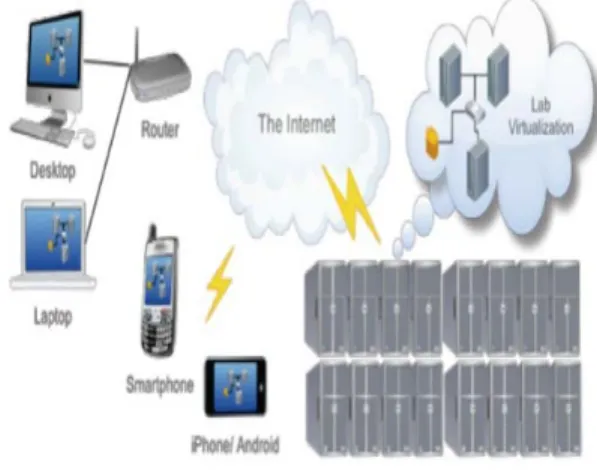
The proposed architecture is intended for designing and configuring a cloud computing system that; serve the educational of the university in a very economical and cost efficient manner. It delivers a range of functionalities and services that map well onto the cloud computing requirements and expectations. There are few principal components in proposed architecture as shown in Figure 1.
Figure 1: General overview of the proposed solution Architecture In the proposed solution the virtualized labs are hosted on a publicly accessible cloud-based computer infrastructure that is connected through high-speed high-throughput redundant Internet connection. The on-demand instances of virtual labs run on cluster of physical servers that are hosted in remote or local datacenter, the physical infrastructure is designed for high-availability, redundancy and future scalability. Virtualized Labs can be accessed from many internet-enabled devices, which include smartphones (iPhone, Android, etc.) and any computer.
Figure 2 depicts a high level overview of the various technologies and architectural choices that are used
.
Figure 2: High level overview of the propose architecture
3.1 Proposed Architecture Components
The proposed architecture is composed of the following components:
• Web and Application Servers: The Web and Application servers serve the primary web interface for the cloud application.
• Distributed Document-Based Database: Distributed document-based databases have recently gained wide adoption on Internet scale applications. A Distributed document-based Database does not store its information in rigidly defined tables similar to the more traditional RDBMS systems; however, each record is stored as a “document”. Each “document” consists of multiple “fields” of data that serve a similar role to “columns” in the traditional RDBMS world.
• Cloud Middle-Ware: The Cloud Middle-Ware is the internal plumbing layer underneath the cloud. It is what makes the whole system one unified entity. In the proposed solution we take the eLearning solution from the cutting-edge SOA (Service Oriented Architecture) to the bleeding-edge Cloud Computing Architecture. The Cloud Middle-Ware is an essential component being the core layer that connects various subsystems together. The messaging bus connects together various sub-systems such as: (I) Central Authentication Service, (II) Monitoring and Auditing Framework, (III) Cloud Manager, (IV) Configuration Management Framework, (V) Logging Framework, and (VI) and Billing System.
3.2 Middleware Cloud Design
Designing the Midlleware Cloud include the following activities:
1. Researching the best technique for synchronous / asynchronous scalable message-driven bus system.
2. Design of groundbreaking logging technology that is decentralized for maximum throughput and asynchronous to ensure the maximum efficiency and accuracy of the logging system.
3. Design of cloud-scale monitoring framework that allows detection of events, monitoring physical servers load, and network congestion, I/O congestion on the storage backend.
4. Design of a cloud-scale configuration management framework that provides a decentralized configuration information inventory for every component of the system. 5. Setup a continuous integration build and testing system to ensure that there is no regression during the development time.
3.3 Elastic Virtual Compute Cloud
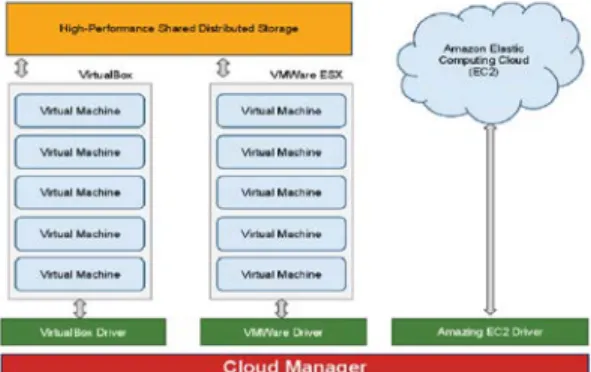
This component comprises the cloud itself. As shown in figure 3; the Elastic Virtual Computing Cloud component denotes the actual cloud subsystem that will be used to host any needed virtual labs. The Cloud Manager component is what drives the Computing Cloud, it configures virtual labs, spins up and down virtual machines, configures virtual networking between different virtual machines and so on. The Cloud Manager interfaces with the Computing Cloud through various pluggable adaptor driver layers, each layer pertaining to a specific virtualization technology.
Figure 3: Elastic virtual computing cloud
3.4 Cloud Manager
As depicted in the figure 4, the cloud Manager is a central component of the solution. It is responsible of managing the virtual labs, starting and stopping virtual machines and complete virtual labs, taking and reverting to snapshots, responding to user demands. Implementation of The Cloud Manager include two main activities:
1. Implementation of the document-based database abstraction layer and writing code for model mapping into document-based schema-free style.
2. Integration with OpenStack Bexar (Nova)
Figure 4. Cloud Manager Architecture
4. Research Issues and Design
One of the significat questions while impementing the proposed solution is; How is the Cloud-based Virtual Lab service accessed and which functionalities are provided by the Virtual Lab web interface? So the next design isuues must considered, Which are as follow:
•Social Network in every LMS Students must be able to: Track/Connect with Friends, and Communicate with learners interested in same/similar topics. Also, Leverage the existing social networks data to collect information about friends and interests.
•Data mining through the learner behavior and social networks data to build a list of: (I) Recommended Courses (personalized) Recommending people to follow Guiding students when asking help. (II) Score every interaction the user is doing that reflects the effect of this interaction on the data mining accuracy process
•Test Different protocols for distributed task execution information for accessing virtual machines
•Study industry standards for content creation. Create process for content creation for web application. Define standard file formats for content definition and entry.
•Implementation of communication layer between lab advisor server and cloud manager and web view showing progress across the lab. Managing all cloud technology choices. Reviewing networking, security and performance choices to ensure a highly secure, scalable and high performance implementation. Managing reviewing all technology choice for: Cloud Scaling, Monitoring, Orchestration and Provisioning, Continuous Integration, CDN, Distributed DB
•Remote Access Protocol to choose is VNC, it's fast and easy to implement in the web browser using pure HTML5 and Javascript technologies. Remote desktop refers to software or an OS feature allowing applications, often including graphical applications, to be run remotely on a server, while being displayed
locally. There are various professional third party, open source and freeware remote desktop applications, some of which are cross platform across various versions of Windows, Mac, and UNIX / Linux / BSD. The main remote desktop protocols foreseen to be utilized in proposed architecture are Virtual Network Computing (VNC) – a cross platform protocol and Remote Desktop Protocol (RDP) – a Windows specific protocol. This kind of component interface is intended for human interaction allowing remote administration, observation, debugging, configuration of components in a comfortable manner.
•Communication between Host and guest operating system on LXC virtualization environment is to be done with internal UNIX sockets and named pipes. Performance is proved to be at the maximum because of the shared memory nature of LXC.
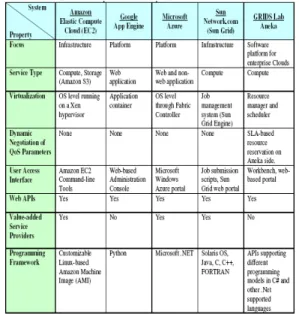
•Emerging Cloud Platforms: Industry analysts have made bullish projections on how Cloud computing will transform the entire computing industry. Table 1, compare six representative Cloud platforms with industrial linkages
Table 1: Comparison of Some Representative Cloud Platforms
5. Conclusion
The development of eLearning solution cannot ignore the cloud computing trends. On Demand cloud based virtual lab provides completely customizable training solutions for the needs of your organization. From a simple instructor-led virtual classroom to hosted labs employing cloud technology, to a total training package using our very own Learning Management System; we work with individual clients to tailor a reliable custom solution for each client's specific needs. Gone are the days of trying to configure software for an entire computer lab or expensive
travel costs associated with on-site training. Let On Demand virtual lab ' affordable and flexible solutions take the headaches out of corporate training.
References
[1] H.E. Schaffer, S.F. Averitt, M.I. Hoit, A. Peeler, E.D. Sills, M.A. Vouk, “NCSU’s Virtual Computing Lab: A
Cloud Computing Solution,” Computer, vol.42, no.7,pp.94-97, July 2009.
[2] D. Hamilton. 'Cloud computing' seen as next wave for technology investors. Financial Post, 4 June 2008.
[3] R. Buyya, C. S. Yeo, and S. Venugopal. Market-Oriented Cloud Computing: Vision, Hype, and Reality for Delivering IT Services as Computing Utilities. In Proceedings of the 10th IEEE International Conference on High Performance Computing and Communications (HPCC 2008), Dalian, China, Sept. 2008. [4] D. Kasi Viswanath, S. Kusuma and Saroj Kumar Gupta, Cloud Computing Issues and Benefits Modern Education, Global Journal of Computer Science and Technology: Cloud and Distributed, Volume 12 Issue 10 Version 1.0, July 2012.
[5] M. Nagappan, M.A. Vouk, “Adaptive Logging: A Case Study of Logs from a Cloud Computing Environment”.
In the Fast Abstracts track of International Symposium on Software Reliability Engineering, 1-4 Nov, 2010, San
Jose, California.
[6] A. Fernandez, D. Peralta, F. Herrera and J.M. Benitez, An Overview of E-Learning in Cloud Computing, L. Uden et al. (Eds.): Workshop on
LTEC 2012, AISC 173, pp. 35-46. Springer- Verlag Berlin Heidelberg 2012.
[7] Thongchai Kaewkiriya and Nattavee Utakrit, A Model of an ELearning Management System Based on Cloud Computing and Web Service, Information Technology Journal, Vol.8, No.1, January-June 2012.
[8] H.E. Schaffer, S.F. Averitt, M.I. Hoit, A. Peeler, E.D. Sills, M.A. Vouk, “NCSU’s Virtual Computing Lab: A
Cloud Computing Solution,” Computer, vol.42, no.7, pp.94-97, July 2009.
[9] M. Vouk, A. Rindos, S. Averitt, J. Bass, M. Bugaev, A. Peeler, H. Schaffer, E. Sills, S. Stein, J. Thompson, M.P. Valenzisi, “Using VCL Technology to Implement Distributed Reconfigurable Data Centers and Computational Services for Educational Institutions”. IBM Journal of Research and Development, Vol. 53,
No. 4, pp. 2:1-18, 2009.
[10] Rajkumar Buyya, Chee Shin Yeo, Srikumar Venugopal, James Broberg, and Ivona Brandic , " Cloud Computing and Emerging IT Platforms:Vision, Hype, and Reality for Delivering Computing as the 5th Utility" , Future Generation Computer Systems. Volume 25, Issue 6, June 2009.
[11] Lijun Mei,W.K. Chang, T.H. Tse. A Tale of Clouds: Paradigm Comparisons and Some Thoughts on Research Issues. Proceedings of the 2008 IEEE Asia-Pacific Services Computing Conference (APSCC 2008), IEEE Computer Society Press, Los Alamitos, CA (2008).