Accepted Manuscript
Not Copyedited
Determining the appropriate proportion of owner-provided design in
design-build contracts
–
a content analysis approach
Bo Xia1, Albert Chan2, Keith Molenaar3, Martin Skitmore4
1 Lecturer, School of Urban Development, Queensland University of Technology, Garden Point
Campus, 2 George Street, Brisbane QLD 4000, Australia. Email: [email protected]
2 Professor, Department of Building and Real Estate, Hong Kong Polytechnic University, Hung
Hum, Kowloon, Hong Kong, China. Email: [email protected]
3 Associate Professor, Department of Civil, Environmental and Architectural Engineering,
University of Colorado at Boulder, Campus Box 428, ECOT 643
Email: [email protected]
4 Professor, School of Urban Development, Queensland University of Technology, Garden Point
Campus, 2 George Street, Brisbane QLD 4000, Australia. Email: [email protected]
Abstract
The Request For Proposal (RFP) with the design-build (DB) procurement arrangement is a document in which an owner develops his requirements and conveys the project scope to DB contractors. Owners should provide an appropriate level of design in DB RFPs to adequately describe their requirements without compromising the prospects for innovation. This paper examines and compares the different levels of owner-provided design in DB RFPs by the content analysis of 84 requests for RFPs for public DB projects advertised between 2000 and 2010 with an aggregate contract value of over $5.4 billion. A statistical analysis was also conducted in order to explore the relationship between the proportion of owner-provided design and other project information, including project
Accepted Manuscript
Not Copyedited
type, advertisement time, project size, contractor selection method, procurement process and contract type. The results show that the majority (64.8%) of the RFPs provide less than 10% of the owner-provided design. The owner-provided design proportion has a significant association with project type, project size, contractor selection method and contract type. In addition, owners are generally providing less design in recent years than hitherto. The research findings also provide owners with perspectives to determine the appropriate level of owner-provided design in DB RFPs.
Key words
Design and build, Request For Proposals, content analysis, owner-provided design proportion.
INTRODUCTION
Design-build (DB) is a delivery method where one entity or consortium is contractually responsible for both the design and construction work involved (Songer and Molenaar 1997). It offers many advantages, such as single-point responsibility, time saving and enhanced financial certainty, and is occupying an increasing proportion of the construction market worldwide (Konchar and Sanvido 1998; Haque et al. 2001; Hale et al. 2009). When owners decide to deliver their projects by the DB method, an important step forward is to create a Request For Proposal (RFP) to solicit interest from prospective design-builders. The RFP is a document in which an owner develops his requirements and conveys the project scope to DB contractors (Harris and McCaffer 1995; Molenaar et
Accepted Manuscript
Not Copyedited
al. 2000). It also serves as an effective tool for the allocation of risk and responsibility between owners and design-builders.
With DB procurement, even though owners can allocate most of the responsibility to the design-builders, they may still have to complete a certain amount of design work (Janssens 1991). Therefore, as Beard et al (2001) points out, DB owners have to provide an appropriate proportion of DB project information in the RFP in order to define their project needs. The U.S. Federal Highway Administration (2006) also advocate that, after choosing DB as the preferred procurement option, contracting agencies may have to prepare an appropriate level of preliminary design for inclusion in the RFPs to initiate DB contracts. It is in the best interest of owners to provide a certain amount of design information in the RFPs to decrease the design-builders’ risks and increase their understanding of the project (Design-build Institute of American 1995).
However, determining an appropriate level of owner-provided design information to provide in RFPs is never an easy task. The level of owner-provided design information should be commensurate with the needs of the owner but no more (Innovative Pavement Research Foundation 2009). An appropriate amount of owner-provided design information should be sufficient to describe the owner’s requirements without compromising the potential for innovation. As a result, the determination of the optimal amount of owner-provided design information included in RFPs poses challenges to many owners, especially to those with little experience (Janssens 1991; Beard et al. 2001).
Accepted Manuscript
Not Copyedited
Against this background, this paper reports on a content analysis of a large collection of RFPs in order to better understand the appropriate level of owner-provided design for DB procurement. It is believed that the analysis of different owner-provided design levels provided in RFPs will not only reflect owners’ different philosophies of DB practice, but may also reveal the factors that affect owners’ decisions on the determination of the optimal level of owner-provided design.
OWNER-PROVIDED DESIGN PROPORTIONS IN DB RFPS
For DB owners, determining an appropriate owner-provided design proportion affects the timing of the hand over to the contractor. Providing too many owner-provided design decisions in DB RFPs may incur unnecessary fees to the owner and limit the design-builder’s innovation potential to the design process. In contrast, too little owner-provided design information may impose extra expense on prospective design-builders and prevent owners from obtaining a satisfactory final project. As the American Association of State Highway and Transportation Officials (2005) opine, the level of conceptual or preliminary design completed prior to appointing a DB contractor can influence the degree of success of the DB approach.
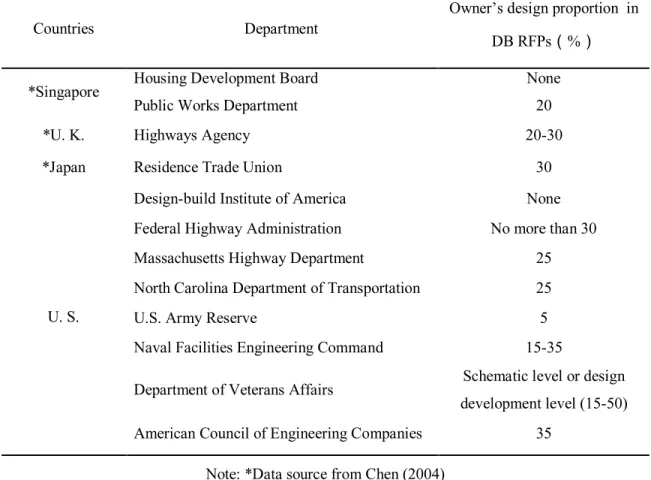
Given the importance and difficulty of deciding on an appropriate owner-provided design proportion, several countries provide guidelines, as shown in Table 1, to help owners reduce project risk and ensure their successful fulfillment.
Accepted Manuscript
Not Copyedited
Please insert Table <1> here
While the differences shown in Table 1 may well be due to the different conditions of the DB markets and understanding of the organizations involved, the unique situational conditions of each DB project makes it unlikely that a single owner-provided design proportion would be appropriate for all settings of DB projects. Under these circumstances, the research study mainly focused on examining the different amounts of owner-provided design completed along with other project characteristics included in DB RFPs. This reflects owners’ practices in DB projects and reveals potential factors affecting the determination of appropriate owner-provided design proportions in DB RFPs.
RESEARCH METHODS
Content analysis was employed to investigate the different amounts of owner-provided design provided by public owners in DB practice. Content analysis is an observational research method that is used to systematically evaluate the symbolic content of all forms of recorded communications (Kolbe and Burnett 1991). By simply counting the number of times an activity happens or a topic is depicted, content analysis is frequently adopted to determine the major facets of a set of data (Fellows and Liu 2008).
The first step was to collect a sizable sample of actual DB RFPs from a variety of public agencies, which included local (County, Town, City, State) governments, U.S Army Corps of Engineers, Naval Facilities Engineering Command, U.S. Air Force, Department
Accepted Manuscript
Not Copyedited
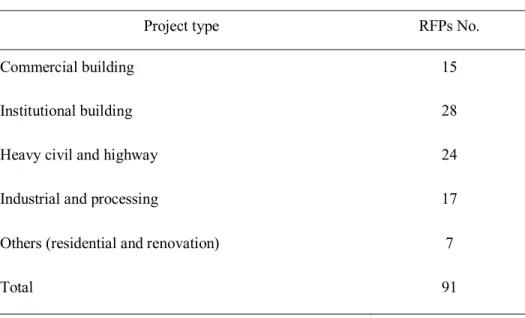
of Defense, Department of Veteran Affairs, National Aeronautics and Space Administration, Federal Highway Administration public schools, colleges and universities. This consisted of 91 RFPs, posted publicly online by 76 agencies, from 32 States spanning between 2000 and 2010, the majority of which were advertised in the past 5 years, and with an aggregate contract value of over $5.4 billion. The RFPs covered a fairly wide range of project types, as shown in Table 2.
Please insert Table <2> here
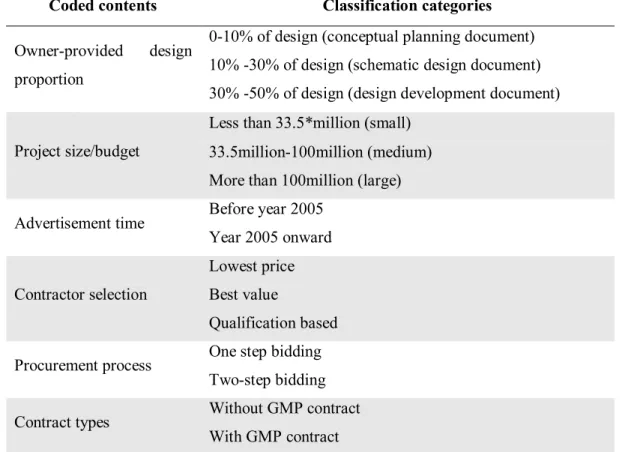
The second step was to determine the form of content analysis to be used – either qualitative or quantitative. The choice is dependent on the nature of the project. In qualitative content analysis, the emphasis is on determining the meaning of the data (i.e. grouping data into categories), while quantitative content analysis extends this to generate numerical values of the categorized data (frequencies, ratings, ranking, etc) for statistical analyses. Comparisons can be made and hierarchies of categories can be examined (Fellows and Liu, 2008). The content analysis in the research included both qualitative and quantitative forms. The text of the RFPs was coded into categories of owner-provided design proportion along with other project characteristics, including project size/budget, procurement process, contractor selection method, contract type, project type and advertisement time. By breaking down the content of the material into meaningful and pertinent units of information, certain characteristics of the message could be analyzed and interpreted.
Accepted Manuscript
Not Copyedited
30%; 30-50%; 50-100%. The classification is based on the sequence of design work in construction projects, which include conceptual planning, schematic design, design development and construction documents (The Royal Institute of British Architects 2007; The American Institute of Architects 2008). It is generally accepted that conceptual planning provides less than 10% of design, with schematic design at 30% or 35% percent of design, and detailed design at more than 50%. The project budget, procurement process and contractor selection method were classified into sets of sub-categories according to the content of the RFPs. The sub-categories of the coded contents are shown in Table 3.
Once the data of the above-mentioned project characteristics were coded and collected, the second task was to examine the frequencies of the coded categories, and to use statistical tools to explore the relationship between the owner-provided design proportion and other project characteristics.
Please insert Table <3> here
RESULTS OF THE CONTENT ANALYSIS
The owner-provided design proportion in all the RFPs ranges from zero to 50%, with 64.8% containing less than 10% of the owner-provided design work, 28.6% containing 10-30% and 6.6% containing 30-50% of the owner-provided design work. This is very much in accordance with the Federal Highway Administration (2006) view that it is better to complete no more than 30% of preliminary design before a DB contract award.
Accepted Manuscript
Not Copyedited
It was also found that owners or their agents provide only project scope, project requirements, site information, design criteria and program summary in RFPs.
Please insert Table <4> here
A series of Chi-Square (2) contingency table analyses were applied to examine the
relationship between the owner-provided design proportion and other coded categories. The chi-square contingency table analysis determines the extent to which a statistical relationship exists between two variables (McClave et al. 2010) and is one of the most widely applied statistical tools for categorical data analysis. When applying the chi-square test however, it should be borne in mind that the correlation does not infer a causal relationship between the two categorical variables involved.
According to the results in Table 4, the null hypothesis that the owner-provided design proportion is independent of project type is rejected (p=0.003<=0.05), meaning that there is a significant association between project type and owner-provided design proportion. In particular, Table 4 indicates that, for heavy civil and highway projects, owners usually provide larger amounts of design in their RFPs than in other types of DB projects. For the highway projects, this may be due to the fact that the Federal Highway Administration (FHWA) requires highway agencies to obtain a national environmental permit, for which an amount of approximately 30% of preliminary engineering is required. As a result, most highway project clients prefer to rely on prescriptive specifications and provide a significant proportion of owner-provided design in their RFPs.
Accepted Manuscript
Not Copyedited
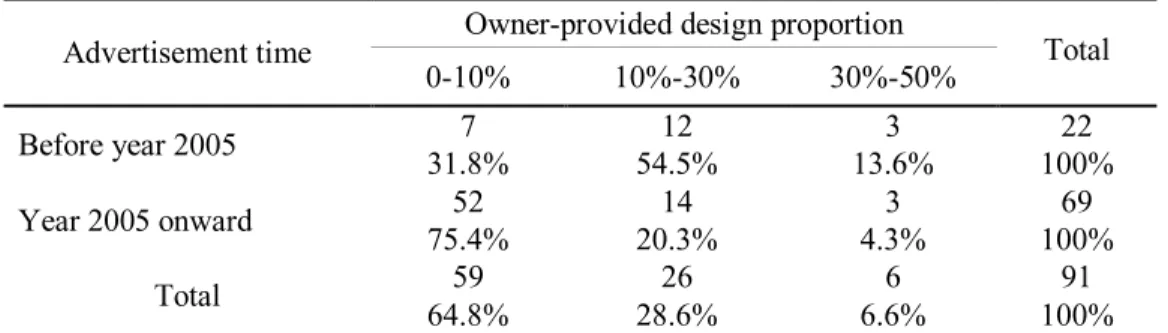
Please insert Table <5> here
Table 5 provides an interesting result concerning the relationship between the owner-provided design proportion in RFPs and the advertisement time of RFPs. This indicates that owners tend to provide less amounts of design in DB RFPs in recent years. In the RFPs issued after 2005, 75.4% of provide less than 10% of design. In contrast, only 31.8% of those issued before 2005 provide less than 10% of design. With the increase in DB knowledge and hands-on experience, increasing numbers of owners prefer performance specifications - providing design-builders with more design and project responsibilities.
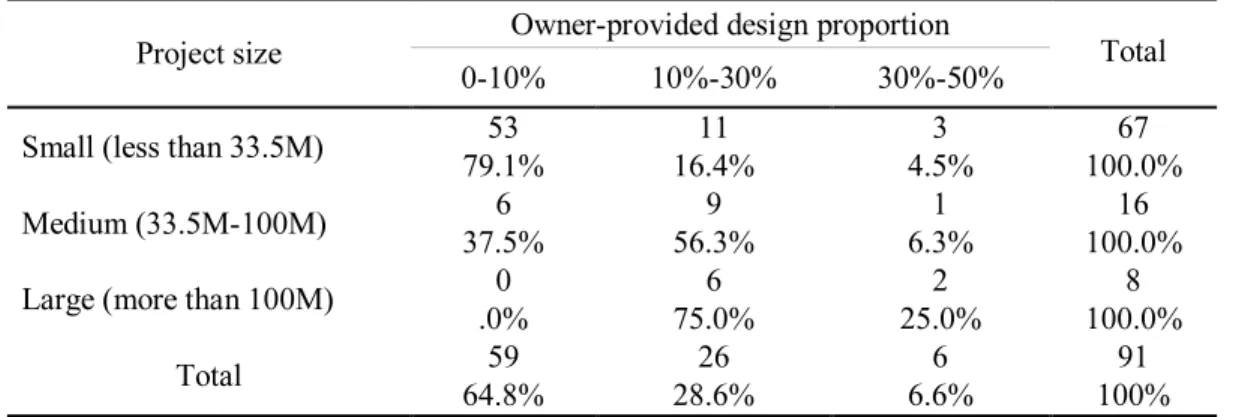
For the relationship between the owner-provided design proportion and project size, the results of the 2 test in Table 6 show that p=0.00 <=0.01. The null hypothesis that the
owner-provided design proportion is independent of project size is therefore rejected - meaning the owner-provided design proportion in DB RFPs is dependent on project size and that owners tend to provide a larger amount of design in RFPs for larger projects. This applies especially for the projects with budgets exceeding 100 USD million, where all the owners provide more than 10% of design in their RFPs (shown in Table 6). Of course, this is to be expected in that most owners assert a firmer control on projects with larger budgets, and it is the usual practice of owners to work with their traditional consultants to the point of schematic design before engaging a DB contractor (Beard et al. 2001).
Accepted Manuscript
Not Copyedited
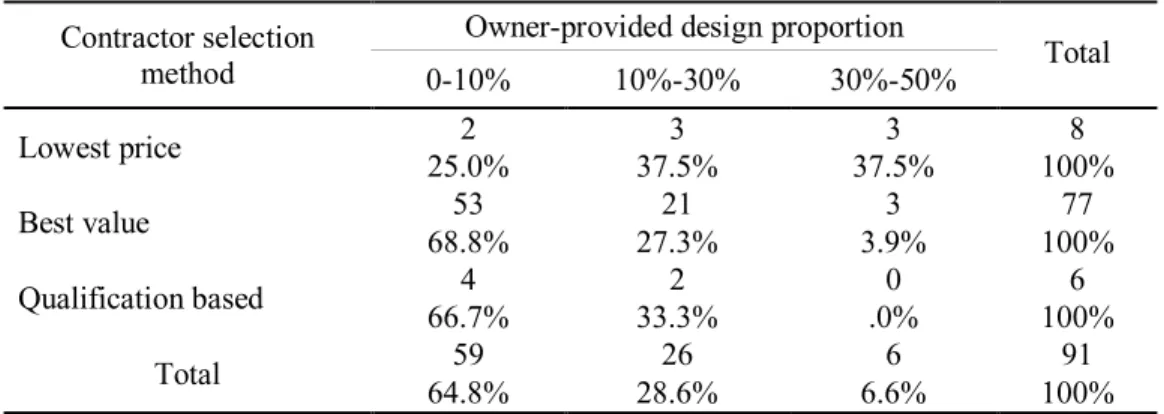
The methods of contractor selection, which include those based on the lowest price, best value and qualifications, are similarly not independent of owner-provided design proportion (p=.004<.01). According to Table 7, the majority of owners (68.8%) use the best-value method for contractor selection. In addition, owners tend to provide less design amounts in RFPs when the contractor selection methods move from those based on the lowest price to those based on contractor qualifications. The lowest fixed-price method is the standard procedure used in the traditional-bid-build delivery system, where the design documentation is 100% complete (Molenaar and Gransberg 2001). When the DB contractor is selected on lowest-price based, owners typically provide more design information (usually 15%-50%) in order to increase price competition. When the qualifications of design-builders are combined with price in the selection process, it is better to provide less design in order to allow more room for the design-builder’s innovative input.
Please insert Table <7> here
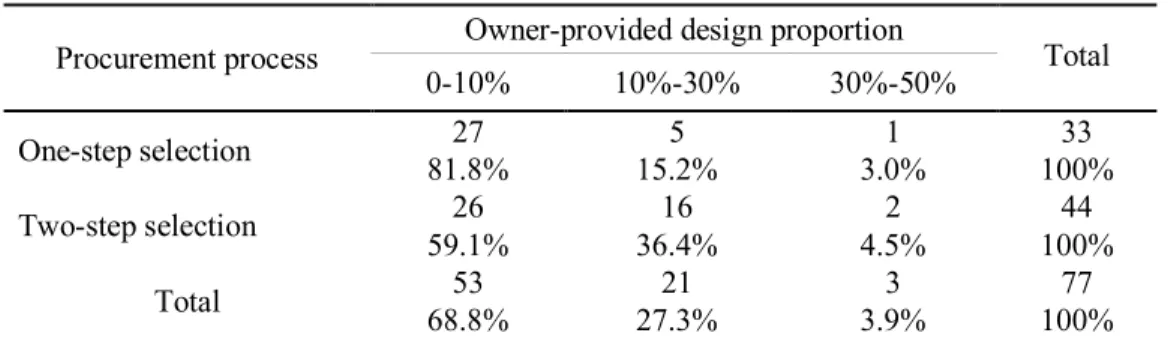
The one-step and two-step methods are procedures within the best value selection method. The one-step procedure involves the evaluation of a technical proposal in addition to price proposal. The two-step procedure involves the prequalification of firms through a request for qualification and then the evaluation of price and/or technical proposals. The results in Table 8 show that the owner-provided design proportion is independent of the procurement procedure involved. This finding suggests that the process of prequalification/short listing may not have an effect on the amount of owner-provided design in the RFPs.
Accepted Manuscript
Not Copyedited
Please insert Table <8> here
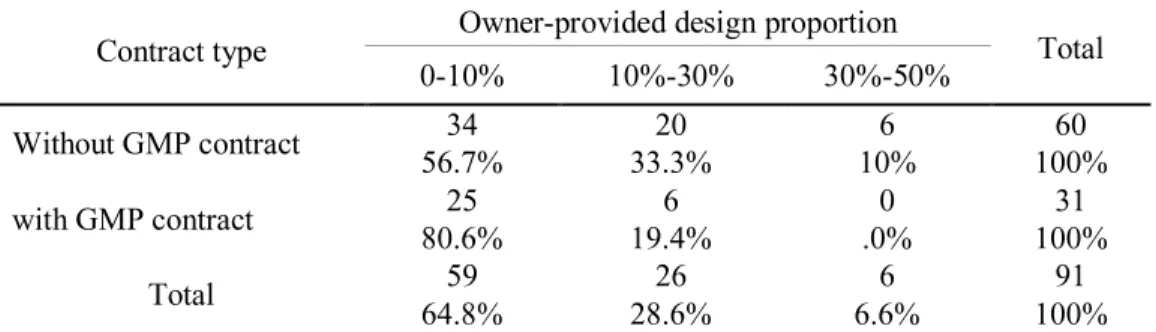
The Guaranteed Maximum Price (GMP) contract establishes a price that cannot be exceeded. The owners benefit from GMP contracts by paying only the actual reimbursable costs of the work and by knowing that the project will not exceed a pre-established price (Beard et al. 2001; Chan et al. 2007). According to the results in Table 9, owners tend to provide less design in RFPs when the GMP contract is applied. This is to be expected as design-builder and owner are able to reach a target price with even very preliminary programmatic requirements of the owner.
Please insert Table <9> here
DISCUSSION
The content analysis provides insights into the mechanism by which owners provide an appropriate design proportion in DB RFPs. The results of the analysis indicate that the owner-provided design proportion in DB RFPs has a statistically significant association with project size, contractor selection method and contract type. In addition, the content analysis shows that owners tend to provide comparatively less design in RFPs as the DB market matures.
According to the analysis, project size is the major project characteristic considered by owners when determining their design amount in DB RFPs. Larger size projects usually have a higher project complexity. Furthermore, large projects usually involve multiple
Accepted Manuscript
Not Copyedited
contracts, multiple layers of sub-contractors and suppliers, and complex coordination systems (Pheng and Chuan 2005). This is particularly true for construction projects, where the availability of facilities, materials and staffing are all related to the size of projects. As a result, the risk increases dramatically with project size. Under these circumstances, the majority of the owners prefer to work with traditional design consultants to complete a quite substantial amount of the design before engaging design-builders. This appears to be the major reason why the owner-provided design proportion in the sample RFPs is generally higher for larger projects. However, it is not intended to suggest here that owners provide more design RFPs for larger projects. More research in is required to investigate how project complexity affects owner-provided design proportions.
The selection of a DB contractor is a critical task in a DB project and, according to the content analysis, is not independent of the owner-provided design proportion in DB RFPs. The selection of design-builders is largely based on lowest price, best value, and the qualifications of prospective design-builders. According to Molenaar et al. (2000), the level of design at the RFP stage influences the selection process, in which there are different levels of competition, from open tendering to single negotiation. Some owners prefer competitive or open tendering in which contractor selection is usually price-oriented, while others favor negotiation or a more co-operative process where non-price criteria play a significant role. When a minimal design is used in an RFP, it is beneficial to select the design-builder based not only on price but also on other competence-based qualifications. If the owner wants to obtain the best value from the project and more
Accepted Manuscript
Not Copyedited
innovative input from the design-builder, it is better to provide less than 30% of the design information in the DB RFPs. Alternatively, owners should provide a greater design proportion in order to attract more competitive proposals from prospective DB contractors.
The adoption of GMP contracts also has a statistically significant association with the owner-provided design proportion. The intention of a GMP contract is to provide the owner with the benefit of an overall cap on project cost. In DB practice, a GMP contract is usually negotiated based on conceptual planning documents rather than the more detailed plans and specifications used for traditional competitive bidding. Thus, it is understandable that a less amount of owner-provided design proportion is provided in DB RFPs. However, it should be noted that the GMP should be established when the owner’s program is sufficiently defined to make the GMP value realistic and meaningful (DBIA
Contracting Guide 1997). In order to establish GMPs, owners should clearly understand
what is required and concisely define the project scope in their RFPs. In addition, scope changes should be avoided as much as possible, otherwise the GMP may not enable owners to have an early price guarantee and make go/no-go decisions (Beard et al. 2001).
CONCLUSIONS
In DB procurement, the determination of the owner-provided design amounts in the RFPs is important to the success of DB projects but also poses difficulties to many clients. The primary objective of this paper is, through the content analysis of a sample of 91 RFPs, to
Accepted Manuscript
Not Copyedited
explore the relationship between owner-provided design proportions and other project characteristics. The findings indicate that the owner-provided design proportion in RFPs is significantly associated with project size, selection method of design-builders and the adoption of GMP contracts. In addition, it is found that owners provide less design in recent years than in earlier times. These findings furnish owners and other stakeholders with an understanding of how different circumstantial conditions affect owner-provided design proportions in DB RFPs.
The research findings of this study also provide a number of practical implications for DB owners. Firstly, for large DB projects owners, especially the inexperienced ones, the project requirements and expectations should be clearly defined before leaving the remaining work to the design-builders. Secondly, for those who do not have in-house design agents, out-source design consultants should be employed to protect owners’ interests and reduce the risks involved. Furthermore, for large projects, the best-value two-step process is recommended for DB procurement. The best value selection of design-builders is the preferred approach unless the low bid method is legislatively mandated. In particular, the two-step method is the most frequently used approach for best value selection. Owners can evaluate the qualifications of prospective design-builders in the first phase and evaluate the technical and price proposals of the shortlisted bidders in the second phase. As a result, the best value of DB projects can be obtained.
The content analysis of the 91 RFPs produced several useful conclusions concerning the relationship between the owner-provided design proportion and other coded categories.
Accepted Manuscript
Not Copyedited
However, it should be noted that all the conclusions derived from the content analysis need to be viewed with caution. This is because, firstly, although the total sample size is acceptable for the statistical analysis, the numbers for some categories are quite small (less than 5). As a result, the reliability of the findings will be reduced. Secondly, similar to any other opinion-based research studies, despite all efforts the study suffers to some extent from subjectivity, bias, imprecise definition, and human inability to process complex information. However, the effects of these limitations may be further reduced by the adoption of a larger sample size in future studies.
In addition, more research is required to facilitate the determination of the owner-provided design proportion in DB RFPs. First, a scientific analysis of how project characteristics affect the owner-provided design proportion is required. In particular, the relationship between project size/complexity and owner-provided design proportions needs further investigation. Second, more relevant factors that influence the determination of owner-provided design proportions need to be explored and investigated. Once these have been completed, the development of guidelines and a framework to determine appropriate owner-provided design proportions in DB RFPs could be established in future studies.
REFERENCES
American Association of State Highway and Transportation Officials (AASHTO) (2005).
Accepted Manuscript
Not Copyedited
at website: http://onlinepubs.trb.org/onlinepubs/archive/NoteDocs/25-25(12)_FR.pdf, visited at June, 2010
Beard, J.L., Loulakis Sr., M.C. and Wundram, E.C. (2001). Design-Build—Planning
through Development, McGraw-Hill, NY.
Chan, D.W.M., Chan, A.P.C., Lam, P.T.I., Lam, E.W.M. and Wong, J.M.W. (2007). “Evaluating Guaranteed Maximum Price and Target Cost Contracting Strategies in Hong Kong Construction Industry.” Journal of Financial Management of Property and Construction, 12 (3), 139-149.
Chen, C.H. (2004). Effect of Completion Level of Owner’s Basic Design in Design-Build Projects, Master degree thesis, Department of Construction Engineering, National Kaohsiung First University of Science and Technology, Taiwan.
Design-build Institute of American (1995). Design-build RFQ/RFP Guide for Public Sector Projects, Design-build Institute of American, Washington D.C.
Federal Highway Administration of the U.S. Department of Transportation (2006).
Design-build Effectiveness Study. Available at website
http://www.fhwa.dot.gov/reports/designbuild/designbuild0.htm, visited at June, 2010 Federal Highway Administration of the U.S. Department of Transportation (2009).
Current Design-build Practices for Transportation projects. Available at website:
http://www.fhwa.dot.gov/construction/constracts/pubs/dbpractice/, Visited at July 2010.
Fellows, R. and Liu, A. (2008). Research methods for construction (3rd Edition). Blackwell Science, Oxford, United Kingdom.
Accepted Manuscript
Not Copyedited
Hale, D.R., Shrestha, P.P, Gibson, G.E. and Migliaccio, G.C. (2009). “Empirical comparison of design/build and design/bid/build project delivery methods.” Journal
of Construction Engineering and Management, 135(7), 579-587.
Haque, M. E., Alkaabi, N. and Arosha, D.S. (2001). “Selection of a right project delivery system: a tabular knowledge base approach.” Proceedings of the Third International Conference on Construction Project Management, 29-30 March 2001, Singapore, 471-480.
Harris, F. and McCaffer, R. (1995). Modern Construction Management, BSP Professional Books, Oxford.
Innovative Pavement Research Foundation (2009). Using design-build Acquisition for Airfield Pavement, Available at website: http://ww.iprf.org/products/main.html. visited at July 2010.
Janssens, D.E.L (1991). Design-Build Explained, Macmillan Education Ltd, London. McClave, J., Benson, P.G. and Sincich, T. (2010). Statistics for Business and Economics,
11th ed. Prentice Hall.
Kolbe, R.H. and Burnett M.S. (1991). “Content analysis research: an examination of applications with directives for improving research reliability and objectivity.”
Journal of Consumer Research, 18, 243-250.
Konchar, M.D. and Sanvido, V.E. (1998). “Comparison of U.S project delivery system.”
Journal of Construction Engineering and Management, 124 (6), 435-444.
Molenaar, K.R. and Gransberg, D.D. (2001). “Design-build selection for small highway projects.” Journal of Management in Engineering, 17(4), 214-223.
Accepted Manuscript
Not Copyedited
Molenaar, K.R., Vanegas, J.A. and Martinez, H. (2000). “Appropriate risk allocation in design-build request for proposals (RFPs).” ASCE Proceedings of Construction Congress VI: Building together for a better tomorrow in an increasingly complex world, 1083-1092.
North American Industry Classification System (2007). Small Business Size Standards, website available at http://www.sba.gov/sites/default/files/Size_Standards_Table.pdf, visited at August 2011.
Pheng, L.S. and Chuan, Q.T. (2005). “Environmental factors and work performance of project managers in the construction industry.” International Journal of Project
Management, 24(2006), 24-27.
Songer, A.D. and Molenaar, K.R. (1997). “Project characteristics for successful public -sector design-build.” Journal of Construction Engineering and Management, ASCE,
123(1), 34-40
The American Institute of Architects (2008). The Architect’s Handbook of Professional
Practice (14th edition), John Wiley & Sons Inc, New Jersey.
The Royal Institute of British Architects (2007). The RIBA Outline Plan of Work 2007, Website available at: http://www.architecture.com, visited July 2010.
Accepted Manuscript
Not Copyedited
List of table captions:
Table 1 Proportion of owner-provided design in DB RFPs proposed by different Table 2 Summary of data sample
Table 3 Categories of the coded RFP content
Table 4 Relationships between owner-provided design proportion and project types Table 5 Relationship between owner-provided design proportion and advertisement time Table 6 Relationship between owner-provided design proportion and project size
Table 7 Relationship between the owner-provided design proportion and contractor selection method
Table 8 Relationship between the owner-provided design proportion and the best-value procurement process
Table 1 Proportion of owner-provided design in DB RFPs proposed by different organizations
Countries Department
Owner’s design proportion in
DB RFPs(%)
*Singapore Housing Development Board None
Public Works Department 20
*U. K. Highways Agency 20-30
*Japan Residence Trade Union 30
U. S.
Design-build Institute of America None
Federal Highway Administration No more than 30
Massachusetts Highway Department 25
North Carolina Department of Transportation 25
U.S. Army Reserve 5
Naval Facilities Engineering Command 15-35
Department of Veterans Affairs Schematic level or design development level (15-50) American Council of Engineering Companies 35
Note: *Data source from Chen (2004)
Accepted Manuscript
Not Copyedited
Table 2 Summary of data sample
Project type RFPs No.
Commercial building 15
Institutional building 28
Heavy civil and highway 24
Industrial and processing 17
Others (residential and renovation) 7
Total 91
Accepted Manuscript
Not Copyedited
Table 3 Categories of the coded RFP content Coded contents Classification categories
Owner-provided design proportion
0-10% of design (conceptual planning document) 10% -30% of design (schematic design document) 30% -50% of design (design development document) Project size/budget
Less than 33.5*million (small) 33.5million-100million (medium) More than 100million (large) Advertisement time Before year 2005
Year 2005 onward Contractor selection
Lowest price Best value
Qualification based Procurement process One step bidding
Two-step bidding Contract types Without GMP contract
With GMP contract
Note: *33.5 million USD is the size standard for small construction business in the North American Industry Classification System (NAICS, 2007)
Accepted Manuscript
Not Copyedited
Table 4 Relationships between owner-provided design proportion and project types Project types Owner-provided design proportion Total
0-10% 10%-30% 30%-50% Commercial building 13 2 0 15 86.7% 13.3% .0% 100% Institutional building 20 5 3 28 71.4% 17.9% 10.7% 100%
Heavy civil & highway 7 14 3 24
29.2% 58.3% 12.5% 100%
Industrial & processing 13 4 0 17
76.5% 23.5% .0% 100%
Total 63.1% 53 29.8% 25 7.1% 6 100% 84
Note: The2= 19.738 with 6 degrees of freedom; level of significance p=0.003 (excluding residential and renovation projects).
Accepted Manuscript
Not Copyedited
Table 5 Relationship between owner-provided design proportion and advertisement time Advertisement time Owner-provided design proportion Total
0-10% 10%-30% 30%-50% Before year 2005 7 12 3 22 31.8% 54.5% 13.6% 100% Year 2005 onward 52 14 3 69 75.4% 20.3% 4.3% 100% Total 64.8% 59 28.6% 26 6.6% 6 100% 91 Note: 2= 13.912 (p=0.001, d.f.=2)
Accepted Manuscript
Not Copyedited
Table 6 Relationship between owner-provided design proportion and project size Project size Owner-provided design proportion Total
0-10% 10%-30% 30%-50%
Small (less than 33.5M) 53 11 3 67
79.1% 16.4% 4.5% 100.0%
Medium (33.5M-100M) 37.5% 6 56.3% 9 6.3% 1 100.0% 16
Large (more than 100M) 0 6 2 8
.0% 75.0% 25.0% 100.0%
Total 64.8% 59 28.6% 26 6.6% 6 100% 91
Note: 2= 27.493 (p=0.000, d.f.=4)
Accepted Manuscript
Not Copyedited
Table 7 Relationship between owner-provided design proportion and contractor selection method
Contractor selection method
Owner-provided design proportion
Total 0-10% 10%-30% 30%-50% Lowest price 2 3 3 8 25.0% 37.5% 37.5% 100% Best value 68.8% 53 27.3% 21 3.9% 3 100% 77 Qualification based 66.7% 4 33.3% 2 .0% 0 100% 6 Total 59 26 6 91 64.8% 28.6% 6.6% 100% Note: 2= 15.302 (p=.004, d.f.=4)
Accepted Manuscript
Not Copyedited
Table 8 Relationship between owner-provided design proportion and the best-value procurement process
Procurement process Owner-provided design proportion Total 0-10% 10%-30% 30%-50% One-step selection 27 5 1 33 81.8% 15.2% 3.0% 100% Two-step selection 59.1% 26 36.4% 16 4.5% 2 100% 44 Total 68.8% 53 27.3% 21 3.9% 3 100% 77 Note: 2= 4.637 (p=.098, d.f.=2)
Accepted Manuscript
Not Copyedited
Table 9 Relationship between owner-provided design proportion and contract type Contract type Owner-provided design proportion Total
0-10% 10%-30% 30%-50% Without GMP contract 34 20 6 60 56.7% 33.3% 10% 100% with GMP contract 25 6 0 31 80.6% 19.4% .0% 100% Total 64.8% 59 28.6% 26 6.6% 6 100% 91 Note: 2= 6.310 (p=.043, d.f.=2)