PART III - LAND DEVELOPMENT AND GROWTH MANAGEMENT 1
Chapter 3-2 - BUILDINGS AND BUILDING REGULATIONS 2
ARTICLE IX. - TREE REQUIREMENTS
3 4
Sec. 3-2-186. - Definitions. 5
Terms used in this article are defined as follows: 6
(a) Agriculture: As defined by Chapter 570, Florida Statutes. 7
(b) Authorized county official: That county employee so designated by the county administrator. 8
(c) Caliper: The diameter of a tree trunk in inches, measured at 12 inches above the natural ground 9
level. 10
(d) Damaged tree: A tree that has been wounded (bark scraped or removed, limbs removed or 11
shattered, roots cut or crushed) to an extent that its survival is unlikely. 12
(e) Development, development activity: An activity, other than agriculture, that may include the 13
following: 14
(1) Clearing, scraping or removing the vegetation from a site. 15
(2) Adding, removing, exposing, excavating, leveling, grading, digging, burrowing, dumping, 16
piling, dredging, grubbing, or otherwise significantly disturbing the soils of a site. 17
(3) The construction, reconstruction, conversion, structural alteration, relocation, or enlargement 18
of any structure; any mining, excavation, landfill, or land disturbance, and any use or 19
extension of the use of land. 20
(f) Development site: That portion of a plot or parcel upon which development occurs. 21
(g) Diameter at Breast Height: Diameter of the tree trunk measured at a height of 54 inches from 22
existing grade. Multi-trunk trees are also measured at 54 inches and the diameters of each trunk 23
are cumulative. 24
(h) Hardship: An exceptional circumstance which is unique to the subject property which is not shared 25
by other property owners in that area, such as peculiar physical characteristics of the property. 26
Self-created problems are not undue hardships nor are common difficulties shared by other 27
property owners in the area. 28
(i) Drip line: The outermost perimeter of the crown of a tree as projected vertically to the ground, as 29
illustrated on Exhibit A. 30
(j) Heritage tree: A tree and its root system within the Cypress (Taxodium spp.), Oak (Quercus spp.), 31
and Pine (Pinus spp.) species which has a minimum 24 inch trunk diameter at breast height. 32
(k) Native tree: Any individual tree of a species listed in Figure 1. 33
FIGURE 1. APPROVED TREE SPECIES—NATIVE 34
American Holly (Ilex opaca)
Bald Cypress (Taxodium distichum)
1
Baycedar (Suriana maritima)
2
Black Mangrove (Avicennia germinans)
3
Blolly (Torrubia obtusata; Buapira discolor)
4
Longleaf (Torrubia longifolia)
5
Bluejack Oak (Quercus incana)
6
Button Bush (Cephalanthus occidentalis)
7
Buttonwood (Conocarpus erectus)
8
Catclaw Blackbeard (Pithecellobium unguis-cati)
9
Chapman Oak (Quercus chapmanii)
10
Cherry Laurel (Prunus caroliniana)
11
Coastal Plain Willow (Salix caroliniana)
12
Coconut Palm (Cocos nucifera)
13
Dahoon Holly (Ilex cassine)
14
East Palatka Holly (Ilex opaca "East Palatka")
15
Everglades or Paurotis Palm (Acoelorrhaphe wrightii)
16
Florida Elm (Ulmus americana var. floridana)
17
Florida Fiddlewood (Citharexylum fruticosum)
18
Florida Royal Palm (Roystonea elata regia)
19
Gumbo-Limbo (Bursera simaruba)
20
Hercules-Club or Toothache-Tree (Zanthoxylum clava-herculis)
21
Laurel Oak (Quercus laurifolia)
22
Lime Prickly-Ash (Zanthoxylem fagara)
23
Live Oak (Quercus virginiana)
24
Loblobby Bay (Gordonia lasianthus)
25
Longleaf Pine (Pinus palustris)
26
Mahogany (Swietenia mahogani)
27
Myrtle Oak (Quercus myrtifolia)
28
Pignut Hickory (Carya glabra)
29
Pond Cypress (Taxodium ascendens)
30
Pop Ash (Fraxinum carolinana)
31
Red Bay (Persea borbonia)
32
Red Mangrove (Rhizophora mangle)
33
Red Mulberry (Morus rubra)
34
Sabal or Cabbage Palm (Sabal palmetto)
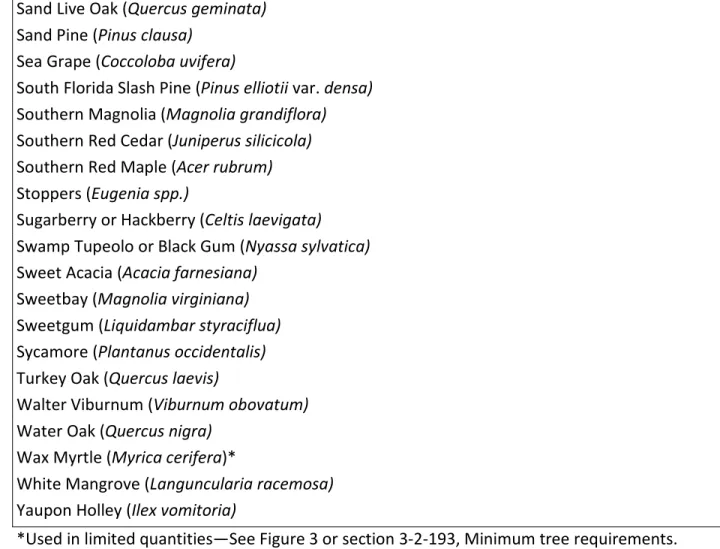
Sand Live Oak (Quercus geminata)
1
Sand Pine (Pinus clausa)
2
Sea Grape (Coccoloba uvifera)
3
South Florida Slash Pine (Pinus elliotii var. densa)
4
Southern Magnolia (Magnolia grandiflora)
5
Southern Red Cedar (Juniperus silicicola)
6
Southern Red Maple (Acer rubrum)
7
Stoppers (Eugenia spp.)
8
Sugarberry or Hackberry (Celtis laevigata)
9
Swamp Tupeolo or Black Gum (Nyassa sylvatica)
10
Sweet Acacia (Acacia farnesiana)
11
Sweetbay (Magnolia virginiana)
12
Sweetgum (Liquidambar styraciflua)
13
Sycamore (Plantanus occidentalis)
14
Turkey Oak (Quercus laevis)
15
Walter Viburnum (Viburnum obovatum)
16
Water Oak (Quercus nigra)
17
Wax Myrtle (Myrica cerifera)* 18
White Mangrove (Languncularia racemosa)
19
Yaupon Holley (Ilex vomitoria)
20
*Used in limited quantities—See Figure 3 or section 3-2-193, Minimum tree requirements. 21
22
FIGURE 2. APPROVED TREE SPECIES—NON-NATIVE 23
Black Olive (Foresteria segregata)
24
Chinese Elm (Ulmus parvifolia)
25
Crape Myrtle (Lagerstroemia indica)
26
Jerusalem Thorn (Parkinsonia aculeata)
27
Loquat (Eriobotrya japonica)
28
Royal Poinciana (Delonix regia)
29
Silver Dollar Eucalyptus (Eucalyptus cinerea)
30
Tree of Gold (Tabebuia argentea)
31
Yellow Poinciana (Peltophorum petrocarpum)
32
(l) Native tree replacement fund: A fund established to provide money for the purpose of planting 33
trees on government-owned properties. 34
(m) Natural ground level: The elevation and grade of the parcel that existed prior to the development 35
activity. 1
(n) No tree affidavit: A signed notarized statement by the landowner or his agent stating that no trees 2
exist upon the site. 3
(o) Parcel: A lot or tract of land. 4
(p) Planted tree: A tree which has been nursery grown for resale or otherwise transplanted. 5
(q) Preserved tree: A tree preserved on-site which has been barricaded or is located 100 feet or more 6
from the farthest point of development and will count toward a development's minimum tree 7
requirement. 8
(r) Prohibited trees: Trees of undesirable or exotic species which disrupt natural habitats or are 9
otherwise destructive. Trees listed as invasive species on the Florida Exotic Pest Plant Council 10
Invasive Plan Lists, Category I and Category II, shall be considered prohibited. 11
(s) Site Plan Review (SPR): Staff review of development applications. 12
(t) Spiking (also known as "spurring"): The use of any metal gaff device, to aid in tree-climbing in order 13
to remove branches, limbs or leaves from a tree. 14
(u) Topping (also known as, "stubbing," "heading," "heading-back," "stubbing off," "tipping," 15
"hatracking," "topping-off," "dehorning," "lopping," "roundover," "cut-over"): Trimming of limbs to 16
stubs larger than three (3) inches in diameter within the tree's crown to such a degree as to remove 17
the normal canopy and disfigure the tree. 18
(v) Tree: A woody perennial with one or more well-defined main stems or trunks attaining four inches 19
or more in diameter growing upright to maturity, or to form a crown and branching at that point, 20
ultimately reaching a height of 14 feet or more. 21
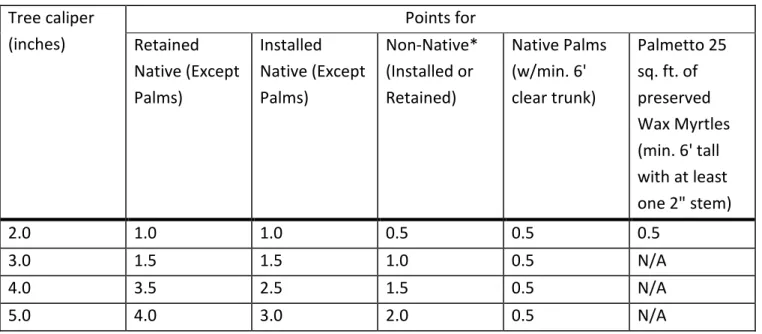
(w) Tree points: A number calculated according to Figure 3. 22
FIGURE 3. TREE POINTS 23 Tree caliper (inches) Points for Retained Native (Except Palms) Installed Native (Except Palms) Non-Native* (Installed or Retained) Native Palms (w/min. 6' clear trunk) Palmetto 25 sq. ft. of preserved Wax Myrtles (min. 6' tall with at least one 2" stem) 2.0 1.0 1.0 0.5 0.5 0.5 3.0 1.5 1.5 1.0 0.5 N/A 4.0 3.5 2.5 1.5 0.5 N/A 5.0 4.0 3.0 2.0 0.5 N/A
6.0 4.5 3.5 2.5 0.5 N/A
7.0 5.0 4.0 3.0 0.5 N/A
8.0 5.5 4.5 3.5 0.5 N/A
8.0** 6.0 5.0 4.0 0.5 N/A
*From Charlotte County Approved Tree List (Figure 2) 1
**Add .5 points for every inch thereafter (except in the case of Palms, Wax Myrtles, and Palmetto). 2
3
Sec. 3-2-187. - Applicability. 4
The terms of this article shall apply to the removal of any native tree, unless the removal is otherwise 5
exempted in this article. This article shall also apply to the tree removal, protection, and tree plantings 6
required of a development. 7
8
Sec. 3-2-188. – Exemptions from this Article. 9
(a) This article shall not apply to the following: 10
(1) Properties that meet all of the following criteria: 11
a. The primary principal use is bona fide agriculture; 12
b. The property is zoned for agriculture; 13
c. The future land use map (FLUM) designation is agriculture; and 14
d. The property is not within a development of regional impact (DRI). 15
(2) Commercial plant and tree nurseries, where plants and trees are grown or sold for 16
horticultural purposes. 17
(3) Cemeteries. 18
(4) Removal of native trees as part of an approved management activity within a preserve or 19
resource conservation area. 20
(5) Removal of native trees with less than four caliper inches and any palm with less than six 21
feet of clear trunk. 22
(6) Removal of non-native trees. 23
(7) Removal of dead trees. 24
(8) The trimming, cutting, or other alteration to any existing native tree, provided such activities 25
are consistent with sound horticultural practices. 26
(9) Removal of native trees in within utility, drainage, and road right-of-way easements in 27
existence prior to September 1, 1992 and the expansion of road easements in existence prior 28
to September 1, 1992. 29
(10) Removal of native trees from utility right-of-way easements less than 20 feet in width and 30
less than one-half mile long. Utility rights-of-way easements greater than 20 feet in width, 31
regardless of length, are subject to the conditions of this article unless said right-of-way 1
easements are subject to approval under the Transmission Line Siting Act, F.S. §§ 403.52 2
through 403.5365, or the Florida Electric Power Plant Siting Act, F.S. §§ 403.501 through 3
403.518. 4
(b) In the event of an emergency such as the approach and imminent landing of a hurricane, 5
windstorms, flood, freezes, fire, or other disasters, the county administrator retains the authority 6
to temporarily waive the requirements of this Article. 7
8
Sec. 3-2-189. - Native tree removal. 9
Prior to the removal of any native tree of four caliper inches or greater and any palm with six or more 10
feet of clear trunk, the landowner or his agent must receive a tree removal permit signed by a county 11
official. 12
13
Sec. 3-2-190. - Native heritage trees. 14
No person shall cut down, remove, relocate, or in any way damage a native heritage tree, as defined in 15
Sec. 3-2-186j. These trees shall be protected without regard to their location or the date of final 16
development approval. 17
(a) The Zoning Official may exempt a heritage tree from the terms and provisions of this section if: 18
(1) The tree is in advanced stages of decline as determined by a certified arborist; or 19
(2) The tree is located where a structure or improvement allowed as a permitted principal use 20
under zoning regulations is to be located and the applicant has made every effort to 21
accommodate the heritage tree within the design of the structure or improvement. It is the 22
intent of this provision that a permit shall be granted for the removal of a heritage tree only 23
after the applicant has demonstrated an effort to design and locate the proposed structure 24
or improvement to prevent the removal of heritage trees consistent with the permitted use 25
of the property. 26
(3) The tree is causing substantial structural or utility damage, to be determined by a qualified 27
engineer. 28
(b) Encroachment under a heritage tree will be allowed only to the extent provided by this article. 29
30
Sec. 3-2-191. - Criteria for issuance of native tree removal authorization. 31
(a) Tree removal authorization shall be granted only when an authorized county official has 32
determined that the removal is consistent with at least one of the criteria below. 33
(1) Trees pose a safety hazard to pedestrian or vehicular traffic or cause disruption to public 34
utility services. 35
(2) Trees pose a safety hazard to buildings or structures. 1
(3) Trees completely prevent access or cross access to a lot or parcel. 2
(4) Trees prevent development or physical use. It is the intent of this provision that a permit 3
shall be granted for the removal of any tree when the applicant has demonstrated an effort 4
to design or locate a proposed structure or improvement so as to minimize the removal of 5
trees. 6
(5) Diseased trees or trees so weakened by age, storm, fire or other injury so as to pose a 7
danger to persons, property, improvements or other trees. 8
(b) Authorization to remove trees, when granted, shall be confined to the trees specifically 9
identified for which removal is permitted. Removal of trees must be performed within six 10
months from the date of the issuance of the tree removal authorization or during the 11
development activity for which SPR approval was granted. 12
(c) Nothing in this article shall be construed to require the removal of any native trees by the 13
applicant. 14
15
Sec. 3-2-192. - Application requirements for development activities. 16
(a) All applicants proposing development must submit the following to the community development 17
department at the time of application for building permits and prior to any clearing activity: 18
(1) A tree inventory consisting of a scaled drawing indicating: 19
a. Development site boundaries. 20
b. Location of all individual trees, other than prohibited species, which have a caliper four 21
inches or greater; the trees' common names; and their approximate calipers. 22
c. A scaled drawing superimposed on the tree inventory illustrating all proposed and 23
existing improvements; which trees are to be removed; and which trees are to be 24
preserved. 25
(2) Proof that removal of trees is consistent with tree removal criteria in section 3-2-191. 26
(3) A fee may be charged for each caliper inch of tree which has been granted tree removal 27
authorization. These fees shall be placed into the native tree replacement fund pursuant to 28
section 3-2-197. 29
(4) In the event that there are no trees on the development site, the applicant shall not be 30
required to provide the tree inventory. In lieu of this requirement the applicant shall submit 31
a "No Tree Affidavit." 32
(b) For development requiring SPR approval, all documentation listed above and a landscape plan 33
illustrating the incorporation of both preserved (if applicable) and planted trees into the proposed 34
development must be submitted at the time of preliminary site plan submittal. 35
1
Sec. 3-2-193. - Minimum tree requirements for development. 2
For all development regulated by this article, tree points must be preserved or planted according to 3
Figure 4, below. Damaged trees do not count towards points. A list of trees acceptable for the purpose 4
of this article is given in Figures 1 and 2. (See definitions). 5
FIGURE 4. TREE POINTS FOR DEVELOPMENT TYPES 6
Development Type Number of Tree Points Required
Residential, commercial and industrial 1 tree point for every 2,000 square feet of development site
Outdoor-oriented recreational activities which require open space and are available to the general public
1 tree point for every 4,000 square feet of development site
7
(a) In order to count toward the minimum tree point requirement, a preserved or planted tree must 8
have a minimum height of eight feet measured from the natural ground level to the highest point 9
of the foliage and a minimum caliper of two inches. 10
(1) Trees preserved within the minimum required rear and side yard setbacks of the 11
development site may be counted toward the tree point requirement. Trees may be planted 12
anywhere within the development site, including the minimum required rear and side yard 13
setbacks, except where otherwise prohibited by the provisions of this article. A single phase 14
of phased development shall be considered a development site and all the points shall be 15
calculated within that phase. 16
(2) Trees preserved or planted within easements may be counted toward the tree point 17
requirement. 18
a. If a preserved tree located within an easement is removed during the lawful 19
development activity within the easement for which the easement was intended, this 20
loss shall not be held against the landowner or against the conditions of this article, 21
and no action shall be taken against the rightful user of the easement for which it was 22
intended. 23
b. A list of acceptable trees for tree planting in utility easements near power lines is set 24
forth below in Figure 5. 25
FIGURE 5. RECOMMENDED TREES FOR PLANTING UNDER POWER LINES 26
Crape Myrtle (Lagerstroemia indica) 27
Loquat (Eriobotrya japonica) 28
Silver Dollar Eucalyptus (Eucalyptus cinerea) 29
Sweet Acacia (Acacia farnesiana) 1
Wax Myrtle (Myeica cerifera) 2
c. Trees planted or preserved within easements shall not interfere, at or before maturity, 3
with power, cable television, or telephone lines, sewer or water pipes, or any other 4
existing or proposed overhead or underground utility service. Location of underground 5
utility lines shall be determined prior to easement planting. 6
d. In the event that a tree is planted within an easement and is removed during lawful 7
development activity within the easement for which the easement was intended, this 8
loss shall be the responsibility of the property owner, the tree shall be replaced, and no 9
action shall be taken against the rightful user of the easement for which it was 10
intended. 11
(3) Trees planted to meet the minimum tree point requirements of this article may not be 12
planted within county rights-of-way. 13
(b) While all preserved native palms may be counted, no more than 25 percent of the required tree 14
points may be obtained from planted native or non-native palm trees. 15
(c) No more than 50 percent of the required tree points may be obtained from approved non-native 16
trees (excluding non-native palms, which commonly count for 25 percent of total required points 17
per section 3-2-193(b). 18
(d) No more than 25 percent of the required tree points may be obtained from approved Wax Myrtle 19
which has been planted or preserved. 20
(e) No more than 25 percent of the required tree points may be obtained from the approved square 21
footage of preserved Palmetto. 22
(f) Replacement trees must carry plastic tags identifying their species and retained until the certificate 23
of occupancy is granted. 24
25
Sec. 3-2-194. – Tree preservation and protection during development. 26
(a) Tree protection. Where healthy trees of appropriate location, species, and quality exist on-site prior 27
to development, efforts shall be made to preserve such trees permanently at natural grade. 28
(1) Prior to the site clearing phase of development, the trees to be preserved shall be protected 29
by the construction of barriers. 30
(2) The barriers shall be constructed of wooden (or equivalent) posts at least two inches by two 31
inches, and shall be implanted in the ground deep enough to be stable. The barriers shall be 32
visible, with at least three feet above the ground. The protective posts shall be placed not 33
more than six feet apart and shall be linked together using lumber; erosion fabric; net or 34
plastic fence material, or snow fencing. Stakes strung with line or flagging shall not be 35
considered a protective barrier. 1
(3) Barriers shall be placed at least six feet from the trunk of any protected palm. 2
(4) For tree species other than palms, barriers will be placed at the drip line, except as allowed 3
in an area of encroachment as defined in subsection (b) of this section. 4
(5) In situations where Palmetto (Serenoa repens) occurs as a dense understory to existing oaks, 5
pines, or palms, the existing Palmetto may be used as a living barricade for tree preservation, 6
provided such Palmettos are retained to the dripline of the proposed preserved tree 7
throughout construction. If the minimum square footage (25 sq. ft.) of Palmetto is then 8
retained after construction, such Palmetto may qualify for additional tree points. [See sec. 9
3-2-193(e)]. 10
(6) Where clusters of trees or large areas are to be protected, the area may be designated by 11
barriers placed at the drip line from the outermost trees of the cluster or within the 12
allowable area of encroachment. (If the outermost trees are palms, the barrier shall be 13
placed at least six feet from the trunks of the outermost palm.) 14
(7) Barriers will remain in place until all construction activity, except landscaping, within the 15
protected areas is complete. 16
(8) Trees not protected in the manner defined by this section throughout the construction 17
period will not be considered preserved for purposes of this article, except for trees so 18
located that they are 100 feet or more from the farthest point of development activity. 19
(9) No equipment, vehicles, construction materials, temporary structures or buildings, 20
machinery, fill soil, debris, fuel, paint, solvent, oil, thinner, asphalt, cement, grout, or 21
construction chemical of any kind will be placed, allowed to enter, or be stored within the 22
protective barriers established around protected trees or protected areas. 23
(10) Temporary sanitation facilities shall not be located within the tree protection areas. 24
(11) No damaging attachment, wires (other than support wires for a tree), signs or permits shall 25
be fastened to any tree protected by this article. 26
(b) Encroachment permitted: In the event that the preservation techniques referenced in subsection 27
(a) are deemed impracticable, trees and tree roots may be encroached upon (See Exhibit A for 28
diagram) subject to the following conditions: 29
(1) No more than one-half of the radius of the tree canopy is impacted. This encroachment shall 30
occur on no more than one side of the tree. 31
(2) No more than one-third of all tree roots found at the outermost limits of the tree's drip line 32
are encroached upon. 33
(3) The remaining area of the tree's roots shall be protected by barriers at the drip line 34
throughout construction and shall remain in preconstruction condition during and after 35
construction. 1
(4) Paved areas of allowable encroachment shall use techniques that provide for aeration and 2
irrigation of the root system. These techniques include: 3
a. Substituting gravel or pebbles for typical fill soils; and 4
b. Using pervious or porous paving materials in the areas of encroachment. 5
(5) Supplemental irrigation shall be provided throughout construction in order to mitigate tree 6
stress induced by this encroachment. 7
(c) If the development utilizes construction techniques such as pilings or piers, which will not impact 8
tree root systems, the area of allowable encroachment may be exceeded. 9
(d) In no event-shall a damaged tree, a dead tree, a tree not protected in accordance with the 10
provisions of this section, or a tree not included in Figures 3 and 4 be counted as a preserved or 11
planted tree for purposes of this article. 12
(e) On-site inspection for conformance with the provisions of this section shall be conducted by the 13
code compliance division inspectors or authorized county official at any time during a site's 14
development. 15
16
Sec. 3-2-195. – Compliance with Minimum Tree Requirements. 17
On-site inspection for conformance with the requirements of this article shall be conducted by the 18
County in order to receive a certificate of occupancy (C.O.). 19
(a) The board of county commissioners shall establish, by resolution, appropriate fees to defray the 20
cost of enforcing the provisions of this article. 21
(b) If the requirements of this article are not met at the time of final inspection, a reinspection fee, in 22
an amount established by resolution, will be assessed for any additional inspections. 23
(c) For a period of one year from the date of the issuance of the C.O., any tree regulated by this article 24
that dies, or receives major damage or contracts a disease, such that its restoration to a sound 25
condition is impractical, must be replaced by a tree of comparable size and type or a combination 26
of trees having an equal number of tree points. Compliance may be determined by a follow-up 27
inspection that may occur up to one year from the date of the original C.O. inspection. 28
(d) Any tree which is required as a replacement to the original C.O. tree is also subject to a one-year 29
follow-up inspection, following its installation. 30
31
Sec. 3-2-196. - Tree replacement. 32
Qualifying, existing trees shall be preserved whenever feasible in order to meet the tree point 33
requirements. Whenever the removal of trees on a development site would result in failure to meet 34
the minimum tree point standards, approved replacement trees shall be planted in sufficient number 35
and size to meet these standards, and the following conditions shall apply: 1
(a) Approved tree species. All trees selected to meet the requirements of this article shall be chosen 2
from the Approved Tree List, Figures 1 and 2. Other tree species may be included on the 3
development site, except prohibited species, but they shall not be counted toward meeting the 4
requirements of this article. Trees planted in compliance with chapter 3-5, article XVIII, Landscape 5
Requirements, of the County Code, may be used to help satisfy the requirements of this section, 6
provided they meet the criteria set forth in this article. 7
(b) Tree quality. All trees used in conformance of this section shall meet the standards for Florida No. 1 8
or better as provided by Grades and Standards for Nursery Plants, Part II, Palms and Trees; current 9
edition; State of Florida, Department of Agriculture, Tallahassee. 10
(c) Installation. The property owner(s) shall be responsible for installing all trees in a sound, 11
professional manner and in accordance with accepted good horticultural techniques. 12
(1) Grow bags and containers shall be completely removed from the root ball prior to planting. 13
(2) Burlap shall be sliced in both directions on the sides of the root ball and removed from the 14
top one-third of the root ball. 15
(3) All twine or wire shall be cut off from around the trunk at the top of the rootball. 16
(4) Trees shall be mulched to a minimum depth of two inches and a maximum depth of four 17
inches with organic mulch at least to the perimeter of the root ball. 18
(5) The owner(s) or their agent(s) shall provide sufficient soil and water to sustain healthy 19
growth of all trees. 20
(d) Anchoring. Trees with a caliper of four inches or more shall be anchored for a period of at least one 21
year. Single staking of trees shall be prohibited. 22
(e) Postponement of planting. In the event the property owner is not residing in Charlotte County at 23
the time of certificate of occupancy (C.O.) issuance, and (i) wishes to choose and install his/her own 24
trees; or (ii) is not available to care for the newly planted trees, upon written request, the property 25
owner may post a security deposit, either as cash or certified check, which is equivalent to the 26
established dollar amount for the development's required number of tree points. (Same as the 27
"buy-out" fee). This cash security deposit is valid for 90 days from the issuance of the C.O. 28
(1) Upon inspection and written approval from the County that all tree installation has been met 29
within the allotted ninety-day period, the posted security deposit will be refunded within five 30
working days. 31
(2) Should the property owner fail to properly install the required number of tree points in the 32
allotted time, the money will be placed into the native tree replacement fund without 33
further refund. 34
1
Sec. 3-2-197. - Native tree replacement fund. 2
(a) The public works department is hereby authorized and directed to administer a native tree 3
replacement fund which consists of monies collected as payment for tree removal authorization 4
and in lieu of planting or preserving trees on developed properties. The community development 5
department is hereby authorized and directed to collect the monies for payment of the native tree 6
replacement fund. Thus, a person shall pay to the community development department a sum 7
determined by multiplying the number of required tree points which they wish to be excused from 8
preserving or planting on a development site times the native tree replacement fee, said fee to be 9
established by resolution of the board of county commissioners. 10
(1) The community development department shall keep records of the monies received 11
pursuant to this section. 12
(2) The board of county commissioners shall establish, by resolution, a program administered by 13
the public works department which shall apply monies received to the planting of native 14
trees, native shrubs, mulch, installation, design, and irrigation on lands or easements of the 15
county or government owned lands. Non-substantive amendments may be made from time 16
to time without action by the board of county commissioners as deemed necessary for the 17
administration of the program. 18
19
Sec. 3-2-198. - Slope variance. 20
Notwithstanding other county requirements, and in order to facilitate the policy that preservation is 21
more desirable than replacement, if preservation cannot be accomplished in conjunction with a 6 to 1 22
slope but can be accomplished by using a 4 to 1 slope, then such is authorized. The construction of tree 23
wells and the use of stemwall construction may be used and is encouraged whenever possible to 24
prevent changes in the grade within the drip line of protected trees. 25
26
Sec. 3-2-199. - Water retention/recharge areas. 27
As an additional alternative to present slope requirements, when the use of water retention/recharge 28
areas can be accomplished on-site and is beneficial to trees to be preserved, such retention/recharge 29
areas may be used. 30
31
Sec. 3-2-200. - Prohibited trees. 32
The planting of any prohibited species of tree shall be strictly prohibited. 33
1
Sec. 3-2-201. - Prohibited practices. 2
The following practices or procedures shall be considered unlawful in the county, except where 3
exempted: 4
(a) It shall be unlawful practice for any person, firm or agency to "top" or allow to be "topped", or 5
severely prune, so as to appear stunted, any tree. 6
(1) All tree pruning shall be conducted according to the latest edition of the National Arborist 7
Association standards, which are hereby incorporated by this reference. 8
(2) Trees severely damaged by storms or other causes, or certain trees under utility lines or 9
other obstructions where other pruning practices are impractical may be exempted from this 10
section. 11
(b) It shall be unlawful for any person, firm, or agency to climb any living tree, using the practice 12
known as "spiking" or "spurring". The practice of "spurring" or "spiking" shall be allowed only to 13
achieve the total removal of a tree for reasons authorized by this article. 14
15
Sec. 3-2-202. - Voluntary planting. 16
This article shall not be interpreted to restrict, regulate, or limit the voluntary planting of any tree, 17
other than prohibited trees, in the county. The provisions of this article govern only the planting of 18
trees which are required to be planted or retained under this ordinance. 19
20
Sec. 3-2-203. - Variance, appeal and penalty. 21
(a) Variance. 22
(1) The board of zoning appeals may, upon appropriate application in writing, vary or waive the 23
terms and provisions of this article due to unreasonable hardship in specific cases. The 24
criteria for a variance are as follows: 25
a. Unique or peculiar conditions or circumstances apply to the property. 26
b. The strict literal enforcement of the terms of this regulation would result in 27
demonstrable and undue hardship or deprive the property owners of rights commonly 28
enjoyed by other property owners. 29
c. The requested variance is the minimum modification of these regulations. 30
d. The requested variance is compatible with all other county regulations. 31
(2) The preservation of any approved tree over 18 inches diameter at breast height may be 32
considered by the appropriate county official as the basis for the granting of a variance from 33
the literal application of the provisions of this article and other county regulations. 34
(b) Appeal. Any party aggrieved by the administrative interpretation or enforcement of this article may 35
appeal to the board of zoning appeals pursuant to the Charlotte County Code. 1
(c) Penalty for violation. 2
(1) Each preserved tree destroyed or suffering detrimental alteration during construction must 3
be replaced by either a comparable size and type of tree, or by tree replacement conditions 4
as provided by this article, before issuance of a certificate of occupancy. 5
(2) No certificate of occupancy or power release shall be issued for any development until all 6
applicable approval or restoration plan conditions have been accomplished. 7
(3) Failure to comply with any provisions of this article shall be referred to the code 8
enforcement board, which has the power to levy a fine not to exceed $250.00 per day for 9
each day the violation occurs. 10
(4) If an individual fails to obtain the appropriate authorization for any tree removal prior to 11
development, the community development department may require a fine, which will vary 12
depending on the number of offenses within the calendar year. 13
a. For a first offense, the fee is four times the original tree removal fee. In the case of tree 14
removal fee exemptions, the fee is four times the standard processing fee. 15
b. For a second offense in one calendar year, the fee is four times the original tree 16
removal fee plus $150.00. In the case of tree removal fee exemptions, the fee is four 17
times the standard processing fee plus $150.00. 18
c. For multiple offenses within one calendar year, the fee is four times the original tree 19
removal fee plus $500.00 for each occurrence. In the case of tree removal fee 20
exemptions, the fee is four times the standard processing fee plus $500.00 21
(5) If an individual falsifies information on any tree form, or does not post the tree permits on 22
the subject property, the community development department may require a fine, which 23
will vary depending on the number of offenses within a calendar year. 24
a. For a first offense, a written warning. 25
b. For a second offense in one calendar year, the fine is $50.00. 26
c. For multiple offenses within one calendar year, the fine is $150.00 for each occurrence. 27
(6) For violations to any prohibited practice or planting a prohibited tree, the community 28
development department may require a fine, which will vary depending on the number of 29
offenses within a calendar year. 30
a. For a first offense, a written warning. 31
b. For a second offense in one calendar year, the fine is $50.00. 32
c. For multiple offenses within one calendar year, the fine is $150.00 for each occurrence. 33