The Knowledge-Learning-Instruction (KLI) Framework:
Toward Bridging the Science-Practice Chasm to Enhance Robust Student Learning
Kenneth R. Koedinger Albert T. Corbett
Charles Perfetti
and the current and past members of the Pittsburgh Science of Learning Center
Executive Summary
The volume of research on learning and instruction is enormous. Yet progress in improving educational outcomes has been slow at best. Many learning science results have not been translated into general practice and it appears that most that have been fielded have not yielded significant results in randomized control trials. Addressing the chasm between learning science and educational practice will require massive efforts from many constituencies, but one of these efforts is to develop a theoretical framework that permits a more systematic accumulation of the relevant research base.
A key piece in such a theoretical framework is the development of levels of analyses that are fine enough to be supported by cognitive science and cognitive neuroscience, but also at levels
appropriate to guide the design of effective educational practices. An ideal scientific solution would be a small set of universal instructional principles that can be applied to produce efficient and robust student learning for any educational goal. This holy grail is likely unattainable both because effective instructional practices in one subject-matter domain, like science, are often not effective in another, like second language and because even within a domain, specific
instructional goals and contexts add restrictions to the application of principles. Thus, our strategy is to strive for instructional principles with as much generality as possible, while recognizing that (and stipulating how) their effectiveness may be constrained by student and knowledge characteristics of the target course.
What are the features of knowledge that may so constrain? To answer that question, we have embarked on an effort to create taxonomy of kinds of knowledge with a focus on functional cognitive characteristics that may determine which learning processes are most likely to produce different kinds of knowledge. Cognitive science has identified a vast array of learning strategies, processes, and mechanisms and these are also in need of order. Similarly, the learning and educational sciences have produced an array of instructional principles and practice
recommendations. Our theoretical framework builds on work in these fields. The Knowledge-Learning Instruction (KLI) Framework encompasses the three components that constitute its name. Although we focus in this paper on the knowledge taxonomy, we begin to outline
taxonomies of learning processes and of instructional principles. We suggest “complexity” as a key organizing principle and the use of the time course of the application of a unit of knowledge, a learning process, or an instructional principle as operational method for empirically grounding this notion of complexity.
The purpose of the framework and the taxonomic efforts is not just collection and organization, but generation of new research questions and hypotheses. One hypothesis-generating frame
involves the relationship between the complexity of components of knowledge targeted by a course and the complexity of the instructional principles that are likely to be most effective and efficient in enhancing robust student learning in that course. See Table 5. We hypothesize that an instructional principle at a particular level of complexity will be effective for knowledge components of similar complexity and those of greater complexity, but not for ones of less complexity. In other words, complex instructional strategies (intended to support complex learning processes involving deliberate reasoning and sense-making) are best used only for the most complex of knowledge component goals, but simpler instructional strategies (intended to support simpler learning processes like memory) are relevant and effective for knowledge component goals of all complexity. A specific instance of this hypothesis is that the moderately complex instructional principle of prompting students to self-explain (or asking deep questions) is effective and efficient for learning more complex knowledge components (e.g., principles, like electric field properties, in mathematics and science) but is not effective and efficient for
learning less complex knowledge components (e.g., categorical decisions, like English articles, in second language learning). The complexity dimension does not collapse onto domain
differences. Thus, second language learning contains complex as well as simpler knowledge components, and so do math and science.
Thus the KLI framework has properties we think are essential to making a bridge from research to education. Its analysis of learning in terms of multi-level knowledge components reveals complexities that allow generalizations across domains. These generalizations, in turn, support instructional principles of high generality that, when combined with instructional goals, allow practical suggestions about curricula and intervention decisions.
1. Introduction: The need for a learning-to-instruction theoretical framework
The cognitive and learning sciences have a substantial base of highly refined and extensively tested theories of cognition and learning (e.g., Anderson & Lebiere, 1998; McClelland, Cleeremans, & Servan-Schreiber, 1990; Newell, 1990; Sun, 1994). For issues of educational science, specifically the application of a learning science to a science of instruction, such theories provide broad useful but limited guidelines. In designing instruction to support learning, one must deal with the complexities, tradeoffs, and uncertainties that arise in every transition from basic science to application. In crafting instruction – from a single response of a computer-based intelligent tutor to a teacher managing a classroom discussion to a full curriculum – the designer faces an enormous space of possible actions, in contexts where systematic, cleanly controlled, experimental contrasts of alternative approaches are impractical at best and often impossible. A theoretical framework that, in its very conception, included issues of instruction would be a significant aid to instructional applications of learning science research. Such a framework could help support “rigorous, sustained scientific research in education”, as urged by the National Research Council report (Shavelson & Towne, 2002).
In the following sections, we first develop the basic background that motivates our attempt to formulate a general theoretical framework for enhancing student learning. We then define and explain the basic concepts that shape the theoretical framework, then provide elaboration and examples across academic domains, and identify exemplary instructional principles that derive from research using the theoretical framework. We conclude by suggesting how the framework can aid a sustained research effort and generate new hypotheses.
1.1. The Educational Context
Heated debates in education, sometimes dubbed “education wars’, have been most visible in reading and math. Research has informed these debates, particularly in reading, but many of the core premises in these debates remain as assumptions with insufficient scientific support. Further, advocates in these debates tend to differ on the kind of scientific support that is needed, with some emphasizing rigor (e.g., internal validity, randomized controlled experiments) and others emphasize relevance (e.g., ecological and external validity and appropriate settings and assessments). Our approach embeds rigorous experimental research methods in the context of real learning, with real students, in real contexts.
1.2 Theories of Learning and Instruction
Our emphasis on connecting learning research to instructional principles is not unique. Research in the learning sciences has led to statements of principles, including the influential NRC report “How People Learn” (Bransford, Brown, & Cocking, 2000), instructional design principles (e.g., Clark & Mayer, 2003), and learning principles drawn from Psychology research
(http://www.psyc.memphis.edu/learning/principles/; Graesser, 2009). Progress in the “reading wars” was marked by a succession of evidence-based recommendations that draw on principles of learning to read alphabetic writing systems (Bransford et al, 2000; Snow et al 1998, National Reading Panel, 2000). Broad learning principles also have been directed specifically at teachers and educational decision makers (e.g., http://www.instituteforlearning.org/; Pashler et al., 2007). We join the tradition of extracting principles from research, because we believe that finding the right level to communicate evidence based-generalizations is important for guidance
in instruction. However, we also are committed to the idea that any principle must be based on sound evidence that supports the generality implied by the principle or identifies its limiting conditions. Achieving generality requires evidence in real instructional contexts and across a range of content domains.
Finding the right level of analysis or grain size for theory is a major question. Like all theories, including physical theories, the theoretical entities vary in the levels of analysis to which they apply, both in terms of the grain of the unit (micro to macro) and its functional level
(neurological, cognitive, behavioral, social). We refer to these two together as “grain size”. In the long run, we expect translation (not necessarily reduction) across adjacent levels, for instance, neurological to cognitive and vice versa. However, for coherence one must choose a grain-size and adopt it fairly consistently, with the realization that translation to larger and smaller grain sizes can occur.
Learning and education theories have tended to use macro levels of analysis with units at large grain sizes. For example, situated learning, despite its origins as a general proposition about the social-contextual basis of learning (Lave and Wenger, 1991), has through its extension by others (e.g., Greeno, 1998), become an educational hypothesis. As a scientific idea, situated learning has merit and is subject to empirical investigation. However it tends to use a rather large grain size including groups and environmental features as causal factors in performance. It also tends to focus on rich descriptions of cases studies and not on claims that may generalize beyond these cases. These features work against two important goals that we have: (1) Identifying mechanisms of student learning that lead to instructional principles. (2) Communicating instructional
principles that are general over contexts and meaningful to instructional design. We assume that learning is indeed situated, and understanding learning environments, including social interaction patterns that support learning, is an important element of a general theory. But we take the interaction between a learner and a specific instructional environment as the unit of analysis. Learning theories have small grain sizes as well. At the neural level, variations on Hebb’s idea (Hebb, 1949) about neuronal plasticity refer to a basic mechanism of learning, often expressed simplistically as “neurons that fire together, wire together”. Neuron network models built this way have provided neurological correlates of behavioral learning and models for cognitive learning mechanisms using multi-level networks (e.g., O’Reilly & Munakata, 2000). Micro-level theories also can provide accounts of elementary causal events by using symbols, rules, and operations on basic entities expressed as computer code, as embodied, for instance, in the ACT-R theory of Anderson (1990; 1993). Although such theories can be and were developed without attention to biology, their predictions have been linked to brain systems (e.g., Anderson et al., 2004). It is important for the learning sciences that such theories, and their innovative
predecessors (e.g., Newell & Simon, 1972), demonstrate the ability to predict and explain human cognition at a detailed level that is subject to empirical testing. The small grain size of such theories and the studies that support them leave them mostly untested at the larger grain size of knowledge-rich academic learning and they tend to be insufficient to constrain instructional design choices. There are exceptions, however. For instance, detailed theories about learning to read have been used to specify effective instructional interventions that affect brain circuits for learning to read (Sandak et al, 2004; Shaywitz et al, 2004). Moreover, without this level of explanation, we would have little confidence that the levels of explanation that suits our purpose
could ever be translated to a precise mechanistic account. Our point is that to directly target instructional decisions that we believe should be influenced by learning science, an intermediate level is needed.
The levels of explanation we target are indeed intermediate to the larger and smaller grain sizes exemplified above. We believe that the aim of communicating the essential ideas of an
instructionally relevant science of learning requires an intermediate level. This level must contain propositions whose scope is observable entities related to instructional environments and learner characteristics that affect learning events. These propositions are empirical claims, so they are testable by experiments. Finally, the learning propositions allow translation both downward to micro-level mechanisms and upward to instructional principles. The theoretical framework we describe in section 2 uses this intermediate cognitive level, which we refer to as the learning event level. First, we describe a research context for theory development.
1.3 Situating the theoretical framework in a student learning context
The Pittsburgh Science of Learning Center (PSLC) studies student learning of academic content as taught in courses. We are developing a theoretical framework that, because it is grounded in real student learning situations, applies directly to course-based learning. Important to this approach is that the learning situations span a range of academic content.
The advantage of studying multiple academic content areas is that generalizations and limits on generalizations become visible, allowing theoretical propositions and instructional principles to be expressed with appropriate boundary conditions. We do not assume that learning a second language and learning physics are identical processes at all levels of analysis. Instead, we assume that studies of learning are intrinsically about learning domain content and the scientific goal is to develop both general theoretical propositions and instructional principles across domains and to identify the domain-specific constraints on learning.
The PSLC research program has spanned the following student learning domains, each an academic course situated in one or more K12 Schools or University settings that cooperate with the PSLC research program: Physics, Chemistry, Algebra, Geometry, French, Chinese, and English as a second language. These academic courses have been studied at the early college, high school, or middle school level, a fact that imposes a potential grade- or experience-level boundary condition for generalizations based on the research. However, every theoretical proposition and instructional principle derived from this research is an empirically testable hypothesis for other grade or experience levels, like elementary school or adult job training. 1.4. Research Settings: In vivo experiments, lab experiments, and data logging
The goal of grounding our theoretical claims in research settings that represent application settings is best met, in our case, by research within operating courses and with students
participating in those courses without any extra incentives. Course-based studies of all kinds are common in educational research, and they vary along many dimensions: whole classroom or individual student changes; in the classroom or “student pull-out”; domain-derived tasks or not; rigorous control or not; etc. To build the kind of learning theory to which we aspire, some classroom settings and research procedures are privileged, whereas a wider range of settings is important and necessary. The essential standards are real students, real subject matter, and
rigorous control. Learning research has tended to trade-off laboratory rigor against classroom realism, with the former sometimes limited in generalization to classroom settings and the later sometimes suffering from lack of experimental rigor. We advocate research that combines the realistic settings of course-based research with experimental control that is as rigorous as possible within these real-world constraints. PSLC’s primary methodology is called in vivo experimentation and it is described on the PSLC wiki (learnlab.org/research/wiki) and in other PSLC talks (e.g., Klahr, Perfetti, & Koedinger, 2009, VanLehn & Koedinger, 2007; Salden & Aleven, 2009; Salden & Koedinger, 2009) and publications (e.g., Koedinger et al., 2009). Because in vivo experimentation comes with restrictions, including timing (i.e., the experiment runs as constrained by the course schedule) and ethical restrictions (e.g., including a condition hypothesized to be worse than current practice is not allowed), sometimes laboratory
experimentation is preferred particularly at an earlier stage of development or to disentangle alternative explanations of results. However, these laboratory studies maintain important aspects of ecological validity by using the same course materials and same student population, while they lose the contextual and motivational backdrop of a study within a course.
Another source of empirical evidence for theory development is extensive logging of student interactions as they occur in experiments and in LearnLab courses, whether as part of an experiment or as part of normal course operation. Such data provide a source for further testing causal hypothesizes about why a particular instructional treatment is working or not. With the increasing use of educational data mining methods, such records become important resources for testing hypothesis about learning and providing data for testing simulations of learning models. The PSLC established its DataShop (learnlab.org/datashop; Koedinger, Baker, Cunninghma, Skogsholm, & Stamper, in press) for exactly this purpose. It is a computer repository for experimental data obtained by classroom research that is open to researchers worldwide. As of June 2007, DataShop had over 160 data sets available for analysis, but of course that number continues to increase. The important point is that one can test hypotheses about student learning by use of such a database instead of doing an experiment that, in some aspects important to the researcher, has already been done.
Having set some conceptual and methodological context, we turn to a description of the theoretical framework.
2. The Knowledge-Learning-Instruction (KLI) Framework
The aim of the theoretical framework is to provide a general set of learning and instructional concepts that can be used to help explain student learning. It is a framework because it does not, at the level of theory, generate precise, falsifiable predictions. However, the framework does entail a hypothesis-testing research agenda. We use the framework versus theory distinction consistent with Anderson (1993, p. 2, with “cognition” replaced with “learning”).
“Frameworks are composed of the bold, general claims about [learning]. They are sets of constructs that define important aspects of [learning] … Frameworks, however, are insufficiently specified to enable predictions to be derived from them, but they can be elaborated, by the addition of assumptions, to make them into theories, and it is these theories that generate predictions. A single framework can be elaborated into many different theories.”
We emphasize that the propositions within the framework can be used to generate hypotheses within specific domains and instructional situations that, with further work, lead to precise and falsifiable predictions. Indeed, we do desire that researchers will elaborate the framework to generate theoretical predictions. However, our main goal here is to identify broad claims and constructs on which many researches can agree, even those with different theoretical positions (e.g., symbolic versus connectionist theories, cognitive vs. social-situated theories).
2.1. Robust learning.
The scope of the framework is to give an account of the conditions that yield robust student learning: learning that lasts over time (long-term retention) and that transfers to new situations that differ from the learning situation along various dimensions (e.g., superficial differences in materials and assessment events). One kind of transfer seems special enough to warrant a category of its own, which we call accelerated future learning—learning in a new domain that can take advantage of prior learning in a domain (Bransford & Schwartz, 1999). This accelerated future learning can include the idea of learning how to learn, that is, acquiring general learning strategies that can apply to a wide range of situations, as well as conceptual learning in which concepts are learned deeply enough (i.e., in general enough form) to transfer to a new domain. For example, prompting students to self-explain in a Physics unit on electricity led to accelerated future learning in a magnetism unit (Hausmann & VanLehn, 2007). Such an effect can arise either because treatment students improved their learning strategies by becoming better self-explainers or because they learned electricity concepts (e.g., electrical field principles) in a deeper, more general way, such that it was easier to adapt those concepts to acquire similar magnetism concepts (e.g., magnetic field principles). Differences in prior experience can also lead to accelerated future learning in language as well. For example, a native English speaker who learns French as a second language will learn the specific system of French gender marking. This learning could provide a sensitivity to gender marking that would accelerate the learning of another second language that has gender marking, even if it had no immediate transfer effect on initial performance. Again, a study of such an effect needs to test whether it is about general “learning to learn” or specific concepts that can be applied to new situations.
2.2. Learning Events, Instructional Events, Assessment Events
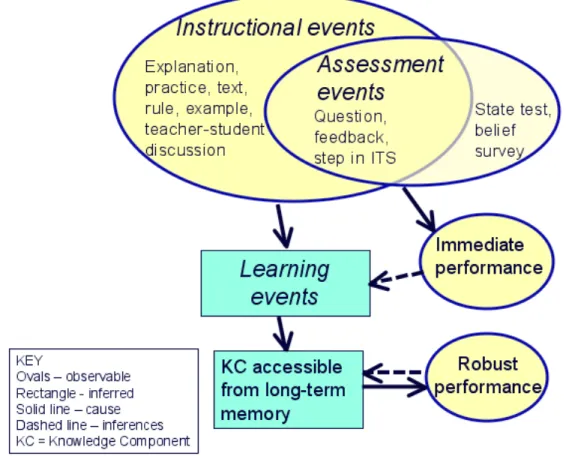
Central to analysis with the KLI framework is a set of observable and unobservable events: learning events, instructional events, and assessment events, which decompose the temporal progression of learning. Figure 1 represents the relationships among the three events.
Instructional and assessment events are observable changes to the instructional environment controlled by instructional designer or instructor. Instructional events are intended to produce learning (they evoke learning events). One can observe instructional events: a lesson, a 10 second episode on a computer, or a series of didactic moves by a teacher or computer tutor. Assessment events involve student response that is evaluated. Some assessment events are instructional, some are not. Test items are the most common kind of assessment event, but embedded assessments can occur in the context of instruction also, for instance, whether or not a student is correct without help on steps in a tutored problem-solving scenario. The unobservable entity in the triangle is the learning event, a central focus of the framework. Learning events are essentially changes in cognitive and brain states that can be inferred from data, but cannot be directly observed (brain imaging may be an exception) or directly controlled through
inferred from assessments of both immediate performance and robust performance, that is, performance that is remote in time (long-term retention) or in nature (transfer or future learning) from the activities during instruction. More detailed inferences about learning events can be informed experimentally, that is, by contrasts in performance due to differences in instructional or assessment events.
Figure 1. Understanding learning at the event level: Knowledge is acquired or modified during unobservable learning events inside students’ minds. These learning events are influenced by instructional events, in which the student’s learning environment is modified, and assessment events, in which student knowledge is inferred from performance either at the time of the event or later.
The goal of this event decomposition is to explain how observable instructional events affect unobservable learning events and associated changes in knowledge that can then be measured by assessment events, both in the near-term and long-term. There are scale issues to consider in this event analysis, especially time scale. Our focus is on intermediate size functional cognitive units and associated instructional, learning, and assessment events. Such events may vary in time from about 1 second, for instance, for a fact retrieval task with instructional feedback, to many
minutes, for instance, a classroom dialogue around the concept of an integer.
To apply this framework, we decompose learning in two ways, temporally and structurally. Temporally, we can decompose the instructional and learning process over time into smaller segments, or learning events, which are unobservable and usually bracketed by some change in
instructional input (an instructional event) or some request for student response (an assessment event). Structurally, we can decompose the otherwise undifferentiated changes occurring in the students’ minds into knowledge components. Learning events produce knowledge components (or changes thereof) and acquisition of these components is the purported explanation for consistency (e.g., in terms of similar error rate, response latency, or explanation) in student performance and transfer from one assessment event to another. The next section presents the notion of knowledge components and a taxonomy of different kinds of knowledge components.
3. Knowledge: Decomposing Task Complexity and Transfer
Others have argued for the importance for educational design of analyzing learning goals into components of knowledge (e.g., diSessa, 1993; Minstrell, 2001). For instance, Anderson and Schunn (2000) suggested “there is a real value for an effort that takes a target domain, analyzes it into its underlying knowledge components, … communicates these components, and monitors their learning”. Use of such cognitive task analysis to design instruction has been demonstrated to be quite effective in a number of training domains (e.g., Clark, Feldon, van Merriënboer, Yates, & Early, 2007; Lee, 2003), however, it is not a common approach for designing academic instruction. Cognitive task analysis remains as much an art as a science, in part, because of the unobservable nature of knowledge and limited scientific tools for characterizing it at a useful level of analysis. Thus, we think an effort toward defining a taxonomy of kinds of knowledge components is worthwhile and can be useful, we submit, even without costly implementation of computational models that has been the traditional approach of cognitive science.
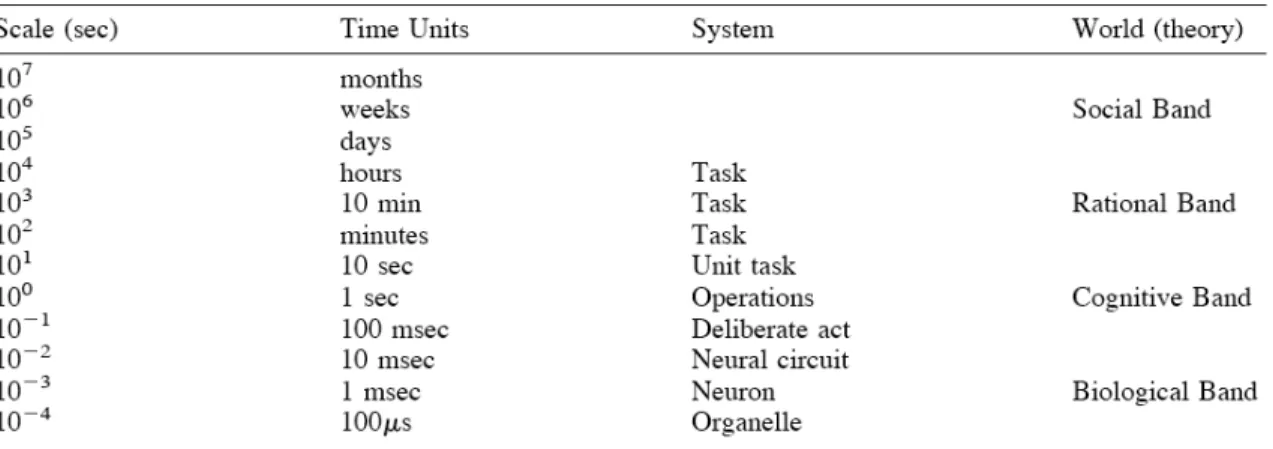
We define a knowledge component is an acquired unit of cognitive function or structure that can be inferred from performance on a set of related tasks. As a practical matter, we use “knowledge component” broadly to generalize across (and potentially ignore important distinctions between) other terms for describing pieces of cognition or knowledge, including theoretical terms like schema (e.g., van Merriënboer & Sweller, 2005; Cheng & Holyoak, 1985), production rule (e.g., Newell & Simon, 1972; Anderson & Lebiere, 1998), misconception (e.g., Clement, 1987), or facet (e.g., Minstrell, 2001) as well as more common terms such as concept, principle, fact, or skill (c.f., Bloom, 1956). Knowledge components describe mental processes at about the unit task level within Newell’s (1990) time scales of human action (see Table 1). Unit tasks last
about 10 seconds (between 1 second and a minute) are at the interface between what Newell called the “cognitive band” and “rational band”. Scientific investigation at these intermediate time scales (around a minute) is critical to make productive bridges between current
neuroscience advances within biological band (where millisecond mental processes are being explored) and educational research within the social band (where learning processes that recur over months are being explored).
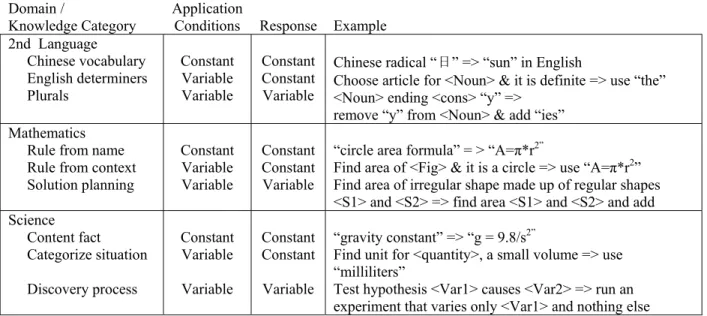
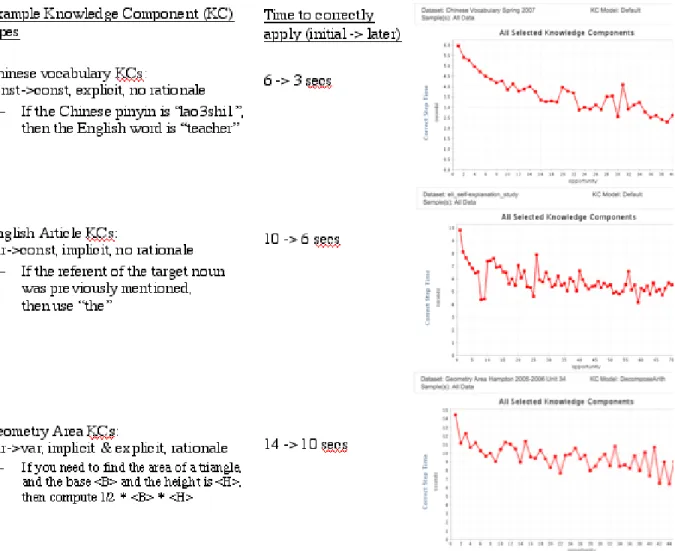
Table 2 provides some examples of kinds of knowledge components within second language learning, math, and science domains. Figure 2 shows sample learning curves of student performance in these domains. These curves illustrate, among other things, a rough
correspondence between the complexity of a knowledge component and the average time for a correct application (the left column in Figure 2). As we illustrate below, there are many different kinds of knowledge components, some are simpler and faster to apply and others are more complex and slower to apply. Distinguishing kinds of knowledge components and their complexity is important not only because deep analysis of domain knowledge is a powerful source for innovative instructional design, but also because different kinds of learning processes and instructional treatments may be more or less effective depending on the nature and
complexity of the target knowledge.
Knowledge components that function in a given task can be wide ranging, multi-leveled,
overlapping, and hierarchical (or not), thus generally posing a problem of how to target the right components for a given learning situation. Because the KLI framework targets the analysis of academic learning, our strategy is to focus on knowledge that is to be acquired by students in the academic course under analysis. This general strategy leads to a more specific one, to focus on the component level at which the novice student makes errors. Thus, while components are often embedded in other components and hierarchical (e.g., sentence comprehension relies on word identification, which relies on letter recognition), we choose the levels that are associated with the skill level and error performance that is actually observed. For second graders, word reading errors may lead to a focus on knowledge components relevant for word identification that are above the grapheme (letter) level. For adults learning Chinese, word reading errors could lead to a focus on the grapheme (character) level, stroke level, or radical level, depending on observable error patterns.
Table 2. Examples of different kinds of knowledge components in Second Language Learning, Mathematics and Science
Domain /
Knowledge Category Application Conditions Response Example 2nd Language Chinese vocabulary English determiners Plurals Constant Variable Variable Constant Constant Variable
Chinese radical “日” => “sun” in English
Choose article for <Noun> & it is definite => use “the” <Noun> ending <cons> “y” =>
remove “y” from <Noun> & add “ies” Mathematics
Rule from name Rule from context Solution planning Constant Variable Variable Constant Constant Variable
“circle area formula” = > “A=π*r2”
Find area of <Fig> & it is a circle => use “A=π*r2”
Find area of irregular shape made up of regular shapes <S1> and <S2> => find area <S1> and <S2> and add Science Content fact Categorize situation Discovery process Constant Variable Variable Constant Constant Variable “gravity constant” => “g = 9.8/s2”
Find unit for <quantity>, a small volume => use “milliliters”
Test hypothesis <Var1> causes <Var2> => run an experiment that varies only <Var1> and nothing else
3.1 Kinds of knowledge components
We describe examples of knowledge components (KCs) starting with simple kinds with a shorter time scale and move toward increasingly more complex knowledge components with a longer time scale. A knowledge component (KC) relates task features, or conditions of application to a response (see examples in Table 2).
A simple KC example is:
To state the meaning of the Chinese radical 日 in English, produce the word “sun.”
In this KC, the Chinese radical 日 and the goal of generating an English word are task features and the response is the production the English word “sun.”
Because knowledge components are unobservable, they are hypotheses about the nature of students’ capabilities that must be discovered from behavior on tasks or “assessment events”. In other words, KCs are not pre-determined by instructional designers, but can be empirically derived from sets of tasks that instructional designers can specify (either to characterize
instructional objectives or pre-requisites of a course). Some simpler KCs can be directly tied to a single task, for instance, the KC above corresponds with the task “What is the meaning of the Chinese radical 日?” for which the answer is “sun”. For such simpler KCs, the task features are external in the world (as mediated by perception) and the responses act on and change the external features, as in a motor response.
However, in more complex or “integrated” KCs, the features can be internal, in the mind (e.g., inferred features of a new goal), and the responses can be internal mental actions. An example of such an integrated KC is:
To find the area of irregular shape made up of regular shapes <S1> and <S2>, first find the areas of <S1> and <S2> and then add the results.
While knowledge may well be non-symbolic in its brain-based implementation, for purposes of scientific analysis, we describe knowledge components in a symbolic format, but distinguish whether the KC represents an implicit association, skill, or procedure that a student cannot verbalize and an explicit concept or procedure that a student can verbalize (cf., Alibali & Koedinger, 1999; Dienes & Perner, 1999). We employ a condition-response format to
emphasize that knowing is not just about knowing what or knowing how, but knowing when. Indeed, learning the conditions of application of knowledge, the “when”, may be more difficult than learning possible responses, the “what” (cf., Gobet & Wood, 1999; Zhu, Lee, Simon and Zhu, 1996).
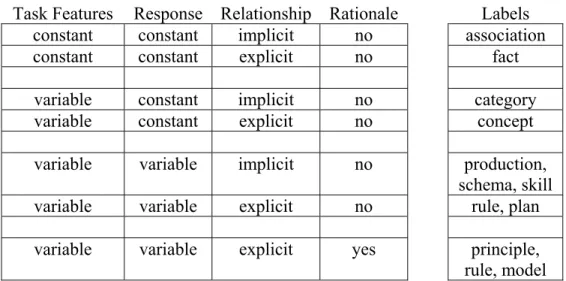
Table 3 illustrates a classification of knowledge components using the following dimensions: • The TASK FEATURES or conditions of application can be either constant or variable. • The RESPONSE can be either constant or variable.
• The RELATIONSHIP between the tasks feature(s) and response can be implicit or explicit. • A RATIONALE justifying the relationship between the task features and response may or
may not be known.
Table 3. Some Basic Knowledge Component Categories Task Features Response Relationship Rationale Labels
constant constant implicit no association constant constant explicit no fact variable constant implicit no category variable constant explicit no concept
variable variable implicit no production,
schema, skill
variable variable explicit no rule, plan
variable variable explicit yes principle,
rule, model
In the example KC above, the task feature (the Chinese radical 日) is a constant and the response (sun) is a constant. The relationship is explicit (i.e., students express it words), but there is no underlying justification for the relationship, it simply the result of conventions of the languages. As indicated in the last column of Table 3 (second row), such knowledge components are commonly called “facts.” These labels are rough mappings to commonly used terms and not necessarily one-to-one with the cells in this taxonomy (e.g., some “rules” have a rationale, like theorems in mathematics, but other “rules” may reflect regularities of arbitrary conventions, like grammar rules). It is an interesting question whether or not all 16 cells in the 4-dimensional space exist; certainly we do not have unambiguous labels for all cells. Our point, however, is to use these dimensions to better understand sources of complexity in knowledge acquisition and potential dependencies or constraints on relevant learning processes and instructional methods.
Constant->Constant KCs. The relatively simple “fact” KCs are pervasive in learning, including, for instance, vocabulary facts in 2nd language learning1. The relationship is explicit, but there is usually is no rationale or justification (cognates are an exception). An example of such fact knowledge is that the Chinese character for “lao3shi1” translates to the English word “teacher”. Acquiring such KCs is an important instructional objective in second language learning. Similar KCs are essential in middle school, high school and post-secondary mathematics and science, particularly, definitions of terms. For instance, “pi” is the ratio of a circle’s circumference to its diameter.2 These tend to be relatively minor components in post-elementary mathematics, but they can be significant barriers to learning. For example, student performance in the Assistment system (Feng, Heffernan, & Koedinger, 2009) reveals that errors in simple fraction
multiplication word problems (e.g., “What is 3/4 of 1 1/2?”) are often not about the math, but about students not knowing that “of” indicates “multiplication”. Because such
constant->constant KCs may be implicit associations for experts (i.e., they perform the translation without verbal awareness), they can lead to “expert blind spot” (Koedinger & Nathan, 2004). An expert can misjudge what makes learning difficult for novices because he is unaware of the knowledge he has acquired that makes some tasks easy for him (like comprehending an algebra equation), but not for students (cf., Biederman & Shiffrar, 1987).
Variable->Constant KCs. A second broad category consists of KCs with variable conditions of application and a single or constant response. KCs with this structure are essentially category-recognition rules. Some examples of such many-to-one mappings include article selection in English noun phrases, for instance, “to construct a noun phrase with a unique referent, use the article ‘the’” (e.g., “The moon …”). Such categorical or classification knowledge exists in mathematics as well, for instance, any expression that indicates the quotient of two quantities is a fraction3. Again such KCs may be represented only implicitly in a student’s (or expert’s) mind in that the student may be able to accurately recognize what expressions are fractions, but cannot articulate how she does so. For most first language English speakers, article selection knowledge is implicit – they do it effectively and fluently, but cannot explain their choices. We say a KC is known explicitly when students can explain the concept as well as give the right response under the right circumstances.
Variable->Variable KCs. Perhaps the largest category of KCs has variable conditions of application and has responses that vary depending on the conditions. An example in second
1 Vocabulary KCs for words with explicit morphological markers (e.g., past tense of regular verbs in English, like “jumped”) are not members of this constant->constant fact category, but of the variable->variable rule category (e.g., To form the past tense of <verb>, produce <verb> followed by “ed”).
2 Note that the explicit constant->constant relationship between “the ratio of circle’s
circumference to its diameters” and “pi” is arbitrary, with no rationale, but the explicit constant->constant relationship between “the ratio of circle’s circumference to its diameters” and 3.14 does have a rationale.
3 Note that knowledge of recognizing expressions as fractions (e.g., saying that “3/4” is a fraction but that “3-4” is not) is not the same as being able to state the definition of a fraction, which constant->constant KC (mapping “fraction” to “quotient of two quantities”).
language learning is a rule for generating an English plural: To form the plural of a singular noun <N> ending in an “s” sound or a “z” sound, form the word <N> “es”. In mathematics and
science, KCs which apply formulas to solve problems have a variable->variable structure, like: To find the area of a triangle with height <H> and base <B>, multiply <H> * <B> * 1/2. As with the other categories these KCs can be known implicitly, explicitly, or both. They can also vary in whether or not they have a rationale. The rules for creating plurals essentially arbitrary in that there is nothing about the world that forces them to be as they are and thus, different
languages have different ways to create plurals. Some KCs, on the other, have rationales and are essentially determined by nature. For instance, the formula for the area of a triangle is a provable regularity of Euclidean spaces that are approximated in the real world. We hasten to note that just because some KCs have rationales does not mean that students know the rationales when they know the KC. Quite to the contrary, it is often the case that a student may know a KC (an implicit or explicit one) and not know its rationale. The importance of the rationale feature of kinds of KCs, however, is relevant in considering whether certain forms of instruction, like collaborative argumentation or accountable talk (see below) will have purchase for a particular kind of knowledge component. The framework suggests a hypothesis that for KCs without a rationale, instructional approaches like collaborative argumentation or accountable talk may not be productive.
The distinctions between implicit and explicit KCs and those with and without a rationale are important for a number of reasons, but one of them is that different forms of the same idea can reinforce each other (e.g., Ainsworth & Van Labeke, 2004; Blum & Mitchell, 1998; Mayer, 2001; Mayer & Anderson, 1991; Paivio, 1990; Rittle-Johnson, Siegler, & Alibali, 2001; Wiley & Voss, 1999). Knowing a KC explicitly as well as implicitly may mean a student is more likely to recall it. Further, KCs that have rationales support sense making strategies whereby the
rationale, if known, can serve to reconstruct a partially forgotten knowledge component or better adapt it to unfamiliar (transfer) situations.
Another reason to make these distinctions is that they suggest different levels of complexities of KCs that may be associated with how difficult they are to learn. We discuss other kinds of KCs and sources of complexity further below, but first we present data from PSLC LearnLab courses that illustrate how the different kinds of KCs may yield different performance times.
KC Complexity, Time to Apply, and Time to Learn. KCs can vary substantially in complexity, both between and within the kinds of KCs discussed so far. Variations within a KC category can result from differences in the complexity of the conditions (i.e., how much encoding or recoding of the perceptual stimulus must be done) or the complexity of the response and how it is
constructed (i.e., the distance from motor operations). Across KC categories, KCs with variable conditions or responses tend to be more complex than constant conditions or responses, knowing a KC both explicitly and implicitly is more complex than knowing it just implicitly, and similarly knowing the rationale of a KC as well as the KC itself is more complex than knowing a KC without a rationale.
We suggest two ways to ground and estimate KC complexity. The first is theoretical. Simply put, the more complex the description of the KC, the more complex is the KC. Making this idea precise is not easy, but note related efforts in AI to define “description length” (Rissanen, 1978).
It requires making difficult decisions about what is the primitive or “atomic” level of KC description. Like molecules that can be made up of other molecules, descriptions of KCs may reference other KCs. Structure mapping theory (Gentner, 1983) provides one reasonably precise version of this idea in which knowledge structures are described as layers of relations between relations with the lowest layer being relations of surface features. Recall that our analysis is focused on students taking a specific course and thus we stop unpacking knowledge components into smaller components when the smaller components are ones that students can perform with a sufficiently high accuracy and fluency4.
Figure 2. Examples of different kinds of Knowledge Components and associated learning curves from student performance in units from three different courses, Chinese, English as Second Language, and High School Geometry. The curves on the right show the change in the average time for a correct application of a knowledge component (the y-axis) after successive opportunities to learn it (the x-axis). Data points are averaged over all students and knowledge components.
4 In a KC analysis for a particular course, a KC should be unpacked into smaller KCs when incoming student performance on tasks assessing those smaller KCs is sufficiently lower than a high threshold success rate (e.g., 95%), or in some cases, than a desired reaction time even when success rate is above threshold.
A second grounding of KC complexity is empirical and is in terms of the difficulty students have in applying the KC, one measure of which is the time it takes for students to correctly execute the KC. In general, simpler KCs can be executed more quickly, as suggested by the learning curves displayed in Figure 2. In these curves the y-axis is the average time for correct entries in computer-based tutoring systems for science, math, and second-language learning. The average is over each student on each target knowledge component in a particular unit of instruction. The x-axis shows the number of opportunities that students have had to practice and learn these knowledge components (feedback, hints, or examples of correct entries are provided as needed by individual students). In general, students learn with more opportunities and this relation is reflected in Figure 2 where the curves go down, indicating faster correct performance as opportunities increase.
Figure 2 shows learning curves from a Chinese vocabulary unit, an English grammar unit on use of articles, and a Geometry unit on area of figures. The Chinese Vocabulary unit involves constant->constant KCs like the Chinese character for “lao3shi1” translates to the English word “teacher”. Students’ correct performance of these KCs, which involves retrieving the correct response and typing it in, takes about three to six seconds on average (see Figure 1a). The English Article unit involves variable->constant KCs, like “if the referent of the target noun was previously mentioned, then use ‘the.’” Students’ correct performance of these KCs, which involves retrieving the correct response and selecting it from a menu, takes about six to ten seconds (see Figure 1b). The Geometry Area unit involves variable->variable KCs like if you need to find the area of a circle with radius <R>, then compute 3.14 * <R> ^ 2. These typically involve retrieving or constructing the needed mathematical operations or formula and typing in the arithmetic steps to be taken (e.g., 3.14*3^2) or the final result (e.g., 28.26). Correct entry takes about ten to fourteen seconds (see the third row in Figure 2).
Other empirical methods for estimating KC complexity are possible. In addition to time for correct performance, student difficulty with KCs can also be measured by error rates, for instance, the error rate observed on an associated paper test item (c.f., Koedinger, Alibali, & Nathan, 2008) or, within our computer tutors, the correctness of a student’s first attempt on a step (associated with a KC) without asking for a hint. Tutoring systems can further provide automated dynamic assessments of student learning process and progress. An “assistance score” is the amount of assistance a student needs to eventually get a step correct and is computed in the DataShop by adding the number of incorrect entries and number of hint requests a student makes on the step (e.g., 2 incorrect entries and 1 hint yields an assistance score of 3). The time to complete a step, including all incorrect entries and hint interactions, can also be informative and is provided by DataShop.
Other Kinds of Knowledge Components and Complexity Factors. Table 3 indicates some, but not all, important features of knowledge components and their complexity. Other kinds of knowledge have significance in understanding academic learning processes and have been the subject of investigations within the PSLC. These include integrative knowledge (e.g., Case & Okamoto, 1996; Slotta & Chi, 2006), prerequisite conceptual and perceptual knowledge (e.g., Booth & Koedinger, 2008), probabilistic knowledge (e.g., Frishkoff, Pavlik, Levin, & de Jong,
2008), incorrect or shallow knowledge (e.g., Aleven & Koedinger, 2002; Chi, Feltovich, & Glaser, 1981; Clement, 1987; Minstrell, 2001) and others.
We do not have space here to discuss all of these, but it is worth emphasizing that many
components of knowledge are not directly tied to a single behavioral pattern (e.g., like recalling an appropriate formula in a given situation), but can nevertheless be inferred from behavioral patterns across a variety of task situations. We call such a component an “integrative knowledge component” because it must be integrated (or connected) with other KCs to produce behavior (it is not “atomic” in the sense discussed above). Such components might also be referred to as “hidden” or “cognitive” because they are not easily inferred from direct behavioral data. A typical strategy for such inference is to use a subtraction methodology where performance differences in two related tasks implicate an integrative KC. For example, Heffernan and Koedinger (1997) found students were significantly worse at translating two-step algebra story problems into expressions (like 800-40x) than they were at translating two closely matched one-step problems (with answers 800-y and 40x). They hypothesized that many students are missing an integrative KC that is necessary to solve the two-step problems but not for the one-step, namely an algebra grammar rule indicating that more complex expressions (like 800-40x) can be made up of simpler ones (40x). Recent research supports this hypothesis by showing how instruction specifically designed to address learning of this hidden KC significantly improved student performance (Koedinger & McLaughlin, in press).
Integrative KCs have a condition or an action that is an internal mental state like deep feature condition not directly observable or completely accurately inferred by target students from the external problem scenario or activity context. The above algebra grammar rule is integrative in that it requires integration with other knowledge, other simpler grammar rules, to produce an external behavior, an output.
In section 5, we discuss how different kinds of knowledge may have bearing on whether or not an instructional principle is relevant and effective. For instance, it may be that when the target of instruction is probabilistic knowledge or rules with many exceptions, more explicit forms of instruction (e.g., instructional explanations or prompts for self-explanations) will be relatively less effective than they are for other kinds of knowledge. Teaching or eliciting explicit rules may be counter-productive because there are too many exceptions and the probabilistic knowledge patterns are better acquired simply through examples and repeated practice with feedback. The opposite may be true for integrative knowledge where more implicit forms of instruction (e.g., example study, repeated practice) may not be sufficient for the brain to induce the necessary deep features and mental conceptual structures that implement the integration. In this case, providing and eliciting explanations may be critical to break down the complexity of the learning task and externalize the more complex chains of credit and blame assignment needed to construct integrative knowledge.
The sources of input for learning, whether examples or verbal descriptions, have alternative interpretations and this ambiguity means that students will often acquire knowledge that is incorrect. Usually that knowledge has some validity in that it produces correct behavior in some circumstances. The difficulty students experience in acquiring target knowledge depends not only on the complexity of the knowledge itself, for which the taxonomy above well addresses,
but is also affected by the field of alternative interpretations. These field effects may be competitive, making learning more difficult, or cooperative, and make learning easier. For instance, in learning the English article system, it is tempting to acquire the rule that “an” is used rather than “a” when the first letter of the following noun is a vowel. This rule is consistent with most example uses, but in fact is incorrect, “an” used when the first sound is a vowel (e.g., “an honorarium”). Learners are often drawn (perhaps much more often than we tend to recognize) to make reasonable (implicit or explicit) interpretations of one or more examples that are incorrect. In geometry, for instance, students appear to implicitly acquire a rule that angles that look equal in a diagram are equal (Aleven & Koedinger, 2002). This issue of field effects is clearly relevant to instructional design as some design choices are more likely to tempt incorrect interpretations (cf., Chang, Koedinger, & Lovett, 2004), some may reduce that likelihood (e.g., Chang, 2006; Paas & Van Merrienboer, 1994; Schmidt & Bjork, 1992; Shea, Kohl, & Indermill, 1990). Other instructional design choices may leverage cooperative field effects, like concrete representations supporting abstract knowledge acquisition (cf., Goldstone & Son, 2005; Koedinger & Anderson, 1998; but see also Kaminski, Sloutsky, & Heckler, 2008) or sources of inductive bias from prior learning (e.g., object bias in word learning) or other related knowledge. That an idea or skill may be mentally represented in multiple forms (e.g., example, implicit rule, explicit rule) and connect in multiple ways to related knowledge components (e.g., links to other modalities or to a rationale) is likely to be critical to robust knowledge acquisition and retention. Support for this claim comes from both human learning (e.g., Ainsworth & Van Labeke, 2004; Mayer, 2001; Mayer & Anderson, 1991; Paivio, 1990; Rittle-Johnson, Siegler, & Alibali, 2001; Wiley & Voss, 1999) and machine learning (e.g., Blum & Mitchell, 1998; Caruana, 1997; Muslea, Minton, & Knoblock, 2002; von Neumann, 1956) research.
3.2 Knowledge Component Complexity Guides Instructional Decisions
A fundamental KLI assumption is that many learning processes and instructional design decisions are not intrinsically domain-based, but are determined by the type of KCs being learned (cf., Sweller & Chandler, 1994; Wulf & Shea, 2002). While some types of KCs (e.g., constant-constant KCs) may be particularly prevalent in some domains (e.g., second language vocabulary learning), instructional principles should refer to KCs rather than to domains. For example, a hypothetical principle “drill and practice is not effective for mathematics” is at the wrong level of analysis because it does not describe what it is about mathematics that makes drill and practice unsuitable. Instead, we believe it is more productive to associate instructional design decisions with knowledge component types and associated learning processes, such as:
Study-practice trials (e.g., Pavlik, 2007) support constant->constant fact encoding and memory strengthening
Worked examples, tutored practice (e.g., Koedinger & Aleven, 2007), and apprenticeship-style model-scaffold-fade strategies (e.g., Collins, Brown, Newman, 1989) support inductive learning and compilation of implicit knowledge of variable condition categories and
productions,
Prompted self-explanations involve verbally-mediated reasoning chains that lead to
construction of explicit knowledge of concepts and rules and to integrative knowledge that connects implicit and explicit knowledge components
Accountable talk moves (Michaels, O’Connor, & Resnick, 2008) by teachers, like “Is this always true?”, prompt verbally and socially-mediated reasoning chains that can lead to more elaborated integrative knowledge connecting rationales to explicit concepts and principles It remains an open question whether domain specificity constrains the form of knowledge components in a deep qualitative way or only in a quantitative way. To the extent that domains reflect biological constraints, one might consider the possibility of qualitative differences. Thus first language learning would have constraints that make it easier (KCs are partly given) than say algebra learning. However, second language learning may cede this advantage, becoming more like algebra learning than first language learning. These are important questions that require their own research, but for our purposes we believe domain-specific knowledge components are necessary as a starting point and the connection across domains is to be determined. In the following sections we discuss the wide variety of kinds of (unobservable) learning processes that mediate between kinds of (observable) instructional events and the resulting acquisition of different kinds of (unobservable) knowledge (see Figure 1).
4. Learning: Toward a Taxonomy of Processes for Knowledge Acquisition and Improvement
There are many robust learning processes and a goal for the macro-level of the KLI framework is to formulate a useful taxonomy for them. Our theoretical framework recognizes three major categories of learning processes, listed from simpler to more complex:
A. Fluency building processes: Implicit learning processes involved in memory
strengthening and streamlining of knowledge to produce more automatic and composed (“chunked”) knowledge. Fluency building can be conceived as making the link between the condition and response of a KC more direct, more consistent, faster to response, and more resistant to interference.
B. Refinement processes: Non-verbal learning processes that improve the accuracy of
knowledge including generalization, discrimination, classification, categorization, causal induction, non-verbal explanation-based learning (short non-verbal deductive chains). Refinement can be conceived as modifying the condition (or response in the case of a variable response) part of a KC to make it more accurate, that is, more likely to produce desirable behavior under appropriate circumstances.
C. Sense making processes: Explicit (language-mediated) learning strategies wherein
students deliberately try to understand the instruction or engage in higher-level thinking including comprehension of verbal descriptions of KCs, verbal explanation-based learning, scientific discovery, explicit rule-mediated deduction. Sense making can be conceived as making links between implicit and explicit forms of knowledge or between a KC and its rationale.
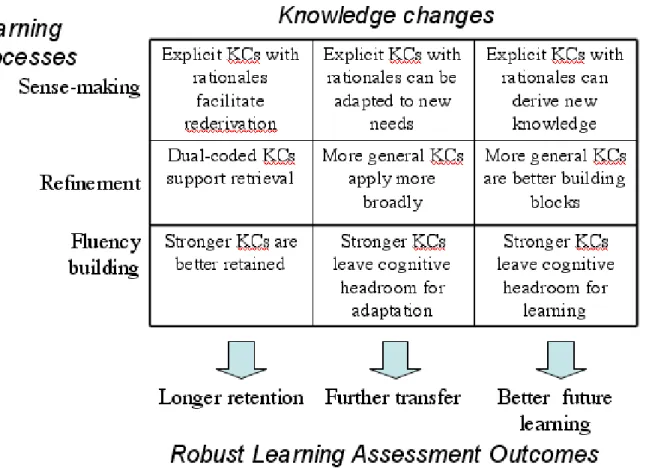
Figure 3 illustrates how these different learning processes can lead to different kinds of knowledge changes and ultimately to measurable robust learning outcomes.
Figure 3. How different classes of learning processes change knowledge to yield different robust learning outcomes.
Fluency building processes. The brain is constantly engaged in creating and strengthening of
connections between the conditions and responses of knowledge components in use.
Strengthening operates all throughout learning from the initial formation of a KC to each time it is subsequently used. It operates on all kinds of KCs from the simplest implicit
constant->constant associations to the most complex variable->variable schemas or model structures. Even after a knowledge component becomes well established (reliably applied by the student) and its information content is not changing much, fluency-building processes continue to act, leading to fast and effortless performance. There are two principle processes underlying fluency gains, knowledge compilation and strengthening, although it is not clear they are different as opposed to reflecting different levels of analyses. Knowledge compilation leads to faster application of a knowledge component. In compilation, an initial declarative encoding of knowledge components is proceduralized into a directly executable form (Anderson & Lebiere, 1998) and chains of small knowledge components may be composed into a single larger KC. In strengthening, knowledge components become more available in memory with repeated use, resulting in faster and more reliable retrieval of KCs.
Part of the study of fluency is determining how it accelerates further learning (see the lower right cell in Figure 3). Although it is widely believed that mastery of the parts facilitates more
open questions that address knowledge-based influences on learning are at a level of analysis that is critical for engineering effective academic courses, but which falls between lower analyses cognitive psychology and cognitive neuroscience and high level analyses of education research -- in other orders, at a level of analysis the KLI framework is intended to address.
Refinement processes. Refinement processes involve modifications to knowledge components,
particularly to the conditions or features under which the knowledge is retrieved and should be applied. Like fluency building processes, knowledge refinement processes can occur throughout the “lifetime” of a KC (or of a cluster of related KCs). Refinement processes are relevant to Variable->Constant and Variable->Variable KCs. These processes modify the condition part of the KC and may add a missing relevant feature to the condition of a knowledge component (a "discrimination") or remove an irrelevant feature (a "generalization"). For instance, consider a typical novice knowledge component in geometry: "If angles look equal, then they are equal" (Aleven & Koedinger, 2002). While this knowledge component can yield correct answers, it is incorrect in general. A student may refine this knowledge component by removing the irrelevant feature "angles look equal" or by adding a relevant feature, like "angles opposite each other in crossing lines" or "angles that are base angles of an isosceles triangle". Such refinement leads to a knowledge component with higher “feature validity”, meaning it is now more likely to be applied when appropriate and not applied when inappropriate. Early learners may make errors in the refinement process by adding an irrelevant feature condition to a knowledge component (e.g., because in an example the angles that are concluded to be equal, do look equal, a student may incorrectly induce that looking equal is a relevant feature) or by failing to add a relevant feature (e.g., not notice that the base angles in an isosceles triangle are the ones across from the equal sides).
While fluency-building processes involve core mechanisms of the cognitive architecture, such as memory strengthening, refinement processes make use of existing knowledge, such as more elemental KCs that may be composed into the condition or response of a larger KC. They also draw on cognitive resources and take time to execute. Unlike the sense-making processes discussed next, refinement processes can operate without explicit awareness and cannot be directly verbalized. Specific kinds of refinement learning mechanisms (non-verbal learning processes that improve the accuracy of knowledge) can be found in the cognitive science and machine learning literatures including generalization (e.g., Catrambone, 1996; Hummel & Holyoak, 2003; Shepard, 1987), discrimination (e.g., Chang, 2006; McClelland, Fiez, & McCandliss, 2002; Richman, Staszewski, & Simon, 1995), perceptual chunking (e.g., Gobet, 2005; Servan-Schreiber & Anderson, 1990), classification and categorization (e.g., Blum & Mitchell, 1998; Collins & Singer, 1999; DiBello, Stout, & Roussos, 1995; Medin & Schaffer, 1978; Quilici & Mayer, 1996), non-verbal explanation-based learning (Mitchell, Keller, & Kedar-Cabelli, 1986).
We use refinement to refer to feature changes whether they are changes to explicit (declarative or verbal) knowledge components, or changes to implicit (procedural or non-verbal) knowledge components. Learning from examples or by experience may result in feature refinements that students cannot verbalize. For instance, first language learners acquire the features for correct choice of articles, like "a" and "the", without being able to articulate the explicit rules for article choice. Even second language learners, as well as math and science learners, engage in such
non-verbal feature refinement and produce implicit knowledge. Non-non-verbal feature refinement can also produce explicit, verbal knowledge. Such cases are indicated when a student can express a rule with correct features (e.g., “it is the base angles of an isosceles triangle that are equal”), but cannot explain how they learned (came to know) those correct features. When a student can explain, they are engaging in sense making, which is discussed in the next section.
Sense-making processes. Sense-making processes are robust learning strategies wherein
students try to understand the instruction or engage in higher-level, language-mediated thinking to create knowledge, perhaps independently of instruction. Sense-making processes involve explicit reasoning and include comprehension strategies, self-explanation, and social
argumentation. While sense making can focus on task features and responses, it plays a key role in transforming implicit relationships into explicit relationships, thereby transforming constant-constant associations into facts, variable-constant-constant categories into concepts, and variable-variable productions into rules. Similarly, when sense-making focuses on the rationale for a feature-response relationship, it transforms variable-variable rules into principles.
As with fluency building and refinement, sense making may occur at any point during the lifetime of a KC. However, unlike fluency building processes, which are always active (i.e., running as a background process in the brain’s hardware architecture), sense-making strategies are deliberate and occur only when a student chooses to engage in them. Unlike refinement learning mechanisms, which are non-verbal, sense-making strategies are explicit, in the sense of being supported by the use of words or external symbols (whether sub-vocalized, written, or spoken in social dialogue). Sense-making processes include explicit comprehension strategies (e.g., Graesser, McNamara, & VanLehn, 2005; Palinscar & Brown, 1984), verbally-mediated self-explanation (e.g., Ainsworth, S., & Loizou, 2003; Chi, Bassok, Lewis, Reimann & Glaser, 1989; Lewis, 1988; VanLehn, Jones, & Chi, 1992), explicit hypothesizing and scientific
discovery processes (Levine, 1966; Klahr & Dunbar, 1988), deductive proof (e.g., Stylianides & Ball, 2008; Stylianides & Stylianides, 2009), and explicit argumentation like collaborative discourse (e.g., Asterhan & Schwarz, 2007; 2009).
Summary. Characterizing the range of learning processes is important because they provide the causal link between instructional methods and changes in student knowledge. The KLI
framework suggests there are likely to be important dependencies between kinds of knowledge, learning processes, and choices of most effective instructional methods. We have indicated above some dependencies between knowledge and learning processes, for instance, that fluency building processes may be most important for learning simple Constant->Constant components without a rationale whereas sense making processes may be most important for learning more complex Variable->Variable components that have a rationale (and may be irrelevant for components without a rationale). Fluency-building processes may also be relevant for more complex Variable condition components that, for instance, may not last in long-term memory without appropriate repetition. Similarly, refinement processes are also likely to be relevant for the kinds of complex integrated and interconnected KCs (with rationales) produced by sense-making processes. These observations suggest a potential asymmetry whereby simpler learning processes (fluency and refinement) may support complex knowledge but complex learning processes (e.g., argumentation) may not be relevant to simple knowledge (e.g., arbitrary Constant->Constant associations).
In the next section we describe examples of some instructional principles that characterize methods that have been experimentally demonstrated to yield better robust learning efficiency outcomes then reasonable alternatives. After that, in section 6, we provide a more detailed analysis of one of these principles. Finally, in section 7, we return to the issue of dependency and, in particular, hypothesize a general relationship between knowledge component types and instructional methods.
5. Instructional Principles and Hypotheses About their Effectiveness
The main question for this section is what kinds of instructional events yield robust learning in an efficient way? We are not only concerned about robust learning outcomes, but the
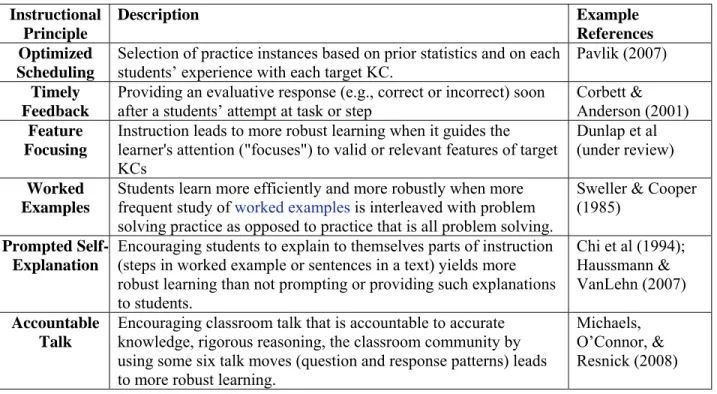
instructional time in which they are achieved. We seek principles that achieve greater robust learning outcomes without taking more time or that achieve equivalent robust learning, but in significantly less time. Table 4 shows a list of instructional principles from simplest to most complex. The simplest, Optimized Scheduling, has tended to be used with the simplest kinds of knowledge components, constant->constant facts (e.g., Pavlik, 2007). The most complex, Accountable Talk, has tended to be used with the most complex kinds of knowledge
components, explicit principles with rationales. We next describe some of these in more detail. Table 4. Some examples of instructional principles, roughly from simpler to more complex. Instructional Principle Description Example References Optimized Scheduling
Selection of practice instances based on prior statistics and on each students’ experience with each target KC.
Pavlik (2007)
Timely Feedback
Providing an evaluative response (e.g., correct or incorrect) soon after a students’ attempt at task or step
Corbett & Anderson (2001)
Feature Focusing
Instruction leads to more robust learning when it guides the learner's attention ("focuses") to valid or relevant features of target KCs
Dunlap et al (under review)
Worked Examples
Students learn more efficiently and more robustly when more frequent study of worked examples is interleaved with problem solving practice as opposed to practice that is all problem solving.
Sweller & Cooper (1985)
Prompted Self-Explanation
Encouraging students to explain to themselves parts of instruction (steps in worked example or sentences in a text) yields more robust learning than not prompting or providing such explanations to students. Chi et al (1994); Haussmann & VanLehn (2007) Accountable Talk
Encouraging classroom talk that is accountable to accurate knowledge, rigorous reasoning, the classroom community by using some six talk moves (question and response patterns) leads to more robust learning.
Michaels, O’Connor, & Resnick (2008)
Optimized Scheduling
This principle involves applying an instructional schedule that has been ordered to maximize robust learning. Optimized scheduling involves maximizing instructional efficiency (i.e., robust learning gains per instructional time spent) by mathematically deriving when a student should repeat practice of a knowledge component. The time interval between practice opportunities of a KC is optimal (neither too short or too long) when it best balances the benefit of enhanced