Large-Scale Spectral Clustering on Graphs
Jialu Liu
Chi Wang
Marina Danilevsky
Jiawei Han
University of Illinois at Urbana-Champaign, Urbana, IL
{
jliu64, chiwang1, danilev1, hanj
}
@illinois.edu
Abstract
Graph clustering has received growing attention in recent years as an important analytical technique, both due to the prevalence of graph data, and the usefulness of graph structures for exploiting intrin-sic data characteristics. However, as graph data grows in scale, it becomes increasingly more chal-lenging to identify clusters. In this paper we pro-pose an efficient clustering algorithm for large-scale graph data using spectral methods. The key idea is to repeatedly generate a small number of “supernodes” connected to the regular nodes, in or-der to compress the original graph into a sparse bipartite graph. By clustering the bipartite graph using spectral methods, we are able to greatly im-prove efficiency without losing considerable clus-tering power. Extensive experiments show the ef-fectiveness and efficiency of our approach.
1
Introduction
Graph data composed of large numbers of data objects inter-connected with each other via meaningful relationships, has become increasingly prominent in real life. Examples include friendship graphs in Facebook, web pages connected by hy-perlinks, and co-author graphs in bibliographic data. In many other machine learning applications, pairwise similarities be-tween data objects can be modeled using a graph, and the sub-sequent problem of data clustering can be viewed as a graph clustering problem.
Graph clustering aims to partition the nodes into densely connected subgraphs such that nodes within the same cluster have more connections than those in different clusters. Dis-covering clusters in graph not only helps to visualize and de-fine hierarchies [Hermanet al., 2000], but is also meaning-ful for many real world problems, such as community detec-tion [Fortunato, 2010; Smyth and White, 2005] and outlier detection [Guptaet al., 2012]. In addition, clustering results can be used as building blocks for many other algorithms to reduce graph and model complexity [Song et al., 2008; Dalvi et al., 2008]. Using and interpreting such methods without some form of summarization becomes difficult as graphs grow in size. However, actually discovering clusters
becomes quite challenging as graphs balloon in size, a com-mon phenomenon in today’s era of “big data.” Thus, there is a pressing need to develop efficient and effective clustering algorithms that can be adapted for large-scale graphs.
In this paper, we propose such an algorithm using spec-tral methods, which have been widely used for effective graph clustering [Shi and Malik, 1997]. Many previous stud-ies have examined accelerating spectral clustering. Most of these [Shinnou and Sasaki, 2008; Yanet al., 2009; Sakai and Imiya, 2009; Chen and Cai, 2011] have been devoted to data represented in a feature space instead of a graph. Other ap-proaches are designed to achieve efficiency by finding nu-merical approximations to eigenfunction problems [Fowlkes et al., 2004; Chenet al., 2006; Liuet al., 2007] or adapting standard eigensolvers to distributed architecture [Chenet al., 2011; Miaoet al., 2008]. In contrast, we aim to mitigate the computational bottleneck by reducing the size of the graph, while still providing high-quality clustering results, as com-pared to standard spectral methods. Specifically, we gener-ate meaningfulsupernodeswhich are connected to the orig-inal graph. Correspondingly, we obtain abipartitestructure which preserves the links between original graph nodes and the new supernodes. In this representation, we expect these supernodes to behave as cluster indicators that may guide the clustering of nodes in the original graph. Furthermore, the supernode clustering and regular node clustering should mu-tually help induce each other. In this way, the clustering of the original graph can be solved by clustering the bipartite graph. By controlling the number of supernodes and enforc-ing the sparsity of the generated bipartite graph, we are able to efficiently achieve this goal.
It is worthwhile to highlight several key aspects of the pro-posed approach:
1. As far as we know, this is the first exploration of a large-scale graph clustering algorithm which uses spec-tral methods on a transformation of the graph structure. The proposed design greatly reduces time requirements without considerably impacting performance.
2. Our method scales well. Most of the computations are simple matrix multiplications and thus can be easily implemented and efficiently processed in distributed or multi-core architecture.
3. We propose two alternative approaches in this paper. The first uses a one-step generation of supernodes, and
the second adopts an iterative framework to regenerate supernodes based on the clustering result obtained from the previous step.
2
Related Work
The general spectral clustering method [Ng et al., 2001; Shi and Malik, 1997] was first shown to work on data repre-sented in feature space. As we are mainly interested in graph data, we need one more step to construct an adjacency matrix which takesO(n2p)time wherenandprepresent number of data points and features respectively. Calculating the eigen-decomposition of the corresponding Laplacian matrix is the real computational bottleneck, requiring O(n3) time in the
worst case. Therefore, applying spectral clustering for large-scale data becomes impossible for many applications. In re-cent years, many works have been devoted to accelerating the spectral clustering algorithm.
Among them, [Fowlkes et al., 2004] adopts the clas-sical Nystr¨om method, which was originally proposed to find numerical approximations to eigenfunction problems. It chooses samples randomly to obtain small-size eigenvec-tors and then extrapolates these solutions. [Shinnou and Sasaki, 2008] reduces the original data set to a relatively small size before running spectral clustering. Similar to this idea, in [Yanet al., 2009], all data points are collapsed into centroids through k-means or random projection trees so that eigen-decomposition only needs to be applied on the centroids. [Sakai and Imiya, 2009] uses random projec-tion in order to reduce data dimensionality. Random sam-pling has also been applied to reduce the size of data points within the eigen-decomposition step. [Chen et al., 2006; Liu et al., 2007] introduce early stop strategies to speed up eigen-decomposition based on the observation that well-separated data points will converge to the final embedding more quickly. In [Chen and Cai, 2011], landmark points are first selected among all the data points to serve as a codebook. After encoding all data points based on this codebook, accel-eration can be achieved using the new representation. The authors in [Khoa and Chawla, 2012] work on resistance dis-tance embedding, which employs a similar idea to spectral clustering and exhibits comparable clustering capability.
3
Revisiting Spectral Clustering
In this section, we briefly introduce the spectral clustering algorithm [Shi and Malik, 1997; Ng et al., 2001]. Sup-pose that we are given an undirected and weighted graph G = (V, E). Assume |V| = n represents the number of nodes and|E|=mrepresents the number of edges or links1.
We can then use a non-negative weightedn×nadjacency matrixWto describeG, whereW ={Wij}i,j=1,...,n. Based onW, theLaplacian matrixLis defined as follows:
L=D−W
whereD is a diagonal matrix whose entries are column (or row, sinceW is symmetric) sums ofW. Based on this Lapla-cian matrix, spectral clustering aims to find k orthonormal
1
In the following sections, edges and links are used interchange-ably.
column vectorsX1, X2, . . . , Xkwith the objective function:
min
X T r(X
TD−1/2LD−1/2X) s.t.XTX=I whereX ∈Rn×kis a matrix consisting of the column vectors
andkis the number of clusters.
It turns out that these vectors are indeed the eigenvectors corresponding to theksmallest eigenvalues obtained from the eigen-decomposition (EVD) on D−1/2LD−1/2. After row
normalization of these eigenvectors, one can apply any clas-sical clustering algorithm such ask-means to partition these low-dimensionalembeddings. It is worth noting that the com-plexity of EVD on ann×ngraph isO(n3)without
consid-ering the sparsity or calculating limited pairs of eigenvalues and eigenvectors.
4
Large-Scale Spectral Clustering on Graphs
Now we introduce our Efficient Spectral Clustering on Graphs (ESCG) for large-scale graph data. The basic idea of our approach is designing an efficient way to coarsen the graph by generating supernodes linked to the nodes in the original graph. A bipartite graph between nodes in Gand generated supernodes is then constructed to replaceG, so that the original high-dimensional EVD can be avoided.4.1
Generation of Supernodes
Given the initial graphGofnnodes, we want to generate a set ofdsupernodes to coarsen the graph under the condition that d n. Inspired by the intuition behindsimultaneous or co-clustering[Dhillon, 2001], which says that clustering results of two related object types can be mutually enhanced, we expect that a partition of supernodes can induce a parti-tion of the observed nodes, while a partiparti-tion of the observed nodes can imply a partition of supernodes. Therefore, we first develop a simple and efficient algorithm to establish an initial clustering on graph G. Then we generate supernodes based on this initial clustering.
Our proposed approach works as follows: given the graph G, we randomly pickdseeds in the graph and compute short-est paths from these seeds to the rshort-est of the nodes. We then partition all the nodes intoddisjoint subsets represented by the seeds: each node chooses the representative seed with the shortest distance.
To solve the shortest path problem, we first transform the edge weight demonstrating the similarity into distance:
Mij =−log Wij maxW +ε
whereεis a very small number that functions as the addi-tional decay along the path. We incorporate the decay in or-der to prevent the possible distance between two nodes from being0. The logarithmic transformation is adopted because the summation of Mij’s along the paths in the graph can be viewed as the multiplication of the edge weights, which makes sense for estimating the distance for any pair of nodes. After this step, the range of the distance value on each edge should be within[ε,+∞). Dijkstra’s algorithm is then adopted to compute the shortest paths from seeds to the rest of the graph, which takesO(md+ndlogn)time.
After running Dijkstra’s algorithm, we are able to parti-tion all nodes inGintoddisjoint subsets by comparing their shortest paths to the seeds. We assign each node to the par-tition with the closest seed. Note that this step can be imple-mented in parallel.
Given these d disjoint subsets, d supernodes in total are assigned accordingly. The linkage between supernodes and regular nodes inGis described by a binary matrixR∈Rd×n. Each element inR is set to be 1 if there is a link between supernode and regular node. It should be noted thatRis also a sparse matrix whose Frobenius norm is equal to√n. At this point, we know thatRcontains the edges between supernodes and regular nodes whileW describes the edges withinG. We therefore absorbW intoRto finish transformingGinto the bipartite graph. In abipartitegraph, the nodes can be divided into two disjoint groups, such that edges only exist between nodes in different groups. Denote the associated edge weight matrixWˆ ∈Rd×nof the bipartite graph is as follows:
ˆ
W =RW. (1)
The design of this step can also be explained with the fact thatRis essentially a one-to-many bipartite graph whileWˆ is a many-to-many graph. Only in the latter case is each su-pernode related to many regular nodes and vice versa. Obvi-ously, this many-to-many relationship can be further modeled to achieve the goal mentioned at the beginning of this subsec-tion, i.e., to propagate clustering information between nodes located on both sides of the bipartite graph. It is also worth noting that in order to obtain better clustering power, intu-itivelydshould be set larger so that the information loss in going toWˆ fromW is smaller.
4.2
Spectral Clustering on Reduced Graphs
Through the transformation to the bipartite graph, we sig-nificantly reduce the size of the full edge weight matrix of G from n ×n to d ×n. In this section, we introduce how to convert the EVD of the graph Laplacian mentioned in the previous section into a singular value decomposition (SVD) problem, such that the overall time complexity is O(md+ndlogn+nd2), which is a significant reduction fromO(n3)sincedn.
To begin, we give the adjacency matrix of the bipartite graph described above:
W0 = 0 WˆT ˆ W 0 .
Here, we use the “prime” notation to denote the adjacency matrix, which is a square matrix of size(n+d)×(n+d). Hence we also have representations forL0andD0in this bi-partite model: L0= D1 −WˆT −Wˆ D2 ,and D0= D1 0 0 D2
whereD1 andD2 are two diagonal matrices whose entries
are column and row sums ofWˆ, respectively.
The generalized eigen-decomposition (GEVD) ofL0 and D0can be written as D1 −WˆT −Wˆ D2 u v =λ D1 0 0 D2 u v . (2)
Algorithm 1Efficient Spectral Clustering on Graphs (ESCG)
Input: Adjacency matrixW ∈ Rn×nfor graphG, number
of clustersk, desired number of supernodesd
Output: Clustering of nodes inG
1: Randomly sampledseeds and apply Dijkstra’s algorithm to compute shortest paths.
2: Partition nodes intoddisjoint subsets with shortest paths.
3: Generatedsupernodes and build their connections tod disjoint subsets respectively with matrixR∈Rd×n.
4: Compute matrix Wˆ indicating the adjacency for the transformed bipartite graph by Eq. 1.
5: ComputeZ = D−12 /2W Dˆ 1−1/2 whereD1 andD2 are
diagonal matrices of column and row sums ofWˆ.
6: Obtain the largest k eigenvalues and corresponding eigenvectors fromZZT.
7: Generate right singular vectorsXofZas in Eq. 4 .
8: Form the matrixU =D−11 /2X.
9: Treat each row ofUas a node inRk, partition these nodes
intokclusters viak-means algorithm.
Under the representation ofx =D11/2uandy = D21/2v, Eq. 2 becomes
D2−1/2W Dˆ 1−1/2x= (1−λ)y D1−1/2WˆTD2−1/2y= (1−λ)x.
For convenience, we useZto denoteD−12 /2W Dˆ −11 /2and the relationship betweenxandyis then seen more clearly:
Zx= (1−λ)y, ZTy= (1−λ)x. (3) It is easy to verify thatxretains the clustering information of original nodes inG, andy retains that of the supernodes, which are inherited from u andv, respectively. Therefore, Eq. 3 justifies the intuition that the partitions of the origi-nal nodes and those of the supernodes can induce each other through linear operations. In fact, xandy are mutually af-fected by Z, which is essentially a normalized edge weight matrix between the original nodes and the supernodes. How-ever,xandydo not directly indicate the cluster membership of each node in the bipartite graph since they themselves are normalizations ofuandvwhereuandvare real relaxations into discrete partitions, as in spectral clustering.
In addition, Eq. 3 demonstrates that xandy are the left and right singular vectors corresponding to the largest sin-gular values of Z. Thus, the GEVD ofL0 andD0 that was previously mentioned is not necessary to save computation time. Note that the size ofD−12 /2W Dˆ −11 /2remains the same asWˆ, i.e.,d×n. Thus, a better way to computexis to first estimateybecausedis much smaller thann,.
Denote the SVD ofZas follows: Z =YΣXT
where Σ = Diag(σ1, σ2,· · ·, σd) and Y ∈ Rd×d (X ∈
Rn×d) are left (right) singular vectors. Moreover,X andY are two matrices formed by pairs of column vectors xand y satisfying Eq. 3. It is easy to check that the left singular
Algorithm 2Regeneration of Supernodes
Input: Embedding matrixU ∈Rn×k
Output: Sparse matrix Rdescribing the links between
su-pernodes and regular nodes inG
1: Initialize a sparse matrixR∈R(2k−2)×n.
2: fori= 2tokdo
3: Compute meanU·,iof vectorU·,i.
4: SetR2×i−3,j to 1 ifUj,i≤U·,ifor allj ∈1,· · ·, n.
5: SetR2×i−2,j to 1 ifUj,i> U·,ifor allj ∈1,· · ·, n.
6: end for
vectors of Z are exactly the eigenvectors of ZZT and the corresponding eigenvalues areσ21, σ22,· · · , σ2d. Thus, by per-forming eigen-decomposition ofZZT, we can directly obtain Y andΣ2. As these singular values are all nonnegative real
numbers andY is an unitary matrix, we can getXas follows: XT = Σ−1YTZ (4) As the final step,k-means is usually adopted to cluster the “top” kcolumn vectors of normalized X. Other clustering approaches such as hierarchicalk-means or approximate k-means may also be used to achieve better efficiency. Alg. 1 summarizes the algorithm ofEfficient Spectral Clustering on Graphs(ESCG). Note that in order to obtainkcolumn vec-tors from SVD, the number of supernodes should be at least kto ensure that the rank of matrixZis large enough.
4.3
Regeneration of Supernodes
In the aforementioned approach, supernodes are connected to regular nodes according to the shortest paths to randomly selected seeds. The supernodes thus behave like cluster indi-cators responsible for propagating knowledge of the original graph. However, once we get the clustering result using spec-tral techniques discussed above, we may use this knowledge to form non-random supernodes and improve the final results. We therefore propose an iterative way to regenerate the su-pernodes based on the current clustering results, aiming to repeatedly improve the clustering. In particular, it is natural to require each supernode to link to a set of densely connected nodes, which themselves form a better local cluster than the random sampling method discussed in Sec. 4.1. Also the pro-cess of discovering such local clusters must be efficient. In-spired by the fact that the column vectors of the embedding matrixU can be used to indicate partitions of nodes in the graph [Shi and Malik, 1997], supernodes can be guided to connect to nodes which form local clusters that are inferred from the element values in the column vectors ofU.
In our approach, we generate(2k−2)supernodes in total, corresponding to the rightk−1columns of the embeddings (the leftmost column is ignored since it contains constant el-ements.) For details please refer to Alg. 2, where we assume the first column vector to be filtered, for simplicity.
Alg. 3 gives the procedure ofEfficient Spectral Clustering on Graphs with Regeneration(ESCG-R).
4.4
Computational Complexity Analysis
For ESCG, the supernodes generation step (lines 1-4 in Alg. 1) takesO(m(d+ 1) +ndlogn)time, as it is simply
Algorithm 3 Efficient Spectral Clustering on Graphs with
Regeneration (ESCG-R)
Input: Adjacency matrixW ∈ Rn×nfor graphG, number
of clustersk, desired number of supernodesd, number of iterationst
Output: Clustering of nodes inG
1: fori= 1totdo
2: ifi= 1then
3: Create matrixR∈Rd×nas in Alg. 1 (lines 1 - 4).
4: else
5: Create matrixR∈R(2k−2)×nas in Alg. 2 .
6: end if
7: Same with lines 4-8 as in Alg. 1.
8: end for
9: Treat each row ofUas a node inRk, partition these nodes
intokclusters viak-means algorithm.
a combination of Dijkstra’s algorithm and a matrix multipli-cation operation. ESCG then needsO(nd)time to compute ZandO(nd2)time forZZT. The EVD step2 ofZZT (line 6) has time complexityO(d3), and obtaining the right
sin-gular vectorsX takesO(ndk)time. Summing these gives O(m(d+ 1) +ndlogn+nd+nd2+d3+ndk). Sincedn
andk ≤ d, we can preserve just the dominant components, yielding a total complexity ofO(md+ndlogn+nd2).
Compared to ESCG, the main difference in ESCG-R is that the number for supernodes in later iterations (line 5) de-creases from d to2k−2. The complexity of this step is O(mk). As the loop (lines 1 to 8) takestiterations, the total time complexity isO(md+ndlogn+mkt+n(d2+k2t)).
5
Experiments
In this section we present several experiments to show the effectiveness of our proposed approach. We begin with the description of the data sets used in our experiment.
5.1
Data Sets
Two synthetic data sets and two real world data sets are used in our experiments. The important statistics of these data sets are summarized below (see also Table 1):
• Syn-1K is a synthetic data set generated from k-NN
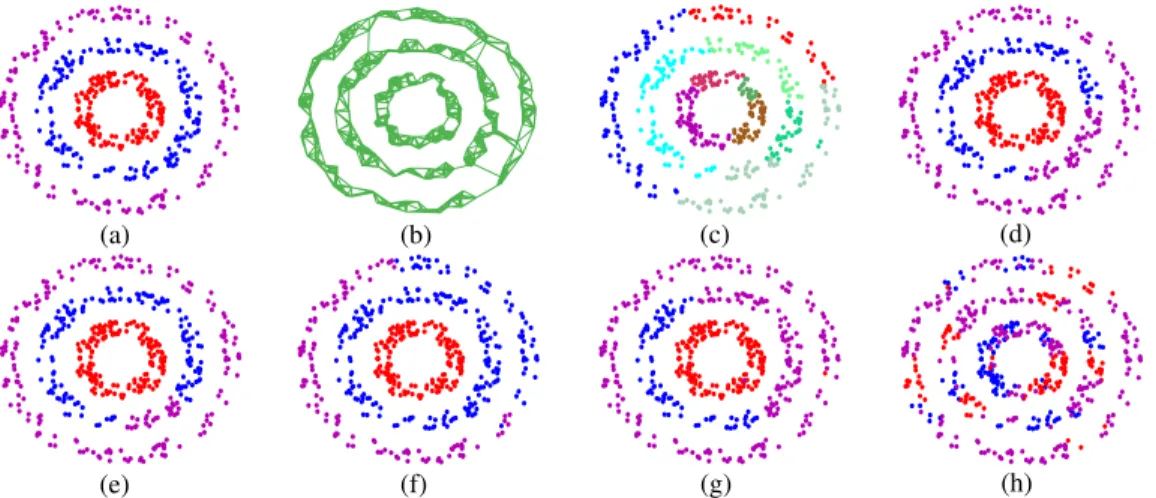
graph of three circles similar to Fig. 1 (a) and (b).
• Syn-100Kis a synthetic data set generated according to
[Brandeset al., 2003] where each node has about 40 out-cluster and 120 within-out-cluster neighbors.
• DBLP is a collection of bibliographic information on major computer science journals and proceedings3. We
use a subset of the DBLP records that belong to four areas: artificial intelligence, information retrieval, data mining and database. We generate a graph of authors linked by the co-conference relationship.
• IMDBis an international organization whose objective is to provide useful and up to date movie information4.
We create a graph of movies linked by the co-director
2We consider EVD using QR decomposition for simplicity. 3
http://www.informatik.uni-trier.de/ ley/db/ 4
relationship. The genre information is considered to be the clustering label. We use four genres: documentary, music, comedy and adult.
Table 1: Statistics of the four data sets
data set nodes edges clusters sparsity
Syn-1K 1,000 10,000 3 0.01 Syn-100K 100,000 8.2M 10 0.0016
DBLP 28,702 62.4M 4 0.1515
IMDB 30,731 257K 4 5×10⁻⁴
5.2
Algorithms for Comparison
To demonstrate the effectiveness and efficiency of our method, we compared with the following clustering algo-rithms which can be applied to graph data directly:
• Shortest Paths (SP) algorithm. To show our method can significantly improve the clustering result from the ini-tial partition obtained from shortest path algorithm, we report its performance by selectingkrandom seeds. • Efficient Spectral Clustering on Graphs (ESCG), the
method proposed in this paper. There is one parame-ter in the ESCG algorithm: the number of supernodes d. In our experiments, we empirically set it to 30. The model selection is discussed in the Section 5.6.
• Efficient Spectral Clustering on Graphs with Regenera-tion (ESCG-R), the second method proposed in this pa-per, which regenerates supernodes. The number of iter-ations is empirically set to be 5 and related experiments can be found in the Section 5.6.
• Standard Spectral clustering (SC) algorithm. We imple-mented the algorithm in [Nget al., 2001].
• Resistance Embedding Spectral Clustering (RESC) from [Khoa and Chawla, 2012], an efficient spectral clustering method that can be applied to graph data. We implement the algorithm and set the parameterKRP to be 50 as suggested by the authors.
• Nystr¨om[Fowlkeset al., 2004], a method that aims to
find numerical approximations to eigenfunction prob-lems. We use the Matlab implementation online5. In order to randomize the experiments, we conduct 20 test runs with different random initializations and report the aver-age performance.
5.3
Evaluation Metric
The clustering result is evaluated by comparing the obtained label of each sample using clustering algorithms with that provided by the data set. The accuracy metric (AC) [Chen and Cai, 2011] is used to measure the performance.
We also report the running time of each method. All coding was implemented in MATLAB R2011b and run on a desktop with Intel Core I7 2600 and 16GB memory.
5.4
Experimental Results
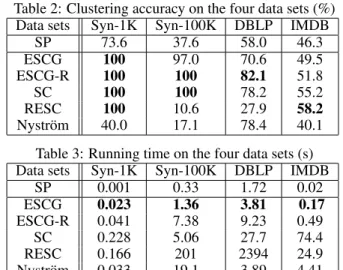
Table 2 shows the clustering performance of the different gorithms on all four data sets. We can see that ESCG al-ways outperforms SP - which is in fact a module of ESCG
5
http://alumni.cs.ucsb.edu/∼wychen/
Table 2: Clustering accuracy on the four data sets (%) Data sets Syn-1K Syn-100K DBLP IMDB
SP 73.6 37.6 58.0 46.3 ESCG 100 97.0 70.6 49.5 ESCG-R 100 100 82.1 51.8 SC 100 100 78.2 55.2 RESC 100 10.6 27.9 58.2 Nystr¨om 40.0 17.1 78.4 40.1 Table 3: Running time on the four data sets (s) Data sets Syn-1K Syn-100K DBLP IMDB
SP 0.001 0.33 1.72 0.02 ESCG 0.023 1.36 3.81 0.17 ESCG-R 0.041 7.38 9.23 0.49 SC 0.228 5.06 27.7 74.4 RESC 0.166 201 2394 24.9 Nystr¨om 0.033 19.1 3.89 4.41 for generating supernodes. ESCG-R achieves better perfor-mance than ESCG since the process of regenerating supern-odes based on the embeddings of ESCG makes use of more knowledge from the original graph.
On the Syn-1K data set, since the k-NN graph is relatively clean, ESCG, ESCG-R, SC and RESC all achieve 100% ac-curacy. Despite SP’s significant efficiency, its accuracy is only 73.6% which is 26.4% less than all other methods. Al-though both ESCG and ESCG-R use SP to generate supern-odes, they both significantly improve on SP’s performance in the clustering task. Nystr¨om performs poorly on this data set since Syn-1K is sparse and finding approximations of eigen-decomposition using the sampling technique on a sparse ma-trix is very difficult. To further study this data set, we add noise into the graph, as visualized in Fig. 1 (a) and (b). The re-sults of our proposed methods and other algorithms are shown in Fig. 1 (c) to (h). Based on the initial clustering from short-est path calculations, ESCG significantly refines the result and ESCG-R further improves performance.
On the Syn-100K data set, SP is surprisingly unable to find a good partition on the graph, and only achieves 37.6% in terms of accuracy. This is due to the fact that each node has 40 out-cluster links and in this case, shortest path length may not be a good feature for clustering. However, ESCG is still able to achieves 97% accuracy, again demonstrating its effective-ness over SP. With regeneration of supernodes, ESCG-R fi-nally reaches 100% accuracy, the same as SC. It is worth not-ing that RESC performs on the level of random guessnot-ing on this data set. This may be due to the random projection step within the algorithm since too many edges are intra-cluster. Nystr¨om once again performs poorly due to graph sparsity.
On the DBLP data set, ESCG-R achieves the best perfor-mance, beating the second best Nystr¨om by 3.9%. Nystr¨om shows its power on the DBLP data set because this graph is much more dense. RESC posts a similarly poor performance on this data set as on the Syn-100K data set.
On the IMDB data set, all algorithms are relatively close. Among them, RESC has 58.2% accuracy and SC has 55.2%. Our proposed ESCG and ESCG-R perform a little worse, with accuracies of 49.5% and 51.8%, respectively. Due to
(a) (b) (c) (d)
(e) (f) (g) (h)
Figure 1: Toy example on the synthetic data set Syn-1K. Top 4 figures, from left to right: (a) ground-truth partition; (b) k-NN graph; (c) initial clustering results by shortest path, whend= 10; (d) clustering results by ESCG. Bottom 4 figures, from left to right: clustering results by (e) ESCG-R after 5 iterations; (f) spectral clustering; (g) RESC; (h) Nystr¨om method.
0 50 100 150 200 250 300 20 40 60 80 100 d Accuracy(%) DBLP SP ESCG ESCG−R SC Resc Nystrom
Figure 2: Performance of ESCG/ESCG-R w.r.t. parameterd. the graph sparseness, Nystr¨om only shows 40.1% accuracy, nearly 20% lower than the best.
In conclusion, we find that all the scalable clustering meth-ods in our experiment including ours cannot always beat SC, demonstrating its strength and stability. However, our pro-posed methods, ESCG and ESCG-R, are relatively stable and effective, outperforming other efficient algorithms.
5.5
Complexity Study
Table 3 lists the running time for different algorithms on all four data sets. For the convenience of testing, we do not in-corporate the running time fork-means because this step is shared by all of the algorithms except SP. As shown in the table, ESCG takes the least amount of time to obtain the em-beddings with the exception of SP, which is essentially one module in our algorithm. When the graph is dense, we note that RESC becomes extremely slow since it needs to construct a diagonal matrix of all edges and to apply random projec-tion and some addiprojec-tional operaprojec-tions on the matrix. ESCG-R adopts an iterative framework and therefore should always take more time than ESCG. However, due to the small size of the regenerated supernodes, the time complexity does not increase much, as demonstrated in the table.
5.6
Parameter Study
In this subsection, we study the parametersdandtin our pro-posed algorithms. As shown in Fig. 2, in order to obtain better
Iteration # Accu ra cy(% ) 2 4 6 8 10 98 99 100 2 4 6 8 10 96 98 100 2 4 6 8 10 70 75 80 2 4 6 8 10 47 50 53
Figure 3: ESCG-R w.r.t. # iteration on the four data sets. clustering power,dshould be set a bit larger thankso that the information loss ofWˆ fromWis smaller. Thus, in the experi-ments, we setdto be 30 which can ensure the efficiency while not sacrificing too much clustering power. Fig. 3 shows the performance of ESCG-R w.r.t. varying number of iterations ton the four data sets. It can be seen that the performance generally improves as the number of iterations grows.
6
Conclusion
In this paper we tackle the scalability issue of spectral cluster-ing methods on large-scale graphs. We propose a method to reduce graph size, based on effectively compressing the graph information into a smaller number of “supernodes”. Clus-tering supernodes with spectral methods is less expensive, and the clustering results can also be propagated back to the original graph with low cost. We reduce the computational complexity of spectral clustering significantly, fromO(n3)to
O(md+ndlogn+nd2). Although graph compression nat-urally induces inaccuracy, empirical studies demonstrate that our method can considerably decrease the necessary runtime while posting a tolerably small loss in accuracy.
7
Acknowledgment
This work was supported in part by the U.S. National Science Foundation grants IIS-0905215, U.S. Army Research Labora-tory under Cooperative Agreement No. W911NF-09-2-0053 (NS-CTA).
References
[Brandeset al., 2003] U. Brandes, M. Gaertler, and D. Wag-ner. Experiments on graph clustering algorithms. In In 11th Europ. Symp. Algorithms, volume 2832, pages 568– 579. Springer, 2003.
[Chen and Cai, 2011] X. Chen and D. Cai. Large scale spec-tral clustering with landmark-based representation. In Proc. of the 26th AAAI Conf. on Artificial Intelligence (AAAI), pages 313–318, 2011.
[Chenet al., 2006] B. Chen, B. Gao, T. Liu, Y. Chen, and W. Ma. Fast spectral clustering of data using sequential matrix compression. InProc. of the 17th European Conf. on Machine Learning (ECML), pages 590–597, 2006. [Chenet al., 2011] W. Chen, Y. Song, H. Bai, C. Lin, and
E. Y. Chang. Parallel spectral clustering in distributed sys-tems.IEEE Transactions on Pattern Analysis and Machine Intelligence (TPAMI), 33(3):568–586, 2011.
[Dalviet al., 2008] B.B. Dalvi, M. Kshirsagar, and S. Sudar-shan. Keyword search on external memory data graphs. Proc. of the VLDB Endowment (PVLDB), 1(1):1189– 1204, 2008.
[Dhillon, 2001] I.S. Dhillon. Co-clustering documents and words using bipartite spectral graph partitioning. InProc. of the 7th ACM SIGKDD Int. Conf. on Knowledge Discov-ery and Data Mining (KDD), pages 269–274, 2001. [Fortunato, 2010] S. Fortunato. Community detection in
graphs.Physics Reports, 486(3-5):75–174, 2010.
[Fowlkeset al., 2004] C. Fowlkes, S. Belongie, F. Chung, and J. Malik. Spectral grouping using the nystr¨om method. IEEE Transactions on Pattern Analysis and Machine Intel-ligence (TPAMI), 26(2):214–225, 2004.
[Guptaet al., 2012] M. Gupta, J. Gao, Y. Sun, and J. Han. Integrating community matching and outlier detection for mining evolutionary community outliers. In Proc. of the 7th ACM SIGKDD Int. Conf. on Knowledge Discovery and Data Mining (KDD), pages 859–867, 2012.
[Hermanet al., 2000] I. Herman, G. Melanc¸on, and M.S. Marshall. Graph visualization and navigation in informa-tion visualizainforma-tion: A survey. IEEE Transactions on Vi-sualization and Computer Graphics (TVCG), 6(1):24–43, 2000.
[Khoa and Chawla, 2012] N. Khoa and S. Chawla. Large scale spectral clustering using resistance distance and spielman-teng solvers. InProc. of 2012 Int. Conf. on Dis-covery Science, pages 7–21, 2012.
[Liuet al., 2007] T. Liu, H. Yang, X. Zheng, T. Qin, and W. Ma. Fast large-scale spectral clustering by sequen-tial shrinkage optimization. InProc. of the 29th European Conf. on IR Research (ECIR), pages 319–330, 2007. [Miaoet al., 2008] G. Miao, Y. Song, D. Zhang, and H. Bai.
Parallel spectral clustering algorithm for large-scale com-munity data mining. InThe 17th WWW workshop on So-cial Web Search and Mining (SWSM), 2008.
[Nget al., 2001] A. Ng, M.I. Jordan, and Y. Weiss. On spec-tral clustering: Analysis and an algorithm. InAdvances in Neural Information Processing Systems (NIPS), pages 849–856. 2001.
[Sakai and Imiya, 2009] T. Sakai and A. Imiya. Fast spec-tral clustering with random projection and sampling. In Proc. of the 6th Int. Conf. on Machine Learning and Data Mining in Pattern Recognition (MLDM), pages 372–384, 2009.
[Shi and Malik, 1997] J. Shi and J. Malik. Normalized cuts and image segmentation. IEEE Transactions on Pattern Analysis and Machine Intelligence (TPAMI), 22(8):888– 905, 1997.
[Shinnou and Sasaki, 2008] H. Shinnou and M. Sasaki. Spectral clustering for a large data set by reducing the sim-ilarity matrix size. InProc. of the 6th Int. Conf. on Lan-guage Resources and Evaluation (LREC), 2008.
[Smyth and White, 2005] P. Smyth and S. White. A spectral clustering approach to finding communities in graphs. In Proc. of the 5th SIAM Int. Conf. on Data Mining (SDM), pages 76–84, 2005.
[Songet al., 2008] Y. Song, Z. Zhuang, H. Li, Q. Zhao, J. Li, W. Lee, and C. Giles. Real-time automatic tag recom-mendation. InProc. of the 31st Annual Int. ACM SIGIR Conf. on Research and Development in Information Re-trieval (SIGIR), pages 515–522, 2008.
[Yanet al., 2009] D. Yan, L. Huang, and M.I. Jordan. Fast approximate spectral clustering. InProc. of the 7th ACM SIGKDD Int. Conf. on Knowledge Discovery and Data Mining (KDD), pages 907–916, 2009.