This version was downloaded from Northumbria Research Link: http://nrl.northumbria.ac.uk/29617/
Northumbria University has developed Northumbria Research Link (NRL) to enable users to access the University’s research output. Copyright © and moral rights for items on NRL are
retained by the individual author(s) and/or other copyright owners. Single copies of full items can be reproduced, displayed or performed, and given to third parties in any format or medium for personal research or study, educational, or not-for-profit purposes without prior permission or charge, provided the authors, title and full bibliographic details are given, as well as a hyperlink and/or URL to the original metadata page. The content must not be changed in any way. Full items must not be sold commercially in any format or medium without formal permission of the copyright holder. The full policy is available online: http://nrl.northumbria.ac.uk/policies.html
AN EFFICIENT APPROACH TO
ONLINE BOT DETECTION BASED ON
A REINFORCEMENT LEARNING
TECHNIQUE
M M ALAUTHMAN
PHD
AN EFFICIENT APPROACH TO
ONLINE BOT DETECTION BASED ON
A REINFORCEMENT LEARNING
TECHNIQUE
MOHAMMAD MANSOUR ALAUTHMAN
A thesis submitted in partial fulfilment of the
requirements of the University of Northumbria at
Newcastle for the degree of Doctor of Philosophy
Research undertaken in the
Faculty of Engineering and Environment
A
BSTRACT
In recent years, Botnets have been adopted as a popular method used to carry and spread many malicious codes on the Internet. These codes pave the way to conducting many fraudulent activities, including spam mail, distributed denial of service attacks (DDoS) and click fraud. While many Botnets are set up using a centralized communication architecture such as Internet Relay Chat (IRC) and Hypertext Transfer Protocol (HTTP), peer-to-peer (P2P) Botnets can adopt a decentralized architecture using an overlay network for exchanging command and control (C&C) messages, which is a more resilient and robust communication channel infrastructure. Without a centralized point for C&C servers, P2P Botnets are more flexible to defeat countermeasures and detection procedures than traditional centralized Botnets.
Several Botnet detection techniques have been proposed, but Botnet detection is still a very challenging task for the Internet security community because Botnets execute attacks stealthily in the dramatically growing volumes of network traffic. However, current Botnet detection schemes face with significant problem of efficiency and adaptability. The present study combined a traffic reduction approach with reinforcement learning (RL) method in order to create an online Bot detection system. The proposed framework adopts the idea of RL to improve the system dynamically over time. In addition, the traffic reduction method is used to set up a lightweight and fast online detection method. Moreover, a host feature based on traffic at the connection-level was designed, which can identify Bot host behaviour. Therefore, the proposed technique can potentially be applied to any encrypted network traffic since it depends only on the information obtained from packets header. Therefore, it does not require Deep Packet Inspection (DPI) and cannot be confused with payload encryption techniques.
The network traffic reduction technique reduces packets input to the detection system, but the proposed solution achieves good a detection rate of 98.3% as well as a low false positive rate (FPR) of 0.012% in the online evaluation. Comparison with other techniques on the same dataset shows that our strategy outperforms existing methods. The proposed solution was evaluated and tested using real network traffic datasets to increase the validity of the solution.
D
ECLARATION
I declare that the work contained in this thesis has not been submitted for any other award and that it is all my own work. I also confirm that this work fully acknowledges opinions, ideas and contributions from the work of others.
Name: Mohammad Mansour Alauthman. Signature:
A
CKNOWLEDGEMENTS
Firstly, I would like to express my sincere gratitude to my supervisor Dr. Nauman Aslam for the continuous support of my Ph.D. study and related research, for his patience, motivation, and immense knowledge. His guidance helped me in all the time of research and writing of this thesis. I also want to thank my supervision committee members Dr. Rafe Alasem and Dr. Li Zhang for reviewing my thesis and providing constructive comments that help me improve my work. As well, I owe special thanks to Professor Alamgir Hossain for his excellent guidance throughout the preliminary stages of my research.
My work has benefited from and has been influenced by discussions with a number of people over the years. For these discussions, I express my gratitude to my friends Dr Majed Alsanea, Dr Loai Kayed Bani Melhim and Dr Sami Smadi. They offered a lot of help and advice on my research and wonderful friendship.
Likewise, I would also like to express my special appreciation for Ahmad Alshorman and Amer Hatamleh for spending countless hours with me in proofreading advice to help the presentation of this research.
In addition, I thank my fellow PhD researchers of LAB F7 and LAB F6 for the stimulating discussions, for the sleepless nights we were working together before deadlines, and for all the fun we have had in the last four years. Also, I acknowledge all my colleges in college of science Al-Zulfi, KSA.
On a personal note, I cannot say enough to thank my dearest parents brothers and sisters for their prayers and continued support. Last but not the least, I am also thankful to my wife for always being there for me in the ups and downs of my life and tremendous support.
C
ONTENTS
ABSTRACT ... i
DECLARATION ... ii
ACKNOWLEDGEMENTS ... iii
CONTENTS ... iv
LIST OF TABLES ... vii
List of Figures ... viii
LIST OF ABBREVIATIONS AND ACRONYMS ... x
1 INTRODUCTION ... 1
1.1Introduction ... 1
1.2Research Motivation... 2
1.3 Research Aims and Objectives... 3
1.4 Thesis Contributions ... 3
1.5 Research Methodology ... 6
1.6 Thesis Scope... 7
1.7 Thesis Outline ... 9
2 BACKGROUND INFORMATION AND LITERATURE REVIEW ... 10
2.1 Introduction ... 10
2.2 Background of Botnets ... 11
2.2.1 Definitions related to the Botnet ... 11
2.2.2 Generic Botnet Life Cycle ... 12
2.2.3 P2P Botnet Life Cycle ... 14
2.3 Botnet Threats ... 14
2.3.1 Distributed Denial of Service ... 15
2.3.2 Spam ... 15
2.3.3 Stealing Information... 15
2.3.4 Exploiting resources ... 16
2.4 Botnet Classification ... 16
2.4.1 Botnet Classification According to Control and Command Structure ... 17
2.4.2 Botnet Classification Based on the Communication Protocols ... 20
2.5 Taxonomy of Botnet Detection ... 22
2.5.1 Honeynet-based Detection ... 23
2.5.3 Anomaly-based Detection ... 26
2.5.4 Machine learning based Detection ... 31
2.5.5 DNS-based Detection ... 37
2.5.6 Hybrid Botnet Detection Approaches ... 39
2.6 Summary ... 40
3 TRAFFIC REDUCTION APPROACH FOR BOT DETECTION ... 41
3.1 Introduction ... 41
3.2 Overview of Bot Detection Approach... 42
3.3 Network Traffic Capture ... 44
3.4 Network Traffic Reduction ... 45
3.5 Traffic Reduction Evaluation ... 47
3.5.1 Description of Experimental Datasets ... 47
3.5.2 Traffic Reduction Approach Evaluation ... 48
3.6 Discussion ... 51
3.7 Summary ... 52
4 CONNECTION-LEVEL FEATURES FOR BOT HOST DETECTION ... 53
4.1 Introduction ... 53
4.2 Overview of Offline Bot Detection Approach ... 54
4.3 Features Extraction ... 55
4.3.1 Connection-level Features ... 57
4.3.2 Connection Features Reduction ... 60
4.3.3 Host Feature Extraction... 62
4.4 The Malicious Activity Detector ... 66
4.5 Experimental Results and Evaluation ... 67
4.5.1 Experimental Tools ... 67
4.5.2 Experimental Procedure ... 67
4.5.3 Evaluation Metrics ... 68
4.5.4 Host Feature Set Evaluations ... 71
4.5.5 Offline Bot Detection Approach Evaluation ... 73
4.6 Discussions ... 77
4.7 Summary ... 78
5 REINFORCEMENT LEARNING APPROACH FOR ONLINE BOT DETECTION ... 79
5.2 Reinforcement Learning ... 79
5.2.1 Components of Reinforcement Learning System ... 80
5.2.2 The Markov Property ... 82
5.2.2.1 Markov Decision Process ... 82
5.2.2.2 Partially Observable Markov Decision Process ... 84
5.2.3 Reinforcement Learning Models... 84
5.2.4 Exploration Versus Exploitation ... 85
5.3 Formulation of Botnet Problem Using Reinforcement Learning ... 86
5.3.1 Bot Detection Algorithm Using Reinforcement Learning ... 89
5.4 Online Bot Host Detection Approach ... 93
5.5 Experimental Results and Evaluation ... 95
5.5.1 Experiments Using Differences Sliding Time-window Size ... 95
5.5.2 Testing on Zero-day Attack ... 100
5.5.3 Reinforcement Learning Model Evaluations ... 101
5.5.3.1 Evaluation the Efficiency of the Proposed Approach Based on Reference Dataset ... 101
5.5.3.2 Evaluation the Efficiency of the Proposed Approach based on Updated Dataset ... 105
5.5.3.3 Evaluation Based on the Learning Rate ... 109
5.6 Discussion ... 113
5.7 Summary ... 115
6 CONCLUSIONS AND FUTURE WORK ... 117
6.1 Thesis Summary ... 117
6.2 Summary of Key Contributions ... 118
6.3 Difficulties and Solutions ... 119
6.4 Limitations ... 119
6.5 Future Research Directions ... 120
REFERENCES ... 122
APPENDICES ... 135
A APPENDIX A ... 135
B APPENDIX B ... 138
C LIST OF EXPERIMENT PARAMETERS ... 141
D IMPLEMENTATION FRAMEWORK ... 143
L
IST OF
T
ABLES
Table 2.1 C&C structures and basic properties . ... 20
Table 2.2 Comparison of Botnet communication protocols. ... 22
Table 2.3 Summary of Honeynet detection methods. ... 24
Table 2.4 Summary of signature-based methods. ... 26
Table 2.5 Summary of host anomaly-based methods. ... 29
Table 2.6 Summary of network anomaly-based methods. ... 31
Table 2.7 Summary of machine learning based detection methods. ... 38
Table 2.8 Summary of DNS-based detection methods. ... 39
Table 3.1 Dataset distribution. ... 48
Table 3.2 Traffic reduction rates. ... 49
Table 3.3 Network traffic reduction rules rates ... 50
Table 3.4 Comparison of traffic reduction with other Bot detection techniques. ... 52
Table 4.1 Extracted features of network traffic connections. ... 58
Table 4.2 Features importance ranking by entropy algorithm. ... 62
Table 4.3 Host features of network traffic. ... 63
Table 4.4 Experimental Tools. ... 67
Table 4.5 Standard deviation of evaluation matrices. ... 78
L
IST OF
F
IGURES
Figure 1.1 Research Methodology ... 8
Figure 2.1 Generic Botnet life cycle. ... 13
Figure 2.2 P2P Botnet life cycle. ... 14
Figure 2.3 A typical centralized Botnet structure. ... 18
Figure 2.4 A typical decentralized (P2P) Botnet architecture... 19
Figure 2.5 Unstructured C&C architecture. ... 20
Figure 3.1 Bot detection framework ... 43
Figure 3.2 The sliding time-window mechanism. ... 45
Figure 3.3 Average rates of network traffic reduction rule :(a) Legitimate traffic and (b) Botnet traffic. ... 50
Figure 4.1 Overview of Offline Bot detection phases... 55
Figure 4.2 Normalized host features comparison. ... 71
Figure 4.3 Entropy rates of total control packets per host. ... 72
Figure 4.4 Entropy rate of transmitting control packets per host. ... 72
Figure 4.5 Entropy rates of receiving control packets per host... 73
Figure 4.6 (a) ACC rates, (b) DR rates, (c) F-measure rates. ... 74
Figure 4.7 (a) AUC rates, (b) MCC rates. ... 75
Figure 4.8 (a) RMSE rates, (b) NDEI rates. ... 76
Figure 4.9 (a) FPR rates, (b) FNR rates. ... 76
Figure 5.1 General reinforcement learning system architecture ... 81
Figure 5.2 Markov decision process . ... 83
Figure 5.3 Partial Markov decision process. ... 84
Figure 5.4 Host states. ... 88
Figure 5.5 Neural Network Agent state. ... 92
Figure 5.7 Extract new behaviour phase. ... 94
Figure 5.8 Improving the classifier agent. ... 95
Figure 5.9 (a) ACC rates, (b) DR rates, (c) F-measure rates. ... 96
Figure 5.10 (a) AUC rates, (b) MCC rates. ... 97
Figure 5.11 (a) RMSE rates, (b) NDEI rates. ... 98
Figure 5.12 (a) FPR rates. (b) FNR rates. ... 99
Figure 5.13 ROC comparison. ... 99
Figure 5.14 Detection rate (Zero-day attack). ... 100
Figure 5.15 False Positive Rate (Zero-day attack). ... 101
Figure 5.16 Online evaluations the ACC of a classifier based on a reference dataset. . 102
Figure 5.17 Online evaluations the AUC of a classifier based on a reference dataset. 103 Figure 5.18 Online evaluations the MCC of a classifier based on a reference dataset. 104 Figure 5.19 Online evaluations the RMSE of a classifier based on a reference dataset ... 105
Figure 5.20 Online evaluations the ACC of a classifier based on an updated dataset. . 106
Figure 5.21 Online evaluations the AUC of a classifier based on an updated dataset. . 107
Figure 5.22 Online evaluations the MCC of a classifier based on an updated dataset. 108 Figure 5.23 Online evaluations the RMSE of a classifier based on an updated dataset. ... 109
Figure 5.24 Evaluations of the extract new behaviours based on 10s time-window. ... 110
Figure 5.25 Evaluations of the extract new behaviours based on 30s time-window. ... 111
Figure 5.26 Evaluations of the extract new behaviours based on 60s time-window. ... 111
Figure 5.27 Test the online system based reference neural network. ... 113
L
IST OF
A
BBREVIATIONS AND
A
CRONYMS
ACC Accuracy
ACK TCP flag indicates the value in acknowledgement is valid
AUC Area Under the ROC curve
C&C Command And Control
CART Classification And Regression Tree
DDoS Distributed Denial Of Service
DNS Domain Name System
DPI Deep Packet Inspection
DR Detection Rate
FIN TCP flag indicates that No more data from sender
FNR False Negative Rate
FPR False Positive Rate
HTTP Hypertext Transfer Protocol
IP Internet Protocol
IRC Internet Relay Chat
ISCX Information security centre of excellence
ISOT Information Security And Object Technology
JPCAP A Network Packet Capture Library
LBNL Lawrence Berkeley National Lab
MCC Matthews Correlation Coefficient
MDP Markov Decision Process
NDEI Non-Dimensional Error Index
OSI Open Systems Interconnection
P2P Peer-To-Peer
POMDP Partially Observable Markov Decision Process
RMSE Root Mean Square Error
ROC Receiver Operating Characteristic Curves
RST TCP flag indicates that Reset The Connection
SYN TCP flag initiate a TCP connection
TCP Transmission Control Protocol
TNR True Negative Rate
1
INTRODUCTION
1.1
Introduction
Internet services are increasing in popularity and many new online services appear every day. The use of online services leads to a massive volume of online financial transactions, where sensitive information is exchanged via the Internet. The attacker's interest may thus be converted from curiosity to economic benefit. Attackers utilise different types of malware to accomplish their goals. Among the diverse types of malware, the Botnet is considered to be the most dangerous means of performing online crimes (Rgio S. C. Silva, Rodrigo M. P. Silva, Raquel C. G. Pinto, & Ronaldo M. Salles, 2013).
A Botnet network contains Bots, which are computers infected by malware such as Trojan horses, backdoors or worms without the user’s permission. The Botmaster remotely manages a Botnet through a C&C channel (Gu, Perdisci, Zhang, & Lee, 2008). Recently, Botnets have been sold and rented in an underground market by Botmasters for commercial profit. They can begin many cyber-crimes: creating phishing web pages, carrying out massive amounts of spam emails, stealing sensitive users information and generating DDoS attacks (Ullah, Khan, & Aboalsamh, 2013).
According to a recent Symantec Internet Security Threat Report in April 2014 (Symantec Corporation, 2014), Botnets accounted for 76% of all spam sent out in 2013, which was about 10 billion per day on average. Botnet infections are a global pandemic. Recently Microsoft alone estimated that, as of April 2015, more than one million machines are currently infected by the Ramnit worldwide Botnet (Batchelder et al., 2014).
The scale of Botnet contaminations worldwide makes the detection of Botnet activity an important task. Botnet detection has been a significant subject in the cyber security domain for the last decade. Despite concerted efforts reported in the literature degrade the malicious activities of Botnets, the diversity of Botnet structures and protocols creates from the Botnet detection a demanding task for the cyber-security society (Demarest, 2014; IBM, 2013; Plohmann, Gerhards-Padilla, & Leder, 2011)
1.2
Research Motivation
Analysing network traffic and identifying host malicious activity inside a network is a significant requirement for network admin in order to manage their networks and detect infected computers. Therefore, network administrators require an efficient strategy to keep the network free from any suspicious activity. Additionally, Botnets grow rapidly in terms of both volume and variety, and they have begun to infect infrastructures such as industrial control systems (Falliere, Murchu, & Chien, 2011) and smartphones (Mullaney, 2012).
As a result, Botnets have been realized to be one of the most dangerous threats to Internet safety. It is therefore crucial to detect, prevent and mitigate Botnet activities. Developing Botnet detection systems is a primary concern since it serves as an essential step in further prevention and mitigation strategies. In this regard, network-based Botnet detection systems are particularly desired due to the visibility of the network behaviour of all hosts in monitored networks.
The number of networked computers and devices is enormous and keeps grow, and volumes of network traffic are high and rapidly increasing. This means that detection systems require the efficiently processing of a massive volume of network traffic. However, most existing Botnet detection systems (Chen & Lin, 2015; Goebel & Holz, 2007; Gu, Perdisci, et al., 2008; Gu, Zhang, & Lee, 2008; Lu, Rammidi, & Ghorbani, 2011; Rafique & Caballero, 2013; Seewald & Gansterer, 2010; R. Tyagi, Paul, Manoj, & Thanudas, 2015; Yen & Reiter, 2008) rely on DPI to analyse packet content, which is computationally expensive and inefficient in recognizing unknown payload signatures. Consequently, when these detection systems are deployed in high-speed or high-volume networks, they may not be able to perform a comprehensive analysis of all network traffic and thus lead to the failure to immediately detect Bot hosts.
However, identifying infected computers before the Bot exploits a host machine in a serious way is a challenging task in cyber-security. In the few last years, several methods have been proposed to identify Botnets threats that represent a risk for cyber-security systems. The majority of these studies have focused on ways of improving offline Botnet detection systems. Generally, the exact detection results obtained using these approaches reflect only the past situation of the network traffic.
Therefore, the results of these approaches may become worthless later the when status of the network environment changes. In this case, all of these offline methods may become invalid since they do not use online detection approaches. Therefore, a Bot detection system needs to be developed that is able to monitor Bot host activities in an online manner and to repeat Bot host activities to network admin as soon as possible.
1.3
Research Aims and Objectives
The aim of this research is to develop an online P2P Bot host detection system based on RL. The approach proposed in this research has the following characteristics. It detects Bots during the propagation phase before any malicious action has been taken. Furthermore, it does not require DPI analysis for signature matching, and does not need to analyse the entire network traffic. It detects Bots independent of port numbers, IP addresses and host characteristics. Therefore, the main objectives of this research are:
1. To investigate the characteristics of network traffic that can be used to discriminate the behaviour of P2P Bots from normal traffic.
2. To develop a RL system has the ability to recognize zero-day attacks caused by a P2P Botnet.
3. To generate a host traffic representation based on traffic reduction, that is used to detect the hosts of Bots.
1.4
Thesis Contributions
The objective of this thesis is to develop an efficient network-based Bot host detection system. The thesis introduces a network-based solution, which achieves the following requirements. Firstly, efficiency is enhanced by using a traffic reduction method to build a lightweight detection system able to deal with massive network volumes of traffic. Secondly, Bot detection is accomplished earlier by detecting the Bot in the propagation
phase before it starts malicious activities. Finally, it is adaptable due to the use of a RL approach to a detection system able to learn online new Bot behaviour from the network environment. This thesis makes three specific contributions which as following:
1. A network traffic reduction approach has been designed which will be able to increase the performance of the proposed framework.
2. The ‘connection-based’ detection mechanism is payload-independent, and depends on only information obtained from the headers of TCP control packets.
3. A new model-based RL algorithm computes the reward from the dynamic
environment.
Firstly, in Chapter 3, a new traffic reduction technique is introduced to facilitate the deployment of Bot host detection systems on a high-speed network. As discussed above, the majority of Botnet detection schemes rely on DPI and examine the entire network traffic. The use of DPI assumes access to the payload of each packet. This method can be accurate in classifying network traffic if the packet payloads are not encrypted. However, the majority of new malware applies evasion methods such as the encryption of payloads or protocol encapsulation and obfuscation which mean that the payload is covered (P. Wang, Wu, Aslam, & Zou, 2015). Furthermore, examining all packets on a high-speed network is an expensive task because of the speed of the networks and the amounts of packets transferred via a network is increasing daily. However, a detection system which applies DPI may suffer from efficiency limits when processing a large volume of traffic from high-volume or high-speed networks (Jun et al., 2008). The goal of the present study is to increase the effectiveness of detection systems by decreasing the volume of traffic which needs to be analysed without affecting the accuracy of the detection process in an ideal solution. To achieve this goal, a novel traffic reduction method is proposed for a Bot host detection framework which selects only TCP control packets. This framework can efficiently and effectively reduce the amount of traffic that will be entered into the detection system.
Reducing network traffic can be accomplished by generating a representation of all of the entire network packets. Moreover, the behaviour of the representative traffic should reflect the behaviour of all network traffic. Using a representative traffic approach will reduce the volume of the traffic needed to be analysed. Therefore, it means faster analysis
and lower computation time. To the best of our knowledge, this is the first P2P Bot host detection approach applying such a reduction technique to achieve efficiency in Bot detection host.
Secondly, in Chapter 4, host traffic features have been designed based on the connection-level that can differentiate between a Bot and a legitimate network host. More specifically, the proposed features contribute to the identification of the Bot host by using a minimum set of packets that need to be utilized in developing an efficient Bot detection system. The goal of the proposed feature set is designed to boost the effectiveness of P2P Bot detection in three challenging scenarios: i) the Bot performs malicious activities in a stealthy way by using an evasion approach such as encryption techniques; ii) the earlier detection of P2P Bot at the primary stage of its life cycle, the propagation stage; iii) the feature set helps the detection method to detect an infected machine if it is the only one in the network. The framework solves the above challenges by working on the headers of TCP control packets to bypass encrypted network traffic. Moreover, focusing on the connection behaviour will help the detection system to recognize Bot behaviour at an earlier stage when the Bot propagates and tries to contact other peers to find new updates. Furthermore, the proposed feature sets are estimated for every host in the network in order to detect any single infected machine. To the best of our knowledge, this is the first time that connection-based features have been used in P2P Bot host detection. As the features are extracted from the headers of the network packets, they do not rely on packet payloads. With this characteristic, our detection approach will not be affected by traffic encryption. Moreover, the proposed approach can also be used to detect unknown P2P Bots. Furthermore, the feature set helps the detection system to identify P2P Bot infects even if it just one.
Finally, in Chapter 5, a new model-based reinforcement learning method is built to solve a Bot host detection problem. More specifically, an online RL system is designed to detect a P2P Bot in the connection (propagation) stage. The goals of the RL model are to satisfy the requirements of adaptability, novelty and early detection. To accomplish these goals, a new algorithm for RL is designed to boost the adaptability of the detection system, evaluate any new Bot host pattern and adapt the detection system according to the new Bot pattern.
The neural network has been adopted with a resilient back-propagation learning algorithm as a classification technique. This has robust capabilities for dealing with a nonlinear problem due to its ability of approximation. In addition, utilizing a feature set based a traffic reduction technique with the RL algorithm improves the capability of the detection system to detect timely Bot host behaviour and enhances of the online system so as to learn new kinds of attack patterns (zero-day). To the best of our knowledge, this work is the first to provide an online Bot detection method that is based on a new RL algorithm. Also, RL techniques require some set of action-selection procedures, which guarantee that there is an balance between exploration and exploitation. The difficulty is to obtain good action-selection tactics which apply a good balance of exploration and exploitation. The proposed approach introduces an adaptive threshold factor to manage the adaption of a new Bot pattern and to make a balance between exploration and exploitation. The proposed online Bot host detection is timely because detection is achieved for each host, and when the required features accumulated from the host are adequate then the judgment can be made instantly. Hence, an infected host can be identified within a short time. Also, to ensure the generalization of the proposed detection approach, we use a testing dataset from a different network traffic source in order to ensure the generalization of the classifier.
However, Bots and the users of computers exploit the Internet network in the same way, but with different objectives. The proposed framework should be able to differentiate between malicious traffic generated by Bot activity and legitimate user or application activities. Therefore, the main expected contribution of this research is to design an online detection of a P2P Bot host which focuses on both traffic reduction and RL in order to achieve efficient Bot detection able to complete detection in a short time.
1.5
Research Methodology
The general research methodology used in the research is the positivist approach. According to (Iivari, Hirschheim, & Klein, 1998) this method contains hypothesis and testing experiments, therefore, it’s suitable for the research. Besides, the general experimental procedures used in statistics approaches such as neural network, machine learning and fuzzy to obtain conclusions from the data comprise the following steps (Wechsler & Harry, 2000):
1. State the problem
2. Formulate the hypothesis
3. Design the experiment/generate the data 4. Collect the data and perform pre-processing 5. Estimate the model
6. Interpret the model/draw the conclusions
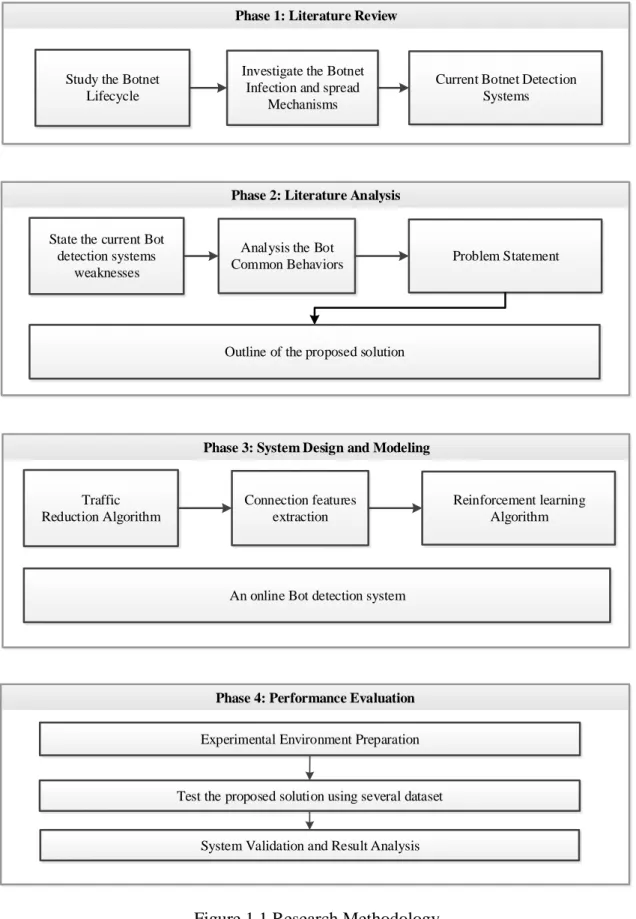
The main stages of the adopted research methodology in this research as show on in Figure 1.1 include the literature review, the literature analysis, design and modelling and performance evaluation.
1.6
Thesis Scope
The scope of this thesis is limited to developing a P2P Bot detection approach based only on TCP network traffic. The TCP network traffic is captured from a local area network. Moreover, the information of the control packets header is used.
The UDP packets are excluded in this research because UDP is a connectionless protocol, the information in a UDP packets is inadequate to decide if it as control or payload packets unless we have information about packet’s application. Thus, it is impossible to classify UDP packets into control and payload packets immediately as in the state of TCP.
Phase 1: Literature Review
Phase 2: Literature Analysis
Phase 3: System Design and Modeling
Phase 4: Performance Evaluation
Study the Botnet Lifecycle
Investigate the Botnet Infection and spread
Mechanisms
Current Botnet Detection Systems
State the current Bot detection systems
weaknesses
Analysis the Bot
Common Behaviors Problem Statement
Outline of the proposed solution
Traffic Reduction Algorithm Connection features extraction Reinforcement learning Algorithm
An online Bot detection system
Experimental Environment Preparation
System Validation and Result Analysis Test the proposed solution using several dataset
1.7
Thesis Outline
This thesis is organized into six chapters. This chapter presents the objectives of this thesis. It starts by presenting a background discussion of the Bot problem along with the research goals and contributions.
Chapter 2 gives an overview of Botnets concepts. The Botnet life cycle is described, and the risks of Botnets are listed. Previous Botnet detection approaches and relevant research using machine learning are reviewed as well. Taxonomy of Botnet detection techniques is provided, and the advantages and disadvantages of each type are discussed.
Chapter 3 discusses the design of the proposed traffic reduction algorithm which aim to increase the efficiency of the Bot detection system. Besides, a briefly detailed for each component of the Botnet detection system is presented. Also, a detailed description of the network datasets used in this study are introduced in this chapter.
Chapter 4 explains the connection-based feature extraction process. In addition, the chapter presents the offline Bot detection system based on connection-level feature set. Also, the procedures followed in the experiments are discussed.
Chapter 5 provides an introduction to RL, Markov decision processes and the partially observable Markov decision process. In this chapter, a formulation is given of Botnet problems based on RL. Besides, a new model-based RL algorithm for Bot host detection is introduced in a dynamic partially observable environment. Finally, assessment based on a real-world dataset is presented in the chapter.
Finally, Chapter 6 draws the conclusion of the thesis and discusses potential future research directions to improve or extend the present work.
2
BACKGROUND
INFORMATION
AND
LITERATURE
REVIEW
2.1
Introduction
In recent years, there has been increasing interest in Botnet problems compared to others threats to computing. Malware has infected every area of the Internet, and this shows no signs of stopping. Despite the relative novelty of Botnets, a significant number of studies have attempted to find a solution to the problems they create.
Botnet hazards have increased in the internet environment subsequent to the first known Botnets found at the beginning of the 1990s based on the Internet Relay Chat (IRC). The IRC was set up in the late 1980s to allow the computer user to connect to the Internet anywhere and to join live chats. Botnets exploited the benefits of this channel so as to set up communication between the Botmaster and the Bot in the victim’s computer.
The reason for investigating the Botnet threat in depth is that electronic crime has increased, and in the past few years, Botnet targets have changed so that secret information found on the victim’s machines is taken. The difficulty of detection has given the Botnet the leading position in cyber-crime. Furthermore, Botnets are improving methods of evasion along with the development of spreading techniques, and this also increases the difficulty of Botnet detection. Although, a considerable number of studies have been published on Botnet detection, new types of Botnet continually come up with new techniques to avoid detection by existing methods.
This thesis focuses on establishing a P2P Bot detection strategy that utilizes neural networks combined with a RL approach to detect hosts on the network that generate malicious traffic behaviours. Furthermore, this approach should work online, and at the same time achieve good accuracy and high detection rates.
This chapter began by introducing the history of Botnets. The following section gives definitions of terms related to Botnets and explains the life cycle. Section 2.3 introduces the threats from Botnets and Section 2.3 illustrates Botnet evolution. Sections 2.4 and 2.5 classify Botnets and Botnet detection approaches respectively. A summary of this chapter and its relevance to the present study are given in Section 2.6.
2.2
Background of Botnets
This section describes Bots, Botnets, C&C and victim hosts, and then elaborates on the role of Botnet in cyber-crime.
2.2.1
Definitions related to the Botnet
Bot: the word Bot derives from the word robot, which means "worker.” In the world of computers, a Bot is a general term adopted to describe an automated operation (Schiller & Binkley, 2011). In other words, a Bot refers to a malicious code on victim computer that allows the attacker to control the computer remotely and perform specific operations (Rgio S. C. Silva et al., 2013).
A Botnet: is a collection of compromised computers (zombies) connected through
the network, and it is under the control of a Botmaster via a C&C channel (Huy, Xuetao, Faloutsos, & Eliassi-Rad, 2013; Lashkari, Ghalebandi, & Reza
Moradhaseli, 2011). The Bot is commonly installed on the victim’s computer in
several ways, such as when an untrusted website is surfed or a malicious email attachment is open. Generally the Bot is configured to be launched when it infects the victim’s machine, and then the Bot will be ready to receive a command from the Botmaster through the C&C server (Rgio S. C. Silva et al., 2013).
Command and Control (C&C): is a communication channel used to transfer orders between the Botmaster and Bots to achieve various distributed attacks remotely (Feily, Shahrestani, & Ramadass, 2009; Nagaraja et al., 2011). Furthermore, the interaction between the Botmaster and Bots through the C&C communication channel can be classified into three groups: message types, message directions and communication protocols (Rodríguez-Gómez, Maciá-Fernández, & García-Teodoro, 2013). C&C message types can be classified as command or control messages. A command message is used by the Botmaster to send an order to the
Bots to execute an action on the victim's computer. The other type of C&C message is a control message that gives the Botmaster information about the status of Botnets, such as the number of active Bots. What is more, C&C message directions may be divided into two categories: pulls and pushes (Gu, Zhang, et al., 2008). In a pull style, the C&C server sends a command to Bots and waits for them to respond before sending the second order. On the other hand, if the C&C server sends a command and it does not wait for a response, from this is a push case message. These approaches are used by centralized Botnet structures such as IRC and HTTP Botnet-based. The communication protocols perform a significant part of the communication between the C&C server and the Bots. IRC, HTTP and P2P protocols are the most common types of the protocol used in C&C server communications (Rodríguez-Gómez et al., 2013).
The Botmaster (attacker): is the person who creates the Bots and coordinates all the operations going on between the Bots and the C&C server. In addition, the Botmaster builds and develops the ability of the Bots to infect a victim’s machine as well as coordinating the communication between Botnet system components (Boshmaf, Muslukhov, Beznosov, & Ripeanu, 2013). However, on the internet there are many toolkits that can be used to build and manage Botnet systems (Boshmaf et al., 2013).
The victim, the main aim of the Botmaster is to spread the Bot code to infect any connected computer and then control these computers via the C&C server. For instance, system, person or network could be a Botnet targets. The victims vary depending on the objective of the attacks or the Botnet type, for example, receiving spam email or stealing confidential information from the victim’s machine. In another example, DDoS attacks have played a key role in companies losing millions of dollars (Rodríguez-Gómez et al., 2013).
2.2.2
Generic Botnet Life Cycle
This section reviews the main stages of the Botnet life cycle. Botnet behaviour is addressed in terms of the set of operations used by a Botnet during its life cycle phase. The majority of Botnet detection approaches focus on the specific stage of a Botnet life cycle via studying its behaviour during these phases. As a result, the analysis of the Botnet
life cycle is also important in understanding previous work on Botnet detection and Botnet behaviour. (Zhaosheng et al., 2008), (Feily et al., 2009) and (Rgio S. C. Silva et al., 2013) addressed Botnet life cycles in similar ways with slight differences, dividing it into three stages: infection, communication and attack. However, the Botnet life cycle can be described in details in five phases: initial infection, secondary injection, connection, command and control, and updating and maintenance (Feily et al., 2009) as illustrated in Figure 2.1. Botnetmaster (1) (2) (3) (4) (4) and (5) (1) Initial infection (2) Secondary injection (3) Connection
(4) Command and Control (5) Update and maintenance Botnet
Victim machine
Figure 2.1 Generic Botnet life cycle (Feily et al., 2009).
The first phase of creating a Botnet is a critical phase; the Botmaster tries to exploit a known computer operating system’svulnerability to infect the user’s machine. Moreover, scanning techniques are used by an attacker to insert the Bot inside the target’s machine (Feily et al., 2009). There are several methods for installing Bots in end-user computers, such as opening malicious spam email attachments or browsing malicious webpages (Lu et al., 2011).
When the initial infection is accomplished, then the secondary injection phase starts by executing the dropper script code in the infected machine. The execution of the dropper script code downloads the Bot binary from specific internet server using a File Transfer Protocol (FTP), HTTP or Peer-to-Peer (P2P), and then setup a newer Bot code on the victim machine. At the end of this phase, the infected machine turns into a zombie (Bot).
After that, the third phase begins by launching the C&C server to issue the communication channel with an army of recruited Bots which gives the Botmaster control ever the Botnet network (Feily et al., 2009). The fourth phase starts when the Botmaster has the ability to use the C&C server to send commands to the Bot in order to execute it on the target's machine. The final phase of the Botnet’s life cycle is updating and maintenance, where the Botmaster updates the Bot software for several reasons. For instance, the Botmaster may need to add a new function to enhance the Botnets future attacks or to improve the evasion methods. In addition, update the IP address of a new C&C server can be updated to keep it working and thus then prevent it from being blocked due to the evolution of Botnet detection techniques.
2.2.3
P2P Botnet Life Cycle
The lifecycle of the P2P Botnet consists of four primary phases, namely: initial infection, peer propagation, secondary injection and attack. These phases are shown in Figure 2.2 (Felix, Joseph, & Ghorbani, 2012). Firstly, the Bot code is created for insertion into an end-user computer using different techniques such as vulnerability exploitation, web downloads, automatic scanning and email attachments (Chao, Wei, & Xin, 2009)
Secondly, the Bot tries to connect with other Bots on infected hosts based on its own hard-coded peer list. Thirdly, the Bot downloads the latest update of the Bot code through the C&C channel, which will update it for future tasks. In this phase, a host is considered a Bot in the Botnet network. Finally, the Bot initiates malicious activities such as spam or phishing emails, DDoS, stealing information, and scanning activities.
Figure 2.2 P2P Botnet life cycle.
2.3
Botnet Threats
A Botnet is more dangerous than previous more traditional threats such as worms and viruses. The Honeynet project listed many kinds of Botnet attacks, including such as DDoS, Spam, Stealing information and Exploiting resources (Bacher, Holz, Kotter, &
Initial infection Peer propagation Secondary injection Attacks
Wicherski, 2005). Moreover, Lanelli et al. reported that Botnets can be exploited in several kinds of cybercrimes (Ianelli & Hackworth, 2005).
2.3.1
Distributed Denial of Service
The DDoS is one of the most potent threats produced by Botnets. In the 2014 Information Security Breaches Survey report in the UK, 38% of big organisations were attacked by DDoS in the previous year (Mille, Horne, & Potter, 2014). The massive number of members in a Botnet network gives the DDoS considerable destructive power. The Botmaster uses the Botnet network to take down the victim system of control as the Bots members send huge numbers of requests to this system. In addition, some massive Botnets can even be harmful to Internet Service Providers (ISPs).
2.3.2
Spam
Spam is an operation where an overwhelming quantity email messages containing advertisements or malicious links are sent to a large number of users. A Botnet is the best choice for an attacker use as a tool to send spam emails. The spam attacks start by sending commands to the Bots from Botmaster before they begin sending spam email to the victim's address. In this case, the detection approaches that used a blacklist technique become useless and hereby hard to detect a real attacker.
Ramachandram et al. identified Botnets as the major cause of email spam problems (Ramachandran & Feamster, 2006). In a study which set out to determine the source of email spam, John et al (2009) found that the Botnets were responsible for 79% of spam email received at the University of Washington (John, Moshchuk, Gribble, & Krishnamurthy, 2009).
2.3.3
Stealing Information
A Botmaster employs Bots to collect secret information from victim hosts by using techniques such key logging, reading log files and screen capture. For example, the SDBot is a type of Botnet which employs a keylogging technique to gather users’ sensitive information. This can then be sold to others in order to perform illegitimate actions (Bailey, Cooke, Jahanian, Yunjing, & Karir, 2009). In addition, the Zeus Bot’s main tools use keylogging methods to steal credit card information and private bank
accounts, which allows the Botmaster to extract passwords and usernames from a bank’s web page, emails, and social network accounts (Selvaraj, 2014). Moreover, this Bot exploits the Windows application program interface (API) to extract private user information before the web browser can encrypt it (Hannah & Gianvecchio, 2015).
2.3.4
Exploiting resources
Bot hosts are controlled to perform illegal activities. For example, the Bot uses the victim's computer to visit a website periodically to increase the number of website visitors without the user’s permissions. In addition, they can be used to cast fake votes or to grow the number of followers on Twitter and Facebook.
2.4
Botnet Classification
As can be seen from the Botnet life cycle, the C&C server mechanism is the most important component of a Botnet system. Based on the C&C mechanism, the Botmaster able to communicate with Bots, and infrastructure of the C&C communicational channel is the main difference between a Botnet and other malware (Zeidanloo, Bt Manaf, Vahdani, Tabatabaei, & Zamani, 2010). In contrast to other malware which is used to perform malicious behaviour individually, a Botnet works as a group of infected hosts based on the C&C communication channel. Therefore, the Botmaster can use this channel to deliver a command to thousands of Bots in order to launch an attack or receive information from victim computers. In 2005, Cooke and co-workers classified Botnets depending on their C&C mechanism into three different groups: centralized, distributed, and random. This paper also contained the first academic analysis of the P2P Botnet (Cooke, Jahanian, & McPherson, 2005). Dittrich and Dietrich grouped Botnets into four classes in terms of their development environments as IRC, HTTP, P2P and hybrid Botnets (David Dittrich & Sven Dietrich, 2008). However, in this thesis, the Botnet network is described based on the structure of its C&C channels and the type of protocol used in Botnet communications as follows.
2.4.1
Botnet Classification According to Control and Command
Structure
The C&C server is what makes Botnets more powerful than other types of malicious malware. Botnet structure based on the C&C server can be classified into centralized, decentralized and unstructured C&C architectures (Chao et al., 2009).
Centralized architecture: Here, all Bots member are connected to one or many C&C servers as shown in Figure 2.3, such as in HTTP and IRC Botnets. The C&C server plays a significant role in delivering commands from the Botmaster to Bots, and there are no direct connections between Bots. In addition, the centralized architecture is considered to be the easiest type of Botnet to construct, but it does suffer from the fact that it has a single point of failure in the C&C server. A shutdown of the C&C server would result in the loss of communication between the Bots and Botmaster (Ludl, McAllister, Kirda, & Kruegel, 2007). In spite of this weakness, it is widely used in cyber-crimes, because the commands are sent more quickly with low latency. However, it is not so difficult to detect the C&C server, and thus to crush the whole Botnet network.
Decentralized (P2P) Botnet: In this architecture, there is no centralized point for the C&C, so mitigating or detecting these Botnets is very challenging. Due to the distributed network structure of P2P systems, all peers in the network work as a Bot (client) and C&C (server) at the same time. In this case, the Botmaster plays the main role by sending commands to any infected peers to execute any order or requesting information at any time as shown in Figure 2.4. However, in order to avoid the weakness of a single point of failure, Botnet attackers have recently started to build Botnets based on decentralized C&C infrastructures such as the P2P Botnet (Felix et al., 2012), the P2P model was adopted by many types of Botnet, for example Storm Bot, Conficker Bot and Waledac Bot (Davis, Fernandez, & Neville, 2009).
Bot
Bot
Bot
Bot
Figure 2.3 A typical centralized Botnet structure.
In 2007, the Storm Botnet showed that the power of decentralizing C&C structure to protect the viability of a Botnet. Decentralizing the C&C introduces a serious challenge to defenders who cannot remove an individual set of points to destroy a Botnet (Grizzard, Sharma, Nunnery, Kang, & Dagon, 2007; Stover, Dittrich, Hernandez, & Dietrich, 2007). A decentralized Botnet architecture is hard to detect as a result of the anonymity involved and the dispersed nature of the P2P network’s design (Han & Im, 2012).
Bot Bot Bot Bot Botmaster Bot Bot Bot Bot Bot Bot Internet
Figure 2.4 A typical decentralized (P2P) Botnet architecture.
Unstructured C&C (Hybrid) architecture, as demonstrated in Figure 2.5, this model is considered an extreme form of P2P Botnet; where every Bot has a connection with one peer and it does not own information about other peers in the Botnet network. Furthermore, the Bots are organized randomly in this architecture (Rgio S. C. Silva et al., 2013). In this type, there cannot be a direct communication between the Botmaster and the Bot where has to search randomly on the Internet to find a Bot in ordered to submit a new task. What is more, it is not affected by a single point of failure, as is centralized architecture. In addition, Wang et al.(2010) introduced a hybrid Botnet model as a new idea that combined the fundamental characteristics of centralized and decentralized C&C mechanisms in order to gain the benefits of both a low latency of communication and P2P flexibility (P. Wang, Sparks, & Zou, 2010). However, this architecture does not have a warranty for the message delivery, and it suffers from a high rate of C&C message latencies (Bailey et al., 2009).
Bot
Figure 2.5 Unstructured C&C architecture.
The general properties of the different Botnet structures are summarized in Table 2.1 (Bailey et al., 2009).
Table 2.1 C&C structures and basic properties (Bailey et al., 2009).
Topology Complexity Detectability Message
Latency Survivability
Centralized Low Medium Low Low
Decentralized
(P2P) Medium Low Medium Medium
Unstructured Low High High High
2.4.2
Botnet Classification Based on the Communication
Protocols
It is necessary to own a communication channel linking the Botmaster with their Bots inside victim machines in order to facilitate the flow of send/receive information between
them. Based on existing network communication protocols, Botnets can be categorized according to protocols as IRC-based, Web-based, P2P-based and Custom protocols (A. K. Tyagi & Aghila, 2011). Table 2.2 shows a comparison of Botnet communication protocols.
IRC-based: In this type of Botnet, an Internet Relay Chat (IRC) channel plays a
key role in Botnets development. Initially, the idea of IRC Bots was developed to support chatting services, not taking into account the fact that this idea was utilized by malicious developers, and then the first IRC-based Botnet appeared. The Botmaster used the IRC Botnet to bring the victim machine under control and to exploit it to execute malicious activities. According to Trend Micro report, examples of IRC Botnets are Rbot, Phatbot, GTBot and Sdbot (Trend-Micro, 2006). Nevertheless, the IRC can be efficiently identified by configuring the devices of network security in order to hinder IRC traffic.
Web-based: HTTP protocol is used by this type of Botnet as the main
communication channel, as the basis of the widespread HTTP protocol. The Botmaster uses this protocol to spread malicious activities, which is difficult to detect and capable of bypassing network security devices. Through the World Wide Web, the Botmaster uses HTTP to manage his Bots. The Botmaster identifies a web server, and then the Bots periodically connect to the specific web server in order to receive commands or send information. Unlike IRC Botnets, HTTP Botnet communication can be hidden in legitimate HTTP traffic in order to evade detection systems. There are many examples of this Botnet such as the Rustock Bot (Chiang & Lloyd, 2007) and blackEnergy Bot (Daswani & Stoppelman, 2007). However, HTTP Botnets and IRC Botnets suffer from the disadvantage of a single point of failure in the C&C server (K. Wang, Huang, Lin, & Lin, 2011).
P2P-based: Napster was the one of the first peer-to-peer networks; P2P protocols then became popular. The main concept of the P2P network is that every node works as a server and client at the same time. Several protocols may be followed such as Gnutella, eDonkey, BitTorrent and Kademlia. The core of these protocols is totally decentralized and that attracted the attention of Botmasters (Mukamurenzi, 2008). P2P Botnets adopt a decentralized architecture using an
overlay network to exchange command and control data making their detection even more difficult. So, the P2P Botnet is named based on its use of P2P mechanisms or protocols. Many Botnets utilize the P2P network, such as the Conficker (R. Weaver, 2010), Storm (Holz, Steiner, Dahl, Biersack, & Freiling, 2008), Nugache (Stover et al., 2007) and Waledac (Stock et al., 2009).
Custom protocols: In addition to the previously listed types, there are kinds of Botnets that use their own protocols based on the TCP/IP stack, and they only use transport-layer protocols such as UDP, TCP and ICMP.
Table 2.2 Comparison of Botnet communication protocols.
Communication
protocols Example Topology Weakness Advantages
IRC-base Rbot, Phatbot, GTBot and Sdbot. Centralized Single point of failure in the C&C server. It is widely used in cybercrimes, because the
commands are sent quickly with low latency. Web-based (HTTP) Rustock Centralized Single point of failure in the C&C server. HTTP Botnet communication can be hidden in legitimate HTTP traffic to evade detection systems. P2P-based BlackEnerg, Storm and Zeus Decentralized - Avoid the weakness of a single point of failure.
2.5
Taxonomy of Botnet Detection
Recent years have witnessed several Botnet detection techniques which can be classified as signature-based, anomaly-based, DNS-based and data mining-based (Feily et al., 2009). Other researchers such as Han et al. have classified P2P Botnet detection systems into three general types: data mining, machine learning and network behaviour and traffic analysis (Han & Im, 2012). What is more, Zeidanloo and colleagues classify the Botnet detection system as Honeynets or intrusion detection systems (IDS), and they also divide
the IDS system into three sub-groups of anomaly-based, specification-based and signature-based. In addition, the Botnet detection system can be classified based on its
installation point as host-based, network-based and hybrid systems (Zeidanloo,
Shooshtari, Amoli, Safari, & Zamani, 2010). Lu et al (2011) have classified Botnet detection techniques on the basis of machine learning type as supervised or unsupervised Botnet detection (Lu et al., 2011).
2.5.1
Honeynet-based Detection
Honeynets are one of the most common detection methods used by many researchers recently. This technique that imitates an infected machine so as to convince the Botmaster that it is a Bot in his Botnet in order to record all communication and actions between them. This mechanism is commonly used in the initial phase of Botnet detection. A Honeynet method contains two components: the Honeypot and Honeywell (Bacher et al., 2005). The Honeypot points out a vulnerable host. What is more, the Honeywell refers the group of tools used to capture and analyse the send and receive traffic from the honeypot. By utilizing the information gathered by a Honeynet, it is possible to perform a comprehensive analysis and to extract the main features of a Bot to understand its technology and therefore uses the extracted features in improving Botnet detection. GenIII (Balas & Viecco, 2005) and Honeyd (Provos, 2003) are two popular Honeynets in the field of malware detection.
In 2006, Baecher et al. introduced a Nepenthes platform as a framework for collecting information from self-replicating malware based on the honeypot. The Nepenthes framework is one of the most practical ways to provide the developer of an antivirus system with information about unknown malware (Baecher, Koetter, Holz, Dornseif, & Freiling, 2006). Rajab and co-workers proposed distributed multifaceted Honeynets, effectively capturing the activities of IRC Bots (Rajab, Zarfoss, Monrose, & Terzis, 2006). Moreover, the honeypot mechanism was used in the Botminer method to understand the behaviour of two Botnets, Nugache and Storm. However, there are many Botnet detection techniques which utilize Honeynets such as (Barford & Yegneswaran, 2007; Cooke et al., 2005; Freiling, Holz, & Wicherski, 2005; Kang et al., 2009; Pham & Dacier, 2011).
Despite the success of the Honeynet in reducing the effects of Internet malware, it has some shortcomings. It takes time to analyse information about the malware binaries. Moreover, if an attacker has knowledge of the existence of the Honeypot, therefore, it will not send anything to it, or it may send fake commands in order to give the honeypot the wrong information. Table 2.3 summarize Botnet detection methods that utilize the Honeynet.
Table 2.3 Summary of Honeynet detection methods.
Method Technique Shortcoming
(Baecher et al., 2006)
Collecting information from self-replicating malware based on the honeypot.
- Malware binaries
analysing time.
- Providing false attack
information by the attacker.
(Rajab et al., 2006) Distributed multifaceted Honeynets.
2.5.2
Signature-based Detection
Signature-based detection includes exploring the traffic in the network to find a set of traits such as a series of bytes or sequences of packets and a matching set of pre-specified signature lists. Whenever there is a match in particular network traffic, the administrators are alerted or there a predefined action will be taken by the system. Some IDS, applying the signature approach use a repository to store signatures. The repository is frequently explored to match predefined patterns such as the content of payload packets or system activities to determine whether it contains known signatures. So, the quality of signatures plays a significant role in the performance of signature-based detection. Despite an attempt to generate automatic signatures for malware (Kreibich & Crowcroft, 2004), it is still a restricted to human expertise and knowledge.
Unfortunately, signature-based detection does not have the ability to detect an unknown Botnet. For example (Lu et al., 2011) proposed an approach for detecting the Botnet’s malicious traffic by using an n-gram feature selection algorithm to analyse payload content. Then they clustered P2P applications into groups based on payload content using a decision tree model to distinguish between known applications and malicious Botnet traffic. In the clustering stage, three clustering algorithms used in the approach are K-means (Jain, Murty, & Flynn, 1999), merged X-K-means and un-merged X-K-means (Pelleg
& Moore, 2000). Moreover, the approach is based on the hypotheses that the diversity of Botnet packet content is less than that of legitimate traffic. Although the approach is able to detect Botnets independently of protocol and network structure, it is vulnerable to methods of encryption of payload content and authorization to read the actual content of the packets. Clearly, this method will no longer work because today’s Botnets are much more sophisticated.
SNORT is one of the popular network intrusion detection schemes. It examines the network traffic and applies certain rules/patterns to identify well-known signatures of Bots (Alder et al., 2007). SNORT is suitable for detecting Bots that have information about it, with low FPR and instant detection. However, it fails to classify similar Bots with hardly changed signatures or new types of Bots till their signatures have been determined and attached to the rule set database.
In 2007, Goebel and Holz presented another technique of using a signature-based approach called Rishi. The method works by comparing the IRC communication traffic with known IRC Bot nickname patterns, or using unusual channels for communication (Goebel & Holz, 2007). But the Rishi approach fails to detect non-IRC Bots or new (unknown) nicknames, or if the Bot applies an encryption algorithm in communication. In 2007, Gu and colleagues suggested a BotHunter that utilizes the correlation analysis of malicious behaviour. It correlates SNORT (Roesch, 1999) alarms in the bidirectional communication between external and internal hosts to detect the C&C communication and malicious activities such as scanning and exploit usage. Then this evidence is used in a rule-based system to detect the host infected by the Botnet (Gu, Porras, Yegneswaran, Fong, & Lee, 2007). The BotHunter also has its weaknesses. This method will be avoided if Botnets update their predefined infection procedures or if the C&C interactions frequency is very low (Gu, Zhang, et al., 2008). In general, the main advantage of signature-based approaches is to achieve a high detection rate since it uses the signature found in the database. However, a major drawback is its incapability to detect new Bot attacks, or so-called zero-day attacks (N. Weaver, Paxson, Staniford, & Cunningham, 2003). Another drawback of signature-based detection is that it needs the involvement of human expertise to create the signatures.
Table 2.4 Summary of signature-based methods.
Method Technique Shortcoming
(Lu et al., 2011) K-means, Un-merged X-means, Merged X-means clustering - Payload encryption content. - Privacy issue.
(Goebel & Holz, 2007) N-gram analysis
- Fail to detect non-IRC
Bots.
- Payload encryption.
- Detect zero-day attack.
BotHunter (Gu et al., 2007).
Correlation analysis
- Detect zero-day attack.
- Need human expertise
to create the signatures.
2.5.3
Anomaly-based Detection
Anomaly-based detection techniques have been explored a lot in the last decade, and they are the most general detection technologies. They try to determine the “normal” behaviour of the system to be protected and then look for any considerable changes in network behaviours (García, Zunino, & Campo, 2014). This includes any behaviour that is considered an unusual activity such as traffic at uncommon ports, network traffic with high volumes, latency with high network traffic and abnormal system behaviour based on a predefined pattern of normal system behaviour. These approaches attempt to build a model of abnormal system behaviour in order to find any similarities with previously expected malicious behaviour located in the range of a given threshold. According to Zeidanloo and co-workers, anomaly-based methods are classified on the basis of data collection location into host-based and network-based. Network-based techniques can be broken down into active and passive (Zeidanloo, Shooshtari, et al., 2010). The main advantage of anomaly-based methods is their ability to detect new types of attacks, known as zero-day attacks. These attacks are malicious activities that are not already known by the detection system, and cannot be detected by signature-based approaches. However, the quality of the features selected for use in the detection system and high false alarm
rates are the most common limitations of such detection approaches which apply anomaly-based techniques (N. Weaver et al., 2003).
Host-based
A host-based Botnet technique attempts to detect a Bot binary as a virus and so, it treats the infected machine as a way of anti-virus software. This approach is based on the hypothesis that a Bot programme executes a series of calls to system libraries which are dissimilar to those performed using normal processes (Trend-Micro, 2006). Host-based techniques monitor the machines activities and record system events such as remote control activities, register updates, file deletion and traffic sent to or received from a host. An alert is activated when it detects Botnet activities on the host.
In 2007, Stinson and Mitchell proposed a BotSwat as a host-based detection technique based on the above premise. BotSwat has tools to monitor and track the interactions of computer program calls with system libraries that receive data from the untrusted network in order to discriminate between Botnet command responses from normal host activities. Moreover, this method was created with the aim to detect Botnets independent of C&C architectures or communication protocols (Stinson & Mitchell, 2007).
EFFORT (Seungwon, Zhaoyan, & Guofei, 2012) a host-based detection approach that collects Bot characteristics at client and network levels, and correlates Bot-related information by monitoring local computer activity such as keystrokes and monitoring connections with other computers. This approach applies one class of supervised support vector machine algorithms to model legitimate user behaviour (Witten & Frank, 2005). Furthermore, fifteen Bot samples were used to evaluate the method and a 100% true positive rate was achieved with less than 1% FPR. The main advantage of this method is that it does not depend on the protocol and communications topology used. In addition, it is able to detect Bots that use encryption techniques to hide malicious behaviour. The major limitations of this method are critical to evasion techniques, such as fast-flux, and it also cannot be proven as a real-time detection approach.
In 2008, Liu and colleagues introduced a BotTracer as a Botnet detection tool based on a virtual machine. This method is based on the idea that a Bot has three features. Firstly, the Bot has automatic start-up activities without involving any user actions. Secondly, the Bot must establish C&C a communication channel with its Botmaster. Finally, a Bot must launch an attack remotely or locally. These features represent the three basic stages of a
Bot attack: injection, update, and attack. Besides this, a Bot should communicate with a rendezvous point in order to launch a C&C channel with its Botmaster, and BotTracer catches these channels and analysed them to identify the Bot C&C channels. The BotTracer runs a virtual machine on the host that contains a copy of the host system file that automatically starts without human interaction. Then, it will monitor all auto start communication processes to find a Bot C&C channel fingerprint (Liu, Chen, Yan, & Zhang, 2008). Therefore, it will detect the Bot when it begins a malicious activity. This is a real-time technique that is capable of detecting unknown Bots without considering the communication protocol. Moreover, it achieves a low FPR regardless of the encryption of Botnet communication traffic. However, in BotTracer high levels of computation are required due to the virtual machine’s degradation of host performance. What is more, many Bots have the ability to check for the presence of a virtual machine, so, in this case, the BotTracer will not work.
Al-Hammadi and Aickelin proposed a P2P Botnet detection approach by correlating behavioural features. The approach developed a program to monitor and extract suspicious API function calls in order to use these features as input to the correlation algorithm. Moreover, the Storm P2P Bot was used as a case study (Al-Hammadi & Aickelin, 2010). However, the main shortcomings of this technique are that the detection threshold is undefined, and it is evaluated using only one type of Bot. Another host-based study in Botnet detection introduced by Nummipuro presented some of the P2P Botnet’s behavioural characteristics such as using the System Service Table (SST) Hooking (Nummipuro, 2007). Although this host-based approach achieved satisfactory results in reducing the spread of malware, it works an individual host and so the monitoring and analysis operation is costly, complex and non-scalable.
Table 2.5 summarize a host anomaly-based Botnet detection methods.
Network-based
Nowadays, ne