Northumbria Research Link
Citation: Smadi, Sami, Aslam, Nauman and Zhang, Li (2018) Detection of Online Phishing Email using Dynamic Evolving Neural Network Based on Reinforcement Learning. Decision Support Systems, 107. pp. 88-102. ISSN 0167-9236
Published by: Elsevier
URL: https://doi.org/10.1016/j.dss.2018.01.001 <https://doi.org/10.1016/j.dss.2018.01.001>
This version was downloaded from Northumbria Research Link: http://nrl.northumbria.ac.uk/33250/ Northumbria University has developed Northumbria Research Link (NRL) to enable users to access the University’s research output. Copyright © and moral rights for items on NRL are retained by the individual author(s) and/or other copyright owners. Single copies of full items can be reproduced, displayed or performed, and given to third parties in any format or medium for personal research or study, educational, or not-for-profit purposes without prior permission or charge, provided the authors, title and full bibliographic details are given, as well as a hyperlink and/or URL to the original metadata page. The content must not be changed in any way. Full items must not be sold commercially in any format or medium without formal permission of the copyright holder. The full policy is available online:
http://nrl.northumbria.ac.uk/pol i cies.html
This document may differ from the final, published version of the research and has been made available online in accordance with publisher policies. To read and/or cite from the published version of the research, please visit the publisher’s website (a subscription may be required.)
Detection of Online Phishing Email using Dynamic Evolving Neural
Network Based on Reinforcement Learning
Sami Smadi, Nauman Aslam and Li Zhang1
Department of Computer and Information Science, Northumbria University, UK
{sami.smadi, nauman.aslam, li.zhang}@northumbria.ac.uk
Abstract
Despite state-of-the-art solutions to detect phishing attacks, there is still a lack of accuracy for the detection systems in the online mode which leading to loopholes in web-based transactions. In this research, a novel framework is proposed which combines a neural network with reinforcement learning to detect phishing attacks in the online mode for the first time. The proposed model has the ability to adapt itself to produce a new phishing email detection system that reflects changes in newly explored behaviours, which is accomplished by adopting the idea of reinforcement learning to enhance the system dynamically over time. The proposed model solve the problem of limited dataset by automatically add more emails to the o✏ine dataset in the online mode. A novel
algorithm is proposed to explore any new phishing behaviours in the new dataset. Through rigorous testing using the well-known data sets, we demonstrate that the proposed technique can handle zero-day phishing attacks with high performance levels achieving high accuracy, TPR, and TNR at 98.63%, 99.07%, and 98.19% respectively. In addition, it shows low FPR and FNR, at 1.81% and 0.93% respectively. Comparison with other similar techniques on the same dataset shows that the proposed model outperforms the existing methods.
Keywords: Online Phishing Email Detection, Reinforcement Learning, Neural Network
1. Introduction
Stealing a person’s identity is one of the most popular cybercrime activities. According to the Federal Trade Commission in 2015 (Commission et al., 2016), identity theft was ranked second with 16% of all customer complaints. The most common way to steal an online consumer’s personal identity is called phishing, which can be defined as a fraudulent attempt, usually made through
email, to steal your personal information (OpenDNS, 2016). Phishing started to appear in the mid-1990s, and it has become an important issue in online transactions since that time.
The total number of unique phishing attacks reports collected by anti-phishing working group (APWG) from January to September 2015 was 1,033,698, which is twice the number of reports for the same period in 2014 (APWG, 2015). From the increase in registered phishing attacks we
10
can conclude that the used solutions to handle phishing attacks failed to handle attacks lunched from hosts that are not blacklisted or using techniques that evade known approaches in phishing detection. These kind of attacks are known as zero-day phishing attacks (Almomani et al., 2013; Ramesh et al., 2014).
Phishers use many di↵erent techniques to initiate phishing attacks, the main methods used
15
nowadays are email (Mohammad et al., 2014), SMS (smishing) (Kang et al., 2014), Social net-work/media (Schniederjans et al., 2013), VoIP (voice phishing) (Collier & Endler, 2013), instant messaging (Luo et al., 2013), search engines and malicious websites (Maurer, 2014; Ramesh et al., 2014). Phishers always modify their methods to use any communication method available to reach their victims. Previous studies has shown that 65% of phishing attacks use email as the main
20
communication channel to lure online customers (Vishwanath et al., 2011; Tan et al., 2016). In this paper, the detection method is built to detect phishing attacks at the email level, since this is the most popular method used to spread these attacks. Nevertheless, the same text used in phish-ing emails are also sent via other communication channels to reach online customers. Moreover, the proposed model can be used to detect phishing attacks at any other communication channel
25
as long as the format used is text or HTML. Thus, the proposed model is a significant research contribution to discover phishing attacks.
A new kind of phishing attack was launched in the late 2007 which is called spear phishing (Krombholz et al., 2015). This is a highly targeted phishing attack. Rather than sending phishing emails to anyone in the usual way, the phisher sends spoofed emails to consumers that appear
30
to originate from somebody they know. For example, phishers can send emails pretending that an organization's manager is asking employees to update their data (like login information) or pretending that the email has come from a friend on social networks. The extent of spear phishing
increased dramatically between 2009 to 2011, and it has been responsible for some high-profile corporate data breaches (Caputo et al., 2014). This kind of attack is successful because the phisher
35
can collect information about consumers easily from the Internet by the basic mining of company websites.
Phishing problems a↵ect the electronic commerce because online customers trust the Internet
environment less (Verma, 2013; Kobayashi & Okada, 2013). Phishers use techniques which evolve to lure online customers, creating new phishing websites and spreading emails that try to convince
40
Internet users to follow fraudulent links to access their websites. Phishing emails employ sophis-ticated techniques which direct the online customers to open a new web page, which has not yet been added to the black-list. A phishing attack that uses these new types of techniques is called a zero-day attack (Almomani et al., 2013).
In summary, phishers continue to improve their tactics using new techniques, targeting specic
45
groups, and using alternative channels to spread their attacks. The present research focuses on detecting phishing attacks at email level, since most phishers use this channel to initiate their attacks.
The novel contribution of this paper is the ability of the proposed Phishing Email Detection System (PEDS) to adapt itself to reflect changes in the environment. The novelty claim stems
50
from the fact that we introduced a new approach that used Reinforcement Learning. To best of our knowledge, this is the first work that has applied RL based methods towards this application. A new algorithm called Feature Evaluation and Reduction (FEaR) is developed to explore the new behaviour as well as to rank a selected list of features. In the field of online phishing email detec-tion, the number of important feature is always changing. The proposed algorithm is dynamically
55
changing the number of important features and extract them from next email. A neural network (NN) is used as the core of the classification model, and a novel algorithm called Dynamic Evolving Neural Network using Reinforcement learning (DENNuRL) is developed to allow the NN to evolve dynamically and build the best NN able to solve the desired problem. This paper is organised as follows. Relevant work on protection techniques is discussed and their advantages and
disadvan-60
of pre-processing, experimental design, the system model, DENNuRL, and RL-Agent. The results and discussion are shown in Section 4. Finally, the conclusions and suggestion for future work are presented in Section 5.
2. Relevant Work 65
To date, many techniques have been developed to fight phishing attacks, including legislation and technology developed to protect online customers. The solutions developed can be categorised as technical or non-technical. Non-technical anti-phishing solutions include awareness and training programmes to teach online consumers how to recognise phishing emails and websites (Alsharnouby et al., 2015; Vishwanath et al., 2016; Wang et al., 2009). (Vishwanath et al., 2016), the authors
70
focus on phishing susceptibility of individuals and cognitive-information processing. (Wang et al., 2009) focus on how individuals behave or deal with the e-mails, a questionnaire has been designed and they collect behavioural data through logs. The non-technical solutions are very important, but they need to keep teaching Internet users about the new kinds of attack, and users need to read a lot of information. Therefore, a solution is needed that gives protection to online consumers
75
without their requiring intervention or action. The non-technical solutions are outside of the scope of this study. The second type of solution includes technical anti-phishing such as developing a security system that protects online customers without the need for their intervention.
Technical phishing email detection has been investigated in many studies, a few of which have built systems to handle zero-day phishing attacks. Black- and white-list techniques are used to
80
prevent phishing attacks by maintaining a database of both trusted and phishing websites. White-lists are the White-lists of trusted websites that an Internet user visits regularly. This technique allows the user to navigate only to a website which has been considered previously to be a legitimate internet site, which makes this method very efficient in handling zero-day phishing attacks. It also
produces no false positives. The main disadvantage of using white-lists is that it is hard to manage
85
previously used websites that users will navigate to in the future. When a user chooses to open a legitimate internet site, and this website is not listed in the white-list, the system will consider it to be a phishing website, which increases the false negative rate. This means that white-lists is
not very popular. (Li et al., 2012) proposed a phishing prevention tool called the IEPlug which is based on a white-list. IEPlug inspects a website visited by the user and if a phishing website
90
is detected the certificate authority dialog is shown and a warning is given to the user. The main disadvantage of using this technique is that the white-list need to be maintained manually and the visual e↵ects may disturb users. In a black-list phishing prevention approach, the requested URL
is compared with a predefined phishing black-list. Black-List phishing prevention is a very well-known technique to handle phishing attacks. Most famous web browsers such as Google Chrome
95
and Internet Explorer uses black-lists for phishing prevention. If the Internet user tries to visit a fraudulent website which is already saved in the black-list, the web browser denies access or warns the user about that website. Furthermore, black-lists have very low false-positive rates, which leads many users to prefer than heuristic methods. The main reasons for the extensive use of the black-lists is their low false positive rate and also they are very simple to design and implement
100
(Olivo et al., 2013). (Sheng et al., 2009) conducted a study to evaluate the e↵ectiveness of
black-lists in detecting phishing attacks. Some fresh phishes were used in the evaluation process, where the phish life was less than thirty minutes. This study showed that tools based on the black-lists are ine↵ective in the prevention of zero-day phishing attacks, more than 80% of which were
not detected. The main disadvantage of using a black-list is that it will not contain all phishing
105
websites at any given moment, because the lifetime of these websites is so small. In the time between initiating an attack and its detection the phisher may deceive many customers and then create another fraud website (Mohammad et al., 2015).
A multi-tier classification method was proposed for phishing email filtering (Islam & Abawajy, 2013). They also proposed an innovative method for extracting the features of phishing emails
110
based on a weighting of message content and message header. A multiple classification algorithm is used including SVM, AdaBoost, and Nave Bayes. They are divided the email classification on three tiers, and they use 21 di↵erent features. Each email is classified in the first tier and reclassified
in the next tier using another classification algorithm, so that if the email is correctly classified it will be passed on to the analyser and subsequently sent to the appropriate folder. Otherwise, it will
115
folder. The proposed model achieved 97% accuracy, and the main weakness is that the authors did not take into consideration the computing overhead and performance issues of using multiple classifiers in multiple tiers. Furthermore, their model is fixed and cannot be automatically adapted to handle new phishing attack behaviour. Finally, the overall metrics also needed to be enhanced.
120
(Almomani et al., 2013) proposed a novel framework that classifies email in the online mode into phishing and ham email. The proposed model is called the phishing dynamic evolving neural fuzzy framework (PDENFF). Here, a total of 21 features were extracted from each email which are grouped into four groups: spam, body, URL and header features. The generated set of features is called the short vector. In the next step, the framework generates basic rules, and then a
125
dynamic evolving neural fuzzy inference system (DENFIS) is used to produce the fuzzy rules, which the system is able to add, delete or update in the online mode. Two datasets were used for training and assessing the proposed model. In the first dataset, 8000 phishing and ham emails were collected from Monkey.org (Nazario, 2015) and the SpamAssasin (Mason, 2005) corpora. In the second dataset, 2300 emails were collected from a mail server at the NAV6 centre at the University
130
of Sains, Malaysia, which contain 300 of phishing, and 2000 ham emails. An experiment was conducted to show the merits of the proposed model, and the first two experiments demonstrated the benefits of using the short and long vectors and compared the output of the PDENFF with other classification models for the o✏ine dataset. The third experiment was applied to zero-day
phishing attacks and the model tested with a third dataset achieved a performance level of 98%.
135
The main weaknesses of the proposed model were, firstly, that the dataset used for assessing the model in the online mode was very small, consisting of 300 emails. Secondly, the authors did not show how the system evolved in the online mode.
A robust server-side model to handle phishing email detection has been proposed by (Ra-manathan & Wechsler, 2012), which is called phishGILLNET. Natural language processing and
140
machine learning techniques were used in multi-layered method to build the proposed model. PhishGILLNET was tested with 400,000 emails, 10% of which were phishing, 10% were ham and the rest were spam. The experiments were conducted using 10-fold cross-validation. The proposed model achieved 97.7% accuracy for phishGILLNET2 in the classification of emails as phishing,
spam, and ham. The main drawback of the study is that URL processing was not taken into
145
consideration to determine if a hyperlink is for a phishing or legitimate website. Furthermore, the detection mechanism was based on a list of topics which can be avoided easily by new phishing attacks, which means that this solution will fail to handle zero-day attacks. In addition, the phish-ing email dataset used was not a proven and publically available dataset, and instead the author selected a subset of spam emails and considered them to be phishing emails.
150
The main conclusion drawn from previous studies is that only a limited number can handle zero-day phishing attacks. Moreover, the approaches published so far su↵er from high false positive
rates and low accuracy. Furthermore, some studies did not use proven datasets or only analysed a small number of instances which may not fully represent all kinds of phishing attack. Finally, handling zero-day phishing attacks requires new behaviour that phishers may use to lure the online
155
customer to be explored, and none of the previous studies provide clear ideas of how this can be accomplished.
3. Online Phishing email detection system
3.1. Problem statement
Through investigating the previous studies, a very limited number of studies have been built
160
to handle zero-day phishing attacks. Any model that supposed to detect zero-day phishing attack need to have the ability to dynamically adapt the detection model to reflect changes in new phishing emails. In addition, it should have the ability to explore new behaviours in newly received email in the online mode. To the best of our knowledge, none of the previous studies give a clear idea of how to explore these new behaviours in zero-day phishing emails. The proposed model called
165
PEDS will have the ability to explore new behaviours using a novel algorithm called FEaR in any new dataset. The PEDS will incrementally enhance itself to handle new attacks depending on the idea of reinforcement learning. The proposed model will be the first work in this field that used reinforcement learning to detect zero-day phishing attack. The NN is used as the core of the detection model and a novel algorithm called DENNuRL is proposed to derive the best NN that
170
to reflect changes in zero-day phishing attack. 3.2. Proposed Framework
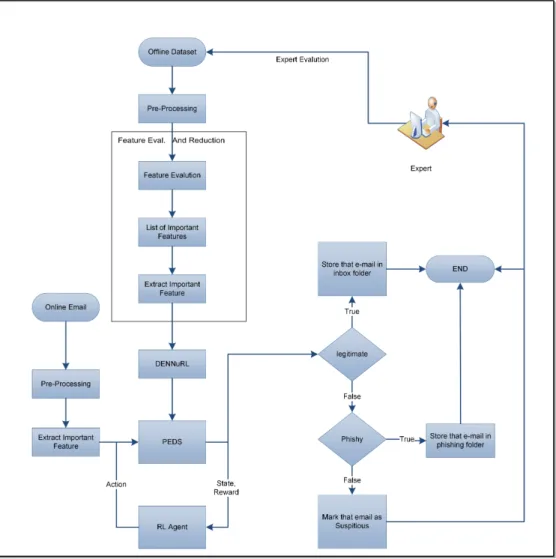
The proposed framework is called PEDS which is an online phishing email detection based on supervised and unsupervised machine learning techniques, as shown in Figure 1. The supervised
175
machine learning technique used a training dataset to build the detection model, while the unsu-pervised machine learning tries to adapt the detection model using a new delivered email to the system. The proposed model combines a neural network, reinforcement learning, data mining as-sociative classification techniques and a set of algorithms to detect phishing attacks. The proposed framework will have the ability to explore new phishing behaviours, and consists of the following
180
stages: pre-processing, FEaR, DENNuRL and RL-Agent. These stages will be discussed in more detail in the following sections.
3.3. Phishing Email Detection System
The generation of the PEDS, as shown in Figure 1, starts by applying the pre-processing phase which will extract fifty features from the o✏ine dataset, the pre-processing phase is described in
185
Section 3.4. The result of the pre-processing is used as input to FEaR algorithm which will detect the important list of features based on the training dataset, the FEaR algorithm is described in Section 3.5.1. In the next step, DENNuRL, as shown in Section 3.7, will be used to generate the PEDS which will be utilized in the online mode to classify emails. Later the RL-Agent will be used continuously to adapt the PEDS to reflect newly explored behaviour in the online mode.
190
The generated PEDS is a trained NN used to classify emails in the online mode to phishing and ham emails, the first NN is built using the DENNuRL based on the o✏ine dataset. The PEDS is
continuously adapted later using the RL-Agent to reflect changes in the online dataset. The full description of how the system evolve in the online mode will be discussed in Section 3.8.
3.4. Pre-processing
195
The pre-processing phase contains two steps. The first selects feature to be extracted from each email text and header; these features describe the di↵erent properties of each email. The
Figure 1: Phishing email detection system
second step includes selecting the most e↵ective features from the set extracted in the first step to
speed-up the building and adaptation of the classification model. 3.4.1. Feature Selection and Extraction
200
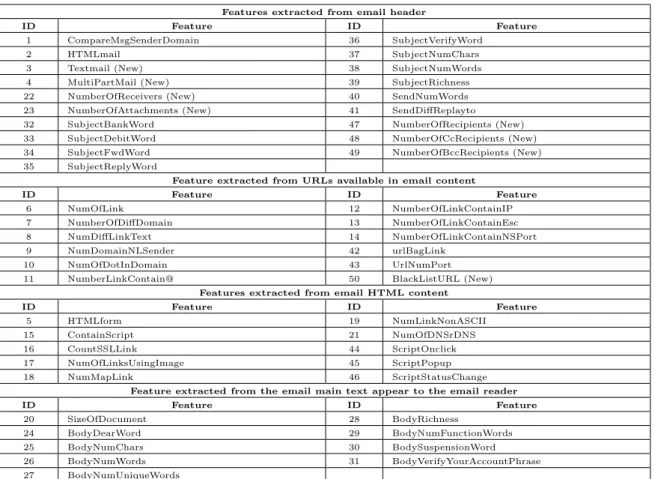
The features are selected from two sources: email headers and email content. These contain fifty features, eight of them are newly proposed and the rest of them drawn from previous studies. During the development of the detection system, the set of important features could change dynam-ically to reflect zero-day phishing attacks. The proposed features extracted from di↵erent parts of
the email, and grouped into four groups depending on their nature: email headers, URLs, HTML,
205
Table 1: List of features
Features extracted from email header
ID Feature ID Feature
1 CompareMsgSenderDomain 36 SubjectVerifyWord
2 HTMLmail 37 SubjectNumChars
3 Textmail (New) 38 SubjectNumWords
4 MultiPartMail (New) 39 SubjectRichness
22 NumberOfReceivers (New) 40 SendNumWords
23 NumberOfAttachments (New) 41 SendDi↵Replayto
32 SubjectBankWord 47 NumberOfRecipients (New)
33 SubjectDebitWord 48 NumberOfCcRecipients (New)
34 SubjectFwdWord 49 NumberOfBccRecipients (New)
35 SubjectReplyWord
Feature extracted from URLs available in email content
ID Feature ID Feature
6 NumOfLink 12 NumberOfLinkContainIP
7 NumberOfDi↵Domain 13 NumberOfLinkContainEsc
8 NumDi↵LinkText 14 NumberOfLinkContainNSPort
9 NumDomainNLSender 42 urlBagLink
10 NumOfDotInDomain 43 UrlNumPort
11 NumberLinkContain@ 50 BlackListURL (New)
Features extracted from email HTML content
ID Feature ID Feature 5 HTMLform 19 NumLinkNonASCII 15 ContainScript 21 NumOfDNSrDNS 16 CountSSLLink 44 ScriptOnclick 17 NumOfLinksUsingImage 45 ScriptPopup 18 NumMapLink 46 ScriptStatusChange
Feature extracted from the email main text appear to the email reader
ID Feature ID Feature 20 SizeOfDocument 28 BodyRichness 24 BodyDearWord 29 BodyNumFunctionWords 25 BodyNumChars 30 BodySuspensionWord 26 BodyNumWords 31 BodyVerifyYourAccountPhrase 27 BodyNumUniqueWords
header and content. From the content, the URLs, HTML, and text are extracted depending on the email content type. The email is divided into these parts to reduce the pre-processing time, and at the end every feature has been extracted from the appropriate parts.
3.5. Description of Features
210
The full description for the features listed in Table 1 is as follows:
• Features extracted from email header: 1-CompareMsgSenderDomain: This compares the message ID domain and sender domain and is a binary feature that determines if the domain names taken from the email sender are equal to those taken from the message-ID (Toolan & Carthy, 2010). 2-HTMLmail: Binary feature that determines if the email content type is
215
is text/plain in the email header (Smadi et al., 2015). 4-MultiPartMail: A binary feature that validates if the email content type is multipart (Smadi et al., 2015). 5-NumberOfReceivers: Counts how many receivers are included in the (from) attribute in the email header. 6-NumberOfAttachments: Counts how many attachments there are. 7- SubjectBankWord:
220
Checks if the email subject contains the word bank and returns (true) if it exists and (false) otherwise (Khonji et al., 2012). 8-SubjectDebitWord: Checks if the email subject contains the word debit and returns (true) if it exists and (false) otherwise (Khonji et al., 2012). 9-SubjectFwdWord: Checks if the email subject contains the word Fwd: and returns (true) if it exists and (false) otherwise (Toolan & Carthy, 2010). 10-SubjectReplyWord: Checks
225
if the email subject contains the word Re: and returns (true) if it exists and (false) other-wise (Toolan & Carthy, 2010). 11-SubjectVerifyWord: Checks if the email subject contains the word verify and returns (true) if it exists and (false) otherwise (Khonji et al., 2012). 12-SubjectNumChars: Counts the number of characters the subject field contains and re-turns that number (Toolan & Carthy, 2010). 13-SubjectNumWords: Counts the number
230
of words the subject field contains and returns that number (Toolan & Carthy, 2010). 14-SubjectRichness: Calculates the division between the number of words over the number of characters found in the subject field (Chandrasekaran et al., 2006). 15-SendNumWords: Counts the number of words the sender field contains and returns that number (Toolan & Carthy, 2010). 16-SendDi↵Replayto: Checks if the email sender is not the same as the Replay
235
to field, and returns (true) if they are equal and (false) otherwise (Toolan & Carthy, 2010). 17-NumberOfRecipients: Counts how many receivers are included in the (To:) attribute in the email header. 18-NumberOfCcRecipients: Counts how many receivers are included in the (Cc:) attribute in the email header. 19-NumberOfBccRecipients: Counts how many receivers are included in the (Bcc:) attribute in the email header.
240
• Feature extracted from URLs available in email content: 20-NumOfLink: Computes the number of hyperlinks which appear in the email body (Fette et al., 2007). 21-NumberOfDi↵Domain: Counts the number of di↵erent domains that are used in the email
hyperlinks that have hyperlink text which does not contain the domain name of the
hy-245
perlink target (Fette et al., 2007). 23-NumDomainNLSender: Computes how many hy-perlinks use a domain which is not equal to the sender domain (Fette et al., 2007). 24-NumOfDotInDomain: Computes the number of dots used in each hyperlink and returns the maximum number (Fette et al., 2007). 25-NumberLinkContain@: Counts the number of links in the email body which contain the @ character (Gansterer & P¨olz, 2009).
26-250
NumberOfLinkContainIP: Counts the number of URLs in the email which contain an IP address (Fette et al., 2007). 27-NumberOfLinkContainEsc: Counts the number of URLs in the email body which contain hexadecimal numbers or URL-escaped characters (Drake et al., 2004). 28-NumberOfLinkContainNSPort: Counts the number of URLs in the email body which contain a non-standard port (other than 80 or 443) (Drake et al., 2004).
29-255
urlBagLink: A binary feature that returns (true) if any of the following words is found in the URL; these words are click, here, login, and update (Bergholz et al., 2010). 30-UrlNumPort: Counts the number of URLs that contain a port in the authority section of that URL and returns that number (Toolan & Carthy, 2010). 31-BlackListURL: A binary feature that re-turns (true) if there is any of the URL which exist in the email body exist in the black-list
260
of URLs. These blacklist URLs are collected from PhishTank, which is a free community site where anyone can submit, verify, track and share phishing data. This feature is updated every 60 minutes to ensure that it contains the most recently registered phishing websites.
• Features extracted from email HTML content: 32-HTMLform: Checks if the email content contains an HTML form element (Bergholz et al., 2010). 33-ContainScript: Checks if the
265
email contains a JavaScript pop-up (Bergholz et al., 2010). 34-CountSSLLink: Counts the number of URLs in the email body which point to a website that encrypts the connection with a self-signed certificate. 35-NumOfLinksUsingImage: Computes the number of pictures which are used as hyperlinks (Gansterer & P¨olz, 2009). 36-NumMapLink: Computes the number of pictures with image maps that are used as hyperlinks (Gansterer & P¨olz, 2009).
270
37-NumLinkNonASCII: Counts the number of URLs that contain non-standard ASCII char-acters (Gansterer & P¨olz, 2009). 38-NumOfDNSrDNS: Checks if the domain names have a
corresponding reverse DNS entry and return (true) if they are equal, otherwise returns (false) (Inomata et al., 2005). 39-ScriptOnclick: A binary feature that checks if an email contains onClick JavaScript event and returns (true) if it is available and return (false) if not (Khonji
275
et al., 2012). 40-ScriptPopup: A binary feature that checks if an email contains a JavaScript pop-up windows in its content and return true if it is available and false otherwise (Khonji et al., 2012). 41-ScriptStatusChange: A binary feature that checks if an email contains a JavaScript that changes the text which appears in the status bar, and returns (true) if it is available otherwise returns (false) (Gansterer & P¨olz, 2009).
280
• Feature extracted from the email main text appear to the email reader: 42-SizeOfDocument: Returns the email message size in bytes (Gansterer & P¨olz, 2009). 43-BodyDearWord: Bi-nary feature which checks if the email body contains the word Dear and returns (true) if it exists, or otherwise returns (false) (Khonji et al., 2012). 44-BodyNumChars: Counts how many characters are in the email body (Chandrasekaran et al., 2006). 45-BodyNumWords:
285
Counts how many words are in the email body (Chandrasekaran et al., 2006). 46-BodyNumUniqueWords: Counts the number of unique words in the email body (Chan-drasekaran et al., 2006). 47-BodyRichness: Calculates the number of words divided by the number of characters found in the email body (Chandrasekaran et al., 2006). 48-BodyNumFunctionWords: Counts the number of function words discovered in the email
290
body. Function words are account, access, bank, credit, click, identify, inconvenience, infor-mation, limited, log, minutes, password, recently, risk, social, security, service and suspended (Chandrasekaran et al., 2006). 49-BodySuspensionWord: Checks if the email body contain the word suspension and returns (true) if it exists and (false) otherwise (Khonji et al., 2012). 50-BodyVerifyYourAccountPhrase: Binary feature that checks if the email body contains the
295
words (verify your account) and return (true) if it exists and (false) otherwise (Khonji et al., 2012).
The newly proposed features with their IDs are: Textmail (3), MultiPartMail (4), NumberOfRe-ceivers (22), NumberOfAttachments (23), NumberOfRecipients (47), NumberOfCcRecipients (48), NumberOfBccRecipients (49), and BlackListURL (50).
3.5.1. Feature Evaluation and Reduction (FEaR)
After applying the processing phase and extracting the fifty features described in the pre-vious section, the results are sent to the FEaR algorithm. This algorithm is used to determine the number of actual features that the classification process is applied to. The selected features will depend on the training dataset, which is used to determine the actual number of features that is
305
necessary to classify the emails in the training dataset. The features used will change if the training dataset is changed. Depending on the dataset used to build the detection model, the algorithm will choose from the fifty features a set of features that is e↵ective in determining email type. The rest of the features are not considered important and will be excluded from subsequent analysis, which will speed up the development process while preserving the same level of accuracy as if the
310
detection model was developed with all fifty features. The steps of the FEaR algorithm are shown below, the first step will use the CART algorithm (Berk, 2016) to generate the regression tree (RT), then RT will be used in the later steps to reduce the number of features from fifty features to the list of important features that can classify emails in the training dataset with high accuracy. Applying the FEaR algorithm involves the following benefits. Firstly, it will discover the phisher
315
behaviour used in the o✏ine dataset. Secondly, it will decrease the complexity of the generated model, by minimizing the number of input neurons and the number of connections between the input layer and the hidden layer. Thirdly, it will speed up the adaptation process to generate the best neural network; and the speed of the adaptation will have a crucial e↵ect on the online system.
Finally, it will accelerate the classification process.
320
3.6. Reinforcement Learning Paradigm
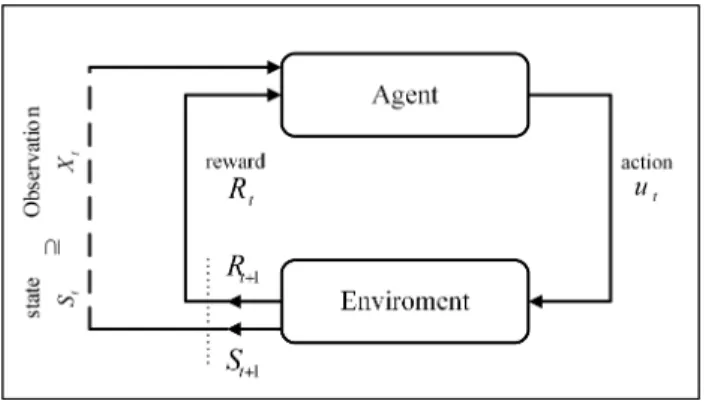
The reinforcement learning approach has been used to learn the optimal behaviour. It is based on the idea of trial-and-error interaction with the environment. RL has the following main components as shown in Figure 2:
(1) Agent: The controller of the system observe the system state St by reading observations Xt. 325
In the proposed model the observation will be the NN architecture, the email record, and the NN output. The agent interacts with the system by performing actions Ut and it gives rewards
Figure 2: Reinforcement learning framework
R(t+1), which can be used to improve the policy. After trying these actions, a NN is generated for every action, the reward from these actions is computed and the Q-table is updated. (2) Action: These influence the development of the environment, which apply changes in the
330
environment. The actions Ut will be one or any number of the following. Firstly, the number of significant features can be modified, which will change the number of neurons in the input layer. Secondly, the up-to-date-dataset can be changed, which contains the o✏ine dataset plus
any new phishing and ham emails detected by the PEDS with high accuracy. These newly added emails may contain new behaviour explored by the FEaR algorithm. Lastly, the NN
335
architecture that is used as the core of the classifications system can be changed.
(3) Policy (⇡): This is a mapping from the state of the environment to the action to be taken in this state. The policy is the core of the RL-Agent in the sense that it alone is sufficient
to determine the behaviour of mapping from the state of the environment to the action to be taken by the RL-Agent.
340
(4) Reward/cost function: The reward function specifies the overall objective of the RL-Agent, and it depicts the immediate reward the agent receives for performing a certain action in a given system state.
3.7. Dynamic Evolving Neural Network using Reinforcement Learning (DENNuRL)
The NN is one of the most powerful techniques that has been used extensively to build
classi-345
fication models. The capability of a NN model depends on characteristics such as the number of layers, the number of neurons in the hidden layers, the training function, the number of training
epochs and the problem to be solved (Islam et al., 2009). Usually, researchers determine the NN architecture manually and give a large number of training epoch, which means that the model gen-erated will not be the optimal one to solve the desired problem. Furthermore, the model gengen-erated
350
will not have the ability to adapt itself to reflect changes in the environment.
In the proposed algorithm, a NN with three layers was chosen; these are the input, hidden, and output layers. A three-layer NN was chosen because it can solve any linear or non-linear problem (Aggarwal, 2007; Srivastava et al., 2014; Zhang & Zhang, 1999). The number of neurons in the input layer depends on the number of features selected by the FEaR algorithm, which will
355
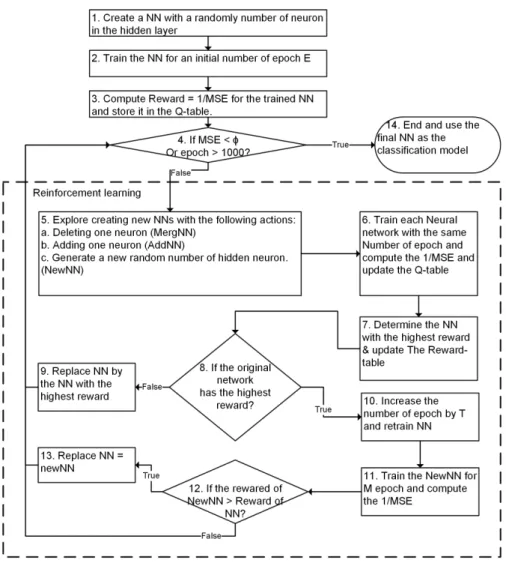
change dynamically depending on the discovery of new behaviour. The number of neuron in the output layer for NN network built for a classification problem will depends on the problem being solved. In the proposed model the output layer will contains two neurons, as we are developing a binary classification problem. The main focus in the proposed model, as shown in Figure 3, will be to determine the right number of neurons in the hidden layer. A large number of hidden
360
neurons may overfit the training data, and a small number will underfit the data. Overfitting and underfitting will generate a NN with a bad level of generalization, these too issues must be taken into consideration when NN used as the core of a classification models.
During the development and enhancement of the NN, the proposed technique takes into consid-eration the overfitting and underfitting problems that a↵ect NN efficiency. The overfitting problem
365
is caused by a large number of neurons in the hidden layer. It is solved by using the merge opera-tion. As an indication of the scale of overfitting problems, the early stopping technique (Prechelt, 2012) is used, which is accomplished by dividing the training dataset into training and validation datasets. At the time of training, the validation error is computed and if this error cannot be reduced six consecutive times, then the training process is stopped. If the validation error cannot
370
be enhanced, this means that the architecture used has led to overfitting in the problem be solved, even if the training error is reduced. The second issue is called underfitting, and if too few hidden neurons are chosen the NN generated will not have enough power to solve the problem, which is solved by adding neurons to the hidden layer. The steps of the DENNuRL algorithm are shown in Figure 3, and Algorithm A2 shows the full detail. The merge operation as shown in step 5,
Figure 3: Dynamic evolving neural network using reinforcement learning (DENNuRL)
Algorithm A2 which select which neuron to delete was proposed by Islam et al. (2009) and works as follows Islam et al. (2009). To choose which neurons to merge, the following steps are applied. The correlation between hidden neurons is measured, which is calculated based on the output of the hidden neurons for the training dataset according to A.4. The least significant hidden neuron is merged with the most correlated one, where the least significant neuron does not a↵ect the
380
classification process. To accomplish this action, two steps need to be applied. Firstly, the signifi-cance of every neuron is computed, which is evaluated by computing the standard deviation of the output of every neuron. A neuron's output that does not change for di↵erent inputs is considered
to be less significant, as shown in Equation 3. Secondly, the correlation is computed between the most and least significant neurons using Equations 1 and 2. The two neurons with the highest
385
correlation is chosen for merging, by deleting the two correlated neurons and creating one new neuron. The input weight and bais for the new neuron is the average of the input and bais for the deleted neurons. The output weight is sum of weight for the deleted neurons.
R(i, j) = p C(i, j)
C(i, i)C(j, j) (1)
where i, j are the two neurons whose correlation R(i, j) is measured, and C = cov(x, y) is the covariance between all hidden neurons which is defined as described in Equation 2:
390 con(A, B) = 1 N 1 N X i=1 (Ai µA)⇤(Bi µB) (2)
where (A, B) is the output matrix of two hidden neurons for all the examples in the training dataset, µA is the mean of A, and µb is the mean ofB.
Sd= v u u t 1 N 1 N X i=1 |Ai µ|2 (3)
whereSd is the standard deviation and A is the output matrix for one neuron for all examples in
the training dataset, andµ is the mean of A:
µ= 1 N N X i=1 Ai (4)
3.8. Reinforcement Learning Agent (RL-agent)
395
After producing the first PEDS using the DENNuRL algorithm based on the training dataset in the o✏ine mode, the system starts the development process by reading unclassified email in the
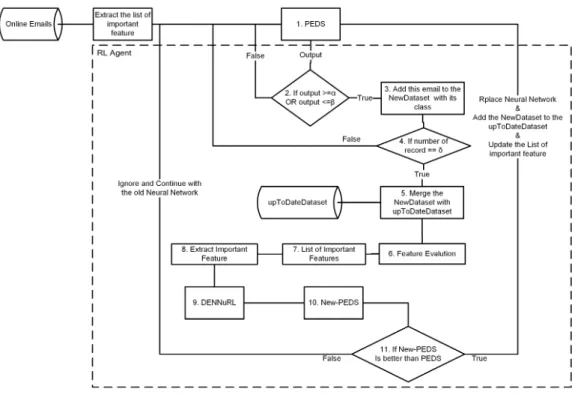
online mode. Figure 4 shows the RL-Agent algorithm, the system classifies emails into phishing and ham email. The RL-agent keeps watching the output of the PEDS in the online mode and works as shown in Algorithm A3.
Figure 4: Reinforcement learning agent
To handle the possibility of reinforcing a wrong result, the proposed model tests the new PEDS for a reference dataset which is the o✏ine dataset that is used to generate the first detection
model. If the new PEDS cannot achieve better performance compared with the first PEDS, then we assume that the system is reinforcing a wrong classification. In such a case, the enhancement is ignored and the system is reinitialized. After all there is a possibility of miss-classification for some
405
email that the model is not trained on (zero-day attacks); the proposed model tries to solve this problem using exploration-exploitation mechanism as shown in step 2 in the RL-Agent Algorithm. The RL-Agent Algorithm explores adding a group of emails (10% of the o✏ine dataset) to the
NewDataset. These emails are classified by the current PEDS with high accuracy ( 95%). The NewDataset will contain the old dataset plus the new group of email.
4. Results and Discussion
4.1. Dataset
The experiments were conducted using a dataset combination from three publicly available datasets, two of which are email datasets and one is for phishing URL datasets. These datasets are described next.
415
1. PhishingCorpus (Nazario, 2015) PhishingCorpus is a phishing email dataset. This dataset was collected manually, and researchers in this field use this dataset extensively. The Phish-ingCorpus was collected from 2004-2007, and the last update of those dataset was completed in 2015. The total number of phishing emails collected was 7315.
2. SpamAssassin (Mason, 2005) The SpamAssassin project collected ham and spam email; the
420
total number of emails collected is 6047 of which 4951 are ham emails. In training and testing the proposed model, the ham emails from the SpamAssassin corpus are used.
3. PhishTank (OpenDNS, 2016) The PhishTank URLs dataset was collected by the PhishTank organization, which is a collaborative clearing house for data and information about phishing on the Internet. This dataset is used to update the content of the BlackListURL feature,
425
and the list of blacklisted URLs is updated every 60 minutes from the PhishTank website automatically. The phishing URLs dataset is updated every hour because PhishTank updates its database hourly. 26722 phishing URLs were collected, and this number is added to every 60 minutes.
To train and test the PEDS, the dataset has been divided into an o✏ine dataset and online dataset.
430
The total number of emails used is 4951 for ham emails and 7315 for phishing emails. From the phishing email in every experiment, 4951 emails were chosen randomly. The total number of emails was 9902, and 4000 were selected randomly as an o✏ine dataset. The rest of the emails are used as
an online dataset to assess the system's development in response to a zero-day phishing attack. The experiment was conducted and repeated fifty times, and in every iteration the o✏ine dataset was
435
sorted in random order and divided into 70% for training, 15% for validation and 15% for testing. The results are recorded for every iteration and then the average computed for all iterations to ensure the reliable performance of the system.
In the field of phishing email the available datasets are very limited since it contains user confidential data. The proposed model solves this problem by automatically adding more email to
440
the o✏ine dataset as it processes email in the online mode. In addition, the reward value in the
DENNuRL algorithm is the MSE error which has the advantage of being independent of dataset size used. Moreover, the richness of the proposed model could be easily enhanced by adding any available dataset to the o✏ine dataset.
4.2. Evaluation Metrics
445
To evaluate the quality of the proposed model the list of the following metrics is used to evaluate the system performance. Suppose that M denotes the total number of phishing emails and D denotes the total number of legitimate emails. Then nm 2 M is the number of correctly detected phishing emails, whilend2Dis the number of emails correctly detected as legitimate,nf
is the number of legitimate emails detected as phishing, andnp is the number of phishing emails
450
detected as legitimate. For each detected email, the following evaluation method is applied: True positive (T P): The number of phishing emails correctly classified as phishing.
T P =nm/M (5)
True negative (T N): The number of legitimate emails correctly classified as legitimate.
T N =nd/D (6)
False positive (F P): The number of legitimate emails incorrectly classified as phishing.
F P =nf /D (7)
False negative (F N): The number of phishing emails incorrectly classified as legitimate.
455
F N =np/M (8)
Based on these four rules, other factors can be derived: precision, sensitivity, accuracy, and F Measure (Wickens, 2001; Zhu et al., 2010; Ferri et al., 2009). Accuracy is the sum of T P and
T N (the number of correct decisions) divided by the total number of emails. P recisionis the ratio of how many decisions were correct, which isT P divided by the sum ofT P andF P. Sensitivity is the number ofT P assessments divided by the number of all positive assessments. TheF M easure
is a measure of the test's accuracy, which refers to the balance betweenprecisionand sensitivity. These four metrics are shown in following definitions:
P recision= |T P| |T P|+|F P| (9) Sensitivity = |T P| |T P|+|F N| (10) Accuracy = |T P|+|T N| |T P|+|T N|+|F P|+|F N| (11) 465
F M easure= 2⇤P recision⇤Sensitivity
P recision+Sensitivity (12)
4.3. E↵ect of Using FEaR Algorithm
To evaluate the ability of the FEaR algorithm to detect new behaviour available in the dataset, many experiments were conducted. After applying the pre-processing algorithm and extracting the fifty features for all email in the selected dataset (9900 emails), the dataset is divided into a sub datasets, the element of each dataset were chosen randomly and used as input to the FEaR
470
algorithm to explore the important list of features.
For the training dataset the FEaR algorithm use the CART algorithm (Berk, 2008) to build the RT in the first step. After building the RT the FEaR algorithm use it as input to the later steps where the important list of features was selected. As shown in Table 2, for a dataset with 500 emails, the FEaR algorithm detected 11 features as important features that can be used to
475
distinguish between phishing and ham emails. With changing in the training dataset, a new phishing email is explored which could mean a new behaviour used by the phisher to lure online customers. The FEaR algorithm builds a di↵erent regression tree that can best classify the emails in the training dataset, and in every experiment it changes the tree nodes (features) from the total list of features. The FEaR algorithm showed the ability to explore these behaviours, when the
480
algorithm processes datasets of di↵erent list of emails, a di↵erent list of features is selected. In the
next section, the selected list of features is used to build the classification model, and the system is evaluated to see if it can detect phishing emails with high accuracy. In Table 2, for the sub dataset of size 1000, the FEaR algorithm explore di↵erent set of features, this happen due to the
fact that di↵erent set of email where chosen randomly where di↵erent phishing email may include
di↵erent behaviours user by phishers to lure the online customers. The ability of the proposed
algorithm to dynamically choose di↵erent set of behaviours when the training dataset is changed
will be main part of the online phishing email detection system. The proposed algorithm for the
Table 2: Important features discovered using FEaR algorithm
Dataset Size Count of Impor-tant Feature Features 500 11 3, 6, 11, 20, 24, 28, 29, 35, 37, 39, 41 1000 17 1, 3, 6, 7, 11, 17, 20, 25, 26, 28, 29, 34, 35, 37, 39, 40, 44 1000 18 3, 6, 7, 11, 20, 21, 24, 25, 26, 27, 28, 29, 35, 37, 38, 39, 40, 41 1000 18 3, 6, 7, 8, 10, 11, 20, 24, 25, 26, 28, 29, 34, 35, 37, 39, 40, 41 1500 19 3, 6, 9, 10, 11, 17, 20, 22, 23, 24, 26, 27, 28, 29, 35, 37, 38, 39, 40 2000 23 1, 3, 6, 7, 10, 11, 16, 17, 20, 22, 24, 26, 27, 28, 29, 34, 35, 36, 37, 39, 40, 41, 42 2500 27 1, 3, 6, 7, 8, 11, 16, 17, 18, 20, 22, 23, 24, 25, 26, 27, 28, 29, 34, 35, 36, 37, 38, 39, 40, 41, 48 3000 28 3, 4, 6, 7, 9, 10, 11, 12, 20, 22, 23, 24, 25, 26, 27, 28, 29, 32, 35, 36, 37, 38, 39, 40, 41, 42, 43, 48 3500 29 1, 3, 6, 7, 8, 10, 11, 16, 18, 20, 22, 23, 24, 25, 26, 27, 28, 29, 34, 35, 36, 37, 38, 39, 40, 41, 42, 43, 44 4000 30 1, 3, 6, 7, 8, 9, 10, 11, 16, 17, 20, 22, 23, 24, 25, 26, 27, 28, 29, 32, 34, 35, 36, 37, 38, 39, 40, 41, 42, 44 9900 33 1, 3, 6, 7, 8, 9, 10, 11, 16, 17, 18, 20, 22, 23, 24, 25, 26, 27, 28, 29, 31, 32, 34, 35, 36, 37, 38, 39, 40, 41, 42, 44, 48
selection from a large set of features solves the problem of selecting the right set of features to be used to build a classification model. Furthermore, the number of important features changes
490
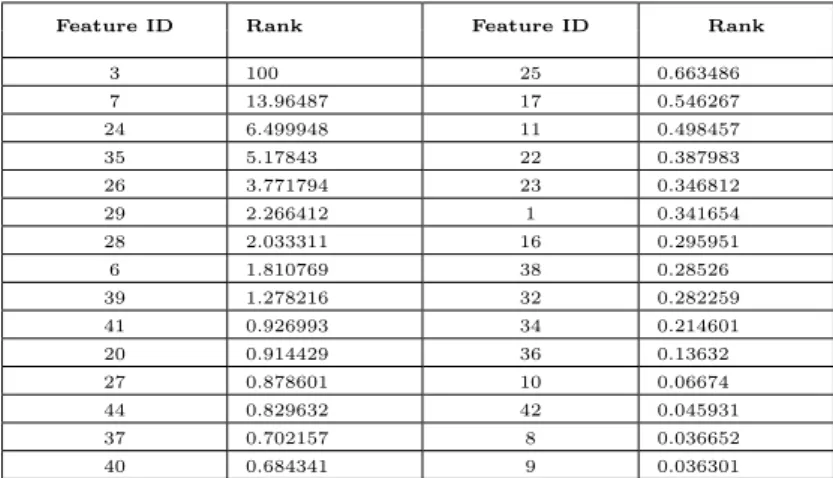
dynamically when the dataset changes without any user intervention, whereas other studies (Islam & Abawajy, 2013; Gansterer & P¨olz, 2009; Hamid & Abawajy, 2011) have used fixed numbers of features to classify phishing email and the sets of features chosen are changed manually. Moreover, the proposed algorithm can be used to rank the selected features, as shown in Table 3 where the ranks (V i) are evaluated in step 3 in the FEaR algorithm. In the online mode, when building a new
495
dataset that contains new phishing emails, the FEaR algorithm will explore the new behaviours that the new dataset may contain. In this section the FEaR algorithm is evaluated with di↵erent
sizes of dataset, using the complete list of features as input and selecting the most e↵ective list of
features that can classify email in the dataset under investigation. If the dataset size is changed, it will contain di↵erent groups of phishing and ham email. The FEaR algorithm successfully selects
500
di↵erent lists of features for di↵erent datasets. The experiments conducted in the next section will show that the selected list of features by FEaR algorithm can be used to build a classification model that can classify emails with a high level of accuracy.
Table 3: Feature ranking evaluated by FEaR algorithm with 4000 emails
Feature ID Rank Feature ID Rank
3 100 25 0.663486 7 13.96487 17 0.546267 24 6.499948 11 0.498457 35 5.17843 22 0.387983 26 3.771794 23 0.346812 29 2.266412 1 0.341654 28 2.033311 16 0.295951 6 1.810769 38 0.28526 39 1.278216 32 0.282259 41 0.926993 34 0.214601 20 0.914429 36 0.13632 27 0.878601 10 0.06674 44 0.829632 42 0.045931 37 0.702157 8 0.036652 40 0.684341 9 0.036301
Some of the newly proposed features are selected by the FEaR algorithm. As shown in Table 2, features (3, 4, 22, 23, and 48) are the new features proposed in this study are selected as important
505
features by FEaR algorithm. The selection of these new features by FEaR algorithm depends on the size of the dataset, as an example, if the dataset size is 500 email, then the FEaR algorithm select one new feature (feature 3). For 3000 email Features (3, 4, 22, and 23) are selected as important. The rank of the newly proposed features shows that such features are part of most important features when compared with the previously proposed features as shown in Table 3. As
510
an example, feature 3 is selected as the most important feature.
In this section the FEaR algorithm is evaluated with di↵erent sizes of dataset, using the
com-plete list of features as input and selecting the most e↵ective list of features that can classify email
in the dataset under investigation. If the dataset size is changed, it will contain di↵erent groups of phishing and ham email. The FEaR algorithm successfully selects di↵erent lists of features for
515
di↵erent datasets. The experiments conducted in the next section will show that the selected list
of features by FEaR algorithm can be used to build a classification model that can classify emails with a high level of accuracy.
The pre-processing algorithm extracted a large set of features which cover all aspects of emails where features are selected and extracted from the email header and content. The selected list of
520
used in future attacks.Furthermore, the richness of the proposed model can be enhanced by adding any possible feature that represent any information in the email which may be used by phishers in future attacks. The FEaR algorithm solves the problem of selecting the active list of features that can classify the training dataset with the highest accuracy.
525
4.4. DENNuRL
As discussed before, the DENNuRL algorithm, as shown in Figure 3, is used to generate the first PEDS employed in online mode. Later in online mode, the same algorithm will be utilized as part of the RL-Agent as shown in Figure 4. In both cases, it will be used to automatically choose the best NN to solve the desired problem.
530
The first PEDS built by using the DENNuRL algorithm based on the o✏ine dataset (4000
emails). As an example of the e↵ect of DENNuRL algorithm, Table 4 shows the enhancement of
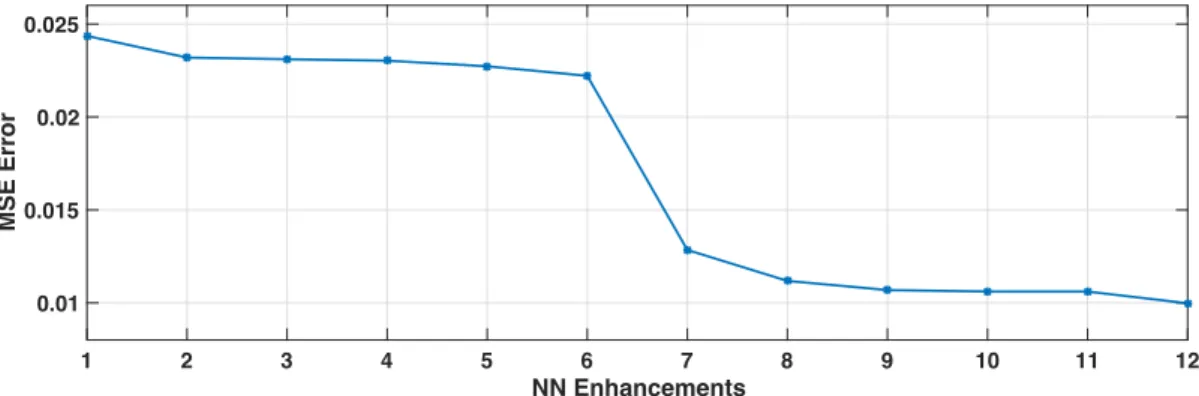
the NN, from the NN randomly generated in the first step to the final version that will be used as a PEDS. The MSE error guides the enhancement process where the NN with the lower MSE error will be better. Figure 5 shows the enhancement performed by DENNuRL algorithm in terms
535
of MSE error, with the system developments. MSE error is computed based on Equation A.4 as described before. In the first NN shown in Table 4, the number of neuron 27 is selected randomly by the algorithm, then the system tries the di↵erent actions and select the NN that return the
maximum rewards (minimum MSE error). In second enhancement, a new random NN is selected, at the third enhancement, one more neuron is added to the hidden layer. At step 11, two neurons
540
were merged in the hidden layer, and finally, in the last enhancement the training epoch is increased in order to reduce the MSE error.
Table 4 and Figure 5 shows the enhancement performed by the DENNuRL algorithm in terms of MSE error, according to the system's development. In the first NN shown in Table 4, the number of 27 neurons is selected randomly by the algorithm, and then the system tries the di↵erent actions
545
and selects the NN that returns the maximum rewards (minimum MSE error). In the second enhancement, a new random NN is selected, and at the third enhancement one more neuron is added to the hidden layer. At step 11, two neurons are merged in the hidden layer, and finally in the last enhancement the training epoch is increased in order to reduce the MSE error.
1 2 3 4 5 6 7 8 9 10 11 12 NN Enhancements 0.01 0.015 0.02 0.025 MSE Error
Figure 5: An example of NN enhancement using the DENNuRL in terms of MSE error
Table 4: An example of the NN adaptation using the DENNuRL algorithm
NN No. Number of neuron in the hidden layer Number of epoch MSE error 1 27 10 0.024355 2 37 10 0.023192 3 38 10 0.023105 4 39 10 0.023026 5 6 10 0.022724 6 7 10 0.022211 7 7 60 0.012845 8 8 60 0.01118 9 8 360 0.010688 10 20 610 0.010609 11 19 610 0.010607 12 19 1010 0.009976
4.5. The Phishing Email Detection System (PEDS)
550
After building the first PEDS using the DENNuRL algorithm, the system start classifying the online dataset described in Section 4.1. While PEDS classifies email in the online mode the RL-agent keep track of the output of the system. To compare the ability of the PEDS to detect phishing emails for the system before and after the adaptation, a detection error trade-o↵ (DET)
curve (Martin et al., 1997; Adler & Schuckers, 2005) is used. The DET curve is a graphical
555
representation that shows a trade-o↵ between the two types of error: missed detections (y-axis)
and false alarms (x-axis). Missed detection (false negative) is where a phishing email is classified as legitimate, and a false alarm (false positive) is where a legitimate email is classified as phishing. The two kinds of error were evaluated for the two FEDS for the same dataset selected randomly from the original dataset. The first system is the PEDS developed initially before applying the
adaptation process, and the second is the PEDS after applying the adaptation using the RL-Agent. The DET gives a good indication of the efficiency of the system at di↵erent operation points. The
DET curve shown in Figure 6 clearly indicates that the adapted system has lower probabilities of false rejection and false acceptance rates at all operation points. The DET curve is generated by
Figure 6: Detection error tradeo↵(DET) for PEDS before and after adaptation
sweeping the decisions threshold over the range of scores produced by the detection system, and
565
performance is evaluated at small, successive intervals. Then the normal deviations of the miss versus false alarm rates at each interval are plotted. The detection error trade-o↵function, which
takes in a list of prediction values and a list of truth values, produces output containing the false alarm (FPR) and missed detection (FNR) for all threshold values. The DET curve, which is the line showing the trade-o↵between FPR and FNR, is typically viewed in logarithmic coordinates.
570
The DET curve shown in Figure 6 shows that the two kinds of error, false alarms (x-axis) and miss detection (y-axis) are related. The nature of this relationship is determined using the following equation (Auckenthaler et al., 2000):
y= ( 1
T
x+µT
T
) (13)
where (µT, T) are the parameters of the target distribution, which is assumed to be Gaussian. A
special point in the DET curve, where the probability of false alarms is equal to the probability of
575
The EER can be evaluated using Equation 14. x=y= µT 1 + T and PEER= 1 p 2⇡ Z x 1 e t2/2dt (14)
By visual inspection of the DET curve, we can confirm that the PEDS after adaptation is better taking into consideration the two kinds of error. A weighted average of missed detection and false alarm rates may be used as a kind of figure of merit or cost function. The point on the DET curve
580
where such an average is minimized is called the EER. In Figure 6 these points are indicated by arrows.
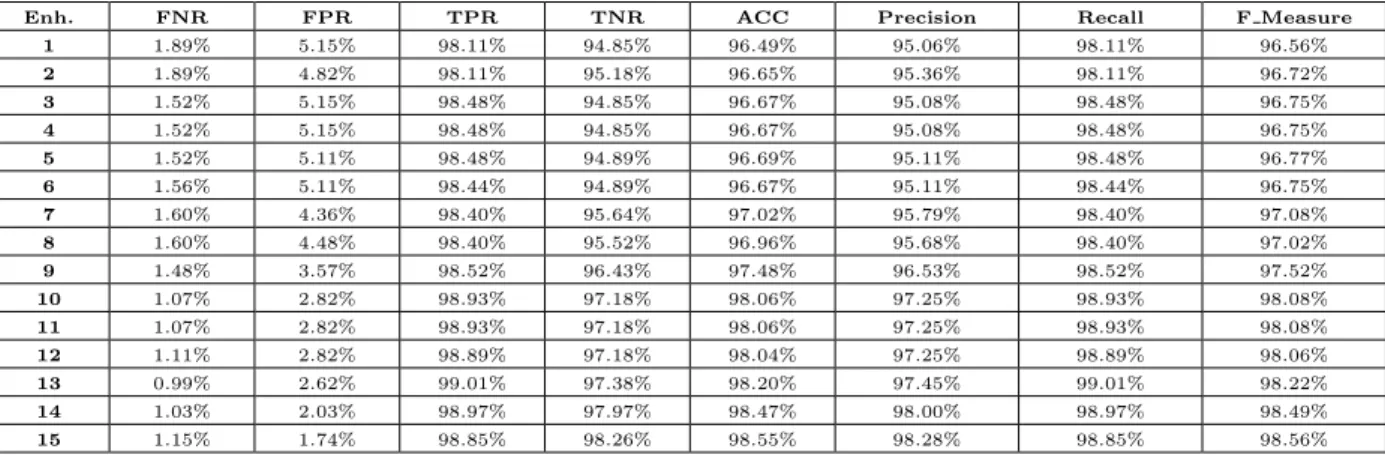
Table 5 summarizes the enhancement of the PEDS. To show how the system evolves in the online mode, eight di↵erent metrics were computed, which were accuracy, precision, recall, F Measure,
TPR, FPR, TNR, and FNR after every adaptation of the FEDS in the online mode. Figure 7 show
585
how the system evolves in terms of accuracy, where fifteen enhancements have been conducted throughout the processing of the online dataset of 5902 emails, and the results clearly show an enhancement in all metrics over time.
Table 5: PEDS enhancements in terms of FNR, FPR, TPR, Accuracy, Precision, Recall, and F Measure
Enh. FNR FPR TPR TNR ACC Precision Recall F Measure
1 1.89% 5.15% 98.11% 94.85% 96.49% 95.06% 98.11% 96.56% 2 1.89% 4.82% 98.11% 95.18% 96.65% 95.36% 98.11% 96.72% 3 1.52% 5.15% 98.48% 94.85% 96.67% 95.08% 98.48% 96.75% 4 1.52% 5.15% 98.48% 94.85% 96.67% 95.08% 98.48% 96.75% 5 1.52% 5.11% 98.48% 94.89% 96.69% 95.11% 98.48% 96.77% 6 1.56% 5.11% 98.44% 94.89% 96.67% 95.11% 98.44% 96.75% 7 1.60% 4.36% 98.40% 95.64% 97.02% 95.79% 98.40% 97.08% 8 1.60% 4.48% 98.40% 95.52% 96.96% 95.68% 98.40% 97.02% 9 1.48% 3.57% 98.52% 96.43% 97.48% 96.53% 98.52% 97.52% 10 1.07% 2.82% 98.93% 97.18% 98.06% 97.25% 98.93% 98.08% 11 1.07% 2.82% 98.93% 97.18% 98.06% 97.25% 98.93% 98.08% 12 1.11% 2.82% 98.89% 97.18% 98.04% 97.25% 98.89% 98.06% 13 0.99% 2.62% 99.01% 97.38% 98.20% 97.45% 99.01% 98.22% 14 1.03% 2.03% 98.97% 97.97% 98.47% 98.00% 98.97% 98.49% 15 1.15% 1.74% 98.85% 98.26% 98.55% 98.28% 98.85% 98.56%
Finally, to show the reliable performance of the proposed model, the experiment was repeated fifty times. Every experiment started from a random case and the final PEDS was produced after
590
the enhancements were tested. Table 6 shows a summary of the di↵erent metrics used in the assessment of PEDS performance; the experiment was repeated fifty times and an average is taken.
1 2 3 4 5 6 7 8 9 10 11 12 13 14 15 System Enhancement 0.96 0.965 0.97 0.975 0.98 0.985 0.99 Accuracy
Figure 7: System enhancements in terms of accuracy
Table 6: Results for the online PEDS averaged over 50 independent runs
FNR FPR TPR TNR ACC Precision Recall F Measure AUC
0.93% 1.81% 99.07% 98.19% 98.63% 98.21% 99.07% 98.64% 99.43%
4.6. Comparative Analysis
Table 7 shows the outcome of the comparison of the present results with those of previous work,
595
the phishing and ham emails used in these works were mainly collected from Monkey.org (Nazario, 2015) and the SpamAssasin (Mason, 2005) corpora.
Table 7: Comparison of our approach with previous work
Author No. of
features
Feature approach
Sample Results
Islam and Abawajy (2013) 21 Hybrid Undetermined size ACC 97% FP 2% FN
9% Almomani et al. (2013) 21 Hybrid Phishing 4300 Legitimate 6000 ACC 98% Khonji et al. (2012) 47 Hybrid Phishing 4116 Legitimate 4150 ACC 97% FP 0.60% Gansterer and Plz (2009) 30 Hybrid Phishing 5000 Legitimate 5000 ACC 97% Ramanathan et al. (2012) 200 topics Content 400,000 email ACC 97.7%
Ma et al. (2009) 7 Hybrid Phishing 46,525 Legitimate
613,048
ACC 99%
Toolan and Carthy (2010) 22 Hybrid Ham 4202 Spam 1895 Phishing 4563
ACC 97%
Hamid & Abawajy (2011) 7 Hybrid Total 4594 ACC 92%
(Islam & Abawajy, 2013) proposed a multi-tier classification model that used a combination of three classification algorithms (SVM, AdaBoost, and NaiveBayes). In this study twenty-one features were extracted from email header and content. The highest accuracy registered is 97%
600
with the arrangement (C1C3C2) whereC1 as support vector machine,C2 as Boosting (AdaBoost) and C3 as Bayesian (Naive Bayes). However, the proposed algorithm could not be modified to handle new type of attacks that the classifier combination does not have the ability to be adapted to reflect changes in the online emails. (Almomani et al., 2013) proposed a novel model that handles zero-day phishing attacks. Twenty-one features were used in building the detection model and 98%
605
accuracy was achieved, but the proposed model in the online mode was tested with only a tiny dataset of 300 phishing emails and 2000 legitimate emails. Khonji et al. (2012) used 47 features to represent phishing emails and achieved 97% accuracy (Khonji et al., 2012). However, this study did not take into consideration metrics such as true positive and true negative rates or AUC and false negative rates, despite the fact that these metrics are extremely important. Gansterer
610
et al. (Gansterer & P¨olz, 2009) used 30 features, and applied the J48 and SVM algorithms for classification and achieved 97% accuracy, but this study only used the metrics of accuracy and false positive rate. (Ramanathan & Wechsler, 2012) used the PLSA topic trainer to build the trained model, and a high accuracy was achieved at 97.7% while using the largest dataset in comparisons with other studies. The main disadvantages of this study including ignoring many features that
615
are related to URLs, which are the main connections between the emails and phishing websites. Furthermore, in the selection of the dataset it was assumed that the Enron email dataset is free from spam and phishing email, which has not been proven by the dataset producer. Finally, they did not consider redundancy in this vast dataset. (Ma et al., 2009) proposed a hybrid approach with seven features, and it successfully achieved 99% accuracy. However, this study did not use a verified
620
dataset of phishing and legitimate emails, and also only 7% of the dataset were phishing emails. (Toolan & Carthy, 2010) used 22 features to test three datasets. Approximately 97% accuracy was achieved for the first test which did not include phishing emails, but for tests two and three which included phishing emails much lower accuracy rates of 84% and 79% were achieved. (Hamid & Abawajy, 2011) also used seven hybrid features with several datasets and achieved 96% accuracy,
but this accuracy rate was reduced when dataset size increased. The present approach used fifty hybrid features which was reduced to a number of e↵ective features by the feature evaluation and
reduction phase. The number of important features changed dynamically to reflect changes in the dataset. The dataset grows dynamically by running the proposed model in the online mode. Only a few studies have considered handling zero-day phishing attacks, yet our model has been
630
proven to have the capability to handle zero-day phishing attacks with high accuracy. In the field of phishing email detection any small enhancement in the overall metrics is significant (Islam & Abawajy, 2013; Gansterer & P¨olz, 2009). Because when the system is wrongly classified one email as phishing and the user cannot see that email it could cause a loose of a significant information. Moreover, the proposed model successfully achieved an enhancement in accuracy from 96.5% to
635
98.6% as shown previously in Figure 7, and the enhancement continue as more email received by the system. The proposed model takes 4000 emails as a training dataset which is 44% of the overall dataset, while other researcher used 90% of the dataset as a training dataset. Nevertheless, the proposed system shows an ability to enhance itself in the online mode and overwhelms the existing studies. The proposed model can overcome the problem of high false positive rate by increasing
640
the size of training dataset. Moreover, the system shows an ability to enhance itself in the online mode in terms of all metrics as shown previously in Table 5 and Figure 7, while it processes in the online mode. On the other hand, the error rate for previous studies will be increased dramatically when handling zero-day phishing attacks, because it is not modifying the list of features to reflect changes in the zero-day attacks.
645
5. Conclusions and Future Work
Phishing is one of the most serious cybercrime threats that reduces the costumer trust in the trade-commerce. This paper shows how a NN with RL can be used to build a powerful model to detect zero-day phishing attacks with high performance levels and acceptable error rates. A novel algorithm has been proposed for developing the best NN, as well as an algorithm to explore
650
new behaviour and adapt the phishing email detection system dynamically, with the capability to explore new behaviours. The significance of the proposed model lies in following aspects. Firstly,
the PEDS is capable of online detection with the ability to adapt itself to reflect changes in the dataset. Secondly, the reinforcement learning methodology used in the proposed approach increases the ability of the system to evolve based on changes in the environment. Finally, the performance
655
of the online PEDS was evaluated using a set of metrics and compared with previously proposed approaches for phishing email detection. The proposed approach registers high accuracy, TPR, and TNR at 98.63%, 99.07%, and 98.19% respectively. In addition, it shows low FPR and FNR, at 1.81% and 0.93% respectively, and the rest of the metrics used to evaluate the proposed approach are summarized in Table 6. Future work may include adding more datasets to the o✏ine dataset
660
to increase the richness of the model, and the model may be extended to classify spam email as well as phishing and ham email.
Appendix A. Algorithms
Algorithm A1 Feature Evaluation and Reduction(FEaR)
1: Building a classification and regression tree using the CART algorithm. A brief description of how the CART algorithm works is as follows:
a. Start with the training dataset.
b. Take into consideration all possible values of all features; in this case, fifty features. c. Choose one featurexi with a specific valuet1, (xi =t1) that generates the largest division
in the email class, which will be the feature that can have the best division in relation to the email class.
d. Split the data into two branches: if (xi< t1), then send the data to the left-hand branch;
otherwise, send the data to the right-hand branch.
e. Repeat the same process on these two nodes. The final output is a tree as shown in which is used as input to the second step. The nodes in this tree will be the selected features that can generate the best division of the training dataset.
2: Evaluate the importance of every feature, where every node in the tree generated in the first step will represent one feature. The importance of every feature (node 1) that has two children (nodes 2 and 3) is estimated by applying Equation A.1:
V1 =
(R1 R2 R3)
N um node (A.1)
whereR1, R2 and R3 are the node risks for the parent and children nodes, and Num node
is the total number of nodes in this tree. The risk is defined as shown in Equation A.2.
Ri=Pi⇤Ei (A.2)
wherePi is the node probability and Ei is the node error computed by the CART algorithm
for every node in step 1.
3: Create a crisp value for each feature by dividing the importance value of each feature computed in step 2 by the maximum importance value as shown in Equation A.3:
⇢
Vi =
Vi
max(v))⇤100|8i= 1,2,3...n (A.3)
whereVi is the importance of feature icomputed in step 2, n is the number of features, v is
the vector of all features, andmax(v) is the maximum value in the vector v.
4: Select the features with crisp valuesVi>0 as important features. The features with Vi = 0 do
not have a corresponding node in the tree constructed in step 1.
5: Reduce the number of features extracted in the pre-processing phase from 50 features to the