Generating Application Layer IDS Rules
from Cyber Threat Intelligence
A thesis submitted to the
Graduate School of Natural and Applied Sciences
by
Bahruz Jabiyev
in partial fulllment for the degree of Master of Science
in
This is to certify that we have read this thesis and that in our opinion it is fully adequate, in scope and quality, as a thesis for the degree of Master of Science in CyberSecurity Engineering.
APPROVED BY:
Necati Ersen i³eci . . . . (Thesis Advisor)
Prof. Dr. Tahsin Erkan Türe . . . . Doç. Dr. O§uzhan Külekçi . . . .
This is to conrm that this thesis complies with all the standards set by the Graduate School of Natural and Applied Sciences of stanbul ehir University:
DATE OF APPROVAL: 20 June 2016
Declaration of Authorship
I, Bahruz Jabiyev, declare that this thesis titled, 'Generating Application Layer IDS Rules from Cyber Threat Intelligence' and the work presented in it are my own. I conrm that:
This work was done wholly or mainly while in candidature for a research degree at
this University.
Where any part of this thesis has previously been submitted for a degree or any
other qualication at this University or any other institution, this has been clearly stated.
Where I have consulted the published work of others, this is always clearly
at-tributed.
Where I have quoted from the work of others, the source is always given. With the
exception of such quotations, this thesis is entirely my own work.
I have acknowledged all main sources of help.
Where the thesis is based on work done by myself jointly with others, I have made
clear exactly what was done by others and what I have contributed myself.
Signed: Date:
Generating Application Layer IDS Rules from Cyber Threat
Intelligence
Bahruz Jabiyev
Abstract
Variety and complexity of cyber threats are increasing in parallel with technological ad-vancements in computer technologies. Therefore, it is getting harder to detect and ght cyber threats. Sharing of threat intelligence is a good way to grow immunity against various and complex threats, since it enables sharing parties to learn from others' experi-ences and knowledge, thereby to become alert to potential threats. XML-based standards TAXII, STIX and CybOX, of which development is led by MITRE, allow us to describe cyber threats in an extensive and standardized manner and to share them eectively. The aim of this thesis is to convert STIX/CybOX formatted threat intelligence data to Suricata rules which can be readily implemented on Suricata IDS/IPS. To create rules for a Suricata engine based on latest threat information on a regular basis, will enable it to get familiar with emerging threats.
Tezin Türkçe Ba³l§
Bahruz JabiyevÖz
Siber tehditlerin çe³it ve karma³kl§ bilgisayar teknolojilerindeki geli³imlere paralel olarak artyor. Bu yüzden, siber tehditleri tespit etmek ve onlarla sava³mak zorla³yor. Siber istihbaratn payla³lmas, çe³itli ve karma³k tehditlere kar³ korumay artrmann iyi bir yöntemidir, çünkü bu ³ekilde ba³kalarnn bilgi ve tecrübesi kullanlarak tehditlere kar³ daha uyank olunabilir. MITRE'nin geli³imine öncülük etti§i TAXII, STIX ve Cy-bOX standartlar bize siber istihbaratn kapsaml ve standartla³trlm³ bir ³ekilde tarif edilmesini ve etkin olarak payla³lmasn sa§lyor. Bu tezin amac, STIX/CybOX for-matndaki siber tehdit istihbaratn, kolayca Suricata IPS/IDS sistemlerinde tanmlan-abilecek Suricata kurallarna dönü³türmek. Düzenli olarak, güncel siber tehditleri baz alarak olu³turulan Suricata kurallar, Suricata sisteminin yeni yaranan tehditlere a³ina olmasna olanak sa§layacaktr.
First, I want to dedicate my work to my dear future wife, Günay. She
supported me through the period of my thesis writing and shared my
happiness during the times I was starting, writing and getting closer
to the end of my thesis. Also, I want to dedicate this work to my
family, who have brought me up and who have been my lovely and
kind supporters in every phase of my life.
Acknowledgments
I would like to thank to my kind and polite instructor Necati Ersen i³eci, who tirelessly helped me to write this thesis, despite the fact that I was interrupting him often to ask my questions. I also feel myself grateful to Assistant Professor Hatice Tekiner Mo§ulkoç and Professor Erkan Ture who helped me a lot to start to this program.
Contents
Declaration of Authorship ii
Abstract iii
Öz iv
Acknowledgments vi
List of Figures viii
Abbreviations ix
1 Cyber Dimension of Life 1
1.1 Benets of Computer Technologies . . . 1
1.2 Application Areas of Computer Technologies . . . 2
2 Cyber Threats and Countermeasures 3 2.1 Examples for Cyber Threats . . . 4
2.2 Security Measures Taken Against Cyber Threats . . . 5
2.2.1 Anti-Malware Software Products . . . 5
2.2.2 Preventive Network Devices . . . 5
3 Cyber Intelligence Sharing 7 3.1 Cyber Intelligence . . . 7
3.2 Importance of Sharing . . . 8
3.3 TAXII Protocol for CTI Sharing . . . 8
3.4 CybOX . . . 9 3.5 STIX . . . 13 4 Suricata 20 5 Related Work 23 6 Our Work 25 7 Conclusion 27 8 Future Work 29 vii
List of Figures
3.1 Customizing a Feed Poll . . . 19 3.2 Creating a Feed . . . 19
Abbreviations
CTI Cyber Threat Intelligence
CybOX Cyber Observable Expression
C2 Command and Control
DDoS Distributed Denial of Service
DNS Domain Name System
HTTP HyperText Transfer Protocol
HUMINT HUMan based INTelligence
ICS Industrial Control System
IDS Intrusion Detection System
IP Internet Protocol
IPS Intrusion Prevention System
OSINT Open Sources Intelligence
SIEM Security Information and Event Management
SMB Server Message Block
SMTP Simple Mail Transfer Protocol
STIX Structured Threat Information eXpression
TAXII Trusted Automated eXchange of Indicator Information
TCP Transmission Control Protocol
URL Uniform Resource Locator
XML eXtensible Markup Language
WAF Web Application Firewall
Chapter 1
Cyber Dimension of Life
After computer systems started to play a central role in every part of mankind's life, a new dimension emerged into our lives, cyber dimension. The term "cyber" is used to refer to things related to computer and internet. Computers or computerized systems span larger portion of our lives with each passing day. Computer technologies have innumerable benets for us, but we should also be aware of threats brought into our lives by the fast expansion of them.
1.1 Benets of Computer Technologies
The term "computer technologies" is commonly used for systems based on computer, like personal computers, tablets, smart phones, industrial control systems and so on. The most notable abilities of computers technologies are speed and accuracy. They facilitate communications over very long distances, speed up production of many things to large extent, store and manipulate large amount of data, do heavy and precise calculations and make many other things possible in various areas including science, health, critical infrastructures and large enterprise organizations. To better describe the role of computer technologies in the areas stated above, it is absolutely reasonable to say that, current level reached in those areas couldn't be reached without computer technologies.
Chapter 1. Cyber Dimension of Life 2
1.2 Application Areas of Computer Technologies
Scientic researches exploit the power of computers in order to increase the accuracy and speed of calculations to the maximum level. Quantum Physics and Molecular Biology are good examples for branches of science in which computer power is indispensable. Health sector is also highly dependent on computer technologies. Almost all medical devices are computer based systems. Computers take the central role in the management of patients' medical data and facilitates doctor-patient relationship. Today, critical infrastructures also extensively use the computer technologies to achieve their aims. Industrial control systems owe its ability to do precise calculations and rapid operations to their computer-based nature. Enterprise organizations also use computers to achieve their career goals and manage their internal aairs. To mention all areas in which computer technologies are used and for what aims they are used in those areas, is out of scope of this work. But to describe better the extent of computer usage in today's world, it is possible to say that there is almost not an area remaining untouched by computer technologies.
Chapter 2
Cyber Threats and
Countermeasures
Today, cyber domain is counted as fth domain of war after land, sea, air and space because of its potential to be destructive as other domains. Mankind has witnessed a large number of devastating attacks coming from the cyber domain targeting governments, critical infrastructures, enterprise organizations and other important entities. It is not dicult to imagine how disastrous it is for a critical infrastructure to be out of service for many hours or days as a result of a cyber attack. And many large enterprise organizations are confronted with cyber attacks which are real threat to their reputation, privacy and availability. It is also possible to show many examples of cyber attacks targeting banks or other nancial organizations which have resulted in theft of mind-boggling amounts of money and customer information. Governmental organizations also are under threat of espionage-motivated cyber attacks which are mostly state-sponsored and well-organized attacks. In response to the threats coming from cyber domain for which we gave a short description, hardware and software-based protection techniques have been developed and deployed over the last decades. However, experiences till today has shown us that developed security measures are not sucient by themselves for full protection from cyber attacks.
Chapter 2. Cyber Threats and Countermeasures 4
2.1 Examples for Cyber Threats
Here are some main types of cyber threats and short descriptions for them:
Malware Malware is a shortened name for Malicious Software. Malware is a program created to do malicious activities on the target system. These malicious activities may include taking control of the victim system and get commands from remote attacker. Malwares can also be spy programs which are logging every keystroke, recording the sound around or video in order to send it to the attacker. Some types of malware make threats against the victim and force them to do something, like encrypt all les and force them to pay to decrypt them.
Advanced Persistent Threats APTs are mostly very well-organized, very creepy and dangerous programs. Most of the time, they are tailor-made programs for their target. This type of malware is designed to persist for long time in the victim systems and do malicious activities on them like collecting information about systems and sending it to the attacker.
Botnet Botnet is a name given to networks made up of a large number of infected computers, sometimes hundreds of thousands. These computers are malware infected and controlled by Command and Control (C2) Servers. C2 Servers are the main actors of most Distributed Denial of Service (DDoS) attacks. They use their bots (or infected computers) to conduct attacks to a specic target by making each of them send packets to the target system, so that cause overload on the target, which generally results in denial of service. Most of the time, the motivation behind these attacks is to take down the target server and cause availability problems, which in turn may cause monetary damage, loss of reputation and so on.
Social Engineering Social engineering attacks, also known as phishing attacks are tailor-made attacks for the victim. In these attacks, usually a trusted person or an organization is impersonated. The main goal in these attacks is to deceive the victim into downloading some malicious le or visiting some malicious site and so that gain access to the internal network or steal the credentials of the victim. Other attack scenarios are also possible.
Chapter 2. Cyber Threats and Countermeasures 5
2.2 Security Measures Taken Against Cyber Threats
In order to mitigate cyber threats, many security products have been developed to date. Some of them are ghting local threats within the host, protecting local le system against malicious les. Once they are detected they are removed from the system. Other type of taken security measures include ghting cyber attacks coming over network, by detecting threats either in transport layer or in the application layer.
2.2.1 Anti-Malware Software Products
Anti-Malware products, commonly known as antivirus programs, mainly monitor local lesystems for any illegal le or connection. Antivirus products rely mainly on a database of identiable pieces of known suspicious code (le signatures), as well as behavioral and pattern-matching analysis (heuristics) to identify suspect les [1, p.10].
2.2.2 Preventive Network Devices
Several types of network devices have been emerging till today, each of them responsible for ghting dierent aspects of network intrusions. Some of them are vitally important so that it is virtually impossible for a company to function properly without them. Almost all types of network devices are getting deployed more commonly as a natural result of increasing complexity of cyber attacks that companies are exposed to. Below, some major types of network devices have been listed with short explanations about them. Firewall Nowadays, it is not possible to imagine a company which has a computer network inside and does not deploy a rewall which serves as an exterior gate for the company's network. Its main goal is to isolate company's internal network from outside world. Based on rules written to a rewall, it is ltering incoming and outgoing network trac.
Web Application Firewall As cyber attacks, targeting security holes in web appli-cations, are increasing in popularity, Web Application Firewalls (WAF) are deployed to combat them. Fundamentally, they monitor application layer part of packets and drop them when they detect dangerous pattern in them.
Chapter 2. Cyber Threats and Countermeasures 6 Anti-DDoS Devices As we have already mentioned, Distributed Denial of Service attacks, DDoS attacks in short, are remaining as one of the most serious threats for a company's availability, in other words, its capability to serve its customers all the time. To mitigate this sort of attacks, Anti-DDoS devices have been developed. They guard company's network by blocking trac surpassing certain level in terms of packet rate or number of packets from a single source.
Intrusion Prevention/Detection System In short IPS/IDS, is among the most successful security solutions which is able to analyze packets at network, transport layers and additionally at application layer for some protocols. Normally, these systems have hundreds or thousands of rules implemented on them for detecting dangerous packets. If a matched packet is found, it generates log about it. If it is deployed in IPS/inline mode, it also prevents packets from passing, besides generating log about that packets. Suricata is one of the most successful and well-known IPS/IDS engines. Since Suricata is closely related to the topic of this thesis, shortly we will return back to Suricata and give detailed information about it.
Chapter 3
Cyber Intelligence Sharing
One way to grow immunity to cyber attacks threatening us is to create a cooperation in which cooperating parties share their experiences, observations, knowledge with other parties to give them a chance to be aware, to assess and adopt, so that help them to protect themselves better. As the number and variety of parties involved and the complexity of shared information increases, there will be more need to do sharing in time and cost-ecient manner. This is possible through a standardized and comprehensive sharing protocol adopted by each cooperating party.
3.1 Cyber Intelligence
Cyber intelligence is a general term used to refer to information which is valuable from cyber security aspect. This can be in various forms, may be an IP address of C2 server which should be blocked, may be the hash of a malicious le which should be removed once detected, may be a malicious e-mail which should be regarded as a phishing attempt or may be an attack technique which should be associated with the related threat actor when observed. When cyber intelligence is shared, it will enable us to take concrete actions against related threats and protect ourselves better.
Chapter 3. Cyber Intelligence Sharing 8
3.2 Importance of Sharing
When increasing complexity of cyber attacks is considered, Cyber Threat Intelligence (CTI) sharing is key to succeed in cyber defense. Sharing is a good rst step to make a defensive cooperation. By sharing cyber threat information, each party in the coop-eration can build up a stronger immunity against threats, given that cyber actors can use same techniques for more than one target. Sharing can also help to paint a more complete portrait about threat actors and techniques they use. To explain it with ex-ample, say, you have a malicious le in your hand, others' observations and knowledge about that specic le will help you to better understand the goals of this malicious le, or vice versa, after getting some information about that malware you can share it to help others to handle the same situation if they encounter it in the future. One im-portant aspect of threat intelligence sharing is that, network products can also become more eective by sharing intelligence with each other. A security tool can automati-cally convert threat intelligence to something actionable. By leveraging a comprehensive and standardized threat intelligence sharing protocol, it is possible to enable time and cost-ecient communication of entities of dierent natures and types. To use common language for sharing intelligence is also helpful for avoiding ambiguities.
3.3 TAXII Protocol for CTI Sharing
TAXII, which is the abbreviation of "Trusted Automated Exchange of Indicator Infor-mation", is an open-source and community-driven project, which is being developed by MITRE Corporation. The main goal of TAXII project is to provide a standard way for sharing threat intelligence between the cyber entities in a speedy and secure man-ner, thereby establishing a fullling sharing environment. To carry threat data, TAXII protocol uses HTTP, which enables TAXII to take advantage of HTTP security mech-anisms like encryption and authentication [2]. TAXII Protocol also works well with its native threat expression formats like CybOX and STIX of which development also led by MITRE Corporation.
Chapter 3. Cyber Intelligence Sharing 9
3.4 CybOX
Cyber Observable Expression (CybOX) is an XML format standard to describe observed cyber entities including but not limited to:
Action (e.g. Create File) Domain Email File IP Address Network Connection URL
Below, a CybOX expression for an action of creating a le is shown. In this action, a le, bad_file with MD5 hash value of D3AA2F5A6B937885DE25302801E74AB2 is successfully created in C:\Windows\system32. It is quite common to observe such an action while analyzing malware samples.
1 <cybox:Action id="example:Action-b57aa65f-9598-04fb-a9d1-5094c36d5dc4" action_status=" Success" context="Host" timestamp="2016-05-28T09:22:00.0Z">
2 <cybox:Type xsi:type="cyboxVocabs:ActionTypeVocab-1.0">Create</cybox:Type> 3 <cybox:Name xsi:type="cyboxVocabs:ActionNameVocab-1.0">Create File</cybox:Name> 4 <cybox:Associated_Objects>
5 <cybox:Associated_Object id="example:Object-043d8340-0300-46ee-b3bd-27693c8f64b7"> 6 <cybox:Properties xsi:type="FileObj:FileObjectType">
7 <FileObj:File_Name>bad_file.exe</FileObj:File_Name> 8 <FileObj:File_Path>C:\Windows\system32</FileObj:File_Path> 9 <FileObj:Hashes>
10 <cyboxCommon:Hash>
11 <cyboxCommon:Type>MD5</cyboxCommon:Type>
12 <cyboxCommon:Simple_Hash_Value datatype="hexBinary">D3AA2F5A6B937885DE25302801E74AB2</
cyboxCommon:Simple_Hash_Value> 13 </cyboxCommon:Hash>
14 </FileObj:Hashes> 15 </cybox:Properties>
16 <cybox:Association_Type xsi:type="cyboxVocabs:ActionObjectAssociationTypeVocab-1.0"> Affected</cybox:Association_Type>
Chapter 3. Cyber Intelligence Sharing 10 18 </cybox:Associated_Objects>
19 </cybox:Action>
Listing 3.1: CreateFile Action CybOX
Domain is among the most basic observables, which can be used to describe attack pat-terns. An example domain CybOX has been described below.
1 <cybox:Observable id="example:observable-0748fef1-f756-4aaa-b537-b996078a33dc"> 2 <cybox:Title>Cryptolocker Domain</cybox:Title>
3 <cybox:Description>This domain is hosted by a Cryptolocker Server.</cybox:Description> 4 <cybox:Object id="example:domainname-d10d61e5-1c63-4c1f-9f46-e079361e96ba">
5 <cybox:Properties xsi:type="DomainNameObj:DomainNameObjectType" type="FQDN"> 6 <DomainNameObj:Value>server1.cryptolocker.com</DomainNameObj:Value>
7 </cybox:Properties> 8 </cybox:Object> 9 </cybox:Observable>
Listing 3.2: A Domain Name CybOX
Email is another type of observable which is commonly observed in phishing attacks. An example for malicious e-mail is described below giving information about its subject and sender.
1 <cybox:Observable id="example:observable-a91d488e-dddb-4ddd-95dd-d269b9169291"> 2 <cybox:Title>Cryptolocker Phishing Email</cybox:Title>
3 <cybox:Description>Email delivered to infect cryptolocker malware</cybox:Description> 4 <cybox:Object id="example:Email-9361c92d-bdc1-4a57-980f-4993cd74958a">
5 <cybox:Properties xsi:type="EmailMessageObj:EmailMessageObjectType"> 6 <EmailMessageObj:Header>
7 <EmailMessageObj:From xsi:type="AddressObj:AddressObjectType" category="e-mail"> 8 <AddressObj:Address_Value>[email protected]</AddressObj:Address_Value> 9 </EmailMessageObj:From>
10 <EmailMessageObj:Subject>View Your Bill</EmailMessageObj:Subject> 11 </cybox:Properties>
12 </cybox:Object> 13 </cybox:Observable>
Listing 3.3: An Email CybOX
CybOX description for an example le is given below. File as an observable type is a quite common and important one. They can say much about the attack technique, attack actor, aim of attack and many more.
Chapter 3. Cyber Intelligence Sharing 11 1 <cybox:Observable id="example:observable-56d275d9-4513-40e5-9fb0-a76af88c8d69">
2 <cybox:Title>Cryptolocker Encrypter File</cybox:Title>
3 <cybox:Description>Encrypts all files using RSA algorithm</cybox:Description> 4 <cybox:Object id="example:file-0b74a6e2-f749-4e25-a725-7eddfdc8746d">
5 <cybox:Properties xsi:type="FileObj:FileObjectType"> 6 <FileObj:File_Name>YourBills</FileObj:File_Name>
7 <FileObj:File_Path>AppData\Cryptolocker</FileObj:File_Path> 8 <FileObj:File_Extension>.exe</FileObj:File_Extension> 9 <FileObj:Size_In_Bytes>4655</FileObj:Size_In_Bytes> 10 <FileObj:Hashes>
11 <cyboxCommon:Hash>
12 <cyboxCommon:Type xsi:type="cyboxVocabs:HashNameVocab-1.0">MD5</cyboxCommon:Type> 13 <cyboxCommon:Simple_Hash_Value>376dff8959aac4bd03e9b929da8e0248</cyboxCommon:
Simple_Hash_Value> 14 </cyboxCommon:Hash> 15 </FileObj:Hashes> 16 </cybox:Properties> 17 </cybox:Object> 18 </cybox:Observable>
Listing 3.4: A File CybOX
Botnet Server IP represented in CybOX format is given as an example below. 1 <cybox:Observable id="example:observable-a1afb57e-211c-41a3-9da5-e5a8e913cd22"> 2 <cybox:Title>Botnet Server</cybox:Title>
3 <cybox:Description>This IP is owned by a Botnet Server.</cybox:Description> 4 <cybox:Object id="example:address-97d0d894-a93a-49bf-b1a7-622386a7b416">
5 <cybox:Properties xsi:type="AddressObj:AddressObjectType" category="ipv4-addr"> 6 <AddressObj:Address_Value>100.10.1.2</AddressObj:Address_Value>
7 </cybox:Properties> 8 </cybox:Object> 9 </cybox:Observable>
Listing 3.5: IPv4 CybOX
Here in this example [3], a TCP connection is described using source and destination IP addresses and port numbers.
1 <cybox:Object id="example:Object-13c00902-fc04-4d63-9362-29afedd50805">
2 <cybox:Properties xsi:type="NetworkConnectionObj:NetworkConnectionObjectType"> 3 <NetworkConnectionObj:Layer3_Protocol datatype="string">IPv4</NetworkConnectionObj:
Layer3_Protocol>
4 <NetworkConnectionObj:Layer4_Protocol datatype="string">TCP</NetworkConnectionObj:
Layer4_Protocol>
5 <NetworkConnectionObj:Source_Socket_Address> 6 <SocketAddressObj:IP_Address>
Chapter 3. Cyber Intelligence Sharing 12 7 <AddressObj:Address_Value>10.0.0.2</AddressObj:Address_Value>
8 </SocketAddressObj:IP_Address> 9 <SocketAddressObj:Port>
10 <PortObj:Port_Value>4444</PortObj:Port_Value> 11 </SocketAddressObj:Port>
12 </NetworkConnectionObj:Source_Socket_Address> 13 <NetworkConnectionObj:Destination_Socket_Address> 14 <SocketAddressObj:IP_Address>
15 <AddressObj:Address_Value>208.29.22.5</AddressObj:Address_Value> 16 </SocketAddressObj:IP_Address>
17 <SocketAddressObj:Port>
18 <PortObj:Port_Value>443</PortObj:Port_Value> 19 </SocketAddressObj:Port>
20 </NetworkConnectionObj:Destination_Socket_Address> 21 </cybox:Properties>
22 </cybox:Object>
Listing 3.6: A Network Connection CybOX
URL can also be described through CybOX. An example is shown below. 1 <cybox:Observable id="example:observable-3a30d6c9-7429-44b9-84bc-68a449a17cae"> 2 <cybox:Title>Malicious page</cybox:Title>
3 <cybox:Description/>
4 <cybox:Object id="example:uri-88a0337f-2db4-4ff1-b182-928c34d2f019"> 5 <cybox:Properties xsi:type="URIObj:URIObjectType" type="URL"> 6 <URIObj:Value>http://www.attacker.com/example.php</URIObj:Value> 7 </cybox:Properties>
8 </cybox:Object> 9 </cybox:Observable>
Listing 3.7: URL CybOX
On whole, CybOX format is used to describe building blocks of more complex types of threat intelligence which is mainly expressed in STIX format. Think of an example in which a phishing attack is done to a company. CybOX format can be used to describe observables in this attack, like malicious le attached to the e-mail or e-mail itself. Whereas to describe the whole phishing attack with various aspects is the responsibility of STIX.
Chapter 3. Cyber Intelligence Sharing 13
3.5 STIX
Structured Threat Information Expression (STIX) aims to describe intrusion attempts in more detail and provide context to what is observed in order to understand cyber situation better. For this aim, various aspects of an intrusion attempt can be represented through STIX. Some of them are listed below:
TTP Indicator Incident Campaign Exploit Target Threat Actor Course of Action
TTP is used to refer to attack techniques and tactics leveraged by an adversary to carry out cyber attacks. Botnet, malware, phishing can be shown among commonly-used TTPs. Identifying TTP used by an adversary can prove very helpful to gain better un-derstanding about the threat actor and intended eects. TTP leveraged by Cryptolocker ransomware, is shown in details in STIX format as follows.
1 <stix:TTP id="example:ttp-3b6871bc-f1b7-42b4-be83-9221f602575d" timestamp="2016-05-06T20 :16:24.142150+00:00" xsi:type=’ttp:TTPType’>
2 <ttp:Title>Cryptolocker Ransomware</ttp:Title>
3 <ttp:Short_Description>Comes as an e-mail attachment and once downloaded and executed it encrypts all files</ttp:Short_Description>
4 <ttp:Intended_Effect timestamp="2016-05-06T20:16:24.142455+00:00">
5 <stixCommon:Value xsi:type="stixVocabs:IntendedEffectVocab-1.0">Extortion</stixCommon:
Value>
6 </ttp:Intended_Effect> 7 <ttp:Behavior>
8 <ttp:Attack_Patterns> 9 <ttp:Attack_Pattern>
10 <ttp:Title>Phishing</ttp:Title>
11 <ttp:Description>Uses e-mail to deliver the malicious executable.</ttp:Description> 12 </ttp:Attack_Pattern>
Chapter 3. Cyber Intelligence Sharing 14 13 </ttp:Attack_Patterns>
14 <ttp:Malware>
15 <ttp:Malware_Instance>
16 <ttp:Name>crypto.exe</ttp:Name> 17 <ttp:Title>Encrypter</ttp:Title>
18 <ttp:Short_Description>Once executed, encrypts all files.</ttp:Short_Description> 19 </ttp:Malware_Instance>
20 </ttp:Malware> 21 </ttp:Behavior> 22 </stix:TTP>
Listing 3.8: TTP
Indicators are among the most commonly-shared form of threat intelligence. As its name suggests, indicators represent things that we should be alert to, since they indicate some sign of an attack. Indicators can be associated with attack actors and TTPs. For ex-ample, "if you see an IP of 10.1.0.0 (potentially a botnet server IP) in your network trac, it can be the indication of threat actor namedZeuswhich is owner of C2 servers". Below, STIX for this example has been given. In the example below, TTP is referenced within the indicator.
1 <stix:Observables cybox_major_version="2" cybox_minor_version="1" cybox_update_version="0"> 2 <cybox:Observable id="example:observable-f8f0de7b-d07b-42cf-9a92-85e3838b7907">
3 <cybox:Title>Cryptolocker Encrypter File</cybox:Title>
4 <cybox:Description>Encrypts all files using RSA algorithm</cybox:Description> 5 <cybox:Object id="Biznet:file-0b74a6e2-f749-4e25-a725-7eddfdc8746d">
6 <cybox:Properties xsi:type="FileObj:FileObjectType"> 7 <FileObj:Hashes>
8 <cyboxCommon:Hash>
9 <cyboxCommon:Type xsi:type="cyboxVocabs:HashNameVocab-1.0">MD5</cyboxCommon:Type> 10 <cyboxCommon:Simple_Hash_Value>376dff8959aac4bd03e9b929da8e0248</cyboxCommon:
Simple_Hash_Value> 11 </cyboxCommon:Hash> 12 </FileObj:Hashes> 13 </cybox:Properties> 14 </cybox:Object> 15 </cybox:Observable> 16 </stix:Observables> 17 <stix:Indicators>
18 <stix:Indicator id="example:indicator-5a0c0420-e500-41f8-baa7-dd1628acb526" timestamp=" 2016-05-06T21:14:53.290760+00:00" xsi:type=’indicator:IndicatorType’>
19 <indicator:Title>Cryptolocker</indicator:Title>
20 <indicator:Type xsi:type="stixVocabs:IndicatorTypeVocab-1.1">File Hash Watchlist</
indicator:Type>
21 <indicator:Observable idref="example:observable-f8f0de7b-d07b-42cf-9a92-85e3838b7907"></
Chapter 3. Cyber Intelligence Sharing 15 22 <indicator:Indicated_TTP>
23 <stixCommon:TTP idref="example:ttp-3b6871bc-f1b7-42b4-be83-9221f602575d" xsi:type=’ttp:
TTPType’/>
24 </indicator:Indicated_TTP> 25 </stix:Indicator>
26 </stix:Indicators> 27 <stix:TTPs>
28 <stix:TTP id="example:ttp-3b6871bc-f1b7-42b4-be83-9221f602575d" timestamp="2016-05-06T20 :16:24.142150+00:00" xsi:type=’ttp:TTPType’>
29 <ttp:Title>Cryptolocker Ransomware</ttp:Title>
30 <ttp:Short_Description>Comes as e-mail attachment and once downloaded and executed it encrypts all files</ttp:Short_Description>
31 </stix:TTP> 32 </stix:TTPs>
Listing 3.9: Indicator
While indicators are serving to avoid attacks in the future, incidents represent things that already happened. In the following example an incident has been described in which Cryptolocker has caused disruption of operations after encrypting critical les. 1 <stix:TTPs>
2 <stix:TTP id="example:ttp-3b6871bc-f1b7-42b4-be83-9221f602575d" timestamp="2016-05-06T20 :16:24.142150+00:00" xsi:type=’ttp:TTPType’>
3 <ttp:Title>Cryptolocker Ransomware</ttp:Title>
4 <ttp:Short_Description>Comes as e-mail attachment and once downloaded and executed it encrypts all files</ttp:Short_Description>
5 </stix:TTP> 6 </stix:TTPs> 7 <stix:Incidents>
8 <stix:Incident id="Biznet:incident-b0f53c03-8a25-4ca4-a48e-9fe256214732" timestamp=" 2016-05-06T23:07:24.780423+00:00" xsi:type=’incident:IncidentType’>
9 <incident:Title>Cryptolocker Infection</incident:Title>
10 <incident:Short_Description>Cryptolocker Encrypted Critical Files.</incident:
Short_Description>
11 <incident:Impact_Assessment> 12 <incident:Effects>
13 <incident:Effect xsi:type="stixVocabs:IncidentEffectVocab-1.0">Disruption of Service / Operations</incident:Effect>
14 </incident:Effects>
15 </incident:Impact_Assessment> 16 <incident:Leveraged_TTPs> 17 <incident:Leveraged_TTP>
18 <stixCommon:TTP idref="Biznet:ttp-3b6871bc-f1b7-42b4-be83-9221f602575d" xsi:type=’ttp:
TTPType’/>
19 </incident:Leveraged_TTP> 20 </incident:Leveraged_TTPs> 21 </stix:Incident>
Chapter 3. Cyber Intelligence Sharing 16 22 </stix:Incidents>
Listing 3.10: Incident
Type of activities targeting a particular sector with a particular motivation (e.g. stealing nancial data) is called a campaign. In the example shown below, a campaign and the TTP used within campaign, related incidents and the threat actor behind the campaign has been described.
1 <stix:Campaigns>
2 <stix:Campaign id="example:campaign-04999dc8-a249-4e7a-a423-31721a4a7996" timestamp=" 2016-05-06T23:21:58.767753+00:00" xsi:type=’campaign:CampaignType’>
3 <campaign:Title>Cryptolocker Business</campaign:Title>
4 <campaign:Intended_Effect timestamp="2016-05-06T23:21:58.767900+00:00">
5 <stixCommon:Value xsi:type="stixVocabs:IntendedEffectVocab-1.0">Advantage - Economic</
stixCommon:Value>
6 </campaign:Intended_Effect> 7 <campaign:Related_TTPs> 8 <campaign:Related_TTP>
9 <stixCommon:TTP idref="example:ttp-3b6871bc-f1b7-42b4-be83-9221f602575d" xsi:type=’ttp:
TTPType’/>
10 </campaign:Related_TTP> 11 </campaign:Related_TTPs> 12 <campaign:Related_Incidents> 13 <campaign:Related_Incident>
14 <stixCommon:Incident idref="example:incident-b0f53c03-8a25-4ca4-a48e-9fe256214732" xsi:
type=’incident:IncidentType’/> 15 </campaign:Related_Incident> 16 <campaign:Related_Incident>
17 <stixCommon:Incident idref="example:incident-ea153c03-3c25-4ca4-a48e-9fe378212333" xsi:
type=’incident:IncidentType’/> 18 </campaign:Related_Incident> 19 </campaign:Related_Incidents> 20 <campaign:Attribution>
21 <campaign:Attributed_Threat_Actor>
22 <stixCommon:Threat_Actor idref="example:threatactor-5d383661-e733-444f-aec1-8bed93390f84 " xsi:type=’ta:ThreatActorType’/>
23 </campaign:Attributed_Threat_Actor> 24 </campaign:Attribution>
25 </stix:Campaign> 26 </stix:Campaigns> 27 <stix:Threat_Actors>
28 <stix:Threat_Actor id="example:threatactor-5d383661-e733-444f-aec1-8bed93390f84" timestamp=
"2016-05-06T23:21:01.776435+00:00" xsi:type=’ta:ThreatActorType’> 29 <ta:Title>Bad Group</ta:Title>
30 <ta:Short_Description>They extort money from victims.</ta:Short_Description> 31 <ta:Type timestamp="2016-05-06T23:21:01.776611+00:00">
Chapter 3. Cyber Intelligence Sharing 17 32 <stixCommon:Value xsi:type="stixVocabs:ThreatActorTypeVocab-1.0">eCrime Actor - Organized
Crime Actor</stixCommon:Value> 33 </ta:Type>
34 <ta:Motivation timestamp="2016-05-06T23:21:01.776752+00:00">
35 <stixCommon:Value xsi:type="stixVocabs:MotivationVocab-1.1">Financial or Economic</
stixCommon:Value> 36 </ta:Motivation> 37 </stix:Threat_Actor> 38 </stix:Threat_Actors>
Listing 3.11: Campaign
Exploit Targets are used to represent security holes (e.g. miscongurations, vulnerabil-ities) that are exposed to cyber threats. In our example [? ], a vulnerability in Mozilla Firefox has been described.
1 <stixCommon:Exploit_Target xsi:type="et:ExploitTargetType" id="example:et-48a276f7-a8d7-bba2 -3575-e8a63fcd488" timestamp="2016-05-20T11:00:00.000000Z">
2 <et:Title>Buffer Overflow vulnerability in Mozilla Firefox</et:Title> 3 <et:Vulnerability>
4 <et:CVE_ID>CVE-2016-1935</et:CVE_ID> 5 </et:Vulnerability>
6 </stixCommon:Exploit_Target>
Listing 3.12: Exploit Target
STIX is also able to represent threat actors. Threat actors are people behind cyber crimes. It is highly likely that, after threat actor is identied, most of other aspects of a cyber crime comes to light. Below, an example representation of a threat actor is shown. 1 <stix:Threat_Actor id="example:threatactor-5d383661-e733-444f-aec1-8bed93390f84" timestamp="
2016-05-06T23:33:10.349984+00:00" xsi:type=’ta:ThreatActorType’> 2 <ta:Title>Bad Group</ta:Title>
3 <ta:Short_Description>They extort money from victims.</ta:Short_Description> 4 <ta:Type timestamp="2016-05-06T23:33:10.347153+00:00">
5 <stixCommon:Value xsi:type="stixVocabs:ThreatActorTypeVocab-1.0">eCrime Actor - Organized Crime Actor</stixCommon:Value>
6 </ta:Type>
7 <ta:Motivation timestamp="2016-05-06T23:33:10.347322+00:00">
8 <stixCommon:Value xsi:type="stixVocabs:MotivationVocab-1.1">Financial or Economic</
stixCommon:Value> 9 </ta:Motivation> 10 <ta:Observed_TTPs> 11 <ta:Observed_TTP>
12 <stixCommon:TTP idref="example:ttp-3b6871bc-f1b7-42b4-be83-9221f602575d" xsi:type=’ttp:
Chapter 3. Cyber Intelligence Sharing 18 13 </ta:Observed_TTP>
14 </ta:Observed_TTPs> 15 </stix:Threat_Actor>
Listing 3.13: Threat Actor
As its name suggests, course of action is a set of defensive actions done either during an attack or after an attack is completed. Example below describes a course of action which aims mitigation of a bot infection and some other information about it. (e.g. cost and ecacy of action)
1 <stix:Course_Of_Action id="example:coa-180819dc-be19-4273-9210-42a102ae3820" timestamp=" 2016-05-06T23:42:50.296472+00:00" xsi:type=’coa:CourseOfActionType’>
2 <coa:Title>Block Botnet Traffic</coa:Title>
3 <coa:Stage xsi:type="stixVocabs:COAStageVocab-1.0">Response</coa:Stage>
4 <coa:Short_Description>Stop Communication Between Internal Network and Botnet Servers</coa:
Short_Description>
5 <coa:Impact timestamp="2016-05-06T23:42:50.296668+00:00">
6 <stixCommon:Value xsi:type="stixVocabs:HighMediumLowVocab-1.0">Low</stixCommon:Value> 7 <stixCommon:Description>Because blocked IPs are not operationally important, impact is low
.</stixCommon:Description> 8 </coa:Impact>
9 <coa:Cost timestamp="2016-05-06T23:42:50.296620+00:00">
10 <stixCommon:Value xsi:type="stixVocabs:HighMediumLowVocab-1.0">Low</stixCommon:Value> 11 <stixCommon:Description>It costs to write a new firewall rule to block related IP.</
stixCommon:Description> 12 </coa:Cost>
13 <coa:Efficacy timestamp="2016-05-06T23:42:50.296719+00:00">
14 <stixCommon:Value xsi:type="stixVocabs:HighMediumLowVocab-1.0">High</stixCommon:Value> 15 <stixCommon:Description>It will stop communication with Botnet Servers.</stixCommon:
Description> 16 </coa:Efficacy>
17 </stix:Course_Of_Action>
Listing 3.14: Course of Action
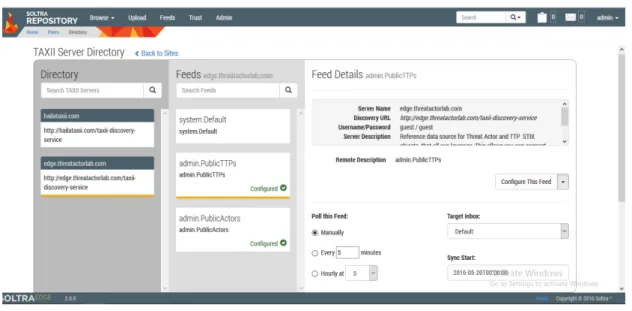
Soltra Edgeis a free TAXII Server, that can be installed as a virtual machine, which has been made available by Soltra1. With its user-friendly web interface (Figure 3.1), this server can be used to poll security feeds regularly from TAXII servers that produce se-curity feeds. There are some freely available feed services includinghttp://hailataxii.
com/taxii-discovery-serviceandhttp://edge.threatactorlab.com/taxii-discovery-service, that are producing threat intelligence and sharing them with clients.
Chapter 3. Cyber Intelligence Sharing 19
Figure 3.1: Customizing a Feed Poll
Soltra Edge also enables producing cyber intelligence and sharing it with others. In fact, the web interface of Soltra Edge makes the job of creating feeds in STIX/CybOX format much easier (Figure 3.2). Once a created feed is saved and published, it is ready to be consumed by others.
Chapter 4
Suricata
Suricata is a high performance Network IDS, IPS and Network Security Monitoring en-gine. Open Source and owned by a community run non-prot foundation, the Open Information Security Foundation (OISF). Suricata is developed by the OISF and its sup-porting vendors [4]. Based on rules implemented on Suricata it is able to analyze packets at network, transport layers and additionally at application layer for some protocols in-cluding HTTP, DNS, SMB and more, and decides whether they are dangerous packets or not, in the case of a packet is dangerous, it generates log or blocks it or do both depending on the mode Suricata works in. A simple Suricata rule is given as an example below.
drop tcp $HOME_NET any -> 10.10.10.10 6667
(msg:"Poison Ivy Trojan Detected."; content:"NICK";
reference:url,example.com/bot_servers; sid:123456; rev:2;)
First keyword in the rule above, namely drop denes the action to take when this sig-nature matches, as its name suggests a packet with matched sigsig-nature will be dropped. There are some additional action keywords. They are pass, reject, alert. Names of actions are quite self-explanatory. The second keyword in the rule above, tcp shows the protocol which this signature concerns. $HOME_NET is a name given to some IP in-terval (e.g. 10.1.0.0/24) which is dened in Suricata.yaml, Suricata's conguration le. It describes source address. Because any is given as source port, all ports hold for this
Chapter 4. Suricata 21 signature to match. The destination IP of a packet must be10.10.10.10 and the desti-nation port6667 to match this signature. Message part, which is msg:"..."gives more information about the signature and the possible alert [5]. To look for a pattern in a packetcontentkeyword is used, in this caseNICKis a word of interest. To give the refer-ence for a signature, from where you can get information about the signature,reference keyword is used. To identify signatures , a unique number, which is called sidis given to each signature. Lastly,revis for revision tracking, which increases by one, every time the author makes a change to the rule. On whole, this signature tries to match patterns of malicious C2 packets, once signature matches, packet is dropped and is not allowed to go any further.
HTTP Keywords HyperText Transfer Protocol (HTTP) is one of layer 7 proto-cols at which Suricata is able to inspect packets. Suricata makes it possible to write rules based on all parts of HTTP payload, from HTTP method to HTTP body, using HTTP keywords. These include http_method, http_uri, http_header, http_cookie, http_user_agent,http_client_bodyand several more. An example, including usage of bothhttp_uri and http_header, is given below.
drop http $HOME_NET any -> $EXTERNAL_NET 80
(msg:"Malicious site visit"; content:"www.attacker.com";http_header; content:"/example.php";http_uri; sid:1234567;)
If a packet visitshttp://www.attacker.com/example.php, this rule will drop that packet and generate an alert for it.
DNS Keywords DNS (Domain Name System) is a protocol for domain name reso-lution. Every time a user visits a website, rst, website address (e.g. www.google.com) is resolved over DNS protocol, then it becomes possible to go to that address. Using DNS keywords it is possible to inspect and lter DNS packets. Example below, shows the usage of dns_query, a keyword that is able to inspect DNS packets.
alert dns any any -> any 53 (msg:"Malicious resolution attempt"; dns_query; content:"www.malicious.com"; nocase; sid:54321;)
This rule will generate an alert every time it detects the word www.malicious.com in a DNS response.
Chapter 4. Suricata 22 File Keywords Starting with Suricata version 1.2 it's possible to extract les from HTTP sessions as well as match on le name, extension and "magic" [6]. Also MD5 hash of les downloaded, can be calculated on the y. Combining the hash feature and features asfileext,filemagic,filename, there is a great chance to identify threatening les crossing our network. What's more, it is also possible to store les to the disk in order to analyze them further. Following rule will calculate hashes of windows executable les on the y and compare them against hashes in BadMD5s.txt, in case of match, an alert will be generated for that matched le.
alert http any any -> any any (msg:"File MD5 Hash Matches."; filemagic:"exe"; filemd5:BadMD5s.txt; sid:12345;)
Chapter 5
Related Work
In order to explore the ways of getting most out of cyber intelligence sharing, we have made use of several articles on this topic. While some of articles describe real-world applications of STIX and CybOX technologies, some are seeking methods for eective use of collected threat intelligence.
In [7], authors have described how a new generation SIEM is being deployed in ACDC (Advanced Cyber Defence Centre) project, to ght botnets and other cyber threats, correlating local security logs and normalized STIX data provided by ACDC partners. Correlation directives dened on the SIEM enables it to identify what is important from enormous amount of events collected. These include quantitative rules (e.g. has specic IP address been sighted three times), temporal rules (e.g. has specic le hash been observed twice within a week) and qualitative rules (e.g. has specic URL address been reported by three dierent tools). Based on these rules, observations that have reached sucient level of reliability is transmitted to CCH (Centralized Data Clearing House) which in turn shares those with other parties. The new generation SIEM deployed in ACDC project becomes more eective in ghting cyber threats after combining STIX events provided by external tools and local security logs, besides producing and sharing cyber intelligence extracted from the combination of two.
Authors in [8] suggest a way to extract specic information from huge amounts of obser-vations captured by network tools and host based applications with the help of inference engines. For that aim, they describe an information relevance reasoning mechanism. To understand a cyber situation better, several queries (e.g. Which servers are targeted?) are made about it. To answer that queries about a situation, inference engines should
Chapter 5. Related Work 24 come into play, which use ontology languages to make inferences automatically. In that project, authors use BaseVISor as inference engine and STIX Ontology which uses STIX components like (TTPs, Indicators etc.) as its classes.
In [9], the author argues that, when compared to enterprise ecosystem, cyber attacks made to Industrial Control Systems (ICS) are harder to detect and combat because of the dierent nature of control systems and limited amount of resources available. To develop understanding to ICS environment attacks and machine-speed remediation to them, MMATR (Machine-to-Machine Automated Threat Response) project started in 2013. This project consists of three parts: 1) enriching CybOX with some additional features like adding temporal context, 2) developing remediation in machine-readable and machine-actionable format, 3) developing machine-readable specications contain-ing threat information and mitigation steps.
It is proposed in [10] to combine data collected from sources in the military and civil en-vironment, namely traditional intelligence with technical data collected (e.g. le hashes, IP addresses, TTPs) to gain a better understanding about a cyber threat. HUMINT (Hu-man Based Intelligence) and OSINT (Open Sources Intelligence) are among the given examples for available sources of conventional information from which it is possible to get information about names, locations, motivations, IP addresses, homepages, blogs and etc. Other resources suggested in the article include social media, chat rooms, hacker forums which may prove very useful to paint a clearer situational picture.
Chapter 6
Our Work
STIX and CybOX aim to represent threat intelligence in a manner that is extensive and easily understandable. While one option is to share threat intelligence with humans so that they make use of it, another option is to share it with network devices so that they automatically learn them. However, in some cases it is only possible through converting threat intelligence to a machine-readable format. For this reason, we have written a script. This code connects to a TAXII server, download STIX/CybOX formatted feeds available and generate Suricata rules based on the data available in feeds. Generated Suricata rules are ready to be implemented on a Suricata engine. You can download this script from https://github.com/behruzcebiyev/ConvertSTIXtoSuricataRules.
This script is able to extract IP addresses in a feed and make a rule at which a list of IP addresses is matched. Every time a feed is polled and IP addresses are extracted, that list of IP addresses, namely the blacklist will grow. This rule will enable Suricata to recognize emerging bad IPs and alert or drop them once detected. Likely, malicious domains can be extracted from a feed with the help of the script. After extracting domain names, the script will create DNS level rules for Suricata which will look for that domains in DNS responses. If a DNS response contains such a domain name, it is an indication of a client in our network, attempting to go to that address and awaiting name resolution to happen. This script will help us to be alert to previously unknown malicious domains visited by users in our local network.
Another type of threat that an IPS/IDS engine is supposed to be ghting against, are malicious pages. This script is also able to generate Suricata rules at HTTP level using HTTP keywords after extracting URL data from a feed downloaded.
Chapter 6. Our Work 26 Considering the Suricata feature of calculating the hash of a le opened/downloaded over HTTP and matching that hash against blacklist of hashes, another feature that we have added to the script is to extract MD5 hash values from a feed and update the MD5 hash blacklist with newest threats' hash values.
Initially , we wanted to add to our script the feature of generating Suricata rules at SMTP level based on mail subject, mail server address. Afterwards, we thought that Suricata rules would be insucient to detect illicit SMTP trac based on these elds, given that attackers use e-mails with tons of dierent subjects and addresses and implementing such rules on Suricata would aect its performance badly. That's why we changed our mind. On whole, our work aims to pull STIX/CybOX formatted cyber intelligence from a TAXII server (like hailataxii.com) and convert it to a readable and actionable format by Suricata IDS/IPS engine, namely generate Suricata rules which can be readily implemented on a Suricate engine. This, in turn, will keep the Suricata engine up-to-date and make it able to defend local networks against latest cyber threats.
Chapter 7
Conclusion
TAXII, STIX and CybOX are among the most successful and the most recent initia-tives to meet the rapidly growing need to share cyber threat intelligence smoothly and eectively. To enable network devices to convert delivered cyber threat intelligence into something actionable is another major need, as it is obvious that machines with this ability will be more successful in ghting emerging threats. As the practical part of our thesis we developed a python script for polling a feed and extracting specic data (like IP address, le hash and etc.) out of the feed and generating Suricata rules based on extracted data. Basically what it does is to get a threat intelligence feed and to convert it to Suricata IDS/IPS rules. This script extracts several types of data out of a feed and generate rules based on them. They are listed below.
IP address Domain name URL
File MD5 hash
During tests, our script worked as expected. It properly generated wanted rules and les which is to be referenced at a rule (e.g. BlackMD5s.txt is referenced at the MD5 blacklisting rule). It can also be customized to make polls on a regular basis, polling packages only available after the last poll time. This ability of the script also tested by
Chapter 7. Conclusion 28 setting it as a cron job making polls every hour. It also worked successfully. However, further features can be added to the script to expand its usage and scope.
Chapter 8
Future Work
Currently, our script generates Suricata rules for 4 cases. bad IP address
malicious domains malicious URLs
bad les based on their MD5 hashes
It would be very useful for the security community, if we published that Suricata rules on the web, since web is an invaluable place to reach others and share that rules, mostly created based on recent security events. So, this can be a good next step following this project. Support for regular expressions in the processes of extracting and creating rules can be another useful feature to add. Also in the future, support for additional cases and other protocols can be added to the script. Also, since rule formats of IPS/IDS engines are similar, the output of this script can be adapted to other engines as well, like Snort, Bro IDS and etc.
Bibliography
[1] M. Sikorski and A. Honig. Practical Malware Analysis : The Hands-On Guide to Dissecting Malicious Software. No Starch Press, San Francisco, CA, USA, 2012.
[2] Stop sending me threat intelligence in email. http://www.tripwire.
com/state-of-security/security-data-protection/cyber-security/ stop-sending-me-threat-intelligence-in-e-mail/. Accessed: 2016-05-26.
[3] Cybox_network_connection_http_instance.xml. https://github.com/
CybOXProject/schemas/blob/master/samples/CybOX_Network_Connection_HTTP_ Instance.xml. Accessed: 2016-06-05.
[4] Suricata. https://suricata-ids.org/. Accessed: 2016-05-29.
[5] Meta-settings. https://redmine.openinfosecfoundation.org/projects/
suricata/wiki/Meta-settings, . Accessed: 2016-05-29.
[6] File extraction. https://redmine.openinfosecfoundation.org/projects/
suricata/wiki/File_Extraction, . Accessed: 2016-06-01.
[7] B. G. N. Crespo and A. Garwood. Fighting botnets with cyber-security analytics: Dealing with heterogeneous cyber-security information in new generation siems. In Availability, Reliability and Security (ARES), 2014 Ninth International Conference on, pages 192198, Sept 2014. doi: 10.1109/ARES.2014.33.
[8] S. Lu and M. M. Kokar. A situation assessment framework for cyber security in-formation relevance reasoning. In Inin-formation Fusion (Fusion), 2015 18th Interna-tional Conference on, pages 14591466, July 2015.
[9] D. Rhoades. Machine actionable indicators of compromise. In 2014 International Carnahan Conference on Security Technology (ICCST), pages 15, Oct 2014. doi: 10.1109/CCST.2014.6987016.
Bibliography 31 [10] A. Kornmaier and F. Jaouän. Beyond technical data - a more comprehensive situ-ational awareness fed by available intelligence information. In Cyber Conict (Cy-Con 2014), 2014 6th International (Cy-Conference On, pages 139154, June 2014. doi: 10.1109/CYCON.2014.6916400.