VERA VERIFICATION
STATEMENT
VERIFICATION OF ENVIRONMENTAL TECHNOLOGIES FOR
AGRICULTURAL PRODUCTION
It is hereby stated (verified) that
Technology:
Farm AirClean BIO Flex 2-stage
(with maximum capacity of 3.600 m3 air m-2 front surface h-1)
Manufactured by: SKOV A/S
has been tested according to the VERA test protocol for Air Cleaning Technologies version 1, September 2010.
The following main results have been documented through the test:
Verified environmental efficiency:
Ammonia emission reduction efficiency at 88 % when applied for pigs Odour emission reduction efficiency at 74 % when applied for pigs Total dust emission reduction efficiency at 70 % when applied for pigs Dust, PM2,5 emission reduction efficiency at 87 % when applied for pigs
Dust, PM10 emission reduction efficiency at 79 % when applied for pigs
Verified operational stability:
The Farm AirClean BIO Flex has demonstrated a satisfactory operational stability
Issued on 2015-05-28
_________________________________________________________________
Page 2 of 9
Exemption of liability
ETA-Danmark A/S does not endorse, certify or approve technologies. VERA verifications are based on an evaluation of the technology performance under specific,
predetermined criteria and the appropriate quality assurance procedures.
VERA as a representative for the Danish EPA, the German Federal Ministry of Food, Agriculture and Consumer Protection and the Dutch Ministry of Infrastructure and Environment make no expressed or implied warranties as to the performance of the technology and do not certify that a technology will always operate as verified. The end user is solely responsible for complying with any and all applicable federal, state, and local requirements. Further the end user must be aware that the countries involved in VERA are having different legal requirements which will influence the status and use of this verification statement in each country.
Page 3 of 9
The VERA Organisation
VERA – Verification of Environmental Technologies for Agricultural Production – is an international organisation for test and verification of environmental technologies for agricultural production. VERA is established as a co-operation between the Danish Environmental Protection Agency, the Dutch Ministry of Infrastructure and Environment and the German Federal Ministry of Food, Agriculture and Consumer Protection.
The purpose of VERA is to enhance a well-functioning market for environmental technologies to increase the environmental protection of agricultural production by substantially accelerating the acceptance and use of improved and cost-effective environmental technologies.
VERA verifies the performance of technologies by carrying out tests according to pre-defined test protocols. A VERA Verification Statement secures validated documentation for the environmental efficiency
and operational stability of the technology and is an important step in introducing the technology to the market. Based on information from the test reports, the VERA Verification Statement gives a general and short description of the technology, its principle of operation, and the main results and conclusions from the VERA test.
Applicant Data
Technology type Biological air cleaner with maximum capacity of 3600 m 3 air m-2 front surface h-1 for pigs
Applied for Reduction of ammonia, odour and dust from exhaust air of forced-ventilated animal housing systems
Technology name Farm AirClean BIO Flex 2-stage
Company SKOV A/S
Contact person Lise Bonne Guldberg
Address Hedelund 4, DK-7870 Roslev, Denmark
Website www.skov.com
Phone +45 7217 5555
E-mail [email protected]
Test institute
Pig Research Centre (VSP), Danish Agriculture and Food Council, Denmark and LUFA Nord-West, Jägerstrasse 23 – 27, DE-26221 Oldenburg , Germany
Page 4 of 9
Technology Description
The Farm AirClean BIO Flex 2-stage is a biological air cleaning system consisting of two rows of moistened cellulose pads, which are positioned vertically. Air is cleaned by a biological process that works by exhaust air being removed from the house through cleaning filters sprinkled with recirculated water. The unwanted substances in the air are absorbed by the water or decompose when they come in contact with the water and the layer of bacteria on the cleaning filters.
Both the first and second stage of the air cleaner consists of 15 cm thick cellulose packed filters. Each filter is 2.0 m high. The width of the filters is designed according to the maximum ventilation rate and the
maximum capacity of the air cleaning system. The air cleaning system has a maximum capacity of 3600 m3 air m-2 front surface h-1 for pigs.
In order to avoid accumulation of inhibitory compounds, water exchange control is based on measurements of conductivity. The two filter steps are sprinkled with water that is recirculated from a sump below each filter step. Clean water is fed into the sump below the second filter step, from which it over-flows into the sump below the first filter step. Addition of fresh water is controlled by the water level in the sump below the first filter step. All water from the air cleaner is discharged from the sump below the first filter step and is either collected or directed to the slurry storage tank. The discharge of water from the sump below the first filter step is regulated by the conductivity in the sump below the second filter step. An automatic washer washes the first filter at regular intervals. This removes dust and redundant biomass. A perforated plate is installed in front of the first filter as a flow straightener to ensure a uniform air distribution and to pre-separate dust.
Test Design
The Farm AirClean BIO Flex 2-stage was tested in the Netherlands by LUFA Nord-West and in Denmark by the Pig Research Centre (VSP) in accordance with the VERA Test protocol for Air Cleaning
Technologies.
The two tests sites are in the following named test site A and B, respectively. In each country the biological air cleaner was tested at one farm location by installing the air cleaner in a pig finishing house.
Measurements of ammonia, odour and dust were performed during an 8 weeks summer period and an 8 weeks winter period. Additionally, key parameters were continuously logged and the system was monitored over a period of one year to create a basis for an evaluation of the operational stability of the system
In the test by LUFA (testsite A) the number of pig places was 900. Summer measurements were carried out from August to September 2013 and the winter measurements were carried out from December 2013 to February 2014. The maximum capacity was 3600 m3 air m-2 front surface h-1 for pigs and the width of the filter was 12,6 m.
In the test by VSP (test site B) the number of animals in the house was 350 pigs. Summer measurements were carried out from August to September 2010 and the winter measurements were carried out from February to April 2011. The maximum capacity was 3600 m3 air m-2 front surface h-1 for finishing pig units and the width of the filter was 5.0 m.
Page 5 of 9
Test Results
Environmental Efficiency
Ammonia reduction
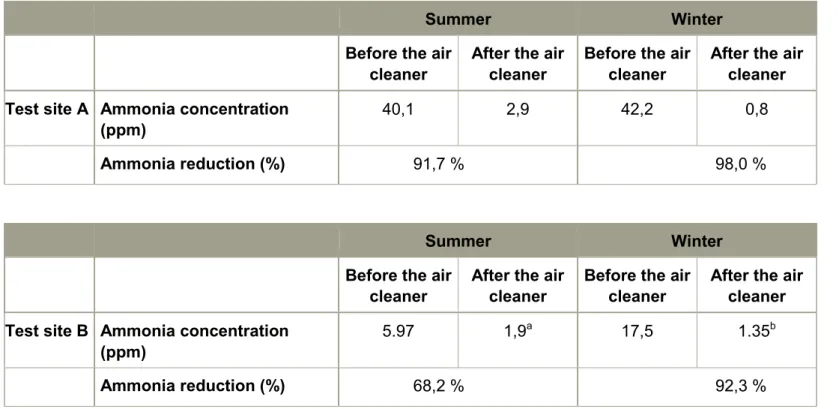
Table 1 presents the ammonia concentration measured at test the site. Table 2 presents the ammonia reduction efficiency of the Farm AirClean BIO Flex 2-stage for the test site and the overall mean for application at finishing pig units.
Table 1: Ammonia concentration before and after the air cleaner during the summer and winter test periods together with ammonia removal efficiency.
Summer Winter
Before the air cleaner
After the air cleaner
Before the air cleaner
After the air cleaner Test site A Ammonia concentration
(ppm)
40,1 2,9 42,2 0,8
Ammonia reduction (%) 91,7 % 98,0 %
Summer Winter
Before the air cleaner
After the air cleaner
Before the air cleaner
After the air cleaner Test site B Ammonia concentration
(ppm)
5.97 1,9a 17,5 1.35b
Ammonia reduction (%) 68,2 % 92,3 %
a) Limit of quantification (LOQ) was 1.08 ppm b) Limit of quantification (LOQ) was 1.35 ppm
Table 2: Reduction percentages of ammonia by the air cleaner given for test site, and as the overall mean.
Ammonia reduction (%) Test site A Test Site B Mean
Summer 91,7 % 68,2 % 80,0 %
Winter 98,8 % 92,3 % 95,6 %
Overall 94,8 % 80,3 % 87,6 %
Page 6 of 9
Odour reduction
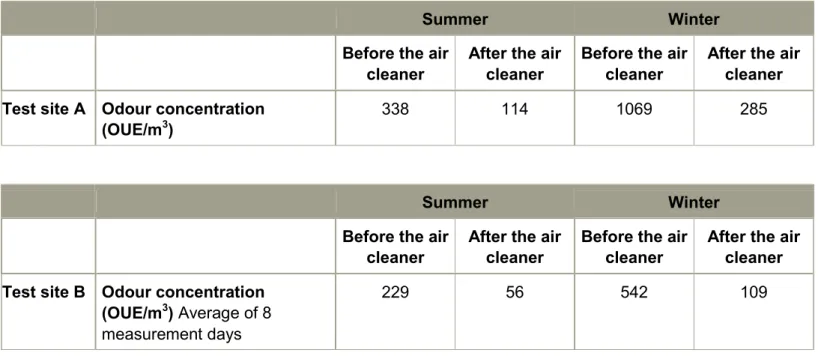
Table 3 presents the odour concentration measured at test site. Table 4 presents the odour reduction efficiency of the Farm AirClean BIO Flex 2-stage for the test site and the overall mean for application at finishing pig units.
Table 3: Odour concentration before and after the air cleaner during the summer and winter test periods.
Summer Winter
Before the air cleaner
After the air cleaner
Before the air cleaner
After the air cleaner Test site A Odour concentration
(OUE/m3)
338 114 1069 285
Summer Winter
Before the air cleaner
After the air cleaner
Before the air cleaner
After the air cleaner Test site B Odour concentration
(OUE/m3) Average of 8
measurement days
229 56 542 109
Table 4: Reduction percentages of odour by the air cleaner given for the test site, and as the overall mean.
Odour reduction (%) Test site A Test Site B Mean
Summer 66 % 76 % 71 %
Winter 73 % 80 % 77 %
Overall 70 % 78 % 74 %
The odour emission was on average reduced with 74 %, when air was passed through the filter. The average odour concentration was reduced to below 300 OU/m3
Page 7 of 9
Dust reduction
The total dust concentration was measured at one test site during both summer and winter (Table 5). The total dust emission reduction is presented in table 6.
Table 5: Total dust concentration measured over 24-hour periods at one test site before and after the air cleaner during the summer and winter test periods. N=2 on each measurement day.
Summer Winter
Before the air cleaner
After the air cleaner
Before the air cleaner
After the air cleaner
Test site A Total dust (mg/m3) 0,97 0,16 2,97 0,60
Test site A Dust, PM2,5 (mg/m3) 0,24 0,02 0,41 0,08
Test site A Dust, PM10 (mg/m3) 0,39 0,08 0,74 0,18
Summer Winter
Before the air cleaner
After the air cleaner
Before the air cleaner
After the air cleaner
Test site B Total dust (mg/m3) 1,4 0,32 0,47 0,28
Test site B Total dust (mg/m3) 1,6 0,7 2,3 0,95
Table 6: Reduction percentages of total dust in the air cleaner given for each summer and winter measurement day and as a mean for each season and the overall mean.
Dust reduction (%) Test site A Test Site B Total Mean Dust, PM2,5 Dust, PM10
Summer 83,9 % 57,9 % 70,9 % 92,4 % 80,9 %
Winter 79,9 % 58,7 % 69,3 % 81,3 % 76,2 %
Overall 81,9 % 58,3 % 70,1 % 86,9 % 78,6 %
The air cleaner removed dust from the air passing the filters. The air cleaner showed a total dust removal efficiency of 70 %.
Operational Stability
The test proved that the air cleaning system had satisfying operational stability. The Farm AirClean BIO Flex 2-stage is delivered with a complete user manual, which describes relevant directions for system operation, maintenance and safety. The air cleaning process is monitored by a computer which monitors consumption and alarm limits (water level, conductivity, pH, washer, pressure, leakage, drainage). In addition to weekly inspections of the filter by the user, the test showed a periodic need for manual washing of the filter.
Page 8 of 9
The functionality and the operational stability of the Farm AirClean BIO Flex system can be checked by relevant authorities by inspecting the run time, EC and water supply. These parameters can be controlled by checking the log files from the computer that regulate and monitors the system. As a starting point, the system should continuously consume water and keep EC below 15 mS/cm in filter 2 with reservation for temporary stops in relation to maintenance and service.
A continuously addition of water is expected when house air is passing the air cleaner in order to compensate for humidification and drainage of water. The volume of water consumed will depend on operation and management of the house, batch plan of pigs, ventilation etc.
Identified Side Effects
None observed.
Additional Results
None observed.Additional Information
No additional information.Test Institutes
Pig Research Centre (VSP), Danish Agriculture and Food Council, Axeltorv 3, 1609 København V, Denmark. Tel: +45 3339 4000, E-mail: [email protected]
LUFA Nord-West, Jägerstrasse 23 – 27, DE-26221 Oldenburg , Germany. Tel: +49 441 801 821, E-mail: [email protected]
Page 9 of 9
Validity and Terms of Use
Validity
This VERA Verification Statement is only valid for the specific verified product/technology and the tested animal category. There is no time limit for the validity of this VERA Verification Statement as long as the product/technology stays unmodified.
ETA-Danmark A/S can, however, at any time invalidate the VERA Verification Statement if it is found to be misused or if significant modifications have been made to the product/technology that are estimated to have a negative effect on the environmental efficiency or operational stability. In regard to the latter ETA-Danmark A/S can require that a new VERA test should be performed.
Terms of Use
The use of this VERA Verification Statement must be in compliance with these terms:
• SKOV A/S must inform ETA-Danmark A/S if any modifications are applied to the technology that can significantly influence the environmental efficiency and/or the operational stability
• This verification cannot be considered an endorsement, approval, authorization or warranty of any kind, and the performance parameters provided cannot be extended to other applications or to other
technologies
• SKOV A/S agrees not to use this VERA Verification Statement, the test reports, or to refer to those for any other technology than the one specified in the statement.
• The VERA Verification Statement will be made available for public access at the ETA-Danmark website: www.etadanmark.dk.
• All other information obtained or produced during the verification process is considered confidential and will not be made available for others than the part owning the intellectual property rights.
Contact Information
This VERA Verification Statement is issued by ETA-Danmark A/S Göteborg Plads 1 DK-2150 Nordhavn Denmark Phone: (+45) 72 4 59 00 E-mail: [email protected] Web: www.etadanmark.dk