Missouri University of Science and Technology
Missouri University of Science and Technology
Scholars' Mine
Scholars' Mine
Computer Science Faculty Research & Creative
Works
Computer Science
01 Aug 2019
Action Recognition in Manufacturing Assembly using Multimodal
Action Recognition in Manufacturing Assembly using Multimodal
Sensor Fusion
Sensor Fusion
Md. Al-Amin
Wenjin Tao
David Doell
Ravon Lingard
et. al. For a complete list of authors, see https://scholarsmine.mst.edu/comsci_facwork/968
Follow this and additional works at: https://scholarsmine.mst.edu/comsci_facwork
Part of the Computer Sciences Commons, Mechanical Engineering Commons, and the Operations Research, Systems Engineering and Industrial Engineering Commons
Recommended Citation
Recommended Citation
M. Al-Amin et al., "Action Recognition in Manufacturing Assembly using Multimodal Sensor Fusion," Procedia Manufacturing, vol. 39, pp. 158-167, Elsevier B.V., Aug 2019.
The definitive version is available at https://doi.org/10.1016/j.promfg.2020.01.288
This work is licensed under a Creative Commons Attribution-Noncommercial-No Derivative Works 4.0 License. This Article - Conference proceedings is brought to you for free and open access by Scholars' Mine. It has been accepted for inclusion in Computer Science Faculty Research & Creative Works by an authorized administrator of Scholars' Mine. This work is protected by U. S. Copyright Law. Unauthorized use including reproduction for redistribution requires the permission of the copyright holder. For more information, please contact
ScienceDirect
Available online at www.sciencedirect.com
Procedia Manufacturing 39 (2019) 158–167
2351-9789 © 2019 The Authors. Published by Elsevier Ltd.
This is an open access article under the CC BY-NC-ND license (https://creativecommons.org/licenses/by-nc-nd/4.0/)
Peer-review under responsibility of the scientific committee of the ICPR25 International Scientific & Advisory and Organizing committee members
10.1016/j.promfg.2020.01.288
10.1016/j.promfg.2020.01.288 2351-9789
Available online at www.sciencedirect.com
Procedia Manufacturing 00 (2019) 000–000
www.elsevier.com/locate/procedia
25
thInternational Conference on Production Research Manufacturing Innovation:
Cyber Physical Manufacturing
August 9–14, 2019
|
Chicago, Illinois (USA)
Action Recognition in Manufacturing Assembly using Multimodal
Sensor Fusion
Md. Al-Amin
a, Wenjin Tao
b, David Doell
a, Ravon Lingard
a, Zhaozheng Yin
c, Ming C.
Leu
b, Ruwen Qin
a,∗aDepartment of Engineering Management and Systems Engineering, Missouri University of Science and Technology, Rolla 65409, USA bDepartment of Mechanical and Aerospace Engineering, Missouri University of Science and Technology, Rolla 65409, USA
cComputer Science Department, Missouri University of Science and Technology, Rolla 65409, USA
Abstract
Production innovations are occurring faster than ever. Manufacturing workers thus need to frequently learn new methods and skills. In fast changing, largely uncertain production systems, manufacturers with the ability to comprehend workers’ behavior and assess their operation performance in near real-time will achieve better performance than peers. Action recognition can serve this purpose. Despite that human action recognition has been an active field of study in machine learning, limited work has been done for recognizing worker actions in performing manufacturing tasks that involve complex, intricate operations. Using data captured by one sensor or a single type of sensor to recognize those actions lacks reliability. The limitation can be surpassed by sensor fusion at data, feature, and decision levels. This paper presents a study that developed a multimodal sensor system and used sensor fusion methods to enhance the reliability of action recognition. One step in assembling a Bukito 3D printer, which composed of a sequence of 7 actions, was used to illustrate and assess the proposed method. Two wearable sensors namely Myo-armband captured both Inertial Measurement Unit (IMU) and electromyography (EMG) signals of assembly workers. Microsoft Kinect, a vision based sensor, simultaneously tracked predefined skeleton joints of them. The collected IMU, EMG, and skeleton data were respectively used to train five individual Convolutional Neural Network (CNN) models. Then, various fusion methods were implemented to integrate the prediction results of independent models to yield the final prediction. Reasons for achieving better performance using sensor fusion were identified from this study.
c
2019 The Authors. Published by Elsevier B.V.
This is an open access article under the CC BY-NC-ND license (https://creativecommons.org/licenses/by-nc-nd/4.0/)
Selection and peer review under the responsibility of ICPR25 International Scientific & Advisory and Organizing committee members.
Keywords: Manufacturing Assembly; Multimodal Sensor System; Sensor Fusion; Deep Learning; Action Recognition
∗Corresponding author. Tel.:+1-573-341-4493. E-mail address:[email protected]
2351-9789 c2019 The Authors. Published by Elsevier B.V.
This is an open access article under the CC BY-NC-ND license (https://creativecommons.org/licenses/by-nc-nd/4.0/)
Selection and peer review under the responsibility of ICPR25 International Scientific & Advisory and Organizing committee members. Available online at www.sciencedirect.com
Procedia Manufacturing 00 (2019) 000–000
www.elsevier.com/locate/procedia
25
thInternational Conference on Production Research Manufacturing Innovation:
Cyber Physical Manufacturing
August 9–14, 2019
|
Chicago, Illinois (USA)
Action Recognition in Manufacturing Assembly using Multimodal
Sensor Fusion
Md. Al-Amin
a, Wenjin Tao
b, David Doell
a, Ravon Lingard
a, Zhaozheng Yin
c, Ming C.
Leu
b, Ruwen Qin
a,∗aDepartment of Engineering Management and Systems Engineering, Missouri University of Science and Technology, Rolla 65409, USA bDepartment of Mechanical and Aerospace Engineering, Missouri University of Science and Technology, Rolla 65409, USA
cComputer Science Department, Missouri University of Science and Technology, Rolla 65409, USA
Abstract
Production innovations are occurring faster than ever. Manufacturing workers thus need to frequently learn new methods and skills. In fast changing, largely uncertain production systems, manufacturers with the ability to comprehend workers’ behavior and assess their operation performance in near real-time will achieve better performance than peers. Action recognition can serve this purpose. Despite that human action recognition has been an active field of study in machine learning, limited work has been done for recognizing worker actions in performing manufacturing tasks that involve complex, intricate operations. Using data captured by one sensor or a single type of sensor to recognize those actions lacks reliability. The limitation can be surpassed by sensor fusion at data, feature, and decision levels. This paper presents a study that developed a multimodal sensor system and used sensor fusion methods to enhance the reliability of action recognition. One step in assembling a Bukito 3D printer, which composed of a sequence of 7 actions, was used to illustrate and assess the proposed method. Two wearable sensors namely Myo-armband captured both Inertial Measurement Unit (IMU) and electromyography (EMG) signals of assembly workers. Microsoft Kinect, a vision based sensor, simultaneously tracked predefined skeleton joints of them. The collected IMU, EMG, and skeleton data were respectively used to train five individual Convolutional Neural Network (CNN) models. Then, various fusion methods were implemented to integrate the prediction results of independent models to yield the final prediction. Reasons for achieving better performance using sensor fusion were identified from this study.
c
2019 The Authors. Published by Elsevier B.V.
This is an open access article under the CC BY-NC-ND license (https://creativecommons.org/licenses/by-nc-nd/4.0/)
Selection and peer review under the responsibility of ICPR25 International Scientific & Advisory and Organizing committee members.
Keywords: Manufacturing Assembly; Multimodal Sensor System; Sensor Fusion; Deep Learning; Action Recognition
∗Corresponding author. Tel.:+1-573-341-4493. E-mail address:[email protected]
2351-9789 c2019 The Authors. Published by Elsevier B.V.
This is an open access article under the CC BY-NC-ND license (https://creativecommons.org/licenses/by-nc-nd/4.0/)
Selection and peer review under the responsibility of ICPR25 International Scientific & Advisory and Organizing committee members. © 2019 The Authors. Published by Elsevier Ltd.
This is an open access article under the CC BY-NC-ND license (https://creativecommons.org/licenses/by-nc-nd/4.0/)
Peer-review under responsibility of the scientific committee of the ICPR25 International Scientific & Advisory and Organizing committee members
2 M. Al-Amin et al./Procedia Manufacturing 00 (2018) 000–000 1. Introduction
Action recognition involves automatically detecting and recognizing purposeful motions by analyzing relevant hu-man subject data obtained from multitudinous sensors [1]. Along with vigorous applications of action recognition in assisted living [2,3,4,5] , human machine interaction [3,6,7], and healthcare [3,4,6,8], it is also increasingly being used in manufacturing for quantifying and evaluating worker performance [9], understanding worker’s operational behavior [10], enabling adaptive and incessant support to workers in assembly lines [11], and executing maintenance work [12]. Though a robust and reliable system of action recognition is greatly needed by various industrial appli-cations, limited research has been dedicated to this endeavor [13]. Particularly, on the way to Smart Manufacturing, worker-centric assembly is becoming an inevitable part of production system [14]. About 40% of cost and 70% of production time involved with assembly still require the manual operation from workers [11]. Action recognition, if it can be reliably and timely achieved, would provide an ability to quickly identify workers’ needs for assistance or on the job training, thus helping reduce production time and cost [11]. Henceforth, a highly reliable system of action recognition is of paramount interest in assembly operation.
Recognizing actions that workers take in performing complex, labor-intensive assembly tasks is not trivial due to a variety of reasons, such as varying time length of actions, kinematic complexity, anthropomorphic variation, viewpoint variation, occlusion, cluttered background, execution rate, and camera motion [15]. Following the increasing trend of demands for neoteric and customized products [16], more intricate and complex operations have been introduced to assembly processes, which magnifies the challenge of action recognition in assembly [17]. Data obtained by one sensor or a single type of sensors are becoming less reliable for recognizing those actions. Data from multiple types of sensors may complement each other, making sensor fusion a way of creating synergy [1,18]. The fusion of meta classifiers constructed from multiple sources of sensor data has been found to increase the efficiency and accuracy of
recognition system to a great extent [19]. Yet a fundamental understanding of fusion mechanisms is needed to better guide sensor fusion in practices.
With the immense advancements in microelectromechanical technology, micro sensors, and wireless communica-tion technology, accommunica-tion recognicommunica-tion using wearable sensors (e.g., accelerometer, gyroscope, and magnetometer) has become a hot research topic [3,7]. Their popularity is getting increased because of various attractive features such as easy to carry, inexpensive, wireless, privacy preservation, and low computational cost [2,3,20]. Wearable sen-sors based on different technologies are not equally good in capturing all human actions because each sensor type is
specifically designed for capturing certain data. For example, a 3-axial accelerometer measures the acceleration along 3 orthogonal axes. A 3-axial gyroscope provides the orientation and rotation movement of sensed object with pitch, roll and yaw angles. A magnetometer measures the local Earth magnetic field vector. Sensor fusion is a straightforward way to take advantage of these technologies to advance action recognition.
Recognition of assembly actions was mostly done using a single classifier. For example, a hidden Markov model (HMM) was used to classify 9 activities involved in a wood workshop [12], and 21 gestures of bicycle repairing tasks [21]. Stiefmeier et al. [13] proposed a string-matching-based segmentation and classification method to identify 46 quality checking activities in car assembly. A k-nearest neighbor (k-NN) algorithm was used to classify 4 basic assembly tasks [22]. Tao et al. [9] collected data on 6 assembly actions and trained a Convolutional Neural Network (CNN) for action classification. Some exceptions have been noticed, which integrated results from multiple classifiers. For example, hierarchical with equal weights [23], hierarchical with variable weights upon classification performance [18,24], majority voting [25], naive Bayesian [25], and the combination of both hierarchical and majority voting [19] have been proposed for the decision level fusion. Sensor fusion comes into effect at not only the decision level, but
the data level and feature level. For example, features from both time and frequency domains were concatenated to recognize 11 child activities [26].
This paper presents a study of developing a sensor fusion based system for recognizing human actions in perform-ing assembly tasks. The study aimed to advance the fundamental understandperform-ing of sensor fusion through exploitperform-ing opportunities of sensor fusion at all levels (data, feature, and score level) and discovering fusion mechanisms that can effectively enhance the ability of action recognition. Therefore, the rest of the paper is organized as the following.
Section2presents the approach to creating the proposed system of action recognition based on sensor fusion, followed by Section3that presents an example for illustrating the implementation and assessment of the proposed approach. Findings from the study and needed future work are summarized at the end, in Section4.
Md. Al-Amin et al. / Procedia Manufacturing 39 (2019) 158–167 159 Available online at www.sciencedirect.com
Procedia Manufacturing 00 (2019) 000–000
www.elsevier.com/locate/procedia
25
thInternational Conference on Production Research Manufacturing Innovation:
Cyber Physical Manufacturing
August 9–14, 2019
|
Chicago, Illinois (USA)
Action Recognition in Manufacturing Assembly using Multimodal
Sensor Fusion
Md. Al-Amin
a, Wenjin Tao
b, David Doell
a, Ravon Lingard
a, Zhaozheng Yin
c, Ming C.
Leu
b, Ruwen Qin
a,∗aDepartment of Engineering Management and Systems Engineering, Missouri University of Science and Technology, Rolla 65409, USA bDepartment of Mechanical and Aerospace Engineering, Missouri University of Science and Technology, Rolla 65409, USA
cComputer Science Department, Missouri University of Science and Technology, Rolla 65409, USA
Abstract
Production innovations are occurring faster than ever. Manufacturing workers thus need to frequently learn new methods and skills. In fast changing, largely uncertain production systems, manufacturers with the ability to comprehend workers’ behavior and assess their operation performance in near real-time will achieve better performance than peers. Action recognition can serve this purpose. Despite that human action recognition has been an active field of study in machine learning, limited work has been done for recognizing worker actions in performing manufacturing tasks that involve complex, intricate operations. Using data captured by one sensor or a single type of sensor to recognize those actions lacks reliability. The limitation can be surpassed by sensor fusion at data, feature, and decision levels. This paper presents a study that developed a multimodal sensor system and used sensor fusion methods to enhance the reliability of action recognition. One step in assembling a Bukito 3D printer, which composed of a sequence of 7 actions, was used to illustrate and assess the proposed method. Two wearable sensors namely Myo-armband captured both Inertial Measurement Unit (IMU) and electromyography (EMG) signals of assembly workers. Microsoft Kinect, a vision based sensor, simultaneously tracked predefined skeleton joints of them. The collected IMU, EMG, and skeleton data were respectively used to train five individual Convolutional Neural Network (CNN) models. Then, various fusion methods were implemented to integrate the prediction results of independent models to yield the final prediction. Reasons for achieving better performance using sensor fusion were identified from this study.
c
2019 The Authors. Published by Elsevier B.V.
This is an open access article under the CC BY-NC-ND license (https://creativecommons.org/licenses/by-nc-nd/4.0/)
Selection and peer review under the responsibility of ICPR25 International Scientific & Advisory and Organizing committee members.
Keywords: Manufacturing Assembly; Multimodal Sensor System; Sensor Fusion; Deep Learning; Action Recognition
∗Corresponding author. Tel.:+1-573-341-4493. E-mail address:[email protected]
2351-9789 c2019 The Authors. Published by Elsevier B.V.
This is an open access article under the CC BY-NC-ND license (https://creativecommons.org/licenses/by-nc-nd/4.0/)
Selection and peer review under the responsibility of ICPR25 International Scientific & Advisory and Organizing committee members. Available online at www.sciencedirect.com
Procedia Manufacturing 00 (2019) 000–000
www.elsevier.com/locate/procedia
25
thInternational Conference on Production Research Manufacturing Innovation:
Cyber Physical Manufacturing
August 9–14, 2019
|
Chicago, Illinois (USA)
Action Recognition in Manufacturing Assembly using Multimodal
Sensor Fusion
Md. Al-Amin
a, Wenjin Tao
b, David Doell
a, Ravon Lingard
a, Zhaozheng Yin
c, Ming C.
Leu
b, Ruwen Qin
a,∗aDepartment of Engineering Management and Systems Engineering, Missouri University of Science and Technology, Rolla 65409, USA bDepartment of Mechanical and Aerospace Engineering, Missouri University of Science and Technology, Rolla 65409, USA
cComputer Science Department, Missouri University of Science and Technology, Rolla 65409, USA
Abstract
Production innovations are occurring faster than ever. Manufacturing workers thus need to frequently learn new methods and skills. In fast changing, largely uncertain production systems, manufacturers with the ability to comprehend workers’ behavior and assess their operation performance in near real-time will achieve better performance than peers. Action recognition can serve this purpose. Despite that human action recognition has been an active field of study in machine learning, limited work has been done for recognizing worker actions in performing manufacturing tasks that involve complex, intricate operations. Using data captured by one sensor or a single type of sensor to recognize those actions lacks reliability. The limitation can be surpassed by sensor fusion at data, feature, and decision levels. This paper presents a study that developed a multimodal sensor system and used sensor fusion methods to enhance the reliability of action recognition. One step in assembling a Bukito 3D printer, which composed of a sequence of 7 actions, was used to illustrate and assess the proposed method. Two wearable sensors namely Myo-armband captured both Inertial Measurement Unit (IMU) and electromyography (EMG) signals of assembly workers. Microsoft Kinect, a vision based sensor, simultaneously tracked predefined skeleton joints of them. The collected IMU, EMG, and skeleton data were respectively used to train five individual Convolutional Neural Network (CNN) models. Then, various fusion methods were implemented to integrate the prediction results of independent models to yield the final prediction. Reasons for achieving better performance using sensor fusion were identified from this study.
c
2019 The Authors. Published by Elsevier B.V.
This is an open access article under the CC BY-NC-ND license (https://creativecommons.org/licenses/by-nc-nd/4.0/)
Selection and peer review under the responsibility of ICPR25 International Scientific & Advisory and Organizing committee members.
Keywords: Manufacturing Assembly; Multimodal Sensor System; Sensor Fusion; Deep Learning; Action Recognition
∗Corresponding author. Tel.:+1-573-341-4493. E-mail address:[email protected]
2351-9789 c2019 The Authors. Published by Elsevier B.V.
This is an open access article under the CC BY-NC-ND license (https://creativecommons.org/licenses/by-nc-nd/4.0/)
Selection and peer review under the responsibility of ICPR25 International Scientific & Advisory and Organizing committee members.
2 M. Al-Amin et al./Procedia Manufacturing 00 (2018) 000–000 1. Introduction
Action recognition involves automatically detecting and recognizing purposeful motions by analyzing relevant hu-man subject data obtained from multitudinous sensors [1]. Along with vigorous applications of action recognition in assisted living [2,3,4,5] , human machine interaction [3,6,7], and healthcare [3,4,6,8], it is also increasingly being used in manufacturing for quantifying and evaluating worker performance [9], understanding worker’s operational behavior [10], enabling adaptive and incessant support to workers in assembly lines [11], and executing maintenance work [12]. Though a robust and reliable system of action recognition is greatly needed by various industrial appli-cations, limited research has been dedicated to this endeavor [13]. Particularly, on the way to Smart Manufacturing, worker-centric assembly is becoming an inevitable part of production system [14]. About 40% of cost and 70% of production time involved with assembly still require the manual operation from workers [11]. Action recognition, if it can be reliably and timely achieved, would provide an ability to quickly identify workers’ needs for assistance or on the job training, thus helping reduce production time and cost [11]. Henceforth, a highly reliable system of action recognition is of paramount interest in assembly operation.
Recognizing actions that workers take in performing complex, labor-intensive assembly tasks is not trivial due to a variety of reasons, such as varying time length of actions, kinematic complexity, anthropomorphic variation, viewpoint variation, occlusion, cluttered background, execution rate, and camera motion [15]. Following the increasing trend of demands for neoteric and customized products [16], more intricate and complex operations have been introduced to assembly processes, which magnifies the challenge of action recognition in assembly [17]. Data obtained by one sensor or a single type of sensors are becoming less reliable for recognizing those actions. Data from multiple types of sensors may complement each other, making sensor fusion a way of creating synergy [1,18]. The fusion of meta classifiers constructed from multiple sources of sensor data has been found to increase the efficiency and accuracy of
recognition system to a great extent [19]. Yet a fundamental understanding of fusion mechanisms is needed to better guide sensor fusion in practices.
With the immense advancements in microelectromechanical technology, micro sensors, and wireless communica-tion technology, accommunica-tion recognicommunica-tion using wearable sensors (e.g., accelerometer, gyroscope, and magnetometer) has become a hot research topic [3,7]. Their popularity is getting increased because of various attractive features such as easy to carry, inexpensive, wireless, privacy preservation, and low computational cost [2,3,20]. Wearable sen-sors based on different technologies are not equally good in capturing all human actions because each sensor type is
specifically designed for capturing certain data. For example, a 3-axial accelerometer measures the acceleration along 3 orthogonal axes. A 3-axial gyroscope provides the orientation and rotation movement of sensed object with pitch, roll and yaw angles. A magnetometer measures the local Earth magnetic field vector. Sensor fusion is a straightforward way to take advantage of these technologies to advance action recognition.
Recognition of assembly actions was mostly done using a single classifier. For example, a hidden Markov model (HMM) was used to classify 9 activities involved in a wood workshop [12], and 21 gestures of bicycle repairing tasks [21]. Stiefmeier et al. [13] proposed a string-matching-based segmentation and classification method to identify 46 quality checking activities in car assembly. A k-nearest neighbor (k-NN) algorithm was used to classify 4 basic assembly tasks [22]. Tao et al. [9] collected data on 6 assembly actions and trained a Convolutional Neural Network (CNN) for action classification. Some exceptions have been noticed, which integrated results from multiple classifiers. For example, hierarchical with equal weights [23], hierarchical with variable weights upon classification performance [18,24], majority voting [25], naive Bayesian [25], and the combination of both hierarchical and majority voting [19] have been proposed for the decision level fusion. Sensor fusion comes into effect at not only the decision level, but
the data level and feature level. For example, features from both time and frequency domains were concatenated to recognize 11 child activities [26].
This paper presents a study of developing a sensor fusion based system for recognizing human actions in perform-ing assembly tasks. The study aimed to advance the fundamental understandperform-ing of sensor fusion through exploitperform-ing opportunities of sensor fusion at all levels (data, feature, and score level) and discovering fusion mechanisms that can effectively enhance the ability of action recognition. Therefore, the rest of the paper is organized as the following.
Section2presents the approach to creating the proposed system of action recognition based on sensor fusion, followed by Section3that presents an example for illustrating the implementation and assessment of the proposed approach. Findings from the study and needed future work are summarized at the end, in Section4.
160 Md. Al-Amin et al. / Procedia Manufacturing 39 (2019) 158–167
M. Al-Amin et al./Procedia Manufacturing 00 (2018) 000–000 3
Nomenclature
ADS action-level data segment EMG electromyography IMU inertial measurement unit LOO leave one out
TTS train test split i index of body joints
j index of joint angles
k index of actions
m index of models/sensor units
n index of workers
l/u/v indices of ADSs in the overall dataset, training dataset, and testing dataset Aj features of joint anglej
Dm,n sensor data of workernobtained by sensor unitm
Ijoint index set of body joints
Iangle index set of joint angles
Iaction index set of actions
Imodel index set of models
Iworker index set of workers
Ji coordinates of jointi
Li distance feature of jointi
Mm CNN model trained using the data obtained by sensor unitm
Naction the number of actions
Nworker the number of workers
Nm,n the number of ADSs extracted from datasetDm,n
Rm,k the accuracy of modelmon predicting actionk
Sm the set of ADSs using sensor unitm
Stn/tsm the ADSs dataset for training/testing modelMm
xm,l/u/v ADS obtained from sensor unitm
ym,l/u/v the ground truth of ADSs obtained from sensor unitm
2. The Approach
The approach to creating the multimodal sensor system and using sensor fusion to achieve reliable recognition of assembly actions is presented below. The proposed method of this paper is not restricted to a specific set of actions in a particular assembly process. Therefore, the method can be generalized for recognizing assembly actions at any workstation of an assembly line wherein the involvement of workers is an inevitable part of the process.
2.1. The multimodal sensor system
This study used two Myo armbands developed by the Thalmic Labs (https://developerblog.myo.com/) and one
Kinect developed by Microsoft (https://developer.microsoft.com/en-us/windows/kinect) to form the multimodal
sen-sor system. The Myo armband is a wearable device that consists of 8 surface electromyography (EMG) sensen-sors and a 9-axis inertial measurement unit (IMU) that consists of a 3-axis gyroscope, a 3-axis accelerometer, and a 3-axis magnetometer. The IMU of Myo armband provides the spatial data (i.e., orientation and motion) of the armband in 13 channels: orientation (7 channels, including quaternions and Euler angles), angular velocities (3 channels), and accelerations (3 channels). Sampling frequencies of the EMG sensors and IMU are 200 Hz and 50 Hz, respectively. Kinect, an infrared light range-sensing sensor, contains an RGB camera (640×480 pixels @ 30 Hz), a 3D depth
4 M. Al-Amin et al./Procedia Manufacturing 00 (2018) 000–000
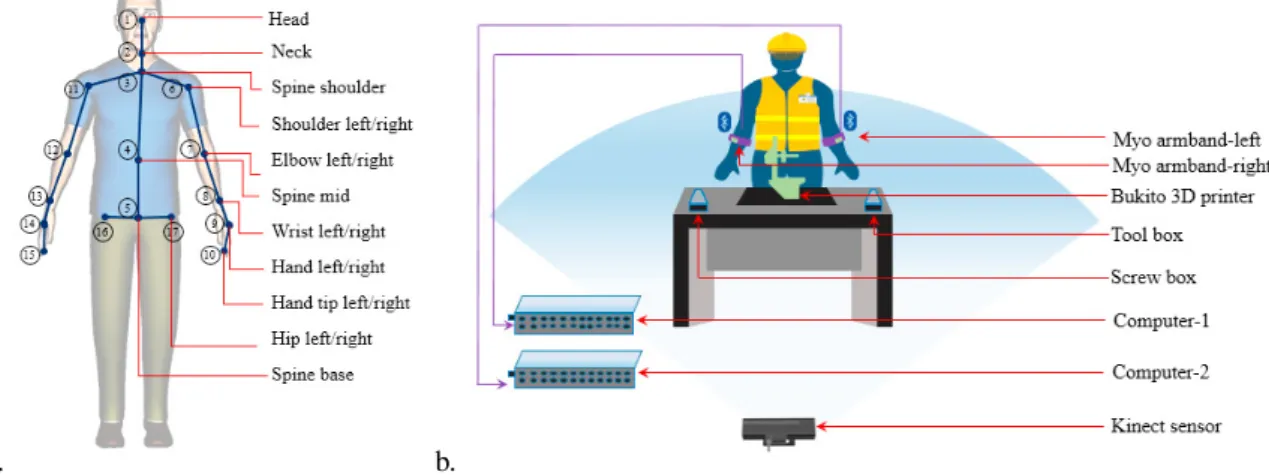
sensor, and a four-microphone array. This study used a Kinect to track the 3D Cartesian coordinates of 17 skeletal joints of workers, as Fig.1(a) shows. The sampling frequency of Kinect is 30 Hz. As Fig.1(b) illustrates, the two
a. b.
Fig. 1. The multimodal sensor system: (a) tracked skeletal joints and (b) setup of the sensor system.
Myo armbands were worn at the left and right forearm regions of a worker, respectively. The EMG and IMU signals of each armband were transmitted to a laptop via the Bluetooth communication unit. The Kinect was used to monitor the assembly operation by the worker, and stored the RGB images and the skeletal joints data of the worker.
2.2. Data preparation
Workers sensed by the multimodal sensor system are indexed byn and the total number of workers isNworker.
Sensor data of these workers were collected for either training action recognition models or testing the models. Sensor data were pre-processed and turned into data with a structure suitable for the convolutional neural network (CNN) model chosen by this study. The data preparation involves four procedures, which are presented below.
2.2.1. Sensor data fusion
The IMU signals of each armband were collected and saved as a time series dataset with 13 channels (3 for acceleration, 3 for velocity, and 7 for orientation), as Fig.2(a) illustrates. The dataset obtained from the armband worn on the right arm of any workern, denoted byDR−IMU,n, provides information on the orientation and motion of the
worker’s right hand. Information of the left hand is given by the the other dataset,DL−IMU,n, obtained from the left
hand armband.
a b
Fig. 2. Data Fusion: (a) IMU time series data of 13 channels,DL/R−IMU,n; (b) EMG time series data of 8 channels,DL/R−EMG,n.
The EMG signals of each armband on workern, collected by eight independent EMG sensors, were similarly turned into a 8-channel time series dataset, illustrated in Fig.2(b). With two armbands, two datasets were obtained, DR−EMG,nandDL−EMG,n, which capture muscle activities of the right arm and left arm, respectively.
Md. Al-Amin et al. / Procedia Manufacturing 39 (2019) 158–167 161 M. Al-Amin et al./Procedia Manufacturing 00 (2018) 000–000 3
Nomenclature
ADS action-level data segment EMG electromyography IMU inertial measurement unit LOO leave one out
TTS train test split i index of body joints
j index of joint angles
k index of actions
m index of models/sensor units
n index of workers
l/u/v indices of ADSs in the overall dataset, training dataset, and testing dataset Aj features of joint angle j
Dm,n sensor data of workernobtained by sensor unitm
Ijoint index set of body joints
Iangle index set of joint angles
Iaction index set of actions
Imodel index set of models
Iworker index set of workers
Ji coordinates of jointi
Li distance feature of jointi
Mm CNN model trained using the data obtained by sensor unitm
Naction the number of actions
Nworker the number of workers
Nm,n the number of ADSs extracted from datasetDm,n
Rm,k the accuracy of modelmon predicting actionk
Sm the set of ADSs using sensor unitm
Stn/tsm the ADSs dataset for training/testing modelMm
xm,l/u/v ADS obtained from sensor unitm
ym,l/u/v the ground truth of ADSs obtained from sensor unitm
2. The Approach
The approach to creating the multimodal sensor system and using sensor fusion to achieve reliable recognition of assembly actions is presented below. The proposed method of this paper is not restricted to a specific set of actions in a particular assembly process. Therefore, the method can be generalized for recognizing assembly actions at any workstation of an assembly line wherein the involvement of workers is an inevitable part of the process.
2.1. The multimodal sensor system
This study used two Myo armbands developed by the Thalmic Labs (https://developerblog.myo.com/) and one
Kinect developed by Microsoft (https://developer.microsoft.com/en-us/windows/kinect) to form the multimodal
sen-sor system. The Myo armband is a wearable device that consists of 8 surface electromyography (EMG) sensen-sors and a 9-axis inertial measurement unit (IMU) that consists of a 3-axis gyroscope, a 3-axis accelerometer, and a 3-axis magnetometer. The IMU of Myo armband provides the spatial data (i.e., orientation and motion) of the armband in 13 channels: orientation (7 channels, including quaternions and Euler angles), angular velocities (3 channels), and accelerations (3 channels). Sampling frequencies of the EMG sensors and IMU are 200 Hz and 50 Hz, respectively. Kinect, an infrared light range-sensing sensor, contains an RGB camera (640×480 pixels @ 30 Hz), a 3D depth
4 M. Al-Amin et al./Procedia Manufacturing 00 (2018) 000–000
sensor, and a four-microphone array. This study used a Kinect to track the 3D Cartesian coordinates of 17 skeletal joints of workers, as Fig.1(a) shows. The sampling frequency of Kinect is 30 Hz. As Fig.1(b) illustrates, the two
a. b.
Fig. 1. The multimodal sensor system: (a) tracked skeletal joints and (b) setup of the sensor system.
Myo armbands were worn at the left and right forearm regions of a worker, respectively. The EMG and IMU signals of each armband were transmitted to a laptop via the Bluetooth communication unit. The Kinect was used to monitor the assembly operation by the worker, and stored the RGB images and the skeletal joints data of the worker.
2.2. Data preparation
Workers sensed by the multimodal sensor system are indexed by n and the total number of workers isNworker.
Sensor data of these workers were collected for either training action recognition models or testing the models. Sensor data were pre-processed and turned into data with a structure suitable for the convolutional neural network (CNN) model chosen by this study. The data preparation involves four procedures, which are presented below.
2.2.1. Sensor data fusion
The IMU signals of each armband were collected and saved as a time series dataset with 13 channels (3 for acceleration, 3 for velocity, and 7 for orientation), as Fig.2(a) illustrates. The dataset obtained from the armband worn on the right arm of any workern, denoted byDR−IMU,n, provides information on the orientation and motion of the
worker’s right hand. Information of the left hand is given by the the other dataset,DL−IMU,n, obtained from the left
hand armband.
a b
Fig. 2. Data Fusion: (a) IMU time series data of 13 channels,DL/R−IMU,n; (b) EMG time series data of 8 channels,DL/R−EMG,n.
The EMG signals of each armband on worker n, collected by eight independent EMG sensors, were similarly turned into a 8-channel time series dataset, illustrated in Fig.2(b). With two armbands, two datasets were obtained, DR−EMG,nandDL−EMG,n, which capture muscle activities of the right arm and left arm, respectively.
162 Md. Al-Amin et al. / Procedia Manufacturing 39 (2019) 158–167
M. Al-Amin et al./Procedia Manufacturing 00 (2018) 000–000 5
2.2.2. Skeletal feature calculation and feature fusion
Coordinates of skeletal joints are spatial data containing the information of human configuration and motion [10]. This study turned the coordinates of joints into two types of skeletal features and used the time series of the features to model worker assembly actions.
Let the spine shoulder (joint #3 in Fig.1(a)) be the reference point or the origin of human skeleton. The distance from each joint to the origin was calculated as a distance feature. Yet distance features may vary with workers who are different in the height, size, arm length, and the location from the camera. To make distance features invariant to
aforesaid factors, distance features were further normalized by dividing them by the vertical distance between spine shoulder (joint #3) and spine base (joint #5). LetJibe the location coordinate of theith joint sensed by the Kinect,
i∈Ijoint={1, . . . ,17}. The normalized distance featureLiis computed as:
Li= ||Ji−J3||2
||J5−J3||2, ∀ i∈Ijoint\{3,5}. (1)
Eq. (1) indicatesL3andL5were excluded, which are equal to 0 and 1, respectively.
Joint coordinates were further used to calculate joint angles between any two connected limbs [27]. Provided with the 17 joints, there are 16 joint angles in total, indexed by j,j∈Iangle={1, . . . ,16}. Letbjandbjbe the orientations
of the two limbs forming the jth skeletal angle, the angle featureAjis calculated as
Aj=arccos
bjTbj ||bj||2||bj||2
, ∀j∈Iangle. (2)
The orientation of any limb, such asbjin (2), can be calculated from the coordinates of joints on the two ends of the
limb.
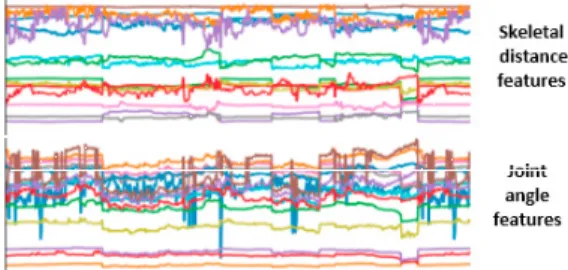
Skeletal distance features and joint angle features of any workernwere further fused, becoming a skeletal feature vector with 31 channels, [L1,L2,L4,L6, . . . ,L17,A1, . . . ,A16]. The time series data of this 31-channel feature vector is
the Kinect dataset,DKinect,n, illustrated in Fig.3.
Fig. 3. Time series of skeletal features including both distance features and joint angle features.
2.2.3. Segmentation of action-level time series data
Consider an assembly operation that requires a worker to sequentially takeNactionactions indexed byk. Throughout
the operation, the multimodal sensor system continuously captured five sets of time series data aforementioned,Dm,n,
form∈ Imodel ={L-EMG, R-EMG, L-IMU, R-IMU, Kinect}and for anyn∈ Iworker ={1, . . . ,Nworker}. Each dataset
Dm,nis long time series data coveringNactionactions. In this study, a sliding window technique was applied to extract
meaningful short segments of time series data from the long time series datasets{Dm,n}. In the remainder of the paper,
6 M. Al-Amin et al./Procedia Manufacturing 00 (2018) 000–000
the extracted segments are named action-level time series data segments (ADSs). These ADSs were used to train and test CNN models for action recognition. The selection of a window length is vital. ADSs of very short time span do not contain sufficient information to fully recognize the performed actions. Those of very long time span may contain
data of more than one action [28]. Successive windows were overlapped to better handle the transition from one action to another. The length of sliding window and the overlapping degree largely depend on sensor data and actions to be recognized [28]. Given the appropriately selected window length and overlapping degree, in total Nm,n ADSs were
extracted fromDm,n, indexed byl. Letxn,m,ldenote an ADS extracted from datasetDm,n, andyn,m,lbe the ground truth
that identifies the action of workerncorresponding to this ADS. 2.2.4. Oversampling to balance the sample sizes among actions
ADSs extracted from the datasetDm,nwere samples of multiple actions. Among theNm,nADSs,Nm,n,kADSs were
samples of actionk. Nm,n,k can dramatically vary from one action to another due to the fact that different actions
possess different cycle times in a manufacturing assembly. For instance, grabbing a tool might take much less time
compared to tightening a screw using an Allen key. The very imbalanced sample sizes across different actions would
imapct the performance of classification algorithms [29]. To overcome this issue, this study adopted an oversampling technique to balance the sample distribution among actions through a random replication of minority class instances [30]. After applying the oversampling technique, all the actions a worker took have the same number of ADSs, equal to maxk∈Iaction{Nm,n,k}. Consequently, the total number of ADSs for any actionk, collected from theNworkerworkers, is
n∈Iworkermaxk∈Iaction{Nm,n,k},m∈Im.
2.3. CNN models for action recognition and model fusion
LetSm ={xm,l}denote the set of ADSs (indexed byl) that were collected from theNworker workers and covered
all actions they took.Smwas split into two mutually exclusive subsets:Smtn={xm,u}andSmts{xm,v}, whereuandvare
indices of ADSs in these two datasets, respectively. A CNN modelMmwas trained usingStnm, andStsmwas used to test
the model. In total five models were trained:ML−EMG,MR−EMG,ML−IMU,MR−IMU, andMKinect.
For anyv, there were five ADSs obtained by the five different sensor units, respectively. Therefore, worker actions
can be predicted by five independent models as well as by a combination of these models. For an ADSxm,v, the
pre-diction made by modelMmis a probability distribution onIaction, denoted byPm,vand||Pm,v||1=1. Model fusion was
used in this study to attempt to improve the prediction performance. Table1lists four methods of model fusion con-sidered in this study. AF1, AF2, and AF3 in Table1are based the average fusion method that averages the predictions of various independent models. WF is a weighted average of predictions, which is discussed below.
Table 1. Methods of model fusion.
Fusion Model Name Index Set of Models for Fusion Fusion Method AF1 IAF1={L−IMU,R−IMU} 12m∈IAF1Pm,v
AF2 IAF2={L−IMU,R−IMU,Kinect} 13m∈IAF2Pm,v
AF3 IAF3={L−IMU,R−IMU,L−EMG,R−EMG,Kinect} 15m∈IAF3Pm,v
WF IWF=IAF3 15m∈IWF wm·Pm,v
The five CNN models may not be equally good at predicting all the actions of assembly operation. For example, tightening a screw using fingers may be predicted better by MR−EMG or MR−IMU than does MKinect because EMG
and IMU data should be more capable than skeletal features in capturing fine motions. A weighted fusion method emphasizing the strength of each model in recognizing specific actions was proposed. In this study a modification factor assigned to the prediction of actionkmade by modelm,wm,k, was determined using the corresponding recall,
Rm,k. For any actionk, the five CNN models were divided into two tiers according to their recall values: models with
the top two recall values were in the first tier and their predictions were amplified by multiplying the modification factorwm,k that is greater than 1. The remaining three were in the second tier and their predictions are remained
unchanged; that is, the modification factor for tier models is 1. Letwm = [wm,1, . . . ,wm,Naction] be the vector of the modification factors for model m. In the last line of Table 1 wm·Pm,v is the modified prediction of model Mm,
Md. Al-Amin et al. / Procedia Manufacturing 39 (2019) 158–167 163 M. Al-Amin et al./Procedia Manufacturing 00 (2018) 000–000 5
2.2.2. Skeletal feature calculation and feature fusion
Coordinates of skeletal joints are spatial data containing the information of human configuration and motion [10]. This study turned the coordinates of joints into two types of skeletal features and used the time series of the features to model worker assembly actions.
Let the spine shoulder (joint #3 in Fig.1(a)) be the reference point or the origin of human skeleton. The distance from each joint to the origin was calculated as a distance feature. Yet distance features may vary with workers who are different in the height, size, arm length, and the location from the camera. To make distance features invariant to
aforesaid factors, distance features were further normalized by dividing them by the vertical distance between spine shoulder (joint #3) and spine base (joint #5). LetJibe the location coordinate of theith joint sensed by the Kinect,
i∈Ijoint ={1, . . . ,17}. The normalized distance featureLiis computed as:
Li= ||Ji−J3||2
||J5−J3||2, ∀ i∈Ijoint\{3,5}. (1)
Eq. (1) indicatesL3andL5were excluded, which are equal to 0 and 1, respectively.
Joint coordinates were further used to calculate joint angles between any two connected limbs [27]. Provided with the 17 joints, there are 16 joint angles in total, indexed by j, j∈Iangle={1, . . . ,16}. Letbjandbjbe the orientations
of the two limbs forming the jth skeletal angle, the angle featureAjis calculated as
Aj=arccos
bjTbj ||bj||2||bj||2
, ∀j∈Iangle. (2)
The orientation of any limb, such asbjin (2), can be calculated from the coordinates of joints on the two ends of the
limb.
Skeletal distance features and joint angle features of any workernwere further fused, becoming a skeletal feature vector with 31 channels, [L1,L2,L4,L6, . . . ,L17,A1, . . . ,A16]. The time series data of this 31-channel feature vector is
the Kinect dataset,DKinect,n, illustrated in Fig.3.
Fig. 3. Time series of skeletal features including both distance features and joint angle features.
2.2.3. Segmentation of action-level time series data
Consider an assembly operation that requires a worker to sequentially takeNactionactions indexed byk. Throughout
the operation, the multimodal sensor system continuously captured five sets of time series data aforementioned,Dm,n,
form∈ Imodel ={L-EMG, R-EMG, L-IMU, R-IMU, Kinect}and for anyn ∈ Iworker ={1, . . . ,Nworker}. Each dataset
Dm,nis long time series data coveringNactionactions. In this study, a sliding window technique was applied to extract
meaningful short segments of time series data from the long time series datasets{Dm,n}. In the remainder of the paper,
6 M. Al-Amin et al./Procedia Manufacturing 00 (2018) 000–000
the extracted segments are named action-level time series data segments (ADSs). These ADSs were used to train and test CNN models for action recognition. The selection of a window length is vital. ADSs of very short time span do not contain sufficient information to fully recognize the performed actions. Those of very long time span may contain
data of more than one action [28]. Successive windows were overlapped to better handle the transition from one action to another. The length of sliding window and the overlapping degree largely depend on sensor data and actions to be recognized [28]. Given the appropriately selected window length and overlapping degree, in totalNm,n ADSs were
extracted fromDm,n, indexed byl. Letxn,m,ldenote an ADS extracted from datasetDm,n, andyn,m,lbe the ground truth
that identifies the action of workerncorresponding to this ADS. 2.2.4. Oversampling to balance the sample sizes among actions
ADSs extracted from the datasetDm,nwere samples of multiple actions. Among theNm,nADSs,Nm,n,kADSs were
samples of actionk.Nm,n,k can dramatically vary from one action to another due to the fact that different actions
possess different cycle times in a manufacturing assembly. For instance, grabbing a tool might take much less time
compared to tightening a screw using an Allen key. The very imbalanced sample sizes across different actions would
imapct the performance of classification algorithms [29]. To overcome this issue, this study adopted an oversampling technique to balance the sample distribution among actions through a random replication of minority class instances [30]. After applying the oversampling technique, all the actions a worker took have the same number of ADSs, equal to maxk∈Iaction{Nm,n,k}. Consequently, the total number of ADSs for any actionk, collected from theNworkerworkers, is
n∈Iworkermaxk∈Iaction{Nm,n,k},m∈Im.
2.3. CNN models for action recognition and model fusion
LetSm ={xm,l}denote the set of ADSs (indexed byl) that were collected from theNworker workers and covered
all actions they took.Smwas split into two mutually exclusive subsets:Stnm ={xm,u}andStsm{xm,v}, whereuandvare
indices of ADSs in these two datasets, respectively. A CNN modelMmwas trained usingStnm, andStsmwas used to test
the model. In total five models were trained:ML−EMG,MR−EMG,ML−IMU,MR−IMU, andMKinect.
For anyv, there were five ADSs obtained by the five different sensor units, respectively. Therefore, worker actions
can be predicted by five independent models as well as by a combination of these models. For an ADSxm,v, the
pre-diction made by modelMmis a probability distribution onIaction, denoted byPm,vand||Pm,v||1=1. Model fusion was
used in this study to attempt to improve the prediction performance. Table1lists four methods of model fusion con-sidered in this study. AF1, AF2, and AF3 in Table1are based the average fusion method that averages the predictions of various independent models. WF is a weighted average of predictions, which is discussed below.
Table 1. Methods of model fusion.
Fusion Model Name Index Set of Models for Fusion Fusion Method AF1 IAF1={L−IMU,R−IMU} 12m∈IAF1Pm,v
AF2 IAF2={L−IMU,R−IMU,Kinect} 13m∈IAF2Pm,v
AF3 IAF3={L−IMU,R−IMU,L−EMG,R−EMG,Kinect} 15m∈IAF3Pm,v
WF IWF=IAF3 15m∈IWF wm·Pm,v
The five CNN models may not be equally good at predicting all the actions of assembly operation. For example, tightening a screw using fingers may be predicted better byMR−EMG or MR−IMU than does MKinect because EMG
and IMU data should be more capable than skeletal features in capturing fine motions. A weighted fusion method emphasizing the strength of each model in recognizing specific actions was proposed. In this study a modification factor assigned to the prediction of actionkmade by modelm,wm,k, was determined using the corresponding recall,
Rm,k. For any actionk, the five CNN models were divided into two tiers according to their recall values: models with
the top two recall values were in the first tier and their predictions were amplified by multiplying the modification factorwm,k that is greater than 1. The remaining three were in the second tier and their predictions are remained
unchanged; that is, the modification factor for tier models is 1. Letwm = [wm,1, . . . ,wm,Naction] be the vector of the modification factors for modelm. In the last line of Table 1 wm ·Pm,v is the modified prediction of model Mm,
164 Md. Al-Amin et al. / Procedia Manufacturing 39 (2019) 158–167
M. Al-Amin et al./Procedia Manufacturing 00 (2018) 000–000 7 3. An Illustrative Example
3.1. The experiment setup
The workstation for assembling a Bukito 3D printer was set up in a lab. The study used one step of the assembly process, named “putting on the handle” in the product assembly instruction manual, as an example to illustrate and assess the proposed approach to creating the action recognition system. This step of assembly includes seven actions shown in Fig. 4. To capture the between-subjects variability, five subjects were recruited to perform the assembly. Their ages were ranged from 18 to 55 years. The multimodal sensor system for sensing workers in this assembly task was set up in the way shown in Fig.1(b). The Allen key set, screw box, tool box, and Bukito kit were tools and material involved in this assembly. To count the randomness of human actions (i.e., the within-subject variability), the five subjects were asked to repeat the assembly for 10 times.
Fig. 4. Sequential actions for “putting on the handle” in assembling a Bukito 3D printer.
3.2. Data preparation
Time series sensor datasets were created by following the method described in section 2.2. Then, ADSs were segmented from these datasets using a sliding window that can cover 2 seconds of time series data. Any two successive ADSs have a 50% ovelap. The time to complete an action varies significantly among the 7 actions so that the number of ADSs varied largely from one action to another, as Table2illustrates. The oversampling method was applied to create evenly distributed ADSs across the seven actions.
Table 2. The sample size of ADSs (before/after oversampling)
.
Subjects Action-1 Action-2 Action-3 Action-4 Action-5 Action-6 Action-7 Subject-1 26/122 46/122 46/122 70/122 44/122 122/122 50/122 Subject-2 30/128 24/128 66/128 72/128 62/128 128/128 64/128 Subject-3 10/100 18/100 44/100 24/100 36/100 100/100 30/100 Subject-4 10/78 16/78 32/78 64/78 30/78 78/78 30/78 Subject-5 22/134 30/134 60/134 74/134 68/134 134/134 56/134
3.3. Training CNN models for action recognition
Five CNN models{Mm|m∈Imodel}for classifying actions were independently trained. The modelMmwas trained
to automatically extract discriminative features of worker actions from the dataset Sst
m. ADSs were normalized to
be within the range [−1,1] before being fed to the network. The proposed CNN architecture is illustrated in Fig.5.
Parameters for individual CNNs are also summarized in this figure. The Leave One Out (LOO) validation method
8 M. Al-Amin et al./Procedia Manufacturing 00 (2018) 000–000
Fig. 5. The proposed CNN architecture.
was performed to evaluate the strength of individual CNN models in recognizing human actions in assembly. Each time, data of four subjects were used for training the CNN models and data of the remaining one subject were used to assess the prediction accuracy of the models. The LOO validation was performed five times and each time the subject for testing was rotated to a different worker. Consequently, all the ADSs were tested. Given the testing result, the
prediction accuracy of each model on each task was calculated, shown in Fig.6(a). For each action, the two models of the first tier are labeled with their accuracy values in Fig.6. Accordingly, the vector of prediction modification factors, wm, was determined for each modelm, shown in Fig.6(b).
a
b
Fig. 6. Evaluation of model strength: (a) prediction accuracy, and (b) prediction modification factorswm,k.
3.4. Assessment of sensor fusion methods
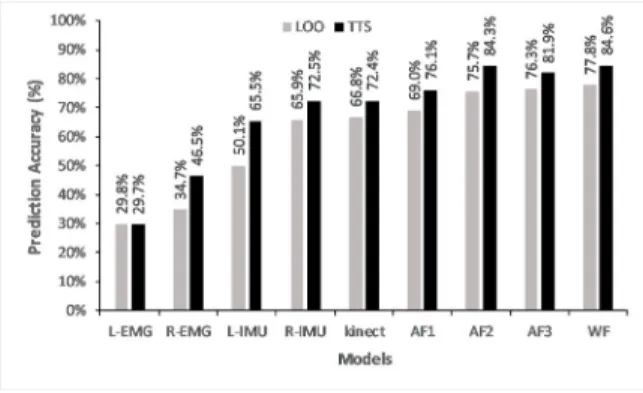
The five CNN models and the four fusion methods based on these models were assessed using two cross validation methods: the LOO and the Train-Test Split (TTS). In use of the TTS method, 50% of ADSs of every subject were used for training and the remaining 50% were used for testing. Fig. 7 shows the prediction accuracy of the five individual CNN models and the four fusion methods evaluated by both LOO and TTS methods. Among the five individual models, the prediction accuracy ofMR−IMU was similar to that ofMKinect, and they outperformed the other
three models.AF1, the average fusion ofML−IMU andMR−IMU, had higher accuracy than did each individual model.
AF2, which addsMKinecttoAF1, further increased the accuracy by 6.7% and 8.2% in the LOO and TTS evaluations,
respectively. Compared toAF2, the average fusion of all five CNN models,AF3, only improved the accuracy by 0.6% in the LOO evaluation. The proposed weighted average fusion,WF, outperformedAF3 by increasing the accuracy by 1.5% in the LOO evaluation and 2.7% in the TTS evaluation. It was noticed thatAF3 in the TTS evaluation had
Md. Al-Amin et al. / Procedia Manufacturing 39 (2019) 158–167 165 M. Al-Amin et al./Procedia Manufacturing 00 (2018) 000–000 7
3. An Illustrative Example
3.1. The experiment setup
The workstation for assembling a Bukito 3D printer was set up in a lab. The study used one step of the assembly process, named “putting on the handle” in the product assembly instruction manual, as an example to illustrate and assess the proposed approach to creating the action recognition system. This step of assembly includes seven actions shown in Fig.4. To capture the between-subjects variability, five subjects were recruited to perform the assembly. Their ages were ranged from 18 to 55 years. The multimodal sensor system for sensing workers in this assembly task was set up in the way shown in Fig.1(b). The Allen key set, screw box, tool box, and Bukito kit were tools and material involved in this assembly. To count the randomness of human actions (i.e., the within-subject variability), the five subjects were asked to repeat the assembly for 10 times.
Fig. 4. Sequential actions for “putting on the handle” in assembling a Bukito 3D printer.
3.2. Data preparation
Time series sensor datasets were created by following the method described in section 2.2. Then, ADSs were segmented from these datasets using a sliding window that can cover 2 seconds of time series data. Any two successive ADSs have a 50% ovelap. The time to complete an action varies significantly among the 7 actions so that the number of ADSs varied largely from one action to another, as Table2illustrates. The oversampling method was applied to create evenly distributed ADSs across the seven actions.
Table 2. The sample size of ADSs (before/after oversampling)
.
Subjects Action-1 Action-2 Action-3 Action-4 Action-5 Action-6 Action-7 Subject-1 26/122 46/122 46/122 70/122 44/122 122/122 50/122 Subject-2 30/128 24/128 66/128 72/128 62/128 128/128 64/128 Subject-3 10/100 18/100 44/100 24/100 36/100 100/100 30/100 Subject-4 10/78 16/78 32/78 64/78 30/78 78/78 30/78 Subject-5 22/134 30/134 60/134 74/134 68/134 134/134 56/134
3.3. Training CNN models for action recognition
Five CNN models{Mm|m∈Imodel}for classifying actions were independently trained. The modelMmwas trained
to automatically extract discriminative features of worker actions from the dataset Sst
m. ADSs were normalized to
be within the range [−1,1] before being fed to the network. The proposed CNN architecture is illustrated in Fig.5.
Parameters for individual CNNs are also summarized in this figure. The Leave One Out (LOO) validation method
8 M. Al-Amin et al./Procedia Manufacturing 00 (2018) 000–000
Fig. 5. The proposed CNN architecture.
was performed to evaluate the strength of individual CNN models in recognizing human actions in assembly. Each time, data of four subjects were used for training the CNN models and data of the remaining one subject were used to assess the prediction accuracy of the models. The LOO validation was performed five times and each time the subject for testing was rotated to a different worker. Consequently, all the ADSs were tested. Given the testing result, the
prediction accuracy of each model on each task was calculated, shown in Fig.6(a). For each action, the two models of the first tier are labeled with their accuracy values in Fig.6. Accordingly, the vector of prediction modification factors, wm, was determined for each modelm, shown in Fig.6(b).
a
b
Fig. 6. Evaluation of model strength: (a) prediction accuracy, and (b) prediction modification factorswm,k.
3.4. Assessment of sensor fusion methods
The five CNN models and the four fusion methods based on these models were assessed using two cross validation methods: the LOO and the Train-Test Split (TTS). In use of the TTS method, 50% of ADSs of every subject were used for training and the remaining 50% were used for testing. Fig. 7 shows the prediction accuracy of the five individual CNN models and the four fusion methods evaluated by both LOO and TTS methods. Among the five individual models, the prediction accuracy ofMR−IMUwas similar to that ofMKinect, and they outperformed the other
three models.AF1, the average fusion ofML−IMUandMR−IMU, had higher accuracy than did each individual model.
AF2, which addsMKinecttoAF1, further increased the accuracy by 6.7% and 8.2% in the LOO and TTS evaluations,
respectively. Compared toAF2, the average fusion of all five CNN models,AF3, only improved the accuracy by 0.6% in the LOO evaluation. The proposed weighted average fusion,WF, outperformedAF3 by increasing the accuracy by 1.5% in the LOO evaluation and 2.7% in the TTS evaluation. It was noticed that AF3 in the TTS evaluation had
166 Md. Al-Amin et al. / Procedia Manufacturing 39 (2019) 158–167
M. Al-Amin et al./Procedia Manufacturing 00 (2018) 000–000 9
a lower accuracy (81.9%) thanAF2 (84.3%). The weighted average fusionWFovercame the limitation ofAF3 and achieved the highest accuracy (84.6%).
Fig. 7. Evaluation of prediction accuracy.
4. Conclusions and Future Work
In this study, we propose a multimodal sensor system and weighted fusion method in developing a robust and reliable action recognition system. The study shows that, EMG and IMU data perform well in recognizing fine actions involved with finger motion i.e., insert screw, tighten screw manually. On the other hand skeletal data does better in recognizing coarse actions involved with arm motion i.e., take the handle, give back the tool. Moreover, we have shown that reliability of the recognition system can be enhanced by fusing the aforesaid information at data, feature and score levels to complement the information and applying oversampling technique to overcome the limitation of unbalanced dataset. Furthermore, we also proposed a new weighted fusion method, that emphasizes each model’s strength in recognizing specific actions and put modification factor to the predictions accordingly in decision making which improves the result. The effectiveness of our proposed sensor system and weighted fusion method has been
verified with an illustrative example of assembling a Bukito 3D printer in lab setting.
The study of this paper builds a foundation for important future work. For instance, exploring other fusion methods to further improve the accuracy; scaling up the current work by applying the proposed approach to the recognition of assembly actions on various workstations of an assembly line.
Acknowledgements
This work was supported by NSF grant CMMI-1646162 on cyber-physical systems. Any opinions, findings, and conclusions or recommendations expressed in this material are those of the authors and do not necessarily reflect the views of the National Science Foundation. The authors also thank the project team members Md Moniruzzaman and Ze-Hao Lai for their insightful comments and suggestions on this study.
References
[1] C. Chen, R. Jafari, N. Kehtarnavaz, A survey of depth and inertial sensor fusion for human action recognition, Multimedia Tools and Applica-tions 76 (3) (2017) 4405–4425.
[2] A. Wang, G. Chen, J. Yang, S. Zhao, C.-Y. Chang, A comparative study on human activity recognition using inertial sensors in a smartphone, IEEE Sensors Journal 16 (11) (2016) 4566–4578.
[3] H. Junker, O. Amft, P. Lukowicz, G. Tr¨oster, Gesture spotting with body-worn inertial sensors to detect user activities, Pattern Recognition 41 (6) (2008) 2010–2024.
[4] F. Attal, S. Mohammed, M. Dedabrishvili, F. Chamroukhi, L. Oukhellou, Y. Amirat, Physical human activity recognition using wearable sensors, Sensors 15 (12) (2015) 31314–31338.
Md. Al-Amin et al. / Procedia Manufacturing 39 (2019) 158–167 167 M. Al-Amin et al./Procedia Manufacturing 00 (2018) 000–000 9
a lower accuracy (81.9%) thanAF2 (84.3%). The weighted average fusionWFovercame the limitation ofAF3 and achieved the highest accuracy (84.6%).
Fig. 7. Evaluation of prediction accuracy.
4. Conclusions and Future Work
In this study, we propose a multimodal sensor system and weighted fusion method in developing a robust and reliable action recognition system. The study shows that, EMG and IMU data perform well in recognizing fine actions involved with finger motion i.e., insert screw, tighten screw manually. On the other hand skeletal data does better in recognizing coarse actions involved with arm motion i.e., take the handle, give back the tool. Moreover, we have shown that reliability of the recognition system can be enhanced by fusing the aforesaid information at data, feature and score levels to complement the information and applying oversampling technique to overcome the limitation of unbalanced dataset. Furthermore, we also proposed a new weighted fusion method, that emphasizes each model’s strength in recognizing specific actions and put modification factor to the predictions accordingly in decision making which improves the result. The effectiveness of our proposed sensor system and weighted fusion method has been
verified with an illustrative example of assembling a Bukito 3D printer in lab setting.
The study of this paper builds a foundation for important future work. For instance, exploring other fusion methods to further improve the accuracy; scaling up the current work by applying the proposed approach to the recognition of assembly actions on various workstations of an assembly line.
Acknowledgements
This work was supported by NSF grant CMMI-1646162 on cyber-physical systems. Any opinions, findings, and conclusions or recommendations expressed in this material are those of the authors and do not necessarily reflect the views of the National Science Foundation. The authors also thank the project team members Md Moniruzzaman and Ze-Hao Lai for their insightful comments and suggestions on this study.
References
[1] C. Chen, R. Jafari, N. Kehtarnavaz, A survey of depth and inertial sensor fusion for human action recognition, Multimedia Tools and Applica-tions 76 (3) (2017) 4405–4425.
[2] A. Wang, G. Chen, J. Yang, S. Zhao, C.-Y. Chang, A comparative study on human activity recognition using inertial sensors in a smartphone, IEEE Sensors Journal 16 (11) (2016) 4566–4578.
[3] H. Junker, O. Amft, P. Lukowicz, G. Tr¨oster, Gesture spotting with body-worn inertial sensors to detect user activities, Pattern Recognition 41 (6) (2008) 2010–2024.
[4] F. Attal, S. Mohammed, M. Dedabrishvili, F. Chamroukhi, L. Oukhellou, Y. Amirat, Physical human activity recognition using wearable sensors, Sensors 15 (12) (2015) 31314–31338.
10 M. Al-Amin et al./Procedia Manufacturing 00 (2018) 000–000
[5] S. Dernbach, B. Das, N. C. Krishnan, B. L. Thomas, D. J. Cook, Simple and complex activity recognition through smart phones, in: 2012 8th International Conference on Intelligent Environments, IEEE, 2012, pp. 214–221.
[6] M. Ramanathan, W.-Y. Yau, E. K. Teoh, Human action recognition with video data: research and evaluation challenges, IEEE Transactions on Human-Machine Systems 44 (5) (2014) 650–663.
[7] T. T. Ngo, Y. Makihara, H. Nagahara, Y. Mukaigawa, Y. Yagi, Similar gait action recognition using an inertial sensor, Pattern Recognition 48 (4) (2015) 1289–1301.
[8] K. Altun, B. Barshan, Human activity recognition using inertial/magnetic sensor units, in: International Workshop on Human Behavior Under-standing, Springer, 2010, pp. 38–51.
[9] W. Tao, Z.-H. Lai, M. C. Leu, Z. Yin, Worker activity recognition in smart manufacturing using IMU and sEMG signals with convolutional neural networks, Procedia Manufacturing 26 (2018) 1159–1166.
[10] M. Al-Amin, R. Qin, W. Tao, M. C. Leu, Sensor data based models for workforce management in smart manufacturing, in: Proceedings of The 2018 Industrial and Systems Engineering Research Conference (ISERC’18), Orlando, FL, 2018, pp. 481–486.
[11] M. Aehnelt, E. Gutzeit, B. Urban, Using activity recognition for the tracking of assembly processes: Challenges and requirements, in: Proceed-ings of the Workshop on Sensor-Based Activity Recognition, 2014.
[12] J. A. Ward, P. Lukowicz, G. Troster, T. E. Starner, Activity recognition of assembly tasks using body-worn microphones and accelerometers, IEEE transactions on Pattern Analysis and Machine Intelligence 28 (10) (2006) 1553–1567.
[13] T. Stiefmeier, D. Roggen, G. Ogris, P. Lukowicz, G. Tr¨oster, Wearable activity tracking in car manufacturing, IEEE Pervasive Computing 7 (2) (2008) 42–50.
[14] W. Unzeitig, M. Wifling, A. Stocker, M. Rosenberger, Industrial challenges in human-centred production, in: MOTSP 2015-lnternational Conference Management of Technology, 2015, pp. 10–12.
[15] J. Zhang, W. Li, P. O. Ogunbona, P. Wang, C. Tang, RGB-D-based action recognition datasets: A survey, Pattern Recognition 60 (2016) 86–105. [16] C. Scheuermann, S. Verclas, B. Bruegge, Agile factory-an example of an industry 4.0 manufacturing process, in: 2015 IEEE 3rd International
Conference on Cyber-Physical Systems, Networks, and Applications (CPSNA), IEEE, 2015, pp. 43–47.
[17] O. Sand, S. B¨uttner, V. Paelke, C. R¨ocker, smart. assembly–projection-based augmented reality for supporting assembly workers, in: Interna-tional Conference on Virtual, Augmented and Mixed Reality, Springer, 2016, pp. 643–652.
[18] M. Guo, Z. Wang, N. Yang, Z. Li, T. An, A multisensor multiclassifier hierarchical fusion model based on entropy weight for human activity recognition using wearable inertial sensors, IEEE Transactions on Human-Machine Systems 49 (1) (2019) 105–111.
[19] O. Banos, M. Damas, H. Pomares, F. Rojas, B. Delgado-Marquez, O. Valenzuela, Human activity recognition based on a sensor weighting hierarchical classifier, Soft Computing 17 (2) (2013) 333–343.
[20] S. Gaglio, G. L. Re, M. Morana, Human activity recognition process using 3-D posture data, IEEE Transactions on Human-Machine Systems 45 (5) (2015) 586–597.
[21] T. Stiefmeier, G. Ogris, H. Junker, P. Lukowicz, G. Troster, Combining motion sensors and ultrasonic hands tracking for continuous activity recognition in a maintenance scenario, in: 2006 10th IEEE International Symposium on Wearable Computers, IEEE, 2006, pp. 97–104. [22] S. Kaghyan, H. Sarukhanyan, Activity recognition using k-nearest neighbor algorithm on smartphone with tri-axial accelerometer, International
Journal of Informatics Models and Analysis (IJIMA) 1 (2012) 146–156.
[23] C. Zhu, W. Sheng, Wearable sensor-based hand gesture and daily activity recognition for robot-assisted living, IEEE Transactions on Systems, Man, and Cybernetics-Part A: Systems and Humans 41 (3) (2011) 569–573.
[24] Y. Guo, W. He, C. Gao, Human activity recognition by fusing multiple sensor nodes in the wearable sensor systems, Journal of Mechanics in Medicine and Biology 12 (05) (2012) 1250084.
[25] P. Zappi, T. Stiefmeier, E. Farella, D. Roggen, L. Benini, G. Troster, Activity recognition from on-body sensors by classifier fusion: sensor scalability and robustness, in: 2007 3rd International Conference on Intelligent Sensors, Sensor Networks and Information, IEEE, 2007, pp. 281–286.
[26] Y. Nam, J. W. Park, Child activity recognition based on cooperative fusion model of a triaxial accelerometer an