GROUP REACHING OVER DIGITAL TABLETOPS WITH DIGITAL ARM EMBODIMENTS
A Thesis Submitted to the College of Graduate Studies and Research In Partial Fulfillment of the Requirements
For the Degree of Doctor of Philosophy In the Department of Computer Science
University of Saskatchewan Saskatoon
By
André Doucette
PERMISSION TO USE
In presenting this thesis in partial fulfilment of the requirements for a
Postgraduate degree from the University of Saskatchewan, I agree that the Libraries of this University may make it freely available for inspection. I further agree that
permission for copying of this thesis in any manner, in whole or in part, for scholarly purposes may be granted by the professor or professors who supervised my thesis work or, in their absence, by the Head of the Department or the Dean of the College in which my thesis work was done. It is understood that any copying or publication or use of this thesis or parts thereof for financial gain shall not be allowed without my written
permission. It is also understood that due recognition shall be given to me and to the University of Saskatchewan in any scholarly use which may be made of any material in my thesis.
Requests for permission to copy or to make other use of material in this thesis in whole or part should be addressed to:
Head of the Department of Computer Science
University of Saskatchewan
ABSTRACT
In almost all collaborative tabletop tasks, groups require coordinated access to the shared objects on the table’s surface. The physical social norms of close-proximity interactions built up over years of interacting around other physical bodies cause people to avoid interfering with other people (e.g., avoiding grabbing the same object
simultaneously). However, some digital tabletop situations require the use of indirect input (e.g., when using mice, and when supporting remote users). With indirect input, people are no longer physically embodied during their reaching gestures, so most systems provide digital embodiments – visual representations of each person – to provide
feedback to both the person who is reaching and to the other group members. Tabletop arm embodiments have been shown to better support group interactions than simple visual designs, providing awareness of actions to the group. However, researchers and digital tabletop designers know little of how the design of digital arm embodiments affects the fundamental group tabletop interaction of reaching for objects. Therefore, in this thesis, we evaluate how people coordinate their interactions over digital tabletops when using different types of embodiments. Specifically, in a series of studies, we investigate how the visual design (what they look like) and interaction design (how they work) of digital arm embodiments affects a group’s coordinative behaviours in an open-ended parallel tabletop task. We evaluated visual factors of size, transparency, and realism (through pictures and videos of physical arms), as well as interaction factors of input and augmentations (feedback of interactions), in both a co-located and distributed environment. We found that the visual design had little effect on a group’s ability to coordinate access to shared tabletop items, that embodiment augmentations are useful to support group coordinative actions, and that there are large differences when the person is not physically co-present. Our results demonstrate an initial exploration into the design of digital arm embodiments, providing design guidelines for future researchers and
ACKNOWLEDGMENTS
Attempting to finish a PhD alone is incredibly difficult. I am extremely thankful that I had the tremendous research, writing, and professional guidance of my
co-supervisors, Regan Mandryk and Carl Gutwin. Without a doubt, the most important skill I learned from this process is presenting ideas and creating compelling arguments that others understand, something that will be with me for the rest of my life and will no doubt be incredibly useful. Carl and Regan, thank you.
To the members of the Interaction Lab, thank you for always challenging me so directly. Though your criticisms were difficult to address at the time, they have made this work stronger and have taught me how to deal with tough criticism. Thanks for
continuing a strong presentation culture in the lab; though scientific presentations are so often monotone and difficult to sit through, the Interaction Lab’s presentations are not.
And for the often tough-love, thank you to my beautiful wife Steph, who endured the turmoil that is a spouse in graduate school and always encouraged me to work
through until the end. It has not always been a fun ride, but we rode it together. Last, I would like to thank NSERC, SurfNet, GRAND, and the Walter C. Sumner Foundation for their financial support through my six years of graduate studies.
CONTENTS
CHAPTER 1 – INTRODUCTION ... 1!
1.1 Dissertation’s Problem Statement ... 3!
1.2 Motivation ... 3!
1.3 Solution ... 4!
1.4 Contributions of this Dissertation ... 5!
1.5 Organization of this Dissertation ... 5!
1.5.1 Chapter Overviews ... 6!
1.6 Grounding for the Work Presented in this Dissertation ... 6!
1.6.1 Reaching Gestures ... 6!
1.6.2 Physical Group Reaching over Traditional Tabletops ... 7!
1.6.2.1 Everyday Interactions ... 7!
1.6.2.2 Games ... 8!
1.6.2.3 Paper-Artifact Based Tasks ... 10!
1.6.2.4 Spatial Layout Tasks ... 11!
1.6.3 Interference in Physical Reaching Gestures ... 11!
1.6.4 Group Reaching in Digital Tabletop Systems ... 12!
1.6.4.1 How are People Embodied? ... 13!
1.6.4.2 Interference in Digital Reaching Gestures ... 14!
1.6.5 Group Reaching in Previous Tabletop Studies ... 15!
1.6.5.1 Spatial Layout ... 15!
1.6.5.3 Group Decision-Making ... 16!
1.6.5.4 Systems for Specific Groups ... 16!
1.6.6 Experimental Details for Studies in this Dissertation Work ... 16!
1.6.6.1 Grounding from Previous Digital Tabletop Research ... 17!
1.6.6.2 Task Used in the Studies ... 18!
1.6.6.3 Participants ... 20!
1.6.6.4 Measures ... 21!
1.6.7 Summary ... 22!
CHAPTER 2 – THE VISUAL DESIGN OF DIGITAL ARM EMBODIMENTS ... 23!
2.1 Introduction to Manuscript A ... 23!
2.1.1 Initial Pilot Study Problem and Motivation ... 23!
2.1.2 Solution and Steps to Solution ... 24!
2.1.2.1 Research Questions ... 24!
2.1.3 Lessons from Traditional Tabletop Pilot Study ... 24!
2.1.4 Embodiment Visual Design Problem and Motivation ... 24!
2.1.5 Solution and Steps to Solution ... 25!
2.2 Manuscript A – Sometimes When We Touch: How Arm Embodiments Change Reaching and Coordination on Digital Tables ... 26!
2.3 Introduction ... 26!
2.4 Related Work ... 28!
2.4.1 Touch and Personal Space ... 29!
2.4.2 Personal Space in Digital Environments ... 29!
2.4.3 Co-located and Distributed Multi-user Collaboration ... 30!
2.5.1 Participants and Tasks ... 32!
2.5.2 Observed Behaviours ... 33!
2.5.2.1 Touch Avoidance ... 33!
2.5.3 Territoriality ... 34!
2.6 Digital Table Study ... 35!
2.6.1 Visual Factors of Arm Embodiment Design ... 35!
2.6.2 Study Procedure ... 35!
2.6.2.1 System and Task Descriptions ... 36!
2.6.2.2 Procedure ... 36!
2.6.2.3 Embodiment Conditions ... 37!
2.6.2.4 Participants and Demographic Factors ... 38!
2.6.2.5 Measures and Data Analyses ... 38!
2.7 Results ... 40!
2.7.1 Touch Avoidance ... 40!
2.7.2 Territoriality ... 41!
2.7.3 Awareness ... 44!
2.7.4 Open-Text Questions and Observed Behaviours ... 44!
2.7.4.1 Observations of Coordination with Physical Embodiments ... 45!
2.8 Discussion ... 45!
2.8.1 Interpretation of Results ... 45!
2.8.1.1 Differences Between Physical and Digital Embodiments ... 45!
2.8.1.2 Territoriality ... 46!
2.8.1.3 Occlusion and Digital Embodiment Size ... 47!
2.8.2.1 Touch Input (real arms) vs. Indirect (digital embodiments) ... 47!
2.8.2.2 Visual Realism does not Reproduce Social Protocols ... 48!
2.8.2.3 Lack of Awkwardness Could be Useful ... 48!
2.8.2.4 Relationships Change Behaviour ... 48!
2.8.2.5 Occlusion is an Important Factor in Embodiment Design ... 48!
2.8.3 Directions for Future Research ... 48!
2.8.3.1 Replacing Coordination Mechanisms on Tables ... 48!
2.8.3.2 Mixed Input Ecologies ... 49!
2.8.3.3 Other Instantiations of Social Protocols ... 49!
2.9 Conclusion ... 50!
2.10 Summary of Manuscript A ... 51!
CHAPTER 3 – EFFECTS OF EMBODIMENT AUGMENTATIONS ... 52!
3.1 Introduction to Manuscript B ... 52!
3.1.1 Problem and Motivation ... 52!
3.1.2 Solution and Steps to Solution ... 53!
3.1.2.1 Research Questions ... 53!
3.2 Manuscript B – The Effects of Tactile Feedback and Movement Alteration on Interaction and Awareness with Digital Embodiments ... 54!
3.3 Introduction ... 54!
3.4 Related work ... 57!
3.4.1 Physical Touch ... 57!
3.4.2 Personal Space in Digital Environments ... 58!
3.4.3 Tabletop Embodiments ... 58!
3.5 Digital Tabletop Study ... 60!
3.5.1 Embodiment Augmentations ... 60!
3.5.1.1 Implementation of Augmentations ... 61!
3.5.2 Study Setup ... 62!
3.5.2.1 System and Task Descriptions ... 62!
3.5.2.2 Procedure ... 63! 3.5.2.3 Participants ... 64! 3.5.2.4 Measures ... 65! 3.5.2.5 Data Analyses ... 65! 3.6 Results ... 66! 3.6.1 Crossing Events ... 66! 3.6.1.1 Permanence Effects ... 67! 3.6.2 Subjective Responses ... 67! 3.6.2.1 Awareness ... 68! 3.6.2.2 Awkwardness ... 69! 3.6.2.3 Feelings of Invasion ... 69!
3.6.2.4 Frustration and Annoyance ... 70!
3.6.2.5 Interview Responses ... 71!
3.6.3 Observed Episodes ... 71!
3.7 Discussion ... 72!
3.7.1 Interpretation of Main Results ... 73!
3.7.1.1 Slowed Movement ... 73!
3.7.1.2 Blocked Movement ... 73!
3.7.1.4 Pocket Tactile Feedback ... 74!
3.7.2 Using the Findings in Tabletop Design ... 74!
3.7.2.1 The Design Goal of Adding Artificial Constraints ... 75!
3.7.2.2 Tension Between Discomfort and Usefulness ... 75!
3.7.2.3 Making Actions Public ... 76!
3.7.3 Generalization and Limitations ... 77!
3.8 Conclusion and Future Work ... 77!
3.9 Summary of Manuscript B ... 79!
CHAPTER 4 – DISTRIBUTED ARM EMBODIMENTS ... 80!
4.1 Introduction to Manuscript C ... 80!
4.1.1 Problem and Motivation ... 80!
4.1.2 Solution and Steps to Solution ... 81!
4.1.2.1 Research Questions ... 81!
4.1.2.2 Changes to System and Experimental Protocols for this Study ... 82!
4.2 Manuscript C – How Arm Embodiments Affect Coordination, Co-Presence, and Awareness on Distributed Digital Tabletops ... 83!
4.3 Introduction ... 83!
4.4 Related Work ... 86!
4.4.1 Distributed Embodiments ... 86!
4.4.2 Digital Personal Space and Mediated Touch ... 87!
4.4.3 Social Presence and SoE in Distributed Systems ... 87!
4.5 The Study ... 88!
4.5.1 Task ... 89!
4.5.3 Conditions ... 89!
4.5.3.1 Embodiment Latency ... 90!
4.5.4 Measures and Statistics ... 91!
4.5.4.1 Planned Comparisons ... 91! 4.5.4.2 Quantitative Analyses ... 92! 4.5.4.3 Qualitative Analyses ... 93! 4.5.4.4 Co-located Condition ... 93! 4.5.5 Participants ... 93! 4.6 Results ... 94! 4.6.1 Coordination ... 94! 4.6.1.1 Crossings Analysis ... 94!
4.6.1.2 Follow-up Reaching Analysis ... 95!
4.6.1.3 Physical Resting Position (video analysis) ... 96!
4.6.1.4 Observations of Coordination (video analysis) ... 97!
4.6.1.5 Summary of Coordination Results ... 97!
4.6.2 Co-presence ... 97!
4.6.2.1 Sense of Being in the Same Space (questionnaire) ... 97!
4.6.2.2 “No other person there” (video analysis) ... 98!
4.6.2.3 Use of Horizontal Space (video analysis) ... 98!
4.6.2.4 Similarity to Interacting at the Same Table ... 99!
4.6.2.5 Realness of VideoArms (interviews) ... 100!
4.6.2.6 Vibration Reminded me of the Other Person (interviews) ... 100!
4.6.2.7 Summary of Co-presence Results ... 100!
4.6.3.1 Subjective Awareness of Partner’s Actions ... 101!
4.6.3.2 Awkwardness of Crossing ... 102!
4.7 Discussion ... 102!
4.7.1 Summary of Results ... 102!
4.7.2 Interpretation of Results ... 102!
4.7.3 Physical Reaching versus Mouse Reaching ... 103!
4.7.4 Predicting the Other Person’s Actions ... 103!
4.7.5 Distributed Tactile Feedback ... 104!
4.7.6 What it Means to be Embodied with Arm Embodiments ... 105!
4.7.7 Future Work ... 106!
4.8 Conclusion ... 106!
4.9 Summary of Manuscript C ... 108!
CHAPTER 5 – OVERALL DISCUSSION ... 109!
5.1 Review of Work in this Dissertation ... 109!
5.1.1 Goals of the Research ... 109!
5.1.2 The Studies ... 109!
5.1.2.1 Paper-based Pilot ... 109!
5.1.2.2 Study 1 – Visual Design ... 110!
5.1.2.3 Study 2 – Embodiment Augmentations ... 110!
5.1.2.4 Study 3 – Distributed Environment ... 110!
5.1.3 Summary of Overall Results ... 111!
5.2 Lessons Learned ... 111!
5.2.1 Occlusion ... 111!
5.2.3 Embodiment Resting Position ... 112! 5.2.4 Preparatory Gestures ... 113! 5.2.5 Input Fidelity ... 113! 5.3 Design Guidelines ... 114! 5.3.1 Visual Design ... 114! 5.3.1.1 Co-located Occlusion ... 114! 5.3.1.2 Distributed Occlusion ... 114! 5.3.1.3 Picture Embodiments ... 115! 5.3.1.4 Video Embodiments ... 115! 5.3.2 Interaction Design ... 115!
5.3.2.1 Touch and Mouse Input ... 115!
5.3.2.2 Augmentations ... 115!
5.3.2.3 Movement Alteration ... 115!
5.3.2.4 Co-located Tactile Feedback ... 116!
5.3.2.5 Distributed Tactile Feedback ... 116!
5.4 Bringing it All Together ... 116!
5.4.1 Visual Design of Arm Embodiments ... 116!
5.4.2 “Embodied” ... 117!
5.4.2.1 Are Arm Embodiments Tools or an Extension of the Body? ... 118!
5.4.2.2 The Role of Touch ... 118!
5.4.3 Playful Interactions ... 120!
5.4.4 On the Novelty of Digital Tabletops and Arm Embodiments ... 120!
5.4.5 Co-located and Distributed Tabletop Territories with Arm Embodiments ... 121!
5.4.7 Social Protocols ... 122!
5.4.8 On Our Exploratory Approach ... 123!
5.5 Limitations of Results ... 125!
5.5.1 Demographics ... 125!
5.5.2 Other Tasks ... 125!
5.5.3 Performance ... 126!
5.6 Future Work ... 126!
5.6.1 Beyond Workspace Awareness and Crossings ... 126!
5.6.1.1 Augmentations as Warnings ... 126!
5.6.1.2 Augmentations as Reminders ... 126!
5.6.1.3 Protection of Territory ... 127!
5.6.1.4 Feedback of Asynchronous Changes ... 127!
5.6.1.5 Beyond Crossing ... 127!
5.6.2 Formation of New Group Norms ... 127!
5.6.3 Desktop Systems ... 128!
5.7 CONCLUSION ... 129!
5.8 Contributions of this Dissertation ... 129!
APPENDIX A – TABLE OF PARTICIPANT LANGUAGES ... 144!
APPENDIX B – TABLE OF PARTICIPANT GROUPINGS ... 145!
APPENDIX C – EXPERIMENT CONSENT FORMS ... 146!
APPENDIX D – DEMOGRAPHICS QUESTIONNAIRE FOR ALL STUDIES ... 149!
APPENDIX E – INTERVIEW QUESTIONS ... 150!
APPENDIX F – STUDY 1 – POST-EXPERIMENT QUESTIONNAIRE ... 152!
APPENDIX H – STUDY 3 – POST-EXPERIMENT QUESTIONNAIRE ... 164! APPENDIX I – STUDY 3 – BETWEEN-CONDITIONS QUESTIONNAIRE ... 168!
LIST OF FIGURES
Figure 1 – Experimental setup ... 19!
Figure 2 - Study setup (left), and word distribution (right). ... 32!
Figure 3 - The hallway passing technique. ... 33!
Figure 4 – Accommodation. ... 34!
Figure 5 –The four arm embodiments (top left), different levels of occlusion (top right), Picture arms in the system (bottom left), and Pen embodiments (bottom right). ... 39!
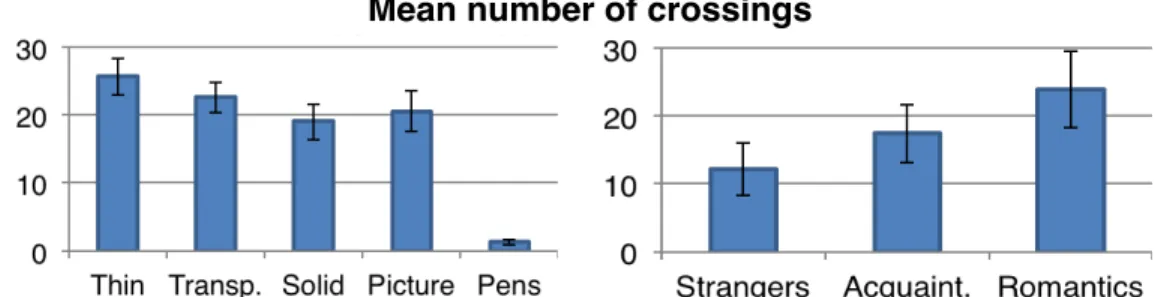
Figure 6 - Mean (±SE) number of crosses, by embodiment (left) and by relationship (right). ... 40!
Figure 7 - Subjective feelings of awkwardness. ... 41!
Figure 8 - Mean (±SE) percent time occluding other’s haiku. ... 41!
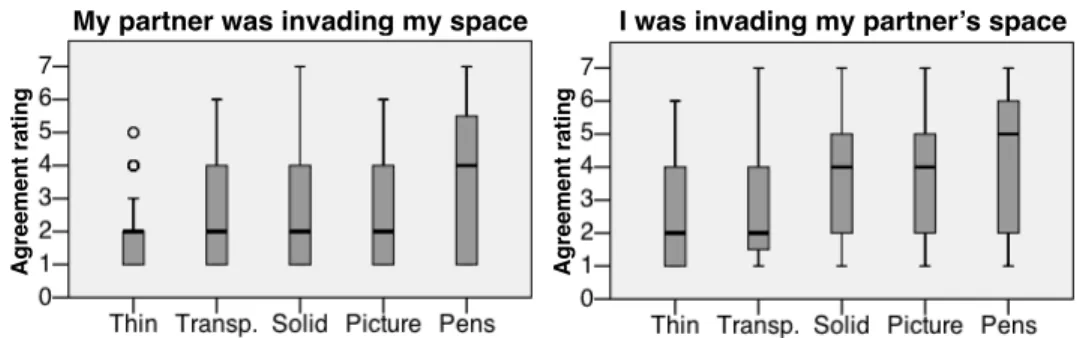
Figure 9 - Feelings of being invaded, and of invading partner. ... 43!
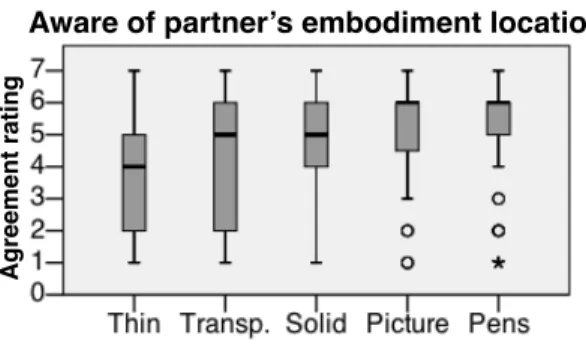
Figure 10 - Subjective awareness of partner's embodiment location. ... 44!
Figure 11 - Distribution of words relative to haiku papers. ... 63!
Figure 12 - Mean crossings (±SE) by augmentation type. ... 66!
Figure 13 - Mean crossings (±SE) between the Baseline trials ... 67!
Figure 14 - Subjective ratings of awareness ... 68!
Figure 15 - Subjective ratings of awkwardness ... 69!
Figure 16 - Subjective ratings of invasion ... 70!
Figure 17 - Subjective ratings of annoyance and frustration ... 71!
Figure 18 - Crossings with arm embodiments. A crossing with Transparent embodiments (left), and a crossing of VideoArms without crossing lines (right). ... 92!
Figure 19 - Mean number of crossings, with conditions grouped by input type (below)
and question (above) ... 95!
Figure 20 - Mean number of reaches passed haiku papers ... 95!
Figure 21 - Proportion of time reaching into the table’s public space ... 96!
Figure 22 - Subjective sense of being in the same space (dots are outliers, box bounds are upper and lower quartile with median as cross bar, and whiskers are min and max non-outliers) ... 98!
Figure 23 - People's horizontal size when distributed (top) and when collocated (bottom). Lines split the table in half, showing how people stretch to the other side when distributed ... 99!
Figure 24 - Subjective responses to “similar to interacting at the same table” ... 99!
Figure 25 - Subjective awareness of partner’s action ... 101!
Figure 26 - Subjective feelings of awkwardness to cross embodiments ... 102!
Figure 27 - Subjective response to embodiment is "part of me" ... 118!
Figure 28 - Subjective response to embodiment is "part of them" ... 118!
Figure 29 - Personal workspaces without physical seated location, extending from the center of the shared space instead of the edges of the shared space ... 128
LIST OF TABLES
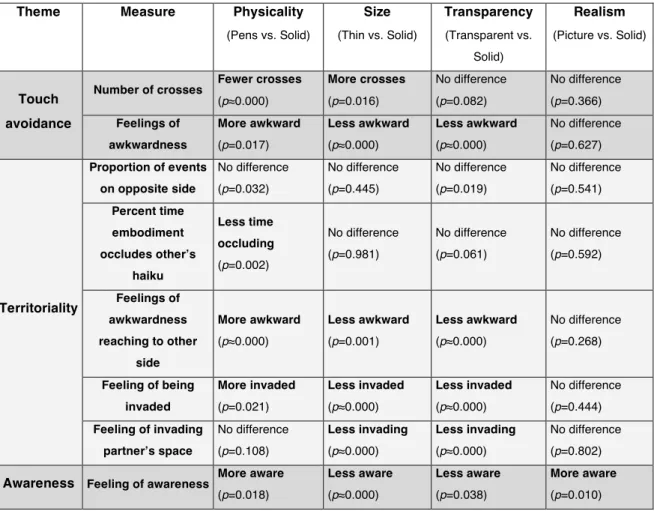
Table 1 - Pairwise comparisons showing the effect of each factor as compared to Solid (e.g., for Physicality, Pens had fewer crosses than Solid). Bolding indicates
significant difference (after correction for objective measures). ... 42!
Table 2 - Embodiment augmentation types ... 60!
CHAPTER 1 INTRODUCTION
Horizontal surfaces, especially tables, are great for group work. From large boardroom tables to small desks with two students working on an assignment, tables enable groups to naturally organize their work. Tables provide a shared focus on work artifacts, allow people to sit comfortably, and allow people to move around the table to easily form sub-groups. However, traditional tabletops limit groups due to the constraints of the physical world and on the tools used to interact over tables. For example, it is difficult to reach objects on the far side of the table and to undo destructive physical actions, such as cutting a piece of paper.
Digital tabletops provide new opportunities for groups to collaborate by removing some constraints of the physical world and adding new functionality. For example, digital tabletops enable groups to easily make copies of work artifacts, and share changes
amongst the group members. Groups can also easily undo actions, save work artifacts, and retrieve multiple versions later.
In both traditional and digital tabletops, people require access to objects on the tabletop’s surface. Previous researchers in Human Computer Interaction (HCI) have focused on improving the efficiency of interaction techniques, focused on individual performance (e.g., to enable faster selection); however, when designing a system for group work, there is a tradeoff between designing for individuals (usually focused on speed and accuracy) and designing for the group activity (e.g., ensuring all group members are aware of what others are doing) (Gutwin 1998).
With traditional tabletops, the only mechanism to access objects on the table’s surface is to physically reach for that object. These physical reaching actions are useful for group work: the large physical gestures are easy to see, and when two people reach simultaneously for the same object, they both detect a potential conflict and quickly
coordinate using a turn-taking mechanism to deal with the conflict. However, this kind of physical access is limiting; for example, people can only interact with objects within their physical reach.
Although many digital tabletops do support physical input (typically through a touch screen), digital tabletops can support other kinds of input as well. For example, indirect input (e.g., when interacting with a mouse) removes the physical reach
constraint, as people can now reach objects anywhere on the table. Indirect input can also be less tiring, as the small physical motions required to move a mouse are easier for long term use than physically reaching over a tabletop. However, indirect input means people are no longer physically embodied during their reaching gestures. This lack of physical embodiments may be detrimental to the group, as many of the coordinative behaviours groups depend on for successful interactions rely on social protocols surrounding physical arms (see Section 1.6.2 for a full discussion).
Instead, when using indirect input, most systems provide digital embodiments – visual representations of each person – to provide feedback to both the reacher and other group members. The most common digital embodiment is a simple cursor. Initial
fundamental research in digital embodiments has shown that cursors are difficult to use during group work: cursors are small and hard to track on a large display (Ha 2006), cursors are difficult to design to ensure distinguishability when there are multiple people interacting (Moraveji 2009), and it is difficult to assign ownership of cursors because there is no obvious link between a cursor and the person controlling it (Nacenta 2007). These problems are in stark contrast to physical arms. People are continuously aware of the location of other people’s physical bodies, people’s arms have natural differences that make them distinguishable, and the physical link of an arm to a body makes it clear who owns each arm.
A potential improvement on cursors is arm embodiments, and researchers have shown they may be useful for group coordination (Nacenta 2007). The benefits include a visual link between the embodiment and the person using it, clearly indicating who is controlling each embodiment, as well as the fact that they are larger and therefore easier to see and track. However, researchers and digital tabletop designers know little of how
the design of digital arm embodiments can affect the fundamental group tabletop interaction of reaching for objects.
1.1 Dissertation’s Problem Statement
Researchers and designers know little of how the design of digital arm embodiments affects group reaching behaviour on a tabletop display.
1.2 Motivation
Researchers have long suggested that digital tabletops will be useful in a large range of situations, including architectural and urban planning, brainstorming, and
scientific data visualization. Digital tabletops have made large strides in recent years, and are finding niche markets (e.g., air traffic control (Conversey 2011) and oil and gas pipelining tools1). As technological costs continue their decline, digital tabletops will become ubiquitous. Even if tabletops never become primary work systems, they may still be very effective at supporting secondary tasks. For example, even if a digital tabletop is only used for a weekly brainstorming meeting, the digital tabletop may greatly increase the efficiency of that meeting.
Regardless of the use case, it is important that digital tabletops support a group’s natural coordinative processes, and not force groups to adapt to the constraints of the digital system (Wallace 2008). For example, systems should be easy to use and learn, and support walk-up interactions like the traditional whiteboard.
To build effective digital tabletop systems, it is important for researchers and designers to understand how the design of the system can affect a group’s natural
processes. However, we still know little of how digital tabletops can support fundamental behaviours of groups, such as reaching.
In this dissertation, we investigate how digital group reaching is different than physical group reaching, and how the design of digital arm embodiments affects group
reaching behaviour. Design, in the context of digital arm embodiments, includes the visual design (what they look like) and the interaction design (how they work). We will show that the visual design, the way that input controls the embodiment, and the way that embodiments respond when interacting with others’ embodiments, all affect group reaching behaviour.
1.3 Solution
Our solution is to provide an initial understanding of how the design of tabletop embodiments changes a group’s reaching behaviour. This solution has four steps: Step 1 – Understand physical reaching behaviour on traditional tabletops and digital tabletops
We will observe groups interacting over a traditional tabletop in a paper-based task to understand how groups coordinate access to shared objects when reaching with their physical arms. We will then compare this behaviour to physically reaching in an identical task implemented on a digital tabletop.
Step 2 – Determine how the visual design of digital tabletop embodiments affects reaching behaviour
Based on previous literature, we will design a set of digital tabletop embodiments that vary only in their visual design. We will then determine empirically (in a controlled lab study) how the visual design of digital embodiments affects a group’s reaching behaviour. This study will compare the different visual designs to physically reaching in a digital system using the same task studied in part one.
Step 3 – Design digital arm embodiments that introduce constraints of physical arms and determine their effects on reaching behaviour
Based on attributes of physical arms, we will develop four augmented arm
embodiments and evaluate how these affect a group’s reaching behaviour. This study will use the same system as in part two.
Step 4 – Examine how input, visual design, and augmentation affect reaching behaviour when collaborators are distributed
The physical presence of the other person may affect how people interpret different visual designs and augmentations, and how people interact physically. We will extend the system studied in parts two and three to support distributed collaborators, and evaluate how removing the partner’s physical body affects people’s reaching behaviour.
1.4 Contributions of this Dissertation
The main contribution of this dissertation work is an initial understanding of how the design of digital tabletop arm embodiments affects a group’s reaching behaviour.
This work also has several secondary contributions:
• Understanding of how a group’s relationship (strangers, friends/co-workers, and intimate couples) affects group reaching behaviour.
• Design and initial understanding of how embodiment augmentations affect group reaching behaviour.
• Understanding of how distribution changes feelings of working with another person.
• Empirical evidence showing how the visual design of arm embodiments, from simple lines to full live video, affect group reaching behaviour.
• Understanding of how reaching with physical arms (in co-located and distributed settings) affects group reaching behaviour.
1.5 Organization of this Dissertation
This dissertation is presented in a manuscript style, where we present an overall architecture for the research and answer research questions through the manuscripts we have published throughout the work. There are three manuscripts that make up the core of this dissertation. They are presented in Chapter 2, Chapter 3, and Chapter 4.
1.5.1 Chapter Overviews
The remaining portions of this chapter provide a grounding on which the remainder of the dissertation depends. We present definitions, previous work, and describe how the task studied throughout this dissertation can generalize to many common tabletop tasks.
Chapter 2, Chapter 3, and Chapter 4 are mainly composed of the three
manuscripts described above. Preceding each manuscript, we first motivate the work presented in the manuscript and place the work from the manuscript into the context of the dissertation questions. These chapters close with lessons learned from that
manuscript, and how these lessons contribute to the next component of dissertation work. Chapter 5 presents an overview of the contributions of the dissertation, and discusses how the results from the three manuscripts can inform the design of digital systems by describing the nine design guidelines stemming from the results presented in this dissertation. We close with a discussion of future opportunities for arm embodiments and the design of digital systems that effectively support group processes.
1.6 Grounding for the Work Presented in this Dissertation
In this section, we describe the background topics required to ground the work presented in this dissertation. First, we give definitions of terms used in this work. Second, we motivate the study of group reaching behaviour by describing how common this interaction is in real-world tasks. Third, we describe tasks previous researchers have used to study group tabletop interactions as justification for the task used throughout this work. Last, based on this grounding work, we describe the task and experimental details that are common across the work presented in this dissertation.
1.6.1 Reaching Gestures
A reaching gesture is defined as the mechanism people use to access an object. It is a common occurrence in everyday life, and is particularly important for many tabletop tasks (see Section 1.6.2). An example of a simple reaching gesture is someone reaching for and grabbing the saltshaker on the dinner table.
Group reaching is the subset of reaching gestures in which the reaching gesture occurs in a physical space shared by other people. In general, people avoid interfering with other people, so group reaching gestures typically include coordination with others. For example, people typically ask another person to pass the saltshaker at the dinner table instead of reaching through another’s personal space.
A digital reaching gesture is the mechanism to spatially access the visual
representation of a digital object. In a digital system, the objects people access are digital work artifacts and controls (e.g., a photo or the save icon). Access to a digital object includes any interaction, including selection and those in direct manipulation interfaces (e.g., pan and pinch to zoom). This dissertation focuses on reaching gestures as part of interaction (i.e., to access an item), so communicative gestures such as deixis (Genest 2011) is not directly studied in this work.
The digital objects studied in this dissertation must have a visual representation, and people interact with them by reaching for, and interacting with, the visual
representation. This excludes digital actions accessed without reaching. For example, clicking the save icon is included, but using a keyboard shortcut instead is not included. 1.6.2 Physical Group Reaching over Traditional Tabletops
There are many real world scenarios where group reaching is essential. In general, people must physically touch an object to interact with it and must reach for the object in order to touch it, so most tasks require a reaching gesture before interaction. In this section, we present representative examples of everyday interactions, games, paper-artifact based tasks, and spatial layout tasks requiring group reaching.
1.6.2.1 Everyday Interactions
People encounter situations requiring group reaching over tabletops every day. For example, group reaching is required when eating a meal as a group, as well as mundane tasks such as adding milk to your coffee at Starbucks. In general, people avoid reaching through another’s personal space when reaching for food or objects on the table. When eating at a table, people will typically ask to have that object passed to them (e.g., “Please pass the salt”), whereas people typically wait for their turn when adding milk or
sugar to their coffee to the Starbucks counter. There is often an intricate dance between individuals, with close-proximity turn-taking to avoid physical collisions with other bodies, and to resolve conflicts when two people simultaneously grab a shared item (e.g., the same creamer).
These examples are interesting because of the breadth of interactions they cover. They include both shared objects (salt shaker, creamer) and single-use objects (dinner rolls, stir sticks). Note that both shared and single-use objects often require two reaching gestures: the first to grab the object, and a second to put it back (or throw it in the trash at Starbucks, which is typically also near the counter). These situations also encompass various group memberships. It is common to eat dinner with others with close-knit relationships (friends, co-workers, and family), but first dates and business lunches often occur between strangers. Similarly, at the Starbucks counter, people interact with people they are familiar with, as well as with strangers. These situations also encompass
differently sized groups and table sizes, from small café tables with two people to huge wedding party tables.
1.6.2.2 Games
The second class of tabletop tasks where group reaching is required is games. There is a huge set of games that are played at a tabletop, including puzzles, card games, and board games.
First, a typical puzzle is a large picture split into small pieces that connect
together to form a large picture. Groups typically dump the individual pieces in the center of the table for everyone to share. People quickly decide on which part of the puzzle they will focus on (e.g., one person works on the sky, another on the tiger), and begin
collecting pieces that may be part of their section to make a pile near them. The group reaching gestures here include reaching for a piece of interest and passing a piece to another person (e.g., when one person has a piece they believe belongs in the puzzle section the other person is working on (Azad 2012)). Another reaching gesture is to move the shared box cover closer to inspect the final product.
Second, fast-paced card games sometimes require breaking the social protocols of group reaching in order to effectively play the game. For example, Speed2 and Spoons3 are two fast-paced card games where group reaching conflicts are essential to
successfully playing the game. In Speed, two players race to play all of their cards. Players discard cards from their hand by incrementing or decrementing the number of the top card of either discard pile. For example, if the top card of a discard pile is a five, players can play a four or a six. Because both players play cards on both discard piles, the game is a race between the two players when both players have eligible cards. This situation often culminates in physical collisions, as both people try to place a card on the same discard pile simultaneously. These physical collisions are in stark contrast to people’s typical behaviour of avoiding physical collisions. Breaking this social protocol is indeed part of the fun of Speed.
Spoons is a card game similar to Musical Chairs, in that there is one spoon fewer in the center of the table than there are players. Spoons is different than Speed in that play requires at least three people, and can easily support large groups of ten players. Each player has a hand of four cards. The dealer starts by picking up a new card, and
discarding a card to the player to their right. This player picks up the card, and discards to their right. The goal of the game is to have four-of-a-kind as your hand, after which you can pick up one of the spoons. The remaining players race to pick up the other spoons; the player remaining without a spoon loses this round.
Spoons is particularly interesting because it requires both a main task (picking up and discarding cards) as well as a secondary task (monitoring people’s reaching gestures into the center of the table to grab a spoon). Often, a player with a winning four-of-a-kind hand will try to sneak a spoon without others noticing. The difficulty of monitoring reaching gestures into the public, shared, space as well as working in your private workspace (your hand of cards) makes this game fun and challenging.
2 http://en.wikipedia.org/wiki/Speed_(card_game) 3 http://en.wikipedia.org/wiki/Spoons
Third, and in contrast to the conflicts created in high-speed card games, most board games are turn-based. Turn-based interactions create a natural “lock-step” of interactions, preventing most group reaching conflicts. For example, in Chess, only one person interacts at a time, and so there is little need to worry about group reaching conflicts. Note that some turn-based board games do still have some implicit reaching rules. For example, in Monopoly, one player is typically assigned the role of “banker”, and is the only player allowed to reach into the bank to distribute money. In addition, the exchange of money (e.g., when purchasing a property or paying rent when landing on an owned property) requires group reaching coordination to ensure the handoff of money occurs seamlessly (though some players may throw money in frustration).
1.6.2.3 Paper-Artifact Based Tasks
There is a large class of group tabletop tasks focused around the manipulation of paper artifacts. These kinds of tasks include those with a single shared paper artifact and those with multiple paper artifacts.
Shared paper artifact tasks include those where people huddle around a shared artifact, such as a book. For example, two students working on an assignment may share a single copy of a textbook for reference, or a single copy of the assignment. In this case, the two students must coordinate access to a shared textbook (e.g., when one person grabs the book to look up a term), or must coordinate simultaneous access (e.g., they may move the assignment paper between them and both read through the problem). These tasks typically include individual work artifacts owned by each person. For example, each student has their own copy of the assignment answer, where they work individually.
Tasks with multiple paper artifacts are those with multiple work artifacts. For example, when a couple does their taxes or when co-workers fill out an expense report, they often spread out receipts over a table. These tasks require a lot of reaching gestures, as the group organizes the set of paper artifacts into categories or piles. In contrast to the homework example above, these tasks often also include a single shared artifact, such as the single expense report, instead of individual workspaces for each group member. Another common example of multiple paper artifact tasks is photo sharing, where groups organize a set of photos into piles.
1.6.2.4 Spatial Layout Tasks
Another kind of task requiring group reaching is spatial layout tasks. Typical examples of spatial layout tasks include scrapbooking, architectural planning (e.g., deciding on the layout of furniture in a room), and newspaper and magazine layouts.
In spatial layout tasks, the main interaction is moving the representations of objects around a main shared artifact (e.g., moving a picture of a couch around a room). This requires group reaching as, typically, only one person should move an object at a time. In addition to moving artifacts, there are other physical gestures in the shared space as part of the group communication (e.g., pointing gestures). In contrast to most group reaching gestures, these communicative gestures typically do not conflict with others, but instead may be used as signals to request the next turn (e.g., reaching to point to the map often signals others that you would like to speak).
1.6.3 Interference in Physical Reaching Gestures
As described in the examples above, an important aspect to group reaching is the social protocols that guide people’s behaviour. These social protocols generally involve preventing interference between people. There are two common kinds of interference that occur during group reaching gestures: occlusion and physical collisions.
Occlusion is defined as the obscuring of the workspace. Because physical bodies are solid, people cannot see through them. In addition, it is difficult to see “around” another person’s physical body. For example, when someone is reaching, the objects under their arm are difficult to see and interact with.
A physical collision is defined as the physical contact of two people’s bodies. This may occur when two people simultaneously reach for a shared item, when someone tries to reach an item around where another person is working, or when moving around the tabletop (e.g., bumping into another person).
Both occlusion and physical collisions are interference because they prevent, or make more difficult, the group’s interactions. When physically reaching over a tabletop, it is typically not possible to completely avoid interfering with others working on the same physical workspace; however, people generally try to avoid interfering with others.
People are typically conscious of when their bodies are occluding another’s work artifacts, and will avoid physical collisions whenever possible (Andersen 1978, Hall 1966).
Combined, people’s aversion to interfering with others is demonstrated through territoriality, the division of a space into personal and group territories. People have a natural tendency to avoid reaching into another person’s personal space – the invisible bubble around a person’s physical body that others only enter in specific situations (Hall 1966). In tabletop work, a person’s personal space is extended out onto the tabletop. This space, called a personal workspace (Scott 2004), has the same social protocols as
traditional personal space: people avoid reaching through, and avoid interacting with objects, in another’s personal workspace. As most individual work takes place in the personal workspace, avoiding reaching through others’ personal workspaces reduces the risk of occluding their work artifacts, as well as physically colliding with them.
1.6.4 Group Reaching in Digital Tabletop Systems
The previous discussion focused on physical reaching gestures for physical objects over traditional tabletops. This discussion is important to ground the work of group reaching over digital tabletop systems, which is described in this section.
There are two main mechanisms for reaching objects on a digital tabletop: physical reaching (typically with a touch screen tabletop) and digital reaching.
When working over a traditional tabletop, physical reaching is the only
mechanism to access objects on the table. People have years of experience interacting around others’ physical bodies, and have built a set of social protocols to guide people’s interactions. For example, when two people reach simultaneously for the same object (say the saltshaker), they detect the potential conflict and quickly resolve it, often without any verbal coordination. Usually, one person will back off, letting the other person go first. These social protocols allow people to predict how others will interact, and often enable groups to coordinate access to shared items with little verbal communication (Hornecker 2008).
Although physical reaching has coordinative benefits for groups interacting over a tabletop, it is also limiting. For example, people can only interact with objects they can physically reach, so they may need to walk around a large table in order to grab the object they are interested in (Nacenta 2007), or ask someone to pass it to them.
Digital systems are not limited by many of the constraints of the physical world. For example, digital tabletops may not necessarily limit people to their physical reach by using indirect input with another input device (e.g., reaching with a mouse and cursor). This digital reaching allows people to interact with any item on the tabletop, regardless of its location. Although digital reaching is powerful for individuals, researchers know little of how digital reaching may affect a group’s coordinative processes, such as coordinating access to shared objects through group reaching.
1.6.4.1 How are People Embodied?
A main difference between physical and digital reaching is how people are embodied. When physically reaching on a touchscreen tabletop, people are embodied by their physical arms: they are visually represented and provide input to the system using their physical arm and hand. When digitally reaching, people are no longer physically embodied in their reaching gestures, so most systems provide digital embodiments.
In a digital system, an embodiment is an appropriate body image to represent users and their actions to themselves and to others (Benford 1995). Essentially,
embodiments are how people are visually represented and how they provide input to the system. The most common digital embodiment is a simple cursor.
Some fundamental research in digital embodiments has shown that cursors are difficult to use during group work: cursors are small and hard to track (Ha 2006), cursors are difficult to design to ensure distinguishability when there are multiple people
interacting (Moraveji 2009), and it is difficult to assign ownership of cursors because there is no obvious link between a cursor and the person controlling it (Nacenta 2007). These problems are in stark contrast to physical arms. People are continuously aware of the location of other people’s physical bodies, people’s arms have natural differences that make them distinguishable, and the physical link of an arm to a body makes it clear who
A potential improvement on cursors is arm embodiments, and researchers have shown they may be useful for group work (Nacenta 2007). The benefits include a visual link between the embodiment and the person using it, as well as the fact that they are larger and therefore easier to see and track.
1.6.4.2 Interference in Digital Reaching Gestures
The interference described in Section 1.6.3 (occlusion and physical collisions) also applies to digital tabletop systems. Both types of interference can prevent others from working: occluding the view of an object makes it harder to interact with it, and, as physical bodies cannot occupy the same space simultaneously, physical blocking restricts where people can interact on a touchscreen tabletop.
With digital reaching, both kinds of interference can be reduced. A smaller digital embodiment makes it less likely that a person’s interactions will occlude where another is interacting. In addition, because digital embodiments do not have the same physical constraints of physical arms, two digital embodiments can occupy the same tabletop space simultaneously: thus, there are no physical collisions.
The reduction of interference with digital embodiments is often perceived as a benefit over physical reaching. For example, people can now work faster because they no longer have to worry about interfering with others’ work. People can also reach through another person’s digital embodiment, enabling interactions that could not occur with physical arms.
However, removing constraints may not always be completely beneficial. Constraints (whether physical or social) help guide people’s behaviour, enabling groups to predict what other people will do. Social constraints (e.g., of not interfering with others) ensure that group members stay aware of what other people are doing, an important component of successful group work. Physical constraints also enable a class of coordination mechanisms currently not possible with digital reaching. For example, people can move an item out of another’s reach to claim ownership of it, or may place their physical arm down on the table’s surface in order to block off a section of the table.
Thus, the lack of constraints of many digital embodiments may actually be detrimental to group work. A main contention of this dissertation work is indeed that digital embodiments may require the addition of constraints to support successful collaboration, an idea that we explore throughout this dissertation work.
1.6.5 Group Reaching in Previous Tabletop Studies
There is a wide range of tasks researchers have used in previous tabletop studies, ranging from spatial layout tasks, games, and group decision-making tasks. In this section, we outline a representative set of examples of tasks that require group reaching (tasks completed without group reaching are not presented).
1.6.5.1 Spatial Layout
A spatial layout task is one where a group must organize a set of objects into a particular layout. Previous studies used tasks ranging from seating allocation charts (Harris 2009, Marshall 2008, Marshall 2009, Yuill 2012), garden layouts (Rogers 2006), home-furniture layouts (Wu 2003, Tse 2007), and newspaper layouts (Birnholtz 2007). Another type of spatial layout tasks is photo sorting: making a collage based on a theme (Scott 2005), creating a comic strip (Pinelle 2008b), creating a storyboard (Nacenta 2007), and tagging photos (Morris 2006). Lastly, researchers have also used a tabletop magnetic poetry task, where the group must assemble a given poem from words displayed on the tabletop (Ryall 2004).
In each of these tasks, the objects to be laid out (people, furniture, plants, newspaper articles, pictures) are draggable elements on the tabletop. People reach out into the public space and move them around on, typically, a static background or template (e.g., an architecture drawing of a room or garden).
1.6.5.2 Games
There are a variety of custom designed games used in previous tabletop research. The most common are puzzles, like pieces of a larger image (Müller-Tomfelde 2008) or tangram puzzles (where geometric shapes are arranged into the silhouette of a larger shape) (Bolton 2012). Other researchers used novel games, such as a sheep herding game (Zhang 2007) and a shape binning game (Nacenta 2007). Lastly, researchers have also
used commonly known games, such as Lego and Pictionary (Scott 2003). In each of these, the main interaction is similar to spatial layout tasks: a set of static items on the tabletop that people move around by dragging.
1.6.5.3 Group Decision-Making
Another large class of tabletop tasks are group decision-making tasks, those where the main goal is for the group to discuss alternatives and decide on a particular solution. These range from UML design diagram creation (Potvin 2012), visual analytics (Isenber 2010), itinerary- (Rogers 2004, Tse 2007) and route-planning (Tang 2006), and brainstorming (Clayphan 2011). These tasks are slightly different than other tasks, as there may not be a single correct answer; instead, the main measures of success include participation of the group, the number of ideas created, or consensus among the group members.
In many of these tasks, there is a create-discuss-iterate cycle, where group members create a solution and discuss changes for the next iteration of the solution. The creation portion typically involves group members interacting simultaneously on the tabletop (e.g., while deciding on a particular route). This portion requires group reaching as described before, by interacting in the public space to create and manipulate task artifacts. The discussion portion typically includes group reaching as well, typically for communicative gestures (such as deixis over a map (Genest 2011)) and annotations. 1.6.5.4 Systems for Specific Groups
Researchers have also used systems designed for a specific group (e.g., air traffic controllers (Conversy 2011)). These kinds of tasks may be difficult to generalize to other situations, as they were designed for specific interaction and background knowledge. 1.6.6 Experimental Details for Studies in this Dissertation Work
The main question addressed in this dissertation (how the design of digital arm embodiments affect group reaching behaviour) is answered through a set of controlled laboratory studies. To enable generalizations between studies, all studies use the same task and experimental protocol. In this sub-section, we first describe the previous work from the HCI literature our work builds upon. We then briefly describe the task used in
the studies and how this task encapsulates important components of typical experimental tasks, followed by discussion of participant choice and the measures shared between studies.
1.6.6.1 Grounding from Previous Digital Tabletop Research
The work presented in this dissertation builds upon an initial exploration of reaching in digital tabletops by previous researchers. In this sub-section, we set the stage by describing the previous work on which we build the core of the work in this
dissertation.
Initial research in collaborative digital tabletops focused on input techniques, including touch-, pen-, and mouse-based input, and how these input techniques change people’s awareness, coordination, and feelings of invasion. For example, researchers found that touch input increases people’s awareness of the other person’s interactions (Ha 2006, Hornecker 2008) as compared to mouse-based input. When comparing a direct input technique to indirect input techniques, researchers found that physically reaching onto the table’s surface to reach for items is the most similar to how people interact in the real world and the best technique all around, providing the best awareness of other
people’s actions (Nacenta 2007). In another study, touch input had more conflicts (e.g., grabbing the same item) than mouse-based input, though groups were able to resolve the conflict faster with touch input than mouse-based input (Hornecker 2008).
Though physical reaching techniques are more natural and support group processes well, one issue identified early on is that touch-based input has an intrinsic limitation of physical reach; it is much harder to reach and interact with items that are far away with touch-based input than with mouse-based input (Ha 2006, Nacenta 2007, Pinelle 2008a). Researchers also found that touch input is considered more invasive into people’s personal space than mouse-based input, possibly because of the physical collisions with others (Ha 2006).
Due to the physical reach constraints, physical collisions, and awkwardness of close-proximity interactions with touch-based input, researchers began investigating digital reaching techniques, such as radar views (world-in-miniature), telepointers
pen was a laser pointer), and pantographs (cursor with lines visually connecting the cursor to the person controlling it) (Nacenta 2007). Researchers found that radar views had the most conflicts because people were less aware of what others were doing, that telepointers are difficult to associate with the person controlling them, and that laser beams are difficult to use for precise distant interactions (Nacenta 2007). Overall, researchers recommended using pantographs when both reaching and awareness are important (Nacenta 2007).
Building on this initial work, researchers focused on the design of digital arm embodiments, those represented by the pantograph technique from (Nacenta 2007). An initial exploratory study compared two cursors (a circle and an arrow pointing to the user), three pantograph embodiments (thin line, thick line above the workspace, and thick line below the workspace), a cartoon-shaped arm, and direct touch (Pinelle 2008a). This exploratory work showed that arm embodiments do not have the same social constraints as physical arms, and that people subjectively preferred the larger and more realistic-looking arm embodiments. Overall, people even preferred digital arm embodiments to physical input, suggesting arm embodiments may be better for groups than touch input. This exploratory work suggested that the input (mouse or touch) and the size, occlusion, and realism of arm embodiments are important factors of arm embodiment design, which we study in a controlled manner in Chapter 2.
1.6.6.2 Task Used in the Studies
The goal of selecting a task to study was to ensure generalizability to a variety of task types. It was important to select a common interaction, instead of a specific task situation, to ensure the results would be useful in a variety of situations. The interaction chosen is dragging static task artifacts.
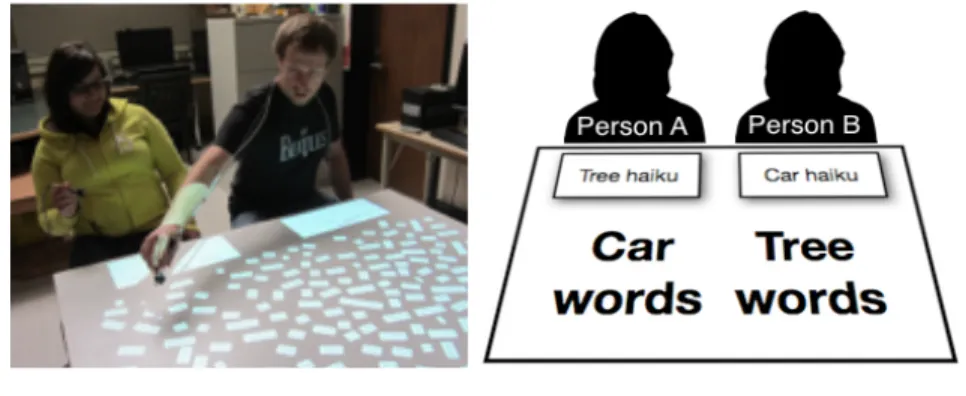
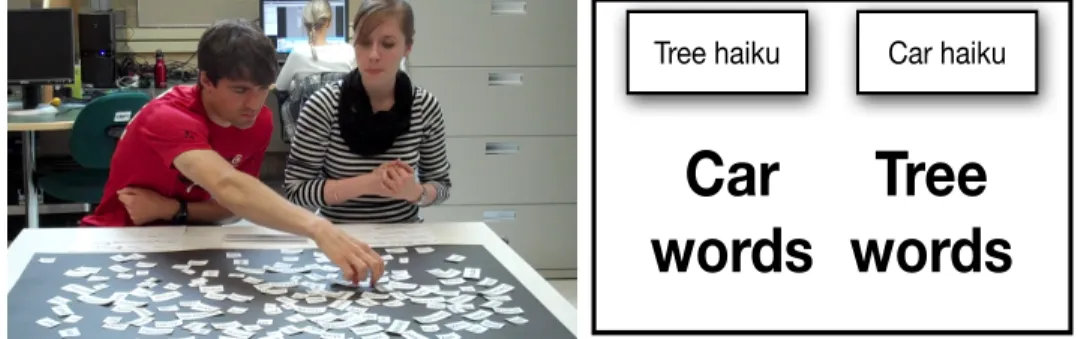
The task used in this dissertation work is a poem-building task, based on magnetic poetry (Ryall 2004). Dyads (groups of two) sit side-by-side at a tabletop and are
instructed to create haikus about an assigned topic. People create haikus from a set of shared words on the tabletop (see Figure 1). The words are static: people can drag whole words around the table and onto their individual haiku papers in front of them.
Each person’s topic is chosen such that words from one topic are less useful for the other person. For example, Tree words (e.g., slow, grow, leaves) are less useful for a Car haiku than Car words (e.g., fast, road, crash). The words available for each trial were split: one third from the first topic, one third from the second topic, and the last third as “joiner” words (e.g., pronouns, articles, and conjunctions). Words were distributed across the table’s surface, with the same word orientation and location between groups for the same condition. Topic word locations were switched, such that the words on each side of the table were more appropriate for the haiku on the other side of the table (see Figure 1). This switch encouraged people to reach to the other side of the table, increasing the likelihood of physical reaching conflicts (collisions and occlusion).
!
Figure 1 – Experimental setup
This task encompasses the following important components of tasks used in previous tabletop studies.
Group reaching for static task artifacts. In this haiku-building task, the only digital action is reaching and moving words around the table. People must reach into the shared public space to access words, move them into their personal territory (their piece of paper), and re-arrange the words within their territory to build their haiku. Thus, the haiku task is an example of a spatial layout task.
Task constraints. The open-ended nature of the task ensures that participants do not feel pressured by time constraints or competition, and thus follow the common social protocols guiding physical reaching gestures (see Section 1.6.2). Though open-ended, this task does have minor constraints by requiring people to build a haiku about a particular topic. This combination of an open-ended and constrained task are similar to many of the
tasks described in the previous section, specifically puzzles, spatial layout, and decision-making tasks.
Discussion during the task. In addition to the main task of building a haiku, people may help their partner, leading to discussions and communicative gestures. For example, one person may ask if the other has seen a particular word, and the other person replies by gesturing to that word’s location. This behaviour is common in many decision-making tasks, such as route- and itinerary- planning, and discussions over a map (for example, see (Genest 2011)).
1.6.6.3 Participants
The constructs investigated in this dissertation (specifically, an aversion to reaching into another’s personal space) are based on the subjective idea of personal space. Researchers have shown that personal space is culturally mediated: some cultures are more comfortable with close-proximity interactions than others (Hall 1966).
In this work, we do not control for cultural backgrounds, but do collect a proxy of culture, namely people’s first language (see Appendix A for a language breakdown of participants). As people are randomly assigned a partner, or choose their own partner such as a friend or co-worker, we cannot use culture as a factor in statistical analyses, due to there being uneven numbers of groups in each pairing. Even so, as all participants live in Canada, they may have adopted North American norms, regardless of their particular backgrounds.
In addition to cultural differences, gender pairings may also have an affect on personal space. For example, male-male touching is less common in North American cultures than male-female touching. Similar to culture effects, we do not control for gender pairings. As described in Section 1.6.6.4, the main measure of “crossings” is difficult to programmatically assign to one person or another. Therefore, although we collect the gender pairings, it is not possible to use these pairings to group participants for use in statistical tests. For example, we cannot test whether males are less likely to touch other males than they are females, as male-female pairings include both male-to-female and female-to-male touches collected as a single measure.
Lastly, the group’s relationship may affect people’s willingness to physically touch the other person. Intimate couples are less likely to avoid touching their partner than strangers. In all studies, the demographics questionnaire collects a group’s
relationship through the following questions: Do you know your partner; how long have you known your partner; and how often do you interact each week with your partner. In addition, Study 1 studies relationship as an experimental factor: strangers have never met, friends and co-workers must interact at least once a week, and intimate couples self-identify as an intimate couple (note that all intimate couple pairings were male-female, though this was not deliberately controlled). The other studies all choose a sub-set of relationship types, as described in each study’s section.
1.6.6.4 Measures
To better understand people’s reaching behaviour, we collect four main measures. Number of crossings (as a proxy of touch avoidance). Physical reaching
behaviour is guided partly by people’s aversion to touching another person’s physical body (that is, touch avoidance (Andersen 1978)). The main measure of touch avoidance in our studies is how many times people cross embodiments (both for physical arms and digital embodiments). This is collected automatically by the system and the log files produced by the system are used in statistical analyses.As shown in Figure 18, mouse-based crossings are measured as when the lines running through the embodiments (from the shoulder to the finger tip) cross, and touch-based embodiment crossings are measured as when the embodiment blobs intersect. Due to the side-by-side seated location of the participants (see Figure 2), the person sitting on the right was more likely to cross over the person sitting on the left. In the physical world, it is typically clear who is responsible for a violation of this social protocol; however, this is difficult to attribute
programmatically to one person or the other. Therefore, the main measure of crossings is collected as a group measure.
Questionnaires. The constructs investigated are highly personal behaviours (e.g., personal space), so we also collect people’s perceptions of the different embodiments through subjective questionnaires. We collect people’s feelings of invasion and
of co-presence in the distributed system. These subjective responses are used in non-parametric statistical analyses.
Video analyses. All experimental sessions are also recorded from an angle enabling observation of both people’s physical bodies and their interactions on the tabletop. The videos are not coded for statistical measures, but instead are used as exploratory and explanatory analyses of a group’s behaviours. The videos also collect audio, which may provide some additional insight into the group’s behaviour.
Interviews. In addition to the above measures, we also ask groups about their experiences through semi-structured interviews at the end of each session (see Appendix E for interview scripts). These interviews help better understand the observations
gathered from video analyses and during the sessions, and provide an opportunity to ask questions specific to behaviours observed for this particular group.
1.6.7 Summary
In this section, we outlined why an understanding of group reaching behaviour over tabletops is important for designers and researchers. This behaviour is both common and complex, guided by social protocols built up over years of interacting around other people’s physical bodies. In the remainder of this dissertation, we describe the steps we took to better understand group reaching behaviour, both as a physical and a digital behaviour, and how the design of digital arm embodiments affects this fundamental group behaviour. These steps are organized by fundamental research questions that are answered through controlled laboratory experiments using the task and measures previously described.
CHAPTER 2
THE VISUAL DESIGN OF DIGITAL ARM EMBODIMENTS4
2.1 Introduction to Manuscript A
To begin investigating group reaching behaviour with digital arm embodiments, it is important to first have a basic understanding of how groups reach over traditional tabletops and whether this is different than physical reaching in a digital system. With this baseline behaviour in mind, we can investigate group reaching behaviour with digital arm embodiments, and how the visual design of a digital arm embodiment can change group reaching behaviour.
2.1.1 Initial Pilot Study Problem and Motivation
The first problem investigated in this manuscript is that researchers and designers have little understanding of how physical reaching in digital systems is similar or
different to physical reaching over a traditional tabletop.
People may behave differently in a digital system than they would in a face-to-face environment. For example, the perceived anonymity of the Internet allows people to interact with others without consequence (e.g., see the recent surge in awareness for cyber bullying). Over the years, an etiquette of online behaviour (netiquette) has evolved
4 The manuscript in this chapter, reproduced with permission from ACM, was published as:
Doucette, A., Gutwin, C., Mandryk, R.L., Nacenta, M., & Sharma, S. (2013). Sometimes when we touch: how arm embodiments change reaching and collaboration on digital tables. In Proceedings of the 2013 conference on Computer supported cooperative work (CSCW '13). ACM, New York, NY, USA, 193-202.
to help guide some people’s behaviour. The fact that people behave differently in digital and traditional environments suggests that reaching behaviour may also be different. 2.1.2 Solution and Steps to Solution
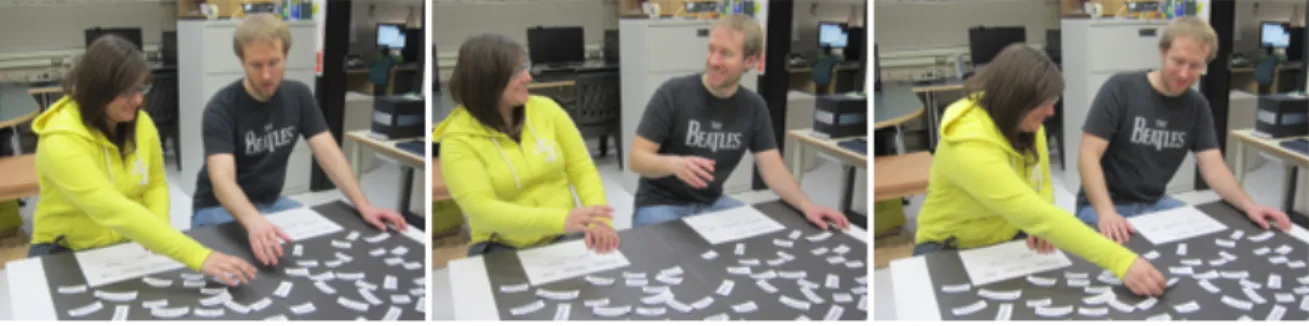
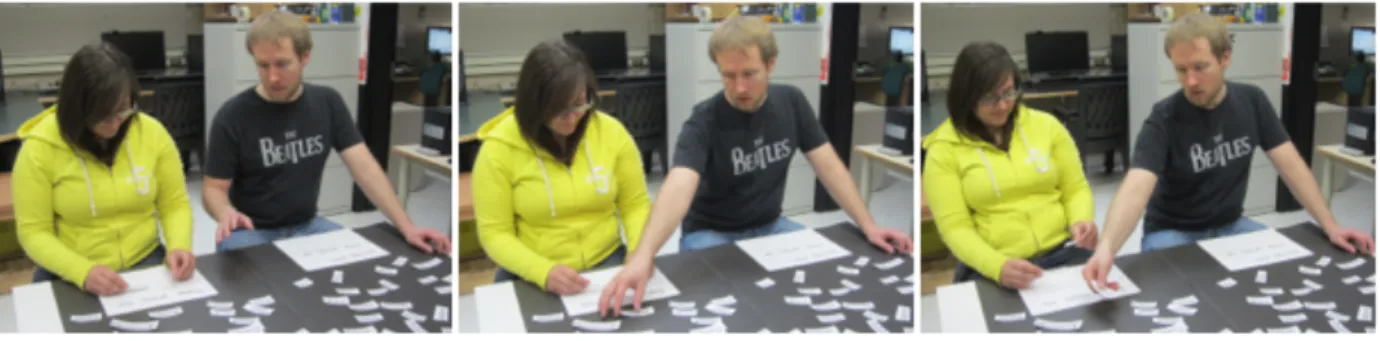
To investigate this problem, we compare physical reaching behaviour on a
traditional tabletop (an initial pilot study with pieces of paper) to physical reaching in the same task in a digital system. This analysis is observational, as this initial pilot study does not include a mechanism to collect quantitative behavioural measures.
2.1.2.1 Research Questions
1. How do groups coordinate access to shared paper artifacts at a physical tabletop? 2. How do these coordinative mechanisms change at a digital tabletop?
2.1.3 Lessons from Traditional Tabletop Pilot Study
As shown later in this Chapter, physical reaching behaviour is the same in digital systems as it is in traditional, paper-based environments, likely because both involve physical interactions that are governed by the same social protocols. With this baseline understanding, we can begin investigating digital group reaching, and how the visual design of arm embodiments may change a group’s reaching behaviour.
2.1.4 Embodiment Visual Design Problem and Motivation
The second problem investigated in this manuscript is that researchers and designers have little understanding of how the visual design of digital arm embodiments affects group reaching behaviour.
Physical reaching is useful for group work: it is natural and enables group
members to quickly coordinate access to shared objects. However, the physical world can be limiting for group interactions. For example, people can only interact with items that are within their physical reach.
Digital interactions are not necessarily limited by the constraints of the physical world. For example, with indirect input (e.g., through the use of a mouse), people can
interact with items anywhere on a digital tabletop. However, when interacting digitally, people are no longer physically embodied during their reaching gestures. Instead, most systems embody digital interactions through a digital embodiment, the simplest being a cursor.
Researchers have shown that cursors are difficult for group interactions, as it is difficult to track multiple cursors, and cursors are difficult to design to ensure adequate differentiability and identifiability. Thus, researchers suggested arm embodiments, that is, embodiments visually extending from the person’s seated location (Nacenta 2007). Arm embodiments are easier to track (due to being visually larger than cursors), and clearly demarcate who is controlling each embodiment (due to the visual link between the person and the embodiment) (Nacenta 2007).
Previous work investigated four factors of tabletop embodiment design: size, occlusion, presence of a connecting line, and realism (Pinelle 2008a). Researchers suggested that the design of digital arm embodiments may affect people’s willingness to cross embodiments, based on attributes of social distance (Pinelle 2008a). This initial exploratory study was useful to inform our work, though they did not compare the digital interactions to traditional tabletop interactions, and the large size of the table may have caused the low level of physical arm conflicts. In addition, the “realistic” embodiments in (Pinelle 2008a) were single-colour cartoon arms. These remove the intricate shape of physical arms (such as the wrist and elbow) and the realistic texture of physical arms. 2.1.5 Solution and Steps to Solution
Our solution is to provide empirical evidence showing how four factors of digital arm embodiments affect group reaching behaviour. Based on the exploratory results from (Pinelle 2008a), we designed four arm embodiments based on four main visual factors: physicality, transparency, size, and realism. The empirical evidence stems from a lab study evaluating how group reaching behaviour changes with each of these visual factors.