SMART Rwanda Master Plan
2015 ~ 2020
Abbreviations and Acronyms
AISI African Information Society Initiative
AMIS Agriculture Management Information System
APP Application
B2B Business to Business
BNR Banque National du Rwanda
BP Best Practice
BPO Business Processing Outsourcing
BRM Business Reference Model
BSC Broadband Systems Corporation
CAGR Compound Annual Growth Rate
CAPEX Capital Expenditure
CAS Conditional Access System
CBHI Community Based Health Insurance
CCTV Closed-Circuit Television
CD Community Development
CERT Computer Emergency Response Team
CMS Content Management System
CNS-ATM Communication Navigation Surveillance /Air Management
COMESA Common Market for Eastern and Southern Africa
CS Cyber Security
CSIRT Computer Security Incident Response Team
CTC Coordination Technical Committee
DB Data Base
DCRS Develop a Digital Court Recording System
DDoS Distribute Denial of Service
DTT Digital Terrestrial Television
DVB-T2 Digital Video Broadcasting-Second Generation Terrestrial
EA Enterprise Architecture
EAC East African Community
EAPP East African Power Pool
EASSy Eastern Africa Submarine Cable System
EDPRS Economic Development & Poverty Reduction Strategy
E-GOV E-Government
EHR Electronic Health Records
EIU Economist Intelligence Unit
EMIS Education Management Information System
EMR Electronic Medical Records
EQMS Electronic Queue Management System
ERMS Electronic Records Management System
ERS Emergency Response System
ESS Energy Saver System
ETCS Electronic Toll Collection System
EWSA Energy, Water, and Sanitation Authority
FDI Foreign Direct Investment
FMS Financial Management Systems
FSDP Financial Sector Development Program
FTE Full-Time Employee
FWG Focus area Working Group
FY Fiscal Year
G2B Government-to-Business
G2C Government-to-Citizen
GAAP Generally Accepted Accounting Principles
GBI Government Business Intelligence
GCIO Government Chief Information Officer
GDP Gross Domestic Product
GIDW Government Integrated Data Warehouse
GIS Geographic Information System
GNI Gross National Income
GNP Gross National Product
GoR Government of Rwanda
GPS Global Positioning System
GSI Government Secure Intranet
HIV Human Immunodeficiency Virus
HLSC High Level Steering Committee
HRMS Human Resource Management System
IaaS Infrastructure as a Service
ICT Information Communication Technologies
ICT4D ICT for Development
ID Identification
IDC Internet Data Center
IDI ICT Development Index
IDS Intrusion Detection Systems
INSEAD European Institute for Business Administration (Institute Européen d'Administration des Affaires)
INVIL Information Network Village
IPAR Institute of Policy Analysis and Research
IPPS Integrated Personnel and Payroll System
IPS Intrusion Prevention Systems
ISPA Internet Service Provider in Africa
ISS Inspection Support System
ITA Integrated Technical Architecture
ITU Information Technology Union
IXP Internet Exchange Point
JICA Japan International Cooperation Agency
JIMS Judicial Information Management System
JRLOS Justice, Reconciliation, Law & Order Sector
JSWG Joint-sector Working Group
KIST Kigali Institute of Science and Technology
KMN Kigali Metropolitan Network
KN Knowledge Network
KPI Key Performance Indicator
LMIS Labor Management Information System
LTE Long-Term Evolution
LUMIS Land Use Management Information System
MAJ Maison d’ acess a la Justice
MDA Ministry, Department, Agency
MDG Millennium Development Goal
MINAGRI Ministry of Agriculture and Animal Resources
MINALOC Ministry of Local Government
MINECOFIN The Ministry of Finance and Economic Planning
MINEDUC Ministry of Education
MINICT Ministry in charge of Information Communications Technology
MITIR Monitoring Information Technology Impact in Rwanda
MOH Ministry of Health
MYICT Ministry of Youth and ICT
NBB National Fiber Backbone
NCAB National Cyber Security Advisory Board
NCSRC National Cyber Security Research Centre
NEIS National Education Information System
NEPAD New Partnership for Africa's Development
NHS National Health Service
NICI Plan National Information and Communications Infrastructure Plan
NICI I NICI Plan Phase I (2000-2005)
NICI II NICI Plan Phase II (2006-2010)
NICI III NICI Plan Phase III (2011-2015)
NICI III+ NICI Plan Phase III+(2013-2018), also referred to as ICT Sector Strategic Plan (SSP)
NICI IV NICI Plan Phase IV (2016-2020)
NID National ID
NISC National ICT Steering Committee
NPD New Project Development Division
NRI Networked Readiness Index
NUR National University of Rwanda
OECD Organization for Economic Cooperation and Development
OpenMRS Open Medical Records System
OPEX Operational Expenditure
OS Operating System
PaaS Platform as a Service
PDA Personal Digital Assistant
PEST Analysis Political, Economic, Social and Technological analysis
PKI Public Key Infrastructure
PPSS Personal Policy Support System
PSD Private Sector Development
PSF Private Sector Federation
PSN Public Sector Network
R&D Research and Development
R&R Roles and Responsibilities
RAMA la Rwandaise d ‘Assurance Maladie
RBS Rwanda Bureau of Standard
RDB Rwanda Development Board
RDB/HCID Rwanda Development Board – Human and Institution Capacity Development Division
RDB/ICT Rwanda Development Board – ICT Department
RICTA Rwanda ICT Association
RIPPS Rwanda Integrated Payment Processing System
RITA Rwanda Information Technology Agency (predecessor of RDB-ICT)
RNP Rwanda National Police
ROI Return on Investment
RTN Rwanda Telecentres Network
RTTA Rwanda Tour and Travel Association
RURA Rwanda Utilities Regulatory Authority
RwEdNet Rwanda Education Network
S&T Science and Technology
SaaS Software as a Service
SCM Supply Chain Management
SD Skills Development
SME Small and Medium Enterprises
SMS Short Message Service
SNS Social Networking Services
SOC Secure Operation Centre
SRMP SMART Rwanda Master Plan
SSA Sub-Saharan Africa
STB Set Top Box
TCS Toll Collection System
TFT Task Force Team
TRACnet Treatment & Research AIDS Centre network
TVET Technical, Vocational Education and Training
UC Unified Communication
UNDP United Nations Development Programme
UNESCO United Nations Educational, Scientific, and Cultural Organization
UNIDO United Nations Industrial Development Organization
VAT Value Added Tax
VfR Vision for Rwanda
VLP Virtual Landing Point
VoIP Voice over Internet Protocol
VUP Vision 2020 Umurenge Programme
WAN Wide Area Network
WBF World Broadband Forum
WBN Wireless Broadband Network
WDI World Development Indicator
WEF World Economic Forum
WHO World Health Organization
WIBRO Wireless Broadband (version of WiMAX service)
Glossary
Application A program, or group of programs, designed for the end user
Backbone Network An enabling network that interconnects and provides a path for the
exchange of information between various networks
Best Practice A set of guidelines, ethics or ideas that represent the most efficient or prudent course of action Big Data
Big data refers to exponential growth and availability of data, both structured and unstructured. The increasing analytics on larger data will lead to accurate analysis
Budgeting Planned future income and expenditures often serve as a guideline for spending and saving Business Investment Set of investment in resources, generally in terms of fiscal and human capital, to enable specific business Chasm Period where effective investment is hindered, further reducing overall productivity/return of the investment Cloud Computing
Providing the means through which everything from computing power to computing infrastructure, application, business processes to personal collaboration can be deliver to a user as a service wherever and whenever
Coefficient A consistent number by which a variable is multiplied
Communication Evolution Model Established and utilized by Korean government, measures the efficiency and development of communication between different governmental agencies and departments
Community Based Health Insurance
An emerging concept for providing financial protection and support against the cost of illness and improving access to the quality health services for low-income population in rural who are excluded from formal insurance
Computerized Registry A term referring to the digitalized medical information of patients; information stored electronically Consolidation A process of bringing together separate parts into a single or unified whole from hardware perspective
Co-relationship Cause and effect relationship between factors
Cost Benefit Analysis Analyzing benefits of the input cost with quantitative measures
Cost Estimation Approximated probable cost/expense of a product, program, or project
Cyber Crime Term referring to any illegal activity that utilizes a computer and
electronic devices as its primary means of commission
Cyber Threat Potential cyber events that may cause unwanted outcomes, resulting in harm to a system or organization
Data Facts translated into a form that is more convenient to move or process
Data Aggregation A process in which information is gathered and expressed in a summary form (For example, for statistical analysis)
Data Base An organized collection of data
Data Center
Facility used to house computer systems and associated components, including telecommunications and storage systems with redundant or back up power supplies, redundant data communication connections, environmental controls, and various security devices
Depreciation Decreased asset value for a given time - allocation of the cost of an assets over useful life Economic Value The worth of a good or service as determined by people's preferences and the tradeoffs they choose to make given their scare resources, or
the value the market places on an item
Electronic Health Record A systematic collection of electronic health information about an individual patient or population Enterprise Architecture A conceptual blueprint that defines the structure and operation of an organization
E-Storage An online space in which information can be saved, accessed and shared
Extranet A computer network that allows controlled access from the outside, for specific business or educational purposes Foreign Direct Investment Term referring to investment directly put into production or business by another country Generally Accepted Accounting
Principles A term referring to the standard framework of guidelines for financial accounting established in each individual country Green IT The Green IT aims to reduce the carbon footprint generated by the Information System business while allowing reducing the cost
Human Capital Economic value of human competence and capability
Implementation Roadmap Set of schedules for implementing projects based on the urgency, strategic importance, and input resources Industry Inducement Effect By implementing specific initiatives, the impact of inducing or increasing overall effectiveness of industry either through productivity
or job creation
Information A term referring to accurate and specific data organized for a purpose
Information Platform An online portal that aims to promote, share and exchange information
Integration
A process of bringing together the component subsystems into one functioning system from software perspective
Intellectual Property
A term referring to the creation of the mind such as art, music, software, literary work, and etc. for which exclusive rights are recognized; legal concept
Intranet A term for a collection of private computer network technologies as a tool to facilitate communication, information sharing, operational systems, or computing services within an organization
Joint Venture Business agreement in which the parties agree to develop, for a defined time, a new entity and new assets by contributing equity and related assets
Key Public Infrastructure
A system that enables users of an unsecure public network such as the Internet to securely and privately exchange data and money through the use of a public and a private cryptographic key pair, the digital certificate, that is obtained and shared through a trusted authority
National Budgeting Estimated and planned government revenue and expenditure for the
current and following year NICI Plan
A National Information and Communication Infrastructure Plan consisting of policies, strategies and implementable programs; It’s a guiding framework for integrating ICTs into national development programs, and a monitoring and evaluation tool of the role of ICTs in national development
National Maturity For a given country, the measure of how far specific sector (ICT, Finance, etc.) have progressed in terms of utilizing technology, adopting new methods, and accepting new policies and procedures Open DB An initiative to build very large database like information systems, then make them publicly and freely available as open-source tools PEST Analysis Framework of macro-environmental factors used in the environmental analysis component of strategic management including political,
economic, social, and technological factors
Portal (Web) A term referring to service that offers and brings broad and diverse information and resources together in a uniform way allowing access to end users
Process Automation A technology term that is used to describe any process being automated through the use of computers and computer software requiring less human intervention and less human time to deliver Process Optimization A discipline of adjusting a process to optimize some specified set of systems by reducing some constraints; Maximizing efficiency Public Private Partnership
A cooperative venture between the public and private sectors, built on the expertise of each partner, that best meet clearly defined public needs through the appropriate allocation of resources, risks, and rewards
Server System responding to requests across a computer network
Share Infrastructure Physical elements of an organization that is shared with other parts of the same organization Shared Services Operation or service that are used or shared by multiple parts of the same organization SNS Online service or platform to build social relations with other entities that share interests or activities
Social Infrastructure Basic infrastructure to enable and set-up basis for enhancement
Social Security Action programs that government promotes for the welfare and good of the population Strategic Importance The applied project or business effect to the industry or nation is significant Supply and Demand
Management
An effort to make an equilibrium between price and quantity; management towards creating a free market economy in which as supply increases the price decreases and as demand increases the price increases
Supply Chain Management
The management of the flow of goods as they move in a process from supplier to consumer; maximizing customer value and achieve a sustainable competitive advantage
Tax incentive Country's tax code designed to incentivize, or encourage a particular economic activity Telecenters A term referring to a public or shared place where people can have access to ICT through devices including computers, the internet, and
other digital technologies
Unified Communication A term used to describe all forms of call, multimedia/cross-media, and instant messaging functions Urgency The nature of specific business or project is precedence to related development and that specific business and project act as an enabler
for other projects or business to be developed Vision 2020
A vision to transform Rwanda’s economy into a middle income and knowledge-based society with an annual growth rate of at least 11.5% with high levels of savings and private investment thereby reduces the country dependence on external aid.
Table of Contents
Abbreviations and Acronyms
... 2
Glossary
... 9
I.
Introduction
... 22
1. Background ... 22
2. ICT for National Competitiveness ... 22
3. SMART Rwanda Vision ... 25
4. SMART Rwanda Implementation ... 26
Implementation ... 33
This integrated governance structure shall combine expertise from central and local government, and the wider public and private sector as well as include both technical and commercial roles. This will provide all public and private sector bodies with the opportunity to shape implementation of the RISA Strategy, and ensure that solutions never lose sight of the need for improved public services as well as increased efficiency. It will also mean that specific local requirements and the need for flexibility are not overtaken by a ‘one size fits all’ approach that will negatively impact service quality. ... 34
5. Policy Orientation ... 35
5.1 Broad Band Policy Orientation ... 35
5.2 Private Sector Development ... 36
5.3 Cyber Security Policy Orientation ... 41
5.4 e-Waste Policy Orientation ... 42
5.5 Open Data and Interoperability ... 43
1. Major Consideration Factors ... 46
2. Current ICT Status and Analysis Framework ... 48
2.1 Aligning Vision & Strategic Goal ... 48
2.1.1 Vision 2020 Analysis ... 48
2.1.2 EDPRS II Analysis ... 50
2.1.3 7-Year Government Program (2010~2017) Analysis ... 51
2.1.4 ICT Sector Strategic Plan (2013 – 2018) Analysis ... 51
2.1.5 SMART Africa Manifesto (2013) ... 52
2.2 NICI Plans Progress Review ... 52
2.3 ICT Maturity Level Assessment – a quick diagnosis ... 58
2.4 PEST Analysis ... 60
2.4.1 Political Environment Analysis ... 61
2.4.3 Social Environment Analysis ... 63
2.4.4 Technological Environment Analysis ... 65
2.5 Key Initiatives ... 68
III. Strategic Planning
... 69
1. Goals ... 69
2. Core Objectives and Focus Areas ... 69
IV. Implementation Roadmap
... 77
1. Approach ... 77
2.1: Project Priority ... 78
2.1.1 Priority Evaluation of the Projects ... 78
2.1.2 Portfolio Analysis ... 79
2.1.3 Estimated Costs ... 80
2.1.4. Projects Selection using “SPREAD” Principles ... 81
3. SRMP Execution Model ... 83
3.1 Public- Private Partnership ... 83
3.1.1 ICT Public-Private Partnership (PPP) Model ... 84
4. Skill Development Framework ... 85
4.1 ICT Competency and Skill Development Conceptual Framework ... 85
V. Forecasting Expected Benefits
... 87
1. Approach ... 87
2. Economic Effect Analysis ... 88
2.1 GDP Contribution Effect ... 89
2.2 Industry Inducement Effect ... 90
2.3 Employment Inducement Effect ... 92
3. International ICT Index ... 93
VI. Conclusion
... 95
References:
... 97
Foreword
The Government of Rwanda seeks to provide better, faster and more secure services to all Rwandans. This requires a strong move towards online services, better protection of private information, more collaboration between government departments, and a change in public service culture. The future of government ICT is not just about technology. It is also about how the government uses information and technology to deliver better services, create jobs and transform the Rwandan society and economy in a constantly changing environment. Achieving these objectives requires a transformation in our approach to ICT. This is the focus of the SMART RWANDA Master Plan.
The SMART Rwanda Master Plan, 2015-2020 describes how the priorities, as well as other
environmental factors, will shape our ICT services and define our major ICT priorities over the next five years. The plan also links to the key actions and detailed plans that underpin those priorities.
The key deliverables of the SMART Rwanda Master Plan are:
• 24-hour Self-Service Government. – All govt. services will be online by 2018
• Cashless and Paperless govt. - All govt. financial transactions will be made electronically and via mobile by 2018
• Over US$50M saved through efficiency gains - savings through outsourcing and reduction of future wage bill by foregoing recruitment of additional GoR ICT staff
• Almost US$1BN value of opportunities for the private sector - This is the approximate value of projects to be implemented by SRMP and most through the PPP model.
• SMART Rwanda to contribute 10% to GDP- Broadband access and other ICT infrastructure projects offer a platform for economic growth.
• Close to 100,000 jobs to be created directly by investment based on the SMART Rwanda Master Plan – foster an enabling environment for private investments to drive job creation, productivity and competitiveness supported by technology and innovation.
The SMART Rwanda Master Plan provides a foundation for the current government transformation agenda. As we look to continue to transform our society through more efficient processes, systems and infrastructure, we all need to lift our game to enable change. This SMART Rwanda Master Plan points the direction we need to take.
Preamble
he Government of Rwanda (GoR) recognized in the late 1990s that ICTs could play an important role in accelerating the socio-economic development of the country and creation of an information and knowledge economy. Indeed, as the excerpt from H. E. President Kagame’s speech at the official opening of the Regional ICT Investment Summit in Kigali, 4-6 May 2006, he remarked, “ We have said it time and again: the role of ICTs in national, regional, and continental development and, specifically, in wealth creation, employment generation, and poverty reduction, cannot be over-emphasized. Disease, illiteracy, poverty and other ills are real social challenges that must be addressed if we are to attain a good quality of life. Fortunately, ICTs present themselves as key potent tools that can be used to address a number of these challenges.”1
It is in this context that the SMART Rwanda Master Plan reviews and analyses the current national socio-economic development policies, strategy and provisions as well as ICT development, deployment and use in the country through a baseline study. The SRMP also identifies the progress made and the developmental challenges of the country and makes the case for accelerating the march towards a knowledge economy and society as a way of addressing these challenges.
NICI Process
Rwanda’s NICI process commenced in 1998 with the first phase concentrated on a comprehensive ICT-led Integrated Socio-Economic Development Framework for Rwanda. This was followed by the development of an Integrated ICT-led Integrated Socio-economic Policy for Rwanda in 2000 aimed at facilitating the transformation of Rwanda into an information- rich, knowledge-based society and economy within twenty years.
The NICI I Plan (2001-2005), the first of four to be developed within the framework of the Vision for Rwanda (VfR), served as the cornerstone of the Government’s socio-economic development plan over the period. The NICI I Plan was designed to provide details of how these policy commitments of the Government could be translated into concrete programs and initiatives for implementation.
1Speech by His Excellency Mr. Paul Kagame, President of the Republic of Rwanda, at the official opening of the
T
The timeframes of the other NICI Plans were:
! The NICI II Plan (2006 to 2010); ! The NICI III Plan (2011 to 2015); and ! The NICI IV Plan (2016 to 2020).
During implementation of the projects identified under NICI III, the Plan’s objectives were reassessed and re-aligned to the second Economic Development & Poverty Reduction Strategy (EDPRS II, 2013 ~ 2018) and a new strategy the ICT Sector Strategic Plan (SSP) 2013 -2018 was the outcome. This is currently under implementation with all incomplete projects under the NICI III incorporated into the ICT SSP.
The SMART Rwanda Master Plan 2015-2020 objectives build on the past NICI Plans including the ICT SSP achievements to further strengthen Rwanda’s economic base and improve its economic environment for accelerated growth towards achieving a predominantly information and knowledge-based economy.
Box 1: SMART Rwanda Principles
Proposed Approach
A proposed “Think Big, Start Small, Scale Fast” approach would be undertaken to deliver success. The proposed approach implies:
• Think Big: Identify the long term (5 – 10 years) transformative trends, vision and outcomes for Smart Rwanda. The transformative trends could include significant industry change, business model disruption, the emergence of new ICT solutions and enablers.
• Start Small: From the trends, vision and outcomes, the implementation team identifies strategic starting points where Rwanda has a competitive advantage in demonstrating success. The implementation team the selects a number of small, experiential orientated projects to pilot. This “Start Small” experiences will give the implementation team an early win to demonstrate success, and gain better depth of insight into the challenges and opportunities. These insights could be converted into best practices for full-fledged implementations.
• Scale Fast: From those “Start Small” projects, the implementation team would be able to determine which areas need to be addressed in terms of moving forward more aggressively with the future. The experience gained and the best practices accumulated would facilitate a “scale fast” whole-of-country implementation.
Lessons Learned
The Rwanda NICI process, being among the first in Africa and judged as one of the most successful, does have a number of key lessons that continue to remain relevant towards the success of the SMART Rwanda Master Plan:
• The continued need for high-level political championship for the plan to succeed.
! Resource mobilization to implement the policy and the plan is crucial if a high proportion of the initiatives and projects identified are to succeed.
! Stakeholder participation in the policy and plan development process is crucial for ensuring buy-in and acceptance of the need to pursue an ICT4D development agenda; and
! A clear vision, mission, and strategy and a well-scheduled execution plan with a step-by-step approach including specific milestones and expected outputs are crucial.
Executive Summary
In 2000, the government of Rwanda (GoR) established Vision 2020 as an economic blueprint to achieve a knowledge-based economy and become a middle-income country by 2020. Along with Vision 2020, the first of the Economic Development and Poverty Reduction Strategy 2007 - 2012 (EDPRS I) and later EDPRS II 2013 -2018, further acknowledged ICT as a key driver for this economic growth. The national information and communication technology plans, NICI Plans I~III 2000 – 2015 were later initiated to guide the ICT4D programs and initiatives linked to the objectives and goals outlined in V2020 and EDPRS I & II.
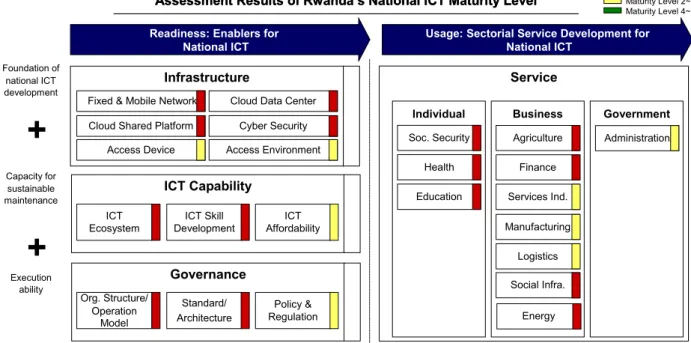
Despite the achievement of the NICI Plans, especially in building basic infrastructure and launching a highly successful healthcare system and increasing access to financial services, challenges still remain. An assessment of Rwanda’s ICT maturity level (National ICT Competitiveness, 2012) ranks it globally at 88th out of 144, confirming the
need of a significantly different national ICT strategy and matching investments to accelerate the delivery of the necessary information systems, processes, and skills to support the achievement of the economic objectives.
The current national ICT strategy, ICT Sector Strategic Plan 2013 ~ 2018 requires a review and re-orientation aligned to the new initiatives of SMART ICT as defined in the SMART Rwanda Conference held in June 2012. Further, the African Union Heads of State and Government at the end of the Transform Africa Summit in October 2013 confirmed this several months later by signing the SMART Africa Manifesto in Kigali. These efforts have as yielded a new national ICT strategy, the SMART Rwanda Master Plan (SRMP) replacing the ICT SSP. It is this SMART Rwanda Master Plan that underpins the current government transformation agenda.
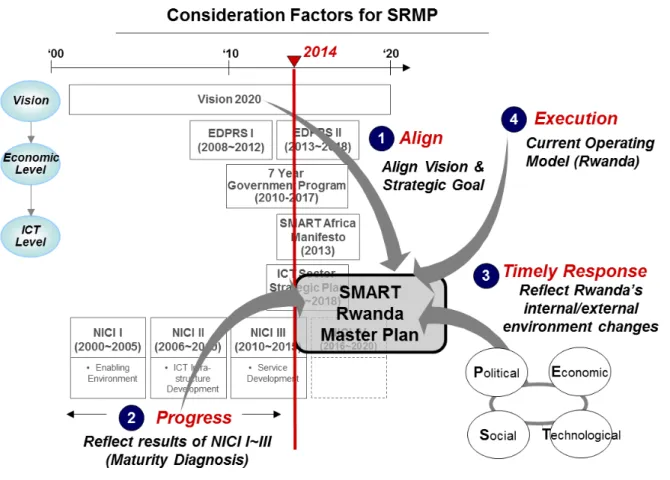
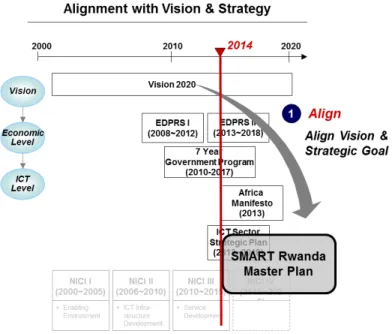
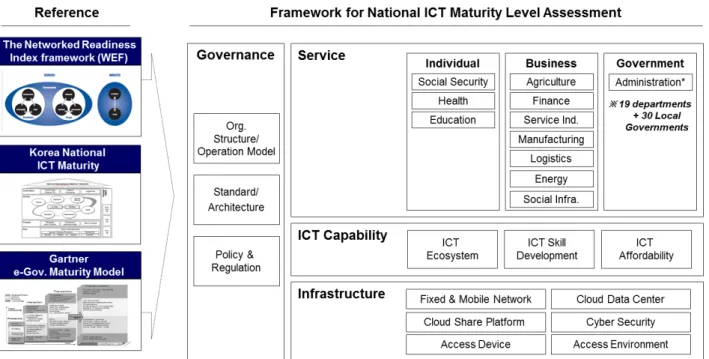
The SRMP derived key initiatives through analysis and assessment from four perspectives: aligning national development vision and strategies, reflecting the achievements of NICI I~III and ICT SSP, assessment of Rwanda’s internal and external environment challenges, and the current execution and management performance. Based on the analysis, three enablers, ICT Capability & Capacity, Governance & Management, Secured & Shared Infrastructure were identified. Seven pillars were also defined: SMART Agriculture, Finance, Business & Industry, Health, Education, Government, and Cities.
The process of developing SMART Rwanda also defined a vision statement: “A prosperous and knowledgeable society through SMART ICT”. This vision is underpinned by projects in 20 focus areas based on ten core objectives covering all the seven pillars. The strategy development process also established a prioritization and implementation roadmap for each of the projects having considered their strategic impact, urgency, and resources. Further, these projects were filtered on the “SPREAD” principles to further narrow down projects that are realizable and actionable.
The expected investment cost of the projects under SRMP is about US$500M, with an accumulated economic benefit2 of US$1,722M with a 140 percent ROI and 21 per cent
contribution to GDP, and more than 50,000 jobs created. Other expected benefits include increased innovation and capacity for ICT exports, economic productivity, reduce poverty and achieve national economic objectives.
In order to achieve the stated benefits above and address challenges of co-ordination, silo-approach, and poor project completion rate, a different governance and management structure is proposed. This structural change is accompanied by greater emphasis on performance management and resource allocation. The SRMP will continuously monitor 4 main global ICT indexes related to performance of the ICT investment. In addition, to efficiently manage and increase the success of the projects requires close collaboration with the private sector through PPP and other innovative models. This is to encourage greater private sector participation, allowing for even more increased productivity and return on investment.
The key strategic differences in the SRMP to previous NICI Plans include:
(i) Execution Model - restructured the leadership and governance structure to make it more accountable, streamlined and responsive. This will involve strengthening the mandate of the National ICT Steering Committee, and the creation of Rwanda Information Society Agency (RISA). RISA will be accountable for the execution and success of the SRMP and also implement a strategy to drive common capabilities, infrastructure and standards across the public sector. This should significantly drive
down the current operating, administrative and recurrent costs, and leverage on existing investments to increase efficiency and productivity.
(ii) Performance management - monitor and aggressively track the ROI and progress of the strategy execution using 4 ICT indicators: ICT Development Index, Global Competitiveness Index, Networked Readiness Index, and e-Government Development Index. A further 20 KPI’s for each of the 10 core strategies will be also monitored.
(iii) Program and project selection process and management – embed best practices; allocate adequate resources and rigorous program management through effective engagement of stakeholders and project team integration to significantly improve the success rate of projects. A clear linkage between the project outcomes, the key strategic priorities and agreed measures of success will be mandatory prior to project implementation.
(iv) Monitoring and evaluation – regular reviews and continuous monitoring and evaluation of the achievement of the stated objectives and outcomes. Furthermore, a mechanism will be developed for evaluating the impact of the SRMP execution on jobs creation, ICT literacy, and infrastructure growth, alongside the other relevant ICT indicators.
(v) Private sector participation – implement a partnership program between government, private investors and development partners through models like PPP to share the investment burden of the national ICT investment costs.
The vision of “knowledge-based economy” requires that the economy be directly based on the production, distribution and use of knowledge and information. This should be reflected by growth in high-technology investments, high-technology industries, more highly skilled labor and associated productivity gains. In this view, investments in research and development, education and training and new managerial work structures is key, and SMART Rwanda Master Plan shows how.
I.
Introduction
1.
Background
Despite a global economic recession resulting in an average global growth rate of 2.6 per cent, Rwanda has managed to show the highest annual economic growth rate of 8.2 per cent in the last 3 years. This continuous growth has been enabled in part by the government’s aggressive investments in Information Communication Technology (ICT) and the rapid expansion of the mobile telecommunication sector. Furthermore, being landlocked has made it imperative for Rwanda’s continued development and investment in ICT.
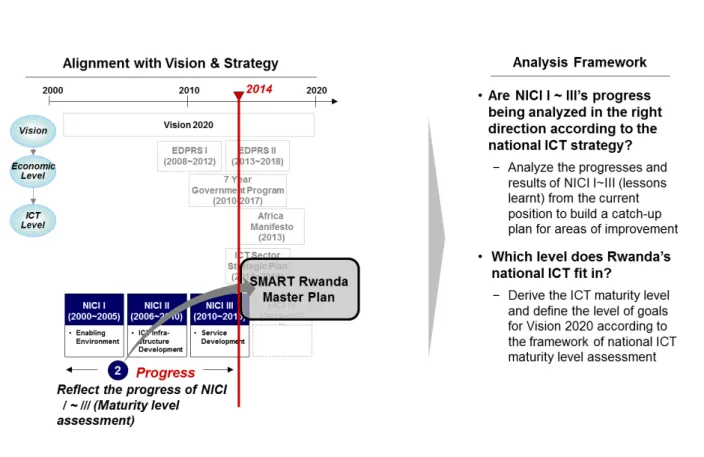
Having recognized the importance of the ICT investments in achieving the socio-economic growth, the GoR (Government of Rwanda) adopted the National Information and Communications Infrastructure Plan (NICI) in 2000. The first NICI Plan, NICI I (2000-2005) focused on establishing an enabling environment to promote the development and growth of Rwanda’s ICT sector. The second plan, NICI II (2006-2010) focused on providing world-class communications infrastructure to serve as the backbone for current and future communication related requirements. The third plan, NICI III (2011-2015 Plan), focused on the development of services by leveraging ICTs to improve the delivery. NICI III’s overarching goals focused on accelerating service developments through ICTs, thereby facilitating sustainable economic competitiveness and increasing ICTs’ contributions to GDP.
Consequently, the adoption of aggressive ICT developments provides a basis for Rwanda to make a quantum leap forward to become a middle-income nation. In order for the ICT to be efficiently and proactively operated and managed, the strategy and plans require alteration and oriented in correlation to the current ICT and socio-economic status. This therefore calls for a new blueprint for ICT under the tag of SMART ICT.
Rwanda is currently at a critical point with 6 years to realizing the goals of Vision 2020, and this called for a reassessment of the current ICT strategy, the ICT Sector Strategy Plan, and affirmation of the strategic direction and progress. This assessment revealed a need to make significant changes to the strategy. The changes required can be summarized as the SMART Rwanda Master Plan.
2.
ICT for National Competitiveness
What is the role of ICT and appropriate direction of ICT investment?
ICT has changed the course of global community over the last 30 years. The new wave of innovation has equally created opportunities and challenges. The rapid development of information
and communication is bringing various outcomes: new markets are created, and related policies are being impacted. Although developed nations are more advanced in the technical skills and knowledge for now, innovative technologies are presenting and providing the developing nations with room for new market opportunities to change the current market situations. Just as electricity played a key factor in an economic development during the industrialization period, ICT will serve as a core element in the knowledge-based economic development.
For developing countries, ICT investment is an essential driver that brings forth economic development. There is a positive correlation between ICT competitiveness and national competitiveness: a higher ICT competitiveness leads to a stronger national competitiveness according to The World Economic Forum (2011).
Rwanda recognized very early on that ICT investment plays an important role in the national growth and economic development. Although there is a consensus on the importance of the ICT investment, the limited ICT investment sources and resources are hindering the development. Hence, strategies with distinct methods to utilize the limited resources and maximize the return are required.
In developing SMART Rwanda Master Plan, a comprehensive and thorough analysis was conducted to identify focal areas of investments considering strategic impact, outcomes and required resources as well as identified critical success factors for the investment.
According to the WEF’s “The Global Competitiveness Report - 2012,” Rwanda is currently in the initial economic growth stage of development. In this stage, Rwanda is focused on providing basic ICT infrastructure to support healthcare and education. Maximizing the return of investment in ICT must consider the application and utilization of this investment through higher education and training to develop skills and improve capabilities for innovation and higher productivity.
Figure 1: ICT Investment driving national competitiveness
The capacity of broadband utility and efficiency are the key drivers of an economic development in the developing countries. WBF (World Broadband Forum) has established a link between access and speed of BB to an increase in GDP.
Rwanda has invested significant amount of effort and resources in establishing an ICT infrastructure itself a significant step towards becoming the “regional ICT Hub”. With the completion of “Rwanda’s National Backbone Network Project” in December 2010,the project established a fiber optic backbone network covering over 3,000 km across the country.
Furthermore, Rwanda Utilities Regulatory Authority (RURA) is driving the broadband development by establishing a policy that promotes the responsibility of guaranteeing high Internet service quality from the telecommunication and Internet service providers.
Backbone networks for key main networks related to administration, education, finance, and national information security are currently being developed or have been established. However, limited access to the backbone network, has constrained the Internet penetration to 7% and this need to be addressed by installing last mile networks.
Role of the Private Sector
The role of private sector is crucial in development of a National ICT strategy in terms of both infrastructure investment and driving innovation. The government has facilitated this with creation of a business environment that is conducive to investment. The private sector participation will
The Global Competitiveness Index framework
※The Global Competitiveness Report 2013-2014 ※Global Competitiveness Index : WEF (World Economy forum 2013) State 1~2 State 2 State 2~3 State 3 State 1
Accelerating national growth by ‘National ICT Innovation’ Quantum Leap Quantum Leap Economic Growth Stage Efficiency Driven Economic Growth Stage Innovation Driven Economic Growth Stage Rwanda’s
As-Is • Infrastructure• Health • Education & Training • Financial Market
Development • Labor Market Efficiency
• Institution • Technological Readiness • Market Size • Innovation •…
Jump-up in National Growth Stages by Effective Adoption of ICT
Globa l Comp etitiv enes s Index* So… So… Basic requirements sub index Efficiency enhancers sub index Innovation & sophistication factors sub index
• Pillar1. Institutions • Pillar2: Infrastructure • Pillar3.
Macroeconomic environment • Pillar4. Health and
primary education • Pillar5. Higher education and training • Pillar6: Goods market efficiency • Pillar7. Labor market
efficiency • Pillar8. Financial market development • Pillar9. Technological readiness • Pillar10. Market size
• Pillar11. Business sophistication • Pillar12: Innovation Key for factor-driven economies Key for Efficiency-driven economies Key for innovation-driven economies
stimulate and build sustainable value chains, which are the basis for shared growth, and reduce the government’s burden to finance and provide the resources for the ICT development. The private sector involvement also brings industry expertise and experience necessary to increase the success of the project implementation. The government is actively trying to attract multinational corporations through investment-friendly policies to develop a Techno pole, and also partner with the private sector on specific projects. The presence of multinationals should facilitate knowledge transfer, local skills development, and faster innovation.
Financing
Achieving the vision of the SMART Rwanda Master Plan will require the mobilization of significant financial and human resources. Funding of the flagship projects in this SRMP will come from GoR, its development partners, and other public or private institutions through Private Public Partnerships (PPPs) and collaborations. Due to financial limitations in public and official development assistance, it is essential to develop innovative funding mechanisms to mobilize additional resources from other sources as outlined below. The private sector will be encouraged through development of suitable incentives including but not limited to Special Purpose Vehicles (SPVs), angel investors, waivers on licensing fees, tax incentives and tax breaks.
3.
SMART Rwanda Vision
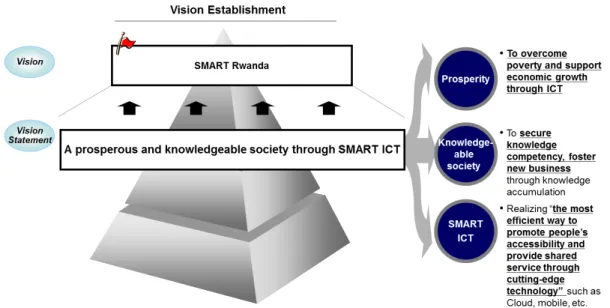
SMART Rwanda Master Plan articulates the alignment of key initiatives and implications with the overall national economic goals. It is from this alignment that the guiding vision is derived. The SMART Rwanda Vision Statement is “a prosperous and knowledgeable society through SMART ICT”
! Scope: To secure national ICT execution capability, expanding ICT accessibility, and establishing programs to enhance economic growth.
! Focus: To secure country’s reliance on ICT by upgrading protection and security, agreeing on rights and responsibilities for data use on the basis of context, and driving accountability and enforcement.
! Image: To become a regional ICT Hub, enhancing Rwanda’s international reputation as a knowledge-based middle-income nation.
SRMP’s vision statement is clear about Rwanda’s continued reliance on the effective and efficient utilization of Information and Communication Technologies. With the implementation of the SMART Rwanda Master Plan, Rwanda can improve citizens’ quality of life while at the same time
developing capability of the private sector key industries to achieve a sustainable socio-economic growth.
Figure 2: SMART Rwanda Vision Statement
• Prosperity: Sustained economic growth, poverty reduction and a reduction in income inequality
• Knowledgeable society: To secure and accumulate knowledge competency, as the driver of productivity and economic growth
• SMART ICT: To develop the infrastructure, appropriate skills and competencies, necessary to develop innovative products that help increase the social, economic, and environmental sustainability and support increase in productivity and competitiveness.
4. SMART Rwanda Implementation
Background
Currently, strategic national ICT projects are implemented and managed by the ICT Department in RDB. However, the Rwanda Information Society Agency (RISA) is the proposed new structure for the governance, management and delivery of the goals and objectives of the national ICT Strategy, the SMART Rwanda Master Plan 2015~2020. It’s objective is to bring about increased accountability, transparency, reduce duplication, and greater emphasis on performance to bring about the desired efficiencies and effectiveness and therefore an increased return on ICT investment. In addition to the creation of a RISA, other proposed changes in the governance, management and delivery of the
SMART Rwanda Master Plan (SRMP), include:
• Expansion of the mandate of the National ICT Steering Committee;
• Establishment of a Board that is representative of the key economic and social sectors and members from private sector;
• Relocation of the SRMP governance and management responsibility to RISA from Rwanda Development Board (RDB) where it is currently managed;
• Re-assignment of the M&E function from RDB to MYICT;
• Centralized management of government ICT under RISA to a drive common standards, infrastructure and capabilities strategy.
Purpose
Currently, ICT governance, implementation and support in Government institutions are fragmented and operating in silos. The purpose of the RISA Strategy is to provide a clear institutional governance structure for the integrated and centralized management of all Government of Rwanda ICT strategies. RISA will also execute and manage the SMART Rwanda Master Plan (SRMP). RISA shall enhance the government’s operations and strategic focus by the application and execution of Information and Communication Technologies (ICT) to support improvements in productivity, management effectiveness and ultimately, the quality of services offered to citizens. This should in turn reduce costs and provide high quality public services by removing unnecessary overlap between government ministries, agencies, and departments (MDAs) and avoid costly duplication of technology.
The RISA will therefore facilitate significant improvement of public services through better use of ICT, making the way government works, smarter, cost effective, and innovative. The strategy focuses on improving services through a shared ICT infrastructure, increased ICT Capability and improved ICT Governance.
Strategic Principles
The RISA strategy is underpinned by a number of principles, summarized as follows:
• Expand and Improve quality of public services through adoption of greater standardization and simplification;
• Focus on innovation, interoperability and open standards to facilitate information sharing, collaboration and accessibility to deliver greater value for money;
• Utilize effective portfolio, program and project management techniques to maximize the impact of ICT-enabled change; and
• Benchmark ICT investment, costs, and performance annually.
Objectives
The general objective of RISA shall be to develop, manage, and implement national ICT programs to support socio-economic transformation of the country.
Particularly, RISA shall have the following objectives:
1. To ensure coordination and implementation of National ICT programmes;
2. To drive strategies to ensure usage of ICT common standards, resources, infrastructure and capabilities across the Government;
3. To coordinate the Government’s overall ICT investment by focusing on return on investment, impact creation and benefits realization;
4. To embed a Culture of Innovation and Process Improvement for increased efficiency in Government operations;
5. To advise the Government on national needs and policies in respect of all information and communications technology;
6. To coordinate and promote research and development relating to information and communications technology in conjunction with government institutions, Universities and other private institutions;
7. To define minimum standards and codes relating to equipment attached to telecommunication and radio-communication systems, and any equipment or software used independently or as an adjunct to or in conjunction with such systems within the Government and the monitoring of and access to such equipment and software;
8. To encourage, promote, facilitate, invest in and otherwise assist in the establishment, development and expansion of the information and communications industry in Rwanda, including information and communications technology manpower resources in Rwanda;
9. To work with all relevant stakeholders to provide facilities for the training of and do anything for the purpose of advancing the skills and knowledge of persons for any purpose connected with the information and communications industry in Rwanda; 10.To advise on, establish and maintain standards of education and training in
information and communications technology in Rwanda;
11.To plan, promote, develop and implement information and communications technology systems and services for Government ministries, departments and agencies;
12.To establish and maintain information and communications technology data privacy and personal data protection;
13.To promote the use of the Internet and electronic commerce and to establish enabling frameworks for that purpose;
14.To provide consultancy and advisory services concerning information and communications technology;
15.To foster the development and expansion of information and communications services in the world in collaboration with other countries and international organizations;
16.To establish relations and collaborate with other regional and international agencies with the same attributions;
17.To act internationally as the national body representative of Rwanda in respect of information and communications technology matters;
18.To promote the acceptance and use of information and communications technology in Rwanda with due consideration to:
a. Trends in the development of information and communications technology and evolution of standards and protocols used in the information and communications industry;
b. Convergence between broadcasting services and other services using information and communications technology, and the need to accommodate technological change;
Prioritization
The RISA Strategy consolidates a number of significant cross-government and agency programs already underway, and in some cases expanding their scope to meet the Government’s transformation goals. New initiatives will be added as concepts and benefits are proven, and will typically require business cases as well subjected to portfolio management.
Early delivery of ICT investment planning changes and the development of a new operating model are both critical to the success of the RISA Strategy, and will both be prioritized by the RISA (and MDA’s). This is a deliberate move towards a more disciplined approach, where the most important functions are prioritized and the emphasis is on quick delivery.
Monitoring and Evaluation
The SRMP monitoring and evaluation framework describes the key indicators that will be used to measure progress and impact in the implementation of the SRMP. RISA will work in partnership with RURA and NISR to collect and analyze data to measure economic impact of ICT on development and the national economy.
The RISA Strategy is outcome-focused and SRMP outlines a clear step-by-step guideline for delivering the RISA goals, it must also remain flexible to be adjusted over time as priorities and circumstances change.
The benefits of the RISA Strategy are:
! Reduce complexity and duplication in ICT investment; ! Faster realization of savings and return on ICT investments;
! Improved access to integrated government information and services; ! Enhanced capability across all aspects of the public service delivery; and
! Improving the leverage of operational scale across government and effective engagement with the ICT industry.
Risks
The SMART Rwanda Master Plan requires a standardized, flexible and efficient ICT infrastructure to enable delivery of these objectives in an effective, secure and sustainable manner. Above all, it seeks to reduce inefficiency, replication of systems and duplication of effort. Currently, technology investment planning is agency-specific, often near-term focused, and is biased significantly towards the purchase of technology infrastructure capital assets. The RISA Strategy addresses these challenges by considering:
! The impact of emerging technologies: Technology continues to change at a rapid rate, and emerging technologies will have a dramatic effect on how public sector ICT is delivered. In the longer term, other technologies will begin to play a role. This strategy provides the flexibility for new technology developments and sector-specific requirements to be incorporated as they arise.
! Regional and International alignment and coordination: A key element of this strategy, therefore, is to ensure alignment and compliance with the SMART Africa Manifesto and other regional agreements, decisions and treaties. The RISA shall continue to share best practice and help solve common problems. This approach ensures continuation to exploit technology to its full effect in efforts to deliver constantly improving services.
! Governance: The governance structure, meanwhile, ensures that RISA strategic objectives receive the necessary high-level support, accountability and maintain visibility at the highest echelons of the government.
The implementation of the SRMP requires effective risk identification and management to ensure the realization of its objectives in an effective, secure and flexible manner. The risks associated with its
implementation may emerge before and during the implementation process. In order to manage these risks, identification of the risks and their mitigation will be done periodically at the start, middle and end each activity of the implementation process.
Key Areas of the SRMP Strategy
Common Infrastructure
At the heart of the RISA Strategy is the creation of a common, secure and flexible infrastructure that is available across the public sector. To achieve this, the strategy sets out the vision for the following:
• Integrated Public Network & Communications: A single holistic telecommunications infrastructure that will deliver converged voice, video and data communications.
• The Government Cloud (G-Cloud): A government cloud infrastructure that enables public bodies to select and host ICT services from a secure, resilient and cost-effective shared environment. The Government Cloud is a key enabler as it shall provide a single access point for ICT services, applications and assets.
• Data center rationalization: A program of data center consolidation that will deliver large cross-government economies of scale, meet environmental and sustainability targets and provide secure, resilient services. Aligned with development of the Government Cloud, this program will reduce the number of data centers planned or already in use. Shared services will be provided via the Government Cloud to further exploit opportunities.
• Desktop services: While all public sector bodies need to provide their staff with access to functions such as email, word processing, spreadsheets, document management, and internet browsing, historically each public sector organization has separately specified, built and run its desktop service – creating additional cost and complexity. Instead, there will be a set of common desktop designs that conform to information assurance and sustainability requirements, setting this as a best practice across the public sector.
Common Standards
All products, services and assets contained in the government ICT infrastructure will benefit from a suite of common standards for security, interoperability and data standards, which will facilitate data sharing and make it easier to integrate public services. The key focus being on:
• Architecture and standards: The technical architecture and standards work underpins all elements of the RISA Strategy. This will ensure security, interoperability and common data standards that will facilitate transition of supplier or product, as well as data sharing and the joining up of public services.
• Open Source, Open Standards, Reuse: Traditionally, the public sector has relied on commercial off-the-shelf (COTS) software or bespoke developments from global providers. This restricts the ability of the public sector to reuse solutions, reduces flexibility to manage assets efficiently and prevents government organizations from switching suppliers. The Open Source, Open Standards, Reuse Strategy provides government’s approach to open source alternatives that meet public sector requirements. This strategy will build capability within the public sector to increase the amount of open source code and software in use and to make it available for reuse elsewhere.
• Information security and assurance: Data losses within the public sector have rightly raised the profile of information assurance. However, data sharing is an essential element of integrated services. This means that there must be effective, proportionate management of information risk. By developing a secure infrastructure, as outlined above, will provide a trusted platform that will allow public sector bodies to match their information risk appetite with their information risk exposure: users of the infrastructure will be able to take information assurance for granted without feeling that their effectiveness has been compromised.
Common Capability
The RISA Strategy incorporates building capability as well as capacity in ICT. The strategy can only be delivered through the people who work within public sector ICT, and a cultural change in ICT usage and procurement.
• ICT Skills & Capacity Building: Increasing the capability will not only improve the performance of ICT, but it will also reduce the amount the public sector spends on ICT consultants and contractors. The RISA Strategy provides a focal point for increasing the professionalism of ICT delivery within the public sector. A Government IT Professional skills and competency framework will be used for recruitment, training and performance management of government ICT professionals.
• Reliable project delivery: Reliable project delivery is critical and the RISA will work closely with stakeholders to identify those major programs and projects that have a high complexity
and associated high delivery risk, and take a more proactive role in managing them and overseeing their success.
Implementation
The RISA is responsible for leading the overall government objectives to expand services and improve service delivery, generate efficiencies across departments, develop expertise and capability across the Public Service, and ensure business continuity. Change will be delivered through:
! Coordinating government’s overall ICT investment, focusing on return on investment and benefits realization;
! Tightening planning and decision-making disciplines, and improving leadership, governance capability and assurance;
! Rationalizing and consolidating service channels;
! Uplifting government’s capability to take advantage of new and emerging technologies
Factors critical to successful implementation
! Providing clarity: It is crucial that scope, governance and operating models for ICT functional leadership are well understood from the outset. Boundaries will be made clear, including the extent that the strategy will drive the MDAs, and also the role of the RISA. Decision-making arrangements will be streamlined and mechanisms for prioritizing investment requests will be clearly articulated. Actions like these will provide MDA leaders with an understanding of where they can operate independently and where the context of their sector and/or the integrated RISA takes precedence.
! Committed leadership: MDA leadership teams must be committed to and support the strategy. The RISA will assist the MDAs to understand the impact on how they utilize common ICT capabilities to deliver their business strategies and to move their services to an integrated digital channel delivery model.
! Alignment: MDAs will be asked to adhere to the objectives of the RISA. The respective ICT leaders will be responsible for leading the development and establishment of the changes and taking on some delegated responsibilities from the RISA.
! Funding: The action plan relies heavily on a “value-for-money” approach to support the plan’s delivery capabilities. The approach provides clarity on how MDA’s will be supported to transition from capital-intensive asset development to ‘as-a-service’ consumption using operational expenditure.
! Assurance: The RISA will provide assurance that ICT risks and processes are identified and effectively managed.
In order for the strategy to fully deliver its potential, the National ICT Steering Committee will coordinate, promote and embed the principles and approaches of the RISA Strategy through the establishment of the RISA and the RISA Council. This will mean working with the RISA Governance Structure to develop a shared vision of locally delivered public services aligned with the SMART Rwanda Master Plan. The implementation will also be supplemented through private sector organization exploiting the infrastructure and opportunities it brings to enable achievement of the SRMP objectives.
This integrated governance structure shall combine expertise from central and local government, and the wider public and private sector as well as include both technical and commercial roles. This will provide all public and private sector bodies with the opportunity to shape implementation of the RISA Strategy, and ensure that solutions never lose sight of the need for improved public services as well as increased efficiency. It will also mean that specific local requirements and the need for flexibility are not overtaken by a ‘one size fits all’ approach that will negatively impact service quality.
5. Policy Orientation
There are several key policies need to be considered to anchor the successful implementation of SRMP. These policies are
:
5.1Broad Band Policy 5.2Cyber Security Policy
5.3Private Sector Development Policy 5.4eWaste Policy
5.5Open Data Policy
5.1 Broad Band Policy Orientation
In 2013, GoR approved the broadband policy aimed at restructure the telecommunication sector under an infrastructure-sharing regime by way of a wholesale-only, open-access network as a means to accelerate rollout of broadband network and services, and eliminate duplicated investments – thus availing affordable broadband for all. The policy positioned broadband as a driver of economic growth, social cohesion, productivity and innovation across all sectors of the economy and promote guide initiatives to drive down the cost of end-user equipment; stimulate the development and uptake of relevant content; and driving aggressive digital awareness campaigns.
Objective
The major benefits that will come as result of improved connectivity:
• Improved quality and access of healthcare services will reinforce the use of advanced medical applications like telemedicine, the management and exchange of patients’ electronic records information, across Rwanda.
• Improved government service delivery will greatly enhance the government’s capability to communicate within government institutions, and with its citizens. Provide online service for informational and transactional purposes, which will drive down the cost to government, of service delivery.
• Improved quality of education by enabling delivery of digital contents for instruction, irrespective their location; it will also facilitate the relationship between institutions.
• Arts, culture and entertainment: citizens will experience an evolution in the entertainment scene: this will play a role in improving and expanding channels of knowledge dissemination.
• Reduced cost of communications and improved marketability for investment creates an environment that stimulates economic growth due to the lower cost of communications that attracts businesses to all parts of the country, and the streamlined distribution of products and services to all corners of the nation. With the improved access to the rest of the country and the world through Broadband, all areas of the country will be able to increase their marketability, and therefore attract more investment.
• Increased employment and growth of SMEs. Broadband connectivity unlocks creativity and creates economic activities that create jobs, more especially to the youth.
The availability of high-speed, reliable and secure Broadband will stimulate Hospitality industry, and attract more visitors to the country and drawing increased foreign exchange, and thus create a heavy impact on the economy. A significant number of SMART Rwanda Master Plan flagship projects rely on the presence of the BB infrastructure for successful roll out and implementation.
5.2 Private Sector Development
The private sector’s role in ICT sector is undeniably crucial and this role can be defined in many ways depending on the vision in question. As private sector players, ICT Private Sector Development has been defined according to four major focus areas all of which contribute to the success of business proprietors.
The four focus areas defining ICT-Private Sector Development are:
• Grow Existing Indigenous ICT Businesses
• Cultivate New Local ICT Enterprises
• Export & FDI Expansion
1. Grow Existing Indigenous ICT Businesses
Rwanda has recorded great statistics in World Bank doing business reports, however up to now it is hard to keep track of the progress of private companies operating in Rwanda, their growth or failure. It is against this and other reasons that the ICT-PSD is envisioned as first being able to track the progress and growth of local ICT companies by developing an appropriate index to measure the growth of the private sector against set targets.
2. Cultivate New Local ICT Companies
The second aspect of ICT-Private Sector Development addresses the development of new local ICT companies. Although a number of initiatives have been put in place to foster entrepreneurship and particularly technology related, there’s still a lack of a coherent framework that tracks the development of new enterprises both in technology and other sectors.
The development of new local ICT companies, goes hand in hand with the first aspect of the definition of the ICT-PSD that is, growing existing indigenous ICT companies. In order to attain nationwide growth and prosperity stimulated by ICT, a national framework to support the emergence and development of local ICT companies is required.
3. Improve Business and Industry Productivity & Efficiency
Unlike other sectors ICT is crosscutting, as such this means that although it may not be seen at the forefront of all operations, it is an enabler adding value in organizations; big and small, public and private.
As a result, ICT Private Sector Development cannot be seen only as inward progress for ICT companies but rather as how it contributes to the development of other sectors. At sector level it has the potential to offer value in 3 main ways both to private and public organizations:
i) Reducing Costs
ii) Improving service delivery iii) Creati