Archive University of Zurich Main Library Strickhofstrasse 39 CH-8057 Zurich www.zora.uzh.ch Year: 2018
On the choice and influence of the number of boosting steps for
high-dimensional linear Cox-models
Seibold, Heidi ; Bernau, Christoph ; Boulesteix, Anne-Laure ; De Bin, Riccardo
Abstract: In biomedical research, boosting-based regression approaches have gained much attention in the last decade. Their intrinsic variable selection procedure and ability to shrink the estimates of the regression coefficients toward 0 make these techniques appropriate to fit prediction models in the case of high-dimensional data, e.g. gene expressions. Their prediction performance, however, highly depends on specific tuning parameters, in particular on the number of boosting iterations to perform. This crucial parameter is usually selected via cross-validation. The cross-validation procedure may highly depend on a completely random component, namely the considered fold partition. We empirically study how much this randomness affects the results of the boosting techniques, in terms of selected predictors and prediction ability of the related models. We use four publicly available data sets related to four different diseases. In these studies, the goal is to predict survival end-points when a large number of continuous candidate predictors are available. We focus on two well known boosting approaches implemented in the R-packages CoxBoost and mboost, assuming the validity of the proportional hazards assumption and the linearity of the effects of the predictors. We show that the variability in selected predictors and prediction ability of the model is reduced by averaging over several repetitions of cross-validation in the selection of the tuning parameters.
DOI: https://doi.org/10.1007/s00180-017-0773-8
Posted at the Zurich Open Repository and Archive, University of Zurich ZORA URL: https://doi.org/10.5167/uzh-142477
Journal Article Accepted Version Originally published at:
Seibold, Heidi; Bernau, Christoph; Boulesteix, Anne-Laure; De Bin, Riccardo (2018). On the choice and influence of the number of boosting steps for high-dimensional linear Cox-models. Computational Statistics, 33(3):1195-1215.
Revised
Proof
https://doi.org/10.1007/s00180-017-0773-8O R I G I NA L PA P E R
On the choice and influence of the number of boosting
steps for high-dimensional linear Cox-models
Heidi Seibold1,2 · Christoph Bernau3 ·
Anne-Laure Boulesteix1 · Riccardo De Bin1,4
Received: 12 January 2016 / Accepted: 13 October 2017 © Springer-Verlag GmbH Germany 2017
Abstract In biomedical research, boosting-based regression approaches have gained
1
much attention in the last decade. Their intrinsic variable selection procedure and 2
ability to shrink the estimates of the regression coefficients toward 0 make these tech-3
niques appropriate to fit prediction models in the case of high-dimensional data, e.g. 4
gene expressions. Their prediction performance, however, highly depends on specific 5
tuning parameters, in particular on the number of boosting iterations to perform. This 6
crucial parameter is usually selected via cross-validation. The cross-validation proce-7
dure may highly depend on a completely random component, namely the considered 8
fold partition. We empirically study how much this randomness affects the results of 9
the boosting techniques, in terms of selected predictors and prediction ability of the 10
Electronic supplementary material The online version of this article ( https://doi.org/10.1007/s00180-017-0773-8) contains supplementary material, which is available to authorized users.
B
Heidi Seibold [email protected] Christoph Bernau [email protected] Anne-Laure Boulesteix [email protected] Riccardo De Bin [email protected]1 Institute for Medical Information Processing, Biometry and Epidemiology, LMU Munich,
Munich, Germany
2 Epidemiology, Biostatistics and Prevention Institute (EBPI), University of Zurich, Zurich,
Switzerland
3 Leibniz Supercomputing Centre, Munich, Germany
Revised
Proof
related models. We use four publicly available data sets related to four different dis-11
eases. In these studies, the goal is to predict survival end-points when a large number 12
of continuous candidate predictors are available. We focus on two well known boost-13
ing approaches implemented in the R-packages CoxBoost and mboost, assuming the 14
validity of the proportional hazards assumption and the linearity of the effects of the 15
predictors. We show that the variability in selected predictors and prediction ability 16
of the model is reduced by averaging over several repetitions of cross-validation in 17
the selection of the tuning parameters. 18
Keywords Boosting·Cross-validation·Parameter tuning·High dimensional data·
19
Survival analysis 20
1 Introduction
21Boosting-based regression approaches have gained a lot of attention in the last decade, 22
showing both interesting theoretical properties (Bühlmann and Yu 2003;Bühlmann 23
2006;Tutz and Binder 2006) and yielding good empirical results in terms of prediction
24
accuracy, including applications to prediction with high-dimensional data (Mayr et al. 25
2014a). In this paper we focus specifically on two boosting approaches that are based
26
on a solid theoretical framework, implemented in user-friendly software and able to 27
efficiently cope with high-dimensional data and handle censored survival end-points: 28
the model-based boosting approach (Bühlmann and Yu 2003), implemented in the R 29
packagemboost (Hothorn et al. 2015); and the likelihood-based boosting approach 30
(Tutz and Binder 2006) adapted to survival end-points byBinder and Schumacher
31
(2008a) and implemented in the R packageCoxBoost(Binder 2013).
32
In our analyses we focus on prediction models for time-to-event outcomes. This 33
kind of application, despite being extremely common in biomedical practice, has not 34
been well investigated in statistical literature in the case when a large number of can-35
didate predictors, such as gene expressions, are available. In this context, boosting 36
techniques can play an important role. They have, indeed, two important character-37
istics which are essential in providing a good prediction model when the number of 38
the predictors exceeds the sample size: the ability to shrink the parameter estimates 39
toward 0, and the identification of the relevant predictors (variable selection). The lat-40
ter is performed by allowing only a moderate number of parameters to have non-zero 41
values. These two properties suggest the existence of a relationship between boosting 42
techniques and methods based on penalized regression. Works which have investigated 43
this connection, mainly focusing on the similarities between L2-boosting and lasso, 44
areHastie et al.(2001),Efron et al.(2004) andBühlmann and Hothorn(2007).
45
Another common characteristic of the boosting and the penalized regression tech-46
niques is the presence of one or more tuning parameters. In particular, as boosting 47
is an iterative method in which a weak learner is sequentially applied to a suitable 48
modification of the data, the most critical parameter to set is the number of iterations 49
(boosting steps). Its choice greatly impacts the number of involved predictors and the 50
complexity of the resulting prediction model. Despite the importance of this param-51
eter, literature on its choice is scarce. The R packagesmboostandCoxBoostexploit 52
Revised
Proof
cross-validation-based procedures. In particular, when working with proportional haz-53
ards models, both packages implement the cross-validated partial log-likelihood by 54
Verweij and Houwelingen(1993). The packagemboost also offers a different
pro-55
cedure, based on the Akaike information criterion: introduced byBühlmann(2006) 56
and investigated in the survival analysis context byHothorn et al.(2006), its use in 57
practice is actually discouraged due to its tendency to overshoot the optimal value 58
(Hofner et al. 2014). This tendency is primarily due to the systematic underestimation
59
of the true degrees of freedom in component-wise boosting algorithms (Mayr et al. 60
2012). An advantage of AIC-based stopping criteria is that they can be made totally 61
data-driven, avoiding the necessity of pre-specifying a range of values to search for 62
the optimum. The works ofChang et al.(2010) and, especially,Mayr et al.(2012) 63
focus on this approach, with the latter adjusting for the underestimation of the degrees 64
of freedom using a re-sampling method, at the expense of computation time. 65
However, the aforementioned approaches are not really well-known and cross-66
validation is by far the most popular procedure used in practice to choose the number 67
of boosting steps. Unfortunately, cross-validation is often implemented without tak-68
ing into account its possible drawbacks and the effect that it can have on the tuning 69
procedure. An important problem of cross-validation and related approaches is the 70
high variability of the results (Boulesteix et al. 2013): the output may be completely 71
different for two different random partitions into the K folds used in the proce-72
dure, in the sense that different numbers of boosting steps are identified as optimal 73
depending on the considered random partition. As a consequence, the final predic-74
tion model—fit using the selected number of boosting steps—may greatly depend 75
on a completely random component, namely the considered partition into the K
76 folds. 77
In this paper we address the issue of the choice of the number of boosting steps from 78
an empirical perspective. In particular, we specifically address three questions related 79
to the variability of cross-validation-based results: (i) how much does the prediction 80
accuracy of the final prediction model depend on the random CV partition used for 81
the choice of the number of boosting steps? (ii) how much do the set of selected 82
predictors depend on the random CV partition used for the choice of the number of 83
boosting steps? (iii) to what extent can this variability be reduced through adapting 84
the cross-validation tuning procedure by averaging over several random partitions 85
intoKfolds? Despite the focus on the prediction of censored survival end-points from 86
high-dimensional data, most conclusions are generalizable to other types of end-points 87
and/or other types of predictors. 88
This paper is structured as follows. Section 2 gives an introduction to the two 89
considered boosting methods, cross-validation for tuning and the evaluation of survival 90
prediction models using the Brier score. The first empirical study based on four high-91
dimensional gene expression data sets, each consisting of both learning and test sets, is 92
presented in Sect.3. The effect of considering several partitions in the cross-validation 93
procedure is shown in the second empirical study (Sect.4). Finally, Sect.5contains 94
some conclusions. A simulation study in which we investigate the role of correlation 95
between covariates with respect to the number of boosting steps and the prediction is 96
available in the Supplementary Material. R-codes used for this paper are available in 97
the Electronic Supplementary Material. 98
Revised
Proof
2 Methods
99The general idea of a boosting procedure is to repeatedly fit a weak estimator to the 100
data in order to minimize a loss function. Here we focus on the implementation to sur-101
vival data of the model-based boosting and the likelihood-based boosting approaches. 102
Both depend on two tuning parameters: a penalty parameter, whose choice is usually 103
hardly influential, and the number of boosting steps,mstop, which, on the contrary, 104
greatly affects the performance of the procedure and, consequently, the behavior of 105
the resulting prediction model. In this section, we briefly review the two boosting algo-106
rithms, sketch how to apply the cross-validation technique in order to selectmstop, and 107
provide some information on the Brier score, the measure of prediction ability that 108
we use in the paper. For a more complete review on boosting, please seeMayr et al. 109
(2014b)
110
2.1 Model-based boosting 111
Model-based boosting is a direct implementation of the gradient boosting idea 112
described in the seminal paper ofFriedman(2001), which provides a statistical view 113
of the boosting technique introduced byFreund and Schapire(1996) in the machine 114
learning literature. In the Friedman paper, boosting is characterized as a gradient 115
descent algorithm, where in each iteration a base learner is fit to the negative gradient 116
of a loss function. Here we focus on its adaption to survival data which fit the Cox 117
model assumptions, as implemented in the packagemboostwithin the function
glm-118
boost with argumentfamily=CoxPH(). In particular, this version uses the negative 119
partial likelihood as the loss function and the ordinary least squares estimator as the 120
base-learner. The derivation of the negative gradient vector was firstly provided in 121
Ridgeway(1999). Based on themboost function, other implementations using
spe-122
cific weights (Hothorn et al. 2006) or considering non-linear effect for the predictors 123
(e.g.,Schmid and Hothorn 2008) are available through themboost function, but are 124
not considered here. 125
The packagemboost implements the component-wise boosting version, the use 126
of which is often motivated by the challenges typical of high-dimensional data. This 127
procedure consists of updating the vector of regression coefficient estimates only one 128
dimension at a time. At each step, for all the vector components, a possible update 129
is computed by fitting a least squares estimator on the gradient vector. Among all 130
possible updates, the one which decreases the loss function the most is selected, 131
and it is added, suitably multiplied by a penalty parameter, to the related regression 132
coefficient estimate. This updating procedure ends when the pre-specified number of 133
boosting stepsmstopis reached. It is worth stressing the crucial role of this parameter: if 134
it is too small the estimates of the regression coefficients may be insufficiently refined, 135
leading to a prediction model unable to explain the outcome variability; if it is too 136
large, the final model risks being too complex and overfitting the learning data. The 137
number of boosting steps highly affects the variable selection property of the boosting 138
procedure as well: the chance of including a predictor in the model, indeed, increases 139
with the number of iterations. Therefore, if the number of steps performed is too small, 140
Revised
Proof
a relevant predictor may be excluded from the model. While if it is too large, irrelevant 141
predictors may be included, with high risk, especially in the high-dimensional data 142
context of overfitting. In contrast, the choice of the penalty term is unimportant, and, 143
in our analyses, we keep the default value (0.10, see, e.g.,Bühlmann and Hothorn 144
2007).
145
2.2 Likelihood-based boosting 146
The second algorithm that we consider is the adaptation to survival data of likelihood-147
based boosting (Tutz and Binder 2006), introduced byBinder and Schumacher(2008a) 148
and implemented in the R packageCoxBoost. This algorithm uses a penalized version 149
of the negative partial log-likelihood as the loss function, which it minimizes by repeat-150
edly fitting a first order approximation of the ridge estimator. In the component-wise 151
version used in this paper, only one regression coefficient per iteration is updated, 152
although the R package offers the chance to update more at each step (Binder and 153
Schumacher 2008a). In practice, at each step all possible updates (one for each
regres-154
sion coefficient) are computed, and then the most relevant—namely that which, once 155
plugged into the loss function, leads to the smallest value—is selected. This “best” 156
update is incorporated in an offset term, which is simply the linear predictor obtained 157
in the previous boosting step. Again, the total number of boosting steps performed 158
is highly relevant in determining the behavior of the resulting prediction model, and 159
a good choice of this tuning parameter is again crucial. As with the model-based 160
boosting technique, there is a second tuning parameter to consider, the penalty term. 161
In this case, it is directly applied to the partial log-likelihood through the L2 norm 162
which characterizes the ridge regression. The penalty term is usually selected through 163
the rough method implemented in the functionoptimCoxBoostPenaltyof the package 164
CoxBoost. In this paper: (i) to have a more robust result, we repeat the procedure 100 165
times and take the median value; (ii) since we will consider several kinds of cross-166
validation (leave-one-out, 3-, 5-, 10 and 20-fold), we repeat the procedure for each 167
kind of cross-validation and select the median value among the 5 penalty parameters. 168
The use of a single penalty term for all kinds of cross-validation procedure assures the 169
comparability of their results in terms of the number of boosting steps. Obviously this 170
procedure does not optimize the value of the penalty parameter, but it quickly provides 171
a term with a reasonable magnitude: as with model-based boosting, the choice of the 172
penalty parameter is not crucial. The original paper only claims that a “large enough” 173
value is necessary (Binder and Schumacher 2008a). 174
2.3 Choice of the tuning parameter based on cross-validation 175
The number of boosting steps is highly relevant in both boosting procedures consid-176
ered. We stated in the introduction that the usual way to compute its value is through 177
cross-validation (CV). The general idea of CV is to mimic the presence of a learning 178
and a test set by splitting the available data setDintoK disjoint and approximately 179
equal-sized subsets D1, . . . ,DK. Each fold of this split is then separately used as a
180
test set to evaluate the behavior of a model fit on the otherK−1 folds. 181
Revised
Proof
In the R implementation of the two boosting procedures analyzed, the evaluation is 182
made in terms of the cross-validated partial log-likelihood introduced byVerweij and 183 Houwelingen(1993), 184 cvpl(m)= K k=1 plβˆ(m−Dk)−pl(−Dk)βˆ(−Dk) m , (1) 185
where pl(·)denotes the complete partial log-likelihood, pl(−Dk)(·)the partial log-186
likelihood computed without the observations contained in thek-th fold andβˆ(m−Dk) 187
denotes the vector of the regression coefficient estimates computed using the same 188
subset (Dwithout observations inDk). Note that the value of the first term on the right
189
hand side of Eq.1 increases with increasing proximity ofβˆ(m−Dk) to the maximum 190
likelihood estimate (mle). The second term, instead, penalizes for possible over-fitting: 191
it is computed on the data used to obtainβˆ(m−Dk), and therefore it decreases the value 192
ofcvpl(m)as much asβˆ(m−Dk)explains too much the data variability. 193
The cross-validated partial log-likelihood is used to estimate the optimal number of 194
boosting steps. The estimates of the regression coefficients, indeed, depends onm, as 195
highlighted by the subscripts in Eq.1. The optimal valuemstop, therefore, is obtained 196
by maximizing overmthe cross-validated partial log-likelihood. 197
2.4 Brier score and integrated Brier score 198
The Brier score is a quadratic score rule originally developed to measure the accuracy 199
of weather forecasts (Brier 1950) and adapted to the context of survival analysis 200
by Graf et al. (1999). In this context, the Brier score is able to measure both the
201
discriminative ability and the calibration of a model, in contrast, e.g., with the widely 202
used concordance index, which is only able to evaluate the former property (De Bin 203
et al. 2014a). The Brier score is based on the predicted survival probabilitySˆi(t), that,
204
ideally, at timet should be 1 if the subjecti is alive, 0 otherwise (Schumacher et al. 205
2007). IfI(Ti >t)indicates whether the observationiis or is not alive at timet, the
206
Brier score can be estimated as 207 ˆ B S(t)= 1 n n i=1 ˆ Wi(t) I(Ti >t)− ˆSi(t) 2 208
wherenis the number of the observations in the test data set andWˆi(t)are weights
209
introduced in order to deal with censored observations (for further details, seeGerds 210
and Schumacher 2006;Mogensen et al. 2012). Please note that the survival probability
211
estimation Sˆ is computed using the test set, but is calculated based on the model 212
determined using the learning set. 213
When plotted with respect to time, the Brier score leads to the so-called prediction 214
error curves, which can be used to graphically investigate the behavior of the predictive 215
model. Alternatively, we can summarize the information in a single value, called the 216
Revised
Proof
“integrated Brier score”, by integrating the Brier score with respect to the time. The 217
integrated Brier score corresponds to the measure of the area under the prediction error 218 curves, 219 ˆ I B S= T 0 ˆ B S(t)dt, 220
whereT is the value up to which the integral is considered. In our study, we selectT
221
as the largest time value in the test set. 222
3 Empirical study
2233.1 Data 224
In our analyses, we consider four publicly available medical data sets with survival 225
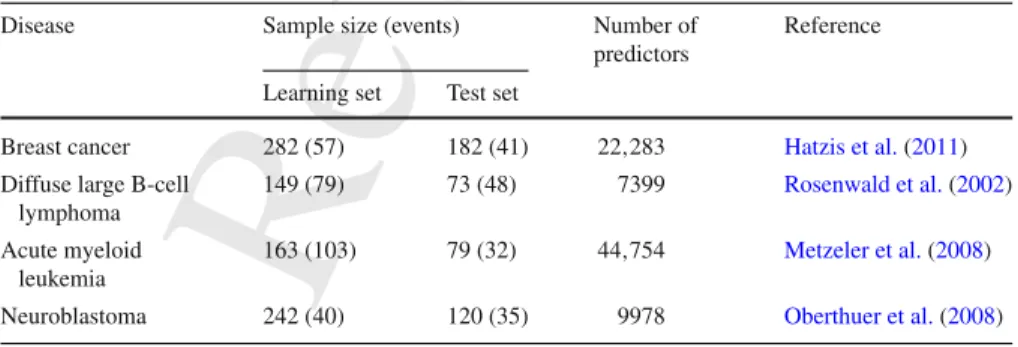
outcome and information on gene expression of patients (see Table1). Each of these 226
data sets consists of a learning set, using which we compute the optimal number of 227
boosting steps and fit the model, and a test set, for which we compute the integrated 228
Brier score. It is particularly important to keep the learning and test data totally separate 229
in order to have a reliable evaluation of the prediction abilities of the resulting models. 230
In all analyses, we assume that the covariate effects are linear and that the proportional 231
hazards assumption holds. 232
Breast cancer data This data set is from a prospective multicenter study conducted 233
byHatzis et al.(2011) to develop genomic predictors for neoadjuvant chemotherapy.
234
It involves patients with newly diagnosed ERBB2 (HER2 or HER2/neu)-negative 235
breast cancer, for which information is provided on the (possibly censored) distant 236
relapse-free survival time and the gene expressions of 22283 probe sets, which is 237
obtained through the Affymetrix U133A GeneChip. The data set consists of a learning 238
set, containing information on patients who had their biopsy between June 2000 and 239
December 2006, and an independent test set, whose patients had their biopsy between 240
April 2002 and January 2009. Specifically, we use the observations considered inDe 241
Bin et al.(2014b): the sample sizes are 282 patients (with 57 events) and 182 patients
242
Table 1 The four data sets used in our empirical study
Disease Sample size (events) Number of
predictors
Reference
Learning set Test set
Breast cancer 282 (57) 182 (41) 22,283 Hatzis et al.(2011)
Diffuse large B-cell lymphoma
149 (79) 73 (48) 7399 Rosenwald et al.(2002)
Acute myeloid leukemia
163 (103) 79 (32) 44,754 Metzeler et al.(2008)
Revised
Proof
(41 events) for the learning and test sets, respectively. The data are publicly available 243
from the Gene Expression Omnibus, reference GSE25066. 244
Diffuse large B-cell lymphoma The second data set is from the study ofRosenwald 245
et al.(2002) on patients with diffuse large B-cell lymphoma. It contains 7399
gene-246
expression measurements from 240 patients who had no previous history of lymphoma, 247
divided in a learning set (160 patients) and a test set (80 patients). The outcome of 248
interest is the overall survival time. In our paper we use the data set as pre-processed 249
byBøvelstad et al.(2009), which contains the information of only the 222 patients
250
for which the International Prognostic Index is also available. However, we did not 251
consider this predictor in our analysis. As a result of this restriction, the learning and 252
test sets contains 149 and 73 patients, respectively. Due to the presence of censored 253
data, the effective sample sizes are 79 (learning set) and 48 (test set). 254
Acute myeloid leukemia data The third data set contains information on patients with 255
acute myeloid leukemia enrolled between 1999 and 2003 (learning set) or in 2004 (test 256
set) in a multicenter trial of the German AML Cooperative Group (Metzeler et al. 2008). 257
The outcome of interest is the overall survival, defined as the time between study entry 258
and death from any cause. The learning set contains 163 patients, of which 103 died. 259
The data consist of the gene-expression measurements of 44754 probe sets, obtained 260
using the Affymetrix HG-U133 A&B microarray. For the 79 patients belonging to 261
the test set (32 events), instead, the gene expressions were derived using Affymetrix 262
HG-U133 plus 2.0 microarray. The data is publicly available from Gene Expression 263
Omnibus, reference GSE12417. 264
Neuroblastoma data The last data set contains information on patients with neurob-265
lastoma studied byOberthuer et al.(2008). The original learning set consists of 256 266
patients recruited between 1989 and 2004 for the German Neuroblastoma Trial NB90-267
NB2004 for which the overall survival time and the gene expressions of 9978 probe 268
sets are available. The test set consists of 120 patients with the same disease, but col-269
lected in several countries (29 in Germany, 26 in the US, 26 in France, 12 in Spain, 270
11 in Italy, 6 in Belgium, 5 in the UK and 5 in Israel), for which the same outcome 271
and probe sets were measured. In our study, we did not directly use the data from 272
the original study (available from the ArrayExpress database, accession number E-273
MTAB-16), but those pre-processed byBøvelstad et al.(2009), in which 14 patients 274
are excluded due to missing data. Since it was not possible to recover the original split 275
into learning and test sets, here we randomly split the whole data set into a learning 276
set of 242 patients (40 events) and a test set of 120 patients (35 observations), which 277
are the sample sizes used byBøvelstad et al.(2009). 278
3.2 Study design 279
The main focus of our first study is the cross-validation-based choice of the optimal 280
number of boosting steps in model-based and likelihood-based boosting. We consider 281
values between 0 and 200. The lower limit leads to the null model, while the upper limit 282
Revised
Proof
has been arbitrarily chosen as “sufficiently large” (namely, twice the default in both 283
mboostandCoxBoost). We investigate how the variability caused by randomness due 284
to the CV fold-split affects the results of the boosting procedures in terms of number 285
of iterations performed, selected predictors and prediction ability of the models. 286
In our analysis, for both boosting techniques we replicate the following 2000 times: 287
– we apply the 3-, 5-, 10- and 20-fold CV procedures to compute the optimal number 288
of boosting steps, using only the observations from the learning set; 289
– we fit a prediction model by applying the boosting technique to the learning set, 290
using the tuning parameter obtained in the previous point; 291
– we note the number of predictors selected in the model; 292
– we evaluate the prediction ability of the model by estimating the integrated Brier 293
score on the test set. 294
In addition, we collect the same information (number of boosting steps, number of 295
selected predictors, integrated Brier score) when using leave-one-out CV: since this 296
procedure is deterministic, this operation is performed only once. 297
3.3 Results 298
3.3.1 Number of boosting steps
299
The first goal of this empirical study is to evaluate how the optimal number of boosting 300
steps (mstop) is influenced by the different random splits—learning and test sets—of 301
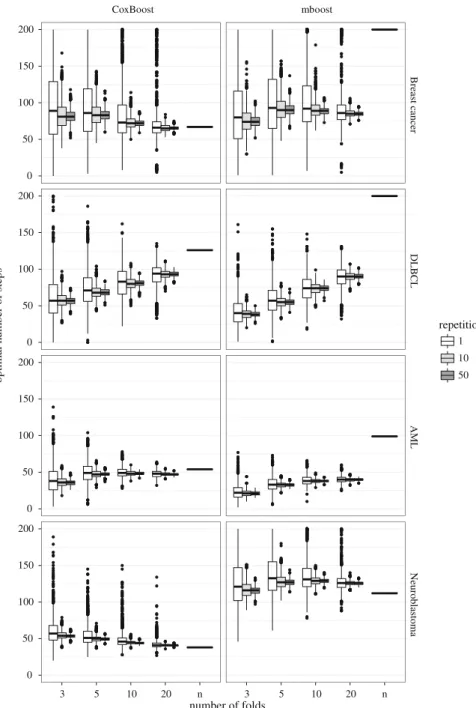
the cross-validation procedure. Figure1shows the distribution of the values obtained 302
over 2000 iterations for each data set, using the CV procedures implemented both in 303
mboostand inCoxBoost. This and the following figures contain information on results 304
of regular CV as well as information on results of repeated CV. The repeated CV is 305
discussed in Sect.4. For now we focus on the white boxplots in Fig.1, which show 306
results for the regular cross-validation. Regardless of the boosting technique chosen, 307
the variability ofmstop is very large, with values that range from 0 (minimum) to 308
200, the upper limit that we considered in our experiment. In particular, this means 309
that, using the same data, we can obtain completely different results simply due to 310
the particular fold-split used. The four considered example data sets suggest that 311
this result may be partially mitigated by a large sample size (although this different 312
behavior may of course also be simply due to random variations): we notice that in the 313
acute myeloid leukemia example, in which we have 103 events, we experience less 314
variability (see Fig.1, third row) than in the other data sets, especially when applying 315
mboost. Nevertheless, it is worth noting that the sample sizes and, more in general, 316
the characteristics of all our data sets, are typical of biomedical studies and therefore 317
in practical situations we may experience this large variability in the choice ofmstop. 318
As expected, the variability decreases with an increase in the number of folds because 319
increasing the number of folds means approaching to (the completely deterministic) 320
leave-one-out CV. Leave-one-out CV produces extreme numbers of steps inmboost
321
for all data sets except the Neuroblastoma data set and forCoxBoostin the DLBCL 322
data set. All extreme numbers of steps for leave-one-out CV are higher than most or 323
all numbers of steps computed by other cross-validation procedures. This suggests 324
Revised
Proof
CoxBoost mboost Breast cancer DLBCL AML Neuroblastoma 3 5 10 20 n 3 5 10 20 n 0 50 100 150 200 0 50 100 150 200 0 50 100 150 200 0 50 100 150 200 repetitions 1 10 50 optimal n u m b er of steps number of foldsFig. 1 Number of boosting steps (mstop) selected in the 2000 iterations (except leave-one out CV) computed
using different CV folds in the four data sets with bothCoxBoost(left) andmboost(right). The color defines the type of CV. White stands for normal, gray for repeated CV
Revised
Proof
that leave-one-out CV leads to models that are more likely to overfit the data in these 325
cases. 326
Note that in our study the number of boosting steps is allowed to vary from 0 327
to 200. In some cases (see, e.g., the results for the breast cancer data set, Fig. 1, 328
first row) the upper limit is reached, meaning that the results could be even more 329
extreme with a larger maximum number of boosting steps. Given the relevant increase 330
in computational time and computer memory necessary to consider a higher upper 331
limit, we think that a value of 200 is fairly reasonable and sufficient to demonstrate 332
the problem of variability induced due to the random CV splits. 333
3.3.2 Selected predictors
334
The high variability in the choice ofmstopis not a problem itself, but it may substantially 335
affect the model building process and consequently the properties of the prediction 336
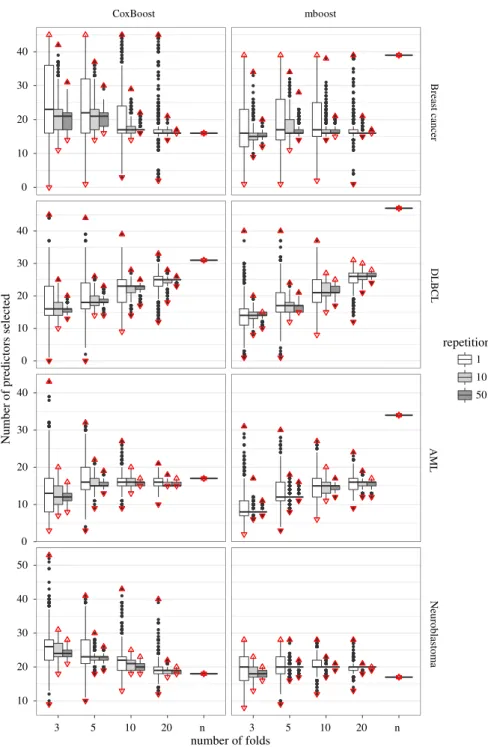
model. In Fig.2we report the number of predictors selected in each of the replications 337
of our experiment for the model-based (mboost) and the likelihood-based (CoxBoost) 338
boosting procedures, respectively. The downward facing triangles indicate the min-339
imum number of predictors selected, i.e. the number of predictors always selected. 340
The upward facing triangles indicate the maximum number of predictors selected, 341
i.e. the number of predictors selected at least once. For a more precise visualization 342
of the number of predictors always selected and the number of predictors selected at 343
least once, see Figures 6 and 7 in the Supplementary Material. The Supplementary 344
materials also contain the complete tables of the selected predictors, including the 345
information on the number of times they are selected (Tables 2–5 in the Supplemen-346
tary Material). Note that the number of predictors selected at least once, the number of 347
predictors always selected and the mean number of predictors selected, is equivalent 348
for leave-one-out CV because it is deterministic and was only computed once. 349
Again, we first focus on the regular CV and ignore the results of the repeated CV 350
for now. The different values of mstop, as determined by the random fold-splits in 351
the cross-validation procedure, greatly influence the prediction models in terms of 352
selected predictors. In particular, extremely low values ofmstopprevent the boosting 353
technique from including many predictors in the model: as a consequence, very few 354
predictors are selected in all 2000 replications performed in our study. On the other 355
hand, high values ofmstopcan result either in higher values for the estimates of a few 356
predictors or in a high number of selected predictors: in our examples the latter seems 357
to happen, as shown by the relatively large number of predictors selected at least once. 358
Note that a boosting model always contains all predictors of a scarcer model (with 359
fewer boosting steps), i.e. the predictors selected in the beginning always stay in the 360
model. 361
The (relatively) greater stability in the choice ofmstopinduced by a larger number 362
of folds in the cross-validation procedure results both in an increase in the number of 363
predictors selected in all replications and a decrease in the predictors selected at least 364
once. This is least strong in the application of the breast cancer data: both formboost
365
andCoxBoost, the variability of mstop slightly decreases with increasing number of 366
folds but not as strong as in the other applications (see Fig.1, first row). This results 367
in a less evident stabilization in the predictors selected. For example usingCoxBoost
Revised
Proof
Neuroblastoma AML 3 5 10 20 n 3 5 10 20 n 0 10 20 30 40 0 10 20 30 40 0 10 20 30 40 10 20 30 40 50 number of foldsNumber of predictors selected
repetitions 1 10 50 Breast cancer DLBCL CoxBoost mboost
Fig. 2 Number of predictors selected in 2000 iterations computed using different CV folds in the four data sets with bothCoxBoost(left) andmboost(right). The color defines the type of CV. White stands for normal, gray for repeated CV. The triangles indicate the minimum and maximum number of predictors selected (color figure online)
Revised
Proof
the number of predictors always included is 0 for the 3-fold CV, 1 for the 5-fold, 369
3 for the 10-fold and 2 for the 20-fold for the breast cancer data, whereas for the 370
acute myeloid leukemia data it is 3 for the 3-fold, 3 for the 5-fold, 9 for the 10-fold 371
and 10 for the 20-fold CV. The number of predictors selected at least once is always 372
45 for the breast cancer data but goes down from 43 (3-fold) to 21 (20-fold) for the 373
acute myeloid leukemia data. There is no tendency of the median number of selected 374
predictors over data sets. For the DLBCL and AML data it increases with increasing 375
number of folds. For the Breast cancer and Neuroblastoma data it decreases with 376
increasing number of folds for CoxBoost and does not show a clear tendency for 377
mboost. 378
Leave-one-out CV in general tends to favor more complex models, which are more 379
likely to overfit the learning data. Figure2 supports that inmboostfor all data sets 380
except the neuroblastoma data set. ForCoxBoostthe number of predictors selected is 381
particularly high for the DLBCL data. So essentially all examples that show extremely 382
high values formstopalso show many predictors included in the model. 383
Finally, we note that in all the four data sets the rank of the predictors based on 384
their inclusion frequencies is slightly different betweenmboost andCoxBoost (see 385
Tables 2–5 in the Supplementary Material). This is a consequence of the differences 386
in the learning path for the two boosting techniques (for further details, seeDe Bin 387
2016).
388
3.3.3 Connection between the number of boosting steps and the number of selected
389
predictors
390
Throughout the paper, we stressed the influence of the number of boosting steps on the 391
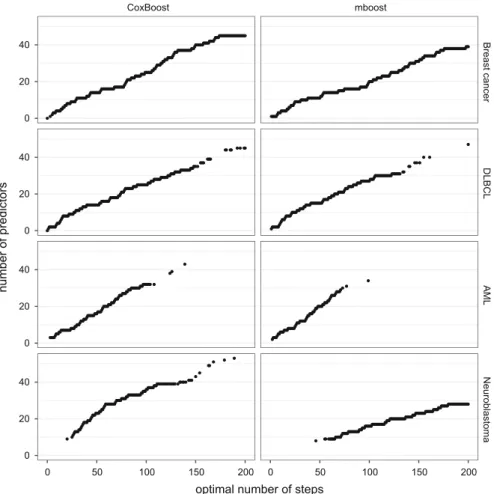
model sparsity. To better understand this statement, we plot in Fig.3all values ofmstop 392
obtained inalliterations against the number of predictors included in the corresponding 393
models. Given a certainmstop the model is deterministic and hence a differentiation 394
between different types of CV is not needed here. We note that models are less sparse 395
as the value of the optimal number of boosting steps increases, resulting in a non-396
decreasing function. The steps in the curve correspond to those iterations in which 397
the boosting algorithm includes a new predictor into the model. When the algorithm 398
updates the regression coefficient of a previously selected predictor, instead, the curve 399
remains flat. Please note that the boosting learning path is deterministic. Therefore, 400
once we know the number of boosting steps (and the penalty factor), we can determine 401
uniquely the fitted model. 402
Figure 3 shows once again how important a stable selection of the number of 403
boosting steps is. Extremely large values may result in extremely complex models and 404
the other way around for extremely smallmstop, with obvious implications in terms 405
of interpretation and prediction accuracy. 406
We note that the slopes of the curves formboostandCoxBoostare fairly similar. 407
The largest difference occurs in the Neuroblastoma data set. Here for the most extreme 408
value that we allow formstop, namely 200, the number of predictors is much lower 409
formboost(28) than forCoxBoost(53). Please note that the slopes of the curves are 410
also strongly related to the value chosen for the penalty parameter. The stronger the 411
penalty (i.e., smallerν for mboost, largerλ forCoxBoost, see also De Bin 2016), 412
Revised
Proof
CoxBoost mboost Breast cancer DLBCL AML Neuroblastoma 0 50 100 150 200 0 50 100 150 200 0 20 40 0 20 40 0 20 40 0 20 40optimal number of steps
number of predictors
Fig. 3 Optimal number of steps plotted against the number of predictors included in the respective model, for bothCoxBoost(left) andmboost(right)
the less steep the curve. Formboostwe usedν =0.1 and for CoxBoostλ =2052 413
for the breast cancer data,λ =1422 for the DLBCL data,λ =1854 for the AML 414
data andλ=720 for the neuroblastoma data. These values were computed using the 415
procedure described in Sect.2.2. Larger values of the penalty parameter correspond 416
to smaller step-wise updates of the coefficients, and consequently there are more 417
iterations without adding new predictors (flat parts of the curves in Fig.3); with a 418
larger penalty it may be necessary to perform two boosting steps to obtain the same 419
coefficient update obtained in one step in case of a small penalty. 420
3.3.4 Prediction ability
421
When we are interested in explanatory models, knowledge of the selected predictors 422
and the stability of the resulting model among several repetitions of the same procedure 423
is particularly important. This is not, however, the main focus of boosting: the boosting 424
Revised
Proof
approach is mainly used in the context of prediction models, where the focus is more 425
on the goodness of the prediction than on the model itself. For example, if we have two 426
strongly correlated predictors, from a predictive point of view it is equivalent to include 427
the former, the latter, or both with two coefficients that combine their effects. For this 428
reason, here we investigate the effect of the randomness of the cross-validation-based 429
choice ofmstopon the prediction ability, analyzing the differences in the estimates of 430
the integrated Brier score among the resultant models. We report in the white boxplots 431
of Fig.4the results forCoxBoost (left) and formboost(right) using 3-, 5-, 10-, 20-432
fold and leave-one-out CV. The results are based on 2000 iterations, except for the 433
leave-one-out CV, for which, obviously, only one value is provided. 434
As a consequence of the decrease in the variability ofmstop, and the relative decrease 435
in the variability in terms of selected predictors, the variability of the integrated Brier 436
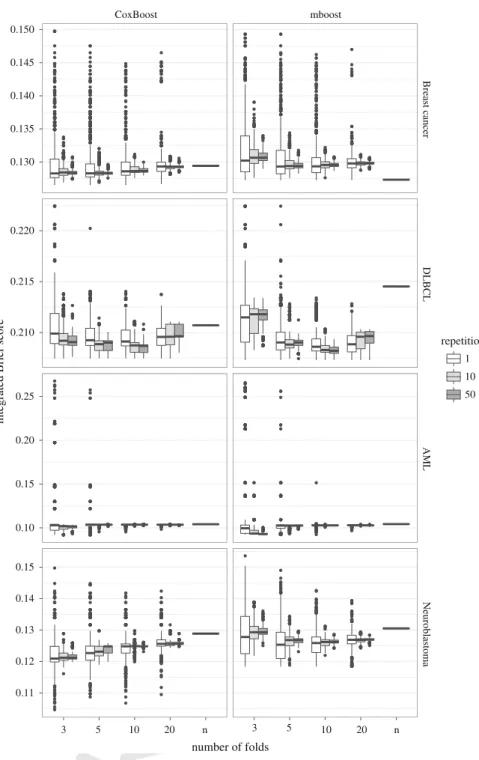
score decreases with an increase in the number of cross-validation folds. We note a 437
peculiar behavior in the acute myeloid leukemia example: despite it having the lowest 438
variability in terms ofmstop, it shows a high variability in terms of integrated Brier 439
score, with several cases of extremely high values (visualized by the outlier-points in 440
the box-plots of Fig.4). Strongly unexpected, leave-one-out CV leads to good results 441
formbooston the breast cancer data set. For some unknown reasons in this case the 442
more complex model is the better model. This does not happen often, and may be a 443
particularity of this data set, in which predictors with weak effects are relevant. Note 444
that this result may explain why in the original study a complex gene-signature (up to 445
73 probe-sets) leads to good results, which have not been obtained when focusing on 446
sparse models (see, e.g.De Bin et al. 2014b). Please note that, in general, the inclusion 447
of more predictors decreases the model portability (the model is too specific for the 448
learning data). In this sense, it is not surprising that this result has been obtained by 449
using leave-one-out CV, which is known to favor data-specific models. In all other 450
cases, indeed, the integrated Brier score from leave-one-out CV is higher than the 451
median of the integrated Brier score from other folds, including CoxBoost on the 452
breast cancer data set. 453
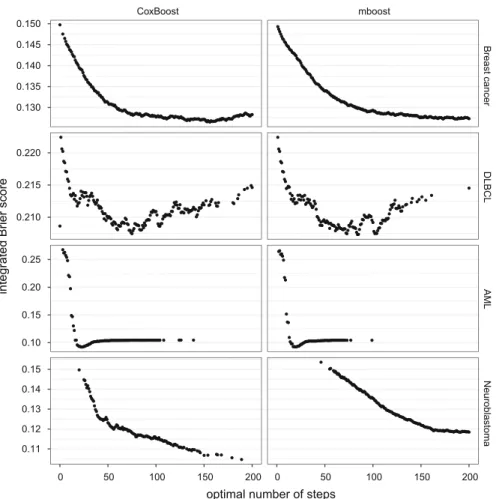
Figure5shows the connection between the number of boosting steps and the inte-454
grated Brier score for all analyses. Again, note that given a certainmstopthe model 455
is deterministic and thus we do not differentiate between types of CV here. For the 456
Breast cancer and the Neuroblastoma data sets the figures suggest thatmstopgreater 457
than 200 should have been chosen, whereas for the other two data sets 200 was more 458
than enough. The figure also gives information on why for the AML data set there are 459
such outliers in the integrated Brier score seen in Fig.4: The prediction performance 460
is very bad if there are only very few boosting steps but improves quickly with an 461
increase in the number of boosting steps. 462
4 Effect of repeated cross-validation
463In the previous section we saw that the randomness of the folds split in the cross-464
validation procedure causes variation in the results and the prediction ability. From a 465
theoretical point of view, to avoid this problem we should consider all the combinations 466
of then observations in K folds, following the theory of complete cross-validation 467
Revised
Proof
CoxBoost mboost Breast cancer DLBCL A ML Neuroblastoma 3 10 20 n 10 20 n 0.130 0.135 0.140 0.145 0.150 0.210 0.215 0.220 0.10 0.15 0.20 0.25 0.11 0.12 0.13 0.14 0.15 number of foldsintegrated Brier score
1 10 50
5 3 5
repetitions
Fig. 4 Integrated Brier score for models computed using different CV folds and a different number of repetitions in the four data sets, for bothCoxBoost(left) andmboost(right)
Revised
Proof
CoxBoost mboost Breast cancer DLBCL AML Neuroblastoma 0 50 100 150 200 0 50 100 150 200 0.130 0.135 0.140 0.145 0.150 0.210 0.215 0.220 0.10 0.15 0.20 0.25 0.11 0.12 0.13 0.14 0.15optimal number of steps
integrated Brier score
Fig. 5 Optimal number of steps plotted against the integrated Brier score, for bothCoxBoost(left) and
mboost(right)
(Kohavi 1995), and transform the estimator of mstop based on the cross-validated
468
likelihood into a complete U-statistic. With the usual sample size of a medical study, 469
this is clearly computationally unfeasible (see alsoFuchs et al. 2013). Between the 470
current case of only one split and the theoretical case of all splits, nonetheless, there 471
are several intermediate cases in which we can obtain a more stable result in an 472
acceptable amount of time. For this reason, we suggest the use of a repeated cross-473
validation procedure for the choice of the tuning parameter: instead of considering the 474
cross-validated partial log-likelihood, one should consider a repeated cross-validated 475 partial log-likelihood, 476 r cvpl(m)= R r=1 cvplr(m) 477
with R being the number of repetitions and cvplr(m) the cross-validated partial
478
log-likelihood of the r-th repetition. Note that due to the random nature of cross-479
Revised
Proof
validation the subsets D1, . . . ,DK (see Eq. 1) are different for each repetition
480
r=1, . . . ,R. 481
Again, the optimal value ofmstopis computed by maximizing the function overm. 482
4.1 Study design 483
The repeated cross-validated likelihood should be based on the maximum feasible 484
number of different splits, i.e. the largest I that is within the constraints of rea-485
sonable calculation time. In our study, involving 2000 replications of 4 kinds of 486
cross-validation, we considerI =10 as well asI =50. Obviously, when the goal is to 487
fit a prediction model based on a specific sample, a larger number can be considered. 488
The data sets and the methods used in this section are the same as Sect.3. Leave-one-489
out CV is not considered again because the results do not change. We fit a prediction 490
model using the tuning parameter computed in a 3-, 5-, 10- and 20-fold CV procedure 491
and we consider the selected predictors and the prediction ability in terms of integrated 492
Brier score. The procedure is repeated 2000 times. 493
4.2 Results 494
In this section we focus on the impact of repeated CV and with this, also address the 495
parts of the previous figures that were not addressed in Sect.3. 496
4.2.1 Number of boosting steps
497
Figure1shows the improvements in stability in the choice of the optimal number of 498
boosting steps using the repeated cross-validated partial log-likelihood. If we compare 499
the results of repeated cross-validation in gray and normal cross-validation in white, 500
we note a pronounced decrease in the variability, both in terms of interquartile and 501
total range. The decrease between normal CV and the 10 times repeated CV is greater 502
than the decrease between 10 and 50 repetitions. The medians of the distributions are 503
almost equal with a light tendency of being lower when computed with the repeated 504
cross-validated partial log-likelihood. The reason probably lies in the avoidance of 505
the highest values that characterized the distributions in the original cross-validation 506
procedure. The absence of the extreme values (especially those on the borders, namely 507
0 and 200), in particular, is the most positive improvement obtained by implementing 508
the repeated cross-validation, because it prevents situations in whichmstopis chosen 509
incorrectly due to a particularly unfortunate partition of the observations. 510
4.2.2 Selected predictors
511
The superiority of a more stable choice for the optimal number of boosting steps is 512
clear when examining selected predictors (Figure 7 in the Supplementary Material). 513
Avoiding underestimation and overestimation ofmstop, indeed, leads to the identifica-514
tion of a clear group of relevant predictors always selected in our 2000 replications, 515
and to the decrease of the rarely selected predictors. The latter property is particularly 516
Revised
Proof
evident in the acute myeloid leukemia example, in which the maximum number of 517
selected predictors is 22 when using 10 repetitions and 19 with 50 repetitions. We note 518
that with 50 repetitions we are relatively close to a deterministic result, i.e. the inclu-519
sion frequencies of the predictors is mostly 2000 (always) or 0 (never). The median 520
number of predictors selected barely changes except for the Breast cancer data, for 521
which the median number of predictors selected is lower when the cross-validation 522
is repeated. The complete information on which predictors were selected is shown in 523
Tables 2–13 in the Supplementary Material. 524
4.2.3 Prediction ability
525
The analysis of the integrated Brier score also reflects the advantages of using a 526
repeated cross-validated partial log-likelihood for the choice ofmstop. As can be seen 527
in Fig. 4, the avoidance of extreme values for the tuning parameter results in the 528
disappearance of the worst prediction performances obtained with the simple cross-529
validated partial log-likelihood. For the acute myeloid leukemia example for both 530
mboostandCoxBoostthe bad predictions experienced in the previous section do not 531
occur. The improvement between 10 and 50 repetitions of cross-validation is not as 532
striking as between none and 10 repetitions but with 50 repetitions we come even 533
closer to a stable result, especially for 3-fold CV. To support our findings through 534
Fig. 4 and to analyse the importance of both the number of folds in CV and the 535
number of repetitions, we computed a linear model with the interquartile range of 536
the integrated Brier score as endpoint including main effects of repeated CV and the 537
number of folds. We computed the interquartile range from the 2000 iterations for 538
each method (CoxBoost and mboost), data set, number of folds and number of CV 539
repetitions, which results in 96 values. We computed a separate model for mboost and 540
CoxBoost. The models show that using 10 repetitions instead of 1 has a significant 541
impact whereas using 50 repetitions instead of 10 is not as pronounced for both mboost 542
and CoxBoost (see Table 14 in the Supplementary Material). The more folds are used 543
the lower the interquartile range of the integrated Brier score, but the only confidence 544
interval where both limits are (at least slightly) negative is in the comparison of 5 545
versus 3 folds. The effects estimated from the linear models depend strongly on the 546
four data sets selected. However a simulation study showed comparable results (see 547
Table 1 in the Supplementary Material) which further supports our findings. 548
5 Conclusions
549Boosting techniques have proved to be useful tools in selecting a prediction model, 550
especially in the important case in which the number of predictors is much higher than 551
the number of observations. One weakness of boosting is the strong dependence on 552
tuning parametermstop, namely the number of boosting steps. Please note that several 553
statistical methods share this weakness. Until now there has not been a convincing 554
theory developed on the choice of this parameter and practitioners are compelled 555
to use a cross-validation procedure. We have seen that this solution is sub-optimal, 556
since it may lead to surprisingly different results in terms of selected predictors and 557
Revised
Proof
prediction ability of the model depending on the particular partition of the observations 558
into the CV folds. A particularly unfortunate split may cause a severe underestimation 559
or overestimation of the optimal value of boosting steps, with the consequence that 560
the boosting algorithm may produce a very misleading model. We have seen that this 561
problem affects the CV procedure irrespectively of the number of folds used. In our 562
study, we showed that the implementation of a repeated CV procedure decreases the 563
variability in the choice of the tuning parameter and produces a more robust result: as 564
a consequence, far fewer extreme values ofmstopwould be expected. The results of the 565
10-replication cross-validated partial log-likelihood suggest that few replications are 566
sufficient to greatly improve the selection of the best tuning parameter. The extension to 567
50 replications shows that increasing the number of replications may lead to even better 568
results. As often happens, however, there is no free-lunch solution and an increase in 569
replications also results in a large increase in the number of computations to perform. 570
Therefore, the trade-off between variability reduction and computational time plays an 571
important role in the choice of the number of replications. In our opinion, 10 (or only 572
a few more, let us say 15 or 20) replications may be sufficient to avoid extreme cases 573
and, consequently, obtain reliable results. Nevertheless, we note that the advances in 574
computational techniques (e.g., parallel computing) and computational power (better 575
hardware) constantly relax the computational time issues, and in the future more 576
replications may be implemented without noticeable drawbacks. In this work we 577
focused on boosting for high-dimensional linear Cox-models. We believe that repeated 578
cross-validation will lead to similar improvements in other contexts. Details, however, 579
have to be studied. 580
Acknowledgements We thank Rory Wilson and Jenny Lee for language improvements. HS and RDB 581
were supported by Grants BO3139/4-1, BO3139/4-2 and BO3139/2-3 to ALB from the German Research 582
Foundation (DFG). 583
References
584Binder H (2013) CoxBoost: Cox models by likelihood based boosting for a single survival endpoint or 585
competing risks, R package version 1.4.http://CRAN.R-project.org/package=CoxBoost 586
Binder H, Schumacher M (2008a) Allowing for mandatory covariates in boosting estimation of sparse 587
high-dimensional survival models. BMC Bioinform 9:14 588
Binder H, Schumacher M (2008b) Adapting prediction error estimates for biased complexity selection in 589
high-dimensional bootstrap samples. Stat Appl Genet Mol Biol 7:12 590
Boulesteix AL, Richter A, Bernau C (2013) Complexity selection with cross-validation for lasso and sparse 591
partial least squares using high-dimensional data. In: Lausen B, Van den Poel D, Ultsch A (eds) 592
Algorithms from and for nature and life. Springer, Berlin, pp 261–268 593
Bøvelstad H, Nygård S, Borgan Ø (2009) Survival prediction from clinico-genomic models—a comparative 594
study. BMC Bioinform 10:413 595
Brier GW (1950) Verification of forecasts expressed in terms of probability. Mon Weather Rev 78:1–3 596
Bühlmann P (2006) Boosting for high-dimensional linear models. Ann Stat 34:559–583 597
Bühlmann P, Hothorn T (2007) Boosting algorithms: regularization, prediction and model fitting. Stat Sci 598
22:477–505 599
Bühlmann P, Yu B (2003) Boosting with the L2loss: regression and classification. J Am Stat Assoc 98:324– 600
339 601
Chang YCI, Huang Y, Huang YP (2010) Early stopping inl2boosting. Comput Stat Data Anal 54:2203–2213 602
De Bin R (2016) Boosting in Cox regression: a comparison between the likelihood-based and the model-603
based approaches with focus on the R-packages CoxBoost and mboost. Comput Stat 31:513–531 604
Revised
Proof
De Bin R, Herold T, Boulesteix AL (2014a) Added predictive value of omics data: specific issues related 605to validation illustrated by two case studies. BMC Med Res Methodol 14:117 606
De Bin R, Sauerbrei W, Boulesteix AL (2014b) Investigating the prediction ability of survival models based 607
on both clinical and omics data: two case studies. Stat Med 33:5310–5329 608
Efron B, Hastie T, Johnstone I, Tibshirani R (2004) Least angle regression. Ann Stat 32:407–499 609
Freund Y, Schapire R (1996) Experiments with a new boosting algorithm. In: Proceedings of the 13th 610
international conference on machine learning. Morgan Kaufmann, pp 148–156 611
Friedman JH (2001) Greedy function approximation: a gradient boosting machine. Ann Stat 29:1189–1232 612
Fuchs M, Hornung R, De Bin R, Boulesteix, AL (2013) A U-statistic estimator for the variance of 613
resampling-based error estimators. Technical Report 148, University of Munich 614
Gerds TA, Schumacher M (2006) Consistent estimation of the expected brier score in general survival 615
models with right-censored event times. Biom J 48(6):1029–1040 616
Graf E, Schmoor C, Sauerbrei W, Schumacher M (1999) Assessment and comparison of prognostic classi-617
fication schemes for survival data. Stat Med 18:2529–2545 618
Hastie T, Tibshirani R, Friedman J (2001) The elements of statistical learning: data mining, inference and 619
prediction. Springer, New York 620
Hatzis C, Pusztai L, Valero V, Booser DJ, Esserman L, Lluch A, Vidaurre T, Holmes F, Souchon E, 621
Wang H et al (2011) A genomic predictor of response and survival following taxane–anthracycline 622
chemotherapy for invasive breast cancer. J Am Med Assoc 305(18):1873 623
Hofner B, Mayr A, Robinzonov N, Schmid M (2014) Model-based boosting in R: a hands-on tutorial using 624
the R package mboost. Comput Stat 29:3–35 625
Hothorn T, Bühlmann P, Dudoit S, Molinaro A, Van Der Laan MJ (2006) Survival ensembles. Biostatistics 626
7:355–373 627
Hothorn T, Buehlmann P, Kneib T, Schmid M, Hofner B (2015) mboost: model-based boosting, R package 628
version 2.4-2.http://CRAN.R-project.org/package=mboost 629
Kohavi R (1995) A study of cross-validation and bootstrap for accuracy estimation and model selection. 630
In: Proceedings of international joint conference on artificial intelligence, pp 1137–1145 631
Mayr A, Hofner B, Schmid M (2012) The importance of knowing when to stop. A sequential stopping rule 632
for component-wise gradient boosting. Methods Inf Med 51:178–186 633
Mayr A, Binder H, Gefeller O, Schmid M (2014a) Extending statistical boosting. Methods Inf Med 53:428– 634
435 635
Mayr A, Binder H, Gefeller O, Schmid M (2014b) The evolution of boosting algorithms. Methods Inf Med 636
53:419–427 637
Metzeler KH, Hummel M, Bloomfield CD, Spiekermann K, Braess J, Sauerland MC, Heinecke A, Rad-638
macher M, Marcucci G, Whitman SP et al (2008) An 86-probe-set gene-expression signature predicts 639
survival in cytogenetically normal acute myeloid leukemia. Blood 112(10):4193–4201 640
Mogensen UB, Ishwaran H, Gerds TA (2012) Evaluating random forests for survival analysis using predic-641
tion error curves. J Stat Soft 50(11):1–23 642
Oberthuer A, Kaderali L, Kahlert Y, Hero B, Westermann F, Berthold F, Brors B, Eils R, Fischer M (2008) 643
Subclassification and individual survival time prediction from gene expression data of neuroblastoma 644
patients by using caspar. Clin Cancer Res 14(20):6590–6601 645
Ridgeway G (1999) Generalization of boosting algorithms and applications of Bayesian inference for 646
massive datasets. PhD thesis, University of Washington 647
Rosenwald A, Wright G, Chan WC, Connors JM, Campo E, Fisher RI, Gascoyne RD, Muller-Hermelink 648
HK, Smeland EB, Giltnane JM et al (2002) The use of molecular profiling to predict survival after 649
chemotherapy for diffuse large-b-cell lymphoma. N Engl J Med 346(25):1937–1947 650
Schmid M, Hothorn T (2008) Flexible boosting of accelerated failure time models. BMC Bioinform 9:269 651
Schumacher M, Binder H, Gerds T (2007) Assessment of survival prediction models based on microarray 652
data. Bioinformatics 23:1768–1774 653
Tutz G, Binder H (2006) Generalized additive modeling with implicit variable selection by likelihood-based 654
boosting. Biometrics 62:961–971 655
Verweij PJ, Van Houwelingen HC (1993) Cross-validation in survival analysis. Stat Med 12:2305–2314 656