V T T P U B L I C A T I O N S
TECHNICAL RESEARCH CENTRE OF FINLAND ESPOO 2000
Minna Mäkäräinen
Software change management
processes in the development of
embedded software
4 1 6
VTT PUBLICATIONS 416
Software change management processes in the development of embedded...
Minna Mäkäräinen
Tätä julkaisua myy Denna publikation säljs av This publication is available from VTT TIETOPALVELU VTT INFORMATIONSTJÄNST VTT INFORMATION SERVICE
PL 2000 PB 2000 P.O.Box 2000
02044 VTT 02044 VTT FIN–02044 VTT, Finland Puh. (09) 456 4404 Tel. (09) 456 4404 Phone internat. + 358 9 456 4404 Faksi (09) 456 4374 Fax (09) 456 4374 Fax + 358 9 456 4374
V T T P u b l i c a t i o n s
V T T P u b l i c a t i o n s
V T T P u b l i c a t i o n s
V T T P u b l i c a t i o n s
V T T P u b l i c a t i o n s
V T T P u b l i c a t i o n s
V T T P u b l i c a t i o n s
V T T P u b l i c a t i o n s
V T T P u b l i c a t i o n s
P
ISBN 951–38–5573–2 (soft back ed.) ISBN 951–38–5574–0 (URL: http://www.inf.vtt.fi/pdf/)ISSN 1235–0621 (soft back ed.) ISSN 1455–0849 (URL: http://www.inf.vtt.fi/pdf/)
VTT PUBLICATIONS
395 Ämmälahti, Erja. Application of NMR spectroscopy to structural studies of lignin. 1999. 58 p. + app. 33 p.
396 Tervonen, Juha. Accident costing using value transfers. New unit costs for personal
injuries in Finland. 1999. 99 p. + app. 14 p.
397 Sirola, Miki. Computerized decision support systems in failure and maintenance
man-agement of safety critical processes. 1999. 123 p. + 24 p.
398 Kuikka, Seppo. A batch process management framework. Domain-specific, design
pattern and software component based approach. 1999. 215 p.
399 Laitinen, Tarja. Thiosulfate pitting corrosion of stainless steels in the paper machine environment. 1999. 33 p. + app. 68 p.
400 Joutsensaari, Jorma. Aerosol synthesis of nanostructured, ultrafine fullerene particles. 1999. 64 p. + app. 101 p.
401 Roine, Matti. Accident risks of car drivers in wintertime traffic. 1999. 137 p. + app. 20 p.
402 Niemelä, Eila. A component framework of a distributed control systems family. 1999.
188 p. + app. 68 p.
403 Laitinen, Antero. Supercritical fluid extraction of organic compounds from solids and
aqueous solutions. 1999. 58 p. + app. 84 p.
404 Helynen, Satu. Production and consumption potentials for bioenergy in Finland to the
year 2010. 1999. 97 p. + app. 31 p.
405 Saarinen, Ari. EMFI-actuator: vibro-acoustical consideration. 1999. 109 p. + app. 30 p. 406 Korhonen, Jukka, Salmela, Mika & Kalaoja, Jarmo. The reuse of tests for configured
software products. 2000. 67 p.
407 Rusanen, Outi. Adhesives in micromechanical sensor packaging. 2000. 74 p. + app.
54 p.
408 Koskela, Lauri. An exploration towards a production theory and its application to
construction. 2000. 296 p.
409 Rahikkala, Tua. Towards virtual software configuration management. A case study.
2000. 110 p. + app. 57 p.
410 Storgårds, Erna. Process hygiene control in beer production and dispensing. 2000.
105 p. + app. 66 p.
411 Kivistö-Rahnasto, Jouni. Machine safety design. An approach fulfilling European
safety requirements. 2000. 99 p. + app. 9 p.
412 Tuulari, Esa. Context aware hand-held devices. 2000. 81 p.
414 Valmari, Tuomas. Potassium behaviour during combustion of wood incirculating
fluidised bedpower plants. 2000. 88 p. + app. 75 p.
415 Mäkelä, Kari. Development of techniques for electrochemical studies in power plant
environments. 2000. 46 p. + app. 128 p.
416 Mäkäräinen, Minna. Software change management processes in the development of
VTT PUBLICATIONS 416
Software change
management processes
in the development of
embedded software
Minna Mäkäräinen
VTT ElectronicsAcademic Dissertation to be presented with the assent of the Faculty of Science, University of Oulu, for public discussion in the Auditorium L10,
ISBN 951–38–5573–2 (soft back ed.) ISSN 1235–0621 (soft back ed.)
ISBN 951–38–5574–0 (URL: http://www.inf.vtt.fi/pdf/) ISSN 1455–0849 (URL: http://www.inf.vtt.fi/pdf/)
Copyright © Valtion teknillinen tutkimuskeskus (VTT) 2000
JULKAISIJA – UTGIVARE – PUBLISHER
Valtion teknillinen tutkimuskeskus (VTT), Vuorimiehentie 5, PL 2000, 02044 VTT puh. vaihde (09) 4561, faksi (09) 456 4374
Statens tekniska forskningscentral (VTT), Bergsmansvägen 5, PB 2000, 02044 VTT tel. växel (09) 4561, fax (09) 456 4374
Technical Research Centre of Finland (VTT), Vuorimiehentie 5, P.O.Box 2000, FIN–02044 VTT, Finland phone internat. + 358 9 4561, fax + 358 9 456 4374
VTT Elektroniikka, Sulautetut ohjelmistot, Kaitoväylä 1, PL 1100, 90571 OULU puh. vaihde (08) 551 2111, faksi (08) 551 2320
VTT Elektronik, Inbyggd programvara, Kaitoväylä 1, PB 1100, 90571 ULEÅBORG tel. växel (08) 551 2111, fax (08) 551 2320
VTT Electronics, Embedded Software, Kaitoväylä 1, P.O.Box 1100, FIN–90571 OULU, Finland phone internat. + 358 8 551 2111, fax + 358 8 551 2320
Mäkäräinen, Minna. Software change management processes in the development of embedded soft-ware. Espoo 2000, Technical Research Centre of Finland, VTT Publications 416. 185 p.+ app. 56 p.
Keywords software change management, software configuration, software maintenance,
process improvement, process modelling, process analysis
Abstract
The goal of the research presented in this thesis is to examine software change management processes in order to identify essential change management prob-lems and improvement requirements, to define processes which would aid in solving these problems, and give an example of how these processes can be implemented in practice.
The subjects of the empirical research part of the study have been four Finnish companies which develop embedded software. Therefore, the focus of the study is on the processes which are used in developing embedded software. However, the literature study explores the problems of software change management from a more generic viewpoint, and can also be used as a reference for software de-velopment done for other purposes.
Three of the four case studies are used in deriving the generic change manage-ment problem classes and process descriptions. These three case studies include only analysis of the change processes and problems related to them. The fourth case study is used for illustrating how the proposed problem classification can be used in change process analysis, and how the proposed process models can be instantiated in practice. The change processes were not only analysed, but the study also included the definition of new processes, the planning of their im-plementation, and the implementation and enactment of the new processes in the organisation.
Preface
This thesis summarises the results of the research I was involved in while working at VTT Electronics. It explores the problems of software change man-agement on the basis of a literature study and practical case examples. I started to contemplate the process of software change management when I was working in the ESPRIT project called AMES. Later, I had the opportunity to apply the solutions and ideas developed in the AMES project in projects for Finnish com-panies. The literature study part of the thesis was mainly done while I was working as a visiting researcher at Fraunhofer IESE, Germany. I finalised the writing of the thesis while working at Nokia Mobile Phones. I want to thank Dr. Veikko Seppänen and Dr. Jorma Taramaa for encouraging me to continue my studies at VTT Electronics, Dr. Dieter Rombach for the opportunity to work at Fraunhofer IESE, and Dr. Pekka Isomursu and Dr. Pertti Huuskonen for helping me through the last phases of the writing process at Nokia Mobile Phones. Un-fortunately, I am not allowed to name the helpful persons from the companies I studied during the research process. Anonymous thanks to all of you!
This work has been financially supported by my employers. I also received fi-nancial support, which is gratefully acknowledged, from the following founda-tions: Seppo Säynäjäkankaan rahasto, Tauno Tönningin säätiö, and the Finnish Cultural Foundation.
Dr. Ilkka Tervonen has been the advisor of my post-graduate studies for seven years. I cannot thank him enough for all the work he has done for my studies. The reviewers of the thesis, Dr. Cornelia Boldyreff and Dr. Karlheinz Kautz, gave me valuable and profound comments, which dramatically improved the quality of the thesis. I am very grateful for the time and effort they used for re-viewing my work.
Finally, I want to thank my family and friends for their love and support. My parents have given me an enormous amount of support and understanding, still giving me the space to live my own life. And Pekka, my soulmate, thank you for all you are!
Contents
Abstract ...3
Preface...4
List of symbols...8
1 Introduction...9
1.1 Research questions and overview of research methods...10
1.2 Scope of the research...11
1.3 Structure of the thesis ...12
2 Research method ...16
2.1 Overview...16
2.2 Research approach ...16
2.3 Research methods used in the case studies in the problem analysis stage ...16
2.4 Research methods used in the construction stage...23
2.5 Research methods used in the demonstration stage...24
2.5.1 First phase: Analysis of current practices...26
2.5.2 Second phase: Definition of goals for new practices ...29
2.6 Evaluation of the results ...30
2.7 Research process...31
2.8 Summary...33
3 Analysis of related work ...34
3.1 Overview...34
3.2 Scope of software change management...34
3.3 Why is software change management difficult?...41
3.4 Software change management – Product dimension ...44
3.5 Software change management – Process dimension ...46
3.5.1 Olsen's change management model ...48
3.5.2 V-like change management model...50
3.5.3 Ince's change process model ...52
3.5.4 The AMES model ...55
3.5.5 Spiral-like change management process...56
3.6 Software change management – Technological dimension...58
3.7 Summary...62
4 Analysis of the state of the practice ...63
4.1 Overview...63
4.2 Summary of case studies ...63
4.2.1 Case one...64
4.2.2 Case two...70
4.2.3 Case three ...74
5 Software change management problems...81
5.1 Overview...81
5.2 Classification of problems and improvement requirements in change management processes...81
5.2.1 Effectiveness problems...82
5.2.2 Communication problems...84
5.2.3 Analysis and location problems...87
5.2.4 Traceability problems ...89
5.2.5 Decision-making problems ...90
5.2.6 Tool-related problems...91
5.3 Summary...96
6 Generic change management process model ...97
6.1 Overview...97
6.2 Background...97
6.3 Layered change processes...98
6.3.1 Product-level changes ...102
6.3.2 Project-level changes ...103
6.4 Generic change management process ...104
6.4.1 Trivial defect correction ...106
6.4.2 Defect correction ...109
6.4.3 Requirement-level modification ...111
6.4.4 Improvement proposal ...111
6.5 Relation of process levels and process types...112
6.6 Comparison to other models...112
6.7 Summary...114
7 Implementation ...116
7.1 Overview...116
7.2 Operational organisation...116
7.3 Process management...116
7.3.1 Reviews of change requests...117
7.3.2 Monitoring the change requests...117
7.4 Quality responsibilities related to change requests ...118
7.4.1 Technical review...118
7.4.2 Testing ...118
7.4.3 Other change types ...119
7.5 Sources of change requests...119
7.6 Description of the change management process...122
7.7 Existing change management support ...125
7.8 Problems and improvement proposals related to change management ...127
7.8.1 Effectiveness problems...127
7.8.2 Communication problems...127
7.8.3 Analysis and location problems...128
7.8.4 Traceability problems ...130
7.8.6 Tool-related problems...131
7.9 Description of the implementation solution ...132
7.9.1 Vocabulary...132
7.9.2 Instantiation of the generic processes in the case study ...133
7.9.3 Selection of tool environment...153
7.10 Implementation and deployment of the defined solution...155
7.11 Summary ...159
8 Evaluation of results ...160
8.1 Introduction...160
8.2 Evaluation of the change management problem classification...160
8.3 Evaluation of the change management process model ...162
8.4 Experiences from the implementation and deployment ...167
8.5 Summary ...171
9 Conclusions...172
9.1 Answers to research questions...172
9.2 Generalisation of the results ...173
9.3 Future research...174
10 Epilogue ...176
References ...177
Appendix A: Case one – aerospace organisation
Appendix B: Case two – consumer electronics organisation Appendix C: Case three – telecommunication organisation
List of symbols
AMES An ESPRIT project on tools and methods for application management
CM Change Management
CMM Capability Maturity Model developed by the SEI
CMS Code Management System, version control tool by Digital
CS Cellular System
ESPRIT European Strategic Program for Research and Development in Infor-mation Technology
GQM Goal-Question-Metric method
HOOD Hierarchical Object Oriented Design, an object oriented design lan-guage
HW Hardware
OS Operating System
Pr2imer Practical Process Improvement for Embedded Real-Time Software, a process improvement service package by VTT Electronics
SADT Structured analysis and design technique SCM Software Configuration Management
SEI Software Engineering Institute at the Carnegie Mellon University, Pittsburgh, USA
SW Software
UI User interface
VTT Technical Research Centre of Finland (Valtion teknillinen tut-kimuskeskus, in Finnish)
1 Introduction
The problem of managing software changes has gained a lot of attention in re-cent years. The European Space Agency’s Ariane 5 Flight 501 rocket disaster was caused by poor change management in reused software parts. The year 2000 problem has required a great deal of effort on updating and verifying the opera-tionality of software systems all over the world. The combination of year 2000 modifications and the inception of the European Monetary Union between 1998 and 2002 will result in fundamental modifications to most legacy systems used today; to name but a few of the recent change management crises.
At the same time, the importance of software development in electronics has increased rapidly during the past ten to fifteen years. One of the basic reasons for this is that new types of software-intensive products have emerged, espe-cially in communications and consumer electronics. This growth has put pres-sure on companies and led to the adoption of effective software engineering processes.
During the early days of embedded systems development it was normal to de-velop the different technological parts of the system, such as hardware, system software and application software, separately. At present, the development of different product technologies must be done concurrently. Time-to-market con-straints require better integration of the different product technologies. During the development of the hardware and software components, the system require-ments often change and evolve. The changes relate to all parts of the product, creating problems and special requirements for change management.
Customer-specific features of electronics products are often implemented by means of application software rather than hardware. The existence of several customer-specific versions of the same application software creates problems in managing the modifications. The applications may share most parts of the source code, or they may be totally separate with redundant source code parts. Both situations are problematic. If the applications share parts of the source code, changes made in one of the applications are reflected in the other applica-tions through the common parts and may create erroneous situaapplica-tions or unex-pected behaviour. When the applications are totally separate, a modification
implemented in one application has to be repeated several times if it is relevant to some other applications.
The use of reusable software components has increased in the development of embedded software. The software is not programmed from scratch, but rather assembled using reusable software components. This kind of a development process sets special requirements for change management, such as the mainte-nance of a component library, predicting the impacts of changes in reused com-ponents, analysing the behaviour of the combination of reused components and new software, managing versions of reused components, etc.
In the case of embedded software, needs for changes are not only created by the application software, but also by the hardware, the system software and other parts of the product (Taramaa 1998). If the hardware components of the product have to be modified for example because of a design error, a corresponding modification may also be necessary in the application software. The hardware and software components are usually designed concurrently. Since the hardware environment is not stable when the software requirements are defined, redefini-tion of both applicaredefini-tion and system software is often unavoidable. Therefore, continuous interaction between application software, hardware and system software developers and maintainers is required.
1.1 Research questions and overview of research
methods
The goal of the thesis is to find answers to the following research questions:
• What are the essential change management problems and improvement re-quirements found in developing embedded software?
• What kind of a management processes would help in responding to these requirements?
The first research question is studied using a literature study and by analysing the change management processes in three organisations. The case study organi-sations are analysed using semi-structured focused interviews complemented with tool and document analysis and analysis of process and product related measurement data, when available. Using these sources, essential problems in change management are identified and analysed, and improvement requirements for change management practices are proposed. As a result of the analysis of change management problems a characterisation of the problem domain is de-rived, and a classification of the typical problems in software change manage-ment is developed. The problems are related to the special features of compa-nies developing embedded software.
The second research question examines what kind of generic change manage-ment process types would provide support for responding to the software change management problems identified. As a result, a generic model of software change management processes is derived.
The proposed generic process model is applied in one case study in order to implement new change management processes. The implementation process is described in order to answer to research question three. The implementation solution will be described, including (1) a description of the initial change man-agement status and the requirements for improving software change manage-ment practices in the organisation, (2) an analysis of change managemanage-ment prob-lems using the problem classification proposed, (3) the process models instanti-ated from the generic change management processes presented, and (4) a de-scription of the technical implementation. Finally, the experiences of using the new change management solutions based on the proposed model are evaluated. The used research methods are described in detail in chapter 2.
1.2 Scope of the research
The scope of software change management is restricted in this thesis to changes in the software itself, i.e. source code, design documentation, test cases, user manuals, etc. It is not defined to cover issues related to changes in the develop-ment environdevelop-ment, human resources, project schedules, etc.
The industrial case studies presented in the thesis are all from the domain of embedded software. Therefore, the thesis proposes a change management prob-lem classification and process model for organisations developing embedded software. Since other application domains have been studied only from the viewpoint of the research presented in the literature, a thorough analysis of dif-ferences between the domain of embedded software and other domains was not possible. The specific requirements for the development of embedded software are analysed by mapping the identified problem areas and improvement re-quirements onto the special features of the embedded software.
The thesis focuses on the change management process. The tools and techno-logical solutions for specific process activities, such as program comprehension, impact analysis or regression testing, are not covered in detail.
1.3 Structure of the thesis
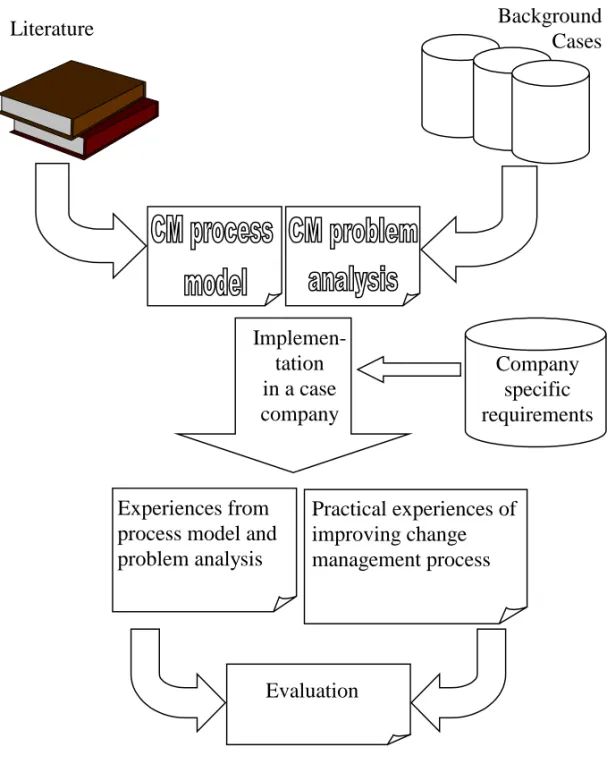
The structure of the thesis is illustrated in Figure 1. Typical problems and im-provement requirements for software change management are derived from the literature study and the three background case studies. The goal of combining the literature study and case studies is to provide both of-the-art and state-of-the-practice viewpoints for analysing the problems and defining a change management process model. The presented process model is then applied in implementing new change management solutions in one case organisation. The implementation includes evaluation of the initial status of change management in the organisation by utilising the problem classification defined, tailoring of the generic change management processes for the needs and requirements of the case organisation, and implementation of the new change management solution.
Background
Cases
Literature
Experiences from
process model and
problem analysis
Implemen-tation
in a case
company
Company
specific
requirements
Practical experiences of
improving change
management process
Evaluation
Figure 1. Structure of the thesis.
Chapter 1 of the thesis presents the research problems and the scope of the the-sis. It also presents an overview of the structure of the thesis and gives a brief summary of the main chapters.
Chapter 2 explains the research methods used in different phases of the con-struction of the thesis.
Chapter 3 summarises published research work related to the subject of the the-sis.
Chapter 4 examines the change management processes and problems in three companies developing embedded software. The chapter summarises the case studies. More detailed case material is included in appendices A to C. The chapter aims at providing a practical viewpoint to defining the typical change management problems presented in chapter 5 and the change management proc-esses presented in the chapter 6. Chapters four and five describe how this thesis defines software change management.
Chapter 5 presents a classification of change management problems and im-provement requirements derived from the literature study and the background case studies summarised in the previous chapter. The problems and improve-ment requireimprove-ments are presented in the form of a problem classification frame-work. Where possible, the specific problems related to the special features of embedded software development are presented separately for each problem class.
Based on the problems and requirements defined, chapter 6 proposes a generic change management process model, which aims at providing a general frame-work for building a process environment which would respond to the problems and improvement requirements of the organisation. This chapter describes how change management processes are defined in this thesis.
Chapter 7 applies the proposed problem classification by analysing the change management requirements in one case organisation. The initial status of change management is briefly described, and the identified problems and improvement requirements are presented using the classification framework presented in chapter 5. To tackle the problems encountered, a new change management proc-ess environment is designed by applying the procproc-ess model proposed in chapter 6. The instantiation of the generic process model to the special needs of the case organisation is presented. Finally, the implementation of the instantiated model is presented.
Chapter 8 evaluates the experiences gained and results obtained from using the proposed problem classification and process model for implementing a new
change management solution in the case organisation. Also, guidelines for the successful deployment of the new solution are given. The defined solution had been in active use in the organisation for some years at the time of writing this thesis.
The last chapter concludes the research work presented in the thesis, gives a summary and analysis of the answers obtained to the original research questions and speculates on future research on the topic.
2 Research method
2.1 Overview
This chapter describes the research approach adopted in constructing this thesis, and the research methods used in different research stages.
2.2 Research
approach
The research approach selected for this work is mainly constructive. Three main research stages can be identified: (1) Problem analysis, (2) Construction and (3) Demonstration. The problem analysis examines the domain of software change management using a literature study and three case studies. Based on the prob-lems and improvement requirements identified in the problem analysis stage, a classification framework for typical problems in change management, related especially to the specific features of embedded software, is derived. Further-more, the results of the problem analysis are used in the construction stage to derive a generic change management process model. The last stage instantiates and demonstrates the proposed solutions in one industrial case study. The prob-lem classification is used in defining the case requirements for an improved change management solution, and the generic process model is used for deriving the process instantiations for one organisation.
2.3 Research methods used in the case studies in the
problem analysis stage
The problem of software change management was analysed using a literature study and three case studies. The first two case studies (narratives are presented in Appendices A and B) were conducted using qualitative, focused interviews. The conceptual schema of the interviews is presented in Figure 2. The concep-tual schema was used in deriving an interview framework, which included the focus areas that should be addressed and discussed during the interview ses-sions. The interview framework used in the first two case studies is described in detail in (Mäkäräinen 1996). The framework used in the third case study is
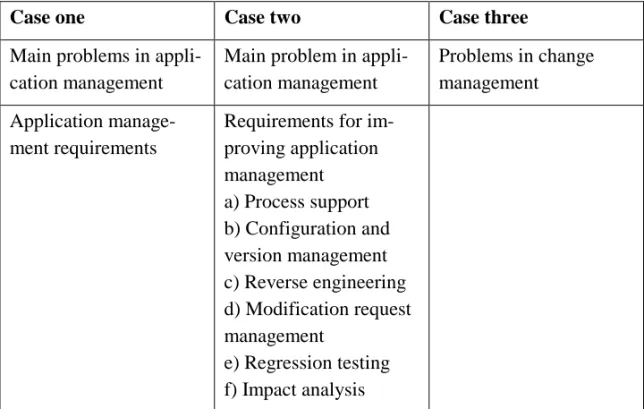
dif-ferent in structure and wording, but the conceptual schema used in deriving it is the same. The interview framework was also used in writing notes on individual interview sessions. The conceptual schema for the interviews was the same in all three case studies. However, the interview framework was constructed sepa-rately for each case study. The experiences from previous case studies were used in constructing a new interview framework. Also, the individual needs and special features of the studied case organisation affected the interview frame-work. The same framework was then further refined into a framework of the in-case summary narrative. Since the interview frameworks for each in-case study were slightly different, the resulting case narratives also differ in format, as can be seen from Table 1.
Table 1. Structure of case narratives.
Case one Case two Case three
Operational organisa-tion
Operational organisa-tion
Introduction,
Context of the analysis Description of applica-tion domain a) Technical description b) Documents Description of applica-tion domain a) Technical description b) Documentation
Description of the prod-uct Application develop-ment a) General information b) Development proc-esses c) Development meth-ods/techniques d) Development envi-ronment e) Development docu-mentation Application develop-ment a) Development proc-esses b) Development meth-ods/techniques c) Development envi-ronment d) Development docu-mentation Organisation of change management
a) Two layers of change processes b) Documentation c) Quality management of change management processes d) Human resources management
Table 1. Continues.
Case one Case two Case three
Change requests a) Defects found in testing
b) Defects found in reviews
c) Added and modified features d) Improvement propos-als e) Sources of change requests Current application management practices a) General information b) Application man-agement organisation c) Application manage-ment process d) Application man-agement environment Current application management practices a) Application manage-ment organisation b) Application man-agement process c) Application manage-ment meth-ods/techniques d) Application man-agement environment e) Maintenance history
Current change proc-esses a) Defects found in testing b) New/modified fea-tures c) Improvement propos-als
d) Errors found in re-views
Change management methods and techniques
Table 1. Continues.
Case one Case two Case three
Main problems in appli-cation management
Main problem in appli-cation management
Problems in change management Application
manage-ment requiremanage-ments
Requirements for im-proving application management a) Process support b) Configuration and version management c) Reverse engineering d) Modification request management e) Regression testing f) Impact analysis
Focused interviews were also used as a main information source in the third case study, but the information extracted by means of interviews was comple-mented with quantitative data, i.e. data acquired from the GQM-based meas-urement programme (van Solingen & Berghout 1999), and change management related document and tool analysis. The third case company had a running measurement programme which provided data related to changes. Triangulation between results of multiple data collection methods was used to achieve stronger substantiation of results and to increase the confidence in the findings. The methods also supported each other; the document and tool analysis per-formed before the interviews familiarised the interviewees with the concepts used in the company and decreased the need to explain standard procedures and tools in detail during the interview sessions.
Change control tools Development tools Process descriptions and guidelines Change document * Life cycles * Traceability * Characteristics SW documentation * Life cycles * Traceability * Consistency Development and maintenance * Definitions * Characteristics Change processes * Types * Steps * Roles
Roles in making and managing change Project organisation
SW Artefacts
Processes
People
Environment
create & manage
act create & manage
modify support use Change mgmnt training Process q u a lity ma n a ge m e n t Prod uct qua lity m a nag em ent
Figure 2. Conceptual schema.
The first two case studies were done in an ESPRIT project called AMES (AMES 1993). The project aimed at improving the application management process as one business process of a company by providing a methodological framework for application management, a set of tools for supporting the most critical activities of application management, and an integrative infrastructure to ensure the interoperability of the tools provided by the project and commercial off-the-shelf tools. The project defined application management as:
Contractual responsibility for the management and execution of all activities related to the maintenance and evolution of existing applications.
The first two case studies aimed not only at learning about the change processes and related problems in the case study organisations, but also at creating re-quirements for the change management methods and tools to be developed in the AMES project. Therefore, a list of requirements was generated by the repre-sentatives of the case study organisations. This list was not generated in the third case study, since it was not part of the AMES project, and did not aim at
implementing tools or methods for change management. Instead, this study fo-cused on identifying change management problems.
Since one of the main goals of the case studies was to reveal problems and bot-tlenecks in the change management, the interviewing technique was considered a suitable method for performing the case studies. The strength of the interview method is its privileged access to the common understanding of the subjects, the understanding that provides their worldview and the basis for their actions (Kvale 1996). The personal perspectives of the subjects and the interviewer provided a distinctive and sensitive understanding of the problems faced in the complex phenomena of change management. Interviews have been evaluated to be effective in exploring what problems the subjects see as most important, how the subjects place themselves in various classification schemes, etc. (Goguen & Linde 1997).
The interviewees were selected using theoretical sampling, i.e. they were chosen for theoretical, not statistical, reasons. The goal of theoretical sampling is to allow replication and extension of the emergent results by examining extreme situations and polar types (Eisenhardt 1989). Since only a limited number of interviews could be done, choosing subjects who represent different roles and belong to different organisational units was considered to provide the most ex-tensive and comprehensive material for the analysis.
The data collection instruments, i.e. the interview protocol and the interview framework constructed on the basis of the conceptual schema, were not altered during individual case studies. Some adjustments were done between the case studies in order to include learnings from previous case studies and to adapt the data collection instrument to the specific features of the case.
However, the experiences from the first two case studies showed that the inter-viewing technique had some weaknesses in studying the work flows and proc-esses related to change management. The interviewees found it difficult to de-scribe their actual work flows in words. They very easily drifted into describing the official processes (see Figure 6) stated in the process documentation, or if they were involved in process improvement tasks, it was natural for them to describe the processes as they thought the processes should be performed. Therefore, there was a danger of getting a description of the official process or
the prescriptive process, not a descriptive process model of the current situation (see Figure 6). For this reason, triangulation was used in the third case study. The interviews were complemented with other methods, which gave additional information and indications of the actual processes and work-flows performed by the software designers and other software personnel. The complementary methods were process measurement, analysis of tools related to change man-agement, and document analysis.
Appendices A, B and C give explanatory narratives of the case studies, and only a brief summary of the cases is presented in the body of the thesis to give the reader a quick overview of the empirical data used in the construction phase of the thesis. As Barton Cunningham (Barton Cunningham 1997) states, the prob-lem with narratives is that since they are used to summarise an assortment of evidence, they may not seem to be presented in a standardised structure, and they may appear unfocused. This can also be seen from the narratives presented here. However, the descriptive information is assumed to provide evidence of the practices in the field in an orderly manner.
The interviews were documented as follows:
• Interview notes from individual interview sessions were written by the in-terviewer.
• An interview narrative was composed from the individual interview reports.
• A change process analysis document was derived by adding to the interview narratives the results of the brainstorming sessions and other discussions which were arranged to discuss the findings of the interviews.
The notes from the individual interview sessions are confidential documents, which were used only by the interviewers. The interview narratives and process analysis documents were distributed to the organisation under study. These are project documentation and cannot be publicly reviewed. Shortened versions of the change process analysis documents of the case studies presented in the ap-pendices A and B have been published (Mäkäräinen 1996). The third case study (presented in appendix C) has not been published before.
2.4 Research methods used in the construction stage
The constructs proposed by this thesis are derived from both the case studies and the literature study. The presented change management models are based on the change management models presented in the literature, which were adapted to the needs and requirements identified in the case studies.
The case data was analysed using within-case analysis. Within-case analyses typically involve detailed case study write-ups for each case study (Eisenhardt 1989). The write-ups were compiled from notes and observations made during the data collection, and took a the form of narrative descriptions of the cases. Brief summaries of the narratives are presented in the appendices of this thesis. The process models are described primarily in text form, but some graphical process models are provided to illustrate the processes. The graphical process models are presented as data flow diagrams (DFD). The syntax of DFD models is the following (Pressman 1992): (1) the squares represents the external enti-ties, which act as sources of system inputs, or sink of system outputs, (2) the arrows represent the data flows between the activities, and the arrow head indi-cates direction of data transfer, (3) the bubbles represent the actions which transform the input data into output data, and (4) the double lines with arrows illustrate a repository of data. The DFD notation is illustrated in Figure 3.
Figure 3. Symbols of the data flow diagram.
2.5 Research methods used in the demonstration stage
The constructed change management model is demonstrated in one additional case study. The model is used in defining the change management processes in the organisation studied and in implementing a new change management solu-tion in the organisasolu-tion.
The starting point for the case study was a need for implementing new solutions for change management through better understanding of the initial status of the change management processes. The trigger for the project came from the de-ployment of a new SCM tool, which has features for supporting change man-agement. The aim was to examine the possibilities of using these features for better change management support in the organisation.
The case study follows the Pr2imer cycle. The Pr2imer service package has been developed by VTT Electronics (Technical Research Centre of Finland) for sup-porting actions that aim at improving software processes (Karjalainen et al. 1996). The Pr2imer method divides a process improvement project into the four phases illustrated in Figure 4.
Activity Data flow
Data store External
Ana lysis of current pra ctices
1.
Definition of goa ls for new pra ctices2.
Pla n for process im-provement steps3.
Use in product develop-ment Piloting4.
PRODUCT
DEVELOPMENT
Figure 4. Pr2imer process improvement cycle.
The goal is to first analyse the current practices in order to achieve a better un-derstanding of the current processes, problems and strengths in change man-agement in the case organisation. Based on the results of the first phase, a deci-sion whether the organisation wishes to change its current way of managing changes is made. The second phase defines the goals for the new practices to be adopted to change the current situation. The third phase aims at planning the transition from the current situation to the target state. The final phase includes the piloting and deployment of the planned improvement actions. Chapter 7 presents:
• a description of the initial change management status analysed in phase one,
• a description of the target state of change processes defined in phase two,
• a description of the implementation solution defined in phase three, and
• a summary of experiences from the piloting and deployment of the new change management solution in the organisation which was performed in phase four.
2.5.1 First phase: Analysis of current practices
The goal of the first phase was to describe the initial status and problems in the change management practices in the case organisation. The goal was to gain familiarity with the change management environment in the case organisation, apply the problem classification framework presented by this thesis, and define what kinds of improvement needs can be identified in the change management processes. The methods chosen were:
• semi-structured focused interviews,
• analysis of tools used in change management or in interfacing change man-agement tools, and
• document analysis.
Semi-structured focused interviews were selected as the main research method for defining the initial status of change management in the organisation. The focus area was software change management, and the goal of the interviews was to identify and characterise the change management processes and find the problems related to change management. The conceptual schema used in deriv-ing the interviewderiv-ing framework is the same as in the background case studies (see Figure 2). The schema defines the rough focus areas of the interview ses-sions, and the framework adapts the common schema to the special features of the organisation in question. The interview framework was used as an inter-viewing instrument in formulating specific questions and guiding the discussion. The interviews were conducted by interviewing each interviewee in a separate session, i.e. only one interviewee was present at each interview session.
Since the purpose of the study is to learn about change management processes, not to test hypotheses, no coding of the interview material was done (Glaser & Straus 1967). The interview results were analysed throughout the process. The understanding of the processes and problems related to them started to take form immediately after the first interview sessions. Triangulation (Barton Cunning-ham 1997), i.e. combining the perspectives of the interviewees together with the results of the change management tool and document analysis, was used in cre-ating a narrative of the case study.
A similar division for maintenance-related questions has been presented by Layzell and Macaulay (Layzell & Macaulay 1994). They used the following five sections: (1) Background and overall structure of an organisation, (2) Structure and composition of the maintenance function, (3) The maintenance activity, (4) Assessment of the maintenance function, and (5) Future maintenance require-ments.
The original purpose of the framework was to support requirements elicitation for the development of an application management environment (Mäkäräinen 1996). The idea of using focused interviews in defining the strengths and bottle-necks in processes was later used in defining the Pr2imer process improvement service package. An expanded interview framework and focused interviews have been used in several successful process improvement programmes in co-operation with VTT Electronics and Finnish industry (Mäkäräinen & Komi-Sirviö 1996, Karjalainen et al. 1996).
The subjects within the case organisation were selected using theoretical sam-pling from different types of projects (user interface projects, hardware interface projects, etc.) and different software development tasks (project managers, in-experienced designers, senior designers, persons responsible for configuration management, etc.). The subjects were not given any information about the inter-view focus area in advance. There were two interinter-viewers, the author of this thesis and a member of the software process team of the organisation. The author of this thesis performed a document study to get familiar with the organ-isational structure and organisation-specific practices and guidelines. This en-sured that the interviewer spoke the same language as the interviewees, and also saved time in the interviewing sessions, as the interviewees did not have to elaborate on basic issues concerning the tools used organisation-wide, responsi-bilities within the organisation structure, etc. The objective of the interviews was clearly stated to the interviewees before the interviewing sessions; i.e. they were told that the goal is to define the current status of the change management practices in the organisation in order to identify their strengths and weaknesses, and to examine if the new software configuration management system could be used more efficiently in supporting the change management processes.
The individual interview sessions lasted from one hour to three hours. As inter-view sessions usually took place in a meeting room, the interinter-viewees had no
possibility for checking actual software documents during the interview ses-sions. In between the interview sessions, some of the interviewees showed ex-amples of relevant change documentation to the interviewers.
Since the first two organisations studied were rather small, practically all soft-ware designers were interviewed during the studies. The third company was considerably larger, and only a part of the software personnel could be inter-viewed (six persons).
The interpretation of the interview results was done by the author of this thesis. The interpretation was done in three phases. First, the results of individual in-terviewing sessions were written down as individual memos. The memos were sent to the interviewees, who could read and check them for any misunder-standings or add comments or information they had forgotten to mention in the interviewing sessions. The individual interviewing memos are confidential, and were not submitted to anyone else but the interviewees. As the interviews con-tinued, a summary of all the interviews was constructed. The summary report was sent to the interviewees, the case company representative in the interviews, and the manager of the SCM tool deployment project for comments. A review was arranged, where the author of the thesis presented a summary document and the reviewers could give their comments. The comments were discussed in a meeting, and the changes agreed to be relevant were made.
Goguen and Linde (1997) give a guideline for researchers performing interview studies:
Do not ask people to describe activities that they do not normally describe, or if you do, then do not believe the answers.
The focused interviews on change management could not avoid asking people to describe activities which they normally do not have to express in words in nor-mal conversation. This problem was tackled by examining the recorded data related to change activities, and comparing them with the interview results. For example, the error recordings were browsed to study the error handling proc-esses, and software item version histories were examined to find information about traceability issues.
The interviews are complemented with tool and document analysis. Both were done prior to the interviews to familiarise the interviewers with the change man-agement environment used by the interviewees. Also, some additional docu-mentation could be identified during the interview sessions, so the document and tool analysis were extended to continue throughout the whole first phase of the Pr2imer cycle. The purpose of the tool analysis is to identify the tools cur-rently used in change management, find their strengths and weaknesses and study the change histories recorded using them. The purpose of the document analysis is to study the documentation related to change management, which mostly consisted of official process descriptions and user manuals.
2.5.2 Second phase: Definition of goals for new practices
The second phase of the Pr2imer improvement cycle generates the definition of new change management practices based on the problems and improvement ideas identified during the first phase of the cycle.
The new processes are defined using the generic change management processes described in chapter 6. The process descriptions are defined by a small group of software personnel from the organisation and the author of this thesis. The proc-ess for managing requirement-level modifications is further studied in a separate project, since it requires a more thorough analysis across organisational entities outside the software department. The group involved in the process description includes members from the software method and process improvement group. The resulting processes are reviewed by software engineers from product devel-opment projects.
The change processes are described using the Information Mapping method (Horn 1992). The method provides guidelines for structuring and presenting infromation. The Information Mapping method has been in use since 1972 mostly in documenting training and procedural and reference manuals. It sup-ports both paper and online modes. The process descriptions are aimed to be included in the company’s online process documentation, so support for the online mode is required. The method supports separating information into small units based on its purpose or function for the reader. The method aims at sup-porting the readers in quickly finding the relevant information in the document.
2.6 Evaluation of the results
The main part of the result evaluation is concerned with the evaluation of the success of the demonstration phase, i.e. how the change management model is instantiated in the organisation used in the case study. The following methods are used:
• Discussions with the development team.
• Observations in the case organisation.
• Interviews of users who had been involved both with the old change man-agement system and the new one.
The discussions with the team that is responsible for the instantiation of the new change management solutions in the organisation provide an evaluation of how the development team considered the new solution to address the change man-agement problems and needs stated. The team has a deep understanding of the initial goals and problems, since it is involved in defining them together with the software practitioners. On the other hand, since the development team defines the new solutions by themselves and they are not dealing with the change man-agement problems in their everyday work, their evaluation may be biased and not provide actual improvements in software development. Therefore, the qualitative evaluation by the development team is complemented with observa-tions and interviews of actual end users.
The observations were made by studying the actual change management system and databases, and how they were used in the projects. Since the observations were made by the author of this thesis, who was a member of the development team, the observations are subject to the same bias as the discussions with the development team.
Some end users, who have been involved with software development tasks long enough to use both the old change management system and the new solution, were interviewed to get a more objective evaluation. The interviews are struc-tured into two parts, evaluation of the performance of the new system with
re-spect to the problem areas, and evaluation of how the implementation solved the specific problems stated at the beginning of the case project.
The main success criterion for evaluating the results is to prove that the con-structs built in this thesis were usable and helpful in defining the new change management solution in a company developing embedded software, and to evaluate if the new solution was successful in solving the change management problems found in the organisation studied and if it fulfilled its function in the everyday software development work in the company.
The constructed change management model is assessed through studying its instantiation in one case study. The construction is assessed against the criteria of value. March and Smith (March & Smith 1995) advise the assessment of the product of design science to answer the questions "Does it work?" and "Is it an improvement?". The work presented here is a representative of design science, where the attempt is to create things that serve human purposes, as opposed to natural sciences, where the focus is on explaining how and why things are. (March & Smith 1995)
The first question, "Does it work?", is examined by observing the instantiation of the model in the case study, and the evolution and usage of the instantiated model in the organisation. The observation methods include discussions with and interviews of people who participated in the instantiation, use the instanti-ated system and have been responsible for the support of the system when it has been used, and studies of the maintenance histories, as well as development and maintenance documentation. Also, the actual change data collected in the com-pany was observed to evaluate the system.
2.7 Research
process
The author started exploring the subject of software maintenance in the AMES project in 1993. The initial goal was to focus on the software maintenance phase, i.e. the activities taking place after the delivery of the complete software system. The author was responsible for analysing the maintenance activities in the two companies in order to derive the requirements for the maintenance sup-port environment, including process, method and tool supsup-port. The analysis
work was done in co-operation with the software designers and process im-provement personnel in the organisations. In the first case organisation, the analysis team consisted of the author, one senior researcher from VTT (the em-ployer of the author at that time), who had an extensive background in software maintenance and configuration management issues, and a representative from the case organisation, who had process improvement responsibilities in addition to working as a software designer in the project analysed in the case study. The second case study was done by a team of two persons, the author of the thesis and a representative of the company studied, who was responsible for software process improvement and worked as a software designer in the company. The third case study was done later outside the scope of the AMES project. The study was performed by the author of this thesis with the aid of two members of the software process team at the company, both responsible for software con-figuration management processes and tools.
As the work progressed, the focus of the study shifted from the software main-tenance phase, i.e. the post delivery activities, to software change management, i.e. change activities at any point of the software life cycle. These three case studies together with a literature study formed our understanding of software change management as it is defined in this thesis. After the first two case studies performed in the context of the AMES project, the author reported the results at that point in a licentiate thesis (Mäkäräinen 1996).
These three case studies (described in appendices A, B and C) are presented in this thesis as background information for the change management models pre-sented. This means that these case studies are part of the problem analysis phase of the research. The narratives of the case studies are presented in the appendi-ces, and a brief explanatory summary of the cases is given in chapter 4. The literature study constitutes another part of the problem analysis phase. The lit-erature study was primarily done simultaneously with the two first case studies, but has been extended to continue throughout the whole research period.
The fourth case study presented in this thesis demonstrates the constructed change management model in one organisation. This organisation is not one of the three used for constructing the change management model. The fourth case study was started in the same manner as the first three case studies were per-formed; i.e. by analysing the change management practices in the case
organisa-tion. The analysis was done by a group of two persons, the author of the thesis and a representative of the company, who was a member of the software process team. The results of the analysis phase were used as requirements for instanti-ating the model. The new change management processes were instantiated from the generic model by the author of this thesis, with the exception of one process instance, which was instantiated in a separate project by the process improve-ment team of the company. The supporting environimprove-ment, piloting, training and deployment of the new system were done by the process improvement team of the company with the help of subcontractors in implementation matters. How-ever, the author of this thesis followed the work closely, and acted as a consult-ant throughout the implementation and piloting periods.
2.8 Summary
The research approach adopted in this thesis is constructive. The constructs proposed are derived using a literature study and three case studies, and evalu-ated in one case study. The main instrument used in the case studies is focused interviews of the software personnel in the organisations studied.
3 Analysis of related work
3.1 Overview
This chapter presents an overview of the research related to software change management. It discusses the relationship of software change management to related concepts. The chapter continues with a discussion of the software change management problems presented in the literature. The findings from related work are later used in chapters 5 and 6 for defining how software change management processes and related problems are defined in this thesis.
3.2 Scope of software change management
The processes and problems related to changing software items have tradition-ally been related to the maintenance of the software (e.g. IEEE 1993, Schneiwind 1987, Bjerknes et. al. 1991). Controlling changes during the software de-velopment time has been defined as a task for software configuration manage-ment (SCM) (Pressman 1992). This thesis combines these two viewpoints to software change management: it examines the processes for managing changes to existing software items and configurations in any phase of the software life cycle .
Taramaa (1998) has discussed the relationship of software configuration man-agement and change manman-agement. His software configuration manman-agement framework examines software configuration management from the viewpoint of version control, release-oriented and change-oriented SCM. The framework presents a 12-level improvement framework for software configuration man-agement. The first levels include version control oriented activities. At these levels change management is limited mainly to the creation and storage of change documents. The levels from four to five have characteristics from soft-ware manufacturing and also include some aspects of change control, such as a link between the change documentation and the changed software items. The sixth level is called the "Change-oriented level", and it emphasises request-driven change control, including support for software evolution and
mainte-nance. The last six levels include product management components, highlight-ing efficient usage of reusable components and advanced assembly systems. Weiderman et al. (1997) distinguish software maintenance from system evolu-tion using the following criteria:
• Software maintenance deals with fine-grained, localised changes, while system evolution deals with coarser-grained, structural changes. System evolution changes the structure and architecture of the system, while main-tenance changes leave the structure of the system relatively constant.
• Software maintenance is a short term activity, which produces few eco-nomic and strategic benefits. System evolution on the other hand increases the strategic and economic value of the software.
• Software maintenance typically responds to one software requirement at a time, while system evolution allows the system to comply with broad range of new requirements.
In this thesis, software maintenance refers to the software life cycle phase be-ginning when the first delivery of the software is made, and ending when the software is taken out of use. Evolution, on the other hand, refers to the step-wise, incremental development of the software during its lifetime. Evolution of the software system takes place both in the development and maintenance phases through successive and concurrent changes. The activity of managing these changes is called change management. Evolutionary software development is a process in which the software is delivered incrementally. The feedback and analysis of the latest incremental delivery generates the requirements for subse-quent deliveries. (Lam et al. 1999)
The definition of change management is derived from the discussion of software maintenance, evolution and iteration presented by Schneidewind (Schneidewind 1987). Schneidewind asks the following questions:
• Do we have the wrong model for maintenance? He states that change activ-ity and change management should be an integral part of development and
all other phases of the software life cycle. The change should be associated equally with post-delivery activities and with development.
• Do requirements end in the requirements phase? Schneidewind concludes that requirements change continually, and it is not possible to develop a complete, consistent and unambiguous specification prior to software de-sign. The major problem in requirement management is the evolution of the requirements in response to changes in the environment.
• Is the life cycle model appropriate for maintenance? Schneideman criticises the association of software maintenance only to the post-delivery phase of the software life cycle.
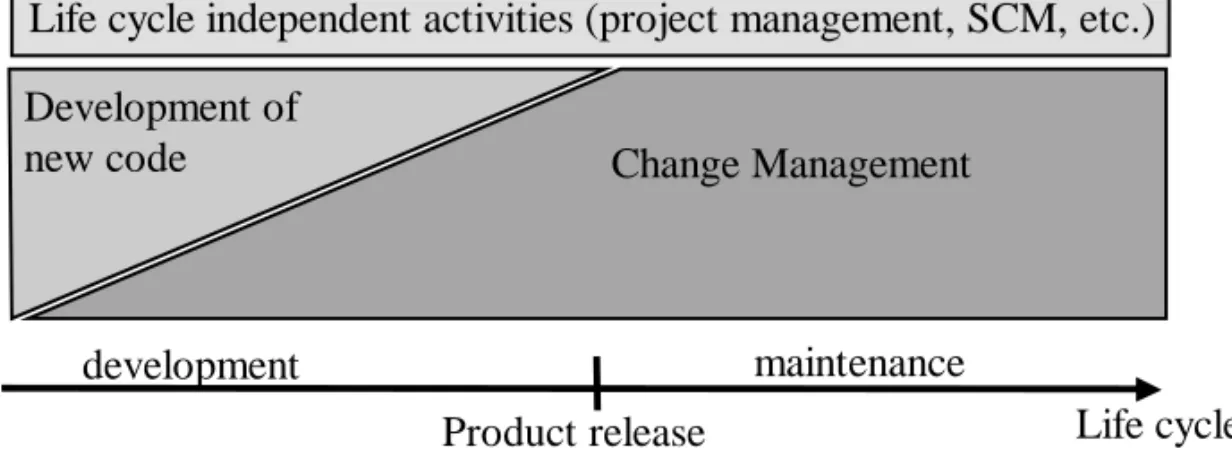
As Lehman suggests, change is intrinsic in software and must be accepted as a fact of life (Lehman 1980). The relationships between the concepts of software development, maintenance and software change management, as they are de-fined in this thesis, are illustrated in Figure 5. Software change management refers to the management of the evolution of the software. Evolutionary soft-ware development consist of stages which incrementally expand the softsoft-ware under development (Boehm 1988). The software evolution starts right from the beginning of the creation of a software item. There are two main reasons for changes during the development time: the requirements of the system change during the development time, and the development of a complicated system is very error-prone (Ince 1994). The more complete the software becomes, the more time and effort is required for change management. In the testing and maintenance phases, practically all the development work is change manage-ment. The development of new software mainly takes place at the beginning of the software life cycle and decreases towards the implementation, while evolu-tionary changes increase. The situation will be even more dramatic when the development project bases the development work on reuse of software compo-nents or adaptation of an old system to new requirements. In these cases, the development project may focus entirely on managing the changes to reused items instead of creating new software from scratch. The evolutionary develop-ment style also shifts the nature of the developdevelop-ment work from waterfall type of development to managing the evolution of the software. For example, the devel-opment model defined for developing fuzzy logic control systems (Isomursu 1995) proposes controlled evolution as the main vehicle for deriving fuzzy
sys-tems. The vagueness or uncertainty of the processes typically controlled by fuzzy control systems makes exact specification of the fuzzy design parameters difficult, if not impossible, without exploration. Therefore, iterative prototype-based development has proved to be successful in deriving fuzzy design pa-rameters.
The target of this thesis is to achieve a better understanding of change manage-ment problems and processes, during both the software developmanage-ment and main-tenance phases.
Change Management
Development of
new code
Life cycle independent activities (project management, SCM, etc.)
development
maintenance
Product release
Life cycle
Figure 5. Software change management in software development and mainte-nance phases.
Figure 5 illustrates the relationships between some key concepts of this thesis. The software life cycle is divided into two main phases: development and maintenance. The maintenance phase starts when the product is first released, and the development phase includes all activities before that. In some cases, the maintenance phase may not exist at all. This is the case described in the first case study presented in this thesis (Appendix A). The actual software work is characterised as development of new code and managing changes to existing code. The amount of new development usually decreases towards the end of the development phase, and in the maintenance phase all work consists exclusively of managing changes to the existing system. The proportional share of new de-velopment and change management vary between cases. Sometimes the life cycle starts from a situation where everything has to be built from scratch. In these cases, the proportion of new development is 100% at the beginning and decreases towards the end of the development phase. In some cases, the
devel-opment phase starts with reusable items from previous develdevel-opment tasks, and the proportion of change management is high right from the beginning of the development phase.
In this thesis, the term "software maintenance phase" is used to describe the post-delivery phase of the software life cycle, and the term "software change management" to describe the management of modifications to existing software items, regardless of in what phase of the software life cycle the modifications are made. Several definitions for software maintenance have been presented in the literature. The definitions can be categorised as follows:
• Life cycle approach. Software maintenance is the phase beginning after the delivery of the software and ending at the retirement of the application.
• Life cycle approach combined with functional description. Software mainte-nance is the modification of a software product after delivery to correct faults, to improve performance or other attributes, or to adapt the product to a modified environment. (IEEE 1993)
• Plain functional approach without restrictions concerning the life cycle. The job of software maintenance is to correct errors and to change program op-eration as requirements change. (Berns 1984)
The major difference between software and hardware maintenance is that soft-ware, unlike hardsoft-ware, does not wear out in use. The maintenance of the hard-ware parts of a system includes replacement or repairing of worn or broken parts, while software does not need this kind of sustained repair.
In addition, the word ‘maintenance’ is generally used by the software engineer-ing community to point to all activities takengineer-ing place after the first delivery of the system (Turski 1981). As Sommerville stated, the addition of a new wing to a building would never be called ‘maintenance’ by construction engineers, yet adding a totally new feature to a software system is considered a maintenance activity (Sommerville 1982).
However, software starts to evolve and require changes even before its mainte-nance. Software change management is an integral part of the software
devel-opment process from the very beginning. The environment where the software is supposed to operate evolves thoroughout the system development time, creating change pressure on the original requirements (Lienz & Swanson 1980). Fur-thermore, the software items in different abstraction levels require modifications because of the defects introduced by the software engineers and the increasing knowledge about the problem domain. This thesis defines ‘software change management’ as a discipline for managing the changes to the software system thoroughout its lifetime, in both the development and maintenance phases (Schneidewind 1987) (Lehman 1980). It claims that there is no fundamental difference in, for example, correcting an error in the software a week before the release date during the development phase, or a day after the release during the maintenance phase. Differences may be found from contractual and organisa-tional viewpoints, but not in the procedures carried out to change the software. Swanson also defined the most commonly referred to classification of software maintenance tasks (Swanson 1976). The classification covers four dimensions of software maintenance tasks: corrective, adaptive, preventive and perfective changes. The diagnosis and correction of errors found in operational software are characterised as corrective changes. Adaptive changes aim at adapting the software to environmental changes, such as hardware changes or a new operat-ing system. Preventive modifications are made to anticipate and prevent future problems, e.g. through re-structuring existing systems. Perfective modifications alter the functionality of the software, usually by adding new features. Although Swanson discusses software maintenance tasks, the experiences from the case studies presented in this thesis show that the division is applicable for changes taking place both before and after software delivery.
In addition to the close connection to software maintenance research, software change management is very tightly related to software configuration manage-ment. Software configuration management is defined by the IEEE 828 standard (IEEE 828 1990) to include the following basic elements:
• Configuration identification. Identifying and defining the configuration items for the product.
• Change control, including configuration control. Controlling all changes to these items throughout the life cycle of the product.