When Should an MLM or Network
Marketing* Program Be Considered
an Illegal Pyramid Scheme?
••
History, effects, and defining characteristics of product-based pyramid
schemes.
••
Tools for identifying the most harmful of new product-based pyramid
schemes as targets for proactive enforcement
••
Recommendations for enforcement of laws and rules protecting
consumers against product-based pyramid schemes—and suggestions for
improved laws and rules
••
Unmet challenge to network marketing (MLM) industry leaders
••
Consumer awareness guidelines for distribution to consumers
By Jon M. Taylor, Ph.D.
Consumer Awareness Institute
*a.k.a. Multi-level Marketing, Consumer Direct Marketing, Chain Distribution
Scheme, (Multi-level) Purchasing Plan, Gifting Network, etc.
© 2000 by Jon M. Taylor, P.O. Box 488, Kaysville, UT 84037 Web site: whatisgood.com /nwm E-mail: [email protected]
Report Abstract 3
Acknowledgements 4
Definitions of Relevant Terms 4
The History of Pyramid Schemes and Multi-level (or Network) Marketing (MLM) 5 Destructive Effects on the Lives of MLM Participants 7
How this Research Came about 7
Challenge to the Industry: “Prove Me Wrong.” 8 Naked Pyramid Scheme vs. Product-Based Pyramid Scheme (PPS) 9
Types of MLM Compensation Systems 10
Defining Characteristics of Product-Based Pyramid Schemes (PPS) 10 PPS DEFINING CHARACTERISTIC #1: A chaining hierarchy of levels of distributors— 10 more than is functionally justified—is recruited without area limits, which leads to
extreme leverage and perceived saturation in the marketplace.
PPS DEFINING CHARACTERISTIC #2: Relative vertical equality (RVE) in compensation 11 leads to an emphasis on recruiting and extreme horizontal inequality (EHI) over the entire network of distributors.
Table 1: “Which distributors get the money paid out by one highly leveraged MLM?” 13
PPS DEFINING CHARACTERISTIC #3: Significant purchase or recruiting quotas are 14 required (or incentives offered) to qualify for increasing bonus levels or purchasing discounts in an ascending hierarchy of payout levels—the “pay to play” feature.
The Key Problem with the FTC Definition of a Multi-level Marketing Program 14 NEEDED: A More Proactive Approach to Enforcement of Laws Against Pyramid Schemes 16 as Applied to PPS’s
Syndrome Analysis—A Tool For Corroborating The Existence Of A Pyramid Scheme 16 Symptoms of a Product-Based Pyramid Scheme (PPS) Syndrome 17 Characteristics of More Acceptable Non-PPS Marketing Organizations 22 How to Develop a Pyramid Scheme that Is Very Profitable for the Founders— 24
and Get Away with It
TABLE OF CONTENTS, continued
Conclusions 26
Recommendations 27
Final Comment 28
Notes 28
Appendix A: My Unique Background and Experience with Network Marketing (MLM) 29 Appendix B: Unmet Challenge to Network Marketing (MLM) Industry Leaders: 31
“Network Marketing Payout Distribution Study”
Appendix C: Twelve Tests for Evaluating a Network Marketing (MLM) “Opportunity” 37 Appendix D: Web Sites that Offer a Critical View of MLM/Network Marketing 40
REPORT ABSTRACT
One of the most problematical of business models is multi-level or network marketing (MLM ). Many MLM programs show all the effects and characteristics of a pyramid scheme, but the MLM industry has nonetheless been allowed to continue and flourish. Though considered benign by many, its insidious and corrupting influence and the financial and social harm suffered by participants is considerable. Unfortunately, victims of these programs seldom complain, blaming themselves for their failures.
This problem is compounded by limited resources available to enforcement agencies, faced with a profusion of both naked pyramid schemes (wherein no products are offered) and product-based pyramid schemes (PPS’s), operating as MLM’s. They are now appearing by the hundreds on the internet, and established MLM companies are expanding into overseas markets.
Due to inadequate definitions of what constitutes a pyramid scheme, insufficient resources, and/or lack of prosecutorial will in enforcement of existing statutes, enforcement agencies often wind up catching the
minnows, but letting the sharks go free. The consequences are enormous—millions of consumers are being bilked out of billions of dollars each year.A1
A pyramid scheme,as currently defined by the FTC (and similarly in many state laws), are plans which (1) “concentrate on the commissions you could earn just for recruiting new distributors” and which (2) “generally ignore the marketing and selling of products and services.”A2
The above two criteria have proven to be inadequate for determining whether or not any given MLM program is a pyramid scheme. Interpretations based on qualified mathematical analyses of compensation systems could yield a wider application of the laws against pyramid schemes to PPS’s. They would also allow for more proactive enforcement.
The key to predicting potential harm to victims of a PPS is to determine the degree of leverage of the compensation system. Once a highly leveraged PPS is identified by its compensation system, the prognosis is certain: inordinate emphasis on recruiting will follow, and only a few at the top of the pyramid will profit at the expense of the investments in product purchases by those in their downline—most of whom lose money. In other words, emphasis on recruiting is just one of the effects, not the cause, of the problems with PPS’s.
Problems with interpreting the FTC definition of a pyramid scheme has been compounded by information releases from the FTC, state agencies, and the Better Business Bureau (BBB), in which MLM’s are not only distinguished from pyramid schemes, but are exonerated as non-pyramids, when in fact they may be PPS’s and actually more pyramidal in their effects over time than naked pyramid schemes.
Based on the FTC’s definition of multi-level marketing, it is assumed that implementation of “rules” will keep MLM’s out of the category of pyramid schemes. Such rules are ineffective unless they incorporate
fundamental changes in the MLM compensation system so that it provides significantly greater rewards for retailing than for recruiting— in actual payout from the company, since MLM prices are generally too high for retail markup to non-distributors.
This paper provides legislators, enforcement agencies, educators, and others with three distinguishing characteristics that can be used as tools to determine proactively whether or not any given MLM program will lead to the harmful effects of a highly leveraged product-based pyramid scheme (PPS):
1. A chaining hierarchy of levels of distributors— more than is functionally justified— is recruitedwithout area limits, which leads to extreme leverage and perceived saturation in the marketplace.
2. RVE-EHI. Relative vertical equality (RVE) in compensation systems leads to extreme horizontal inequality (EHI) in payout over the entire network of distributors— huge payouts to a tiny percentage of participants, while the vast majority wind up losing the money and effort they invested over a period of time.
3. Significant purchase or recruiting quotas are required (or incentives offered) to qualify for increasing bonus levels or purchasing discounts in an ascending hierarchy of payout levels (the “pay to play” feature).
Syndrome analysis, in which any program can be evaluated based on a set of pyramidal characteristics, can serve to corroborate the existence of a PPS.
Legislators, courts, and consumer protection agencies would serve consumers better if they improved their methods of determining whether or not an MLM business fits the definition of a pyramid scheme— or at the very least were more cautious in implying that an MLM program is not a pyramid scheme, when in fact it is more likely a PPS that has managed to escape corrective action. Genuinely helpful information should be supplied to consumers. (See Appendix C for a rigorous set of guidelines.)
It would be helpful if MLM companies were required in their recruiting to disclose average total payout from the company less purchases from the company by percentiles of distributors. The percentage of all distributors (past and present) who have achieved each payout level should also be disclosed. This would reveal extreme payout patterns typical of pyramid schemes.
The concepts and analytical framework for this paper are based on first-hand experience, a broad background in marketing and entrepreneurship, education and experience as a business analyst and behavioral researcher, extensive interviews with distributors from a variety of MLM programs, and a synthesis of the thinking of the best experts in the field.
The MLM industry has been challenged to refute many of the basic concepts for this report, but has so far responded with silence.
ACKNOWLEDGEMENTS
Some of the top experts on MLM’s and pyramid schemes have been consulted in preparation of this paper.
Kristine Lanning of the Office of Consumer Protection, Department of Justice, State of North Carolina, provided a clear picture of the legislative and regulatory framework within which enforcement officials have to operate in dealing with MLM’s.
Bruce Craig, formerly an Assistant Attorney General for the State of Wisconsin for 30 years and who litigated numerous pyramid schemes, also helped in understanding with the realities of what can be accomplished. His petition to the FTC regarding Amway’s compliance with the “Amway rules” is revealing.
The case prepared by the FTC’s Peter Vandernet against Equinox was encouraging in demonstrating that powerful arguments can be put forth against an MLM that is in reality a pyramid scheme.
Douglas M. Brooks of Gilman and Pastor, of Boston Massachusetts, attorney representing NuSkin distributors in Canada who have been pursuing a class action against NuSkin International, Inc., for seven years, helped in comparing the unlimited recruiting of MLM’s to territorial controls important to franchises. He was also helpful in arguing against pyramid schemes masquerading as MLM’s, deceptive sales practices, and related problems of MLM’s.
Robert Fitzpatrick, author of False Profits, helped in refining concepts and content and in forming an
organization—Pyramid Scheme Alert—to bring together the best resources for combating the growth of all types of pyramid schemes, including most MLM’s.
Ruth Carter, author of Behind the Smoke and Mirrors, provided valuable contacts and web resources through her popular and extremely valuable web site— mlmsurvivor.com.
Dean VanDruff, author of the very popular articles “What’s Wrong with Multi-level Marketing?” and “Frequently Asked Questions” on his web site
(vandruff.com) provided conceptual input. Other valuable web sites are referenced in Appendix D.
My one-year test as a distributor for a popular MLM program, was vital in grasping the concept, motivation, dynamics, and effects of MLM’s that were in reality product-based pyramid schemes. Top level distributors in this program provided valuable input.
In mentioning personal experience with MLM, there some who will say this is just a sour grapes response to my “failure.” Let me respond by asserting that I was not a failure, but could see after a year that being in the top 1% was not profitable. One would have to be in the top 1/10 of 1% to begin to earn a significant profit—and then only at the expense of deceiving hundreds, even thousands of victims (each of whom would lose money) to get there. I later learned that this was true for many MLM programs.
Others will say, “No wonder you had a bad experience. You should have tried this MLM instead.” But I sought input from hundreds of actual distributors and ex-distributors from a wide variety of MLM programs, using a variety of compensation systems. Industry representatives and authors I consulted, such as Richard Poe (Wave 3: The New Era in Network
Marketing) and Leonard Clements (Inside Network Marketing), helped me to understand their viewpoints as well. I believe my analysis and conclusions are both fair and accurate.
DEFINITIONS OF RELEVANT TERMS What’s in a definition? Plenty—even billions of dollars—as this paper will demonstrate. In order to lead the reader through difficult and subtle issues related to multi-level marketing (MLM or “network marketing”), some definitions are necessary—some from a standard dictionary, others unique to this analysis.
Multi-level marketing program (MLM for short, later referred to as “network marketing” or MLM), as defined by the FTC—
any marketing program in which participants pay money to the program promoter in return for which the participants obtain the right to (1) recruit additional participants, or to have additional participants placed by the promoter or any other person into the program participant’s downline, tree, cooperative, income center, or other similar program grouping; (2) sell goods or services; and (3) receive payment or other compensation; provided that: (a) the payments received by each program
participant are derived primarily from retail sales of goods or services, and not from recruiting additional participants nor having additional participants placed into the program participant’s downline, tree, cooperative, income center, or other similar program grouping, and (b) the marketing program has instituted and enforces rules to ensure that it is not a plan in which participants earn profits primarily by the recruiting of additional participants rather than retail sales.1
Pyramid scheme (as currently defined by the FTC and in some state legislation)—plans which “concentrate on the commissions you could earn just for recruiting new distributors” and which “generally ignore the marketing and selling of products and services.2
An example of definitions used by state regulators is the following:
“Pyramid scheme” means any sales device or plan under which a person gives consideration to another person in exchange for compensation or the right to receive compensation which is derived primarily from the introduction of other persons into the sales device or plan rather than from the sale of goods, services, or other property.3
Network marketing—a term devised my MLM companies to get around the implications of “multi-level marketing”—which sounds too much like a chain distribution or pyramid form of marketing.
Naked pyramid scheme refers to a blatant pyramid scheme that is easy to detect because no products are offered, merely a participation fee or “investment.” Chain letters work on the same principle. A continuous chain of “participants” or “investors” is recruited, in which each pays a fee to participate and receives money by recruiting others into the system.
A product-based pyramid scheme (PPS) is a pyramid scheme that in most respects resembles a naked pyramid scheme, except that products are purchased by
distributors, primarily for resale (supposedly). Such product purchases, often combined with other incentives, qualifies distributors for commissions in ascending levels in the distributor hierarchy.
Relative vertical equality (RVE) in compensation—a characteristic common to both illegal pyramid schemes and most MLM programs, in which distributors far removed from consumers (the upline) receive as much or more total remuneration per sale from the company as does the distributor who actually sells the product to the consumer. The reward system creates greater incentive to recruit a downline of distributors than to sell products.
Extreme horizontal inequality (EHI) in payout to distributors—a characteristic common to both illegal pyramid schemes and most MLM programs, in which extreme inequality is created across the entire network of distributors, with relatively few distributors at the top of one or more pyramidal hierarchies receiving very large payouts from the MLM company, as opposed to the vast majority of distributors who receive little or no payout (usually losing money after expenses). In effect, the losses of the many finance the opulence of the few.
Back end weighted system—a MLM compensation system in which company remuneration is meager to front-line distributors (who actually sell the products to consumers) but generous to upline distributors with very large downlines, to the point that disproportionate incomes can be made by a handful of upline distributors on the “back end” of the compensation system. A strong RVE-EHI or pyramidal emphasis is seen in back end weighted systems.
Front end weighted system—a compensation system in which company remuneration to distributors is generous for front end (front-line) distributors who actually sell the products to consumers, but which does not allow huge and disproportionate fortunes to be made by upline
distributors. Deception and appeals to greed are minimized.
Middle weighted system—a system in which the payout per sale is larger for those distributors two to four levels up in the hierarchy than either for front line distributors or for those further upline.
Pyramidal—“of or like a pyramid”4
Downline—all of the MLM distributors who are recruited under a given distributor and from whom are generated overrides on product sales.
Upline—the direct line of distributors who are above a given distributor in the MLM distributor hierarchy or pyramid scheme and who receive overrides from his/her sales or purchases.
Scheme—“a plan or program of action, especially a crafty or secret one; . . . a systematic or organized framework; . . . design.”5
Syndrome—“a group of signs and symptoms that occur together and characterize a particular abnormality” and “a set of concurrent things (as emotions or actions) that usually form an identifiable pattern”6
THE HISTORY OF PYRAMID SCHEMES AND MULTI-LEVEL (OR NETWORK)
MARKETING (MLM)
The history of pyramid schemes in this country is fascinating, but I will include merely a brief sketch here. When Charles Ponzi organized the Securities Exchange Company in Boston in 1919 and issued promissory notes payable in 90 days with 50 percent interest, he kicked off a storm of investment frenzy which duped just about everyone, including politicians, law enforcement officers, and reporters. He tricked speculators by using the money of new investors to pay old investors huge ‘profits.’
Ponzi took in over $15 million from this and other schemes before his house of cards collapsed, causing losses for thousands and leading to jail time and his eventual deportation to Italy in 1934. Incidentally, there were similar schemes prior to Ponzi (for example, John Law’s “Mississippi Bubble” scheme in France in 1719 and William Franklin Miller’s Franklin Syndicate in 1899—a.k.a. “520 percent Miller”), but the Ponzi name stuck for this type of phenomena.
Some consider Ponzi schemes as separate and distinct from pyramid schemes, but as one writer observed,
Ponzi and pyramid schemes do have similarities. Both are fraudulent arrangements for the receipt and
redistribution of money with early participants winning and those who enter later losing. In each case it is essential to continue the game with new infusions of money, for if the play ends and there is an accounting, there must be a deficit and cries of pain. But where Ponzi promised a definite return on one’s investment—albeit a huge one—the possibilities in a pyramid were almost limitless as new subscribers feed those who joined before.
Furthermore, the machinery of the pyramid is always explained and is, in fact, one of its alluring features, whereas Ponzi plans invariably refer obscurely to exotic investments that are really irrelevant and usually nonexistent. In some cases the pyramid seems almost acceptable socially, as in the cases of chain letters or distributorship plans, but there has never been any question about the vice of Ponzi schemes.”7
Later came chain letters, beginning with the “send-a-dime” letter widely appearing in Denver in 1935, which bore the heading “Prosperity Club” and the slogan “In God We Trust” This led to the $1 chain letter in Omaha, chain letter agencies or “factories, and the “Circle of Gold” which spread from California throughout the country in the late 1970’s—all of which used the postal system.
Many of these chain letters went underground because of aggressive enforcement of federal mail fraud statutes. Still other variations, such as chart and airplane games, emerged later.
“Chain selling” or “chain distribution” systems, the basis of multi-level marketing, was an eventual offshoot from chain letters. With chain selling, the selling of products was made through multiple levels of distributors, each of whom received some type of compensation for the sales of those recruited at lower levels, or one’s
“downline.”
In 1967 Glenn W. Turner began an incredible distribution scheme in Orlando, Florida.
His line purported to be cosmetics, featuring mink oil as a special ingredient, but in reality he sold distributorships. A participant paid a fee and became a distributor, entitling him to sell the cosmetic products, but more important, entitling him to sell other
distributorships. Little selling of the cosmetics actually took place, for the real money was to be made in the sale of distributorships. Those transactions were essentially the same as in the chain letter, or the airplane or chart games, in that the new participant paid one fee to the party who brought him in, another to the party at the top, and then assumed a position at the bottom of the pyramid.
Over five years, Turner “parlayed $10,000 . . . into a conglomerate that generated a cash flow of $200 million, and in which as many as 100,000 people may have invested. . . .Two main business organizations were developed to carry out his activities: Koscot (‘Kosmetics Company of Tomorrow’) Interplanetary, Inc., the sales arm, and Dare to Be Great, Inc., the training body.”8
I cannot leave the Turner case without quoting the following, which sounds like many typical MLM opportunity meetings today:
Would-be [Dare to Be Great] participants were brought to staged gatherings in places like hotel ballrooms where clean-cut young men, each with a rhinestone pin of a flag . . . attached to his lapel, subjected them to the rigors of high-pressure salesmanship. . .” These gatherings, called “Adventure Meetings” or “Golden Opportunity Meetings,” were described by one judge as being like an old-time revival meeting but directed toward the joys of making easy money rather than salvation. Their purpose is to convince prospective purchasers, or
‘prospects,’ that Dare is a sure route to great riches. At the meetings are employees, officers, and speakers from Dare, as well as purchasers (now
‘salesmen’) and their prospects. The Dare people, not the purchaser-‘salesmen,’ run the meetings and do the selling. They exude great enthusiasm, cheering and chanting; there is exuberant handshaking . . . The Dare people dress in expensive, modern clothes. . . . they drive new and expensive automobiles, which are conspicuously parked in large numbers outside the meeting place.
Dare speakers describe, usually in a frenzied manner, the wealth that awaits the prospects if they will purchase one of the plans. Films are shown usually involving the ‘rags-to-riches’ story of Dare founder Glenn W. Turner. The goal of all of this is to persuade the prospect to purchase a plan . . . and thus grow wealthy as part of the Dare organization.9
It is against this backdrop that we will look at the illegality of pyramid schemes and how they are often distinguished from “legitimate” MLM programs.
The FTC has described the essential features of an illegal pyramid scheme as follows:
Such schemes are characterized by the payment by participants of money to the company in return for which they receive (1) the right to sell a product and (2) the right to receive in return for recruiting other participants into the program rewards which are unrelated to sale of the product to ultimate users. . . As is apparent, the presence of this second element, recruitment with rewards unrelated to product sales, is nothing more than an elaborate chain letter device in which individuals who pay a valuable consideration with the expectation of recouping it to some degree via recruitment are bound to be disappointed.10
It appears that pyramid schemes are considered illegal when legitimate products are subordinated to the emphasis on sales rights and overrides from recruiting a network of participants, quite unrelated to sales of products themselves. Such programs lead to inflated and unrealistic promises and inevitable market saturation. So pyramid schemes allow a few opportunists to take advantage of the ignorance and vulnerability of an unwitting populace—who fail to see that mathematically only a few can succeed at the expense of failure and losses of the masses recruited into any given program.
But there is a business model that is at least as pyramidal and powerful as any illegal pyramid
scheme—and in my opinion more pernicious because of its more pervasive effects. It is a phenomenon that has for the most part escaped recognition as a pyramid scheme because legitimate products are offered and the money required for entry into the system is nominal, usually less than $100 for a kit of sales materials and samples. Yet it costs consumers billions of dollars every yearA1 —dwarfing illegal pyramid schemes to a mere speck in comparison. The business phenomenon of which I speak is multi-level marketing (MLM), more recently referred to as network marketing (NWM).
One problem with using a generic term exclusively is that new schemes are being generated by the hundreds, many claiming to have solved the problems of MLM’s. “Network marketing,” for example, was a term coined to get around the onerous sound of “multi-level”
marketing—which almost implied a pyramid scheme. But for now I will use the generally accepted “MLM”
acronym.
According to an FTC release on May 23, 1979, Amway—one of the earliest MLM companies—was ordered by the FTC “to stop fixing retail and wholesale prices and misrepresenting the profitability of Amway distributorships.” Since that time Amway Corporation (as a company) has been more careful about making inflated promises to prospects. However, on a far more important issue, Amway and—by extension—an emerging industry triumphed. The complaint that Amway’s sales plan was an illegal pyramid scheme was dismissed by the Commission—a major coup for Amway and for all MLM companies that followed.
It is this latter point that has given credence to MLM and led to enormous growth in an industry that in the past decade has cost consumers tens of billions of dollars and left tens of millions of participants holding the bag of broken promises—and in many cases— broken lives.
To be fair to responsible enforcement agencies and to those who draft laws relating to pyramid schemes, it is extremely difficult to define what is and what is not a pyramid scheme. MLM, for example, is continually reinventing itself in new versions and complex compensation systems—partly to get around legislation against pyramid schemes. So it is not surprising that a simple definition of what constituted a pyramid scheme was adopted. How that definition is applied, however, is open to interpretation.
Consumers continue to be provided with misleading information (regarding what constitutes a pyramid scheme) from government agencies and from the Better Business Bureau. Sources favorable to MLM, such as the Direct Selling Association (using the “Direct Selling Education Foundation” as a front), MLM industry sources (such as Upline), and business and “opportunity”
publications (such as Success magazine) then expand upon and perpetuate these misconceptions.
DESTRUCTIVE EFFECTS ON THE LIVES OF MLM PARTICIPANTS
The effects on the lives of participants is well described by Robert Fitzpatrick in excerpts from the web site of Pyramid Scheme Alert (Appendix D):
In recent decades, pyramid schemes have become an insidious, pervasive and corrupting influence in the marketplace and community, causing financial and social harm on a global scale.
Since 1980 a new form of sales and marketing, called multi-level marketing or network marketing, has spread worldwide and spawned an explosion of pyramid sales schemes involving tens of millions of consumers. The line between legal forms of network marketing and fraudulent pyramid programs is a point of controversy, confusion and inquiry in many countries.
MLM Pyramid Schemes:
• The largest and most widespread of the pyramid schemes are those that disguise themselves as "Multi-level Marketing" (MLM) businesses. • These schemes cause the greatest harm, affect
the most people, and steal the largest amount of money.
• They can involve millions of people, swindle billions of dollars.
• Because they mask themselves as "sales and distribution businesses" they unfairly compete with legitimate business
• Because MLM pyramid schemes require high levels of recruiting, they entice people to defraud their own families and friends. Consequently, the social harm can be as greater or even greater than the financial damage.
• Because MLM pyramid schemes masquerade as "independent business" they play upon and distort important values such as independence, initiative, entrepreneurship, and personal freedom.
• Because MLM pyramid schemes make promises of extraordinary wealth to the participants, people can be induced to spend all their earnings, lose or quit their existing jobs, neglect their families and other relationships and take on great debt in the pursuit of the elusive "dream" they have been deceptively sold.
• MLM pyramids operate as private "networks" outside the mainstream of business and normal social life. They are strictly hierarchical with uplines, downlines and charismatic "leaders." • They require loyalty and large commitments of
time, and they persuade participants to avoid anyone ("negative") who questions or critiques MLM. Consequently, MLM pyramid schemes can gain the power of a cult over people’s lives.
HOW THIS RESEARCH CAME ABOUT As a long-time critic of MLM programs, I was curious to know why so many otherwise intelligent and capable persons were involved. The growth of MLM amazed me, since it seemed obvious it was just a disguised pyramid scheme. Yet several persons whom I trusted and respected tried to recruit me into their downline. They convinced me that I may have misjudged the industry and that MLM may have a real future as a viable and ethical business model. By closing my mind to it I could be missing out on something really promising.
Finally, I decided to investigate MLM for myself— even to the point of seriously trying one highly rated program in an effort to prove for my self whether or not my original objections to MLM were valid. They were. A more detailed account of my participation and motivation for performing this research are included in Appendix A, along with my background and credentials.
On learning of my experience, many MLM
enthusiasts from other companies suggested I try another company. But I felt my time and resources were too precious to waste. Besides, I was more interested in MLM as an issue for consumers generally than as a money-making vehicle for myself. If most MLM programs are merely cleverly disguised pyramid schemes with all the negative fallout of naked pyramid schemes, consumers need to be warned.
I decided to perform an informal telephone survey of persons who had had experience with a wide spectrum of other MLM programs. These included a variety of compensation systems—breakaway, binary, matrix, unilevel, etc. But all were organized as a multi-level hierarchy of distributors.
After hundreds of phone calls, I learned that even modest success (say, a minimum wage for the time spent) was extremely rare. After expenses were subtracted, including product purchases that would not likely have occurred had they not been enrolled in the program, the vast majority lost money, and some a great deal of time. Generally, those who invested the most, lost the most.
Though legitimate products are offered and recruiting fees for participation are disguised or eliminated (thereby getting around laws forbidding pyramid schemes), it became apparent that MLM generally is as pyramidal as any illegal pyramid scheme that could be conceived. As one MLM author admitted:
This “pyramid” effect reinforces the philosophy of many people in the MLM industry that the best way to make a substantial income with the least amount of actual selling is to recruit other people to do the work. Income is therefore generated through establishing the network, and not through the actual selling of products. Interviews with current MLM salespeople and distributors [from 11 different MLM companies]
revealed a startling 100% that expressed this same philosophy.12
One thing that my interviews revealed was a surprising number of maxed out credit cards, foreclosed homes, bankruptcies, and broken homes resulting from compulsive participation in MLM programs. A relative of a couple caught up in such a tragedy reported the
following about one MLM addict:
He went bonkers with his latest MLM deal. He felt the necessity to buy a fancy sports car and the best suits to appear well-heeled, then quit his job and mortgaged his home—without his wife’s permission. She was distraught when she found out, but he just responded with grandiose ideas and big promises.
Since she did not “catch the vision,” he felt his wife was holding him back. He continued to call the shots without consulting her. She lost all trust in him, and the family began to unravel. They lost their home and wound up in bankruptcy. She was embarrassed when they were forced to move in with her parents.
This couple finally divorced. Living in a trailer, he is still chasing his MLM dream. He doesn’t make alimony or child support payments. Why should he? Plenty of money is always just around the corner. Then he will catch up.13
MLM supporters are quick to point out that such irresponsible behavior had more to do with the person than with the program. But my interviews convinced me that such “multi-level junkies” are more common than is often acknowledged—certainly more common than in other types of businesses I have observed. For at least some participants there seems to be an addictive component to multi-level programs, whether it be MLM or illegal pyramid schemes—very much akin to an addiction to gambling.
I began sharing my research and experience in speeches to groups, and the feedback was interesting. One tax accountant said he had worked for H&R Block as one of the principals in northern Utah for many years, during which time his group had completed about 15,000 tax returns, several hundred of whom were MLM distributors. He said that in all that time he could remember only one of the MLM distributors who had reported a net profit on his return—and that person was bankrupt within a year!
This observation caught my attention. So I surveyed other tax accountants, financial planners, insurance agents, and other professionals who had access to people’s financial records. Their responses
were very similar—actual profits resulting from MLM participation were extremely rare. This heightened my suspicion that MLM was in fact a pyramid scheme— masked as a legitimate system for marketing products.
If in fact less than one in 100 or one in 1000 distributors ever earns a profit from MLM, that in itself would lean towards multi-level programs being classified as a bogus business opportunity—or as a pyramid scheme, depending on the definition— rather than as a legitimate
business. This is especially true when such programs are touted by MLM promoters as “the opportunity of a lifetime,” etc. At the very least, MLM’s should be watched for violations of laws against deceptive sales practices, such as overstating potential earnings.
CHALLENGE TO THE INDUSTRY: “PROVE ME WRONG”
As feedback began coming in, I began to see patterns displayed by MLM’s that were eerily similar to illegal pyramid schemes. One was a system of overrides in which upline persons would receive as much in commissions from sales as the front-line distributors making the sales. This appeared to result in extremely large payouts to top distributors, while those beneath them received little or no remuneration from the company. And retail prices were too high to sell at retail. So the emphasis was naturally on recruiting—if any money were to be made.
Taking a frontal approach, I wrote a letter to the presidents of 60 of the most prominent MLM companies and shared my conclusions in a report and request for information (Appendix B). I called it “The Network Marketing Payout Distribution Study.”14
The report began with a challenge to each president to prove me wrong by revealing the breakdown of payout by percentiles to distributors in his/her company that could be used for comparison—and to reveal (if such were present) the extreme horizontal inequality that would characterize a pyramid scheme. If they desired to prove my conclusions wrong they had an opportunity and a format for doing so.
I even gave these executives a choice between a simple and a more comprehensive report option, depending on how definitive they wanted to be. A data base consultant assured me that my request could be satisfied by a good programmer in only one or two days of effort, using the existing data base of most any modern MLM company.
While a few promised to cooperate, none of the presidents ever finally released the requested data, even with the promise that it be kept confidential. It seemed that none were able or willing to demonstrate that they were not a pyramid scheme by revealing percentile breakdowns of payouts to distributors that could be used for comparison and analysis.
I informed these MLM executives that if they were unwilling to supply the needed data, I would publish the information that I had, with the report’s conclusions asserted by default, since the companies themselves were the only ones who could furnish the data to adequately refute them.
I also issued the same challenge to MLM industry representatives and pro-industry “experts,” but none were able or willing to comply with my request.
At least I have obtained useful insights through the back door by asking questions about net income of people who handle the money of MLM distributors. While their recollections were revealing and probably correct, valid conclusions cannot be drawn from them exclusively.
It would be extremely helpful for consumers and researchers to secure release of valid data from MLM company executives on payout distribution. I can’t force compliance—though enforcement agencies could, and I believe should—considering the large amounts of money which are at stake for consumers.
NAKED PYRAMID SCHEME VS. PRODUCT-BASED PYRAMID SCHEME
To distinguish between typical pyramid schemes and those masking as MLM’s, I will introduce two terms that should help clear up the confusion between the two, along with some features which they have in common.
A “naked pyramid scheme”refers to a blatant pyramid scheme that is easy to detect because no products are offered, merely a participation fee or “investment.” Chain letters work on the same principle. A continuous chain of “participants” or “investors” is recruited, in which each pays a fee to participate and receives money by recruiting others into the system.
We may call them “participants,” rather than “distributors,” because no products are offered. Sometimes participants are referred to as “investors,” a misnomer because there is no title to property or legitimate securities.
A product-based pyramid scheme, or PPS, is exactly what the name implies. A PPS is similar to a pyramid scheme, except that products are purchased by distributors, primarily for resale—supposedly. Such product purchases, often combined with other incentives, qualifies distributors for commissions in ascending levels in the distributor hierarchy.
As this paper demonstrates, the negative consequences of PPS’s are far more severe than the most blatant naked pyramid schemes because they are harder to detect and can grow to mammoth
proportions before they are detected or transmigrated to new pyramids with new products—or moved on to new countries. This is how some of the more durable MLM’s have survived. Some U.S.-based MLM’s expanded into vulnerable countries in Asia when regulatory agencies in this country began investigating them.
Some have considered any MLM program as exempt from laws against pyramid schemes, as long as the program offers legitimate products, which can be retailed through its distributor hierarchy. A moment’s reflection will reveal the fallacy behind this logic (though statutes in
some states, such as Utah, are weakened by this distinction).
As suggested above, if such an exemption were allowed, a pyramid promoter could initiate a PPS distribution system that in all other respects was like a naked pyramid scheme and then introduce quality products to legitimize the pyramid scheme. All they would have to do is create the illusion that the emphasis is on retail sales, not recruiting (which is inherently an illusion in most programs, due to RVE-EHI, discussed later). This is precisely what many MLM companies have done in order to minimize regulatory scrutiny while they conduct pyramid distribution schemes.
In trying to identify what PPS’s have in common with chain letters and naked pyramid schemes, I found two major characteristics which the three of them have in common and which cause most of the problems inherent in all types of pyramid schemes. A third characteristic usually found in PPS’s—significant purchase quotas and/or recruiting incentives—adds leverage and power to the scheme.
In my opinion, the issue is not whether or not products are offered or whether the emphasis is on recruiting or retailing. The latter emphasis is merely the effect, not the cause, of the problem—which is the highly leveraged MLM compensation system.
While this may seem confusing to some, I will sometimes use the acronym “PPS” to refer to the more generic practice of product-based pyramid schemes. “MLM” will be used in most cases, however, when referring to accepted MLM programs. If it were more widely accepted I would use PPS in every case, simply because the MLM designation has evolved into “network marketing,” “consumer direct marketing,” etc. I suspect new terms will arise, but they could all eventually fall under the generic umbrella of PPS.
TYPES OF MLM COMPENSATION SYSTEMS A frequent argument of MLM promoters is that while they may agree that there are problems in the MLM industry, each will claim they have solved the problems with their new brand of MLM compensation system, which is supposedly more fair, honest, generous, etc., than all the others. I believe the three defining elements discussed here will reveal the fallacy of these new, improved systems, so far as “correcting the problems” so common in the MLM industry.
Why are compensation systems so important to MLM promoters? Because they are at the heart of what MLM is about. As one promoter admitted in a meeting I attended, “Our compensation system IS our product.”
Some of the common compensation systems used by MLM companies are as follows:
Unilevel systems, which allow an unlimited number of recruits on the front line. However, there is a limit on the number of levels deep that can qualify for
commissions or overrides. Unitary systems could be referred to as simple or broad-based pyramids.
Matrix systems, which are shaped in the form of blocks, or matrixes, which have limits on how many distributors can be recruited into one’s front line. These could be referred to as blocked or flat pyramids.
Binary systems, in which recruiting is done in a downline of two legs, with incentives to maintain matching volume, or a balance, between the two legs. Binary systems are really matrix systems limited to two “profit centers” that may continue recruiting of downline distributors indefinitely. Binary systems could be considered split pyramids.
Stairstep/Breakaway systems allow distributors to ascend a stairstep of levels in a hierarchy of distributor breakaways. Each breakaway is a separate organization tied to one person who draws overrides from the entire breakaway organization. When tied to minimum requirements for breakaways on the front line, an extremely leveraged pyramid scheme results, in which enormous payout to top level distributors is financed partly by commissions from purchases of hundreds or even thousands of aspiring distributors beneath them—the vast majority of whom lose money.
Stairstep/breakaway systems are really nested pyramid schemes, with many pyramids (often
polypyramids) nested within a master pyramid or mega-pyramid. The effects, in terms of losses to participants, far exceed those of naked pyramid schemes, which are considered illegal. In the author’s opinion, if any of the product-based pyramid schemes were found to be illegal, stairstep/breakaway compensation and marketing systems should be at the top of the list.
Other MLM’s or PPS’s may exist and will continue to be developed, as creative pyramid promoters seek new ways to make a fortune and to circumvent legislation against pyramid schemes or to avoid arousing regulatory scrutiny. In many cases, before regulators figure out what is happening, the promoters have made their fortunes and moved on. Seldom is much or any of the money recovered for the victims of these scams.
DEFINING CHARACTERISTICS OF A PRODUCT-BASED PYRAMID SCHEMES (PPS’s)
All durable PPS’s have certain features in common, and MLM’s tend to display these features. When all three of the characteristics below exist in a PPS, the program will lead to all the effects of a naked pyramid scheme (often much worse in the long run) if not detected and stopped. The vast majority of participants lose whatever
time and money they have invested, while the company and a few upline distributors profit from their losses.
PPS DEFINING CHARACTERISTIC #1: A chaining hierarchy of levels of distributors— more than is functionally justified—is recruited without area limits, which leads to extreme leverage and perceived saturation in the marketplace.
The MLM concept has great appeal to some people, especially marketers who find it tedious and expensive to go through standard distribution channels. The notion of “people telling people” or “word-of-mouth advertising” has wide acceptance. But problems occur when such direct marketing is tied to a chaining of distributors without appropriate market controls. When this happens, you often see the following:
a. A multi-level hierarchy of several levels of distributors—more than is functionally justified for providing products and services in a given market area
For even the largest of conventional distributor arrangements, the entire U.S. can be covered by a maximum of five levels in the distributor hierarchy; e.g., front line sales person, plus local and/or district, regional, and national sales managers. More than that is
superfluous and bloated, driving up product prices and making sales at a competitive retail markup
unprofitable and unrealistic.
When several levels are allowed in a multi-level hierarchy of distributors, there is seldom any functional justification for doing so other than to encourage
recruiting and the illusion of very large potential incomes to more people than is mathematically possible—a hallmark of pyramid schemes. Also, with an upline of many levels, all getting overrides from the sales of front line distributors, the top level distributors may be profiting to an extreme degree from the losses
(including product purchases) of those beneath them.
Such exorbitant incomes result from the reaping of huge overrides from the combined efforts of hundreds or even thousands of downline distributors. MLM
promoters refer to this as “residual income” or “leverage”—large payouts disproportionate to effort expended, resulting primarily from the purchases of downline distributors.
Leverage can be illustrated by adding up a downline of MLM distributors that is extended to five levels— although many programs allow for many more levels. But for the purpose of illustration, assume that a distributor recruits five active distributors, each of whom recruits five more, and so on through five levels of distributors. The exponential growth of the pyramid becomes evident:
Level 1: 5 distributors
Level 2: 25+5=30 total distributors
Level 3: 125+30=155 total distributors
Level 4: 625+155=780 total distributors
Level 5: 3,125+780=3,905 total distributors
If each distributor were to buy enough products each month to yield an override of $10 in commissions and bonuses to the original upline distributor, then with a four-level downline, the distributor gets $7,800 per month, while with a complete five-level downline the same distributor gets $39,050 per month. Of course, it seldom works out that way, but these are the type of figures that are often presented to prospective new recruits at MLM opportunity meetings.
This example illustrates why so much emphasis is placed on recruiting as opposed to selling products to persons outside the pyramid. $39,050 is much more appealing than $50 that might be earned by a Level 1 distributor for selling the products (assuming $10 total commissions from each of five customers). When a distributor is rewarded over 781 times as much to recruit as to retail products, it does not require a survey to determine where the emphasis will be.
What is often not factored into projections made at opportunity meetings is the expenses of conducting the business. If operating expenses plus products purchased from the company (which would not likely have been purchased if the person had not been a participant in the program) are subtracted from commissions, few are making any profits—except for those at the top levels in the distributor hierarchy. The vast majority are losing money, only to fatten the bank accounts of their respective uplines, from commissions on their product purchases.
From the above example we can see that limited leverage is seen in an MLM program (or PPS ) until several levels are included. The extent of aggregate investments—usually experienced as losses—of
participating distributors to support upline gains would be much more limited with a small number of distributor levels. In fact, with less than five levels, the system would probably die out for lack of opportunity for ambitious participants to receive extremely large override checks from downline purchases. Blatant appeals to greed would be lessened. This is why most PPS’s allow for several levels of distributors.
b. No territorial protection to prevent saturation
Though not normal for MLM’s, if reasonable territorial protection is not offered to participants in a given area, the program will ultimately collapse from market saturation. Recruiters promote the illusion of an ever-expanding market and of the potential for large payouts for virtually all new recruits.
With unlimited recruiting in a given area, new distributors soon find it increasingly difficult to recruit more distributors. This is due to perceived market
saturation, wherein prospects perceive limited opportunity to profit from participation.
To illustrate an approach more in line with market realities, suppose the program were limited to one distributor for each 10,000 population in a given area or to one distributor in each one-mile radius—much like the territorial protection of a retail franchise. Then the problem of saturation would not be as significant. But limiting the amount of recruiting or the number of distributors in a given area is highly uncharacteristic of PPS’s because that would lessen the illusion of the potential for very large payouts for new recruits. Such limitations would render a PPS impotent.
PPS company leaders, sensing perceived saturation and potential collapse, often develop new “divisions” or geographic “territories” (such as in vulnerable states or countries with weak anti-pyramid laws) to start new pyramids and thereby keep their top distributors happy.
PPS DEFINING CHARACTERISTIC #2: Relative vertical equality (RVE) in distributor compensation leads to an emphasis on recruiting and to extreme horizontal inequality (EHI) over the entire network of distributors.
While researching this subject, I often asked myself why MLM is so pyramidal in concept, motivation, and effects, and yet has been so successful in avoiding the label of “pyramid scheme.” After careful comparison of the compensation systems of MLM’s with pyramid schemes, I found a striking similarity. I call it relative vertical equality (RVE) in commission structure. It works like this:
Let us suppose a person selling a MLM product gets paid a 5% commission from the MLM company. This is not much, but he/she is told that the product can be sold at a 30-40% markup to retail customers. However, since the product is priced so high to begin with, the distributor winds up selling it wholesale and hoping to make money recruiting and getting overrides from a downline. The distributor gets 5% from those he/she recruits, 5% from those they in turn recruit, and 5% from those below them—and so on until the maximum number of levels allowed in the program. Vertical equality looks like this: 5% paid to the top distributor in the hierarchy
5% paid to the next highest distributor in the hierarchy
5% paid to the next distributor in the hierarchy
5% paid to the distributor who recruited the person who sells the product
5% paid to the distributor at the bottom of the hierarchy who actually sells the products
Whenever I have shown this 5-5-5-5-5 vertical equality structure to a group of consumers, many of them responded, “What’s wrong with that? Everyone gets their fair share.” What they don’t recognize until it is pointed out to them is that vertical equality is exactly how illegal pyramiding or chain letters work. Incidentally, the 5-5-5-5-5 per cent structure is for illustration only. A wide variety of compensation patterns is used in MLM and the percentages and levels of payout vary greatly, but relative vertical equality in total compensation per unit of sale is common to nearly all MLM programs.
To further clarify that last point, strict vertical equality is not always evident in MLM programs, especially when the compensation systems include escalating commissions at higher levels in the distributor hierarchy and/or extensive and complicated bonuses and awards. But after all aspects of compensation are factored in, when a distributor on the front line gets relatively the same total payout per sale from the MLM company as a hierarchy of distributors three or more levels above (the upline), you have what I call relative vertical equality (RVE). Nearly all MLM programs show this characteristic, as do all pyramid schemes.
Each successive level theoretically increases geometrically the number of persons in a distributor’s downline until perhaps thousands eventually are each contributing 5% from their sales (or purchases). This is where the leverage and the real money is. I saw a
photocopy of a monthly check to a founding distributor of a major MLM company in the amount of $400,000.
That’s over $5 million a year!This is also why so little emphasis is placed on selling the product. Selling the “opportunity” is where the money is. As psychologists learned decades a go, you get the behavior you reward.
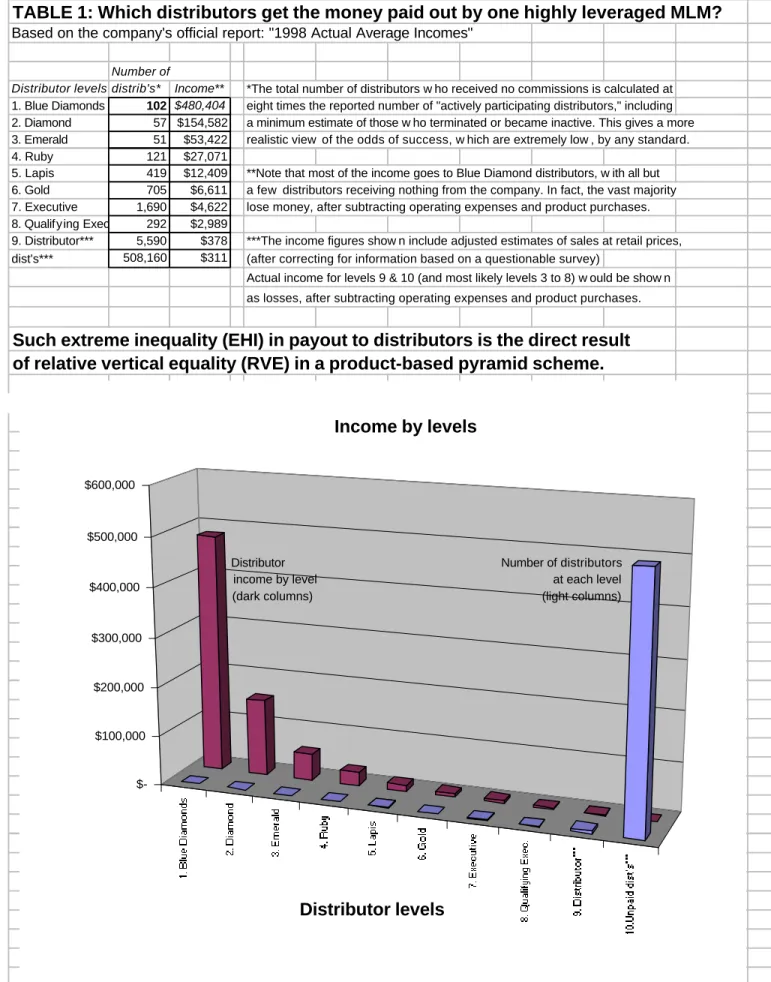
So what is the consequence of RVE in compensation systems? It leads inevitably to extreme horizontal inequality (EHI) in payout over the entire network of distributors. A relative handful of distributors receive huge paychecks, while over 90% (often over 99%) come away empty—actually losing money in most cases, after expenses are subtracted.
Table 1 shows the pattern of EHI in payout distribution in one prominent MLM company which is required by consent decree with the FTC to release average income figures by distributor levels. The
information contains some statistical inconsistencies, which are here corrected, using the best information available to me. While the leverage demonstrated in this example is highly extreme, most any MLM will
demonstrate leverage beyond the norm for an acceptable business opportunity.
Based on the foregoing, I believe a similar pattern exists among distributors in most MLM companies. Such patterns could be verified by the release (by MLM company executives) of data on company payout to distributors by percentiles. Lacking that, I can only offer my estimate of what those patterns look like, based on extensive interviews and personal observations, including those of the company illustrated in Table 1.
Note that—unlike other corporate and small business arrangements, most MLM distributors wind up losing money—assuming all expenses and products purchased from the MLM company are taken into account.
In essence, RVE inevitably leads to EHI. EHI could easily be tested by requiring MLM companies to reveal payout to distributors by percentiles for all distributors— not just the “active” ones. (Again, see my “Network Marketing Payout Distribution Study,” Appendix B.)
If companies were required to disclose these
statistics, I believe some startling information would come out. It would not surprise me to see many companies in which projections of very large incomes offered to recruits were in actuality achieved by far less
than 1/10 of one percent of all distributors recruited into the network.
I believe the focus on pyramid schemes asprograms which emphasize sales rights, rather than the sale of products and services, is inadequate. Other factors need to be factored into any attempts to determine what is a pyramid scheme.
This issue may be both the heart and the Achilles heel of the MLM industry. RVE-EHI, combined with chaining more levels and recruiting more distributors than is functionally justified, is at the core of most PPS programs, and they are their most vulnerable features when understood.
15
TABLE 1: Which distributors get the money paid out by one highly leveraged MLM?
Based on the company's official report: "1998 Actual Average Incomes"
Number of
Distributor levels distrib's* Income** *The total number of distributors w ho received no commissions is calculated at 1. Blue Diamonds 102 $480,404 eight times the reported number of "actively participating distributors," including 2. Diamond 57 $154,582 a minimum estimate of those w ho terminated or became inactive. This gives a more 3. Emerald 51 $53,422 realistic view of the odds of success, w hich are extremely low , by any standard.
4. Ruby 121 $27,071
5. Lapis 419 $12,409 **Note that most of the income goes to Blue Diamond distributors, w ith all but 6. Gold 705 $6,611 a few distributors receiving nothing from the company. In fact, the vast majority 7. Executive 1,690 $4,622 lose money, after subtracting operating expenses and product purchases.
8. Qualifying Exec. 292 $2,989
9. Distributor*** 5,590 $378 ***The income figures show n include adjusted estimates of sales at retail prices, dist's*** 508,160 $311 (after correcting for information based on a questionable survey)
Actual income for levels 9 & 10 (and most likely levels 3 to 8) w ould be show n as losses, after subtracting operating expenses and product purchases.
Such extreme inequality (EHI) in payout to distributors is the direct result
of relative vertical equality (RVE) in a product-based pyramid scheme.
$-$100,000 $200,000 $300,000 $400,000 $500,000 $600,000
Distributor levels
Income by levels
Distributor Number of distributors income by level at each level (dark columns) (light columns)
PPS DEFINING CHARACTERISTIC #3: Significant purchase or recruiting quotas are required (or incentives offered) to qualify for increasing bonus levels or purchasing discounts in an ascending hierarchy of payout levels. This is referred to as the “pay to play” feature of a pyramid scheme.
While this may not be a necessary feature of a PPS, it is a prominent feature in enduring PPS’s. The “successful” (in terms of lasting more than a year or two) MLM’s make it difficult for a distributor to be satisfied at any level of sales already accomplished. Higher bonus levels for recruiting more distributors or for moving more products keeps success-motivated participants on a continual treadmill. As a result, they often purchase more than they need for themselves or than they can realistically sell, especially at the excessive retail prices suggested for many MLM products.
As already discussed, if such product purchases—and other operating expenses—were subtracted from commission checks, very few would be showing an actual profit. Then, to add insult to injury, MLM companies or their distributors often strongly recommend attendance at seminars and convention events—for a fee—and purchase of training materials, and sales “tools,” all of which add to the cost of doing business.
A related problem occurs when a distributor buys enough products to achieve a certain level of payout qualification and has to continually buy a certain minimum quantity of products to maintain that level. When they find they can’t sell them and finally quit, they are left with a garage or basement full of
products. I and other observers have found this to be a common problem with MLM’s, regardless of rules against stockpiling.
From the standpoint of the MLM company, such minimums and the sales of such sales aids help guarantee continued business and profitability. For its top distributors, override commission checks are much larger. The losers are the downline distributors who often are not fully aware of how much the business is costing them in time and money.
Pyramid schemes masquerading as MLM’s are often allowed to grow and flourish unchecked because they do not require a large up-front enrollment fee to sign up. Because recruiters often do not profit from the initial recruitment of a distributor, it is assumed the program is not a pyramid scheme.
In fact, nothing may be further from the truth. As mentioned, MLM companies typically incorporate escalating incentives to purchase products (sometimes at initial signup, sometimes later) to qualify for ever-higher levels in the distributor hierarchy and/or for larger discounts on product purchases. Enforcement officials sometimes refer to this as the “pay to play” feature of a [product-based] pyramid scheme. Also, because of a compensation system with rewards for recruiting a certain number of distributors (or escalating incentives to recruit more and more distributors), many of the more ambitious distributors will recruit “dummy distributors” from friends and family members and buy products in their names. It is not until they leave the system that the more astute among them realize that they have in effect paid a very large fee (in the form of product purchases) for participation in a pyramid scheme. Often this amounts to many thousands of dollars over a period of months.
Such an amount paid into a naked pyramid scheme would immediately arouse suspicions by the public and by enforcement agencies of its constituting an illegal pyramid scheme. But as already stated, since the money paid into an MLM program is paid for legitimate products and over a period of time, most participants (and many regulators) fail to see it as an investment in a pyramid scheme. However, this “pay to play” feature of a product-based distribution system is often a clear indication it is in fact an illegal pyramid scheme.
Many observers believe that MLM products are sold at a premium to support a large downline. If an MLM product were to be sold at a premium of $20 more than competitive products sold through other outlets, the $20 premium could be considered the pyramid premium portion of the price, which would flow to the top of the distributor hierarchy in typical pyramid fashion.
Also, as mentioned above, powerful incentives may be built into the program for the distributor to buy much larger quantities of the product than he/she can realistically sell in order to qualify for ever larger payout (or discount) percentages. This is why incentives for purchases over a period of time need to be considered in calculating the cost of fully participating in the scheme.
THE KEY PROBLEM WITH THE FTC DEFINITION OF A MULTI-LEVEL MARKETING PROGRAM
The Federal Trade Commission (FTC) defines a multi-level program as follows (problems are noted in italics)—
[multi-level marketing is] any marketing program in which participants pay money to the program promoter in return for which the participants obtain the right to
(1) recruit additional participants, or to have additional participants placed by the promoter or any other person into the program participant’s downline, tree, cooperative, income center, or other similar program grouping;
(2) sell goods or services; and
(3) receive payment or other compensation; provided that:
(a) the payments received by each program participant are derived primarily from retail sales of goods or services, and not from recruiting additional participants nor having additional participants placed into the program participant’s downline, tree, cooperative, income center, or other similar program grouping, and (b) (b) the marketing program has
instituted and enforces rules to ensure that it is not a plan in which
participants earn profits primarily by the recruiting of additional
participants rather than retail sales.1(rep)
The major problem with the latter part of this definition is that “rules” are not sufficient to overcome the tendency to invest one’s efforts and money where the greatest return is perceived to be, unless such rules address the fundamental compensation systems that cause the problems with MLM’s. This is especially true where such incentives are literally hundreds (even thousands) of times greater than rewards for complying with the “rules” —such as recruiting a large downline versus selling products at retail to non-distributors.
Any dog owner knows that if you place a five pound package and a one ounce portion of hamburger in front of a dog—two feet apart—the animal will move first to the larger package before considering the smaller one. It would be very difficult to convince a dog with a rule or command that it would be to his advantage to forsake the large package for the tiny one.
This is why researchers such as myself have observed widespread ignoring or circumventing of such rules by MLM distributors. The same can be said for misrepresenting product effectiveness or income potential. When the compensation system indirectly provides extreme rewards for stretching the truth,
while severely penalizing honesty, the result is predictable.
However, even when actions are taken by the FTC and state agencies against MLM’s, it is sometimes difficult to validate and enforce those actions, especially since the larger MLM’s have deep pockets and can often find ways around such rulings. For an agency to enforce action against MLM’s as PPS’s requires the prosecutorial will and the resources to do so.
For example, according to research done at the office of the Attorney General of the state of Wisconsin, Amway blatantly ignores “the Amway rules” to avoid FTC action for conducting a pyramid scheme. These include:
(1) the “70% rule” (distributors must derive at least 70% of their income from retail sales to non-distributors) and
(2) the “10-customer rule” (an Amway representative had to prove that he/she has made at least 10 retail sales each month). 15
In1993, NuSkin International, Inc., was ordered by the FTC to provide information on average incomes for distributors, but using statistical sleight of hand was able to hide relevant information on the odds of success from prospects and from enforcement officials reviewing their program. Their annual report entitled “Actual Average Incomes,” showing average incomes for each level of “actively participating distributors” is made available to anyone who requests it.
An uninformed prospect reading the report is led to believe that 100% of those who make an effort as new distributors in the NuSkin “business opportunity” earn a profit. But close inspection by an analyst who is familiar with their program revealed some
fundamental flaws in their reporting.
The actual odds of success for all distributors who attempt the NuSkin program (after all expenses are subtracted, including product purchases) is probably less than 1/10 of 1%! It is astounding that NuSkin has been allowed to continue misleading consumers for so long, resulting in hundreds of thousands of persons investing in the NuSkin program—who probably would not have done so had they been furnished correct information.16
Apparently until now, the Enforcement Division of the FTC has considered NuSkin in compliance with its 1993 Order to cease and desist misrepresenting earnings. However, I understand NuSkin’s compliance with the order is now under review, so hopefully this situation will change.
If a distributor tells prospective recruits that they have one chance in 10,000 of making a profit for their efforts, what are the chances he/she will be successful as a recruiter? Would a recruiter who gave out such