WAN, NFV and Cloud Services Orchestration
Planet Orchestrate
A primary challenge facing network operators today remains how to quickly introduce and operationalize new cloud and NFV-based services in their networks while keeping costs under control. Planet Orchestrate™ is Cyan’s innovative domain and multi-technology application for the Blue Planet platform that allows network operators to leverage the service agility, automation and flexibility offered by SDN, NFV, and the cloud.
Architected to be entirely modular, data and template-driven, Planet Orchestrate provides the intelligent allocation, creation and management of virtual and physical service resources – including network elements, storage, compute, and applications – across the telco cloud and WAN from a single-pane-of-glass. Purpose-built for network operators, Planet Orchestrate accelerates service providers’ transition to SDN and NFV, allowing them to be more nimble in responding to customer and market demands.
Highlights
• Manages, automates and orchestrates services comprised of physical and virtual resources across the telco cloud and WAN
• Flexible architecture integrates NFV, Cloud, and Multi-Domain Service Orchestration capabilities
• Open system interoperates with different OSSs, cloud platforms, SDN controllers, NMS/EMSs, network elements and VNFs
• Complies with ETSI’s NFV ISG Management and Orchestration (MANO) framework
• Powerful, intuitive user interface provides a single-pane-of-glass for orchestrating all service resources
© 2014, Cyan, Inc. Page 2
Planet Orchestrate: Programmable
Network and Service Orchestration
Planet Orchestrate creates a highly programmable and interoperable system that is agnostic to the type of resources or services being orchestrated. Through its use of service and resource information templates and open APIs, Planet Orchestrate supports interoperability and interaction with the industry’s widest range of operational support systems (OSSs) and other higher-layer applications, cloud management platforms, physical network elements and cloud- or NFV-based virtual resources. Planet Orchestrate can be customized to suit the needs of diverse network operator environments and applications. The system's flexible architecture integrates capabilities that can be used individually, or in combination, to support different use cases:
Multi-Domain Service Orchestration, NFV Orchestration, and Cloud Orchestration.
Multi-Domain Service Orchestration
The service provider infrastructure is comprised of multiple technologies layers, as well as specialized domains such cloud, metro, and core networks. Services typically span multiple technology layers and domains. Further, orchestration can occur within a layer and a domain, but also across multiple layers and domains.
Planet Orchestrate supports Multi-Domain Service Orchestration (MDSO) capabilities to efficiently provision and manage “service chains” comprised of physical network elements and SDN/NFV-enabled virtual components across multiple domains. Using APIs, Planet Orchestrate can be integrated with SDN controllers such Cyan’s Planet Operate, as well as 3rd party controllers, element/network management systems, and cloud management platforms. This breaks down management silos, allowing network operators to orchestrate services from end-to-end.
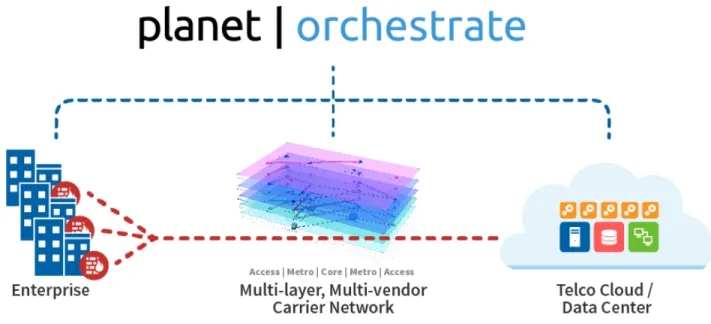
Figure 1: Planet Orchestrate manages, automates and orchestrates services across the telco cloud and the multi-layer, multi-vendor WAN
© 2014, Cyan, Inc. Page 3
Multi-domain service orchestration provides network operators the flexibility to deliver compelling services such as NFV-enabled Ethernet. This offering incorporates an SDN-powered, auto-provisioned Carrier Ethernet Network-as-a-Service (NaaS), with optional software-based features such as vFirewall and vEncryption that can be instantiated by the end-customer when and where needed through a portal, or an API.
By supporting the ability to integrate different NFV, cloud, and SDN capabilities as required, multi-domain service orchestration allows operators to adopt new technologies at their own pace.
NFV Orchestration
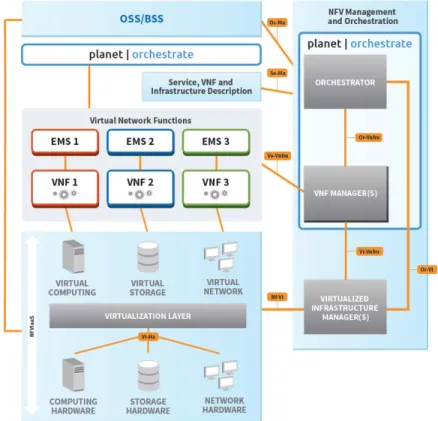
Planet Orchestrate supports versatile multi-vendor NFV Orchestration (NFVO) capabilities that are fully compliant with the ETSI NFV ISG Management and Orchestration (MANO) framework. As illustrated in Figure 2, Planet Orchestrate can perform VNF management and orchestration functionality, or in the case where a VNF manager is provided by the VNF vendor, perform only the orchestration functions.
The open architecture of Planet Orchestrate NFVO enables rich, multi-vendor environments within the NFV Infrastructure (NFVI), including support for different cloud management software and physical servers. This further enables operators to break the long-standing cycles of vendor lock-in.
Planet Orchestrate NFVO is also highly flexible, enabling operators to deploy and manage a variety of VNFs at varying degrees of scale and performance. The NFV orchestration engine provides intelligent placement of VNFs and supports distributed NFVI to optimize use of NFV resources. VNFs also can span one or more data centers, or be distributed to servers or devices located on the customer premises.
As a carrier-grade system, Planet Orchestrate supports the performance, availability and security demands of service provider applications. Full performance monitoring and alarm/event reporting is provided for the NFVI and virtual functions, including tracking of relationships and inter-dependencies between the NFVI resources and VNFs. An intrinsic knowledge of the topology and the mapping between application and virtual resources enables rapid fault-isolation and recovery as well as high-availability and resiliency.
Figure 2: Planet Orchestrate provides flexible, multi-vendor and
© 2014, Cyan, Inc. Page 4
Cloud Orchestration
Planet Orchestrate provides Cloud Orchestration capabilities that allow network operators to deliver flexible data center-based service offerings, such as Infrastructure as a Service (IaaS) and Platform as a Service (PaaS). Using Cloud Orchestration, network and data center operators can offer their customers the ability to instantiate new cloud resources, such as virtual machines, new tenant networks, or additional storage, dynamically, and on demand. The requests can be made by end-users through web portal, or by specific applications using an API.
Combining Cloud Orchestration with Multi-Domain Service Orchestration provides dynamic control over network resources such as bandwidth and QoS, enabling operators to offer enterprises the control they demand over application performance and resource allocation for a superior customer experience. Cloud Orchestration capabilities will be supported in a future Planet Orchestrate release. Figure 3: Planet Orchestrate enables faster introduction of new services comprised of both
www.cyaninc.com Cyan, Inc. Planet Orchestrate Data Sheet 1383 North McDowell Blvd., Suite 300
Version 2G Petaluma, CA, USA, 94954
+1 707 735 2300
© 2014, Cyan, Inc. Page 5
Technical Specifications
System
Resources and services modeled using HOCON+ (JSON extended)
Model import/export flexibility:o TOSCA o YANG o YAML
Template-driven service provisioning
RESTful API s
Supported Cloud Management Systems:o OpenStack (initial release) o VMware Vsphere (future)
Multi-domain Service Orchestration Features
Service-chaining across physical and virtualnetwork elements
Hierarchical deploymento Support for existing NMS, EMS, controllers
Customer-facing portalNFV Orchestration Features
Centralized and Distributed NFV (D-NFV)
Deploy/delete a new VNF instance
Advanced VNF placemento User-selectable
o Policy-based (semi-automated) o Auto-placement
NFV Orchestration (Continued)
Clustered and non-clustered VNFs
Composite and atomic VNFs supported (initial release)o Fortinet Virtual Firewall (vFW) o Certes Virtual Encyption (vEncrypt) o vCPE (vFW + vEncrypt service chaining) o PowerDNS Virtual DNS (vDNS)
Orchestration spanning multiple VIMs (Virtualized Infrastructure Managers).
Scaling of VNFs based on pre-defined KPI/criteria
Support for multiple VNF packaging options
Support for flexible VNF descriptor formats
KPI performance monitoring(application/VNF and infrastructure/CMS)