ONLINE CONSUMER BEHAVIOR: AN EXPLORATORY STUDY
Namita Bhandari* & Preeti Kaushal**
*Panjab University, Chandigarh, India **Chitkara University, Punjab, India
Abstract
Online shopping is gaining momentum in India. With internet penetration improving in the country, smart phones becoming affordable and lifestyles becoming hectic, the way people used to shop are changing. Also with a huge chunk of young and working population, Indian demographics are a delight for e-commerce retailers. But to gain the trust and attention of Indian consumers in this virtual shopping world there are many aspects of consumer behavior which need to be explored. What exactly is Indian consumer thinking when he is buying online, what are his expectations, apprehensions, anxieties and phobias which e-retailers need to overcome. Is an Indian online consumer comfortable with the click-of-the mouse buying, any improvements or areas which he thinks need to get addressed, any specific part of online buying which delights him. To answer such queries the present study gives an insight. This study aims to identify the main factors which an online buyer considers while making online purchases by using factor analysis. The results have shown various reasons like trust, information, convenience, experience, effortless shopping and bargain because of which consumers do online shopping.
Keywords: OnlineShopping, E-commerce, Consumers, online buyers.
Introduction
Online shopping, e –commerce, e-tailing or any other way in which you address it, but sale and purchase of retail goods and services via web has become an important part of shopping phenomena. It all started in 1997, when worth multi-billion dollar orders were placed through the website of Dell Computers. After that Amazon and eBay further popularized it. And now there is a huge deluge of websites selling variety of products. Indian internet shopping story is still unfolding with approximately 150 million internet users and that too only at an internet penetration of around 12%. So there lies a huge unexplored potential for this trend to ride the wave of Indian demographic story. To understand what Indian consumer is buying online and what is coming in his/her mind while exploring the aisles of online stores, this study is being undertaken. Another point worth noticing is the greater involvement of Tier-II cities in this activity. In fact in a study conducted by the name of “Great Online Shopping Festival” has found that more than 50% of online buying is contributed by non-metros (Google India, 2013). That’s why this study is being conducted in and around Chandigarh. In fact to highlight the increasing popularity of e-retailing the same study (Google India, 2013) has found that 2012 has been a phenomenal growth year in the chapters of Indian online shopping story as it has witnessed 128% increase in consumer interest in the year 2011-12.
Further with increasing usage of smart phones and better broadband connectivity, the online shopping trend will further get a boost. Also the kind of convenience attached by doing shopping with the click of the mouse this trend is further going to get boost. Living pace is getting faster, our daily schedules are getting more hectic and further with increasing fuel expenses, trip to our favorite retail stores has become costlier. In such a scenario consumers have started appreciating the hassle free online shopping mode. Yes, visiting your favorite store has a factor of hedonic pleasure attached to it, but ease of saving time, fuel and efforts has started taking precedence. In some countries e-retailing has already become quite popular whereas in few countries like India it is at evolving stage, with ecosystem components like, broadband penetration and smart phone ownership not fully developed. All these things taken together are going to give a new twist to the businesses happening so far and disruptive business models are going to happen through e-commerce mode.
Review of Literature
There are many factors which draw a consumer towards online purchase with few like access to lots of information, competitive prices, great choice, convenience etc. (Zhou, Dai & Zhang, 2007). Various studies have tried to understand internet buying phenomenon from different angles. It has also been observed that cultural dimensions of a nation like being individualistic or collectivist and masculine or feminine too effects the tendency to buy online (Chau et al., 2002). Online shopping has also been found to have some peculiar influence of reference groups, peers, family members and their recommendations (Foucault & Scheufele, 2002). The online shopping experience can further be improved if online vendors engage with buyers more through social media, blogs, chat rooms etc. and thus generating more online referrals (Zhou et al., 2007).The studies also reveal that to understand the consumer psychology regarding online purchase cannot be directly taken from normal retail purchase, there is a need to separately understand this (Cheung et al., 2003). To understand online shopping behavior various theoretical models like Technology Acceptance Model, Theory of Reasoned Action or Innovative Diffusion Theory have also been used (Cheung et al., 2003). Internet shopping and
web gives a consumer lots of ease to find and compare suitable products, thus helps him to make more informed buying decision (Alba et al., 1997). Further online search reduces a buyer’s search cost due easy and accessible availability of information, reviews and online databases and consumers use different strategies while searching information on web like, choice of search engine, information filtering etc. (Kumar, Lang & Peng, 2005).
The literature also has evidence of relation being examined between CRM practices and online retailing. There has been observed positive effect on customer satisfaction by using CRM practices at right time of online marketing growth stage (Srinivisan & Moorman, 2005).The internet based diffusion of technology has also been heralded as an important game changer in the relation between producer and consumer, if we see how historically changes have come in the behavior of consumers over time led by cultural, social, political or technological dynamics and it has also changed the way competitors gain advantage by looking for best bargains in supply chain (Dickson, 2000). Then there is also found to be differences on the basis of gender that information technology diffusion in shopping behavior is observed, with male and females having variation in the way they use and adopt technology (Slyke et al., 2005). So it is also required to understand such gender-based differences in context to web-based shopping. To understand that what kind of key points should be kept in mind while developing websites for online shopping theoretical models like Expectation Confirmation model or Information System Continuance theory , this can help in drafting strategies to bring customers back to the websites for shopping, hence increasing customers life time value (Chang & Chou, 2011). Further, in the same study it has been observed that when consumers develop an association with a brand on web community they tend to share their positive experience and knowledge about the websites with other prospective buyers creating a strong positive publicity for the e-commerce site. That is why some of the e-commerce sites have strategized to set up their online virtual communities, so that a platform is provided to the users to share their experiences (Chang & Chou, 2011). Out of alternative retail formats a customer selects his preference on the basis of certain dimensions like: how many categories are provided, alternatives provided for each category, what kind of consideration set can be formed, comparison of alternatives on the basis of quality and quantity, transaction costs like delivery time, delivery costs, transaction costs, supplier facility, ease of placing orders, personal information security, social communities available for the website etc. (Alba et al., 1997).
To support the online shopping recall, the traditional modes of advertisement by using experience association messages instead of item specific messages should be used, also it depends on that how the integration between spoken and written words is maintained which effects that memory would be retained b a customer for long for that brand (Tavassoli, 1998). The factor of gaining trust of consumers to go ahead with online deals without getting jittery about their confidential financial and personal information is very crucial (Schlosser et al., 2006). The increasing importance of internet based shopping is actually encouraging vendors to go for multi-channel strategy and use of multiple retail formats simultaneously especially post dot-com burst, where companies are optimizing their marketing expenditure by using their internet efforts to enhance customer relationship (Bart et al., 2005). Further many characteristics of web-sites and consumers influence web-site trust, like: financial risk, information risk, consumer’s degree of involvement with products or service, depth of information provided on a site and degree of information browsing required for a service or a product (Bart et al., 2005).
Need of the Study
With increasing popularity of online shopping the competition is getting escalated and thus it has become imperative for e-retailers to understand the motivators which bring consumers to shop online (Zhou et al., 2007). Moreover Indian markets are still untapped in terms of online shopping phenomena and this trend is still gaining popularity among consumers. Also the recently done surveys have also indicated the huge growth expected from non-metros in the near future (Google, 2013). As the online buying trend is gaining popularity in India and many companies aim to capitalize on it, it becomes significant to get insight about the why, how and what of online consumer behavior. So this study tries to understand the antecedents behind the online purchase that too in Indian context.
Objective of the Study
The objective of the study is to understand and find the factors which influence the consumers while buying online. The Study
To understand the dimensions of consumer behavior which doing online shopping, this study has been conducted with following particulars:
Research Design: The research design is exploratory in nature as it just aims to figure out the main factors which a customer considers while buying a product from an e-commerce website.
Data Collection and Questionnaire Design: To understand the construct of online shopping both primary as well as secondary data has been used. To collect the primary data a questionnaire was developed with questions based on demographic profile of the respondents and 22 statements to measure the attitude of respondents on a five point likert scale. These statements were collected by doing a group discussion in a group of ten people belonging to management education background.
Sample Size and Sampling Method: To collect the data convenience sampling method was used. 125 respondents were contacted from the area of Chandigarh, Panchkula and Mohali and we were able to get 100 completely filled questionnaires; thus leading to a response rate of 80%.
Statistical Analysis: To explain the structure or dimensions of various multidirectional factors which are useful in studying the construct of online shopping behavior, the data was statistically analyzed by using data reduction technique i.e. factor analysis.
Results & Discussion
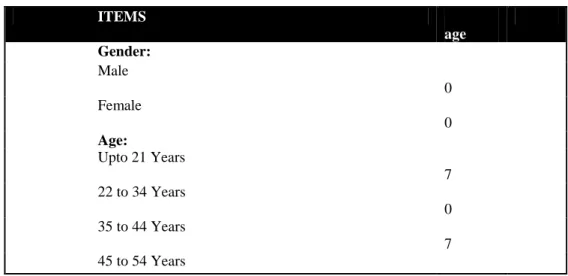
(a.) Sample Profile: From the below table, the demographic profile of the respondents can be seen, with sample consisting of 60% of male and 40% of female respondents. Majority of the respondents i.e. 60% belonged to 22 to 34 years age group and below 21 years and from 35 to 44 years number of respondents were 17% each.
Table 1: Demographic Profile
Factor Analysis:
To create dimensions or factors from the 22 items on which attitude of respondents were measured on five point likert scale were factor analyzed on SPSS. Before going ahead with factor analysis the condition of data adequacy is checked by seeing the value of Kaiser-Meyer-Olkin Measure of Sampling Adequacy (KMO). The Appendix1 shows a KMO of 0.653, which is considered good for using factor analysis. To check if there exists sufficient relation between the variables to factor analyze them, Bartlett’s Test value is checked from Appendix1 and it is coming significant. From the total variance explained table in Appendix2 we can see that the numbers of factors extracted are seven whose Eigen values are more than one. The factors are extracted on Kaiser’s Criterion of retaining factors. The cumulative variance explained by these seven factors is coming out to be 63.6%, and the individual variance explained by each factor is very balanced among the seven factors. Now to understand that under which factor, the variable belongs, Rotated Component Matrix table in Appendix3 will be used. The rotation is done based on Principal Component Analysis method. Here a variable’s loading is shown only under that factor against which it is highest. Further, only those variables are retained whose loadings are at least 0.4, as we had selected this suppression criterion while running factor analysis on SPSS.
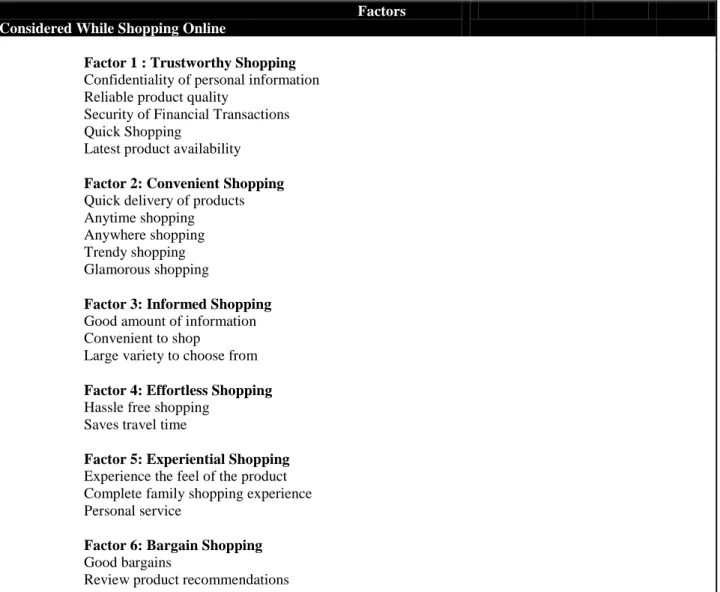
After interpreting the Rotated Component Matrix table, which has crafted factors by using Varimax rotation by using Kaiser Normalization criterion, we have come up with the following factors which contain certain variables grouped under respective heads:
Factor 1 (Trustworthy Shopping): This factor includes five items which are majorly related to confidentiality of personal information, reliable product quality, secure financial transactions and also two items as quick shopping and latest products available. The literature also has indicated consumers’ apprehension for their personal and financial information security and websites are also making efforts to ensure to provide such security by providing secure web technology, but along with that, e-commerce sites need to invest in overcoming consumer’s fear perception towards making online purchase (Schlosser et al., 2006). Further an association has been observed between trust and online purchase intentions thus leading to consideration for speedy shopping and latest products availability. Moreover studies have found that such contemporary electronic or interactive shopping modes provide extensive opportunities to browse and compare products and thus go for the best and latest ones (Alba et al., 1997). Further online trust is driven by many sub-factors such as security, privacy, error-free transactions, fulfillment of order as consumer feels vulnerable while doing shopping transactions on internet (Bart et al., 2005). In fact the element of online trust includes perception of consumers regarding that how an e-commerce site perform on expectations related to products, service, believability and consistency of information (Bart et al., 2005).
Factor 2 (Convenient Shopping): This factor contains five items as: quick delivery, anytime, anywhere shopping, trendy and glamorous shopping. These components provide a kind of experience to users of e-commerce which lead to customer satisfaction and further act as a strong differentiator over traditional retail formats. This perception of ease
ITEMS % age Gender: Male 6 0 Female 4 0 Age: Upto 21 Years 1 7 22 to 34 Years 6 0 35 to 44 Years 1 7 45 to 54 Years 6
which comes with the use of technology while doing shopping is also an important antecedent of customer satisfaction regarding online shopping, which further leads to repeat purchase and visit to an e-commerce site (Alba et al., 1997).
Factor 3 (Informed Shopping): Under this dimension the three items which are getting clubbed are as: convenient to shop, good amount of information available and large variety to choose from while shopping on net. The findings are consistent with the literature which has placed huge emphasis on reduced search cost as an advantage associated with internet based shopping, as consumers are able to serach products, compare reviews with great search tools and that too free of cost (Spann & Tellis, 2006); (Kumar, Lang & Peng, 2005). With number of brands mushrooming up which provide dynamically changing stuff especially related to fashion and technology the search for variety holds a very important position in the field of online buying. The depth and degree of information associated with a product category is an important characteristic linked with the web-based shopping and in fact purchases which are information intensive need to have website with user friendly navigation facility (Bart et al., 2005).
Factor 4 (Effortless Shopping): This factor includes two items as in hassle free shopping and saves travel time. In today’s environment of hectic routine, increasing fuel prices, parking problem and distance wise widespread markets, this factor makes huge sense in favor of online shopping.
Factor 5(Experiential Shopping): This dimension includes three items as: experience the feel of the product, complete family shopping experience and personal service. The web site signals which convey more information about the products and website designs which are more user friendly and bestow trust have higher possibility of getting website visits converted into purchase intentions (Schlosser et al., 2006). The effort has also been made to overcome the disincentives associated with electronic shopping like product feel by offering more interactive options on while doing electronic shopping (Alba et al., 1997). Also to ensure vibrancy in online shopping zone it is required that vendor’s strategies should focus on that the e-commerce sites give users a reliable and enjoyable experience and consumers also aim to do an informed and bargain driven shopping (Doherty & Chadwick, 2010).
Factor 6(Bargain Shopping): This includes two items as good bargains and review product recommendations. The opportunity to get to know reviews of users or visitors of an online commerce site through chat rooms, blogs or other online forums is a big driver of trust and also works in favor of online purchase (Bart et al., 2005). In fact Smith et al. (1999) have concluded that due to search ease brought by internet, market efficiency while doing web based shopping goes up due to increase in price elasticity among consumers.
Table 2
Factors Considered While Shopping Online
Factor 1 : Trustworthy Shopping Confidentiality of personal information Reliable product quality
Security of Financial Transactions Quick Shopping
Latest product availability Factor 2: Convenient Shopping Quick delivery of products Anytime shopping Anywhere shopping Trendy shopping Glamorous shopping
Factor 3: Informed Shopping Good amount of information Convenient to shop
Large variety to choose from Factor 4: Effortless Shopping Hassle free shopping
Saves travel time
Factor 5: Experiential Shopping Experience the feel of the product Complete family shopping experience Personal service
Factor 6: Bargain Shopping Good bargains
Reliability:
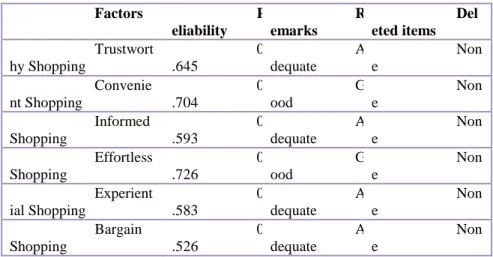
Now to check that how consistently the above created factors are explained by the sub-items included under each dimension, the reliability of the factors with their sub-items has been checked. To check the reliability the Cronbach alpha (α) has been calculated for each factor. The results are as follows:
Table 3: Cronbach Alpha (α) Values
Factors R eliability R emarks Del eted items Trustwort hy Shopping 0 .645 A dequate Non e Convenie nt Shopping 0 .704 G ood Non e Informed Shopping 0 .593 A dequate Non e Effortless Shopping 0 .726 G ood Non e Experient ial Shopping 0 .583 A dequate Non e Bargain Shopping 0 .526 A dequate Non e
The results of reliability check by using Cronbach alpha (α) show that all the factors have more than 0.5 of alpha value with their respective sub-items, hence the factors created have a good reliability score. As Appendix 4 to 9 show that for the first factor of trustworthy shopping the reliability score for five sub-items is coming 0.645, which can be considered adequate; for the second factor of convenient shopping the five sub-items have alpha value of 0.704 which can be considered good; for the third factor of informed shopping the three sub-items have alpha value of 0.593 which can be considered adequate; for the fourth factor of effortless shopping the two sub-items have alpha value of 0.726 which can be considered good; for the fifth factor of experiential shopping the three sub-items have alpha value of 0.583 which can be considered good and for the sixth factor of bargain shopping the two sub-items have alpha value of 0.526 which can be considered good.
Limitations of the Study
The results of a study should always be seen in the light of its limitations. Like, in this study the sample size is an issue, as to make the findings more generalized the sample size should have been larger. But the KMO value of sample adequacy has found the sample size adequate to use factor analysis. Moreover, to improve the findings the sample should have been drawn by using probabilistic sampling technique where as in the present study due to shortage of time convenience sampling was used.
Managerial Implications of the Study
The above results give direction to the managers and vendors of e-commerce websites as it helps in framing strategies to make online shopping a more user friendly experience. Also as in India online shopping has not yet reached its tipping point, so it gives an insight into that what the apprehensions and expectations of Indian web shoppers are. Moreover, many brick-mortar businesses are planning to venture into click-mode also, so for them it is important to understand that why consumers do online shopping, how they view various components of online shopping experience. The issues like security of financial information while transacting on websites and confidentiality of their personal information still bring anxiety to the minds of Indian consumers, hence online vendors need to bring that assurance to their minds by having robust back-end technology as well as right image through their websites’ features. Further, the factor of convenience also tops the mind of an online buyer, so effort should be made to delight the consumer by giving extremely good buying experience by ensuring quick delivery and hassle free online transactions.
Future Scope of the Study
The theoretical framework concluded from the study in the form of six dimensions or factors crafted out can be used further to understand the of online consumer behavior. These factors can be further regressed on the customer satisfaction score of the users of online retail services to better understand the significance of each factor to bring better user experience to online shoppers. Different dimensions in the form of six factors which have come up through this study can be studied separately in detail to further understand the construct of online shopping behavior.
References
Alba, J., Lynch, J., Weitz, B., Janiszewski, C., Lutz, R., Sawyer, A., & Wood, S. (1997). Interactive home shopping: Consumer, retailer, and manufacturer incentives to participate in electronic marketplaces. Journal of Marketing, 61 (3), 38-53.
Bart, Y., Shankar, V., Sultan, F., & Urban, G. L. (2005). Are the drivers and role of online trust the same for all web sites and consumers? A large-scale exploratory empirical study. Journal of Marketing,69 (4), 133-152.
Chang, S., & Chou, C. (2011). Factors affecting user's online shopping behavior: Integrating the constraint-based and dedication-based relationship perspectives. African Journal of Business Management, 5(2), 370-382.
Chau, P. Y. K., Cole, M., 45, A. P. M., Montoya-Weiss, M., & O'keefe, R. M. (2002). Cultural differences in the online behavior of consumers. Communications of the ACM, 45 (10), 138-143.
Christy M. K. Cheung, C. M. K., Zhu, L., Kwong, T., Chan, G. W. W., & Limayem, M. (2003, June). Online consumer behavior: A review and agenda for future research. 16th Bled eCommerce Conference eTransformation. Bled, Slovenia, 194-218.
Dickson, P. R. (2000). Understanding the trade winds: The global evolution of production, consumption, and the internet. Journal of Consumer Research, 27 (1), 115-122.
Doherty, N. F., & Chadwick, F. E. (2010). Internet retailing: the past, the present and the future. International Journal of Retail & Distribution Management, 38(11/12).
Foucault, B., & Scheufele, D. (2002). Web vs. campus store? Why students buy textbooks online. Journal of Consumer Marketing, 19 (4/5), 409-424.
Google India. (2013). Retreived from: http://yourstory.in/2013/01/google-india-study-about-online-shopping/
Kumar, N., Lang, K. R., Peng, Q. (2005, January). Consumer search behavior in online shopping environments. Proceedings of the 38th Hawaii International Conference on System Sciences (HICSS-38), 87-102.
Schlosser, A.E., White, T. B., & Lloyd, S. M. (2006). Converting web site visitors into buyers: How web site investment increases consumer trusting beliefs and online purchase intentions. Journal of Marketing, 70 (2), 133-148.
Slyke, C. V., Belanger, F., & Hightower, R. (2005). Understanding gender-based differences in consumer –commerce adoption. Proceedings of the 2005 Southern Association of Information Systems Conference, 24-29.
Smith, M., Bailey, J., & Brynjofsson, E. (1999). Understanding digital markets: Review and assessment (Erik Brynjolfsson & Brian Kahin, eds.). MIT: MIT Press.
Spann, M., & Tellis, G. J. (2006). Does the internet promote better consumer decisions? The case of name-your-own-price auctions. Journal of Marketing,70 (1), 65-78.
Srinivasan,R., & Moorman, C. (2005). Strategic firm commitments and rewards for customer relationship management in online retailing. Journal of Marketing, 69 (4),193-200.
Tavassoli, N. T. (1998) Language in multimedia: Interaction of spoken and written information. Journal of Consumer Research, 25 (1), 26-37.
Zhou, L., Dai, L., & Zhang, D. (2007). Online shopping acceptance model: A critical survey of consumer factors in online shopping. Journal of Electronic Commerce Research, 8 (1), 41-62.
Appendix:
Appendix 1:
KMO and Bartlett's Test Kaiser-Meyer-Olkin Measure of Sampling Adequacy. . 653 Bartlett' s Test of Sphericity Approx . Chi-Square 6 37.326 Df 2 31 Sig. . 000
Appendix 2:
Total Variance Explained
Component
Initial Eigenvalues Extraction Sums of Squared Loadings Rotation Sums of Squared Loadings
Total % of
Variance Cumulative % Total
% of
Variance Cumulative % Total
% of Variance Cumulative % 1 4.746 21.574 21.574 4.746 21.574 21.574 2.388 10.855 10.855 2 2.373 10.786 32.360 2.373 10.786 32.360 2.223 10.103 20.958 3 1.681 7.642 40.003 1.681 7.642 40.003 2.115 9.615 30.573 4 1.497 6.804 46.807 1.497 6.804 46.807 2.001 9.097 39.670 5 1.385 6.293 53.100 1.385 6.293 53.100 1.883 8.559 48.229 6 1.243 5.650 58.750 1.243 5.650 58.750 1.812 8.235 56.463 7 1.071 4.868 63.618 1.071 4.868 63.618 1.574 7.155 63.618 8 .937 4.257 67.875 9 .908 4.128 72.003 10 .862 3.917 75.920 11 .754 3.427 79.347 12 .671 3.048 82.395 13 .593 2.697 85.092 14 .560 2.544 87.637 15 .525 2.385 90.021 16 .459 2.084 92.106 17 .411 1.869 93.974 18 .378 1.717 95.691 19 .291 1.325 97.016 20 .259 1.176 98.192 21 .223 1.014 99.206 22 .175 .794 100.000
Extraction Method: Principal Component Analysis.
Appendix 3:
Appendix 4:
Reliability Statistics
Cronbach's Alpha N of Items
.645 5
Appendix 5:
Reliability Statistics Cron
bach's Alpha N of Items
.704 5
Rotated Component Matrix a
Component
1 2 3 4 5 6 7
Good Amount Of Information .471
Convenient To Shop .819
Enjoyable Shopping Experience
Confidentiality Of Personal Information .747
Good Internet Connection .751
Reliable Product Quality .718
Good Bargains .473
Security Of Financial Transactions .520
Experience The Feel Of The Products .614
Quick Delivery Of Products .808
Anytime Shopping .540
Anywhere Shopping .578
Review Product Recommendations .881
Hassle Free Shopping .759
Saves Travel Time .797
Trendy Shopping Experience .473
Complete family Shopping Experience .739
Large variety to Choose From .675
Personal service .696
Quick shopping .496
Glamorous and Exciting Shopping Experience .557
latest Product Availability
.443
Extraction Method: Principal Component Analysis.
Appendix 6:
Reliability Statistics Cr
onbach's Alpha N of Items
.5
93 3
Appendix 7:
Reliability Statistics Cr
onbach's Alpha N of Items
.7
26 2
Appendix 8:
Reliability Statistics Cr
onbach's Alpha N of Items
.5
83 3
Appendix 9:
Reliability Statistics Cr
onbach's Alpha N of Items
.5
26 2
Appendix 10:
QUESTIONNAIRE
1.Indicate the extent of your agreement or disagreement with each of the following statements by putting a tick mark under the appropriate number. The meaning of the numbers is as:
1 2 3 4 5
Strongly Disagree Moderately Disagree Neither Disagree
Nor Agree Moderately Agree Strongly Agree
I buy online because : N
o. Statements 1 2 3 4 5
1
Good amount of information 2
Convenient to shop 3
Enjoyable shopping experience 4
Confidentiality of personal information 5
Good internet connection 6
Reliable product quality 7
Good bargains(Best Prices/deals) 8
Security of financial transactions 9
Experience the feel of the product/trials 1
0
1 1 24*7(anytime) shopping 1 2 Anywhere shopping 1 3
Review features of products and
recommendation 1
4
Hassel free shopping 1
5
Saves travel time 1
6
Trendy shopping experience 1
7
Complete family shopping experience 1
8
Large variety to choose from 1 9 Personal services 2 0 Quick shopping 2 1
Glamorous and exciting shopping experience 2
2
Latest product availability
3. Have you ever made a purchase on internet ? a. Yes b. No
4. Name :_________________________________________ 5. Age : (Tick the correct option)
[ ] 21 and Under [ ] 22 to 34 [ ] 35 to 44 [ ] 45 to 54 [ ] 55 to 64 [ ] 65 and Over 6. Monthly Income : (a) Upto Rs. 20,000 (b) 20,001 to 40,000 (c) 40,001 to 60,000 (d) 60,001 to 80,000 (e) 80,001 to 100,000 (f) 100,001 and above
Name: ________________________________
Address: _________________________________
Phone/E-mail: __________________________________ Thank you very much for participating in this study. Your time and opinions are greatly and deeply appreciated.