Research Article
Engineering Change Orders Design Using Multiple Variables
Linear Programming for VLSI Design
Yu-Cheng Fan, Chih-Kang Lin, Shih-Ying Chou, Chun-Hung Wang,
Shu-Hsien Wu, and Hung-Kuan Liu
Department of Electronic Engineering, National Taipei University of Technology, Taipei 10608, Taiwan Correspondence should be addressed to Yu-Cheng Fan; [email protected]
Received 7 June 2014; Accepted 18 July 2014; Published 24 August 2014 Academic Editor: Chih-Cheng Lu
Copyright © 2014 Yu-Cheng Fan et al. This is an open access article distributed under the Creative Commons Attribution License, which permits unrestricted use, distribution, and reproduction in any medium, provided the original work is properly cited. An engineering change orders design using multiple variable linear programming for VLSI design is presented in this paper. This approach addresses the main issues of resource between spare cells and target cells. We adopt linear programming technique to plan and balance the spare cells and target cells to meet the new specification according to logic transformation. The proposed method solves the related problem of resource for ECO problems and provides a well solution. The scheme shows new concept to manage the spare cells to meet possible target cells for ECO research.
1. Introduction
Engineering change orders (ECO) are important technolo-gies used for changes in integrated circuit (IC) layout and compensate for design problems. Traditionally, when chip shows errors, it often requires new photomasks for all layers. However, photomasks of deep-submicron semiconductor fabrication process are very expensive. In order to save money, ECO technology modifies only a few of the metal layers (metal-mask ECO) to reduce the cost of photomasks for all layers [1].
To perform the ECO, IC designers adopt sprinkling many unused logic gates during IC design flow. When chip is manufactured and shows design errors, IC designers modify the gate-level net-list using the presprinkling unused logic gates. At the same time, the designers track and verify the modification to check formal equivalence after ECO process. The designers must guarantee the revised design matching the revised specification.
How to achieve ECO efficiently? There are some litera-tures that address this problem and provide related solution. In literature [2], Tan and Jiang describe a typical metal-only ECO flow with four steps that include placement and spare cell distribution, logic difference extraction, metal-only
ECO synthesis, and ECO routing [2]. Kuo et al. insert spare cells with constant insertion for engineering change and describe an iterative method to determine feasible mapping solutions for an EC problem [3]. Besides, in order to per-form ECO efficiently, literature [4–9] adopt minimal change EC equations automatically. Brand proposed incremental synthesis method [4]. Huang presented a hybrid tool for automatic logic rectification [5]. Lin et al. addressed logic synthesis techniques for engineering change problems [6]. Shinsha et al. performed incremental logic synthesis through gate logic structure identification [7]. Swamy et al. achieved minimal logic resynthesis for engineering change [8]. Watan-abe and Brayton presented another kind of incremental synthesis technique for engineering changes [9]. However, few researchers discuss the resource between spare cells and target cells. Therefore, in order to solve the problems, we adopt linear programming technique to plan and balance the spare cells and target cells in this paper. The proposed scheme meets the new specification according to logic transformation and overcomes the related problems of resource for ECO research.
This paper is organized as follows. In Section 2, we address typical ECO design flow. InSection 3, logic trans-formation is discussed. InSection 4, multiple variables linear
Volume 2014, Article ID 698041, 5 pages http://dx.doi.org/10.1155/2014/698041
Old net-list ECO
New register transfer level
ECO New net-list
ECO editing Old register transfer level Logic synthesis DFT Placement and routing
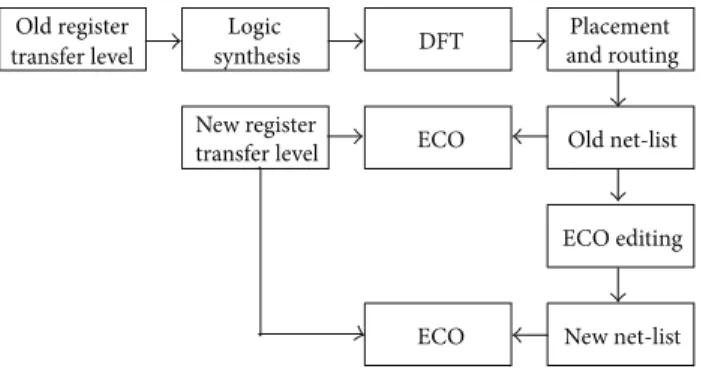
Figure 1: A typical ECO design flow.
Find out patch logic Mapped patch logic Patch logic Mapping Available spare cell list Equivalent and timing check Figure 2: Two-phase ECO design flow.
programming for VLSI design is presented. InSection 5, we discuss the advantage and disadvantage of the related works. Finally, we conclude this paper inSection 6.
2. Typical ECO Design Flow
Before describing the proposed method, we address a typ-ical manual ECO design flow in Figure 1. IC designers perform the change in register transfer level and verify fixed code matching the new specification at first. Then, old net-list is scanned to search the possible fix points. After the possible fix points are searched, IC designers modify the net-list and check the functionally equiva-lent between new net-list and new register transfer level [10–14].
Next, we describe two-phase ECO design flow inFigure 2. To patch the logics of the modified circuit, we prepare available spare cell list. According to logic function, the modified circuit is mapped to specified logics. After patching logic, equivalent check and timing check are performed to make sure that the new function met the new specification.
However, there are some important problems that appear during patching logic. Are there enough spare cells and types to satisfy the consumption of patch logic? How to estimate the quantity and logic types of ECO procedure? In order to solve this problem, we proposed an engineering change orders design using multiple variables linear programming for VLSI design in this paper.
3. Logic Transformation
Before discussing the engineering change orders design using multiple variables linear programming, we addressed ECO logic transformation.Figure 3describes an ECO prob-lem with an equation out = (𝐴 + (𝐵𝐶)). Figure 3(b) lists the available spare cells. According to the list, we discover the available spare cells are not enough. In order to solve the problem, we adopt another mapping solution with an equation out =(𝐴𝐵𝐶) instead of the original equation in
Figure 3(c). It requires one AND and one INV gate. The
mapping solution in Figure 3(c) requires gates fewer than the available spare cells and is constructed with the available spare cells.
However, most of spare cells only provide basic logical functions that include AND, OR, NOT, NAND, and NOR. Half Adder (HA), Full Adder (FA), And-Or-Inverter (AOI), and Or-And-Inverter (OAI) can provide complex logical functions. We can adopt these logical cells to perform ECO function. For example, AOI22 can be implemented by two NAND and one AND cells in Figure 4. According to the existing resources of spare cells, we can resynthesize the changed function lists.
4. Multiple Variables Linear Programming for
VLSI Design
Although logic transformation skill makes the ECO technol-ogy come true, a chip often does not own enough spare cells to modify the function to meet a new specification. How to allocate limited resource? We should estimate quantity of spare cells and logic transformation rule to perform optimal engineering charge orders.
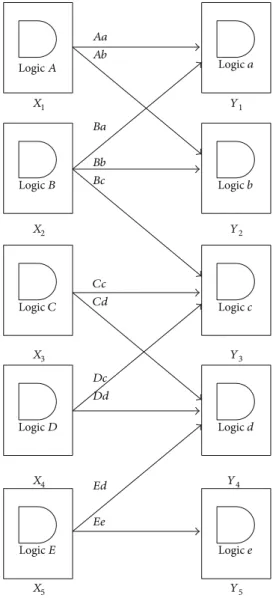
In Figure 5, it describes the engineering change orders
design using multiple variables linear programming for VLSI design and relation of logic transformation. “Logic𝐴” is one kind of spare cells that can be transformed into “Logic 𝑎” or “Logic𝑏.” Similarly, “Logic𝐵” can be transformed into “Logic𝑎,” “Logic𝑏,” or “Logic𝑐.” “Logic𝐶” performs ECO function instead of “Logic𝑐” or “Logic𝑑.” Besides, Logic𝐷is transformed into “Logic𝑐” or “Logic𝑑.” Equivalently, “Logic
𝐸” is transformed to “Logic𝑑” or “Logic𝑒” to achieve ECO function.
We assume𝑋1, 𝑋2, 𝑋3, 𝑋4, and𝑋5are the number of spare cells, Logic𝐴, Logic𝐵, Logic𝐶, Logic𝐷, and Logic𝐸. Let𝑌1, 𝑌2, 𝑌3, 𝑌4, and𝑌5 be the desired number of target cells, Logic𝑎, Logic𝑏, Logic𝑐, Logic𝑑, and Logic𝑒.
Besides, 𝐴𝑎 is the number of spare cells (Logic𝐴) to be transformed into Logic𝑎and𝐴𝑏is the number of spare cells (Logic 𝐴) to be transformed into Logic 𝑏. Similarly,
𝐵𝑎, 𝐵𝑏, and𝐵𝑐are the number of spare cells (Logic𝐵) to be transformed into Logic𝑎, Logic𝑏, and Logic𝑐. In a similar way,𝐶𝑐and 𝐶𝑑are the number of spare cells (Logic𝐶) to be transformed into Logic𝑐and Logic𝑑,𝐷𝑐and𝐷𝑑are the number of spare cells (Logic𝐷) to be transformed into Logic
𝑐and Logic𝑑, and𝐸𝑑and𝐸𝑒are the number of spare cells (Logic𝐸) to be transformed into Logic𝑑and Logic𝑒.
A A B C BC (a)
Type Spare cells
AND 2 OR 2 INV 1 NAND 1 (b) A B C A (c)
Figure 3: Example of an ECO problem. (a) EC equation: output =(𝐴 + (𝐵𝐶)). (b) Spare cells. (c) Mapping: output =(𝐴𝐵𝐶).
(a) (b)
Figure 4: AOI22 can be implemented by two NAND and one AND cells.
X1 Y1 X2 Y2 X3 Y3 X4 Y4 X5 Y5 Logic A Logic B Logic C Logic D Logic E Logic a Logic b Logic c Logic d Logic e Aa Ab Ba Bb Bc Cc Cd Dc Dd Ed Ee
Figure 5: ECO design using multiple variables linear programming for VLSI design and relation of logic transformation.
Therefore, the restriction rule of the number of spare cells and transformed target cells inFigure 5is written as follows:
𝑋1= 𝐴𝑎 + 𝐴𝑏; 𝑋2= 𝐵𝑎 + 𝐵𝑏 + 𝐵𝑐; 𝑋3= 𝐶𝑐 + 𝐶𝑑; 𝑋4= 𝐷𝑐 + 𝐷𝑑; 𝑋5= 𝐸𝑑 + 𝐸𝑒. (1)
Besides, the restriction rule of the engineering change orders design using multiple variables linear programming in
Figure 5is written as follows:
𝐴𝑎 + 𝐵𝑎 ≧ 𝑌1; (2)
𝐴𝑏 + 𝐵𝑏 ≧ 𝑌2; (3)
𝐵𝑐 + 𝐶𝑐 + 𝐷𝑐 ≧ 𝑌3; (4)
𝐶𝑑 + 𝐷𝑑 + 𝐸𝑑 ≧ 𝑌4; (5)
𝐸𝑑 + 𝐸𝑒 ≧ 𝑌5. (6) However, spare cells are not often enough; designer should balance the spare cell allocation to meet all require-ments of desirable cells.
We assume one case when𝐵𝑏 ≦ 𝑌2. In order to provide enough spare cells, we should increase the number of𝐴𝑏to achieve𝐴𝑏 + 𝐵𝑏 ≧ 𝑌2.
Similarly, when 𝐶𝑐 + 𝐷𝑐 ≦ 𝑌3, we should increase𝐵𝑐 number to meet𝐵𝑐 + 𝐶𝑐 + 𝐷𝑐 ≧ 𝑌3.
Therefore, we define another restriction rule of the engi-neering change orders design which is written as follows:
𝐴𝑎 = 𝑋1− 𝐴𝑏;
Table 1: ECO methods comparison.
Method Traditional ECO Proposed method
Cell resource prediction Constraint based Multiple variables linear programming
Predictive precision of patching logic number Normal precision High precision
Balance between spare cells and target cells Low balance High balance
Restriction rule Not define Define
Resource optimization Not define Define
Solution boundary Not define Define
According to formulas (2) and (7), we can balance the number of𝐴𝑏,𝐵𝑏, and𝐵𝑐to achieve the target number𝑌1. Consider the following:
𝑋1− 𝐴𝑏 + 𝑋2− 𝐵𝑏 − 𝐵𝑐 ≧ 𝑌1. (8) In a similar way, we define the restriction rule of the engineering change orders design which is written as follows:
𝐵𝑐 = 𝑋2− 𝐵𝑎 − 𝐵𝑏; 𝐶𝑐 = 𝑋3− 𝐶𝑑; 𝐷𝑐 = 𝑋4− 𝐷𝑑.
(9)
According to formulas (4) and (9), we can balance the number of𝐵𝑐, 𝐶𝑐, and𝐷𝑐to achieve the target number𝑌3. Consider
𝑋2− 𝐵𝑎 − 𝐵𝑏 + 𝑋3− 𝐶𝑑 + 𝑋4− 𝐷𝑑 ≧ 𝑌3. (10) We model the engineering change orders problems using multiple variables linear programming. According to the functions, we can understand the engineering change orders relation between supply and requirement. Then, designer can estimate and perform ECO using spare cell efficiently.
5. Discussion
In this Section, we discuss the advantage and disadvantage of the related works.Table 1shows ECO method comparison. The proposed approach designs a multiple variable linear programming ECO for VLSI design. Our method can predict cell resource accurately using multiple variable linear pro-gramming techniques. Traditional ECO is not to predict it well. Besides, our scheme provides a high accurate prediction of patching logic number to balance between spare cells and target cells. It is hard for traditional ECO method to do these. Moreover, we define restriction rule, resource optimization, and solution boundary of ECO problem to increase the efficiency of the proposed ECO method and provide a well solution.
6. Conclusion
In this paper, we proposed an engineering change orders design using multiple variables linear programming for VLSI design. The paper discusses typical ECO design flow, logic
transformation, and multiple variables linear programming for VLSI design. The presented scheme estimates the resource of spare cells and provides a well solution of ECO problems.
Conflict of Interests
The authors declare that there is no conflict of interests regarding the publication of this paper.
Acknowledgments
This work was supported by the National Science Council of Taiwan under Grant nos. NSC 101-2221-E-027-135-MY2 and 102-2622-E-027-008-CC3. The authors gratefully acknowl-edge the Chip Implementation Center (CIC), for supplying the technology models used in IC design.
References
[1] J. A. Roy and I. L. Markov, “ECO-system: embracing the change in placement,”IEEE Transactions on Computer-Aided Design of Integrated Circuits and Systems, vol. 26, no. 12, pp. 2173–2185, 2007.
[2] C. Tan and I. H. Jiang, “Recent research development in metal-only ECO,” inProceedings of the 54th IEEE International Midwest Symposium on Circuits and Systems (MWSCAS ’11), pp. 1–4, August 2011.
[3] Y. M. Kuo, Y. T. Chang, S. C. Chang, and M. Marek-Sadowska, “Spare cells with constant insertion for engineering change,” IEEE Transactions on Computer-Aided Design of Integrated Circuits and Systems, vol. 28, no. 3, pp. 456–460, 2009. [4] D. Brand, A. Drumm, S. Kundu, and P. Narain, “Incremental
synthesis,” inProceedings of the IEEE/ACM International Con-ference on Computer-Aided Design, pp. 14–18, 1994.
[5] S. Huang, K. Chen, and K. Cheng, “AutoFix: A hybrid tool for automatic logic rectification,”IEEE Transactions on Computer-Aided Design of Integrated Circuits and Systems, vol. 18, no. 9, pp. 1376–1384, 1999.
[6] C. Lin, K. Chen, and M. Marek-Sadowska, “Logic synthesis for engineering change,”IEEE Transactions on Computer-Aided Design of Integrated Circuits and Systems, vol. 18, no. 2-3, pp. 282–292, 1999.
[7] T. Shinsha, T. Kubo, Y. Sakataya, J. Koshishita, and K. Ishihara, “Incremental logic synthesis through gate logic structure identi-fication,” inProceedings of the IEEE/ACM Conference on Design Automation, pp. 391–397, Jun 1986.
[8] G. Swamy, S. Rajamani, C. Lennard, and R. K. Brayton, “Mini-mal logic re-synthesis for engineering change,” inProceedings of
the IEEE International Symposium on Circuits and Systems, pp. 1596–1599, 1997.
[9] Y. Watanabe and R. K. Brayton, “Incremental synthesis for engineering changes,” inProceedings of the IEEE International Conference on Computer Design: VLSI in Computers and Pro-cessors (ICCD ’91), pp. 40–43, Cambridge, Mass, USA, October 1991.
[10] J. Wang,Finding the Minimal Logic Difference for Functional ECO, Taiwan Cadence Design Systems, 2012.
[11] Y. C. Fan and H. W. Tsao, “Watermarking for intellectual property protection,”IEE Electronics Letters, vol. 39, no. 18, pp. 1316–1318, 2003.
[12] Y. Fan and H. Tsao, “Boundary scan test scheme for IP core identification via watermarking,”IEICE Transactions on Information and Systems, vol. E88-D, no. 7, pp. 1397–1400, 2005. [13] Y. Fan, “Testing-based watermarking techniques for intellectual -property identification in SOC design,”IEEE Transactions on Instrumentation and Measurement, vol. 57, no. 3, pp. 467–479, 2008.
[14] Y. Fan and Y. Chiang, “Discrete wavelet transform on color picture interpolation of digital still camera,”VLSI Design, vol. 2013, Article ID 738057, 9 pages, 2013.
International Journal of
Aerospace
Engineering
Hindawi Publishing Corporationhttp://www.hindawi.com Volume 2010
Robotics
Journal ofHindawi Publishing Corporation
http://www.hindawi.com Volume 2014
Hindawi Publishing Corporation
http://www.hindawi.com Volume 2014
Active and Passive Electronic Components
Control Science and Engineering
Journal of
Hindawi Publishing Corporation
http://www.hindawi.com Volume 2014 Hindawi Publishing Corporation
http://www.hindawi.com Volume 2014
Hindawi Publishing Corporation http://www.hindawi.com
Journal of
Engineering
Volume 2014
Submit your manuscripts at
http://www.hindawi.com
VLSI Design
Hindawi Publishing Corporation
http://www.hindawi.com Volume 2014
Hindawi Publishing Corporation
http://www.hindawi.com Volume 2014 Shock and Vibration Hindawi Publishing Corporation
http://www.hindawi.com Volume 2014
Civil Engineering
Advances inAcoustics and VibrationAdvances in
Hindawi Publishing Corporation
http://www.hindawi.com Volume 2014
Hindawi Publishing Corporation
http://www.hindawi.com Volume 2014
Electrical and Computer Engineering
Journal of
Advances in OptoElectronics
Hindawi Publishing Corporation
http://www.hindawi.com Volume 2014
The Scientific
World Journal
Hindawi Publishing Corporation
http://www.hindawi.com Volume 2014
Sensors
Journal of Hindawi Publishing Corporationhttp://www.hindawi.com Volume 2014
Modelling & Simulation in Engineering
Hindawi Publishing Corporation
http://www.hindawi.com Volume 2014
Hindawi Publishing Corporation
http://www.hindawi.com Volume 2014
Chemical Engineering
International Journal of Antennas and
Propagation
International Journal of
Hindawi Publishing Corporation
http://www.hindawi.com Volume 2014
Hindawi Publishing Corporation
http://www.hindawi.com Volume 2014
Navigation and Observation
International Journal of
Hindawi Publishing Corporation
http://www.hindawi.com Volume 2014