Security Programs as Part
of Efficient Supply Chain
Management
Juha Hintsa
Cross-Border Research Associationwww.cross-border.org [email protected]
Dr. Ari-Pekka Hameri
Ecole des Hautes Etudes Commerciales,University of Lausanne [email protected]
This paper aims to explain how different supply chain security initiatives and programs affect different supply chain partners and their operational efficiency. Three in-depth cases-a global consumer goods company, a carrier, and a port operator-were studied through multiple interviews to understand how the five supply chain security initiatives affected their operational efficiency. The case organizations, security programs, and aspects of operational efficiency were triangulated in the case analysis to derive managerial and practical implications. The findings indicate that over the short term, implementing the supply chain security initiatives increases freight fees and overhead costs due to the needed technology and IT investments, but the case organizations also benefit from information transparency, better partnering, and above all means of achieving resilient and efficient operational supply chains. Other benefits include reductions in the following supply chain problem areas: theft, smuggling, counterfeit, and loss and damage. Some supply chain partners see that the changes also generate new business opportunities.
Introduction
Many aspects of the business world have changed since the 9/11 terrorist attacks. New security regulations have been implemented to trace, control, and inspect people, material, and the flow of information. These new regulatory constraints have a permanent impact on how international supply chains are being managed. Companies are required to comply with the new regulations, forcing them to change organizational settings, adopt new information technologies, and reshape their business processes accordingly. This transformation also affects providers of logistics services, customs brokers, administrators, and freight-forwarding companies, all of which form the backbone of global trade operations and processes. The fundamental motivation for this article stems from the search for patterns in this profound change process towards more secure global trade and how it affects efficient supply chain
management. We also examine the impact of new security regulations on operational performance of global supply chain operators through a case study approach. Operational speed, defined as the lead time from order handling, production, and delivery to customer, has been recognized as one of the common characteristics of successful companies in competitive business environments. Many cases are reported of firms excelling after setting operational speed as their key strategic approach to operations (Schmenner, 1988; Stalk & Hout, 1990; Womack & Jones, 1996). Numerous firms have focused on operational speed; perhaps the best known are computer assembler Dell and apparel company Zara. These companies avoid the perilous impact of supply chain dynamics by operating at speeds in which the capital consecrated to their operations is a fraction of the overall volume of the business, enabling them to react to sudden demand variations with
agility and to outperform their competitors. However, when facing external and abrupt changes and disturbances in the business environment, even these most trimmed supply chains become vulnerable.
Supply chain vulnerability has also triggered significant research activity, which so far has focused mainly on technical details and implications to secure global material flows. Articles conceptualizing the phenomenon have emerged as companies increasingly require strategies and tools to cope with the changing environment (Willis & Ortiz, 2004). This article continues within this tradition as it sets to study the implications of these changes and how companies should react to them in order to maintain high supply chain efficiency.
The rest of the paper is organized in the following way. First, the relevant literature concerning supply chain management in general is reviewed together with the key results of the latest supply chain security research. This is followed by a key research hypothesis formulation and methodological considerations proved by detailing the sample and interview templates and outlining the research activity. The results are then reviewed, first from the supply chain management point-of-view, and then their practical implications are discussed. Finally, the key findings are discussed and avenues for future research in this fast-moving field are outlined.
Literature review
Supply chain management (SCM)
Stemming from age-old military logistics of maneuvering troops and supplies, SCM has emerged as one of the key success factors for any industrial company wanting to compete in global markets. During the 1980s, with the influence of the Japanese approach to managing suppliers through close partnerships and information sharing, the traditional distant supplier management was making way for a better integrated SCM. It
was realized that efficient in-house operations were vulnerable to poor supplier performance and therefore the whole value-adding chain needed to be integrated to optimize benefits from the operations. Numerous studies from that time period document this development as a vital part of an efficient production system delivering high-value goods to global clientele (Hall, 1983; Schonberger, 1982; Suzaki, 1987). Since then, the focus has been on developing operational practices, with short lead times and information transparency.
It was also reported that industries needed to confront cyclical fluctuations, especially because supply chains are long and prone to dynamic effects (Forrester, 1961; Houlihan, 1987). The mismatch between demand information and material supply is amplified and transmitted upstream in the value chain, generating a surge effect, which misleads various decision-making processes in the chain. The longer the throughput times and the greater the number of players in the chain, the more pronounced this phenomenon is. The further away from the down stream the company is located, the more serious this so-called “bullwhip-effect” becomes. One clear way to avoid this is improved operational speed and quality of information flow throughout the value chain (Fisher & Raman, 1996; Lee et al., 1997). These studies demonstrate that information received by the supplier is substantially more varied than the original demand because orders are batched, prices
fluctuate, and because people have a natural tendency to game. It is also shown that the bullwhip effect becomes more violent as lead times increase and the more complex the supply chain is.
Companies and their business units inevitably take part in one or more supply chains at the same time. Frohlich and Westbrook (2002) demonstrate that manufacturing companies with both upstream and downstream integration had better performance than one-sided integrated companies, which was better than not being integrated at all. This suggests emphasizing information flow improvement, which was boosted by the adoption of Internet-based tools in integrating supply chain parties in a transparent manner. By using a transaction cost approach, Williams et al. (2002) evaluated supply chain theory and concluded that electronic commerce had the greatest potential to reduce supply chain-related transaction costs. Facilitating fluent information and timely information flow in a supply chain requires investments in information systems that extend over company boundaries. Rabinovich et al. (2002) studied this and concluded that improved demand chain performance was more likely to result from operational initiatives such as lean production with lead-time reduction than from direct investment in information systems for improving information flow. Fisher (1997) takes SCM analysis further by stating that the nature of the demand for a product determines the supply chain structure. With functional products, one should focus on the physical supply of the product, that is, availability, speed, and punctuality, and innovative products should emphasize market mediation, that is, customer satisfaction. Following the product life cycle, innovative products may turn into functional ones. This has been the case with mobile phones since they became commodity in the end of 1990s. Childerhouse et al. (2002) worked out an integrated framework for “focused demand
New regulatory
changes and voluntary
programs in business
environment affect
manufacturers, carriers
and authorities
operating, facilitating
and controlling global
chains,” which extends the product cycle phase, with delivery lead time, volume, product variety, and variability of demand. In their framework, there is an underlying “swift, even flow” theory in which companies may apply push or pull strategies and implement postponement and other product design strategies, depending on the market situation. To complete the previous supply chain models, Heikkilä (2002) adds other important supplier issues to this model after analyzing mobile network delivery business. These new facets include elements from the duration of relationship, trust, and customer perceptions of the support received from the supplier to the nature of demand in determining whether a given chain should be more focused on efficiency or market mediation. The previous short introduction to key SCM studies and advances shows that a networked operation that constantly creates value should focus on shorter lead times in partnering and information sharing with key supply chain partners. In supply chains, the overall performance becomes hard to manage because there are several players with alternating objectives. Adding external hazards and deliberate actions of bad will to this context makes the whole SCM management a fragile and vulnerable entity. Preventing this from happening is the main object of the second part of the literature review.
Supply chain security (SCS)
Research on SCS has radically increased since the turn of this century. General awareness of the issues has been fueled not only by the 2001 terrorist attacks, but also by various natural catastrophes, disease outbreaks, and the problems stemming from the narrow supply base (Papadakis, 2006). Goods being delivered through global supply chains are being managed by various entities such as freight forwarders, customs authorities, carriers of various types, security companies, and distributors with value-adding
logistics services. There are few studies that treat all parties within the supply chain and even fewer that are consecrated to the whole global supply chain operations from a security point of view. Various studies do cover the seldom-treated contributors to global trade operations, such as Thomchick et al. (1999), who study outsourcing of import operations and the change to third-party services. Haughton and Desmeules (2001) highlight the significant and increasing role of customs administration in efficient SCM. In similar vein Shari et al. (2003) show that the lack of agreement internationally on how to revise or harmonize customs regulations means that customs fees remain geared towards large shipments, thus increasing supply chain costs. Supply chain vulnerability and sensitivity attracted the focus of researchers even before the 2001 terrorist attacks. Svensson (2000) develops a conceptual framework on the key issues of supply chain vulnerability by applying it to the automobile industry. Using a traditional supply chain framework, this study details levels of the fragility of supply chain operations on various disturbances in the business environment. In line with this study, much research has focused on the supply chain entities that are within the control of commercial entities, and has thus ignored the regulatory and governmental authorities. In contrast to this trend, Appels and de Swielande (1998) and Heaver (1992) acknowledge the gradual change in attitudes towards customs and other regulatory bodies as the rapid cross-border transaction modernization and security issues have gained momentum. Following this trend, Grainger (2000) provides a concise overview of the impact customs issues can have on international supply chains. This study demonstrates that one way to maintain an efficient supply chain is to be aware and compliant with the latest customs policies and procedures.
Chen (1999) studies the ASEAN (subset consisting of Indonesia,
Malaysia, Philippines, Singapore, and Thailand) import channel performance and looks at the effect of customs regulations and procedures on the performance of the import business in developing countries. Bribery, delays, arbitrary tariff classification, and frequent rule changes are all part of the inefficiencies that seriously impact importer performance at cross-border points. Carr and Crum (1995) were among the first to point out the significance of the legal burden and the new challenges set for traders due to contemporary customs reforms. From the efficient operations management point of view, the message is clear: cross-border operations and their mechanisms need to be further studied to generate both solid empirical evidence and results on these issues, which eventually have a significant impact on the companies and regulators.
Most of the articles lack or have very limited access to supply chain security-related data, which seems to limit research work worldwide. There are some exceptions to this. Sheffi (2001) discusses the necessity of cooperating with the government and adding security measures from the point of view of international traders. Rice and Caniato (2003) presents how companies should aim to simultaneously build secure and resilient supply chains and classifies private sector responses to the governmental security initiatives into various levels of initiatives that companies need to react to. Lee and Wolfe (2003) draw lessons from total quality management programs to the world of SCS management from the strategy point of view. These studies show the multiple facets of the SCS. The issue can be approached from the point of view of proven operations management techniques or by reviewing the changes in the business environment.
There are numerous global regulatory and voluntary security initiatives (see Hintsa & Hameri, 2005; Velea et al., 2005; Gutierrez et al., 2005) and various countries
have their own programmers, such as the Swedish Customs administration, which has set up a procedure through which seaports, terminals/warehouses, forwarders, exporters, and importers can be certified in accordance with international initiatives. On the technology side, numerous ongoing activities aim to develop standards and ready-to-use applications for tracing, transaction automation, goods protection, positioning, and so on (see, for example, Chow et al., 2007). These issues are not directly treated here, yet their implications on efficient SCM are referred to when relevant.
Academic studies reviewing the impact of these regulations on SCM are scarce or they deal with only some facets of these prevailing changes. Yet, some research think-tanks and consultancies have been focusing on these phenomena substantially. In their detailed and practical study, Rice and Spayd (2005) search for collateral benefits that companies and other stakeholders may reap from these changes. Their study, which does not lack detail, classifies the field of SCS into various benefit frameworks, which are broadly based on technological, organizational, and business process implications. The message is clear: an agile and fast-moving company can benefit and gain a competitive advantage by adopting and implementing the new regulations in their operations. In a similar vein, Monahan et al. (2003) conclude that overall supply chain vulnerability reduces clearly staged risk management activity.
To get back to our point, SCM is facing inevitable challenges due to the regulatory changes in the business environment. SCS, like supply chain risk management (Finch, 2004), is becoming an issue requiring globally operating companies to comply with various procedures affecting organizational structures, information technologies to be used, and fundamental value-adding business processes. This sets the scene for the present article: what consequences will the proven SCM principles predict for
companies when they apply new security rules and how will these predictions match what is put into practice?
Research problems,
methodology, and sample
Based on the literature review and the conclusions made, the key research question is, How will the new regulatory changes in business environment affect companies, carriers, and authorities operating, facilitating, and controlling global supply chains? The study was conducted through a multiple case-study approach to investigate new cross-border trade and SCS regulations and programs (C-TPAT, FAST, CSI, 24h-rule and ISPS Code, which are detailed following in the case analysis) affecting global supply chains. The cases represent different organizations-a global consumer goods company, a carrier, and an international port operator-which all have been working on implementing the new and mandatory procedures since 2004. Each of the case studies lasted more than a year, during which period case-specific interviews and discussions were complemented with close observations of persons actively involved in the issues within the case organizations. The insights and observations, together with survey results, were triangulated for validation purposes. Transcripts were checked with interviewees. The selected case organizations were as follows:
1. A global consumer goods company operating on every continent and managing multiple brands through complex sourcing flows to deliver goods on a daily basis to millions of consumers
2. A logistics solutions provider with over 150,000 employees and operations in more than 100 countries with a multimodal fleet of transportation equipment 3. A port operator operating in
several large sea ports in different industrial countries through which a significant part of the trade flows to the concerned countries pass
These organizations were selected to exemplify the overall impact of various regulatory programs on the concerned supply chain players. Port operators are experiencing major changes in their operations through intensified links with governmental authorities and numerous regulatory programs affecting their data management routines. Logistics service providers are caught in the middle of a changing business environment that requires better integrated information flows and compliancy routines, and which opens new business opportunities for them because companies may be slow and reluctant to adopt the new regulations and related procedures. In the sample, the global consumer goods company represents the only manufacturing organization, yet it operates globally, thus facing the numerous implications these regulatory programs have on companies with a global presence. The sample of these three organizations is by its size limited. However, they provide a broad base and even an eclectic source to assess the multiple implications of the regulatory programs on the supply chain management given that they have different roles. Further, the sample serves as a source of insight for numerous companies in different manufacturing and service fields whose business processes and operations rely on companies represented in the sample.
The applied case method, including interviews, is suitable for analyzing the effects on organizational changes and process development. According to Yin (1994), a case study is an empirical inquiry that investigates a contemporary phenomenon within its real-life context when the boundaries between phenomenon and context are not clearly evident and when multiple sources of evidence are used. This is why this paper bases its approach on actual case data (Eisenhardt, 1989; Glaser & Strauss, 1967). The chosen cases ensure sufficient variance along the theoretically important dimensions underlying the phenomena of research interest (Eisenhardt,
1989). In this study, the theoretical dimensions stemming from the very core of operations management are as follows (Schmenner, 2001):
• Value-adding and value-creation at task, process, and whole operational level, that is, the work must somehow produce quantified value to the company. Operations not producing value should be eradicated and focus should be directed on increasing value in such a manner that customers are best satisfied and company stakeholders get a decent return on their investments.
• Operational speed and its improvement by removing hindrances is seen as the key to better performance, and thus this dimension highlights the fact that operations should take place swiftly and predictably. Operational lead times should be under continuous control with the relentless aim to reduce them.
• Variability is inherent in every process and generates delays and disturbances. Usually the more players in a supply chain the more prone it is to the negative impacts of variability. Efficient operations management aims to reduce human variability and the vulnerability in external and natural variability.
• Service level and customer satisfaction form one of the key measures for operational performance. This includes punctuality, fast response, and right quality level delivered to fully meet customers' requirements.
These key operations management issues formed the structure for the case interviews. Each of the studied regulatory safety programs was reviewed on how they have or are anticipated to affect the core value processes and lead times of the case organization. Implications on variation, endogenous or exogenous, were also questioned and how these changes may affect or have already affected the existing service level of the company. In the global consumer
goods company, three channel managers and one supply chain director were interviewed twice over a one and one-half-year period. In addition, several informal discussions were carried out to collect unstructured and daily business-related information. For the logistics service provider, one global industry director and one country manager were interviewed several times over a one-year period. At the same time the company critically assessed the different programs and was already or became a member of several supply chain security initiatives. The port granted access to the management, especially to their work on compliancy issues, yet the key source of information was the director of one major port in Europe.
The data collected from the semi-structured interviews was documented in transcripts that were verified separately with the interviewee. The structure of the interviews was based on the previously mentioned operations management dimensions. Thus each security program was questioned from the point of view of its impact on value creation, operational speed, variation in lead times, and service level. Once the transcripts were approved and documented properly, they were coded under the main operations management issues as various answers had multiple implications on different issues. Because the different case organizations were studying and/or implementing different security programs, secondary data sources related to internal meetings and documents were also used. To ensure reliability of the data, a second round of interviews was conducted that was finer in detail as data were being accumulated along the research project. To validate the main conclusions, they were discussed in detail with the experts in small groups.
Case analyses
As previously mentioned, the case organizations were selected so that they highlight the different
operating roles in the global supply chain. The case descriptions are linked with the key issues and journal articles discussed in the literature review. The multinational consumer goods company with its global manufacturing base and markets is highly dependent on supply chain efficiency. The main operational mode for them is based on forecasts and the push system. Significant improvements in efficiency have been implemented through integrated point-of-sale information systems to avoid demand amplification and distortion in demand information (Fisher & Raman, 1996; Lee et al., 1997). Downstream, goods are delivered through various channels to end-customers, mainly through proprietary distributors that may have their own outlets or serve other major chains in the market. A major part of the production is located in developed economies, yet material flows across numerous borders before reaching the shelves (Frohlich & Westbrook, 2002). Upstream, sourcing is global and raw material easily flows across continental barriers. In all, the global consumer goods company faces all the classical challenges of supply chain management: how to improve operational speed, reduce inventories, access better demand information in order to avoid the surge effect, how to be resilient when disruptions occur, and how to continuously improve customer service (Suzaki, 1987). As one channel manager said, “Maintaining information visibility right from the sourcing to the point of sales remains the ultimate goal for us, in order to improve efficiency, responsiveness, and, eventually, customer service.”
The global logistics solution provider and carrier operates in a highly competitive market with narrow margins forcing them to increase volume, which then forces them to find customer-specific solutions that go beyond traditional transportation. Be it third-party or fourth-party logistics, the services offered extend to managing not only physical material flows, but also
the management of financial and information flows that are tightly integrated into the customer's own operations (Thomchick et al., 1999). The company continuously develops new techniques and solutions to acquire new clientele through deeper integration in customers' value chains. Regulatory changes in the business environment create extra work, but also opens up new business opportunities for the company (Appels & de Swielande, 1998; Heaver, 1992). One of the global industry directors confirms this: “Customers rely on our first-hand and up-to-date knowledge on regulatory changes; compliance and trade facilitation remain our core services and their importance will be reinforced due to these changes in the business environment.” Significant investments to the IT infrastructure are common, as the management of literally millions of assignments calls for up-to-date and mission-critical information (Chow et al., 2007). The current transportation infrastructure is based on a multimodal infrastructure, including some sea transportation, which is minimal compared to the volumes transported by air, road, and partially by rail.
The port operator has the authority to move cargo through several international ports. The business involves managing the movement of cargo containers between cargo ships, trucks, and freight trains and optimizing the flow of goods through customs (Carr & Crum, 1995). One of the critical efficiency criteria for their business is to minimize the amount of time a ship spends in port and the goods in the various buffers and inventories. In all, maintaining efficiency for a port operator involves the productive use and maintenance of the infrastructure and managing supplier and worker relations and contracts. The port operator manages significant amounts of information through communication systems and traditional paperwork. As one of the managers in a stevedoring unit put it, “Managing the information flows is soon becoming a greater challenge than the flow of goods. Our interplay with customs and other authorities will intensify through the new regulatory programs.” In addition to communication and information sharing, they are also responsible for security and port security in general. The case company operates numerous major
international ports, through which millions of containers are processed annually.
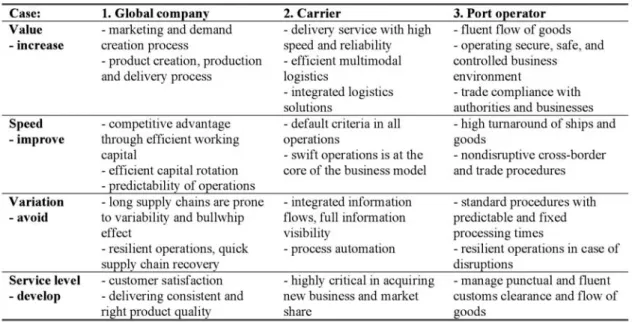
Table 1 summarizes the case organizations and their relationship with the main operational dimensions of efficient supply chain management. The argument for value is evaluated from the process view, that is, what is the value-producing business process that is central to the organization's existence (Hall, 1983). The impact of operational speed improvement is assessed through its importance to the competitiveness of the organization. Variation is explained through the method used to control the surge effect in the supply chain (Schmenner, 2001). Finally, service level is reviewed as the outcome of the other operational dimensions and how it is crucial for the organization's continued success. The major regulatory changes in the business environment, which are forcing global companies to adapt and apply new procedures in the SCM, are mainly being driven by the United States and major international regulatory organizations (Sheffi, 2001; Sheu et al., 2006). In the following, five regulations and/or programs are
Table 1
briefly introduced, using various governmental sources (for reference details and more exhaustive treatment of different regulatory programs see Hintsa & Hameri, 2005; Velea et al., 2005; Gutierrez et al., 2005). Naturally, there are numerous national level, industry, and economic area-specific security initiatives and programs that are not covered here, yet the ones treated here affect the case companies.
Customs-Trade Partnership against Terrorism, C-TPAT (U.S. Customs & Border Protection, 2004), is a voluntary supply chain security program for international cargo and conveyances. It increases security measures, practices, and procedures throughout all sectors of the international supply chain. Central to the security vision of C-TPAT is the core principle of increased facilitation for legitimate business entities that are compliant traders. C-TPAT sets requirements for new data elements: the parties in the international supply chain need to capture and store additional data elements for different supply chain players, including brokers, warehouse keepers, and carriers. There appears to be new storage and archive requirements, driven by self-auditing and external auditing practices. C-TPAT participants are also encouraged to maintain a high degree of automated data communication with their partners (Sheu et al., 2006). These requirements pose no problems for a carrier that already has a high degree of information automation. However, for the channel manager at a global consumer goods company “compliancy with these measures will increase paper work and IT investments in the short term, but there are benefits stemming from upstream data sharing later on.”
The Free and Secure Trade (FAST) program (U.S. Customs & Border Protection, 2005) is a border initiative among the United States, Mexico, and Canada to ensure security while enhancing the economic prosperity of each country. The FAST program
requires participants-carrier, drivers, importers, and southern border manufacturers-to submit an application, agreement, and security profile depending on their role in the C-TPAT and FAST programs. The FAST program allows known low-risk participants to receive expedited border processing. FAST has several effects on international trade and cross-border operations automation that are quite similar to those of C-TPAT. FAST sets requirements for new data elements concerning information on supply chain partners. Manifest data must be passed to customs before border arrival (30 minutes before arrival to gain fast border treatment). FAST certification information needs to be stored and accessed for auditing purposes. FAST also appears to encourage better shipment visibility information throughout the transport chain. Although compliance with this program requires additional work and investments, the rewards are visible, as the channel manager at the consumer goods company indicated: “The rewards will stand at the end, yet the means are not yet in place, but once there the speedier and more predictable operations offset the effort and money invested.”
The Container Security Initiative (CSI) (U.S. Customs & Border Protection, 2006) is based on a project to extend the U.S. zone of security outward so that the U.S. borders are the last line of defense, not the first. Through CSI, maritime containers that are a risk for terrorism are identified and examined at foreign ports before they are shipped to the United States with the aim to prevent terrorist threats from being carried out. While CSI is a government-to-government initiative, the information capture and processing requirements mostly deal with governmental risk management systems, potentially fed by scanners, tracking, and seals data. Among the case organizations, this initiative will mostly concern the port operator: “Ports are mediators between governments; this [CSI]
will definitely affect our processes, be they people or IT related.” The 24-hour rule (Federal Register, 2002) requires sea carriers and NVOCCs (Non-Vessel Operating Common Carriers) to provide U.S. Customs with detailed descriptions of the contents of sea containers bound for the United States 24 hours before a container is laden aboard the vessel at a foreign port. The rule allows U.S. Customs officers to analyze the container content information and identify potential terrorist threats before the U.S.-bound container is loaded at the foreign seaport, not after it arrives in a U.S. port. The most obvious impact of this rule deals with the timing of the manifest/pre-manifest data, that is, the need to send shipment-related data at an earlier stage to the regulatory bodies. There also appears to be rules forcing companies to provide more detailed descriptions of goods as well as more data requirements to identify the various business partners within the supply chain. There are some references concerning reporting and archiving requirements. This rule has an impact on all case organizations, as the channel manager at the global consumer goods company says: “We need to update the planning parameters for goods affected with this rule.” The carrier seconds this: “Material flows affected with this rule need to be adjusted so that we can secure the compliancy of the delivery and inform the customer on the delivery performance accordingly.” Ports are seriously affected to such an extent that closer collaboration with the stakeholders is needed, as one head port operations commented: “This affects directly our core process, yet we are taking precautions by assessing the situation together with the industrial companies and authorities.”
The objective of The International Ship and Port Facility Security (ISPS) Code (IMO, 2002) is to establish an international framework involving cooperation among contracting governments, government agencies, local
administrations, and the shipping and port industries. This collaboration aims to detect and assess security threats and take preventive measures against security incidents affecting ships or port facilities used in international trade; to establish the respective roles and responsibilities of all these parties to ensure maritime security at the national and international levels; to ensure the early and efficient collaboration and exchange of security-related information; to provide a methodology for security assessments so as to implement plans and procedures to react to changing security levels; and to ensure confidence that adequate and proportionate maritime security measures are in place. This initiative seems to have a minor impact on the case organization, given that the other initiatives are moving forward. One port operator says that “this and the other programs we are involved [in] are partially overlapping and
investments in technologies and know-how pave the ground to be compliant with several initiatives at the same time.”
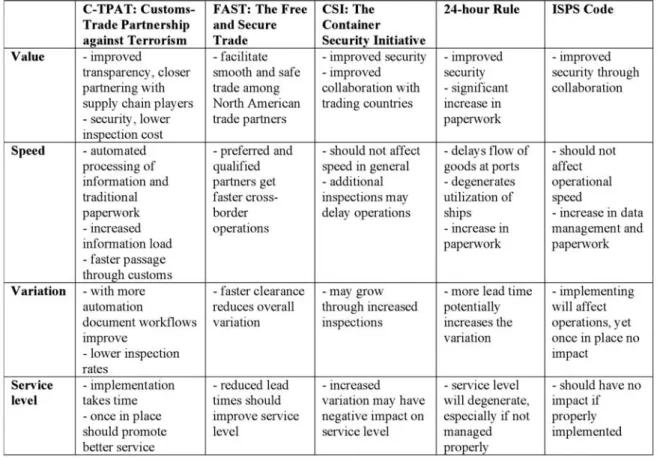
Table 2 summarizes the previously presented five initiatives or programs by detailing their impact on the sampling criteria. The analysis shown is based on the interviews from the case companies and some authorities behind the initiatives. The programs are significantly more complex and detailed than presented, but the outline here enables us to make a summary of their general implications on the main dimensions of efficient operations management.
Triangulation: practical and
managerial implications
The case analysis showed that the global supply chain environment is and will be changing due to the voluntary and/or mandatory security programs that are being
issued and implemented by industrialized nations. The impact on operational efficiency is also evident, yet how these security programs will affect the companies depends on the organization and its business. The triangulation of the cases is performed by intersecting the summarizing tables 1 and 2 to form a case-specific analysis of the different programs and their impact on the operational efficiency in each case organization (table 3). Based on table 3, the case organizations were clearly focused on the short-term implications resulting from the implementation of these programs. Despite the apparent critical comments concerning increased overhead, risks related to the investments in new security and security technologies, and the difficulty involved in quantifying the benefits, the overall spirit of the case organizations was related to long-term positive impact. Security is something to be cherished and
Table 2
valued. This clearly came out in the interviews, and several people made links with the quality movement of the 1980s when ISO-based quality systems were introduced and audits started. The quality efforts improved the overall quality in industrial output. In a similar fashion these modern programs are seen to gradually improve the overall security in our global society. As one manager said, “The security initiatives are like the ISO-9000 certification process two decades ago; we need to document our process[es] so that they comply with the framework, and then we need to operate accordingly.”
The main positive outcome from the implementation of the security programs is the apparent improvement in general security due to increased information
transparency and shipment visibility. The programs force different supply chain players to closer collaboration and towards open information sharing (see also Sheu et al., 2006). This paves the way to improved product safety and traceability. All this will be achieved once the detailed information structures and system interfaces have been properly defined and implemented. This was confirmed by a port manager: “Once implemented, the data being managed is so accurate that detailed analyses and profiling is possible to screen for misuse, incompatibilities, and abnormalities in the trade flows.” The work involved may be significant, especially for companies and organizations with underdeveloped quality and security systems. Industrialized nations are the locomotives of this
development and some of the programs may enlarge the divide between developed and less-developed nations. Therefore, special efforts have been made to broaden these initiatives and make them accessible to every organization that wants to contribute to safer trade and the environment in general.
Improved security, which evidently must follow from the implementation of these programs, implies lower theft, smuggling, and pilferage rates. This should contribute to the global economy in many positive ways. Better business partner recognition leads to closer partnerships and improved supply chain management, and the business environment will become more secure. Naturally, different industrial sectors will experience
Table 3
these changes and benefits to varying extents. Some industries, like the chemical and petroleum industries, are accustomed to strict safety regulations. The constant concern for consumer safety in the food and pharmaceutical industries has already made them responsive and vigilant and will make them comply more easily with the security programs. This also applies to companies dealing with high-value goods such as consumer electronics, luxury goods, and tobacco, which have a long tradition of protecting their goods and assets. At the opposite side there are industrial sectors, such as parts of the electronics, machinery, and clothing industries, which are not likely to have historically adequate security measures and programs. Each company should assess its level of preparedness to comply with these programs and to evaluate the costs and benefits involved.
To summarize, there are different incentives for complying with the programs and there are different benefits and additional costs that emerge once the requirements are fulfilled. From the operations management point of view, the key underlying incentive concerns the swift even flow of goods crossing international borders under normal and also special conditions, for example, high-alert and post-disaster situations. Other benefits include reductions in the following problem areas: theft, smuggling, counterfeit, and loss and damage, as already described in the case studies. The negative impacts foreseen are related to higher freight fees and overhead costs, but like the manager at the carrier said: “These new programs and the changes they impose are creating new business and services opportunities for us.”
Conclusions
and future research
Since the 9/11 terrorist attacks, various security initiatives have been launched, which directly and indirectly affect how supply chains are managed today. By surveying the major regulatory changes in the
business environment and by using three case studies on different supply chain organizations, this paper argues that supply chain security has a permanent impact on efficient supply chain operating models. The case studies show that despite the inherent increase in operational costs and overhead, advanced companies may see an opportunity to improve their operations, while some trade and logistics service companies see the changes as a potential new source of revenue through the adoption of new security procedures.
It is evident that the global supply chain landscape is changing due to numerous regulatory programs. To comply with the requirements, the benefits may be manifold: improved overall security, better control of material and financial flows, and even in some cases improved operational efficiency. But to achieve all this, companies need to invest in training, technologies, and organizational changes. Advanced companies already have a lower threshold in implementing these changes and in complying with the new regulations. Thus, companies about to enter global business or ones with not so advanced and trimmed supply chain processes will face challenges in conforming to the voluntary or mandatory changes in their business environment. As the sample cases indicate, the impact will be significant and affect the fundamentals of competitiveness, be it customer satisfaction, cost efficiency, or operational excellence.
The implications for supply chain theory are related to the fact that regulatory programs affect the business environment. Additional inventories are required and their control principles need to be changed to comply with the regulations while maintaining efficiency. These changes, when badly managed, become new sources for lead time variation and throughput constraints, all of which are root causes for dynamic fluctuations in supply chains. Traditional supply chain organizations lack skills to manage
intensified relations with the authorities and other regulatory bodies. Partnering with suppliers needs to be extended to relationship building with regulatory organizations.
Technological impact of the new regulations, which was not discussed in detail, will also be significant, as tracking, censoring, and identification technologies are incorporated to monitor global flow of goods. As one port operator said, “The containers will no longer be just steel boxes, but soon sensing and information storing high-tech units playing their part of the integrated supply chains.” Automation of cross-border transactions together will increase data transparency across organizational boundaries and therefore open completely new ways of managing supply chains and improving their efficiency. Changes in supply chain security are taking place at such a dynamic rate that only fast-moving and forward-looking companies will benefit the most from them, while many see them only as constraints and increasing overhead costs. As for future research, the multiple benefits stated in this study may be slightly biased because the global consumer goods company and carrier have the economic means to implement and comply with these requirements, while the port operator has no other option but to implement the changes. However, it is not certain whether smaller companies with global clientele are ready and able to invest in the required effort to change their processes and install the technologies needed. This is an issue that should be addressed in future studies.
References
Appels, T., & de Swielande, H. S. (1998). Rolling back the frontiers: The customs clearance revolution. International Journal of Logistics Management, 9(1), 111-118.
Carr, C. M., & Crum, M. R. (1995). The U.S. Customs Modernization and Informed Compliance Act: Implications for the logistics pipeline. International Journal of Logistics Management, 6(2), 67-81.
Chen, K-J. (1999). A study of ASEAN import channel performance. Asia Pacific Journal of Marketing and Logistics, 11(1), 49-63.
Childerhouse, P., Aitken, J., & Towill, D. R. (2002). Analysis and design of focused demand chains. Journal of Operations Management, 20(6), 675-689. Chow, H. K. H., Choy, K. L., Lee, W. B., & Chan, F. T. S. (2007). Integration of web-based and RFID technology in visualizing logistics operations-A case study. Supply Chain Management: An International Journal, 12(3), 221-234. Eisenhardt, K. M. (1989). Building theories from case-study research.
Academy of Management Review, 14(4), 532-550.
Federal Register. (2002). Proposed rulemaking, advance presentation of vessel cargo manifest to customs.
Federal Register,67(211), 66319. Finch, P. (2004). Supply chain risk
management. Supply Chain
Management: An International Journal, 9(2), 183-196.
Fisher, M. (1997). What is the right supply chain for your product? Harvard Business Review, 75(2), 105-116. Fisher, M., & Raman, A. (1996). Reducing the cost of demand uncertainty through accurate response to early sales. Operations Research, 44(1), 87-99. Forrester, J. W. (1961). Industrial dynamics. Cambridge, MA: MIT Press. Frohlich, M. T., & Westbrook, R. (2002). Demand chain management in manufacturing and services: Web-based integration, drivers, and performance.
Journal of Operations Management, 20(6), 729-745.
Glaser, B., & Strauss, A. (1967). The discovery of grounded theory: Strategies for qualitative re-search. London: Wiedenfeld and Nicholson. Grainger, A. (2000). Globalization-Implications for supply chains. Logistics & Transport Focus, 2(2), 46-47.
Gutierrez, X., Hintsa, J., Wieser, P., & Hameri, A.-P. (2005, 27-29 July). New roles for customs brokers in international supply chain. The First International Conference on Transportation Logistics, Singapore. Hall, R. W. (1983). Zero inventories. Homewood, IL: Dow Jones-Irwin. Haughton, M. A., & Desmeules, R. (2001). Recent reforms in customs administrations.International Journal of Logistics Management, 12(1), 65-82. Heaver, T. D. (1992). The role of customs administration in the structure and efficiency of international logistics.
International Journal of Logistics Management, 3(1), 63-71.
Heikkilä, J. (2002). From supply to demand chain management: Efficiency and customer satisfaction. Journal of Operations Management, 20(6), 747-767. Hintsa, J., & Hameri, A.-P. (2005, 27-29 July). Impacts of new supply chain security regulations and programs in international trade and cross-border operations automation systems-A preliminary study. The First International Conference on Transportation Logistics, Singapore. Houlihan, J. B. (1987). International supply chain management. International Journal of Physical Distribution and Materials Management,17(2), 51-66. IMO. (2002). Consideration and adoption of the international ship and port facility security (ISPS) code.
International Maritime Organization, SOLAS/CONF.5/34, December.
Lee, H. L., Padmanabhan, V., & Whang, S. (1997). Information distortion in a supply chain: The bullwhip effect.
Management Science, 43(4), 546-558. Lee, H. L., & Wolfe, M. (2003). Supply chain security without tears. Supply Chain Management Review,Jan.-Feb., 12-20.
Monahan, S., Laudicina, P., & Attis, D. (2003). Supply chains in a vulnerable, volatile world, executive agenda. A.T. Kearney, 3rd Quarter, 5-15.
Papadakis, I. S. (2006). Financial performance of supply chains after disruptions: An event study. Supply Chain Management: An International Journal, 11(1), 25-33.
Rabinovich, E., Dresner, M. E., & Evers, P. T. (2002). Assessing the effects of operational processes and information systems on inventory performance.
Journal of Operations Management, 21(1), 63-80.
Rice, J. B., & Caniato, F. (2003). Building a secure and resilient supply network.
Supply Chain Management Review, Sept./Oct., 22-30.
Rice, J. B., & Spayd, P. W. (2005, May). Investing in supply chain security: Collateral benefits. IBM Center for the Business of Government, Special Report Series.
Schmenner, R. W. (1988). The merit of making things fast. Sloan Management Review, pp. 11-17.
Schmenner, R. W. (2001). Looking ahead by looking back: Swift, even flow in the history of manufacturing. Production and Operations Management,10(1), 87-96.
Schonberger, R. J. (1982). Japanese manufacturing techniques: Nine hidden lessons in simplicity. New York: The Free Press.
Shari, L. B., Hobbs, J. E., & Kerr, W. A. (2003). The impact of customs procedures on business to consumer e-commerce in food products. Supply Chain Management: An International Journal, 8(3), 195-200.
Sheffi, Y. (2001). Supply chain management under the threat of international terrorism. The International Journal of Logistics Management, 12(2), 1-11.
Sheu, C., Lee, L., & Niehoff, B. (2006). A voluntary logistics security program and international supply chain partnership. Supply Chain Management: An International Journal, 11(4), 363-374.
Stalk, G., & Hout, T. M. (1990). Competing against time-How time-based competition is reshaping global markets. New York: The Free Press. Suzaki, K. (1987). The new manufacturing challenge: Techniques for continuous improvement. New York: The Free Press.
Svensson, G. (2000). A conceptual framework for the analysis of vulnerability in supply chains.
International Journal of Physical Distribution & Logistics Management, 30(9), 731-745.
Thomchick, E., Young, R. R., & Grenoble, W. L. (1999). The impact of downsizing on import departments. Transportation Journal, 38(4), 26-33.
U.S. Customs & Border Protection. (2004, Nov.). Securing the global supply chain-Customs-trade partnership against terrorism (C-TPAT), strategic plan. Washington, DC. Retrieved autumn 2008 from www.cbp.gov.
U.S. Customs & Border Protection. (2005, March). FAST reference guide-Enhancing the security and safety of trans-border shipments.CBP Publication No. 0000-0700. Washington, DC: Author. U.S. Customs & Border Protection. (2006, Aug.). Container security initiative-2006-2011 strategic plan. CBP Publication No. 0000-0703. Washington, DC: Author.
Velea, I., Hintsa, J., & Hameri, A. P. (2005, 27-29 July). Internet as an information delivery channel for supply chain security information from customs administrations to trade and logistics.
The First International Conference on Transportation Logistics, Singapore. Williams, T., Maull, R., & Ellis, B. (2002). Demand chain management theory: Constraints and development from global aerospace supply webs. Journal of Operations Management, 20(6), 691-706.
Willis, H. H., & Ortiz, D. S. (2004). Evaluating the security of the global containerized supply chain, infrastructure, safety and environment. Santa Monica, CA: Rand Corporation.
Womack, J. P., & Jones, D. T. (1996). Lean thinking: Banish waste and create wealth in your corporation. New York: Simon & Schuster.
Yin, R. K. (1994). Case study research-Design and methods. Thousand Oaks, CA: Sage Publications.
About the authors
Juha Hintsais a senior researcher in supply chain security management and customs risk management. He has published widely in both practitioner and academic journals. He is the founder of the Cross-border Research Association in Lausanne, Switzerland; and also a researcher at EPF Lausanne and doctoral candidate at HEC University of Lausanne. He is one of the founding members of INCU; and editorial board member for the Journal of Transportation Security and the World Customs Journal. His on-going research projects include: Feasibility study for a possible European supply chain security family of standards (with CEN); China-EU tradelane for visibility and security (with EU FP7); and a series of customs risk management studies (with WCO and SNF). Dr. Ari-Pekka Hameri is professor of operations management at University of Lausanne, Switzerland. He has been involved with numerous international research and spin-off projects dealing with industrial IT and supply chain management. He has published over 50 articles in international management and science journals concerning technology management and transfer, and management of production, projects and supply chains.