BRITISH JOURNAL OF MULTIDISCIPLINARY RESEARCH © 2019 AMERICANAJOURNALS | Volume 9 | Issue 2 | ISSN: 2356-6191
The Comparative Study on SMEs’ Models of Logistics
Supply Chain Financing and Business Performance in
China
Owusu Samuel Mensah*
1,Chen Jianlin
1,Qiao Hu
1and Shi Huan
21
School of Business, Jinggangshan University, Qingyuan District, Ji'an City, Jiangxi Province
P.R. China
ABSTRACT
The adoption of logistics supply chain financing by small businesses has alleviated the difficulties of
SMEs’ financing. This study attempts to analyze the reasons for the difficulties in SMEs’ financing,
pointing out the functions and features of diverse logistics supply chain financing models in SMEs.
The study adopted OLS and logistic model and analyzes SMEs’ financing models of logistics supply
chain financing comparatively in 561 firms. The results of the study indicate that alternatively, using
models of logistics supply chain increase financing ratio, reduce the risk of financing and more
importantly cut down the cost of financing for many SMEs in diverse ways. The results of the study
will have a far-reaching impact on the design of SMEs financial innovative products and
consequently, resolve problems in SMEs’ financing more effectively and efficiently.
Key words:
SMEs; logistics supply chain financing; comparatively study; China.
INTRODUCTION
The Small and Medium Enterprises (SMEs) development in China has gradually become a great force for promoting economic development due to the irreplaceable role in absorbing labors and promoting market prosperity (Jiang, Li, & Lin, 2014). However, the SME's business status and credit status tend to wilfully prevent the lending institutions to give them the needed financial assistance to effectively carry on their operations (Huang, When, & Liu, 2014). Despite the growing number of small businesses in rural China, their access to finance has become very limited (Guan & Yam, 2015). Currently, there are more than 43,000,000 small and medium-sized enterprises in China contributing to the socioeconomic development, however, these
firms are still challenged in their operations, especially in the area of financing (Jiang et al., 2014). The difficulty in securing funds among the SMEs' has compelled many governments to make
provision for partial solutions by putting in place special financing schemes Ferrando and Mulier (2015). For instance, the growing support for the vibrant SME ecosystem by the Chinese government through the rapid transformation from the manufacturing economy focusing on products to a consumer-driven economy has played a significant role in SMEs’ development. However, despite the numerous interventions and policies by stakeholders to safeguard the Small and Medium Scale Enterprises, their activities are challenged by insufficient financing.
Aside both supply and demand factors (Abraham, Facundo, & Schmukler, 2017), that can the low observed use of banking services by SMEs, according to Huang et al. (2014), the financing difficulty for SMEs can be attributed to the information asymmetry that exists between financial institutions leading to adverse selection and moral hazards. The problem of asymmetry information is due to the imbalances in information between the banks and the SMEs in acquiring of capital for investments and this market imperfection has been challenging financial intermediaries to assess the credit-worthiness of the smaller firms, supervise their operations and, moreover, enforce repayment (Abraham et al., 2017) . The financing risk that banks cautiously face in lending money to SMEs possesses a greater threat to their survival. According to Duan, Han, and Yang (2009), the issue of information asymmetry and wrong information cause credit rationing in the credit market, however, based on contract conditions, the various banks finance the SMEs mostly through credit rationing. The reasons can be attributed to the fact that SMEs are mostly at the inferior position in transacting costs and managers of SMEs, moreover, possess low credit due
to their management style and personal
characteristics that have high uncertainty and deters banks from assisting them financially.
Again, effective guarantee or pawn, which is a prerequisite for borrowing money from banks, has made SMEs to be more financially constrained as compare to the large firms (Beck, Demirguc-Kunt, & Maksimovic, 2008). That is, the inability of the various SMEs to make provision of collateral to guarantee the loans compels the financial institutions to lend money to different bodies for different purposes. Looking at the financial market, it is interesting to know that rich people can offer assets guaranty, while SMEs have insufficient assets, which making it difficult for small businesses to take effective assets as guaranty. This is rational since banks try to minimize cost and increase profit by escaping from high risk of doing business due to loan deferments, loan delinquency, and loan default from debtors. Although this comes with a lot of advantages in terms of easy operations, lower risk of doing business, and wide operations to the banks, the SMEs do not stand a chance of becoming highly competitive at both the local and the global market since they operate with limited capital. Again, since the Chinese financial system is centered on four State-Owned Commercial Banks (SOCBs), which is highly centralized and a bit monopolistic, SMEs are unable to obtain the bank loans without government
credit guarantee. An intrinsic shortcoming of this system contributes to difficulties in providing SMEs with financing service. Conversely, logistics supply chain financing has ameliorated the situation effectively and efficiently.
Logistics supply chain financing Models
Logistics supply chain financing model is defined as a model that takes third-party logistics enterprises as intermediary between banks and credit structure of SMEs to ameliorate the information asymmetry, so that SMEs will obtain
bank loans, banks will expand SMEs’ financing
services, third party logistics enterprises will achieve more profit by providing financing value-added service. Therefore, banks, SMEs and third-party logistics enterprises will enjoy the benefits from the tripartite system, which boosts business results and increase productivity. To some extent, the third party logistics enterprises can facilitate control of capital flow in banks by managing the logistics of loan enterprises. In brief, logistics supply chain financing can be regarded as a model that financing institutions like banks and third-party logistics enterprises provide to their clients with settling accounts and financing service in the supply chain operations. The study developed logistics supply chain financing models in SMEs comprising Collection Financing Mode, FTW Financing Mode, and Confirmer Wharf Financing Mode, which will go a long way to create value for
Figure 1-1 shows the Collection Financing model. According to this model, the delivery service transfers rights to financial institutions, and the financial institutions to provide financing according to a certain proportion based on the market situation, the third party logistics enterprise, however, provides inventory services and the pledge of goods. When the consignee repays financial institutions loans, financial institutions deliver instructions to the third party logistics enterprises of releasing the goods and eventually return cargo rights to the consignee.
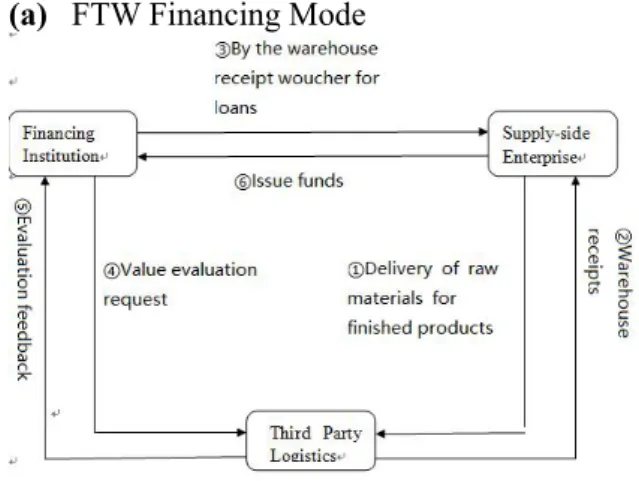
(a) FTW Financing Mode
Figure 2: FTW Financing Mode
Source: Authors' construct
In SMEs production and operation activities, raw materials procurement and finished goods sales are widespread in bulk and seasonal characteristics, this kind of stock material often takes up the amount of precious capital. With its good storage, distribution and trade conditions, FTW financing attracts SMEs in radiation area as a third party warehousing center and facilitates enterprises gaining pledge loans financing from financing institutions by movable property stored in Finance-Transportation and Warehouse. Its essence is to transfer the movable property (mainly raw materials and finished goods) which financial institutions are reluctant to accept into the chattel pledge of product so that as collateral security products to obtain the credit financing. Additionally, FTW financing mode has a derivative form named Counter-guarantee, namely when the borrowing enterprises have difficulty in using checking cargo to apply for the pledge loans from financial institutions, the cargo will be regarded as a counter guarantee pawn by Logistics Company. The borrowing enterprise eventually achieves loans
through the credit guaranteed by Logistics Company. This is illustrated in figure 2.
(b) Confirmer Wharf Financing Mode
Confirmer wharf financing mode mainly refers to the core enterprise acting as vendors in supply chain makes a promise to the financial institution of balance repurchasing unconditionally and through cargoes deposited in the designated financial institution warehouse by suppliers as a pledge to obtain loans from financial institutions.
Figure 3: FTW Financing Mode Source: Authors' construct
From figure1.3, the confirmer wharf financing mode allows the suppliers and core business, third-party warehouse logistics companies as well as banking institutions in the supply chain to sign agreements related to confirmer wharf business simultaneously. If the warehouse logistics companies are the core of financial enterprises, sometimes a fungible purchasing agreement signed with the supplier is necessary to take advantage of supply chain financing. The core enterprise or fungible purchasing suppliers through the core of enterprises have to pay some money to banking institution in accordance with the agreement. Generally, deposit amount equal to the contract value of inventory and pledge as the basis multiplied by the appropriate percentage, the bank will offer the corresponding amount loans after receiving the deposit. During this process, the core business has to undertake counter guarantee liability for the goods. Moreover, third-party logistics or warehousing regulatory authority must assume the responsibility of supervising the delivery of cargo from storage. However, attention must be paid according to the instruction sheet of the bank, delivering the same price cargo from storage according to payment amount in batches.
The main purpose of this study is to find the appropriate SMEs’ Models of Logistics Supply Chain financing that contributes to the performance of some selected firms in Jiangxi and Guangdong in China from 2016 to 2017. Our results further provide evidence for the adoption of appropriate means of acquiring financial assistance by SMEs from the financial institutions in China.
METHODOLOGY
This chapter discusses the procedures used for the collection of data, the variable measurement, and the analytical techniques. The source of materials for the study is primary data, which was collected using structured questionnaires designed and administered to the various firms operating in the following departments; Personal, Procurement, Finance, Marketing, Information Technology (IT). The research is descriptive which involves collecting data to describe the nature of a stated topic under study. Simple random sampling and purposive technique were used to choose the population for the study. Once all the responses were received, they were registered in the database using Stata 13 and SPSS V.20 for the analysis.
3.1 Preliminary Analysis
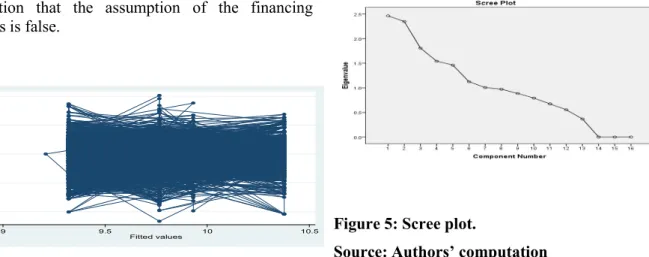
The study adopted residuals versus fitted values plot for verifying the assumptions of the linear model adopted. The plot suggests no change to the model and the random scatter -residuals do not contradict the linear assumptions. The variability is the same and does not appear to be any curvature or just any other indication that there is a problem with the model. This means that the residual plot gives no indication that the assumption of the financing models is false. -4 -2 0 2 4 Re sid ual s 9 9.5 10 10.5 Fitted values
Figure 4: Residual vs. fitted plots
The table below gives detailed explanation of the explanatory factor analysis using output from a standard statistical package (spss v. 20).
3.1 Result from Principal Component Analysis (PCA)
The principal component analysis helps to analyze the interrelationships among the variables used for the study. The first seven principal components have initial Eigenvalues greater 1 and none of the remaining components has an initial Eigenvalue equal to or greater than 1. Following the Kaiser Criterion, the first seven principal components for further analysis (seetable 1).
Table 1: Summary of principal component analysis
The scree plot obviously shows a breakpoint at principal component 7. Following the scree plot selection criterion, we select the first seven principal components for further analysis (seefigure 5).
Figure 5: Scree plot.
Both the Kaiser criterion and the scree plot agree that principal component 1 (PC1) and principal component 2 (PC2) should be selected for further analysis.
Descriptive Statistics
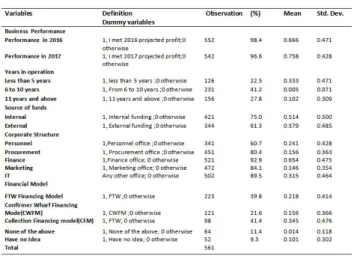
Table 2 presents the summary statistics of the variables used for the study. The variables were categorized as follows: a) the performance of the various forms used for the study in 2016 and 2017, representing the dependent variables; b) the number of years the business has been in operation; c) the source of funds for the various firms captured; d) the various departments in the various firms; and f) the various financial models use in securing funds from financing institutions.
We created dummy variables to represent the various observations belonging to different categories having value 1 and 0 if otherwise. A total of 561 firms/SMEs were conducted in both 2016 and 2017. Out of the total sample size, 552 and 542 firms representing 98.4% and 96.6% respectively with their respective mean of 0.666 and 0.758 disclosed their information about the firms' profit in 2016 and 2017. According to the years of operation, the study revealed that 126 firms had been in operation for less than 5years, 231 firms had operated between 6 and 10 years and 156 firms representing 27.8% of the firms had been in the various businesses for more than 10 years.
With regard to source of funds, 421 firms representing 75% of the sample relied on internal source of funds. This means that the firms relied on their own resources, providing inventory purchases, accounts receivables and accounts payables to finance their own firms in order to be in a better position to secure fund from the external sources. With regards to the external source of funds, 344 firms consisting of 61.3% of the total population depended on external funds. The statistics implied several firms relied on both internal and external source of funds for the business financing.
Since the various departments in the firm play a pivotal role in day-to-day management of business, the study investigated how these departments contributed to the performance of the firms during the study period. The results, however, revealed that 60.7% of the total population had a personnel department, 80.4% had procurement office, 92.9% of the respondents had the financial department, and
84.1% of the respondents had marketing department, while 89.5% of the firms had IT departments that dealt with the operations. The appropriate financing models through which these firms used to secured loans were also investigated. Base on the results, about 40% of the firms adopted FTW Financing Model, 22% of the firms adopted Confirmer Wharf Financing Mode (CWFM), and 41% adopted Collection Financing model (CFM). Moreover, while 11% of the firms do not adopt these financing modes, 9.3% of the firms claimed they have no idea about these models. Table 2 gives detailed statistics of the variables used for the study.
Table 2: Descriptive statistics and variable definition
RESULTS ANALYSIS
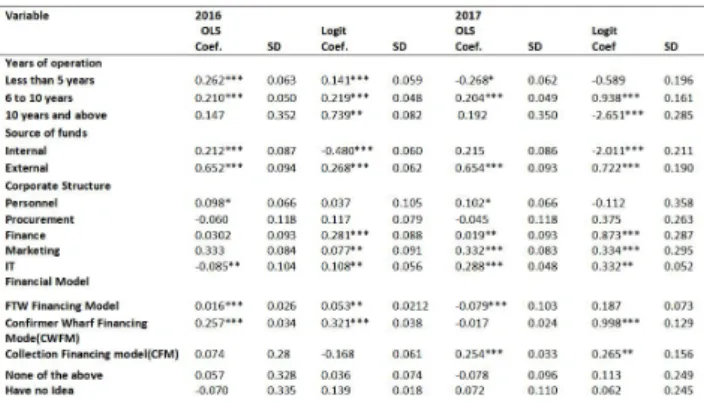
The study investigated how the adoption of some financial models helps in promoting business growth in Jiangxi and Guangdong Provinces in China. Table 3 shows the regression results with the marginal effect of the logistics model and the coefficient of the OLS model.
Since the number of years firms have been in operation play a significant role in the firm's performance, the study looked at how it contributed to the performance of the selected firms. The period firms have being in an operation was found to be significantly associated with the firm's performance in 2016 and 2017. The firms that had been in operation for less than five years recorded some positive gains in their performance in 2016, unlike the negative performance in 2017. Moreover, the regression analysis for 2016 and 2017 revealed that firms which had been in an operation from 6 to 10 were significantly impacted on the firms’ performance.
Securing funds to start a new business venture posses a greater challenge to many entrepreneurs. However,
firms relying on the external source of funds to finance their business operations were found to be significant in 2016 and 2017. According to the regression results, firms which relied on the external source of funds show a consistent significant positive effect on the firms' performance. However, the regression results revealed a significant negative impact of internal source of funds on the firm's performance within the study period. It is therefore suggested that private credit guarantee schemes should be supported by the government to carry out their operations effectively.
Among the factors that contribute to business performance are the activities of the various departments in the company.
According to the study results, the personnel department in the various firms was significantly associated the performance of the firms during 2016 study period as compare to 2017. The procurement department according to the logistic regression model contributed positively insignificant to the firms’ performance in both years. However, the finance and marketing departments significantly associated with the performance of the firms in both 2016 and 2017. The information technology department was found to be significantly associated with business performance during the study periods. In comparison with the results for 2016, the OLS regression result was significant but negatively different.
Table 3: OLS and Logistics Regression Results
The study further investigated the relationship between the various financial modes and business performance. The FTW financing mode was found to be significant associated with the business performance in 2016 as compared to 2017. Moreover, the regression coefficients showed that firms adopting Confirmer Wharf Financing Mode (CWFM) had a positive and significant effect on the firm's performance. However, the coefficients of CWFM
were negative and insignificant in 2017 under the logistic regression analysis.
The OLS and the logistic regression model showed that the adoption of Collection Financing model (CFM) was positively and significantly associated with the firm's performance and was higher in 2017 as compared to previous year’s (2016) performance. Surprisingly, firms using none of the models listed or had no idea about these financial models performed moderately well, though the effect was insignificant.
4. CONCLUSION
Logistics supply chain financing business carries great and profound implications for difficulties of SMEs’ financing. Tower Group defines supply chain financing as "A category of solutions designed to provide working capital financing and accelerated cash flow to suppliers on the basis of the value of physical or financial supply chain events such as the issuance of a purchase order or approval of an invoice". However, in order to improve the success rate of financing, SMEs have to adopt the logistics supply chain financing model alternatively according to their own characteristics, so as to increase the availability of financing, reduce the cost of financing, and eventually improve the current situation of the financing difficulties in SMEs. The research result will have a far-reaching impact on the design of
SMEs financial innovative products, and
consequently, resolve problems in SMEs’ financing. It is therefore suggested that effective credit guarantee scheme either public or private should be effectively equipped to repay the lender either all or part of the loan of the defaulters. Moreover, effective policy, which gears towards collecting accurate information by the SMEs, should be strengthened to facilitate the ease of getting financial assistance from the banks and other financial institutions.
ACKNOWLEDGEMENT
This study is founded by The National Self-finance Fund Project “Based on the Dual Network Embedding of Small and Micro Enterprises' Life Cycle Trap Breakthrough Mechanism and Path Research” with grant number 71563022.
(1) Abraham, Facundo, & Schmukler, Sergio L. (2017). Addressing the SME finance problem. World Bank Policy Research Working Paper,(120333)
(2) Beck, T, Demirguc-Kunt, & Maksimovic, V. (2008). "Financing Patterns around the World: Are Small Firms Different?". Jounal of Financial Economic, 89(3), 467-487.
(3) Duan, Hongbo, Han, Xiaojie, & Yang, Hongbo. (2009). An analysis of causes for SMEs financing difficulty. International Journal of Business and Management, 4(6), 73.
(4) Ferrando, Annalisa, & Mulier, Klaas. (2015). Firms’ financing constraints: Do perceptions match the actual situation? The Economic and Social Review, 46(1, Spring), 87-117.
(5) Guan, JianCheng, & Yam, Richard CM. (2015). Effects of government financial incentives on firms’ innovation performance in China: Evidences from Beijing in the 1990s. Research Policy, 44(1), 273-282.
(6) Huang, Cheng, When, Y, & Liu, Z. (2014). Analysis on financing difficulties for SMEs due to asymmetric information. Global Disclosure of Economics and Business, 3(2), 28-31.
(7) Jiang, Juanjuan, Li, Zhiming, & Lin, Chanyan. (2014). Financing difficulties of SMEs from its financing sources in China. Journal of Service Science and Management, 7(03), 196.