Managing Knowledge as Business Rules
Anca ANDREESCU, Marinela MIRCEA Academy of Economic Studies, Bucharest, Romania,[email protected], [email protected]
In today’s business environment, it is a certainty that will manage to survive especially those organizations which are striving to adapt quickly and with low costs to the new demands of market competition. Knowledge represented by internal business rules of an organization can help crystallize their orientation in order to ensure a competitive advantage in the market. In this context and in a relatively short time, a new trend in software development has arisen, ex-tending current methods and putting a strong emphasis on business rules. This article outlines the importance of managing business rules in an organized manner using dedicated software products and furthermore presents a general prototype for a business rules repository.
Keywords: Business Rules, Management, Knowledge, Rule Engine, Repository Prototype Introduction
As interest for explicit manipulation of business rules grows, researches in this area seem to focus on a common goal: to identify ways that provide support for automatic propagation of changes from business envi-ronment to information systems, and further, to software applications. Thus, it aims to fill the gap between the business level and the information system level, because aligning information system with business functional requirements is a fundamental problem of all organizations. In the same time, it is essential to trace the business rules in all stages of the software life cycle, which can’t be accom-plished without addressing at least the fol-lowing topics [1]:
• Business rules identification: How are business rules identified, starting from the business objectives and from the business stakeholders? How are business rules ex-tracted from the legacy source code?
• Business rules specification: How to speci-fy business rules, so that they are unders-tood by all those involved in the develop-ment process?
• Business rules implementation: What kind of technology should be used to implement business rules? Where to implement busi-ness rules within an application, in order to minimize the effort required modifying the rules?
• Business rules management: Where to store business rules and their contents? How to
manage business rules changes and ver-sions?
The process of identifying business rules can be difficult especially where these rules do not benefit from an explicit representation. Depending on the information they contain, business rules may be based on explicit or ta-cit (implita-cit) knowledge. Explita-cit knowledge can be easily identified, formalized and ex-pressed in the form of principles, terms, poli-cies, formulas, etc. On the other hand, tacit knowledge is not as visible and easily ex-pressed [2]. It has a highly personal and sub-jective nature and may be based on expe-rience, ideals, emotions or intuition. The im-portance of tacit knowledge resides in its ability to clarify the context of business rules for which there is a not well-defined specifi-cation. To understand why a certain rule ex-ists, and what its motivation is, one must first understand its information basis. Otherwise it is possible to lose the meaning for which the rule was created or no longer know if it still reflects reality [3].
In this respect, Scott Amber proposed in [4] a way to capture the information behind a rule by using a template containing the following fields: name, identification code, description, sample, source, document, publication date, related rules, and history of changes.
Once identified, business rules must be speci-fied in an appropriate manner. Thus, a new challenge appears: that the method chosen for rules specification to be understood by all
persons involved in software development. While business people are not so often famil-iar with specification languages that require a higher level of formalization, developers re-quire that business rules statements to be un-ambiguous in order to allow an easy transi-tion towards source code. This contradictransi-tion leads to the following conclusion: to be
un-derstood by all people that are using them, business rules must be specified at different levels of formalization. Figure 1 depicts four levels of formalization at which rules can be described, so they allow the evolution from one specification method to another [5]. The main characteristics of these specification methods are also presented.
Fig. 1. Types of rule expressions [5] So, in the context of different rules
expres-sions and verexpres-sions, a consistent business rules management is essential for the success of a rule-based development process.
2 Business Rules Management Systems - characteristics and architectures
Recent years have been marked by an in-creased interest for a new type of software products, called Business Rules Management Systems (BRMS). These systems externalize business rules and provide facilities for a centralized business rules management. They also offer solutions for compelling problems facing any business: business rules changes in response to increasingly rapid pace of change and the short time required for the implementation of there changes in the soft-ware system.
BRMS products are related both at concep-tual and commercial level with expert sys-tems that have emerged in the 1980s. Expert systems (also known as knowledge-based systems) represent the oldest and perhaps the best documented technology in artificial in-telligence. These are systems that can offer suggestions or take decisions in a well
de-fined area of expertise. There are two types of such systems: a) systems that make deci-sions and which mostly control processes such as systems for financial transactions and b) systems acting as decision support sys-tems, which are not designed to take auto-nomous decisions. But the most important feature of expert systems is given by their ar-chitecture: the knowledge related to problem domain (represented, usually in the form of rules) is stored separately from the code that uses knowledge to solve a specific problem. Expert systems are therefore based on rules. Rules must characterize, in a very complete and accurate manner, the universe of dis-course and the decision-making context. The rules can be derived using data analysis tech-niques or various methods based on statistics. Also, rules can be arbitrary sentences im-posed by prejudices and thinking of the deci-sion-maker. Whatever are their sources and however rules are built, it was observed that declarative rules are sufficiently flexible for the proper representation of acquired know-ledge, being in the same time easy to handle and implement [6].
specified in order to capture the action that must be executed when an event is triggering it. A rule may have different forms depend-ing on the implementation method or type of rule. The classical production rules format is the most used: "If A then B", where A is called antecedent clause and B is called con-sequent. In rules specification, the conse-quent usually takes the form of an action or conclusions. A production rule can have mul-tiple interpretations, such as: when a condi-tion is satisfied, then a particular accondi-tion is
ex-ecuted; if a particular statement is true, then another can be inferred; if a particular syntac-tic structure is present, then another can be grammatically generated. In general, A and B are complex statements, formed from simple constructions using connectivity operators as disjunction, conjunction or negation. A sub-stantial knowledge base can be created using a general specification method, called ECAA
(Event-Condition-Action-Alternative-Action).
Table 1. Comparison between Expert Systems and Business Rules Management Systems
Expert Systems Business Rules Management Systems
Are intended for independently solve one complex problem.
Solve a large number of relatively simple problems, using the form of service calls. Rules generally represent expertise in a
nar-row field, understandable to few people.
Business rules capture general knowledge of the business area. They have a wide au-dience and are intended to be understood and validated by all the people that have an interest within the organization.
When arriving at a conclusion, the problem can be considered solved.
The rules are continuously applied, most organizations aiming for continuous opera-tion of their applicaopera-tions, so that we can not say that such systems reach a specific end point.
Beside rules, they can process expert know-ledge in order to provide answers, advices and recommendations.
Are appropriate for making decisions based on a large number of relatively simple rules.
General principles of expert systems men-tioned above are also applicable to BRMS. Even if the two classes of products are re-lated at conceptual level and even technolo-gically, there is a series of arguments show-ing why they have evolved in different direc-tions (table 1).
Unlike the first generation of expert systems, which mixed together facts, data procedures and rules in knowledge base, a modern BRMS keeps, in most cases, a clear demarca-tion between rules and business data. Know-ledge stored in a BRMS is referenced as rules base or knowledge base, and the me-chanisms that apply knowledge over data are called rule engines or inference engines. According to Jan Graham [7], Business Rules Management Systems have four essential
components illustrated in figure 2.
Fig. 2. Simplified architecture of a BRMS The first element in the above figure consists
of the environment underlying the system and within which the system runs. It can con-tain programming languages and their devel-opment environments, text editors, compi-lers, processors, data structures, etc. The second element is the very structure of know-ledge, including methods of representation and access, as well as techniques for apply-ing knowledge in a rational way in order to solve problems. The third element is the infe-rence engine, which establishes a link be-tween the rules, for obtaining accurate and valid conclusions. In most cases, inference engines operate in a non-procedural way, but some BRMS allow rapid implementation of rule sets using procedural execution methods. The last element of this architecture is the re-pository, where rules are stored and which
al-lows the application of various operations on rules, such as manipulation, versioning man-agement, sharing, etc.
In a broader architectural context, the capa-bilities of BRMS must be centered on the rule-based decision services that it offers to basic applications (figure 3). Expert systems were traditionally designed as closed sys-tems, which independently resolved certain problems and did not allow integration with other programming environments. This is probably one of the reasons why expert sys-tems didn't have the expected success in de-veloping business applications. Unlike expert systems, BRMS products were designed to provide services that automate business ap-plications within an organization.
Fig. 3. Components of a BRMS (adapted after [7]) The separate placement of the rules
reposito-ry must be observed (from which the rules will be imported to represent entries for deci-sion services), but also the likely presence of one or more databases that, in a software sys-tem, are closely related to business rules. In the same time, business rules authoring ser-vices (responsible for business definition) are placed in a separate component. In order to facilitate the application maintenance, the
knowledge base and inference engine are represented as separate entities. Since rules and policies are those that will change over time, it is not practical to rewrite the code as-sociated with each rule engine each time a new rule appears.
Knowledge Base contains usually different types of knowledge about objects, procedures or causal relationships. Knowledge about ob-jects may be stored as object models, XLM
schema, data models or semantic networks [7]. Procedural knowledge can be represented as rules, but they may be, for ex-ample, methods written in Java or macros in MS Excel. Meanwhile, some business proce-dures can be represented as rules.
As previous noted, knowledge about causal relationships is stored as rules of type "IF ... THEN". Programming languages such as C#, Java or COBOL implements such statements using control structures (if / then, while, until or case). Languages that implement business rules are typically declarative, hence non-procedural. This means that the order in which rules are written is not important. Rules apply to knowledge about entities and objects.
Among different ways of knowledge repre-sentation, rules, procedures and objects are, nowadays, the most commonly used by Business Rules Management Systems. In most BRMS products, rules are specified in the form of sentences, containing, usually, the words IF and THEN. However, Morgan proposed in [8] a different style, in order to reduce ambiguity, to establish explicit rela-tionships between elements, to avoid obscure terminology, etc. His style is remarkably close to natural language.
The template concept, frequently used in software development, finds itself useful in rules-based technology as well. In this con-text, it allows the creation of sentences with blanks spaces that will to be filled in after-ward. This reduces the time required to spe-cify the rules and provides premises to en-force a standard style and unambiguous re-presentation.
Most BRMS products allow or even require the placement rules that will to be executed together into a set of rules. The motivation resides in the need to associate rules govern-ing a particular function of an application. For example, all rules that are related to dis-counts may be grouped in the set of rules "discount rules".
Rules syntax checking includes the possibili-ty to check the syntactic correctness of a rule, in real time and as the rule is introduced into the system. In order to accomplish a clear
link between object model and rules is useful to highlight keywords, variables and values using different colors.
It is obvious that an efficient business rules management process can’t be achieved with-out the use of suitable instruments for this purpose. There are plenty of such instruments on the market, that provide facilities for business rules acquisition and management, each covering a specific area of rules life cycle and addressing to different categories of users. Thus, by analyzing the existent so-lutions, three main classes of software prod-ucts based on business rules have been iden-tified. These are described below.
Class A includes products for which business people represent the main audience. They are independent of a particular development en-vironment and perceive business rules man-agement from a business perspective. They provide specialized services for the rules ac-quisition, including identification of those business artifacts that allow placing business rules in a certain context. The offer of such products is relatively small, their main draw-back being that they don’t support rules im-plementation. Typical products for this class are RuleXpress (RuleArts) and RuleTrack BRS (Business Rule Solutions).
Class B includes products intended primarily for developers, especially analysts and soft-ware architects. Their role is to assist the de-velopment of rule-based applications, by providing facilities for rules acquisition, for-malization, modeling and, especially, for im-plementation. In most cases, they don't offer support for non-technical users, such as high-level specification languages. Many products on the market belong to this class: InRule (InRule Technology), VisualRules (Innova-tions Software Technology), Usoft (Ness Technologies), Versata BRMS (Versata) etc. Even though, technically speaking, they represent only parts of a BRMS, rule engines correspond to a technology that can be used in software development independently of any other products. Several rule engines must be noted: open source rules engines such as OpenRules and Drools for Java and NxBRE or Drools. NET for the .NET platform, but
also the rule engine included in Microsoft technology, called Windows Workflow Foundation.
Class C has the widest audience and is open to all categories of persons involved in the development of knowledge-based applica-tions. Being built on the paradigm of expert systems, they allow the creation of intelligent applications based on knowledge acquisition. They are versatile products that have power-ful inference engine and provides a wide range of facilities for rules management, both at business level and at software system lev-el. Blaze Advisor FICO (FICO) and ILOG Rules (IBM) are recognized as market lead-ers in this segment.
3 Evaluation criteria for BRMS products
Most companies that offer BRMS products have evolved from the status of rule engines vendors to that of software development so-lution providers for the business environ-ment. These solutions were based on the de-finition of declarative business rules that run through proprietary rule engines. Besides these, there are also producers that have started from different approaches, such as mapping decision trees or graphs to executa-ble code (for example, Visual Rules product). The rules stored in the repository can be con-sidered as decision services that are often compatible with the latest trends in software architecture, such as SOA or Web services. Aspects regarding the opportunity and the decision to implement a BRMS product and a complete business rules approach were dis-cussed in detail in [9] and [10]. This article aims to recommend a set of evaluation crite-ria for BRMS products and, afterward, these criteria will be applied for the following products: FICO Blaze Advisor, Visual Rules and Windows Workflow Foundation (WWF). The criteria were divided into two categories, as follows:
a) General criteria:
• Affiliation to a class of rule based prod-ucts in accordance with the three classes proposed above and which identify the product target audience.
• Price, especially for rule-based products, significantly reduces the range of poten-tial clients.
• Type of target organization, because for medium or large organizations, the analy-sis of cost-effectiveness may lean in fa-vor of implementing a BRMS, while the vast majority of small companies can not afford to purchase such a product.
b) Technical criteria:
• Allows backward and/or mixed chaining strategies, as there are systems intensive-ly based on knowledge, for which the op-portunity to implement rules using back-ward or mixed chaining is crucial.
• Uses a rule engine based on Rete algo-rithm, particularly useful for systems containing many interrelated rules.
• Uses a high-level language for business rules implementation, aiming the kind of systems that will or should allow busi-ness people to handle, modify or create business rules.
• Represents rules in graphical form as de-cision tables, score tables or dede-cision trees for modeling complex rules.
• The software platform on which the BRMS product runs is important because it must be compatible with the base ap-plications platform.
• Provides the opportunity of testing rules before implementation, being an impor-tant feature that relieves developers of testing rules by using other tools.
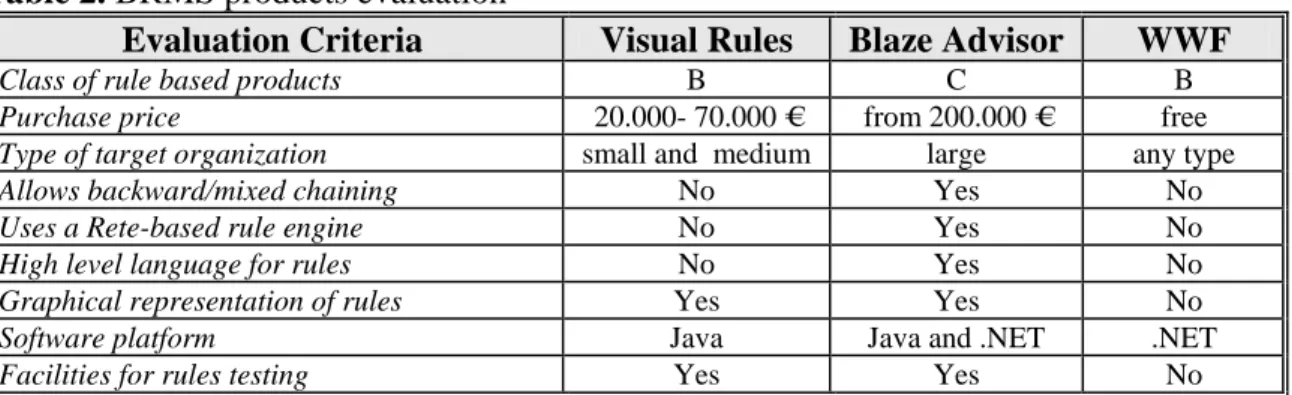
Table 2 presents the evaluation of three BRMS products, by reference to the above criteria.
Table 2. BRMS products evaluation
Evaluation Criteria Visual Rules Blaze Advisor WWF
Class of rule based products B C B
Purchase price 20.000- 70.000 € from 200.000 € free
Type of target organization small and medium large any type
Allows backward/mixed chaining No Yes No
Uses a Rete-based rule engine No Yes No
High level language for rules No Yes No
Graphical representation of rules Yes Yes No
Software platform Java Java and .NET .NET
Facilities for rules testing Yes Yes No
Finally, in terms of usability, the analyzed products are not very suitable in environ-ments where business people must be in-volved directly in the creation and mainten-ance of business logic. An exception is the situation when the development environment allows the creation of very intuitive custom interfaces, as is the case of the web interfaces provided by FICO Blaze Advisor. Visual Rules is not suitable to integrate rules into an existing application, but to build a new appli-cation with rule-based technology.
4 A business rules repository prototype
It is clear that, regardless of how the rules are introduced in the software development process, handling them effectively requires the support of a rules repository, in the same way that data management requires centra-lized databases storage.
A rules repository allows the storage, out-sourcing and distribution of the rules that have been identified in the business modeling phase and in other phases of the development process. Generally speaking, a repository is a specialized type of database that allows the storage of complex objects, together with their description [11]. In software develop-ment, these objects can be models, compo-nents or specifications. Both the require-ments and the conceptual structure of rules repositories have been the subject of several scientific papers or publications in this field, such as [12], [13] or [14].
An example of a logical data model for a rules repository, having a high degree of ge-nerality, was described by Tony Morgan in [8].The author addresses the problem of data repositories’ utility and highlights their
indi-vidual character when compared with other tools for managing rules. Morgan suggested the use of constructions based on XML as a solution to the multitude of formats, groups of rules or taxonomies.
In the same register, Marko Bajec’s and Mar-jan Krisper’s methodological research [15] has resulted in a system prototype for build-ing a business model. This model includes specific business elements, such as: objec-tives, problems, activities, processes, organi-zational and functional units and provides support for the incorporation and manage-ment of business rules in this model. Yet again, rules are treated at the two levels men-tioned above.
Generally speaking, by using rules reposito-ries, it is intended to achieve the following benefits: ● a more effectively and quickly management of business requirements; ● bet-ter tracking and reuse of business rules; ● in-creasing rules security and integrity within the system.
The following paragraphs will present the main objectives and functionality of our pro-posal for a business rules repository proto-type, which was named RuleManager. It was created as a useful tool for developers in de-fining and managing business rules of an or-ganization, being independent of any other development tool. The prototype application must be used within a development process with capabilities for explicit manipulation of business rules, having two types of users: business analyst and software architect, for which a general use case diagram is de-scribed in figure 4. Such a process, extending the Unified Software Development Process [16] with additional activities proper for
business rules manipulation, can be found in [10].
Fig. 4. General use case diagram According to this prototype, the business
analyst plays the most important role in the application, acting as an interface between business people (system's beneficiaries) and developers. His main tasks are related to in-formal and structured specification of busi-ness rules, defining the relationship between rules and grouping rules into sets of rules. On the other hand, the software architect uses the application after the business analyst has entered all the details of a rule. On this basis, the software architect may take design-level decision. Finally, he must introduce in the application information regarding the imple-mentation of rules.
As a rules repository, RuleManager has the following functions:
- To provide support for documenting business rules at three different levels of abstraction: business level (informal de-scription), software modeling level (for-malized description) and implementation level (implementation details).
- To provide rules traceability in a system. - To enable modeling of different
catego-ries of rules, including complex rules
such as decision tables.
- To establish relationships between rules. - To group rules into set of rules according
to functional or organizational criteria. - To provide, through its interfaces, the
possibility to manipulate objects from re-pository in a consistent manner.
- To provide the possibility of granting access rights to individual rules, groups of rules or rules that meet certain condi-tions.
Fig. 5. Actors and their roles in the rules spe-cification activity
In order to ensure that the prototype meets the functionality associated with these objec-tives, the biggest obstacle was to choose a proper method for their formalized descrip-tion. As shown in figure 5, the formalized description represents a bridge between cus-tomer requirements and the actual system implementation.
According to the scenario in the above fig-ure, the formalized description is defined by the business analyst, based on the benefi-ciary's informal description, is validated by the customer and is used by the software arc-hitect to serve as a basis in choosing an im-plementation solutions. Thus, this approach started from the idea that the formalized de-scription should be understood by all these people involved in the development process. In order to specify rules, RuleManager struc-tures a rules model as a tree structure, based on three main elements: entities, rules and relationships.
Entities are those which will form the basis of the formalized specification of the rules, while relationships capture the links between rules. Entities are, in fact, business objects found in the object model defined in the business modeling phase or in the system analysis phase. Each entity has an associated set of attributes, which are assigned to a spe-cific type of basic data: numeric, string or date and time. Certainly, these entities are not isolated and they must be correlated to other entities in the model. The application does not model the dependencies between entities and assumes that they were represented as a class diagram or model of facts.
The prototype allows the definition of four categories of business rules, as follows: - Enumeration rules establish a set of
poss-ible values that an attribute of an entity may take.
- Integrity rules capture some constraints that are applied to an entity's attributes. - “If…then” rules are equivalent to Event -
Condition – Action (ECA) rules or pro-duction rules.
- Decision table rules are used to represent complex rules in a tabular form, and
al-low making associations between several interdependent conditions, on the one hand, and defining a set of actions that correspond to a combination of these conditions, on the other hand. The main advantage of decision tables lies in the in-tuitive way in which they represent knowledge, in order for this to be better understood and validated by humans. For each rule, the user must specify some general information, a formalized description and implementation details. Regarding the general information, they are meant to uni-quely identify a business rule within the sys-tem and also to provide a set of other useful details for implementation. The prototype re-fers to following general fields:
- rule code: must contain a unique identi-fication code for a rule; it can be a mea-ningful name for the rule or a combina-tion of characters and numbers to encode, for example, the type of rule, as in the following examples: BR12, ER05 or DTR23.
- description: refers to a brief characteri-zation of a rule.
- details: contains the specification of a rule in an informal manner, namely in natural language. This information is provided by the beneficiaries and is a part of the system requirements.
- source: represents, from business pers-pective, the basis of a business rule, be-cause rules characterize the business, and not the developed system. These sources can be, for example, organization's inter-nal policies or legal regulations coming from outside the organization.
- category: allows the inclusion of a rule in a set of rules, for the reasons that were mentioned earlier on.
- validity: refers to the period during which the rule will be operational.
- mode: describes the dynamic character of a rule, and may take two values - static and dynamic. It can be very useful for decision makers to know the possibility of a rule to change frequently. Ideally, all rules should be implemented so that they can be changed without affecting the
sys-tem modules that implement business logic and, especially, without requiring a recompilation of the entire application. Rules-based development principles promote the very idea of implementing all rules in an external component, where rules can be managed by business people and executed by a rules engine. The reali-ty, however, differs from this ideal scena-rio, and the characteristics of particular rule, of the system, and not least, the available resources of the beneficiary, may constitute impediments for using a rules engine.
- status: helps establish important mo-ments in the life cycle of a rule. At the time when it was created, a rule state must be proposed. Once it was validated by beneficiary, together with the business analyst, it passes the approved state. An approved rule will be implemented until it becomes operational, moment set by specifying the range of validity. After adding the implementation details, the
rule becomes active. Finally, there is the possibility that the rule to become inac-tive due the expiration of its validity in-terval, a decision taken within the organi-zation or other reasons.
For the formalized description of a rule, the prototype provides editing features specific to each category of rules. For example, for editing "if...then" rules, it was taken into ac-count the fact that the user must have, in terms of semantic, more flexibility in defin-ing the conditions of a rule, but syntactically, he must use a predefined set of symbols . Be-side this, “if…then” rules formalized defini-tions must comply with the following pat-tern:
If [( ] <condition> [<condition > [ ) ]
[ ( ] AND /OR < condition >….] [ ) ]
then <action> [<action >
< action > …].
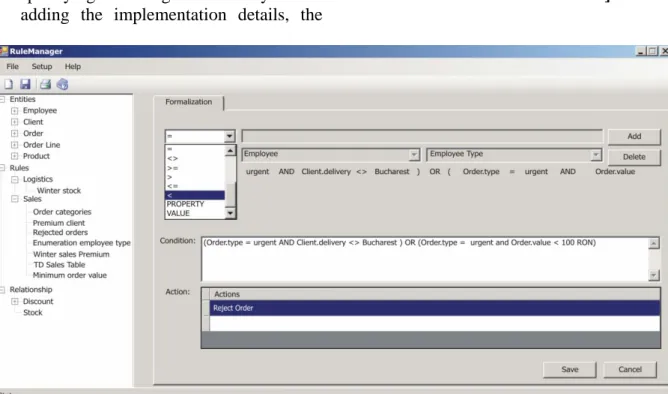
Fig. 6. The editor for the formalized description of an “if…then” rule As shown in figure 6, the introduction of any
element in the definition of such rules is sub-ject to selection from a list, if these elements are logical operators (AND, OR), mathemati-cal operators (+, -, *, /, =, <>, <=, >=, =) or round brackets. To refer to a property of an
entity, the option PROPERTY must be se-lected and, in order to introduce values asso-ciated to a property, the option VALUE must be selected. Actually, Figure 6 illustrates how to edit the formalized description for the following rule: "If an order is urgent and the
shipping address is outside of Bucharest or if the order is urgent and order value is less than 100 RON, then the order will be re-jected."
Also, note that the editor allows the insertion of such items anywhere within an already de-fined condition by selecting one or more elements that are placed before the ones that we want to add. Regarding the actions, the user is free to enter any specification. There-fore, the prototype allows easy rules editing, however, in a controlled manner.
The establishment of relationships between rules is an important feature of a rules repo-sitory, since, in a system, many rules are in close connection with other rules. The proto-type implements one method of connecting rules, according to which between two rules may exists three types of relationships, as in the subsequent definitions:
Definition 1: Rule R1 includes rule R2, if for the establishment of the truth value of R1 if it is necessary for R2 to be previously executed. Definition 2: Rule R2 extends rule R1, if R2
re-evaluates, for a particular case, the con-clusions established through the evaluation of R1.
Definition 3: Rule R2 excludes rule R1, if R2 stipulates an exception from R1.
It must be mentioned that, at the level of rela-tionships, rules can be grouped into sets of rules other than those encountered in the rules definition. Thus, in case of the example in Figure 6, a new set of rules may be needed (named Discount), in order to contain the re-lationships between the rules governing dis-count policies.
5 Conclusions
Business rules encompass knowledge about specific politics, procedures, definitions or legal regulations that every organization must comply with. If accurately managed, they may lead to relevant competitive advantages within the business environment. This article analyzed the fundamental principles that go-vern rule-based development and the particu-larities of Business Rules Management Sys-tems, by providing a set of evaluation criteria for this type of software products. In order to
illustrate the need and usefulness of a me-chanism that allows business rules manage-ment during the software system develop-ment cycle, a solution for a business rules re-pository prototype was proposed. In brief, this prototype is independent by any devel-opment tool and addresses those rules that will be directly implemented in the system. Future research will include the definition and addition of supplementary functionalities to the repository prototype, such as: ● ha n-dling collections of business objects; ● code generation for rules programming languages or specification languages, like RuleML; ● management of rules versions; ● import business object model, as a database structure or class model.
References
[1] M. Bajek, M. Krisper, Issues and Chal-lenges in Business Rule-Based Informa-tion Systems Development, European Conference on Information Systems, 2005.
[2] I. Nonaka, H. Takeuchi, The Know-ledge-Creating Company, Oxford Uni-versity Press, Oxford, 1995.
[3] J.A. Zachman, A framework for Informa-tion Systems Architecture, IBM Systems Journal, Vol. 26, No. 3, 1987.
[4] S. Ambler, Object-Oriented Business Rules, Software Development Magazine, June 2000.
[5] B. Von Halle, Business Rules Applied, John Wiley & Sons, Inc., 2002
[6] R. Petruşel, Sisteme suport de decizie în domeniul fluxurilor de trezorerie aplicate
la întreprinderile mici şi mijlocii din
România, PhD thesis, “Babes-Bolyai” University, Cluj-Napoca, 2007.
[7] I.Graham, Business Rules Management and Service Oriented Architecture: A Pattern Language, Wiley, 2007.
[8] T. Morgan, Business Rules and Informa-tion Systems: Aligning IT with Business Goals, Addison Wesley, 2002.
[9] A. Andreescu, A. Uta, Methodological Approaches Based on Business Rules,
In-formatica Economică Journal [Online],
http://revistaie.ase.ro/content/47/04Andre escu,%20Uta.pdf
[10] A. Andreescu, A General Software De-velopment Process Suitable for Explicit Manipulation of Business Rules, The pro-ceedings of the “CompSysTech ’09” In-ternational Conference, Rousse, Bulgaria, pp. IIIA.9-1, June 2009.
[11] P. A. Bernstein, U. Dayal. An Overview of Repository Technology, in proceeding of VLDB'94, pp. 705-713, Santiago, Chile, 1994.
[12] N. Haggerty, J. Wall, G. Van Etten, De-fining The Requirements for a Business Rule Repository, The Data Administra-tion Newsletter, no.16, 2001. Available: http://www.tdan.com/view-articles/4924
[13] R. Butleris, K. Kapoèius, The Business Rules Repository for Information Systems Design, ADBIS Research Communica-tions, 6th East European Conference ADBIS, Bratislava, 2002
[14] L. Čeponis, O. Vasilecas, Logical View of Architecture of Business Rules Reposi-tory, Information Sciences, no.36, 2006. Available: http: //www.ceeol.com
[15] M. Bajec, M. Krisper, A methodology and tool support for managing business rules in organizations, Journal Informa-tion Systems, Vol. 30, no. 6, Elsevier Science Oxford, September 2005.
[16] G. Booch, J. Raumbagh, I. Jacobson, The Unified Software Development Process, Addison-Wesley, 1999.
Anca Ioana ANDREESCU is university lecturer in Economic Informatics Department, Academy of Economic Studies of Bucharest. She published over 15 articles in journals and magazines in computer science, informatics and business management fields, over 20 papers presented at national and interna-tional conferences, symposiums and workshops and she was member in over nine research projects. In January 2009, she finished the doctoral stage, the title of her PhD thesis being: The Development of Software Systems for Busi-ness Management. Her interest domains related to computer science are: busiBusi-ness rules ap-proaches, requirements engineering and software development methodologies.
Marinela MIRCEA is assistant professor in Economic Informatics Depart-ment, Academy of Economic Studies of Bucharest. She published over 30 ar-ticles in journals and magazines in computer science, informatics and busi-ness management fields, over 15 papers presented at national and internation-al conferences, symposiums and workshops and she was member over ten re-search projects. She is the author of one book (currently in issue) and she is coauthor of three books. In February 2009, she finished the doctoral stage, and her PhD thesis has the title Business management in digital economy. Her interest do-mains are: programming, information system and project management.
![Fig. 1. Types of rule expressions [5]](https://thumb-us.123doks.com/thumbv2/123dok_us/28749.2503951/2.893.132.724.311.596/fig-types-of-rule-expressions.webp)

![Fig. 3. Components of a BRMS (adapted after [7]) The separate placement of the rules](https://thumb-us.123doks.com/thumbv2/123dok_us/28749.2503951/4.893.215.637.521.919/fig-components-brms-adapted-separate-placement-rules.webp)