2010-6
is
s
Na
ti
on
al
B
an
k
W
or
ki
ng
P
ap
er
s
Daytime is money
The views expressed in this paper are those of the author(s) and do not necessarily represent those of the Swiss National Bank. Working Papers describe research in progress. Their aim is to elicit comments and to further debate.
Copyright ©
The Swiss National Bank (SNB) respects all third-party rights, in particular rights relating to works protected by copyright (information or data, wordings and depictions, to the extent that these are of an individual character).
SNB publications containing a reference to a copyright (© Swiss National Bank/SNB, Zurich/year, or similar) may, under copyright law, only be used (reproduced, used via the internet, etc.) for non-commercial purposes and provided that the source is mentioned. Their use for commercial purposes is only permitted with the prior express consent of the SNB.
General information and data published without reference to a copyright may be used without mentioning the source.
To the extent that the information and data clearly derive from outside sources, the users of such information and data are obliged to respect any existing copyrights and to obtain the right of use from the relevant outside source themselves.
Limitation of liability
Daytime is money
S´ebastien Kraenzlin and Thomas Nellen∗ Swiss National Bank†
B¨orsenstrasse 15, P.O. Box, CH-Z¨urich
E-mails: [email protected], [email protected] January 2010
Abstract
Based on real-time trade data from the Swiss franc overnight interbank repo market and SIX Interbank Clearing (SIC) – the Swiss real-time gross settlement (RTGS) system – we are able to gain valuable insights on the daytime value of money and its determinants: First, an implicit hourly interbank interest rate can be derived from the intraday term structure of the overnight rate. We thereby provide evidence that an implicit intraday money market exists. Second, we show that after the introduction of the foreign exchange settlement system CLS the value of intraday liquidity has increased during the hours of the CLS settlement cycle. Third, the turnover as well as the liquidity in SIC influence the intraday rate correspondingly. These facts provide evidence for the cost of immediacy. Features like RTGS, delivery-versus-payment and payment-versus-payment sub-stitute credit risk with liquidity risk which in turn increases the value of intraday liquidity. The analysis is central bank policy relevant insofar as different designs of intraday liquidity facilities and different collateral policies result in different intraday term structures for the overnight money market.
JEL-Codes: E58, G21, G28
Keywords: interbank money market, intraday credit, term structure
∗We are indebted to P. Haene, K. Hug, M. Schlegel and A. Sturm for valuable discussions. The
authors also thank the anonymous referee for valuable comments and suggestions. Received: October 2009; and accepted in revised form in January 2010.
†The views expressed in this paper are those of the authors and do not necessarily represent those
1
Introduction
The institutional framework through which central banks provide the finan-cial system with intraday and overnight liquidity share a number of features. Martin/McAndrews (2008) provide a summary of the literature according to which one crucial difference between intraday and overnight liquidity remains puzzling: There is an interbank market for overnight (ON) reserves whereas there seems to be no interbank market for intraday reserves. We provide em-pirical evidence that the ON rate in the Swiss franc interbank money market shows a clear downward trend throughout the operating day of the SIX In-terbank Clearing (SIC), the Swiss real-time gross settlement (RTGS) system. Based on real-time trade data from the Swiss franc repo platform we derive an implicit intraday interest rate from the intraday term structure of the ON mar-ket. Therefore, in Switzerland, like in some other countries as well, an implicit intraday interbank market for money exists.
We interpret this as evidence for the cost of immediacy of RTGS systems postulated by Kahn/Roberds (2001). Using a neoclassical monetary model they show that if intraday credit is available from the central bank on a collateralized basis, RTGS will impose an intraday liquidity cost. This interpretation is also consistent with the following evidence found that the implicit intraday interest rate depends on the turnover as well as on the liquidity in SIC. This also mirrors the theoretical findings in VanHoose (1991) and Angelini (1998) who apply a model of a bank’s intraday liquidity management in an RTGS system.
Our results also highlight that a remarkable change has taken place after the introduction of the foreign exchange settlement system Continuous Linked Settlement (CLS) in 2002.1 During the opening hours of CLS the level of the im-plicit intraday interest rate has increased. This is evidence for the presumption by Baglioni/Monticini (2008) that the introduction of CLS and the correspond-ing payment-versus-payment (PVP) mechanisms could trigger the development of an intraday money market. Indeed, after the introduction of CLS the value of intraday liquidity increased and, hence, the implicit price for intraday credits rose. Incorporating settlement features such as PVP or delivery-versus-payment (DVP) mechanisms into RTGS systems can increase the number and value of time critical payments that have to be settled until a certain time of the day. As a consequence, banks face higher intraday liquidity needs in order to fulfill their settlement obligations.
The Swiss National Bank (SNB) has provided free and collateralized
day liquidity on the basis of repo transactions since 1999. Neither before nor after the introduction of this standing facility has an explicit interbank market for Swiss franc intraday liquidity developed. The use of the intraday liquidity facility is pegged by the opportunity costs of collateral and transaction costs. These costs are not equal among participants of the Swiss franc repo platform. Evidence for this is that some banks do make use of the SNB’s intraday facility and some don’t. The availability of intraday credits from SNB’s intraday credit facility however also affects the bank’s term in the ON market. Regression re-sults based on bank specific information show a different willingness to pay for ON funds of banks that use the SNB’s intraday facility and such that don’t.
The paper is structured as follows. The next section provides a short overview of SIC and the SNB’s intraday facility. Section 3 describes the data stemming from the Eurex repo trading platform and SIC. In the subsequent section the econometric methodology is presented. The last two sections discuss the results and provide concluding remarks.
2
SIC and the SNB’s intraday liquidity facility
2.1 SIX Interbank Clearing
Having started operations in 1987, SIC is one of the oldest RTGS systems.2 Initially, design and architecture of the system were rather simple. The three main building blocks consisted in the non-allowance of intraday liquidity (in contrast to overdrafts in Fedwire and collateralized intraday credits in Target2), a central queuing mechanism and the strict ”first in - first out” (FIFO) rule for payments processing and settlement. The transfer of funds in SIC is subject to the strict condition that the bank issuing the transfer order holds adequate balances on its SIC account. In the event of insufficient coverage, the transfer order is automatically held pending until covering funds have accumulated in the account through incoming payments or any form of credits by the SNB. The system automatically retries to settle pending payments on a continuous basis. The settlement algorithm stayed the same until 1994 when priorities were introduced.3 In December 2001 the settlement algorithm was enriched with circles processing.4
Ever since the early stages of planning, it has been envisaged to provide for the settlement of various interbank payment services in SIC. This process started in 1995 with the integration of the securities settlement system SECOM of SIX SIS AG (SIS), the Swiss International Central Security Depository (ICSD). This link allows a delivery-versus-payment (DVP) mechanism in securities settlement by settling both the cash and the security side on a trade-by-trade (gross set-tlement) basis. In 2002 the process of integration has been ended so far by the integration of CLS. This was done in a rather straightforward and simple way. All CLS members were given a special subaccount in SIC. This account serves the only purpose of settling CLS related cover payments. For all other payments the main accounts are used.5 SIC operations start at 17.00 p.m. the day before the actual value date. End of day is scheduled for 16.15 p.m. Within the SIC settlement day, CLS settlement cycles take place on an hourly basis from 7 a.m. to 12 a.m. on the actual value date. CLS members have to meet a
2For a comprehensive description of the system see Heller, Nellen and Sturm (2000).
3From an individual participant’s perspective, the settlement sequence of payments is determined
by the chosen priority. Within a specific order of priority, the FIFO-rule applies.
4In case the system is not able to settle payments for a certain period of time, the algorithm is
searching for bilateral off-setting payments. On average circles processing is activated once to twice daily.
5Other interbank payment services that are settled in SIC comprise cash flows resulting from
retail payment clearinghouses and the exchanges (or their central counterparties) such as SIX Swiss Exchange (SIX x-clear), Scoach and Eurex (Eurex Clearing).
pay-in schedule set by CLS in due time. This requires large amounts of reserve balances to be transferred during specific time slots. However, SIC serves as a settlement system for both, large-value payments and retail payments. The overwhelming number of transactions is retail oriented whereas the overwhelm-ing value of payments stems from large-value interbank payments. Risk and efficiency considerations were the deciding factors that convinced the Swiss fi-nancial market and the SNB to opt for such an integrative solution. SIC allows for final settlement in central bank money and concentration of settlement al-lows for pooling of liquidity. The size and time criticality of CLS payments, however, led to a solution with two separate accounts for CLS participants.
2.2 The SNB’s Intraday Liquidity Facility
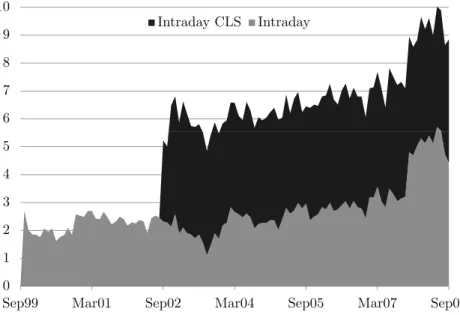
The main intention of the SNB’s intraday liquidity facility is to facilitate the settlement of payments via SIC and foreign exchange transactions in the CLS subaccounts. All banks that have access to the Swiss franc repo market can obtain intraday funds from the SNB. The intraday liquidity has to be covered with 110% of collateral eligible for SNB repos. As intraday liquidity has to be repaid by the end of the value day, it is not considered for the fulfillment of the minimum reserve and liquidity requirements. SNB provides intraday credits on an interest rate free basis. Banks can repay the intraday liquidity drawn at any time during the day. This standing facility has been introduced in 1999 and has since then been used intensively by market participants. Starting with the introduction of intraday liquidity specifically designated for CLS (”Intraday CLS”) the average monthly drawn volume increased by CHF 5 bn to approx. CHF 8 bn (see figure 1).6
6 7 8 9 10 Intraday CLS Intraday 0 1 2 3 4 5
Sep99 Mar01 Sep02 Mar04 Sep05 Mar07 Sep08
Figure 1: Average Monthly Drawn Intraday Volume (in bn CHF)
3
Data and stylized facts
In June 1999 the Swiss franc repo trading, clearing and settlement system was launched and has since then provided market participants with an integrated platform for repo transactions. Almost all interbank repo transactions in Swiss francs are traded on the Eurex repo trading platform and only a negligible amount is carried out over-the-counter (OTC).7 The Eurex repo trading plat-form is thus the representative market for repo transactions in Swiss francs.
The data used in this study consists of interest rates that were charged for Swiss franc ON repo transactions between commercial banks on the Eurex repo trading platform. In particular, each data point provides information on the two banks involved, the interest rate charged, the collateral category chosen as well as the cash amount provided. The sample covers all transactions that were concluded from 18 June 1999 to 15 September 2008. Since the SNB’s provision of reserves changed considerably after September 2008, we exclude this period. The ON repo market is the most liquid market segment of the Swiss franc repo market. During the considered period a total of 130 banks acted either as cash taker or provider. Since the introduction of the platform in 1999 the average number of active banks as well as the average daily volume increased significantly. In 2000 9 banks traded an average daily volume of CHF 320 million, while in 2008 approximately 50 banks traded CHF 6,5 billion per
7For a detailed overview on the characteristics and development of the Swiss franc repo market
day. Overall the dataset consists of 100,200 ON transactions conducted on 2,319 business days.8 Approximately 60% of the ON liquidity was transacted during the last two hours of the business day (between 2 and 4 p.m.).
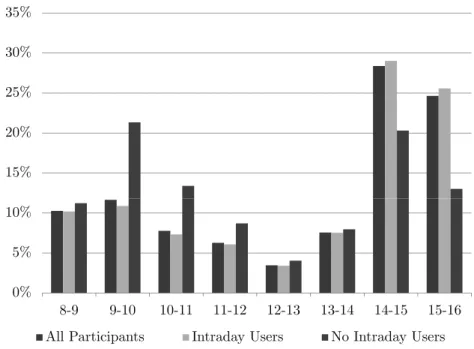
We split participants on the Swiss franc repo market into two categories: Banks that actively use the SNB’s intraday facility (”Intraday Users”) and such that do not (”No Intraday Users”). The classification into these two bank cate-gories is done as follows: Up to the date on which a bank has used the intraday facility for the first time, it is considered as ”No Intraday User”. All subsequent transactions are considered for the ”Intraday Users” category. Figure 2 shows that the ”Intraday Users” conclude on average two-thirds of the ON volume be-tween 2 and 4 p.m. This behavioral pattern suggest that the ”Intraday Users” prefer to draw from the SNB’s intraday facility in the morning in order to settle payments in SIC or CLS and repay the intraday liquidity in the afternoon by concluding ON transactions. The ”No Intraday Users”, in contrast, transact approximately 60% of the volume until noon, whereof they are especially active from 9 to 10 a.m. In order to settle payments in SIC these banks therefore favor to obtain the necessary funds directly in the ON market. In this case the ON liquidity virtually exerts a dual function, namely as intraday liquidity to settle payments and ON liquidity as funding tool. Therefore, ”No Intraday Users” act as cash takers relatively more often during the early morning hours. On average, ”Intraday Users” accounted for approximately 85% (90%) of the ON volume before (after) the introduction of CLS.
Furthermore, we use data on the volume of unsettled payments in SIC. The hourly volume of unsettled payments in SIC is derived by subtracting the settled volume up to that hour from total daily turnover in SIC. The volume of unsettled payments in SIC (P Ut) is derived by subtracting the cumulative hourly turnover (Ut) from total daily turnover (UT). Turnover generated by the SNB which results, among others, from monetary policy operations is excluded. In January 1999, on average only 28% of the volume of payments had been settled by 1 p.m.; by September 2008, this figure increased to 83%. The increase in volume of settled payments can mainly be subscribed to the positive impacts of intraday liquidity.
8These transactions are fully comparable with each other as they are against SNB eligible collateral
and as the collateral is not subject to a haircut (or initial margin). No haircut applies as the net exposure a party holds vis-a-vis each participant is calculated twice daily. If the net exposure exceeds the unilaterally defined variation margin, a margin call is triggered. Credit and market risks are therefore offset to a great extent and as a result no haircut applies.
15% 20% 25% 30% 35% 0% 5% 10% 8-9 9-10 10-11 11-12 12-13 13-14 14-15 15-16
All Participants Intraday Users No Intraday Users
Figure 2: Hourly ON volume in % of total
4
Methodology
With the data at hand two types of regressions are run. The first regression estimates the implicit intraday term structure of the ON interest rates and the second regression relates the pattern found in the first regression to the condi-tions prevalent in SIC, namely the intraday liquidity usage and the turnover.
All regressions are run for the whole sample, namely from 18 June 1999 to 15 September 2008 as well as for two sub-sample periods.9 The introduction date of CLS on 10 September 2002 is considered as a structural break. This is done in order to investigate whether the introduction of PVP for foreign exchange transactions, namely the introduction of CLS, increased the cost of immediacy. An increase in the implicit price for intraday credits would validate the hypoth-esis by Baglioni/Monticini (2008) that CLS has fostered the establishment of an implicit market for intraday credits.
All regressions are first run for the banking system as a whole. However, as seen in figure 2, the ”No Intraday Users” conclude significantly more ON trades in the morning than the ”Intraday Users”. We expect that the use of the SNB’s intraday facility lowers the banks’ willingness to pay high ON rates in the morning. By drawing intraday liquidity, a bank can prefund its liquidity needs
9The last two days of the minimum reserve period as well as the last day of the month are excluded
from the regression as ON rates tend to be particularly volatile on these days. See Benito et.al. (2006) for an empirical analysis on the volatility of the Euro ON interest rate (EONIA).
to settle the payments either in SIC or CLS early in the day. Later in that day, when ON rates are expected to be lower, the bank can repay the intraday credit by concluding an ON transaction on the interbank market. Hence, to evaluate if the banks’ willingness to transact and pay in the ON market depends on the use of the SNB’s intraday facility, the regressions are also run for these two bank categories.
4.1 Estimation of the intraday term structure
In order to measure the implicit intraday interest rate we closely follow the approach by Baglioni/Monticini (2008). Let t = 1, ...,8 denote the time bands during the day, with t= 1 being the first time band from 8 a.m. to 9 a.m. and
t= 8 the last time band from 3 p.m. to 4 p.m.10 Transactions are settled imme-diately after the trade is concluded. Once a trade is concluded and matched, the securities are instantaneously blocked and a payment message with high priority is sent to SIC. Given the availability of securities and funds, settlement usually takes place within a few seconds. Repayment of all ON transactions concluded on the Swiss franc repo market is automatically triggered by SIS at 7:50 a.m. Hence, compared to an ON transaction concluded at 10 a.m., the time length of an ON transaction at 9 a.m. is one hour longer. The set of hourly interest rates [r1, r2,..., r8] thus represents the ”intraday term structure” of the ON rates and, therefore, the intraday price of money. In contrast to Baglioni/Monticini (2008),
rt represents the hourly volume weighted interest rate.
To account for day-to-day differences in the level of ON rates which may, for example, result from interest rate hikes or day specific tensions, we derive the hourly interest rate differential (¯rt). The hourly interest rate differential is calculated by taking the difference between the volume weighted interest rate (rt) charged on overnight loans for each hourly band (t = 1, ...,7 or 8) and the ON rate over the entire day (rT). Finally, this differential is used to obtain the net intraday term structure.
To estimate the term structure of the ON interest rate we run a least square dummy variable regression. We thereby test whether the overnight rate signif-icantly depends on hourly dummies (di = 1 if t = i and di = 0 otherwise) for each opening hour of the Swiss franc repo market. The time bandt= 1 (from 8 to 9 a.m.) is used as reference variable and is represented by the constant (α).
εt are the regression residuals.
10Banks can conclude trades on the Swiss franc repo market starting at 7 a.m. However, as
trans-actions are seldom concluded between 7 a.m. and 8 a.m., the first time band is defined to take place between 8 a.m. and 9 a.m.
¯ rt=α+ 8 i=2 βidi+εt (1)
Based on these regression results we can derive a synthetic measure of the hourly interest rate charged in the Swiss franc repo market, by calculating the following equation:
¯
rt= ¯r1 −s·t (2)
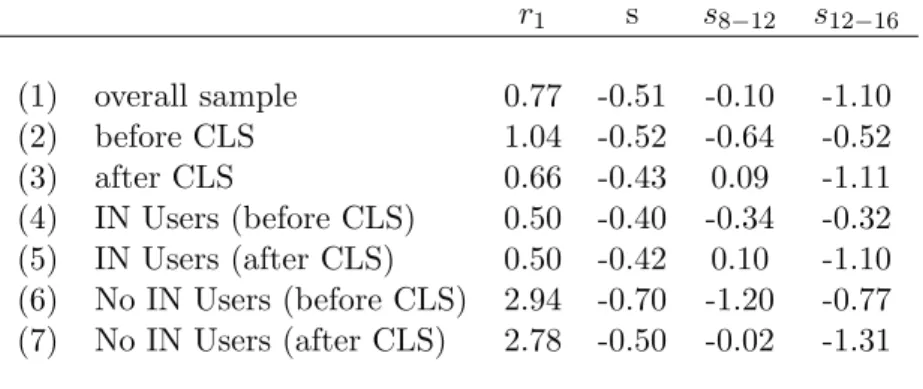
where ¯r1 represents the interest rate difference for the first time band, s the synthetic value andtthe time elapsed during the day. The coefficientsbasically shows the decline of ON rates during the day and is a measure for the decrease in willingness to pay for ON funds towards the end of the day. The average daily synthetic value as well as the synthetic value for the time bands s8−12 (during the CLS settlement cycle) ands12−16 (when the CLS settlement is finished) are calculated.11
4.2 Explaining the intraday term structure
As set out in Angelini (1998), the hourly ON interest rate theoretically depends on the volume of unsettled payments in the payment system. In order to explain the intraday term structure we account for the banks’ liquidity needs by taking the volume of unsettled payments as an explanatory variable. However, the degree of liquidity stress that the volume to be settled exerts on a bank depends on the actual liquidity available in the system.12 We account for this by using the hourly outstanding intraday liquidity drawn from the SNB’s intraday facility as the second explanatory variable. We expect that a high volume of unsettled payments in SIC increases liquidity stress and hence banks’ willingness to pay higher ON rates. High hourly outstanding intraday liquidity in turn leads to a lower willingness to pay and hence a flatter intraday term structure. Such results would validate the hypothesis that RTGS systems favor the development of an implicit market for intraday funds, or in theoretical parlor, RTGS systems impose a cost of immediacy.
As mentioned in subsection 2.2, banks can either draw intraday liquidity for SIC or for CLS specific subaccounts in SIC. Intraday liquidity designated
11The average hourly synthetic value is determined by dividing the difference betweend
8 and the
constant by the number of time bands.
12We only look at the two groups. Hence we account for the intraday liquidity on a group level
rather than on an individual bank level. As a consequence, no direct effects of liquidity drawings by individual banks are considered.
for CLS is in general used in CLS subaccounts until 12 a.m. Usually, banks subsequently transfer remaining balances on their CLS subaccounts to their SIC main accounts. Consequently, banks normally use these funds only after 12 a.m. for settlement of payments in the main accounts of SIC. The liquidity variable, It, is thus the hourly outstanding intraday volume drawn for main accounts plus the hourly outstanding volume of intraday liquidity drawn for CLS subaccounts. The latter variable is set to zero for the time before 12 a.m.13
13Banks can repay intraday liquidity at any time during the day. If this has not been the case,
repayment will automatically be activated by SIS at 3 p.m. As a consequence the hourly intraday volume need not be the amount of intraday liquidity drawn from the SNB’s intraday facility. In the following, we account for the fact that repayment of intraday liquidity was done before 3 p.m.
5
Regression results
5.1 Estimation of the intraday term structure
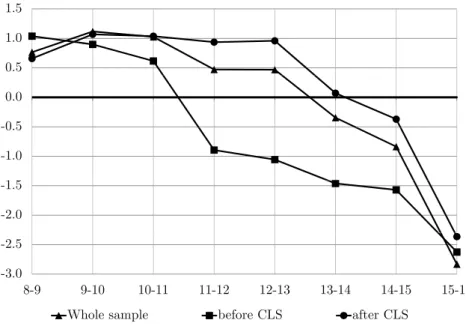
The regression results are displayed in table 2 and plotted in figures 3 and 4. The first three regressions estimate the implicit intraday term structure for the entire sample (1), for the time period before (2) and after the introduction of CLS (3). All three regressions show a clear downward pattern of the ON interest rate throughout the opening hours of the Swiss franc repo market. In the morning (afternoon) participants paid approximately 1bp (3bp) above (below) the daily volume weighted ON rate. Furthermore, regressions (2) and (3) reveal that the introduction of CLS marks a structural break. After the introduction of CLS, ON rates stay as high as at the beginning of the day until the end of the CLS settlement cycle at noon. Only from then on the intraday term structure follows the beforehand seen clear downward pattern. In addition, the difference between opening and closing intraday rates has become smaller after the introduction of CLS. Overall, regression results provide evidence that the value of intraday money has increased during the hours of the CLS settlement cycle. This can be taken as evidence that the introduction of PVP for foreign exchange settlement has increased the cost of immediacy. Before PVP a bank could delay paying its leg of a transaction until it was convenient and less expensive. With the introduction of CLS and hence PVP, banks must make their payments at a specific time during the day – which is relatively early in Switzerland – at a time where there is competition from other payment needs.14 We estimate the mark-up on hourly ON rates due to CLS to be approximately 0.50bp per hour, leading to a total of roughly 1.5bp for the CLS settlement cycle.15
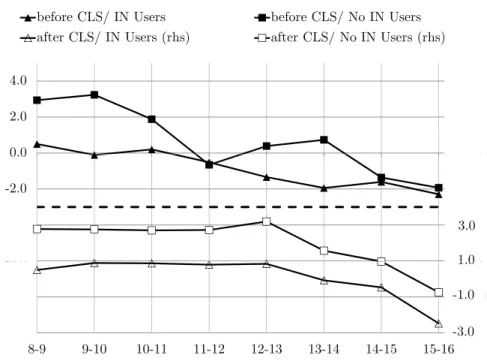
The bank group specific regressions (4)-(7), where we differ between ”Intra-day Users” and ”No Intra”Intra-day Users”, show that the ON rate gradually declines for both bank groups during the day. Figure 4 plots the intraday term structure. Before the introduction of CLS the two bank groups’ willingness to pay differed significantly: ”Intraday Users” paid approximately 2.8bp more for ON funds in the morning than in the evening, while ”No Intraday Users” paid around 5bp more. This is intuitive as the latter group’s overall willingness to pay a pre-mium for ON funds in the morning is higher than for those banks that make
14In contrast to our findings Baglioni/Monticini (2008) find a declining implicit intraday term
structure throughout the day in a sample that covers a period after the introduction of CLS. A possible explanation here fore may be the difference in relative importance of CLS banks in the respective markets. In markets where CLS banks are the dominant players, such as in Switzerland, the implicit cost of intraday funding during CLS hours is more likely to increase.
15To quantify the average hourly mark-up we sum up the differences between the ¯r
after CLS−
¯
1.5 0.5 1.0 -0 5 0.0 1 5 -1.0 0.5 -2.0 -1.5 -3.0 -2.5 8 9 9 10 10 11 11 12 12 13 13 14 14 15 15 16 8-9 9-10 10-11 11-12 12-13 13-14 14-15 15-16
Whole sample before CLS after CLS
Figure 3: Intraday term structure (in bp)
use of the SNB’s intraday facility. The ”Intraday Users” can get liquidity at an interest of zero at the SNB and still have the opportunity to get less expensive ON funds in the evening. At the end of the day the difference in willingness to pay converges.
After the introduction of CLS the hourly interest rate differential during the CLS settlement cycle remains for both groups as high as at the beginning of the day. The introduction of CLS again marks a structural break. It is evident that the difference between the two bank groups’ willingness to pay remains stable at the level of approximately 2bp and does not converge to zero as was the case before the introduction of CLS. We would expect the willingness to pay for ON funds as intraday liquidity at the end of the day to be the same for both groups since almost all payments are settled. A necessary condition for such a price difference is non-anonymous trading. This applies for the Eurex trading platform.16 The lack of trade anonymity may have fostered price difference between participants.17 However, non-anonymous trading is not a sufficient explanation for the non-convergence to occur and remains puzzling. Finally, it is evident that the difference between the beginning and end of day interest rate differential (¯r8−¯r1) for ”No Intraday Users” decreased from 5bpto 3.5bpwhereas it stays at the level of 3pb for ”Intraday Users”. The decrease in difference for
16On the Swiss franc repo market an interbank relationship has to be enabled by both banks. In the
period of observation roughly 25% of all potential interbank relationships were activated bilaterally.
17Such a price difference should not be evidenced in an anonymous interbank repo market where
before CLS/ IN Users before CLS/ No IN Users
after CLS/ IN Users (rhs) after CLS/ No IN Users (rhs)
1 4.0 7 9 0 0 2.0 5 7 -2.0 0.0 1 3 -6 0 -4.0 3.0 1 0 -1 1 -8.0 -6.0 1.0 -1.0 -3 -10.0 8-9 9-10 10-11 11-12 12-13 13-14 14-15 15-16 -3.0
Figure 4: Term structure w/r to bank categories (in bp)
”No Intraday Users” stands for a lower volatility of ON rates throughout the day.
Table 1 provides information on the average hourly synthetic value. For the entire period of observation (1) the average hourly decline in price of money is estimated to be 0.51bp. This demonstrates that ON funds are less valuable the more time has elapsed in the trading day as these funds exert less the dual function, namely as intraday liquidity to settle payments and ON liquidity as funding tool. This is in line with the result that Baglioni/Monticini (2008) obtain for the unsecured interbank money market in Euro. The decline in prices for the two subsamples, before (2) and after the introduction of CLS (3) mark a slight change from 0.52bp to 0.43bp. The change gets more visible if we consider the synthetic values for different time bands, namely during (s8−12) and after the CLS settlement cycle (s12−16). The synthetic values after and before CLS are significantly different for both time bands. The synthetic value decreases constantly for the period before CLS. After the introduction of CLS the synthetic value stays constant or even slightly increases in the first time band and then decreases more sharply in the second time band. Participants in the Swiss franc repo market thus value ON funds in the afternoon less valuable than during the settlement hours of CLS. Differently said, the value of intraday money during the hours of the CLS settlement cycle has become higher after the introduction of CLS. The average daily synthetic value is also evidence that
the willingness to pay of ”Intraday Users” decreased by less than that of ”No Intraday Users”. While ”Intraday Users” pay almost the same intraday interest rate of around 0.40bp before and after the introduction of CLS, the one for ”No Intraday Users” decreases from 0.70bp to 0.50bp.
r1 s s8−12 s12−16 (1) overall sample 0.77 -0.51 -0.10 -1.10 (2) before CLS 1.04 -0.52 -0.64 -0.52 (3) after CLS 0.66 -0.43 0.09 -1.11 (4) IN Users (before CLS) 0.50 -0.40 -0.34 -0.32 (5) IN Users (after CLS) 0.50 -0.42 0.10 -1.10 (6) No IN Users (before CLS) 2.94 -0.70 -1.20 -0.77 (7) No IN Users (after CLS) 2.78 -0.50 -0.02 -1.31
Table 1: Average hourly synthetic value (in bp)
5.2 Explaining the intraday term structure
As shown in subsection 5.1 the intraday term structure of the ON interest rate defines a positive hourly rate in the money market. In this section we try to explain the intraday term structure. The volume of unsettled payments in SIC and the hourly outstanding intraday liquidity drawn from the SNB’s intraday facility are taken as explanatory variables. Again we run the regression for the entire sample (1), for the period before (2) and after the introduction of CLS (3) as well as for the subgroups ”Intraday Users” (4)-(5) and ”No Intraday Users” (6)-(7). The regression results are given in table 3.
In all regressions the volume of unsettled payments in SIC has a highly significant and positive influence on the intraday term structure of the ON interest rate. We take this as evidence that higher liquidity stress, indicated by the volume of unsettled payments, results in a higher hourly ON rate. The influence of unsettled payments has decreased since the introduction of CLS. For the ”No Intraday Users” the influence remains larger than for ”Intraday Users”.
In regressions (3) and (5) the outstanding intraday volume yields highly significant and negative coefficients. In all other regressions the coefficients are insignificant. The effect of intraday liquidity on ON rates is only evident for the period after the introduction of CLS and only for the ”Intraday Users”. This result can be attributed to the fact that intraday liquidity specific for CLS, which
amounts to more than half of total intraday volume drawn, is made available for the main accounts of CLS participants after noon. This additional liquidity further boosts their settlement performance in SIC and reduced their liquidity stress. The regression only accounts for the direct effect of intraday liquidity on the ON rates. Hence it is consistent that the hourly outstanding intraday volume only exerts a significant influence on ”Intraday Users” willingness to pay.
The smaller influence of unsettled payments on ON rates after the intro-duction of CLS can mainly be attributed to the indirect benefits of the SNB’s intraday facility for both, ”Intraday Users” and ”No Intraday Users”. Tak-ing into account that the intraday volume drawn has substantially increased since September 2002 (see figure 1), the use of the SNB’s intraday facility has attenuated liquidity stress resulting from unsettled payments. Unsettled pay-ments have been reduced heavily over settlement hours after the introduction of CLS. This says that the available intraday liquidity does not only yield a direct positive effect for ”Intraday Users” but indirectly affects settlement for all mem-bers via a smoother settlement, i.e. privately drawn intraday liquidity yields a positive externality.18 Indeed, the hourly unsettled payments coefficients are reduced for both groups in regression (4) and (5) for ”Intraday Users” and (6) and (7) for ”No Intraday Users”. Nevertheless, ”No Intraday Users” stay under a higher liquidity pressure than do ”Intraday Users”, which explains why ”No Intraday Users” willingness to pay is 2bp higher than that of ”Intraday Users” (see discussion in subsection 5.1).
18If a bank draws intraday liquidity to settle payments early in the morning, all participants of the
payment system benefit from additional intraday liquidity since they can settle their own payments with incoming funds from other participants. This is true for both banking groups, whether or not the receiver uses the SNB’s intraday facility.
6
Comparisons and conclusions
The theoretical literature represented by VanHoose (1991) and Angelini (1998) postulates the emergence of an intraday interest rate in the interbank market. Baglioni/Monticini (2008) perceive the empirical evidence regarding the price of intraday liquidity to be rare and inconclusive. Indeed, Angelini (2000) finds no relevant intraday pattern in the level of interest rates for the ON market in the Italian screen-based e-MID interbank market for the period from mid-1993 to end-1996. Looking at the same market, Barucci et.al. (2003) find a downward pattern for the period January 1999 to August 2001 and Baglioni/Monticini (2008) find a clear downward pattern for the period 2003 to 2004. For the unsecured US ON federal funds market Bartolini et.al. (2005) find a similar downward pattern for the deviation of an average half hourly rate from the target rate in the period from February 2002 to September 2004.
This paper provides further empirical evidence on the implicit price of in-traday liquidity. Based on data from the secured ON market in Switzerland, we show that a downward sloping intraday term structure has existed at least since the introduction of the Swiss franc repo market in 1999. This is additional evidence for the theoretical results by VanHoose (1991) and Angelini (1998).
Baglioni/Monticini (2008) explain the switch from no to a clear downward pattern of the ON rate that took place between Angelini (2000) and their own analysis by the introduction of real-time settlement and the PVP mechanism for foreign exchange transactions (TARGET in 1999 and CLS in 2002). The move towards gross settlement and PVP is claimed to have made intraday liquidity more valuable and to have created incentives for banks to charge a price for it. We find corresponding evidence for these claims. The downward pattern of the ON rate depends on the liquidity needs stemming from the RTGS sys-tem. The implicit intraday interest rate positively depends on the correspond-ing turnover and negatively on the outstandcorrespond-ing volume of intraday liquidity. We interpret this as evidence for the ”cost of immediacy” of RTGS systems as postulated by Kahn/Roberds (2001). We also find evidence for the posi-tive externality of higher market liquidity that is claimed by Angelini (1998). Higher market liquidity drives down pending payments for both groups of par-ticipants, namely ”Intraday Users” and ”No Intraday Users”. Correspondingly, both groups profit from lower liquidity stress that results in a lower implicit price of intraday liquidity.
has increased the price of intraday liquidity. This is due to the strict pay-in schedule of the CLS settlement cycle. CLS membership requires banks to dispose of large amounts of intraday liquidity to meet the time critical CLS pay-in schedule. As a consequence, the introduction of CLS has increased the price of intraday liquidity for all banks. Since the introduction of CLS the level of the ON rates stayed more or less constant from the beginning of the day until the end of the CLS settlement cycle at noon. In the afternoon the implicit price of intraday liquidity follows a clear downward pattern again.
The scarcity of intraday liquidity and the corresponding reaction of banks to price intraday liquidity such as claimed by Baglioni/Monticini (2008) can also be verified by evidence on the Swiss franc repo market. The introduction of CLS resulted in banks applying differentiated pricing for banks that do and those that do not make use of the SNB’s intraday credit facility. The latter pay higher ON rates at the beginning of the day. After the introduction of CLS the beginning of day difference does not disappear towards the end of the day but keeps almost constant until the end of the day. We attribute this to the segmented market structure and the non-anonymity of the market.
It is also interesting to compare the hourly implicit intraday interest rate of the Euro with the one of the Swiss franc money market. The difference between the beginning and end of day ON interest rate is 3.5bp for the Euro and 3bp for the Swiss franc money market. In comparison to Baglioni/Monticini (2008), our hourly interest rate measure is based on one hour less. Taking this into account, the hourly implicit intraday interest rate is 0.5bp and 0.43bp for the Euro and Swiss Franc money market respectively (see results for regression (3) in table 2). Baglioni/Monticini (2008) point out, that the market intraday interest rate in the US is pegged by the overdraft fee applied by the Fed. The annualized hourly fee for overdraft is 1.5bp.19 Furfine (2001) derived the hourly implicit intraday interest rate for the unsecured US money market and obtained a rate of 0.9bp. Compared to the empirical evidence for the US and Euro money market the hourly implicit intraday interest rate for the Swiss franc money market is thus the lowest.20
Baglioni/Monticini (2008) argue that their estimate of the intraday interest
19See Baglioni/Monticini (2008), p. 1539 for the derivation of the annualized hourly fee.
20There is one basic difference between the hourly implicit intraday interest rate for CHF and the
ones for the Euro and the USD. The latter two results are based on the unsecured interbank money market, whereas the former is based on the secured money market. However, to obtain the hourly implicit intraday interest rate the difference is taken between the hourly ON rate and the overall daily ON rate. Hence the risk premium related to the bank specific data is filtered away by this differencing. Therefore, results are comparable.
rate provides an indirect evidence that the cost of collateralizing intraday loans from the Eurosystem is lower than the fee charged by the Fed. This might explain why the Fed investigates the introduction of an additional collateral-ized intraday overdraft facility for Fedwire.21 Following this line of argument, the difference between the hourly interest rate for Euro and Swiss Franc could be traced back to structural differences between the respective intraday credit facilities. One potential source could be transaction costs for which evidence is hard to find. Another source could be the respective collateral policies applied by the two central banks. Whereas in the Eurosystem only Euro denominated collateral is eligible, the SNB allows for a much wider variety of currencies.22 Since the SNB’s collateral policy allows for a greater diversification in collateral holdings, opportunity costs may be lower and as a result lead to a lower hourly implicit intraday interest rate.
21See the Federal Reserve Board’s request for public comment on its proposed changes to its
daylight overdraft policy:
http://www.federalreserve.gov/newsevents/press/other/20080228b.htm
22See Bank for International Settlement (2006) for more information on the respective
App
e
ndix:
Regression
Results
(1) (2) (3) (4) (5) (6) (7) o v erall sample b efore C LS after C LS b efore CLS a fter CLS b efore C LS after C LS IN Users IN U sers N o IN U sers N o IN U sers Constan t 0.00765*** 0.01038* 0.00658*** 0.00502 0.00504** 0.02937** 0.02778*** (-0.00193) (-0.00507) (-0.00189) (-0.00557) (-0.0019) (-0.00941) (-0.00403) dumm y 9 0 .00353 -0.00140 0.00411 -0.00610 0.00384 0.00300 -0.00023 (-0.00253) (-0.00668) (-0.00238) (-0.00687) (-0.0024) (-0.01332) (-0.00471) dumm y 10 0.00260 -0.00422 0.00379 -0.00301 0.00368 -0.01057 -0.00075 (-0.00243) (-0.00638) (-0.00233) (-0.0069) (-0.00236) (-0.01218) (-0.00488) dumm y 11 -0.00293 -0.01933* 0.00278 -0.01018 0.00292 -0.03592 -0.00056 (-0.00262) (-0.00757) (-0.00232) (-0.00746) (-0.00233) (-0.01887) (-0.00514) dumm y 12 -0.00296 -0.02095** 0.00301 -0.01839* 0.00337 -0.02548 0.00415 (-0.00267) (-0.00689) (-0.00249) (-0.00744) (-0.0025) (-0.01703) (-0.00603) dumm y 13 -0.01110*** -0.02500*** -0.00588** -0.02443*** -0.00580** -0.02204* -0.01206* (-0.00228) (-0.00595) (-0.00216) (-0.00644) (-0.00217) (-0.01095) (-0.00484) dumm y 14 -0.01602*** -0.02609*** -0.01029*** -0.02106** -0.00970*** -0.04296*** -0.01807*** (-0.00229) (-0.00599) (-0.0021) (-0.00648) (-0.00211) (-0.01242) (-0.00451) dumm y 15 -0.03597*** -0.03664*** -0.03022*** -0.02794*** -0.02974*** -0.04867*** -0.03521*** (-0.00282) (-0.00692) (-0.00253) (-0.00739) (-0.00255) (-0.01359) (-0.00592) No. Obs. 13,454 3,511 9,519 3,197 9,379 1,106 3,176 R-squared 0 .03 0 .02 0 .05 0 .01 0 .05 0 .03 0 .04 Adj. R-squared 0 .03 0 .02 0 .05 0 .01 0 .05 0 .02 0 .04 ***: significance o n the 1% lev el; **: 5% lev el; *: 10% lev el; robust standard errors are rep orted in p aren theses T a ble 2 : D escriptiv e regression(1) (2) (3) (4) (5) (6) (7) o v erall sample b efore C LS after C LS b efore CLS a fter CLS b efore C LS after C LS IN Users IN U sers N o IN U sers N o IN U sers In trada y (in bn) -0.00009 0.00060 -0.00183*** -0.00136 -0.00199*** 0.01015 0.00129 (-0.00039) (-0.00301) (-0.00032) (-0.00302) (-0.00032) (-0.00594) (-0.00081) Unsettled P a ymen ts (in bn) 0.00031*** 0.00047*** 0.00017*** 0.00035*** 0.00016*** 0.00074*** 0.00043*** (-0.00003) (-0.00006) (-0.00002) (-0.00006) (-0.00003) (-0.00014) (-0.00005) Constan t -0.01639*** -0.03608*** 0.00071 -0.02706*** 0.00066 -0.05972*** -0.00902 (-0.00248) (-0.00812) (-0.00211) (-0.00821) (-0.00213) (-0.0175) (-0.00504) No. Obs. 13,361 3,418 9,519 3,162 9,379 1,040 3,176 R-squared 0 .02 0 .02 0 .03 0 .01 0 .03 0 .03 0 .03 Adj. R-squared 0 .02 0 .02 0 .03 0 .01 0 .02 0 .03 0 .03 ***: significance o n the 1% lev el; **: 5% lev el; *: 10% lev el; robust standard errors are rep orted in p aren theses T a ble 3 : E xplanatory regression
References
Angelini, P. (1998): An analysis of competitive externalities in gross settlement systems. Journal of Banking and Finance, 22, 1-18.
Angelini, P. (2000): Are banks risk averse? Intraday timing of operations in the interbank market. Journal of Money, Credit and Banking, Vol. 32, No. 1, 54-73. Baglioni, A. and A. Monticini (2008): The intraday price of money: Evidence from the e-MID interbank market. Journal of Money, Credit and Banking, Vol. 40, No.7, 1533-1540.
Bank for International Settlement (2006): Cross-border collateral arrangements. Committee for Payment and Settlement Systems.
Barucci, E., C. Impenna and R. Ren (2003): The Italian overnight market: mir-costructure effects, the martingale hypothesis and the payment system, Banca d’Italia, Temi di discussione, Number 474, June 2003.
Bartolini, L., S. Gudell and S. Hilton (2005): Intraday Trading in the Overnight Federal Funds Market, Federal Reserve Bank of New York Current Iussues in Economics and Finance, Volume 11, Number 11, November 2005.
Benito, F., A. Leon and J. Nave (2006): Modeling the Euro Overnight Rate, WP-AD 2006-11, Working Paper Serie AD from Instituto Valenciano de Inves-tigaciones Economicas (Ivie).
Furfine, C. (2001): Banks as monitors of other banks: evidence from the overnight federal funds market, Journal of Business, 74, 33-57.
Heller, D. and Y. Lengwiler (2003): Payment obligations, reserve requirements, and the demand for central bank balances, Journal of Monetary Economics 50, 419-432.
Jordan, T. J. (2007): Das Repo-Gesch¨aft in Schweizerfranken und die Innova-tion des geldpolitischen Instrumentariums der Schweizerischen NaInnova-tionalbank, Aktuelle Rechtsprobleme des Finanzplatzes Schweiz, 2007.
Kahn, C. and W. Roberds (2000): The CLS bank: A solution to the risk of international payments settlement?, Federal Reserve Bank of Atlanta, Working paper 2000-15a.
Kahn, C. and W. Roberds (2001): Real-time gross settlement and the cost of immediacy, Journal of Monetary Economics 47, 299-319.
Kraenzlin, S. (2007): The characteristic and development of the Swiss franc repurchase agreement market, Financial Markets and Portfolio Management, 21, 241-261.
Martin, A. and J. McAndrews (2008): Should there be intraday money mar-kets?, Federal Reserve Bank of New York Staff Report no. 337.
McAndrews, J., and S. Rajan (2000): The timing of funding of Fedwire Funds transfers, FRBNY Economic Policy Review, July, 17-28.
VanHoose, D. (1991): Bank behaviour, interest rate determination, and mone-tary policy in a financial system with an intraday federal funds market, Journal of Banking and Finance, 15, 343-65.
4XJTT/BUJPOBM#BOL8PSLJOH1BQFSTQVCMJTIFETJODF
2004-1 Samuel Reynard: Financial Market Participation and the Apparent Instability of Money Demand
2004-2 Urs W. Birchler and Diana Hancock: What Does the Yield on Subordinated
Bank Debt Measure?
2005-1 Hasan Bakhshi, Hashmat Khan and Barbara Rudolf: The Phillips curve under
state-dependent pricing
2005-2 Andreas M. Fischer: On the Inadequacy of Newswire Reports for Empirical Research on Foreign Exchange Interventions
2006-1 Andreas M. Fischer: Measuring Income Elasticity for Swiss Money Demand:
What do the Cantons say about Financial Innovation?
2006-2 Charlotte Christiansen and Angelo Ranaldo: Realized Bond-Stock Correlation: Macroeconomic Announcement Effects
2006-3 Martin Brown and Christian Zehnder: Credit Reporting, Relationship Banking, and Loan Repayment
2006-4 Hansjörg Lehmann and Michael Manz: The Exposure of Swiss Banks to
Macroeconomic Shocks – an Empirical Investigation
2006-5 Katrin Assenmacher-Wesche and Stefan Gerlach: Money Growth, Output Gaps and
Inflation at Low and High Frequency: Spectral Estimates for Switzerland
2006-6 Marlene Amstad and Andreas M. Fischer: Time-Varying Pass-Through from Import
Prices to Consumer Prices: Evidence from an Event Study with Real-Time Data
2006-7 Samuel Reynard: Money and the Great Disinflation
2006-8 Urs W. Birchler and Matteo Facchinetti: Can bank supervisors rely on market data? A critical assessment from a Swiss perspective
2006-9 Petra Gerlach-Kristen: A Two-Pillar Phillips Curve for Switzerland
2006-10 Kevin J. Fox and Mathias Zurlinden: On Understanding Sources of Growth and Output Gaps for Switzerland
2007-2 Ibrahim Chowdhury and Andreas Schabert: Federal Reserve Policy viewed through a Money Supply Lens
2007-3 Angelo Ranaldo: Segmentation and Time-of-Day Patterns in Foreign Exchange
Markets
2007-4 Jürg M. Blum: Why ‘Basel II’ May Need a Leverage Ratio Restriction
2007-5 Samuel Reynard: Maintaining Low Inflation: Money, Interest Rates, and Policy Stance
2007-6 Rina Rosenblatt-Wisch: Loss Aversion in Aggregate Macroeconomic Time Series
2007-7 Martin Brown, Maria Rueda Maurer, Tamara Pak and Nurlanbek Tynaev: Banking
Sector Reform and Interest Rates in Transition Economies: Bank-Level Evidence from Kyrgyzstan
2007-8 Hans-Jürg Büttler: An Orthogonal Polynomial Approach to Estimate the Term
Structure of Interest Rates
2007-9 Raphael Auer: The Colonial Origins Of Comparative Development: Comment.
A Solution to the Settler Mortality Debate
2007-10 Franziska Bignasca and Enzo Rossi: Applying the Hirose-Kamada filter to Swiss data: Output gap and exchange rate pass-through estimates
2007-11 Angelo Ranaldo and Enzo Rossi: The reaction of asset markets to Swiss National Bank communication
2007-12 Lukas Burkhard and Andreas M. Fischer: Communicating Policy Options at the Zero Bound
2007-13 Katrin Assenmacher-Wesche, Stefan Gerlach, and Toshitaka Sekine: Monetary
Factors and Inflation in Japan
2007-14 Jean-Marc Natal and Nicolas Stoffels: Globalization, markups and the natural rate of interest
2007-15 Martin Brown, Tullio Jappelli and Marco Pagano: Information Sharing and Credit: Firm-Level Evidence from Transition Countries
2007-16 Andreas M. Fischer, Matthias Lutz and Manuel Wälti: Who Prices Locally? Survey Evidence of Swiss Exporters
2008-1 Martin Brown and Christian Zehnder: The Emergence of Information Sharing in Credit Markets
2008-2 Yvan Lengwiler and Carlos Lenz: Intelligible Factors for the Yield Curve
2008-3 Katrin Assenmacher-Wesche and M. Hashem Pesaran: Forecasting the Swiss
Economy Using VECX* Models: An Exercise in Forecast Combination Across Models and Observation Windows
2008-4 Maria Clara Rueda Maurer: Foreign bank entry, institutional development and credit access: firm-level evidence from 22 transition countries
2008-5 Marlene Amstad and Andreas M. Fischer: Are Weekly Inflation Forecasts Informative?
2008-6 Raphael Auer and Thomas Chaney: Cost Pass Through in a Competitive Model of
Pricing-to-Market
2008-7 Martin Brown, Armin Falk and Ernst Fehr: Competition and Relational Contracts: The Role of Unemployment as a Disciplinary Device
2008-8 Raphael Auer: The Colonial and Geographic Origins of Comparative Development
2008-9 Andreas M. Fischer and Angelo Ranaldo: Does FOMC News Increase Global FX
Trading?
2008-10 Charlotte Christiansen and Angelo Ranaldo: Extreme Coexceedances in New EU
Member States’ Stock Markets
2008-11 Barbara Rudolf and Mathias Zurlinden: Measuring capital stocks and capital services in Switzerland
2008-12 Philip Sauré: How to Use Industrial Policy to Sustain Trade Agreements
2008-13 Thomas Bolli and Mathias Zurlinden: Measuring growth of labour quality and the quality-adjusted unemployment rate in Switzerland
2008-14 Samuel Reynard: What Drives the Swiss Franc?
2008-15 Daniel Kaufmann: Price-Setting Behaviour in Switzerland – Evidence from CPI Micro Data
2008-16 Katrin Assenmacher-Wesche and Stefan Gerlach: Financial Structure and the Impact of Monetary Policy on Asset Prices
2008-18 Raphael Auer and Andreas M. Fischer: The Effect of Low-Wage Import Competition on U.S. Inflationary Pressure
2008-19 Christian Beer, Steven Ongena and Marcel Peter: Borrowing in Foreign Currency: Austrian Households as Carry Traders
2009-1 Thomas Bolli and Mathias Zurlinden: Measurement of labor quality growth caused
by unobservable characteristics
2009-2 Martin Brown, Steven Ongena and Pinar Ye,sin: Foreign Currency Borrowing by Small Firms
2009-3 Matteo Bonato, Massimiliano Caporin and Angelo Ranaldo: Forecasting realized
(co)variances with a block structure Wishart autoregressive model
2009-4 Paul Söderlind: Inflation Risk Premia and Survey Evidence on Macroeconomic
Uncertainty
2009-5 Christian Hott: Explaining House Price Fluctuations
2009-6 Sarah M. Lein and Eva Köberl: Capacity Utilisation, Constraints and Price Adjustments under the Microscope
2009-7 Philipp Haene and Andy Sturm: Optimal Central Counterparty Risk Management
2009-8 Christian Hott: Banks and Real Estate Prices
2009-9 Terhi Jokipii and Alistair Milne: Bank Capital Buffer and Risk Adjustment Decisions
2009-10 Philip Sauré: Bounded Love of Variety and Patterns of Trade 2009-11 Nicole Allenspach: Banking and Transparency: Is More Information
Always Better?
2009-12 Philip Sauré and Hosny Zoabi: Effects of Trade on Female Labor Force Participation 2009-13 Barbara Rudolf and Mathias Zurlinden: Productivity and economic growth in
Switzerland 1991-2005
2009-14 Sébastien Kraenzlin and Martin Schlegel: Bidding Behavior in the SNB's Repo Auctions
2010-1 Charlotte Christiansen, Angelo Ranaldo and Paul Söderlind: The Time-Varying Systematic Risk of Carry Trade Strategies
2010-2 Daniel Kaufmann: The Timing of Price Changes and the Role of Heterogeneity
2010-3 Loriano Mancini, Angelo Ranaldo and Jan Wrampelmeyer: Liquidity in the Foreign
Exchange Market: Measurement, Commonality, and Risk Premiums
2010-4 Samuel Reynard and Andreas Schabert: Modeling Monetary Policy
2010-5 Pierre Monnin and Terhi Jokipii: The Impact of Banking Sector Stability on the Real Economy
2010-6 Sébastien Kraenzlin and Thomas Nellen: Daytime is money