Published as: Wood, R.T.A., Shorter, G.W. & Griffiths, M.D. (2014). Rating the
suitability of responsible gambling features for specific game types: A resource for
optimizing responsible gambling strategy.
International Journal of Mental Health and
Addiction,
12, 94–112.
Rating the suitability of responsible gambling features for specific game types:
A resource for optimizing responsible gambling strategy
Abstract
A Delphi based study, rated the perceived effectiveness of 45 responsible gambling (RG) features in relation to 20 distinct gambling type games. Participants were 61 raters from seven countries, including responsible gambling experts (n = 22), treatment providers (n = 19) and recovered problem gamblers (n = 20). The most highly recommended RG features could be divided into three groups 1) Player initiated tools focused on aiding player’s behaviour 2) RG features related to informed- -player-choice 3) RG features focused on gaming company actions. Overall, player control over personal limits were favoured more than gaming company controlled limits, although mandatory use of such features was often recommended. The study found that recommended RG features varied considerably between game types, according to their structural characteristics. Also, online games had the possibility to provide many more RG features than traditional (offline games). The findings draw together knowledge about the effectiveness of RG features for specific game types. This should aid objective, cost-effective, evidence based decisions on which RG features to include in an RG strategy, according to a specific portfolio of games. The findings of this study will available via a web-based tool, known as the Responsible Gambling Knowledge Centre (RGKC).
Introduction
Arguably, the current paradigm in responsible gambling (RG) theory and practice is a focus on encouraging players to take responsibility for their own behavior. This position, outlined in the “Reno Model” (Blaszczynski, Ladouceur, & Shaffer, 2004) emphasizes a science-based framework for RG, and defines RG as follows:
“Responsible gambling refers to policies and practices designed to prevent and reduce potential harms associated with gambling; these policies and practices often incorporate a diverse range of interventions designed to promote consumer protection, community/consumer awareness and education, and access to efficacious treatment” (p.308).
And, this view of the individual as being primarily responsible for their own gambling behavior also appears to be endorsed by many players (Wood & Bernhard, 2010; Wood & Da Silva, 2013). For those who operate gambling businesses, the model suggests that RG should focus upon helping players to help themselves. Importantly, the targets for such an approach are predominantly those players who are ‘at risk’ and may benefit from measures designed to help them to maintain healthy gambling behavior. Those individuals that already have a gambling problem are not the main focus of RG (beyond being directed to a suitable treatment provider and/or other referral services). Gambling problems are frequently characterized by irrational thinking (Griffiths, 1994), and no amount of encouragement and support to gamble responsibly is likely to be effective for those who already have a problem. Similarly, gaming company staff are usually not qualified to administer ‘treatment’ to problematic players, nor would it be appropriate for them to take on such a role (Griffiths, 2010).
Both Bernhard (2007) and Reith (2009) have pointed out that in recent years there has been an overall shift of perspective in relation to theory, research and practice concerning RG. Prior to this, gambling problems used to be seen as largely a medical issue with little control or power attributed to those affected. Increasingly, support for individual autonomy has become the important issue. Reith (2009) suggests that this shift in perspective, is in part driven by a reframing of gambling from a ‘deviant’ to a ‘normal’ leisure pursuit undertaken by a much broader demographic than was traditionally the case.
This shift also reflects wider social and cultural changes that have seen more of an emphasis on the importance of consumers making informed purchase choices on a wide variety of products and services – whether reading nutritional labels for dietary purposes or clearly understanding the implications of signing credit agreements. As is the case in a number of settings, facilitating informed player choice has become a major priority in building responsible gaming policy and strategy – an approach that reflects the fact that millions of participants willingly play games of chance world-wide every day as a legitimate and moderate leisure activity (Wood & Bernhard, 2010).
In a report prepared for the Australian Gambling Council on the principles of informed choice and gambling, Blaszczynski, Ladouceur, Nower and Shaffer (2005) highlight three basic strategic tenets that they argue should underpin informed choice: (i) Individuals are personally responsible for their level of participation in gambling; (ii) Informed choice is a pivotal requirement for responsible gambling; and (iii) Science can contribute in determining which information is necessary to promote informed choice in gambling. Accordingly, it follows that in order to effectively promote RG, the player should have all the necessary information and resources available to make informed decisions on when to gamble, when to stop, and how much to spend. Such information should include ‘facts’ about playing games and the probabilities, prize structures, etc. but can also include information about the players’ own behavior in order to promote behavioral transparency (Griffiths & Wood, 2008).
This information should help players to consciously monitor and understand their playing behavior. Such a personal responsibility approach to RG also suggests that the liability for gambling problems resides (primarily) with the individual, emphasizing that the individual is not a passive recipient of gambling but makes personal decisions about when to play and how much to play with. However, it might also be argued that gaming companies have a duty to ensure that players can access this information, and in sufficient detail, in order to make well-informed choices (Smeaton & Griffiths, 2004; Griffiths, Wood & Parke, 2009).
This conception of RG also has a firm basis in established theory relating to the development of problem gambling. That is, Problem gambling is associated with a loss of control and an unwillingness to take personal responsibility for individual actions (e.g., Jacobs, 1986; Blaszczynski, & Nower, 2002; Wood & Griffiths, 2007). RG strategy aimed at promoting and supporting individual autonomy directly focuses on helping ‘at risk’ players to maintain a good understanding of their behavior patterns. Furthermore, players appear to value the notion of taking personal
responsibility, rather than being subjected to mandatory restrictive practices. For example, there is a growing body of evidence to show that (most) players prefer to be give access to voluntary tools that provide information and control (Bernhard, Lucas, & Jang, 2006; McDonnell-Phillips, 2006; Parke et al, 2007; Griffiths, et al 2009; Wood & Bernhard, 2010). Finally, it seems that technology can be utilized to help support informed player choice. The technological evolution of gambling means that there are increasing opportunities to provide enhanced feedback to players about their gambling behavior (e.g., detailed information on wins, losses, time spent gambling, changes in behavior over time etc.) as well as tools to help them better manage their gambling behavior (e.g., setting spend limits, temporary self-exclusion, self-diagnostic tests, immediate referral to online support services etc.) (Griffiths, et al.2009).
Having a credible responsible gambling policy is now an essential part of business planning for the entire regulated gambling sector. At the same time, there has been an increase in research investigating strategies that can help protect against the development of gambling problems in vulnerable players (e.g., Nisbet, 2005; Sharpe et al, 2005; Monaghan, 2009; Griffiths, et al 2009; Monaghan, & Blaszczynski, 2010a). Consequently, the range of responsible gambling initiatives has expanded considerably and includes such diverse features as: self exclusion, player information and support services, referral to treatment services, behavioral tracking and feedback, staff training, spending and time limits, pre-commitment, warning messages, game design, etc. Within each area there are often numerous variations and options that may be considered.
Whilst the efficacy of RG tools has been the focus of increasing numbers of research projects (e.g., Nisbet, 2005; Sharpe et al, 2005; Bernhard, Lucas, & Jang, 2006; Williams, West & Simpson, 2007; Wohl et al , 2008; Monaghan, 2008; 2009; Wood & Griffiths, 2008; Griffiths, et al 2009; Monaghan & Blaszczynski, 2007; 2010a; 2010b; Wohl et al 2010; 2011; Wood & Bernhard, 2010), there are currently no published studies that have examined overall RG strategies in relation to multiple gaming scenarios. That is, what impact are various RG features likely to have for vulnerable players, in the context of a variety of different games offered by a gaming company? Furthermore, even when gaming companies consult expert knowledge on this matter, it can be difficult to obtain a clear and objective recommendation based on one or two perspectives in a rather broad and diverse field. Whilst responsible gambling frameworks provide a broad outline for the areas that should be
covered, they frequently fall short of considering the most effective combination of RG features and initiatives for a specific portfolio of games and/or platforms.
The present study was designed to bridge a gap between RG theory and practice, to allow better-informed, and more effective, RG decisions to be made on which features to include in an overall RG strategy. To achieve this goal the project synthesized the views of a well-informed group of international advisors with expertise as researchers in the RG field, problem gambling treatment providers, and individuals who had a unique insight having recovered from a gambling problem.
Method
Participants: Twenty-two leading RG experts from seven countries (Canada n = 8, USA n = 4, UK n = 3, Sweden n = 1, Australia n = 4, Holland n = 1 and Denmark n = 1) were recruited. These comprised researchers with experience and demonstrable publications in the field of responsible gambling and/or problem gambling. The selection criteria being that they should be authors on at least 10, peer reviewed, published papers relating to the field of RG. Each expert was contacted by email to request their participation. Twenty-five experts were contacted and three declined to take part (88% response rate). All of the RG experts were remunerated for their participation. Nineteen treatment providers from four countries (Canada n = 10, USA n = 2, UK n = 4, Sweden n = 3) were also recruited for the study. These were practising counsellors who had at least two years of experience working with clients who have gambling problems. They were initially recruited through contacts known to the authors and then through a ‘snowballing’ referral system, with recruited participants recommending further possible recruits. Twenty-seven treatment providers were approached, of which eight declined to take part (70% response rate). Seventeen treatment providers were remunerated for their participation, two did not want to be remunerated. Finally, twenty ‘recovered’ problem gamblers from two countries (Canada n = 11 and the UK n = 9) were recruited. These were people who previously had experienced a serious gambling problem, such that they underwent treatment, but now considered that they no longer had a problem with gambling and no longer gambled. They were recruited via a request posted on an online support service for people with gambling issues, or had taken part in a previous study that had used a newspaper advertisement to recruit participants. All of the recovered problem gamblers were interviewed prior to the study by the first author in order to ascertain the extent of their previous gambling problem, and their current
status. All of the recovered problem gamblers contacted agreed to participate (100% response rate). The recovered problem gamblers were remunerated in the form of a voucher for a well-known online store.
Procedure: First a scoping study identified and drew together empirical research findings and/or best practice relating to all known RG features. The review informed the questions and statements that were presented to the panel members in the Delphi. The scoping study also produced two taxonomies. The first, categorized RG features according to type (see Appendix I). The second categorized game types according to the structural characteristics of the games and the platform by which they can be played (e.g., offline, online) (see Appendix II). These taxonomies ensured that Delphi effectively compared all currently known RG features against all currently known game types. Both taxonomies were sent to the RG Experts to comment on their completeness and consistency, following which some minor amendments were made. Each RG expert was presented with the taxonomy of RG features and asked to describe what they believed were the essential requirements for each feature to be effective, and to highlight any issues for consideration.
The next phase of the study, utilised a five-stage Delphi procedure, in order to more fully understand how the three rater-groups, rated the suitability of each RG feature in relation to each game type, as identified by the RG feature and game type taxonomies. The Delphi method has been shown to be a successful technique for facilitating communication between a group of experts, and assists the formation of a well informed group judgement. The Delphi method has been extensively used to generate reliable forecasts in the fields of public health and education (e.g., Helmer, 1977; Adler et al, 1996; McBride et al, 2003; Okoli & Pawlowski, 2004) and, more recently, gambling studies (e.g., Griffiths, Wood & Parke, 2008; Griffiths & Wood, 2009; Meyer et al, 2011).
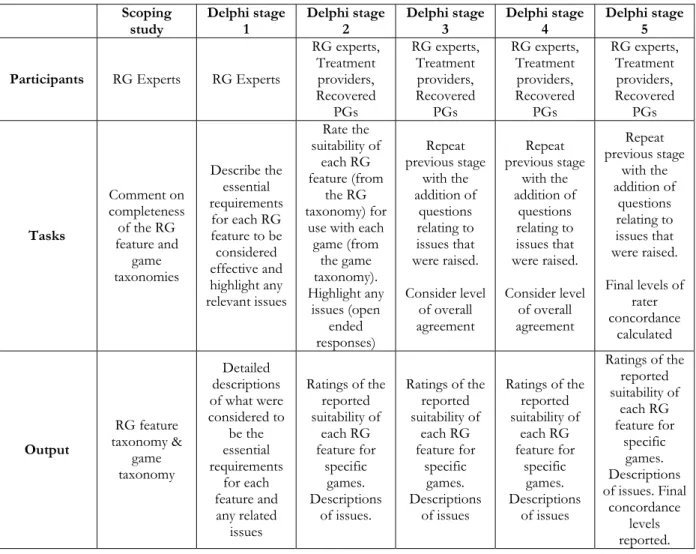
Participants were contacted on five separate occasions and asked to complete an online survey (see Table 1). Each survey contained a ranking exercise whereby participants indicated on a five-point Likert scale, the extent to which they believed a particular RG feature could be suitable for a specific game type. Participants were also encourage to provide open ended responses and comments, in order to ensure that all participants had the opportunity to raise relevant questions and highlight any issues, which could then be addressed by all participants in the next survey. Comments also allowed for the inclusion of any important caveats that should be considered when implementing specific
RG features, or in relation to specific games.Overall, participants rated a total of 45 RG features in relation to 20 game types.
INSERT TABLE 1 HERE
Analysis: Delphi analysis procedures outlined by Okoli and Pawlowski (2004) were followed and each recommendation was only considered to have a significant level of inter-rater agreement if Kendall’s W coefficient of concordance was at least 0.7, indicating a strong level of agreement. Values ranged from 0.781 to 0.982. Standard deviations ranged from 0.526 to 1.221. Consequently, the overall agreement between all raters was considered to be high and no recommendations were excluded from the study. Further possible differences between the three rater-groups were explored using Kruskal-Wallis Tests. Where these overall tests were significant at the 0.05 level, paired differences were explored using Mann-Whitney U-Tests for which a bonferroni correction was applied due to multiple comparisons. The adjusted p value was 0.167 (to allow for three comparisons). In order to define the final recommendations for the suitability of each RG feature (e.g., Highly recommended, Desirable, Limited Value, No value), the modal response was reported. Hsu and Sandford (2007) note that the Delphi technique has a tendency to create a convergence of views, and as such the modal scores can be much more informative than the mean or median scores, which may be misleading.
Results
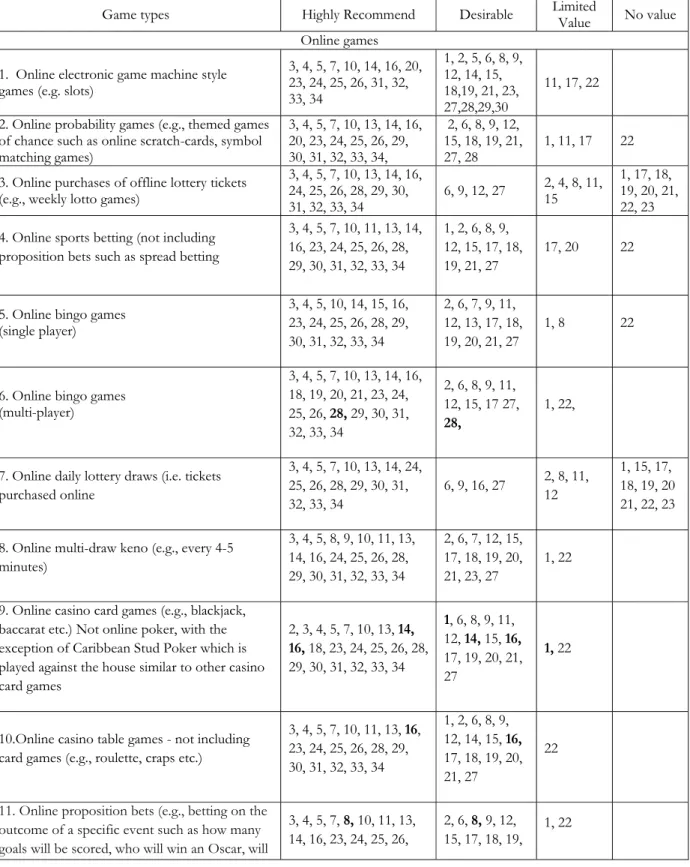
The findings show recommendations from the three rater-groups (n = 61) for 45 RG features in relation to 20 different game types. Not all RG features are relevant to all game types. For online games, thirty four relevant RG features were considered. For offline games, between fourteen and eighteen relevant RG features were considered, depending on the game type. Overall, a total of 573 specific recommendations were obtained. Table 2 illustrates the recommended RG features for each game type based on the modal rater response.
Three RG features that were ‘highly recommended’ for all games (both online and traditional) were; only accepting non-credit based purchase payments (e.g., debit-cards, cash, pre-paid account), providing clear and accessible information about prize structures (number and size of prizes), as well
as the prize-back percentage (return to player). For online games, no payment of large winnings by any method that can be instantly re-gambled and showing purchase payments in actual monetary values were both ‘highly recommended.’ Similarly, for twelve out of thirteen online games payment using a pre-committed amount via a player account was ‘highly recommended’ (’desirable’ for online slots). Player-initiated permanent self-exclusion was ‘highly recommended’ for all games except online poker tournaments (rated ‘desirable’). Player-initiated temporary self-exclusion (e.g. take a break for a week) was ‘highly recommended’ for all games except for online poker tournaments and (traditional) purchasing of lottery tickets. A player-initiated ‘panic button (e.g. denies gambling access for 24 hours) was ‘highly recommended’ for all online games, except poker tournaments for which it was deemed ‘desirable.’ Player-defined spend limits (mandatory use) were highly recommended for all online games, except for online multi-draw keno and online single-player bingo (rated ‘desirable’ for both games). Player defined (mandatory) maximum bet limits were ‘highly recommended’ for all online games. Whereas, gaming company defined bet limits (mandatory use) were recommended for five out of thirteen online games. Player-defined maximum time limits (mandatory use) were also ‘highly recommended’ for all online games.
By comparison, gaming company defined maximum time limits (mandatory use) were ‘highly recommended for two out of thirteen online games (poker cash games and poker tournaments). Visible display or pop-ups indicating time spent playing were ‘highly recommended’ for all online games, except for multi-draw keno and online lottery games or ticket purchases (rated ‘desirable’ and ‘no value’ respectively). The use of visible displays or pop-ups indicating amounts won and lost were ‘highly recommended’ for all online games (‘desirable’ for Electronic Gambling Machines - EGMs). Providing detailed player account and behavioural information (e.g., length and frequency of previous sessions) was ‘highly recommended’ for all online games. Providing access to a voluntary online diagnostic self-test to help players better understand their gambling behavior was ‘highly recommended’ for all online games. The provision of mandatory continuous player feedback and warnings of changes in behavior, was ‘highly recommended’ for eleven out of thirteen online games (except online slots and probability games). Whereas, voluntary use of this RG feature was rated as ‘desirable’ for all online games. The use of a non-gambling feature such as a short video or musical interlude was rated as ‘no value’ or ‘limited value’ for all online games and EGMs.
For traditional (offline) games, showing ID to gain access to the gaming area was highly recommended for all games, except lottery ticket and scratch-ticket/tab purchases (usually not relevant as purchased at a store counter). No access to an ATM in the gaming establishment, was ‘highly recommended’ for all traditional games, except lottery ticket purchases (rated as ‘no value’). Similarly, no access to an ATM in the immediate vicinity of the gaming area was ‘highly recommended’ for all offline games, except for lottery ticket purchases (rated ‘no value’) and scratch-ticket/pull-tab games (rated ‘desirable). Providing leaflets with details of problem gambling support services was rated as ‘highly recommended’ for all traditional games except lottery ticket purchases (rated ‘desirable). Having stickers with help-line numbers was ‘highly recommended’ for EGMs. Posters with this information were ‘highly recommended’ for all traditional games except lottery ticket and scratch-card/pull-tab purchases (both rated ‘desirable’). Having staff trained to identify and support people with gambling problems was ‘highly recommended’ for all traditional games except for lottery ticket and scratch-card/pull-tab purchases (both rated ‘desirable’).
INSERT TABLE 2 APPROXIMATELY HERE
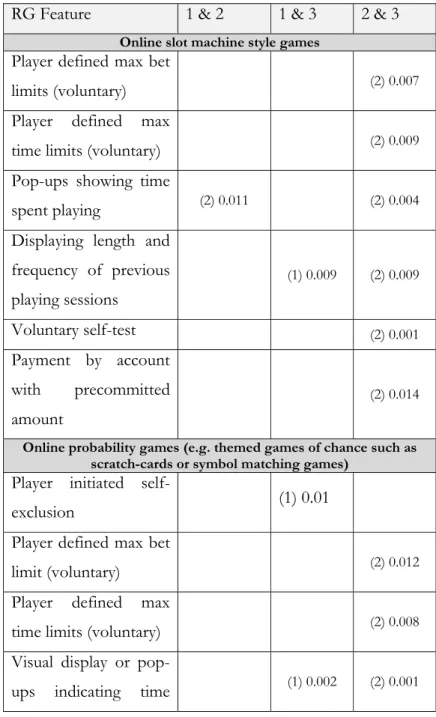
Whilst the overall level of concordance (agreement) of the three rater-groups was significant for each RG feature and game type examined, we nevertheless explored where some differences might be evident between the rater-groups (see Table 3). Differences were most notable between rater groups two and three (treatment providers versus recovered problem gamblers) with 28 significant rating differences (out of a total of 573 ratings). These differences showed that treatment providers gave more positive ratings for some RG features related to online games, and specifically, the use of player-set limits, displaying information about amounts spent and time spent playing, and the use of player self-tests. Twenty five significant rater group differences were observed (out of a total of 573 ratings) between the rater groups one and two (RG experts versus treatment providers). Again, treatment providers gave more positive ratings to RG features, predominantly in traditional (offline) gambling environments, and specifically, access to ATMs, prohibiting credit purchases, restricting access to winnings and staff training to spot and intervene with PGs. There were six significant differences (out of a total of 573 ratings), between groups one and three (RG experts and recovered PGs). RG experts gave more positive ratings, in relation to, displaying information to players about their play sessions, temporary self-exclusion, pop-up time warnings, and use of a self-test. However, recovered PGs were more positive about the use of blocking software to exclude minors from
online gambling. Overall, where differences between rater groups were evident, it was the treatment providers that most frequently gave the highest ratings for RG features. Whereas, the recovered PGs were the least likely to give a high rating for an RG feature.
INSERT TABLE 3 HERE
Discussion
The project was designed to help bridge a gap between RG theory and RG practice, by identifying what is currently understood, by a wide range of stakeholders, about the effectiveness of current RG features and their suitability for minimising harms in relation to specific gambling based games. At a practical level, such findings could assist gaming companies and regulators in making more well-informed, and potentially more effective, RG strategy decisions to reduce the likelihood of harm to potentially vulnerable players. Subsequently, the findings should help to ensure that funds spent on developing and applying RG strategies are more optimally used. That is, emphasis can be placed on implementing those features that were viewed as providing benefits, in relation to the games contained in a specific game portfolio. Furthermore, the findings offer the possibility to standardize RG procedures, allowing for a more objective implementation process overall.
The results described in this paper focused on the most and least recommended RG features. A full list of all recommendations was considered for presentation here, but with 573 separate results it was too large to describe every individual recommendation. However, the interested reader can see all of the recommendations displayed in Table 2. Regarding the least recommended RG features, we should be weary of dismissing these features altogether. For example, least recommended RG features may have been less familiar to raters and/or may become more useful through further development, or as new game types are developed. For example, use of a video or musical interlude as a break from play is, currently, a rather uncommon RG feature designed to be used a continuity break from extended play. The purpose being to offer a cooling down period whereby players have a chance to consider whether or not they should quit playing or continue. Presently, there is no direct empirical evidence to show that such a feature has merit. However, theoretically such a break from play could be potentially helpful in facilitating rational playing behaviour. As such, the study identifies RG features that may require some empirical testing before they are accepted, or perhaps
rejected. Similarly, caution should be exercised when deciding on whether or not to implement an RG feature that is only recommended for one or two games in an overall game portfolio. For some specific games, certain RG features will be much more important than for other games. For example, gaming-company-defined, mandatory, maximum time limits were only ‘highly recommended’ for online poker games. However, problematic online poker play can be characterized by spending excessive amounts of time playing instead of (or in addition to) spending large sums of money whilst playing.
In exploring the most highly recommended RG features, it was observed that they could be divided into three broad types. Overall, there was a preference for player initiated RG features that focus on aiding player’s behaviour such as; self exclusion to avoid play permanently, for pre-defined periods, or for a quick break), setting personal, spend, bet and time-limits. Furthermore, mandatory player-defined limits on play were overall more highly recommended than gaming-company-player-defined limits, supporting the view that RG is somewhat dependent upon personal decision making, even if use of the RG feature itself is a requirement. The second type of ‘highly recommended’ RG feature related to the promotion of informed player choice, by providing information such as; presentation of winnings in real monetary values, providing clear information on prize structures and prize-back percentages, offering self-diagnostic tools and literature, as well as behavioural feedback with warnings of potentially negative changes in play patterns, pop-up reminders of time and money spent and problem gambling referral information. The third type of ‘highly recommended’ RG feature focused on gaming company actions such as; delaying player reinvestment of large wins, prohibiting credit for gambling, restricting physical access to money via onsite ATMs, controlling physical access to gaming areas through identification checks, and staff trained to identify and help people with gambling problems. This observation of RG feature types supports the previous literature that argues RG policy and practice should primarily focus on encouraging and empowering players to make rational decisions based on sufficient information and adequate means of control (e.g. Blaszczynski, Ladouceur, & Shaffer, 2004; Bernhard, 2007; Wood & Griffiths, 2008; Reith, 2009; Wood & Bernhard, 2010). Whilst at the same time, it also suggests there is a role for gaming company interventions that do not overly interfere with every-day player autonomy.
Whilst the overall level of agreement between all raters was significant, it was interesting to examine more subtle differences between the three rater-groups. We found that treatment providers rated
some online RG features more positively than recovered PGs. Reasons for these differences are purely speculative but may relate to a desire (by treatment providers) for gaming companies to make more efforts at harm minimisation. The extent to which treatment providers believe in the efficacy of such RG features is difficult to determine, although the treatment providers in this study must presumably have at least some faith in them in order that they would recommend them for implementation. By comparison, recovered PGs distrust of gaming companies to help curb gambling problems may conceivably be a reason why they were less positive of these RG features. Alternatively, it may be that some of the recovered PGs had direct experience of using some of these RG features and found that they did not help in their particular situation. Further qualitative research, would be needed to understand in detail how both treatment providers and recovered PGs, perceive gaming company roles in relation to minimising gambling harms.
In relation to RG features for more traditional (offline) games, it was found the treatment providers rated several RG features more highly than RG experts. The higher ratings, by treatment providers, related to the location of ATMs, prohibition of credit for game purchases, restricting immediate access to large winnings and the training of staff to identify and assist people experiencing gambling problems. Again, it is not clear whether these differences relate to a desire (by treatment providers) that gaming companies should make more of an effort to prevent PG, and/or that they believed in the efficacy of such RG features. The truth may, of course, lie somewhere in between, and suggests the need for further research to examine how different stakeholders perceive RG features more generally. Given that treatment providers have a unique insight into the development of gambling problems, their involvement in the design and implementation of RG features could be highly valuable. For example, their experience of working with PGs may give them an insight into how ATM location can be a factor in extended problematic play for their clients.
Through the development of the RG feature taxonomy, it was interesting to observe that there are many more RG features available for electronic gambling games than for traditional gambling games. For example, there were 34 RG features identified for online multi-player bingo, whereas for traditional bingo in a bingo hall, casino or gaming centre there were only 15 relevant RG features. The nature of electronic gambling is such that there is a greater opportunity, than with traditional games, to control the gaming environment (e.g., the look and sound of the game) the gambling experience (e.g., the speed and duration of a game) and to provide player limit-setting tools (e.g.,
player set spend limits, and time limits). Arguably, this control of the structure and environment of the game could also allow for a game to be developed that has a higher addictive potential for at-risk players, than a traditional game. In this respect, responsible game design is critical, and RG features designed to aid this process (e.g. www.GAM-GaRD.org) and/or consultation with appropriate experts in the RG field should arguably be considered as part of a responsible game design process.
In addition to controlling the game dynamics and associated game related feedback, electronic gambling, and particularly online gambling, allows for the possibility of providing highly detailed behavioural feedback (e.g., detailed account information, time spent playing, warnings of behaviour change etc.). Furthermore, for those who may be experiencing gambling issues, online games provide an opportunity to conveniently refer players to relevant support and/or treatment services, both online (e.g., www.gamtalk.org) as well as more traditional support services such as telephone help-lines. Therefore, it might be argued that electronic gambling also has, at least the potential, to offer a more responsible gambling environment than has traditionally been the case. The key consideration here being, that it is not the medium in which a game is played that defines how problematic a game may be. Rather, the structural and situational characteristics of each specific game need to be carefully examined, together with careful consideration of the appropriate RG features, in order to offer the best possibility for responsible gambling experiences (Griffiths, Wood & Parke, 2009).
The findings from this study brought together international knowledge and experience from a wide range of experts and stakeholders, to consider what is currently known about the impact of various RG features for helping vulnerable players, in different gaming environments. As such these findings should help to ensure that more evidence-based decisions can be made, when deciding on which RG features to implement for an overall portfolio of games. Consequently, the findings should help drive forward RG practice by highlighting what is currently known (and just as importantly, what is not known) about the impact of specific RG initiatives. The current literature relating to RG effectiveness, is rather disparate and fragmented. It is important to clarify, integrate, and detail such information in a format that is both accessible and applicable by those who can make practical use of it (i.e., gaming companies, regulators, researchers), and the findings from this study should help to achieve this goal. Whilst it is a truism to say that ‘more research needs to be done,’ it is important that current research findings are utilized in a manner that allows for better informed decisions to be
made (today), based on what we currently know, towards the goal of minimizing the incidence of problem gambling across the full range of games on offer.
In assessing the limitations of this study, it was evident that that designing and implementing RG features is not, and likely never will be, a perfect science. Whilst on going research contributes to our overall understanding, such studies are unlikely to definitively identify the optimal effectiveness of every RG feature, in every context. Furthermore, different studies sometimes find varying results, largely because it is difficult (and sometimes impossible) to replicate a study when the variables and the samples are not constant. Furthermore, much research in this field is carried out in non-ecologically valid settings (e.g., in the laboratory) and/or frequently utilizes undergraduate student participants from particular disciplines (e.g., psychology). Unlike chemistry or physics where factors invariably remain uniform, social science research must deal with thinking, acting individuals in a changing environment with varying social contexts. Also, in the context of this study, we cannot guarantee the knowledge that each rater had of the RG features examined. However, we can say that they represented a well-informed group of individuals and that their unique perspectives produced a coherent and significantly concordant set of evaluations.
We would also like to point out, that the findings in this study do not suggest that majority opinion is better than scientific knowledge. Rather, in a case where there is limited and sometimes divided views on scientific knowledge, expert opinion is helpful in summarizing what we do and don’t know and for making well-informed estimates, where knowledge is lacking, based on relevant experience. In fact, considering the overall degree of consensus between the different rater groups, unless there was strong empirical evidence to the contrary, then the ratings should arguably be considered a valuable insight. Such a view of knowledge based on expert consensus is not a radical way of thinking, particularly in the social sciences. For example, the DSM V (and all the previous DSM versions) used for classifying mental disorders (including pathological gambling), also relied upon expert consensus to evaluate what was currently understood about such disorders, as part of the ongoing development of the classification system. Whilst the DSM review involved a much lengthier and involved process over several years, and examined a far greater volume of information than exists in the RG field, the logic behind utilizing expert knowledge is essentially the same.
It should also be noted that this study represents views based on a best-case-scenario, where resources are no object and where protection of players is the only consideration. That is, gaming companies have to work with what they can afford to implement and must consider any potential impact on the overall playing experience. Hence it is important to know which RG features appear to be most helpful for which particular games, so that the RG features that are viewed as most desirable for the particular portfolio of games can be implemented (most cost effective) and the least desirable RG features might be avoided (least cost effective).
Despite the limitations of the present findings, we would argue that studies such as this help us to better understand how, why, and when RG features work in broader terms. This is similar to medical research that utilizes findings to help reduce or prevent symptoms, without necessarily always curing an illness. In this way, current RG features can be used to help some players to avoid developing issues with their gambling behavior. Whilst these features are not 100% effective, and likely never will be, the application of what is known to work, even if only partially, should be actively encouraged, whilst increasingly more effective RG features are developed over time. In fact, the use of such tools in ‘real world’ gambling settings, provides an extremely valuable perspective on how further improvements may be made. All of the features that were included in this study are currently in use in at least one jurisdiction around the world at this point in time. As such, the findings are not suggesting that RG features be utilized that have not already been implemented elsewhere, with at least some degree of success. Consequently, those in the gambling industry (as well as other stakeholders in the gambling studies field) can be confident that the RG features examined in this study do not to the best of our knowledge carry unknown unintended consequences.
Whilst this study has helped to define those RG features that can help players manage their gaming behavior in relation to specific games, it does not take into account other non-game focused RG initiatives. For example, staff training, problem gambling awareness campaigns, responsible advertising codes, are some examples of other RG initiatives that may have merit in terms of the promoting RG at a broader level (Griffiths & Wood, 2008). The diverse nature of such initiatives is such that it is probably not possible to assess their specific impact on actual game playing behavior (or at least, not at the level of an individual game). For example, media campaigns that raise awareness about problem gambling, are likely useful in terms of educating players’ general
understanding of what a gambling problem looks like, and where they can get help. However, the effectiveness of such RG initiatives is unlikely to be measurable in terms of their impacts on a specific game type. Therefore, it is important when developing or evaluating an RG strategy, that the broader context, both socially and culturally is also examined (e.g., does the gaming company’s customer base contain a significant proportion of people whose culture values the notion of good luck?). In this respect, it is often worth consulting with a variety of experts and key stakeholders in order to help ensure that there is a comprehensive understanding of the potential issues involved.
Finally, in order that the information detailed in this study might be put to some practical use by gaming company RG staff, regulators and other researchers. The RG feature recommendations will be made available as an interactive website tool. The site will give visitors the option to select a specific game type to see which RG features are recommended. Or, a specific RG feature may be selected in order to see which game types it is most suited for. In addition, there will be descriptions of the essential characteristics of each RG feature, together with a discussion of any issues that should be considered before implementation. The resultant web-based tool will be known as the ‘Responsible Gambling Knowledge Centre’ (RGKC), and it should help to further translate research knowledge into applied practices. Nevertheless, it will be important that the such a tool is regularly updated over time to include new empirical research findings, stakeholder perspectives, and the addition of new RG features. In doing so, it is hoped that the findings will prove to be helpful for the ongoing development and evaluation of more effective RG strategies over time.
References
Adler, Michael, & Erio Ziglio (Eds.) (1996). Gazing into the Oracle: The Delphi Method and its Application to Social Policy and Public Health. London: Jessica Kingsley Publishers.
Bernhard, B.J., Lucas, A.F. & Jang, D. (2006). Responsible gaming device research report. University of Nevada, Las Vegas International Gaming Institute.
Bernhard, B.J. (2007). The voices of vices: Sociological perspectives on pathological gambling.
American Behavioral Scientist. 51(1): 8-32.
Blaszczynski, A. P., & Nower, L. (2002). A pathways model of problem gambling. Addiction, 97,487– 499.
Blasczczynski, A., Ladouceur, R., & Shaffer, H.J. (2004). A science-based framework for responsible gambling: The Reno model. Journal of Gambling Studies 20, 3, 301-317.
Blaszczynski, A., Ladouceur, R., Nower, L., & Shaffer, H. (2005). Informed choice and gambling: Principles for consumer protection. Report prepared for the Australian Gaming Council, Australia.
Griffiths, M.D. (1994). The role of cognitive bias and skill in fruit machine gambling. British Journal of Psychology,85, 351-369.
Griffiths, M.D. (2010). The gaming industry’s role in the prevention and treatment of problem gambling. Casino and Gaming International,6(1), 87-90.
Griffiths, M.D. & Wood, R.T.A. (2008). Responsible gaming and best practice: How can academics help? Casino and Gaming International,4(1), 107-112.
Griffiths, M.D. & Wood, R.T.A. (2009). Centralised gaming models and social responsibility. Casino and Gaming International, 5(2), 65-69.
Griffiths, M.D., Wood, R.T.A., Parke, J. (2009). Social Responsibility Tools in Online Gambling: A Survey of Attitudes and Behavior among Internet Gamblers, CyberPsychology and Behavior, 12, 413-421.
Helmer, O. (1977). Problems in futures research: Delphi and causal cross-impact analysis. Futures, 9,
17-31.
Hsu, C.C. &. Sandford, B.A. (2007). The Delphi Technique: Making Sense Of Consensus. Practical
Assessment, Research & Evaluation, 12, 10, Available online:
http://pareonline.net/getvn.asp?v=12&n=10
Jacobs, D. F. (1986). A general theory of addictions: A new theoretical model. Journal of Gambling Behavior, 2, 15–31.
McBride, A.J., Pates, R., Ramadan, R., & McGowan, C. (2003). Delphi survey of experts' opinions on strategies used by community pharmacists to reduce over-the-counter drug misuse. Addiction, 98, 487-497.
McDonnell-Phillips Pty Ltd. (2006). Analysis of gambler precommittment behaviour. Report to the National Gambling Research Program Working party on behalf of the Australian Ministerial Council on Gambling, Brisbane.
Meyer, G., Fiebig, M., Häfeli, J. & Mörsen, C. (2011). Development of an assessment tool to evaluate the risk potential of different gambling types. International Gambling Studies, 11, 2, 221-236.
Monaghan, S. (2008). Review of pop-up messages on electronic gaming machines as a proposed responsible gambling strategy. International Journal of Mental Health and Addiction, 6, 214-222.
Monaghan, S., (2009). Responsible gambling strategies for Internet gambling: The theoretical and empirical base of using pop-up messages to encourage self-awareness. Computers in Human Behavior, 25, 202-207.
Monaghan, S., & Blaszczynski, A. (2007). Recall of electronic gaming machine signs: A static versus a dynamic mode of presentation. Journal of Gambling Issues, 20, 253-268.
Monaghan, S., & Blaszczynski, A. (2010a). Electronic gaming machine warning messages: Information versus self-evaluation. Journal of Psychology, 144, 83-96.
Monaghan, S., & Blaszczynski, A. (2010b). Impact of mode of display and message content of responsible gambling signs for electronic gaming machines on regular gamblers. Journal of Gambling Studies, 26,1, 67-88.
Nisbet, S. (2005). Responsible gambling features of card-based technologies. International Journal of Mental Health and Addiction, 3,2, 54-63
Okoli, C & Pawlowski, S.D. (2004). The Delphi method as a research tool: an example, design considerations and applications. Information & Management,42, 15-29.
Parke, J. & Griffiths, M.D. (2007). The role of structural characteristics in gambling. In G. Smith, D. Hodgins & R. Williams (Eds.), Research and Measurement Issues in Gambling Studies (pp.211-243). New York: Elsevier.
Reith, G. (2009). Reflections on responsibility. Journal of Gambling Issues, 22, 149-155.
Sharpe, L., Walker, M., Coughlan, M., Enersen, K., & Blaszczynski, A. (2005). Structural Changes to Electronic Gaming Machines as Effective Harm Minimization Strategies for Non-Problem and Problem Gamblers. Journal of Gambling Studies, 21, 503-520.
Smeaton, M. & Griffiths, M.D. (2004). Internet gambling and social responsibility: An exploratory study, CyberPsychology and Behavior, 7, 49-57.
Williams, R. J., West, B. L., & Simpson, R. I. (2007). Prevention of problem gambling: A comprehensive review of the evidence. Report prepared for the Ontario Problem Gambling Research Centre, Guelph, Ontario, Canada.
Wohl, M.J.A., Christie, K., Matheson, K., & Anisman, H. (2010). Animation-based education as a gambling prevention tool: Correcting erroneous cognitions and reducing the frequency of exceeding limits among slot players. Journal of Gambling Studies, 26, 469-486.
Wohl, M. J. A., Lyon, M., Donnelly, C. L., Young, M. M., Matheson, K., & Anisman, H. (2008). Episodic cessation of gambling: A numerically aided phenomenological assessment of why gamblers stop playing in a given session. International Gambling Studies, 8, 249-263.
Wohl, M., & Pellizzari, P. (2011, October). Player tools, do they work? New research and implications for operators. Nova Scotia Gaming Corporation Responsible Gambling Conference, Halifax, NS. Retrieved from http://www.responsiblegamblingns.ca/presentations/
Wood, R.T.A., & Griffiths, M.D. (2008). Why Swedish people play online poker and factors that can increase or decrease trust in poker websites: A qualitative investigation, Journal of Gambling Issues, Issues, 21. Available at http://www.camh.net/egambling/issue21/pdfs/06wood.pdf
Wood, R.T.A., & Griffiths, M.D. (2007). A qualitative investigation of problem gambling as an escape-based coping strategy, Psychology and Psychotherapy: Theory, Research and Practise, 80,
107-125.
Wood, R.T.A. & Bernhard, B.J. (2010). Found in translation. Paper presented at the Nova Scotia Gaming Corporation Responsible Gambling Conference, Halifax.
Wood, R.T.A & Da Silva, L. (2013). Understanding positive play: An exploration of non-problematic playing experiences and practices, presented at the New Horizons in Responsible Gambling Conference, Vancouver.
Table 1. Delphi stages overview Scoping study Delphi stage 1 Delphi stage 2 Delphi stage 3 Delphi stage 4 Delphi stage 5
Participants RG Experts RG Experts
RG experts, Treatment providers, Recovered PGs RG experts, Treatment providers, Recovered PGs RG experts, Treatment providers, Recovered PGs RG experts, Treatment providers, Recovered PGs Tasks Comment on completeness of the RG feature and game taxonomies Describe the essential requirements for each RG feature to be considered effective and highlight any relevant issues Rate the suitability of each RG feature (from the RG taxonomy) for
use with each game (from the game taxonomy). Highlight any issues (open ended responses) Repeat previous stage with the addition of questions relating to issues that were raised. Consider level of overall agreement Repeat previous stage with the addition of questions relating to issues that were raised. Consider level of overall agreement Repeat previous stage with the addition of questions relating to issues that were raised. Final levels of rater concordance calculated Output RG feature taxonomy & game taxonomy Detailed descriptions of what were considered to be the essential requirements for each feature and any related issues Ratings of the reported suitability of each RG feature for specific games. Descriptions of issues. Ratings of the reported suitability of each RG feature for specific games. Descriptions of issues Ratings of the reported suitability of each RG feature for specific games. Descriptions of issues Ratings of the reported suitability of each RG feature for specific games. Descriptions of issues. Final concordance levels reported.
Table 2: Recommended RG features according to game type (Responsible Gambling Feature Taxonomy)
RG feature recommendations should be cross-referenced to the RG features listed in Appendix II
Game types Highly Recommend Desirable Limited Value No value
Online games 1. Online electronic game machine style
games (e.g. slots)
3, 4, 5, 7, 10, 14, 16, 20, 23, 24, 25, 26, 31, 32, 33, 34 1, 2, 5, 6, 8, 9, 12, 14, 15, 18,19, 21, 23, 27,28,29,30 11, 17, 22 2. Online probability games (e.g., themed games
of chance such as online scratch-cards, symbol matching games) 3, 4, 5, 7, 10, 13, 14, 16, 20, 23, 24, 25, 26, 29, 30, 31, 32, 33, 34, 2, 6, 8, 9, 12, 15, 18, 19, 21, 27, 28 1, 11, 17 22 3. Online purchases of offline lottery tickets
(e.g., weekly lotto games)
3, 4, 5, 7, 10, 13, 14, 16, 24, 25, 26, 28, 29, 30, 31, 32, 33, 34 6, 9, 12, 27 2, 4, 8, 11, 15 1, 17, 18, 19, 20, 21, 22, 23 4. Online sports betting (not including
proposition bets such as spread betting
3, 4, 5, 7, 10, 11, 13, 14, 16, 23, 24, 25, 26, 28, 29, 30, 31, 32, 33, 34 1, 2, 6, 8, 9, 12, 15, 17, 18, 19, 21, 27 17, 20 22
5. Online bingo games (single player) 3, 4, 5, 10, 14, 15, 16, 23, 24, 25, 26, 28, 29, 30, 31, 32, 33, 34 2, 6, 7, 9, 11, 12, 13, 17, 18, 19, 20, 21, 27 1, 8 22
6. Online bingo games (multi-player) 3, 4, 5, 7, 10, 13, 14, 16, 18, 19, 20, 21, 23, 24, 25, 26, 28, 29, 30, 31, 32, 33, 34 2, 6, 8, 9, 11, 12, 15, 17 27, 28, 1, 22,
7. Online daily lottery draws (i.e. tickets purchased online 3, 4, 5, 7, 10, 13, 14, 24, 25, 26, 28, 29, 30, 31, 32, 33, 34 6, 9, 16, 27 2, 8, 11, 12 1, 15, 17, 18, 19, 20 21, 22, 23 8. Online multi-draw keno (e.g., every 4-5
minutes) 3, 4, 5, 8, 9, 10, 11, 13, 14, 16, 24, 25, 26, 28, 29, 30, 31, 32, 33, 34 2, 6, 7, 12, 15, 17, 18, 19, 20, 21, 23, 27 1, 22
9. Online casino card games (e.g., blackjack, baccarat etc.) Not online poker, with the exception of Caribbean Stud Poker which is played against the house similar to other casino card games 2, 3, 4, 5, 7, 10, 13, 14, 16, 18, 23, 24, 25, 26, 28, 29, 30, 31, 32, 33, 34 1, 6, 8, 9,11, 12, 14, 15, 16, 17, 19, 20, 21, 27 1, 22
10.Online casino table games - not including card games (e.g., roulette, craps etc.)
3, 4, 5, 7, 10, 11, 13, 16, 23, 24, 25, 26, 28, 29, 30, 31, 32, 33, 34 1, 2, 6, 8, 9, 12, 14, 15, 16, 17, 18, 19, 20, 21, 27 22
11. Online proposition bets (e.g., betting on the outcome of a specific event such as how many goals will be scored, who will win an Oscar, will
3, 4, 5, 7, 8, 10, 11,13, 14, 16, 23, 24, 25, 26,
2, 6, 8, 9, 12, 15, 17, 18, 19,
it snow on Christmas day). Note: This includes spread-betting
28, 29, 30, 31, 32, 33, 34 20, 21, 27
12. Online poker (tournament games) (e.g., players purchase chips at the start and then play until they are knocked out of the tournament). Note: Assume that buying further chips is not allowed 6, 7, 8, 10, 11, 13, 14, 16, 17, 23, 24, 25, 26, 28, 29, 30, 31, 32, 33, 34 2, 3, 4, 5, 9, 12, 15, 19, 20, 21, 27 1, 18, 22
13. Online poker (cash games) (e.g., players bet with cash until they run out of money or quit) Note: This could also include a tournament where players are permitted to buy more chips to avoid being knocked out
3, 4, 5, 7, 8, 10, 11, 13, 14, 16, 17, 18, 20, 23, 24, 25, 26, 28, 29, 30, 31, 32, 33, 34 2, 6, 9, 12, 15, 19, 21, 27 1, 22 Offline games 14. Electronic Game Machines (EGMs) such as
slot machines and video lottery games (VLTs) in a bar, casino or gaming centre
2, 3, 4, 29, 31, 32, 33, 34, 35, 36, 38, 39, 42, 43, 44, 45 20, 36, 24, 40, 41, 37, 21, 22, 41
15. Sports betting at a betting shop, racetrack or casino
3, 4, 29, 33, 34, 35, 36,
37, 38, 39, 42, 44, 45 2, 1 16. Lottery ticket purchases (e.g., weekly lotto
games) 3, 29, 33, 34, 4, 42, 44, 45 2, 36, 37, 38, 39
17. Scratch-ticket or pull-tab games 3, 4, 29, 33, 34, 38, 42 36, 37, 39, 44,
45 2
18. Bingo games at a Bingo hall, Casino or Gaming Centre
2, 3, 4, 29, 33, 34, 35,
38, 39, 42, 44, 45 4, 36, 37, 19. Multi-draw Keno (e.g., a 5 minute Lotto
draw type game) at a bar, Casino or Gaming Centre.
3, 4, 29, 33, 34, 35, 38,
39, 42, 44, 45 2, 36, 37, 44
20. Casino card games and casino table game 2, 3, 4, 29, 33, 34, 35,
Table 3. Significant differences between rater groups in terms of rating the effectiveness of RG features for specific game types
1 = RG Experts, 2 = Treatment Providers, 3 = Recovered PGs
Highest rating group shown in brackets (i.e. they rated RG feature significantly higher than their comparison rater group).
RG Feature 1 & 2 1 & 3 2 & 3
Online slot machine style games
Player defined max bet
limits (voluntary) (2) 0.007
Player defined max
time limits (voluntary) (2) 0.009 Pop-ups showing time
spent playing (2) 0.011 (2) 0.004 Displaying length and
frequency of previous playing sessions (1) 0.009 (2) 0.009 Voluntary self-test (2) 0.001 Payment by account with precommitted amount (2) 0.014
Online probability games (e.g. themed games of chance such as scratch-cards or symbol matching games)
Player initiated
self-exclusion (1) 0.01
Player defined max bet
limit (voluntary) (2) 0.012
Player defined max
time limits (voluntary) (2) 0.008 Visual display or
spent playing
Diagnostic self-test (2) 0.013 Online purchase of lotto tickets
Player defined bet
limits (voluntary) (2) 0.009
Player defined loss
limits (voluntary) (2) 0.015
Voluntary self-test (1) 0.006 (2) 0.003
No purchase with
credit (2) 0.012
Temp self-exclusion (1) 0.013
Player defined spend
limits (voluntary) (2) 0.012
Player defined max bet
limits (voluntary) (2) 0.004
Player defined max bet
limits (mandatory) (2) 0.006
Player defined max
loss limits (voluntary) (2) 0.008 Player-defined max
time limits (voluntary) (2) 0.004 Player-defined max
time limits (mandatory) (2) 0.01 Pop-ups or displays
showing time spent playing
(2) 0.016
Voluntary self-test (2) 0.002 No purchase with
credit (2) 0.009
Online bingo games
Limiting hours of
Player defined spend
limits (voluntary) (2) 0.008
Player-defined max
time limits (voluntary) (2) 0.005 Player-defined max
time limits (mandatory)
(2) 0.004
Pop-ups or displays showing time spent playing
(2) 0.009
Account and behavior info (e.g. length and frequency of sessions)
(2) 0.016
Voluntary self-test (2) 0.003
Continuous feedback and warnings about behavior change
(2) 0.009
No purchase with
credit (2) 0.005
Online proposition bets
No purchase with
credit (2) 0.001
Online poker (tournament games)
No purchase with
credit (2) 0.002
Online poker (cash games)
No purchase with
credit (2) 0.004
EGM in bar, casino or gaming centre Limit hours of availability (2) 0.009
Large winnings not
instantly available to play (2) 0.016 No access to ATM in
gaming establishment (2) 0.003 Staff trained to spot and
Sports betting at betting shop, racetrack or casino No access to ATM in
gaming establishment (2) 0.003 No access to ATM in
immediate vicinity of the gaming area
(2) 0.016
Scratch-ticket or pull-tab games No access to ATM in
gaming establishment (2) 0.012 No access to ATM in
immediate vicinity of the
gaming area (2) 0.01
Bingo games and bingo hall or gaming centre No access to ATM in
gaming establishment (2) 0.003 No access to ATM in
immediate vicinity of the
gaming area (2) <.0005
Staff trained to spot and
support PGs (2) 0.001
Multi-draw ken in bar, casino or gaming centre No access to ATM in
gaming establishment (2) 0.002 No access to ATM in
immediate vicinity of the
gaming area (2) 0.003
Casino card and table games No access to ATM in
gaming establishment (2) 0.001 No access to ATM in
immediate vicinity of the
gaming area (2) 0.002
Any game in any environment Public awareness campaigns
about where to get help for
PG (2) 0.013
Free blocking software to prevent children gambling
online (2) 0.015 (3) 0.001
Appendix 1: Game Taxonomy
(Game types that have been considered in the study)
1.Online slot machine style games
2.Online probability games (e.g., themed games of chance such as online scratch-cards, symbol
matching games)
3.Online purchases of offline lottery tickets (e.g., weekly lotto games)
4.Online sports betting (not including proposition bets such as spread betting) 5.Online bingo games (single player)
6.Online bingo games (multi-player)
7.Online daily lottery draws (i.e. tickets purchased online)
8.Online multi-draw keno (e.g., every 4-5 minutes)
9.Online casino card games (e.g., blackjack, baccarat etc.) Not online poker, with the exception of Caribbean Stud Poker which is played against the house similar to other casino card games
10.Online casino table games - not including card games (e.g., roulette, craps etc.)
11.Online proposition bets (e.g., betting on the outcome of a specific event such as how many goals
will be scored, who will win an Oscar, will it snow on Christmas day). Note: This includes spread-betting
12.Online poker (tournament games) (e.g., players purchase chips at the start and then play until they
are knocked out of the tournament). Note: Assume that buying further chips is not allowed
13.Online poker (cash games) (e.g., players bet with cash until they run out of money or quit) Note:
This could also include a tournament where players are permitted to buy more chips to avoid being knocked out.
Traditional (offline) games
14. Electronic Game Machines (EGMs) such as slot machines and video lottery games (VLTs) in a bar, casino or gaming centre
15. Sports betting at a betting shop, racetrack or casino 16. Lottery ticket purchases (e.g., weekly lotto games)
17. Scratch-ticket or pull-tab games
18. Bingo games at a Bingo hall, Casino or Gaming Centre
19. Multi-draw Keno (e.g., a 5 minute Lotto draw type game) at a bar, Casino or Gaming Centre.
20. Casino card games and casino table games
Appendix 2: Responsible Gambling feature taxonomy
(RG features that are considered in the study. Also to be used in conjunction with Table 2)1. Delayed membership schemes (e.g., have to wait 24 hours before able to play) 2. Limiting hours of availability (e.g., close at midnight)
4. Player initiated temporary self-exclusion (e.g. taking a break for a week) 5. Player initiated panic button (e.g. denies access to site for 48 hrs) 6. Player defined spend limits (voluntary use)
7. Player defined spend limits (mandatory to use)
8. Gaming company defined spend limits (mandatory use) 9. Player defined maximum bet limits (voluntary use) 10. Player defined maximum bet limits (mandatory use) 11. Gaming company defined bet limits (mandatory use) 12. Player defined maximum loss limits (voluntary use) 13. Player defined maximum loss limits (mandatory use)
14. Gaming company defined maximum loss limits (mandatory use) 15. Player defined maximum time limits (voluntary use)
16. Player defined maximum time limits (mandatory use)
17. Gaming company defined maximum time limits (mandatory use)
18. Mandatory game breaks after a pre-determined time has elapsed (e.g., player is sent back to accounts page)
19. Voluntary player-set game breaks after a pre-determined time has elapsed (e.g., player is sent back to accounts page)
20. Mandatory time warnings (e.g., pop-up stating time elapsed)
21. Voluntary player-set time warnings (e.g., pop-up stating time elapsed) 22. Use of non-gambling feature such as short video or musical interlude
23. Visible displays or pop-ups on gaming machines/online gaming that indicate time spent playing
24. Visible displays or pop-ups on gaming machines/online gaming that indicate amount won and lost
25. Providing player account and behavioral information (e.g. length and frequency of sessions) 26. Providing a voluntary diagnostic self-test to help players better understand their gambling
behavior (online gambling)
27. Offering voluntary continuous player behavioral feedback and warning of changes in behavior
28. Mandatory continuous player behavioral feedback and warning of changes in behavior 29. Purchase payments by non-credit related means (e.g. cash, debit-card, pre-paid account etc.) 30. Payment through account and pre-committed amount (e.g., player sets limit before
gambling)
31. Large winnings not paid in any method that can be instantly re-gambled
32. Purchase payments and winnings expressed as actual monetary value only (not credits or tokens)
33. Clear and accessible information displaying the prize-back percentage (return to player) 34. Clear and accessible information about the prize structure (number and size of prizes) 35. ID must be shown to gain entry to gaming area
36. A player card is required in order to play (e.g., provides account information, allows limits to be set etc.)
37. A voluntary player card can be used by those who want it (e.g., provides account information, allows limits to be set etc.)
38. No access to ATM in gaming establishment
39. No access to ATM in the immediate vicinity of the gaming area 40. Removing note acceptors from machines completely
42. Leaflets providing information about problem gambling support services (e.g. helpline numbers)
43. Stickers on the machines providing information about problem gambling support services (e.g. helpline numbers)
44. Posters providing information about problem gambling support services (e.g. helpline numbers)