(IJSBAR)
ISSN 2307-4531
(Print & Online)
http://gssrr.org/index.php?journal=JournalOfBasicAndApplied
---
224
Financial Literacy Levels of Medium and Small Scale
Businesses Owners and its Correlation with Firms’
Operating Performance: in Case of Hossana Town
Mulugeta Abuye
*Lecturer of Accounting and Finance, Wachemo University P.o.B 667 Hossana, Ethiopia Email: [email protected]
Abstract
Financial literacy is seen as an important instrument for the success of medium and small businesses, since it helps to understand and evaluate the information needed to make daily decisions that have financial impacts in companies‟ day-to-day management. Therefore, the goal of this research is twofold: to assess the financial literacy levels of small business owners (medium and small enterprises) in the Hossana Town and to analyze the relation between these results and the operating performance of those companies, as a measure of business economic performance. The study tests the hypothesis that, all other factors being constant, a higher financial literacy level of small business owners should motivate a better performance of the company. The sample in this study is composed by medium and small businesses of the Hossana town in the three sub cities, and through questionnaires it was obtained the data needed to gauge the levels of financial literacy. The results evidence a rather level of financial literacy among small business owners. And, the data also supports the existence of a significant positive correlation between financial literacy levels and companies‟ operating performance. This result highlights the importance of providing to small business owner adequate financial education on the expectation of improving their performance as business leaders.
Keywords:Financial literacy; small business owners; operating performance.
--- * Corresponding author.
225
1. Introduction
1.1. Back ground of the study
Since the mortgage crisis, governments around the world start to express concerns about the levels of financial illiteracy among their citizens, mainly due to the daily confirmation of the increasing of consumer over indebtedness and, also, of household bankruptcy rates. Moreover, the financial illiteracy has been widely referred as an aggravating factor of this financial crisis [1]. Consequently, it is also defended financial literacy should be seen as a public policy objective in order to improve welfare through better decisions making and mitigate the asymmetry between the final consumer and, mainly, the financial institutions[2]. These concerns rapidly expanded to the scientific community and, nowadays, it is noticed a huge growth of research based on financial literacy matter, mostly in relation with the accurate financial literacy levels, which are seen as indicators to sustain the need for financial education. Another reason for this recent growth on research is related with the effects of financial literacy on individual retirement planning success. The increasing concern of governments around the world with the straining employer sponsored for the Social Security System, mainly caused by rise of life expectancies and falling of birth rates, is opening a door for financial literacy as one of the solutions for this matter. Through financial education, governments would be able to encourage their citizens to take more self-responsibility for their retirement incomes and livings [3]. Despite the importance of small businesses in many economies, the major research done so far is mainly focused on personal finance issues of general public, leaving a gap for the analysis of the levels of financial literacy among small businesses [4]. Portuguese economy is greatly dependent on the small businesses‟ activity, including small enterprises and micro enterprises. In the fact, in 2013 these small businesses accounted for 35% the total revenue of our country and for 53% of the total employment [5]. The importance of financial literacy it is not only expressed in the failure of small businesses and it consequences, as expressed by [6]. In addition, financial literacy plays an important role among those business owners because it provides the financial tools needed to take informed decision, through the accurate understanding of financial information, which largely contributes for the future success of the company. Otherwise, decisions may be poorly taken or lead to advises of accountants or financial advisors [4]. Therefore, considering the importance of small businesses at national economy and the little attention that scientific community has given to the measurement of financial literacy levels among this business community, the present study is fulfilling this gap by assessing the levels of financial literacy among small businesses owners in the Hossana town. In addition, these results correlated with the actual operating performance of the company, as a measure of the business economic performance of the companies under considerations. This goal of the research has twofold objective. It provide statistical evidence of the relation between financial literacy levels of small business owners and the operating performance of their firms, and, in the case of a significant positive correlation, highlight the importance of proving to small business owner adequate financial education on the expectation of improving their performance as a business leaders. Under the belief that is not expected to see a company with a good operating performance, being ran by an owner with a poor level of financial literacy, at the same time, this is the major responsible for the decisions in his company.
1.2. Problem Statements
226
was concluded that the lack of financial culture worked as an aggravating factor of this crisis [2]. In one hand, it was found, as a common practice the application of investor‟s savings in complex financial products without fully understand its risks. Moreover, in the other hand, financial institutions were selling financial products without being able to fully understand its financial complexity. The recent developments in financial literacy research focus on personal finance issue, through the assess of the levels of financial literacy of general public with the aim of justify the need for financial education, which is believed, that will help to decrease the asymmetric information between citizens and financial institutions and, as a consequence, improve the financial markets efficiency. Despite, the definition of financial literacy regarding personal finance issue be more developed and widely accepted. The definition of financial literacy regarding small business is much more demanding, not only for financial knowledge, which must contemplate the capability of read and understand financial statements information. Also in financial behavior, with the habits concerned with the analysis of financial information, and financial preferences or attitudes, which must be positively correlated with financial knowledge and behavior, in the moment of taking the daily management decisions. A recent work from two authors describes financial literacy as “the ability to understand and use business financial statements to generate key financial ratios to evaluate and manage a business” [6]. In relation to financial literacy levels, Reference [7] emphasized a contradiction found out at the results of the studies explored, related with the low level of financial literacy among university students when, in general, past studies have shown that individuals with higher level of education have higher levels of financial literacy. In the years that followed the financial crisis, it was possible to witness to an increasing research related with financial literacy, due to the fact of being the financial illiteracy widely pointed as an aggravating factor of that crisis. Moreover, one of the major aims of this recent research is to sustain the need for financial education in order to protect final consumer from even more complex financial product available at market [1]. Since many economies around the world are dependent of the success of small businesses, which is also the case of Ethiopia, it is important not only provide the levels of financial literacy of general public, but also gauge the levels of financial literacy of small businesses owners. The studies at literature about small business owner‟s financial literacy are very scarce and it was not found anyone similar to each other. Considering the studies found so far at literature about the financial literacy levels of small business owners, it is possible to notice that there is no one that could possible serve as a benchmark for the present research in studies area. This gap at literature sustain the need for this investigation, which has two main goals: assess the levels of financial literacy of small business owners and correlate this literacy level with their firms‟ performance. This is quite normal due the scare literature about financial literacy among small business owners.
1.3. Study Objectives and Hypothesis
There are two main objectives for this study: to assess the literacy levels among the small business owners and to analyze the relation of financial literacy levels with the firm performance. The assessment of the levels of financial literacy among small business owners intends to fill in a gap in the literature review by creating an index, similarly to the work developed by [8], when studying the financial literacy levels of Portuguese population, which enables the comparison between every small business owner. The index presented further on, as well as, the explanation about its construction.
227
Hypothesis 1: “Small business owners with higher education present higher financial literacy levels”
Hypothesis 2: “Small business owners with education in/or related with economics present higher financial literacy levels”
Brown and his colleagues [4] conducted a study where it was demonstrated the increase of financial literacy levels among owner managers, through a year program of financial education [9]. Found also evidence that entrepreneurs with education in economics area presented higher levels of financial literacy.
Hypothesis 3: “Younger small business owners present lower financial literacy levels”.
The evidence in the literature about this hypothesis it is not consensual. Reference [4,8] found evidence of lower levels of financial literacy among young entrepreneurs, in the case of the first author, and among younger individual, in the case of the second. Instead [9] considered her sample composed with a majority of younger entrepreneurs and her major findings where that they possess good levels of financial literacy.
Hypothesis 4: “The financial literacy levels of small business owners are higher in bigger firms.”
Reference [9] tested a similar hypothesis in her work, but for two of three business characteristics of dimension, number of workers and revenue, she did not found statistical significance.
Hypothesis 5: “Small business owners responsible for companies’ financial area present higher financial literacy levels than those who trust the financial area to accountants.”
Reference [4] Found as a common practice among small business owners to trust the responsibility of financial area of the companies in the accountants. In the second part of the study, the results obtained for the financial literacy levels of small business owners are correlated with the operating performance of their companies using the operating performance model developed by [10], properly adapted to the present study.
Hypothesis 6: “There is a positive relation between the financial literacy levels of small business owners and the performance of their firms.”
1.4. Significance of the Study
Findings from this study assist academicians in broadening of the prospectus with respect to this study hence providing a deeper understanding of the critical factors that affect the performance of small business enterprises. Moreover, the findings helps MSEs in Hossana town and others, within an insight into the benefits of enhancing operating performance to predict the factors that affect the performance of small business enterprises. The government can use the findings of this study to assist in policy formulation and developing a framework for critical finance, marketing, work premises.
228
Geographically the current study limited with in Wachemo University catchment area in Hossana town, Hadiya zone. As far as the performance indicators varies in dynamics environment it is difficult to includes all the variable in a single research, therefore this study try to correlate financial literacy level of small business enterprises owner‟s with business performance. Limitation of the study: This current study may lack comprehensiveness, because the collected data were not sufficient to explain depth for some sector. However, the instrument used and the methodology aided to minimize the effects on the other sectors. The other hesitations are on the ignored variables that may have great impact on the results of study. Thus, it is better, other researchers to give attention on the effect of educational policy and environmental factors to wards correlation of financial literacy and firms‟ operation performance.
2.Related Literature Review
Financial Literacy highlights the importance and attention given to financial literacy after the 2007 worldwide financial crisis. “Financial Literacy and Small Business Performance” and “Assessment of business owners‟ financial literacy levels”, are both gathering the two main objectives of the present research, which are to assess the levels of financial literacy among small business owners and to correlate those results with their firms‟ performance.
2.1. Financial Literacy
Financial literacy, for many years, does not have a unanimous definition at literature, although, recently [11] provide an embracing and widely accepted definition of financial literacy gathering three main pillars: financial knowledge, attitudes and behaviors. Around the world, popular media and public in general used to use various terms as synonymous to describe the concept of financial literacy, for example financial capability, financial culture, financial knowledge and financial education [2]. In addition, past studies reveal that in some countries there was a certain trend to consider the studies related with financial knowledge as a good approach of financial literacy. Despite, at that time, the literature could not present a consensus related with a universal definition of financial literacy, the definitions found were designed around same basis and around the same goal, the individual financial wellbeing [1]. An example of the financial literacy basis is possible to see through the definition presented by the authors [12], where they define financial literacy, as the ability to make informed judgments and to take effective decisions regarding the use and management of money. Moreover, the financial literacy goal is possible to notice a definition of [13], financial literacy is “A measure of the degree to which one understands key financial concepts and possesses the ability and confidence to manage personal finances through appropriate, short-term decision making and sound, long-range financial planning, while mindful of life events and changing economic conditions”. The work of [11], provides, not only an embracing term that could include financial knowledge, financial ability, financial culture as Financial Literacy, but also a complete and widely accepted definition of financial literacy. This definition gather three important concepts: knowledge, attitudes and behaviors, which are, nowadays, the three pillars that completely describe financial literacy, and results at the following definition: “financial literacy is a combination of awareness, knowledge, skill, attitude and behavior necessary to make sound financial decisions and ultimately achieve individual financial wellbeing”. This definition is on the basis of the most relevant works done so far concerned with gauging the
229
financial literacy levels of general public, such as the OECD Pilot Exercise in 14 countries from Latin America, Africa, West and East Europe and Asia. At a national level [8] supported the assessment of financial literacy level of Portuguese population under this definition. The main progresses in Financial Literacy found at literature began after the subprime crisis in 2007, since it was concluded that the lack of financial culture worked as an aggravating factor of this crisis [2]. In one hand, it was found, as a common practice the application of investor‟s savings in complex financial products without fully understand its risks. On the other hand, financial institutions were selling financial products without being able to fully understand its financial complexity. The recent developments in financial literacy research focus on personal finance issue, through the assess of the levels of financial literacy of general public with the aim of justify the need for financial education, which is believed, that will help to decrease the asymmetric information between citizens and financial institutions and, as a consequence, improve the financial markets efficiency Reference [7] review compare and analyze past studies conducted in Australia, United States and United Kingdom related with this matter during that period. One of the main findings of these authors was concerned with the huge difference among financial literacy measurement of past studies, which result in a great difficulty in creating a true benchmark for the results obtained in those different countries, identifying a gap for future research. They also emphasize the financial literacy as a pillar to support the need for financial education, since, already at that time, financial illiteracy was been pointed as one of the reasons for financial instability. This phenomenon is a consequence of the easy access to credit and the ready issue of credit cards, alongside with the fast growth of marketing of financial products. In relation to financial literacy levels, they emphasized a contradiction found out at the results of the studies explored, related with the low level of financial literacy among university students when, in general, past studies.
2.2. Financial Literacy and Small Business Performance
The rare literature about small business owner‟s financial literacy provides a slightly different definition of financial literacy, being the main distinction related with the understanding of information provided by financial statements. Instead of financial knowledge being only focus on the comprehension of borrowing and saving matters, interest compounding, concept of inflation and risk diversification. A small business owner must be able to evaluate the information needed to make decisions that have financial ramifications or consequences on the business. According to [4], financial literacy for small business owners must contemplate the ability to read and understand fundamental financial statements, as well as, the ability with numbers, in order to make informed judgments and to make effective decisions regarding the use and management of money. A recent work from two authors describes financial literacy as “the ability to understand and use business financial statements to generate key financial ratios to evaluate and manage a business” [6]. However, as it has not been given much attention to financial literacy of small businesses owners, the literature does not provide an embracing definition of financial literacy in business context. Differing to what happens with financial literacy for personal finance issues. Since many economies around the world are dependent of the success of small businesses, which is also the case of Hossana town general for Ethiopia, it is important not only provide the levels of financial literacy of general public, but also gauge the levels of financial literacy of small businesses owners. In most of small businesses is common to find its owner as an employee, which is mainly focus on the operational area of the business, forgetting the strategy and planning of the business activities and, where
230
financial education could make the difference, by improving business owners‟ financial skills. In fact, [4], with an educational program, evidence the rise of financial literacy among entrepreneurs, and [6] could evidence the relation between financial literacy and the success of small businesses, by clearing the connection between the inadequate financial literacy and financial difficulties experienced by entrepreneurs. The studies at literature about small business owner‟s financial literacy are very scarce and it was not found anyone similar to the present research in order to establish a benchmark. Sage [14] carried out a survey about Canadian Small Business Financial Literacy, with a sample of 300 small businesses, where it gauges the perceptions, knowledge and habits of small business owners related with financial and resources management. The main result of this survey provides the perception of the respondents in different areas. The areas they need to learn more about financial planning, tax payment and cash-flow; the areas they feel more comfortable with: dealing with clients, dealing with suppliers and managing the finances of their businesses, and the areas where they fail most of the time dealing with taxes, managing sales and marketing and managing the finances of their businesses. Despite the interesting finding of Sage Canadian Survey, their results are based on respondents‟ perceptions and not so much on specific understanding of financial statements, correspondent to the financial knowledge, which is a fundamental pillar to provide accurate levels of financial literacy. Additionally, some of the question of this survey where asked in order to understand the frequency of usage of technology and accounting software, which is reasonable considering the institution which carry out the study. Study carried out by [4] on financial literacy of small businesses owner-entrepreneurs in their first year of activity. The basis of this study is settled on a program called “Training in Business Basics”, specially created for this population target of new small businesses with less than ten employees. The authors, in order to carry out their study, provide 147 small businesses of United Kingdom in their first three years of life with educational modules based on basic finance. The argument behind this study is on the belief that small business owners with the adequate financial education will be less needed of accountants and financial advisors on trust, in order to understand the financial position of their companies and make informed financial decisions by their own. Similarly, to [14], the major findings of these authors are mainly related to perceptions of financial awareness and literacy. They concluded that even though the participants appeared to be aware of their own lack of financial literacy, still they did not perceive the importance of this matter in relation to other aspects of running a small business. Study by[6] Surveyed 14 small businesses owners in Florida in order to determine their level of financial understanding and their usage habits of financial statements in making management decisions, which is almost the same to say, that they were gauging the levels of financial literacy. Since, according to their study Small Business Financial Literacy is defined “as the ability to understand and use business financial statements to generate key financial ratios to evaluate and manage a business”. The questions used in their survey focused mainly in two of the three pillars that sustain the definition of financial literacy widely accepted according to the literature: Financial Knowledge and Financial Behaviors, excluding, Financial Attitudes. The authors mainly conclude with the case study that was a clear connection between lack of financial literacy and financial difficulties experienced by entrepreneurs, and adequate financial education can partially decrease the financial difficulties. [9] Used questionnaire in order to carry out her work based in questions about entrepreneurs confidence levels and financial behavior, without include any question about financial knowledge, which is a pillar, not only, for financial literacy in personal finance issues, but also a main matter in gauging the financial literacy levels of small business owners according to the literature. Despite this gap, the major findings of her work shown that 66% of studied sample present a
231
good levels of financial literacy. Considering the studies found so far at literature about the financial literacy levels of small business owners, it is possible to notice that there is no one that could possible serve as a benchmark for the present research. This gap at literature sustain the need for this investigation, which has two main goals: assess the levels of financial literacy of small business owners and correlate this literacy level with their firms‟ performance. To the best of my knowledge concerned, there are no studies in the literature analyzing the relation between the companies‟ operating performance and the financial literacy levels of small business owners in Ethiopia. This is quite normal due the scare literature about financial literacy among small business owners.
2.3. Assessment of business owners’ financial literacy levels
The work of [3] refer the difficulty of measure the financial attitudes and financial behaviors in order to achieve financial literacy levels. Based on that, and keeping in mind four key principles: simplicity, relevance, brevity and capacity to differentiate, they design three questions which provide answers to three important economic concepts that individuals should have in order to make financial decisions, which are: (1) understanding of interest compounding; (2) understanding of inflation; and (3) understanding of risk diversification. These questions have been used in several studies as a benchmark to allow for international comparisons of financial literacy levels, such as, [15,16,17,18,19,11].
Record Keeping : Business owners had recorded all revenues and expenditures based on the documents gathered during interview. However, majority of the respondents were still using notebooks and piece of paper in recording their business transactions. The used of appropriate book of accounts such as journals and ledgers was not observed all the time during collection of data [20]. Explained that it is possible that the small business owner keep records, but not in a formal manner. In addition, separation of business records from personal records was slightly observed. The separation of these two records will help the business owners split business profit from personal profit. On the other hand, majority of respondent did not summarize their records. This task helps them be aware of the result of their business transaction.
Savings : Micro and small entrepreneurs are quite literate in monitoring their sales over the expenditure most of the time. They understand that in order to save they should have surplus at least. However, the respondents were not consistently set aside funds for future expenses. It was not manifested all the time that they were planning to have a ready money for their unexpected expenses through savings. It was also found out that majority of the business owners did not deposit their extra money in the bank or invest in cooperative this is because they are not setting a target percentage out of their surplus in savings. What they knew is whatever money they have after deducting all personal expenses that will be the savings for them. Reference [21] emphasized that many lower-income persons are capable and have desire to save but have trouble in doing so for purely economic reasons. Majority of the entrepreneurs are not considering investing into other business opportunity using their savings. They would rather use other source of fund such as loan than to use their extra money. According to [22] micro and small entrepreneurs must invest out of their income for things are not permanent.
232
aware about the consequence in not paying the loan. They knew that not paying on time would result in paying penalties and other surcharges. However, micro and small entrepreneurs are not much literate in separating the payment of their business loans from personal loan using their business money. Accounting principles assert that business transaction should be separated from the owner‟s transaction, this principle is fundamental, and it applies to all types of organization. It was also noted that majority of the business owners prefer to borrow short-term loan from national lender than to borrow from financial institution such as banks, lending companies and credit card companies. This finding supports the observation of [23] that only 20 percent of the short-term credit for the small businesses comes from the bank. In relation with this, the result also shows that business owners are not much concern on interest rate. They are more concern about the approval of the loan.
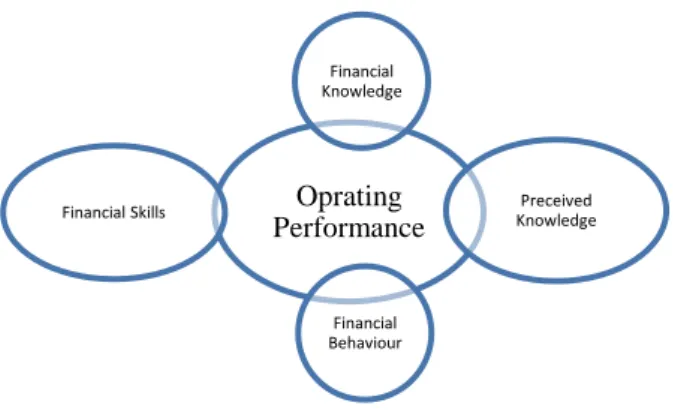
Budgeting :With respect to controlling their business, spending micro and small entrepreneurs are moderately literate. They were not consistent in planning about when to spend and what to spend in their business. Literacy on making written plan for the next month sales and business spending were both moderate. This means that business owners sometime make a written budget and sometimes not at all. These written plans are important for monitoring purposes but were not able to do this on regular basis. In terms of financial budgeting, the financial literacy of micro and small entrepreneurs was not manifested all the time. One of the evidence is the respondents were not computing the payback period for their capital expenditure. Based on the findings above, business owners are not prepared to manage their business properly [23]. Found that acquiring financial knowledge is a critical financial management tool. It is a tool for ensuring that not only the privileged few have the knowledge and ability to effectively build assets, manage their debt, and avoid being misled, exploited or cheated by the plethora of aggressively marketed financial products that are now available. However, acquiring these business skills is less important to them based on the result. What they know about business is purely selling their products. Other factors are not important as long as consumers will buy their products. Like general or health literacy, financial literacy could be conceptualized as having two dimensions – understanding (personal financial knowledge) and use (personal financial application) [25]. This is depicted in figure 1.
2.4. Conceptual Dimensions of Financial Literacy
Figure 1: Conceptual dimension Oprating Performance Financial Knowledge Preceived Knowledge Financial Behaviour Financial Skills
233
3. Materials and Methodology
This section presents the adopted methodology, mainly about how the information gathered and the instruments used. In addition, gives the detailed for the built questionnaire, the sample calculation and characterization, the index construction and the adapted operating performance model.
3.1. Research Design
This study used the questionnaire methodology to assess the financial literacy levels of Medium and small business owners, similarly to the most relevant studies developed so far focused on personal finance issue of general public, such as, at a global level, in [11] and, at a national level [18]. The questionnaire was composed in four major areas of questions: The first one, Respondent Characterization, includes questions its answers are the base for most of the study hypothesis mention at Purposes of Investigation. Also, includes a space to indicate the fiscal number of the company, which enables to access the economic and financial information available on Balance Sheet Analysis System), in order to calculate the operating performance of each company. Lastly, a question about the perception of the financial literacy level of each micro and small business owner, in order to establish a comparison between this self-assessment and the results were also obtained from the questionnaire. The Financial Knowledge section included not only questions about understanding of interest compounding, inflation and risk diversification, according to contributes in this matter of [3], although purposely adapted to the business environment. However, have also questions about the understanding of financial statements, which, according to the literature review, and the base for the questions of financial knowledge in the context of business financial literacy. The questions of Financial Behavior and Financial Attitudes are represented at the same group of question, due the connection between them, and represent an adaptation of the contributes provided by [3] from the personal finance issues transported to the business environment and business daily routines aspects. In addition, incorporate contributes from the authors that have explored financial literacy in small businesses, which are [4,6,9]. Those questions include business plan, cash flow forecast, and profitability analysis and bank loans.
3.2. Sample Size Determination
The sample of this study composed by respondents of small enterprises from Hossana town, according to the division settled by FDRE law, and referred in this work as small businesses. It was determined taking into account the formula calculation, explained below, and the Distributions of micro and small enterprises number in the Hossana town. In order to determine the planned quote needed to proceed forward with this study, it takes into account the polytomous characteristic of results of the variable. In addition “there are two methods to determine sample size for variables that are polytomous or continuous. One method is to combine responses into two categories and then use a sample size based on proportion. The second method is to use the formula for the sample size for the mean” [26]. The mentioned formula is represented below:
234
Where,
n0=sample size
Z = Z statistic for a level of confidence,
= population standard deviation of the study variable,
e = Margin of error or maximum error of the estimate. It identifies the maximum difference between the sample and the true population mean.
3.3. Operating Performance Model
The operating performance model is adapted from [10] to analyze the relation between the financial literacy levels of the small business owner and the performance of their firms. The analysis also will be controlled for the leverage, dimension and the activity sector of the firm. The model that as uses is:
Performancei = ROA of firm i
Rating _FLIi a rating for financial literacy index for firm i
LEVi= leverage ratio for firm i
LNTAi =the natural logarithm of total assets for firm i
Xi = a vector of industry dummies, i. e. indicator variables for the business activity classes.
ROA is the ratio between the operating income and the average of beginning-and ending-period book value of total assets. The operating income is measured by the operating income before depreciation, amortization, and taxes, plus interest income. Leverage ratio meant to measure the company‟s debt levels, through the sum of short term and long-term debt divided by total assets.
LNTA is a proxy for the dimension of the firm measured by the natural logarithm of total assets.
X includes dummy variables for the every class of industry of test sample.
3.4. Data Analysis
Descriptive analysis of results for Financial Literacy Index is used for description of firms. To get a better understanding of financial literacy of small business owners the results further analyzed looking for the factors that influencing its variables. In order to determine the appropriate statistical test, it is required to test the
235
normality of index distribution. For operating performance measurement, the adapted model helped to determine the results.
4.Results Analysis and Discussion
This section analyze data collected from respondents (mostly the owners of SMES) found in Hossana town. The questionnaires were designed and distributed that aimed to determine the level of financial literacy of small business owners and operating performance of the firms.
4.1. Descriptive analysis of results
The companies that made part of this study mainly belong to five categories:
Table 1: MSE in sectors
Sector of MSE Population Sample taken Manufacturing 120 38 Construction 158 60 Service 231 75 Trade 144 53 Agriculture 65 25 Total 718 250
In relation to global financial literacy index, which comprise the three components of financial literacy definition (financial knowledge, behavior and attitudes), the minimum punctuation observed is 3 and maximum almost hits the 100 with 91, as is possible to see in table below about the descriptive statistics of the obtained financial literacy index (Table 2).
Table 2: Descriptive Statistics: Original and Global Financial Literacy Index
Minimum observation
Maximum observation
Mean Median Standard deviation Original financial literacy index -32 28 2 3 14
Global financial literacy index 3 91 53 54 21
The average and the median are very near of each other with, respectively, 2 and 3, suggesting that, on average, the small business owners present rather low financial literacy level. Table 2 presents the distribution of respondents across financial literacy rating levels showing that 44% of the respondents have extremely low financial literacy levels. Considering the partial financial literacy level, divided by the three components of financial literacy definition, the highest punctuation is reached in Financial Attitudes and Behaviors. The Financial Knowledge did not go further than the 89 points as a maximum, according to the Table3.
236
Table 3: Descriptive Statistics: Partial Financial Literacy Index
Minimum observation
Maximum observation
Mean Median Standard deviation
Knowledge 0 89 50 56 24
Attitude 0 100 80 83 25
Behavior 0 100 41 33 30
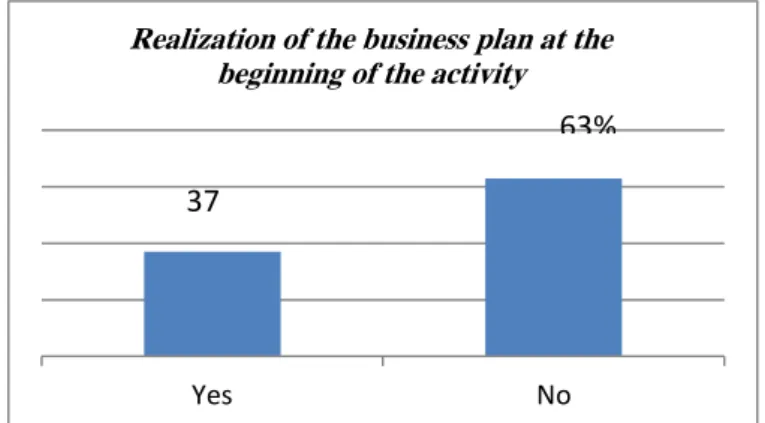
The Financial Knowledge questions are divided in two groups. The first five questions are related to standard financial literacy issues for personal finance (interest compounding, inflation and risk diversification) by the authors [11], but transformed for the business environment. The last four questions were about knowledge of financial statements given that, according to authors [4,6], financial literacy among small business owners is defined by their level of use and understanding of financial statements and analysis of financial ratios in order to make sound management decisions, analysis of financial ratios. The Financial Behavior has the lowest punctuation average, with 41, contrasting with the highest average on Financial Attitudes, with 80. Although it is important to note that the questions about Financial Attitudes and Financial Behavior were presented at the same group of questions due to its connection between each other, so on average the small business owners have the right attitude towards determined subject, but in practice their actions or behavior do not reflect their intentions. For example, considering three questions addressed in the work of [9] related with the elaboration of the business plan at the beginning of the activity, many respondents considered it very important, but in practice, before the opening of their companies they did not elaborate a business plan. Only 37% of the business owners elaborate the business plan at the beginning of the activity, while 63% of the respondents considered important or very important it realization not only at the beginning of the activity but also facing the need of an investment (figure 2).
Figure 2: Realization of the business plan at the beginning of the activity
Almost the totally of the respondents (90%) considered important or very important the periodic analysis of company‟s profitability, but more than half of the respondents (51%) have the wrong behavior towards this business procedure since they never or only once a year do the company‟s profitability analysis, as it is possible notice from the figure 3.
Yes No
Realization of the business plan at the beginning of the activity
37
237
Figure 3: Frequency of Company's Profitability Analysis
The questionnaire also included questions about cash flow forecast preparation, due to the contributions of [4], and the results exhibited that the majority of the small business owners of the sample (60%) admitted to not know how to do a cash flow forecast. However, from the remaining 40%, only 19% take the best behavior towards this subject, which to prepare the cash flow forecast at least every single month (figure 3).
Figure 4: Cash flow forecast
In order to fund their business, some of the respondents currently have bank loans, and, due to this reality, there were selected two questions to better understand if they followed the baking conditions and renegotiated the same [18]. In the sample, 41% of small business owners do not have any contracted bank loan and the remaining respondents which have bank loans, only 26% admitted to monitor and renegotiates the credit conditions at least once a year. The majority of the respondents shows a passive attitude towards the conditions of a bank loan after its contracting and do not review the contracts terms in order to update it to market conditions and minimize the financial losses. Small business owners tend to overestimate their capacities, since only 11% admitted to have a rather low level of financial literacy, when the results exhibited to be four times
never Onece a year At leat every six
months
at leat every single year 6%
46% 26% 22%
Frequency of company's profitability
analysis
never Onece a year At leat every
six months
at leat every single year
57% 13% 11% 19%
238
higher in the number of small business owners in this situation. The results also showed that small business owners have the right attitude towards financial matters although financial behavior does not follow this trend.
4.2. Statistical Analysis of the Factors That Influence the Financial Literacy
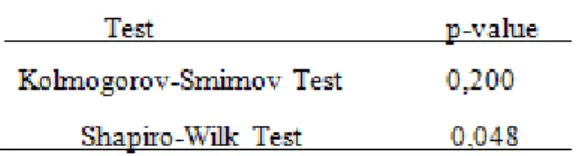
To get a better understanding of financial literacy of small business owners the results are further analyzed looking for the factors that influencing its variables. In order to determine the appropriate statistical test, it is required to test the normality of index distribution. The conducted tests were: Kolmogorov-Smirnov test and Shapiro Wilk test. Table 4 exhibits the results obtained for those tests with SPSS.
Table 4: Normality test
The results are not conclusive, since considering the Kolmogorov-Smirnov Test, for confidence level of 95%, the null hypothesis, which states that the sample follows a normal distribution, is not rejected (p-value > 0.05) and using the Shapiro-Wilk Test the null hypothesis is rejected (p-value < 0.005. However, the normal distribution also depends of asymmetry coefficients, measured by skewness and kurtosis, which maybe around 0 and 3, respectively, and those two statistics have shown to be powerful and informative [27].
The global financial literacy index presents a skewness of -0,11 and a Kurtosis of -0,92, so combining this statistics with the former normality tests, it is rejected the null hypothesis for a normal distribution. So, for assessing the equality of the medians of Global Financial Literacy Index, taking into account its non-normal distribution, it was conducted the Kruskal-Wallis test, which is a non-parametric test used to test 2 or more groups with different dimensions. It follows approximately a X2 distribution with “n-1” degrees of freedom, being “n” the number of groups in each category.
Running the Kruskal-Wallis test at the SPSS program it is obtained the p-value test and the mean ranks. The null hypothesis in every test means that the medians are statistically equals in the population groups in analysis. And, considering a confidence level of 95%, the null hypothesis is rejected since the p-value of the test is lesser than 0.05, meaning that the medians of population groups are statistically different. Then it will be presented the statistical tests and its conclusions in relation to the hypothesis tests in study.
Hypothesis 1: “Male small business owners present higher financial literacy levels than female gender.” According to [11], the male population presents higher levels of financial literacy. In the sample the male small business owners exhibits, on average, a higher financial literacy level but, for a confidence level of 95%, this difference is not statistically significant. This result follows the evidence found at literature for the similar tests done with Portuguese population (Table 5).
239
Table 5: Hypothesis 1 “Male small business owners present higher financial literacy levels than female gender” Kruskal-Wallis test
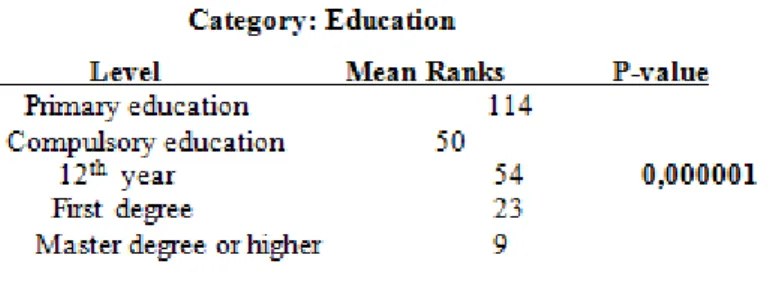
Hypothesis 2: “Small business owners with higher education present higher financial literacy levels.”
- H0 The medians of global financial literacy index of small business owners with different education
levels are equal.
- H1 The medians are different.
Reference [18], at a national level, and [11], at a global level, stated that individuals with higher education levels exhibit a higher financial literacy level, despite [9] could not statistically prove that different among entrepreneurs. At the present study, on average, the financial literacy levels increase with the degree of education, and for a confidential level of 95%, the small business owners with a higher education level have higher financial literacy (Table 6).
Table 6: Hypothesis 2: Small business owners with higher education present higher financial literacy levels. Kruskal-Wallis test
Hypothesis 3: “Small business owners with education in/or related with economics present higher financial literacylevels.”
- H0 The medians of global financial literacy index of small business owners with education in/or related with economics are equal.
- H1 The medians are different.
In relation to the third study hypothesis, entrepreneurs with education related with accounting, economics and related demonstrated to have higher financial literacy levels. The present study also showed, on average, a higher financial literacy levels among small business owners with education related with economics compared with those without. Despite this expected result, which shows that more education, specially focused on economics, reflects in higher levels of financial literacy, it was possible to prove statistically, for a confidence
240
level of 95%, the rejection of null hypothesis.
Table 7: Hypothesis 3 “Small business owners with education in/or related with economics present higher financial literacy levels” –Kruskal-Wallis test
Hypothesis 4: “Younger small business owners present lower financial literacy levels.”
- H0 The medians of global financial literacy index of small business owners of different ages are equal. - H1 The medians are different.
The literature concerned with financial literacy for personal finance issues indicates that the population between 30 - 60 years old exhibits a higher level of financial literacy[11]. At the present study, despite, on average, small business owners of intermediate age groups (45 to 54 years old) showed a higher financial literacy level, it is not possible to reject the null hypothesis of this fourth study hypothesis (p-value > 0.05). Also [9] could not find statistical significance in this specific test and that could be explained because the population target in a business context is not as younger as the population target for the studies of financial literacy for personal finance issues. In this last studies, the younger‟s respondents have 18 years old and at the present work the younger small business owner has 27 years old and the sample has a higher concentration of individuals at the age group between 35 and 44 years old (Table 8).
Table 8: Hypothesis 4 Younger small business owners‟ present lower financial literacy levels Kruskal-Wallis test
Hypothesis 5: “The financial literacy levels of small business owners are higher in bigger firms.”
The company dimension of the present study hypothesis is measured by the amount of revenue in 2018 and the entire sample was not included for this specific test, excluding the sole proprietorship businesses because their
241
financial statements are not available.
- H0 The medians of global financial literacy index of small business owners from companies with different sizes are equal.
- H1 The medians are different
On the referred sample, which excludes the sole proprietorship businesses, on average the financial literacy levels increases with the size of the company and those differences between the revenue categories presented at the below table are statistically significant, for a confidence level of 95%. With this result it is possible to state that the needs for financial education are concentrated in the owners of smaller companies (9).
Table 9: Hypothesis 5 “The financial literacy levels of small business owners are higher in bigger firms.” – Kruskal-Wallis test
Hypothesis 6: “Small business owners responsible for companies’ financial area present higher financial literacy levels than those who trust the financial area toaccountants.”
- H0; The medians of global financial literacy index of small business owners responsible or not for financial area are equal.
- H1: The medians are different.
At the literature was found as a common practice the trust of financial area to accountants[4].
The test results exhibit a difference statistically significant between the financial literacy levels of small business owners who are responsible for their financial area and those who trust this area to their accounts. As a result, the needs for financial education should rely on business owners who are not liable for their companies‟ financial area since they present lower levels of financial literacy (Table 10).
242
Table 10: Hypothesis 6 “Small business owners responsible for companies‟ financial area present higher financial literacy levels than those who trust the financial area to accountants.”
Hypothesis 7: “There is a positive relation between the financial literacy levels of small business owners and the performance of their firms.”
H0: The medians of global financial literacy index of small business owners with a positive or a negative ROA are equal.
H1: The medians are different.
The results (Table 11) highlight a positive relation between financial literacy levels and firms‟ performance, measured by ROA, which statistically evidence a higher concentration of low levels of financial literacy among entrepreneurs whose firms have a negative or null ROA.
Table 11: Hypothesis 7 “There is a positive relation between the financial literacy levels of small business owners and the performance of their firms” Kruskal-Wallis test
The results exhibit that in all study hypothesis was possible to prove the difference between the medians of respondents‟ characteristics, except for gender and groups of age. The hypothesis 7 result strengthens the needs for study the relation between financial literacy levels and firms‟ operating performance, measured by ROA as proxy.
4.3. Operating Performance Results
This section is exhibited the statistical analysis and results of the adapted operation performance model described at Methodology chapter. As already referred the entire sample was not included for this part of the
243
study, excluding the sole proprietorship businesses because their financial statements are not available at SABI, so instead of a sample of 250 companies, it was used a sample of 103 companies.
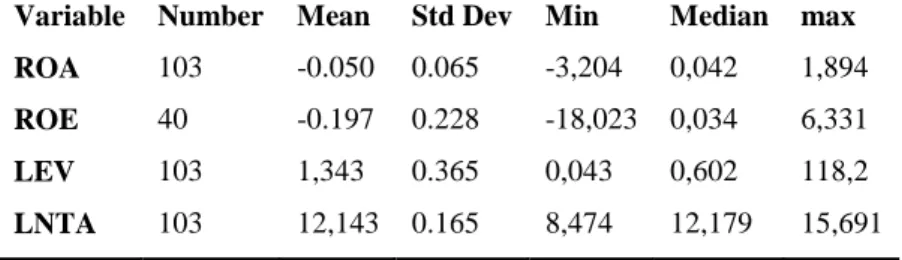
Table 12: Descriptive Statistics
Variable Number Mean Std Dev Min Median max ROA 103 -0.050 0.065 -3,204 0,042 1,894 ROE 40 -0.197 0.228 -18,023 0,034 6,331 LEV 103 1,343 0.365 0,043 0,602 118,2 LNTA 103 12,143 0.165 8,474 12,179 15,691
The Table 12 presents descriptive statistics for dependent and independent variables of the operating performance model. The ROE (return on equity) was introduced as a independent variable because this variable was also used in former studies as a measured of operating performance, according to the literature, but not as the preferred one. The mean of ROA is negative of 5% (median 4.2%). The mean of ROE is smaller, with -20% (median 3.4%), and also has one less observation because the sample has an outlier with a huge impact at results. The leverage mean is very high about 134% (median 60%), which can be justified by the existence of some companies in the sample technically bankrupt (18%).
Table 13: Pearson correlation coefficients
Variable ROA ROE RATING_FLI LEV LNTA
ROA 1,000
ROE 0,435 1,000
RATING_FLI 0,433 0,131 1,000
LEV -0,750 -0.025 -0,321 1,000
LNTA 0,348 0,172 0,489 -0,373 1,000
The Table 13 presents the Pearson correlation coefficients between the dependent and independent variables of the operating performance model. The dependent variable ROA is positively correlated with RATING_FLI, as well as the dependent variable ROE, although less correlated with the this independent variable. Only the correlation of ROA and RATING_FLI is statistically significant. The highest absolute value of the correlations among the independent variables is 0.75, which is indicative that the regression results might not be affected by multicollinearity. According to [6], the financial difficulties of small business owners fall into three categories: loss of revenues, insufficient cash-flow, and excessive debt. Generally, in most companies the loss of revenue is related with the economy recession, which, of course, is not controllable by business owners. However, insufficient cash flow and excessive debt are both areas that small business owners can manage, given sufficient Financial Literacy. In the sample of the present work, excluding sole proprietorship businesses, 31% have
244
negative ROA in 2017, however only 37% were experiencing historical losses of revenue, in the last 3 years, on average higher than 5% per year. And, the majority of the referred sample (58%) has excess of debt, with a leverage ratio higher than 50%, however only 27% of those companies were facing historical losses of revenue, in last 3 years, on average higher than 5% per year, which means that the remaining 73% companies with excess of debt and the remaining 63% with negative ROA can possibly improve it with appropriate financial education. Table 14 reports two columns of results of the OLS regression analysis, using as the independent variable the ROA, the first with the inclusion of 12 variables dummies for industry activity and the other without the inclusion. The ROE was not included due to its non-statistically significant correlation with the dependent variable RATING_FLI according to Pearson correlation coefficients.
Table 14: Results of OLS Regression of Adapted Operating Performance Model
Variable ROA
Coefficient estimate (t-statistic)
Interest -0.226 (-0.433) -0.144 (-0.395) RATING _FLI 0.103** (2,308) 0.118*** (2.755) LEV -0.110*** (-8.124) -0.121*** (-9.131) LNTA -0.004 (-0.133) -0.121 (-0.192)
Industry dummies Included -
R2 71.3% 60.4%
Adjusted R2 65.3% 59%
Std deviation 0.36 0.39
N 103 103
Degrees freedom 72 84
At both regressions, the variables RATING and LEV are statistically significant. The exception is in the variable LNTA, although it was also regressed this model replacing this variable by the total assets of firms and the results also did not evidence statistical significance. The doubt of whether or not include the dummy variables for industry activity was solved by the F test of quality improvement of the adjustment (Table 15), with the following hypothesis tests.
- H0: Coefficients associated to the 12 dummies all simultaneously equal to zero. - H1: At least one is different of zero.
245
Table 15: Quality Improvement of the Adjustment – F test
For a confidence level of 95%, is rejected H0(Fobs >Fcrit) which allow to conclude that the introduction of the 12
industry dummies significantly contributes for the quality improvement of the adjustment. The regression of the adapted model (Table 14, column 1) exhibit a good explanatory power, with an adjusted R-squared of 65%, and the independent variable, RATING_FLI, has a positive relation with the ROA, also statistically significant, for a confidence level of 95%. These results evidence that a higher financial literacy level of small business owners contribute for a better performance of their firms, alongside with the rather low financial literacy level of entrepreneurs found at this research, this increases the need for financial education.
5. Conclusions and Recommendation
5.1. Conclusion
This research has twofold objective: to assess financial literacy levels of small business owners of the Hossana town and correlate this results with the performance of their firms. In order to achieve the first goal was used a questionnaire methodology, similarly to the major works developed so far for personal finance issues. Being the questionnaire composed by four major areas: respondent characteristics; financial knowledge, financial behavior and financial attitudes. The last three components provide from financial literacy definition world widely accepted [11]. The second goal was achieved through the adaptation of the operating performance model of [10]. The sample used to assess the financial literacy level sum 250 respondents, a number that ensures its representativeness, and they where mainly from Hossana Town, following the distribution of firms across the south of the country. The results evidence that small business owners tend to overestimate their capacities, since only 11% admitted to have a rather low level of financial literacy, when the results exhibited to be four times higher in number of small business owners in this situation. Also it showed that small business owners have the right attitude towards financial matters, however their financial behavior does not follow this trend.
The lower financial literacy levels are associated with firms with null or negative ROA, measure used as a proxy for firms‟ performance. This result strengthened the need for a deeper analyze of the relation between financial literacy levels of small business owners and their firms‟ performance. The regression of the adapted model using exhibits a positive correlation between financial literacy rating and ROA, with statistical significance. This allows to conclude that a higher financial literacy level of small business owners contribute for a better performance of their firms. And, alongside, with the rather low financial literacy level of entrepreneurs found at this research, this strengthens the needs for financial education for this specific public. The major contributes of the present research are the improvements at evaluation methodology in assess the financial literacy levels among small business owners; study for the first time the relation between financial literacy levels and firms‟ performance, and, considering the evidence of a positive relation between this two variables, aware for the needs
246
of adequate financial education for small business owners on the expectation of improving their performance as business leaders. With an adequate program of financial education is expected an improvement of financial literacy levels, a reduction of the risk of small business owners experience financial difficulties due controllable factors, like excessive debt, and minimize the number of small business owners that are mere employees of their companies to become business leaders
5.2. Recommendation
The study recommends that SMEs should consider enrolling in financial literacy program or any other related programs to enhance their capability. Considering the fact that majority of SMEs in informal sector scored poorly in performance and financial literacy, in the three sub cities, thus the governments and national government needs to ensure that all SMEs have the basic financial literacy. This is very important owing to the fact that, SMEs plays a paramount role in economy and growth in this sector means growth in economy. Book keeping skills require a longer duration for trainees to master the skills. Accordingly, the Micro and Small Enterprise Authority charged with a mandate to do capacity building of MSEsshould in collaboration with village Youth training on book keeping skills for MSEs on a train the trainer approach whereby instructors in the Youth Polytechnics can be used to train MSEs having been trained by MSEA. Youth polytechnics are easily reachable and training programmes can be organized at the convenience of the participants. This would help ensure that all SMEs have basic book keeping literacy. Incorporate financial education in the school curriculum from Primary level so that individuals are financially informed early in life. Business studies as a subject was removed from primary school curriculum in Ethiopia and is an elective at secondary level.
Reference
[1] Atkinson, A., and Messy, F. A. (2011). Assessing Financial Literacy in 12 Countries: An OECD/INFE International Pilot Exercise. Journal of Pension Economics and Finance, 10(4), 657-665.
[2] Huston, S. J. (2010). Measuring Financial Literacy. Journal of Consumer Affairs, 44(2), 296-16.
[3] Lusardi, A., and Mitchell, O. S. (2011b). Financial Literacy around the World: An Overview. Journal of Pension Economics and Finance, 10(4), 497-508. 50
[4] Brown, R. B., Saunders, M. N. K., and Beresford, R. (2006). You owe it to yourself: The financially literat e manager. Accounting Forum, 30(2), 179- 191. doi: 10.1016/j.accfor.2006.03.001
[5] Banco de Portugal (2014). Análise Sectorial das Sociedades não Financeiras em Portugal 2009-2014.
[6] Pearl, D., and Eileen, R. g. (2014). Financial Literacy and the Success of Small Businesses: An Observation from a Small Business Development Center. Numeracy, 7(1).
[7] Marcoli, S. and Abraham, A. (2006), “Financial Literacy Research: Current Literature and Future Opportunities”, International Conference on Contemporary Business (3rd : 2006 : Leura, N.S.W.)
247
[8] Banco de Portugal 2010. Relatório do Inquérito à Literacia Financeira da População Portuguesa.
[9] Couto, F. (2013), Financial literacy of entrepreneurs of Portugal “Literacia Financeira e Empreendedorismo em Portugal”, Dissertação, Faculdade de Economia do Porto.
[10] Bauwhede, H. V. (2009). On the relation between corporate governance compliance and operating performance. Accounting & Business Research (Wolters Kluwer UK), 39(5), 497-513.
[11] Atkinson, A., and Messy, F. (2012). Measuring Financial Literacy: OECD Publishing
[12] Schagen, S. and Lines, A. (1996). Financial literacy in adult's life: A. Report of the NatWest Group Charitable Trust. Berkshire: National Foundation for Educational Studies,
[13] Remund, D. L. (2010). Financial Literacy Explicated: The Case for a Clearer Definition in an Increasingly Complex Economy. Journal of Consumer Affairs, 44(2), 276295.
[14] Sage 2012. Sage Canadian Small Business Financial Literacy Survey.
[15] Lusardi, A., and Mitchell, O. S. (2009). How Ordinary Consumers Make Complex Economic Decisions: Financial Literacy and Retirement Readiness. National Bureau of Economic Research, Inc, NBER Working Papers: 15350.
[16] Financial capability study in the United States. (2010). 401K Advisor, 17(1), 11-11.
[17] Lusardi, A., Mitchell, O. &Curto, V. (2010). Financial Literacy among the Young, Journal of Consumer Affairs, Summer, 358 – 380
[18] Lusardi, A., and Mitchell, O. S. (2011a). Financial Literacy and Planning: Implications for Retirement Wellbeing. National Bureau of Economic Research, Inc, NBER Working Papers: 17078.
[19] Rutherford, M., McMullen, P. & Oswald, S. (2001). Examining The Issue Of The Size And The Small Business: A Self Organized Map Approach. Journal of Business Economic Studies, 7(2): 64-81.
[20] Jacob, K., Hudson, S., & Bush, M. (2000). Tools for survival: An analysis of financial literacy programs for lower-income families. Woodstock Institute, Chicago.
[21] Karides, M. (2005). „Whose Solution Is It? Development Ideology And The Work Of Micro-Entrepreneur In Carribean Context.‟ International Journal of Sociology and Social Philosophy, 25 (½): 30-62.
[22] Leiber, N. (2010). „Yet another blow to small business credit.‟ <http://search.ebscohost.com/login.aspx?d irect=true&db=bth&AN=51806230&site=bsilive Accessed October 12.2018
248
[23] Jacob, K. (2002). Evaluating your financial literacy program: A practical guide. Woodstock Institute, Chicago
[24] Houston, S. J. (2009). The concept and measurement of financial literacy. Journal for Financial Services, 20(6), 36-58
[25] Israel, Glenn D. 1992. Determining Sample Size. Program Evaluation and Organizational Development, IFAS, University of Florida. PEOD-5. November.
[26] D'Agostino, R. B., Belanger, A., and D'Agostino, R. B., Jr. (1990). A Suggestion for Using Powerful and Informative Tests of Normality. The American Statistician, 44(4), 316-321.