Regular Paper
Limits of Thread-Level Parallelism in Non-numerical Programs
Akio Nakajima,
†,☆Ryotaro Kobayashi,
†Hideki Ando
††and
Toshio Shimada
†Chip multiprocessors (CMPs), which recently became available with the advance of LSI technology, can outperform current superscalar processors by exploiting thread-level paral-lelism (TLP). However, the effectiveness of CMPs unfortunately depends greatly on their ap-plications. In particular, they have so far not brought any significant benefit to non-numerical programs. This study explores what techniques are required to extract large amounts of TLP in non-numerical programs. We focus particularly on three techniques: thread partitioning with various control structure levels, speculative thread execution, and speculative register communication. We evaluate these techniques by examining the upper bound of the TLP, using trace-driven simulations. Our results are as follows. First, little TLP can be extracted without both of the speculations in any of the partitioning levels. Second, with the specula-tions, available TLP is still limited in conventional function-level and loop-level partitioning. However, it increases considerably with basic level partitioning. Finally, in basic block-level partitioning, focusing on control-equivalence instead of post-domination can significantly reduce the compile time, with a modest degradation of TLP.
1. Introduction
Chip multiprocessors (CMPs) are expected to be the major next-generation microproces-sors. A CMP exploits thread-level parallelism (TLP) in addition to instruction-level paral-lelism (ILP) by executing multiple threads in parallel. Because of the diminishing returns from investment of resources in the exploitation of ILP, TLP is expected to be a major source of performance improvements.
Recently, commercial CMPs have been an-nounced with expectations of such improve-ments. However, for now, effective applications of CMPs are limited. They are principally in-tended for explicitly parallel applications (e.g., independent multiple programs, on-line trans-action processing (OLTP), and numerical pro-grams). Although the CMP architecture im-proves the performance of such applications4), it brings little benefit to implicitly parallel ap-plications, i.e., non-numerical programs, which form the largest group of computer applica-tions. Many academic studies have been car-ried out2),8),10),12),13),15),16), but unfortunately the speedup so far confirmed relative to a single superscalar processor is insufficient.
In general, two approaches are available to †Department of Electrical Engineering and
Com-puter Science, Nagoya University
††Department of Computational Science and Engi-neering, Nagoya University
☆Presently with Hitachi Ltd.
find solutions to this problem. One is a bottom-up approach that consists in proposing a tech-nique and evaluating the amount of TLP in a particular architecture. The other is a top-down approach that consists in examining the amount of TLP contained in a program by im-posing only constraints associated with a par-ticular technique and relaxing all other con-straints. A study of the latter approach is called a limit study, because the TLP obtained is the upper bound. A limit study suggests that the technique is potentially beneficial if the upper bound is large enough; otherwise, it is definitely inadequate.
A pioneering investigation of TLP limit stud-ies for non-numerical programs was carried out by Lam and Wilson9). Their study focuses on control flows when partitioning a program into threads, and shows that the limit of paral-lelism becomes much higher than that of single-thread execution if a program is partitioned into control-independent threads at the basic block level. The results of this study are quite encouraging as regards the possibility of build-ing a CMP for non-numerical programs, but there is still scope for further investigation.
We are interested in two aspects of techniques that can significantly affect the limit of TLP. One is the level of partitioning. In general, a compiler partitions a program into threads based on control structures, and the level of a control structure for thread partitioning is the source of TLP. The levels that usually exist 12
are functions, loops, and basic blocks. Function and loop levels are often used in traditional nu-merical parallelizing compilers (e.g., Stanford SUIF3)), because parallelism at those levels is generally abundant in numerical programs. We question whether those levels also have a suf-ficient amount of TLP in non-numerical pro-grams, or whether the compiler must further search for TLP at a lower level (i.e., the ba-sic block level). Basic block level partition-ing is costly in compile time, and it imposes more overhead related to parallel thread ex-ecution (e.g., inter-thread communication and thread creation) because the size of a thread is small relative to that in the upper levels. Fur-thermore, it is technically undeveloped, though some studies have been carried out6),16). Thus, loop or function levels may be more desirable if their upper bound is large enough.
Another aspect we are interested in is tech-niques for relaxing control dependence con-straints. Intuitively, control dependences can severely limit the amount of available paral-lelism unless special care is taken, because con-ditional branches frequently appear in non-numerical programs. However, their nega-tive effect can be minimized if the compiler successfully partitions a program into control-independent threads with sufficient parallelism. This study introduces speculative thread execu-tion and speculative inter-thread register com-munication as techniques for relaxing control dependence, and explores their effect on the TLP limit.
The remainder of this paper is organized as follows. Section 2 explains the basic as-sumptions of a multiprocessor and the proces-sor cores in our simulation. Section 3 models thread execution associated with thread parti-tioning levels. Section 4 describes the specula-tive thread execution and register communica-tion. Section 5 presents evaluation results. Sec-tion 6 compares our study with previous work. Finally, Section 7 concludes the paper.
2. Basic Assumptions
This section describes our basic assump-tions about processor cores and multiproces-sors. They are common to any model examined here in our simulation.
2.1 Processor Core
Each processor core in the multiprocessor fetches all instructions on the branch-predicted path simultaneously with infinite bandwidth
until a mispredicted branch is encountered. No instruction can be fetched until the immedi-ately preceding mispredicted branch has been executed. We assume a local-history two-level branch predictor, PAs17), with sufficiently large tables. No branch misprediction penalty is im-posed. Fetched instructions are stored in an instruction window of infinite size. Those in-structions whose data dependences are resolved are then issued and executed simultaneously. The latency of any instruction is a single cy-cle. The number of registers is assumed to be infinite, and thus all of the anti- and output dependences are resolved by register renaming. In addition, memory disambiguation is ideally removed. The issue width, function units, and memory ports are assumed to be infinite, and consequently no resource constraints exist. We call this model theSP model.
We further define the ORACLE model to find the upper bound of parallelism in our experi-ment. It has perfect branch prediction, and the execution order of its instructions is constrained only by true data dependences.
2.2 Multiprocessor
An infinite number of threads can be exe-cuted simultaneously with an infinite number of processor cores. Memory is shared, with an infinite number of ports having a single-cycle access latency. A thread is created at a fork point with zero-cycle latency. Thread creation is performed non-speculatively on control de-pendences unless explicitly described; that is, a thread is created when the control is guaranteed to reach its fork point.
Register values are communicated directly, not via memory, among threads. Note that this is not a radical assumption in a CMP7),8),15). Register communication has a zero-cycle la-tency with infinite bandwidth, and it is per-formed non-speculatively on control depen-dences unless explicitly described; that is, a de-fined value in a thread is sent to the consumer threads when the definition is found toreach1)
the consumer after resolution of control depen-dences (a detailed discussion will be provided in Section 4.2). On the other hand, in mem-ory value communication, the last definition of a memory variable is assumed to be known a priori. More generally, memory disambiguation among threads is assumed to be perfect.
3. Models of Thread Partitioning Lev-els
This section first describes the definitions of models associated with thread partitioning lev-els, and then gives a small example that ex-plains the models.
3.1 Model Definitions
We define the following four models:
• TheFC modelpartitions a program at the function level. It attempts to create a new thread that contains a callee function at each function call. The current thread con-tinues beyond the function call.
• TheLP model partitions a program at the loop level. It attempts to create N new threads at the header of the loop, where
N is the number of loop iterations. Each thread contains each single-loop iteration other than the first iteration, and the por-tion succeeding to the loop; the first iter-ation is contained in the current thread. The model knows N a priori, even if it is determined only dynamically. This implies perfect speculation regarding the control of loop iteration, unlike other models. We in-troduce this perfection to ascertain the up-per bound of the loop-level partitioning. • ThePD modelpartitions a program at the
basic block level. At the top of each basic block, the model attempts to create new threads, where each starts from its post-dominating18)block. Note that block Y is said to post-dominate X if Y appears on any path from X to the EXIT on the con-trol flow graph. From the definition, the created threads are control-independent of the current thread.
• The CE model also partitions a program into control-independent threads at the ba-sic block level, like the PD model, but lim-its the starting point of a new thread to a control-equivalent14) block, not a post-dominating block. Note that block X is control-equivalent with block Y if X dom-inates1) Y and Y post-dominates X. Al-though there are various situations in titioning of the CE model, typically it par-titions a program at the IF-THEN-ELSE level. While the PD model can create a new thread from any part of the IF, THEN, and ELSE, the CE model can only create a new thread from the IF part. Therefore, the number of candidates of partitioning is
reduced. This makes it possible to reduce the calculation cost incurred by the com-piler for selecting beneficial partitioning. In any model, instructions within a thread are executed as in the SP model.
In our simulation, we optimally partition a program by referring to a trace. We first calcu-late the partitioning candidates associated with a model. Then, in the order that appears on the trace, we simulate instruction execution for each candidate for cases of both partitioned and non-partitioned programs for sufficient long cy-cles. If the partitioning is found to be benefi-cial, the candidate is adopted; otherwise, it is discarded.
To examine the upper bound, we perform perfect function inlining; that is, we ignore dependences caused by the conventions of register-use and function call. For example, we ignore all operations of stack frame alloca-tion and deallocaalloca-tion, and those of saving and restoring preserving registers. Also, we ignore loop induction variables, because they severely limit parallelism as loop-carried dependences, but can be easily removed by the compiler.
3.2 Example
We explain the ORACLE, SP, FC, LP, and PD models, using a small-scale example. The CE model is omitted because it can be easily understood from the PD model.
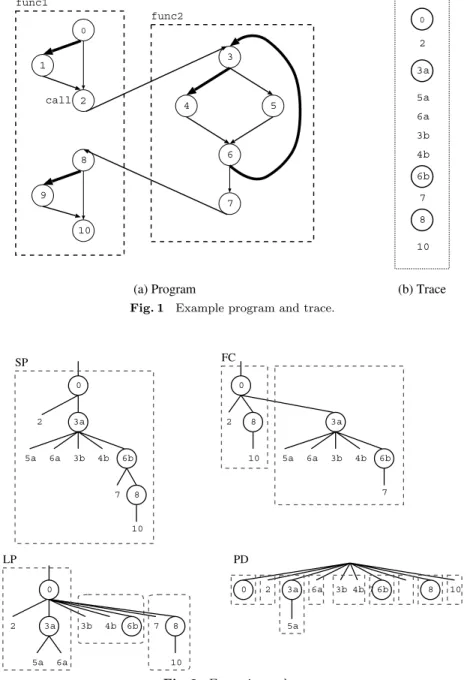
Consider a program presented by the con-trol flow graph shown inFig. 1a. The program consists of two functions: func1 and its callee func2. Assume for the sake of simplicity that each node representing a basic block has a single instruction that is numbered, and that there are no data dependences among the instructions. The edges represent control flows. Branch pre-dicted flows are highlighted by bold edges.
Consider the trace of this program shown in Fig. 1b. A letter a or b is attached to each instruction number to distinguish the specific instance if necessary. Mispredicted branch in-structions are circled.
The execution order in each model is shown in Fig. 2. The instructions in a rectangle with a broken outline compose a single thread. The instructions at the same level are executed si-multaneously. Here, for the sake of simplicity, we do not consider the benefit of partitioning, and instead show all of the partitioning dates. As explained before, we discard candi-dates that are not beneficial in our simulation. The ORACLE model executes all of the
in-Fig. 1 Example program and trace.
Fig. 2 Execution order.
structions simultaneously, because there are no data dependences (we omit the figure). The SP model simultaneously fetches instructions between mispredicted branches, and executes them in the order that satisfies data depen-dences. In this example, because there are no data dependences, all of the fetched instruc-tions are executed simultaneously. The FC model creates a new thread with func2 when call instruction2is fetched. The LP model cre-ates two new threads when instruction 3a in
the loop head is fetched: the second iteration of the loop and the instructions succeeding to the loop. Note that the first iteration is included in the current thread. The PD model creates new threads starting from 2, 3a, 6a, 3b, 6b, 7, 8, and 10 when instruction 0 is fetched, because the blocks to which these instructions belong post-dominate the block to which instruction0 belongs.
4. Relaxation of Control Dependence This section describes speculative thread exe-cution and register communication, which relax control dependences.
4.1 Speculative Thread Execution We can easily infer that control dependences significantly limit TLP in non-numerical pro-grams, because branches frequently appear. Thus, speculative thread execution on branches should have a great benefit. Control spec-ulation generally relies on branch prediction to maximize the benefit. Although poten-tially there are many ways to realize specula-tive thread execution, we believe that there are three approaches: One relies on static branch prediction. The compiler predicts a likely path, and adequately partitions the path. Another approach relies on dynamic branch prediction. The compiler partitions a program into threads in such a way that a newly created thread has no control dependences on its fork point. How-ever, at run time, the new threads are created and start execution soon after the fork point is speculatively fetched. The third approach com-bines both of the approaches described above.
It is difficult to determine which approach is the best, because the first approach has a disad-vantage in that it relies on low-accuracy static branch prediction, the second approach limits the opportunity for partitioning to static con-trol independence, and the third approach is complicated. While this is an important issue, it is beyond the scope of this study. In our sim-ulation, we adopt the second approach. That is, if the fetched predicted path between consecu-tive mispredicted branches includes fork points, each immediately and simultaneously creates new threads.
4.2 Speculative Register Communica-tion
As explained in Section 2.2, register commu-nication must wait until the definition is deter-mined to reach the consumer. We explain this constraint using the following code example:
i0: r1 = 1; i1: if (r2) i2: r1 = 2; i3: r3 = r1;
Consider that we partition this program into two threads: (i0,i1,i2) and (i3). Instruction i3uses registerr1, but which of the register val-ues defined byi0andi2will reach instruction i3 is unknown before branch i1 is executed.
Consequently, the communication of registerr1 will be delayed until the branch execution, con-straining TLP.
We can relax this constraint by introducing speculative register communication that relies on branch prediction. That is, a register value can be sent if the definition of that register is found to be the last on the predicted path. In the example above, assume that branch i1 is predicted to be untaken. In this case, the value of r1is sent immediately afteri0is executed, without waiting for the execution of branchi1. In our simulation, if the fetched instructions on the predicted path between consecutive mis-predicted branches include a last register def-inition instruction in the current thread, such a register is immediately communicated to the following threads.
5. Evaluation Results
We built a trace-driven simulator for evalua-tion. The trace is collected using the simulator from SimpleScalar Tool Set Version 3.0a5). The instruction set is the SimpleScalar/PISA, which is an extension of the MIPS R10000 instruction set11). We use eight benchmark programs of SPECint95.
5.1 Thread Partitioning Levels and Control-Speculations
This section evaluates the effect of thread partitioning levels on TLP, with and without speculative thread execution and register com-munication.
Figures 3, 4, 5, 6show the values of TLP in the LP, FC, PD, and CE models, respec-tively. We define the speedup or the TLP for each model as the IPC of the corresponding model divided by that of the SP model. The four bars for each benchmark program repre-sent the TLP with four different speculation techniques: no speculation, speculative thread execution only, speculative register communi-cation only, and both the speculations. As a reference, Table 1 shows the IPCs for the SP and ORACLE models as well as the speedup of the ORACLE model over the SP model.
As shown in Fig. 3, the FC model exhibits little TLP without the control speculations in any benchmark program. This is not surpris-ing, because branches are very frequent in non-numerical programs, and consequently con-trol dependence constraints severely limit TLP. Since functions are often data-independent, considering the programming abstraction
man-Fig. 3 TLP of the FC model.
Fig. 4 TLP of the LP model.
Fig. 5 TLP of the PD model.
ner, we expected high TLP if the speculations were introduced. Surprisingly, however, the TLP is still low in most benchmark programs. We believe the reason for this to be that the overlap executions of multiple functions are lim-ited because there are many branches between function calls; branch misprediction sequential-izes function execution even though data depen-dences among functions are fairly loose. The only exceptions are m88ksim and vortex. Those benchmark programs exhibit high TLP with both the speculations. This is because many dominant function calls fortunately depend on a small number of branches, and also these
Fig. 6 TLP of the CE model.
Table 1 IPCs of the SP and ORACLE models.
IPC ORACLE
Benchmark SP ORACLE Speedup compress95 6.4 205.7 32.0 gcc 7.8 275.2 35.5 go 4.5 139.6 31.1 ijpeg 22.7 245.1 10.8 li 8.6 69.5 8.1 m88ksim 6.8 481.9 71.3 perl 10.0 173.2 17.3 vortex 38.3 815.8 21.3 G.M. 10.2 234.6 23.1
Table 2 Weighted average number of loop iterations. Loop Benchmark Iterations compress95 8.2 gcc 2.4 go 2.9 ijpeg 16.8 li 2.4 m88ksim 2.8 perl 3.2 vortex 2.4
branches are highly predictable.
The TLP of the LP model is severely lim-ited, as shown in Fig. 4. The first reason for this is that the number of loop iterations is generally very small. Table 2 shows the av-erage number of loop iterations, weighted by the number of times that the control entered each loop. The only programs for which we can expect high potential TLP are compress95 and ijpeg. These programs have a few dom-inant loops that iterate many times (approxi-mately 50% in the dynamic instruction count), but they also have many loops with small it-erations. The fraction of the execution time with such loops of small iterations limits the TLP by Amdahl’s law. Moreover, as long as we look at the dominant loops in these pro-grams, they have loop-carried dependences that
severely limit the TLP.
Since the PD model can create many control-independent threads beyond many branches without a rigid control structure constraint, un-like the FC and LP models, we expected that control dependence constraints would have a weak effect on TLP. Unexpectedly, however, control-dependence constraints strongly limit TLP, as in the FC and LP models (see Fig. 5). The TLP is only 1.7 on average, though it is larger than that of the FC and LP mod-els. However, either speculative thread execu-tion or speculative register communicaexecu-tion in-creases the TLP. Combined, the speculations significantly further increase the TLP to 10.3 on average. The reason speculative thread ex-ecution is effective in the PD model is as fol-lows. The PD model tends to create many new control-independent threads soon after the cur-rent thread is created. Considering that there is no control dependence among the current and newly created threads, the created threads de-pend on only a small number of branches. Since a control path with a small number of branches is highly predictable with the dynamic branch predictor, speculative thread execution effec-tively relaxes the control dependence constraint on threads. A similar argument can be made for the effectiveness of speculative register commu-nication.
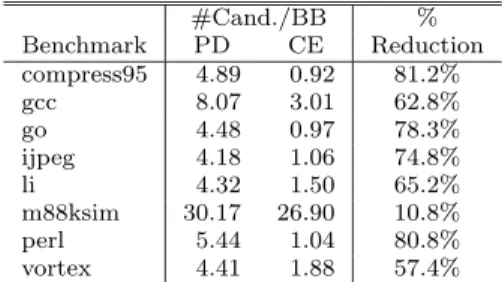
As can be seen by comparing Fig. 6 with Fig. 5, the CE model exhibits a similar amount of TLP to that of the PD model. The degra-dation from the PD model is only 11% on av-erage. On the other hand, the amount of com-putation the compiler needs to do for partition-ing is dramatically decreased. Table 3shows the number of static partitioning candidates per basic block in the PD and CE models, and the percentage reduction realized by use of the CE model. As shown in the table, the num-ber of partitioning candidates is significantly
re-Table 3 Number of partitioning candidates per basic block and percentage reduction.
#Cand./BB % Benchmark PD CE Reduction compress95 4.89 0.92 81.2% gcc 8.07 3.01 62.8% go 4.48 0.97 78.3% ijpeg 4.18 1.06 74.8% li 4.32 1.50 65.2% m88ksim 30.17 26.90 10.8% perl 5.44 1.04 80.8% vortex 4.41 1.88 57.4%
duced in most benchmark programs. Therefore, partitioning focusing on control-equivalence is attractive in terms of the extraction of large amounts of TLP with a short compilation time.
6. Related Work
Olukotun et al. compared the performance of a CMP with a traditional architecture to a wide-issue single superscalar processor under the same die size12). They found that the par-allelism achieved by the two processors is com-parable in non-numerical programs, but they concluded that the CMP would outperform the single processor because of the advantage of the high clock rate. More recently, the Compaq Pi-ranha project carried out similar performance comparisons on OLTP by designing a chip4). They extrapolated from their ASIC design to a custom design that a CMP with eight simple processor cores delivers five times the OLTP performance of a more complex single super-scalar processor. Unlike those studies, we ex-plore the upper bound of the TLP with various parallel execution techniques in abstract ma-chines.
As mentioned in Section 1, Lam and Wilson did pioneering work in a TLP limit study9). They found that high TLP can be achieved if a program is partitioned into control-independent threads. Unlike their study, ours explores the effectiveness of various thread partitioning lev-els and control speculations.
7. Conclusions
In this paper, we have measured the limits of TLP in non-numerical programs to determine the effectiveness of three techniques: thread partitioning with various control structure lev-els, speculative thread execution, and specula-tive register communication. We found that, without the control speculations, little TLP is extracted from the loop and function levels, though a small amount is extracted from the basic block level. On the other hand, with the control speculations, although their effective-ness is limited at the loop and function levels, a large amount of TLP is obtained from the basic block level. In other words, basic block-level partitioning with the control speculations is essential to obtain high TLP.
Multithreading at the basic block level is im-mature, unlike that at the function and loop levels. In real systems, there are many hur-dles to overcome in all areas, from compilers
to hardware. One of the issues is the large overhead related to parallel thread execution including thread creation and inter-thread com-munication. The size of a thread at the basic block level usually becomes small in compar-ison with that at the conventional levels, im-plying that the overhead is frequently imposed. With the advantage of integration into a sin-gle chip, CMP implementation can allow this overhead to be small in comparison with tra-ditional on-board implementation, but further architectural research must be carried out to boost performance to a satisfactory level.
Another issue of concern is the mispredic-tion penalty of control speculamispredic-tions. Because we focused on investigating the upper bound, we did not take misprediction penalties into ac-count. However, in real systems, misprediction penalties considerably degrade performance un-der high TLP execution. To decrease the mis-prediction penalty, we must find branch pre-dictors with higher accuracy, along with meth-ods of recovering from misprediction with very small penalties.
From a software point of view, compile time is a concern. The compiler must optimally se-lect beneficial partitions from a vast number of partition candidates, and the compile time in-creases according to the number of candidates. In this study, we have described a method that focuses on control-equivalence rather than post-domination. This method significantly reduces the size of the candidate set with a modest degradation of TLP.
References
1) Aho, A.V., Sethi, R. and Ullman, J.D.: Compilers: Principles, Techniques, and Tools, Addison-Wesley Publishing Company, Read-ing, MA (1986).
2) Akkary, H. and Driscoll, M.: A Dynamic Mul-tithreading Processor,Proc. 31st Int. Symp. on Microarchitecture, pp.226–236 (1998).
3) Amarasinghe, S., Anderson, J., Lam, M. and Tseng, C.: The SUIF Compiler for Scalable Parallel Machines, Proc. Seventh SIAM Conf. on Parallel Processing for Scientific Computing (1995).
4) Barroso, L.A., Gharachorloo, K., McNamara, R., Nowatzyk, A., Qadeer, S., Sano, B., Smith, S., Stets, R. and Verghese, B.: Piranha: A Scal-able Architecture Based on Single-Chip Mul-tiprocessing, Proc. 27th Int. Symp. Computer Architecture, pp.39–51 (2000).
5) Burger, D. and Austin, T.M.: The
Sim-plescalar Tool Set, Version 2.0, Technical Re-port CS-TR-97-1342, University of Wisconsin-Madison (1997).
6) Kasahara, H., Honda, H., Mogi, A., Ogura, A., Fujiwara, K. and Narita, S.: A Multi-grain Parallelizing Compilation Scheme for OSCAR (Optimally Scheduled Advanced Multiproces-sor),Proc. Fourth Int. Workshop on Languages and Compilers for Parallel Computing, pp.856– 864 (1991).
7) Keckler, S.W., Dally, W.J., Maskit, D., Carter, N.P., Chang, A. and Lee, W.S.: Ex-ploiting Fine-Grain Thread Level Parallelism on the MIT Multi-ALU Processor, Proc. 25th Int. Symp. on Computer Architecture, pp.306– 317 (1998).
8) Kobayashi, R., Iwata, M., Ogawa, Y., Ando, H. and Shimada, T.: An On-Chip Multiproces-sor Architecture with a Non-blocking Synchro-nization Mechanism,Proc. 25th EUROMICRO Conference, pp.432–440 (1999).
9) Lam, M.S. and Wilson, R.P.: Limits of Control Flow on Parallelism,Proc. 19th Int. Symp. on Computer Architecture, pp.46–57 (1992). 10) Marcuello, P., Gonzales, A. and Tubella, J.:
Speculative Multithreaded Processors, Proc. 1998 International Conference on Supercom-puting, pp.13–17 (1998).
11) MIPS Technologies, Inc.: MIPS R10000 Pro-cessor User’s Manual, Version 2 (1996). 12) Olukotun, K., Nayfeh, B.A., Hammond, L.,
Wilson, K. and Chang, K.: The Case for a Single-Chip Multiprocessor,Proc. Seventh Int. Conf. on Architectural Support for Program-ming Languages and Operating Systems, pp.2– 11 (1996).
13) Park, I., Falsafi, B. and Vijaykumar, T.N.: Implicitly-Multithreaded Processors,Proc. 30th Int. Symp. Computer Architecture, pp.39–51 (2003).
14) Smith, M.D., Horowitz, M.A. and Lam, M.S.: Efficient Superscalar Performance through Boosting, Proc. Fifth Int. Conf. on Architec-tural Support for Programming Languages and Operating Systems, pp.248–259 (1992). 15) Sohi, G.S., Breach, S.E. and Vijaykumar,
T.N.: Multiscalar Processor, Proc. 22nd Int. Symp. on Computer Architecture, pp.414–425 (1995).
16) Vijaykumar, T.N. and Sohi, G.S.: Task Selec-tion for a Multiscalar Processor,Proc. 31st Int. Symp. on Microarchitecture, pp.81–92 (1998). 17) Yeh, T-Y. and Patt, Y.: Two-Level
Adap-tive Branch Prediction, Proc. 24th Int. Symp. and Workshop on Microarchitecture, pp.55–61 (1991).
for Parallel and Vector Computers, Addison-Wesley Publishing Company, Inc., New York, NY (1991).
(Received September 21, 2005) (Accepted December 2, 2005)
Akio Nakajima was born in 1978. He recieved the B.E. and M.E. degrees from Nagoya Uni-versity in 2002 and 2004, respec-tively. Since 2004, he has been engaged in research and develop-ment on disk array subsystems at Systems Development Laboratory, Hitachi, Ltd.
Ryotaro Kobayashireceived his B.E., M.E., and D.E. de-grees from Nagoya University in 1995, 1997, and 2001, respec-tively. Since 2000 he has been a research assistant in Nagoya University. His research inter-ests include computer architecture and multi-threaded architecture. He is also a member of IEEE and IPSJ.
Hideki Ando received the B.S. and M.S. degrees in elec-tronic engineering from Osaka University, Suita, Japan, in 1981 and 1983, respectively. He re-ceived the Ph.D. degree in infor-mation science from Kyoto Uni-versity, Kyoto, Japan, in 1996. From 1983 to 1997 he was engaged in the research and development of digital signal processors for ISDN, microprocessors for inference machines of the Japanese fifth-generation computer sys-tems project, and general-purpose VLIW ma-chines at the LSI Research and Development Laboratory, Mitsubishi Electric Corporation, Itami, Japan. From 1991 to 1992 he was a visiting scholar of Stanford University. In 1997 he joined the faculty of Nagoya University, Nagoya, Japan, where he is currently a Profes-sor in the department of computational science and engineering. His research interests include computer architectures and compilers.
Toshio Shimadareceived his B.S. and M.S. degrees in Mathe-matical Engineering and Instru-mentation Physics in 1968 and 1970 respectively from Tokyo University. He received his Ph.D. degree in Information Sci-ence and Technology in 1992 from Tokyo Uni-versity. He had worked at Electrotechnical Lab-oratory from 1970 to 1992. He is currently a professor at Nagoya University. Dr. Shimada’s research interests involve low power consump-tion processors and special purpose LSI.