SPEC Kit 326
Digital Humanities
November 2011
Tim Bryson
Librarian for South Asian Studies and Religious Studies Emory University
Miriam Posner
Mellon Postdoctoral Research Associate Emory University
Alain St. Pierre
Humanities Librarian for European History and Philosophy Emory University
Stewart Varner
Digital Scholarship Coordinator Emory University
Series Editor: Lee Anne George SPEC Kits are published by the Association of Research Libraries
21 Dupont Circle, NW, Suite 800 Washington, DC 20036-1118 P (202) 296-2296 F (202) 872-0884 http://www.arl.org/resources/pubs/spec/ [email protected] ISSN 0160 3582 ISBN 1-59407-870-X 978-1-59407-870-5 Copyright © 2011
This compilation is copyrighted by the Association of Research Libraries. ARL grants blanket permission to reproduce and distribute copies of this work for nonprofit, educational, or library purposes, provided that copies are distributed at or below cost and that ARL, the source, and copyright notice are included on each copy. This permission is in addition to rights of reproduction granted under Sections 107, 108, and other provisions of the US Copyright Act.
The paper used in this publication meets the requirements of ANSI/NISO Z39.48-1992 (R1997) Permanence of Paper for Publications and Documents in Libraries and Archives.
SPEC
Kit 326
Digital Humanities
November 2011
Survey reSultS
Executive Summary ... 11 Survey Questions and Responses ... 15 Responding Institutions ... 62
repreSentative DocumentS
Mission/PurposeUniversity of Alabama
Alabama Digital Humanities Center ...66 Alabama Digital Humanities Center | Mission/History ...67
Boston University
A Cyberinfrastructure for Research and Learning in a Digital Culture ...68
Case Western Reserve University
Freedman Center ...69 Freedman Center Mission and Vision...70
Columbia University
Digital Humanities Center...71 Mission and Program of the DHC ...72
Georgia Tech
Scholarly Communication and Digital Services | Our Mission ...73
University of Illinois at Urbana-Champaign
Scholarly Commons | About Us ...74
Indiana University Bloomington
Institute for Digital Arts and Humanities ...75
Northwestern University
Digital Collections Department ...79
Rice University Center for Digital Scholarship ...80
Rutgers University Scholarly Communication Center ...82
About the Scholarly Communication Center ...83
Margery Somers Foster Center ...84
Sharon A. Fordham Multimedia Resource ...85
University of South Carolina Center for Digital Humanities ...86
University of Virginia Scholars’ Lab ...88
Scholars’ Lab | About Us ...89
Washington University in St. Louis About the Washington University Digital Gateway ...90
Services Emory University Digital Scholarship Commons ...92
DISC > About...93
University of Florida Digital Collection Services ...94
University of Illinois at Urbana-Champaign Digital Humanities ...97
Digital Content Creation Service ...98
University of North Carolina at Chapel Hill Carolina Digital Library and Archives | Services ...99
University of Virginia What is the Scholars’ Lab? ...101
Washington University in St. Louis Washington University Digital Gateway | Support ...104
Policies and Procedures University of Alabama Alabama Digital Humanities Center | Policies ...106
Columbia University Collection Digitization & Exhibition Program Procedures ...107
University of Florida Project Planning Resources for Library Faculty and Staff ...108
Proposal Template for New Digital Collections & Projects ...109
Indiana University Bloomington How to Collaborate with IDAH ...111
University of Miami
Proposal for Digital Initiatives ...113
Rice University Guidelines for Digital Projects ...115
Digital Library Initiative Application Profile ...116
Digital Projects Emory University DISC > Projects > Commonwealth: A Postcolonial Studies Community...124
Commonwealth Project Charter ...125
DISC > Projects > Lynchings in Georgia (1875–1930) ...128
Lynchings Draft Project Charter ...129
University of Florida Digital Programs & Projects ...132
University of Florida Digital Collections ...133
University of Illinois at Urbana-Champaign MONK ...135
University of North Carolina at Chapel Hill Carolina Digital Library and Archives | Our Portfolio ...136
University of Oregon Wired Humanities Projects ...138
Rutgers University Projects of the Margery Somers Foster Center ...139
University of South Carolina Center for Digital Humanities | Projects ...140
University of Virginia Scholars’ Lab | Works in Progress ...142
Fellowships Case Western Reserve University Freedman Fellows Program—Overview...144
Freedman Fellows Program 2011 ...145
Indiana University Bloomington Institute for Digital Arts and Humanities | Fellowships ...146
What Kinds of Faculty Fellow Projects Can IDAH Support? ...148
University of Kansas IDRH co-sponsors three HASTAC Scholars ...149
Grants
Cornell University
Grants Program for Digital Collections in Arts and Sciences ...156
University of Kansas Institute for Digital Research in the Humanities | Seed Grants ...160
University of Massachusetts Amherst Digital Humanities Grants ...161
Promotional Materials Columbia University Digital Humanities Center brochure ...164
University of North Carolina at Chapel Hill Carolina Digital Library and Archives brochure ...170
Documenting the American South brochure ...172
Documenting the American South bookmarks ...174
University of South Carolina Center for Digital Humanities | News ...175
Repositories Cornell University Rose Goldsen Archive of New Media Art ...178
Indiana University Bloomington IUScholarWorks Repository ...179
Ohio State University Knowledge Bank Center ...181
Rice University digital scholarship archive ...182
Rutgers University RUcore | About Rucore ...184
SelecteD reSourceS
Libraries in the Digital Age ...187Digital Humanities and the Library ...188
Digital Humanities: Infrastructure and Evolution ...189
Digital Humanities: Staffing and Support ...189
Data Preservation and Stewardship ...190
executive Summary
IntroductionThe ARL escience survey in 2009confirmed how profoundly and quickly technology has transformed research in the sciences. Research in the humanities is being transformed as well. Digital humanities is an emerging field which employs computer-based technologies with the aim of exploring new areas of inquiry in the humanities. Practitioners in the digital humanities draw not only upon traditional writing and research skills associated with the humanities, but also upon technical skills and infrastructure. A number of research institutions host digital scholar-ship centers or otherwise provide services to help re-searchers design, produce, disseminate, and maintain digital projects. These centers are often, but not always, located in libraries and incorporate library staff or ser-vices into their core programming. Other institutions provide similar services in a less centralized manner. Some services target specific disciplines; others are multidisciplinary. Some institutional initiatives, such as George Mason University’s Center for History and New Media, are well established, while others are still in the planning phase.
This survey was specifically interested in digi-tal scholarship centers or services that support the humanities (e.g., history, art, music, film, literature, philosophy, religion, etc.) The purpose of the survey was to provide a snapshot of research library experi-ences with these centers or services and the benefits and challenges of hosting them. It explored the
orga-questions. The survey was conducted between April 11 and May 13, 2011. Sixty-four of the 126 ARL mem-bers completed this survey for a response rate of 51%.
Ad Hoc Nature of Service
While a great many of the responding libraries do offer support for digital humanities, the survey indicates that they are still developing systematic policies and staffing models for this type of project. In many cases, libraries are piecing together resources from many departments to meet demand as it arises. A number of respondents described their digital humanities sup-port as “a work in progress” or “in development.”
Libraries are likewise developing staffing proce-dures to meet patrons’ needs. While some libraries have staff dedicated to digital humanities, others call on IT staff and librarians as needs arise. Respondents repeatedly described librarians’ roles in digital hu-manities projects as “ad hoc.” A number of respon-dents indicated that their institutions were waiting to determine the full level and complexity of demand before fully staffing support for digital humanities.
Major Trends
While most respondents provide services supporting digital humanities projects, only five (8%) reported that their library hosts a center specifically dedicated to the field. Almost half of the respondents (30 or 48%) provide ad hoc services, and almost a quarter (15 or 24%) host a digital scholarship center that provides
Project Staffing
Most library staff support is improvised and de-pends on the needs of the specific project and the availability of related services in units outside the library. Only 18 respondents (35%) indicated they have any dedicated staff for DH projects, and while one of these reported 16 permanent staff available to sup-port researchers, the majority have fewer than five. Dedicated staff is most often a digital scholarship or digital humanities librarian. Technologists, such as programmers and developers, are the next largest cat-egory. These 18 libraries also call on subject librarians, support staff, and others depending on project need.
Subject librarians are dedicated project staff at only three libraries, but this category is the most likely to be called upon on an ad hoc basis, followed closely by technologists. In comments about other categories of available library staff, about half mentioned includ-ing a metadata specialist, followed by media, pres-ervation, and communication specialists. A few also mentioned design, instructional, repository, archivist, and scanning specialists.
Services and Support
The survey responses suggest that there is a strong desire for digital humanities projects to be closely affiliated with the library. For example, some respon-dents stated that they only support projects that use library collections, while others indicated that they want library staff to participate as partners in projects. This participation most commonly takes the form of high-level support such as consultations and project management for DH projects. Less frequently, there is technical support such as web development, en-coding, and systems administration. Beyond that, support takes the form of traditional library activities such as instructional services, metadata support, and resource identification.
Hardware and Software
The responding libraries provide a variety of hard-ware and softhard-ware to support DH projects. Scanners are provided almost universally, and well over half of the libraries provide image, video, and audio editing stations. Most of the libraries provide bibliographic management applications and content management
systems. A majority also provides GIS software and data analysis tools. In many cases these tools are available for self-service by researchers, though a few respondents pointed out that staff use the tools to support DH projects. A slim majority of respondents (25 or 52%) reported that their libraries provided dedi-cated space to use these tools for digital humanities projects. The size of this space ranges from 100 to 6,000 square feet and averages 1204 square feet. In most cases (16 or 70%), some part of the space is securable for working with sensitive datasets.
Service Users
A large majority of respondents (47 or 98%) re-ported that faculty may use digital humanities sup-port services, while slightly fewer—though still a substantial majority—provide services to graduate students (41 or 85%) and post-doctoral or other affili-ated researchers (37 or 77%). About two-thirds of the respondents (31 or 65%) provide services to under-graduate students. More than a quarter offers services to nonaffiliated researchers, particularly if they are collaborating with an affiliated faculty member.
Libraries employ a variety of methods to ad-vertise their digital humanities support services. Respondents rely on communications from subject liaisons more than any other method, but library web-sites are also widely used. Half of the responding libraries use publications in print or electronic form to market services. Library staff also attend events, send direct email, and use social media to spread the word about these services.
Project Workspace
Library staff meet with researchers in a variety of spaces to plan or consult on DH projects. Staff offices are the most popular meeting spaces by far; 94% of respondents (45) meet with scholars there. Library staff also commonly meet with researchers in schol-ars’ own offices and in a variety of library meeting spaces. Coffee shops are popular, too.
Funding Sources
Most respondents report that funding for DH projects from a combination of the library operating budget and grants. About half report funding from
academic departments, library IT, or special one-time funds, and about a third receive funding from en-dowments. About three-fourths of the respondents reported that researchers do not usually bring fund-ing with them. In some case because they are still in the grant writing stage of their project.
While formal policies governing library support for DH projects are currently rare (only six libraries reported having a written document), libraries are developing mechanisms for managing these projects. Sixteen respondents described proposal processes that help determine whether a project warrants sup-port based on academic criteria, such as research significance and audience, as well as more practical concerns such as resource availability and existing workload. Proposals tend to be reviewed and ap-proved by library management or, in some cases, a library committee.
Policies and Procedures
Even when formal policies and proposal processes are absent, about half of those who responded to the survey use a Memorandum of Understanding, or MOU, to define the roles and responsibilities of those working on the project. Specifically, MOUs often de-fine the scope of work, deliverables, timeline, costs (and who pays them), deposit agreement (when items will be placed in the library collection), downtime, and hours of operation.
Sustainability
The majority of respondents (27 or 59%) indicated that their libraries preserve digital humanities proj-ects produced in-house. However, comments sug-gested that many libraries’ preservation strategies are selective or evolving: in a number of cases, preserva-tion workflows are “in-process” or “under discus-sion.” Those libraries that preserve digital humanities projects adopt a range of sustainability strategies. Most commonly, libraries create projects that adhere to widely accepted standards for metadata. They also
into project cost estimates (37%) or audit projects for long-term sustainability (31%).
Partnerships
Partnerships, both intra-institutional and inter-institutional, are very common in the digital humani-ties. Three-fourths of the responding libraries have partnered with other units in their institutions, fre-quently with university-wide technology services. University departments and various centers and of-fices were also common partners. Partnerships with other institutions were less common (56%), though respondents demonstrated a level of diversity within those partnerships. Other universities were the most common partners but non-profits and community groups were well represented.
Assessment
Most of the responding libraries do not perform a formal assessment of the effectiveness of their digital humanities services. Of those that do, the primary measures were level of demand and web analytics. A slight majority of those that did assessments made or plan to make adjustments as a result of them—some technical, some logistical, and some programmatic.
Emerging Practices and Procedures
As mentioned above, library-based support for the digital humanities is offered predominantly on an ad hoc basis. However, as demand for services support-ing the digital humanities has grown, libraries have begun to re-evaluate their provisional service and staffing models. Many respondents expressed a desire to implement practices, policies, and procedures that would allow them to cope with increases in demand for services. A number of these models exhibit char-acteristics that are noteworthy either for their unique-ness or success. This section will examine noteworthy emerging practices and procedures.
field of digital humanities matures. Future surveys might explore the advantages and disadvantages of hosting dedicated digital humanities centers with respect to more generalized approaches or approaches that target specific fields in the digital humanities. Staff Contributions
It is striking that many of the technical skills required for digital humanities projects are ones commonly possessed by professionals working in traditional fields of librarianship. To be specific, the survey results indicate that metadata librarians, archivists, special collections librarians, preservation specialists, and subject librarians are routinely called upon to serve on teams executing digital humanities projects. This gives credence to the belief that libraries have more to offer for digital humanities projects than just their collec-tions. In fact, one is tempted to conclude that libraries will continue to support the digital humanities not only by acquiring staff with novel skill sets, but also by relying upon skills that have long been required in traditional librarianship.
Service Formalization
As mentioned above, libraries have typically provided digital humanities services on a provisional basis. As demand for such services has grown, however, librar-ies have found it increasingly difficult to maintain this service model. A number of respondents indicated in their survey responses a desire to formalize their service models in order to manage both growth in de-mand and customer expectations. A number of librar-ies have begun using Memoranda of Understanding (MOUs) as a way of formalizing the scope of services they provide.
Project Sustainability
As digital humanities projects have grown in size, complexity, and number, libraries have had to devote increasingly more attention to the sustainability of the projects they support. A number of respondents acknowledged the importance of sustainability, and a few noted that their preservation workflows are “in
process” or “under discussion.” One strategy adopted by many libraries is to sustain or preserve only some projects, but not all. Another is to adhere to widely accepted platforms and metadata standards when creating a project.
Challenges and Opportunities
The survey revealed that at this stage in the evolution of digital humanities partnerships, there are still many challenges that need to be addressed. The general lack of policies, protocols, and procedures has resulted in a slow and, at times, frustrating experience for both library staff and scholars. This points toward the need for libraries to coordinate their efforts as demand for such collaborative projects increases. Additionally, support for digital humanities suffers from the peren-nial library issues of underfunding and understaffing. While scholars have traditionally used grant funds to pay for hardware, software, and labor, respondents to the survey reported that it is uncommon for scholars to come to the library with grant funds in hand for a digital humanities project.
It is clear that creative solutions will need to be found as money for still-emerging initiatives remains elusive. Libraries may find it valuable to present their support of digital humanities projects not as a new service, but as a way to more efficiently utilize scarce resources in the support of faculty projects. For ex-ample, deans and provosts are often inundated with funding requests for projects that start from scratch. They may be interested in a library-based initiative that could provide a foundation for such work and ef-ficiently coordinate resource allocation by procuring hardware and software for the initiative as a whole and not just for individual projects. Similarly, granting agencies frequently receive applications for exciting projects that will have a hard time surviving reality if there is no dedicated technology support available to the scholar. Furthermore, explicitly involving the library from the beginning of a project should help scholars create more realistic sustainability plans, which are increasingly being required by grants.
executive Summary
IntroductionThe ARL escience survey in 2009confirmed how profoundly and quickly technology has transformed research in the sciences. Research in the humanities is being transformed as well. Digital humanities is an emerging field which employs computer-based technologies with the aim of exploring new areas of inquiry in the humanities. Practitioners in the digital humanities draw not only upon traditional writing and research skills associated with the humanities, but also upon technical skills and infrastructure. A number of research institutions host digital scholar-ship centers or otherwise provide services to help re-searchers design, produce, disseminate, and maintain digital projects. These centers are often, but not always, located in libraries and incorporate library staff or ser-vices into their core programming. Other institutions provide similar services in a less centralized manner. Some services target specific disciplines; others are multidisciplinary. Some institutional initiatives, such as George Mason University’s Center for History and New Media, are well established, while others are still in the planning phase.
This survey was specifically interested in digi-tal scholarship centers or services that support the humanities (e.g., history, art, music, film, literature, philosophy, religion, etc.) The purpose of the survey was to provide a snapshot of research library experi-ences with these centers or services and the benefits and challenges of hosting them. It explored the
orga-questions. The survey was conducted between April 11 and May 13, 2011. Sixty-four of the 126 ARL mem-bers completed this survey for a response rate of 51%.
Ad Hoc Nature of Service
While a great many of the responding libraries do offer support for digital humanities, the survey indicates that they are still developing systematic policies and staffing models for this type of project. In many cases, libraries are piecing together resources from many departments to meet demand as it arises. A number of respondents described their digital humanities sup-port as “a work in progress” or “in development.”
Libraries are likewise developing staffing proce-dures to meet patrons’ needs. While some libraries have staff dedicated to digital humanities, others call on IT staff and librarians as needs arise. Respondents repeatedly described librarians’ roles in digital hu-manities projects as “ad hoc.” A number of respon-dents indicated that their institutions were waiting to determine the full level and complexity of demand before fully staffing support for digital humanities.
Major Trends
While most respondents provide services supporting digital humanities projects, only five (8%) reported that their library hosts a center specifically dedicated to the field. Almost half of the respondents (30 or 48%) provide ad hoc services, and almost a quarter (15 or 24%) host a digital scholarship center that provides
Project Staffing
Most library staff support is improvised and de-pends on the needs of the specific project and the availability of related services in units outside the library. Only 18 respondents (35%) indicated they have any dedicated staff for DH projects, and while one of these reported 16 permanent staff available to sup-port researchers, the majority have fewer than five. Dedicated staff is most often a digital scholarship or digital humanities librarian. Technologists, such as programmers and developers, are the next largest cat-egory. These 18 libraries also call on subject librarians, support staff, and others depending on project need.
Subject librarians are dedicated project staff at only three libraries, but this category is the most likely to be called upon on an ad hoc basis, followed closely by technologists. In comments about other categories of available library staff, about half mentioned includ-ing a metadata specialist, followed by media, pres-ervation, and communication specialists. A few also mentioned design, instructional, repository, archivist, and scanning specialists.
Services and Support
The survey responses suggest that there is a strong desire for digital humanities projects to be closely affiliated with the library. For example, some respon-dents stated that they only support projects that use library collections, while others indicated that they want library staff to participate as partners in projects. This participation most commonly takes the form of high-level support such as consultations and project management for DH projects. Less frequently, there is technical support such as web development, en-coding, and systems administration. Beyond that, support takes the form of traditional library activities such as instructional services, metadata support, and resource identification.
Hardware and Software
The responding libraries provide a variety of hard-ware and softhard-ware to support DH projects. Scanners are provided almost universally, and well over half of the libraries provide image, video, and audio editing stations. Most of the libraries provide bibliographic management applications and content management
systems. A majority also provides GIS software and data analysis tools. In many cases these tools are available for self-service by researchers, though a few respondents pointed out that staff use the tools to support DH projects. A slim majority of respondents (25 or 52%) reported that their libraries provided dedi-cated space to use these tools for digital humanities projects. The size of this space ranges from 100 to 6,000 square feet and averages 1204 square feet. In most cases (16 or 70%), some part of the space is securable for working with sensitive datasets.
Service Users
A large majority of respondents (47 or 98%) re-ported that faculty may use digital humanities sup-port services, while slightly fewer—though still a substantial majority—provide services to graduate students (41 or 85%) and post-doctoral or other affili-ated researchers (37 or 77%). About two-thirds of the respondents (31 or 65%) provide services to under-graduate students. More than a quarter offers services to nonaffiliated researchers, particularly if they are collaborating with an affiliated faculty member.
Libraries employ a variety of methods to ad-vertise their digital humanities support services. Respondents rely on communications from subject liaisons more than any other method, but library web-sites are also widely used. Half of the responding libraries use publications in print or electronic form to market services. Library staff also attend events, send direct email, and use social media to spread the word about these services.
Project Workspace
Library staff meet with researchers in a variety of spaces to plan or consult on DH projects. Staff offices are the most popular meeting spaces by far; 94% of respondents (45) meet with scholars there. Library staff also commonly meet with researchers in schol-ars’ own offices and in a variety of library meeting spaces. Coffee shops are popular, too.
Funding Sources
Most respondents report that funding for DH projects from a combination of the library operating budget and grants. About half report funding from
academic departments, library IT, or special one-time funds, and about a third receive funding from en-dowments. About three-fourths of the respondents reported that researchers do not usually bring fund-ing with them. In some case because they are still in the grant writing stage of their project.
While formal policies governing library support for DH projects are currently rare (only six libraries reported having a written document), libraries are developing mechanisms for managing these projects. Sixteen respondents described proposal processes that help determine whether a project warrants sup-port based on academic criteria, such as research significance and audience, as well as more practical concerns such as resource availability and existing workload. Proposals tend to be reviewed and ap-proved by library management or, in some cases, a library committee.
Policies and Procedures
Even when formal policies and proposal processes are absent, about half of those who responded to the survey use a Memorandum of Understanding, or MOU, to define the roles and responsibilities of those working on the project. Specifically, MOUs often de-fine the scope of work, deliverables, timeline, costs (and who pays them), deposit agreement (when items will be placed in the library collection), downtime, and hours of operation.
Sustainability
The majority of respondents (27 or 59%) indicated that their libraries preserve digital humanities proj-ects produced in-house. However, comments sug-gested that many libraries’ preservation strategies are selective or evolving: in a number of cases, preserva-tion workflows are “in-process” or “under discus-sion.” Those libraries that preserve digital humanities projects adopt a range of sustainability strategies. Most commonly, libraries create projects that adhere to widely accepted standards for metadata. They also
into project cost estimates (37%) or audit projects for long-term sustainability (31%).
Partnerships
Partnerships, both intra-institutional and inter-institutional, are very common in the digital humani-ties. Three-fourths of the responding libraries have partnered with other units in their institutions, fre-quently with university-wide technology services. University departments and various centers and of-fices were also common partners. Partnerships with other institutions were less common (56%), though respondents demonstrated a level of diversity within those partnerships. Other universities were the most common partners but non-profits and community groups were well represented.
Assessment
Most of the responding libraries do not perform a formal assessment of the effectiveness of their digital humanities services. Of those that do, the primary measures were level of demand and web analytics. A slight majority of those that did assessments made or plan to make adjustments as a result of them—some technical, some logistical, and some programmatic.
Emerging Practices and Procedures
As mentioned above, library-based support for the digital humanities is offered predominantly on an ad hoc basis. However, as demand for services support-ing the digital humanities has grown, libraries have begun to re-evaluate their provisional service and staffing models. Many respondents expressed a desire to implement practices, policies, and procedures that would allow them to cope with increases in demand for services. A number of these models exhibit char-acteristics that are noteworthy either for their unique-ness or success. This section will examine noteworthy emerging practices and procedures.
field of digital humanities matures. Future surveys might explore the advantages and disadvantages of hosting dedicated digital humanities centers with respect to more generalized approaches or approaches that target specific fields in the digital humanities. Staff Contributions
It is striking that many of the technical skills required for digital humanities projects are ones commonly possessed by professionals working in traditional fields of librarianship. To be specific, the survey results indicate that metadata librarians, archivists, special collections librarians, preservation specialists, and subject librarians are routinely called upon to serve on teams executing digital humanities projects. This gives credence to the belief that libraries have more to offer for digital humanities projects than just their collec-tions. In fact, one is tempted to conclude that libraries will continue to support the digital humanities not only by acquiring staff with novel skill sets, but also by relying upon skills that have long been required in traditional librarianship.
Service Formalization
As mentioned above, libraries have typically provided digital humanities services on a provisional basis. As demand for such services has grown, however, librar-ies have found it increasingly difficult to maintain this service model. A number of respondents indicated in their survey responses a desire to formalize their service models in order to manage both growth in de-mand and customer expectations. A number of librar-ies have begun using Memoranda of Understanding (MOUs) as a way of formalizing the scope of services they provide.
Project Sustainability
As digital humanities projects have grown in size, complexity, and number, libraries have had to devote increasingly more attention to the sustainability of the projects they support. A number of respondents acknowledged the importance of sustainability, and a few noted that their preservation workflows are “in
process” or “under discussion.” One strategy adopted by many libraries is to sustain or preserve only some projects, but not all. Another is to adhere to widely accepted platforms and metadata standards when creating a project.
Challenges and Opportunities
The survey revealed that at this stage in the evolution of digital humanities partnerships, there are still many challenges that need to be addressed. The general lack of policies, protocols, and procedures has resulted in a slow and, at times, frustrating experience for both library staff and scholars. This points toward the need for libraries to coordinate their efforts as demand for such collaborative projects increases. Additionally, support for digital humanities suffers from the peren-nial library issues of underfunding and understaffing. While scholars have traditionally used grant funds to pay for hardware, software, and labor, respondents to the survey reported that it is uncommon for scholars to come to the library with grant funds in hand for a digital humanities project.
It is clear that creative solutions will need to be found as money for still-emerging initiatives remains elusive. Libraries may find it valuable to present their support of digital humanities projects not as a new service, but as a way to more efficiently utilize scarce resources in the support of faculty projects. For ex-ample, deans and provosts are often inundated with funding requests for projects that start from scratch. They may be interested in a library-based initiative that could provide a foundation for such work and ef-ficiently coordinate resource allocation by procuring hardware and software for the initiative as a whole and not just for individual projects. Similarly, granting agencies frequently receive applications for exciting projects that will have a hard time surviving reality if there is no dedicated technology support available to the scholar. Furthermore, explicitly involving the library from the beginning of a project should help scholars create more realistic sustainability plans, which are increasingly being required by grants.
Survey QueStionS anD reSponSeS
The SPEC survey on Digital Humanities was designed by Tim Bryson, Librarian for South Asian
Studies and Religious Studies, Miriam Posner, Mellon Postdoctoral Research Associate, Alain St. Pierre, Humanities Librarian for European History and Philosophy, and Stewart Varner, Digital Scholarship Coordinator, at Emory University. These results are based on data submitted by 64 of the 126 ARL member libraries (51%) by the deadline of May 13, 2011. The survey’s introductory text and questions are reproduced below, followed by the response data and selected comments from the respondents.
Scholars and librarians share a common interest in creating, converting, and finding information in digital formats, for analyzing or manipulating this information, and for sharing, disseminating, or publishing it. A number of research institutions host digital scholarship centers or otherwise provide services to help researchers design, produce, disseminate, and maintain digital projects. These centers are often, but not always, located in libraries and incorporate library staff or services into their core programming. Other institutions provide similar services in a less centralized manner. Some services target specific disciplines; others are multidisciplinary.
This survey is specifically interested in digital scholarship centers or services that support the humanities (e.g., history, art, music, film, literature, philosophy, religion, etc.) The purpose of this survey is to provide a snapshot of research library experiences with these centers or services and the benefits and challenges of hosting them. The survey explores the organization of these services, how they are staffed and funded, what services they offer and to whom, what technical infrastructure is provided, whether the library manages or archives the digital resources produced, and how services are assessed, among other questions.
Background
1. Which of the following statements best describes services that support digital humanities projects at your institution? N=63
The library provides ad hoc services that support digital humanities projects 30 48%
The library hosts a digital scholarship center that supports multiple disciplines,
including the humanities 15 24%
Services for digital humanities projects are hosted outside the library 7 11%
The library hosts a digital scholarship center that is specifically dedicated
to the humanities 5 8%
The library hosts digital scholarship services but not for humanities projects 2 3%
Digital scholarship services are not offered at my institution 4 6%
comments
The Library Provides Ad Hoc Services that Support Digital Humanities Projects
As a single check box I must say that the bulk of services rest outside the Libraries. However, that is not to say that the Libraries does not host content and provide services, we do.
Digital humanities projects are supported both by the Libraries and by separate entities on our campus.
Our new facility, the Taylor Family Digital Library, has a host of services that will support Digital Humanities projects, including hardware and software, consultation and presentation practice rooms, display opportunities and space for presenting exhibitions and seminars, etc. It is just in the process of opening, so we don’t have our formal program in place yet.
The campus IT organization has also made a recent modest investment in digital humanities support services. The library is considering consolidating DH services into a center, but it has not happened yet.
The main support for digital humanities is provided through the Institute of Digital Arts and Humanities (IDAH). IDAH sponsors faculty fellows to work on projects for a year, providing some software development and grant proposal writing support, and the library (through the Digital Library Program, DLP) supports those projects on a more or less ad hoc basis
There are also some services hosted outside the library.
We offer a set of repository and publishing services to the university community. We do not offer services specifically tailored to humanities faculty, but they are among our users.
The Library Hosts a Digital Scholarship Center that Supports Multiple Disciplines It is work in progress.
Our center supports multiple disciplines, but has several programs targeted toward the digital humanities. Some projects are also hosted outside the library.
The libraries are currently working to build Digital Libraries through Special Collections and an Institutional Repository. Both will serve the Humanities, as well as other disciplines.
The Libraries’ digital repository, RUcore, along with the Scholarly Communication Center, provides services supporting the humanities and other disciplines, including digital exhibits, online journals, and digital collection archiving. The unit in the library that supports digital humanities is “Digital Library Services” but this has broader concerns (i.e., digitizing library collections, ETDs, etc.). There is a separate “Humanities Digital Workshop” that more specifically supports digital humanities, and exists outside the library physically and organizationally, with which we collaborate. We are imminently hosting a digital scholarship center for humanities, social sciences, and interdisciplinary research. It will be fully operational this summer.
We have multiple centers for digital scholarship services on campus: In addition to the library’s new digital scholarship center, there are two other institutes that provide fellowships, forums, and other funding for students and faculty doing digital scholarship.
Within the Libraries’ Center for Digital Scholarship (CDS) is a partnership called the Institute for Digital Research in the Humanities which has three partners: the Libraries, the Hall Center for humanities research, and the College of Liberal Arts and Science. It is one of several CDS programs.
Services for Digital Humanities Projects are Hosted Outside the Library
The library has a Digital Collections Department that works with Digital Humanities and the University Press on digital scholarship projects.
The projects managed by the Center for Bibliographic Studies and Research are hosted outside of the campus library. The Library Hosts a Digital Scholarship Center that is Specifically Dedicated to the Humanities
The Digital Humanities Center focuses on helping patrons use our digital humanities resources and to create digital resources for individual or small group research projects. However, we also assist in the creation of some digital content that is aimed for a broader audience, and work closely with departments charged with larger scale digital projects. We are also becoming a place where patrons can bring a project idea, do some small-scale testing for proof of concept, and then get referred to those dedicated production departments. In addition to the Digital Humanities Center, we also offer digital humanities support through the Center for Digital Research and Scholarship and the Center for New Media Teaching and Learning, both of which are units within the University Libraries/Information Services. There is a Faculty Drop-by Center for the Center for New Media and Teaching and Learning.
We have a number of small units that do support digital scholarship in all disciplines, but my unit is specifically devoted to the Humanities. We are hoping to create a DSC consortium and a New Media Production Lab open to faculty and
Project Staffing
2. Please indicate which categories of library staff provide services that support digital humanities projects and whether these staff are dedicated to such services or are called on an ad hoc basis to meet demand. N=51
N Dedicated Staff Ad hoc
IT staff 46 7 39
Subject librarian 44 3 43
Digital scholarship/humanities librarian 39 13 28
Support staff 38 5 33
Undergraduate student assistant 29 3 26
Graduate student assistant 24 4 21
Other staff category 17 5 15
Number of Responses 51 18 50
Please specify the other staff category. N=20 Dedicated Staff
Digital Repository Manager; production team (programmers, web developers) supporting digital humanities projects within CDRS; educational technologists, programmers, and web developers supporting digital humanities projects within CCNMTL.
DLS has a Director, Metadata, Digital Access and Digital Projects Librarians who support digital humanities projects as they arise and also in-house digitization.
Grant-funded Post-Doc.
Metadata and other librarians who are not “subject librarians.”
We have one grant funded programmer working full-time on a single DH project. Ad hoc
Developers, Content Lead. Digitization staff.
From campus: campus GIS specialist, Center for Digital Humanities staff; from in the library: Digital Library Program staff, metadata librarians, archivists and Special Collections staff; scholarly communication specialists; CLIR Postdoctoral Fellows.
Instruction.
Instructional services, technical services, library communications staff. Librarians and staff in the MPublishing wing of the library.
Metadata, design, media production, logistics, web.
Non-IT non-librarian specialist exempt project or production management staff, Metadata librarians. Other librarians depending on project—cataloguers, preservation specialists, etc.
Part-time librarians.
Preservation staff, Metadata staff.
Special Collections—not sure if dedicate students to this.
Special collections/archives curators or archivists and metadata librarian.
We have a unit (DCAPS) that focuses full-time on supporting the library’s digital scholarship initiatives but not limited to digital humanities.
3. If you indicated above that dedicated staff support digital humanities projects, please enter the number of permanent staff who provide these services. N=13
Number of permanent staff
Minimum Maximum Mean Median Std Dev
0.50 16 4.31 2 5.19
4. If library staff are called on an ad hoc basis to support digital humanities projects, please briefly describe how many of each staff category typically work on a project and under what circumstances they are called (e.g., to help resolve a specific technical question or to collaborate on an entire project). N=44
1–2 Digital librarians; 1-2 Subject librarians; 1-2 IT staff; 1 Preservation librarian; 1 Metadata/Bibliographic librarian; New Media specialist; any number of student assistants. Teams are put together based on perceived or anticipated outcome; each is expected to contribute in his/her own area of expertise to project outcomes.
2–3 librarians, 1 support staff.
3 FTE librarians provide ad hoc assistance to collaborate on entire projects 4 FTE IT support staff help to resolve specific technical questions and supervise students .50 FTE support staff provides assistance variable student assistance
digitalculturebooks, dedicated to the digital humanities and new media studies. Furthermore, the MPublishing wing includes several units dedicated to digitization and digital dissemination of humanities material. The infrastructure for HathiTrust, and much of its administrative staff, is housed at the U-M Library. The Digital Library Publishing Services unit of library IT has long been a leader in digital archiving. The recent addition of a unit called the Digital Media Commons (including a 3D lab, 3D printers, Media conversion labs, performances spaces, and a top-tier audio recording studio) to the library will be increasingly used for digital humanities projects.
Currently there isn’t a lot of digital humanities activity here. It’s *very* ad hoc; there have only been a couple of projects so far. We have a relatively new Digital Initiatives and Open Access department in the libraries, whose staff does have DH expertise, but we work overwhelmingly on digital library services as opposed to DH services.
Depends on the project and specialties needed.
Developers: 2. Content Lead: 1. Role varies depending on the project.
Digital scholarship/humanities librarians (i.e., digital projects librarians) perform project management throughout the lifecycle of an initiative. These staff also provide similar services to digital projects in non-humanities disciplines. Subject librarians (mostly in the past) have helped to develop project ideas and speak to user needs for a set of materials. IT staff provide technical (hardware and software) support, mostly to the Carolina Digital Library and Archives staff who then use these tools to assist faculty, but occasionally to faculty directly. Graduate and undergraduate student assistants provide digitization support, metadata creation support, and writing of contextual material. Instructional services staff consult on usability, interface design, and issues related to integration of data with web-based tools. Technical services staff consult on metadata implementation, and create collection-level MARC records for digital projects. Library communications staff provide public relations support.
Five to six staff on average get involved/collaborate, typically: an archivist or curator (to help select objects and define scope of support, etc.), IT support staff (to structure the project), head of digital library initiatives, head of special collections, a metadata librarian (to consult about metadata structure or crosswalking), a student assistant (for scanning objects).
In my department, staff and students are called on an ad hoc basis to help create digital finding aids that are posted on lib guides. In my capacity as Humanities Librarian and Subject Specialist I have selected some materials for digitization for the Digital Libraries of the Caribbean and possible FSU Digital Library Collections. I have asked staff and students to review microfilm and print holdings to identify potential additions to such collections.
In the number above [16 permanent staff], I am including all members of the Libraries Digital Program staff and the Preservation and Reformatting staff devoted to digitization projects. If I were to add the staffs of the Center for New Media in Teaching and Learning and the Center for Digital Research and Scholarship, we could add another 50 staff. All of these 66 staff support digital projects. Not all of them are humanities projects, but we could certainly count at least 50 percent of their time as dedicated to such, given the fact that the majority of materials scanned, at least, are of a historic character. When we speak of individual researchers’ projects at the Digital Humanities Center, the number of staff involved is usually one (DHC head or graduate assistant), most frequently in a consulting or training role, but occasionally, where some more advanced technical skills are required, the DHC head may get involved in such areas as processing of files, markup, or database creation. When tasks are of a larger scale, involving the Libraries Digital Program, Preservation, CCNMTL, or CDRS, as many as 4 to 5 may be involved, here in a production capacity (even where materials may ultimately be sent out of house for parts of the process).
It all depends on the project.
IT Staff for technical support; undergrad students for scanning, OCR, ORC editing; Head, Digital Initiatives for collection creation, metadata creation, project management, uploading, marketing; Support Staff for web pages, uploading, maintenance.
IT staff have been called in to establish web server space and support software and hardware needs related to the publishing of digital scholarship and providing access to web-based projects. Subject librarians have been called in to provide subject specific support in a team working on digital scholarship—for instance to teach students to use a bibliographic tool that we then adapt to create data files, etc. Staff members with expertise in digital sound and imaging have been brought in to work with students on individual projects.
Librarians work with a scholarly society outside of the library as a librarian editor and metadata consultant to scholars who contribute content; with faculty as needed on their digital projects; staff supply support on the same projects that librarians are involved with.
Often the projects are imaging projects so image management specialists will be involved, then there are generally some technical aspects to get the material online (programming/designing interface).
One or two people collaborate on a digitization committee.
Please note that we are just rolling out this suite of services and are still figuring out the staffing needs. The number of staff involved in a single project can range from quick reference questions to intensive subject expertise, programming, and metadata support. Subject librarians: 1 (may collaborate fully on project; may provide quick reference or
collection support). Support staff: 1 or 2 (may collaborate fully on project; may troubleshoot as needed). Other staff: metadata librarians (1–2); Digital Library Program staff (1–2); archivists and other Special Collections staff (1–2); CLIR Postdoctoral Fellows (1); scholarly communication specialists (1).
Project management (project by project); digitization lab staff; Fedora support; support of DLP infrastructure. Software development dedicated to faculty DH projects typically happens in IDAH.
Projects generally include a project leader, one of the two dedicated staff, plus other specialists representing digital imaging, data archiving, metadata services, audio/video expertise, technology, or preservation services.
Projects range from publishing digital journals and (currently one) monograph to online archives with scanning, design, and funding needs. Draws on a range of skills, from subject librarians, special collections librarians, cataloguers, digital library programmers, media specialists, etc.
Several librarians collaborate with a campus digital humanities group. This effort is in the early stages here.
Special Collections/digital scholarship librarian to oversee the entire project. Subject librarian to consult with the faculty member. Metadata librarian to develop metadata scheme and review metadata. IT librarian for project management. IT staff member to configure systems, set up accounts, upload content. Web Services staff member to configure search and browse interfaces.
Subject librarians are involved when their liaison group has specific projects—this number varies. Metadata librarians involved in all projects as required. Digital Initiatives Coordinator and Institutional Repository Services Librarian involved as required. IT librarians and programmers involved as required.
The ad hoc help is called upon fairly regularly for specific projects that require more input of time and expertise. The Digital Library Center has two core functions: service and production. The service group (1 librarian, 1 programmer dedicated to digital work but technically in the IT department, and 2 staff) provides support and collaborates on digital humanities projects.
Typically, assign a metadata librarian, developer (IT), subject specialist, and user-interface specialist (web). Varies widely depending on project. Typically, 1–2 in each category above will work on a project.
We are at the beginning of this service/facility and wanted to avoid “staffing up” until such time as we knew the level of activity we would have. A typical circumstance for now follows a path something like this: faculty member contacts or is referred to the Associate Dean, discussion of project leads to recommendations about what types of consultations with which library faculty/staff would be appropriate, separate meetings occur with these consultants, faculty member continues with project (libraries can provide training and ongoing consultation). Thus far, this approach has worked well. We do have a place holder for a dedicated faculty position as the program grows. In the model we follow, which interested humanities faculty helped build, the individual faculty member is responsible for “doing” the project. We are dependent on library IT staff for all of our system maintenance and any programming or web services that we require.
We have a metadata team consisting of 3 librarians, 3 professional staff, a graduate assistant, and a number of undergraduate student assistants. This team works closely with a librarian and a professional staff in the IT division who support digital projects. None of these staff and faculty are specifically dedicated to digital humanities projects, but all of them support humanities faculty and resources that come through our services. One of our librarians has a particular interest in digital humanities, and so tends to be the point person for any special DH-related projects that come to us. We have five librarians, one IT professional, and varying numbers of support staff and student assistants who engage with projects according to the needs of the projects. These staff members represent two teams: Research Enterprise and Scholarly Communication, and Archives and Special Collections.
We have metadata specialists who assist with metadata projects from time to time and subject librarians who assist with outreach.
We have one (or maybe two) librarians who provide digital humanities support services, but these services are usually only on a discussion level and not necessarily on a doing level.
We have several librarians and library staff whose job descriptions include support of digital humanities projects, but they will be called together based on the student or faculty query. The Digital Content Creation and Metadata librarians will be brought in to collaborate on a mass digitization project and/or one that involves ContentDM archive. Several other librarians, such as the Mathematics and Engineering librarians, who currently lead projects on metadata and digital libraries, are brought in as needed for their respective expertise. And I, as the English and Digital Humanities Librarian, consult with students and faculty to refer them to the correct personnel and resources on campus who can help them.
We have two librarians (Fine Arts and Humanities) and two staff members who assist when faculty bring a digital humanities project to us. The librarians help with content and copyright questions. The staff help with technical support and actually do the digitization using scanners, photo, or multimedia equipment.
We have worked with scholars to acquire materials for a project, to extract data or files from a database, to assist with technical questions, and to put material into the Institutional Repository. We provide information for grant applications and sometimes matching funding.
We host linguistic corpora that require ongoing server maintenance and ad hoc technical troubleshooting. Around this dataset we have co-hosted various events requiring various staff involvement, including PR. Other efforts include text markup, course design, and data management, each of which typically engage the Digital Information Division. We typically launch pilot projects with the collaboration of multiple people across several departments, and use these to develop grant proposals for more ambitious DH endeavors. A seed project typically involves participants from the Department of Digital Scholarship and Programs, Cataloging and Metadata Services, Web and Emerging Technologies, and our special collections units.
We usually create a team of relevant experts that could include people from Preservation (includes our digitization unit), Metadata/Cataloging Services, Special Collections or Subject Bibliographers, and Library IT staff. Typically the team will persist throughout the project unless some staff are only needed on an ad hoc consulting basis. We may work with Campus IT or Divisional IT staff as well, so roles are defined at the beginning of the project depending on what is needed.
5. What is the title of the position that has primary responsibility for managing/coordinating these services?
6. To whom does this person report? N=48
Primary Responsibility Reports to Comments
A group: Director, Centre for Scholarly Communication, Director, Centre for Arts and Culture, Technology Officer, TFDL
Vice Provost, Libraries and Cultural Resources
Again, these are ad hoc, typically involving Associate Dean.
Dean of Libraries To date our efforts here have been ad hoc
and opportunistic.
Associate Dean for Library Technology Dean
Associate Librarian Dean of Libraries No single person in charge. Team
approach. A given project may fall more in one Associate Librarian’s areas than another.
Associate Librarian for Digital Services and Co-director for the Institute for Digital Research in the Humanities.
Assistant Dean, Collections and Scholar Services
There is also a faculty co-director who reports to the Chair of Anthropology in the College of Liberal Arts and Sciences. Associate University Librarian for Digital
Initiatives and Open Access
University Librarian Again, the AUL for DIOA does not have
formal responsibility for this. But if a humanities scholar is thinking about a digital project, that’s who will probably
Primary Responsibility Reports to Comments
Co-Director, IDAH Vice Provost for Research Coordinator of DH support does not
report through the library, which can cause issues as the person responsible for bringing in faculty projects has no responsibility for the work that is actually done on those projects in the DLP.
Diffuse Mostly through Collections.
Digital Initiatives Coordinator Acting Associate University Librarian for Information Resources
Staff time commitment to digital humanities (as opposed to other digital scholarship services) has not been quantified.
Digital Initiatives Librarian Head, Bibliographic Services
Digital Library Center, digital services librarian (currently serving as interim director.)
Permanent chair of department once hired, currently Associate Dean for Technology & Support Services Digital Library Production Head
(Manages/Coordinates all Digital Services, not just Humanities)
The Associate Dean of Special Collections
Digital Projects Librarian Associate Directory for Information
Technology
Digital Scholarship Coordinator The Chief Technology Strategist
Director of Digital Library Services Associate Dean for Library Technologies Director of Digital Research & Scholarship Deputy University Librarian
Director of Scholarly Technology AUL Digital Initiatives and Content Management
Director of the Digital Library Library AD for Organizational
Development Director, Center for Digital Scholarship University Librarian Director, Digital Library Technology
Services
Dean of Libraries
Director, Wired Humanities Projects Dean of the Libraries When I put 3 down for permanent staff,
that’s deceiving. Two of us are sort of permanent, and we are each half time. The third, a graduate assistant, is quarter time. But we manage about 12 work-study students and volunteer undergraduates.
English and Digital Humanities Librarian Dean of the University Library My title has more or less designated me as the coordinating point person for digital humanities services, but there are a host of library staff and other campus personnel who actively coordinate digital humanities projects and activities.
Primary Responsibility Reports to Comments
For small projects: Head of the DHC; for larger library projects: Director of the Libraries’ Digital Program
Head of DHC reports to Director for History and Humanities (who reports to Associate University Librarian for Collections & Services); Director of LDPD reports to Deputy University Librarian and Associate Vice President for Digital Programs and Technology Services
CCNMTL and CDRS projects are overseen by the directors of those two groups. Services are not yet tightly coordinated, so each group serving digital humanities operates somewhat independently. We plan for more coordination in the future as we bring on new leadership for the Humanities & History division. Head of Digital Library Initiatives Senior Associate University Librarian
Head of Digital Library Services Deputy Director
Head of Digital Scholarship and Programs Deputy University Librarian Head of Special Collections, Archives and
Digital Scholarship
Associate University Librarian for Collections
Head, Desktop & Network Services AUL for LIT
Head, Digital Collections Associate University Librarian for Special
Libraries
Head, Digital Humanities Center Associate Dean for Public Services
Head, Digital Initiatives Associate Dean of Libraries for Collection
& Technology Services Head, Digital Publishing Group in the
Carolina Digital Library and Archives
Head, Carolina Digital Library and Archives
The Carolina Digital Library and Archives (CDLA) is the unit within the UNC Library that is charged with primary outward-facing support for digital humanities work. The Library Systems department provides core infrastructure for these initiatives, and since early 2010, oversees any local development (programming) work. However, many others throughout the library provide support for digital humanities work as well. Also, the CDLA, Library Systems, and the library in general collaborate on digital projects in disciplines other than the humanities.
Head, Digital Scholarship Lab Associate Director for Research and
Learning Services Head, Research Enterprise and Scholarly
Communication
Primary Responsibility Reports to Comments
Head, Scholarly Communication and Digital Services
Associate Dean We provide support for digital scholarship
to humanities researchers. The Scholarly Communication and Digital Services department provides lecture recording, conference, journal, and repository services that help researchers from across campus produce, disseminate, and maintain the digital products of their creative endeavors.
Librarian for Digital Research and Scholarship
Head of Collections, Research, and Instructional Services (unit head under the AUL for Academic Services)
Please note that we are just rolling out this suite of services and are still figuring out the staffing needs. The number of staff involved in a single project can range from quick reference questions to intensive subject expertise, programming, and metadata support.
Manager, Instructional Support Services Associate Dean for Support Services
Metadata Librarian Head of the Scholarly Resources
Integration Department
N/A N/A Although there is significant ad hoc
Digital Humanities activity in the library, there is no centralized approach to Digital Scholarship as an object of study in itself. AULs for Publishing and Library IT are ultimately the hierarchical leaders for most DH work, but such work is seldom imagined strictly in terms of Digital Humanities (especially inasmuch as the term is viewed as nebulous, or a moving target).
No one position
No position currently exists.
Subject Librarian Department Head of Information Services
There is no primary position. Varies
Varies by project/program Distributed, at the moment, to some
extent.
Responsibility is shared across library departments including collections, rare books & manuscripts, and IT.
ServiceS and SuPPort
7. Please indicate which of the following types of services your library offers users who are engaged in digital humanities projects. Check all that apply. N=49
Project Development and Support N=47
Initial project development consultations 46 98%
Digital project management 43 92%
Grant writing to support digital humanities research 26 55%
Outreach and marketing 23 49%
Other activity, please describe 14 30%
Assistance with identification of materials for the collection/project.
Assistance with system specifications, coordination with the Library Systems department. Co-write grant if library is a partner. Referral to appropriate digital tools and services.
Digital curation of resources from prior/existing digital humanities projects. Facilitation of interdepartmental and inter-institutional collaboration.
Except for the first of these, the Libraries would take on those tasks only when it had become a full-fledged Libraries Digital Project, CCNMTL, or CDRS project. Only the first, and to minor degree the third, would apply in the case of individual patron DHC projects.
Most projects are internal, based on the library’s special collections. Ongoing consultations as project proceeds.
Scanning, OCR, uploading, PhotoShop editing, archiving, maintenance.
Seed grants. Connections to special collections for shared projects that utilize manuscripts. Assistance with long-term data management. We are willing to support grant writing activities, but thus far have not assumed this role. We do provide supporting statements for grant seekers.
Skills workshops for faculty and/or students (typically in conjunction with other campus units). Our new research commons, which includes digital humanities lab space and a library sandbox, may help us to add to/refine this list of services.
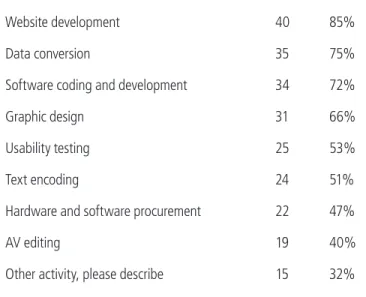
Technology and Design N=47
Website development 40 85%
Data conversion 35 75%
Software coding and development 34 72%
Graphic design 31 66%
Usability testing 25 53%
Text encoding 24 51%
Hardware and software procurement 22 47%
AV editing 19 40%
Other activity, please describe 15 32%
Any and all of these services are available dependent on project and partnership agreements (cost-recovery, for a fee, part of a grant, etc.)
Copyright, digitization, metadata, publishing.
Current work is all done in connection with the UF Digital Collections and the Digital Library of the Caribbean. Work not connected is outside of the scope of support from the current staff.
Discovery interface.
Education in theory and practical use/application. Imaging.
Metadata analysis and development. Metadata creation, digitization.
Once again, in their fullest sense, at least, these would normally apply only for full-fledged LDPD, CCNMTL, or CDRS projects. DHC projects might involve some small level of programming, but would instead tend to rely on preexisting software tools.
Open source software installation, configuration, and XML markup.
Our new research commons, which includes digital humanities lab space and a library sandbox, may help us to add to/refine this list of services. Most of our previous technology and design work would have been done within or in partnership with the Digital Library Program.
Provision of server space (on servers we already own); installation and maintenance of free, open-source software such as WordPress, Omeka, Archon.
Referral to services outside the Libraries for services not provided.
Software development where DLP infrastructure is concerned. Text encoding consultation. The Libraries are prepared to provide these services as we are able.