Groÿer Beleg
Java Code Generation for Dresden
OCL2 for Eclipse
submitted by
Claas Wilke
born 16.04.1983 in Buxtehude
Technische Universität Dresden
Fakultät Informatik
Institut für Software- und Multimediatechnik
Lehrstuhl Softwaretechnologie
Supervisor: Dr.-Ing. Birgit Demuth
Professor: Prof. Dr. rer. nat. habil. Uwe Aÿmann
Submitted February 19, 2009
Contents
1 Introduction 1
2 The Dresden OCL Toolkit 3
2.1 The Dresden OCL Toolkit . . . 3
2.2 The Dresden OCL2 Toolkit . . . 4
2.3 Dresden OCL2 for Eclipse . . . 4
3 Employed Programming Techniques 7 3.1 Aspect-Oriented Programming . . . 7
3.2 StringTemplate . . . 8
4 Requirement Analysis 11 4.1 The DOT2 and Requirement Analysis . . . 11
4.1.1 Variation of the Fragment Generation . . . 11
4.1.2 Variation of the Fragment Instrumentation . . . 13
4.1.3 Parametrization of the Code Generation . . . 14
4.2 Related Work . . . 16
5 Design and Fragment Generation 17 5.1 The Architecture . . . 17
5.1.1 The Package Structure. . . 17
5.1.2 The Class Structure . . . 17
5.2 Type Mapping . . . 23
5.2.1 Primitive Types . . . 23
5.2.2 Enumerations . . . 24
5.2.3 Tuples . . . 25
5.2.4 Collection Types . . . 25
5.2.5 Special OCL types . . . 25
5.3 Fragment Generation. . . 26
5.3.1 Property Call Expressions . . . 26
5.3.2 Operation Call Expressions . . . 27
5.3.3 Collection Literal Expressions . . . 30
5.3.4 Iterator Expressions . . . 30
6 Fragment Instrumentation 33 6.1 Initial and Derived Values . . . 33
6.1.1 Initial Values with Init. . . 33
6.1.2 Derived Values with Derive . . . 34
6.2 Method Implementation with Body. . . 34 V
6.3 Attribute and Method Denition with Def . . . 36
6.4 Preconditions . . . 38
6.5 Postconditions . . . 41
6.5.1 The Special Property @pre . . . 41
6.5.2 The Special Operation OclIsNew . . . 42
6.6 Invariants . . . 45
6.6.1 Strong Verication . . . 45
6.6.2 Weak Verication. . . 46
6.6.3 Transactional Verication . . . 48
6.7 The Special Operation AllInstances. . . 48
7 GUI Implementation and Test 51 7.1 The Code Generation Wizard . . . 51
7.2 Tests on the Implementation . . . 51
7.2.1 Fragment Generation. . . 54
7.2.2 Fragment Instrumentation . . . 54
7.2.3 Performance Test . . . 54
8 Evaluation and Outlook on Future Works 57 8.1 The Task of this Work . . . 57
8.2 The Provided Features . . . 57
8.2.1 Variation of the Fragment Generation . . . 57
8.2.2 Variation of the Fragment Instrumentation . . . 58
8.2.3 Parameterization of the Code Generation . . . 59
8.3 Outlook on Future Works . . . 59
A Type Mapping 61
B Operation Mapping 63
C Code Fragment Templates 69
D The Royal and Loyal Example 77
Chapter 1
Introduction
Today, the Object Constraint Language (OCL) is an accepted and common tech-nique to enrich UML models with constraints and model extensions. The code generation for object-oriented languages like Java from UML models is com-monly used in all major case tools. But the support of OCL code generation is commonly missing or incomplete. The Dresden OCL Toolkit provides a col-lection of tools enabling software developers to extend their toolkits by using features developed for OCL such as an OCL parser or an OCL interpreter. The code generation of OCL constraints was supported by the Dresden OCL Toolkit in its last version which is outdated nowadays. Furthermore, the old code gen-erator creates unreadable and complicate Java code which can not be refactored easily.
OCL and the Dresden OCL Toolkit have evolved and an usable code gener-ator with a satisfying support of the OCL 2.0 standard is missing. This work will tackle that task. A new Java code generator which will support as much features of the OCL 2.0 standard as possible will be developed. Furthermore, this work will analyze how aspect-oriented techniques can be used to instrument generated code into existing model code in Java.
The Object Constraint Language (OCL) is a standard add-on of the Unied Modeling Language [WK04, p. 19]. OCL enables the software developer to extend his UML diagrams with additional and more precise information. New attributes, associations and methods can be dened, initial and derived values or operation bodies can be added. The main features of OCL provide the deni-tion of constraints for precondideni-tions (condideni-tions which must be valid before the execution of a method), postconditions (conditions which must be valid after the execution of a method) and invariants (conditions which must be valid dur-ing the lifetime of an UML object). Such constraints are enforced and checked during the runtime of the constrained model code.
The rst version of OCL was developed by IBM in 1995 [HH01]. In 1997 OCL became part of the Unied Modeling Language (UML) and was released as an Object Management Group (OMG) specication in the version 1.1 [Wik09] [OMG97]. In 1999 the development of UML 2.0 and OCL 2.0 were started with the UML 2.0 and UML 2.0 OCL Request for Proposals [Wik09]. In September 2004 the 2.0 versions of UML and OCL were released. The OCL 2.0 specication has been published by the OMG and is available at [OMG06].
The major task of this work is the development of a new Java code gener-1
ator for the Dresden OCL Toolkit. The minor thesis (Groÿer Beleg) of Katrin Eisenreich [Eis06] who already evaluated the code generator of the last toolkit version will be used as a base for the requirements analysis and the design of the new Java code generator. The new code generator will use aspect-oriented programming techniques to realize the fragment code instrumentation. A sup-port of the OCL as far as supsup-ported by the Essential OCL meta model will be provided. The implementation will be tested and evaluated.
This work is structured as follows: The rst part deals with the Dresden OCL Toolkit and its dierent versions which will be introduced in chapter 2. Afterwards, some programming techniques used for the new code generator and its generated code such as aspect-oriented programming will be presented in chapter3. A requirement analysis based on the minor thesis of Katrin Eisen-reich [Eis06] and the OCL2J approach [BDL04] will follow in chapter 4. In chapter5 and 6, the main part of this work, the design of the code generator, the fragment code generation (including type the operation mapping) and the fragment code instrumentation will be explained. Chapter7will discuss briey the implementation of a graphical user interface and will present the test suites which were used during development of the Java code generator. Finally, chap-ter 8 will evaluate the results of this work and will look at some tasks which could be realized in future works.
Some typographical conventions are used in this work to highlight special key words or language constructs:
• Italics are used to highlight important keywords and scientic terms. • Typewriter font is used to sign model elements or language constructs
of dierent programming and modeling languages such as Java or OCL.
• Blue color is used to denote hyperlinks between references in the digital
Chapter 2
The Dresden OCL Toolkit
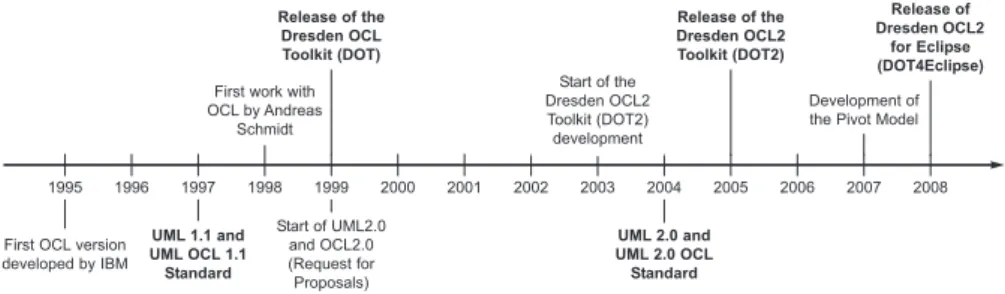
The Dresden OCL Toolkit has been developed at the Technische Universität Dresden since 1999. Today, the toolkit is one of the major software projects at the chair of software technology and three dierent versions of the toolkit have already been released. Figure 2.1 shows a time line illustrating the dierent releases of OCL and the Dresden OCL Toolkit.
1995 1996 1997 1998 1999 2000 2001 2002 2003 2004 2005 2006 2007 2008 First OCL version
developed by IBM UML 1.1 and UML OCL 1.1 Standard Start of UML2.0 and OCL2.0 (Request for Proposals) UML 2.0 and UML 2.0 OCL Standard First work with
OCL by Andreas Schmidt Start of the Dresden OCL2 Toolkit (DOT2) development Development of the Pivot Model Release of the Dresden OCL Toolkit (DOT) Release of the Dresden OCL2 Toolkit (DOT2) Release of Dresden OCL2 for Eclipse (DOT4Eclipse)
Figure 2.1: The dierent release of OCL and the Dresden OCL Toolkit.
2.1 The Dresden OCL Toolkit
A rst work which examined OCL at the Techische Universität Dresden was done by Andreas Schmidt in 1998, examining how OCL could be mapped to the Structured Query Language (SQL) [Sch98]. The rst base for the toolkit was realized by Frank Finger in 1999 [Fin99] [Fin00]. An OCL standard li-brary and possibilities to load and parse UML models and OCL constraints and furthermore the possibility to generate Java code from OCL constraints were implemented. The instrumentation of the created Java code was realized by Ralf Wiebicke [Wie00]. This rst released version of the toolkit was called Dresden OCL Toolkit (DOT).
2.2 The Dresden OCL2 Toolkit
The development of the second version of the toolkit started in 2003. The basis of this version was created with the adaptation of the DOT to the Netbeans MDR Repository by Stefan Ocke [Ock03]. This version of the toolkit was named Dresden OCL2 Toolkit (DOT2). It was based on the OCL standard in the version 2.0. The DOT2 provided the loading and parsing of UML models and OCL constraints and the transformation of constrained models into SQL [Hei05] [Hei06].
The possibility to generate and instrument Java code for OCL constraints was adapted from the DOT to the DOT2 by Ronny Brandt in 2006 [Bra06]. The DOT2 is the last release of the Dresden OCL Toolkit which provides Java code generation and instrumentation. Thus the DOT2 is the basis for the evaluation of the code generation in this work.
2.3 Dresden OCL2 for Eclipse
Since 2007 the DOT2 has been replaced by a new version of the Dresden OCL Toolkit. The implementation of a pivot model by Matthias Bräuer [Brä07] made the newest version of the toolkit independent from specic repositories and it can therefore be adapted to many dierent meta models. By now, adaptions to the Netbeans MDR Repository used by the DOT2, to the UML2 meta model of the Eclipse Model Development Tools Project [MDT09] and to the Ecore meta model are supported.
In addition to the implementation of the pivot model an OCL parser to load and verify OCL constraints [Thi07] and an OCL interpreter [Bra07] were integrated. For this last release of the toolkit named Dresden OCL2 for Eclipse (DOT4Eclipse) the new code generator of this work will be developed.
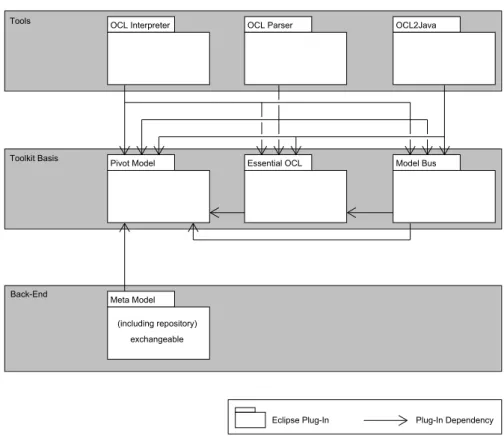
The architecture of DOT4Eclipse is shown in gure 2.2. The architecture is the result of the work of Matthias Bräuer [Brä07] and can easily be extended. The architecture can be separated into three layers: The back-end, the toolkit basis and the toolkit tools.
The back-end layer represents the repository and the meta model which can easily be exchanged because all other packages of the DOT4Eclipse do not directly communicate with the meta model but use the Pivot Model which delegates all requests to the meta model instead. For example a possible meta model is the UML2 meta model of the Eclipse Model Development Tools Project [MDT09].
The second layer is the toolkit basis layer which contains the Pivot Model, Essential OCL and the Model Bus. The use of the Pivot Model was mentioned before. The package Essential OCL extends the Pivot Model and implements the OCL Standard Library to extend loaded models with OCL constraints. The package Model Bus loads, manages and provides access to models the user wants to work with.
The third layer contains all tools which are provided by the toolkit. By now this layer already contains the OCL interpreter and the OCL parser which uses the packages of the second layer to load, verify and interpret OCL constraints. The new code generator will be a third tool which will be located in the third layer and which will use the Pivot Model, the Essential OCL and the Model
2.3. DRESDEN OCL2 FOR ECLIPSE 5
Meta Model
OCL Interpreter OCL Parser
Pivot Model Essential OCL Model Bus OCL2Java Tools Toolkit Basis Back-End (including repository) exchangeable
Eclipse Plug-In Plug-In Dependency
Bus package.
The DOT4Eclipse has been developed as a set of Eclipse plug-ins. All pack-ages which are located in the Toolkit Basis and Tools Layer represent dierent Eclipse plug-ins. Additionally, the DOT4Eclipse contains some plug-ins to pro-vide GUI elements such as wizards and examples to run the DOT4Eclipse with some simple models and OCL expressions.
Chapter 3
Employed Programming
Techniques
This Chapter presents some techniques which were used to realize the newly de-veloped code generator. At rst, aspect-oriented programming will be explained and the language AspectJ will be presented. Afterwards the template engine StringTemplate will be introduced.
3.1 Aspect-Oriented Programming
Aspect-oriented programming (AOP) is a programming paradigm which solves some problems of object-oriented programming such as crosscutting concerns [AK07].
Crosscutting concerns are design and implementation problems that cut across several places in [a] program [AK07]. They occur in many software systems and their implementation leads to code tangling, scattering and code replication [AK07]. A typical example for crosscutting concerns are logging mechanisms which log some runtime activities such as the entry of any method. If such a logging mechanism will be implemented manually, any method of any class which will be logged has to be refactored by adding additional lines for the logging mechanism. If the logging mechanism shall be removed or adapted, any of these methods has to be refactored again. Another typical example for crosscutting concerns are constraint implementations [Eis06, p. 32].
AOP denes additional code fragments in separate les called aspects. An aspect is a piece of code which [AK07] [ABR06]:
1. Species one or several points in the code which cause events, if the control ow reaches these points (join points),
2. Species sets of join points (pointcuts),
3. Denes what happens if one of these events occur; meaning which code will be executed additionally at these points (advices).
Aspects are always dened in relation to a core, are specied separately from this core and are woven into this core by an aspect weaver [Aÿm03, p. 260].
1 public aspect LoggingAspect {
2
3 protected pointcut
4 publicMethods(SampleClass aClass):
5 call(public SampleClass.∗(..)) && this(aClass);
6
7 before(SampleClass aClass) : publicMethods(aClass) {
8 System.out.println("Entered a public method.");
9 }
10 }
Listing 3.1: A simple logging aspect.
For the logging example such an aspect must dene a pointcut which de-scribes the entry joinpoint of any method which shall be logged and an advice describing the additional logging code which shall be executed before the exe-cution of any of these methods.
Some languages which realize aspect-oriented programming are AspectJ, As-pectC++ and Eos [AK07].
The developed code generator of DOT4Eclipse uses AspectJ to instrument the generated code fragments for OCL constraints into the Java classes of the constrained model. AspectJ will be introduced briey in the following. AspectJ is a seamless aspect-oriented extension to the Java programming language that enables clean modularization of [these] crosscutting concerns [Asp09b].
Aspects dened by AspectJ are basically separated into pointcut denitions and advice denitions. A simple aspect is shown in listing 3.1. It describes all public methods of a class SampleClass in the pointcut publicMethods(Sample-Class) and a simple advice which is executed before the call of these methods. AspectJ provides instrumentation technologies for all constraint types de-ned in OCL. Post- and preconditions can be dede-ned by using before or after advices. Properties can easily be observed by the pointcut types get and set. More keywords exist to support the realization of denitions, initializations and body expressions.
A detailed documentation of AspectJ is available in [Böh06] and at [Asp09b]. More details about the instrumentation of OCL constraints using AspectJ are presented in chapter6.
3.2 StringTemplate
StringTemplate is a java template engine to generate source code, [...] or other formatted text [Str09]. It has already been used during the development of the Ocl22Sql code generation tool of the DOT2 developed by Florian Heiden-reich [Hei06]. Heidenreich evaluated dierent template engines and decided that StringTemplate was the template engine which satised the requirements of the code generation tool best [Hei06, p. 34f].
During this work StringTemplate is used for fragment generation and frag-ment instrufrag-mentation. Some simple examples for StringTemplate templates will now be explained. More information about StringTemplate is available at [Str09].
3.2. STRINGTEMPLATE 9
1 templateName(param1, param2, ...) ::=<<
2 This is some generated code using $param1$ and $param2$
3 at specified positions.
4 >>
Listing 3.2: A simple StringTemplate.
1 $if(param1)$
2 This code contains $param1$.
3 $else$
4 Param1 was not set.
5 $endif$
Listing 3.3: An if expression.
1 $values, types:{aValue, aType |
2 $aValue$ is of type $aType$. }; separator = "\n"$
Listing 3.4: An iteration. 1 template1(param1) ::=<< 2 $template2(param1 = param1)$
Listing 3.5: A template referring to another template.
StringTemplates can be dened in text les and loaded into class instances of StringTemplateAdapter which I refactored from the class Declarative-Template developed by Florian Heidenreich [Hei06, p. 42]. The templates can be bound with parameters by using the method setAttribte("name", "value") and the template can be converted into code using the method to-String().
The structure of a simple template which can be parameterized with the parameters param1 and param2 is shown in listing 3.2. The structure of an if expression which checks if the parameter param1 is set and prints dierent code depending on this condition is shown in listing3.3. Listing 3.4shows an iteration over the parameters values and types which can be set multiple times using the method setAttribute(..) again and again. The code contained in the iteration is printed for any iteration of the two parameters. Finally, StringTemplates can refer to other templates. Listing 3.5 shows a template template1(param1) which refers to the template template2(param1).
Chapter 4
Requirement Analysis
This chapter evaluates the Java code generator of the Dresden OCL2 Toolkit (DOT2) and compares it with another existing tool called OCL2J. Advantages and disadvantages of the code generators are presented and requirements and improvements are developed.
4.1 The DOT2 and Requirement Analysis
The Java code generator of the DOT2 has already been evaluated during the minor thesis (Groÿer Beleg) of Katrin Eisenreich in 2006 [Eis06]. Katrin Eisen-reich did a variance analysis of the code generator and developed a feature tree to compare dierent code generators. Furthermore, she evaluated the code generator of the DOT2 using this feature tree and pointed out some possible improvements for following versions of the code generator. In the following the features pointed out by Katrin Eisenreich are presented and discussed.
The features of code generation were separated into three dierent categories [Eis06, p. 17]:
1. The variation of the fragment generation, 2. the variation of the fragment instrumentation, 3. and the conguration of the code generation.
4.1.1 Variation of the Fragment Generation
The category variation of fragment generation collects the following feature points [Eis06, p. 17]:
• The supported constraint types, • coding conventions,
• the representation of OCL types,
• the access to model attributes in the generated code,
• and the technology to create the dierent code fragments which are
in-strumented during the code instrumentation. 11
Constraint Types
Generally, a code generator should support as much constraints of the OCL specication as possible. The new code generator which will be developed dur-ing this work has to support all constraint types which are supported by the Essential OCL meta model and the existing OCL parser of DOT4Eclipse.
The supported constraint types contain invariants, pre- and postconditions like the code generator of the DOT2, but also initial and derived values, def-initions of new attributes and methods, body expressions for methods and let expressions to dene temporary variables. Messages and state expressions will not be supported because they are not supported by Essential OCL [Thi07, p. 100].
Furthermore, the new code generator will support some special OCL opera-tions like oclIsNew() and oclAllInstances() which are not supported by the code generator of the DOT2.
Coding Conventions
The feature point coding conventions describes the possibility to format the generated code to project specic coding conventions but also the possibility to create code for dierent programming languages.
The code generator developed during this work will only support the genera-tion of Java code. But the code generator will be developed variably to provide the possibility to extend or adapt the code generator for code generation of other object-oriented programming languages. Coding conventions will not be supported by the code generator because features to format code have already been implemented in the Eclipse Java Development Workbench.
Representation of OCL Types
The DOT2 denes special types in Java for all OCL types. The use of such an OCL standard library improves the code generation because the created frag-ments become very simple.
However, a standard library also causes some disadvantages: The created code contains overhead because a lot of the dened OCL types already exist in Java (for example primitive types like String or Integer). The created code contains more delegations to additionally dened Java objects and thus causes less performance than possible [BDL04, p. 11f].
The code generator developed during this work will not use a complete stan-dard library to implement the OCL types in Java. All types which can be rep-resented by already existing Java types will be directly mapped. Some exclusive types which can not be directly mapped to Java types will be implemented in new Java classes.
Attribute Access
A common problem during code generation is the access to class attributes and methods of the already existing model code. Java supports the declaration of private or protected attributes and methods which are not visible for other class instances. In [Eis06, p. 23] dierent solutions for attribute access are discussed.
4.1. THE DOT2 AND REQUIREMENT ANALYSIS 13 The developed code generator will instrument the created code fragments using the aspect-oriented Java extension AspectJ. AspectJ supports an easy so-lution for the access problem by providing a keyword privileged which en-ables dened aspects to access private attributes and methods of aected class instances [BDL05, p. 2].
Fragment Generation
The creation of code fragments will be implemented as in the old code generator of the DOT2 by traversing over the abstract syntax graph of the constrained model and its dened constraints.
The old code generator creates code fragments from strings which are di-rectly implemented in the code of the code traversation [Eis06, p. 26]. Such a technology is both inecient and hardly to refactor. Thus the new code gen-erator will separate the traverse meachanism and the code generation by using templates which are parameterized during the code generations. The templates are externally saved. Thus the templates can be easily updated, exchanged and refactored.
4.1.2 Variation of the Fragment Instrumentation
The fragment instrumentation can be separated into the following features [Eis06, p. 29]:
• The code instrumentation, • the instrumentation location,
• the reversibility of the instrumentation, • the technology used for instrumentation,
• and the reaction on violated constraints during runtime.
This work will use the aspect-oriented languageAspectJ to realize the im-plementation. Thus some of the remarked features are strongly related to each other an can not be evaluated independently. Fundamentally the instrumenta-tion technology and the reacinstrumenta-tion on constraint violainstrumenta-tion remain.
Instrumentation Technology
The code generator of the DOT2 directly inserts the code fragments into the aected classes. For some constraints new wrapper methods are added which call the methods constrained by the generated code [Wie00, p. 14]. This attempt causes some disadvantages: The source code of all aected classes has to be available because the code instrumentation does not work with Java byte code. In addition to this fact the direct code instrumentation causes code which can not be refactored easily. Constraint and model code can not be separated. An independent refactoring of model and constraint code is not possible. The reversibility of the instrumentation needs some precautions and marks in the instrumented code [Eis06, p. 34].
To avoid all the problems mentioned above, the new code generator will use AspectJ to realize the instrumentation. The instrumentation code is not directly
inserted into the Java source code but is declared in so-called aspects which are woven by an Aspect Weaver into the model code (see also section3.1).
This technology has a lot of advantages: The fragment code can be instru-mented into Java source code and Java byte code as well. The source code of all aected classes has not to be available [BDL04]. An independent refactoring of constraint and model code is possible, the reversibility of the instrumentation can be easily performed by executing the Java code without the aspect weaver. Moreover by using AspectJ the implementation of special OCL operations such as oclAllInstances() can easily be implemented which would be hard (if not impossible) in simple Java code [BDL04, p. 41].
Reaction on Constraint Violations
To react on violated constraints during the runtime of the constrained code, the new code generator will use the same technology as the code generator of the DOT2. The code generator will provide the possibility to congure a so-called violation macro which has already been introduced by Ronny Brandt [Bra06, p. 16]. The violation macro represents some lines of code and will be executed at any position in the code where a constraint is violated. Examples for violation macros are a simple print statement such as System.out.println("Constraint was violated."); or a throw statement of a new runtime exception such as throw new RuntimeException("Constraint was violated.");.
4.1.3 Parametrization of the Code Generation
The last group of features pointed out by Katrin Eisenreich is the parametriza-tion or conguraparametriza-tion of the code generaparametriza-tion. Four major features belong to this group [Eis06, p. 43]:
• The selection of constraints for which code will be generated, • the strength with which invariants will be veried,
• inheritance principles for constraints, • and the conguration of violation macros.
The Selection of Constraints
The selection of constraints for code generation can be realized in a central conguration or decentral (for example by annotations in the constraint les). The conguration can be realized by manual selection of all constraints or by a rule based selection (for example all invariants could be selected) [Eis06, p. 43]. The new code generator of DOT4Eclipse will provide a GUI wizard which enables the user to do both, manual selection and rule based selection in a central conguration menu.
The Strength of Invariant Checks
A central question during constraint code generation is the question in which situations during runtime invariants will be checked and veried. Dierent op-tions are possible which would be useful in dierent situaop-tions and user scenarios [Eis06, p. 45] [Wie00, p. 22] [BDL04, p. 20f] [BDF+04, p. 30]:
4.1. THE DOT2 AND REQUIREMENT ANALYSIS 15 1. Invariants could be checked after the execution of any constructor and the change of any attribute or association which is in scope of the invari-ant condition. This range could be too strict in some scenarios, because programmers could store temporary values in attributes or associations during computation which violate constraints.
2. Invariants could be checked after the execution of any method of the con-strained class. This variant could also be to strict for some user scenarios. 3. Invariants could be checked after the execution of any constructor or public method of the constraint class. This variant could be to liberal for some user scenarios.
4. Invariants could be checked after any method which was marked by the programmer for example via an annotation.
5. And nally, invariants could only be checked if the user calls a special method at runtime such as checkConstraints(). This scenario is similar to the transaction technique of database systems.
Due the fact that all the dierent possibilities have advantages and disadvan-tages, the new code generator of the DOT4Eclipse will enable the user to decide which verication technique he wants. The new code generator will provide the three scenarios (1), (3) and (5) called strong verication, weak verication and transactional verication.
These three scenarios could be useful for users in dierent situations. If a user wants to verify strongly that his constraints are veried after any change of any dependent attribute he should use strong verication. If he wants to use attributes to temporary store values and constraints should only be veried if any external class instance wants to access values of the constrained class, he should use weak verication. If the user wants to work with databases or other remote communication and the state of his constraint classes should be only validated before data transmission, he should use the scenario transactional verication.
The Inheritance of Constraints
Normally the inheritance of OCL constraints follows Liskov's substitution prin-ciple which declares that every constraint of a constrained class must also be checked for any subclass of the constraint class [WK04, p. 145] [BDL04, p. 21f.]. Postconditions and invariants can be strengthened during inheritance, preconditions can be weakened.
Enforcing Liskov's substitution principle during code generation is a very dicult task because the code generator has to check for any precondition to see if the precondition will be weakened by another constraint dened over any sub-class. Thus the new code generator will not follow Liskov's substitution principle. But the developed wizard will provide an option which will let the user decide whether or not invariants, pre- and postconditions shall be inherited. The Reaction on Violated Constraints
As already mentioned, the new code generator will provide a violation macro technique to enable the user to decide how the constraint code will react on
violated constraints. This violation macro can be set generally for all constraints or individually for any constraint by the user [Eis06, p. 45f]. The new code generator will provide both possibilities in the code generation wizard.
4.2 Related Work
For all I know there is only one project which already tried to realize an aspect-oriented realization of an OCL code generator. This project is called the OCL2J approach. The OCL2J approach was developed at the Carleton University Ot-tawa, Canada in 2004 [BDL04] [BDL05] [DBL06]. The work intensively inves-tigated the Java code generator of the DOT and studied which advantages and disadvantages would be gained by an OCL code generator which instrumen-tation technique is based on aspect-oriented programming. Unfortunately no source or byte code was available to test the OCL2J tool.
The tool uses the aspect-oriented programming language AspectJ and solves many of the problems and tasks mentioned during the evaluation of Katrin Eisenreich: Source and byte code weaving is possible using OCL2J, constrained and constraint code can be developed independently [BDL04, p. 17f].
Like the old code generator of the DOT2, the OCL2J tool supports code generation for invariants, pre- and postconditions. Let and body expressions, enumerations, dened and derived values are not supported. The tool does not use an OCL standard library for the OCL type representations in Java, but tries to map as much types as possible directly to Java types. Primitive types in OCL are separated into primitive and wrapper types in Java [BDL04, p. 18, 32].
Special OCL operations and properties like @pre, allInstances() and ocl IsNew() are supported [BDL04, p. 8, 29, 39]. The code generator uses Java reection to resolve information from the provided model source or byte code [BDL04, p. 19f]. Invariants are checked after constructors and before and after the execution of public methods of the constrained class [BDL04, p. 20]. Reactions on constraint violations are runtime exceptions or error messages [BDL04, p. 50]. The tool was intensively tested using the royal and loyal model developed by Warmer and Kleppe [WK04, p. 39] [BDL04, p. 50, 95f] which can be found in appendixD.
All things considered the OCL2J approach presents a good basis for a code generator implementation using aspect-oriented technologies for code instru-mentation. The tool provides many solutions for tasks and problems which have to be solved during this work. Interesting solutions for problems like the OCL method allInstances() are provided. Thus, the tool was used as a cen-tral background for this research.
Chapter 5
Design and Fragment
Generation
This chapter presents the architecture of the developed code generator. It de-scribes which plug-ins of DOT4Eclipse are referred and which interfaces are introduced. The ExpressionSwitch class which is used to iterate over the data structure of the pivot model and its constraints is also presented. Finally, solu-tions for the type mapping to Java and for the fragment code generation from OCL constraints to Java are shown.
5.1 The Architecture
This section introduces briey the architecture of the new code generator. The package structure and the class structure will be presented. The class Expres-sionSwitch will be introduced.
5.1.1 The Package Structure
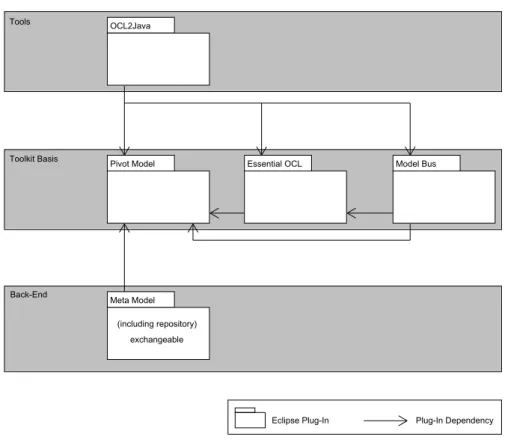
The Java code generator is realized as a new plug-in of DOT4Eclipse which depends on dierent other plug-ins of the toolkit. Like the OCL parser and the OCL interpreter introduced in section 2.3, the code generator directly de-pends on three dierent plug-ins. These three plug-ins are the Pivot Model, the Essential OCL plug-in and the Model Bus plug-in. Figure5.1 illustrates these dependencies.
5.1.2 The Class Structure
This section explains some classes and interfaces introduced for the Java code generator.
Some Internal Classes
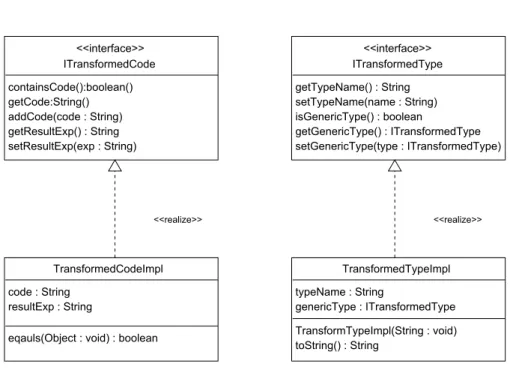
Figure5.2 shows two dierent interfaces which are internally used by the code generator. The rst interface ITransformedCode describes fragments of code generated by the code generator. It provides methods to add or get the contained
Meta Model OCL2Java
Pivot Model Essential OCL Model Bus
Tools
Toolkit Basis
Back-End
(including repository) exchangeable
Eclipse Plug-In Plug-In Dependency
5.1. THE ARCHITECTURE 19 <<interface>> ITransformedCode containsCode():boolean() getCode:String() addCode(code : String) getResultExp() : String setResultExp(exp : String) <<interface>> ITransformedType getTypeName() : String setTypeName(name : String) isGenericType() : boolean getGenericType() : ITransformedType setGenericType(type : ITransformedType) TransformedCodeImpl
eqauls(Object : void) : boolean code : String resultExp : String TransformedTypeImpl TransformTypeImpl(String : void) toString() : String typeName : String genericType : ITransformedType <<realize>> <<realize>>
Figure 5.2: The interfaces ITransformedCode and ITransformedType and their realizations.
code and to set or get the result expression. The result expression describes a variable or expression containing the result of the contained code. The contained code for example could be a simple expression such as int result = 2;. Then, the result expression would be the variable expression result, because this variable contains the result of the whole code. The interface ITransformedCode is realized by the class TransformedCodeImpl which additionally provides the method equals(Object) to compare to dierent pieces of transformed code.
The second interface called ITransformedType describes already transform-ed types during code generation. It provides methods to set and get its type's name and eventually to get or set a generic type as well. The realization TransformedTypeImpl additionally provides the method toString() which re-turns a string containing the name of the type (eventually including the name of the generic type).
Both interfaces are used internally during code generation, but are further-more visible for other plug-ins, because the interface ITransformedCode is also used to set violation macros for the code generation.
Public Interfaces
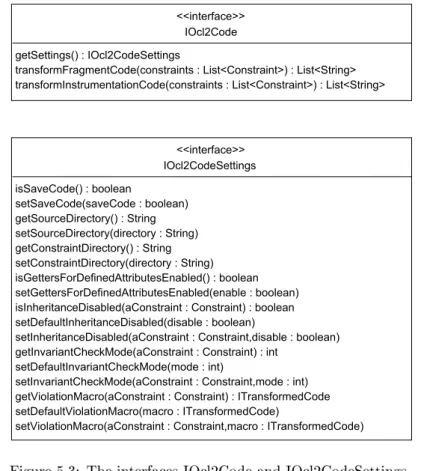
The code generator plug-in denes two public interfaces which are visible for other plug-ins. These two interfaces are shown in gure 5.3. The rst in-terface called IOcl2Code represents code generators and denes three meth-ods. The method getSettings() returns an instance of the second interface IOcl2CodeSettings which provides a lot of methods to congure the associ-ated IOcl2Code instance. The two other methods of IOcl2Code can be used to
transform instrumentation code or fragment code for a given list of constraints. Currently, only one class implements the interface IOcl2Code, which is the Ocl2Java class realizing the Java code generator. More implementations are possible to implement other code generators, for example a code generator which generates C++ and AspectC++ code instead of Java code. The interface could be used by an adaption of the declarative SQL code generator OCL22SQL [Hei06] as well, but such a code generator would not need the provided method transformInstrumentationCode().
<<interface>> IOcl2Code getSettings() : IOcl2CodeSettings
transformFragmentCode(constraints : List<Constraint>) : List<String> transformInstrumentationCode(constraints : List<Constraint>) : List<String>
<<interface>> IOcl2CodeSettings isSaveCode() : boolean setSaveCode(saveCode : boolean) getSourceDirectory() : String setSourceDirectory(directory : String) getConstraintDirectory() : String setConstraintDirectory(directory : String) isGettersForDefinedAttributesEnabled() : boolean setGettersForDefinedAttributesEnabled(enable : boolean) isInheritanceDisabled(aConstraint : Constraint) : boolean setDefaultInheritanceDisabled(disable : boolean)
setInheritanceDisabled(aConstraint : Constraint,disable : boolean) getInvariantCheckMode(aConstraint : Constraint) : int
setDefaultInvariantCheckMode(mode : int)
setInvariantCheckMode(aConstraint : Constraint,mode : int) getViolationMacro(aConstraint : Constraint) : ITransformedCode setDefaultViolationMacro(macro : ITransformedCode)
setViolationMacro(aConstraint : Constraint,macro : ITransformedCode)
Figure 5.3: The interfaces IOcl2Code and IOcl2CodeSettings.
The Expression Switch Pattern
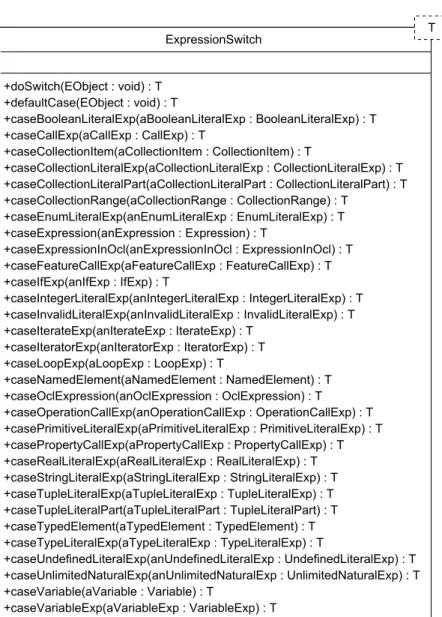
The code generator uses the class ExpressionSwitch which is provided by the Essential OCL plug-in as shown in gure 5.4. The class ExpressionSwitch implements the Switch Class Pattern which can be generated for EMF models and can be used to iterate over the abstract syntax model (ASM) of these models [BSM+03, p. 207]. The switch class implements a switch-like callback
mech-anism that is used for dispatching based on a model object's type [BSM+03,
p. 207]. The class ExpressionSwitch already generated by Matthias Bräuer provides such a switch mechanism for Essential OCL models.
During the development of the OCL interpreter of DOT4Eclipse Ronny Brandt compared the Switch Pattern with the commonly known Visitor Pattern
5.1. THE ARCHITECTURE 21 ExpressionSwitch +doSwitch(EObject : void) : T +defaultCase(EObject : void) : T +caseBooleanLiteralExp(aBooleanLiteralExp : BooleanLiteralExp) : T +caseCallExp(aCallExp : CallExp) : T +caseCollectionItem(aCollectionItem : CollectionItem) : T +caseCollectionLiteralExp(aCollectionLiteralExp : CollectionLiteralExp) : T +caseCollectionLiteralPart(aCollectionLiteralPart : CollectionLiteralPart) : T +caseCollectionRange(aCollectionRange : CollectionRange) : T +caseEnumLiteralExp(anEnumLiteralExp : EnumLiteralExp) : T +caseExpression(anExpression : Expression) : T +caseExpressionInOcl(anExpressionInOcl : ExpressionInOcl) : T +caseFeatureCallExp(aFeatureCallExp : FeatureCallExp) : T +caseIfExp(anIfExp : IfExp) : T +caseIntegerLiteralExp(anIntegerLiteralExp : IntegerLiteralExp) : T +caseInvalidLiteralExp(anInvalidLiteralExp : InvalidLiteralExp) : T +caseIterateExp(anIterateExp : IterateExp) : T +caseIteratorExp(anIteratorExp : IteratorExp) : T +caseLoopExp(aLoopExp : LoopExp) : T +caseNamedElement(aNamedElement : NamedElement) : T +caseOclExpression(anOclExpression : OclExpression) : T +caseOperationCallExp(anOperationCallExp : OperationCallExp) : T +casePrimitiveLiteralExp(aPrimitiveLiteralExp : PrimitiveLiteralExp) : T +casePropertyCallExp(aPropertyCallExp : PropertyCallExp) : T +caseRealLiteralExp(aRealLiteralExp : RealLiteralExp) : T +caseStringLiteralExp(aStringLiteralExp : StringLiteralExp) : T +caseTupleLiteralExp(aTupleLiteralExp : TupleLiteralExp) : T +caseTupleLiteralPart(aTupleLiteralPart : TupleLiteralPart) : T +caseTypedElement(aTypedElement : TypedElement) : T +caseTypeLiteralExp(aTypeLiteralExp : TypeLiteralExp) : T +caseUndefinedLiteralExp(anUndefinedLiteralExp : UndefinedLiteralExp) : T +caseUnlimitedNaturalExp(anUnlimitedNaturalExp : UnlimitedNaturalExp) : T +caseVariable(aVariable : Variable) : T +caseVariableExp(aVariableExp : VariableExp) : T T
[GHJV95, p. 331] and pointed out that the Switch Pattern provides a good solution to iterate over an ASM of an Essential OCL model [Bra07, p. 25]. The key benet of the Switch Pattern is the fact that only one class in the class structure has to be adapted if the meta model has been changed. The class which has to be adapted is the switch class itself.
The same criteria which lead Ronny Brandt to use the SwitchPattern for the implementation of his OCL interpreter were used to decide that the Switch-Pattern would provide a good solution for the iteration over the Essential OCL models to generate Java code as well.
The mechanism of the SwitchPattern is very simple. In DOT4Eclipse the class ExpressionSwitch provides the method doSwith(EObject) which can be called to iterate over Essential OCL models. The doSwitch(EObject) method checks, which type of EObject was given as parameter rst and then calls the depending case() method. "[... E]ach case walks up the inheritance hierarchy from the actual type of the object to EObject, calling out to a specic case() handler method for each class. It stops when one of these methods return a non-null value, which doSwitch() then returns" [BSM+03, p. 208].
The advantage of this pattern is the fact that the developer does not have to think about the tree structure of his ASM. He only has to implement all methods of the SwitchPattern which handle cases of model elements that are concrete and not abstract. For example the developer has to implement the methods caseIntegerLiteralExp() and caseStringLiteralExp() but not the method caseLiteralExp().
The class ExpressionSwitch is an abstract class which can be parameterized with a type that represents the result type of all case() methods. In the depending case() methods the developer implements the code which will be executed when such an element has been reached during iteration. During code execution the doSwitch(EObject) can be called recursively to react on sub elements of the currently handled element of the ASM. The Java code generator parameterizes the pattern with the type ITransformCode. Thus, any case() method returns a piece of transformed code.
The class ExpressionSwitch provides the central iteration mechanism of the new code generator. The case() methods contain the code which generates the corresponding Java code to the given Essential OCL expressions. The case() methods use StringTemplates, parameterize them and use them to generate the Java code.
The Ocl2Java Class
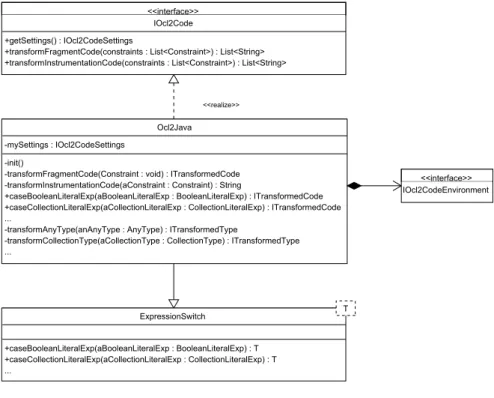
Figure5.5shows the implementation of the interface IOcl2Code called Ocl2Java which represents the central class of the developed code generator (Please note that not all methods of the classes Ocl2Code and ExpressionSwitch are shown in the diagram). The code generator extends the class ExpressionSwitch to iterate over the constraints and their expressions to generate code.
To generate code fragments the method transformFragmentCode(List< Constraint>) is called which internally calls the private method transform-FragmentCode(Constraint) for any constraint of the given list. This method invokes the method doSwitch(Eobject) for the expression of the given con-straint. doSwitch(Eobject) is the method which starts the iteration provided by the ExpressionsSwitch class.
5.2. TYPE MAPPING 23 For any type of expression the depending case() method is implemented to generate the code for the expression. In addition to methods to handle dierent expressions, the class Ocl2Java also provides methods to transform types of the pivot model into Java types. The class Ocl2Java possesses an environment called IOcl2CodeEnvironment which provides methods to generate variable names or to store some values during code generation such as referred attributes or variables on which the special OCL operation @pre is invoked.
<<interface>> IOcl2Code +getSettings() : IOcl2CodeSettings
+transformFragmentCode(constraints : List<Constraint>) : List<String> +transformInstrumentationCode(constraints : List<Constraint>) : List<String>
Ocl2Java -init()
-transformFragmentCode(Constraint : void) : ITransformedCode -transformInstrumentationCode(aConstraint : Constraint) : String
+caseBooleanLiteralExp(aBooleanLiteralExp : BooleanLiteralExp) : ITransformedCode +caseCollectionLiteralExp(aCollectionLiteralExp : CollectionLiteralExp) : ITransformedCode ...
-transformAnyType(anAnyType : AnyType) : ITransformedType
-transformCollectionType(aCollectionType : CollectionType) : ITransformedType ... -mySettings : IOcl2CodeSettings <<interface>> IOcl2CodeEnvironment ExpressionSwitch +caseBooleanLiteralExp(aBooleanLiteralExp : BooleanLiteralExp) : T +caseCollectionLiteralExp(aCollectionLiteralExp : CollectionLiteralExp) : T ... <<realize>> T
Figure 5.5: The code generator Ocl2Java.
5.2 Type Mapping
As already mentioned in section 4.1.1, the new code generator does not use a standard library to transform OCL types into Java types. The types are transformed into already existing Java types instead (if this is possible). The type mapping is realized in the code generator via simple StringTemplates which results in the name of the mapped type in Java. The type mapping from OCL to Java types is explained briey in the following. An overview of all mapped OCL types can be found in appendixA.
5.2.1 Primitive Types
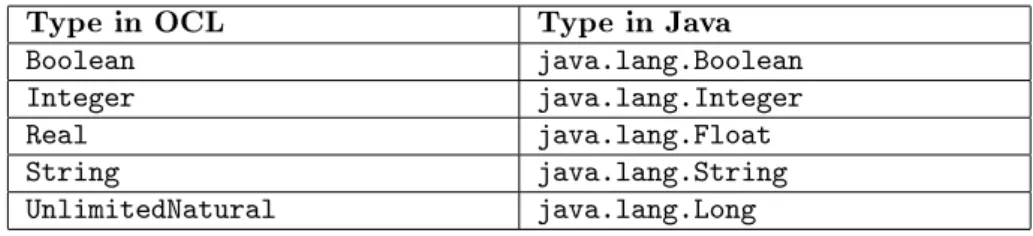
OCL contains the primitive types Integer, Real, UnlimitedNatural, Boolean and String. Warmer and Kleppe propose to map these types to the primitive types in Java as well [WK04, p. 97]. Integer becomes int, Real becomes float and Boolean becomes boolean.
Type in OCL Type in Java Boolean java.lang.Boolean Integer java.lang.Integer Real java.lang.Float String java.lang.String UnlimitedNatural java.lang.Long
Table 5.1: Type mapping from OCL to Java for primitive types. This solution causes trouble because primitive Types in Java can not be used as generic types, for example in the declaration of collections. The automatic substitution from primitive to wrapper types in the Java compiler (called au-toboxing [Ull06, Section 8.2.5]) solves this problem in many situations, but the initialization of collections with primitive generic types is not not possible in Java.
Furthermore, primitive types also cause problems when all their instances for the special OCL operations allInstances() and oclIsNew() shall be col-lected. In addition to that the instanceof operator in Java needed for the OCL operations oclIsKindOf() and oclIsTypeOf() is not available for prim-itive Java types. Finally, new dened methods returning a primprim-itive type can not be implemented by default using the Java statement return null;
The OCL2J approach (introduced briey in section4.2) solves this problem by standardly mapping to primitive types and converting these primitive types into wrapper types in any situation were this is compulsory [BDL04, p. 32]. The newly developed code generator avoids this technique and thus supports the possibility to exchange any type of the type mapping (e. g. if the code generator will be adapted to another target language). It only uses wrapper types in Java. Table5.1shows all primitive OCL types and their corresponding wrapper types in Java.
This solution solves the initialization problem for generic collections but causes some new problems as well: the implementation of already dened methods in the model using body constraints could be error-prone if the origi-nally dened method returns a primitive type in Java. For example a method getAge():int could cause an error if the generated code tries to return an Integer instance. The same problem could occur if the generated code tries to address join points of a Java method by using a wrapper type instead of a primitive type as return type. The second problem is solved by using wild cards in the pointcut declaration but the rst problem is ignored by the developed code generator and should be addressed and nally solved in future works.
5.2.2 Enumerations
OCL provides the possibility to use Enumeration types. Enumeration types exist in Java as well. Thus, enumerations are mapped to the corresponding Java type as shown in table5.2.
5.2. TYPE MAPPING 25
Type in OCL Type in Java
Enumeration<T> java.lang.Enum<T>
Table 5.2: Type mapping from OCL to Java for enumerations.
Type in OCL Type in Java
TupleType(<attribute1>:
<type1>, ...) java.util.HashMap<String,Object> Table 5.3: Type mapping from OCL to Java for tuples.
5.2.3 Tuples
OCL provides a Tuple type with which the user can dene a collection of dif-ferent values (possibly of dierent types) identied by an attribute name inside the tuple [OMG06, p. 35]. Java does not support tuple types. Thus, tuples are transformed into a map containing the name of the attributes as a key of the Java type java.lang.String and a value of any type (sub-classes of java.lang.Object) such as proposed in [WK04, p. 100]. The mapping for tuple types is shown in table5.3.
A map can be used for tuples in Java because OCL does not dene any operations over tuples which are not provided be the java.util.Map interface. The access to tuple attributes can be simply transformed into a value call like aTuple.get("attributeName").
5.2.4 Collection Types
OCL denes four dierent collection types: Bag, OrderedSet, Sequence, and Set [OMG06, p. 144]. Some of them such as Bag can be directly mapped to Java classes or interfaces like java.util.List. But the OCL specication denes many operations over its collection types which are not present for col-lection types in Java. Thus, the four colcol-lection types are the only types for which the code generator introduces new Java types.
A new plug-in of the DOT4Eclipse called tudresden.ocl20.pivot.ocl2-java.types has been created. This plug-in contains implementations for the four collection types and a general abstract collection class. Any code generated by the new code generator has to import these type package in order to be able to work with collections dened in OCL. The type mapping for the OCL collections is shown in table5.4.
5.2.5 Special OCL types
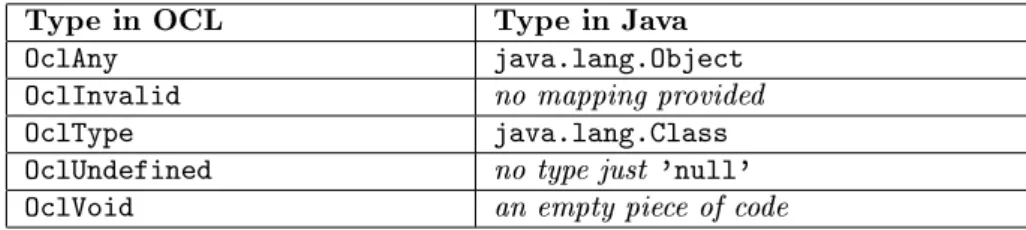
OCL introduces some other special types called OclAny, OclType, OclUnde-fined, OclVoid and OclInvalid. OclAny can be mapped to java.lang.Object and OclType to java.lang.Class. OclUndefined and OclVoid are not mapped to any specic type in Java, because undened literal expressions are mapped to null in Java and void literal expressions are mapped to an empty piece of code in Java because they are used as generic type of collections whose generic type has not been set. The type OclInvalid has not to be mapped because OclInvalid is the result of all invalid constraints which are already blocked by
Type in OCL Type in Java Bag<T> tudresden.ocl20.pivot. ocl2java.types.OclBag<T> OrderedSet<T> tudresden.ocl20.pivot. ocl2java.types.OclOrderedSet<T> Sequence<T> tudresden.ocl20.pivot. ocl2java.types.OclSequence<T> Set<T> tudresden.ocl20.pivot. ocl2java.types.OclSet<T> Table 5.4: Type mapping from OCL to Java for collections.
Type in OCL Type in Java
OclAny java.lang.Object
OclInvalid no mapping provided
OclType java.lang.Class
OclUndefined no type just 'null'
OclVoid an empty piece of code
Table 5.5: Type mapping from OCL to Java for special OCL types. the parser before code can be generated for them. The type mapping for the special OCL types is presented in table5.5.
The special type OclAny supports some operations such as allInstances(), oclIsNew() or OclAsType(). Some of these methods are directly transformed into corresponding operations or operators in Java such as instanceof ex-plained in section 5.3.2. Others are realized during fragment instrumentation and are explained in sections6.5and6.7.
5.3 Fragment Generation
This section explains briey how the literals of the given OCL expressions are transformed into Java code. For all code transformations, the code generator uses StringTemplates to generate the Java code inside the corresponding case() method of the ExpressionSwitch class. The StringTemplates used can be found in appendixC.
This section will not explain all dierent expressions possible in OCL. The transformation for primitive types, enumerations, if expressions and some spe-cial OCL types such as OclAny are not described. Some details about the transformation of the type expressions can be found in section5.2.
The transformation of property call expressions, operation call expressions, collection literal expressions and iterator expressions will be explained in the following.
5.3.1 Property Call Expressions
A PropertyCallExpression is a reference to an Attribute of a Classier dened in a[n] UML model. It evaluates to the value of the attribute [OMG06, p. 44]. Generally, a property call expression can simply be transformed from OCL to
5.3. FRAGMENT GENERATION 27
1 Tuple {name: String = ’John’, age: Integer = 10}.name
Listing 5.1: OCL code for a property call expression on a tuple type.
1 java.util.HashMap<String, Object> tuple1;
2 tuple1 = new java.util.HashMap<String, Object>();
3
4 tuple1.put(name, "John");
5 tuple1.put(age, new Integer(10));
6
7 tuple1.get("name");
Listing 5.2: Generated Java code for a property call expression on a tuple type. Java. For example the OCL expression Person.age will be transformed to the Java code Person.age which is exactly the same.
An interesting case occurs, when a property call expression will be trans-formed which references to a tuple attribute which is not implemented as a tuple type in Java (see also section 5.2.3). For example the OCL expression shown in listing5.1leads to such a property call expression. The transformed Java code for this expression is presented in listing5.2. As shown in the listing, the general property call has to be transformed into a method call on the map which represents the tuple in Java.
5.3.2 Operation Call Expressions
An OperationCallExp refers to an operation dened in a Classier. The ex-pression may contain a list of argument exex-pressions if the operation is de-ned to have parameters [OMG06, p. 45]. Generally, such an operation call expression can be simply transformed from OCL to Java. The OCL ex-pression Person.getAge() for example will be transformed to the Java code Person.getAge() which is exactly the same expression. All operation map-pings from OCL to Java used by the new code generator are listed in appendix B. In the following some special cases are discussed briey.
Operations Delegated to other Types
Some operations which are provided in OCL must be referenced to other types or utility classes in Java. An example is the operation abs() which is available for numeric types in OCL. In Java this operation is delegated to the utility class java.lang.Math (see listing5.3).
Equality on Primitive Types
The decision to transform all primitive OCL types to wrapper type in Java (see section 5.2.1), causes a problem invoking the OCL operation = on primitive types in Java. Primitive types in Java are normally compared using the oper-ator ==. But using the operoper-ator == does not work on wrapper types in Java. new Integer(0) == new Integer(0) results in false because the operator == checks if both Integers are the same instance. The operation Object.equals()
1 // Java code for aNumeric.abs().
2 result = java.lang.Math.abs(aNumeric);
Listing 5.3: Java code for the OCL operation abs().
1 // Java code for aCollection−>size() = 1.
2 ((Object) aCollection.size()).equals(new Integer(1));
Listing 5.4: Java code for the equality operation on primitive types.
1 // Java code for anInteger / anotherInteger.
2 result = ((Float) anInteger / (Float) anotherInteger);
Listing 5.5: Java code for the division of two Integers.
1 // Java code for sum on Collection<GenericType>.
2 GenericType result;
3 result = new GenericType(0);
4
5 /∗ Compute the result of a sum() operation. ∗/
6 for (GenericType anElement : aCollection) {
7 result += anElement;
8 }
Listing 5.6: Java code for the OCL operation sum().
1 // Java code for anObject.allInstances().
2 result = (new OclSet<aType>((java.util.Set<aType>)
3 this.allInstances.get(anObject.getClass()
4 .getCanonicalName()).keySet()));
Listing 5.7: Java code for the OCL operation allInstances().
1 // Java code for anObject.oclAsType().
2 result = ((aType) anObject);
3
4 // Java code for anObject.oclIsKindOf().
5 result = (anObject instanceof aType);
6
7 // Java code for anObject.oclIsOfType().
8 result = (anObject.getClass().getCanonicalName()
9 .equals("Cannonical name of aType");
5.3. FRAGMENT GENERATION 29 must be used instead to compare wrapper types. This operation works but some operations such as Collection.size() result in a primitive type in Java such as int. Invoking equals() on a primitive type in Java is not possible. Thus the code generator generates a special code for the = operation on primitive OCL types. The left hand expression of such an expression in OCL is cast to Object in Java and then the operation equals() is invoked. Such a solution works in Java because of the autoboxing mechanism [Ull06, Section 8.2.5]. The presented solution is shown in listing5.4. The same solution is used for the OCL operation <>.
Division on Integer Types
Another special case for the Integer type in OCL is the division operand. In OCL the result of a regular division on Integer types is a value of the type Real. In Java, the normal division results in an Integer type. Thus, a cast must be performed before the given integer literal expression is divided (see listing5.5).
Sum on Collection Types
A special problem occurs when the OCL operation sum() shall be implemented. The sum() operation is provided for all collection types and results in the sum of all elements contained in the collection. Such a result can only be computed if the elements of the collection are of numeric types [OMG06, p. 146]. Such an operation normally could be implemented in the new implemented collection types.
However, such an implementation of a collection which has a generic element type can not be realized in Java. The problem occurs when the collection does not contain any element. The operation sum() has to decide whether it has to return null or 0 depending on the question whether or not the collection has a numeric generic type. But the generic type of a collection is not bound when the collection is initialized but when the collection gets its rst element. Thus this decision can not be done for an empty collection. Runtime errors can occur for example when a collection with the generic type String does not contain any element. The operation sum() which results it the collection's generic type (which is String) returns an Integer because the collection does not know that its generic type is not a numeric type.
Thus the operation sum() is not implemented in the Java collection classes but is generated during code generation as a for() loop. Listing5.6shows such an implementation in Java. The advantage of this solution is that the OCL parser always knows the result type of the sum() operation and thus the code can be generated for empty collections also.
Operations on the Type OclAny
The special OCL type OclAny supports some special operations, which are avail-able for all types in OCL. The operation allInstances() returns all instances of the type the operation has been invoked on. Such an operation is not avail-able in Java and can only be implemented by using advanced programming techniques such as aspect-oriented programming. Section6.7 explains how this
1 Sequence { 1, 2, 3, 4, 5, 6, 7, 8, 9, 10 }
2
3 Sequence { 1..10 }
Listing 5.9: Two ways to initialize a collection in OCL.
1 OclSequence<Integer> collection;
2 collection = new OclSequence<Integer>();
3
4 /∗ TODO: Auto−generated initialization does
5 only work for numeric values. ∗/
6 for (Integer index = new Integer(1);
7 index <= new Integer(10); index++) {
8 collection.add(index1);
9 }
Listing 5.10: Java code for a collection with range initialization. method is implemented during fragment instrumentation. Listing 5.7 shows a call on the map which realizes the storage of all instances in the generated code (see section5.2.4).
Other operations of oclAny() are oclAsType(), oclIsKindOf() and oclIs-TypeOf(). Their transformations are shown in listing5.8.
5.3.3 Collection Literal Expressions
The transformation of collection literal expressions from OCL to Java is very simple. The only dierence between OCL and Java is the initialization of the collections. In OCL two dierent possibilities are provided to initialize collec-tions [OMG06, p. 177]:
1. Any item can be described by its own CollectionLiteralPart, 2. A set of items can be described by a CollectionLiteralRange.
Both possibilities are shown in listing 5.9. If a collection is initialized in OCL using a range expression the resulting Java code must contain a loop which iterates over the given range and adds an element to the collection for every element in the range. Such a Java implementation is shown in listing5.10. Please note that this construct only works for a collection which has an Integer element type. The OCL parser of DOT4Eclipse only accepts range expressions if they are dened over Integer values. Thus, the code generator does not have to consider the collection's element type.
5.3.4 Iterator Expressions
OCL denes a lot of operations over collections, which compute a result by iterating over all elements of the collections [OMG06, p. 25]. Such operations are called iterators and are represented by iterator expressions in the OCL meta model. All these iterator operations can be implemented in Java by dening loops over the collection. Such a Java implementation is shown in listing 5.11
5.3. FRAGMENT GENERATION 31
1 Boolean result;
2 result = true;
3
4 /∗ Iterator: aCollection−>forAll(Object anElement : aBooleanExpression) ∗/
5 for (Object anElement : aCollection) {
6 7 if (!aBooleanExpression) { 8 result = false; 9 break; 10 } 11 // no else 12 }
Listing 5.11: Java code for the iterator forAll.
for the special iterator forAll which evaluates a given Boolean expression for all elements of the collection [OMG06, p. 27].
All other iterators use similar Java code to iterate over their collection and to compute their result. In OCL, however, iterators can also be used to iterate over more than one element: an iterator can iterate over the same collection twice to compare pairs of elements in a collection. Java does not support loops over more than one collection item. But loops can be nested in Java. Warmer and Kleppe pointed out that any iterator expression which uses more than one iterator variable can be transformed into a nested iterator [WK04, p. 179]. Thus, the transformed Java code for an iterator with more than one iterator variable results in nested for() loops in Java.
Another special case is the OCL iterator sortedBy, which iterates over a given collection and compares its elements by a given comparator expression. Let us assume we have a class ClassX with an attribute attributeY and want to iterate through a collection of ClassXs by comparing their attributeYs. Listing5.12shows such an OCL expression.
Java provides the utility class Comparator do dene a compare strategy over a given class. Using Comparators, the operation java.util.Collections.sort (aCollection, aComparator) can be used to sort collections. The code gener-ator uses these utility classes in the generated Java code for sortedBy itergener-ators (see listing5.13).
1 inv: aCollection−>sortedBy(attributeY)
Listing 5.12: A 'sortedBy' iterator in OCL.
1 ClassX result;
2 java.util.Comparator<ClassX> comparator;
3
4 comparator = new java.util.Comparator<ClassX>() {
5
6 /∗∗ Method which compares two
7 elements of the collection. ∗/
8 public int compare(ClassX elem1, ClassX elem2) {
9 10 int compareResult; 11 compareResult = 0; 12 13 if (elem1.attributeY < elem2.attributeY) { 14 compareResult = −1; 15 } 16
17 else if (elem1.attributeY > elem2.attributeY) {
18 compareResult = 1; 19 } 20 21 return compareResult; 22 } 23 }; 24 25 result = java.util.Collections 26 .sort(aCollection, comparator);
Chapter 6
Fragment Instrumentation
For the instrumentation of the transformed code fragments into the Java classes I decided to use the aspect-oriented language AspectJ. A short introduction in aspect-oriented programming can be found in section3.1.
This chapter will present the instrumentation of all constraint types realized by the developed code generator. The solutions for some special OCL opera-tions and attributes which can not be realized without code instrumentation are also presented. All shown examples use the royal and loyal example and its constraints which were published in [WK04]. The royal and loyal example can be found in appendixD.
6.1 Initial and Derived Values
Initial and derived values of attributes and association ends can be dened using the OCL expressions init and derive [OMG06, p. 9].
6.1.1 Initial Values with Init
By using the OCL expression init it is possible to dene initial values for attributes which have already been dened by another OCL expression or an UML model [OMG06, p. 164]. Listing6.1shows a simple init expression which denes the initial value of the attribute points for the class LoyaltyAccount [WK04, p. 43]. Thus, the attribute points will be initialized with 0 during the creation of any LoyaltyAccount instance.
The easiest solution to instrument this init expression is to dene an aspect containing a pointcut which describes all constructors of the class Loyalty-Account and an advice which is executed after the dened pointcut and which initializes the attribute points. Such an aspect is described in listing6.2.
Please note that the given aspect uses the modier privileged to enable the access to eventually referenced attributes of the class LoyaltyAccount which are not visible (attributes dened using the modiers private or protected).
The presented solution also works with inheritance relationships. Eventually other init expressions for a sub-class of LoyaltyAccount can override the init expression of LoyaltyAccount because their aspect code is executed after the execution of the aspect code for the class LoyaltyAccount.
1 context LoyaltyAccount::points
2 init: 0
Listing 6.1: A simple init constraint.
1 public privileged aspect InitAspect {
2
3 protected pointcut
4 allConstructors(LoyaltyAccount aClass):
5 execution(public LoyaltyAccount.new())
6 && this(aClass);
7
8 after(LoyaltyAccount aClass) :
9 allConstructors(aClass) {
10 aClass.points = 0;
11 }
12 }
Listing 6.2: An aspect instrumenting a simple init expression.
6.1.2 Derived Values with Derive
Using the OCL expression derive, derived values for attributes or association ends can be dened. Derived values are derived from other attributes and/or association ends of the constrained class [OMG06, p. 165]. Listing6.3shows a simple derive expression which derives the attribute printedName of the class CustomerCard from the association owner [WK04, p. 43].
My rst idea to compute derived values was to dene setter pointcuts for all attributes and association ends from which the derived value is derived using the ApsectJ expression set. However, this solution is error-prone. Attributes or association ends can be implemented by collections for which the pointcut set is only aected if the collection is redened and not if any element is added or removed from the collection.
I therefore decided to derive the value when the derived value is read using the ApsectJ expression get. Listing 6.4 shows such an aspect for the con-straint given in listing 6.3. The pointcut printedNameGetter(CustomerCard aClass is aected at any time when the attribute printedName of the class CustomerCard is read and the advice before(CustomerCard aClass) always executes the code to derive the attribute before the printedName attribute is read.
As the solution for init expressions, this solution also works with inheri-tance. The solution could possibly be improved if the derived attribute would only be computed if the value of the dependent attributes and associations ends did really change.
6.2 Method Implementation with Body
Using the OCL expression body, the bodies of methods can be dened in OCL [OMG06, p. 165]. Listing6.5shows a simple body expression which denes an implementation of the method LoyaltyProgram.getName().