Green Practices in the Hotel Industry: The
Push and Pull Factors
Norhani Aripin
#1, Noor Afza Amran
#2, Natrah Saad
#3, Noor Rohin Awaluddin
*4 #Tunku Puteri Intan Safinaz School of Accountancy (TISSA-UUM)Universiti Utara Malaysia, 06010 UUM Sintok, Kedah, Malaysia
[email protected] [email protected] [email protected]
*Othman Yeop Abdullah Graduate School of Business (OYAGSB)
Universiti Utara Malaysia, 06010 UUM Sintok, Kedah, Malaysia
[email protected] Abstract - The objective of this study is to determine the
motivational factors and barriers that influence the implementation of green practices in Malaysian hotels. The environmental issue in Malaysia has a long history, which began with river pollution because of tin mining operations. It has now become more critical as air pollution and waste disposal by the hotel industry have a negative impact on the environment.A total of 86 questionnaires were received from four-star and five-star hotels in Selangor, Kuala Lumpur and Putrajaya. The dependent variable is green practices, while the independent variables are motivational factors and barriers. Data from the questionnaires were analyzed using the Partial Least Squares-Structural Equation Modeling approach and the SmartPLS software. Motivational factors are found to have a significantly positive relationship with the implementation of green practices. However, the barriers to green practices do not have statistical significance. The study contributes to existing literature by introducing factors that encourage the Environmental Management System (EMS) and also recommends the study of more strong factors in green practices research.
Keywords: Green Practices, Hotel Industry, Motivational factors, Barriers, EMS
Corresponding author: [email protected]
1.
Introduction
An Environmental Management System (EMS) is a problem-solving tool that should be practiced by all employees in an organisation (Tinsley & Pillai, 2006). An EMS is defined as “a framework for implementing environmental management into an organisation‘s activities, products and services” (Meade & Pringle, 2001). An EMS is a repetitive cycle, which includes policymaking, planning, implementing, reviewing as well as improving the environmental performance of an organisation.
In Malaysia, the hotel industry has begun to implement green practices in their management system (Kasim, 2009; Ustad, 2010). Most foreign tourists believe that one very important criteria of good hotel management is the managers’ commitment to preserve nature and not damage the existing eco-system (Chan, 2008; Mensah, 2006). Green practices have led to increased environmental awareness in Malaysia. According to the Travel & Tourism Competitiveness Report 2017, Malaysia is ranked at 26th position. The number of hotels in Malaysia that have begun to implement green practices in their management system is increasing (Siti-Nabiha et al., 2011). There were approximately 14 certified green hotels in 2015 and the number increased to 20 certified green hotels in 2017 (Ministry of Tourism and Culture, 2017). Malaysia also targets 100 green hotels to be certified by 2018 (President of Malaysian Association of Hotels, 2015).
The hotel industry is one of the sectors that has a great impact on the environment. Prior studies have found that environmental pollution from hotels comes from waste material sources (Moorthy & Yacob, 2013). According to Bohdanowicz (2005), between 160 and 200 kilograms of carbon dioxide per square meter of room are released annually by a normal hotel. The hotel sector comprises the housekeeping department, food and beverage production and services, laundry services, guest rooms and conference and meeting facilities (Bakori, Samdin, & Hassan, 2012). All the activities under these departments and services produce undesirable emissions, such as clorofluorocarbon, noise, fumes and odours that cause pollution. According to Kasim (2009) and Bohdanowicz (2005), the hotel sector is one of the main sectors that causes environmental degradation and accounts for various kinds of pollution, such as water, energy and waste pollution.
Environmental issues within the hotel sector have been discussed globally. Over the past decades, the United Nations has expressed concern with the status of environmental protection (Chan & Lam, 2001). A hotel should practice and operate nature-oriented, environmentally-focused and environment-friendly use of energy, water and materials in order to diminish the ______________________________________________________________
International Journal of Supply Chain Management
IJSCM, ISSN: 2050-7399 (Online), 2051-3771 (Print)
negative impacts on the environment (Fryxell & Lo, 2003).
A study has shown that the adoption of the EMS can lead to cost savings as a result of proactive environmental management, which can improve environmental performance (Meade & Pringle, 2001). Ayuso (2006) stressed that hotels have adopted energy management, waste management and water conservation to protect the environment. Generally, most hotels all around the world have begun to implement green practices in their housekeeping department, food and beverage production and services, laundry services, guest rooms and conference and meeting facilities, including the Malaysian hotel industry (Bakori, Samdin, & Hassan, 2012).
Despite the huge benefits of adopting the EMS, efforts to green the hotel industry in Malaysia is progressing slowly due to several barriers (Yusof & Jamaludin, 2014). Thus, the aim of this study is to examine the motivational factors and the barriers that influence the implementation of green practices among Malaysian hotels.
2.
Literature review
Issues on implementation of environmental management practices in the hotel industry have been investigated by several researchers (Bakori, Samdin, & Hassan, 2012; Bohdanowicz, 2005; Mensah, 2007; Tzschentke et al., 2008). Generally, due to different situational contexts, such as local government regulations, overall social concern with environmental issues and characteristics of their establishments, hotels would have different reasons and motivational factors to implement EMS practices.
Bohdanowicz (2005) examined environmental management in over 600 European hotels and found that reduction in operational costs is the most important driver for managers to adopt and implement the EMS in their hotel operations. In addition, the demand from customers and improvement of public image are other important factors that motivate the implementation of the EMS in European hotel operations. Further, Kirk (1995) reported that 75% of customers think they are environmentally-minded customers and 54% of customers think they are environmentally-minded travelers. Thus, these customers prefer to stay in hotels that are environmental-friendly.
De Burgos-Jimenez, Cano-Guillen, and Cespedes-Lorenter (2002) evinced that 10% of travelers from Spain are ready to pay the highest prices for hotel services that are caring about the environment. Customers are more concerned with environmental issues, and thus they demand for hotel services that could provide good environmental quality as their holiday destination. Furthermore, Rivera (2002) found that the aim of Costa Rican hotels to adopt the EMS is to attract more customers by improving their market reputation through the creation of a ‘green’ image hotel. On the other hand, Bohdanowicz (2005) found that European hotel managers consider improvement of marketing strategies and hoteliers’
environmental concern as the least significant motivational drivers to implement the EMS.
Mensah (2007) conducted a research on environmental management practices and hoteliers’ attitude in Ghana and found that most of the hoteliers’ main motivational factors are to provide a safe and healthy environment as well as quality services in a clean environment and reduce the cost of environmental threats. In addition, government regulations are also considered as one of the most significant external forces that drive hoteliers to adopt and implement the EMS (Bakori, Samdin, & Hassan, 2012; Chan & Wong, 2006; Ann, Zailani, & Wahid, 2006; Rivera, 2002). Further, other factors, such as pressure from stakeholders, potential cost saving, government incentives, competitors, customers’ demand and improved public image, also encourage hotels to implement green practices. Hence, this research puts forth the following hypothesis:
Hypothesis 1: There is a positive relationship between motivational factors of the environmental management system and implementation of green practices.
However, the implementation of the EMS is facing several challenges. According to Chan (2008), even though hotels are pressured by their stakeholders, customers, financial institutions, government regulatory agencies and shareholders to increase their commitment to improve environmental performance, 40% of hotels in China still do not have a formal EMS in place. Further, only about 10.6% of the hotels in China have an EMS in place and are ISO 14001 certified. The four common barriers concluded by previous research are high implementation and maintenance cost, lack of knowledge, understanding and availability of professional advice and lack of resources.
KamalulAfiffin, Abdul Khalid, and Abdul Wahid (2013) conducted a research on the challenges to the implementaion of green practices in the hotel industry and suggested the following barriers: regulations or government, customers’ demand, level of competition, greenness at the organisational level and attitude toward change (level of risk-taking). Further, Yusof and Jamaludin (2014) suggested the significant challenges to EMS implementation include lack of green experts and lack of resources in terms of work force and green equipment and difficulty in balancing the quality of services with environmental performance.
According to Chan (2008), to be successful, the implementation of EMS requires time, money and people. Implementation costs identified by Yusof and Jamaludin (2014); Ann, Zailani, and Wahid (2006); and Chang and Ho (2006), may include training, documentation, process modification, registration fees, registration, maintenance, organisational adoption, legal consequences, storage of equipment or accessories, hiring specialist environmental assistance, computer software and new staff recruitment. It can be concluded that the implementation cost for EMS can be significant and this is one of the barriers faced by the hoteliers.
According to Tinsley and Pillai (2006), there is limited knowledge about the standards and concepts among top management and this has led to a limited level of commitment towards EMS and ISO standards. There are some underlying organisational factors that have become barriers to EMS implementation. These include: management style, top management commitment and communication, culture of the organisation, innovation and technology. These organisational cultural issues, coupled with lack of knowledge and availability of professional advice, are significant barriers to the adoption of EMS for various hotels. Undeniably, support from top management and owners of hotels and resorts is very important for the success of green operations (Yusof & Jamaludin, 2014).
Yusof and Jamaludin (2014) found that some hotels agree that lack of government support and enforcement have an effect on green operations; while some hotels do not agree since the government has been very supportive in their green programmes and practices. In Malayisa, despite the fact that hotels have not received enough support from the government at the beginning of the implementation of the EMS, but now, the situation has improved. The government shows committment by providing several incentives for hotels that implement the EMS and green practices. Generally, the guests are supportive of green operations, where only 10% of the hotel guests are not satisfied with the hotels’ green operations (Yusof & Jamaludin, 2014). Manaktola (2007) found that guests are willing to stay and support green initiatives of hotels. Hence, this research hypothesises that:
Hypothesis 2: There is a negative relationship between barriers to the environmental management system and implementation of green practice
s
3.
Research methodology
3.1
Data collection
The population of this research are four and five-star hotels in the central region of Peninsular Malaysia, including Selangor, Kuala Lumpur and Putrajaya. There are about 90 four-star and five-stars hotels in this region. The questionnaires were distributed to the operations managers of the hotels. A total of 56 completed questionnaires were received. Section A of the questionnaire focuses on the EMS. Sections B to D focus on green practices, motivational factors of and barriers to the EMS, respectively. Section E focuses on the profile of participant hotels.
3.2
Measurement of variables
3.2.1 Dependent variable: Green practices
According to Siti-Nabiha et al. (2011), the instruments used for analysis are as follows: internal practices consist of 11 items; such as employee involvement; green information; green committee; and government involvement. Using a five-point Likert scale adopted from
Siti-Nabiha et al. (2011), the respondents had to appropriately tick the value in the scale that represents their hotel. The value of “1” means ‘not implemented at all’ through to “5” which means ‘highly implemented’.
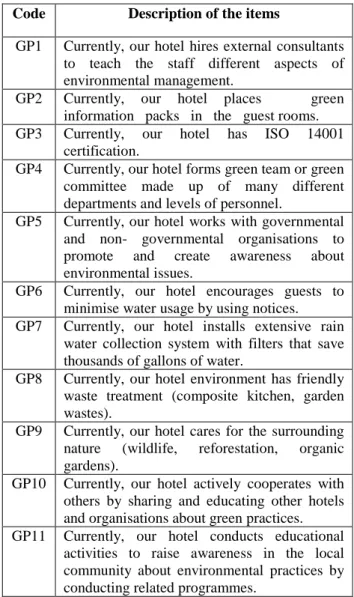
Table 1. Description of green practices
Code Description of the items
GP1 Currently, our hotel hires external consultants to teach the staff different aspects of environmental management.
GP2 Currently, our hotel places green information packs in the guest rooms. GP3 Currently, our hotel has ISO 14001
certification.
GP4 Currently, our hotel forms green team or green committee made up of many different departments and levels of personnel.
GP5 Currently, our hotel works with governmental and non- governmental organisations to promote and create awareness about environmental issues.
GP6 Currently, our hotel encourages guests to minimise water usage by using notices. GP7 Currently, our hotel installs extensive rain
water collection system with filters that save thousands of gallons of water.
GP8 Currently, our hotel environment has friendly waste treatment (composite kitchen, garden wastes).
GP9 Currently, our hotel cares for the surrounding nature (wildlife, reforestation, organic gardens).
GP10 Currently, our hotel actively cooperates with others by sharing and educating other hotels and organisations about green practices. GP11 Currently, our hotel conducts educational
activities to raise awareness in the local community about environmental practices by conducting related programmes.
3.2.2
Independent variables
This study has two independent variables: motivational factors of the EMS, and barriers to the EMS.
3.2.2.1 Motivational factors of the environmental
management system
Using a five-point Likert scale, 10 items were used to measure motivational factors of green practices. The items include: pressure from stakeholders, potential cost savings, importance of conserving natural resources, pressure or demand from guests, need to keep up with competitors, governmental regulations, pressure or demand from employees, government incentives, improve public image and gain marketing opportunities.
Table 2. Description of motivational factors of EMS
Code Description of the items
MEMS1 Our hotel is encouraged to implement environmental management system because of pressure from the stakeholders.
MEMS2 Our hotel is encouraged to implement environmental management system because of potential cost savings. MEMS3 Our hotel is encouraged to implement
environmental management system because of importance of conserving natural resurces.
MEMS4 Our hotel is encouraged to implement environmental management system because of pressure/demand from guests.
MEMS5 Our hotel is encouraged to implement environmental management system because of need to keep up with competitors.
MEMS6 Our hotel is encouraged to implement environmental management system because of governmental regulations. MEMS7 Our hotel is encouraged to implement
environmental management system because of pressure/ demand from employees.
MEMS8 Our hotel is encouraged to implement environmental management system because of government incentives (for example, tax benefits).
MEMS9 Our hotel is encouraged to implement environmental management system to improve public image.
MEMS10 Our hotel is encouraged to implement environmental management system to gain marketing opportunities.
3.2.2.2 Barriers to environmental management
system
Adopted from Yusof and Jamaludin (2014), 10 items were used to measure the barriers to green practices. The items include: implementation cost is too high, lack of knowledge, lack of technology, no potential benefit, lack of human resources, making necessary infrastructure changes is too difficult, renewal cost of certification is too high, the process involves too much paper work, the process is time consuming and lack of government support. A five-point Likert scale was used where “1”means ‘strongly disagree’ through “5” meaning ‘strongly agree’.
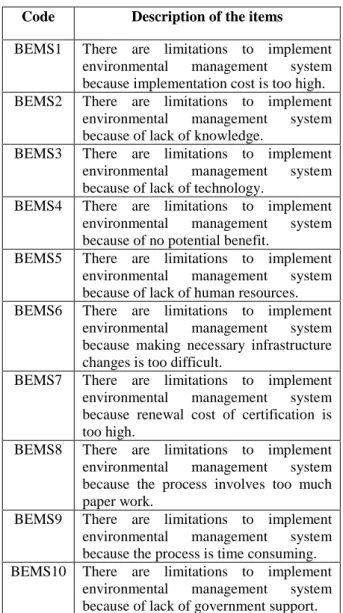
Table 3. Description of barriers of EMS
Code Description of the items
BEMS1 There are limitations to implement environmental management system because implementation cost is too high. BEMS2 There are limitations to implement
environmental management system because of lack of knowledge.
BEMS3 There are limitations to implement environmental management system because of lack of technology.
BEMS4 There are limitations to implement environmental management system because of no potential benefit.
BEMS5 There are limitations to implement environmental management system because of lack of human resources. BEMS6 There are limitations to implement
environmental management system because making necessary infrastructure changes is too difficult.
BEMS7 There are limitations to implement environmental management system because renewal cost of certification is too high.
BEMS8 There are limitations to implement environmental management system because the process involves too much paper work.
BEMS9 There are limitations to implement environmental management system because the process is time consuming. BEMS10 There are limitations to implement
environmental management system because of lack of government support.
4.0
Result and discussion
4.1
Descriptive result
Table 4 provides descriptive statistics about the hotels, including hotel category, classification, rating, location, years of operations and ownership. From Table 4, it can be seen that 44 (78.6%) hotels are business hotels. This is consistent with the location of the hotels, which covers Selangor, Kuala Lumpur and Putrajaya, as the main business locations of Malaysia. Further, 35 (62.5%) hotels are medium hotels. About 57% (32) of the respondent hotels are 4-star hotels while the remaining (43%) are 5-star hotels. Almost 100% of the hotels are located at the city and commercial centres.
Table 4. Description of the Hotel (n=56)
Hotel Category Frequency Percent
Resort Hotel 2 3.6 Business Hotel 44 78.6 Heritage Hotel 5 8.9 Boutique Hotel 5 8.9 Hotel Classification Medium 35 62.5 Large 21 37.5 Hotel Description Luxury 17 30.4 Mid-Range 38 67.9 Others 1 1.8 Hotel rating 4-Star 32 57.1 5-Star 24 42.9 Hotel Location City Centre 41 73.2 Commercial Centre 14 25.0 Tourist Resort 1 1.8 Years in Operation 5 years or less 5 8.9 6 to 10 years 15 26.8 11 to 15 years 17 30.4
More than 15 years 19 33.9
Number of guestrooms 101 - 300 rooms 31 55.4 > 300 rooms 25 44.6 Hotel Ownership Independently owned, self-managed 28 50.0 Independently owned, managed by franchise agreement 4 7.1 Chain owned, managed through chain 24 42.9 Part of an international chain or group 12 21.4 Part of locally operated chain or group 17 30.4
Foreign owned and
operated 9 16.1
Locally owned and
operated 18 32.1
Environmental Management System
Yes 29 51.8 No 27 48.2 ISO 14000/14001 Yes 2 3.6 No 54 96.4 Environmental Policy Yes 22 39.3 No 34 60.7
Further, about 90% of the hotels have been in operations for more than five years. In addition, 19 (33.9%) hotels have been in operations for more than 15 years. It implies that these hotels are not new players in this industry. In terms of number of rooms, 55% of the hotels have less than 300 rooms, while the remaining hotels are big, where they have more than 300 rooms. Regarding the ownership of the hotel, 50% are independently owned and self-managed, while 42% are chain-owned and managed through chains. About half of the respondents have EMS in place, a limited number (3%) are certified under ISO 14001 and 40% have environmental policy.
4.2
Partial
Least
Squares-Structural
Equation Modelling (PLS-SEM) results
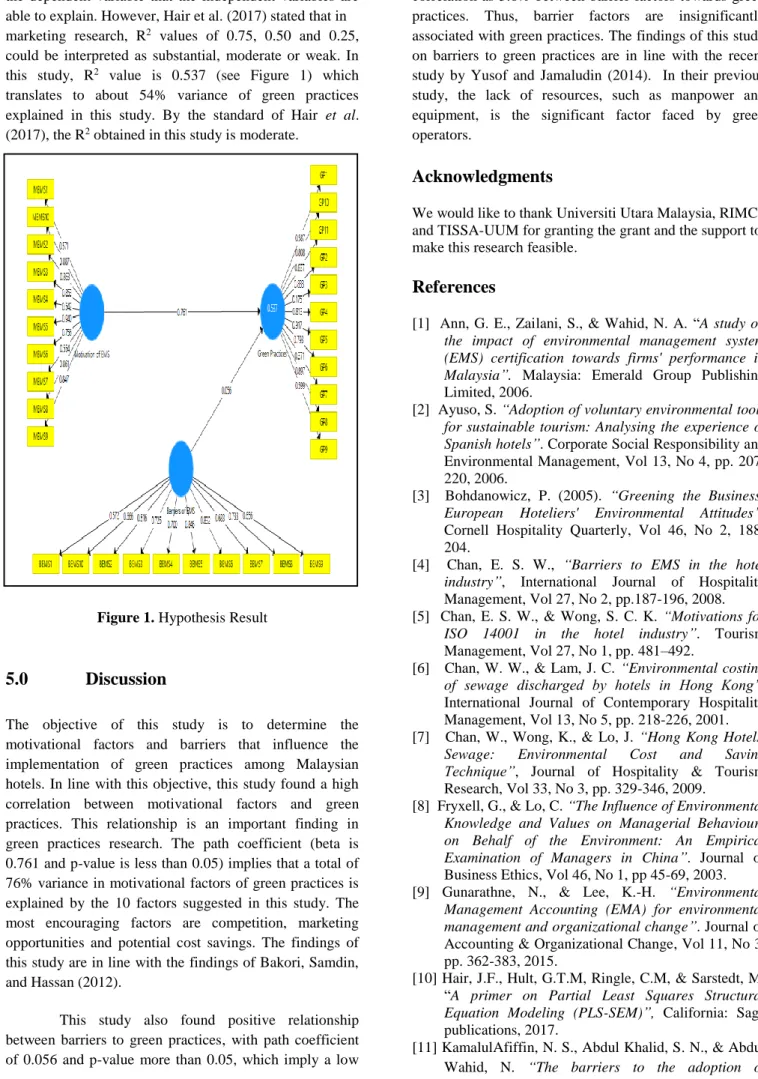
The direct relationships in the model of this study were examined through the PLS algorithm and the results are shown in Table 5. Hypotheses 1 suggests a positive relationship between motivational factors of EMS and green practices. The result of the PLS supports this relationship with path coefficient (beta 0.761, t= 6.72, P<0.05). Hypothesis 2 predicted a negative relationship between barriers to the EMS and green practices. However, this hypothesis is not supported (beta 0.056, t= 0.271, P > 0.05).
Table 5. Hypothesis results
Hypo. Path Path
Coeff. SE T-Value P-Values H1 MEMS ->GP 0.761 0.113 6.720 0.000 H2 BEMS -> GP 0.056 0.206 0.271 0.786
GP=Green Practices; MEMS=Motivational factors of Environmental Management System; BEMS=Barriers to Environmental Management System
One of the key criteria for assessing the path model is the coefficient of determination or R2 of the endogenous variables (Hair et al., 2013; 2017). The coefficient of determination is the amount of variance in
the dependent variable that the independent variables are able to explain. However, Hair et al. (2017) stated that in marketing research, R2 values of 0.75, 0.50 and 0.25, could be interpreted as substantial, moderate or weak. In this study, R2 value is 0.537 (see Figure 1) which translates to about 54% variance of green practices explained in this study. By the standard of Hair et al. (2017), the R2 obtained in this study is moderate.
Figure 1. Hypothesis Result
5.0
Discussion
The objective of this study is to determine the motivational factors and barriers that influence the implementation of green practices among Malaysian hotels. In line with this objective, this study found a high correlation between motivational factors and green practices. This relationship is an important finding in green practices research. The path coefficient (beta is 0.761 and p-value is less than 0.05) implies that a total of 76% variance in motivational factors of green practices is explained by the 10 factors suggested in this study. The most encouraging factors are competition, marketing opportunities and potential cost savings. The findings of this study are in line with the findings of Bakori, Samdin, and Hassan (2012).
This study also found positive relationship between barriers to green practices, with path coefficient of 0.056 and p-value more than 0.05, which imply a low
correlation as 5.6% between barrier factors towards green practices. Thus, barrier factors are insignificantly associated with green practices. The findings of this study on barriers to green practices are in line with the recent study by Yusof and Jamaludin (2014). In their previous study, the lack of resources, such as manpower and equipment, is the significant factor faced by green operators.
Acknowledgments
We would like to thank Universiti Utara Malaysia, RIMC and TISSA-UUM for granting the grant and the support to make this research feasible.
References
[1] Ann, G. E., Zailani, S., & Wahid, N. A. “A study on the impact of environmental management system (EMS) certification towards firms' performance in Malaysia”. Malaysia: Emerald Group Publishing Limited, 2006.
[2] Ayuso, S. “Adoption of voluntary environmental tools for sustainable tourism: Analysing the experience of Spanish hotels”. Corporate Social Responsibility and Environmental Management, Vol 13, No 4, pp. 207-220, 2006.
[3] Bohdanowicz, P. (2005). “Greening the Business: European Hoteliers' Environmental Attitudes”. Cornell Hospitality Quarterly, Vol 46, No 2, 188-204.
[4] Chan, E. S. W., “Barriers to EMS in the hotel industry”, International Journal of Hospitality Management, Vol 27, No 2, pp.187-196, 2008. [5] Chan, E. S. W., & Wong, S. C. K. “Motivations for
ISO 14001 in the hotel industry”. Tourism Management, Vol 27, No 1, pp. 481–492.
[6] Chan, W. W., & Lam, J. C. “Environmental costing of sewage discharged by hotels in Hong Kong”, International Journal of Contemporary Hospitality Management, Vol 13, No 5, pp. 218-226, 2001. [7] Chan, W., Wong, K., & Lo, J. “Hong Kong Hotels'
Sewage: Environmental Cost and Saving Technique”, Journal of Hospitality & Tourism Research, Vol 33, No 3, pp. 329-346, 2009.
[8] Fryxell, G., & Lo, C. “The Influence of Environmental Knowledge and Values on Managerial Behaviours on Behalf of the Environment: An Empirical Examination of Managers in China”. Journal of Business Ethics, Vol 46, No 1, pp 45-69, 2003. [9] Gunarathne, N., & Lee, K.-H. “Environmental
Management Accounting (EMA) for environmental management and organizational change”. Journal of Accounting & Organizational Change, Vol 11, No 3, pp. 362-383, 2015.
[10] Hair, J.F., Hult, G.T.M, Ringle, C.M, & Sarstedt, M. “A primer on Partial Least Squares Structural Equation Modeling (PLS-SEM)”, California: Sage publications, 2017.
[11] KamalulAfiffin, N. S., Abdul Khalid, S. N., & Abdul Wahid, N. “The barriers to the adoption of
environmental management practices in the hotel industry: A study of Malaysian Hotels”. Business Strategies Series, Vol 14, No 4, pp. 106-117, 2013.
[12] Kasim, A. “Managerial attitudes towards environmental management among small and medium hotels in Kuala Lumpur”, Journal of Sustainable Tourism, Vol 17, No 6, pp. 709-725, 2009.
[13] Kasimu, A. B., Zaiton, S., & Hassan, H. “Hotels involvement in Sustainable Tourism Practices in Klang Valley, Malaysia”, International Journal of Economics and Management, Vol 6, No 1, pp. 21-34, 2012.
[14] Kirk, D. “Environmental management in hotels”, International Journal of Contemporary Hospitality Management, Vol 7, No 6, pp. 3-8, 1995.
[15] Manaktola, K., & Jauhari, V. “Exploring consumer attitude and behaviour towards green practices in the lodging industry in India”, International Journal of Contemporary Hospitality Management, Vol 19, No 5, pp. 364-377, 2007.
[16] Meade, B., & Pringle, J. “Environmental management system for caribbean hotels and resorts: A Case Study of Five Properties in Jamaica”, Quality Assurance in Hospitality & Tourism, Vol 2, No 3-3, pp. 149-159, 2001.
[17] Mensah, I. “Environmental management and sustainable tourism development: The case of hotels in Greater Accra Region (GAR) of Ghana”, Journal of Retail & Leisure Property, Vol 6, No 1, pp.15-22, 2007.
[18] Moorthy, K., & Yacob, P. “Green Accounting: Cost Measures”, Open Journal of Accounting, Vol 2, No 1, pp. 4-7, 2013.
[19] Penny, W. Y. “The use of environmental management as a facilities management tool in the Macao hotel sector”, Facilities Emerald, Vol 25, No 7-8, pp. 286-295, 2007.
[20] Rahman, I., Park, J., & Chi, C. G.-Q. “Consequences of “greenwashing: Consumers’ reactions to hotels’ green initiatives”, Management Decision, Vol 27, No 6, pp. 1054-1081, 2015.
[21] Revilla, G., Dodd, T., & Hoover, L. “Environmental Tactics Used By Hotel Companies in Mexico”,
International Journal of Hospitality & Tourism Administration, Vol 1, No 3-4, 111-127, 2011. [22] Rezai, G., Sumin, V., Mohamed, Z., Shamsudin, M.,
& Sharifuddin, J. “Implementing Green Practices as Sustainable Innovation Among Herbal-Based SME Entrepreneurs”, Journal of Food Products Marketing, Vol 22, No 1, pp. 1-18, 2016.
[23] Rivera, J. “Assessing a voluntary environmental initiative in the developing world: The Costa Rican Certification for Sustainable Tourism”, Policy Science, Vol 35, No 4, pp. 333–360, 2009.
[24] Sezgin, M., Buyukipekci, S., & Gumus, M. “Tourism Investment Analysis In Karaman Province And Tourism Investment Map”, Suleyman Demirel University Journal of Faculty of Economics & Adminstrative Sciences, Vol 17, No 3, pp. 39-54, 2014.
[25] Siti-Nabiha, A. K., George, R. A., Abdul Wahid, N., Amran, A., Mahadi, R., & Abustan, I. “The Development of a green practice index for the Malaysian hotel industry”, Issues in Social and Environmental Accounting, Vol 8, No 1, pp. 23-7, 2014.
[26] Siti-Nabiha, A. K., George, R. A., Abdul Wahid, N., Amran, A., Abustan, I., & Mahadi, R. “A field survey of environmental initiatives at selected resorts in Malaysia”, World Applied Sciences Journal, Vol 12, Special Issue of Tourism and Hospitality, pp. 56-63, 2011.
[27] Stalcup, L., Deale, C., & Todd, S. “Human Resources Practices for Environmental Sustainability in Lodging Operations”, Journal of Human Resources in Hospitality & Tourism, Vol 13, No 4, pp. 389-404, 2014.
[28] Tinsley, S., & Pillai, I. “Environmental management systems : Understanding organisational drivers and barriers”, London: Earthscan, 2006.
[29] Ustad, B. H. “The adoption and implementation of environmental management systems in New Zealand hotels: The managers' perspective”, Auckland University of Technology, 2010.
[30] Yusof, Z. B., & Jamaludin, M. “Barriers of Malaysian Green Hotels and Resorts”, Procedia Social and Behavioral Sciences, Vol 153, 501-509, 2014.