Discourses of educational leadership the
under-explained influence of context
Deborah Maria Humphreys
A thesis submitted in partial fulfilment of the
requirements of Liverpool John Moores University
for the degree of Doctor of Philosophy
Table of Contents
Abstract ………...i
Acknowledgements……….iii
List of figures and tables………...iv
1. Chapter 1: Introduction ... 1
1.1 Aims and rationale ... 1
1.2 Research context ... 2
1.3 Methodology and chosen methods ... 3
1.4 Situating my argument ... 5
1.5 Situating myself within the study ... 6
1.6 Claims to originality ... 7
1.7 Overview of thesis structure ... 8
2. Chapter 2: Setting the scene: policy and literature ... 10
2.1 Changing focus of leadership in education ... 11
2.2 School effectiveness research ... 13
2.3 UK Policy – New Public Management (NPM) ... 14
2.4 Remodelling of the school workforce ... 15
2.5 Complex nature of leadership in education ... 19
2.5.1 Leadership versus Management ... 19
2.5.2 Theory within education ... 21
2.5.3 Leadership: a highly contested concept ... 22
2.6 Leadership as the property of leaders ... 25
2.6.1 Traits and Skills approaches ... 26
2.6.2 Leadership styles and behaviours ... 28
2.6.3 Contingency and Situational approaches ... 29
2.7 Leadership and followership ... 30
2.7.1 Leader–Member Exchange (LMX) theory of leadership ... 30
2.7.2 Transactional leadership... 33
2.7.3 Charismatic and Transformational leadership ... 35
2.7.4 Transformational leadership ... 37
2.8 Leadership as a social process ... 42
2.8.1 The practice of leading ... 43
2.9 Teacher leadership ... 44
3. Chapter 3: Conceptual framework ... 47
3.1 Distributed Leadership ... 49
3.1.1 Key researchers within the field of distributed leadership ... 49
3.1.2 Distributed leadership as conjoint activity ... 50
3.1.3 Distributed Leadership as direction-setting and influencing practice ... 53
3.1.4 Communities of practice and distributed leadership ... 55
3.1.5 Summary ... 56
3.2 Contextual factors and their relevance for this study ... 57
3.3 Understanding contextual factors of leadership ... 58
3.3.1 The dynamic interaction of different levels and types of context ... 59
3.3.2 The context of meaning making ... 61
3.3.3 Power and context... 62
3.3.4 Identity and context ... 66
3.3.5 Summary ... 68
3.4 Why I am using discourse analysis in this study. ... 69
3.5 Foucault – his influence for discourse analysis and this study ... 70
3.6 Linguistic definitions of discourse: formal and functionalist paradigms ... 73
3.6.1 Formalism ... 73
3.6.2 Functionalism ... 74
3.7 Critical approaches to discourse analysis ... 75
3.8 The Hallidayan influence within critical discourse analysis ... 75
3.9 Fairclough social analysis, discourse analysis, text analysis ... 76
3.10 The reason for choosing Gee’s methodological approach for this study ... 77
3.11 Situating my own research using Gee’s approach ... 78
3.12 Gee’s approach... 81
3.13 Seven building tasks used to build reality through language ... 81
3.13.1 Politics – the distribution of social goods ... 81
3.13.2 Part of the community – (identities) ... 82
3.13.3 Relationships – (sense of belonging) ... 82
3.13.4 Significance... 83
3.13.5 Practices – (sense of becoming by engaging in certain activities) ... 83
3.13.6 Connections ... 83
3.13.7 Sign systems and knowledge ... 83
4. Chapter 4: Methodology and methods ... 85
4.1 Critical Social Theory ... 86
4.2 Cognitive Mapping as a method... 89
4.3 Semi-structured interviews ... 90
4.4 Document analysis ... 91
4.5 Information gathering and the criteria used to ensure ‘quality’ and ‘validity’ 91 4.6 Case study ... 93
4.7 Purposive Sampling ... 94
4.8 Limitations of approaches and methods ... 96
4.9 Generalizability ... 97
4.10 Metaphors ... 97
4.11 Relationship with my participants ... 97
4.12 My approach ... 98
4.13 What counts as data or evidence in relation to my research questions? ... 99
4.14 The context and ‘line of reasoning’ and reducing the data ... 99
4.15 Ethical Issues ... 100
4.16 The importance of utterance-type and utterance-token meaning ... 100
4.16.1 Utterance-type meaning ...101
4.16.2 Utterance-token meaning ...101
4.17 Thinking devices for conducting the analysis ... 102
4.18 An interconnected framework revisited ... 102
4.19 Seven building tasks ... 103
4.20 Six tools of inquiry ... 104
4.20.1 Situated meaning as a tool of inquiry ...104
4.20.2 Cognitive maps as a tool of inquiry ...104
4.20.3 Discourse as a tool of inquiry ...105
4.20.4 Intertextuality and Conversation as tools of inquiry ...106
4.20.5 Social languages as a tool of inquiry ...106
4.21 Grammatical contructions which perform communicative functions ... 107
4.21.1 Germanic and Latinate words ...108
4.21.2 Co-locations ...108
4.21.3 Lexical verbs referring to state ...108
4.21.4 ‘I’ Statements ...108
4.21.5 Lexical words or content words ...108
4.21.6 Pronouns ...108
4.22 Discursive Practice approach/analysis ... 109
5. Chapter 5: Interpretation and Explanation ... 111
5.1 Introduction to the chapter ... 111
5.2 The objective of this chapter ... 111
5.3 Themes from the data ... 113
5.3.1 The pivotal role of the headteacher ...113
5.3.2 The theme of leadership activity ...113
5.3.3 The theme of a commodification of education ...114
5.3.4 The theme of relations of power...114
5.3.5 The theme of Culture and Identity-Work ...114
5.4 Summary ... 115
5.5 Analysis and interpretation of the themes ... 115
5.5.1 Introduction ...115
5.6 The theme of the pivotal role of the headteacher ... 115
5.6.1 The pivotal role of the headteacher discourse ...116
5.6.2 Headteacher’s role in engaging in certain practices of leadership ...116
5.6.3 Achieving solidarity in sustaining the practices of leadership ...118
5.6.4 Speaking in the first person (‘I’) to build identity of the pivotal role ...118
5.6.5 Goal setting and raising standards as part of the pivotal role ...119
5.6.6 Enabling, modelling and guidance ...121
5.6.7 Distributed leadership in the gift of the headteacher ...122
5.6.8 Summary ...124
5.7 The theme of leadership activity ... 125
5.7.1 How leadership practice was carried out ...125
5.7.2 Developing teams and structures as a form of leadership activity ...125
5.7.3 Developing relationships as a form of leadership activity ...128
5.7.4 Managing communications as a form of leadership activity ...129
5.7.5 Bestowing staff development as a leadership activity ...130
5.7.6 Making connections to build leadership activity ...132
5.7.7 Situated meaning as endorsing the pivotal role of the headteacher ...133
5.7.8 Summary ...134
5.8 The theme of commodification of education ... 134
5.8.1 Making connections to build a sense of belonging ...135
5.8.2 Talking the market ...136
5.8.3 Celebrating success as part of the community ...137
5.8.4 Commitment and engagement with the community ...139
5.8.5 Summary ...141
5.9 The theme of relations of power... 142
5.9.1 Distributed leadership and managerial power...142
5.9.2 The cognitive model of success, empowerment and achievement ...144
5.9.3 Power and influence ...145
5.9.4 Influence resulting in actions...146
5.9.6 Summary ...149
5.10 The theme of Culture and Identity-Work ... 149
5.10.1 Sensemaking through story-telling ...149
5.10.2 Creating stories with a moral plot as central to the school ethos ...151
5.10.3 Inspirational and transformational ...152
5.10.4 Using sensemaking to create identities ...153
5.10.5 Summary ...154
6. Chapter 6: Discussion, Implications and Contribution ... 155
6.1 Contextual factors ... 159
6.2 Discourse of the pivotal role of the headteacher ... 163
6.3 The Discourse of Leadership activity ... 167
6.4 Discourse of commodification of education ... 170
6.5 Discourse of relations of power ... 173
6.6 Discourse of Culture and identity-work ... 175
6.7 Implications of this analysis for the practice of leadership within school .... 178
6.8 Implications ... 179
6.8.1 Monologic versus Dialogic ...179
6.8.2 Government driven managerialism versus disrupt the assumed normality ...180
6.8.3 Relations of influence versus relational ...181
6.8.4 Pre-formed entity versus state of becoming ...182
6.8.5 Shape and maintain versus empowerment ...183
6.9 Conclusion ... 184
6.10 The path forward ... 186
i
Abstract
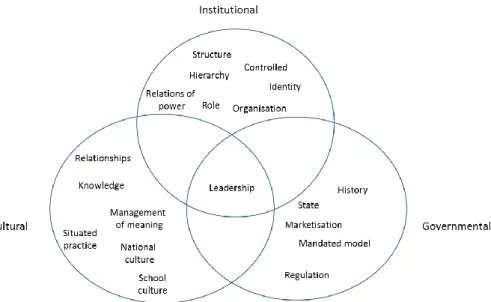
The aim of the this small scale empirical research study was to shed a discursive light on the leadership that was experienced within two primary school settings in the North West of England and the constraints of context that shaped the discourses of leadership within those schools. Contextual factors have been defined as being on three levels: institutional, cultural and governmental. So using this framework as a sorting category for posing situated questions of the participants and Gee’s (1999; 2005; 2011) interconnected one to explore and question the data and the taken-for-granted assumptions, it has been possible to garner an understanding of how these contexts interacted in framing an individual’s understanding of the leadership they were experiencing and implications for their practice.
The research questions which this study addressed were:
What are the contextual factors that shape discourses of educational leadership?
What does the discursive analysis reveal of how stakeholders talk about ways of becoming in the leadership they are experiencing within a socially situated practice?
What are the implications of this analysis for the practice of leadership within school?
The research was influenced by two particular approaches to discourse analysis, a ‘practice approach’ and a ‘critical approach’. As educational practices are communicative events, this study has adopted a critical discourse analysis in making visible the ways that individuals talk about leadership they are experiencing within their settings. Through a Foucauldian lens it was possible to question the basis for the assumptions and norms of educational leadership in school and examine the ways in which individuals within school were both constructed and shaped by that discourse.
This study takes the view that the school as an organizational context for leaders is both complex and under explored as it is in a constant state of flux. Various complexities are acknowledged concerning the contextual nature of leadership; it is complex, context specific, socially constructed, negotiated and hierarchical.
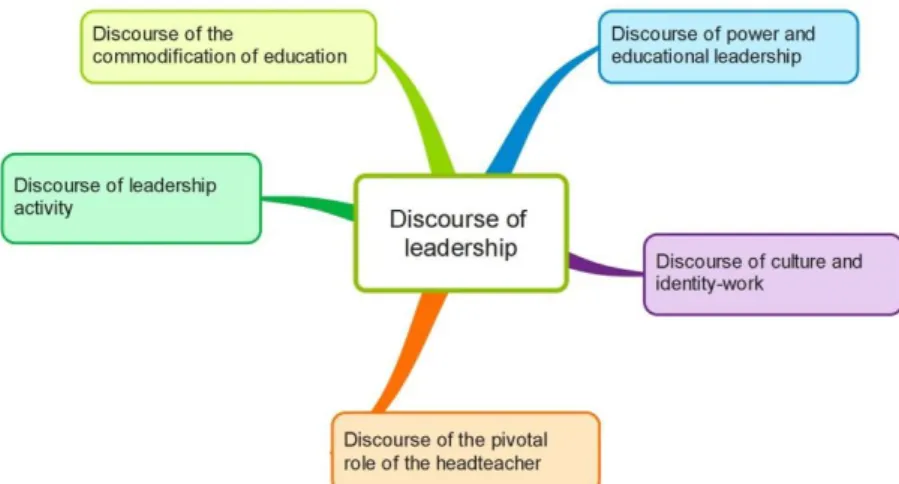
ii Analysis of 18 in-depth semi-structured interviews and 18 cognitive maps reveals a range of Discourses of contextual factors of leadership such as the Discourse of the pivotal role of the headteacher; Discourse of leadership activity; Discourse of identity-work; Discourse of power relations and Discourse of commodification of education all made visible by the individuals within the school to which they endeavour to belong.
iii
Acknowledgements
First and foremost I would like to thank and acknowledge the unwavering love and support of my husband Les, who has been with me every step of this journey! His constant offers of help, advice and motivation, along with countless cups of coffee and listening to my endless thoughts on the subject has enabled me to complete this life-long ambition, thank you Les, I love you very much.
Also my appreciation goes to my mother, Pauline Jones who has kept the family up to-date with my progress and supported me also on this journey. Her attitude to life and commitment to our family are values that I treasure and hope to emulate.
I would also like to acknowledge my late father, Arthur Jones who sadly passed away in April 2012, he would have been so proud to see me accomplish a PhD. He was and is a true inspiration to me. He firmly believed that there were no boundaries and that we could achieve anything we put our minds to.
Finally my thanks and appreciation goes to my supervisor, Dr. Aileen Lawless who has believed in me from the start and who has provided essential support, guidance and good humour every step of the way, thank you Aileen.
iv
List of figures and tables Page
Figure 2.1 Representations of leadership over time 12
Table 2.2 Theories of leadership 25
Table 2.3 Personality Characteristics, Behaviours, and Effects on Followers of Charismatic Leadership
36
Figure 3.1 Dynamic interaction of contextual factors on leadership
60
Figure 3.2 Interconnect Framework 81
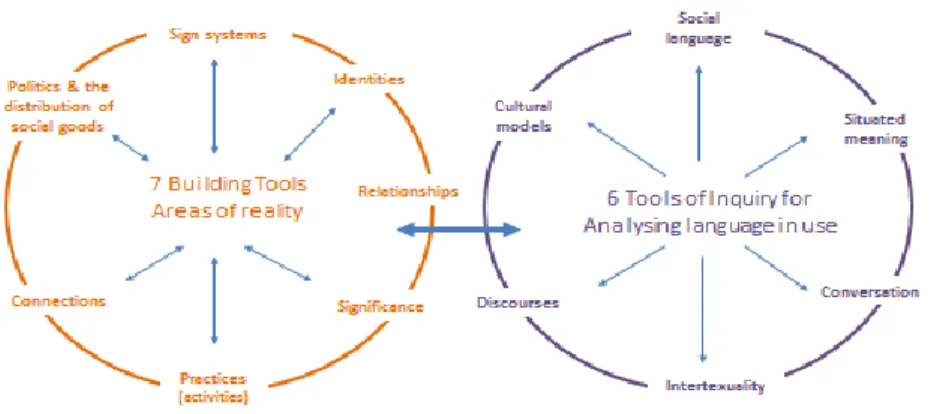
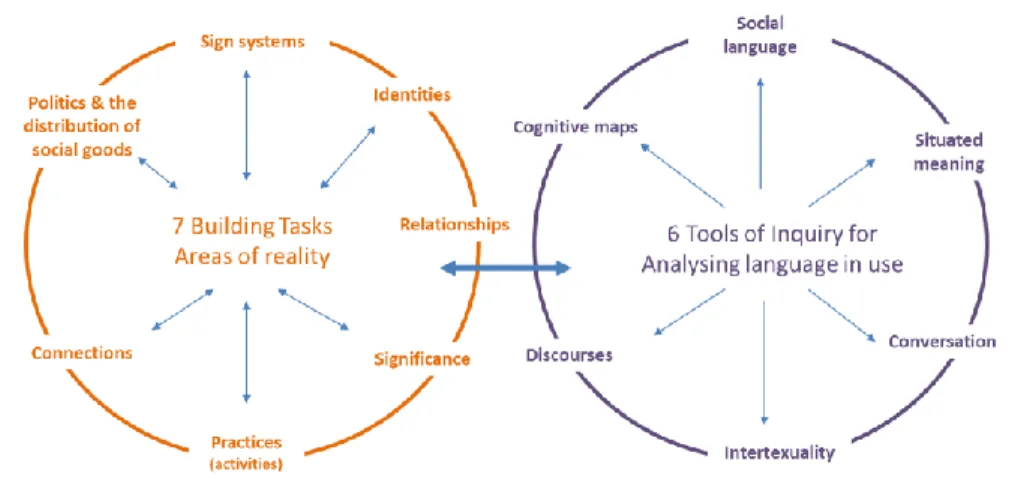
Figure 4.1 Interconnected Framework 103
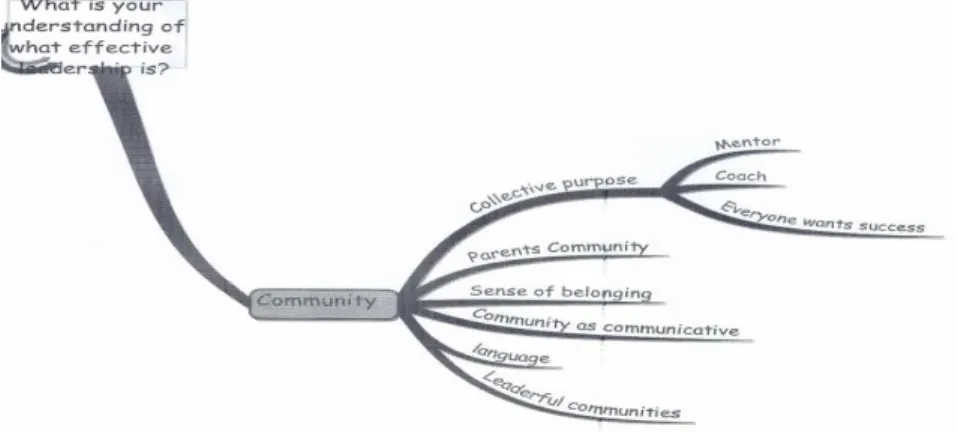
Figure 4.2 Cognitive Map 105
Figure 6.1 Dynamic interaction of contextual factors on leadership
159
Figure 6.2 The five discourses of leadership 162
Figure 6.3 Pivotal role of the headteacher cognitive map 163
Figure 6.4 Leadership activity cognitive map 167
Figure 6.5 The commodification of education cognitive map 170
Figure 6.6 The relations of power cognitive map 173
Figure 6.7 Culture and identity-work cognitive map 175
Table 6.1 Key differences between present perspectives and discursive perspectives of leadership
1
1.
Chapter 1: Introduction
1.1 Aims and rationale
The aim of this study is to shed a discursive light on leadership and the constraints of context within a primary school setting. Methodologically, the research is best described as an interpretive discursive study, grounded in critical social philosophy. Which seeks to gain a deeper professional understanding of leadership within the primary schooling sector. Social reality for me is meaningfully understood by perceiving individuals as social actors, actors who are not always fully aware of the impact of the social stage on their actions.
In order to address the above aim the research engages with the following questions to provide a coherent structure for the study:
What are the contextual factors that shape discourses of educational leadership?
What does the discursive analysis reveal of how stakeholders talk about ways of becoming in the leadership they are experiencing within a socially situated practice?
What are the implications of this analysis for the practice of leadership within school?
My intellectual puzzle concerns how the effectiveness of leadership in two primary school settings can provide insights into how contextual factors shape that leadership. Therefore, in trying to understand the world in which educational researchers operate, this study is conducted within a range of beliefs about the ways in which education research can be understood as practice (Mason, 2002; Gillies, 2013).
The research questions stem from a desire to understand what shapes leaders’ discourses within a primary setting and how this impacts on an individual’s way of becoming within school. More often than not leadership in schools is learnt by on-the-job experiential learning, through a cluster network of school leaders and by adopting a mandated model of leadership. My experience has taught me that this leadership varies incredibly even within identical socioeconomic environments. My conceptual framework is therefore built around assembling data, evidence and arguments which are used to generate ideas and propositions. My strategy has been to operationalize what teachers articulate as ‘effective’ with regard to what
2 leadership feels like and how they observe it, know it and how their identities as teachers are built or destroyed as a result of it.
Furthermore, having moved from the private sector to become a primary school teacher, latterly a teacher educator within the higher education sector and subsequently a governor, I have always been preoccupied by a concern with policy compliance, particularly prescribed by the Office for Standards in Education, Children’s Services and Skills (Ofsted), and the bureaucratic nature of monitoring and evaluation within a school environment. The monitoring and evaluation involved powerful ways of being, or, in the terminology of Gee (2005), Discourses, which originated in and supported policy. In terms of my theoretical approach, a critical discourse analysis provides me with a way of thinking about the power behind the language-in-use and the relationships that this may affect and shape. I am interested in why some discourses were marginalized compared to others (Foucault, 1974). As a result, language and the analysis of discourse are central themes that permeate this thesis.
1.2 Research context
A case study approach is chosen when it is of specific interest, ‘it is the study of the particularity and complexity of a single case’ (Stake, 1995:xi). With regards to this study the case is a headteacher who led two primary schools in the North West of England. He was chosen for a number of reasons: firstly, because I have known him for a number of years, having taught beside him and latterly having become community governor of his second school; and secondly and more importantly, because the headteacher was head of both primary schools, allowing me to perform purposive sampling as I was able to observe and investigate the phenomenon over a four-year period. Also, the headteacher was a non-teaching head in both case study sites, therefore devoting most of his time to leadership and management. Additionally, it is significant that both schools have achieved positive inspection reports from Ofsted, especially in respect of management and leadership.
Ofsted reports are conducted by a team of professional educators (some previous heads themselves) who have standardized criteria against which they evaluate a school: overall effectiveness; achievements and standards; personal development and well-being; quality of provision and leadership and management (Ofsted, 2011; 2013; 2014).
3
1.3 Methodology and chosen methods
Education, educational research and the social sciences present a very complex set of interrelated issues. The way individuals build their relationships within organizations, along with the different ways in which they participate within social groups they find themselves part of within those organizations, is relational, time specific and related to common frames of reference (Schedlitzki & Edwards, 2014). This study is interested in the conscious and taken-for-granted ways of how things work, and why, in particular contexts.
This research is influenced by two particular approaches to discourse analysis: a ‘practice approach’ and a ‘critical approach’ (Lawless et al., 2011). Looking at effective leadership as discursive practice provides a means of critically analysing how participants ‘talk-about’ their practice (Lave and Wenger, 1991), allowing the researcher to examine what is being said, by whom, why, how and what happens as a result. A helpful means of looking at discourse analysis in this context is provided by Rigg (2005), who argues that thinking of discourse as both noun and verb can aid understanding. In other words, making a distinction between discursive resource and discursive practice enables an analysis of both what is being communicated, the resources; and how it is being communicated, the practices. This view is also supported by Lawless et al. (2011:265) who suggest that ‘a practice approach views language as situated within a particular social and cultural context rather than within a particular interaction’.
In terms of a critical approach to discourse analysis, is as Rogers (2011:3) suggests a broad framework that brings critical social thoeries into dialogue with theories of language ‘critical discourse analysts are generally concerned with a critical theory of the social world and the relationship of discourse in the construction and representation of this social world and a methdology that allows them to describe, interpret and explain such relationships’. Gee (1999:1) offers both a theory and a method for studying how language is used ‘on site to enact specific social activities and social identities’. Gee’s approach draws on American anthropological linguistics and narratives; social discourse theories and cognitive psychology (ibid.). For Gee (1999:28; 2004; 2005; 2011) critical discourse analysis (cda) argues that ‘language-in-use is always part and parcel of, and partially constitutive of specific social practices and that social practices always have implications for inherently political things like status, solidarity, the distribution of social goods and power’. For Gee lanugague-in-use is not just for saying things but used with other non verbal tools
4 builds things in the world. For him whenever we say or write anything we are building ‘one of seven areas of reality’ (1999:30). By adopting Gee’s approach to discourse analysis this study offers both a methodological framework and a method which bridges the gap between more linguistic-orientated studies of language and the socio-cultural approaches of language as a social practice, this is further explored in 3.10.
The focus for this study is on the grammar of what is said the language-in-use. It is also interested in ‘ways of representing, believing, valuing, and participating with all of the sign systems that people have at their disposal’ (Rogers, 2004:7). Gee is well known for the distinction between little ‘d’ and ‘D’ discourse, ‘it was one of the ways through which critical discourse analysis gained leverage in educational studies’ (ibid.) What Gee (1999; 2005; 2011) refers to as Discourse with a capital ‘D’ represents an individual’s way of thinking, believing, acting, interacting, speaking, listening and valuing (Gee, 1999). Little ‘d’ discourse refers to what is said or written. This distinction stresses that ‘the form of language cannot exist independent of the function of language and the intention of speakers’ (Rogers, 2004:7.), as a result serving to reproduce society through its social structures, relationships and value systems, ‘language has meaning only in and through social practices’ (Gee, 1999:8, 2005; 2011; Fairclough, 2015). For Fairhurst ‘discourse scholars ask ‘How’ questions (‘How is leadership brought off?’) in other words what stretches of oral language is being used and why. For her when Discourse scholars are using capital ‘D’ they are asking ‘the ‘What’ questions (‘What kind of leadership are we talking about?’)’ (2011:503).
The focus therefore within this study is on how discourse is put together, and what is gained by its construction, ways of being in school. This can highlight how language not only describes things, but builds things and has implications in terms of individual identity and social practice, and also politically in terms of the distribution of power (Gee, 2005; 2011; Lawless et al., 2011). This study therefore shares the assumption ‘that because language is a social practice and because all social practices are not treated equally, all analyses of language are therefore inherently critical’ (Rogers, 2004:2).
It was pertinent for the purposes of this study to introduce the distinction between ‘D/discourse analsyis’ to stress that this study is interested in ‘analyzing language as it is fully integrated with all the other elements that go into social practices (ways of thinking or feeling, ways of manipulating objects or tools, ways of using
non-5 linguistic symbol systems, etc)’ (Gee, 1999:9). Now having made the point for the purpose of ease, this study will simply use the phrase ‘discourse analysis or discourse’ but will mean by this phrase both little ‘d’ discourse and capital ‘D’ Discourse.
This study further draws upon Foucault’s work on discourse (1972) to address the research questions above. The Foucauldian school of thought sees discourse as a particular way of looking at and structuring the world. As will be discussed in Chapter 3, adopting a Foucauldian critique, together with Gee’s (2005:9; 2009; 2011) interconnected framework, provides a means, a set of ‘thinking devices’. This enables me to analyse the talk of the participants in terms of their physical locations in their settings and the social relationships and practices including relations of power that form part of their life in school. As a result, it is possible to question the basis for the assumptions and norms of educational leadership in the two case study site schools.
Furthermore, the methods of cognitive mapping and semi-structured interviews are used to try to understand the complexity of the socially situated practice of school (Mason, 2002). Cognitive mapping as a method is used as this can enhance the understanding of the participants’ frames of reference as, through the process of mapping, relationships between concepts are demonstrated by propositions which are produced by the linking of two or more concepts by words written by the respondents which form meaningful statements (Novak & Gowin, 1984). By recording the process additional rich data was captured. Semi-structured interviews are appropriate because I wanted to question, to listen to participants talk in order to understand their situated knowledge.
1.4 Situating my argument
I situate my argument in the particular environment of the present primary school sector. Leadership discourse within schools requires measurable aims or goals, that is, generally quantifiable in nature (Gillies, 2013). School leaders and staff are therefore held accountable for the achievement of these outcomes. The focus within this study is on how language in these school communities is an ingredient of social processes resulting in, and sustained by, forms of power embedded within dialogical and relational social practices (Cunliffe, 2014), affected by time and space and co-produced (Grint, 2001; Osborne et al., 2002; Jackson & Parry, 2008; Schedlitzki & Edwards, 2014).
6 ‘Leadership discourses, therefore, do not describe what is, or what must be, but instead construct the educational space in such a way as to render it fit for the discourse’ (Gillies, 2013:46). A critical analysis of leadership within a primary school environment, I shall argue, necessarily needs to provide insights into the dynamics of the interactions and the construction of the educational space. The purpose of this is to open up a discursive space to talk about why, more so than other, broader aims of education, leadership discourses within a primary school setting require measurable outcomes.
1.5 Situating myself within the study
Trowler (2014:5) refers to doing research where one is employed or studying as ‘insider’ research. He advocates that what ‘counts as ‘inside’ also depends on one’s own identity positioning; how one sees oneself in relation to the organisation’. He warns that an insider approach must be appropriate and ‘congruent with the research question’ (ibid:9). Reason and Rowan (1991, cited in Trowler, 2014:6) suggest that by carrying out insider research it is possible ‘to combine more objective research approaches, ‘naïve enquiry’ with those suffused with cultural awareness’, something as a governor and teacher educator I can bring to the table. It is a matter of being conscious of where the fine line rests between ‘where and how the endogenous character of one’s research potentially illuminates the issues of interest, and where it could obscure them’ (Trowler 2014:6).
Cunliffe (2014) further suggests that how we relate to each other within organisations is at the heart of management. For her there are three paths, relational, reflexive and a moral and ethical responsibility of those in management positions. Relational because within organisations we are in relationship with others that may not be the same as ourselves. In addition there needs to be an understanding of morals and ethics not in the standard sense of organisational ethics but in our relationships and interactions with others. Finally for her individuals need to adopt a reflexive practice something which is especially pertinent to my role as a leader within an educational setting and my journey for a greater understanding of leadership within education. For her, ‘exploring the taken-for-granted relationship between language and our experience of the world, and examining the impact that assumptions of social constructed realties have on management theory and practice’ is paramount (ibid:xvii). It is this emphasis on wanting to understand and be reflexive of the assumptions of socially constructed realities that surround leadership for me as a leader, an academic with teacher education and governor of a local
7 primary school that I want to explore. Furthermore being a governor of one of the schools and my connections with the headteacher I must remain vigilant of how I relate to my participants and be ever conscious not to assume there is only one meaning for example mine. In addition as Cunliffe (2014:41) advocates to be conscious that I am always ‘in relation’ to my participants
The design of my research study moreover, ‘should not lose sight of the structural influences on practices’ being conscious of not being ‘over-focused on the practices-as-presented rather than on the forces that shape them’ (Trowler, 2014:56). Truth claims therefore need to limit themselves to the areas of practice being investigated (ibid.). Therefore my methods and process of analysis needs to be relevant, robust and rigorous. This is something that will permeate throughout the study.
1.6 Claims to originality
This research contributes to a critical discursive approach which provides an illuminating lens for opening up a discursive space in which to question taken-for-granted assumptions of leadership and ways of being within a primary school setting. In addition Cunliffe (2014) argues that leaders within organisations need to take in account the two-way process of communication and adopt a dialogic aspect of language. She believes that the present focus of a monological one often practised by management within organisations results in leaders being unresponsive to not only the diversity of the many but leads to obliviousness of how a leader’s voice is being received. This research contributes to such a critique and draws attention to the pivotal role of the headteacher and the preponderance of a monological leadership discourse.
In addition Fairhurst (2011) suggests that discursive scholars do not concern themselves with gaps in the literature but instead focus on localized problems or issues of negotiated meanings. This research contributes to such a focus. Through an examination of the discourse, it has been possible to reveal the socio-historical basis for leadership as experienced within a primary school setting. It explains how leadership has developed to reflect the socially situated practice in which it resides and examine localized issues where negotiated means result in coordinated pre-determined actions. This research contributes to such a debate by opening up a discursive space in which to examine the under explored influence of context on leadership within a primary school setting.
8 Gillies (2013) on applying the work of Foucault to the field of educational leadership, questions what sort of actions on themselves must individuals undergo in order to be legitimized within the discourse of educational leadership and therefore be accepted and to speak authoritatively. This research by adopting a discursive approach to institutional life of school provides some insights into why experienced teachers are tied into a power structure which does not enable them to work in an emancipatory way.
Furthermore this study contributes by presenting a conceptual framework for understanding the context of leadership which aids in furthering the discussion of how the interactions of different levels and types of context act to frame an individual’s context and hence their ‘technologies of self’ (Foucault, cited in Gillies, 2013:15) within which leadership is understood and co-created.
1.7 Overview of thesis structure
Having outlined the aim and the research questions for this study as well as my motivations for undertaking the research, this chapter now moves on to present a structure for the thesis, providing a brief overview of each chapter.
Chapter 2 UK Historical Policy Context
This chapter begins by framing the UK Policy context within which headteachers and staff in the schools make sense of leadership within their settings, before moving on to present the themes from policy which frame and impact upon individuals within the case study sites. Central to the discussion is the ideology of a school improvement agenda focussing on educational standards, with the headteacher as the single leader. The chapter then proceeds to examine the complex nature of leadership in education. Principal to the argument within Chapter 2 is how leadership and management has been theorised within the management and school leadership literature over the years, from viewing leadership as the property of leaders; to considering the relationship of followers and leaders before ending the chapter by examining leadership as a social practice.
Chapter 3 The Conceptual framework
The aim within Chapter 3 is to develop an interpretivist theoretical framework based around social constructivism and meaning making. This framework is based on a distributed model of leadership within the two case study site schools; a social constructionist perspective on context; and a critical language analysis. Gee’s
9 (1999) interconnected framework for conducting a critical discourse analysis is introduced and how I situate my research within this framework. In addition the rationale for why this study has adopted a Foucauldian lens is presented.
Chapter 4 Methodology and methods
Informed by my discussion of the theories and concepts as presented in Chapter 3, Chapter 4 establishes critical social theory as a suitable methodology for the study and establishes the research tools appropriate for undertaking a critical discourse analysis (cda). Ethical issues and limitations of the study are considered ending the chapter with a discussion of the unit of analysis and analytical process. The analytical tools and procedures utilised when analysing and interpreting the data will also be presented together with a discussion around Gee’s (1999; 2005; 2011) tools of inquiry in order to present a sharp and comprehensible analysis.
Chapter 5 Interpretation and Explanation
In Chapter 5 by making use of Gee’s (1999) tools of inquiry the findings and interpretation of the data are presented. A systematic analysis ensues bringing out the significance of the data gathered.
Chapter 6 Discussion, Implications and Contribution
This chapter concludes the thesis and draws together the analysis by drawing on the literature as reviewed in the study to help inform the analysis and discussion. In addition the chapter will present the implications and the limitations of the findings and the study’s claim to academic contribution made clear.
10
2.
Chapter 2: Setting the scene: policy and literature
Introduction
This thesis aims to critically look at the discourse of individuals within two primary school settings as they talk about their perceptions of the leadership they are experiencing. My conceptual and methodological approach therefore is designed to allow the participants to be heard as they think about and talk about the leadership within their schools and then to relate what is talked about back to the policy, the wider education system and the literature.
Thus the conceptual framework and analytical tools need to take into account ways of analysing the ‘talk’ within the setting(s) and to locate this within their social contexts. Furthermore, to identify from their discourses ways of being and to explain these discourses (Gee, 2005), these ways of being, in light of wider social and political issues requires an understanding of the contextual factors that impact upon their experience within school.
Likewise, the methodology and methods need to be chosen not for reasons of the inherent superiority of particular philosophies or sociological approaches, but for their value in the political interpretation of the subject. Moreover, my interest lies in the ways of being of the individuals within the settings and a desire to understand how they make sense of their world through drawing on the social resources available to them. This chapter therefore presents discourses of policy and engages with theories and themes from the literature that can provide a lens through which to understand the social location of the individuals within school and, through theorization, understand their ways of being and make sense of how they experience leadership within the settings.
This study explores how contextual factors shape discourses of leadership within two primary school environments within the current UK educational policy context. In order to develop the research questions, inform the design of the methods and situate subsequent findings, it is to those discourses that this study now turns: firstly, to discuss the relevant UK historical policy context and its relevance for school leadership; secondly, to discuss the traditional approaches to leadership and their significance for this study; and thirdly, to critically discuss current issues in leadership and context and how they are pertinent for the education sector.
11
2.1 Changing focus of leadership in education
The development of educational leadership and management as a field of study and practice in the UK was derived from management principles first applied to industry and commerce. This began as late as the 1960s, but since then there has been rapid expansion.
Theory development largely involved the application of management models to educational settings (Bush, 1995). However, as the subject grew as an academic subject in its own right, its theorists and practitioners began to develop their own models based on their own observations and experience in educational environments and now there is, as Thomson et al. point out, a leadership industry made up of knowledge producers located in private companies, universities and schools (2013, cited in Gillies, 2013).
Therefore, what follows is an exploration of the situation that, despite a perception within the educational sector over the last 30 years of the changing focus of educational research, it nevertheless has all centred around the issue of how educational leadership is seen as transforming schools. This nucleus has initiated site based management within schools, changing from local authority administration to management led iniatives, and from strategic and development planning to performance accountability leadership, all positioned within a policy discourse of implementing workforce reform which has at its heart, in part, the headteacher recruitment and teacher retention crisis, but above all progressing the school improvement agenda (Gunter 2012b).
It was New Labour that invested, developed and ‘sought to structure knowledge production, ways of knowing and who are regarded as knowers in the field of school leadership’(Gunter, 2012:346). This was achieved by commissioning an extensive analysis of the leadership literature (Bennett et al., 2003) – developing, as the preferred model of school leadership, transformation distributed leadership (Bush and Glover, 2003) and being instrumental in ‘constructing and communicating a discourse about what can be said and who can say it through National College seminars’ (Gunter, 2012:346).
The overview in Table 2.1 below, adapted by the author, is not a time-framed chronology of all policy and initiatives within England over this period, but rather illustrates particular points within the period ca. 1988–2010 that have shaped and continue to shape the interplay between managerialism and leadership within
12 schools (Grint, 2011). These have resulted in new identities, particular ideologies and particular relations of power. At the heart of this discourse is the expectation that headteachers, when particular paradigms were ‘presented as common sense statements about what works, underpinned by beliefs in the power of the single person’, would drive them home (Gunter, 2012:346). This single individual would become involved in policy implementation through these new managerialist approaches with a political agenda of bringing about improvements in schools and the curriculum (Gunter, 2007). It is this discourse that provides the policy context for this study.
HISTORY OF LEADERSHIP
Figure 2.1 Representations of leadership over time
Political Events Leadership Model
1979-90s 1950-70s 1997-2010 -1900s Uncertainty New Labour Headteachers remodelled
Leadership as a social process Prevalence of mandated model of leadership
New Public Management, Managerialism model, Distributed leadership
Remodelling of the school workforce National agreement 2003 Teacher leadership
New Public Management. School effectiveness & school improvement agenda. Incorporated within education policy -private sector principles and formed part of the modernisation of public sector education provision resulting in competition, compliance, efficiency & effectiveness.
Charismatic leadership Education reform act 1988.
Theory Movement
Leadership as the property of a gifted few
Contingency Theory, Focus on large scale quantatitive studies, evidence based informed practice Transformational leadership 1978
Mary Parker Follett - relationship of leaders & followers 1900s: Rule of thumb, Great Man
13
2.2 School effectiveness research
A result of the adoption of managerialist studies in the 1980s was the development of ‘school effectiveness research’. This school of thought adopted quantitative methods to analyse what led to an effective school. However, this school of thought was riddled with criticisms (Riley & MacBeath, cited in Bennett et al., 2003). The data collected was statistical and there were issues of accuracy of measurement as well as widespread disagreement about agreed definitions – for example, what exactly was meant by ‘effective leaders’ – or concerns about the social and economic content.
As a result, disillusionment with the positivist approach of school effectiveness research was countered by the growth of the school improvement movement. This approach has the organization at the core and has as its rationale the development of strategies that will lead to improvement. It calls upon a wide variety of approaches to data collection, sees each school as a community and recognizes the significance both of those with a ‘stake’ in the findings being involved in the research and, more importantly, of the leadership of these communities.
Under the ‘New Labour Government’ of the late 90s, the emphasis for education research remained on school improvement, but with an underlying belief that this depended on teachers developing their classroom skills and reflective practice as part of the school improvement agenda. Hence the term ‘practitioner research’ came to be more widely used. The field of ‘practitioner research’ involves a wide variety of contexts such as social work, police work, health care work and schooling. The different contexts result in different approaches, but what they each share is what Dadds and Hart (2001:7) refer to as a ‘study of one’s own professional practice with a view to improving that practice’. However, as in other areas of the public sector, practitioner research in education can be carried out for a variety of reasons and take many forms, and in the main was driven by policy and political agendas.
Within this shift in focus, like other areas of the public sector, leadership as a theme also emerged strongly. In England it was a means of transforming schools. Initially promoted by the Conservative administrations led by Margaret Thatcher and John Major as part of the ‘school improvement’ agenda, moves were made to remodel schools, focusing on effective and efficient management of schools as part of the wider educational reforms of the late 1980s early 90s. This involves centralizing the curriculum and linking assessment to the new National Curriculum, while at the
14 same time devolving financial responsibilities to schools which supported the growth in the marketization of schools. A further result of these reforms was the creation of institutional requirements that fostered the expansion of managerialism within the school educational sector (Gerwirtz, 2002). This drive was subsequently taken up by New Labour, with their ideology of a school improvement agenda, focusing on educational standards within schools which had the headteacher as the single leader in the institution who would be the key influencer in driving this forward. This all formed part of the drive for the centralization of education, which is expanded upon next.
2.3 UK Policy – New Public Management (NPM)
New Labour was also preoccupied with the centralization of education. They imposed policy and initiatives to raise ‘educational standards’ as part of their wider move for public sector reform involving the civil service, health and social services as well as education, described as the continuation of Thatcher’s New Public Management (NPM) paradigm (Gunter, 2008). Through New Public Management (NPM), a concept coined by Hood (1991), Margaret Thatcher (1979–1990) wanted to drive changes in public policy management by drawing on practices from the private sector, using market forces to hold the public sector accountable. Her objective was to modernize and ensure efficiency within the sector. The rationale for NPM was that citizens were to be considered as customers with more choice and the right to opt out of service delivery. Public sector educational provision is closely linked to this modernization, and especially leadership ‘as a reform strategy central to the NPM project’ (Hall et al., 2013:174). Policy, therefore, is understood within this study as a tool or technology (Foucault, 1979; Ball, 2008) that seeks to make changes in discourse, practices and meanings, where these ‘work to privilege certain ideas and topics and speakers and exclude others’ (Ball, 2008:6).
For education in particular, the drive was directed toward standards and accountability; devolution and delegation; flexibility and incentives; and expanding choice (Butt & Gunter, 2005). It was presented as a positive reform based on the ‘need to move from a system of informed prescription to informed professional judgement’ (DfES 2002, in Butt & Gunter, 2005:133). Targets and accountability for schools were also part of these new strategies and initiatives, all part of the new Re-modelling of the Workforce policy announced in January 2003.
15 New Labour continued to support the managerialism model and financial autonomy that the Conservatives had initiated. They also continued to support ‘evidence-based’ policy, seeking guidance from research such as that commissioned by the Department for Education and Skills (DfES) in 2000; 2001, 2002 to shape their modernization policy, particularly in relation to the raising standards agenda (Ozga, 2002).
However this resulted in an infrastructure that promoted local competition between schools, creating ‘by the mid-1990s certain dysfunctions (which) had been generated through the workings of the quasi-market, not least long working hours and unattractive nature of teaching as a career’ (Gunter, 2008:257). This put pressure on schools to perform better as they competed with each other within local authorities to raise attainment in national tests, the results of which were published in league tables, enhancing competition between schools. A culture of managerialism supported the infrastructure of this, perpetuating not only the sytem but the policy process, reinforcing the perception that, over the preceding quarter of a century, the economic objectives of education have come to dominate discourse and the political agenda of successive administrations.
2.4 Remodelling of the school workforce
The National Agreement of January, 2003 (DfES, 2003) between the government, employers and unions (except the National Union of Teachers, one of the largest teaching unions) resulted in the remodelling of the school workforce. This agreement is considered historic; its rationale was to tackle the problem of teacher workload and the crises in retention and recruitment of teachers (Butt & Gunter, 2005). It was preceded by the studies of PricewaterhouseCoopers (PwC, 2001) commisioned by the DfES and the School Teachers’ Review Body (DfES, 2000). It involved contractual changes for teachers; a reduction in administrative and clerical work; limited hours for covering absent staff; remission in hours if part of the leadership team within school; guaranteed planning, preparation and assessment (PPA) time; and, for the headteacher, time to lead the school. It was introduced in three phases over two years and monitored by the Workforce Agreement Monitoring Group (WAMG) comprising members from the unions, private sector and the government. Two further groups were also formed, both government backed initiatives: one to review policy in order to cut bureaucracy, named the Implementation Review Unit (IRU); and a third body, originally located within the
16 National College of School Leadership and then transferred to the Training and Development Agency, the National Re-modelling Team (NRT).
Among the consequences of remodelling for schools were that they recruited more support staff and could either introduce or develop the role of financial manager, or employ a bursar (previously a role held within the Local Authority). Pastoral care for students and parental liaison became the role of a learning mentor or student services function rather than a teacher, and teaching assistants could now teach and cover for absent staff or for PPA time. Workload for teachers was also reduced through ready-made lesson plans made available on the internet and online completion of assessments and reports, to name but a few changes (Gunter, 2008). The NRT presented schools with a prescriptive change management model to implement these changes, thus redefining educational leadership as the means for transforming schools.
Two further developments which can be linked to the remodelling programme are, firstly, the introduction of Academies from 2002, consisting of a partnership between a private sponsor and government funding to create new schools, whereby private interests control the governance of the school and the ethos and direction. Secondly, the continued remodelling of headship within schools with the introduction of National Standards for Headteachers 2004 (Department for Education and Skills, 2004) and the 2007 study from the Department for Education and Skills in partnership with PricewaterhouseCoopers (DfES/PwC, 2007) was another important aspect of the remodelling programme. PwC advocated that it was not a legal requirement for the headteacher to have Qualified Teacher Status (QTS), hence their rationale for the role to be split between a Chief Executive and Chief Operating Officer. A headteacher’s role could now be divided between administrative leadership and leadership of teaching and learning (Gunter, 2008). Labels such as ‘leader’, ‘manager,’ or ‘administrator’, as Fitzgerald (2008:332) argues, are ‘all part of the commodification of teaching’ as ‘attaching labels to the particular work, authority and status of teachers is a discursive process that signals the role and identity of those adults within the bureaucracy of schools’, all part and parcel of a system of ‘organisational requirements and reform implementation rather than teaching and learning’ (ibid.).
Remodelling of the workforce in schools did not begin with teaching and learning, but with what teachers should not be doing, ‘the need for the national curriculum, testing, league tables and inspection were part of a drive to open up the “secret
17 garden” into a public playing field where the job of the teacher was pulled apart and rebuilt in particular ways’ (Gunter, 2008:259). Under the Conservative administration, teachers would no longer be responsible for designing the curriculum or exercising their judgement on standards, as this would now be undertaken by Her Majesty’s Inspectors and privatized companies.
New Labour, on the other hand, took this one step further with the implementation of national strategies such as the ‘Literacy and Numeracy Hour’, prescribing materials for teaching and learning with a prescriptive delivery mechanism. As Thatcher’s government was keen to lay claim to raising standards, so too was New Labour. The then Secretary of State for Education and Skills, Estelle Morris, was clear in her rhetoric promoting the discourse of an effective school which continues to have implications for the case study schools:
[O]ur … strategies, and policy have been key strands in our new national
framework. They have had a transforming effect on teaching in primary schools … The number of unsatisfactory or poor lessons by primary teachers has plummeted from 17% in 1995/96 to 4% in 2000. Our policies have helped primary teachers make the difference. (Estelle Morris, 2001:6)
Regarding the rhetoric within the White Paper Schools: Achieving Success (DfES, 2001), Ball (2008:95) observed that this educational system would ‘echo the pace of globalisation and the speed of contemporary capitalism’ and argued that education was firmly rooted within the economy and ‘neo-liberal versions of the performing school’ (Fitzgerald & Gunter, 2008). Shamir (2008:3) defines neoliberalism as:
a complex, often incoherent, unstable and even contradictory set of practices
that are organised around a certain imagination of the ‘market’ as a basis for
the universalisation of market-based social relations’ which ‘penetrat(e) every aspect of our lives of the discourse and/or practice of commodification, capital-accumulation and profit making.
Such a neo-liberal model of education, Ball (2008) suggests, is evident within the UK education system today. Factors which may have consequences for the settings within this study.
The rationale for this new remodelling was to introduce national accountability, which included national testing, inspection by Ofsted and intervention at both school and local education authority (LEA) level, all part of the public service reform as highlighed by New Labour in 2001 (Morris, 2001). The objective of this modernization was to break with the past and for headteachers and teachers alike to
18 embrace a future vision. Raynor & Gunter (2007), however, saw this as an attack not only on public service identities, but practices as well. Section 3.2.4 expands the discussion on the construction of identities and the view that they are produced and controlled.
A further means to secure reforms within schools was through national state-directed training of headteachers, through which they are trained and accredited as transformational organizational leaders (Raynor & Gunter, 2007). This began under the Major government in 1997 with the creation of the National Professional Qualification for Headship (NPQH) and continued under New Labour, who realized that it needed a person on the ground to deliver and be responsible for implementation of the reforms and deliver nationally determined targets irrespective of their own experiential knowledge and local context. Furthermore, key leadership researchers (DfES, 2004; Leithwood et al., 2006, Day et al., 2009; Ofsted, 2014) have identified headteachers as central to the delivery of national reforms and critical to realizing key outcomes of schooling. These key researchers advocate that it is the headteachers who are accountable, and are capable of carrying out actions that were not possible under previous regimes where the emphasis during the post-war period was on such things as administration, management, professionalism and guardianship for those in their charge in loco parentis.
However, following the Education Reform Act (1988), headteachers were being remodelled as chief executives, a process that developed further under New Labour with the normalization of strong leadership and the assumption that headteachers, as effective leaders, are essential to successful schools drawing on school effectiveness research (Raynor & Gunter, 2007). ‘Leadership, therefore, is a tool designed for a particular purpose. It is designed to achieve what might not otherwise be achieved’ (Gillies, 2013:21) – that is, better school outcomes – through the relationships and practices of teachers who might or might not effect change in terms of quality or quantity.
If, as Leithwood et al. (2006) advocate, leadership is about vision and influence in order to reach organizational goals and management is about efficiency, leadership is therefore a more effective way of securing the required end result. For this study, then, a question to be addressed is wherein does this perceived effectiveness lie in terms of the overall leadership discourse. Furthermore, by using a Foucauldian lens and his concept of critique, this study will be able to probe, question and challenge the assumptions underlying leadership practices and the leadership vision,
19 investigating why that particular vision was chosen over others while also probing professional autonomy and why teachers within school feel compelled to follow the vision.
2.5 Complex nature of leadership in education
2.5.1 Leadership versus ManagementAlthough leadership has been recognized as important for schools by politicians, inspectors, practitioners and researchers, the function of leadership has not been consistently referred to by these individuals. Furthermore, in the study of strategic leadership and management in education, the terms ‘leadership’ and ‘management’ are often used interchangeably. Similarly, although the literature does not always make a clear distinction between the two, the idea of leadership as being more important than management permeated the leadership literature from the mid-1980s (Schedlitzki,and Edwards, 2014).
Furthermore, researchers continue to debate not only the relationship between these two terms but also, and more frequently, between the aims and methods of educational leadership and of management (Fidler, 1997); the form or style of leadership (Bolam et al., 1999; Leithwood and Jantzi, 1999; Southworth, 2004); and to what issues leaders should pay attention. Some studies suggest that school leaders should concentrate on organizational culture (Hargreaves, 1994); others, such as Sergiovanni (1998:105), advocate that management and leadership division is the same as the division of tactical and strategic leadership; while, according to Zaccaro and Klimoski (2001:3), many studies of leadership are context free, the concentration being less on organizational variables that might impact on leadership and more on the ‘interpersonal processes between individuals, nominally leaders and followers’.
Cuban (1988:190), who states that ‘there are more than 350 definitions of leadership but no clear and unequivocal understanding as to what distinguishes leaders from non-leaders’, links leadership with change while management is seen as a maintenance activity. Fidler (1997:26) argues against a firm distinction between leadership and management, claiming that they have an ‘intimate connection’ and a ‘great deal of overlap, particularly in respect of motivating people and giving a sense of purpose to the organisation.’
20 Other viewpoints of leadership believe that it should be grounded in a personal and professional value. For example, Bush (1999) links leadership to values, vision and influence while management relates to implementation or technical issues, whereas Beare, Caldwell and Millikan (1989:99) also advocate that ‘outstanding leaders have a vision of their schools – a mental picture of preferred future – which is shared with all in the school community’, and pay little attention to the detail of management within a school.
Whilst there is considerable debate within the management literature about the relationship between leadership and management, Zaleznik (1977) suggested that leaders develop visions and drive changes and managers monitor and solve problems. Kotter (1990) believed that not all managers are leaders and therefore not all leaders are managers, whilst Yukl (2002) adopted the view that leaders could be divided into those who acted on ‘position power’ and those who acted on ‘personal power’, the former being a positional privilege whilst the latter is derived from expertise and character. It seems that, traditionally, leadership is defined by its counterpart, management. The definition of management derives its meaning from the Latin word manus meaning to handle things, objects, machinery – with a growing impetus during the Industrial Revolution for its use in reference to handling machinery.
Leadership, on the other hand, derives its meaning from the Anglo-Saxon word laeder, which means ‘a road’ or ‘path’, suggesting some form of direction giving. Schedlitzki and Edwards (2014) suggest it is these etymological differences that researchers have, over the years, used to distinguish the two concepts.
However, it was Drucker (1995) who advocated that an effective manager should strive to be both a formal and informal leader. He believed that leadership is a key task of management, just as planning, budgeting, organizing etc. are. It is this stance that Jackson and Parry (2008) adopt in understanding the different facets each brings, which need to be intertwined in order to work effectively. They argue that we ‘shouldn’t ghettoize leaders and managers, demarcating those who should lead and those who should manage’ (ibid.:19). The devil, for them, is in the detail (ibid.).
As is evidenced throughout the literature, ‘leadership’ is a highly contested concept, but it is this understanding of leadership and management being intertwined and inseparable that this study adopts. For the last decade there have been those within
21 the literature who identify particular facets of the management process as leadership and the findings from the case study schools are consistent with this. A central element that has developed in many definitions of leadership is the presence of a process of influence within leadership – as Yukl (2002:3) argued, ‘most definitions of leadership reflect the assumption that it involves a social influence process whereby intentional influence is exerted’ to organize the activities and relationships of others within the organization.
This view is reinforced by Harris (2004) and Leithwood (2000), who both support processual distributed leadership as opposed to the traditional top-down leadership models. For Grint (2005), it is not a matter of establishing consensus regarding the term leadership, but rather of understanding what it is, is it a person, a result, a position, a process, or a combination of all these. Grint (ibid.) advocates that leadership is actually a function of a community, not a result derived from an individual deemed to be objectively superhuman.
In order to understand the adoption of preferred models of leadership within schools, this chapter further explores the different approaches to how leadership is considered within education. However, initially it is appropriate for this study to outline the development of educational leadership and management as a field of study and practice within the UK.
2.5.2 Theory within education
The role of educational theory and theorizing about education has been extensively debated, not just in terms of the many different theories propounded, but in terms of whether theory should play a role in education, and if so, where. The position that this study takes is that theorizing is central to scholarly work because, as Carr and Harnet (cited in Gunter, 2001:63) propose, it seeks to challenge ‘the irrationality of conventional thinking in order to make educational ideas and beliefs less dependent on myths, prejudices and ideological distortions that common sense fossilzes and preserves.’ The importance of theory can be seen in why one theory is chosen over another, and how decisions are arrived at as to what is important and useful for a school community of practice. As Southworth (1995:55) asserts, ‘in much of my work on school leadership I have tried to chart the “theories” headteachers hold about their work … I am deeply interested in headteachers’ “folk theories” about school leadership’. This study too is interested in discourses of headteachers including their folk theories, but through its empirical work this study explores the wider connections between the individual and the contextual setting in which they
22 are located to explore how those contextual factors function and shape headteachers’ folk theories in their experience of leadership.
Theory is a useful lens through which to observe and understand practice. For Cunliffe (2014:7), ‘theory and practice are interwoven in many ways.’ She believes that the application of theory to practice is closely aligned with the co-production of knowledge: ‘If we begin to take a critical approach by asking “what are we taking for granted?”, then new ways of thinking about the theory-practice relationship emerge’ (ibid.). Gunter (2001) advocates that theory and theorizing can be used for a number of purposes: to describe what is happening; to understand what and why something is happening; to improve or enable change to take place; or for politicization – to be emancipatory, to enable change within existing power structures.
Theories and theorising have a number of purposes, from being a lens through which to look at practice, through to being a predictive model that can become prescriptive by determining what educational practitioners should do. (Ibid.:66)
A critical analysis may, for one researcher, be the accuracy of their results, yet for another it may be about using theories of power to challenge established ways and assumptions within an organizational environment (Gunter, 2001; Cunliffe, 2014; Gillies, 2013). For Foucault, the discourse of educational leadership, management and administration in schools is at its basic level about the approved and authorized effective exercise of power to achieve educational ends (Gillies, 2013). Through such a lens, the study is able to probe what individuals within school say is true and accept as true in the terms of leadership discourse they are experiencing (power and its contextual relevance for this study is explored in 3.3.3).
2.5.3 Leadership: a highly contested concept
The debate concerning educational theory is long-standing. There have been more than 500 years of research into leadership, and as of 28th July 2015 there were 139,239 items on Amazon.co.uk relating to leadership, yet there is still no clear consensus as to its basic meaning: ‘the concept of leadership remains elusive and enigmatic’ (Meindle et al., 1985:78). This is the case because leadership is a complex concept which draws on our ‘emotions, desires and sense of identity’ (Bolden et al., 2011:17) and is open to subjective interpretation. It is regarded by some as a set of traits or characteristics, while others regard it as a process of social influence. As a result, this study takes the position of Gallie’s (1964:187) notion of an ‘essentially contested concept’ by outlining the developments in defining leadership and consequently adopting the position that a consensus on a definition