Update Propagation for
Peer-to-Peer-based Massively
Multi-user Virtual Environments
Inauguraldissertation
zur Erlangung des akademischen Grades eines
Doktors der Wirtschaftswissenschaften der Universit¨
at Mannheim
vorgelegt vonZweitreferent: Prof. Dr. Alexander M¨adche Tag der m¨undlichen Pr¨ufung: 10.06.2013
Over the years I have been repeatedly asked for advice on whether pursuing a PhD is good idea. I have always replied: Yes, but only if you find a great advisor.
It is my great fortune to have had such an advisor in Prof. Dr. Christian Becker. Thank you, Christian. Thank you for the wine lessons, thank your for the midnight pep talks and Mahalo for letting me get away from it all now and then. Above all, thank you for your trust and support.
A successful thesis doesn’t just need a great advisor, it also needs a great postdoc. Once again I am fortunate to have had such a postdoc in Dr. Gregor Schiele. Thank you Gregor, without your advice and friendship this thesis simply would not have been possible.
I am also deeply indebted to all my colleagues at Wifo II for their support over the last few years. Special thanks go to Dr. Verena. Your cheerful nature made sharing an office with you an absolute joy. The English Theatre will always be legendary! Thank you also to Dr. Florian. Your support in the last few hectic weeks of my thesis was vital to its success. Speaking of support, thank you, Kerstin and Markus for all your help and for putting up with my not-so-occasional chaos.
I also want to express my gratitude to my fair and constructive thesis com-mittee, Prof. Dr. Alexander M¨adche, Prof. Dr. Paul Gans and Prof. Dr. Heiner Stuckenschmidt. A very special thanks goes to Dr. Ingo Bayer for making my graduation date possible.
Thank you also to all my friends for their support, especially Dr. Daniela for keeping me sane when the going got tough and Dr. Martin, the right man to have at your side when someone points a gun at you. Just don’t ask him for directions.
Another huge thank you is due to my entire family, especially my parents, my grandparents and my brother Leonhard, whose encouragement and pa-tience has always been unwavering.
Coming to Mannheim was the right decision for many reasons, most of all because it’s where found my amazing and wonderful girlfriend Dr. Johanna. To the one who makes it all worthwhile: I love you.
Contents
1 Introduction 1
1.1 Massively Multi-user Virtual Environments . . . 2
1.2 MMVE Business Models . . . 4
1.3 Client/Server Architecture . . . 5
1.4 Peer-to-Peer Architecture . . . 6
1.5 Update Propagation for P2P-based MMVEs . . . 7
1.6 Contributions . . . 8
1.7 Thesis Organization . . . 8
2 System Model & Requirements 11 2.1 Massively Multi-user Virtual Environments . . . 11
2.2 peers@play . . . 13 2.2.1 P2P Link Layer . . . 14 2.2.2 P2P Storage . . . 14 2.2.3 Gears4Net . . . 14 2.3 Requirements . . . 15 2.3.1 Interactivity . . . 15 2.3.2 Scalability . . . 16 2.3.3 Self-Organization . . . 16 2.3.4 Additional Requirements . . . 17 3 Related Work 19 3.1 Update Propagation Overlays . . . 20
3.1.1 Non-hierarchical . . . 20
3.1.3 Hybrid P2P-based MMVEs . . . 25
3.2 Coordinator Election . . . 27
3.2.1 Election Parameters . . . 28
3.3 Bandwidth Estimation . . . 28
3.4 Summary . . . 30
4 Update Propagation Overlay 33 4.1 Interest Management . . . 34
4.2 Horizontal Update Propagation Overlay . . . 37
4.2.1 AoP Generation . . . 38
4.2.2 AoP-based Update Propagation . . . 40
4.3 Vertical Update Propagation Overlay . . . 42
4.3.1 Zone Split . . . 45 4.3.2 Zone Join . . . 46 4.3.3 Update Propagation . . . 48 4.3.4 Zone Handover . . . 50 4.3.5 Routing Examples . . . 50 4.4 Coordinator Election . . . 53 4.4.1 Suitability Metric . . . 53 4.4.1.1 CPU . . . 54 4.4.1.2 Stability . . . 55 4.4.1.3 Available Bandwidth . . . 56 4.4.1.4 Metric . . . 57
4.4.2 Coordinator Election Algorithm . . . 59
4.4.3 Bootstrapping . . . 66
4.5 Available Bandwidth Estimation . . . 68
4.5.1 Requirements . . . 69
4.5.2 Overview and Design Rationale . . . 70
4.5.3 Capacity Estimation . . . 72
4.5.4 Threshold . . . 73
4.5.5 Decay Function . . . 74
4.5.6 Dynamic Decay Rate Adaptation . . . 75
CONTENTS
4.5.8 Extended Capacity Estimation . . . 77
4.5.9 Traffic Injection . . . 77
4.5.10 Available Bandwidth . . . 79
5 Evaluation 81 5.1 Update Propagation Overlay . . . 81
5.1.1 Overlay Hops . . . 83
5.1.2 Delay . . . 85
5.2 Coordinator Election . . . 88
5.2.1 Average Suitability of Elected Coordinators . . . 89
5.2.2 Local Search . . . 90
5.2.3 Election in a Resource-constrained System . . . 91
5.2.4 Influence of Samples . . . 92
5.2.5 Election of Unsuitable Coordinators . . . 93
5.2.6 Overhead . . . 94 5.3 Bandwidth Estimation . . . 97 5.3.1 No Background Traffic . . . 98 5.3.2 Background Traffic atM . . . 99 5.3.3 Background Traffic atF . . . 101 5.3.4 Capacity Decay . . . 103 5.3.5 Influence of Threshold . . . 104 5.3.6 Overestimation . . . 104 6 Conclusion 107 6.1 Future Work . . . 109 References 113
Chapter 1
Introduction
Over the last decade Massively Multi-user Virtual Environments (MMVEs) have be-come an integral part of modern culture and business. Applications for these large-scale virtual environments range from gaming to business and scientific research. Some MMVEs reach a user base in the tens of millions and the total number of registered users has quadrupled since 2009 to an estimated 1.7 billion [1]. The market for gaming MMVEs alone is expected to reach 22 billion in 2015 [2].
Despite this success, launching an MMVEs is still a risky proposition. This is in large part due to the high cost associated with setting up and maintaining the necessary server infrastructure. One way of reducing the costs of operating MMVEs is to switch their system architecture from the current client/server-based model to one based on peer-to-peer (P2P) technologies. This has the potential to significantly reduce the infrastructure costs of MMVEs, as users bring their own resources into the P2P system and servers are no longer required, thus decreasing expenses and market entry barriers. This thesis describes a scalable and low-latency update propagation system for P2P-based MMVEs. Update propagation refers to the exchange of information about changes in the virtual environment between users and is one of the key components of MMVEs. Thus, our system represents a key step towards operating MMVEs as fully distributed peer-to-peer systems.
Section 1.1 of this introduction provides a definition and overview of MMVEs in general. We then give a brief review of MMVE business models in Section 1.2. Section 1.3 introduces the standard client/server architecture currently used for MMVEs. In Section 1.4 we motivate the use of a P2P architecture for MMVEs and then show that
update propagation is a key component of any such system in Section 1.5. Finally, we summarize the contributions of this thesis in Section 1.6 and provide an overview of its structure in 1.7.
Figure 1.1: Screenshot of Guild Wars 2[3] - This screenshot illustrates a 3D rep-resentation of a virtual world as shown to the user. In the center is the Avatar used to interact with the world.
1.1
Massively Multi-user Virtual Environments
Application areas for MMVEs include social networks [4], collaboration [5], education [6], business [7] and research [8]. Their most successful applications however, remain Massively Multi-Player Online Games (MMOGs), such as Habbo Hotel [9] with an estimated 250 million registered users [1] and World of Warcraft [10] with over 10 million active subscribers [11]. Figure 1.1 shows a screenshot of the MMOG Guild Wars 2 [3].
Despite the importance of these virtual worlds there is currently no consensus defini-tion for the term MMVE. For the purpose of this thesis, we present our own definidefini-tion, based in part on the discussion of the subject by Bartle in [12].
1.1 Massively Multi-user Virtual Environments
Definition 1:
MMVEs are shared computer-based simulated environments in which large number of users interact with each other in real-time. The environment is shown to the user as a 3D or 2D graphical representation. Users perform their interactions using virtual representations of the themselves (called Avatars) in the virtual environment.
In this context,large numbers of users refers to the fact that an MMVE can theo-retically be shared by an unlimited number of users. This sets them apart from other virtual worlds such as conferencing systems or certain types of multi-player games, which have an upper limit on the number of active users. This upper limit is usually less than 100 users. While the number of users in an MMVE is theoretically unlimited, there are some practical upper limits. These are based on the limitations of content generation and technology.
The limits of content generation derive from the fact that the virtual world itself must be large enough to provide its services and features to all its users. As an example, a virtual town built for a few hundred users cannot practically hold a few thousand of them. This means that designing and producing the content of the virtual world can be a significant bottleneck. In addition, due to the technological limitations of current MMVE architectures, any given virtual environment, no matter how large, can only support a certain amount of concurrent users before the system becomes overloaded.
Even with these limitations in place, MMVEs routinely reach concurrent user num-bers in the tens of thousands. In fact, the current record for concurrent users in a single virtual world is 60453 users, as set by Eve Online in late 2010 [13]. It should be noted that many MMVEs have overall user numbers far exceeding this record. The operators deal with this by setting up a number of parallel and separate virtual worlds, sometimes calledshards orservers.
In our definition, the phraseinteraction in real-time refers to the fact that MMVEs are highly interactive systems. Users expect the system to react quickly to their inputs. Similarly they expect the other users to be informed quickly about their inputs. This means that MMVEs tolerate only small delays between system input and output.
The exact delay that can be tolerated by users is application dependent, i.e. players of a fast-paced action game have lower tolerance for delay than participants of a virtual
world designed purely for social interaction. However research has shown that the tolerated delay can be as low as 60ms [14].
Finally, note that the terms virtual environment and virtual world can be used interchangeably.
1.2
MMVE Business Models
MMVEs are supported by a variety of business models, from charging a monthly sub-scription fee to selling virtual goods. In the following we will give a brief overview of these models.
The earliest MMVEs charged a time-based usage fee, usually an hourly charge. This model was pioneered by titles like Habitat [15] and Neverwinter Nights [16]. These charged several dollars per hour of play in addition to the charges of the online service they were running on [17, 18]. As the charges for internet access changed from a usage-based model to monthly flat fees, this model fell out of favour for MMVEs as well and is no longer used.
It was generally replaced by a subscription model, where users are charged a monthly fee for access to the virtual world. This model is sometimes referred to aspay-to-play
[19]. Early examples of this include Meridian 59 [20] and Ultima Online [21]. The most successful subscription-based MMVE remains World of Warcraft [10], with over 10 million active subscribers [11].
While subscription-based MMVEs are still being launched (e.g. [22]), it has become a more common approach to let users access the virtual world for free and gain revenue by charging for virtual goods or additional features. This model is sometimes called
free-to-play [19], despite the fact that many users spend significant amounts of money while participating in the virtual world. The extent to which the MMVEs are actually available to play for free varies. Some titles merely incentivize purchases, while others eventually require them to allow continued participation or progression in the virtual world. This model has become very successful over the last few years, with several MMVEs switching from a subscription-based model to a Free-to-Play one [23] [24] [25], even increasing revenue and user numbers in the process [26] [27].
Selling virtual goods and virtual currency is one of the main revenue streams for many free-to-play virtual worlds (e.g. [28, 29]). These virtual goods can include
any-1.3 Client/Server Architecture
thing from small temporary improvements of player abilities (e.g. health potions in Lord of the Rings Online [23] for a few cents each) to rent for a piece of virtual real estate in Second Life at several hundred Euro per month [30]. In this context small payments in the range of several cents to several euros are often calledmicro-payments, while larger transactions are often referred to asmacro-payments .
Users of virtual worlds can also create and sell virtual goods to other players [31]. In some virtual worlds, the virtual currency can be converted back to real world currency [30]. This has already become a significant source of income for some individuals and companies [32]. The sale of virtual goods provides another revenue stream for MMVE operators, if they take a cut from every currency conversion or virtual trade.
It should be noted that many MMVEs use a combination of these various revenue streams. Many free-to-play MMVEs also offer optional subscriptions which provide a variety of benefits not available to non-subscribing users (e.g. [33]). This type of hybrid model is often referred to asfreemium. Similarly, subscription-based MMVE will often provide some features and services for an additional fee (e.g. [10]).
It is also common to charge a one-time upfront access fee in addition to other charges, particularly for subscription-based MMOGs [22][3]. This fee is usually in the range of 40-60 Euro. Additional revenue streams, such as advertising or selling real-world merchandise related to the virtual real-world are also regularly used.
As business models evolve, the MMVE market continues to grow: the number of registered MMVE accounts has quadrupled since 2009 [1].
1.3
Client/Server Architecture
All commercially deployed MMVEs are currently based on a client/server (CS) archi-tecture. In this model, the entire virtual world is stored and run on a central server cluster. Users connect to this server cluster using client software. This client software sends updates about the users actions to the server cluster, which then determines the virtual environment’s reactions to them. Any changes to the environment are then sent back to all relevant clients, which display them for the user.
The key problem of this architecture is that it requires a massive investment in the installation and operation of the server infrastructure. The initial setup of the infrastructure for an MMVE can be in the millions of euros [34]. Once the system is
running, it incurs the typical costs of data centres, such as for bandwidth, electricity, cooling, maintenance personnel and replacement hardware.
Setting up the necessary server infrastructure also results in an additional problem for the launch of new MMVEs. Before the launch of a new virtual world, it is often unclear how successful it will become and thus how many users its infrastructure must be able to support. Depending on the actual user numbers, the operator may have either over- or underprovisioned his infrastructure. In case of an overprovisioning, he has invested in more infrastructure than is actually needed. While this allows for a smooth operation of the system, it incurs unnecessary cost. More common is an underprovisioning of resources, where the operator has not provided enough resources to support all the users which are interested in the MMVE. There are many reported cases of MMVEs, whose infrastructure was not sufficient to meet demand during launch, resulting in bad service for customers as well as bad publicity [35]. This in turn can cost an MMVE both current and potential future customers.
Other costs for MMVEs are the initial and continued production of assets for the virtual world, e.g. new areas and activities for MMOGs, and user support.
1.4
Peer-to-Peer Architecture
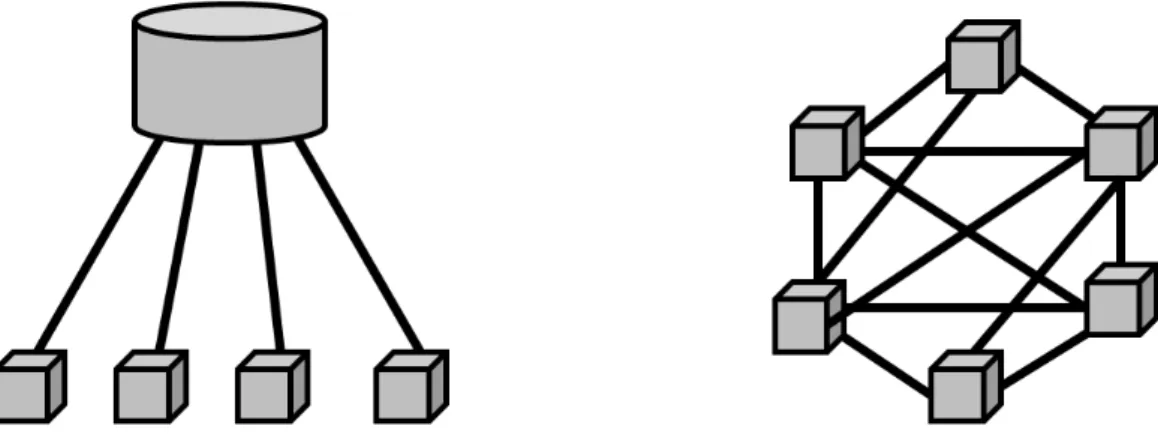
A potential way to reduce or even eliminate this infrastructure cost is to use a peer-to-peer infrastructure to run the virtual world. With a P2P architecture the entire system is run by the end-users (peers) which serve as both clients and servers. All functionality is distributed among the peers, without need for any central or pre-deployed infrastruc-ture. Figure 1.2 compares the basic C/S and P2P architectures.
In a P2P-based MMVE the entire infrastructure of the system can be provided by the users. By distributing the virtual world among the peers and thus eliminating the need for servers, the cost of operating an MMVE is significantly reduced. P2P-based MMVEs also have the potential to eliminate the problem problems of over- and underprovisioning infrastructure resources. As all users bring their own resources into the system, the system can potentially scale with the number of users in the system, without requiring a priori knowledge about this number. P2P can therefore potentially be a disruptive technology for the MMVE market, reducing the barrier of entry and
1.5 Update Propagation for P2P-based MMVEs
operating costs. This significantly reduces the financial risks associated with launching an MMVE.
Figure 1.2: Client/Server vs. Peer-to-Peer - In a C/S-based MMVE, all users run clients which are connected to a server cluster which stores and runs the virtual world. In contrast, a P2P-based MMVE has no central architecture and the virtual world is stored and run entirely on the peers.
1.5
Update Propagation for P2P-based MMVEs
Achieving the goal of a P2P-based MMVEs is an open topic of research, with a signifi-cant number of challenges such as consistency [36, 37, 38], security [39, 40] or persistency [41]. One key challenge is to develop a suitable update propagation system [42].
The actions of users’ avatars influence both the virtual world and other users’ avatars. It is therefore necessary to inform the other users about the resulting changes to the virtual world. This happens through updates messages which contain the relevant information about these changes. These update messages need to be sent (propagated) to the relevant users. We thus define update propagation in MMVEs as follows.
Definition 2:
Update propagation in MMVEs is the task of forwarding update messages containing information about changes in the virtual to the peers which need to be informed about these actions.
scal-able, real-time update propagation system, an MMVE cannot function. A P2P-based update propagation system which meets these requirements is therefore a necessary requirement to enable P2P-based MMVEs.
1.6
Contributions
The goal of this thesis was therefore to develop a scalable, interactive update propa-gation system to enable peer-to-peer-based massively multi-user virtual environments. This has been achieved through three core contributions.
• Update Propagation Overlay: We have developed a dynamic update propa-gation overlay network. This overlay is based on the peers’ positions in the virtual world and their available resources. It uses super-peers for overlay management and dynamic zoning of the virtual world for coordinator assignment.
• Coordinator Election Algorithm: We have also developed a scalable coordi-nator election algorithm which allows the election of suitable super-peers for our overlay. This algorithm is based on the existing dynamic overlay and samples a subset of peers to provide a scalable solution.
• Available Bandwidth Estimation: Finally, both our overlay and election algorithm require information about the available bandwidth in a peer-to-peer system. We have therefore developed an algorithm to estimate the available bandwidth of peers in a fully distributed peer-to-peer system. This algorithm is based on a combination of passive observation and active measurement to provide an accurate, responsive solution with limited system interference.
1.7
Thesis Organization
Based on the contributions outlined above, this thesis is structured as follows.
Chapter 2: System Model
Chapter 2 presents the system model on which our approach is based. We give a more detailed description of MMVEs and discuss the requirements for our approach which result from this. We also give an overview of the peers@play project in which
1.7 Thesis Organization
this thesis was developed and describe the parts of the peers@play system which our approach utilizes.
Chapter 3: Related Work
In Chapter 3 we give a detailed overview of related work in P2P-based MMVEs, specifically regarding update propagation. We also do the same for related work in the areas of election algorithms and available bandwidth measurement, with special focus on P2P systems. We then discuss the differences and advantages our approach provides over this related work.
Chapter 4: Update Propagation
Chapter 4 presents a detailed design of our update propagation approach. First, we present our core contribution in Sections 4.1 to 4.3: The dynamic update propagation overlay, based on available resources and quad-tree-based zoning.
Any hierarchical overlay requires suitable coordinators. This necessitates both the ability to determine what constitutes suitable coordinators and the ability to select them. In Section 4.4 we present both a metric to determine suitability and an election algorithm which allows us to select coordinators based on this suitability.
Finally, our suitability metric and update propagation overlay require information about the available bandwidth of the peers. In Section 4.5 we therefore present an algorithm to estimate the available bandwidth for peers in a fully distributed P2P system.
Chapter 5: Evaluation
In Chapter 5 we perform a detailed evaluation of all three contributions provided in Chapter 4. The results show that our approach provides a scalable and low-delay solution for update propagation in P2P-based MMVEs.
Chapter 6: Conclusion and Outlook
This thesis concludes with a summary of the presented work and an outlook on possible future work in Chapter 6.
Chapter 2
System Model & Requirements
In this chapter we will present our system model. First, we will take a more detailed look at MMVEs. Second, we will introduce the architecture of the peers@play project, for which our update propagation algorithm was developed. Finally, we will look at the requirements for update propagation in P2P-based MMVEs.
2.1
Massively Multi-user Virtual Environments
We have previously given a definition of MMVEs and will now present this concept as our system model in more detail, based on our work in [42]. Our system model consists of a number of users that want to participate in an MMVE, their devices (hosts), a communication network (the Internet) and the P2P-MMVE software. The number of users is a priori undetermined and may change dynamically. We make no assumptions about the geographic position of these users in the real (i.e. non-virtual) world. Each user connects to the MMVEs using a device with sufficient resources to run the MMVE software, e.g. a personal computer or tablet. We call these devicespeers. We assume the P2P-MMVE software to be installed on each device. In practice most MMVEs distribute this software via discs or internet download. Note that we do not assume the existence of any kind of central server infrastructure. A peer can join and leave the system at any time.
To participate, a user activates one of her devices and starts the P2P-MMVE soft-ware. After she is done participating, she stops the software and deactivates the device. A user may change devices between sessions in the virtual world. The virtual world
is presented to the participant through a 2D or 3D graphical representation. Each participant is depicted in the virtual world by virtual representation of herself, called heravatar.
The participant can use this avatar to interact with the virtual world or with the avatars of other participants. The interactions are events in the virtual world, which can result in changes to the world. When such a change has occurred, the other peers in the system must be informed about it, so the change can be presented to the user. This is done via update messages, which must be propagated to all peers for whom the change to the virtual world is relevant.
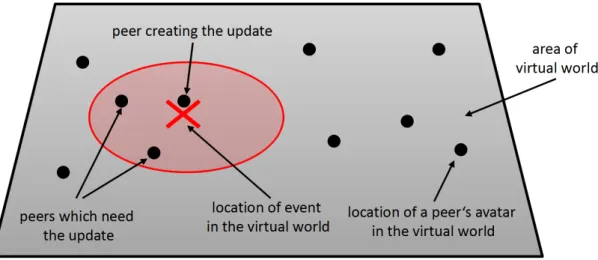
Figure 2.1: Overview of an MMVE- Schematic representation of a virtual world
Figure 2.1 shows a schematic representation of a virtual world. In this figure the user’s avatars are shown as circles. Note that the avatar’s location on the virtual world is decoupled from their hosts location in the real world, i.e. two hosts whose avatars are adjacent in the virtual world may be on different continents in the real world.
The figure also shows an example interaction. Consider a virtual world where a participant interacts with the world by picking up an object from the ground (at the marked location). One of the events resulting from this interaction is the disappearance of the object from the ground. Therefore an update message for this event must be created and propagated to all peers for which this event is relevant, e.g. all peers whose avatars can see the object. These peers are marked by a radius around the event
2.2 peers@play
location. Note that the message does not need to be propagated to those peers whose avatars are too far away to see the event in the virtual world.
2.2
peers@play
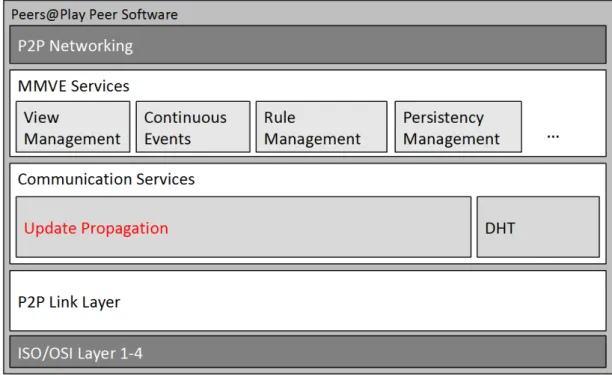
This work was performed in the context of the peers@play project. Its goal is to ”inves-tigate how peer-to-peer technology can be used to create distributed interactive world models that are able to fulfil the highest requirements with respect to scalability, secu-rity and consistency” [43]. To achieve these goals, the project partners have developed and implemented a middleware architecture for P2P-based MMVEs. This architecture has been designed to enable evaluation of P2P protocols and overlays with large number of peers, while providing low overhead and allowing a single code base for evaluation and release software. It is depicted in Figure 2.2.
The contribution of this thesis to the overall architecture is the update propagation component, which allows scalable, low-latency propagation of update messages to all relevant peers. In the following we will briefly discuss the elements of this architecture which are utilized by our update propagation component.
2.2.1 P2P Link Layer
The P2P Link Layer, developed by Holzapfel et al. [44] is built on top of TCP/UDP transport and provides the update propagation system with two key functionalities.
First, the Link Manager allows us to open reliable direct connections between peers. These connections then form the basis of our update propagation overlay. The Link Manager can open connections even in the presence of NAT, using techniques such as relaying, hole punching [45] and Mapping Filtering Behaviour (MFB), a protocol developed to determine the NAT characteristics of a host [46]. Connections can also be reused and shared by the various overlays used by the system (e.g. a storage overlay and the update propagation overlay), in order to improve efficiency. As connections can be used by multiple overlays, the Link Manager also provides a priority system for messages, in order to deal with the problem of message delays due to queuing. Update or overlay maintenance messages can thus be sent with a higher priority than, for example, file transfers.
Second, the Link Manager provides us with bootstrapping capabilities, i.e. the ability the start our P2P system and allow additional nodes to find and enter it. To do so, it supports various techniques, including an IRC-based method described in [47]. 2.2.2 P2P Storage
The update propagation also makes use of the P2P storage layer, which provides per-sistent storage via a DHT overlay such as Chord [48]. This storage overlay is initialized before the update propagation overlay and is used for bootstrapping purposes and to store and retrieve information about the hierarchy of the the update propagation overlay. The storage layer is designed to support a variety of DHT overlay types and provides reliability through replication.
2.2.3 Gears4Net
Evaluating large-scale P2P systems can be challenging, particularly without resorting to simulation or emulation. In order to evaluate the scalability of such a system, it is is necessary to run a large number of peers. However, it is impractical to set up a massive number of individual hosts running an instance of the P2P software. One solution to this problem is to run a large number of peer instances per host. In order to be able
2.3 Requirements
to do so, the underlying system must make efficient use of the host’s resources, such as memory and threads. As a consequence all components of the peers@play system have been built on Gears4Net (G4N) [49], an asynchronous programming model for scalable and distributed applications.
The G4N programming model is based on the concepts of protocols and schedulers. Protocols are highly decoupled entities which contain the main code of the applica-tion. They communicate with each other by message passing via message queues. The execution of the protocols is coordinated by schedulers. Each scheduler can have one or more worker threads which it assigns dynamically to the various protocols. This approach allows G4N the execution of many instances (protocols) of our P2P software with a fixed number of threads and enables us to run a large number of peer instances in parallel on a single host. For a full description of G4N see [50].
2.3
Requirements
We have performed an analysis of general requirements for P2P-based MMVEs [42]. Similar work has been performed by Fan et al. [51]. Based on these analyses we have identified three key requirements for update propagation in P2P-based MMVEs: (1) Scalability, (2) Interactivity and (3) Self-Organization. We will now discuss these requirements in detail.
2.3.1 Interactivity
In MMVEs users interact with each other and the virtual world in real-time. This means that high delay during update messages propagation can have a negative impact on the users’ experience. This delay is the time difference between an interaction and the perception of the resulting event by another user. Studies have shown that users can tolerate between 60 and 500 ms of delay.[52] [14] [53] [54] [55] [55].
Within this range, the specific amount of delay that is tolerated by the users depends on the specific application. MMOGs in particular often feature frequent fast-paced interaction between the players, and thus are within the lower band of this range.
In short, if an MMVE is not able to provide the necessary level of interactivity, the user experience may be significantly diminished. It may even become impossible to participate in the virtual world. Therefore, the delay between a user’s actions and
the MMVE’s observable reactions to them must be kept as short as possible. To do so, the P2P system should try to deliver update messages containing changes to the world state as quickly as possible to minimize the experienced delay.
Interactivity is a requirement that is valid for some P2P systems, e.g., telephony systems, but only of secondary importance for others, e.g., content distribution sys-tems. For MMVEs however, providing the needed level of interactivity is an essential requirement.
2.3.2 Scalability
As the name implies, MMVEs involve a large number of concurrent users, making scalability a key issue in their development. Eve Online [56] currently claims to hold the record of concurrent users for a CS architecture with over 60.000 players sharing the same virtual world at the same time [13]. Note that this number is limited not by player interest, but by the architecture and technology of MMVEs [57]. A common way to deal with these limitations is to distribute the users of an MMVE among a number of virtual worlds which run in parallel. The disadvantage of this approach is that users can only interact with users which are in the same virtual world as they are and not with the complete user base.
Scalability is often mentioned as one of the main advantages a P2P over a CS architecture (e.g. [58]). However, this can not be taken for granted. Without further effort, a P2P-based system may even scale significantly worse than a CS-based one. As an example, the bandwidth of each individual peer’s network connection is usually much lower than that of a game server’s. Therefore, it is very easy to overwhelm a single peer a large number of update messages. If peers are connected to the network using communication technologies with asymmetric up- and download bandwidth (e.g., ADSL), this is especially true for outbound traffic.
Therefore scalability is one of the key requirements for a suitable update propagation approach.
2.3.3 Self-Organization
In the P2P paradigm each users brings their own resources, such as CPU power and bandwidth into the system. This can provide an advantage when trying to fulfil the scalability requirement as each additional user also adds additional resources. However
2.3 Requirements
the resources contributed by most individual users are somewhat limited. As an ex-ample, we have already touched upon the issue of asymmetric bandwidth. In order to provide its service, a P2P-based MMVE must therefore be able to make efficient use of the resources available to it.
Another challenge is the fluctuation of these resources. As users can enter and leave the system at any time, the available resource can fluctuate. P2P-based MMVEs must therefore be able to cope with these fluctuations in order to provide a stable service to it users. Therefore any components of such a system, including the update propagation require a high level of self-organization as they must constantly adapt themselves to the resources currently available to the system.
2.3.4 Additional Requirements
The three requirements we have just discussed are essential to an any update prop-agation system for P2P-based MMVEs. Once these have been fulfilled, additional requirements may be considered. Two requirements which we consider important for commercial deployment of P2P-based MMVEs are Consistency and Security. Consis-tency refers to the fact, that users are ideally presented with a consistent view a world, i.e. a view that is identical for all users in the system. Security refers to issues such as authentication and protection against fraud in the virtual world (e.g. cheating in online games). While these issues are outside the scope of this thesis, they are part of the work performed in the peers@play project. Some security features are part of the P2P Link Layer [44], while consistency features are provided by the consistency manager which is built on top of our update propagation [36][37][37].
Chapter 3
Related Work
Over the last few years there has been a significant amount of research into the feasibility of P2P-based MMVEs. In this chapter we will first give a thorough overview of related work in the area of P2P-based MMVEs, with a focus on update propagation. The various approaches we will discuss can be broadly divided into two main categories: hierarchical and non-hierarchical systems. In non-hierarchical systems all peers perform the same functions, i.e. no peer has more authority or responsibility than other peers. In these systems, the overlay has a flat structure. In contrast, hierarchical systems use so-called super-peers in their overlays to organize the system. This results in an overlay where certain peers are assigned special tasks and responsibilities and a hierarchical structure of the overlay, where peers rely on these super-peers for certain functions.
A special case of hierarchical overlays are hybrid systems, which are not fully dis-tributed systems, but utilize some P2P techniques while retaining some server infras-tructure. In these systems, P2P technologies are generally used to reduce the load on the servers, while avoiding some of the challenges associates with fully distributed P2P systems.
We will first introduce the various approaches for P2P-MMVES that have been developed over recent years, with particular focus on their update propagation com-ponents. We compare and contrast these components to the system developed in this thesis. Subsequently we will do the same for their super-peer election subsystems, while also providing an overview of related work regarding election in distributed sys-tems. Then we will look at related work regarding the issue of determining available bandwidth in fully distributed P2P systems.
Finally we will give a summary of how our system is different compared to existing work and which advantages it confers in the areas of update propagation, super-peer election and available bandwidth estimation.
3.1
Update Propagation Overlays
In the following we will look more closely at the three categories of approaches for update propagation overlays in P2P-MMVEs: non-hierarchical, hierarchical and hybrid systems.
3.1.1 Non-hierarchical
An early non-hierarchical system was Solipsis [59] [60]. In Solipsis, peers create direct connections to all peers in their awareness radius. The awareness radius is the part of the virtual which their corresponding avatar can perceive and is also often called area-of-interest orAoI. (See Chapter 4.1 for a more detailed discussion of this concept.) A peer is thus connected to those peers whose avatars are located nearby in the virtual world. These neighbours then inform each other when new peers enter in each other’s AoIs and therefore when new connections need to be opened. This concept is called
mutual notification.
A major problem with Solipsis is the global connectivity of the system, i.e. the P2P overlay can be partitioned in some circumstances. As long as a peer the remains inside the convex hull formed by the positions of its neighbours, the system generally retains its global connectivity. However there are some situations in which the detection of new neighbours - and thus global connectivity - cannot be guaranteed [61]. In addition, this method generates notable message overhead. For any given position change, Solipsis must check the distances between disconnected peers and send messages about new connections to its neighbour peers.
A common approach for non-hierarchical P2P-based MMVEs is to partition the world by using Voronoi diagrams [62] and to create an update propagation overlay based on this partitioning. A Voronoi diagram can partition a virtual world in such a way, that it is divided innzones, one for each peer. Each zone then contains all points closer the location of the corresponding peer than to that of any other peer.
3.1 Update Propagation Overlays
Thus in Voronoi-based approaches, each peer builds a Voronoi diagram based on its own and its neighbours’ location in the virtual world. The peers (neighbours) included in this diagram are determined by the peer’s AoI. Each peer thus builds its own local partitioning of the virtual world. Note that this is fundamentally similar to Solipsis. All peers have some knowledge of their neighbourhood and build direct overlay connections with their neighbour peers. All Voronoi-based approaches also feature some type of mutual notification.
Variants of this approach are used by VON [61], VCS[63], NOMAD[64], Vorogame [65] and [66] and Solipsis 2.0 [67]. We will now look at some of these approaches in more detail.
In VON by Hu et al. [61], each peer communicates directly with a small number of neighbour peers. These neighbours are determined by partitioning the virtual world using Voronoi diagrams. Each peer builds such a diagram for the part of the virtual world inside its area-of-interest. The peers covered by this diagram are either classified asenclosing neighbours (i.e. the peers whose regions are adjacent to the peer’s region) orboundary neighbours (i.e. the peers whose regions overlap with the area-of-interest). It is the purpose of the boundary neighbours to inform the peer of new neighbours entering its AoI and thus to ensure the consistency of the overlay topology. In this way, peers mutually notify each other when they have to adjust the overlay.
A forwarding scheme [68] was later added to reduce the number of connections in the overlay. Using this scheme, peers only have direct connections to their enclosing neighbours. To reach boundary neighbour, the enclosing neighbours keep forwarding the update until it reaches the target peer. This approach was further optimized by con-structing a spanning tree among the neighbours (calledVorocast) [69] or alternatively by modifying the frequency of update propagation based on the hop count distance of the target from the originating peer (called Fibocast) [69].
VON can also reduce the number of neighbours to which a peer connects, in order to deal with crowding in the virtual world (i.e. when a peer does not have sufficient resources to communicate with all potential neighbours) [70]. It does not attempt to maximize usage of the available resources of a peer, however, in fact bounding resource use at each peer based on the area-of-interest. In addition, a partitioning of the overlay is also possible when two nodes move too fast for mutual notification to work [68] or when two adjacent boundary neighbours leave the game simultaneously [71].
VCS [63] also partitions the world based on a Voronoi diagram and uses the equiv-alent Delauney graph as the overlay network. This means that all peers are connected directly to the peers responsible for their adjacent zones. Update propagation to peers which are not direct neighbours is possible through forwarding along the Delauney graph. To improve the high delay resulting from the forwarding, two extensions were proposed. First, the addition of long range contacts (LRC) [72] which represent short cuts to distant areas of the overlay, thus reducing the hop count for update propagation. This was later replaced with a more efficient approach using a hierarchical layering of Delauney graphs, each probabilistically omitting an increasing number of nodes. This enables skipping nodes when forwarding, in order to reduce the number of hops [73].
VCS has also been adapted to spherical coordinate systems [70] and augmented with a tree-based data aggregation scheme, to further reduce network load [74].
The Voronoi based approach has proven popular enough to be used as the basis for various other approaches for P2P-based MMVEs (e.g. NOMAD [64] or Solipsis 2.0 [67]). It has also been extended by other authors, such as in VoroGame [65], which combines a Voronoi based overlay network for update propagation and a DHT for data distribution and storage of world data.
Other non-hierarchical approaches, i.e., not based on Voronoi diagrams, have also been proposed. In general they share some common characteristics with Solipsis and the Voronoi-based systems. These are in particular: direct connections to neighbour nodes and a form of mutual notification for overlay maintenance. PSense [75] is a good example of this. Once again, a peer maintains connections to neighbour peers, which are classified into near nodes and sensor nodes. Near nodes are rough equivalents to enclosing nodes in VON, while sensor nodes are similar to boundary nodes and used for mutual notification in order to maintain the overlay. This approach also runs into similar problems as Voronoi-based systems, such as a potential partitioning of the overlay network and inefficient usage of the resources of the peers.
QuON [76] also has similar classes of neighbour peers, called direct neighbours and
binding neighbours, once again roughly corresponding to enclosing and boundary neigh-bours in VON. However QuON uses a local quad-tree structure instead of a Voronoi diagram to manage and maintain its connections to these neighbours. As with PSense, overlay partitioning is still a possibility.
3.1 Update Propagation Overlays
Kawahara et al. [77] [78] propose an approach with an extensive mutual notification component. Each peer keeps a fixed list of nearest neighbours and all nodes regularly exchange their neighbour lists. By sorting and comparing these lists, each peer can find new nodes and update its overlay connections. However, this exchange of neighbours creates significant overhead, which means only a small number of neighbours is feasible for each peer [71]. Even though this approach provides some backup mechanisms to reduce the likelihood of an overlay partitioning, it is still a possibility.
Non-hierarchical approaches consistently run into the so-called awareness prob-lem[79]. Avatars must be aware of who their neighbours are in order to maintain the update propagation overlay. If they fail to open connections to qualified neigh-bours due to a lack of awareness, update propagation will be incomplete. Eventually this may even lead to a partitioning of the overlay and thus an effective failure of the P2P-MMVE system. The discussed approaches also struggle to make efficient use of the peers’ available resources. Many systems such as VON or Kawahara actually bound resource use at each node and limit the number of neighbours at a level below what the node may be capable of handling. In addition, it is difficult to exploit the heterogeneity of available resources in a non-hierarchical system, due to the challenge of assigning higher load to peers with higher resources.
As a consequence, hierarchical systems were pursued, even as an extension of fun-damentally non-hierarchical systems such as VON, of which a hierarchical variant was proposed [80] [81]. This variant allows resource-rich nodes (super-peers) to manage multiple regions in the Voronoi diagram, thus introducing a hierarchy based on avail-able resources. As another example, COVER [79] adds a quad-tree-based super-peer hierarchy to a VON-like approach in order to provide 100% awareness. Another way to utilize supernodes with a Voronoi-based approach is to give locations in the virtual world a certain weight [82] when constructing the Voronoi diagram. By doing this it becomes possible to assign larger areas of the virtual world to more capable nodes. Some peers may even be assigned a point-sized region in the diagram, in which case their overlay dutys are taken over by the peer whose region surrounds that point. 3.1.2 Hierarchical P2P-based MMVEs
While early approaches such as Solipsis and VON were generally non-hierarchical, later approaches are built as hierarchical P2P systems, using superpeers to perform various
functions in the system. As mentioned above, even systems such as VON, which started out as fully distributed systems later added some hierarchical elements. While hier-archical and non-hierhier-archical approaches were developed in parallel, a trend towards increasingly hierarchical systems can be observed.
The basic idea behind most hierarchical approaches is to assign additional tasks in the system to certain peers (sometimes calledsuper-peers orcoordinators). Usually the world is divided into regions, with a peer serving as coordinator. The region size can be fixed or dynamically adjusted during run-time (e.g. based on the number of peers in a zone). The coordinator can then be responsible for overlay maintenance in its zone (thus eliminating the need for mutual notification and potentially solving the awareness problem) and can also perform some update propagation function. The latter allows peers with above average available resources to contribute more to the system than in a non-hierarchical overlay, thus making more efficient use of the system’s resources.
One of the earliest hierarchical approaches was SimMUD [83]. This approach parti-tions the virtual world into regions and maps them onto a Pastry [84] key space. Each region is assigned a peer as a coordinator, which then serves as the root of a Scribe [85] multicast tree for that region. Maintaining virtual objects is also the responsibility of the coordinators, which manage the objects and ensure consistency. Updates to the objects are sent to the responsible coordinator, which then propagate any successful updates to the object’s region.
SimMUD is a fixed zone approach which can lead to an overloaded coordinator when too many peers enter a zone. It is also not capable of propagating updates across zone borders. Due to the use of a DHT for update propagation, SimMUD also struggles to meet interactivity requirements. Here the majority of updates take between one and six hops to be delivered. However, due to relaying, some updates require more than 50 hops to reach their destination peer. The usage of DHT overlays such as Chord [48], CAN [86] or Pastry [84] for P2P-based MMVEs was abandoned early on in favour of specialized overlays, mostly due to the comparably high hop count for update propagation [87] [88] [71]. Even approaches that started out as entirely DHT-based system, such as OPeN [88] were later modified to include direct connections [89].
Iimura et al [90] use a DHT only for bootstrapping and persistent storage, similar to our approach. The world is also divided into zones, for each of which a coordinator
3.1 Update Propagation Overlays
peer (called zone owner) is responsible. The peers that are part of a zone open di-rect connections to the zone owner. All updates are propagated via these connections and the coordinator. Similar to SimMUD, the zones have a fixed size, which means the scalability of each zone is limited by the coordinator’s available resources. In fact, according to the authors, their approach is only suitable to small-sized virtual environ-ments with less than 500 nodes. The system also is not capable of propagating updates across zone borders.
The MOPAR scheme [71] also divides the world into several regions and sends all updates in a region via a coordinator node. For the purposes of latency, proposals which propagate all updates via a coordinator (such as HYDRA [91]) achieve latency similar to a client/server-based approach. The zones in MOPAR are hexagonal in shape and a peer is part of several zones, i.e. it’ AoI covers several of zones. The peers are assigned different tasks, ashome nodes,master nodes orslave nodes. Slave nodes are standard peers, while home nodes serve to register master nodes, which in turn are responsible for one zone each. The master nodes then exchange neighbour information amongst each other, informing slave nodes of neighbour changes when necessary.
The Distributed Event Delivery scheme by Yamamoto et al. [92] divides the world into regions. Again, one peer serves as coordinator for each region, responsible for update propagation. In addition to previous approaches, the coordinator can build a hierarchy of sub-coordinators within its zone in order to spread load in a crowded zone. While coordinators are not selected based on their resources, the system occasionally removes and replaces coordinators with high delay. MM-VISA [93] extends the concept of a zoned world with coordinators by classifying virtual objects into various types based on their movement speed in the virtual world. Within each zone, the coordinator then builds multicast clusters based on this classification. Depending on its type, an object may be part of the clusters of neighbouring zones as well. The system uses hexagonal zones.
3.1.3 Hybrid P2P-based MMVEs
In addition to fully distributed and hierarchical systems, there have also been some proposed approaches which attempt to create hybrid systems. These systems combine P2P techniques with a server infrastructure. They have to deal with all the potential problems of a client/server approach, e.g. the infrastructure cost. However, using P2P
techniques can mitigate the issues caused by these problems, e.g. by reducing the load on and thus the cost of the servers. At the same time, having access to a server infrastructure can eliminate or mitigate some of the potential problems of P2P systems, such as dealing with bootstrapping (i.e. initial system set-up) or node failures.
Hybrid approaches generally fit into two classes. The first class uses its server infrastructure to solve issues such as bootstrapping, churn (i.e. handling node join and leave operations) and persistent data storage, but leaves update propagation to the peers. The second class essentially takes a hierarchical overlay, but replaces the coordinators with servers.
Time Prisoner [94] [95] [96] is part of the first class. It uses a server infrastructure to provide a bootstrapping service to the system and handles peer join and leave oper-ations while the system runs. However the actual update propagation is handled like a traditional hierarchical system, which dynamically divides the world using a quad-tree. In this quad-tree,the quads are split and joined again based on the number of peers in the zone. Each zone has a coordinator peer which is responsible for update propagation.
Another example of the first class of hybrid systems is Lee et al.’s approach [97]. Again, this is a zone-based approach which uses a main server for login and bootstrap-ping purposes, but uses peers as zone coordinators. Similar to MOPAR [71], each peer can be interested in multiple zones and therefore connect to several coordinators. Chen et al. [98] also use servers for authentication and verification purposes but use peers as coordinators for the regions of the virtual world.
HYMS [99] is an example of the second class. Once again the virtual world is divided into zones. Usually a server is responsible for update propagation, but when a suitable client is available, it takes over responsibility for update propagation in the zone. The other clients in the zone then connect to this client instead of the server. This enables HYMS to make use of resource-rich peers and reduce load on the servers. Similarly Wehrle et al. [100] dynamically split the world into regions based on CAN [86]. The approach allows either a server or another peer to serve as coordinator. Another example for using servers as coordinators is Hyperverse ([101] [102]), which also uses a dynamic quad-tree to divide the world. A server is assigned to each quad and deals with overlay management and streaming of world content.
3.2 Coordinator Election
Beyond systems specifically designed for hybrid operation, it is generally possible to run those based on a hierarchical overlays as hybrid systems. Any coordinator can in theory be replaced by a server with no impact to system performance (in fact, in many cases performance can be increased due to the higher performance of a server over a peer). This applies to our approach as well (see Chapter 6 for more details on this).
3.2
Coordinator Election
Coordinator election for P2P-MMVEs requires the coordinator to be selected among a massive number of candidates. In addition, it is not sufficient to select any unique leader, but the leader must be suitable, i.e. have sufficient available resources to perform coordinator tasks.
Election is a well-known problem in the area of distributed systems. Classic al-gorithms to ”elect a unique leader from a fixed set of nodes” [103] include the Bully [104] and the Chang and Roberts algorithms [105]. However these algorithms are often designed for a specific network topology and system model (e.g., a ring [105][106]) and have a time and message complexity (O(nlogn)) not suitable for a massive number of candidate nodes in the system [103]. In addition, they are generally only concerned with finding a unique leader and don’t take the suitability of nodes into account.
Additional work has been done on leader election in ad hoc networks ([107] [108] [109] [110]). These approaches are primarily designed to deal with a highly dynamic non-hierarchical topology. Some of this work also takes suitability into account (e.g., [111][109]). However, the main issue remains that these approaches have not been designed with massive user numbers in mind. An election involves all nodes in the network, which is not feasible when dealing with the potential number of peers in a P2P-MMVE. On the other hand, if a hierarchical overlay is used for the P2P-MMVE, the election can potentially utilize the this overlay and does not have to deal with a non-hierarchical structure.
Only a limited amount of work has been done on coordinator election specific to P2P-MMVEs. Even though many hierarchical approaches assume the ability to elect a coordinator, they either do not provide an algorithm for doing so, or use a very simple solution. A number of systems use the topology of the underlying P2P overlay network
to select coordinators. In [83] each region is assigned a key from the Pastry key space. The peer whose ID is the closest to the region ID becomes the coordinator. In [98], each peer manages those regions that are numerically nearest its ID in the DHT. [97] uses JXTA to organize peers in groups: if a region needs a new coordinator, a peer from the group is used. Some approaches use the avatar position in the virtual environment to select coordinators. A peer is selected if there is no coordinator in the user’s zone [90] [71], or if the user’s position is the closest one to the geometric center of the region [79].
Even though all of these approaches put additional load on the coordinators, they do not select the coordinator based on its specific suitability. That is, they select their coordinators based on criteria unrelated to their suitability. This means that they cannot take advantage of resource heterogeneity, and might even select peers as coordinator which do not have sufficient resources to handle this additional load. The pool of potential coordinator candidates is also often limited to one zone. In contrast, a suitable coordinator election algorithm would be quickly able to elect coordinators based on their suitability, among a massive number of peers in the system.
3.2.1 Election Parameters
In order to be able to select the most suitable peers as coordinators, we must also be able to determine the suitability of an individual peer in order to make comparisons. This suitability depends on the specific tasks that the coordinator needs to perform (e.g. in order to perform update propagation tasks, it needs sufficient bandwidth).
Some approaches note that their coordinators have higher requirements than usual, e.g. regarding bandwidth [92] [112] [81], CPU power [92], delay [112], trustworthiness [81], stability [81] and storage capacity [93]. However none of these approaches provide specific techniques for determining the values for these parameters. While the ability to determine suitable peers is crucial to them, they explicitly or implicitly assume their ability to do so.
3.3
Bandwidth Estimation
Determining the available bandwidth between two nodes is a well-known problem [113]. However, most approaches focus on estimating the data rate for a specific connection
3.3 Bandwidth Estimation
between two hosts (e.g., [114] [115] [116] [117] [118]). In contrast, for P2P-MMVEs it is more relevant to know the overall network capacity of a peer, which it can uti-lize for connections to other peers. This information can be used when building and maintaining the overlay or for the selection of suitable super-peers. In the following we therefore discuss existing P2P approaches that deal with measurements of a peer’s total capacity.
Eigenspeed [119] uses passive observation only. Each peer observes the traffic to its neighbours in the overlay and stores the maximum bandwidth it has achieved with each of them. This information is then aggregated across multiple nodes and combined into a consensus view using principal component analysis. The primary contribution of Eigenspeed is on the issue of trust. It assumes that peers cannot be trusted to re-port their own bandwidth to the system. Thus the focus is on preventing attackers or colluding groups of attackers from intentionally reporting incorrect bandwidth. From the viewpoint of bandwidth estimation, Eigenspeed has a number of drawbacks. First, little traffic between two peers can lead to significant underestimations. This is mit-igated somewhat by combining observations from multiple peers. However, this does not work if a peer is experiencing low traffic volume to all its neighbour peers. Second, Eigenspeed assumes stable network capacities. In contrast to this, our approach gets more accurate results in low traffic scenarios by injecting traffic periodically and is able to handle fluctuating network capacities.
ThunderDome [120] uses active measurement only. Its key concept is the use of pairwise active measurements between peers, called bandwidth probes. As the result of such a measurement is always limited by the slowest member of each pair, Thun-derDome proposes an algorithm that schedules pairwise bandwidth probes for all peers in the system. Using a tournament system, peers whose bandwidth has not yet been determined are repeatedly paired and execute a bandwidth probe. This approach takes some time to converge. The authors first prove a logarithmic lower bound for the tournament’s runtime, but also show that improvements are possible under certain as-sumptions about the bandwidth distribution in the system [121]. However, as with Eigenspeed, the results may already be outdated once the tournament has finished. Also, the system relies on existing connections between peers. Thus the bandwidth is depending on the underlay characteristics of the connections. Alternative connections
might show different behaviour. Also, the estimation may change if the background traffic changes during measuring the different connections of a peer.
3.4
Summary
As detailed above, non-hierarchical systems struggle to maintain overlay cohesion. As each peer has the exact same duties in the system, they also cannot take advantage of more resource-rich peers. In fact, many non-hierarchical system bound the resource use of a node, thus wasting additional resources (e.g. bandwidth, CPU) available to the system. They do often provide an advantage when it comes to interactivity, however. Most updates are propagated to their target peer via direct connections (one hop in the overlay). In contrast, many hierarchical systems use the coordinator for update propagation, resulting in propagation over a minimum of two hops. Hierarchical systems also have the advantage of being easily converted to operation in a hybrid mode, where some server infrastructure is added to increase performance of the system.
Existing approaches generally make inefficient use of the resources available to the system on both peers and coordinators. Resource usage on peers is often bounded, even though they could contribute further to the system. When it comes to coordinators, existing approaches often make two incorrect assumptions. First, that they can effi-ciently select coordinators among the massive number of peers in the system. Second, that they know how much bandwidth (and other) resources a peer can contribute to the system.
In this thesis we have built a hierarchical system that is based on some familiar concepts, such as quad-tree-based dynamic zoning and area-of-interest-based update filtering. We advance the state of the art by making maximum usage of available re-sources, especially bandwidth resources. Peers open a maximum possible number of direct connections to their neighbour peers, only using coordinators for update propa-gation when peer resources are insufficient. This allows one hop update propapropa-gation in most cases, with the advantages of a hierarchical structure.
We also provide a means of efficiently selecting suitable coordinators based on their available resources. Our election algorithm utilizes the existing hierarchical overlay structure to sample a random subset of peers in the system. This allows us to signifi-cantly reduce the number of messages and peers involved in any given election. While
3.4 Summary
this means that we cannot guarantee the election of the most suited candidates, the large number of peers in the system makes it likely that the sampled subset contains sufficient suitable peers.
As the construction of the overlay requires information about the available band-width resources of the peers, we also provide a algorithm for the estimation of available bandwidth. In contrast to existing approaches, our bandwidth estimation is a com-bination of passive traffic observation and active traffic injection. Hence, results are immediately available. We also do not assume static capacity of the traffic/channels and adaptation to fluctuations in capacity can be done quickly.
Chapter 4
Update Propagation Overlay
Based on the system model and requirements presented in Chapter 2 we have devel-oped a scalable, low-latency, self-organizing update propagation system for P2P-based MMVEs. This update propagation system consists of three components. These compo-nents are (1) Update Propagation Overlay, (2) Coordinator Election and (3) Available Bandwidth Estimation.
The update propagation overlay is a P2P overlay network which is used to propagate update messages to the interested peers. It is built to maximize the usage of available bandwidth resources, to improve scalability and to reduce the amount of hops each message needs to traverse in the overlay to improve interactivity. The overlay consists of two parts. First, a horizontal overlay is formed between standard peers, based on proximity in the virtual world. Second, a vertical overlay is constructed based on dividing the virtual world into zones and assigning specially selected coordinator peers to each zone. These peers then perform additional overlay management functions.
The coordinator election component allows the system to select coordinators which are suitable to perform these additional functions. It consists of a suitability metric to determine which peers have the resources to perform coordinator functions and an election algorithm which allows a scalable selection of coordinators among the large number of peers in the system. It does so by sampling a subset of all peers, utilizing the existing propagation overlay for this purpose.
Finally, the available bandwidth estimation algorithms allows the system to deter-mine how much bandwidth is available to each peer. This information is vital to both
the horizontal overlay construction as well as to determine the suitability of peers as coordinators.
The complete update propagation system offers reliable delivery of update messages to those (and only those) peers which have an interest in them. It provides an interactive service, by minimizing the number of hops in the update propagation overlay. By utilizing interest management and dynamic adaptation based on the available resources, it provides a scalable solution.
Chapters 4.1, 4.3 and 4.2 will describe the update propagation overlay in detail. We will discuss the coordinator election in Chapter 4.4 and the bandwidth estimation in Chapter 4.5.
4.1
Interest Management
In order to fulfil the requirement of scalability we first need to reduce the number of update message transmissions between peers. In a na¨ıve approach each update message must be sent to each peer in the system. In practice this method does not scale, even for systems with a moderate amount of peers, i.e. more than 100 (see Chapter 5.1.2). Thus we need to reduce the number of peers an update message is sent to. We call this processUpdate Filtering.
A well-known technique to perform Update Filtering is Interest Management [122]. The concept of Interest Management is based on the fact that each avatar only perceives a small part of the virtual world at any given time. This is analogous to the real world: a person can only ever observe a very small area of the world. Therefore, the avatar is not interested in most events that occur in the virtual world, but only the subset of events that occur in the part of the world which it can observe, i.e. those that occur near it. By taking this locality of interest into account, it is possible to significantly reduce the number of updates that are sent to peers and thus to enhance the scalability of the system.
Interest Management is generally based on the well-known concept of the Area-of-Interest (AoI) [122]. Our update filtering algorithm which we will describe in the following, extends this with the additional concept of an Area-of-Effect [123].
The Area of Interest (AoI) is defined as the area of the virtual world, in which a certain peer’s avatar can perceive events. This means that the peer is interested in
4.1 Interest Management
all updates which occur within this area or which influence it. The size of the area is determined by the perceptive abilities of the avatar. For example, an avatar may have a certain view range and can only see events occurring within this range. Thus, the AoI is circular with a radius equal to the view range and centered on the peer.
We extend this concept with a second type of area, called Area of Effect(AoE). We define the AoE as the area in the virtual world, in which a certain event affects the world. The size and shape of this area depends on the event it is associated with. As an example, picking up an object influences an area that is equivalent to the size of the object. As another example, if an avatar makes a sound, the AoE is determined by the distance the sound travels in the virtual world.
For our approach we will be using only circular-shaped AoIs and AoE. More complex shapes are possible and can provide improved update filtering through more accurate expression of interests and effects. The downside of more complex shapes is increased overhead. As this discussion is outside the scope of this thesis, we refer to Heger et al. [124] for more information.
In summary, the AoI is associated with an avatar and represents the part of the virtual world in which the avatar can be affected by events. The AoE is associated with an event and represents the part of the virtual world in which the event can affect peers. This means that by delivering an event to all peers whose avatar’s AoI intersects with the event’s AoE, we can ensure that the event is delivered to all peers whose avatars are interested in it. The algorithm to determine all peers p that a given update u should be delivered to is thus very simple: it compares the AoE of u with the AoI of each p. If they intersect, uis delivered to p. Otherwise, it is not delivered.
This algorithm is given in Algorithm 1. For a given updateuit determines all peers p it should be delivered to. To do so, the algorithm intersects the AoE of u with the AoI of eachp. If they intersect, u is delivered top. Otherwise, it is not delivered.
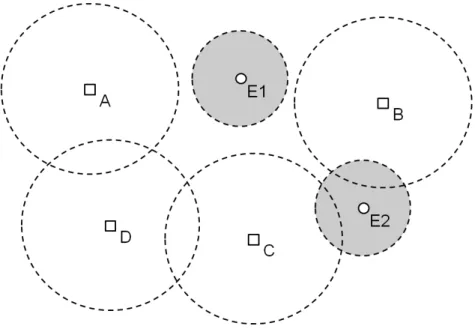
Figure 4.1 illustrates this with an example. Avatar A is generating events E1 and E2. The circular areas around the events represent their AoEs, while the circular areas around avatars A, B, C and D represent their AoIs. As can be seen, event E1’s AoE does not intersect with any avatar’s AoI. This means there is no peer which has an interest in it. Therefore no update needs to be sent for this event at all. The AoE of event E2 intersects with the AoI of both avatar B and Peer C. This means that both avatars are affected by the event and need to receive its corresponding update. Peer
![Figure 1.1: Screenshot of Guild Wars 2[3] - This screenshot illustrates a 3D rep- rep-resentation of a virtual world as shown to the user](https://thumb-us.123doks.com/thumbv2/123dok_us/1583346.2712895/12.892.111.724.321.668/figure-screenshot-guild-wars-screenshot-illustrates-resentation-virtual.webp)