WatchGuard
®
Firebox
®
System
Reference Guide
Firebox System 6.0
Notice to Users
Information in this guide is subject to change without notice. Companies, names, and data used in examples herein are fictitious unless otherwise noted. No part of this guide may be reproduced or transmitted in any form or by any means, electronic or mechanical, for any purpose, without the express written permission of WatchGuard Technologies, Inc.
Copyright, Trademark, and Patent Information
Copyright© 1998 - 2002 WatchGuard Technologies, Inc. All rights reserved.
Firebox, Firebox 1000, Firebox 2500, Firebox 4500, Firebox II, Firebox II Plus, Firebox II FastVPN, Firebox III, Firebox SOHO, Firebox SOHO|tc, Firebox V100, Firebox V80, Firebox V60, Firebox V10, LiveSecurity,
RaipdStream, RapidCore, WatchGuard, WatchGuard Technologies, Inc., AppLock, AppLock/Web, Designing peace of mind, DVCP technology, Enforcer/MUVPN, FireChip, HackAdmin, HostWatch, LockSolid, RapidCare, SchoolMate, ServerLock, ServiceWatch, Smart Security. Simply Done, SpamScreen, Vcontroller are either registered trademarks or trademarks of WatchGuard Technologies, Inc. in the United States and/or other courtries.
© Hi/fn, Inc. 1993, including one or more U.S. Patents: 4701745, 5016009, 5126739, and 5146221 and other patents pending.
Microsoft®, Internet Explorer®, Windows® 95, Windows® 98, Windows NT® and Windows® 2000 are either registered trademarks or trademarks of Microsoft Corporation in the United States and/or other countries. Netscape and Netscape Navigator are registered trademarks of Netscape Communications Corporation in the United States and other countries.
RC2 Symmetric Block Cipher, RC4 Symmetric Stream Cipher, RC5 Symmetric Block Cipher, BSAFE, TIPEM, RSA Public Key Cryptosystem, MD, MD2, MD4, and MD5 are either trademarks or registered trademarks of RSA Data Security, Inc. Certain materials herein are Copyright © 1992-1999 RSA Data Security, Inc. All rights reserved. RealNetworks, RealAudio, and RealVideo are either a registered trademark or trademark of RealNetworks, Inc. in the United States and/or other countries.
Java and all Jave-based marks are trademarks or registered trademarks of Sun Microsystems, Inc. in the United States and other countries. All right reserved.
© 1995-1998 Eric Young (eay@cryptsoft). All rights reserved.
© 1998-2000 The OpenSSL Project. All rights reserved. Redistribution and use in source and binary forms, with or without modification, are permitted provided that the following conditions are met:
1. Redistributions of source code must retain the above copyright notice, this list of conditions and the following disclaimer.
2. Redistributions in binary form must reproduce the above copyright notice, this list of conditions and the following disclaimer in the documentation and/or other materials provided with the distribution.
3. All advertising materials mentioning features or use of this software must display the following acknowledgment: "This product includes software developed by the OpenSSL Project for use in the OpenSSL Toolkit. (http:// www.openssl.org/)"
4. The names "OpenSSL Toolkit" and "OpenSSL Project" must not be used to endorse or promote products derived from this software without prior written permission. For written permission, please contact [email protected]. 5. Products derived from this software may not be called "OpenSSL" nor may "OpenSSL" appear in their names without prior written permission of the OpenSSL Project.
6. Redistributions of any form whatsoever must retain the following acknowledgment: "This product includes software developed by the OpenSSL Project for use in the OpenSSL Toolkit (http://www.openssl.org/)"
THIS SOFTWARE IS PROVIDED BY THE OpenSSL PROJECT ``AS IS'' AND ANY EXPRESSED OR IMPLIED WARRANTIES, INCLUDING, BUT NOT LIMITED TO, THE IMPLIED WARRANTIES OF MERCHANTABILITY AND FITNESS FOR A PARTICULAR PURPOSE ARE DISCLAIMED. IN NO EVENT SHALL THE OpenSSL PROJECT OR ITS CONTRIBUTORS BE LIABLE FOR ANY DIRECT, INDIRECT, INCIDENTAL, SPECIAL, EXEMPLARY, OR CONSEQUENTIAL DAMAGES (INCLUDING, BUT NOT LIMITED TO, PROCUREMENT OF SUBSTITUTE GOODS OR SERVICES; LOSS OF USE, DATA, OR PROFITS; OR BUSINESS INTERRUPTION) HOWEVER CAUSED AND ON ANY THEORY OF LIABILITY, WHETHER IN CONTRACT, STRICT LIABILITY, OR TORT (INCLUDING NEGLIGENCE OR OTHERWISE) ARISING IN ANY WAY OUT OF THE USE OF THIS SOFTWARE, EVEN IF ADVISED OF THE POSSIBILITY OF SUCH DAMAGE.
This product includes cryptographic software written by Eric Young ([email protected]). This product includes software written by Tim Hudson ([email protected]).
© 1995-1998 Eric Young ([email protected]) All rights reserved.
This package is an SSL implementation written by Eric Young ([email protected]). The implementation was written so as to conform with Netscapes SSL.
This library is free for commercial and non-commercial use as long as the following conditions are aheared to. The following conditions apply to all code found in this distribution, be it the RC4, RSA, lhash, DES, etc., code; not just the SSL code. The SSL documentation included with this distribution is covered by the same copyright terms except that the holder is Tim Hudson ([email protected]).
Copyright remains Eric Young's, and as such any Copyright notices in the code are not to be removed. If this package is used in a product, Eric Young should be given attribution as the author of the parts of the library used. This can be in the form of a textual message at program startup or in documentation (online or textual) provided with the package. Redistribution and use in source and binary forms, with or without modification, are permitted provided that the following conditions are met:
1. Redistributions of source code must retain the copyright notice, this list of conditions and the following disclaimer. 2. Redistributions in binary form must reproduce the above copyright notice, this list of conditions and the following disclaimer in the documentation and/or other materials provided with the distribution.
3. All advertising materials mentioning features or use of this software must display the following acknowledgement: "This product includes cryptographic software written by Eric Young ([email protected])" The word 'cryptographic' can be left out if the routines from the library being used are not cryptographic related :-).
4. If you include any Windows specific code (or a derivative thereof) from the apps directory (application code) you must include an acknowledgement: "This product includes software written by Tim Hudson ([email protected])" THIS SOFTWARE IS PROVIDED BY ERIC YOUNG ``AS IS'' AND ANY EXPRESS OR IMPLIED WARRANTIES, INCLUDING, BUT NOT LIMITED TO, THE IMPLIED WARRANTIES OF MERCHANTABILITY AND FITNESS FOR A PARTICULAR PURPOSE ARE DISCLAIMED. IN NO EVENT SHALL THE AUTHOR OR CONTRIBUTORS BE LIABLE FOR ANY DIRECT, INDIRECT, INCIDENTAL, SPECIAL, EXEMPLARY, OR CONSEQUENTIAL DAMAGES (INCLUDING, BUT NOT LIMITED TO, PROCUREMENT OF SUBSTITUTE GOODS OR SERVICES; LOSS OF USE, DATA, OR PROFITS; OR BUSINESS INTERRUPTION) HOWEVER CAUSED AND ON ANY THEORY OF LIABILITY, WHETHER IN CONTRACT, STRICT LIABILITY, OR TORT (INCLUDING NEGLIGENCE OR OTHERWISE) ARISING IN ANY WAY OUT OF THE USE OF THIS SOFTWARE, EVEN IF ADVISED OF THE POSSIBILITY OF SUCH DAMAGE.
The licence and distribution terms for any publicly available version or derivative of this code cannot be changed. i.e. this code cannot simply be copied and put under another distribution licence [including the GNU Public Licence.] The mod_ssl package falls under the Open-Source Software label because it's distributed under a BSD-style license. The detailed license information follows.
Copyright (c) 1998-2001 Ralf S. Engelschall. All rights reserved.
Redistribution and use in source and binary forms, with or without modification, are permitted provided that the following conditions are met:
1. Redistributions of source code must retain the above copyright notice, this list of conditions and the following disclaimer.
2. Redistributions in binary form must reproduce the above copyright notice, this list of conditions and the following disclaimer in the documentation and/or other materials provided with the distribution.
3. All advertising materials mentioning features or use of this software must display the following acknowledgment: "This product includes software developed by Ralf S. Engelschall <[email protected]> for use in the mod_ssl project (http://www.modssl.org/)."
4. The names "mod_ssl" must not be used to endorse or promote products derived from this software without prior written permission. For written permission, please contact [email protected].
5. Products derived from this software may not be called "mod_ssl" nor may "mod_ssl" appear in their names without prior written permission of Ralf S. Engelschall.
6. Redistributions of any form whatsoever must retain the following acknowledgment: "This product includes software developed by Ralf S. Engelschall <[email protected]> for use in the mod_ssl project (http://www.modssl.org/)." THIS SOFTWARE IS PROVIDED BY RALF S. ENGELSCHALL ``AS IS'' AND ANY EXPRESSED OR IMPLIED WARRANTIES, INCLUDING, BUT NOT LIMITED TO, THE IMPLIED WARRANTIES OF MERCHANTABILITY AND FITNESS FOR A PARTICULAR PURPOSE ARE DISCLAIMED. IN NO EVENT SHALL RALF S. ENGELSCHALL OR HIS CONTRIBUTORS BE LIABLE FOR ANY DIRECT, INDIRECT, INCIDENTAL, SPECIAL, EXEMPLARY, OR CONSEQUENTIAL DAMAGES (INCLUDING, BUT NOT LIMITED TO, PROCUREMENT OF SUBSTITUTE GOODS OR SERVICES; LOSS OF USE, DATA, OR PROFITS; OR BUSINESS INTERRUPTION) HOWEVER CAUSED AND ON ANY THEORY OF LIABILITY, WHETHER IN CONTRACT, STRICT LIABILITY, OR TORT (INCLUDING NEGLIGENCE OR OTHERWISE) ARISING IN ANY WAY OUT OF THE USE OF THIS
The Apache Software License, Version 1.1
Copyright (c) 2000 The Apache Software Foundation. All rights reserved.
Redistribution and use in source and binary forms, with or without modification, are permitted provided that the following conditions are met:
1. Redistributions of source code must retain the above copyright notice, this list of conditions and the following disclaimer.
2. Redistributions in binary form must reproduce the above copyright notice, this list of conditions and the following disclaimer in the documentation and/or other materials provided with the distribution.
3. The end-user documentation included with the redistribution, if any, must include the following acknowledgment: "This product includes software developed by the Apache Software Foundation (http://www.apache.org/)." Alternately, this acknowledgment may appear in the software itself, if and wherever such third-party acknowledgments normally appear.
4. The names "Apache" and "Apache Software Foundation" must not be used to endorse or promote products derived from this software without prior written permission. For written permission, please contact [email protected]. 5. Products derived from this software may not be called "Apache", nor may "Apache" appear in their name, without prior written permission of the Apache Software Foundation.
THIS SOFTWARE IS PROVIDED ``AS IS'' AND ANY EXPRESSED OR IMPLIED WARRANTIES, INCLUDING, BUT NOT LIMITED TO, THE IMPLIED WARRANTIES OF MERCHANTABILITY AND FITNESS FOR A PARTICULAR PURPOSE ARE DISCLAIMED. IN NO EVENT SHALL THE APACHE SOFTWARE FOUNDATION OR ITS CONTRIBUTORS BE LIABLE FOR ANY DIRECT, INDIRECT, INCIDENTAL, SPECIAL, EXEMPLARY, OR CONSEQUENTIAL DAMAGES (INCLUDING, BUT NOT LIMITED TO, PROCUREMENT OF SUBSTITUTE GOODS OR SERVICES; LOSS OF USE, DATA, OR PROFITS; OR BUSINESS INTERRUPTION) HOWEVER CAUSED AND ON ANY THEORY OF LIABILITY, WHETHER IN CONTRACT, STRICT LIABILITY, OR TORT (INCLUDING NEGLIGENCE OR OTHERWISE) ARISING IN ANY WAY OUT OF THE USE OF THIS SOFTWARE, EVEN IF ADVISED OF THE POSSIBILITY OF SUCH DAMAGE.
This software consists of voluntary contributions made by many individuals on behalf of the Apache Software Foundation. For more information on the Apache Software Foundation, please see <http://www.apache.org/>. Portions of this software are based upon public domain software originally written at the National Center for Supercomputing Applications, University of Illinois, Urbana-Champaign.
All other trademarks or trade names mentioned herein, if any, are the property of their respective owners. Part No:
Contents
CHAPTER 1
Internet Protocol Reference
... 1
Internet Protocol Header
... 1
IP header number list
... 2
Internet Protocol Options
... 6
Transfer Protocols
... 7
UDP
... 7
TCP
... 8
ICMP
... 8
Other protocols
... 8
Standard Ports and Random Ports
... 9
CHAPTER 2
MIME Content Types
... 11
CHAPTER 3
Services and Ports
... 27
Ports Used by WatchGuard Products
... 28
Ports used by Microsoft Products
... 29
Well-Known Services List
... 30
CHAPTER 4
Hardware Illustrations
... 39
Firebox Illustrations and Descriptions
... 39
Firebox II, Firebox II Plus, and Firebox II FastVPN
... 39
Firebox III front view (Model 700)
... 45
Firebox III rear view (all models except Model 700)
... 46
Firebox III rear view (Model 700)
... 48
... 49
CHAPTER 5
Types of Services
... 51
Packet Filter Services
... 51
Any
... 51
AOL
... 52
archie
... 52
auth (ident)
... 53
Citrix ICA (WinFrame)
... 54
Clarent-gateway
... 54
Clarent-command... 55
CU-SeeMe... 56
DHCP-Server/Client... 56
DNS... 57
Filtered-HTTP... 57
Filtered-SMTP... 58
finger... 58
Gopher... 59
HTTPS... 59
IMAP... 59
LDAP... 60
Lotus Notes... 60
NNTP... 61
NTP... 62
Outgoing Services... 62
pcAnywhere... 62
ping... 63
POP2 and POP3
... 63
PPTP
... 64
RADIUS
... 64
RIP
... 65
SMB (Windows Networking)
... 65
SNMP-Trap
... 67
SQL*Net... 67
Sybase SQL-Server... 68
ssh... 68
syslog... 69
TACACS... 70
TACACS+... 70
telnet... 71
TFTP... 71
Timbuktu... 72
Time... 72
traceroute... 72
WAIS... 73
WatchGuard... 73
WatchGuard Encrypted Connections
... 74
WatchGuard Logging
... 74
WGAgent... 74
whois... 75
Proxied Services... 75
DCE-RPC... 75
FTP... 76
H323... 77
HTTP... 77
Proxied-HTTP... 78
RealNetworks... 79
RTSP... 80
SMTP... 80
StreamWorks... 81
VDOLive... 82
CHAPTER 6
Common Log Messages
... 85
CHAPTER 7
WebBlocker Content
... 97
WebBlocker Categories
... 97
CHAPTER 8
Resources
... 101
Publishers
... 101
Books
... 102
Non-Fiction
... 102
Fiction
... 103
White Papers & Requests for Comments
... 103
Mailing Lists
... 103
Web Sites
... 104
Newsgroups
... 106
CHAPTER 9
Out-of-Band Initialization Strings
... 107
PPP Initialization Strings
... 107
Modem Initialization Strings
... 113
CHAPTER 10
Firebox Read-Only System Area
... 117
Read-Only System Area
... 117
Enhanced System Mode
... 118
Initializing a Firebox using TCP/IP
... 118
Initializing a Firebox Using a Serial Cable
... 119
Booting from the system area
... 120
Working with a Firebox booted from the read-only system area
... 120
Troubleshooting
... 121
Initializing a Firebox Using a Modem
... 122
Initializing using Remote Provisioning
... 122
Managing Flash Disk Memory
... 124
Making a backup of the current configuration
... 124
Restoring a backup configuration
... 125
CHAPTER 11
Glossary
... 127
CHAPTER 12
Field Definitions
... 173
Control Center
... 173
Connect to Firebox dialog box
... 173
Enter Read/Write Passphrase dialog box
... 174
Polling dialog box
... 174
Flash Disk Management Tool
... 175
Enter Encryption Key dialog box
... 175
Flash Disk Management Tool dialog box
... 175
Log Utility
... 176
Copy or Merge Logs dialog box
... 176
LogViewer
... 177
Find Keyphrase dialog box
... 177
Preferences dialog box
... 178
Search Fields dialog box
... 178
Policy Manager
... 180
1-to-1 Mapping dialog box
... 180
Add Address dialog box
... 180
Add Dynamic NAT dialog box
... 181
Add Exception dialog box
... 181
Add External IP dialog box
... 182
Add Firebox Group dialog box
... 182
Add IP Address dialog box
... 182
Add Member dialog box
... 183
Add Port dialog box
... 183
Add Route dialog box
... 184
Add Service dialog box
... 184
Add Static NAT dialog box
... 184
Advanced DVCP Policy Configuration dialog box
... 185
Advanced Dynamic NAT dialog box
... 185
Advanced Export File Preferences dialog box
... 186
Advanced Mobile User VPN Policy Configuration dialog box ...
186
Aliases dialog box
... 188
Authentication Servers dialog box
... 188
Basic DVCP Server Configuration dialog box
... 192
Blocked Ports dialog box
... 192
Blocked Sites dialog box
... 193
Blocked Sites Exceptions dialog box
... 194
Certificate Authority Configuration
... 194
Configure IPSec Tunnels dialog box
... 195
Configure Tunnels dialog box
... 196
Configure Tunnel dialog box
... 196
Connect to Firebox dialog box
... 197
Default Gateway dialog box
... 197
Default Packet Handling dialog box
... 197
DHCP Server dialog box
... 199
DHCP Subnet Properties dialog box
... 200
DVCP Client Setup dialog box
... 201
DVCP Client Wizard
... 202
DVCP Server Properties dialog box
... 203
DVCP Server Properties dialog box
... 204
Dynamic NAT dialog box
... 205
Edit Routing Policy dialog box
... 206
Enter Firebox Access Passphrases dialog box
... 207
Enter Tunnel Name dialog box
... 207
Filter Authentication dialog box
... 208
Firebox Flash Disk dialog box
... 209
Firebox Name dialog box
... 210
FTP Proxy dialog box
... 210
Generate Key dialog box
... 211
High Availability dialog box
... 211
Host Alias dialog box
... 212
HTTP Proxy dialog box
... 212
Incoming dialog box
... 219
Incoming SMTP Proxy dialog box
... 220
IPSec Configuration dialog box
... 224
IPSec Logging dialog box
... 225
Logging and Notification dialog box
... 226
Logging Setup dialog box
... 227
Manual Security dialog box
... 228
Mobile User Client - Select New Passphrase dialog box
.... 228
Mobile User VPN Wizard
... 228
Mobile User VPN dialog box
... 231
Network Configuration dialog box
... 233
New MIME Type dialog box
... 238
New Service dialog box
... 238
Outgoing SMTP Proxy dialog box
... 239
PPTP Logging dialog box
... 241
Remote Gateway dialog box
... 241
Remote User Setup dialog box
... 242
Select Firebox Time Zone dialog box
... 244
Select Gateway dialog box
... 244
Select MIME Type dialog box
... 244
Services dialog box
... 244
Service Properties dialog box
... 245
Set Policy Ordering dialog box
... 247
Setup Firebox User dialog box
... 247
Setup New User dialog box
... 248
Setup Routes dialog box
... 248
Slash Notation dialog box
... 249
SpamScreen dialog box
... 249
WatchGuard Find dialog box
... 250
WatchGuard VPN dialog box
... 250
Firebox Monitors
... 252
Add Displayed Service dialog box
... 252
Remove Site dialog box
... 252
View Properties dialog box
... 252
Historical Reports
... 254
Add Report Filter dialog box
... 254
Historical Reports dialog box
... 255
Report Properties dialog box
... 256
HostWatch
... 260
Filter Properties dialog box
... 260
Properties dialog box
... 261
WatchGuard Security Event Processor
... 262
CHAPTER 1
Internet Protocol Reference
Internet Protocol (IP) specifies the format of packets and the addressing scheme for sending data over the Internet. By itself, it functions like a postal system allowing you to address a package and drop it into the system. There is, however, no direct link between you and the recipient. In other words, there is no package.
Most networks combine IP with higher-level protocols like Transmission Control Protocol (TCP). Unlike simple IP, TCP/IP establishes a
connection between two host servers so that they can send messages back and forth. TCP/IP provides the “packaging.”
Internet Protocol Header
IP is an Internet standard that enables the shipment of datagrams – self-contained packets of information that include their own address and delivery instructions. IP prepends a header to each datagram. The IP header contains a minimum of twelve attributes as well as additional optional attributes.
CHAPTER 1: Internet Protocol Reference
IP header number list
The IP Protocol header contains an 8-bit field that identifies the protocol for the Transport layer for the datagram.
Attribute Size Description
Version 4 bits IP format number (Current version = 4) IHL 4 bits Header length in 32-bit words (Minimum = 5) TOS 8 bits Type of service sets routing priorities. It is
generally under-utilized because few application layers can set it.
Tot_Len 16 bits Total length of packet measured in octets. It is used in reassembling fragments.
ID 16 bits Packet ID, used for reassembling fragments. Flags 3 bits Miscellaneous flags
Frag_Off 13 bits Identifies fragment part for this packet. TTL 8 bits Time to live. It sets the maximum time the
datagram remains alive in the system. Protocol 8 bits IP protocol number. Indicates which of TCP,
UDP, ICMP, IGMP, or other Transport protocol is inside.
Check 16 bits Checksum for the IP header Sour_Addr 32 bits Source IP address
Dest_Addr 32 bits Destination IP address
Options 24 bits IP Options (Present if IHL is 6)
Keyword Number Protocol
0 Reserved
ICMP 1 Internet Control Message IGMP 2 Internet Group Management GGP 3 Gateway-to-Gateway IP 4 IP-within-IP (encapsulation) ST 5 Stream
Internet Protocol Header
UCL 7 UCL
EGP 8 Exterior Gateway Protocol IGP 9 Any private interior gateway
BBN-RCC-MON 10 BBN RCC Monitoring NVP-II 11 Network Voice Protocol PUP 12 PUP
ARGUS 13 ARGUS EMCON 14 EMCON
XNET 15 Cross Net Debugger CHAOS 16 Chaos
UDP 17 User Datagram Protocol MUX 18 Multiplexing
DCN-MEAS 19 DCN Measurement Subsystems HMP 20 Host Monitoring
PRM 21 Packet Radio Measurement XNS-IDP 22 XEROX NS IDP
TRUNK-1 23 Trunk-1 TRUNK-2 24 Trunk-2 LEAF-1 25 Leaf-1 LEAF-2 26 Leaf-2
RDP 27 Reliable Data Protocol IRTP 28 Internet Reliable Transaction ISO-TP4 29 ISO Transport Protocol Class 4 NETBLT 30 Bulk Data Transfer Protocol MFE-NSP 31 MFE Network Services Protocol MERIT-INP 32 MERIT Internodal Protocol SEP 33 Sequential Exchange Protocol 3PC 34 Third Party Connect Protocol
IDPR 35 Inter-Domain Policy Routing Protocol
CHAPTER 1: Internet Protocol Reference
XTP 36 XTP
DDP 37 Datagram Delivery Protocol IDPR-CMTP 38 IDPR Control Message Transport
Protocol
TP++ 39 TP++ Transport Protocol IL 40 IL Transport Protocol SIP 41 Simple Internet Protocol
SDRP 42 Source Demand Routing Protocol SIP-SR 43 SIP Source Route
SIP-FRAG 44 SIP Fragment
IDRP 45 Inter-Domain Routing Protocol RSVP 46 Reservation Protocol
GRE 47 General Routing Encapsulation MHRP 48 Mobile Host Routing Protocol BNA 49 BNA
ESP 50 Encapsulated Security Payload AH 51 Authentication Header
I-NLSP 52 Integrated Net Layer Security TUBA SWIPE 53 IP with Encryption
NHRP 54 NBMA Next Hop Resolution Protocol 55-60 Unassigned
61 Any host internal protocol CFTP 62 CFTP
63 Any local network
SAT-EXPAK 64 SATNET and Backroom EXPAK KRYPTOLAN 65 Kryptolan
RVD 66 MIT Remote Virtual Disk Protocol IPPC 67 Internet Pluribus Packet Core
68 Any distributed file system SAT-MON 69 SATNET Monitoring
Internet Protocol Header
VISA 70 VISA Protocol
IPCV 71 Internet Packet Core Utility
CPNX 72 Computer Protocol Network Executive CPHB 73 Computer Protocol Heart Beat WSN 74 Wang Span Network
PVP 75 Packet Video Protocol
BR-SAT-MON 76 Backroom SATNET Monitoring SUN-ND 77 SUN NDPROTOCOL-Temporary WB-MON 78 WIDEBAND Monitoring WB-EXPAK 79 WIDEBAND EXPAK ISO-IP 80 ISO Internet Protocol VMTP 81 VMTP SECURE-VMTP 82 SECURE-VMTP VINES 83 VINES TTP 84 TTP NSFNET-IGP 85 NSFNET-IGP
DGP 86 Dissimilar Gateway Protocol TCF 87 TCF
IGRP 88 IGRP OSPFIGP 89 OSPFIGP
SPRITE-RPC 90 Sprite RPC Protocol
LARP 91 Locus Address Resolution Protocol MTP 92 Multicast Transport Protocol AX.25 93 AX.25 Frames
IPIP 94 IP-within-IP Encapsulation Protocol MICP 95 Mobile Internetworking Control
Protocol
SCC-SP 96 Semaphore Communications Security Protocol
CHAPTER 1: Internet Protocol Reference
Internet Protocol Options
Internet Protocol options are variable-length additions to the standard IP header. Unfortunately, enabling IP options can be risky; hackers can use them to specify a route that helps them gain access to your network. Because most applications make it very obscure or difficult to use IP options, they are rarely used.
There are several kinds of IP options: Security
Control routing of IP packets that carry sensitive data. Security options are rarely supported.
Stream ID (SID)
The stream ID option is rarely supported. Source Routing
Both the loose source route option and the strict source route option enable the source of an Internet packet to provide routing information. Source routing options can be very dangerous, because a clever attacker might use them to masquerade as another site. However, loose source routing and the traceroute facility can also help debug some obscure routing problems. Record Route
The record route option was originally intended for use in testing the Internet. Unfortunately, record route can record only ten IP addresses. On the present Internet, typical long-haul
ETHERIP 97 Ethernet-within-IP Encapsulation ENCAP 98 Encapsulation Header
99 Any private encryption scheme GMTP 100 GMTP
101-254 Unassigned 255 Reserved
Transfer Protocols
transmissions can involve twenty or thirty hops, rendering the record route option obsolete.
Time Stamp
The time stamp option helps measure network propagation delays. This task is done more effectively, however, with higher-level time protocols or time-stamp messages.
Transfer Protocols
The IP protocol encapsulates information contained in the transport layer. The transport layer has several protocols that specify how to transmit data between applications: for example, UDP, TCP, ICMP, and others.
UDP
User Datagram Protocol (UDP) is a connectionless, potentially unreliable datagram protocol. It trades reliability for speed and low overhead. To ensure accurate transmission, it requires that the application layer verify that packets arrive at their destination.
Characteristics of UDP include:
• Often used for services involving the transfer of small amounts of data where retransmitting a request is not a problem.
• Used for services such as time synchronization in which an occasionally lost packet will not affect continued operation. Many systems using UDP resend packets at a constant rate to inform their peers about interesting events.
• Primarily used on LANs, in particular for Network File System (NFS) services where its low overhead gives it a substantial performance advantage. (Network File System is a popular TCP/IP service for providing shared file systems over a network.) A lack of congestion control means that using UDP for bulk data transfer over long-haul connections is not recommended.
• Supports broadcasts.
CHAPTER 1: Internet Protocol Reference
• A connection is described by its source and destination ports and its source and destination IP addresses. In typical usage, port numbers below 1024 are reserved for well-known services (destinations), and the client side is supposed to use ports above 1023 for the source of the connection. However, this rule has many notable exceptions. In particular, NFS (port 2049) and Archie (port 1525) use server ports at numbers above 1024. Some services use the same source and
destination port for server-to-server connections. Common examples are DNS (53), NTP (123), syslog (514), and RIP (520).
TCP
Transmission Control Protocol (TCP) provides reliable stream-oriented services. It trades speed and overhead for increased reliability. Like UDP, TCP provides source and destination ports that are used in a similar fashion.
TCP uses a rather complicated state machine to manage connections. There are several attribute bits that control the state of a connection. Three very important attribute bits of TCP packets are the SYN, ACK, and FIN bits. The SYN bit is set only on the first packet sent in each direction for a given connection. The ACK bit is set when the other side is
acknowledging the receipt of data to the peer. The FIN bit is set when either side chooses to close the connection.
ICMP
The Internet Control Message Protocol (ICMP) is used primarily to deliver error information about other services. It is otherwise quite similar in practical operation to UDP. That is, it is connectionless and does not guarantee that packets are delivered to their destination. One dangerous ICMP packet is the ICMP redirect packet, which can change routing information on the machines that receive it.
Other protocols
The vast majority of the traffic on the Internet uses one of the three protocols mentioned above. There are some others that are of interest:
Standard Ports and Random Ports
IGMP (Internet Group Multicast Protocol)
A protocol primarily designed for hosts on multiaccess networks to inform locally attached routers of their group membership information.
IPIP (IP-within-IP)
An encapsulation protocol used to build virtual networks over the Internet.
GGP (Gateway-Gateway Protocol)
A routing protocol used between autonomous systems. GRE
A protocol used for PPTP. ESP
An encryption protocol used for IPSec.
Standard Ports and Random Ports
UDP and TCP encapsulate information contained within the application layer. The appropriate application processes are designated by source and destination port numbers. These port numbers, along with the source and destination IP addresses, specify a unique connection on the Internet. For example, it is reasonable to have two telnet sessions from one host to another. However, since telnet uses a well-known service number of 23, something must distinguish these two connections. The other port in these cases will be a port that is typically greater than 1023. This alternative port designation is dynamically allocated by the operating system on the client side.
Random ports can cause a great amount of trouble if they happen to match a well-known service on a port above 1023. If some client machine assigns a random port of 2049, the connection may mysteriously fail. Similar problems can occur with the X Window and Archie services. In practice, most operating systems cycle port numbers between 1024 and a number somewhere in the range of 2100, depending on how many TCP connections are currently open and whether a recently closed connection used a similar port number. This makes the above problem rare.
CHAPTER 2
MIME Content Types
A content-type header is used by applications to determine what kind of data they are receiving, thus allowing them to make decisions about how it should be handled. It allows clients to correctly identify and display video clips, images, sound, or non-HTML data. People are probably most familiar with the MIME content types sent in email.
The WatchGuard Proxied HTTP service uses content-type headers to determine whether to allow or deny an HTTP transaction. Use Policy Manager to configure the Proxied HTTP service to allow or deny content-types. Content types are also used in SMTP and are configurable in the SMTP proxy. This chapter contains a list of the more commonly used MIME content-types.
Wildcards may be used to select all subtypes within a type, thereby denying all or allowing all of that MIME type. For example, to allow all content-types that are text (including text/enriched, text/plain, and others), use the content-type text/*.
New, registered MIME content types appear regularly. WatchGuard recommends frequent checking of an online reference for the most current list. One source of current MIME types is:
CHAPTER 2: MIME Content Types
In addition, WatchGuard encourages you to email requests for inclusion of new content types in our master list to:
Type Subtype Reference
text plain [RFC2646, RFC2046] richtext [RFC2045, RFC2046] enriched [RFC1896]
tab-separated-values [Paul Lindner] html [RFC2854] sgml [RFC1874] vnd.latex-z [Lubos] vnd.fmi.flexstor [Hurtta] uri-list [RFC2483] vnd.abc [Allen] rfc822-headers [RFC1892] vnd.in3d.3dml [Powers] prs.lines.tag [Lines] vnd.in3d.spot [Powers] css [RFC2318] xml [RFC3023] xml-external-parsed-entity [RFC3023] rtf [Lindner] directory [RFC2425] calendar [RFC2445] vnd.wap.wml [Stark] vnd.wap.wmlscript [Stark] vnd.motorola.reflex [Patton] vnd.fly [Gurney] vnd.wap.sl [WAP-Forum] vnd.wap.si [WAP-Forum]
t140 [RFC2793] vnd.ms-mediapackage [Nelson]
vnd.IPTC.NewsML [IPTC] text vnd.IPTC.NITF [IPTC] vnd.curl [Hodge] vnd.DMClientScript [Bradley] parityfec [RFC3009] multipart mixed [RFC2045, RFC2046] alternative [RFC2045, RFC2046] digest [RFC2045, RFC2046] parallel [RFC2045, RFC2046] appledouble [MacMime, Patrick
Faltstrom header-set [Dave Crocker] form-data [RFC2388] related [RFC2387] report [RFC1892] voice-message [RFC2421, RFC2423] signed [RFC1847] encrypted [RFC1847] byteranges [RFC2068] message rfc822 [RFC2045, RFC2046] partial [RFC2045, RFC2046] external-body [RFC2045, RFC2046] news [RFC 1036, Henry Spencer] http [RFC2616] delivery-status [RFC1894] disposition-notification [RFC2298] s-http [RFC2660] application octet-stream [RFC2045, RFC2046]
CHAPTER 2: MIME Content Types
postscript [RFC2045, RFC2046] oda [RFC2045, RFC2046] atomicmail [atomicmail, Borenstein] application andrew-inset [andrew-inset, Borenstein] slate [slate, terry crowley] wita [Wang Info Transfer,
Larry Campbell]
dec-dx [Digital Doc Trans, Larry Campbell]
dca-rft [IBM Doc Content Arch, Larry Campbell]
activemessage [Ehud Shapiro] rtf [Paul Lindner] applefile [MacMime, Patrick
Faltstrom]
mac-binhex40 [MacMime, Patrik Faltstrom]
news-message-id [RFC1036, Henry Spencer]
news-transmission [RFC1036, Henry Spencer]
wordperfect5.1 [Paul Lindner] pdf [Paul Lindner] zip [Paul Lindner] macwriteii [Paul Lindner] msword [Paul Lindner] remote-printing [RFC1486, Rose] mathematica [Van Nostern] cybercash [Eastlake] commonground [Glazer] iges [Parks] riscos [Smith] eshop [Katz]
x400-bp [RFC1494] sgml [RFC1874] cals-1840 [RFC1895] pgp-encrypted [RFC3156] application pgp-signature [RFC3156] pgp-keys [RFC3156] vnd.framemaker [Wexler] vnd.mif [Wexler] vnd.ms-excel [Gill] vnd.ms-powerpoint [Gill] vnd.ms-project [Gill] vnd.ms-works [Gill] vnd.ms-tnef [Gill] vnd.svd [Becker] vnd.music-niff [Butler] vnd.ms-artgalry [Slawson] vnd.truedoc [Chase] vnd.koan [Cole] vnd.street-stream [Levitt] vnd.fdf [Zilles] set-payment-initiation [Korver] set-payment [Korver] set-registration-initiation [Korver] set-registration [Korver] vnd.seemail [Webb] vnd.businessobjects [Imoucha] vnd.meridian-slingshot [Wedel] vnd.xara [Matthewman] sgml-open-catalog [Grosso] vnd.rapid [Szekely]
CHAPTER 2: MIME Content Types
vnd.japannet-registration-wakeup [Fujii] vnd.japannet-verification-wakeup [Fujii] vnd.japannet-payment-wakeup [Fujii] vnd.japannet-directory-service [Fujii] application vnd.intertrust.digibox [Tomasello] vnd.intertrust.nncp [Tomasello] prs.alvestrand.titrax-sheet [Alvestrand] vnd.noblenet-web [Solomon] vnd.noblenet-sealer [Solomon] vnd.noblenet-directory [Solomon] prs.nprend [Doggett] vnd.webturbo [Rehem] hyperstudio [Domino] vnd.shana.informed.formtemplat e [Selzler] vnd.shana.informed.formdata [Selzler] vnd.shana.informed.package [Selzler] vnd.shana.informed.interchange [Selzler] vnd.$commerce_battelle [Applebaum] vnd.osa.netdeploy [Klos] vnd.ibm.MiniPay [Herzberg] vnd.japannet-jpnstore-wakeup [Yoshitake] vnd.japannet-setstore-wakeup [Yoshitake] vnd.japannet-verification [Yoshitake] vnd.japannet-registration [Yoshitake] vnd.hp-HPGL [Pentecost] vnd.hp-PCL [Pentecost] vnd.hp-PCLXL [Pentecost] vnd.musician [Adams] vnd.FloGraphIt [Floersch] vnd.intercon.formnet [Gurak]
vemmi [RFC2122] vnd.ms-asf [Fleischman] vnd.ecdis-update [Buettgenbach] vnd.powerbuilder6 [Guy]
vnd.powerbuilder6-s [Guy]
application vnd.lotus-wordpro [Wattenberger] vnd.lotus-approach [Wattenberger] vnd.lotus-1-2-3 [Wattenberger] vnd.lotus-organizer [Wattenberger] vnd.lotus-screencam [Wattenberger] vnd.lotus-freelance [Wattenberger] vnd.fujitsu.oasys [Togashi] vnd.fujitsu.oasys2 [Togashi] vnd.swiftview-ics [Widener] vnd.dna [Searcy] prs.cww [Rungchavalnont] vnd.wt.stf [Wohler] vnd.dxr [Duffy] vnd.mitsubishi.misty-guard.trustweb [Tanaka] vnd.ibm.modcap [Hohensee] vnd.acucobol [Lubin] vnd.fujitsu.oasys3 [Okudaira] marc [RFC2220] vnd.fujitsu.oasysprs [Ogita] vnd.fujitsu.oasysgp [Sugimoto] vnd.visio [Sandal] vnd.netfpx [Mutz] vnd.audiograph [Slusanschi] vnd.epson.salt [Nagatomo] vnd.3M.Post-it-Notes [O'Brien]
CHAPTER 2: MIME Content Types vnd.novadigm.EDX [Swenson] vnd.novadigm.EXT [Swenson] vnd.novadigm.EDM [Swenson] vnd.claymore [Simpson] vnd.comsocaller [Dellutri] application pkcs7-mime [RFC2311] pkcs7-signature [RFC2311] pkcs10 [RFC2311] vnd.yellowriver-custom-menu [Yellow] vnd.ecowin.chart [Olsson] vnd.ecowin.series [Olsson] vnd.ecowin.filerequest [Olsson] vnd.ecowin.fileupdate [Olsson] vnd.ecowin.seriesrequest [Olsson] vnd.ecowin.seriesupdate [Olsson] EDIFACT [RFC1767] EDI-X12 [RFC1767] EDI-Consent [RFC1767] vnd.wrq-hp3000-labelled [Bartram] vnd.minisoft-hp3000-save [Bartram] vnd.ffsns [Holstage] vnd.hp-hps [Aubrey] vnd.fujixerox.docuworks [Taguchi] xml [RFC3023] xml-external-parsed-entity [RFC3023] xml-dtd [RFC3023] vnd.anser-web-funds-transfer-initiation [Mori] vnd.anser-web-certificate-issue-initiation [Mori] vnd.is-xpr [Natarajan]
vnd.intu.qbo [Scratchley] vnd.publishare-delta-tree [Ben-Kiki] vnd.cybank [Helmee] batch-SMTP [RFC2442]
vnd.uplanet.alert [Martin] application vnd.uplanet.cacheop [Martin] vnd.uplanet.list [Martin] vnd.uplanet.listcmd [Martin] vnd.uplanet.channel [Martin] vnd.uplanet.bearer-choice [Martin] vnd.uplanet.signal [Martin] vnd.uplanet.alert-wbxml [Martin] vnd.uplanet.cacheop-wbxml [Martin] vnd.uplanet.list-wbxml [Martin] vnd.uplanet.listcmd-wbxml [Martin] vnd.uplanet.channel-wbxml [Martin] vnd.uplanet.bearer-choice-wbxml [Martin] vnd.epson.quickanime [Gu] vnd.commonspace [Chandhok] vnd.fut-misnet [Pruulmann] vnd.xfdl [Manning] vnd.intu.qfx [Scratchley] vnd.epson.ssf [Hoshina] vnd.epson.msf [Hoshina] vnd.powerbuilder7 [Shilts] vnd.powerbuilder7-s [Shilts] vnd.lotus-notes [Laramie] pkixcmp [RFC2510] vnd.wap.wmlc [Stark] vnd.wap.wmlscriptc [Stark]
CHAPTER 2: MIME Content Types vnd.wap.wbxml [Stark] vnd.motorola.flexsuite.wem [Patton] vnd.motorola.flexsuite.kmr [Patton] vnd.motorola.flexsuite.adsi [Patton] vnd.motorola.flexsuite.fis [Patton] application vnd.motorola.flexsuite.gotap [Patton] vnd.motorola.flexsuite.ttc [Patton] vnd.ufdl [Manning] vnd.accpac.simply.imp [Leow] vnd.accpac.simply.aso [Leow] vnd.vcx [T.Sugimoto] ipp [RFC2910] ocsp-request [RFC2560] ocsp-response [RFC2560] vnd.previewsystems.box [Smolgovsky] vnd.mediastation.cdkey [Flurry] vnd.pg.format [Gandert] vnd.pg.osasli [Gandert] vnd.hp-hpid [Gupta] pkix-cert [RFC2585] pkix-crl [RFC2585] vnd.Mobius.TXF [Kabayama] vnd.Mobius.PLC [Kabayama] vnd.Mobius.DIS [Kabayama] vnd.Mobius.DAF [Kabayama] vnd.Mobius.MSL [Kabayama] vnd.cups-raster [Sweet] vnd.cups-postscript [Sweet] vnd.cups-raw [Sweet] index [RFC2652] index.cmd [RFC2652]
index.response [RFC2652] index.obj [RFC2652] index.vnd [RFC2652] vnd.triscape.mxs [Simonoff] vnd.powerbuilder75 [Shilts] application vnd.powerbuilder75-s [Shilts] vnd.dpgraph [Parker] http [RFC2616] sdp [RFC2327] vnd.eudora.data [Resnick] vnd.fujixerox.docuworks.binder [Matsumoto] vnd.vectorworks [Pharr] vnd.grafeq [Tupper] vnd.bmi [Gotoh] vnd.ericsson.quickcall [Tidwell] vnd.hzn-3d-crossword [Minnis] vnd.wap.slc [WAP-Forum] vnd.wap.sic [WAP-Forum] vnd.groove-injector [Joseph] vnd.fujixerox.ddd [Onda] vnd.groove-account [Joseph] vnd.groove-identity-message [Joseph] vnd.groove-tool-message [Joseph] vnd.groove-tool-template [Joseph] vnd.groove-vcard [Joseph] vnd.ctc-posml [Kohlhepp] vnd.canon-lips [Muto] vnd.canon-cpdl [Muto] vnd.trueapp [Hepler] vnd.s3sms [Tarkkala]
CHAPTER 2: MIME Content Types vnd.mcd [Gotoh] vnd.httphone [Lefevre] vnd.informix-visionary [Gales] vnd.msign [Borcherding] vnd.ms-lrm [Ledoux] application vnd.contact.cmsg [Patz] vnd.epson.esf [Hoshina] whoispp-query [RFC2957] whoispp-response [RFC2958] vnd.mozilla.xul+xml [McDaniel] parityfec [RFC3009] vnd.palm [Peacock] vnd.fsc.weblaunch [D.Smith] vnd.tve-trigger [Welsh] dvcs [RFC3029] sieve [RFC3028] vnd.vividence.scriptfile [Risher] vnd.hhe.lesson-player [Jones] beep+xml [RFC3080] font-tdpfr [RFC3073] vnd.mseq [Le Bodic] vnd.aether.imp [Moskowitz] vnd.Mobius.MQY [Devasia] vnd.Mobius.MBK [Devasia] vnd.vidsoft.vidconference [Hess] vnd.ibm.afplinedata [Buis] vnd.irepository.package+xml [Knowles] vnd.sss-ntf [Bruno] vnd.sss-dtf [Bruno] vnd.sss-cod [Dani] vnd.pvi.ptid1 [Lamb]
isup [RFCISUP] qsig [RFCISUP] timestamp-query [RFC3161] timestamp-reply [RFC3161] vnd.pwg-xhtml-print+xml [Wright] image jpeg [RFC2045,RFC2046] gif [RFC2045,RFC2046] ief [RFC1314] g3fax [RFC1494] tiff [RFC2302] cgm [Francis] naplps [Ferber] vnd.dwg [Moline] vnd.svf [Moline] vnd.dxf [Moline] png [Randers-Pehrson] vnd.fpx [Spencer] vnd.net-fpx [Spencer] vnd.xiff [SMartin] prs.btif [Simon] vnd.fastbidsheet [Becker] vnd.wap.wbmp [Stark] prs.pti [Laun] vnd.cns.inf2 [McLaughlin] vnd.mix [Reddy] vnd.fujixerox.edmics-rlc [Onda] vnd.fujixerox.edmics-mmr [Onda] vnd.fst [Fuldseth] audio basic [RFC2045,RFC2046] 32kadpcm [RFC2421,RFC2422]
CHAPTER 2: MIME Content Types vnd.digital-winds [Strazds] vnd.lucent.voice [Vaudreuil] vnd.octel.sbc [Vaudreuil] vnd.rhetorex.32kadpcm [Vaudreuil] vnd.vmx.cvsd [Vaudreuil] audio vnd.nortel.vbk [Parsons]
vnd.cns.anp1 [McLaughlin] vnd.cns.inf1 [McLaughlin] L16 [RFC2586] vnd.everad.plj [Cicelsky] telephone-event [RFC2833] tone [RFC2833] prs.sid [Walleij] vnd.nuera.ecelp4800 [Fox] vnd.nuera.ecelp7470 [Fox] mpeg [RFC3003] parityfec [RFC3009] MP4A-LATM [RFC3016] vnd.nuera.ecelp9600 [Fox] G.722.1 [RFC3047] mpa-robust [RFC3119] vnd.cisco.nse [Kumar] video mpeg [RFC2045,RFC2046] quicktime [Paul Lindner] vnd.vivo [Wolfe] vnd.motorola.video [McGinty] vnd.motorola.videop [McGinty] vnd.fvt [Fuldseth] pointer [RFC2862] parityfec [RFC3009] vnd.mpegurl Recktenwald]
MP4V-ES [RFC3016] vnd.nokia.interleaved-multimedia [Kangaslampi] model * [RFC2077] iges [Parks] vrml [RFC2077] model mesh [RFC2077] vnd.dwf [Pratt] vnd.gtw [Ozaki] vnd.flatland.3dml [Powers] vnd.vtu [Rabinovitch] vnd.mts [Rabinovitch] vnd.gdl [Babits] vnd.gs-gdl [Babits]
vnd.parasolid.transmit.text [Dearnaley, Juckes] vnd.parasolid.transmit.binary [Dearnaley, Juckes]
CHAPTER 3
Services and Ports
Well-known services are a combination of port number and transport protocol for specific, standard applications. This chapter contains several tables that list service names, port number, protocol, and description.
CHAPTER 3: Services and Ports
Ports Used by WatchGuard Products
The WatchGuard Firebox, Management Station, and WatchGuard Security Event Processor use several ports during normal functioning.
Port # Protocol Purpose
4100 TCP Authentication applet
4101 TCP WSEP and Management Station 4105 TCP WatchGuard service
4106 TCP WebBlocker 4107 TCP WSEP and Firebox
4103 TCP Retrieve WebBlocker database
4102 TCP Used only in Firebox System (LSS) 3.0x or earlier for logs
Ports used by Microsoft Products
Ports used by Microsoft Products
Port # Protocol Purpose
137, 138 UDP Browsing 67, 68 UDP DHCP Lease 135 TCP DHCP Manager 138
139 UDPTCP Directory Replication 135 TCP DNS Administration 53 UDP DNS Resolution 139 TCP Event Viewer 139 TCP File Sharing 137, 138
139 UDPTCP Logon Sequence 138 UDP NetLogon 137, 138
139 UDPTCP Pass Through Validation 139 TCP Performance Monitor 1723 47 TCPIP PPTP 137, 138 139 UDPTCP Printing 139 TCP Registry Editor 139 TCP Server Manager 137, 138 139 UDPTCP Trusts 139 TCP User Manager 139 TCP WinNT Diagnostics 137, 138
139 UDPTCP WinNT Secure Channel 42 TCP WINS Replication 135 TCP WINS Manager 137 TCP WINS Registration
CHAPTER 3: Services and Ports
Well-Known Services List
In addition to the ports used by services described above, WatchGuard maintains a list of well-known services. Because software developers regularly add new services, this does not represent a comprehensive list of all possible services. For more information, see J. Reynolds and J. Postel, Assigned Numbers, RFC1700, available at these Web sites:
http://www.cis.ohio-state.edu/htbin/rfc/rfc1700.html http://www.iana.org/assignments/port-numbers
If you would like to recommend additions to this list, please send them to: [email protected].
Port # Protocol Purpose
135 TCP Client/Server Communications 135 TCP Exchange Administrator 143 TCP IMAP 993 TCP IMAP (SSL) 389 TCP LDAP 636 TCP LDAP (SSL)
102 TCP MTA - X.400 over TCP/IP 110 TCP POP3 995 TCP POP3 (SSL) 135 TCP RCP 25 TCP SMTP 119 TCP NNTP 563 TCP NNTP (SSL)
Well-Known Services List
Service Name Port # Protocol Description
tcpmux 1 TCP/UDP TCP Port Service Multiplexer compressnet 2,3 TCP/UDP Management Utility
rje 5 TCP/UDP Remote Job Entry echo 7 TCP/UDP Echo
discard 9 TCP/UDP Discard systat 11 TCP/UDP Active Users daytime 13 TCP/UDP Daytime
qotd 17 TCP/UDP Quote of the Day msp 18 TCP/UDP Message Send Protocol chargen 19 TCP/UDP Character Generator ftp-data 20 TCP/UDP File Transfer [Default Data] ftp 21 TCP/UDP File Transfer [Control] ssh 22 TCP/UDP SSH Remote Login Protocol telnet 23 TCP/UDP Telnet
smtp 25 TCP/UDP Simple Mail Transfer nsw-fe 27 TCP/UDP NSW User system FE msg-icp 29 TCP/UDP MSG ICP
msg-auth 31 TCP/UDP MSG Authentication dsp 33 TCP/UDP Display Support Protocol time 37 TCP/UDP Time
rap 38 TCP/UDP Route Access Protocol rlp 39 TCP/UDP Resource Location Protocol graphics 41 TCP/UDP Graphics
nameserver 42 TCP/UDP Host Name Server nicname 43 TCP/UDP whois
mpm-flags 44 TCP/UDP MPM Flags mpm 45 TCP/UDP MPM mpm-snd 46 TCP/UDP MPM Send ni-ftp 47 TCP/UDP NI FTP
CHAPTER 3: Services and Ports
auditd 48 TCP/UDP Digital Audit Daemon
tacacs 49 TCP/UDP Login Host Protocol (TACACS) re-mail-ck 50 TCP/UDP Remote Mail Checking Protocol la-maint 51 TCP/UDP IMP Logical Address Maintenance xns-time 52 TCP/UDP XNS Time Protocol
domain 53 TCP/UDP Domain Name Server xns-ch 54 TCP/UDP XNS Clearinghouse isi-gl 55 TCP/UDP ISI Graphics Language xns-auth 56 TCP/UDP XNS Authentication xns-mail 58 TCP/UDP XNS Mail
ni-mail 61 TCP/UDP NI MAIL acas 62 TCP/UDP ACA Services whois++ 63 TCP/UDP whois++
covia 64 TCP/UDP Communications Integrator (CI) tacacs-ds 65 TCP/UDP TACACS-Database Service sql*net 66 TCP/UDP Oracle SQL*NET
bootps 67 TCP/UDP Bootstrap Protocol Server bootpc 68 TCP/UDP Bootstrap Protocol Client tftp 69 TCP/UDP Trivial File Transfer gopher 70 TCP/UDP Gopher
netrjs-1 71 TCP/UDP Remote Job Service netrjs-2 72 TCP/UDP Remote Job Service netrjs-3 73 TCP/UDP Remote Job Service netrjs-4 74 TCP/UDP Remote Job Service
deos 76 TCP/UDP Distributed External Object Store vettcp 78 TCP/UDP vettcp
finger 79 TCP/UDP Finger
www-http 80 TCP/UDP World Wide Web HTTP hosts2-ns 81 TCP/UDP HOSTS2 Name Server xfer 82 TCP/UDP XFER utility
Well-Known Services List
mit-ml-dev 83 TCP/UDP MIT ML device ctf 84 TCP/UDP Common Trace Facility mit-ml-dev 85 TCP/UDP MIT ML device mfcobol 86 TCP/UDP Micro Focus Cobol kerberos 88 TCP/UDP Kerberos
sug-mit-tug 89 TCP/UDP SU/MIT Telnet gateway
dnsix 90 TCP/UDP DNSIX Secure Application Token Map mit-dov 91 TCP/UDP MIT Dover Spooler
npp 92 TCP/UDP Network Printing Protocol dcp 93 TCP/UDP Device Control Protocol objcall 94 TCP/UDP Tivoli Object Dispatcher supdup 95 TCP/UDP SUPDUP
dixie 96 TCP/UDP DIXIE Protocol Specification swift-rvf 97 TCP/UDP Swift Remote Virtual File Protocol tacnews 98 TCP/UDP TAC News
metagram 99 TCP/UDP Metagram Relay newacct 100 TCP [unauthorized use] hostname 101 TCP/UDP NIC Host Name Server iso-tsap 102 TCP/UDP ISO-TSAP
gppitnp 103 TCP/UDP Genesis Point-to-Point Trans Net acr-nema 104 TCP/UDP ACR-NEMA Digital Imag. Comm. 300 cso 105 TCP/UDP CCSO name server protocol
csnet-ns 105 TCP/UDP Mailbox Name Nameserver 3com-tsmux 106 TCP/UDP 3COM-TSMUX
rtelnet 107 TCP/UDP Remote Telnet Service snagas 108 TCP/UDP SNA Gateway Access Server pop2 109 TCP/UDP Post Office Protocol - Version 2 pop3 110 TCP/UDP Post Office Protocol - Version 3 sunrpc 111 TCP/UDP SUN Remote Procedure Call
CHAPTER 3: Services and Ports
auth(ident) 113 TCP/UDP Authentication Service audionews 114 TCP/UDP Audio News Multicast sftp 115 TCP/UDP Simple File Transfer Protocol ansanotify 116 TCP/UDP ANSA REX Notify
uucp-path 117 TCP/UDP UUCP Path Service sqlserv 118 TCP/UDP SQL Services
nntp 119 TCP/UDP Network News Transfer Protocol cfdptkt 120 TCP/UDP CFDPTKT
erpc 121 TCP/UDP Encore Expedited RPC smakynet 122 TCP/UDP SMAKYNET
ntp 123 TCP/UDP Network Time Protocol ansatrader 124 TCP/UDP ANSA REX Trader
locus-map 125 TCP/UDP Locus PC-Interface Net Map unitary 126 TCP/UDP Unisys Unitary Login
locus-con 127 TCP/UDP Locus PC-Interface Conn Server gss-xlicen 128 TCP/UDP GSS X License Verification pwdgen 129 TCP/UDP Password Generator Protocol cisco-fna 130 TCP/UDP cisco FNATIVE
cisco-tna 131 TCP/UDP cisco TNATIVE cisco-sys 132 TCP/UDP cisco SYSMAINT statsrv 133 TCP/UDP Statistics Service ingres-net 134 TCP/UDP INGRES-NET Service epmap 135 TCP/UDP DCE-RPC Endpoint resolution profile 136 TCP/UDP PROFILE naming system netbios-ns 137 TCP/UDP NETBIOS Name Service netbios-dgm 138 TCP/UDP NETBIOS Datagram Service netbios-ssn 139 TCP/UDP NETBIOS Session Service imap 143 TCP/UDP Internet Message Access Protocol news 144 TCP/UDP NewS
jargon 148 TCP/UDP Jargon
Well-Known Services List
sql-net 150 TCP/UDP SQL-NET
bftp 152 TCP/UDP Background File Transfer sgmp 153 TCP/UDP SGMP
sqlsrv 156 TCP/UDP SQL Service pcmail-srv 158 TCP/UDP PCMail Server sgmp-traps 160 TCP/UDP SGMP-TRAPS snmp 161 TCP/UDP SNMP snmptrap 162 TCP/UDP SNMPTRAP cmip-man 163 TCP/UDP CMIP/TCP Manager cmip-agent 164 TCP CMIP/TCP Agent smip-agent 164 UDP CMIP/TCP Agent namp 167 TCP/UDP NAMP
rsvd 168 TCP/UDP RSVD send 169 TCP/UDP SEND xyplex-mux 173 TCP/UDP Xyplex MUX
xdmcp 177 TCP/UDP X Display Manager Control Protocol NextStep 178 TCP/UDP NextStep Window Server
bgp 179 TCP/UDP Border Gateway Protocol unify 181 TCP/UDP Unify
irc 194 TCP/UDP Internet Relay Chat Protocol at-rtmp 201 TCP/UDP AppleTalk Routing Maintenance at-nbp 202 TCP/UDP AppleTalk Name Binding at-3 203 TCP/UDP AppleTalk Unused at-echo 204 TCP/UDP AppleTalk Echo at-5 205 TCP/UDP AppleTalk Unused
at-zis 206 TCP/UDP AppleTalk Zone Information at-7 207 TCP/UDP AppleTalk Unused
at-8 208 TCP/UDP AppleTalk Unused
qmtp 209 TCP/UDP Quick Mail Transfer Protocol
CHAPTER 3: Services and Ports
ipx 213 TCP/UDP IPX
imap3 220 TCP/UDP Interactive Mail Access Protocol v3 fln-spx 221 TCP/UDP Berkeley rlogind with SPX auth rsh-spx 222 TCP/UDP Berkeley rshd with SPX auth backweb 371 UDP BackWeb
ulistserv 372 TCP/UDP Unix Listserv
netware-ip 396 TCP/UDP Novell Netware over IP
biff 512 UDP Used by mail system to notify users exec 512 TCP Remote process execution
login 513 TCP/UDP Login Host Protocol
who 513 UDP Maintains databases showing who’s who cmd 514 TCP Like exec, but automatic
syslog 514 UDP logging facilities printer 515 TCP/UDP Spooler
talk 517 TCP/UDP Talk protocol ntalk 518 TCP/UDP another Talk utime 519 TCP/UDP Unixtime
router 520 UDP RIP local routing process (on site) timed 525 TCP/UDP Timeserver
tempo 526 TCP/UDP Newdate courier 530 TCP/UDP Rpc conference 531 TCP/UDP Chat netnews 532 TCP/UDP Readnews
netwall 533 TCP/UDP For emergency broadcasts uucp 540 TCP/UDP Uucpd
uucp-rlogin 541 TCP/UDP Uucp-rlogin Stuart Lynne klogin 543 TCP/UDP Kerberos (v4/v5)
kshell 544 TCP/UDP krcmd Kerberos (v4/v5) dhcpv6-client 546 TCP/UDP DHCPv6 Client dhcpv6-server 547 TCP/UDP DHCPv6 Server
Well-Known Services List
cybercash 551 TCP/UDP Cybercash remotefs 556 TCP/UDP Rfs server 9pfs 564 TCP/UDP Plan 9 file service whoami 565 TCP/UDP Whoami
msn 569 TCP Microsoft Network doom 666 TCP/UDP Doom Id Software kerberos-adm 749 TCP/UDP Kerberos administration webster 765 TCP/UDP Network dictionary phonebook 767 TCP/UDP Phone
socks 1080 TCP/UDP Socks hermes 1248 TCP/UDP Hermes lotusnote 1352 TCP/UDP Lotus Notes
netware-csp 1366 TCP/UDP Novell NetWare Comm Service Platform novell-lu6.2 1416 TCP/UDP Novell LU6.2
netopia 1419
8000 UDPTCP Netopia Virtual Office ms-sql-s 1433 TCP/UDP Microsoft-SQL-Server ms-sql-m 1434 TCP/UDP Microsoft-SQL-Monitor winframe 1494 TCP WinFrame
watcom-sql 1498 TCP/UDP Watcom-SQL ingreslock 1524 TCP/UDP Ingres groupwise 1677 TCP GroupWise
nfs 2049 TCP/UDP Network File Server
www-dev 2784 TCP/UDP World Wide Web - development
Squid 3128 TCP/UDP Web proxy/caching service -- frequently scanned for vulnerabilities
ccmail 3264 TCP/UDP Cc:mail/lotus ICQ 2109
4000 TCPUDP Used for chat Firstclass 3000
30004 TCP FirstClass (ftp channel on 510 TCP)
CHAPTER 3: Services and Ports
compuserve 4144 TCP CompuServe Online rfe 5002 TCP/UDP Radio free ethernet aol 5190 TCP America OnLine
x11 6000 TCP/UDP X Window System (through 6063) font-service 7100 TCP/UDP X Font Service
nas 8000 TCP/UDP NCD Network Audio Server iphone 6670 TCP for connecting to the phone server iphone 22555 UDP for audio
iphone 25793 TCP for the address server, in 4.x and 5.0 iphone 1490 TCP for the conference engine in 4.x and 5.0
CHAPTER 4
Hardware Illustrations
WatchGuard supports several versions of Firebox hardware including the Firebox II, Firebox II Plus, Firebox II FastVPN, and Firebox IIIs. The hardware illustrations in this chapter are meant to assist with physically installing, connecting, and monitoring a Firebox.
For more information on the Firebox III, see the Hardware Guide included with this product.
Firebox Illustrations and Descriptions
The Firebox hardware platforms are specially designed and optimized machines. They are small, efficient and reliable. WatchGuard Firebox System software supports only Fireboxes that contain a flash disk: • Firebox II, Firebox II Plus, Firebox II FastVPN, and Firebox IIIs
Firebox II, Firebox II Plus, and Firebox II FastVPN
These Fireboxes are rack-mountable, low-profile components, with an indicator display panel in front and physical interfaces in back. Relative to the Firebox II, the Firebox II Plus has a faster processor and more memory
CHAPTER 4: Hardware Illustrations
to support larger installations. Its appearance is identical to the Firebox II, with the exception of a gold faceplate.
Firebox II FastVPN
The Firebox II FastVPNis equipped with a PCI card that provides accelerated cryptographic processing for public-key and bulk data cryptographic algorithms for traffic through the Firebox. It approaches data rates up to T3 and all of the mandatory algorithms used to
implement the IPSec standard for providing Internet Protocol security.
Firebox II Plus and Firebox II FastVPN Front View
From the outside, the Firebox II Plus and Firebox II FastVPN are identical. Indicators are on a central, back-lit indicator panel. From the left, the indicators are:
Disarmed
Red light indicates the Firebox is either in the process of rebooting or it detected an error, shut down its interfaces, and will not forward any packets. In the latter condition, reboot the Firebox. Armed
Green light indicates the Firebox has been booted and is running. Sys A
Steady– Indicates that the Firebox is running a user-defined configuration.
Blinking– Indicates that the Firebox is running in enhanced system mode.
EXTERNAL
TRUSTED OPTIONAL FIREBOX II
TRAFFIC LOAD WatchG
TECHNOL
Armed (Green) Disarmed (Red)
Sys A
Sys B Security Triangle Display Traffic Volume Indicator Processor Load Indicator
Firebox Illustrations and Descriptions
Sys B
Indicates that the Firebox is running from the read-only factory default system area.
Security Triangle Display
Indicates traffic between the interfaces on the Firebox. Green arrows briefly light to indicate allowed traffic between two interfaces in the direction of the arrows. A red light at a triangle corner indicates that the Firebox is denying packets at that interface.
Traffic Volume Indicator
A stack of lights that functions as a meter to indicate levels of traffic volume through the Firebox. Low volume indicators are green; high volume indicators are yellow. The display updates three times per second. The scale is exponential: the first light represents 64 packets/second, the second light represents 128 packets/second, increasing to the eighth light, which represents 8,192 packets/second, which is the ceiling of the scale, but not the Firebox.
Processor Load Indicator
A stack of lights that functions as a meter to indicate the system load average. The system load average is the average number of processes running (not including those in wait states) during the last minute. The most significant load factor on a Firebox is the number of proxies running. Low average indicators are green, while high average indicators are yellow. The display updates three times per second. The scale is exponential, with each successive light representing a doubling of the load average. The first light represents a load average of 0.15.
NOTE
A Firebox direct from the factory runs in Enhanced System Mode (Sys A). In this mode, the functions of some of the indicators are modified.
CHAPTER 4: Hardware Illustrations
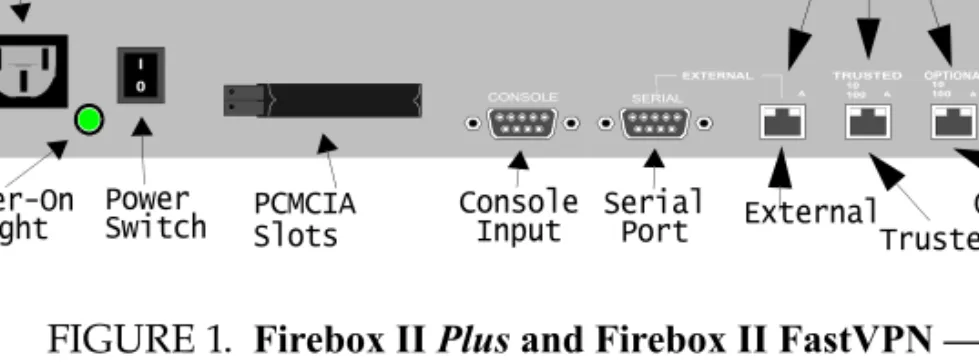
Firebox II Plus and Firebox II FastVPN Rear View
The rear view of the Firebox II Plus and Firebox II FastVPN contains ports and jacks for connectivity as well as a power switch. From the left, rear panel features are as described:
FIGURE 1. Firebox II Plus and Firebox II FastVPN — Rear
View
AC Receptacle
Accepts the detachable AC power cord supplied with the Firebox. Power-On Light
Lights to indicate the Firebox is receiving AC power. Power Switch
Turns the Firebox on or off. PCMCIA Slots
The Firebox accepts one PCMCIA (standard PC-style) modem card in either slot (but not both at once) to facilitate out-of-band management. The PCMCIA interface may be used for other options in the future.
Console Port
Connects to the Management Station or modem via a serial cable supplied with the Firebox.
Serial Port
Included for future expansion.
I
0 EXTERNAL TRUSTED10 OPTIONAL
100 10 100 A A A CONSOLE SERIAL AC Receptacle Power-On
Light Power Switch
Ethernet Jacks
External Trusted
Optional PCMCIA Console
Input SerialPort Slots
Firebox Illustrations and Descriptions
.
FIGURE 2. Firebox II Plus Ethernet Ports
Ethernet Ports
Indicators for each network interface display link status, card speed, and activity. The network interface cards (NICs) are auto-sensing and adapt to wire speed automatically. The speed indicator lights when there is a good physical connection to the Firebox. When the card runs at 10 Mbit, the speed indicator is yellow. When the card runs at 100 Mbit, the speed indicator is green. The amber traffic indicator blinks when traffic is passing through the Firebox.
Firebox III front view (all models except Model 700)
Indicators for the Firebox III Model 1000, Model 2500, and Model 4500 are on a central back-lit indicator panel. The following photograph shows the entire front view.
From the left, the indicators are as described on the next page.
Yel: 10
Grn: 100 A
Traffic Speed
CHAPTER 4: Hardware Illustrations
Disarm
Red light indicates the Firebox detected an error, shut down its interfaces, and will not forward any packets. Reboot the Firebox. Armed
Green light indicates the Firebox has been booted and is running. Sys A
Indicates that the Firebox is running from its primary user-defined configuration.
Sys B
Indicates that the Firebox is running from the read-only factory default system area.
Power
Indicates that the Firebox is currently powered up. Security Triangle Display
Indicates traffic between Firebox interfaces. Green arrows briefly light to indicate allowed traffic between two interfaces in the direction of the arrows. A red light at a triangle corner indicates that the Firebox is denying packets at that interface.
Traffic
A stack of lights that functions as a meter to indicate levels of traffic volume through the Firebox. Low volume indicators are green, while high volume indicators are yellow. The display updates three times per second. The scale is exponential: the first light represents 64 packets/second, the second light represents 128 packets/second, increasing to the eighth light which represents 8,192 packets/second.
Load
A stack of lights that functions as a meter to indicate the system load average. The system load average is the average number of processes running (not including those in wait states) during the last minute. Low average indicators are green, while high average indicators are yellow. The display updates three times per second. The scale is exponential with each successive light representing a doubling of the load average. The first light represents a load average of 0.15. The most significant load factor on a Firebox is the number of proxies running.
Firebox Illustrations and Descriptions
Firebox III front view (Model 700)
Firebox III Model 700 indicators are on a central back-lit indicator panel. The following photograph shows the entire front view.
From the left, the indicators are as described below. Disarm
Red light indicates the Firebox detected an error, shut down its interfaces, and will not forward any packets.
Armed
Green light indicates the Firebox has been booted and is running. Sys A
Indicates that the Firebox is running from its primary user-defined configuration.
Sys B
Indicates that the Firebox is running from the read-only factory default system area.
Power
Indicates that the Firebox is currently powered up. Security Triangle Display
Indicates traffic between Firebox interfaces. Green arrows briefly light to indicate allowed traffic between two interfaces in the direction of the arrows. A red light at a triangle corner indicates that the Firebox is denying packets at that interface.