April 2015
DRAFT: NOT FOR QUOTATION OR CITATION
ILE FINAL REPORT ON IMPLEMENTATION
AND CHANGE
This document contains the first draft final report of the Innovation Learning Environments (ILE) project focused on Implementation and Change. This is a working title, to be replaced in the final publication.
This report has been produced on the basis of notes submitted by the experts and systems participating in Strand 3 of the ILE project, plus additional OECD Secretariat analysis. The aim is to extend the framework already developed by ILE in relation to individual innovative learning environments by incorporating wider directed change that seeks to grow and sustain innovative learning. It is to clarify the notion of “system”, once the focus widens from schooling to broader learning eco-systems. It is to promote understanding of different levels, and distinguishes the “environment”, “meso” and “meta” levels, including in the structure of the report. It aims to present a range of country-based strategies and initiatives that have been submitted to the ILE project and to do this by illustrating the framework and concepts rather than through simple description. And by combining these different foci, the aim is to arrive at deeper understanding of the role of policy and government.
This draft report is being circulated in this version for feedback. On the basis of this feedback it will be revised in the latter half of May 2015 with a view to its subsequent publication. In addition, there will be an Executive Summary prepared for the finalised text and possibly an additional short concluding chapter. The referencing will be revised and extended, with fuller details given of the sources drawn on in preparation of this draft report. The intention is also to feed key messages and frameworks into an ILE Handbook also in preparation and drawing on all the ILE analysis.
TABLE OF CONTENTS
CHAPTER 1: THE ILE 7+3 FRAMEWORK AT SCALE: INDICATORS, CONDITIONS AND POLICIES
CHAPTER 2: THE SUBMITTED ILE STRATEGIES: AN OVERVIEW
CHAPTER 3: INITIATIVES CREATING ‘MESO’ LEVEL LEARNING ECO-SYSTEMS CHAPTER 4: THE META LEVEL: SYSTEMS, CHANGE AND LEADERSHIP
INTRODUCTION
Education has become increasingly important worldwide, and consequently so has its star risen in the political constellation. A – possibly the – key driver for this is economic – the fundamental role identified of knowledge, skills and capacities to underpin and maintain prosperity. The question of how well education systems develop knowledge, skills and capacities, and of what kinds, is increasingly centre stage in public debate. No argument has more political purchase today regarding education’s value than that it enhances competitiveness, even if competition by definition has winners and losers and even if pursuit of competitive edge may come into tension with the array of other missions with which education is charged. The direct link to international competitiveness, and the fact of globalisation, means that education’s international dimension has grown markedly over at least the past two decades. It is both cause and effect – global interdependence has both fuelled comparative measurements and in turn fuels the thirst for more. It also renders education more complex, given the range of cross-border educational activities and the prominent international benchmarks that have become so influential nationally and locally.
These developments create an intense pressure for reform. In many quarters, this is seen as the need to modernise and innovate bureaucratic and cumbersome school systems in their methods, content etc. To this is added the severe pressures on public spending which puts the spotlight on perceived inefficiencies. The pressure often takes the form of favouring ‘learning’ over ‘education’, and signals a readiness to disrupt accepted institutional arrangements as too slow to change, too inward-looking, and too detached from the rapid economic shifts taking place globally and locally. It is a context ripe for innovating learning environments at scale. In the terminology of the OECD schooling scenarios, this is pressure for “deschooling”.
It represents a very different starting point for innovation compared with the longstanding educational desire to realise more holistic education and individual development. On this view, the problem is not that the institutions of education are too detached from the economy but that they are too close, and are pulled to narrow their curricula and instil only superficial knowledge and not deep understanding. The educational charge is also that education systems are profoundly inequitable, far too driven by the social and economic function of sorting and selecting and thus not organised for the optimisation of learning. In the language of the OECD schooling scenarios, this is an argument for “reschooling”.
The economic critique and the educational critique are thus in important respects poles apart, both in their starting points and in the place of the school as an institution. But in other respects, they come closely into alignment and make the pressure to innovate so strong because such divergent critiques lead to the same basic conclusion. The critics of either colour may point to supporting evidence in the large numbers of young people who are disengaged from learning by the time they reach their teenage years. Both might insist that radical overhaul is needed, not tinkering. Both call for innovation and the urgency of focusing on enhancing the power of schools and other places to generate learning. Both may say that systemic change is needed, not isolated innovation here and there.
Yet another constituency are teachers who work in complex, knowledge-intensive situations and yet in most countries feel that theirs is an ambiguous status with insufficient recognition of their professionalism. One response is to retreat into defensive mode and seek to protect an understanding of professional autonomy as the right of the individual teacher to be left undisturbed in his or her own classroom. Innovating learning environments with collaborative definitions of professionalism and the strong engagement of all partners (and most especially young people themselves) offers a far more promising
route for enhancing the attractiveness of teaching than such backward-looking definitions of professionalism.
The differences of the critiques and constituencies notwithstanding, they coalesce around the urgent need to innovate the fundamentals of schooling. If schools are to make serious inroads towards 21st century skills development or towards holistic education or to be highly attractive contemporary professional working environments, it means radical changes to core habits and practices in most schools and systems, those habits which are residues of the predictability and control practices that resemble little of what a learning organisation is now understood to be. It means addressing the low visibility of teacher work and isolation, highly fragmented classroom arrangements, low engagement of the main players (students), conformity and reproduction, and highly unequal measured learning outcomes.
In moving away from excessively bureaucratic models, the growing understanding of complexity highlights the impoverishment of mechanical policy metaphors and the assumption of central policy omnipotence within well-defined and controllable ‘systems’. These fit badly a world of multiple actors, in which global and local players are influential as well as non-formal players and activity. Digital connection has transformed communication and boundaries. More organic metaphors and models might seem messy and more open-ended, but eco-systems and complexity are the nature of the contemporary world. We cannot keep faith with old models simply because they are neater. This understanding runs through this report.
Implementation and Change
This report is the culmination of the third strand of the ILE project on “Implementation and Change”. It thus comes towards the end of an unfolding sequence of influential international work on innovation and learning realised through three foci and strands. These strands are not simply project organisers: they are the fundamental interlocking components which together are needed, in the view of the ILE project, to understand change, innovation and reform:
Learning Research– the fundamentals about learning using international expert knowledge, and how this can and should inspire the design of learning environments (the main reference, The Nature of Learning, OECD, 2010).
Innovative Cases – immersion in country-based innovative practice and design and the ILE framework emerging from the cases (the main reference, Innovative Learning Environments, OECD 2013).
Implementation and Change – working within the framework and bringing it to life as
widespread practice through leadership, innovation strategies and broader system change (main references, Leadership for 21st Century Learning, OECD 2013; chapter in OECD Education Policy Outlook, 2015; upcoming main final report).
Underpinning this three-strand approach has been the conviction of: i) the need to ground all the work firmly in knowledge about how people learn and the circumstances in which they do this most powerfully; ii) the need to understand in detail and to be inspired by actual innovative learning environments but without taking these as “best practice” or as exhausting the relevant universe;; iii) the need to move beyond the level of individual cases to deepen understanding of how to grow, spread and sustain innovative practice beyond the small scale. In short, we have aimed to be relevant to both practice and policy, and have used research to bridge the two.
derived the “7+3”framework that integrates the learning principles. These are discussed in detail in the next chapter, including their policy implications. This third strand builds on these foundations to incorporate and extend the existing framework to cover learning systems more widely, and to address policy strategies and initiatives.
Around 25 systems and networks chose to become involved in Strand Three. The network of participating systems and organisations has proved to be both a vehicle for the work and an important outcome of it in its own right. In looking at diverse strategies to grow innovative powerful learning around the world, themselves only a small selection from those that might be examined, there is no pretence that these add up to a list of “what works” recipes. Contexts and conditions vary so widely, especially in the international context, that such recipes are not meaningful. Much depends on how these are interpreted and implemented in practice: broad categories such as networking or assessment policies or teacher professional development drives cover such a wide range of practices that may be very effective or instead make very little difference. One important criterion of whether they will make a difference is the extent to which they are forwarding the ILE learning principles.
Systems, levels, diffusion and spread
It is a common temptation to translate this ambition in terms of the “macro” level, the “system” level, and about “policy”. But these terms and concepts are themselves problematic.
Take levels. This work is not only about the “macro” level as it importantly includes networks and other initiatives and structures at what we conceive of as the “meso” level. The potential sweep of “macro” varies widely, from such large aggregations as global developments to much more narrowly defined ones. For some, the ‘meso’ level is about whole schools and so much smaller than our understanding. Similar problems exist for “micro”: for some it corresponds to individual learning;; for others, it connotes “the classroom” level;; for still others it is the institution.
There are thus widely differing definitions of what each embraces. The problem is not only lack of agreed demarcations. The problem is more fundamentally that of equating the relevant learning universe with the institutions of a school system publicly organised conceived in the vertical hierarchy of formal layers of governance. It is no longer appropriate or adequate to refer to ‘education systems’ as comprising government (and private providers) plus schools. Conventionally, the assumption is that policy is set by governments and descends in a vertical implementation line through local government (to varying degrees and with differing levels of devolution/delegation), together with implementation/support agencies through to school principals and into the classroom. Ancillary organizations, for example education publishers, exam boards etc. (usually operating for-profit), together with teacher training organisations fit in to the arrangements set by governments.
But, it is no longer appropriate to think in these terms. Amongst other factors, the penetration of digital technologies; the opportunities for other providers to by-pass schools altogether; the closer interest by employers and business in the outcomes of schooling; the interest and expertise in learning of a range of other institutions (e.g. in the creative sector) have turned this official, vertical conception – that never was fully adequate – upside down and have stretched it horizontally.
We need models that embrace the horizontal as well as the vertical, the non-formal as well as the formal, the unsponsored collaboration as well as the institutional. It is not about neglecting schools and their organising systems but of integrating them into more comprehensive concepts and systems.
All this entails that we should be thinking of 'learning eco-systems' – interdependent combinations of different species of providers and organisations playing different roles with learners in differing
relationships to them over time and in varying mixes. This also means that there is not a system but many, not a system level but a complex series of interlocking systems. A ‘learning environment’ as we have defined it in previous ILE work is itself a learning eco-system. And change is about much more than ‘policy’, if this is seen as the directed change of the education authorities: this is only one among multiple sources of transformation.
The first main point of departure for this report then is to underscore the importance of the ‘learning eco -system’, which itself might be involve thousands even millions of players or relative few. Second, we need to distinguish different levels. As the normal, formal institutional architecture is not defining ‘systems’ in this report, we cannot use familiar distinctions such as between the classroom level, the school level, the district level and the system level. Instead, we apply the following distinctions:
The ‘learning environment’ level: this is as conceptualized in previous ILE work. It is neutral about the institutional arrangements underpinning it (though many will involve schools) and is comprised of different partners.
The ‘meso’ level: which is comprises the many compounds of learning environments in networks, communities, chains and initiatives. This level – which is largely invisible in the formal governance charts of education systems – is critical for growing, diffusing and sustaining innovative learning.
The ‘meta’ level: the boundaries defining this level might be very widely drawn or more restrictive;; it is the aggregation of all the learning environments and collectivities in the ‘meso’ level that come within the boundaries chosen. (The term ‘system level’ is not appropriate for this as there is no single ‘system’ in this conceptualization.)
Underpinning all the different layers are the ILE learning principles. These are the design principles to guide implementation at no matter what level of operation.
Structure of the Report
Chapter 1 takes the ILE framework (7+3) and asks of the seven learning principles and the three additional
dimensions (innovating the pedagogical core, learning leadership and formative review, and partnerships) two questions to inform broader implementation and change:
What will be commonly seen when these features have become widespread and not simply found in exceptional individual cases?
What kinds of broader changes will be needed so that these design principles become commonplace features of learning systems?
Chapter 2 reviews the strategies and initiatives submitted to the ILE project. The purpose is to give an overview of their main features before looking into their details and dynamics in the remaining chapters. The chapter uses the device of a set of key terms beginning with ‘C’ through which to summarise those main features.
Chapter 3 then looks in greater detail, using the framework presented above, at the submitted strategies and initiatives as examples of populating the ‘meso’ level of learning eco-systems. It presents how they are learning focused, the mix of formal and non-formal brought together in each, the nature of spread and diffusion adopted by the strategy, and the extent to which the different strategies themselves apply the ILE framework.
seek to shape the meta level by driving wider change as exemplars and harbingers of cultural change. It asks the question: in complex and dynamic learning eco-systems, what does it mean to try to lead change and what in particular is the role of policy in that?
CHAPTER 1: THE ILE 7+3 FRAMEWORK AT SCALE: INDICATORS, CONDITIONS AND POLICIES
Introduction
This chapter presents the framework developed by OECD/CERI work on “Innovative Learning Environments” (ILE) (see OECD 2013). But it takes it further to the next stage which is necessary if this is to spread as widespread practice. Instead of asking simply “what does a powerful and innovative learning environment look like?” it asks and develops the responses to two further questions:
Indicators: what will be commonly seen when these features have become widespread and not simply found in exceptional individual cases?
Conditions and policies: What kinds of broader changes will be needed so that these design principles become commonplace features of learning systems?
These are the questions defining this chapter. It is not looking at specific policies and initiatives but at the powerful, innovative learning environment as identified through the OECD/ILE work, to ask what will education system look like when such learning environments are commonplace and what might help to bring this state of affairs into being. he changes identified are partly about policy in the conventional sense, partly about other means of change and transformation that involve the range of stakeholders and the range of different levels. This chapter concludes by extending the 7+3 framework adapted to look at meso- and meta-level systems as opposed to single cases. This framework provides the lens through which to examine the submitted strategies, especially in Chapters 3 and 4.
The ILE 7+3 framework
The ILE framework might be described as “7 plus 3”. The “The Nature of Learning” report (OECD, 2010) identified seven “principles” for designing learning. These were originally identified to shape the design of individual learning environments so as to optimise learning but they equally serve as principles to guide wider strategies, reforms and system change. The “7 plus 3” framework is based on learning research and the analysis of the innovative cases submitted through the OECD/ILE project.
Running right through the framework are the learning principles that emerged from the OECD/ILE review of learning research (Dumont et al., 2010).
The ILE “Learning Principles”
The research-based “learning principles” state that, in order to be most effective, schools and other learning environments should attend to all of the following design principles:
Learning Principle One: Make learning central, encourage engagement, and be where learners come to understand themselves as learners.
Learning Principle Two: Ensure that learning is social and often collaborative.
Learning Principle Three:Be highly attuned to learners’ motivations and the importance of emotions.
Learning Principle Four: Be acutely sensitive to individual differences including in prior knowledge.
Learning Principle Five: Be demanding for each learner but without excessive overload.
Learning Principle Six: Use assessments consistent with these aims, with strong emphasis on formative feedback.
Learning Principle Seven: Promote horizontal connectedness across learning activities and subjects, in- and out-of-school.
These are design principles to inform the activities and organisation and work of schools and other places of learning based on research evidence of what makes for effective powerful learning. Such principles imply significant innovation in that many schools and systems will need to change, some radically, in order fully to put them into practice. Implementing these research-based principles adds up to an agenda of significant change in most contexts if they are to be embedded into daily practice, and still more in the practice of whole learning environments rather than in isolated pockets by particular teachers at particular times. More demanding still, all the principles should be worked towards rather than a selected few. The follow-up ILE report “Innovative Learning Environments” (2013) put the learning principles at the middle but then added three more dimensions that are about defining and organising learning environments so that they become powerful and innovative and put the principles into practice. Such powerful learning environments:
i. Innovate their “pedagogical cores” – both the core elements (learners, educators, content and learning resources) and the dynamics that connect those elements (pedagogy and formative evaluation, use of time, and the organisation of educators and learners).
ii. Become “formative organisations” with strong learning leadership – with vision, strategies and design, all closely informed by evidence on learning and self-review; and
iii. Open up to partnerships, to create synergies and enhance professional, social and cultural capital - with families and communities, higher education, cultural institutions, businesses, and especially other schools and learning environments.
The next two sections develop what learning systems will look like if these features have become widespread; it also considers the changes and policies that will be conducive to the emergence of systems characterised by 7+3. The discussion advances the ILE framework which has to now been framed only at the micro ‘environment’ level by using the framework as the design principles for wider system change. These are condensed from the full elaboration in which (see Annex), we take the 10 (7+3) dimensions in turn to tease out the specific indicators, conditions and policies associated with each.
Indicators to show the ILE Framework has become widespread
Condensing all the indicators that we as showing that the 7+3 framework has become widespread practice gives the following list of indicators.
Learning activity and motivation: Indicators will reveal high levels of engagement and persistence by learners. The nature of schools and classrooms will be characterised by the “buzz” of collegial activity and learning. A variety of sites for learning will be commonplace beyond conventional classrooms, including different forms of community learning.
Learner agency and voice will be prominent. As the learning becomes more personalised so does the active role of the learners themselves become more powerful and they will be clearly represented in learning leadership teams.
Educator views and practice: When the framework is embedded at scale, indicators would reveal how readily teachers and other educators engage in professional discussion about learning strategies in general, within the organisation and in relation to individual learners. Indicators of teacher practice show readiness to engage with learning leadership, innovation and professional collaboration, including team teaching. Educator knowledge: Indicators of their knowledge about learning might well cover familiarity with the ILE Learning Principles: the more equally and fully teachers understand the nature of learning and diverse teaching strategies related to them the nearer will there be a core of professional knowledge informed by research.
Mixed, personalised pedagogical practices: System-wide there will be a rich mix and diversity of pedagogical practices, including whole-class, small group and individual study: direct contact, virtual and blended learning; school- and community-based. Personalised approaches and formative assessment would be highly visible, as would active pedagogies.
Inter-disciplinarity, curriculum development and new learning materials: there will have been extensive work on integrating inter-disciplinary knowledge around key concepts and developing corresponding learning materials and pedagogies. There will be flourishing research and development around pedagogical expertise and integrated content knowledge, not monopolised by research in universities.
Digital resources, social media and innovative use of ICT: There is widespread use of social media and ICT. Learners will engage in research and intense exchanges around learning projects. Educators will connect with each other, with learners, and with other partners and networks. Teaching, learning and pedagogy will often be tech-rich.
Learning evidence and evaluation: There is a dominant culture and practice of evaluative thinking and self-review and of using evaluative evidence formatively to inform design strategies. Significant amounts of time are devoted to self-review and associated collaboration and reflection. The learning community
Sophisticated information systems and individual portfolios will be highly developed and widely available to permit the detailed profile and learning history of each learner to be readily accessible for all engaged in designing the teaching, strategy and the learning environment.
New evaluation and assessment metrics: There will be flourishing new metrics developed and in widespread use. These will reflect the aims of learning environments and wider system metrics, and include mastery, understanding, capacity to transfer and use knowledge, curiosity, creativity, teamwork and persistence. Assessment will extend outside conventional school settings. Quality assurance systems, including inspection, will recognise successful learner engagement and exercise of voice.
Leadership profiles: aggregating system-wide, there will be a strong focus on learning and design and decision-making will typically be distributed and shared. It will typically bring in the professional community, learners, and other stakeholders, including foundations.
Diverse partners highly visible: indicators will reveal the extent to which partners who previously might have been regarded as ‘external’ have become integral to pedagogical cores and formative learning leadership. Such partners importantly include parents and other family members, but also community bodies, enterprises, cultural institutions, universities, and other learning environments.
Density of “meso” level activity: High levels of collaboration and engagement with partners, including other learning environments, will mean the highly visible measurable existence of the “meso” level across districts, networks, chains, and communities of practice, whether formed spontaneously or through formalised strategies and networking initiatives.
Global connection: In a global world, it will be the common practice that partnership contacts, with other learning environments and different stakeholders, extend beyond national boundaries.
Conditions and Policies to Implement the Framework as Widespread Practice
Condensing the full discussion of conditions and policies that would develop each of the elements of the 7+3 framework that follows in the Annex gives the following overview of how the framework might be advanced.
Aligning regulation, reducing standardisation, broadening institutions
Learning systems should shift away from standardisation while informed by shared general goals for education and learning. All educational institutions and organisations should be strongly focused on the promotion of learning – as activity, as engagement and as successful accomplishment – using demanding notions of “success”. Educational policy-making has, so far as possible, to be long term and protective of achievements already attained rather than constantly changing in response to short-term demands.
School and system policies need to ensure that institutional functioning and regulation are seen less as ends in themselves but instead constantly and consistently refer to student learning as their essential mission and purpose. Standard rules and uniform procedures should not stymie creative solutions and innovation at the heart of teaching and learning. Regulatory constraints need at least to be re-examined, including bringing “external” partners, experts and volunteers right into activities in “pedagogical cores”.
Broadening the institutional base beyond schools through service learning, diverse non-formal learning opportunities on-line and in communities, and establishing hybrid formal/non-formal programmes are all part of creating dynamic learning systems. This should be about creating more high-quality opportunities for learners and extending professionalism, leadership and quality assurance; it is not about extending bureaucratic control.
There is a case for extending specialist educational offers. There could well be a rich diversity of different types of school emerging, each with particular ethos and curriculum focus.
Accountability and metrics for 21st century learning
There needs to be a strong lead towards innovative learning from curriculum and assessment policy. Accountability systems should be cast in terms of a full range of learning aims, methodologies and metrics. Promoting coherence should be a constant aim to avoid competing, self-negating policy strategies and messages. As regards accountability and assessment regimes, they should ensure that they are not creating highly risk-averse schools just when schools need to be hubs of innovation.
For both systems and individual learning environments, assessments must be used in the service of deep learning and to promote 21st century competences, with close attention to social and emotional skills. There needs to be advances in assessment methodologies including the metrics used. Roadmaps and “consumer guides” may usefully help access and interpret of the wealth of accountability information.
Promoting learning leadership, trust and learner agency
Leadership is critical. This means learning leadership based on deep knowledge of the nature of teaching and learning, and a readiness to innovate and to take calculated risks. It means having the leadership capacity to take staffs, parents and communities forward even on long-term change journeys. It means being able to manage the complex organisational environment of creating visibility and breaking down high boundaries that divide schools from each other and their communities, and classrooms from each other. All these capacities need to be actively developed and maintained.
Policy frameworks are highly influential of prevailing assumptions. They should move away from the “heroic” leadership paradigm, and recognise the distributed, shared nature of leadership. There needs to be widespread official acceptance that learners deserve and are able to be active partners in their own educational organisation and decision-making. This demands high-trust environments, built around the active engagement of learners, their families and their wider communities.
New leadership and governance arrangements must increasingly recognise complex learning systems and optimise potential opportunities by extending beyond schools themselves. Greater connectedness with partners and networks outside the formal system places greater demands on leadership. A policy role is to encourage the sharing of examples and sponsoring on these complex features of contemporary learning systems.
Collaborative expert professionalism
The ILE framework assumes collaborative professionalism, strongly focused on enhancing learning with a range of partners. Innovating learning environments and embedding this form of professionalism are among the most powerful ways of enhancing the attractiveness of the teaching profession. Teacher professional bodies, unions and associations would very helpfully promote this perspective on professionalism.
There will need to be flexibility in educational cultures, practices and learning spaces, and the capacity to accommodate different pedagogies and mixes of group and individual learning. There needs to be expertise in making connections between subjects, in- and out-of-school learning, and connecting specific learning tasks to broader concepts and problems, and in fostering learner engagement; and to be able to do all this
Broadening the educator base by bringing others beyond the established teaching force can facilitate connectedness to expertise and experience. At the same time, to do so brings to the fore the leadership and management roles of teachers and school leaders in more complex organisational arrangements.
Professional learning
Learning is needed to build the professional, innovative and organisational capacity to realise the ILE learning principles, based on sound design strategy and evaluative thinking, and engaging the learning environment as a whole.
Learning is key to building capacity for distributed leadership formatively exercised using learning evidence; it calls for widespread leadership development opportunities. There should similarly be widespread professional development opportunities in evaluation and evaluative thinking. These may come through collaboration and networking, or specifically organised around leadership programmes and bringing in specialist expertise.
Professional collaboration and exchange should be recognised and incentivised in accountability systems, internal and external. The real and virtual environments inhabited by educators should be highly conducive to professional exchange and dialogue. Policy can foster learner-centred networks and communities of learning.
Connectivity – extensive digital infrastructure
There is a clear policy role for investing and partnering in establishing the necessary digital infrastructure. There will need to be an extensive digital infrastructure to underpin teaching and learning activities and the extensive knowledge and curriculum infrastructure. It will be important that learning environments are strongly inter-connected using digital technology, that they have on-line visibility to enable the approach of different potential partners, and so that partnerships themselves can communicate easily at a distance on-line and using social media.
Cultures of networks and partnership
Horizontal connection and collaboration should become as normal a way to characterise learning systems as the vertical, formal relations between levels. Education authorities themselves may be very active in establishing networks or brokering communities of practice.
Extending the capacity of learning environments through partnerships will not work if there are high school walls intended to demarcate very clear boundaries between the ‘internal’ world of the school and various external bodies and stakeholders, especially communities and families, and other learning environments. This bridging is not just about bringing parents and the community more closely into schools; it is also about bringing schools and schooling more into communities.
Connection to such a wide range of potential partners calls for well-organised information about schools, learning organisations and potential partners so that they can find each other and work together. Brokers may well be involved, especially around particular themes or about particular networks.
Performant knowledge systems and cultures of evaluation
Very powerful knowledge systems are needed for the enormous quantities of evaluative and assessment information being created and for complex systems and interconnections. Highly performant knowledge-sharing infrastructure and networking would allow ready access to exemplars, to evaluations, and to the practice and views of other practitioners, rather than assume that each leadership team and learning
community will devise its learning strategies anew. Research findings should be very readily available in succinct and accessible formats suitable for practitioners.
These will not only be meaningful at the micro, environment level, but will be constantly being accessed and used at the ‘meso’ level and at the meta level, too. The relevant sources of assessment knowledge will extend well beyond national boundaries.
Powerful knowledge systems will be cumbersome information banks unless there is the human capacity to use them fully and to interpret sensitively the information being so generated. There needs to be a culture of diagnostic expertise and evaluation. This is both about the creation of professional capacity and its constant use. It is also about a democratisation of this knowledge beyond the hands of a small number of specialist experts.
The ILE Framework and Learning System Architecture
This section presents an architecture for learning systems beyond the single environment level. The 7+3
was originally put forward for the environment level but here it is extended to learning systems at the wider “meso” and “meta” levels. That is, the seven learning principles and the three key dimensions – innovating pedagogical cores; learning leadership and evaluation, design and redesign; and extending capacity through networks and partnerships – serve as the design principles for larger learning eco-systems. When they do, those learning systems are being informed by the principles and features that make them powerful for 21st century learning. But when the focus widens to look at the meso and meta levels, it is necessary to include the institutional components and infrastructure, the verticality of formal governance and the horizontality of the voluntary and non-formal, and the connections of knowledge and collaboration that bind the learning system elements together.
The 7+3 applied to the meso and meta levels
The 7+3 ILE framework may be seen in meso and meta-level learning systems in the following ways. As a source of learning and ‘contagion’: The larger learning eco-system to which the learning environment belongs serves as the vehicle for spreading and reinforcing those principles within its constituent environments. Instead of individual learning environments having each to build their own learning architecture constantly anew, each draws on the examples, support and cooperation of others undertaking similar learning journeys. It is in this sense the source of ‘contagion’ for the ‘innovation virus’ within the separate ‘organic’ bodies that belong to it. This includes the nature of connections within networks.
By embodying 7+3 in its own network operation: The larger learning eco-system may itself be governed by these principles and features, such as when a network chain is itself innovating its understanding of pedagogical relationships, content and resources; has an active learning leadership and is using learning evidence to change direction; or when it reaches out to other bodies or networks with which it forms alliances, or eventually merge.
By active promotion and policy leadership: Influential players within the wider meta level eco-system may put in place the means to promote the 7+3 framework. Leadership in large learning eco-systems is clearly a critical question for how directed change and larger design occur in which simple changes of provision or regulation will not be sufficient. This is discussed separately in Chapter 4, including how policy-makers may be enablers and brokers and “mid
-These will be used to interrogate the different initiatives and strategies submitted by the participating systems in Strand 3 of the ILE project.
The institutions and educational organisation of meso and meta learning systems
So far we have made the 7+3 framework “institution-neutral”: when it refers to individual learning environments these may be found in a wide variety of different institutional and organisational forms and we have not presumed the form these might take. But in describing the architecture of learning systems, it is important to be able to distinguish different organisational forms. That is, any particular eco-learning system at the meso or meta levels can be described not only in terms of the fit and adherence with the “7+3 framework” – which are criteria for 21st century effectiveness and innovation – but in terms of a number of descriptive features which help to distinguish the kind of learning system in question.
Among the dimensions and forms that can be distinguished; among the most important are: Size – the number of constituent elements (which may not be stable or clearly fixed);
The roles played by regulations and guidelines (the extent to which formal regulations define the operation of any particular networks, chains or initiatives – the tightness of relations - and the extent to which the formal system itself might be characterised as ‘networked’ or‘clustered’);; Institutional membership (which kinds of organisations belong and make up the different networks and eco-systems);
Resourcing, especially human and financial (what levels of support do the different meso level groupings enjoy?);
The role of knowledge as the connector, the extent to which this is focused on learning, and the vehicles for knowledge-sharing and learning (including platforms of different kinds);
Technology infrastructure and use (both within and between the constituent elements).
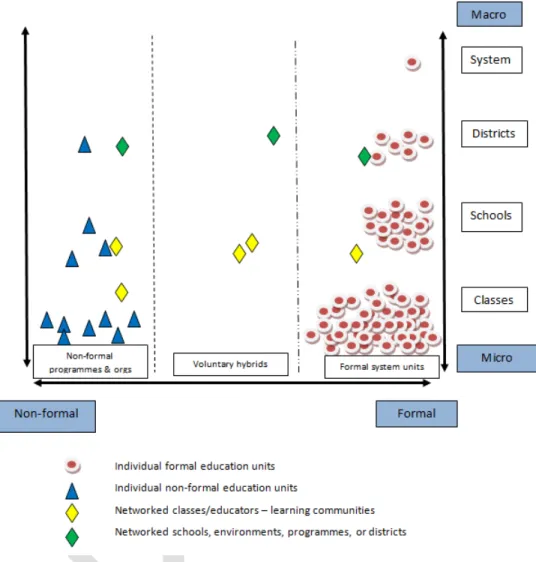
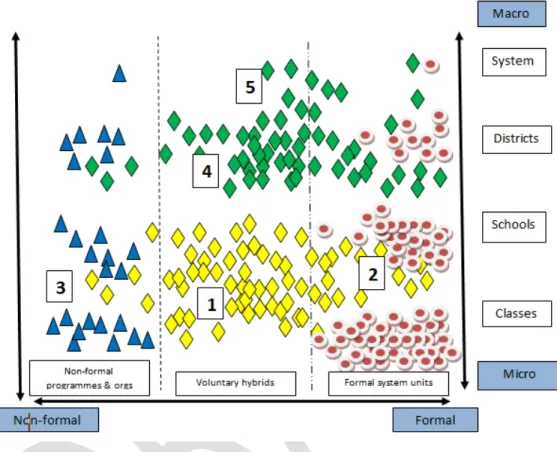
Together with 7+3 these six dimensions define a complex set of criteria and characteristics through which to look at learning eco-systems at the meso and meta levels. To simplify they may be condensed to two main characteristics:
Learning focused: How learning-focused are the environments and networks that make up the system at different levels and how far focused on innovative learning as defined in ILE work through the 7 principles?
Balance of formal and non-formal: how networked are formal learning environments, how recognised are non-formal learning environments, mixed (“hybrid”) environments and networks, and the horizontality of learning systems around vertical governance structures.
These will be used to interrogate the different initiatives and strategies submitted by the participating systems in Strand 3 of the ILE project.
CHAPTER 2: THE SUBMITTED ILE STRATEGIES: AN OVERVIEW
The next three chapters turn to the strategies and initiatives submitted to the ILE project. The purpose is to illustrate how these are being realised in concrete cases, to extend the framework of 7+3 when the focus widens to the meso and meta levels, and to clarify the nature of these levels themselves. As with the earlier OECD/ILE publication Innovative Learning Environments, framework development and the country case presentation are both outcomes in their own right: each has been informed and strengthened by the other in an iterative way.
In Chapter 1, we identified a range of conducive conditions and policies for the ILE 7+3 framework, under the following headings:
Aligning regulation, reducing standardisation, broadening institutions Accountability and metrics for 21st century learning
Promoting learning leadership, trust and learner agency Collaborative expert professionalism
Professional learning
Connectivity – extensive digital infrastructure Cultures of networks and partnership
Performant knowledge systems and cultures of evaluation
These feature throughout the next three chapters. In this one they are summarised as a series of C’s: creation, context, complexity, communication, communities, collaboration, capacities, conditions and climates. The chapter gives an overview of the range of strategies and initiatives gathered through this OECD project; in the next two chapters they are looked at in more detail in terms of how well they illustrate the ILE framework and issues that arise.
The ILE request
The aim of this strand of ILE work has been to identify promising strategies and initiatives for spreading and sustaining innovative learningthat have been put into practice. Whereas the ‘Innovative Cases’ strand looked at particular examples of innovative learning environments, the horizon now broadened from examples of individual schools or ILEs towards change strategies that necessarily involve several and possibly many different sites. They had operated through time so that there is evidence of implementation, rather than planned initiatives that are not yet implemented.
Consistent with the rest of the ILE project, the focus was on learning arrangements for children and young people - understood broadly as referring to 3-19 year-olds or age bands within, with particular interest in change initiatives designed to spread and sustain innovative learning. They could cover a variety of
creating new forms of expertise and change management, and more general drives to create climates favourable to innovative learning. They could target change in one or more of the different components of learning environments: particular learner groups; the learning professionals; content; materials, facilities, and technologies; and the different ways in which these are organised and assessed. We were not looking for general reforms of the curriculum, institutional structures, and the management or governance of schooling that did not have the intention first and foremost to innovate learning environments.
The aim in compiling these strategies and initiatives was both to learn from the experiences and approaches taken, including in constructing guiding frameworks linking the specific examples, and it was to work with the strategies and systems themselves directly. It was research and development (R&D) rather than pure research, and indeed it might be more appropriate to think of it as D&R with practice leading the research, rather than the other way round.
Strategies and initiatives submitted to ILE
Australia (South Australia): Work in the South Australian Department for Education and Child Development (DECD) by a small team to build the innovation momentum. Strategies have included conferences, establishing a website and newsletters to share innovative practices, undertaking research and creating a community of practice involving the most innovative schools. A Research and Innovation framework was developed by late 2011 and innovation became part of the DECD Strategic Plan 2012-2016. The focus is on equity, excellence and sustainability, identifying and up-scaling innovation, as well as establishing system-wide directions for innovation.
Australia (Victoria): This focuses specifically on the Western Metropolitan Region in which reform was a systemic intervention strategy, designed to galvanise a collective effort to lift performance. The focus was initially primarily on improvement in literacy and numeracy, and was subsequently extended to other areas of the curriculum. The approach to system-wide improvement was generated through a process of ‘co -design’ and mutual commitment between the region and all schools.
Austria: The Austrian school reform initiative “New Secondary School” (NMS) began in 2008 in 67 pilot schools has since led to a mandated school reform, to be phased completely by 2018. The goal is to foster innovative learning environments and increase equity. The rationale is that school reform must be addressed on the school level to be effective and change agents require networking and communities of practice. Each NMS designates a member of the teaching staff to be the Lerndesigner, which is seen as a massive system intervention in a system in which schools have a flat hierarchy with the predominance of the autonomy-parity pattern.
Belgium (French community): The aim of the « Décolâge ! » project is to progressively reduce grade repeating in the earliest years of pre-primary and primary education. The project assumes that this requires credible alternative practice. It is looking to reach and mobilise all the professionals and other adults involved to engage in the identification and implementation of such alternatives.
Canada (Alberta): The Canadian Rockies Public Schools District partnered in the 2011 Banff Conference. Its featured initiative is ‘Inspiring Hearts and Minds’, community consultation to identify community values, education trends and major forces of change. Two overarching emergent themes are: a) the “whole child” (intellectual, emotional, social, physical and spiritual development);; and b) schools as the centre of learning and development in the community.
Canada (British Columbia): The featured initiatives are a graduate programme about learning leadership and innovation (Certificate in Innovative Educational Leadership) and three school-to-school networks: Network of Performance Based Schools (NPBS), the Aboriginal Enhancement Schools Network (AESN),
and the Healthy Schools Network (HSN). The learning leadership development is based on a cycle of inquiry, and prominently uses the ILE Learning Principles.
Chile: Among the general programmes are included: the Enlaces Programme; the Programme for Innovative Teaching for Deeper Learning; the UAI Centre for innovation and learning; and diverse strands of the Chile Foundation. The Networks include: the Network of innovative teachers; the regional network Innovemos; the MICROSOFT Alliance for Education; and the Network for leading schools. Among the awards are: the Telefonica foundation award for educational innovation; the Ibero-American award to Educational Innovation;; and the competition “I innovate in class, integrating technologies”.
Finland: the “Schools on the Move” programme is a national action strategy aiming to establish a physically active culture in comprehensive schools. After being piloted from 2010-2012, the programme has grown nationwide, supported by new data and analysis on the relationship between physical activity and children’s learning and well-being.
France: The aim of the RESPIRE website is to create favourable conditions for educators to share their
knowledge, practice, problems and resources, and to strengthen professionalism. It combines design and management by the Education Ministry’s department of R&D and technological support by a regional education knowledge centre. It includes a continuously up-dated knowledge bank of innovations (more than 2500 innovations already compiled and updated). It facilitates the development of “communities of practices” and “professional learning communities” and the mediation of knowledge between practitioners through sharing knowledge and experiences, experiments and initiatives, projects and best practices. Germany (Baden-Württemberg): The Gemeinschaftsschule, is a new type of school: 42 such schools started at the beginning of 2012/2013, with another 87 to follow in 2013/2014. Its principles include: the value placed on equity and on the concept of cooperative learning; the teachers see themselves as specialists in their respective fields, as experts at diagnosing students’ needs, skills and knowledge, and as learning facilitators; it operates with providing an all-day structured space for learning. This concept of schooling is recognized as having far-reaching implications for the curriculum and teacher education. Germany (Thuringia): The start-up project of the Thuringian Ministry for Education, Science and Culture (TMBWK) “Development of Inclusive and Innovative Learning Environments” in the framework of the strategy “Education for Sustainable Development”. An important concept in this is ‘Gestaltungskompetenz’, or competence to shape the future. It consists of skills such as foresight thinking, interdisciplinary knowledge, independent action and participation in societal decision-making processes. The project is working through approximately 40 “reference” or exemplary schools, on selected areas of inclusion such as in innovating learning environments.
Israel: The strategy in this case covers the work of Ministry of Education’s “Experiments and Entrepreneurship Division”. Having identified educators with a robust vision, a five-year process begins. It includes analysis and evaluation, and the provision of support, training, and R&D tools. As time progresses, the innovative initiative should be applied with ever-increasing scope, and at the end of the period, the school completes the experiment book. Those demonstrating special success become dissemination centres for others interested in developing similar innovations.
Korea: strategies of organization and systems focused on multi-cultural education. First, the Centre for Multi-Cultural Education; a special institution established and supported by the Ministry of Education, Science and Technology taking a leading role for research of multi-cultural policies and innovative implementation. Second, Hanul Club is a target school carrying out innovative multi-cultural education,
Mexico (Conafe): The API strategy is about organizing educational interventions through a network of Itinerant Pedagogical Advisors to improve learning for children of rural, disadvantaged communities. The APIs advise the teachers on how to strengthen learning processes, involving the active and collaborative participation of parents. It is coordinated with the Ministries of Education from a number of the different states in Mexico.
New Zealand: “Learning and Change Networks” is a government-initiated strategy to establish a network of knowledge-sharing networks among Māori-language immersion centres, schools and communities to address the equity challenge. Participants in networks work through four development phases: (i) establishing infrastructure to operate as a network across schools and communities, (ii) profiling the current learning environments to understand challenges and agree on change priorities, (ii) implementing a plan to address the change priorities, and (iv) sustaining useful changes and agreeing on next steps. Norway: the national Advisory Team programme is to assist school owners and principals to improve their leadership and learning environments. A team of advisors has been established at a national level aimed at school owners and schools that have special quality challenges in areas such as students lacking in reading and maths skills, under-performing learning environments, and students and apprentices who do not complete or not passing exams in upper secondary education.
Slovenia: An initiative designed to spread and sustain innovative learning in Slovenian schools, based on the principles of empowerment and shared leadership. It combines “direct promotion, provision of incentives, network creation, knowledge management, leadership strategies and other professional development capacity building, creating new forms of expertise and change management, and more general drives to create climates favourable to innovative learning.” Initial work in 10 schools, than spread to all Gymnasia, and now it is being extended to primary schools. The whole process has lasted 10 years. South Africa (KwaZulu-Natal): The ICT in Education (ICT-Ed) project is now being implemented in 200 schools in KwaZulu-Natal. It aims to address the poor quality of teaching and learning in the classroom by replacing traditional teacher-centred teaching with a learner-centred technology-based teaching and learning programme. Several of these schools will also receive a school-strengthening programme that addresses barriers to learning and development.
Spain: The “Curricular Integration of Key Competences” Project is an initiative of the Ministry of Education, Culture and Sport together with the Autonomous Communities. It aims to improve key competences development and is being implemented by the National Centre for Educational Innovation and Research. In the first stage, 150 primary and secondary schools, both public and state supported, were selected. The strategies vary according to whether they are “Initiating Schools”, for the teachers to reflect on their own practice and to get initiated into the competence-based syllabus, or “Advanced Schools” building a common view shared by each teaching team.
Sweden: The project Mother Tongue Theme as an innovative initiative to build, maintain and inspire networks of mother tongue teachers and school leaders. A key part of this project has been, and is, the Mother Tongue Theme website which serves as a knowledge platform for mother tongue teachers in Sweden, Norway and beyond. In 2003, it was awarded the Best Global Website Award, for “the most innovative multilingual and multicultural site in Europe”. Now, 100 teachers and school leaders contribute to the site with unique content in 45 different languages.
Switzerland (Ticino): The School Improvement Advisor initiative has the main aim to help schools and teachers to develop innovative teaching methodologies and practise self-evaluation. The action of the SIA as coach, critical friend and professional in educational investigation can help put innovations into practice.
The targeted learners are young apprentices and students in the Swiss vocational sector in schools mainly in the industrial and commercial fields.
UNICEF (Former Yugoslav Republic of Macedonia): The in-service Teacher Education Programme on
Early Numeracy and Literacy is about addressing low achievement. It is building capacity from the bottom up to stimulate system change over the long term by changing teacher practice. And, it is about changing from the top through adopting a different professional development model, training all teachers in the new programme, and equipping advisors to support these developments. After a preparatory phase, it began to be implemented in actual teacher training and the model of teacher professional development and support from 2009.
United Kingdom (England): Whole Education is a partnership network of schools, organisations and individuals that believe that all young people should have a fully rounded education, developing the knowledge, skills and qualities needed to help them thrive in life and work. It is supporting the spread of innovative practice and change across a self-elected, bottom up community of practice of schools. It has lead Partner schools, Pathfinder Schools and then a larger group of less active Network schools across the country (mainly England), all supporting and learning from each other.
Innova Schools (Peru): is a network of approximately 20 schools, aiming to reach 70 by 2020. The aim is to offer an alternative that is excellent, scalable and affordable. It is implementing a paradigm shift for the context: from teacher centred to student centred, with innovative pedagogies and time use. Technology is regarded as an important tool in the learning process. It uses a blended learning model and an innovation programme that invites students to tackle issues in their community, connecting what they learn in the classroom to the real world, in a framework of open-ended learning.
Lego Education (Peru): A programme involving this foundation and the education ministry aims to stimulate and motivate students and promote teacher learning communities. It includes the provision of 130,000 Education WeDo robotics kits, 30,000 teacher guides with technical content aimed at guiding elementary school teachers, and training of 50 specialists of the Ministry of Education, face-to-face training for 8,000 teachers conducted in 24 regions of Peru, and virtual training via the Internet for 7,000 teachers.
UNETE (Mexico): UNETE, the Association of Business People in Educational Technology, is a non-profit organization supporting educational quality and equity in Mexico. Since 2012, UNETE began pilot programs in 128 schools in 15 states. These aim to deepen understanding of the integration of ICT into teaching and learning; identify the impact on academic performance of ICT integration; scale up the training for and monitoring of technology practices; identify best practice innovations using ICT; and analyse the impact of implementing specific pilot programs in different schools.
Of course, this is only a tiny number of the initiatives and strategies that might have been considered; they are the ones which engaged actively in the OECD/ILE work and who thus had the knowledge and means, as well as the desire, to do so. They provide nevertheless a fascinating set of cases from which to gain insights about the range and nature of the approaches taken, as is done in this overview chapter and those that follow focusing on the ‘meso’ and ‘meta’ levels.
The systems and organisations that engaged with the ILE work could do so with varying degrees of detail and intensity; the varying detail on each included in this and subsequent chapters reflects this variation of submitted information.
Culture change
Several of the strategies emphasise the importance of creating culture change in schools as both much more important than surface change but also much more difficult to realise. The Victorian NWR reform in Australia, for instance, refers to “changing the ‘mind-set’ of schools to aspire to major improvement, changing the instructional practices of the school leaders and teachers and system providing intense and step-by-step support.” The system-wide renovation in Slovenia began from the understanding that past reforms had been excessively top down so that there was insufficient ownership of them by the local actors who matter. The need for new kinds of knowledge and new kinds of schools as learning communities amounted to a veritable culture change, in particular in accepting the importance of being more collaborative and connected. In this case, training in moderation skills was needed given the lack of experience with collaboration. The KwaZulu Natal initiative in South Africa like the Innova Schools Network in Peru, both participating in OECD/ILE, are clear that it is a culture change to move to more active modes of teaching and learning from traditional methods that are failing far too many students in those systems.
Examples of changing beliefs and practices in South Australia
Signs of changing beliefs and practices included staff using social media for ongoing and staff-driven professional development, listening more to student views about their learning needs, using a wider range of assessments and explicit criteria, and more differentiation. From the research evaluations, example comments reflecting this were:
“Better understanding of how research can be used in the classroom…opportunity to work with colleagues and the range of different subject areas…conversations about what they were doing”
“used social media…(before) people were passive learners…waited to be supported by
leadership…(Following the social network professional learning focus)…got people who were having learning conversations at 10pm at night.. (For) fixed mindset people…at least they were being confronted
frequently...at least chipping away even if not getting immediate response to change’”
“Now more understanding of digital technologies and supporting students with specific learning difficulties.... there is lots of change and enthusiasm among staff…and thinking about how children learn. Now teachers
talk about, I’m wondering if I could harness that child’s obsession with something…rather than complaining about the child”.
Clarifying focus
Many of the innovation strategies reported to OECD/ILE are aimed right at such mainstream goals as addressing low educational achievement and enhancing quality. Innovation is necessary because repeating variants of conventional approaches have failed to dent such stubborn and persistent problems as continued low achievement among the same groups of students. In some cases, innovating learning environments is seen not just as a means to these widely-shared equity and quality goals, but as an end in itself. Strengthening the focus on learning is also an explicit goal of several, making schools more learning-centred and getting students to accomplish deep learning rather than superficial mastery. Some have a strong future focus: both Thuringia and Spain, for example, are working to spread new content around 21st c skills and futures literacy.
Several of the systems emphasise how important is clear and relentless focus whatever the specific objectives, rejecting the soft scattergun of “letting 1000 flowers bloom”. Both British Columbia and New Zealand report a relentless recourse to learning evidence to ensure that network innovation activity is disciplined and focused, encouraging accountability and speeding the transfer of knowledge around schools and systems. On focus, trying to cover everything all at once risks disjointed diffusion of effort and missing all targets in the process. Several systems report how choices needed to be made to ensure focus
while avoiding narrow goal-setting that blinkers wider innovation. Many networks, for instance, choose improving “writing” as a core focus for attention in improvement but seen as the vehicle through which many wider innovations can be built. Similarly, the French Belgian initiative “Decolage!”, is strongly focused on reducing grade repetition in the very early years of schooling as the strategic means for consolidating a much wider set of changes related to classroom practice and under-achievement.
Capacity creation – knowledge, professional learning, and collaboration
Knowledge creation and mediation are central features of many of the strategies to innovate learning environments, and to grow and sustain them. This has been a long standing focus of OECD/CERI analysis (e.g. OECD, 2004; OECD, 2009). Many different ways are used to share knowledge and to capture the learning that is continually taking place through the innovation.
Several of the strategies place generating knowledge about the learning that is taking place, and acting on that knowledge, as a cornerstone of the reform drive. The New Zealand Learning and Change Networks has network participants engage at the outset in deep learning for up to six months: to identify the priority learning challenge and to map the current situation round the achievement challenge, as well as to be clear about the learning, teaching leadership and family support practices that are useful and should be kept and those that should be changed. In Victoria, the Western Metropolitan Region strategy has been designed around rigorous performance analysis, a unified leadership focused on building commitment and capacity, training and practice in evidence-based classroom techniques, and the provision of additional resources and support.