DISSERTATION
zur Erlangung des akademischen Grades doctor rerum politicarum
(Doktor der Wirtschaftswissenschaft)
eingereicht an der
Wirtschaftswissenschaftlichen Fakultät der Humboldt-Universität zu Berlin
von
Slobodan Sudaric, M.Sc.
Präsidentin der Humboldt-Universität zu Berlin: Prof. Dr.-Ing. Dr. Sabine Kunst
Dekan der Wirtschaftswissenschaftlichen Fakultät: Prof. Dr. Daniel Klapper
Gutachter:
1. Prof. Dr. Roland Strausz 2. Prof. Dr. Ulrich Kamecke
Eingereicht am: 07.09.2018 Tag des Kolloquiums: 07.02.2019
Acknowledgements
I would like to express my sincere gratitude to my supervisor Roland Strausz for continuous support throughout my studies and for invaluable guidance in my research. I am also sincerely grateful to Pio Baake for his feedback and support as second supervisor, and especially for the joint research project, which the first chapter of this thesis is based on. I would also like to thank Ulrich Kamecke for his support as a member of the examining committee. Moreover, I am grateful to Helmut Bester, Matthias Lang and Anja Schöttner for all their patience and insightful comments throughout the years. Also, I thank Özlem Bedre-Defolie for introducing me to the topic of platform markets.
A special gratitude goes to my coauthor Philipp D. Dimakopoulos who worked tirelessly with me on chapter two. I would also like to thank my colleagues in the Microeconomics Research Group as well as seminar participants in Berlin for their patience and constructive feedback. In particular, I thank Tianchi Li, Colin von Negenborn and Jonas von Wangenheim for their helpful comments and suggestions. I would also like to thank my office mates Lucien Frys, Philipp Heller and Vincent Meisner for their feedback and many lively discussions. For their administrative support, I thank Regine Hallmann, Viviana Lalli, Myrna Selling and Sandra Uzman.
I would also like to thank Marc Bourreau, Robert Somogyi, participants of the IODE workshop in Louvain-la-Neuve, EARIE conference in Lisbon and the ITS conference in Passau, as well as two anonymous referees, for helpful comments on chapter one. For their comments on chapter two, I thank Markus Reisinger, Thomas Ross, participants of the CRESSE conference on Crete, IODE workshop in Liège, MaCCI in Mannheim, BCCP conference in Berlin, EARIE conference in Maastricht, and two anonymous referees. For chapter three I also thank Matthew Ellman, Marco Sahm and participants of the IODE workshop in Liège. Financial support from the Deutsche Forschungsgemeinschaft (RTG 1659 and CRC 190) is gratefully acknowledged.
Contents
Introduction 1
1 Net Neutrality, Prioritization and the Impact of CDNs 5
1.1 Introduction . . . 5 1.2 Related literature . . . 7 1.3 Model . . . 9 1.4 Equilibrium analysis . . . 11 1.4.1 Net neutrality . . . 11 1.4.2 Paid prioritization . . . 12
1.4.3 Content Delivery Networks . . . 15
1.5 Comparison . . . 17
1.5.1 Welfare . . . 18
1.5.2 Investment incentives . . . 21
1.6 Conclusion . . . 24
1.A Appendix . . . 26
1.A.1 Omitted analysis . . . 26
1.A.2 Omitted proofs . . . 28
2 Privacy and Platform Competition 33 2.1 Introduction . . . 33 2.2 Related literature . . . 35 2.3 Model . . . 37 2.3.1 Users . . . 37 2.3.2 Advertisers . . . 38 2.3.3 Platforms . . . 39 2.3.4 Assumptions . . . 39 2.4 Equilibrium analysis . . . 40
2.4.1 Second stage market shares . . . 40
2.4.2 Efficiency benchmark . . . 41 2.4.3 User-optimal outcome . . . 42 2.4.4 Market outcome . . . 42 2.5 Comparative statics . . . 43 2.5.1 Advertiser-side competition . . . 44 2.5.2 User-side competition . . . 45 2.6 Policy implications . . . 46
2.6.1 Comparison of outcomes . . . 46
2.6.2 Policy conclusions . . . 48
2.7 Discussion . . . 50
2.7.1 User prices . . . 50
2.7.2 Collusion . . . 52
2.7.3 Market coverage and multi-homing . . . 53
2.7.4 Positive cross-group externalities . . . 54
2.8 Conclusion . . . 54
2.A Appendix . . . 55
2.A.1 Omitted analysis . . . 55
2.A.2 Omitted proofs . . . 57
2.B Online Appendix . . . 60
3 Demand Dynamics on Crowdfunding Platforms 71 3.1 Introduction . . . 71
3.2 Related literature . . . 74
3.3 Model . . . 76
3.3.1 Players . . . 76
3.3.2 Information structure and timing . . . 77
3.4 Equilibrium analysis . . . 78
3.4.1 Decision problems . . . 78
3.4.2 Uncoordinated equilibrium . . . 82
3.4.3 Coordinated equilibrium . . . 84
3.5 Discussion and robustness . . . 89
3.5.1 Efficiency . . . 90
3.5.2 Sequential pledging . . . 91
3.5.3 Moral hazard . . . 93
3.5.4 Uncertain distribution of valuations . . . 94
3.5.5 Proportional rationing . . . 96
3.6 Conclusion . . . 98
3.A Appendix . . . 100
3.A.1 Omitted analysis . . . 100
3.A.2 Omitted proofs . . . 101
List of Figures
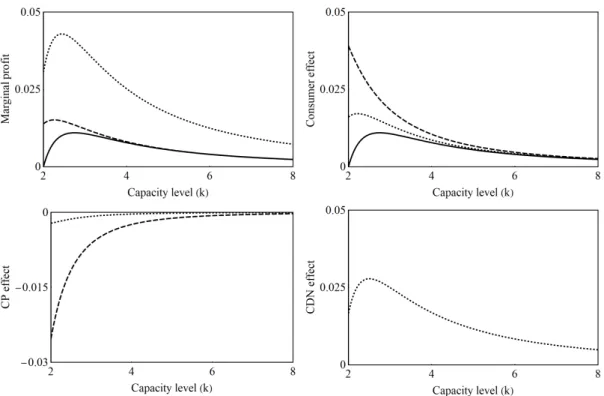
1.1 Comparison of investment incentives . . . 23
1.2 Illustration of conditions (1.55)-(1.57) . . . 31
2.1 Overview of comparative statics . . . 44
2.2 Relaxed advertiser market assumption . . . 65
3.1 Distribution of funding outcomes for video games . . . 72
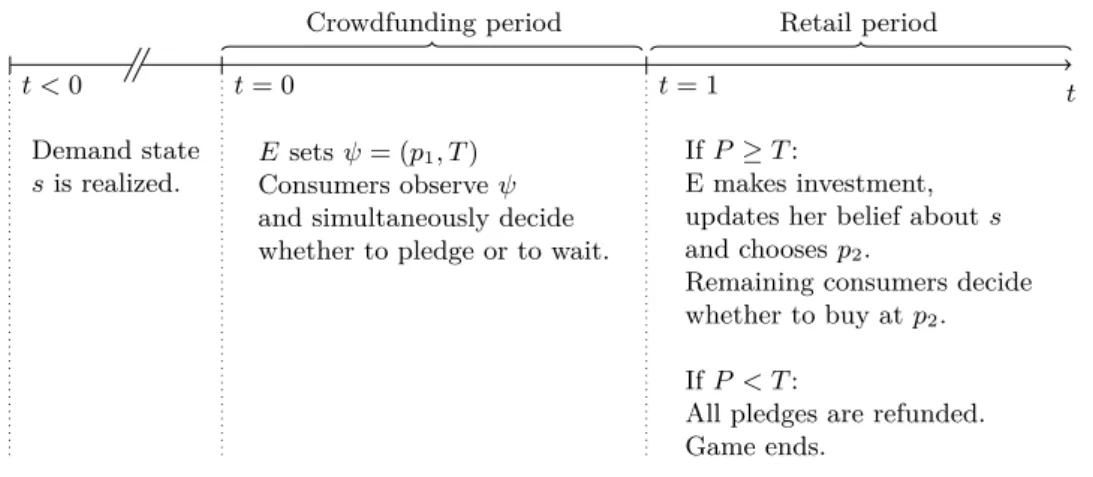
3.2 Timing . . . 78
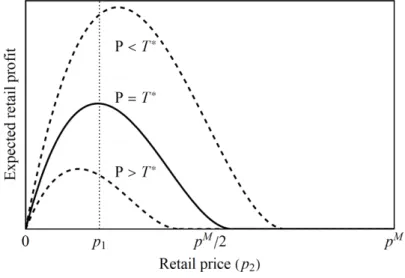
3.3 Period 2 profit maximization problem . . . 86
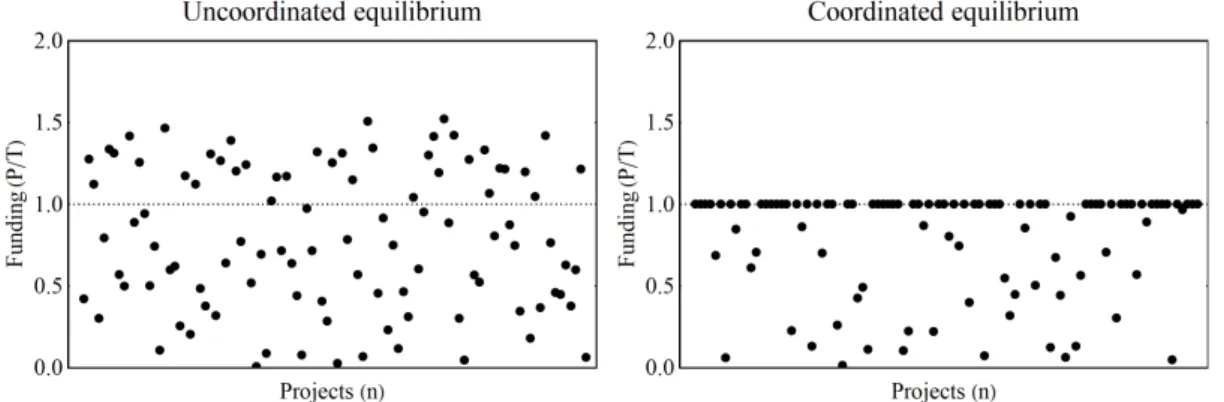
3.4 Simulated equilibrium outcomes . . . 90
3.5 Sequential pledging . . . 92
Abstract
This thesis analyzes regulation, competition and consumer decisions in three distinct platform markets. Chapter 1 studies competition between internet service providers and the interconnection of Content-Delivery-Networks in the light of the net neutrality debate. The results suggest that a departure from a regime of strict net neutrality is associated with efficiency gains. Content-delivery-networks lead to higher incentives for investment on the one hand, however, soften competition for consumers on the other hand. Chapter 2 analyzes competition between ad-based online platforms and platforms’ incentives to collect user data. The model predicts a market failure in this type of environment as the level of data collection in the market equilibrium is inefficient. This result provides a justification for privacy regulation as well as competition policy measures, while the market failure can also be counteracted by establishing a market for personal data. Chapter 3 analyzes crowdfunding platforms as a means to collect funds in light of aggregate demand uncertainty. The results suggest that demand in crowdfunding campaigns is strategically withheld in order to counteract future price changes which implies a limited ability of crowdfunding campaigns to reduce demand uncertainty.
Diese Dissertation befasst sich mit Regulierung, Wettbewerb und
Konsumentenverhalten in drei unterschiedlichen Plattformmärkten. Kapitel 1 analysiert den Wettbewerb zwischen Netzanbietern und die Zwischenschaltung von Content-Delivery-Networks im Rahmen der Netzneutralitätsdebatte. Die Ergebnisse legen nahe, dass eine Abkehr vom Prinzip der strikten Netzneutralität mit Effizienzgewinnen verbunden ist. Content-Delivery-Networks schaffen dabei einerseits zusätzliche Investitionsanreize für Netzanbieter, andererseits reduzieren sie die Intensität des Wettbewerbs um Endnutzer. Kapitel 2 analysiert den Wettbewerb zwischen werbefinanzierten Online-Plattformen und deren Anreize Nutzerdaten zu sammeln. Die modelltheoretische Analyse legt dar, dass derartige Märkte zu einem Marktversagen neigen, da im Marktgleichgewicht eine ineffiziente Menge an persönlichen Daten gesammelt wird. Dieses Ergebnis rechtfertig Regulierungen im Datenschutzbereich und den Einsatz wettbewerbspolitischer Maßnahmen, wobei dem Marktversagen auch durch die Schaffung eines Marktes für Nutzerdaten entgegengewirkt werden kann. Kapitel 3 analysiert Crowdfunding-Plattformen als Finanzierungsquelle bei unsicherer Gesamtnachfrage. Die Ergebnisse legen nahe, dass die Nachfrage in Crowdfunding-Kampagnen strategisch reduziert wird um künftigen
Preisänderungen entgegenzuwirken. Dies impliziert, dass Crowdfunding-kampagnen nur bedingt geeignet sind um Nachfrageunsicherheit zu reduzieren.
Introduction
This thesis analyzes economic interactions on platform markets, which are commonly defined as markets where an intermediary (the platform) facilitates interaction between distinct market sides.1 Platforms nowadays span almost every aspect of public and private life, from communications to grocery shopping, and from dating to political decision making. Unsurprisingly, platforms are also subject to a heated debate among politicians and regulators. The business model of Facebook has been heavily criticized after revelations to what extent the company shares user data with third parties. Alphabet, the parent company of Google, has been fined record sums based on antitrust allegations by the European Commission and faces ongoing investigations in the US. The ‘net neutrality’ debate has led to regulatory changes in the EU and turned into a partisan issue within the US political system. However, one would be misled to think that platforms are restricted to online business models. In fact, the definition only requires the facilitation of interaction between market sides, such that also brick-and-mortar business models can be platform based (e.g. a trade fair matching businesses with clients), infrastructure (e.g. internet service providers connecting content providers to households) or economic institutions in a broader sense (e.g. technological standards encouraging product development for end-users).
The peculiarities of platform markets (direct and indirect network effects, switching costs, potential for natural monopolies, etc.) often challenge standard economic theory and make it difficult to draw implications for policy and regulation. The aim of this thesis is therefore to broaden the understanding of platform markets and to provide insights into mechanisms and dynamics at work. The thesis analyzes three distinct platform markets from the perspective of microeconomic theory. The first chapter considers internet service providers as platforms, providing the infrastructure to connect content providers to consumers. The second chapter considers the role of online media platforms, which attract consumers and advertisers, and obtain revenue by facilitating a match between the two. The third chapter considers crowdfunding platforms which provide a financing source for entrepreneurs by providing access to potential project backers.
1
The definition roughly follows Rysman (2009). Platform markets are also commonly referred to as being two-sided or multi-sided in their nature, where the sides refer to the distinct market sides which are brought together by the platform. See e.g. Hagiu and Wright (2015) for an alternative definition.
The aim of the first chapter is to contribute on the ongoing debate on ‘net neutrality’ with a particular focus on the question whether internet service providers should be allowed to offer differentiated service qualities or stick to a single quality level (net neutrality). This regime choice is of particular interest as it affects not only the static efficiency in the market for given network capacities, but also long-term incentives for investment into network infrastructure. The chapter introduces a model of platform competition between internet service providers, where consumers demand heterogeneous online content within two quality regimes: net neutrality and paid prioritization. One key insight is that paid prioritization increases the static efficiency compared to a neutral network. The model also allows for the analysis of paid prioritization intermediated by third-party providers, so-called Content Delivery Networks (CDNs). While the use of CDNs is welfare neutral, it results in higher consumer prices for internet access. Regarding incentives to invest in network capacity, the model suggests that quality differentiation leads to higher investments than a regime of net neutrality, as long as capacity is scarce, while investment is highest in the presence of CDNs.
The second chapter analyzes competition between online platforms whose business model relies on the collection and processing of user data. This is analyzed within a competition framework, where platforms sell targeted advertising (monetary) and collect user data (non-monetary) to improve their targeting capabilities. Considering that users incur privacy costs, the model predicts that the market equilibrium level of data provision is distorted compared to an efficient benchmark and can be too high or too low: if platforms have significant market power, or if targeting benefits are low, too much private data is collected and vice-versa. Further, the results suggest that market power on the user or the advertiser market side leads to more data collection, which implies substitutability between competition policy measures across market sides. Moreover, the model predicts that if platforms engage in two-sided pricing, i.e. monetary transfers on both market sides, data provision is efficient, as it allows to adequately compensate users for their personal data.
Chapter three studies the role of crowdfunding platforms to facilitate the funding and implementation of an investment project. This is analyzed in a two-period setting, where an entrepreneur wants to launch a product, but lacks funding to cover the necessary investment costs. Funds are raised by pre-selling the product in an all-or-nothing crowdfunding campaign in a market of uncertain size (period 1). Observing the outcome of the campaign, the entrepreneur optimizes the pricing of the product and serves the residual demand in a subsequent retail market (period 2). Consumers face a price risk as they want to secure the product at the lowest possible price and are therefore hesitant whether to participate in the crowdfunding campaign in anticipation of future sales. One prediction of the model is that consumers can be incentivized to participate in the crowdfunding by assuring price stability across periods, thereby eliminating the price risk. This is achieved by withholding demand
in the crowdfunding period in a way that induces the entrepreneur to not change prices in case of a successful campaign. The characterized equilibrium outcome is consistent with empirical observations and is robust to various changes to the model setup.
Chapter 1
Net Neutrality, Prioritization
and the Impact of CDNs
Based on Baake and Sudaric (2018).
1.1
Introduction
This paper contributes to the ongoing debate on ‘net neutrality’ – a concept that broadly requires that all internet traffic should be treated equally (Wu, 2003). One central aspect within the debate revolves around differentiation with respect to Quality-of-Service (QoS), i.e. whether or not all content classes should face identical service quality within the network. While opponents of net neutrality argue that QoS differentiation is part of reasonable network management and should therefore be allowed, if not encouraged, net neutrality proponents argue that this benefits mainly network providers as it opens up new revenue models, and picks a few winners amongst the landscape of content providers (CPs). Indeed this ambivalence can be found e.g. in EU guidelines (EP and Council of the EU, 2015; BEREC, 2016) where a neutral treatment of internet traffic appears as a central pillar of the new regulation, while internet service providers (ISPs) may still offer differentiated QoS under certain conditions.2 While there are various ways of QoS alterations within the management of a network, we would like to focus on the practice of ‘paid prioritization’ where CPs pay ISPs directly for prioritization of their content. We also consider the impact of Content Delivery Networks (CDNs) such as Akamai or Limelight. Instead of contracting with network operators directly, content providers can contract with an 2As long as there is no discrimination within content classes, differentiated QoS measures can be
applied to different content classes if they are considered to be ‘reasonable’. While traffic management measures can not be put in place based on purely commercial considerations, the guidelines remain silent on pricing of differentiated QoS in the case they are technologically reasonable. For further details we refer to BEREC (2016).
intermediary, the CDN, which then delivers the traffic to the ISPs.3
The purpose of this paper is therefore to analyze how paid prioritization affects, firstly, the static efficiency for a given network infrastructure, and secondly, the dynamic efficiency regarding incentives for investment in network capacity. In a neutral regime ISPs are only allowed to offer one quality level, i.e. all participants experience potential network congestion to the same extent. In a paid prioritization regime ISPs can charge CPs for bypassing the network congestion by having access to a ‘priority lane’. In a CDN environment ISPs offer access to their priority lanes to CDNs instead, which then resell the access to CPs. This setup reflects the idea of capacity bottlenecks in the regional or last-mile segment where congestion occurs because of high consumer demand (e.g. in legacy copper or coaxial networks). We present a two-sided market model where two symmetric ISPs compete for consumers and CPs. Consumers are assumed to single-home, i.e. they purchase internet access only once, while CPs are free to multi-home with respect to their QoS choice. Content is differentiated with respect to connection quality sensitivity and quality levels are derived from a M/M/1 queuing system, where the non-priority quality (‘best-effort’) always remains free of charge, while the priority quality becomes a possible revenue source.
Using this framework, we show that the two regimes of QoS differentiation are welfare superior to the neutral regime. As content is differentiated, a tiered quality regime allocates priority to highly sensitive content classes, while it leaves content classes with low quality sensitivity in the waiting queue, resulting in a more efficient use of existing network capacity. In particular we show that from a welfare perspective it is irrelevant whether this is achieved by direct paid prioritization or through the use of a CDN. Differences emerge once we take into account strategic effects of the QoS regimes on competition for consumers. Here we argue that QoS differentiation makes the consumer market more elastic leading to lower consumer prices in regimes of QoS differentiation compared to the neutral regime. In particular, under paid prioritization consumer prices are lowest, as here a price increase on the user market has an additional negative effect on the CP market, while this is not the case in a CDN environment. Lastly, we analyze unilateral incentives to increase network capacity from a symmetric equilibrium perspective and show that as long as network capacity is scarce, both discriminatory regimes lead to higher investment in network capacity
3
CDNs often have direct interconnection points with last-mile networks which can lead to higher traffic quality when delivering content to consumers. However, this quality improvement is not seen as a violation of the principle of net neutrality, as all traffic within the last-mile network is continued to be treated equally, even though from a consumer point of view a quality differentiation takes place. For example, the Netflix-Comcast dispute was not about offering priority lanes for Netflix’s services, but rather about Comcast’s decision to demand interconnection charges from CDNs with a large amount of outgoing data traffic (caused by Netflix). See for example ‘Comcast vs. Netflix: Is this really about Net neutrality?’ (Retrieved May 17, 2018 from https://www.cnet.com/news/comcast-vs-netflix-is-this-really-about-net-neutrality).
than the neutral regime, while investment is highest in the CDN case, irrespective of the initial capacity level.
1.2
Related literature
From a modeling perspective we build on the literature on competition in two-sided markets in general and applications in the telecommunications industry in particular. The general setup follows the competitive bottleneck idea in Armstrong (2006) in the sense that we consider single-homing consumers and allow for multi-homing on the CP side. Applications of a two-sided approach to telephone networks (Armstrong, 1998; Laffont et al., 1998a; Laffont et al., 1998b) and to the internet industry (Laffont et al., 2003) can also already be found in earlier work. The key difference is that we explicitly model network congestion and resulting questions of QoS differentiation, while the early stream of literature largely disregards questions of network quality.
This aspect is analyzed in detail in the younger but growing literature on net neutrality.4 Hermalin and Katz (2007) compare a neutral network where ISPs are restricted to offer a single quality level as opposed to a discriminatory regime where ISPs can offer multiple quality levels to CPs. They conclude with ambiguous welfare effects: offering a single quality level drives some content types out of the market and provides an inefficient low quality level for other content types. However, CPs ‘in the middle’ are likely to benefit from it. Economides and Hermalin (2012) expand on this result by explicitly modeling bandwidth limits where different qualities could introduce welfare gains in light of congested networks. Following a similar QoS approach, Economides and Hermalin (2015) further show that net neutrality leads to lower investment incentives. Guo and Easley (2016) consider QoS differentiation with respect to effective bandwidth and demonstrate that net neutrality is beneficial for content innovation. Another stream of literature tackles the congestion problem using a queuing approach. Choi and Kim (2010) and Cheng et al. (2011) present a model where a monopoly ISP offers a prioritization service to two CPs. This framework is extended by Krämer and Wiewiorra (2012) to a model with a continuum of heterogeneous CPs. While Choi and Kim (2010) and Cheng et al. (2011) derive mixed results regarding welfare and investment incentives, Krämer and Wiewiorra (2012) show that a discriminatory regime is more efficient and provides higher investment incentives in the long run. While we follow the same direction in terms of CP heterogeneity and the use of queuing, our model differs substantially as we consider platform competition.
This aspect is captured to some extent by Economides and Tåg (2012) and Njoroge et al. (2013) where platform competition is considered but the congestion issue is ignored. Choi et al. (2015) present a closely related model in terms of content
4
Greenstein et al. (2016) provide an excellent overview over the inherent trade-offs of the net neutrality debate as well as the associated literature.
differentiation and analyze how the business model of CPs affects the optimal price-quality choice of platforms. The key difference is that while we keep the business model fixed in our model, qualities are endogenous in the sense that they are affected by congestion. Secondly, in the case of competition the authors consider cooperative quality choice, while we consider competition in the quality dimension through the platforms’ pricing strategies. Kourandi et al. (2015) also consider the case of competing ISPs but focus on the aspect of internet fragmentation when ISPs obtain exclusivity over content. The work most closely related to our model is the paper by Bourreau et al. (2015) where competing ISPs offer queuing based prioritization to differentiated CPs. The main difference from a modeling perspective is how surplus is generated in the economy, as the authors consider an elastic number of CPs and interpret the exclusion of CPs as decrease of content variety. In our model consumers’ utility depends on the connection quality of consumed content and not on variety per se. One could therefore see our modeling setup as a combination of the models presented in Choi et al. (2015) and Bourreau et al. (2015). Further, we additionally introduce CDNs as intermediaries which are not considered in any of the previously mentioned papers.
In general the topic of CDNs has largely been disregarded in the net neutrality debate. Hosanagar et al. (2008) study the optimal pricing policy of CDNs but do not perform any welfare comparisons. This is done to some extent in Hau et al. (2011), where different QoS regimes are analyzed in the market for internet interconnection. The overall model differs substantially from ours and in particular the authors do not consider competition between ISPs for consumers, which is a main driver for our results. Interestingly, however, the authors also find that a CDN shifts rents away from consumers to ISPs, a result which qualitatively reoccurs in our analysis, although the underlying mechanics differ. In particular, our results show that CDNs soften competition for consumers compared to a regime where CPs directly contract with ISPs.
Our analysis supports the results obtained by Krämer and Wiewiorra (2012) and Bourreau et al. (2015): a discriminatory regime is superior in terms of static efficiency and tends to provide higher investment in network capacity. At the same time our work complements the existing literature in terms of the role of CDNs. While total efficiency is identical to paid prioritization, consumers face higher prices when CDNs are used. Regarding the ongoing debate on net neutrality our results therefore suggest that if QoS differentiation is to be allowed (see e.g. recent advances in the US), direct prioritization agreements between CPs and ISPs should be preferred over the indirect contracting via CDNs from a (static) consumer perspective, as they lead to lower consumer prices, while investment in network infrastructure is highest in the presence of CDNs.
1.3
Model
We study different QoS regimes in a two-sided market setting where ISPs deliver content from CPs on one market side to consumers on the other market side. CPs strike QoS deals either with ISPs directly (section 1.4.1 and 1.4.2) or with a CDN in section 1.4.3.
Internet service providers There are two identical ISPs i= 1,2 located at the
ends of a Hotelling line (location λi = 0 for i = 1 and λi = 1 for i = 2). ISPs sell internet access to consumers at price pi and make QoS offers (fi, qi) to CPs, such that in exchange for a feefi consumers in network ican be reached at qualityqi. In the case of net neutrality the only offer ISPs can make is of the form (0, qni) where qni denotes the best-effort quality in network i, which is free of charge. This reflects the idea that there is ubiquitous interconnectivity in the economy such that CPs can reach consumers of network i irrespective of whether there is an existing agreement with the network. Under paid prioritization ISPs can offer in addition to the free best-effort quality a prioritization service (fi, qip) with fi ≥ 0 where qip denotes the priority quality level in networki.
The quality levelsqinandqpi are derived from a M/M/1 queuing model with an arrival rate of content requests equal to one such that waiting times are given by
wpi = 1 ki−NiYi with prioritization, (1.1) win= ki ki−Ni wip without prioritization, (1.2)
where Ni ∈ [0,1] denotes the mass of consumers connected to ISP i, Yi ∈ [0,1] denotes the mass of CPs who purchased prioritization in network i, and ki is the network capacity of ISP i. Quality levels in network iare then defined as
qip = 1−wpi with prioritization, (1.3)
qin= 1−wni without prioritization. (1.4)
Further, we make the following assumption regarding network capacities such that quality levels remain non-negative.
Assumption 1.1 Network capacities are sufficiently large ki∈(2,∞).
This assumption ensures that waiting times do not explode for low capacity levels such that we havewpi, wn
i ∈(0,1) and thereforeq p
i, qin∈(0,1). Also, this assumption implies that each network could shoulder the whole traffic by itself such that there are not any purely allocative reasons behind our setup. Also note that qpi > qin and
limki→∞(qpi −qni) = 0, i.e. if capacities are large waiting times in all queues converge to zero and quality differences disappear.
Content providers There is a continuum of differentiated CPs with total mass normalized to one. CPs are differentiated with respect to their quality sensitivityθ∈ Θ≡[0,1] which we assume to be uniformly distributed. Low values ofθcorrespond to content-types with low sensitivity with respect to transmission quality (e.g. e-mails) whereas high values represent quality-sensitive services (e.g. live streaming).
We assume the CPs’ business model is entirely passive (e.g. ad-based) and that the delivery of content of typeθat quality levelqto one consumer generates advertisement revenuesr(θ, q) =θq such thatθmeasures the importance of quality for the revenue generation. A CP of type θ decides whether to purchase prioritization (hθ
i = p) in networkior not (hθi =n) such that profits obtained from networkiare given by
πi(θ, hθi) = r(θ, qin)Ni ifhθi =n r(θ, qip)Ni−fi ifhθi =p (1.5)
resulting in total profits of a CP of typeθ with QoS planhθ ={hθ1, hθ2}of
π(θ, hθ) = X
i∈{1,2}
πi(θ, hθi). (1.6)
We can then define Pi = {θ ∈ Θ | hθi = p} as the set of content types prioritizing in network i and Yi = Rθ∈Pidθ as the total mass of prioritized content in network
i.
Consumers There is a continuum of differentiated consumers with total mass normalized to one. Consumers have a uniformly distributed location x ∈ [0,1] and
obtain utility v(θ, q) =θq from consuming one unit of content from a CP of type θ
delivered with quality q.5 The total utilityVi from content consumption in network
iis then given by Vi= Z θ /∈Pi v(θ, qin)dθ+ Z θ∈Pi v(θ, qip)dθ (1.7)
and can be thought of as a summary statistic for the network quality of ISPi. Overall utilityui(x) from connecting to networki is then given by
ui(x) =u+Vi−pi− |λi−x| (1.8)
and depends on the aggregate utility from content consumptionVi, the internet access pricepi and the location of the consumer.6 Lastly,ucaptures utility which is derived from connecting to the internet but not covered by our CP model and is assumed to be sufficiently high such that market coverage is ensured.
5
Note, in our modelv(θ, q) =r(θ, q) which is a simplifying assumption. We could also allow for
a setting where consumers receive a fractions of the surplus θqi and CPs the remaining fraction (1−s). Our results would not change qualitatively.
6We omit the arguments ofV
Timing In a first step, ISPs set consumer prices pi and (if allowed) prioritization fees fi. Secondly, consumers decide which network to join and CPs decide in which network to purchase prioritization (if applicable) simultaneously. The solution concept is sub-game perfection.
1.4
Equilibrium analysis
In this section we present equilibrium outcomes for the three different QoS regimes which we will refer to by the superscripts given in brackets: Net neutrality (n), paid prioritization (p) and Content Delivery Networks (c). Details of the formal analysis are delegated to Appendix 1.A.1 and proofs can be found in Appendix 1.A.2.
1.4.1 Net neutrality
In this section we consider the benchmark scenario of net neutrality. In this scenario ISPs can not sell prioritization and their only source of revenue is selling internet access to consumers, i.e. we havePi =∅ and therefore Yi = 0 in both networks. As the best-effort quality level is free of charge, CPs will reach consumers of networkiat quality levelqni such that we havehθ = (n, n) ∀θ. Total profits from content delivery obtained by a CP of typeθ are then given by
π(θ, hθ) =θ(qn1N1+q2nN2) (1.9) withqin= 1−1/(ki−Ni) fori={1,2}. Turning to consumers the aggregate utility from content consumption without prioritizationVi is then given by
Vi =qin
Z 1
0
θdθ. (1.10)
Since there is only one quality level in the neutral regime all content types arrive at the uniform quality levelqn. The consumer market shares of both ISPs are then given by the indifferent consumer ˆx:u1(ˆx) =u2(ˆx) on the Hotelling line.
N1 = ˆx≡ 1 2 +
1
2[(V1−p1)−(V2−p2)] andN2= 1−x.ˆ (1.11)
Note, that (1.11) defines Ni only implicitly as the quality levels qni also depend on the consumer market shares. We therefore make use of the implicit function theorem to obtain market share reactions ∂Ni/∂pi. Details can be found in Appendix 1.A.1. The first order conditions to the ISPs’ maximization problems
max
can then be written using the market share reactions obtained in (1.34) such that we get pi = Ni −∂Ni/∂pi . (1.13)
Note, that even though this is a very simple maximization problem it is not the standard Hotelling problem. The endogeneity ofqinleads to less elastic market shares
Ni. Utilizing symmetry in network capacities ki = kj = k we obtain the unique symmetric solutionpn satisfying pn= arg maxpi Πi|pj=pn where
pn= 1 + 2 (2k−1)2
| {z }
=−Ni/(∂Ni/∂pi)
. (1.14)
Equilibrium market shares are then given byNi=Nj = 1/2. Regarding comparative statics we see that∂pn/∂k <0, i.e. consumer prices are lower for higher (symmetric)
capacity levels. The reason is that higher capacity levels make consumer demand more elastic ∂2N
i/∂pi∂k <0. Consider the case where k is very large. Then congestion is basically irrelevant and quality levels in both networks effectively do not depend on the ISPs’ market shares, such that ISPs only compete in prices. If capacity is scarce the congestion problem dampens consumers willingness to switch networks as by joining the rival network the rival’s quality decreases. Hence, demand is less elastic and consumer prices increase. The property ∂pn/∂k <0 will reoccur throughout the
analysis and we will refer to it as ‘capacity effect’.
1.4.2 Paid prioritization
In this section we consider the case where ISPs directly offer CPs paid prioritization agreements. The proposed offer consists of content delivery to all consumers in network i at priority quality qip in exchange for a fee fi, while content delivery at the best-effort quality levelqni remains free of charge.7
CPs make the decision whether to purchase prioritization for each network separately. The decision depends on how the profit of reaching consumers connected to ISP iat best-effort quality qni compares to the profit under a prioritization agreement with access to the priority qualityqpi. By comparing the profit levels given in (1.5) we can pin down an indifferent CP of type ˆθi such thatπi( ˆθi, n) =πi( ˆθi, p) with
ˆ θi= fi (qip−qn i)Ni . (1.15)
7As we consider unit demand the distinction between a linear per-consumer fee and a lump-sum
fee to reach all consumers in networkiis irrelevant. We stick to the latter specification for reasons of conciseness.
CPs will therefore engage in a prioritization contract if they offer sufficiently quality-sensitive content θ ≥ θˆi, and stick to the best-effort quality if their content type is insensitiveθ <θˆi. The set of prioritizing CPs in networkiis then given byPi = [ˆθi,1] such that the mass of prioritized traffic in network iis given by Yi = 1−θˆi. Turning to consumers the aggregate utility from content consumptionVi under prioritization is given by Vi=qni Z θiˆ 0 θdθ+qpi Z 1 ˆ θi θdθ (1.16)
and consists of prioritized (θ ≥ θˆi) and non-prioritized (θ < θˆi) content. The consumers’ decision which network to join is given as in (1.11) by pinning down an indifferent consumer. The profit maximization problem of an ISP can then be written as
max
pi,fi Πi =piNi+fiYi. (1.17)
Due to the endogeneity of the quality levels, we again apply the implicit function theorem to obtain consumer market share reactions∂Ni/∂pj, ∂Ni/∂fj and CP share reactions ∂Yi/∂pj, ∂Yi/∂fj for i, j = {1,2}.8 Further we introduce the following intermediary result which provides us assurance of an interior solution to the maximization problem.
Lemma 1.1 Each ISP has an incentive to offer prioritization. Proof. See Appendix.
First, prioritization introduces additional revenue streams on the CP side of the market. Secondly, compared to no prioritization the network’s overall quality Vi increases as some highly sensitive content types now arrive at high quality, while the quality of the remaining content types barely changes. This pushes more consumers into the network offering prioritization which increases the ISP’s profit even further. As this argument holds for each ISP irrespective of whether the other ISP offers prioritization or not, offering prioritization is a strictly dominant strategy. Given Lemma 1.1 we can now focus on the interior solution given by the first order conditions to the maximization problem in (1.17) such that
pi = Ni −∂Ni/∂pi −fi ∂Yi/∂pi ∂Ni/∂pi and fi = Yi −∂Yi/∂fi −pi ∂Ni/∂fi ∂Yi/∂fi . (1.18)
Comparing (1.18) to (1.13) we see that optimal consumer price setting now takes into account the effect on the CP market, where an increase in prices reduces the number of consumers and hence reduces the revenue from the prioritization business as it decreases the share of prioritizing CPs. Going back to the definition of the indifferent content class in (1.15) we see that there are two effects affecting the
share of prioritizing CPs. First, there is a direct effect when increasing consumer prices, as the share of consumers Ni decreases. Secondly, the indifferent content class depends on the difference in quality levels qip − qin. As a reduction in the number of consumers reduces the total traffic in the network and hence the congestion problem, the difference in quality levels decreases when the number of consumers goes down, pushing the indifferent content class upwards and hence reducing the share of prioritizing CPs.9 In summary, introducing prioritization therefore restricts the ability of ISPs to raise consumer prices.
The optimal prioritization fee similarly balances the revenue generation across both market sides. While an increase in fees reduces the share of prioritizing CPs, the effect on the consumer market is not necessarily monotone. Coming from a situation of no prioritization, a higher share of prioritized content increases utility from content consumption as quality sensitive content arrives at high quality. However, if the share of prioritized content is too large, the congestion externality imposed on the priority queue might outweigh the benefits of prioritizing additional content classes which would decrease overall network quality.
Continuing with the analysis we find a symmetric equilibrium such that (pp, fp) = arg maxpi,fi Πi|pj=pp,fj=fp resulting in Yi = Yj = Yp ≡ 1−θˆp = 2k−ψ and Ni =
Nj = 1/2 as well as ∂Ni/∂fi = 0 for i6=j with equilibrium values
pp= 5−(8k−6)ψ (2k−1)2 | {z } =− Ni ∂Ni/∂pi −fp 4k (2k−1) | {z } =∂Yi/∂pi ∂Ni/∂pi and fp =Yp 1 2k(2k−1) | {z } =− 1 ∂Yi/∂fi (1.19)
where ψ := p2k(2k−1). Note that ∂Yp/∂k < 0 (or equivalently ∂θˆp/∂k > 0),
i.e. the higher the capacity level in the market the lower share of prioritized content classes. If capacity levels rise, networks become less congested and the quality gain from prioritization decreases.10 Therefore, only CPs with extremely sensitive content types opt for prioritization. Regarding consumer prices we obtain∂pp/∂k <0 which is
in line with the capacity effect described in section 1.4.1. The effect of the quality level on prioritization fees is given by∂fp/∂k <0 which reflects the decreasing advantage of
prioritization if overall capacity is large. Further, this effect prevails even in presence of an increased elasticity on the consumer market such that standard platform logic would predict a price increase on the CP market side.
Note that from equations (1.14) and (1.19) we can infer the equilibrium market share elasticity ∂Ni/∂pi in both regimes. Comparing the two cases we see that the consumers’ reaction to price changes is stronger in a prioritization regime.11 The reason for this is that introducing a priority queue already eases the congestion
9
It is easy to verify that∂(qpi −qni)/∂Ni>0. 10To see this remember that lim
k→∞(qip−qin) = 0. 11
problem in the networks. Therefore by switching to the rival network the overall network quality decreases less, hence market shares are more elastic in a prioritization regime. We will refer to this effect simply as ‘elasticity effect’. Note this effect is very similar to the capacity effect described in section 1.4.1. However, while the capacity effect states that market shares become more elastic when the capacity level
k increases, the elasticity effect states that for a given level of k market shares are more elastic in a prioritization regime.
Lastly, we get∂Ni/∂fi = 0 in equilibrium. To gain intuition for this result consider the case where coming from a neutral regime (fi prohibitively high) the prioritization fee is reduced such that Yi > 0. This increases the revenue on the CP side and at the same time increases the network’s quality which attracts more consumers. This ‘double benefit’ is exploited fully in equilibrium, resulting in ∂Ni/∂fi = 0.
1.4.3 Content Delivery Networks
In this section we consider an alteration to the prioritization setup presented in section 1.4.2. In particular we introduce a Content Delivery Network (CDN) as an additional player which serves as an intermediary between CPs and ISPs. The idea is that the CDN enters an agreement with ISPs such that traffic coming from the CDN is prioritized, while traffic not coming from the CDN remains unprioritized.12
For this we introduce an additional ‘offer stage’ at the beginning of the game. In the offer stage the CDN publicly announces lump-sum transfers Fi ∈R, which the ISPs can either accept or reject.13 If ISP i accepts offer Fi, the CDN is free to set the prioritization feefi for reaching costumers in networkijust like in section 1.4.2 while ISPionly sets consumer prices pi. If ISP irejects offer Fi, prioritization in network
iis offered by ISP iinstead.14 In any case prices pi, pj and prioritization fees fi, fj are set simultaneously as before. This setting resembles the industry practice, where ISPs and CDNs make long-term infrastructure level decisions, while offers made to consumers and CPs are made once those decisions are made.15
To avoid multiplicity of equilibria we apply the payoff dominance refinement (Harsanyi and Selten, 1988) to the coordination game in the offer stage, such that in case there 12For simplicity reasons we abstract from any additional quality improvements due to the use of
CDNs.
13
One can alternatively consider a two-part tariffTi= (ti, Fi)∈R2 wheretiis an additional linear
fee. It is clear thatti introduces a double marginalization inefficiency which would reduce the total
obtainable profit of the CDN. We therefore restrict our analysis to the case ofti= 0 which reduces
the proposal to the lump-sum feeFi. 14
We implicitly assume that ISPs commit to not offer prioritization themselves in case they accept the offer such that the offerFican be seen as an exclusive dealing arrangement. Without commitment
the standard Bertrand argument would apply, as in particular the CDN would undercut any positive fee set by the ISP.
15
The fact that offers Fi are public is a simplifying assumption which allows us to focus on the
induced change in competition dynamics. If we consider private offers instead, existence of the presented equilibrium remains unchanged.
are multiple equilibria when deciding whether to accept offersFi, we select the Pareto-dominant equilibrium in terms of ISP profits.
Suppose both offers have been accepted. The maximization problem of the CDN is then given by
max
fi,fj Πc =fiYi+fjYj−Fi−Fj, i6=j (1.20) whereYi and Yj are obtained as in section 1.4.2 and Fi, Fj denote (sunk) lump-sum transfers to both ISP i and j. ISPs in this case only compete on the consumer market:
max
pi Πi =piNi+Fi, i= 1,2. (1.21)
Market share reactions∂Ni/∂pj, ∂Ni/∂fj as well as∂Yi/∂pj, ∂Yi/∂fj fori, j={1,2} are again obtained as in (1.36) giving rise to first order conditions to maximization problems (1.20) and (1.21) of:
pi= Ni −∂Ni/∂pi and fi = Yi −∂Yi/∂fi −fj ∂Yj/∂fi ∂Yi/∂fi , i6=j. (1.22)
We can immediately see that the maximization problem of the ISPs now closely resembles the maximization problem under the neutral regime. In particular ISPs now do not internalize the negative effect of a price increase on the share of prioritized content as they did in section 1.4.2. However, remember that there is a tiered queue on the content market, such that the market share reaction differs compared to the neutral regime due to the elasticity effect. The CDN, on the other hand, internalizes the effect of a fee setting in marketion the share of prioritized content in networkj, while in section 1.4.2 the fee setting internalized the effect on the consumer market share in networki.
Continuing with the analysis we again obtain a symmetric equilibrium (fc, fc) = arg maxfi,fj Πc|pi=pj=pc and pc = arg maxpi Πi|fi=fj=fc,pj=pc for i 6= j resulting in
Ni =Nj = 1/2 and Yi =Yj =Yc ≡1−θˆc = 2k−ψ and ∂Yj/∂fi = 0. Equilibrium values are given by
pc= 5− (8k−6)ψ (2k−1)2 | {z } =−∂Ni/∂piNi and fc=Yc 1 2k(2k−1) | {z } = 1 −∂Yi/∂fi (1.23) andψ=p
2k(2k−1) as in section 1.4.2. It now remains to show that this sub-game
is actually reached, i.e. the CDN makes offers which are accepted by the ISPs.
Lemma 1.2 The optimal offer is symmetric Fi = Fj = Fc and is accepted by both ISPs in equilibrium.
Proof. See Appendix.
Given Lemma 1.2 we know that the CDN prefers contracting with both ISPs compared to contracting with only one ISP. Further, the proposed offers are accepted by the ISPs such that the presented equilibrium outcome is indeed sub-game perfect which allows us to compare derived equilibrium values to the previous QoS regimes. We immediately see that fc = fp and Yc = Yp while pc 6= pp which gives rise to the following result.
Proposition 1.1 The use of CDNs is welfare-equivalent to paid prioritization. Proof. See Appendix.
Proposition 1.1 implies that from a total welfare perspective it is irrelevant whether prioritization is achieved by direct paid prioritization offers made by ISPs, or whether prioritization is offered through the use of a CDN. In particular the CDN will pick prioritization fees which are equivalent to the paid prioritization scenario, resulting in an identical share of prioritized content classes.
Going back to the definition of the critical content class in (1.15), we can see that the only effectfi has on Yj is via the consumer market shareNj. Now consider the case offi, fj being large such thatYi =Yj = 0 and start decreasingfi such that we obtain
Yi >0. This increases the network qualityVi in networkiand hence pulls consumers from networkiinto networkj, increasing the revenue obtained from network i. Now consider a decrease infj such that Yj >0. Consumers are pulled away from network
iinto network j, decreasing the revenue obtained from network iand increasing the revenue obtained from networkj. Given these ‘push-and-pull’ effects, it is optimal for the CDN to set its prioritization fees such that the marginal effect on the consumer market vanishes, resulting in∂Ni/∂fi= 0 and thus∂Yj/∂fi= 0, which in turn leads to identical equilibrium fees as in section 1.4.2.
We can also immediately see that pc > pp as the optimal consumer prices now do not take into account the adverse revenue effect on the CP side ∂Yi/∂pi as is the case under paid prioritization. Unsurprisingly, we therefore observe higher consumer prices in the CDN case. As we consider a covered consumer market the total welfare is unaffected by this price increase, resulting in Proposition 1.1.
1.5
Comparison
This section compares the different QoS regimes from section 1.4. In the first part we look at profits and consumer surplus separately to gain a better understanding of the underlying dynamics before combining our results in a single welfare measure. The second part compares incentives to invest in network capacities.
1.5.1 Welfare
We start this section by defining simplified surplus metrics for symmetric equilibrium outcomes. First, remember that in our symmetric outcomes Ni = Nj = 1/2 while the share of prioritized content is pinned down by an indifferent content class ˆθ such that the share of prioritized content takes the formYi =Yj =Y = 1−θˆ. It turns out to be helpful to denote equilibrium quality levels as functions of ˆθsuch that we have
qni =qjn = qn(ˆθ), qip =qpj =qp(ˆθ). Note, that in a regime of net neutrality we have Y = 0 or equivalently ˆθ = ˆθn := 1. Starting with the definition of consumer utility
(1.8) we can then denote consumer surplusSC as a function of symmetric consumer pricesp and a cutoff level ˆθ:
SC(p,θˆ) = 2 Z 1/2 0 ui(x)dx=u+V(ˆθ)−p− 1 4 (1.24) where V(ˆθ) =qn(ˆθ) Z θˆ 0 θdθ+qp(ˆθ) Z 1 ˆ θ θdθ. (1.25)
Similarly, we can define total CP industry profitsSCP as a function of a cutoff content class ˆθ and a symmetric prioritization feef in the case of prioritization.16
SCP(f,θˆ) = V(ˆθ)−2f(1−θˆ) for ˆθ <1 V(ˆθ) for ˆθ= 1 (1.26)
Finally, we can define total ISP (incl. CDN in section 1.4.3) industry profitsSISP as a function of pricesp, f and critical content class ˆθ.
SISP(p, f,θˆ) = p+ 2f(1−θˆ) for ˆθ <1 p for ˆθ= 1 (1.27)
Combining all three measures into a total surplus measure T S we obtain
T S(ˆθ) =SC+SCP +SISP =u+ 2V(ˆθ)−
1
4. (1.28)
We immediately see that the network qualityV(ˆθ) plays a central role and we therefore
introduce the following intermediate result which will become useful when we compare the different QoS regimes.
16
In a prioritization regime CP industry profits are given by SCP(f,θˆ) = R
ˆ θ 0 π(θ,(n, n))dθ+ R1 ˆ θ π(θ,(p, p))dθ= Rθˆ 0 2r q n(ˆθ), θ dθ+Rˆ1 θ 2 r q p(ˆθ), θ −fdθ= V(ˆθ)−2f(1−θˆ) while in the
neutral regime we haveSCP(∅,1) =
R1
0 π(θ,(n, n))dθ=
R1 0 2r(q
Lemma 1.3 The network quality V(ˆθ) is higher in a prioritization regime:
V(1)< V(ˆθ), θˆ∈(0,1)
Proof. See Appendix.
To gain intuition for Lemma 1.3 it is helpful to consider the extreme case ˆθ= 1, i.e.
no prioritization and all traffic taking place in the best-effort queue. Marginally decreasing ˆθ then implies that highly quality-sensitive content arrives at priority quality, while the quality for all the remaining traffic remains effectively unchanged, i.e. overall network quality increases. A similar argument can be made for the other extreme case ˆθ = 0, where all content is ‘prioritized’, i.e. again the entire traffic
takes place in a single quality queue, while for intermediate levels ˆθ∈(0,1) content
distributes across both queues and some sensitive content classes arrive at priority quality. Hence V(ˆθ) is high for intermediate levels of ˆθ. Starting with consumers we then obtain the following result by comparing consumer surplus under the different QoS regimes.
Proposition 1.2 Consumers benefit from prioritization as consumer prices decline and network quality increases. In particular we have:
i.) V(ˆθp) =V(ˆθc)> V(ˆθn)
ii.) pn> pc > pp
iii.) SC(pp,θˆp)> SC(pc,θˆc)> SC(pn,θˆn)
Proof. See Appendix.
Prioritization has two main benefits for consumers. First, it allocates existing capacity more efficiently such that highly quality sensitive content arrives at priority quality, while content classes for which transmission quality plays a minor role are put in a waiting queue. This increases the total utility from content consumption. Secondly, prioritization makes it harder for ISPs to raise consumer prices as the consumer market becomes more elastic, and since losing consumers to the rival network has an additional negative effect on the revenue obtained on the CP market side. The last effect is not present in the case of CDNs as here ISPs do not internalize the negative effect on the CP side. However, in both cases consumers benefit from prioritization. Turning to the content industry, the following proposition summarizes the main finding.
Proposition 1.3 The content industry does not benefit from prioritization.
SCP(fn,θˆn)> SCP(fp,θˆp) =SCP(fc,θˆc)
There are two main reasons why the content industry does not profit from prioritization. For content classes which are not prioritized θ < θˆ, the free best-effort quality decreases as we have ∂qn(ˆθ)/∂θ >ˆ 0, resulting in lower profits for CPs
with low quality sensitivity. CPs who purchased prioritization now have their content delivered at higher quality, however, the content delivery is no longer free of charge. The content class which is indifferent between prioritization and best-effort quality ˆθ
is worse off under prioritization, as the best-effort quality decreases compared to a neutral regime. Only those CPs with very high quality sensitivity potentially benefit from prioritization. However, in total the content industry is worse off under prioritization. When it comes to the comparison between a paid prioritization regime and a CDN based model this result predicts that CPs are indifferent between the two as the outcome is equivalent.
Proposition 1.4 ISPs do not benefit from prioritization.
SISP(pn, fn,θˆn)> SISP(pc, fc,θˆc)> SISP(pp, fp,θˆp) (1.29)
Proof. See Appendix.
Even though prioritization opens up new revenue streams on the CP side, the induced competition dynamics on the consumer market lead to lower industry profits. Consumer prices decrease as the consumer market becomes more elastic and losing consumers now has additional negative effects on the CP side of the business. This reduction in revenue outweighs any additional revenue which can be obtained from selling prioritization to CPs, resulting in lower ISP industry profits under prioritization. In the case of CDNs the ability to raise consumer prices is less restricted compared to the paid prioritization case, resulting in higher industry profits in the presence of CDNs compared to paid prioritization. However, ISPs would be better off if they would not introduce prioritization offers even if they would be allowed to do so.
Corollary 1.1 ISPs face a prisoner’s dilemma when deciding whether to offer prioritization.
Proof. Follows from Lemma 1.1 and Proposition 1.4.
As ISPs have an unilateral incentive to introduce prioritization offers (see Lemma 1.1), they end up in a situation where competition for consumers is strengthened to such an extent, that the negative effect on the consumer market outweighs the additional revenues made on the CP market side. This result supports the finding in Bourreau et al. (2015). Delegating the prioritization business to a CDN can then be seen as a remedy to soften competition on the consumer market.
Proposition 1.5 Welfare is higher under prioritization
T S(ˆθp) =T S(ˆθc)> T S(ˆθn)
Proof. Follows from Lemma 1.3.
As prices are transfers from consumers to ISPs, and fees from CPs to ISPs / CDN, the welfare comparison boils down to the aggregate network quality. Under a prioritization regime the existing network capacity is allocated more efficiently, resulting in a higher total surplus.
1.5.2 Investment incentives
In this section we want to shed light on how the different QoS regimes affect investment in network infrastructure. For this we compare investment incentives from a symmetric equilibrium perspective. The idea is that capacity investments are typically long-term decisions such that the industry is in equilibrium before the next investment decisions are made. We assume that investment costs for capacity expansion are identical in all regimes and therefore restrict our analysis to the comparison of marginal profits gross of investment costs. The changes ofpi, fi, Niand
Yi with respect to ki are again obtained by applying the implicit function theorem, while we evaluate all expressions at respective equilibrium values which allows us to make use of the envelope theorem for simplification. Detailed derivations can be found in Appendix 1.A.1.
Starting with the neutral regime we obtain
dΠi dki = Consumer effect z }| { pi ∂Ni ∂ki | {z } + +∂Ni ∂pj | {z } + ∂pj ∂ki |{z} − >0. (1.30)
The marginal profit of capacity investment mainly depends on the direct effect
∂Ni/∂ki > 0 of investment in network quality and thereby attracting consumers, and the strategic effect ∂pj/∂ki < 0 of network j in order to recapture lost market share by decreasing prices. The former effect outweighs the latter, such that the overall effect is positive, and we will refer to the overall effect simply as ‘consumer effect’.
Turning to the paid prioritization case we obtain investment incentives of dΠi dki = Consumer effect z }| { pi ∂Ni ∂ki | {z } + +∂Ni ∂pj | {z } + ∂pj ∂ki |{z} − + CP effect z }| { fi ∂Yi ∂ki |{z} − +∂Yi ∂pj |{z} + ∂pj ∂ki |{z} − >0. (1.31)
The dynamics behind the consumer effect are identical as in the neutral regime but differ in magnitude (see detailed discussion below). The main difference is that we now have an additional effect on the CP market side which we will refer to as ‘CP effect’. We again distinguish two different sub-effects: A direct effect∂Yi/∂ki <0 and a strategic effect∂pj/∂ki <0. As a capacity increase eases the congestion problem, less CPs opt for prioritization, resulting in a negative direct effect. Similar to the consumer effect, network j reacts by lowering consumer prices, reducing the market share of networkiand thereby making prioritization in networkieven less attractive, resulting in a second negative (strategic) effect. As the business model of prioritization relies on a congestion problem, investment in capacity expansion directly reduces the obtainable profit from the CP side of the market. In total the positive consumer effect, however, outweighs the negative CP effect, resulting in positive investment incentives.
For the CDN case we need to take into account the effect of the investment decision on the business relationship with the CDN. It turns out to be helpful to denote the lump-sum transfer Fc as a fraction α ∈[0,1] of the CDN profit where α := Fc/Πc . The investment incentive of an ISP can then be written asdΠ˜i/dki where ˜Πi := Πi+αΠc such thatdΠ˜i/dki is given by
dΠ˜i dki = Consumer effect z }| { pi ∂Ni ∂ki | {z } + +∂Ni ∂pj | {z } + ∂pj ∂ki |{z} − + CP effect z }| { α fi ∂Yi ∂ki |{z} − +fj ∂Yj ∂ki | {z } − + CDN effect z }| { dα dki |{z} >0 Πcc >0. (1.32)
We now observe three separate effects: a positive consumer effect, a negative CP effect and a positive ‘CDN effect’. The dynamics in the consumer effect are as before, however, the CP effect now consists only of two direct effects. On the one hand, a capacity increase in network ireduces the congestion problem and hence the benefit from prioritization ∂Yi/∂ki < 0. On the other hand, it also attracts consumers from networkj to join network iand makes thereby prioritization in network j less attractive ∂Yj/∂ki < 0, resulting again in a negative CP effect in total. The CDN effect reflects the fact that as capacity increases the ISP obtains a larger share of the CDN profits. This has mainly two reasons. First, increasing capacityki reduces
CDN profitsdΠc/dki <0 (see CP effect). Secondly, increasing capacity increases the outside option of an ISP, resulting in a higher share of obtainable CDN profits and a positive CDN effect.17
In figure 1.1 we now illustrate the magnitude of the different effects for various levels of initial symmetric network capacity k. Proposition 1.6 summarizes the main findings of the illustrated results.
Figure 1.1: Comparison of investment incentives
Proposition 1.6 Incentives to invest in network capacity are highest in the CDN case. Paid prioritization leads to higher investment incentives than a neutral regime if capacity is scarce k≤k.
Proof. See Appendix.
First, note that the consumer effect is positive in all regimes while the CP effect is negative in the two prioritization regimes. In the CDN case there is an additional positive CDN effect. Those effects, however, differ in magnitude.
Starting with the consumer effect we would first like to mention that the direct effect
∂Ni/∂ki is strongest in the neutral regime. Since a tiered quality scheme already reduces the congestion problem, the marginal effect of capacity expansion is higher when the congestion problem is severe, as in the single-queue (neutral) regime. This means, however, that the strategic effect introduced by∂pj/∂ki must be the driving
17
force behind the ranking in magnitude displayed in the top right graph of figure 1.1. As explained in section 1.4.2, prioritization leads to a more elastic consumer market. Hence, the market share reaction with respect to rival’s prices ∂Ni/∂pj is more strongly pronounced in the prioritization regimes. For the same reason, however, the strategic response by ISPj to an increase in capacityki is less pronounced in the prioritization regimes. As the consumer market share is more elastic, prices pj are decreased to a lower extent than in the neutral regime. The strategic effect combined with a more elastic consumer market results in a stronger consumer effect in the prioritization regimes.
The CP effect is negative in both prioritization cases, however, their composition differs. While under paid prioritization only the direct effect on the proprietary network∂Yi/∂ki<0 is taken into account, in the CDN solution direct effects of both networks are taken into account. The main driver for the difference in magnitude is, however, the weighting factor α in the CDN case, such that in a CDN environment ISPs do not fully internalize the negative effect on the CP market side when deciding on investment in network capacity. In addition to the less pronounced CP effect, ISPs obtain an additional positive CDN effect resulting in highest total marginal profits from capacity investment.
The comparison between the neutral and the paid prioritization regime depends on initial capacity levels.18 If capacity is scarcek≤kthe stronger consumer effect in the discriminatory regime dominates the neutral regime even in light of the negative CP effect. If capacity is abundantk > kon the other hand, consumer effects are virtually identical as high overall capacity makes prioritization irrelevant such that the negative CP effect prevails, yielding higher investment incentives in the neutral regime. In light of existing QoS differentiation measures and global efforts to incentivize broadband investment, we consider the case of scarcity to be more relevant.
1.6
Conclusion
We analyzed equilibrium outcomes under different QoS practices and showed that discriminatory regimes are superior in terms of static efficiency as they allocate existing capacity more efficiently, while at the same time competition for consumers is strengthened, resulting in lower consumer prices and higher network quality in both discriminatory regimes compared to a neutral regime. The extent to which consumers benefit, however, depends on the way how prioritization is achieved. While prices are lowest under paid prioritization, consumer prices increase with the use of CDNs, as ISPs lack the additional incentive to attract consumers to make prioritization more valuable.
18
Regarding investment incentives we showed that both discriminatory regimes lead to higher investment in network capacity than the neutral regime as long as capacity is scarce, while investment is highest in a CDN environment irrespective of the initial capacity level. Under paid prioritization marginal profits obtained from the consumer market side are higher than in the neutral regime, while marginal profits obtained from the CP side are negative as capacity expansion makes prioritization less valuable. In a CDN scenario this detrimental effect on the CP side is not fully internalized, while at the same time ISPs are able to capture a larger fraction of CDN profits when network capacity is expanded, resulting in high investment incentives.
We would like to mainly draw two policy conclusions where the first is driven by our efficiency result. As long as content is heterogeneous and network capacity is scarce, a tiered-quality scheme increases efficiency. This result is not driven by the assumption that total demand on the consumer market is inelastic, as a discriminatory regime simultaneously reduces consumer prices. Also, since the best-effort quality remains free of charge no CPs are excluded from the market. For the second conclusion one should note that the general debate on net neutrality tends to focus on ISP practices, while the use of CDNs is barely mentioned. Our results suggest that while the outcome with CDNs is welfare equivalent to the classical paid prioritization, consumer surplus is lower in the presence of CDNs due to higher prices. Focusing on static efficiency and having consumer welfare in mind, a regime of paid prioritization is therefore to be preferred. If the primary policy goal is, however, investment in network infrastructure then our results suggest that a CDN environment is to be preferred over paid prioritization.
We would also like to point out limitations of our analysis and where future research could be headed. First, we implicitly assume that from a technical perspective contracting with a CDN is equivalent to direct prioritization between ISPs and CPs. Here, a more nuanced analysis could refine the comparison with respect to efficiency. Also, we modeled the contractual relationship between ISPs and CDNs in rather general way. Here, industry specific payment structures (access pricing, etc.) could provide further insights. Lastly, one could alter the industry structure in the upstream market and introduce competition between CDNs.
1.A
Appendix
1.A.1 Omitted analysis
Market share reactions
For the consumer ma