Marketing Model in Developing the Potential SMEs Based on
SWOT Analysis
Dewi Andriany Lailan S. Hasibuan Sri E. Rahayu
Lecture of Economic Faculty, Muhammadiyah University of North Sumatra Abstract
This study aims to explore the strengths, weaknesses, opportunities and threats for Small and Medium Enterprises (SMEs) actors in conducting their business, in addition to the efforts that have been made parties in developing SMEs. Using a focus group discussion with SMEs actors, relevant agencies and banks does the data collection. The marketing model that can be developed are: developing Internet-based marketing to expand market share, develop production technology to produce a greater quantity, provide easier access to the things that support the wider marketplace, accompanied by mentoring, training so that products can be accepted on a broader marketing, set up a platform for SMEs so that the perpetrators have the same standard to compete at a broader level. Implementation of this model requires support from various parties, such as governments, universities, banking, telecommunications services and other stakeholders.
Keywords: Marketing Model, SMEs, SWOT Analysis. 1. Introduction
Small and medium business group is a business group of economic importance in the economy of the city of Medan. This is due, small and medium enterprises and cooperatives is a business sector that has the greatest number with the absorption of a significant labor force. The income gap is quite big still occur among large employers in small and medium enterprises and cooperatives (SMEs), so the development of the competitiveness of Small Businesses, directly an effort to improve the welfare of the masses, as well as narrowing the economic gaps.
Based on data from the Central Statistics Agency (BPS), the number of large employers only 0.2% while the Small Entrepreneur, medium and cooperative reached 99.8%. This means that the number of small and medium enterprises and cooperatives to nearly 500 times the number of large businesses. The issue of Small Business contribution to the GDP, only 39.8%, while large businesses reached 60.2%.
To economic growth, small and medium enterprises and cooperatives contributed only 16.4% and 83.6% large enterprises. Based on market share, small and medium enterprises and cooperatives are only a market share of 20% (80% by large businesses). This shows two things at once, which is super strong big business sector and very weak Small Business sector. The hope is that with the increased production of small businesses, as well as medium and cooperative with a growth rate higher than the rate of productivity growth in the region, or by 6-8% per year, then there will be the absorption of labor and equipment for the small and medium enterprises and cooperatives, along with the growing labor force, by 5-10% per year.
Andriany, et al (2014) have designed a model approach to participatory in empowering poor Medan to improve the living standards, a model that will be applied by small businesses in which the empowerment of the poor is done through empowerment strategy in total which include their social protection program, environmental improvements, human resource empowerment and economic empowerment productive. The expansion of the business base and Small Businesses the opportunity to encourage the growth of new entrepreneurs, through increased knowledge and entrepreneurial spirit. Institutional Strengthening Small Business mainly to expand access to sources of capital, especially bangking and non-banking, use of technology and marketing as well as promotional products. Another simultaneous thing to do is improve the business environment through the simplification of licensing procedures.
The General Guidelines PNPM (2007) mentioned component of community development includes a series of activities to build critical awareness and independence of the community that consists of mapping the potential, problems and needs of the community, participatory planning, organizing, resource utilization, monitoring, and maintenance of the results that have been achieved. To support a series of activities, provided
funding support community learning activities, volunteer development and community assistance operations; and facilitator for facilitation, capacity building, mediation and advocacy. The role of the facilitator, especially at the beginning of empowerment, while community volunteers are the main driving force in society in the region.
It is essential to conduct a study on the efforts that have been made by the perpetrators of SMEs it self and the efforts made by relevant agencies in the development of SMEs, particularly in the field of marketing. Marketing is an important aspect for the development of SMEs, as long as it SMEs only do a limited marketing namely in the areas of production alone.
2. Literature Review
The study of the performance of the marketing done by Andrews and Smith (1996) and Menon et. al (1999) suggest that the test results were less clear because it was lacking in creative marketing programs emphasize on performance marketing. But others argue that creativity has the most influence on the performance marketing because it is very profitable to develop products (Knight, 2000 and Menon et. Al, 1999).
Performance marketing is an important element of the company's performance in general due to the performance of a company can be seen from the performance marketing over the years. Performance marketing is a concept for measuring a company's marketing achievement. Any company interested to know his achievements as a reflection of the success of the business in a competitive market. Slater and Narver (1995) describe the results of the implementation of corporate strategies including in the form of customer satisfaction, the success of new products, increased sales and profitability.
Performance marketing is a common construct used to measure the impact of the company's strategy. However, the issue of performance measurement is an issue and the classic debate because as a construct, multidimensional marketing performance which in it contained a variety of objectives and types of organizations. Therefore, the performance should be measured using a variety of measurement criteria at once (multiple measurement). If using single measurement criteria it will not be able to provide a comprehensive understanding of how the performance of a company's real (Calantone, 1994).
Performance marketing is also said to be the organization's ability to transform itself to meet the challenges of the environment with long-term perspective (Keats et.al, 1998). The performance assessment becomes part of the company's efforts in view of the suitability of the strategy implementation in the face of environmental changes. The environment has become an important part of the company and it is difficult to be changed by the company. Companies can only recognize it and then manage properly so that it can benefit the company. The introduction of a good environment will have an impact on the quality of the resulting strategy, which will further impact on the performance marketing.
Performance marketing is a construct that is often used to measure the impact and orientation strategies applied by the company. The marketing strategy has always aimed to produce marketing performance (such as sales volume and sales growth rate) was good and good financial performance. In general, the size of the company's performance is measured by the value of currency sales, Return on Investment (ROI), Return on Assets (ROA). But the size of the measure was seen as a measure of aggregate produced through the process of accounting and finance, but not directly describe management activities, especially marketing management (Ferdinand, 2002). Therefore, the size of which should be used is a measure that is activity-based measure that can explain the marketing activities that produce performance-marketing performance eg better to use the size of the number of units sold or produced from the only use of the rupiah value of sales.
Marketing strategy development process (Marketing Strategy Making, MSM Process) is one of the important areas of study in marketing management studies. This is important because the system paradigm states that the performance of a strategy is not solely determined by how the strategy implementation and evaluation of strategies carried out continuously, but is also determined by how well the process that accompanies the development of that strategy. In accordance with the paradigm of the system, the performance of a strategy will be determined by how well the preparation and provision of inputs and resources to shape the content of a strategy, as well as input and resources to implement the strategy. The performance of a strategy also depends on the process that is passed in presenting a strategy, as well as intangible as the output of a strategy that has been formulated through the process and feedback was good, and therefore can produce a quality strategy (Ferdinand, 2002).
Preparation of marketing strategy involves determining the strength, direction and interaction of the strategic strength. The aim of developing a marketing strategy is to build, maintain, and sustain competitive advantage. Researchers are many who understand the preparation of the strategy is a structured analytical process. In general, the development of marketing strategy has the following characteristics (Lumpkin, 1997): 1) In particular with regard to the determination of how the company was able to excel in competition, to harness its power to give more value to its customers from time to time, 2) It is a complex process which usually involves a complex decision-making also by managers and require a comprehensive analysis of the environmental changes as well as a blend of useful information, 3) It requires a lot of strategic information that is relevant and extensive knowledge, 4) Involve high uncertainty and confusion and 5) Involve experience, intuition and conjecture from the managers.
Various characteristics of the proven marketing program making require creativity in view of the existing environment. The company can not only rely on the company's internal data, but also need to look for other market data and the ability of the manager to see the opportunities and threats that arise there. With the alignment between marketing programs with the environmental conditions, the company will be able to compete with other companies and they are also able to improve marketing performance.
Luo (1999) explains that creativity is defined as the development of marketing programs to the implementation or application of the strategy undertaken in the market (shape change), which indicates a significant difference from the practice of marketing. Creativity marketing program is a novelty that has been widely used to describe the creativity in the field of advertising. Creativity is an attempt solving business problems faced every day. The process ends when creativity produced a new product, new ideas, new strategies to deal with the changes there. Through creative marketing programs, the company will obtain a new angle with which to face the opportunities and threats ahead. Creativity requires the development of newer and more aggressive alternatives that can make it like a motor that offers a new learning process and the potential to change behaviors within the organization.
Along with the increased competition, the role of marketing as an important part of the company cannot be ignored. Companies need to constantly adjust their marketing programs with various changes that occur in the environment. In this case, the creativity of the marketing program is the key to the competition. According to Andrew and Smith (1996) creativity is an attempt solving business problems faced every day. Creativity arises because of the changes that occur. That is, changing conditions in the business environment makes the company had to think of new ways to adapt it self and to then prepare to compete with other companies. Creativity emerged as an alternative form of development of newer and perhaps more radical than the previous strategy.
The results of the study Menon et al (1999) found that creative marketing strategies positively related to market performance. Average market performance itself is an element of performance marketing in general. Morris (1995) explained that there are three indicators that can be used to measure creativity that is search information, discussion programs, and compliance programs. A search for information related to the company's efforts to identify the environmental conditions. Program discussions related to the company's efforts to exchange views on existing programs. Conformity of the program related to the conformity of the program with the environmental conditions. Creativity in making marketing program will provide a mechanism for companies to differentiate so it can be used as a weapon in improving marketing performance. As long as companies are still using old marketing program and make adjustments to changing conditions occur then the company will be difficult to compete for 'taste' of the consumer has changed. This became the basis for the need for a company to seek marketing programs that can be used as a creative and interesting media to acquire customers.
3. Research Methodology
This study used a qualitative descriptive approach; with the involvement of SMEs and related institutions conduct focus group discussions to identify the strengths, weaknesses, opportunities and threats faced by SMEs. Data collected through the FGD associated with the appropriate marketing system is expected to be applied by the perpetrators of SMEs. The research object is the SMEs, which are in the district of Medan Deli. The research data will be analyzed by means of qualitative analysis SWOT, to uncover strengths, weaknesses, opportunities and threats faced by SMEs.
4. Finding and Discussion
This research was conducted in Medan Deli because the District is a district with the largest population in the city of Medan (173.951 inhabitants, BPS 2015) and when the number of actors Small Business proportionally to follow a population then estimated the number of perpetrators of Small Businesses majority will be obtained in the district of Medan Deli, It is estimated that today in the city of Medan there are about 200 thousand perpetrators of Small Business. Therefore, this study was conducted in the district of Medan Deli to then be used as a model to be developed in the city of Medan.
One of the strong reasons other is no initial information that PNPM Mandiri / PPMBK (Program for Enhancing Livelihoods-based Community) in the case of retrofitting to the perpetrators of Small Business is not running in the district of Medan Deli, so the identification of problems in this district will be portrait as a whole for districts another in the city of Medan.
SMEs age is between 30 s / d 55 years, with an average gender is female with an average education level of high school graduates. This type of business is conducted Batik craft, the craft of the shell (accessories), industrial tofu, shoes, meals, with total workforce of 1-10 people.
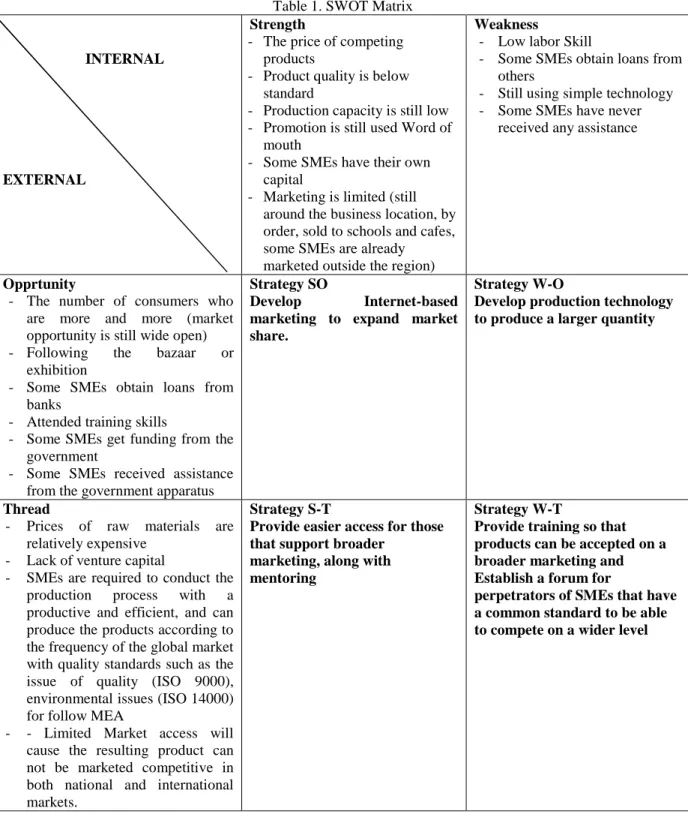
As for strengths, weaknesses, opportunities and threats faced by SMEs perpetrators of marketing aspect can be seen in the following matrix:
Based on feedback from the SMEs, they expect some action that is predicted to contribute to the progress of the business, namely: 1) was formed cooperatives, 2) presence of additional working capital, 3) Keep the training for the workers, 4) the government should help in terms of marketing and 5) government aid in the capital. The things above are expected to help the development of SMEs is more significant, such as the cooperatives which would provide a standard for products to be marketed, so that the guaranteed quality. Assistance in marketing has been done as holding fairs or bazaars, be it regional, national or international. The lack of continuity of the event is the cause of underdevelopment marketing SMEs products.
Based on the information that has been extracted from the perpetrators of SMEs, sub-district government officials, agencies, and banking, it can be concluded that the perpetrators of SMEs has gained a wide range of conveniences, such as in terms of marketing. By organizing an exhibition at the local, regional, national and international, of course, is an activity that supports the familiar product to a wider area. But in reality, the development of SMEs is not evenly show signs satisfactory. Only SMEs are able to be more proactive which shows a significant development. It would be a task to formulate how the continued activity of the relevant agencies, assisted by universities, to ensure continued progress for SMEs.
Furthermore, it can be described some of the strengths, weaknesses, opportunities and threats owned SMEs offender. It is described as follows:
The strength of the SMEs:
1. Operational Flexibility, SMEs are usually managed by a small team, each member has the authority to determine the decision. This makes SMEs more flexible in their daily operations. This business reaction speed to any changes (for example: a shift in consumer tastes, product trends, etc.) Is quite high, so that a small business is more competitive.
2. Speed Innovation, the absence of hierarchical organization and control in SMEs, products and new ideas can be designed, tilled, and launched immediately. Although the brilliant idea came from thinking employees - not the owner - the closeness between them make this idea tend to be more easily heard, accepted and executed.
3. Low Cost Structure, Most small and medium businesses do not have a dedicated workspace in office complexes. Most run at home with their own family members as employees. This reduces the extra costs (overhead) in their operations. Furthermore, small medium businesses also receive support from the government, non-governmental organizations, and the bank in the form of tax relief, donations, and grants. This factor major influence in the formation and financing their operations.
4. Ability to Focus on Specific Sectors, SMEs are not obliged to obtain the quantity sold in large quantities to reach a turning point (break even point - BEP) of their capital. This factor enables small and medium businesses to focus on sector specific products or markets. Examples: home-based craft business can focus on working on the type and model of craft.
Table 1. SWOT Matrix
INTERNAL
EXTERNAL
Strength
- The price of competing products
- Product quality is below standard
- Production capacity is still low - Promotion is still used Word of
mouth
- Some SMEs have their own capital
- Marketing is limited (still around the business location, by order, sold to schools and cafes, some SMEs are already marketed outside the region)
Weakness
- Low labor Skill
- Some SMEs obtain loans from others
- Still using simple technology - Some SMEs have never
received any assistance
Opprtunity
- The number of consumers who are more and more (market opportunity is still wide open) - Following the bazaar or
exhibition
- Some SMEs obtain loans from banks
- Attended training skills
- Some SMEs get funding from the government
- Some SMEs received assistance from the government apparatus
Strategy SO
Develop Internet-based marketing to expand market share.
Strategy W-O
Develop production technology to produce a larger quantity
Thread
- Prices of raw materials are relatively expensive
- Lack of venture capital
- SMEs are required to conduct the production process with a productive and efficient, and can produce the products according to the frequency of the global market with quality standards such as the issue of quality (ISO 9000), environmental issues (ISO 14000) for follow MEA
- - Limited Market access will cause the resulting product can not be marketed competitive in both national and international markets.
Strategy S-T
Provide easier access for those that support broader
marketing, along with mentoring
Strategy W-T
Provide training so that products can be accepted on a broader marketing and Establish a forum for
perpetrators of SMEs that have a common standard to be able to compete on a wider level
The weakness of the SMEs:
1. Lack of Funding Capital and Limited Access. Lack of capital SMEs, because in general, small and medium enterprises are individual enterprises or companies that are covered, which rely on capital from the owner of the number is very limited, while the loan capital from banks or other financial institutions are difficult to obtain because of the requirements of administrative and technical requested by the bank can not be met. The requirements that the greatest obstacle to SMEs is the provision of the collateral because not all SMEs have adequate and sufficient assets to serve as collateral
that is hereditary. HR quality limitations of small businesses both in terms of formal education as well as knowledge and skills greatly affect the management of the business, so that the business is difficult to develop optimally. Besides, with the limitations of the quality of its human resources, the business unit is relatively difficult to adopt new technological developments to enhance the competitiveness of the products it produces.
3. Weak Business Network and Capabilities Market Penetration. Small businesses are generally a business unit of the family, have very limited business networks and low market penetration capabilities, plus the resulting product is very limited and has qualities that are less competitive.
4. Mentality SME Entrepreneurs. The important thing is often also forgotten in any discussion of SMEs, namely the spirit of entrepreneurship, SMEs themselves. The spirit is here, among others, the willingness continues to innovate, tenacious without surrender, be willing to sacrifice and the spirit to take risks. 5. Lack of Transparency. Lack of transparency among the early generations of builders of SMEs to the next
generation. Lots of information and network that is hidden and not notified to the parties subsequently running the business so that it creates difficulties for the future generations in developing its business. 6. The problem of raw materials, this is because the number of the limited availability of raw materials as well
as high raw material prices. SMEs do not have the ability to look for alternative / raw material substitution, because the cost to conduct experiments replacement of raw materials must be quite high.
7. Limitations of technology, the limitations of technology, especially the efforts of the household (micro), is caused by many factors, among others, lack of capital investment to purchase new machines or to enhance the production process, the lack of information regarding developments in technology or machinery and tools the new production-tool, and limited human resources to operate new machines or make innovations in products and production processes.
8. The difficulty of marketing, promotion strategy less convincing consumers. 9. The choice of location that does not represent the perception of consumers.
10. Insufficiency product quality to compete. The absence of standardization of the quality caused SMEs only produce according to their ability and not adapted to the competitive quality standards.
Opportunities of the SMEs:
1. Making products or services that consumers demand. 2. Making a product or service that can win the competition. 3. Preparation and utilize sources of production.
4. The design products that fit the needs of the buyer or customer.
5. Help from the government and outside parties either in the form of working capital loans, equipment, training etc.
6. Sufficient resources. 7. Skills / skills good
8. The presence of CSR funds from the private sector to used by SMEs The thread of the SME:
1. Fully Conducive Business Climate yet. Government policies to cultivate SMEs, although from year to year continue to be refined, but it felt not to be conducive. This can be seen, among others, still the unhealthy competition between entrepreneurs of small and medium entrepreneurs with great.
2. The difficulty of getting permission to run their businesses. Complaints are often heard about the number of procedures to be followed at a cost that is not cheap, coupled with long periods of time. This is somewhat related to the economic policy of the Government is assessed impartially small parties such as SMEs but rather to accommodate the interests of the big employers.
3. Lack of Facilities and Infrastructure Business. The lack of information relating to the progress of science and technology, leading facilities and infrastructure that they have also not fast developing and less support their growth as expected. In addition, SMEs often difficulties in obtaining a place to do business due to the high price of the lease or where there is less strategic.
4. Illegal Payments, Practice of unofficial levies or better known as the extortion become one of the obstacles for SMEs as well as increase spending not less. This not only happens once but also can be repeated periodically, such as every week or every month.
5. Implications of Autonomous Region, with the enactment of Law No. 22 Year 1999 on Regional Government as amended by Law No. 32 of 2004, the regional authority has the autonomy to organize and manage the local community. This system changes will have implications for small and medium businesses in the form of new levies imposed on SMEs. If the condition is not done it will reduce the competitiveness of SMEs.
6. Implications of Free Trade, as it is known that the AFTA which came into force in 2003 and APEC 2020 has important implications to the small and medium enterprises to compete in the free trade. In this case, inevitably SMEs are required to conduct the production process with a productive and efficient, and can produce the products according to the frequency of the global market with quality standards such as the issue of quality (ISO 9000), environmental issues (ISO 14000).
7. Nature of Security Products with short, majority of the products of small industries have traits or characteristics as products and craft with a short resistance. In other words, the products produced by SMEs Indonesia perishable and durable.
8. Limited Market Access will cause the resulting product cannot be marketed competitive in both national and international markets.
9. Lack of Access to Information, In addition to access to finance, SMEs also encounter difficulties in terms of access to information. The lack of information known by SMEs, a little more to give effect to the competition of the products or services of the SME business unit with other products in terms of quality
5. Conclusion and Recommendation
Develop an Internet-based marketing to expand market share. This will require support from various parties, such as providers (to provide cheap internet service along with management training marketing site), department of trade and industry to ensure that the marketed product has a high level of security for public consumption, government officials districts to ensure business continuity where monitoring is done every day so as to identify any small problems faced by SMEs with the perpetrators of the marketing system. Develop production technology effectively and efficiently to produce a larger quantity. This would require the support of institutions such as industry, universities and the machine manufacturers. The production technology developed well adapted to the ability of SMEs in investment, and in terms of location. Providing easier access for those that support broader marketing, along with mentoring. Provide training so that products can be accepted on a broader marketing. Establish a forum for perpetrators of SMEs that have a common standard to be able to compete on a wider level.
References
Andrews, Jonlee and Daniel C. Smith, 1996, “In Search of the Marketing Imagination: Factors Affecting the Creativity of Marketing Programs for Mature Products”, Journal of Marketing Research, Vol. 33, p. 87-174. The Central Bureau of Statistics Medan (BPS), 2015.
Calantone, Roger J et. al, 1994, “Examining the Relationship between Degree of Innovation and New Product Success”, Journal of Business Research, Vol. 30, p. 143-148.
Andriany, Dewi et. al, 2015, Pengembangan Model Pendekatan Partisipatif Dalam Memberdayakan Masyarakat Miskin Kota Medan Untuk Memperbaiki Taraf Hidup, Laporan Penelitian Hibah Bersaing, DP2M DIKTI, Tidak Dipublikasi.
Ferdinand, Augusty, 2002, “Marketing Strategy Making: Proses dan Agenda Penelitian”, Jurnal Sains Pemasaran Indonesia, Vol.1 No, 1, p. 1-22.
Keats BW dan Hitt MA, 1998, “A Causal Model of Linkages Among Environmental Dimentions, Macro Organizational Characteristic and Performance” Academy of Management Journal, Vol. 31, p.570-598.
Knight, Gary, 2000, “Entrepreneurship and Marketing Strategy: the SME Under Globalization”, Journal of International Marketing, Vol.8, No.2, p.12-32.
Lumpkin, G. T., dan Dess, G. G., 1996, “Clarifying the Entrepreneurial Orientation Construct and Linking it to Performance”, Academy of Management Review, Vol. 21 (1), p. 135-172.
Township and Village Enterprises in Southern China”, Journal of Small Business Management, January, p. 37-52.
Morris, Michael H. dan Pamela S. Lewis, 1995, “Determinants of Entrepreneurial Activity Implications for Marketing”, European Journal of Marketing, Vol. 29 No. 7, 1995, p. 31-48.
Menon, Anil, Sundar G. Bharadwaj, Phani Tej Adidam dan Steven W. Edison, 1999, “Antecedents and Concequences of Marketing Strategy Making : A Model and A Test”, Journal of Marketing, Vol. 63, p.18-40. (PNPM) MANDIRI, 2007, Pedoman Umum Program Nasional Pemberdayaan Masyarakat.
Slater, F. Stanley dan John C. Narver, 1995, “Market Orientation and the Learning Organization”, Journal of Marketing, Vol.59.