PROBLEMY TRANSPORTU Volume 6 Issue 4 mobility management, reduction of traffic congestion,
travel behaviors, sustainable transport modes Katarzyna NOSAL
Cracow University of Technology, Chair of Transportation Systems Warszawska 24, 31-155 Krakow, Poland
Corresponding author. E-mail: [email protected]
MOBILITY MANAGEMENT CONCEPT AND EXAMPLES OF ITS USAGE
IN POLISH CONDITIONS
Summary. Nowadays cities are affected by the increasing number of cars. Car traffic leads to considerable problems related with congestion, parking, accidents as well as environmental pollution. Thus a very important issue is change of people’s mobility, behaviours towards more sustainable transport modes: public transport, bikes, walking trips or shared car usage – carpooling and carsharing systems. We can shape the travellers’ attitudes and behaviours using the mobility management concept. Mobility management is an approach to the passenger transport, oriented on promotion of sustainable mobility means and on management of demand for car usage. The paper presents the mobility management concept as well as gives examples of instruments applied in UE, North America, but also in Polish conditions, especially in Krakow.
KONCEPCJA ZARZĄDZANIA MOBILNOŚCIĄ ORAZ PRZYKŁADY JEJ
ZASTOSOWANIA W WARUNKACH POLSKICH
Streszczenie. Współczesne miasta dotknięte są wzrastającą liczbą samochodów osobowych. Ruch zmotoryzowany prowadzi do poważnych problemów związanych z kongestią komunikacyjną, kłopotów z parkowaniem, wypadkami oraz zanieczyszczeniem środowiska. Dlatego niezwykle istotną kwestią jest zmiana zachowań komunikacyjnych ludzi w kierunku korzystania z bardziej zrównoważonych środków lokomocji: środków transportu publicznego, rowerów, podróży pieszych oraz współdzielenia samochodów – podróżowania w systemach carpooling i carsharing. Postawy oraz zachowania podróżnych mogą być kształtowane przy wykorzystaniu koncepcji zarządzania mobilnością. Zarządzanie mobilnością to podejście do przewozów pasażerskich, zorientowane na promowanie proekologicznych środków transportu oraz zarządzanie popytem na użytkowanie samochodów prywatnych. Artykuł prezentuje koncepcję zarządzania mobilnością oraz podaje przykłady instrumentów stosowanych w krajach Unii Europejskiej, Ameryce Północnej, ale i również w warunkach polskich, szczególnie w Krakowie.
1. MOBILITY MANAGEMENT CONCEPT
Contemporary cities are affected by increasing number of cars which results in problems particularly related with growing congestion. Car traffic causes decrease in travel speed, irregularity of public transport operation and, as a consequence for travelers – large time losses, included productive time as well as time for resting. Because of congestion the accessibility to the destination points,
especially these which are located in the city center is threatened. Others difficulties concern: road safety, increasing air pollution, traffic noise and global warming.
Construction of new roads and transport facilities requires large financial resources, covers large areas and results in reductions in space which could be dedicated for other purposes (parks, playgrounds etc.). Parked vehicles form often obstacles for pedestrians, cyclists and those with disabilities. Transport contributes also to urban sprawl and to decentralization of cities.
Concerning these problems, cities has realized that the key issue for problems reduction is change of people’s mobility behaviours towards less car usage and encourage them to travelling by public transport, bikes, walking trips. This approach does not aim on complete elimination of car journeys, but – on more rational usage of individual transport modes eg. realization of car trips in case of lack of opportunity to choice of mobility means. Another possibility is shared usage of one vehicle by few people – travelling in carpooling or carsharing systems.
We can shape travellers’ attitudes and behaviours in presented above way using the mobility management concept. Mobility management is an approach to the passenger transport, oriented on promotion of sustainable mobility modes and on management of demand for car usage.
City residents are able to make a choice related with sustainable mobility means but at the same time some car restrictions and good conditions for pro-ecological transport need to be implemented. These solutions and strong promotion can make public and bike transport as well as walking trips more competitive than cars.
Mobility management, widely applied in many European countries, Asia, Australia and North America - in Poland it is really an innovative concept. Depending on approaches existing in individual country, Mobility Management is also called: Travel Demand Management [4], Transportation Control Measures [16] and Transportation Demand Management [7].
2. MOBILITY MANAGEMENT GENESIS
In recent years mobility management concept promoting modal shift and alternatives to car travelling has gained importance in Europe and especially in metropolitan areas has become a very good solution of improving in effectiveness of traffic systems management measures.
Until the early 1990s, the main way to dealing with negative influence of transport was large – scale infrastructure investments [18]. The concentration on construction and maintenance of roads, railway lines and the relevant machinery resulted from conviction that demand for transport was to be served with the creation of the necessary infrastructure. In the late 20th century the expectation of transport infrastructure was accompanied by a continual growth in demand, which has failed to reach saturation point and led to the considerable overloading and impairment of urban public transport systems [6]. It became clear that the supply oriented approach are not good solutions especially concerning the public sector which needed to reduce expenditures on sizeable infrastructure projects because of growing budget deficit.
Next conception – the predict and provide approach was applied in the 1980s and 1990s. Unfortunately it was deficient in itself in three ways. First, it ignored the impacts of policy interventions themselves [24]. Second, increases in supply were held to release latent demand. Third, long – run elasticity of travel demand was proved not to be the same as short – run one.
In the mid 1990s a new element in transport science emerged – the concept of influencing the demand itself. Scientists have taken into account the possibility of influence on individual decision – making processes by a range of instruments and measures. A key issue in the development of the mobility management practice is the integration of transport planning and policy making process. 3. MORE IMPORTANT PURPOSES OF MOBILITY MANAGEMENT CONCEPT
Apart form encouraging travellers to the change of mobility attitudes and behaviours, realization of mobility management concept aimed also on [10]:
Fulfillment of mobility needs through more effective and more integrated usage of existing transport and urban infrastructure;
Reduction of traffic flows through decrease in number and length of car trips and decrease in demand on private vehicle trips;
Reduction of alarming effects of noise and air pollution through usage of energy efficient vehicles and alternative fuels;
Good access to the transport modes and safety provision for all residents through improvements in vehicles and infrastructure for pedestrians, cyclists and public transport users;
Improvement in access to the journey destinations through provision of high quality public transport service and implementation of carpooling and carsharing systems;
Provision of different transport modes integration and improvement in connections in existing transportation network;
Improvement in attractiveness of places (cities, regions, areas etc.) for residents, workers, shoppers and visitors;
Increase in economic efficiency of transport system. 4. MOBILITY MANAGEMENT INSTRUMENTSChange of the mobility attitudes on behaviours is very long and not easy process, thus mobility management includes many instruments, strategies and solutions which have different influence. A lot of them are related with offering the new transportation options, others provide incentives to decrease in number of trips, to change of mobility mode, trip destination, route or time of realization. Some of them can limit the need of physical movement thanks to the substitutes like telecommunication technology or more efficient land use planning techniques. Political or legislative reforms are also very important – a lot of them aimed on proofreading of existing land use planning process and taking into consideration the question of the mobility management in this process [8]. Mobility management instruments were presented below.
4.1. Legislative instruments
Legislative instruments concern a range of international, national, regional and local documents and regulations which analyze present transport situation, diagnose problems, indicate threats but also opportunities for achievement of sustainable transport development. These acts put emphasis on need or necessity of application of mobility management instruments and other solutions and strategies aimed on implementation of effective and integrated urban transport system.
One of the most important UE instruments is Green Paper "Towards a new culture for urban mobility”. Document was adapted by European Commission and it defines a new role for urban transport within the European transport policy [25]. Essential paper for Polish transport system is “National Transport Policy, 2006 – 2025”, which diagnoses trends and problems of national transport, formulates the aims, principles, priorities of transport policy, directions of transport development (also regarding urban transport) as well as determines appropriate instruments for implementation.
Krakow, as a first city in Poland, passes „Krakow Transport Policy” (1993). Most important aspects defined in document concern: decrease in mobility needs, reduction of car traffic, increase in private vehicles occupancy, increase in safety and security of pedestrians and cyclists, provision priority for public transport in traffic and in future investments as well as incentives for usage of pro-ecological transport modes.
Examples of urban legislative instruments are regulations concerning parking policy or vehicle restrictions which help to discourage or prohibit car use (eg. ban private cars from downtown on certain days or eliminate transit traffic across historical area).
In the city centre of Krakow there are three different types of access zones (A – zone prohibits vehicle traffic and is designated only for pedestrians, B – absolute priority is given to pedestrians and
maximum driving speed should not exceed 20km/h; parking is permitted only in designated areas, C – zone with limited and paid parking. In next future Krakow Authority is going to enlarge B zone and implement a new access regime based on research work done under CARAVEL project. Till now, first access controlled areas extension in the project has been achieved only partly, but concerning parking policy – 300 parking places were removed and two public squares (Little Market Square and Plac Szczepanski) has been renewed and given back to the pedestrians.
4.2. Land use planning related instruments
Land use planning related instruments allow to control car traffic level in urban areas and to manage demand on alternative mobility modes. The United Kingdom is using land use management as a key strategy in reducing transportation carbon emissions and other environmental impacts [9].
This kind of instruments can be related eg. with traffic noises which includes various strategies to reduce traffic speeds and volumes on specific routes and make them more adaptable for pedestrian – and bicycle – friendly. Also with techniques such as: increased residential and employment densities, mixed land use, and jobs – housing balance we are able to reduce total vehicle travel as a result of localization of common destinations (stores, services, jobs) closer together. Demand on pro-ecological transport modes can be stimulated through transit oriented design places, higher density development within reasonable walking distance and with high quality public transport service [9].
Land use planning related instrument is also indicator of parking places, which limits beforehand the number of parking places and the same allowing to control the level of congestion in separated city areas. Land use planning instruments are detailed presented in A. Rudnicki’s article „Polityka rozwoju przestrzennego a zatłoczenie komunikacyjne” [19].
4.3. Infrastructural instruments
Infrastructural instruments are related with development of public transport, walking trips and bicycles friendly solutions: construction or reconstruction of infrastructure, vehicle fleet purchase, improvements in organization and quality of services, application of ITS, organization of Park&Ride, Bike&Ride systems, city bikes rental schemes etc. Especially in Polish conditions the key issue of mobility management process is provision to the residents high quality public transport service [20], dense, cohesive and safety bike path network but also well signed, safety pedestrian routes. These solutions will help to keep current public transport users and cyclists as well as encourage other people to travelling in sustainable way, particularly residents who used to travel by car till now.
Examples of infrastructural instruments were shown below – fig. 1 presents “model” bus – tram stop at the Lubicz St. in Krakow. Stop was rebuilt by adjusting the height of platforms. Now stop is safe and comfortable enough for passengers especially for elders and disabled people. Fig. 2 presents one of the parking of Bike&Ride system implemented in suburban of Stuttgart – this solution help to encourage users to travel by bikes as well as public transport modes.
4.4. Financial instruments
Financial instruments usually aimed on making car travel more expensive and difficult and the same – less attractive for the drivers.
Cordon pricing (area pricing) is the most common applied financial instrument [1]. Some of pricing schemes are time – based and they take into account not only the transit through the area, but the effects of parking too. Others, based on distance driven by the car, are usually applied on the motorways.
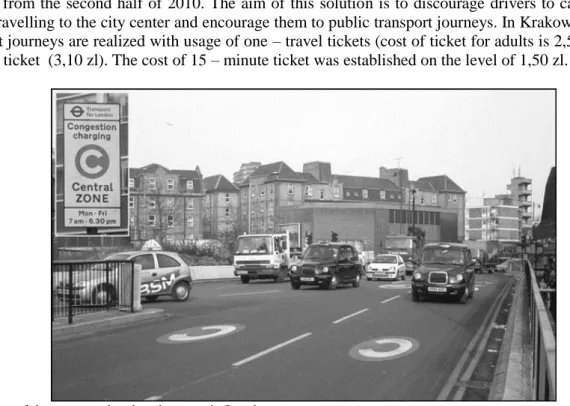
Experience of cities implementing area pricing schemes (eg. Stockholm, Oslo, London) shows that financial instruments are effective solutions allowing significantly to reduce the traffic congestion and increase the usage of sustainable transport modes [17]. As an example – congestion charging scheme was introduced in London in 2003 for the area within the Inner Ring Road of Central London, covering 21 km² (1,3% of the total area of London). The aims of this project concern: reducing
congestion, improving bus service, improving journey time reliability, increasing the reliability and efficiency of freight distribution as well as raising funding for investment in transport. After six months of project realization following effects have obtained (February to August 2003) [1]:
Fig. 1. Model bus - tram stop at the Lubicz St. in Krakow
Rys. 1. Modelowy przystanek autobusowo - tramwajowy na ul. Lubicz w Krakowie
Fig. 2. Bike&Ride parking in suburban of Stuttgart Rys. 2. Parking Bike&Ride na przedmieściach Stuttgartu
Traffic congestion in charging area has reduced by 30%; Bike trips in charging area have increased by 30%;
Number of accidents in charging area has decreased by 20%; Number of public transport users has increased;
The reliability of public transport service has increased.
Financial instrument is also implementation of 15 – minute public transport ticket binding in Krakow from the second half of 2010. The aim of this solution is to discourage drivers to car usage during travelling to the city center and encourage them to public transport journeys. In Krakow, public transport journeys are realized with usage of one – travel tickets (cost of ticket for adults is 2,50 zl) or 1 – hour ticket (3,10 zl). The cost of 15 – minute ticket was established on the level of 1,50 zl.
Fig. 3. One of the gates to the charging area in London
Rys. 3. Jedna z bramek na granicy strefy pobierania opłat w Londynie
4.5. „Soft” instruments
Decision related with choice of particular transport mode concerns many sociological, cultural, psychological aspects, thus there is a necessity to take into consideration specific needs and expectations of different users. That is why the mobility management concept consists of range of “soft” instruments corresponded to individual clients’ needs that can be flexible adapted to various conditions and expectations of target groups.
The term: “soft” is popularly used in English version and it really means activities deal with human mobility behaviour through information, communication, organization and coordination, which have become increasingly important in today’s society [10]. Besides “soft” instruments are not obligatory to the users instead of “hard” instruments related with construction and regulations side of transport (e.g. infrastructure, laws, regulations, tax and pricing schemes). “Soft” measures usually enhance the effectiveness of the “hard” measures related with transport infrastructure development (e.g. new tram lines or new bike paths construction), do not require large financial investments and may have a high benefit – cost ratio.
Examples of “soft” instruments were presented below [2, 10]:
Information and consulting – are related with provision to the travellers information about sustainable mobility modes, analysis of present transport situation, looking for the solutions, evaluation of the alternatives and recommendation of the best solution (e.g. comparison of travel time and costs of different transport modes). Information can be offer through leaflets, brochures, websites including travel planners and data about travelling in sustainable way.
Activities related with creation and sale of transport products – these activities include offering mobility products like: tickets, public transport maps, bike paths maps in specific locations eg. in special mobility points placed in the city center or in points for tourists. Fig. 4 presents mobility point in the city center of Stuttgart – an information, advisory, promotional place where the mobility
products are available for the users (source: www.stuttgart.de). This category of activities include also creation of innovative transport products eg. loyalty programs or public transport tickets which provide entrance to the cultural or sports events.
Activities related with transport services organization, reservation and coordination – this kind of instruments concerning organization and coordination of new ways of travelling (eg. carpooling or carsharing systems), additional public transport services (e.g. organization of shuttle service between selected area and exchange point), coordination of mobility services for the handicaps, reservation of free places in vehicles for carpooling or carsharing users as well as coordination and improvements in existing services, like increase in frequency of selected lines.
Activities related with usage of telecommunication technology – telecommunication technology is usually used in order to replace commuting. It typically means that employers allow certain employees to work at home or at a local workstation either part – or full – time. Communication between them is realized by telephone or Internet (Skype conversation, teleconferences). This technology can be applied also for shopping, social life and others services done by phone or Internet, without need of travelling.
Educational activities – mean all measures focusing on users’ travel awareness raising that present possibility of individual person to make a choice in travel planning process and indicate the more sustainable mobility options. The most popular educational event is “European Mobility Week”. Others activities consist of distribution of leaflets, brochures, posters but also organization of workshops and training in kindergartens, schools, work places. Special workshops are also dedicated for people who are interested in working in the area of mobility management. In framework of CIVITAS CARAVEL project, the City of Krakow has organized a series of educational seminars in kindergartens (Fig. 5), primary schools, high schools and universities. The aim of these meetings was to present problems resulting from car traffic increase and benefits from travelling by sustainable mobility modes for users, environment and quality of city life. These actions were focusing on young people who will take a decision about cities development in next decades [13].
Promotional activities – include different marketing campaigns consisting of special events (e.g. bike happenings), leaflets, brochures, posters, gadgets which encourage people to travelling by tram, bus, bikes, by foot or in carpooling and carsharing systems. [21, 22].
Most popular promotional events are “Bike2work” or “Car Free days”, which are organized in many cities of Europe, North America and Australia every year.
Fig. 4. Mobility point in the city center of Stuttgart Rys. 4. Punkt mobilności w centrum Stuttgartu
Fig. 5. Krakow - educational activities in kindergarten Rys. 5. Kraków - działania edukacyjne w przedszkolu
5. THE AREA OF INSTRUMENTS APPLICATION
The idea of mobility management concept concerns especially urban transport system, but instruments presented above can be applied also to the area of region or country eg. legislative instruments. In many foreign sites mobility management is usually perceived as an activity focused on particular area or place which generates and attract large traffic flows like: distinguished city areas (city center, housing estate, industrial area), big institutions and companies (municipality, school, university, hospital, shopping center etc.). Beside “soft” instruments are appropriate to temporary events – trade fairs, concerts, sports matches – the organization of these events has a significant influence on urban transport system and results often in paralysis of the city. Mobility management help to reduce the negative effects of temporary events organization [15].
The choice of suitable instruments and solutions implemented in frameworks of mobility management depends on political, economic and demographic situation of the city, region, country as well as travel awareness motivating mobility behaviours. The best results are generated through simultaneously application of many different instruments.
6. CONCLUSIONS
Paper presents the mobility management approach, innovative in Poland, but very popular in west and north UE countries, North America and Australia. Foreign examples of concept realization shows many positive results, like: reduction of traffic congestion, improvement in air quality, improvement in public transport service and safety, citizens’ satisfaction from urban transport operation.
Because of progress in science and technology and appearance of new transport, communication and information solutions, mobility management also develops and its definition is variously understood and adapted to requirements and conditions of individual countries. In many European sites, where the quality of public transport is very high, exist dense and cohesive bike network, P&R infrastructure and legislative and land use planning instruments are widely known and applied, mobility management are understood as set of activities only related with “soft” instruments [2].
Taking into consideration differences concern economical and political situation, available sources and mobility awareness, some of instruments implemented in UE or USA are not placed in Polish conditions till now eg. congestion charging schemes, HOV lane – high occupancy vehicle lane (dedicated traffic lanes for vehicles with 2+, 3+ or 4+ passengers) or Guaranteed Ride Home (in many
American companies, employees who travel to work by bike or in carpooling system, in case of lack of possibility to use these transport modes, can back home by taxi at employer’s expense).
References
1. Banister D.: Unsustainable transport. City transport in the new century. Routledge, New York 2005.
2. Definition and Categorization of Mobility Management Measures. Materiały projektu MAX “Successful Travel Awareness Campaigns and Mobility Management Strategies”, 2007, on website: http://www.epomm.org/docs/MAX_Defn_catgsn_MM_measures_Final.doc.
3. Faron A., Rudnicki A.: Idea i narzędzia unijnego projektu MAX mającego na celu podniesienie świadomości potrzeby zarządzania mobilnością. Transport Miejski i Regionalny, 2010, nr 1, p. 19-26.
4. Garling T.: Effectiveness, public acceptance and political feasibility of coercive measures for reducing car traffic. (Garling T., Steg L., Threats from car traffic to the quality of urban life: problems, causes and solutions), ELSEVIER, Amsterdam, 2007.
5. Garling T., Steg L.: Threats from car traffic to the quality of urban life: problems, causes and solutions, ELSEVIER, Amsterdam 2007.
6. Gronau W., Kagermeier A.: Mobility management outside metropolitan areas: case study from north Rhine Westphalia. Journal of transport geography, 2004, no 12/4, p. 315-322.
7. Litman T.: A Sourcebook for Policy-makers in Developing Cities Module 2b: Mobility Management. 2003, on website: http://www.vtpi.org/gtz_module.pdf.
8. Litman T.: Mobility management. Sustainable transport. A sourcebook for policy-makers in developing cities. GTZ, 2002.
9. Litman T.: Potential Transportation Demand Management Strategies, 1999, on website: http://www.vtpi.org/tdm.
10. Mobility management and travel awareness. Portal – transport teaching material, 2003, on website: http://www.eu-portal.net/material/downloadarea/kt7_wm_en.pdf.
11. Mobility management. Research for sustainable mobility, European Commission Brussels, 1999. 12. MOMENTUM – Mobility management for the urban environment, Deliverable 1 – State of the Art
and Deliverable 2 – Blueprint for Mobility Centers, Final report, 2000.
13. Niewitała D., Ochyra M.: Innowacyjne działania w zakresie popularyzowania i promowania idei zrównoważonej mobilności. Transport Miejski i Regionalny, 2008, nr 7-8, p. 12-16.
14. Nosal K.: Wpływ planów mobilności na zmianę zachowań komunikacyjnych. Mat. Konf. Modelowanie podróży i prognozowanie ruchu, SITK, Kraków 2009.
15. Nosal K.: Zintegrowany plan mobilności dla Politechniki Krakowskiej jako przykład zaspakajania potrzeb komunikacyjnych pracowników i studentów oraz zarządzania ich mobilnością, „Transport Miejski i Regionalny”, 2008, nr 7-8, p. 26-29.
16. Pendyala R.M., Kitamura R., Chen C., Pas E.I.: An activity-based micro-simulation analysis of transportation control measures. Transport Policy, vol. 4 no 3 / 1997, p. 183-192.
17. Przemieszczanie zrównoważone – przewodnik po planach zrównoważonego transport miejskiego, Materiały projektu BUSTRIP, on website: http://www.movingsustainably.net.
18. Raeva D.: Mobility Management: Sustainability Option for Sofia’s Urban Transport Policy? Lund, Sweden 2007. On website: http://web.lund.se/upload/130748/ Mobility%20Management% 20Sustainability%20Option%20for.pdf.
19. Rudnicki A.: Polityka rozwoju przestrzennego a zatłoczenie komunikacyjne. Mat. XIV Konferencji naukowo- technicznej Problemy komunikacyjne miast w warunkach zatłoczenia komunikacyjnego, SITK, Poznań 2009.
20. Starowicz W.: Jakość usług w miejskim transporcie publicznym. Wydawnictwo Politechniki Krakowskiej, Kraków 2008.
21. Staszak J.: Promocja usług miejskiego transportu zbiorowego jako element strategii zrównoważonego rozwoju ze szczególnym uwzględnieniem Gdyni. Transport Miejski i Regionalny, 2009, nr 7-8, p. 21-26.
22. Staszak J., Smirnow R.: Udział Gdyni w projekcie edukacyjnym dla dzieci i młodzieży - YOUTH - promującym transport miejski. Transport Miejski i Regionalny, 2009, nr 3, p. 21-26.
23. Suchorzewski W.: Opłaty za wjazd do obszarów śródmiejskich – sukcesy i porażki. Mat. XIV Konferencji naukowo- technicznej Problemy komunikacyjne miast w warunkach zatłoczenia komunikacyjnego, SITK, Poznań, 2009.
24. Vigar G.: The politics of mobility: transport, the environment, and public policy. London, Spon Press, 2002.
25. W kierunku nowej mobilności w miastach. Zielona księga UE, Bruksela, 2008.