Journal of Gerontology:MEDICAL SCIENCES Copyright 2001 by The Gerontological Society of America
2001, Vol. 56A, No. 8, M518–M522
M518
Skilled Finger Movement Exercise Improves
Hand Function
Vinoth K. Ranganathan,
2Vlodek Siemionow,
1,2Vinod Sahgal,
2Jing Z. Liu,
1and Guang H. Yue
1,2 1Department of Biomedical Engineering, The Lerner Research Institute, and 2Department of Rehabilitation Medicine, TheCleveland Clinic Foundation, Cleveland, Ohio.
Background. Aging is accompanied by a marked decline in muscle strength and ability to maintain steady submaxi-mal force. Studies have shown that exercise programs can improve age-related regression of hand function in elderly in-dividuals. The purpose of this study was to train elderly subjects to perform skilled finger movements and to evaluate the changes in hand function involving skillful use of finger pinch.
Methods. Grip strength, maximum pinch force (MPF), steadiness of pinch force at 5%, 10%, and 20% MPF, M wave, and Hoffman (H) reflex were measured. Fourteen elderly subjects were trained with skilled finger movements, and their performance involving finger pinch was measured.
Results. Compared with untrained elderly subjects, the trained older adults significantly (p .05) improved their ability to control submaximal pinch force, to maintain a steady hand posture, and to relocate a small object quickly with finger grip. The amplitude of H reflex increased significantly for the trained group.
Conclusions. Skilled finger movement training improves the ability to control submaximal pinch force, hand steadi-ness, and manual speed in elderly subjects; these improvements may be due to training-induced adaptations in the cen-tral and peripheral nervous systems.
LDERLY individuals face increased difficulty in per-forming daily living tasks such as tying shoe laces, fas-tening buttons, or writing a note. Their hand sensation (1) and ability to control finger force (2,3) are significantly re-duced. Many have suggested that the decline in finger ma-nipulative ability is a consequence of degeneration of the aging sensorimotor system (4–10).
High intensity resistance training appears to attenuate the age-related decline in force-generating capacity and older individuals can achieve similar training-induced increases in muscle mass and strength as compared with young sub-jects (11,12). Strength training a hand muscle of older adults resulted in a decline in the force fluctuation during a steady-force task (3). Increased use of the digits requiring manual dexterity can induce adaptations in the motor cortex (13). Hence, with a training regimen that provides adequate stimulus to the sensorimotor system it is possible to im-prove age-related regression in motor function, including manual function, in older adults.
Human manual function is largely reflected by skillful use of the fingers in grasping, lifting, and manipulating objects between the pulps of thumb and one of the four fingers (finger pinch). Age-related changes in manual function should therefore cause deterioration in the con-trol of finger pinch. Enhancing concon-trol of the finger pinch through training could, to a certain extent, improve both the quality of life and capacity for independent liv-ing in elderly individuals. The purpose of this study was to determine the effects of training with skilled finger movements on the ability to control finger pinch in el-derly subjects.
METHODS
Twenty-eight right-handed elderly volunteers (mean 70.5 years, range 65–79 years) were randomly assigned to either the control (n 14, mean SD, 70 3.5 years) or the training (n 14, 70.9 3.4 years) group. All subjects were healthy and independent and had no neuromuscular disorders. The experimental procedures were explained to the volunteers, and their informed consent was obtained.
Training Task
The training task was to hold two metal balls (2 in diameter and 150 g each) in the palm of the dominant (right) hand and rotate the balls smoothly clockwise or counterclockwise (Fig-ure 1). Before the training began, supervised training was pro-vided in the laboratory to ensure that each subject could per-form the training task independently. Two 10-minute training sessions were performed each day at home for 6 days/week for 8 weeks, allowing equal time for clockwise and counter-clockwise rotations. A daily training log was provided and subjects recorded the time for each session. Two weeks after the training began, subjects returned to the laboratory and their performance (ball-rolling exercise) was checked by the inves-tigator. Subjects were telephoned periodically by the investi-gator to monitor the progress of training. The control group was not trained but participated in all the tests.
Testing
Hand grip strength.—A Jamar dynamometer (Sammons Preston, Bolingbrook, IL) was used for measuring grip
E
TRAINING ENHANCES CONTROL OF PINCH FORCE M519
strength (three trials). Subjects squeezed the grip handle maximally and they were verbally encouraged to exert max-imum force. The highest force among the trials was chosen for analysis.
Maximum pinch force.—The maximum pinch force (MPF) was exerted by a finger individually against the thumb. The force-measurement device consisted of a load cell (Sensotec, Columbus, OH) that measured forces be-tween 0 and 50 lb (Figure 2). In each trial, the subjects squeezed the two digits as hard as possible for about 4 sec-onds. Three trials were performed and the highest force among the trials was used for analysis. The index finger with the thumb was tested first, followed by the middle, ring, and little finger, respectively. The load cell’s voltage output was amplified (1000), digitized (100 samples/s), and recorded on the hard disk of a personal computer using the Spike2 data-acquisition system (1401 Plus, Cambridge Electronic Design, Cambridge, UK).
Steadiness of pinch force.—Target forces of 20%, 10%, and 5% MPF along with absolute force levels of 8 N, 4 N, and 2.5 N were tested for the index and middle fingers against the thumb. In a descending order, each target level was displayed on an oscilloscope and the subject exerted a ramp pinch force. Once the force reached the target level, subjects were instructed to maintain the force on the target as steadily as possible for approximately 15 seconds. Three practice trials were provided before the test. Three trials were recorded at each target force. Each subject was given a 30-second rest between trials and a 2-minute rest between target levels. For the purpose of analysis, a 10-second con-tinuous period of each trial that had the least fluctuations was noted by visual observation. The trial with least
fluctua-tion was used. Steadiness of pinch force was quantified by measuring force fluctuation (SD about the mean).
Hand steadiness.—This test was designed to determine the steadiness of the hand while performing a precision fin-ger pinch. A metal plate with holes of 2, 4, 6, 8, and 10 mm diameters was placed on a table at an inclination of 30 de-grees. A metal probe of 1-mm diameter was connected to a countercircuit. The subject gripped the probe between the thumb and index finger and attempted to hold the probe in each hole without touching the edge of the hole (10 seconds for each hole). Whenever a touching occurred, the counter was activated and increased by one count. Only the errors at the 2 mm diameter hole were recorded.
Pegboard test.—The pegboard test evaluates a person’s ability to coordinate hand-eye movement necessary to per-form a manual task quickly and accurately. The pegboard (Lafayette Instruments, Lafayette, IN) had 24 holes. The pegs were arranged on the table with spacing similar to that of the pegboard’s holes. Subjects lifted the peg in the upper left corner (first column) of the table and placed it in the corresponding pegboard hole, and then continued on to the second peg in the same column, and so on. After finishing the first column, the subject proceeded with the next col-umn. The time taken to relocate the 24 pegs was recorded as the dependent variable for this test.
Hoffman reflex.—The Hoffman (H) reflex is widely used as a measure of motoneuron excitability (14). H reflex was elicited from the adductor pollicis muscle by electri-cally stimulating the ulnar nerve. The stimulus electrodes were placed over the ulnar nerve proximal to the wrist. The Figure 1. The drawing shows the two metal balls (A and B) being
moved clockwise in the left hand. This task requires sequential and coordinated independent finger movements combined with input from sensory receptors in the skin, muscles, and joints. The numbers indicate different positions of the moving balls in the hand. When the balls are rolled counterclockwise, the sequence of the finger move-ment is reversed. All subjects were able to do the task independently with the training hand.
Figure 2. Right arm and digits positioned for measuring pinch force. This arrangement is used for measuring both maximal and sub-maximal pinch forces with a force transducer (load cell). The load cell is aligned with the pads of the index finger and the thumb and was mounted between two plates of a custom-designed housing. When-ever the plates pressed against each other, the load cell was com-pressed, giving a voltage output corresponding to the force applied. The housing was mounted on a wooden armrest, with restraints to hold the arm in position. For each subject, position of the hand, re-straints, angle, and height of the load-cell housing were recorded to ensure consistency during later testing.
M520 RANGANATHAN ET AL.
stimulation intensity (Grass S8800 digital stimulator) was kept supramaximal to ensure that the same intensity was used among subjects and between repeated measures. We first measured the compound muscle action potential (M wave) and then recorded three H reflexes when subjects ex-erted 50% thumb-index MPF. Pulse duration for each stim-ulus was 1 millisecond. The H reflex (peak-to-peak ampli-tude) was normalized to the maximal peak-to-peak M wave and the mean of the three measures was analyzed.
Statistical Analysis
Unpaired t tests were used to compare the results of the grip force, pinch force, pinch force steadiness, hand steadi-ness, and pegboard tests between the control and training groups. Paired t tests were used to compare the changes in the measurements within the control and training groups, before and after training. A p .05 was considered significant. All data are given as mean SD, unless otherwise mentioned.
RESULTS
Hand Grip Strength and MPF
The post-training results showed no significant change in handgrip strength or MPF of any finger pairs for both the trained and control groups.
Pinch Force Steadiness at Relative Force Levels
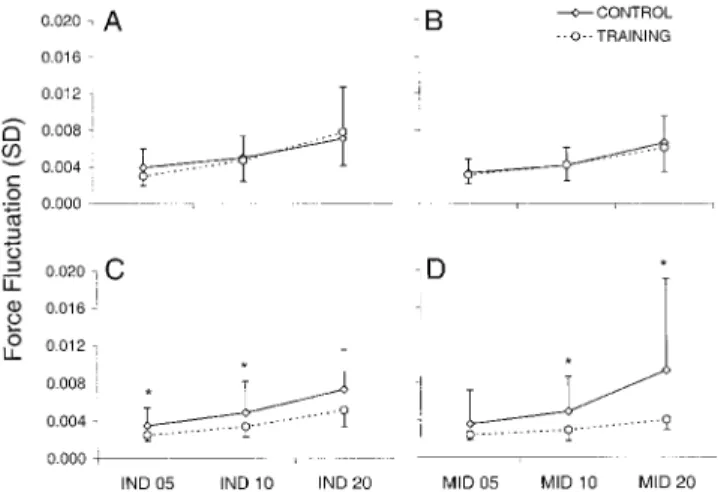
The pinch force steadiness results showed a significant training-induced improvement. Figure 3 shows the pinch force performance for one of the training subjects before (A) and after (B) training. In this subject, there is a substan-tial decline in force fluctuations. In Figure 4, A and B indi-cate that the force fluctuation for both the training and control were similar before training. After training, the dif-ference in the fluctuation was more pronounced between the two groups (Figure 4, C and D). Figure 5 illustrates the changes in force fluctuation for the control (A and B) and trained (C and D) groups at the end of training. The force fluctuation for the trained group decreased significantly (p .05) for both index-thumb and middle-thumb pairs.
Pinch Force Steadiness at Absolute Force Levels
Figure 6 shows the force fluctuation for the control group at the three absolute force levels for the index-thumb (A)
and middle finger-thumb (B) pairs. In Figure 6, C and D show the changes in the training group’s force fluctuation for index- and middle-thumb pairs, respectively. The force fluctuation for the trained group decreased significantly (p .05) for both index-thumb and middle-thumb pairs.
Hand Steadiness and Pegboard Tests
Hand steadiness improved significantly (p .01) for the trained group. Similarly, the time required to place the pegs significantly (p .05) reduced for the trained group (Table 1).
Figure 3. Representative performances by an elderly subject dur-ing pinch-force steadiness task at 5% MPF of the index-thumb com-bination before (A) and after (B) training. The figures show a pro-found decrease in pinch force fluctuation at the end of the training program.
Figure 4. Comparison of baseline (before training) force fluctua-tions for index (A) and middle (B) fingers show that both groups per-formed similarly. However, after training, there is a significant differ-ence in the force fluctuation between the trained and control group for both index (C) and middle (D) finger combinations at two lower force levels (*p .05).
Figure 5. Pinch force fluctuations for the control group before and after training for the index finger-thumb pair, A, and middle finger-thumb pair, B, at 5%, 10%, and 20% MPF; C and D show force fluc-tuation before and after training for the trained group at 5%, 10%, and 20% MPF for the index thumb pair and middle finger-thumb pair, respectively. The decrease in force fluctuation was signif-icant at 5% and 20% (16.71%, p 0.05 and 33.91%, p 0.05, respec-tively) for the index-thumb pair and at all three force levels (22.61%,
p 0.005; 30.31%, p 0.01; and 33.88%, p 0.01, respectively) for the middle-thumb pair (*p .05, **p .005).
TRAINING ENHANCES CONTROL OF PINCH FORCE M521
H-Reflex to M-Wave Ratio
The ratio of H reflex to M wave was calculated and the percentage of H reflex to M wave determined (Figure 7). For the control group, the ratio did not change significantly (p .17). For the trained group the ratio increased by al-most 70% (4.2 1.6 vs 7.1 2.5, p .01).
DISCUSSION
The main purpose of this study was to evaluate the pinch function of the hand in older adults and to determine if training with skilled finger movements could improve the ability to control finger pinch in older adults. We found that the training significantly improved the ability to control submaximal pinch force, hand steadiness, speed in placing small objects accurately, and motoneuron excitability. These improvements could enhance quality of life in older adults because many daily tasks involving hand manipulation re-quire fine control of pinch force, hand steadiness, and rapid hand movements.
Skilled Finger Movement Training Improves Pinch Force Steadiness
Impaired control ability of finger force has been reported in elderly subjects (2,3). Our study, however, is the first to examine this ability during finger-tip pinch by which prob-ably most daily manual tasks that require finger manipula-tion are performed. The skilled finger exercise enabled the elderly subjects to more precisely control their finger pinch, reflected by a steadier pinch force and precision-pinch posture.
Keen and colleagues (3) reported, on average, a 20% re-duction in force fluctuation during low-level contractions of index-finger abduction after strength training with muscle contractions of the same type. The reduction in force fluctu-ation for the trained group in our study was, on average, about 27%. It should be cautioned that it is inappropriate to compare the results of the two studies. First, in the study by Keen and colleagues (3), the training and test tasks involved muscle contraction of the same type (index finger abduc-tion). Thus, there may have been a more “direct” link from the training-induced adaptations in the central and periph-eral nervous system to the performance of the test task, or the improvement in steadiness was a specific transformation of the training effect onto the test task. The training (ball-rolling) and test (finger-pinch) tasks in our study were quite different. No “direct” link may exist between the two; thus, the improvement in pinch force steadiness may result from improved overall hand function resulting from the training. Second, pure finger abduction is a manual task that does not seem to be used frequently during activities of daily living. Therefore, more improvement may be allowed for this iso-lated abduction task. The finger pinch task, however, is used for almost all types of manipulations each day. It can be considered as a highly “trained” task that may allow limited room for training-induced improvements.
Skilled Finger Movement Training Improves Hand Steadiness and Speed of Movement
After training, the elderly subject’s hand became steadier as indicated by a decreased number of contacts between the Figure 6. Pinch force fluctuations for the control group before and
after training for the index finger-thumb pair, A, and middle finger-thumb pair, B, at absolute force levels of 2.5, 4, and 8N; C and D show force fluctuation before and after training for the trained group at 2.5, 4, and 8N for the index thumb pair and middle finger-thumb pair, respectively. The decrease in force fluctuation in the training group was significant at the two lower forces (15.63%, p
0.05 and 20.4%, p 0.05 at 2.5 and 4 N, respectively) for the index-thumb pair and at all three force levels (15.6%, p 0.05; 26.2%, p
0.05; and 27.6%, p 0.05 at 2.5, 4, and 8 N, respectively) for the mid-dle-thumb pair (*p .05).
Table 1. Measurements of Pegboard Test (in seconds) and Hand Steadiness (in Error Counts) Before and After Training Period
Before After % Change
Pegboard Control 31.11 30.86 0.8 Trained 31.13 28.25 9.2* Hand Steadiness Control 66.43 48.21 27.4 Trained 67.15 17.0 74.7** *p .05; **p .005.
Figure 7. H reflex at 50% MPF increased by almost 70% (*p
.05) for the trained group after training. The increase for the control group was not significant. Note that the H reflex was elicited during muscle activation because it is difficult to elicit an H reflex at rest in muscles other than the soleus and gastrocnemius.
M522 RANGANATHAN ET AL.
probe and the metal plate. This improvement may be attrib-uted to the improvement in pinch force steadiness because a steadier force would reduce hand tremor. This improved manual speed may reflect a training-induced decrease in joint stiffness and/or improvement in muscle coordination.
Skilled Finger Movement Training Improves Motor Neuron Excitability
Many studies have demonstrated that the excitability of spinal motoneurons that control muscle reduces with age (15,16). The decline in alpha-motoneuron excitability in el-derly people may play a role in deteriorating hand function. Conversely, the improvement in motoneuron excitability by skilled finger exercise may have contributed to the im-proved ability to control finger pinch in the trained older adults. We do not know the exact process of altering hand function by changing motoneuron excitability, but it may include modifications in the input from sensory receptors and/or descending pathways during the adaptive process of aging or training.
In conclusion, hand function, especially the ability to sus-tain a steady pinch, a critically important function in hand manipulation, deteriorates with age. Training with skilled finger movements improves the ability to maintain a steady pinch force and finger-pinch posture, as well as to move small objects quickly with finger grip. In addition, the train-ing program induced a positive change in the excitability of motoneurons innervating a muscle that is important in con-trolling finger pinch. These improvements could probably allow elderly people to have a more independent life, given the importance of finger pinch in everyday tasks requiring manual dexterity.
Acknowledgments
This study was supported in part by National Institutes of Health Grant HD-36725 and Cleveland Clinic Foundation Research Grant RPC-5488 to G.H. Yue, and the departmental research funds of the Department of Reha-bilitation Medicine at the Cleveland Clinic Foundation.
Address correspondence to Guang H. Yue, PhD, Department of Bio-medical Engineering/ND20, The Lerner Research Institute, The Cleveland Clinic Foundation, 9500 Euclid Avenue, Cleveland, OH 44195. E-mail: [email protected]
References
1. Cole KJ. Grasp force control in older adults. J Motor Behav. 1991;23: 251–258.
2. Galganski ME, Fuglevand AJ, Enoka RM. Reduced control of motor output in a human hand muscle of elderly subjects during submaximal contractions. J Neurophysiol. 1993;69:2108–2115.
3. Keen DA, Yue GH, Enoka RM. Training-related enhancement in the control of motor output in elderly humans. J Appl Physiol. 1994;77: 2648–2658.
4. Kinoshita H, Francis PR. A comparison of prehension force control in young and elderly individuals. Eur J Appl Physiol Occup Physiol. 1996;74:450–460.
5. Kenshalo DR. Age changes in touch, vibration, temperature, kinesthet-ics, and pain sensitivity. In: Birren JE, Schaie KW, eds. Handbook of the Psychology of Aging. New York: Van Nostrand Reinhold; 1977: 562–575.
6. Cole KJ, Rotella DL, Harper JG. Tactile impairments cannot explain the effect of age on a grasp and lift task. Exp Brain Res. 1998;121: 263–269.
7. Brody H. Structural changes in the aging nervous system. Interdiscip Top Gerontol. 1970;7:9–21.
8. Picard N, Smith AM. Primary motor cortical activity related to the weight and texture of grasped objects in the monkey. J Neurophysiol. 1992;68:1867–1881.
9. Smith AM. The activity of supplementary motor area neurons during a maintained precision grip. Brain Res. 1979;172:315–327.
10. Campbell MJ, McComas AJ, Petito F. Physiological changes in ageing muscles. J Neurol Neurosurg Psychiatry. 1973;36:174–182. 11. Hopp JF. Effects of age and resistance training on skeletal muscle: a
review. Phys Ther. 1993;73:361–373.
12. Grabiner MD, Enoka RM. Changes in movement capabilities with ag-ing. Exerc Sport Sci Rev. 1995;23:65–104.
13. Karni A, Meyer G, Jezzard P, Adams MM, Turner R, Ungerleider LG. Functional MRI evidence for adult motor cortex plasticity during mo-tor skill learning. Nature. 1995;377:155–158.
14. Schieppati M. The Hoffman’s reflex: a means of assessing spinal re-flex excitability and its descending control in man. Prog Neurobiol. 1987;28:345–376.
15. Koceja DM, Markus CA, Trimble MH. Postural modulation of the so-leus H reflex in young and old subjects. Electroenceph Clin Neurophysiol. 1995;97:387–393.
16. Angulo-Kinzler RM, Mynark RG, Koceja DM. Soleus H-reflex gain in elderly and young adults: modulation due to body position. J Ger-ontol A Biol Sci Med Sci. 1998;53:M120–M125.
Received July 13, 2000 Accepted August 2, 2000