NBER WORKING PAPER SERIES
CONTRACTIONARY CURRENCY CRASHES IN DEVELOPING COUNTRIES
Jeffrey A. Frankel Working Paper11508
http://www.nber.org/papers/w11508
NATIONAL BUREAU OF ECONOMIC RESEARCH 1050 Massachusetts Avenue
Cambridge, MA 02138 June 2005
This paper was originally presented as the Mundell-Fleming Lecture at the Fifth Annual Research Conference of the International Monetary Fund, November 2004. It is forthcoming in IMF Staff Papers, 2005. The author would like to thank Maral Shamloo, Yun Jung Kim, and Rodrigo Urcuyo for capable research assistance; the Kuwait Fund and the Ash Institute for Democratic Governance and Innovation, both of Harvard’s Kennedy School, for support; and Miguel Messmacher, participants at the ARC, and especially Robert Flood, for useful suggestions. Some results draw on joint work with Eduardo Cavallo, David Parsley, and Shang-Jin Wei. The views expressed herein are those of the author(s) and do not necessarily reflect the views of the National Bureau of Economic Research.
©2005 by Jeffrey A. Frankel. All rights reserved. Short sections of text, not to exceed two paragraphs, may be quoted without explicit permission provided that full credit, including © notice, is given to the source.
Contractionary Currency Crashes in Developing Countries Jeffrey A. Frankel
NBER Working Paper No. 11508 July 2005
JEL No.
ABSTRACT
To update a famous old statistic: a political leader in a developing country is almost twice as likely to lose office in the 6 months following a currency crash as otherwise. This difference, which is highly significant statistically, holds regardless whether the devaluation takes place in the context of an IMF program. Why are devaluations so costly? Many of the currency crises of the last ten years have been associated with output loss. Is this, as alleged, because of excessive reliance on raising the interest rate as a policy response? More likely it is because of contractionary effects of devaluation. There are various possible contractionary effects of devaluation, but it is appropriate that the balance sheet effect receives the most emphasis. Passthrough from exchange rate changes to import prices in developing countries is not the problem: this coefficient fell in the 1990s, as a look at some narrowly defined products shows. Rather, balance sheets are the problem. How can countries mitigate the fall in output resulting from the balance sheet effect in crises? In the shorter term, adjusting promptly after inflows cease is better than procrastinating by shifting to short-term dollar debt, which raises the costliness of the devaluation when it finally comes. In the longer term, greater openness to trade reduces vulnerability to both sudden stops and currency crashes.
Jeffrey A. Frankel
Kennedy School of Government Harvard University
79 JFK Street
Cambridge, MA 02138 and NBER
Contractionary Currency Crashes In Developing Countries The Fifth Mundell-Fleming Lecture, IMF Annual Research Conference
Jeffrey A. Frankel
December 2004 is the tenth anniversary of the Mexican peso crisis of 1994. In retrospect, this crisis ushered in an eight-year series of highly visible devaluations in emerging markets, most of which proved highly costly to the countries involved. These currency crashes are the theme of my lecture.
Accordingly, I will begin by invoking neither Mundell nor Fleming, but another article from three decades ago: Richard Cooper’s “Currency Devaluation in Developing Countries.” This was one of the few major papers from that period to deal explicitly with the macroeconomics of developing countries. The weight of our attention has over the last decade or two shifted increasingly away from rich countries and toward
developing countries, whether judged by the caseload of the staff at the International Monetary Fund or by working papers turned out by scholars in the field of International Finance and Macroeconomics. In part this reflects the extent to which lower- and middle-income countries have become increasingly integrated into world financial markets. Twenty years ago, for example, one would not have wanted to apply the Mundell-Fleming model’s insights regarding international capital mobility to developing countries, because they didn’t have much (capital mobility). Indeed I don’t think the phrase emerging markets even existed then. But after the liberalizations and capital inflows of the early 1990s -- and the crises of the late 1990s -- we are applying to
rich countries in mind. And we have as well created some new models and tools to try to capture what is different about developing countries.
1. Political Costs of Devaluation
I wish to take as our starting point a widely cited statistic from Cooper (1971, p. 28) that, in the aftermath of devaluations, nearly 30 per cent of governments fell within 12 months, as opposed to 14 per cent in a contemporaneous control group. This is an impressive fact, as demonstrated by the frequency with which other authors still cite it 33 years later. AI did a citation count reveals that: Cooper’s article has received 84
citations, with no downward trend over time -- not as high as the two seminal papers that constituted the Mundell-Fleming model and thus gave this lecture its name, but still very healthy for a paper written so long ago.1 So I expect to garner a lot of citations myself by updating Cooper’s calculation !
1.1 Updating a statistic on leaders’ loss of office
Cooper took anything over 10% to be a devaluation episode. But the world changed in the 1970s and 1980s, and depreciations of that magnitude have become commonplace. For a high inflation country, one would not want to say that a new currency crisis occurs every month. So I use the following definition:2
• The devaluation must be at least 25% (on a cumulative 12-month basis)
1 This paper was originally presented as the Fifth Annual Mundell-Fleming lecture. Mundell (1963) and Fleming (1962) received 319 and 257 citations respectively over the same period, 1972-2003. This probably understates the contribution of the Mundell-Fleming model: many discussions of the model cite other works, or none at all. 2 The same as that in Frankel and Rose (1996).
• The devaluation must represent an acceleration of at least 10 percentage points, relative to the rate of depreciation in the 12 months before that. • It must have been at least three years since the last currency crisis.
By these criteria, looking at a sample of 103 developing countries over the period 1971-2003, we found 188 currency crashes. Of these the identity of the country’s chief executive changed within 12 months of the devaluation 27% of the time. The standard of comparison that we use normally is all other 12-month periods: the leader changed 20.5% of the time normally. Thus devaluation increases by an estimated 32% the probability of the executive losing his or her job. The difference is only statistically significant at the 13% level.3 However, it may be that countries that tend generally to instability are overrepresented in the crisis group, so that political turnover is more common in this group even if not necessarily the result of currency crises. If we narrow the standard of non-devaluation comparison periods to the set of countries that have experienced a currency crash at some point during the sample period, on the grounds that these are more comparable to the crisis episodes, we find that the increase in job loss among devaluers now becomes statistically significant at almost 1% level.4
We then narrowed the window to a half-year. Now the chief executive lost office 19.1 % of the time, as opposed to 11.6 % of the time otherwise. In other words, the currency crash increases the probability of a change in the top leadership within the following 6 months by 1.7 times. This time the difference is statistically significant not
3 Appendix 1 A. The source for the identity of the president, prime minister, premier, or other chief executive, is http://rulers.org.
only at the 10% or 1% levels, but at the 0.5% level as well, regardless whether the entire set of countries is used as the standard of comparison.
We also looked at whether the finance minister or central bank governor –
whoever held the office of the country’s governor of the IMF -- lost his or her job. Here, even using the longer 12-month window (and even with only five years of data: 1995-99), the effect is statistically significant. In the year following a currency crash, the occupant of this position changed 58.3 per cent of the time. In other years during this period the rate of turnover was 35.8%. So by this measure the finance minister or CB governor was 63% more likely to lose office. The difference is highly significant statistically (at the .001 level).5
When we segregate countries according to three income levels, we find that the phenomenon chiefly comes from middle income countries. Within the class of poor countries, the increase in turnover of the leader is not statistically significant; and among rich countries there were no cases of a leader losing office within a year of a devaluation.
We also tried segregating countries according to three kinds of political structure: presidential democracy, parliamentary democracy, and non-democracy. Our
expectation was that we would find that the effect of devaluation on leadership turnover would be greater among parliamentary democracies than among presidential
democracies. The logic was that, in any given year, the latter might not have a scheduled election, or if they did, a term limitation might prohibit the incumbent from running for
5 Appendix 1, Part C.
re-election. We found, instead that the job loss rate was much higher and more significant in the case of devaluations occurring in presidential democracies.6
We examined whether an equally large loss of reserves results in job loss as often as a devaluation. Such episodes also tend to be unpleasant (often implying monetary contraction and recession, e.g., Argentina in 1995, 1999). A, but apparently they do not carry the same political costs, however: Their effect on leaders’ job loss was not
significant.
What is it about devaluation that carries such big political costs? How is it that a strong ruler like Indonesia’s Suharto can easily weather 32 years of political, military, ethnic, and environmental challenges, only to succumb to a currency crisis?
1.2. Possible sources of political costs of devaluation
Currency crises have often been accompanied by sharp recessions. Thus an obvious interpretation, which we will consider further, is that leaders are punished by their constituents when the performance of the economy is poor. But before proceeding on the assumption that the loss of ministerial jobs is a reflection of unemployment and depressed activity throughout the economy, let us consider the possibility that the costs of a devaluation may be more political than economic. First, there is the possibility that elections cause currency crashes rather than the other way around. Second, it could be that IMF programs or other austerity programs are unpopular in general, and that the devaluations are an incidental aspect of this. Third, it could be that the leaders in
6 The breakdown by income and democratic structure is given in Parts F, G and H of Appendix 1.
question had made public promises in advance not to devalue, and that they were punished for breaking these promises regardless of subsequent economic performance.
What do I mean by the first possibility, that elections cause devaluations rather than the other way around? It is striking in how many of the major crises of the 1990s, even though trouble began during the run-up to a major regularly scheduled national election, the worst speculative attack and currency crash came soon after the election. This describes Mexico 1994, Korea 1997, and Brazil 1998-99. In an earlier era, one would have guessed that election-motivated macroeconomic expansion -- the famous political business cycle -- explains the need for a subsequent devaluation. But that explanation does not fit the experience of the 1990s as well. Macroeconomic expansion in these election campaigns was limited.7
A better explanation is that devaluation is politically costly to leaders, and so in an election year they try to postpone it -- whether to get re-elected,8 or so that the crash comes on their successors’ watch rather than theirs, or out of the hope that something will turn up to improve the balance of payments.9 A related hypothesis is that because a devaluation uses up scarce political capital, it is more likely to be undertaken by a new leader with a strong mandate, especially in a visible crisis, and especially if he can blame it on his predecessor. Edwards (1994, Table 5) reports that devaluations occur
7 The political business cycle literature observes that politicians are sometimes able to fool voters by aggressive macroeconomic expansion preceding the election, with costs borne later. But Brender and Drazen (2004) argue that is primarily a phenomenon found in countries that have only recently made the transition to democracy. Voters eventually learn.
8 On governments’ incentive to postpone devaluations until after elections, see Stein and Streb (1998, 1999).
9 On governments’ incentive to postpone devaluations until after elections, see Stein and Streb (1998, 1999).
disproportionately often during the first two years after a transfer of government: 77.3% of devaluations among presidential democracies (i.e., those with pre-scheduled elections), and 70.0 % among parliamentary democracies. This is a topic worth exploring, but not here: my calculations about the frequency with which ministers lose their jobs in the year after a devaluation were careful to start the clock the day after the devaluation, so that cases where the devaluation came soon after an electoral change are not included in the statistics.
The second possibility I mentioned is that devaluations are acting as a proxy for unpopular IMF austerity programs or other broad reform packages. IMF-associated austerity programs have often resulted in popular unrest. For example, riots following food-subsidy cutbacks contributed to the overthrow of President Nimeiri of Sudan in 1985.10
One can test the proposition that devaluations are acting as a proxy for unpopular IMF austerity programs by conditioning our previous calculation on the adoption of IMF programs. We created a dummy variable to represent cases where an IMF program was initiated within 3 months on either side of the devaluation.11 The IMF program variable does not seem to raise the frequency of leader job loss, relative to devaluations that did not involve an IMF program. Thus it is not surprising that conditioning on the IMF
10 Edwards and Santaella (1993) report nine cases of post-devaluation coup attempts, in a study that looks at the role of IMF presence along with various measures of political instability in determining whether devaluations during the period 1950-1971 were economically successful. Lora and Olivera (2004) find that voters punish presidents for pro-market policies and for increases in the rate of inflation, but not for exchange rate policies per se. For an earlier summary of the political consequences of IMF-type
austerity programs, see Bienen and Gersovitz (1985).
11 Whether Standby Agreement, or other. See Appendix 2 for list with dates. Part G of Appendix 1 reports the results.
dummy variable has no discernible effect on the frequency of leader turnover: 21.05% of the time for the cases with an IMF program, or 21.92% of the time for the ones without. In both cases, it is similar to the overall rate of job loss following devaluations (19.05%) in the complete sample, and is still almost double the 11.6% rate in normal times.
That leaves the third non-economic explanation, that the ministers in question have made public promises in advance not to devalue, and that they feel it necessary to resign or are punished for breaking these promises, regardless of subsequent economic performance. In many cases the commitment to the peg is explicitly reaffirmed by top policy-makers and political leaders in the months immediately prior to the devaluation. Perhaps such ill-fated promises are originally made because the minister is duplicitous, or at least is ignorant of the speculative pressures he or she is up against. More likely they are too attached to the peg psychologically to let go; many of the currency crashes of the 1990s occurred in countries where governments had a lot invested in the peg, because exchange-rate-based stabilizations earlier had been the successful and popular means of ending a 1980s cycle of high inflation, even hyperinflation.
But I think that a still better way to view the public commitments may be as sincere expressions of a strong desire to maintain the peg. The ministers may realize that events could force the abandonment of the exchange rate policy, if speculative pressures accelerate and it develops that reserves are about to run out, leaving little other option. And they may realize that making an explicit statement beforehand increases the chances that they will have to resign if and when the peg is abandoned. But making the promise is a way of buying a bit of credibility, and buying some time. Specifically it is a device
for signaling that their determination to hold the line on the currency is so strong that they are willing to risk sacrificing their jobs.
We selected a sub-sample of 24 cases out of our total set of currency crashes. We chose roughly equal numbers of cases with and without subsequent premier
changes.12 We searched local newspapers for the 30 days preceding the devaluation for statements by government officials that could be construed as commitments not to devalue. We included assurances even if the language did not read as explicit or ironclad, because these are so often interpreted as promises.13
The sample size is small. But we found that when some member of the government (chief executive, finance minister, or central bank governor) had given assurances that there would be no devaluation, and a devaluation did subsequently occur, the probability that the chief executive would lose his or her job within 12 months was 2/3. Where no such assurances were reported, the frequency of job loss was only 7/18, despite the devaluation. In other words, whatever the credibility benefits of the promise ex ante, it almost doubles the likelihood that the leader loses office ex post. If we use the 6-month horizon, then the relative effect is even stronger: the leader is more than twice as likely to be out on the street if the government had made a previous commitment than if it had remained quiet (.50 vs. .19). If we consider only those cases where the chief executive himself is the one to have given the assurances, then the job loss rate
12 The other major criteria were that the country in question be represented by
comprehensive microfiche files in Harvard’s Widener Library of past newspapers, and that the languages of those newspapers be either English, Spanish, Korean, or Arabic, the languages spoken by the research assistants working on this project. Appendices 3 and 4 offer details of these cases.
13 In at least one case, Syria, the newspapers appear to have been so lacking in candor regarding the relevant exchange rate that they did not even bring up the subject.
becomes 100%. But there were only two such cases, out of 24. Usually the dangerous task of going on the record is delegated to a cabinet member. (Details are reported in Appendix 3 for the 12-month horizon, and Appendix 4 for the 6-month horizon.)
Despite this suggestive outcome, to the effect that the “broken promise” factor does indeed matter, it seems unlikely that this is the sole reason for devaluations to result in turnover at the top. After all, even among those cases where our newspaper search turned up no record of assurances in the month preceding the devaluation -- either from the leader, finance minister, or central bank governor – 220% of the leaders lost office within 6 months of the devaluation anyway, and 393% within 12 months [tables in Appendices 3a and 4a].[M1] This is well above the 11.6% or 20.5% rates, respectively, of job loss in normal times. Evidently the economic effects of devaluation also play an important role.
2. Does Devaluation Necessarily Mean Loss of Output?
As already noted, the most obvious interpretation of why devaluations are so often associated with high political costs is that they are accompanied by painful recessions.14 But why? After all, devaluations are supposed to increase
competitiveness, increase production and exports of tradable goods, reduce imports, and thereby boost the trade balance, GDP, and employment. Hence the story of the British
14 Another possibility is that, even if there is no negative effect on GDP in the aggregate, the redistributional effects could be politically costly to the leaders. For example, a devaluation in an African country may benefitsmall rural coffee and cocoa farmers because the price of their product is determined on world markets, but they tend to have less political power than urban residents, who may be hurt by the devaluation. The problem with this theory is that there are so many examples that go the other way, where the producers of the tradable products (agricultural, mineral, or manufactured) tend to have more political power than the producers of nontraded goods.
Chancellor of the Exchequer “singing in the bath” after the 1992 devaluation of the pound. Apparently developing countries are different, or at least emerging market countries are. Figuring out why may amount to figuring out what aspect of these countries most requires us to modify the macroeconomic models standardly applied to advanced economies.
One can argue that simultaneous monetary and fiscal austerity are the true causes of these declines in economic activity. Or banking failures, or the sudden stop in foreign lending itself. But this misses what, to me, is a key point. According to the standard textbook theories, when a country faces a sudden stop in capital flows, there exists some optimal combination of expenditure-reducing policies (monetary or fiscal contraction) and expenditure switching policies (devaluation) that should adjust to external balance (the new balance of payments constraint), without necessarily sacrificing internal balance (i.e., without a recession). Why did all the countries in the East Asia crisis of 1997-98 suffer a sharp loss in output growth regardless of their mix of devaluation and
expenditure-reduction? The expansionary effect of the devaluation is supposed to be able to make up for whatever contraction comes from other sources.
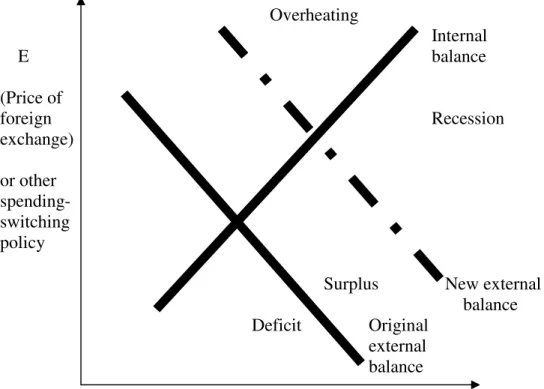
Consider a graphical representation with the interest rate and exchange rate (price of foreign currency) on the axes, as illustrated in Figure 1a. To satisfy external balance, there is an inverse tradeoff between the two instruments. A devaluation and an increase in the interest rate are each ways of improving the trade balance -- the latter by reducing expenditure -- and so the more you have of one the less you need of the other. (If external balance is defined as equilibrium in the overall balance of payments, including the capital account along with the trade balance, the relationship is still
downward-sloping, since a devaluation and an increase in the interest rate are both ways of making domestic assets more attractive to global investors.)
To satisfy internal balance, the tradeoff is traditionally considered to be upward-sloping. An increase in the interest rate reduces the domestic demand for domestic goods, while a devaluation increases the net foreign demand for domestic goods; if you have more of one, you also need more of the other, to prevent excess supply or excess demand.
The existence of two independent instruments implies the possibility of attaining both targets simultaneously, at the intersection of the internal and external balance schedule. In the aftermath of an adverse shock in the foreign sector, for example, the right combination of devaluation and monetary contraction will restore balance of payments equilibrium while maintaining real economic growth.
This is not always the way things actually work.15 By now we have had enough experience with crises in emerging markets that the traditional framework needs to be modified. The simple generalization seems to be that most developing countries that are hit by financial crises go into recession. The reduction in income is the only way of quickly generating the improvement in the trade balance that is the necessary counterpart to the increased reluctance of international investors to lend. External balance is a jealous mistress that can be satisfied only if internal balance is left to go wanting.
15 Paul Krugman, “Latin America’s Swan Song,” 1998, at
Critics of the IMF say that the recessions are the result of Fund policies, specifically the insistence on austerity in country rescue programs. 16 Some can be interpreted as arguing that there should have been more expenditure switching, and less expenditure reduction; that the mix of a lower interest rate combined with a bigger devaluation would successfully maintain internal balance. But many of the devaluations in East Asia and elsewhere were very large as it was. The critics often make the point that high interest rates are not in practice as attractive to foreign investors as the Mundell-Fleming model, for example, would suggest, because they carry increased probability of default. This is true. But in my view it is not the most important correction in the traditional framework. Even if interest rates do not have as big a positive effect on the capital account as our earlier models of high financial integration suggested, so that the graphical relationship may be flatter, I believe that the sign of the effect is still the same. Even if higher interest rates have no effect at all on capital inflows, their effect on the balance of payments still goes the same way, owing to the effect on spending. One cannot normally attract many investors by lowering interest rates. Therefore the external balance line still slopes downward. Claims that high rates are damaging to the real economy willfully ignore the lack of an alternative, if the external balance constraint is to be met.
Where the traditional framework needs most to be modified is the relationship giving internal balance, not that giving external balance. By now the evidence seems strong that devaluation is contractionary, at least in the first year, and perhaps in the second as well. We have long been aware of various potential contractionary effects of
devaluation in developing countries. The same 1971 Cooper article that tallied job
losses among ministers also listed six ways in which devaluation could be contractionary. By 1990, a total of ten such effects had been identified in textbooks.17
Until the currency crashes of the 1990s, a mainstream view had been that any negative effects from a devaluation were before long offset by the positive effect of stimulus to net exports, so that by the second year, when the latter had gathered strength, the overall effect on output had turned positive.18 Now however, one must judge the negative effects stronger than we thought, and the positive effects weaker. Calvo and Reinhart (2001), for example, calculate that exports do not increase at all after a devaluation, but rather are down for the first 8 months. The export side, at least, was supposed to be unambiguously positive. Apparently production is sometimes derailed by corporate financial distress, absence of trade credit, and increased costs of imported inputs, even when the production is for the purpose of export. Imports fall sharply; indeed crisis-impacted countries have for this reason experienced sharp increases in their trade balances beginning as soon as two or three months after the crisis. But this is clearly a response to the unavailability of finance and collapse of income and spending, not to relative prices. In other words, it is expenditure-reduction, not expenditure switching.
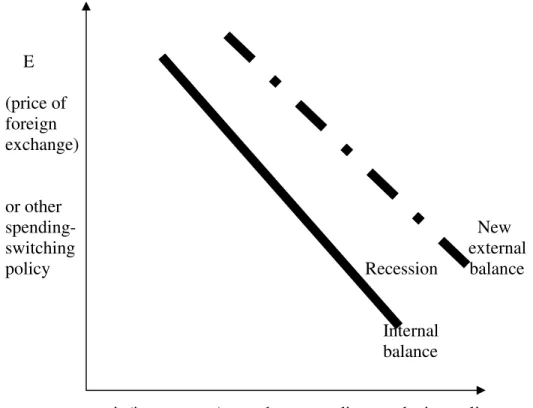
If devaluation is contractionary, then the internal balance line slopes down, not up (as illustrated in Figure 1b). Moreover the slope may be disturbingly similar to the slope of the external balance line. It is hard to see where the two intersect, if they intersect at
17 E.g., the 5th through 9th editions of Ronald Caves, Jeffrey Frankel, and Ronald Jones, World Trade and Payments, 2002.
all. This means that it is hard to see what combination of policy instruments, if any, can simultaneously satisfy both internal and external balance, after an adverse shock has shifted the latter outward. The depressing conclusion is that there is no escape from recession. All policy instruments work via reduction in income in the short run --
devaluation, fiscal contraction, and monetary contraction. Even structural policy reform, such as insisting that bad banks go under, may have a negative effect on economic activity in the short run.
Is the targets-and-instruments framework then no longer useful? I think that the framework is still relevant during the period after a terms-of-trade shock or reversal in capital flows (as reflected in a peaking of reserves), but before the speculative attack hits (as reflected in a very sharp devaluation, loss in reserves, or increase in interest rates). It can be hard to identify such an interval, especially at the time. But I have in mind the interval of a year or so preceding December 2001 in Argentina, July 1997 in East Asia, December 1994 in Mexico. I call this the period of procrastination, for reasons that will become clear below.
3. Why is Devaluation Often Contractionary?
Of the many possible contractionary effects of devaluation that have been theorized, which are in fact responsible for the recessionary currency crashes of the 1990s? Several of the most important contractionary effects of an increase in the exchange are hypothesized to work through a corresponding increase in the domestic price of imports, or of some larger set of goods. Indeed, rapid passthrough of exchange rate changes to the prices of traded goods is the defining assumption of the “small open
economy model,” which has always been thought to apply fairly well to emerging market countries. The contractionary effect would then follow, in any of several ways: the higher prices of traded goods would, for example, reduce real money balances or real wages of workers19, or increase costs to producers in the non-traded goods sector.20
These mechanisms were not much in evidence in the currency crashes of the 1990s. The reason is that the devaluations were not passed through to prices for higher imports, for domestic competing goods, or to the CPI in the way that the small open economy model had led us to believe. The failure of high inflation to materialize in East Asia after the 1997-98 devaluations, or even in Argentina after the 2001 devaluation, was good news -- a surprise that perhaps to some extent compensated for the
unexpectedly sharp recessions. But it calls for some investigation.
3.1 The decline in exchange rate passthrough in developing countries
Conventional wisdom has long been that passthrough is slower or less complete in large industrialized countries than in small developing countries. A number of authors have pointed out a further decline during the 1990s in the passthrough coefficient among
industrialized countries. But most of the many econometric studies of passthrough, even those that examine a recent decline in the passthrough coefficient, have focused on prices of imports into industrialized countries, rather than into developing countries. Taylor (2001) proposed that a decline in passthrough of exchange rate changes into the CPI in
19 Diaz-Alejandro (1963) pointed to a transfer of income from (low-saving) urban workers who consume traded goods, to (high-saving) rich owners of agricultural land 20 Increased costs to producers of non-traded goods could come from either higher costs of imported inputs like oil, or higher labor costs if wages are indexed to the cost of living (e.g., Corbo, 1985, in the context of Chile in 1981).
the 1990s was due to a lower inflationary environment, and looked at US data. Gagnon and Ihrig (2004) extended this claim to a sample of 11 industrialized countries. Otani, Shiratsuka, and Shirota (2003) found a similar decline in passthrough for imports into Japan. Campa and Goldberg (2001) again found a decline in the coefficient in the 1990s, but attributed it to changing commodity composition more than to a less inflationary environment.21 Their data set again consists solely of industrialized countries.
Only a few studies include lower-income countries. Choudhri and Hakura (2001) extend to a sample of 71, including developing countries, the finding that a low-inflation environment reduced passthrough to the CPI in the 1990s. Borensztein and De Gregorio (1999) and Goldfajn and Werlang (2000), study the low passthrough of recent large devaluations in developing countries.22 But these are all studies of influences on aggregate price measures, the CPI in particular, not on import prices. Few studies concentrate on imports of specific goods into developing countries. The difference is important because effects on price indices vs. prices of specific imports are really two distinct conceptions of the word “passthrough.” It is even more important because, as in the rich country context, some authors have claimed that what appears to be slow or incomplete passthrough in developing countries can really be attributed to changes in composition with regard to product varieties. 23
21 It has been pointed out at least since Knetter (1993) that differences in passthrough coefficients could be attributable to differences in the composition of the price index, rather than to differences in passthrough that would show up for narrowly-defined commodities.
22 References to some further studies are given in Frankel, Parsley and Wei (2005). 23 Burstein, Eichenbaum and Rebelo (2002) attribute the low observed passthrough in general price indices to the disappearance from consumption of newly expensive import goods, and their replacement in the indices by inferior local substitutes. No doubt this is indeed a relevant effect.
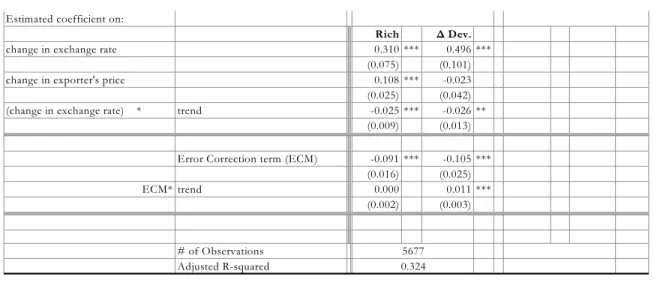
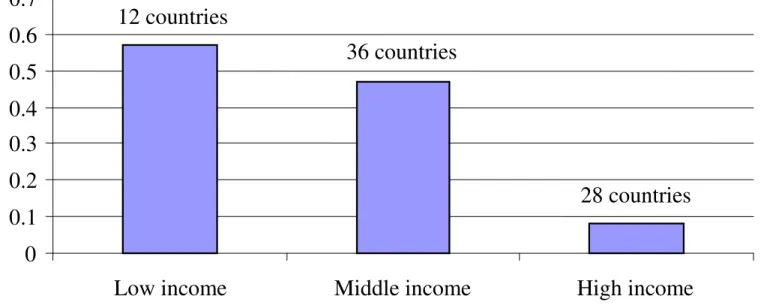
Table 1, taken from Frankel, Parsley and Wei (2005), reports estimates for passthrough to prices of narrowly defined retail imports into 76 countries. Notice, first, confirmation of the conventional wisdom that passthrough has historically been higher in developing countries than in rich countries. As of the beginning of our sample period, 1990, the coefficient was .3 for rich countries and .8 for developing countries, with the difference highly significant statistically. (Figure 3 illustrates the numbers on average during our sample period.) That these numbers fall below 1.0 cannot be attributed to compositional effects, as the 8 goods are defined very narrowly: a roll of color film, a carton of Marlboro cigarettes, an issue of Time magazine, a bottle of Cointreau, etc.
Theories of slow or incomplete passthrough can be divided according to what sort of arbitrage barrier they posit as blocking the enforcement of the law of one price:
barriers to international trade such as tariffs and transportation costs, or local costs of distribution and retail. The results in Frankel, Parsley and Wei (2005) furnish support for both sorts of theories. Bilateral distance is a statistically significant determinant of the Error Correction Mechanism (ECM) term; that is, higher transport costs lead to slower passthrough to import prices. At the same time, a higher wage – the largest component of local distribution and retail costs – also shows up as a significant negative determinant of the passthrough coefficient.24 Both determinants apply to rich and poor
24 Table 1 applies only to prices of retail imports. But results for prices at other stages, reported in Frankel, Parsley and Wei (2005), supply further evidence that both kinds of arbitrage barriers are operative. On the one hand, passthrough is incomplete even for the prices of these imported commodities at dockside, which suggests that local distribution costs cannot be the only barrier to arbitrage – transport costs, tariffs, and other trade barriers must matter as well. In support of this conclusion, distance has an important effect, either reducing or slowing passthrough, at all four stages -- dockside imports, retail, competitors’ prices, and the CPI. On the other hand, passthrough behavior for retail imports is more like behavior for local substitutes than it is like imports at the dock,
countries alike. Size does not appear as a determinant in most of our results: small countries do not experience more passthrough than large, a very surprising finding in light of “pricing to market” theories (i.e., price discrimination by sellers).
For present purposes, the important point is that the passthrough coefficient fell significantly in the course of the 1990s, and that the speed of decline was twice as fast among developing countries as among rich (.051 per year as compared to .025).25 The
speed of passthrough, which is estimated in the form of an ECM term, also shows a
significant downward trend for developing countries (not for rich).
One might wonder if this estimated decline in the passthrough coefficient during the 1990s is an indirect reflection of an asymmetry whereby passthrough of depreciation is greater than passthrough of appreciation, or a threshold effect whereby large
devaluations result in proportionately less passthrough. We have found in extensions that the answer is “no;” the trend remains even after controlling for the big
devaluations.26
which suggests that tariffs and transportation costs cannot be the only barrier to arbitrage – local distribution matters too. In support of this conclusion, higher wages have a strong negative effect on passthrough to the local competitors’ prices and the CPI.
25 Taken literally, the estimated trend is strong enough to bring the passthrough coefficient to zero by 2006. This conclusion may to some extent be an artifact of the assumption of a linear trend that should not be extrapolated. But when we try a different functional form that allows the effect of time to asymptote to zero (the
reciprocal of time), we get a similar result: the passthrough coefficient falls most of the way to zero during the sample period.
26 The threshold effect, while significant, goes the wrong way: changes in the exchange rate above 25% are found to have proportionately larger passthrough effects, not smaller. We did find strong evidence of asymmetry. In fact we cannot reject the hypothesis that appreciation is not passed through at all, suggesting downward price rigidity. This is an interesting finding. But the significant downward trend in the passthrough coefficient remains.
One would expect passthrough to prices of domestically produced goods or the general CPI to be (even) lower than to prices of imports. Our paper also reports results for other local price measures, and this is indeed the pattern they show. (See Figure 2). Tariffs and distance both contribute significantly to low passthrough to the CPI. But passthrough to prices of local substitutes and to the CPI both show the same downward trends over the sample period as passthrough to import prices. The difference in coefficient trends between poor and rich countries is even greater for passthrough to the CPI than it is for import prices. This is important, in the present context, because most of the potential contractionary effects of devaluation require that passthrough extend beyond import prices alone, to include also passthrough to locally produced goods or the CPI.
What can we say about the reasons for the decline in passthrough? As noted, one hypothesis proposed by others is declining long-run inflation rates. This factor turns out to be particularly relevant in the case of explaining the downward trend in passthrough to developing country CPIs.
Another possible explanation for the trend is rising labor costs in retail and distribution. We find that wages are a significant determinant of passthrough. The wage hypothesis turns out to be particularly relevant in the case of explaining the downward trends in passthrough either to the prices of local substitutes or to the CPI (reported in Frankel, Parsley and Wei, 2005). Controlling for wages reverses an estimated tendency for passthrough to the CPI to decline as country income per capita grows. A possible interpretation is that the role of distribution and retail costs in pricing
to market becomes increasingly important as countries achieve higher incomes, owing to the Balassa-Samuelson-Baumol effect.
In any case, most of the decline in passthrough remains unexplained, despite the many contributing factors we estimated.27 The strongest conclusion is simply that incomplete passthrough is another respect in which developing countries have become a bit more like rich countries, for whatever reason.
3.2 The balance sheet effect
If the contractionary effects that rely on passthrough to higher goods prices do not explain the recessions that followed many of the 1990s devaluations, then what does? On the list of contractionary channels, the balance sheet effect is the one that has dominated in terms of attention from researchers, and I think appropriately so. Domestic banks and firms had large debts denominated in foreign currencies, particularly in dollars. They , which they might have been able to service these debts at the previous exchange rate, but which they had trouble servicing after the price of foreign exchange had gone up sharply. The results were lay-offs and bankruptcies.28
27 Another variable we looked at is long-run exchange rate variability. Here the
influence could go either way. On the one hand, if exchange rate variability is another sign of monetary instability, like the inflation rate, it might be thought to contribute to faster passthrough; there is some support for this effect in the case of import prices in developing countries. On the other hand Froot and Kemperer (1989), Krugman (1989) and Taylor (2000) have suggested that when exchange rate fluctuations are largely transitory, passthrough is lower, an effect that is supported in the case of passthrough to the CPI in developing countries. Indeed, an increase in exchange rate variability in the late 1990s can apparently explain fully the significant downward trend in the speed of adjustment of the CPI.
28 The analytical literature on balance sheet effects and output contraction includes, but is not limited to: Aghion, Banerjee and Bacchetta (2000), Cespedes, Chang and Velasco (2003, 2004), Chang and Velasco (1999), Caballero and Krishnamurty (2002),
There is plenty of evidence of the output cost associated with the balance sheet effect. Looking at the experience of the 1990s, Cavallo, Kisselev, Perri and Roubini (2002) show that countries entering a crisis with high levels of foreign debt tend to experience large real exchange rate overshooting (devaluation in addition to the long run equilibrium level) and large output contractions. Similarly, Guidotti, Sturzenneger and Villar (2003) find evidence that liability dollarization worsens output recovery after a sudden stop in capital inflows. Céspedes (2004) finds that the interaction of real devaluation and external debt has a significant negative effect on output.
It is easier to point out the problem of “mismatch” -- between the currency of denomination of a country’s debts and the currency that its firms earn -- than it is to identify a remedy or even a cause. It is not enough to instruct firms to avoid dollar debts or to hedge them, because international investors are not very interested in lending to these countries in their own currencies. The result of following a rule to avoid
borrowing in foreign currency would thus be to borrow less in total (which admittedly might not be such a bad outcome). Eichengreen and Hausmann (1999) have made the inability to borrow in local currencies famous under the name “original sin.” The phrase is meant to imply that the problem is not the fault of the countries themselves, or at least not the fault of recent governments. But we need not accept that it is completely pre-determined.29
Christiano, Gust and Roldos (2002), Dornbusch (2002), Jeanne and Zettelmeyer (2005), Kiyotaki and Moore (1997), Krugman (1999), Mendoza (2002), and Schneider and Aaron Tornell (2001).
29 One school of thought is that the choice of an adjustable peg regime, or other
intermediate exchange rate regime, leads to dangerously high unhedged foreign-currency borrowing. It is argued that a floating regime would force borrowers to confront the existence of exchange rate risk, and thereby reduce unhedged foreign-currency borrowing (e.g., Eichengreen, 1999, p. 105). This sounds like an argument that governments
4. How Might Debtors Mitigate Contractionary Currency Crashes?
One need not dismiss the charge that international financial markets discriminate against developing countries in a number of ways in order to discuss respects in which debtors have some responsibility for their own fate. Let us consider two. One respect is short-run, and one is long-run.
4.1 Shifts on the balance sheet during the “procrastination phase”
The short-run question over which countries have some control arises during the interval that I have called the period of procrastination. When foreign investors lose their previous enthusiasm for financing a country’s current account deficit, the national policy makers must decide whether to adjust, or to wait. Typically they wait. Countries that had previously managed to keep dollar-denominated debt relatively low, tend to switch the composition of their debt in that direction during the year or so preceding the ultimate currency crash, in order to entice skeptical foreign investors to stay in.
A prime example is Mexico during the course of 1994. International enthusiasm for investing in Mexico began to decline after the beginning of the year. The authorities clung to the exchange rate target and delayed adjustment, in the hopes circumstances would turn around. Most obviously, during much of the year they ran down reserves, as
should introduce gratuitous volatility, because private financial agents underestimate risk. But the models of Chamon and Hausmann (2005), Chang and Velasco (2004), Jeanne
(2005), and Pathak and Tirole (2004) point to this advantage of floating, with only fundamentals-generated uncertainty and rational expectations. Hausmann and Panizza (2003) find empirical support only for an effect of country size on original sin, not for an effect of income level or exchange rate regime. Goldstein and Turner (2004) point out things countries can do to reduce currency mismatch.
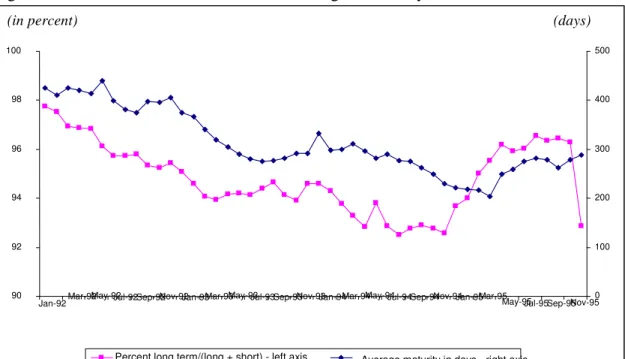
shown in Figure 4. But an important second mechanism of delay was to placate nervous investors by offering them tesobonos (short-term dollar linked bonds) in place of the peso bonds (Cetes) that they had previously held. Figure 5 shows the dramatic increase in dollar-linked debt during the year leading up to the peso crisis of December 1994. It seems likely that the magnitude of the Mexican recession in 1995 stemmed, not just from the adverse balance sheet effects that have been so frequently noted, but particularly from the adverse shift in balance sheets that took place during the course of 1994. A third mechanism of delay was a shift toward shorter maturities, illustrated in Figure 6.30 And the fourth has already been noted, an explicit commitment to defend the peg.
These mechanisms are part of a strategy that is sometimes called “gambling for resurrection.” What they have in common, beyond achieving the desired delay, is helping to make the crisis worse when it does come, if it comes.31 It is harder to restore confidence after a devaluation if reserves are near zero and the ministers have lost personal credibility. Further, if the composition of the debt has shifted toward the short term, in maturity, and toward the dollar, in denomination, then restoring external balance is likely to wreak havoc with private balance sheets regardless the combination of
increases in interest rate versus increases in exchange rate.
The lesson? Adjust sooner rather than later (which is admittedly easier said than done).
30 E.g., Broner, Lorenzoni, and Schmukler (2004).
31 This helps explain why the ratio of short-term foreign debt to reserves appears most so often and so robustly in the literature on early warning indicators for currency crashes. Examples include Berg, Borensztein, Milesi-Ferreti, and Pattillo (1999),Frankel and Rose (1996), Frankel and Wei (2005, Table 2), Goldstein, Kaminsky and Reinhart (2000), Mulder, Perrelli and Rocha (2002), Rodrik and Velasco (2000), and many other references given in those papers.
4.2 Openness to trade reduces vulnerability to currency crises
One final question concerns an aspect of the structure of the economy that can be influenced by policy but only in the long-run: the degree of integration with respect to international trade. Broadly speaking, there are two opposing views on the relationship between a country’s openness and whether it is prone to sudden stops or currency crashes. The first view is that openness makes a country more vulnerable to sudden stops. A country highly integrated into world markets is more exposed to shocks coming from abroad. The second view is that countries that are open to international trade are less
vulnerable to sudden stops. If the ratio of trade to GDP is structurally high, it is easier to adjust to a cut-off in international financing of a given magnitude. I will describe a new test of the relationship between trade openness and vulnerability to sudden stops to help choose between the two hypotheses. Such tests have been done before, but usually without taking into account the possible endogeneity of trade. The incremental contribution here is to use the gravity instrument for trade openness -- which aggregates geographically-determined bilateral trade across a country’s partners -- to correct for the possible endogeneity of trade.
The view that trade openness makes countries more vulnerable to crises comes in a number of forms. One variant is that a weakening in a country’s export markets is sometimes the trigger for a sudden stop in capital flows, so that a high-trade country is more vulnerable. Another variant notes that sudden stops in finance often extend to a loss in trade credit -- especially for imports, but sometimes also even for exports -- and that the resulting shrinkage in trade is more painful if trade was a larger share of the economy
to begin with. A third variant says that financial openness raises vulnerability to sudden stops, and openness to trade in practice goes hand in hand with openness to financial flows.32 In the limiting case, a country that is in autarky with respect to trade must have a net capital account of zero owing to the balance of payments adding-up constraint. Regardless the specific reasoning, the notion that globalization leads to crises is a generalization that appeals to many.
The view that openness to trade makes countries less vulnerable also comes with a number of different specific mechanisms that have been proposed. Eaton and Gersovitz (1981) and Rose (2002) argue that the threatened penalty of lost trade is precisely the answer to the riddle “why do countries so seldom default on their international debts?” Strong trade links are statistically correlated with low default probabilities. International investors will be less likely to pull out of a country with a high trade/GDP ratio, because they know the country is less likely to default. A higher ratio of trade is a form of “giving hostages” that makes a lending cutoff less likely.
Another variant of the argument that openness reduces vulnerability takes as the relevant penalty in a crisis the domestic cost of adjustment, i.e., the difficulty of eliminating a newly-unfinanceable trade deficit. The argument goes back at least to Sachs (1985, p.548). He suggested that Asian countries had been less vulnerable to dislocations than Latin American countries in the international debt crisis of the 1980s -- despite similar debt/GDP ratios -- because they had higher export/GDP ratios. The relatively worse performance observed in Latin America was due to the lower availability of export
32 For example because much trade needs multinational corporations, who in turn need to be able to move money across national borders; or because it is harder to enforce capital controls if trade is free. Aizenman (2003), and Aizenman and Noy (2004).
revenue to service debt. More recently, Guidotti et. al. (2004) make a similar point by providing evidence that economies that trade more recover fairly quickly from the output contraction that usually comes with the sudden stop, while countries that are more closed suffer sharper output contraction and a slower recovery.
Consider first a country that faces a given cut-off in financing, and must adjust without nominal or real exchange rate flexibility. The adjustment must then come through a reduction in spending. To achieve a $1 billion improvement in the trade balance, the contraction has to be $ (1/m) billion, where m is defined as the marginal propensity to import (in a Keynesian model) or the share of spending that falls on tradable goods (in a tradable/nontradable model). The lower is m, the more painful the adjustment. Whether output itself falls depends, of course, primarily on whether wages and prices are flexible. But even in a full-employment world, sharp reductions in consumption are not enjoyable.
Consider, second, a country that does have the option of nominal and real exchange rate flexibility. In traditional textbook models, if the adjustment is achieved in part through nominal and real depreciation, rather than exclusively through expenditure-reduction, the country can accommodate the tougher new financing constraint without necessarily suffering a recession. This is true even if a relatively large devaluation is required to generate the necessary improvement in the trade balance. But since the emerging market crises of 1994-1998, as we have already noted, economists have increasingly emphasized the contractionary balance sheet effect: if the country’s debts are denominated in foreign currency, the balance sheets of the indebted banks and corporations are hit in proportion to the devaluation. If the economy is starting from a
high ratio of trade to GDP the necessary devaluation need not be large, and therefore the adverse balance sheet effect need not be large. But if the economy is not very open to trade to begin with, the necessary devaluation, and the resulting balance sheet impact and recession, will all be large. Again we arrive at the result that whether the necessary adjustment will be large and painful depends inversely on openness.
The balance sheet version of the openness story is modeled formally by Calvo, Izquierdo, and Talvi (2003) and Cavallo (2004). Both have in mind the example of Argentina, which has traditionally had a low ratio of trade to GDP, and has suffered some of the worst sudden stops.33 But the hypothesis that openness to trade reduces a country’s vulnerability to sudden stops transcends any one formal model, causal link, or country example. The same is true of the opposing hypothesis, that openness raises a country’s vulnerability. It would be useful to be able to choose empirically between the two competing hypotheses.
I will report new results -- from Cavallo and Frankel (2004) -- for two questions. (1) What is the effect of openness on vulnerability to “sudden stops” implemented by a probit model measuring the probability of a sudden reduction in the magnitude of net capital inflows, following closely the definition of Calvo, Izquierdo and Mejía (2004)? 34 (2) What is the effect of openness on vulnerability to “currency crises,” implemented by a probit model representing the probability of a sudden increase in exchange market
33 Others who have argued that Argentina’s low trade/GDP ratio helps explain why it was such a victim of the global sudden stop after 1999 include Calvo, Izquierdo, and Mejia (2003), Calvo and Talvi (2004), Desai and Mitra (2004) and Treasury Secretary Paul O’Neill, who once reportedly said it was unsurprising the Argentines had lost the confidence of investors because they don’t export anything.
34 To the best of my knowledge, the increasingly popular expression “Sudden Stops” was first used by Dornbusch, Goldfajn and Valdes (1995). The first analytic approach to the problem of sudden stops is Calvo (1998).
pressure, which is in turn defined as the percentage depreciation plus percentage loss in foreign exchange reserves? In addition to analyzing the probit model of this exchange market pressure definition of a currency crisis, as in Frankel and Wei (2005) we also looked at the output loss subsequent to a crisis.
There is no reason, a priori, why something (openness) that makes the consequences of sudden stops better (less contractionary devaluations) should also necessarily make them less frequent. Or that something that makes the consequences worse should also make them more frequent. Indeed some theories are based on the notion that the worse the consequences, the less often it will happen. But in our results the effects turn out to go the same way, regardless which concept of performance is used.
Calvo, Izquierdo and Mejía (2004) and Edwards (2004a, b) are among the empirical papers that find that openness to trade is associated with fewer sudden stops. On the other hand, Milesi-Ferretti and Razin (1998, 2000) find that openness helps trigger crises and/or sharp reversals of the current account. Most of these papers use the trade/GDP ratio as the measure for openness to trade.
A critic might argue that the trade/GDP ratio is endogenous. One way in which trade openness could be endogenous is via income: countries tend to liberalize trade barriers as they grow richer -- in part because their mode of public finance gradually shifts from tariff revenue to income or VAT taxes. A second way is that trade liberalization could be part of a more general reform strategy driven by pro-globalization philosophy or “Washington Consensus” forces. Other aspects of such a reform program, such as privatization, financial liberalization, or macroeconomic stabilization might affect the probability of crises, and yet an OLS regression analysis might inappropriately
attribute the effect to trade. A third way that trade openness could be endogenous is that experience with crises -- the dependent variable -- may itself cause liberalization, via an IMF program. Or it might have the opposite effect, if a country’s response to a crash is disenchantment with globalization and the Washington Consensus. A fourth way in which trade openness could be endogenous is through the feedbacks between trade and financial openness.
How can the endogeneity of trade be addressed? We use gravity estimates to construct an instrumental variable for trade openness, the methodology developed by Frankel and Romer (1999), in the context of the effect of trade on growth, and updated in the Frankel and Rose (2002) dataset.
The results reported in Table 2 show that openness reduces vulnerability to sudden stops rather than increasing it.35 Not only does this relationship hold up when we move from OLS to instrumental variables, but it appears stronger. The degree of trade openness is a powerful predictor of these capital account shocks: moving from Argentina’s current trade share (approximately .20 of GDP) to Australia’s average trade share (approximately .30 of GDP), reduces the probability of a sudden stop by 32%. The results for openness are the same when we seek to explain currency crashes. Trade protectionism does not “shield” countries from the volatility of world markets as proponents might hope. On the contrary, less trade openness leads to greater vulnerability to sudden stops and currency crashes. In fact out of the set of controls we tried, openness is the only variable that is virtually always statistically significant.36
35 A more complete set of results is reported in Cavallo and Frankel (2004).
36 The current account deficit as a share of GDP is always highly significant in the probit regressions to determine sudden stops, and liability dollarization is sometimes; but not in
4.3 Conclusion
There are thus at least two ways of seeking to minimize vulnerability to sudden stops, devaluations, and associated economic contractions: keeping the economy open to trade, and keeping balance sheets strong by avoiding a shift to short-term dollar debt as a means of procrastination., and keeping the economy open to trade. TWe began this lecture began by noting the frequency with which political leaders and ministers lose office after a devaluation. But seeking to hold on to political viability is presumably the precise reason why governments often procrastinate, why they feel they have to postpone adjustment to balance of payments deficits, and instead run down reserves, shorten the maturity of the debt, and borrow in dollars. So the openness strategy may be the most robust option, politically as well as economically.
the currency crash equation. The reserve/import ratio is always highly significant in the currency crash regression, and sometimes foreign debt/GDP and nominal exchange rate rigidity, but not so in the first equation.
Figure 1a. Attaining Internal and External Balance: Traditional Version Overheating Internal E balance (Price of foreign Recession exchange) or other spending- switching policy
Surplus New external balance Deficit Original
external balance
Figure 1b. Attaining Internal and External Balance: When Devaluation is Contractionary E (price of foreign exchange) or other spending- New switching external
policy Recession balance
Internal
balance
Table 1: Determination of Passthrough to Imported Goods Prices:
Developing Countries, Relative to Rich Countries (76 countries,1990-2001) Source: Frankel, Parsley, and Wei (20054).
! " # # # " # " # $ $% " " # $% # & '( ) * +, -"., / 0 1 / 0 2) 2 # 3 ) 2 , 4 1) 2, 56 7 )5 2, ( 2, 2( 22 5- 5
The 8 import commodities (given with their country of origin) are: Marlboro Cigarettes (US), Coca-cola (US), Cognac (France), Gilbey’s gin (US), Time magazine (US), Kodak Color Film (US), Cointreau Liqueur (France), and Martini & Rossi Vermouth (Italy).
Source: Frankel, Parsley, andWei (2004) – effect within one year, in 76 countries. Note:: Passthrough is greatest for prices of imports at dock, but less for retail and CPI
Figure 2. Exchange Rate Passthrough to Domestic Prices
0.2
0.4
0.6
At the dock
Imported good
prices
Local
competitor
prices
Consumer price
index
passthrough coefficient
Source: Frankel, Parsley & Wei (2004) – Prices for 8 narrowly defined commodities imported into 76 countries; effect of exchange rate change within one year.
Note: Passthrough for less developed countries is greater than for rich countries, historically.
Figure 3: Pass-through and Income
(Average 1990-2001;
Country grouping based on world bank classification)
12 countries
36 countries
28 countries
0
0.1
0.2
0.3
0.4
0.5
0.6
0.7
Low income
Middle income
High income
Figure 4. Evolution of Mexico’s Reserves, from Sudden Stop to 1994 Currency Crash
Source: IMF International Financial Statistics
5 10 15 20 25 30 1992M121993M11993M21993M31993M41993M51993M6 1993M71993M81993M9 1993M101993M111993M121994M11994M21994M31994M41994M51994M61994M71994M81994M9 1994M101994M111994M121995M11995M21995M31995M4
Level 3-month moving average
CRISIS
IMF PROGRAM
Figure 5. Evolution of Mexican Debt According to Currency Denomination, 1992-95
Source: Mexican Ministry of Finance and Public Credit.
Figure 6. Evolution of Mexican Debt According to Maturity, 1992-95
Source: Mexican Ministry of Finance and Public Credit.
(in percent) 0 10 20 30 40 50 60 70 80
Jan-92Mar-92May-92Jul-92Sep-92Nov-92Jan-93Mar-93May-93Jul-93Sep-93Nov-93Jan-94Mar-94May-94 Jul-94 Sep-94
Nov-94Jan-95Mar-95May-95Jul-95Sep-95Nov-95
Tesobonos/(tesobonos+cetes) Tesobonos/total domestic debt
(in percent) (days)
90 92 94 96 98 100
Jan-92Mar-92May-92Jul-92Sep-92Nov-92Jan-93Mar-93May-93Jul-93Sep-93Nov-93Jan-94Mar-94May-94Jul-94Sep-94Nov-94Jan-95Mar-95May-95Jul-95Sep-95Nov-950 100 200 300 400 500
Table 2:
Effect of openness (trade/GDP) on vulnerability to sudden stops and currency crashes Source: Cavallo and Frankel (2004)
To predict sudden stops
(Calvo et al definition) (Frankel & Wei, 20054 definition) To predict currency crashes
Ordinary probit IV Ordinary probit IV
Trade openness t (0.259)** -0.53 (0.813)** -2.45 (0.269)** -0.57 (0.918)* -1.73 Foreign Debt/GDP t-1 (0.217) -0.080 (0.275) 0.196 (0.231) 0.23 (0.373) 0.59 Liability Dollarizationt-1 0.316 (0.195) (0.256)**0.591 (0.249)0.027 (0.234)0.18
Exchange rate rigidity (0.094)0.13 (0.113)* 0.22
CA/GDP t-1 (1.297)** -4.068 (2.06)***-7.386 (1.392)-0.272 (1.455) 0.66 ln Reserves in Months of Imports t-1 -0.26 (0.082)*** (0.099)***-0.37 Constant (0.63)***-2.544 (0.723)**-1.73 (0.749) -0.99 (0.786) 0.304 Obs. 778 1062 557 841
Robust standard errors reported in parenthesis. *** Statistically Significant at 1%
** Statistically Significant at 5% * Statistically Significant at 10%
Estimation performed with regional dummies and year fixed effects.
References
Aghion, P., P. Bacchetta, and A. Banerjee, 2000, “A Simple Model of Monetary Policy and Currency Crises,” European Economic Review, Vol. 44, Nos. 4-6 (May), pp 728-738.
Aizenman, Joshua, 2003, “On the Hidden Links Between Financial and Trade Opening,” NBER Working Paper No. w9906 (Cambridge: National Bureau of Economic Research).
Aizenman, Joshua, and I. Noy, 2004, “On the Two Way Feedback between Financial and Trade Openness,” NBER Working Paper No. 10496 (Cambridge: National Bureau of Economic Research).
Berg, Andrew, Eduardo Borensztein, Gian Maria Milesi-Ferreti, and Catherine Pattillo. 1999. “Anticipating Balance of Payments Crises: The Role of Early Warning Systems.” Occasional Paper 186 (Washington, D.C.: International Monetary Fund).
Bienen, Henry, and Mark Gersovitz, 1985, “Economic Stabilization, Conditionality, and Political Stability,” International Organization, 39, no. 4 (Autumn): pp. 728-754.
Borensztein, Eduardo, and Jose De Gregorio, 1999, “Devaluation and Inflation after Currency Crises,” (Washington, D.C.: International Monetary Fund).
Brender, Adi, and Alan Drazen, 2004, “Political Budget Cycles in New Versus Established Democracies,” NBER WP No. 10539 (Cambridge: National Bureau of Economic Research). Broner, Fernando, Guido Lorenzoni, Sergio Schmukler, 2004, “Why Do Emerging Economies Borrow Short Term?” Fifth Annual Research Conference, International Monetary Fund, November.
Burstein, Ariel, Martin Eichenbaum, and Sergio Rebelo, 2002, “Why Are Rates of Inflation So Low After Large Devaluations?” NBER Working Paper No. 8748 (Cambridge, Massachusetts: National Bureau of Economic Research), January.
Caballero, R., and A. Krishnamurthy, 2003, “Excessive Dollar Debt: Financial Development and Underinsurance,” Journal of Finance, Vol. 58, No. 2 (April), pp. 867-893.
Calvo, Guillermo A., 1998, “Capital Flows and Capital-Market Crises: The Simple Economics of Sudden Stops,” Journal of Applied Economics (CEMA), Vol. 1, No. 1., pp 35-54.
Calvo, Guillermo A., Alejandro Izquierdo and Luis Fernando Mejía, 2003, “On the Empirics of Sudden Stops,” American Development Bank Working Paper. (Washington, D.C. Inter-American Development Bank).
Calvo, Guillermo, Alejandro Izquierdo, and Ernesto Talvi, 2003, “Sudden Stops, The Real Exchange Rate, and Fiscal Sustainability: Argentina’s Lessons,” NBER Working Paper 9828(Cambridge: National Bureau of Economic Research).
Calvo, Guillermo, and Ernesto Talvi, 2004, “Sudden Stop, Financial Factors and Economic Collapse: A View from the Latin American Frontlines,” in From the Washington Consensus Towards a New Global Governance, Barcelona, Sept. 24-26.