Incorporating Content Structure into Text Analysis Applications
Christina Sauper, Aria Haghighi, Regina Barzilay
Computer Science and Artificial Intelligence Laboratory Massachusetts Institute of Technology
{csauper, aria42, regina}@csail.mit.edu
Abstract
In this paper, we investigate how modeling content structure can benefit text analysis ap-plications such as extractive summarization and sentiment analysis. This follows the lin-guistic intuition that rich contextual informa-tion should be useful in these tasks. We present a framework which combines a su-pervised text analysis application with the in-duction of latent content structure. Both of these elements are learned jointly using the EM algorithm. The induced content struc-ture is learned from a large unannotated cor-pus and biased by the underlying text analysis task. We demonstrate that exploiting content structure yields significant improvements over approaches that rely only on local context.1
1 Introduction
In this paper, we demonstrate that leveraging doc-ument structure significantly benefits text analysis
applications. As a motivating example, consider
the excerpt from a DVD review shown in Table 1. This review discusses multiple aspects of a product, such as audio and video properties. While the word “pleased” is a strong indicator of positive sentiment, the sentence in which it appears does not specify the aspect to which it relates. Resolving this ambiguity requires information about global document struc-ture.
A central challenge in utilizing such informa-tion lies in finding a relevant representainforma-tion of con-tent structure for a specific text analysis task. For
1
Code and processed data presented here are available at http://groups.csail.mit.edu/rbg/code/content structure.html
AudioAudio choices are English, Spanish and French Dolby Digital 5.1 ... Bass is still robust and powerful, giving weight to just about any scene – most notably the film’s exciting final fight. Fans should bepleased
with the presentation.
ExtrasThis single-disc DVD comes packed in a black amaray case with a glossy slipcover. Cover art has clearly been designed to appeal the Twilight crowd ... Finally, we’ve got a deleted scenes reel. Most of the excised scenes are actually pretty interesting.
Table 1: An excerpt from a DVD review.
instance, when performing single-aspect sentiment analysis, the most relevant aspect of content struc-ture is whether a given sentence is objective or
sub-jective (Pang and Lee, 2004). In a multi-aspect
setting, however, information about the sentence topic is required to determine the aspect to which a sentiment-bearing word relates (Snyder and Barzi-lay, 2007). As we can see from even these closely re-lated applications, the content structure representa-tion should be intimately tied to a specific text anal-ysis task.
In this work, we present an approach in which a content model is learned jointly with a text analy-sis task. We assume complete annotations for the task itself, but we learn the content model from raw, unannotated text. Our approach is implemented in a discriminative framework using latent variables to represent facets of content structure. In this frame-work, the original task features (e.g., lexical ones) are conjoined with latent variables to enrich the fea-tures with global contextual information. For ex-ample, in Table 1, the feature associated with the 377
word “pleased” should contribute most strongly to the sentiment of the audio aspect when it is aug-mented with a relevant topic indicator.
The coupling of the content model and the task-specific model allows the two components to mutu-ally influence each other during learning. The con-tent model leverages unannotated data to improve the performance of the task-specific model, while the task-specific model provides feedback to im-prove the relevance of the content model. The com-bined model can be learned effectively using a novel EM-based method for joint training.
We evaluate our approach on two complementary text analysis tasks. Our first task is a multi-aspect sentiment analysis task, where a system predicts the aspect-specific sentiment ratings (Snyder and Barzi-lay, 2007). Second, we consider a multi-aspect tractive summarization task in which a system ex-tracts key properties for a pre-specified set of as-pects. On both tasks, our method for incorporating content structure consistently outperforms structure-agnostic counterparts. Moreover, jointly learning content and task parameters yields additional gains over independently learned models.
2 Related Work
Prior research has demonstrated the usefulness of content models for discourse-level tasks. Examples of such tasks include sentence ordering (Barzilay and Lee, 2004; Elsner et al., 2007), extraction-based summarization (Haghighi and Vanderwende, 2009) and text segmentation (Chen et al., 2009). Since these tasks are inherently tied to document structure, a content model is essential to performing them suc-cessfully. In contrast, the applications considered in this paper are typically developed without any dis-course information, focusing on capturing sentence-level relations. Our goal is to augment these models with document-level content information.
Several applications in information extraction and sentiment analysis are close in spirit to our work (Pang and Lee, 2004; Patwardhan and Riloff, 2007; McDonald et al., 2007). These approaches consider global contextual information when de-termining whether a given sentence is relevant to the underlying analysis task. All assume that rele-vant sentences have been annotated. For instance,
Pang and Lee (2004) refine the accuracy of sen-timent analysis by considering only the subjective sentences of a review as determined by an indepen-dent classifier. Patwardhan and Riloff (2007) take a similar approach in the context of information ex-traction. Rather than applying their extractor to all the sentences in a document, they limit it to event-relevant sentences. Since these sentences are more likely to contain information of interest, the extrac-tion performance increases.
Another approach, taken by Choi and Cardie (2008) and Somasundaran et al. (2009) uses lin-guistic resources to create a latent model in a task-specific fashion to improve performance, rather than assuming sentence-level task relevancy. Choi and Cardie (2008) address a sentiment analysis task by using a heuristic decision process based on word-level intermediate variables to represent polarity. Somasundaran et al. (2009) similarly uses a boot-strapped local polarity classifier to identify sentence polarity.
McDonald et al. (2007) propose a model which jointly identifies global polarity as well as paragraph- and sentence-level polarity, all of which are observed in training data. While our approach uses a similar hierarchy, McDonald et al. (2007) is concerned with recovering the labels at all levels, whereas in this work we are interested in using la-tent document conla-tent structure as a means to benefit task predictions.
While our method also incorporates contextual information into existing text analysis applications, our approach is markedly different from the above approaches. First, our representation of context en-codes more than the relevance-based binary distinc-tion considered in the past work. Our algorithm ad-justs the content model dynamically for a given task rather than pre-specifying it. Second, while previ-ous work is fully supervised, in our case relevance annotations are readily available for only a few ap-plications and are prohibitively expensive to obtain for many others. To overcome this drawback, our method induces a content model in an unsupervised fashion and connects it via latent variables to the target model. This design not only eliminates the need for additional annotations, but also allows the algorithm to leverage large quantities of raw data for training the content model. The tight coupling of
rel-evance learning with the target analysis task leads to further performance gains.
Finally, our work relates to supervised topic mod-els in Blei and McAullife (2007). In this work, la-tent topic variables are used to generate text as well as a supervised sentiment rating for the document. However, this architecture does not permit the usage of standard discriminative models which condition freely on textual features.
3 Model
3.1 Problem Formulation
In this section, we describe a model which incorpo-rates content information into a multi-aspect
sum-marization task.2 Our approach assumes that at
training time we have a collection of labeled doc-uments DL, each consisting of the document text
sand true task-specific labelingy∗. For the multi-aspect summarization task,y∗ consists of sequence labels (e.g., value or service) for the tokens of a
document. Specifically, the document text s is
composed of sentences s1, . . . , sn and the label-ings y∗ consists of corresponding label sequences
y1, . . . , yn.3
As is common in related work, we model eachyi
using a CRF which conditions on the observed doc-ument text. In this work, we also assume a content model, which we fix to be the document-level HMM as used in Barzilay and Lee (2004). In this content model, each sentencesi is associated with a hidden topic variableTi which generates the words of the sentence. We will useT = (T1, . . . , Tn)to refer to the hidden topic sequence for a document. We fix the number of topics to a pre-specified constantK.
3.2 Model Overview
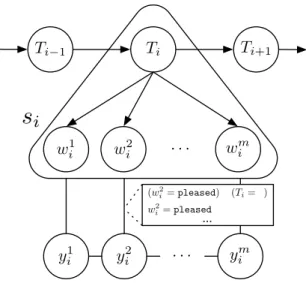
Our model, depicted in Figure 1, proceeds as
fol-lows: First the document-level HMM generates
a hidden content topic sequence T for the
sen-tences of a document. This content component is
parametrized by θand decomposes in the standard
2
In Section 3.6, we discuss how this framework can be used for other text analysis applications.
3
Note that eachyiis a label sequence across the words insi,
rather than an individual label.
y1 i yi2 . . . yim Ti w1 i w2i . . . wmi Ti−1 Ti+1 (w2 i=pleased)∧(Ti= 3) w2 i=pleased ...
s
iFigure 1: A graphical depiction of our model for sequence labeling tasks. TheTivariable represents the content model topic for theith sentencesi. The words of si, (wi1, . . . , wmi ), each have a task label
(y1
i, . . . , yim). Note that each token label has an
undirected edge to a factor containing the words of the current sentence, si as well as the topic of the current sentenceTi. HMM fashion:4 Pθ(s,T) = n Y i=1 Pθ(Ti|Ti−1) Y w∈si Pθ(w|Ti) (1) Then the label sequences for each sentence in the document are independently modeled as CRFs which condition on both the sentence features and the sentence topic:
Pφ(y|s,T) =
n
Y
i=1
Pφ(yi|si, Ti) (2)
Each sentence CRF is parametrized byφand takes
the standard form:
Pφ(y|s, T)∝ exp X j φT fN(yj, s, T) +fE(yj, yj+1) 4
We also utilize a hierarchical emission model so that each topic distribution interpolates between a topic-specific distribu-tion as well as a shared background model; this is intended to capture domain-specific stop words.
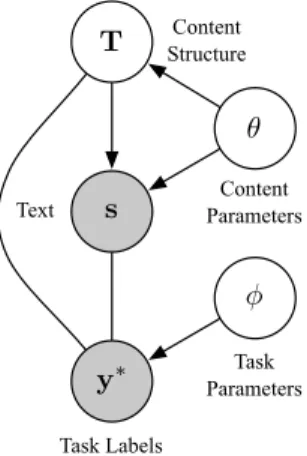
T s y∗ θ φ Content Parameters Task Parameters Task Labels Text Content Structure
Figure 2: A graphical depiction of the generative process for a labeled document at training time (See Section 3); shaded nodes indicate variables which are observed at training time. First the latent
un-derlying content structure T is drawn. Then, the
document textsis drawn conditioned on the content structure utilizing content parametersθ. Finally, the observed task labels for the document are modeled givensandT using the task parametersφ. Note that the arrows for the task labels are undirected since they are modeled discriminatively.
wherefN(·)andfE(·)are feature functions associ-ated with CRF nodes and transitions respectively.
Allowing the CRF to condition on the sentence topicTi permits predictions to be more sensitive to content. For instance, using the example from Ta-ble 1, we could have a feature that indicates the word “pleased” conjoined with the segment topic (see Fig-ure 1). These topic-specific featFig-ures serve to disam-biguate word usage.
This joint process, depicted graphically in Fig-ure 2, is summarized as:
P(T,s,y∗) =Pθ(T,s)Pφ(y∗|s,T) (3) Note that this probability decomposes into a document-level HMM term (the content component) as well as a product of CRF terms (the task compo-nent).
3.3 Learning
During learning, we would like to find the
document-level HMM parametersθand the
summa-rization task CRF parametersφwhich maximize the
likelihood of the labeled documents. The only ob-served elements of a labeled document are the docu-ment textsand the aspect labelsy∗. This objective is given by: LL(φ, θ) = X (s,y∗)∈D L logP(s,y∗) = X (s,y∗)∈D L logX T P(T,s,y∗)
We use the EM algorithm to optimize this objec-tive.
E-Step The E-Step in EM requires computing the posterior distribution over latent variables. In this model, the only latent variables are the sentence top-icsT. To compute this term, we utilize the decom-position in Equation (3) and rearrange HMM and CRF terms to obtain: P(T,s,y∗) =Pθ(T,s)Pφ(y∗|T,s) = n Y i=1 Pθ(Ti|Ti−1) Y w∈si Pθ(w|Ti) ! · n Y i=1 Pφ(y∗ i|si, Ti) ! = n Y i=1 Pθ(Ti|Ti−1)· Y w∈si Pθ(w|Ti)Pφ(y∗ i|si, Ti) !
We note that this expression takes the same form as the document-level HMM, except that in addition to emitting the words of a sentence, we also have an observation associated with the sentence sequence labeling. We treat eachPφ(y∗i|si, Ti)as part of the node potential associated with the document-level HMM. We utilize the Forward-Backward algorithm as one would with the document-level HMM in iso-lation, except that each node potential incorporates this CRF term.
M-Step We perform separate M-Steps for content and task parameters. The M-Step for the content pa-rameters is identical to the document-level HMM
content model: topic emission and transition dis-tributions are updated with expected counts derived from E-Step topic posteriors.
The M-Step for the task parameters does not have a closed-form solution. Recall that in the M-Step, we maximize the log probability of all random vari-ables given expectations of latent varivari-ables. Using the decomposition in Equation (3), it is clear that the only component of the joint labeled document probability which relies upon the task parameters is
logPφ(y∗|s,T). Thus for the M-Step, it is sufficient to optimize the following with respect toφ:
ET|s,y∗logPφ(y∗|s,T) = n X i=1 ETi|si, y∗ i logPφ(y ∗ i|si, Ti) = n X i=1 K X k=1 P(Ti =k|si, y∗ i) logPφ(y ∗ i|si, Ti)
The first equality follows from the decomposition of the task component into independent CRFs (see Equation (2)). Optimizing this objective is equiva-lent to a weighted version of the conditional likeli-hood objective used to train the CRF in isolation. An intuitive explanation of this process is that there are multiple CRF instances, one for each possible hid-den topicT. Each utilizes different content features to explain the sentence sequence labeling. These in-stances are weighted according to the posterior over
T obtained during the E-Step. While this objective is non-convex due to the summation overT, we can still optimize it using any gradient-based optimiza-tion solver; in our experiments, we used the LBFGS algorithm (Liu et al., 1989).
3.4 Inference
We must predict a label sequence y for each
sen-tencesof the document. We assume a loss function over a sequence labelingy and a proposed labeling
ˆ
y, which decomposes as:
L(y,y) =ˆ X
j
L(yj,yˆj)
where each position loss is sensitive to the kind of error which is made. Failing to extract a token is penalized to a greater extent than extracting it with
an incorrect label: L(yj,yˆj) = 0 ifyˆj =yj
c ifyj 6=NONE andyˆj =NONE
1 otherwise
In this definition, NONE represents the background label which is reserved for tokens which do not cor-respond to labels of interest. The constantc repre-sents a user-defined trade-off between precision and recall errors. For our multi-aspect summarization task, we selectc= 4for Yelp andc= 5for Amazon to combat the high-precision bias typical of condi-tional likelihood models.
At inference time, we select the single labeling which minimizes the expected loss with respect to model posterior over label sequences:
ˆ y= min ˆ y Ey|sL(y,y)ˆ = min ˆ y X j=1 Eyj|sL(yj,yˆj)
In our case, we must marginalize out the sentence topicT: P(yj|s) =X T P(yj, T|s) =X T Pθ(T|s)Pφ(yj|s, T)
This minimum risk criterion has been widely used in NLP applications such as parsing (Goodman, 1999) and machine translation (DeNero et al., 2009). Note that the above formulation differs from the stan-dard CRF due to the latent topic variables. Other-wise the inference task could be accomplished by directly obtaining posteriors over eachyjstate using the Forward-Backwards algorithm on the sentence CRF.
Finding yˆcan be done efficiently. First, we ob-tain marginal token posteriors as above. Then, the expected loss of a token prediction is computed as follows:
X
ˆ
yj
P(yj|s)L(yj,yˆj)
Once we obtain expected losses of each token pre-diction, we compute the minimum risk sequence la-beling by running the Viterbi algorithm. The po-tential for each position and prediction is given by
the negative expected loss. The maximal scoring se-quence according to these potentials minimizes the expected risk.
3.5 Leveraging unannotated data
Our model allows us to incorporate unlabeled doc-uments, denotedDU, to improve the learning of the
content model. For an unlabeled document we only observe the document textsand assume it is drawn from the same content model as our labeled docu-ments. The objective presented in Section 3.3 as-sumed that all documents were labeled; here we sup-plement this objective by capturing the likelihood of unlabeled documents according to the content model: LU(θ) = X s∈DU logPθ(s) = X s∈DU logX T Pθ(s,T)
Our overall objective function is to maximize the likelihood of both our labeled and unlabeled data. This objective corresponds to:
L(φ, θ) =LU(θ) +LL(φ, θ)
This objective can also be optimized using the EM algorithm, where the E-Step for labeled and unla-beled documents is outlined above.
3.6 Generalization
The approach outlined can be applied to a wider range of task components. For instance, in Sec-tion 4.1 we apply this approach to multi-aspect sen-timent analysis. In this task, the targetyconsists of numeric sentiment ratings(y1, . . . , yK)for each of
Kaspects. The task component consists of indepen-dent linear regression models for each aspect sen-timent rating. For the content model, we associate a topic with each paragraph; T consists of assign-ments of topics to each document paragraph.
The model structure still decomposes as in Fig-ure 2, but the details of learning are slightly differ-ent. For instance, because the task label (aspect sen-timent ratings) is not localized to any region of the document, all content model variables influence the target response. Conditioned on the target label, all
topic variables become correlated. Thus when learn-ing, the E-Step requires computing a posterior over paragraph topic tuplesT:
P(T|y,s)∝P(s,T)P(y|T,s)
For the case of our multi-aspect sentiment task, this computation can be done exactly by enumerating
T tuples, since the number of sentences and
pos-sible topics is relatively small. If summation is in-tractable, the posterior may be approximated using variational techniques (Bishop, 2006), which is ap-plicable to a broad range of potential applications.
4 Experimental Set-Up
We apply our approach to two text analysis tasks that stand to benefit from modeling content structure: multi-aspect sentiment analysis and multi-aspect re-view summarization.
4.1 Tasks
In the following section, we define each task in de-tail, explain the task-specific adaptation of the model and describe the data sets used in the experiments. Table 2 summarizes statistics for all the data sets.
For all tasks, when using a content model with a task model, we utilize a new set of features which include all the original features as well as a copy of each feature conjoined with the content topic as-signment (see Figure 1). We also include a fea-ture which indicates whether a given word was most likely emitted from the underlying topic or from a background distribution.
Multi-Aspect Sentiment Ranking The goal of multi-aspect sentiment classification is to predict a set of numeric ranks that reflects the user satisfaction for each aspect (Snyder and Barzilay, 2007). One of the challenges in this task is to attribute sentiment-bearing words to the aspects they describe. Informa-tion about document structure has the potential to greatly reduce this ambiguity.
Following standard sentiment ranking
ap-proaches (Wilson et al., 2004; Pang and Lee, 2005; Goldberg and Zhu, 2006; Snyder and Barzilay, 2007), we employ ordinary linear regression to independently map bag-of-words representations
into predicted aspect ranks. In addition to
Task Labeled Unlabeled Avg. Size
Train Test Words Sents
Multi-aspect sentiment 600 65 — 1,027 20.5
Multi-aspect summarization
Amazon 35 24 12,684 214 11.7
Yelp 48 48 33,015 178 11.2
Table 2: This table summarizes the size of each corpus. In each case, the unlabeled texts of both labeled and unlabeled documents are used for training the content model, while only the labeled training corpus is used to train the task model. Note that the entire data set for the multi-aspect sentiment analysis task is labeled.
with content features as described above. For this application, we fix the number of HMM states to be equal to the predefined number of aspects.
We test our sentiment ranker on a set of DVD
re-views from the website IGN.com.5 Each review is
accompanied by 1-10 scale ratings in four categories that assess the quality of a movie’s content, video, audio, and DVD extras. In this data set, segments corresponding to each of the aspects are clearly de-lineated in each document. Therefore, we can com-pare the performance of the algorithm using auto-matically induced content models against the gold standard structural information.
Multi-Aspect Review Summarization The goal of this task is to extract informative phrases that identify information relevant to several predefined aspects of interest. In other words, we would like our system to both extract important phrases (e.g.,cheap food) and label it with one of the given aspects (e.g.,
value). For concrete examples and lists of aspects for each data set, see Figures 3b and 3c. Variants of this task have been considered in review summariza-tion in previous work (Kim and Hovy, 2006; Brana-van et al., 2009).
This task has elements of both information extrac-tion and phrase-based summarizaextrac-tion — the phrases we wish to extract are broader in scope than in stan-dard template-driven IE, but at the same time, the type of selected information is restricted to the de-fined aspects, similar to query-based summarization. The difficulty here is that phrase selection is highly context-dependent. For instance, in TV reviews such as in Figure 3b, the highlighted phrase “easy to read” might refer to either the menu or the remote; broader
5http://dvd.ign.com/index/reviews.html
context is required for correct labeling.
We evaluated our approach for this task on two data sets: Amazon TV reviews (Figure 3b) and Yelp restaurant reviews (Figure 3c). To eliminate noisy reviews, we only retain documents that have been rated “helpful” by the users of the site; we also re-move reviews which are abnormally short or long.
Each data set was manually annotated with aspect labels using Mechanical Turk, which has been used in previous work to annotate NLP data (Snow et al., 2008). Since we cannot select high-quality annota-tors directly, we included a control document which had been previously annotated by a native speaker among the documents assigned to each annotator. The work of any annotator who exhibited low agree-ment on the control docuagree-ment annotation was
ex-cluded from the corpus. To test task annotation
agreement, we use Cohen’s Kappa (Cohen, 1960). On the Amazon data set, two native speakers anno-tated a set of four documents. The agreement be-tween the judges was 0.54. On the Yelp data set, we simply computed the agreement between all pairs of reviewers who received the same control documents; the agreement was 0.49.
4.2 Baseline Comparison and Evaluation Baselines For all the models, we obtain a baseline system by eliminating content features and only us-ing a task model with the set of features described above. We also compare against a simplified vari-ant of our method wherein a content model is in-duced in isolation rather than learned jointly in the context of the underlying task. In our experiments, we refer to the two methods as the No Content Model (NoCM) and Independent Content Model (IndepCM) settings, respectively. The Joint Content
M = Movie V = Video A = Audio E = Extras M This collection certainly offers some nostalgic
fun, but at the end of the day, the shows themselves, for the most part, just don't hold up. (5)
V Regardless, this is a fairly solid presentation, but it's obvious there was room for improvement. (7) A Bass is still robust and powerful. Fans should be pleased with this presentation. (8)
E The deleted scenes were quite lengthy, but only shelled out a few extra laughs. (4)
(a) Sample labeled text from the multi-aspect sentiment corpus [RBig multifunction remote] with [R
easy-to-read keys]. The on-screen menu is [Measy to use] and you [Mcan rename the inputs] to one of several options (DVD, Cable, etc.).
R = Remote M = Menu I = Inputs E = Economy V = Video S = Sound A = Appearance F = Features
I bought this TV because the [Voverall picture quality is good] and it's [A unbelievably thin].
[IPlenty of inputs], including [I2 HDMI ports], which is [Eunheard of in this price range].
(b) Sample labeled text from the Amazon multi-aspect summa-rization corpus
[FAll the ingredients are fresh], [Vthe sizes are
huge] and [Vthe price is cheap]. F = Food A = Atmosphere V = Value S = Service O = Overall
[O This place rocks!] [VPricey, but worth it].
[A The place is a pretty good size] and
[Sthe staff is super friendly].
(c) Sample labeled text from the Yelp multi-aspect summarization corpus
Figure 3: Excerpts from the three corpora with the corresponding labels. Note that sentences from the multi-aspect summarization corpora generally focus on only one or two aspects. The multi-aspect senti-ment corpus has labels per paragraph rather than per sentence.
Model (JointCM) setting refers to our full model de-scribed in Section 3, where content and task compo-nents are learned jointly.
Evaluation Metrics For multi-aspect sentiment ranking, we report the average L2 (squared differ-ence) and L1 (absolute difference) between system prediction and true 1-10 sentiment rating across test documents and aspects.
For the multi-aspect summarization task, we mea-sure average token precision and recall of the label assignments (Multi-label). For the Amazon corpus, we also report a coarser metric which measures ex-traction precision and recall while ignoring labels (Binary labels) as well as ROUGE(Lin, 2004). To compute ROUGE, we control for length by limiting
L1 L2
NoCM 1.37 3.15
IndepCM 1.28†* 2.80†*
JointCM 1.25† 2.65†*
Gold 1.18†* 2.48†*
Table 3: The error rate on the multi-aspect sentiment ranking. We report meanL1andL2between system prediction and true values over all aspects. Marked results are statistically significant withp < 0.05: *
over the previous model and†over NoCM.
F1 F2 Prec. Recall
NoCM 28.8% 34.8% 22.4% 40.3% IndepCM 37.9% 43.7% 31.1%†* 48.6%†* JointCM 39.2% 44.4% 32.9%†* 48.6%† Table 4: Results for multi-aspect summarization on the Yelp corpus. Marked precision and recall are statistically significant with p < 0.05: * over the
previous model and†over NoCM.
each system to predict the same number of tokens as the original labeled document.
Our metrics of statistical significance vary by task. For the sentiment task, we use Student’s t-test. For the multi-aspect summarization task, we
perform chi-square analysis on the ROUGE scores
as well as on precision and recall separately, as is commonly done in information extraction (Fre-itag, 2004; Weeds et al., 2004; Finkel and Manning, 2009).
5 Results
In this section, we present the results of the methods on the tasks described above (see Tables 3, 4, and 5).
Baseline Comparisons Adding a content model significantly outperforms the NoCM baseline on both tasks. The highestF1 error reduction – 14.7% – is achieved on multi-aspect summarization on the Yelp corpus, followed by the reduction of 11.5% and 8.75%, on multi-aspect summarization on the Ama-zon corpus and multi-aspect sentiment ranking, re-spectively.
We also observe a consistent performance boost when comparing against the IndepCM baseline. This result confirms our hypothesis about the
ad-Multi-label Binary labels
F1 F2 Prec. Recall F1 F2 Prec. Recall ROUGE
NoCM 18.9% 18.0% 20.4% 17.5% 35.1% 33.6% 38.1% 32.6% 43.8% IndepCM 24.5% 23.8% 25.8%†* 23.3%†* 43.0% 41.8% 45.3%†* 40.9%†* 47.4%†* JointCM 28.2% 31.3% 24.3%† 33.7%†* 47.8% 53.0% 41.2%† 57.1%†* 47.6%†*
Table 5: Results for multi-aspect summarization on the Amazon corpus. Marked ROUGE, precision, and
recall are statistically significant withp <0.05: * over the previous model and†over NoCM. vantages of jointly learning the content model in the
context of the underlying task.
Comparison with additional context features
One alternative to an explicit content model is to simply incorporate additional features into NoCM
as a proxy for contextual information. In the
multi-aspect summarization case, this can be accom-plished by adding unigram features from the sen-tences before and after the current one.6
When testing this approach, however, the perfor-mance of NoCM actually decreases on both Ama-zon (to 15.0%F1) and Yelp (to 24.5%F1) corpora. This result is not surprising for this particular task – by adding these features, we substantially increase the feature space without increasing the amount of
training data. An advantage of our approach is
that our learned representation of context is coarse, and we can leverage large quantities of unannotated training data.
Impact of content model quality on task per-formance In the multi-aspect sentiment ranking task, we have access to gold standard document-level content structure annotation. This affords us the ability to compare the ideal content structure, provided by the document authors, with one that is learned automatically. As Table 3 shows, the manu-ally created document structure segmentation yields the best results. However, the performance of our JointCM model is not far behind the gold standard content structure.
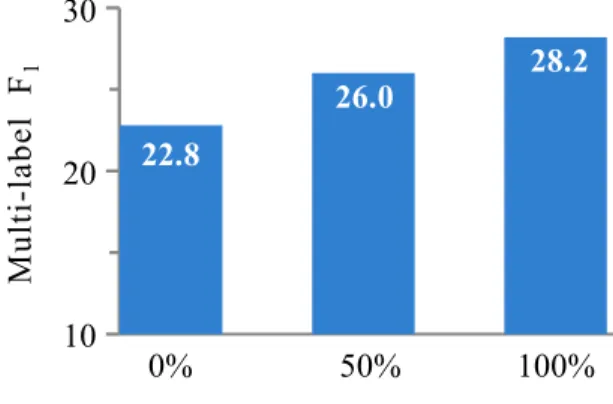
The quality of the induced content model is de-termined by the amount of training data. As Fig-ure 4 shows, the multi-aspect summarizer improves with the increase in the size of raw data available for learning content model.
6This type of feature is not applicable to our multi-aspect
sentiment ranking task, as we already use unigram features from the entire document.
10 20 30 0% 50% 100% M ul ti -l ab el F1
Percentage of unlabeled data 22.8
26.0 28.2
Figure 4: Results on the Amazon corpus using the complete annotated set with varying amounts of ad-ditional unlabeled data.7
Compensating for annotation sparsity We hy-pothesize that by incorporating rich contextual in-formation, we can reduce the need for manual task annotation. We test this by reducing the amount of annotated data available to the model and measur-ing performance at several quantities of unannotated data. As Figure 5 shows, the performance increase achieved by doubling the amount of annotated data can also be achieved by adding only 12.5% of the unlabeled data.
6 Conclusion
In this paper, we demonstrate the benefits of incor-porating content models in text analysis tasks. We also introduce a framework to allow the joint learn-ing of an unsupervised latent content model with a supervised task-specific model. On multiple tasks and datasets, our results empirically connect model quality and task performance, suggesting that
fur-7Because we append the unlabeled versions of the labeled
data to the unlabeled set, even with 0% additional unlabeled data, there is a small data set to train the content model.
10 15 25 0% 12.5% 25% M ul ti -l ab el F1
Percentage of unlabeled data 20
15.1
20.8 22.6
18.9
Figure 5: Results on the Amazon corpus using half of the annotated training documents. The content model is trained with 0%, 12.5%, and 25% of addi-tional unlabeled data.7 The dashed horizontal line represents NoCM with the complete annotated set.
ther improvements in content modeling may yield even further gains.
Acknowledgments
The authors acknowledge the support of the NSF (CAREER grant IIS-0448168) and NIH (grant 5-R01-LM009723-02). Thanks to Peter Szolovits and the MIT NLP group for their helpful comments. Any opinions, findings, conclusions, or recommen-dations expressed in this paper are those of the au-thors, and do not necessarily reflect the views of the funding organizations.
References
Regina Barzilay and Lillian Lee. 2004. Catching the drift: Probabilistic content models, with applications to generation and summarization. InProceedings of the NAACL/HLT, pages 113–120.
Christopher M. Bishop. 2006. Pattern Recognition and Machine Learning (Information Science and Statis-tics). Springer-Verlag New York, Inc.
David M. Blei and Jon D. McAullife. 2007. Supervised Topic Models. InNIPS.
S. R. K. Branavan, Harr Chen, Jacob Eisenstein, and Regina Barzilay. 2009. Learning document-level se-mantic properties from free-text annotations. JAIR, 34:569–603.
Harr Chen, S. R. K. Branavan, Regina Barzilay, and David R. Karger. 2009. Content modeling using la-tent permutations. JAIR, 36:129–163.
Yejin Choi and Claire Cardie. 2008. Learning with com-positional semantics as structural inference for sub-sentential sentiment analysis. In Proceedings of the EMNLP, pages 793–801.
J. Cohen. 1960. A Coefficient of Agreement for Nominal Scales. Educational and Psychological Measurement, 20(1):37.
John DeNero, David Chiang, and Kevin Knight. 2009. Fast consensus decoding over translation forests. In
Proceedings of the ACL/IJCNLP, pages 567–575. Micha Elsner, Joseph Austerweil, and Eugene Charniak.
2007. A unified local and global model for discourse coherence. InProceedings of the NAACL/HLT, pages 436–443.
Jenny Rose Finkel and Christopher D. Manning. 2009. Joint parsing and named entity recognition. In Pro-ceedings of the NAACL.
Dayne Freitag. 2004. Trained named entity recogni-tion using distriburecogni-tional clusters. In Proceedings of the EMNLP, pages 262–269.
Andrew B. Goldberg and Xiaojin Zhu. 2006. See-ing stars when there aren’t many stars: Graph-based semi-supervised learning for sentiment categoriza-tion. InProceedings of the NAACL/HLT Workshop on TextGraphs, pages 45–52.
Joshua Goodman. 1999. Semiring parsing. Computa-tional Linguistics, 25(4):573–605.
Aria Haghighi and Lucy Vanderwende. 2009. Exploring content models for multi-document summarization. In
Proceedings of the NAACL/HLT, pages 362–370. Soo-Min Kim and Eduard Hovy. 2006. Automatic
iden-tification of pro and con reasons in online reviews. In
Proceedings of the COLING/ACL, pages 483–490. Chin-Yew Lin. 2004. ROUGE: A package for automatic
evaluation of summaries. InProceedings of the ACL, pages 74–81.
Dong C. Liu, Jorge Nocedal, Dong C. Liu, and Jorge No-cedal. 1989. On the limited memory bfgs method for large scale optimization. Mathematical Programming, 45:503–528.
Ryan McDonald, Kerry Hannan, Tyler Neylon, Mike Wells, and Jeff Reynar. 2007. Structured models for fine-to-coarse sentiment analysis. In Proceedings of the ACL, pages 432–439.
Bo Pang and Lillian Lee. 2004. A sentimental education: Sentiment analysis using subjectivity summarization based on minimum cuts. InProceedings of the ACL, pages 271–278.
Bo Pang and Lillian Lee. 2005. Seeing stars: Exploiting class relationships for sentiment categorization with respect to rating scales. InProceedings of the ACL, pages 115–124.
Siddharth Patwardhan and Ellen Riloff. 2007. Effec-tive information extraction with semantic affinity pat-terns and relevant regions. In Proceedings of the EMNLP/CoNLL, pages 717–727.
Rion Snow, Brendan O’Connor, Daniel Jurafsky, and An-drew Y. Ng. 2008. Cheap and fast - but is it good? evaluating non-expert annotations for natural language tasks. InProceedings of the EMNLP.
Benjamin Snyder and Regina Barzilay. 2007. Multiple aspect ranking using the good grief algorithm. In Pro-ceedings of the NAACL/HLT, pages 300–307.
Swapna Somasundaran, Galileo Namata, Janyce Wiebe, and Lise Getoor. 2009. Supervised and unsupervised methods in employing discourse relations for improv-ing opinion polarity classification. InProceedings of the EMNLP, pages 170–179.
Julie Weeds, David Weir, and Diana McCarthy. 2004. Characterising measures of lexical distributional simi-larity. InProceedings of the COLING, page 1015. Theresa Wilson, Janyce Wiebe, and Rebecca Hwa. 2004.
Just how mad are you? finding strong and weak opin-ion clauses. InProceedings of the AAAI, pages 761– 769.